EP0186567B1 - Diac mit koplanaren Elektroden - Google Patents
Diac mit koplanaren Elektroden Download PDFInfo
- Publication number
- EP0186567B1 EP0186567B1 EP85402434A EP85402434A EP0186567B1 EP 0186567 B1 EP0186567 B1 EP 0186567B1 EP 85402434 A EP85402434 A EP 85402434A EP 85402434 A EP85402434 A EP 85402434A EP 0186567 B1 EP0186567 B1 EP 0186567B1
- Authority
- EP
- European Patent Office
- Prior art keywords
- region
- regions
- diac
- substrate
- type
- Prior art date
- Legal status (The legal status is an assumption and is not a legal conclusion. Google has not performed a legal analysis and makes no representation as to the accuracy of the status listed.)
- Expired
Links
Images
Classifications
-
- H—ELECTRICITY
- H10—SEMICONDUCTOR DEVICES; ELECTRIC SOLID-STATE DEVICES NOT OTHERWISE PROVIDED FOR
- H10D—INORGANIC ELECTRIC SEMICONDUCTOR DEVICES
- H10D8/00—Diodes
Definitions
- the invention relates to semiconductor components known as diacs, which are two-terminal components having threshold voltage-current characteristics such that when the voltage across the diac increases in absolute value from zero to a threshold value, the diac remains blocked and is traversed only by a leakage current, then, when the voltage exceeds the threshold, the diac abruptly conducts a large current, the voltage remaining around the threshold value. More precisely, the voltage-current characteristic of the diac presents immediately beyond the threshold a part with low negative dynamic resistance which is the cause of a very frank triggering of the conduction of the diac.
- a diac is usually produced in the form of a three-layer NPN or PNP structure, the central region of which is not connected to an electrode; this essentially corresponds to an open base transistor.
- the construction is symmetrical so that the diac works in both directions of voltage application.
- a diac is produced starting from a semiconductor substrate of a first type of conductivity, for example P; a P + overdoped region is diffused on both sides; then a strongly doped region of opposite type is diffused on the two faces.
- the resulting structure is symmetrical, N + P + PP + N + . Electrodes are deposited on the two main faces.
- a disadvantage of this structure is the fact that the thickness of the starting semiconductor substrate practically imposes the width of the central base (of type P for an NPN structure), therefore the conduction characteristics of the diac. We will often have to use fairly thin substrates, with higher risks of breakage during manufacturing.
- the present invention provides a new diac structure in which the extreme, metallized regions of the three-layer structure are formed on the same face of the substrate.
- the invention provides a semiconductor diac structure, having two electrodes and a voltage-current characteristic having a blocking zone and a conduction zone, the blocking zone extending between a zero voltage and a threshold voltage Vd , and the conduction zone having a low negative dynamic resistance immediately beyond the threshold voltage Vd, this structure comprising on one side of a semiconductor substrate of a first type of conductivity with low doping level of the first and second disjoint regions of the first conductivity type (P) at high doping level, a third region and a fourth region of the opposite type (N) at high doping level, respectively adjacent to the first and second regions, the third and fourth regions being covered of separate metallizations constituting the electrodes of the structure formed on said face of the substrate, the layer of the first type of conductivity being isolated ée of any metallization.
- the layer of the first type of conductivity has a part of low doping and more doped parts adjacent to the regions of the second type of conductivity and separated by a narrow region of low doping.
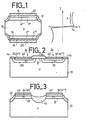
- the structure of a conventional diac is recalled in FIG. 1.
- the general shape of the voltage-current characteristic is shown in the same figure with its threshold Vd, and its portion A with low negative dynamic resistance immediately beyond the threshold.
- the diac is constituted by a base substrate 10 of type P (diac NPN) in which one has diffused on one face a region 12 more doped with type P + and on the other face a region 14 symmetrical with region 12 and same doping profile.
- Opposite N + type regions 16 and 18, highly doped are diffused from each face over part of the depth of regions 12 and 14.
- the surface of these regions 16 and 18 is metallized to form electrodes 20 and 22 respectively, each on a respective face of the substrate.
- the dimensions are represented with arbitrary scales for the different layers, in order to facilitate the representation.
- the electrical characteristics depend on the doping and the thickness of the P-type layer 10.
- FIG. 2 A first embodiment of the invention is shown in FIG. 2.
- a masking oxide layer 44 is formed on the surface of the substrate.
- two windows 24 and 26 separated by a central oxide region are opened by selective etching.
- Regions 28 and 30 of the same type of conductivity as the substrate but more doped (P + ) are diffused in these windows.
- Regions 28 and 30 remain separate, below. the central region of the oxide 44, by a zone 32 having the initial conductivity of the substrate.
- regions 36 and 38 of opposite conductivity type, heavily doped (N ++) are diffused less deeply than regions 28 and 30.
- These regions 36 and 38 are exposed on the same surface of the substrate and are metallized to form two separate contacts 40 and 42 which are the electrodes of the diac.
- the oxide 44 covers the area 32 as well as the outcrop of the junctions between the regions 28 and 36 and between the regions 30 and 38.
- the P-type doping of the regions 28 and 30 is weaker than the N-type doping of the regions 36 and 38 and it is chosen according to the threshold voltage desired for the diac.
- the crossing of the threshold is normally done by avalanche in the region of curvature of one of the N / P junctions thus produced.
- FIG 3 another embodiment is given. Instead of the different junctions between regions N and P going up towards the surface of the substrate, they arrive horizontally on the edge of a furrow 46 dug in the substrate from its surface, this furrow having a depth greater than the depth of the regions 36 and 38 of type N + and also greater than the depth of regions 28 and 30 of type P + .
- This groove is filled with passivation insulator (glass) and it is it which separates region 36 from region 38 as well as region 28 from region 30. Consequently, regions 28, 30, 36 and 38 do not do not need to be formed by localized diffusion: they can be produced by uniform diffusion over the entire surface of the substrate.
- the groove 46 is dug after this uniform diffusion and separates the regions 28 and 30 to produce a structure with three regions N + PN + as in the case of FIGS. 1 and 2 with an overdoping P + at the junctions between the type regions opposite.
- the conduction of the diac is done as a result of a surface breakdown of a P / N junction between the layer or the substrate 30 and the region 28 or 30 at the place where this junction meets the passivated furrow 46 conductive .
- the depth of regions 36 and 38 must be suitably chosen, the concentration profile 28 and 30 decreasing from the surface towards the interior of the substrate.
- the threshold voltage of the diac no longer depends on the starting substrate.
- Metallizations 40 and 42 are produced on the regions 36 and 38, for example by dipping in a chemical bath which deposits nickel on the silicon but not on the passivation glass provided in the central groove 46 and in a peripheral groove 48.
- the devices of FIGS. 2 and 3 are encapsulated for example in a molded resin case with conductive bars or aluminum wires welded between the metallized surfaces 40 and 42 and external pins according to the techniques used for example for thyristors.
- the diac according to the invention can also be integrated into a semiconductor substrate further comprising another component such as a triac for example.
Landscapes
- Thyristors (AREA)
- Electrodes Of Semiconductors (AREA)
Claims (4)
Applications Claiming Priority (2)
| Application Number | Priority Date | Filing Date | Title |
|---|---|---|---|
| FR8418926 | 1984-12-11 | ||
| FR8418926A FR2574595B1 (fr) | 1984-12-11 | 1984-12-11 | Diac a electrodes coplanaires |
Publications (2)
| Publication Number | Publication Date |
|---|---|
| EP0186567A1 EP0186567A1 (de) | 1986-07-02 |
| EP0186567B1 true EP0186567B1 (de) | 1989-06-07 |
Family
ID=9310478
Family Applications (1)
| Application Number | Title | Priority Date | Filing Date |
|---|---|---|---|
| EP85402434A Expired EP0186567B1 (de) | 1984-12-11 | 1985-12-06 | Diac mit koplanaren Elektroden |
Country Status (3)
| Country | Link |
|---|---|
| EP (1) | EP0186567B1 (de) |
| DE (1) | DE3570951D1 (de) |
| FR (1) | FR2574595B1 (de) |
Families Citing this family (5)
| Publication number | Priority date | Publication date | Assignee | Title |
|---|---|---|---|---|
| FR2574594B1 (fr) * | 1984-12-11 | 1987-01-16 | Silicium Semiconducteur Ssc | Structure integree de triac a commande par diac |
| FR2623663B1 (fr) * | 1987-11-24 | 1990-04-13 | Sgs Thomson Microelectronics | Assemblage monolithique de diodes de protection et systemes de protection |
| US4904609A (en) * | 1988-05-06 | 1990-02-27 | General Electric Company | Method of making symmetrical blocking high voltage breakdown semiconductor device |
| CN101651102B (zh) * | 2009-08-25 | 2011-03-23 | 南通明芯微电子有限公司 | 一种双向触发二极管芯片的制备方法 |
| CN119764300B (zh) * | 2024-12-19 | 2025-10-10 | 常州银河世纪微电子股份有限公司 | 一种非对称性触发开关浪涌吸收芯片及其制备方法 |
Family Cites Families (1)
| Publication number | Priority date | Publication date | Assignee | Title |
|---|---|---|---|---|
| US4216488A (en) * | 1978-07-31 | 1980-08-05 | Hutson Jearld L | Lateral semiconductor diac |
-
1984
- 1984-12-11 FR FR8418926A patent/FR2574595B1/fr not_active Expired
-
1985
- 1985-12-06 EP EP85402434A patent/EP0186567B1/de not_active Expired
- 1985-12-06 DE DE8585402434T patent/DE3570951D1/de not_active Expired
Also Published As
| Publication number | Publication date |
|---|---|
| DE3570951D1 (en) | 1989-07-13 |
| EP0186567A1 (de) | 1986-07-02 |
| FR2574595B1 (fr) | 1987-01-16 |
| FR2574595A1 (fr) | 1986-06-13 |
Similar Documents
| Publication | Publication Date | Title |
|---|---|---|
| EP0721218B1 (de) | Integrierte Leistungsschaltung | |
| EP0963608B1 (de) | Schaltungsanordnung zum schutz von teilnehmerschnittstellen | |
| FR2744835A1 (fr) | Circuit integre de puissance haute tension avec fonctionnement a decalage de niveau et sans traversee metallique | |
| FR2465316A1 (fr) | Dispositifs semi-conducteurs pourvus d'elements semi-conducteurs complementaires et procede de fabrication d'un dispositif semi-conducteur compose | |
| EP0742591A1 (de) | Bauelement für den vollständigen Schutz einer Schnittstellenschaltung von Teilnehmerleitungen | |
| JPS55162255A (en) | High voltage resistance resistor element | |
| FR2767967A1 (fr) | Composant transistor | |
| US3629782A (en) | Resistor with means for decreasing current density | |
| EP3276662B1 (de) | Struktur zum schutz eines integrierten schaltkreises gegen elektrostatische entladungen | |
| EP0264415B1 (de) | Halbleiterbauteil zum schutz vor überspannungen und hohen stromstärken | |
| EP0186567A1 (de) | Diac mit koplanaren Elektroden | |
| EP0246139B1 (de) | Eingangsschutzanordnung für integrierte Schaltungen in CMOS-Technologie | |
| EP0191255B1 (de) | Integrierte Anordnung eines durch einen Diac gesteuerten Triac | |
| FR2490405A1 (fr) | Dispositif a circuit integre semi-conducteur | |
| EP1098355A1 (de) | Leistungsdetektor-Bauteil | |
| FR3011121A1 (fr) | Assemblage de puces de circuits integres comprenant un composant de protection contre les surtensions | |
| US4063278A (en) | Semiconductor switch having sensitive gate characteristics at high temperatures | |
| EP0015835B1 (de) | Hochfrequenz-Halbleiterschaltungsvorrichtung und Verfahren zu deren Herstellung | |
| US6677207B1 (en) | Vanishingly small integrated circuit diode | |
| EP0055644A1 (de) | MOS-Transistor mit bipolarer Wirkungsweise wenn in Sättigung betrieben | |
| EP0298882B1 (de) | Schutzthyristor mit Hilfssteuerelektrode | |
| FR2764119A1 (fr) | Transistor bipolaire a grille isolee et procede pour sa fabrication | |
| FR2495378A1 (fr) | Circuit de protection, contre les tensions transitoires, comprenant un thyristor (scr), pour circuits integres | |
| US3945029A (en) | Semiconductor diode with layers of different but related resistivities | |
| EP0004238A1 (de) | Integrierte Schaltung und Verfahren zur Herstellung derselben |
Legal Events
| Date | Code | Title | Description |
|---|---|---|---|
| PUAI | Public reference made under article 153(3) epc to a published international application that has entered the european phase |
Free format text: ORIGINAL CODE: 0009012 |
|
| AK | Designated contracting states |
Kind code of ref document: A1 Designated state(s): CH DE FR GB IT LI |
|
| 17P | Request for examination filed |
Effective date: 19860807 |
|
| 17Q | First examination report despatched |
Effective date: 19880426 |
|
| GRAA | (expected) grant |
Free format text: ORIGINAL CODE: 0009210 |
|
| ITF | It: translation for a ep patent filed | ||
| RAP3 | Party data changed (applicant data changed or rights of an application transferred) |
Owner name: THOMSON-CSF |
|
| AK | Designated contracting states |
Kind code of ref document: B1 Designated state(s): CH DE FR GB IT LI |
|
| REF | Corresponds to: |
Ref document number: 3570951 Country of ref document: DE Date of ref document: 19890713 |
|
| GBT | Gb: translation of ep patent filed (gb section 77(6)(a)/1977) | ||
| PLBE | No opposition filed within time limit |
Free format text: ORIGINAL CODE: 0009261 |
|
| STAA | Information on the status of an ep patent application or granted ep patent |
Free format text: STATUS: NO OPPOSITION FILED WITHIN TIME LIMIT |
|
| 26N | No opposition filed | ||
| ITTA | It: last paid annual fee | ||
| PGFP | Annual fee paid to national office [announced via postgrant information from national office to epo] |
Ref country code: CH Payment date: 19911218 Year of fee payment: 7 |
|
| PG25 | Lapsed in a contracting state [announced via postgrant information from national office to epo] |
Ref country code: LI Effective date: 19921231 Ref country code: CH Effective date: 19921231 |
|
| REG | Reference to a national code |
Ref country code: CH Ref legal event code: PL |
|
| REG | Reference to a national code |
Ref country code: FR Ref legal event code: D6 |
|
| PGFP | Annual fee paid to national office [announced via postgrant information from national office to epo] |
Ref country code: DE Payment date: 20001129 Year of fee payment: 16 |
|
| REG | Reference to a national code |
Ref country code: GB Ref legal event code: IF02 |
|
| PG25 | Lapsed in a contracting state [announced via postgrant information from national office to epo] |
Ref country code: DE Free format text: LAPSE BECAUSE OF NON-PAYMENT OF DUE FEES Effective date: 20020702 |
|
| PGFP | Annual fee paid to national office [announced via postgrant information from national office to epo] |
Ref country code: GB Payment date: 20021204 Year of fee payment: 18 |
|
| PGFP | Annual fee paid to national office [announced via postgrant information from national office to epo] |
Ref country code: FR Payment date: 20021210 Year of fee payment: 18 |
|
| PG25 | Lapsed in a contracting state [announced via postgrant information from national office to epo] |
Ref country code: GB Free format text: LAPSE BECAUSE OF NON-PAYMENT OF DUE FEES Effective date: 20031206 |
|
| GBPC | Gb: european patent ceased through non-payment of renewal fee |
Effective date: 20031206 |
|
| PG25 | Lapsed in a contracting state [announced via postgrant information from national office to epo] |
Ref country code: FR Free format text: LAPSE BECAUSE OF NON-PAYMENT OF DUE FEES Effective date: 20040831 |
|
| REG | Reference to a national code |
Ref country code: FR Ref legal event code: ST |