EP0186836B1 - Verfahren zur Aufkonzentrierung wässriger Lösungen von organischen Verbindungen, die Salze enthalten, unter gleichzeitiger Verringerung des Salzgehaltes - Google Patents
Verfahren zur Aufkonzentrierung wässriger Lösungen von organischen Verbindungen, die Salze enthalten, unter gleichzeitiger Verringerung des Salzgehaltes Download PDFInfo
- Publication number
- EP0186836B1 EP0186836B1 EP85115968A EP85115968A EP0186836B1 EP 0186836 B1 EP0186836 B1 EP 0186836B1 EP 85115968 A EP85115968 A EP 85115968A EP 85115968 A EP85115968 A EP 85115968A EP 0186836 B1 EP0186836 B1 EP 0186836B1
- Authority
- EP
- European Patent Office
- Prior art keywords
- salt
- concentrate
- solution
- diluate
- organic compounds
- Prior art date
- Legal status (The legal status is an assumption and is not a legal conclusion. Google has not performed a legal analysis and makes no representation as to the accuracy of the status listed.)
- Expired
Links
- 150000003839 salts Chemical class 0.000 title claims description 46
- 238000000034 method Methods 0.000 title claims description 29
- 150000002894 organic compounds Chemical class 0.000 title claims description 26
- 239000000243 solution Substances 0.000 claims description 36
- 239000012141 concentrate Substances 0.000 claims description 32
- 238000000909 electrodialysis Methods 0.000 claims description 24
- FAPWRFPIFSIZLT-UHFFFAOYSA-M Sodium chloride Chemical compound [Na+].[Cl-] FAPWRFPIFSIZLT-UHFFFAOYSA-M 0.000 claims description 21
- 239000007864 aqueous solution Substances 0.000 claims description 18
- 239000011780 sodium chloride Substances 0.000 claims description 12
- 239000012266 salt solution Substances 0.000 claims description 4
- 150000004820 halides Chemical class 0.000 claims description 3
- 229920006395 saturated elastomer Polymers 0.000 claims description 3
- QAOWNCQODCNURD-UHFFFAOYSA-L Sulfate Chemical compound [O-]S([O-])(=O)=O QAOWNCQODCNURD-UHFFFAOYSA-L 0.000 claims description 2
- INHCSSUBVCNVSK-UHFFFAOYSA-L lithium sulfate Chemical compound [Li+].[Li+].[O-]S([O-])(=O)=O INHCSSUBVCNVSK-UHFFFAOYSA-L 0.000 claims 2
- QTBSBXVTEAMEQO-UHFFFAOYSA-M Acetate Chemical compound CC([O-])=O QTBSBXVTEAMEQO-UHFFFAOYSA-M 0.000 claims 1
- NLXLAEXVIDQMFP-UHFFFAOYSA-N Ammonia chloride Chemical compound [NH4+].[Cl-] NLXLAEXVIDQMFP-UHFFFAOYSA-N 0.000 claims 1
- CPELXLSAUQHCOX-UHFFFAOYSA-M Bromide Chemical compound [Br-] CPELXLSAUQHCOX-UHFFFAOYSA-M 0.000 claims 1
- BVKZGUZCCUSVTD-UHFFFAOYSA-L Carbonate Chemical compound [O-]C([O-])=O BVKZGUZCCUSVTD-UHFFFAOYSA-L 0.000 claims 1
- BDAGIHXWWSANSR-UHFFFAOYSA-M Formate Chemical compound [O-]C=O BDAGIHXWWSANSR-UHFFFAOYSA-M 0.000 claims 1
- 239000007832 Na2SO4 Substances 0.000 claims 1
- PMZURENOXWZQFD-UHFFFAOYSA-L Sodium Sulfate Chemical compound [Na+].[Na+].[O-]S([O-])(=O)=O PMZURENOXWZQFD-UHFFFAOYSA-L 0.000 claims 1
- LSNNMFCWUKXFEE-UHFFFAOYSA-N Sulfurous acid Chemical compound OS(O)=O LSNNMFCWUKXFEE-UHFFFAOYSA-N 0.000 claims 1
- UCKMPCXJQFINFW-UHFFFAOYSA-N Sulphide Chemical compound [S-2] UCKMPCXJQFINFW-UHFFFAOYSA-N 0.000 claims 1
- 229910001513 alkali metal bromide Inorganic materials 0.000 claims 1
- 229910001514 alkali metal chloride Inorganic materials 0.000 claims 1
- 229910052936 alkali metal sulfate Inorganic materials 0.000 claims 1
- 229910052939 potassium sulfate Inorganic materials 0.000 claims 1
- OTYBMLCTZGSZBG-UHFFFAOYSA-L potassium sulfate Chemical compound [K+].[K+].[O-]S([O-])(=O)=O OTYBMLCTZGSZBG-UHFFFAOYSA-L 0.000 claims 1
- 229910052938 sodium sulfate Inorganic materials 0.000 claims 1
- 235000002639 sodium chloride Nutrition 0.000 description 49
- 239000012528 membrane Substances 0.000 description 14
- VEXZGXHMUGYJMC-UHFFFAOYSA-M Chloride anion Chemical compound [Cl-] VEXZGXHMUGYJMC-UHFFFAOYSA-M 0.000 description 12
- 238000010612 desalination reaction Methods 0.000 description 10
- XLYOFNOQVPJJNP-UHFFFAOYSA-N water Substances O XLYOFNOQVPJJNP-UHFFFAOYSA-N 0.000 description 10
- 238000000108 ultra-filtration Methods 0.000 description 8
- 239000000047 product Substances 0.000 description 7
- 239000000126 substance Substances 0.000 description 6
- 230000000694 effects Effects 0.000 description 5
- 150000001875 compounds Chemical class 0.000 description 4
- QTBSBXVTEAMEQO-UHFFFAOYSA-N Acetic acid Chemical compound CC(O)=O QTBSBXVTEAMEQO-UHFFFAOYSA-N 0.000 description 3
- 239000002253 acid Substances 0.000 description 3
- 229910052784 alkaline earth metal Inorganic materials 0.000 description 3
- PYMYPHUHKUWMLA-WDCZJNDASA-N arabinose Chemical compound OC[C@@H](O)[C@@H](O)[C@H](O)C=O PYMYPHUHKUWMLA-WDCZJNDASA-N 0.000 description 3
- PYMYPHUHKUWMLA-UHFFFAOYSA-N arabinose Natural products OCC(O)C(O)C(O)C=O PYMYPHUHKUWMLA-UHFFFAOYSA-N 0.000 description 3
- SRBFZHDQGSBBOR-UHFFFAOYSA-N beta-D-Pyranose-Lyxose Natural products OC1COC(O)C(O)C1O SRBFZHDQGSBBOR-UHFFFAOYSA-N 0.000 description 3
- 238000005341 cation exchange Methods 0.000 description 3
- 125000000623 heterocyclic group Chemical group 0.000 description 3
- 238000001223 reverse osmosis Methods 0.000 description 3
- 238000000926 separation method Methods 0.000 description 3
- 150000003467 sulfuric acid derivatives Chemical class 0.000 description 3
- QGZKDVFQNNGYKY-UHFFFAOYSA-O Ammonium Chemical compound [NH4+] QGZKDVFQNNGYKY-UHFFFAOYSA-O 0.000 description 2
- IJGRMHOSHXDMSA-UHFFFAOYSA-N Atomic nitrogen Chemical compound N#N IJGRMHOSHXDMSA-UHFFFAOYSA-N 0.000 description 2
- VEXZGXHMUGYJMC-UHFFFAOYSA-N Hydrochloric acid Chemical compound Cl VEXZGXHMUGYJMC-UHFFFAOYSA-N 0.000 description 2
- XEEYBQQBJWHFJM-UHFFFAOYSA-N Iron Chemical compound [Fe] XEEYBQQBJWHFJM-UHFFFAOYSA-N 0.000 description 2
- NBIIXXVUZAFLBC-UHFFFAOYSA-N Phosphoric acid Chemical compound OP(O)(O)=O NBIIXXVUZAFLBC-UHFFFAOYSA-N 0.000 description 2
- WCUXLLCKKVVCTQ-UHFFFAOYSA-M Potassium chloride Chemical compound [Cl-].[K+] WCUXLLCKKVVCTQ-UHFFFAOYSA-M 0.000 description 2
- QAOWNCQODCNURD-UHFFFAOYSA-N Sulfuric acid Chemical compound OS(O)(=O)=O QAOWNCQODCNURD-UHFFFAOYSA-N 0.000 description 2
- 150000001242 acetic acid derivatives Chemical class 0.000 description 2
- 150000007513 acids Chemical class 0.000 description 2
- 229910052783 alkali metal Inorganic materials 0.000 description 2
- 150000001340 alkali metals Chemical class 0.000 description 2
- 150000001342 alkaline earth metals Chemical class 0.000 description 2
- 229940124277 aminobutyric acid Drugs 0.000 description 2
- 150000004649 carbonic acid derivatives Chemical class 0.000 description 2
- 238000005370 electroosmosis Methods 0.000 description 2
- 150000004675 formic acid derivatives Chemical class 0.000 description 2
- -1 metal complex compounds Chemical class 0.000 description 2
- BDAGIHXWWSANSR-UHFFFAOYSA-N methanoic acid Natural products OC=O BDAGIHXWWSANSR-UHFFFAOYSA-N 0.000 description 2
- 239000002245 particle Substances 0.000 description 2
- 235000011007 phosphoric acid Nutrition 0.000 description 2
- BASFCYQUMIYNBI-UHFFFAOYSA-N platinum Chemical compound [Pt] BASFCYQUMIYNBI-UHFFFAOYSA-N 0.000 description 2
- 229920000642 polymer Polymers 0.000 description 2
- FSYKKLYZXJSNPZ-UHFFFAOYSA-N sarcosine Chemical compound C[NH2+]CC([O-])=O FSYKKLYZXJSNPZ-UHFFFAOYSA-N 0.000 description 2
- 239000002904 solvent Substances 0.000 description 2
- LSNNMFCWUKXFEE-UHFFFAOYSA-L sulfite Chemical class [O-]S([O-])=O LSNNMFCWUKXFEE-UHFFFAOYSA-L 0.000 description 2
- 150000003568 thioethers Chemical class 0.000 description 2
- OSWFIVFLDKOXQC-UHFFFAOYSA-N 4-(3-methoxyphenyl)aniline Chemical compound COC1=CC=CC(C=2C=CC(N)=CC=2)=C1 OSWFIVFLDKOXQC-UHFFFAOYSA-N 0.000 description 1
- KXDHJXZQYSOELW-UHFFFAOYSA-N Carbamic acid Chemical class NC(O)=O KXDHJXZQYSOELW-UHFFFAOYSA-N 0.000 description 1
- 241000819038 Chichester Species 0.000 description 1
- RYGMFSIKBFXOCR-UHFFFAOYSA-N Copper Chemical compound [Cu] RYGMFSIKBFXOCR-UHFFFAOYSA-N 0.000 description 1
- 229920000557 Nafion® Polymers 0.000 description 1
- GRYLNZFGIOXLOG-UHFFFAOYSA-N Nitric acid Chemical compound O[N+]([O-])=O GRYLNZFGIOXLOG-UHFFFAOYSA-N 0.000 description 1
- 229910019142 PO4 Inorganic materials 0.000 description 1
- 239000004698 Polyethylene Substances 0.000 description 1
- 108010077895 Sarcosine Proteins 0.000 description 1
- BQCADISMDOOEFD-UHFFFAOYSA-N Silver Chemical compound [Ag] BQCADISMDOOEFD-UHFFFAOYSA-N 0.000 description 1
- ATJFFYVFTNAWJD-UHFFFAOYSA-N Tin Chemical compound [Sn] ATJFFYVFTNAWJD-UHFFFAOYSA-N 0.000 description 1
- 239000005862 Whey Substances 0.000 description 1
- 102000007544 Whey Proteins Human genes 0.000 description 1
- 108010046377 Whey Proteins Proteins 0.000 description 1
- HCHKCACWOHOZIP-UHFFFAOYSA-N Zinc Chemical compound [Zn] HCHKCACWOHOZIP-UHFFFAOYSA-N 0.000 description 1
- 239000003513 alkali Substances 0.000 description 1
- 229910000147 aluminium phosphate Inorganic materials 0.000 description 1
- 150000001412 amines Chemical class 0.000 description 1
- 150000003868 ammonium compounds Chemical class 0.000 description 1
- 238000004458 analytical method Methods 0.000 description 1
- 239000003011 anion exchange membrane Substances 0.000 description 1
- 125000000751 azo group Chemical group [*]N=N[*] 0.000 description 1
- 150000003842 bromide salts Chemical class 0.000 description 1
- 150000001720 carbohydrates Chemical class 0.000 description 1
- 235000014633 carbohydrates Nutrition 0.000 description 1
- BVKZGUZCCUSVTD-UHFFFAOYSA-N carbonic acid Chemical compound OC(O)=O BVKZGUZCCUSVTD-UHFFFAOYSA-N 0.000 description 1
- 150000001735 carboxylic acids Chemical class 0.000 description 1
- 150000001805 chlorine compounds Chemical class 0.000 description 1
- 239000011248 coating agent Substances 0.000 description 1
- 238000000576 coating method Methods 0.000 description 1
- 230000000052 comparative effect Effects 0.000 description 1
- 229910052802 copper Inorganic materials 0.000 description 1
- 239000010949 copper Substances 0.000 description 1
- 230000006378 damage Effects 0.000 description 1
- 230000003247 decreasing effect Effects 0.000 description 1
- 238000010586 diagram Methods 0.000 description 1
- 238000009792 diffusion process Methods 0.000 description 1
- 238000010790 dilution Methods 0.000 description 1
- 239000012895 dilution Substances 0.000 description 1
- 230000005611 electricity Effects 0.000 description 1
- 239000003792 electrolyte Substances 0.000 description 1
- 150000002170 ethers Chemical class 0.000 description 1
- 238000001704 evaporation Methods 0.000 description 1
- 230000008020 evaporation Effects 0.000 description 1
- 238000000605 extraction Methods 0.000 description 1
- 238000011010 flushing procedure Methods 0.000 description 1
- 235000019253 formic acid Nutrition 0.000 description 1
- 235000015203 fruit juice Nutrition 0.000 description 1
- BTCSSZJGUNDROE-UHFFFAOYSA-N gamma-aminobutyric acid Chemical compound NCCCC(O)=O BTCSSZJGUNDROE-UHFFFAOYSA-N 0.000 description 1
- 229910001385 heavy metal Inorganic materials 0.000 description 1
- 239000012535 impurity Substances 0.000 description 1
- 239000003014 ion exchange membrane Substances 0.000 description 1
- 150000008040 ionic compounds Chemical class 0.000 description 1
- 229910052742 iron Inorganic materials 0.000 description 1
- 238000002955 isolation Methods 0.000 description 1
- 229920002521 macromolecule Polymers 0.000 description 1
- 238000004519 manufacturing process Methods 0.000 description 1
- 239000000463 material Substances 0.000 description 1
- 238000005259 measurement Methods 0.000 description 1
- 239000000203 mixture Substances 0.000 description 1
- 230000007935 neutral effect Effects 0.000 description 1
- 150000002823 nitrates Chemical class 0.000 description 1
- 229910017604 nitric acid Inorganic materials 0.000 description 1
- 150000002825 nitriles Chemical class 0.000 description 1
- 229910052757 nitrogen Inorganic materials 0.000 description 1
- 150000007524 organic acids Chemical class 0.000 description 1
- 235000005985 organic acids Nutrition 0.000 description 1
- 239000012466 permeate Substances 0.000 description 1
- 235000021317 phosphate Nutrition 0.000 description 1
- 150000004714 phosphonium salts Chemical class 0.000 description 1
- 150000003013 phosphoric acid derivatives Chemical class 0.000 description 1
- 150000003016 phosphoric acids Chemical class 0.000 description 1
- 229910052697 platinum Inorganic materials 0.000 description 1
- 230000010287 polarization Effects 0.000 description 1
- 229920000573 polyethylene Polymers 0.000 description 1
- 239000001103 potassium chloride Substances 0.000 description 1
- 235000011164 potassium chloride Nutrition 0.000 description 1
- 239000002244 precipitate Substances 0.000 description 1
- 230000002028 premature Effects 0.000 description 1
- 238000005185 salting out Methods 0.000 description 1
- 229940043230 sarcosine Drugs 0.000 description 1
- 229910052709 silver Inorganic materials 0.000 description 1
- 239000004332 silver Substances 0.000 description 1
- 239000007787 solid Substances 0.000 description 1
- IIACRCGMVDHOTQ-UHFFFAOYSA-N sulfamic acid Chemical class NS(O)(=O)=O IIACRCGMVDHOTQ-UHFFFAOYSA-N 0.000 description 1
- 150000003460 sulfonic acids Chemical class 0.000 description 1
- 239000011135 tin Substances 0.000 description 1
- 229910052718 tin Inorganic materials 0.000 description 1
- 229910052725 zinc Inorganic materials 0.000 description 1
- 239000011701 zinc Substances 0.000 description 1
Images

Classifications
-
- B—PERFORMING OPERATIONS; TRANSPORTING
- B01—PHYSICAL OR CHEMICAL PROCESSES OR APPARATUS IN GENERAL
- B01D—SEPARATION
- B01D61/00—Processes of separation using semi-permeable membranes, e.g. dialysis, osmosis or ultrafiltration; Apparatus, accessories or auxiliary operations specially adapted therefor
- B01D61/42—Electrodialysis; Electro-osmosis ; Electro-ultrafiltration; Membrane capacitive deionization
- B01D61/44—Ion-selective electrodialysis
-
- C—CHEMISTRY; METALLURGY
- C07—ORGANIC CHEMISTRY
- C07H—SUGARS; DERIVATIVES THEREOF; NUCLEOSIDES; NUCLEOTIDES; NUCLEIC ACIDS
- C07H1/00—Processes for the preparation of sugar derivatives
- C07H1/06—Separation; Purification
-
- C—CHEMISTRY; METALLURGY
- C07—ORGANIC CHEMISTRY
- C07H—SUGARS; DERIVATIVES THEREOF; NUCLEOSIDES; NUCLEOTIDES; NUCLEIC ACIDS
- C07H3/00—Compounds containing only hydrogen atoms and saccharide radicals having only carbon, hydrogen, and oxygen atoms
- C07H3/02—Monosaccharides
-
- C—CHEMISTRY; METALLURGY
- C09—DYES; PAINTS; POLISHES; NATURAL RESINS; ADHESIVES; COMPOSITIONS NOT OTHERWISE PROVIDED FOR; APPLICATIONS OF MATERIALS NOT OTHERWISE PROVIDED FOR
- C09B—ORGANIC DYES OR CLOSELY-RELATED COMPOUNDS FOR PRODUCING DYES, e.g. PIGMENTS; MORDANTS; LAKES
- C09B67/00—Influencing the physical, e.g. the dyeing or printing properties of dyestuffs without chemical reactions, e.g. by treating with solvents grinding or grinding assistants, coating of pigments or dyes; Process features in the making of dyestuff preparations; Dyestuff preparations of a special physical nature, e.g. tablets, films
- C09B67/0096—Purification; Precipitation; Filtration
-
- B—PERFORMING OPERATIONS; TRANSPORTING
- B01—PHYSICAL OR CHEMICAL PROCESSES OR APPARATUS IN GENERAL
- B01D—SEPARATION
- B01D2311/00—Details relating to membrane separation process operations and control
- B01D2311/10—Temperature control
-
- Y—GENERAL TAGGING OF NEW TECHNOLOGICAL DEVELOPMENTS; GENERAL TAGGING OF CROSS-SECTIONAL TECHNOLOGIES SPANNING OVER SEVERAL SECTIONS OF THE IPC; TECHNICAL SUBJECTS COVERED BY FORMER USPC CROSS-REFERENCE ART COLLECTIONS [XRACs] AND DIGESTS
- Y02—TECHNOLOGIES OR APPLICATIONS FOR MITIGATION OR ADAPTATION AGAINST CLIMATE CHANGE
- Y02A—TECHNOLOGIES FOR ADAPTATION TO CLIMATE CHANGE
- Y02A20/00—Water conservation; Efficient water supply; Efficient water use
- Y02A20/124—Water desalination
Definitions
- This invention relates to a process for concentrating aqueous solutions of organic compounds which contain salts, while at the same time reducing the salt content of these solutions by electrodialysis.
- Reverse osmosis enables solutions of organic compounds to be concentrated by removing solvents, especially water. In general, however, it cannot separate salts from other substances, so that disturbing ionic impurities collect when the valuable product is concentrated.
- Electrodialysis has also been used to separate salts from aqueous solutions, e.g. for the desalination of brackish water and for the production of table salt. In both cases, the goal is the same: separation of salt (NaCI) with the least possible transport of water. All modern ion exchange membranes are therefore optimized for good performance in this direction. In order to increase the current efficiency and desalination rate in electrodial analysis, larger concentration differences are avoided between the diluate and the concentrate, since the salt content in the diluate cannot be reduced below a limit value of approximately 0.1% by high diffusion levels in the concentrate. At high salt concentrations in the concentrate (> 1 molar) the permselectivity of the membranes also breaks down, in dilute solutions it is 85 to 95%.
- Electrodialysis is e.g. in H. Strathmann “Separation of Molecular Mixtures Using Synthetic Membranes”, Steinkopf, Darmstadt, 1979, pp. 76 to 86 and in D.S. Flett “lon Exchange Membranes”, Ellis Horwood, Chichester 1983, pp. 179 to 191.
- aqueous solutions of organic compounds which contain salts can be concentrated with a simultaneous reduction in the salt content if the saline aqueous solution of the organic compound is electrodialysed and an at least 1 molar aqueous salt solution is used as the concentrate.
- Starting solutions for the new process are aqueous solutions of colorless or colored organic compounds contaminated by salts or the free acids on which these salts are based. They can contain water-soluble compounds of various types as organic compounds. These are e.g. ionic compounds such as organic acids e.g. Carboxylic acids, sulfonic acids, phosphoric acids, metal complex compounds, heterocycles, ammonium compounds, such as quaternary compounds, phosphonium salts, betaines, such as aminocarboxylic acids, aminosulfonic acids or heterocyclic betaines, or electroneutral organic compounds, such as carbohydrates, ethers, nitriles, amines, azo compounds, heterocycles or polymer-soluble oligomers or water-soluble.
- organic acids e.g. Carboxylic acids, sulfonic acids, phosphoric acids, metal complex compounds, heterocycles, ammonium compounds, such as quaternary compounds, phosphonium salts, betaines, such as aminocarbox
- the lower molecular weight limit up to which the organic compounds can be separated from the salts depends on whether the compounds are electroneutral or ionic in character. It is around 60 for neutral substances and around 120 for ionogenic substances. Separation effects can also be achieved under these values, but greater losses of the organic compound must then be expected.
- a preferred molecular weight of ionogenic monomeric organic compounds is from 200 to 2000. For example, also use water-soluble oligomers or polymers with molecular weights of 2000 to 2 million.
- the aqueous solutions of the organic compounds contain as salts e.g. the halides, nitrates, sulfates, carbonates, sulfides, sulfites, formates, acetates, phosphates of the alkali metals, the alkaline earth metals, ammonium or water-soluble salts of heavy metals, such as copper, zinc, silver, tin and iron.
- the process of the invention also reduces any content of the free acids on which these salts are based, such as hydrochloric acid, sulfuric acid, carbonic acid, acetic acid, formic acid, nitric acid or phosphoric acid.
- Aqueous solutions can be used for the new process, e.g. contain up to 50% by weight of the organic compound and have a salt content of up to 30% by weight.
- An at least 1 molar aqueous salt solution is used as the concentrate for the new process.
- Suitable salts are, for example, water-soluble halides, sulfides, sulfites, sulfates, carbonates, formates or acetates, preferably those of ammonium or the alkali or alkaline earth metals.
- Particularly suitable are, for example, NaCI, KCI, LiCI, NH 4 CI, Na 2 S0 4 , Li 2 S0 4 and K 2 S0 4 , of which the sulfates are preferred.
- at least 3 molar aqueous solutions of the chlorides or bromides of the alkali metals or a solution of the salts mentioned saturated at room temperature are used.
- Electrodialysis is carried out in a manner known per se in electrodialysis apparatuses, such as those used for the desalination of brackish water, fruit juices and whey, at temperatures up to 100 ° C., preferably at 15 to 80 ° C.
- the current density is between 10 and 0.01 A / dm 2 , preferably between 5 and 0.05 A / dm 2 .
- the cell voltage is 0.5 to 2 V per sub-cell, a sub-cell consisting of a diluate chamber and a concentrate chamber.
- the new process a considerable concentration of saline solutions of organic compounds is achieved with a simultaneous reduction in the salinity without a major loss in electricity yield.
- This advantageous result was not to be expected because, given the high salt concentrations in the concentrate, one had to expect that no or very little desalination of the diluate could be achieved.
- the high salt concentrations in the concentrate do not have the expected negative impact on the desalination effect.
- the salt concentrations in the concentrate can be more than twice as high as would be necessary for optimal permselectivity. They can even be more than a hundred times higher than the salt concentrations that are achieved in the diluate according to the process.
- the electrodialysis according to the invention is e.g. superior to ultrafiltration even when desalination and concentration of solutions of higher molecular weight compounds. This is particularly important when a product with a high salt content is to be brought to a very low salt content. For example, a 30% aqueous solution of polymer A with a salt content (NaCl) of 15% can be brought to a content of 60% A and 7.5% NaCl in one pass by ultrafiltration. 50% of the starting solution goes into the permeate (ideally) as a 15% NaCl solution. Subsequent dilution with water to the old volume and renewed ultrafiltration reduce the salt content by half again and thus to 3.75%.
- the process In total, the process must be carried out 5 times in order to achieve a residual acid content of ⁇ 0.5% (degree of desalination>, 95%).
- the same effect can be achieved in one pass with the electrodialysis according to the invention.
- the method according to the invention thus also represents a cost-effective alternative to ultrafiltration when salts are also to be separated off.
- part of the direct current energy can also be used to facilitate the isolation of the product of value, without using high current yields, while in most cases it is sufficient to concentrate the solution by a factor of 1.2 to 2 and the salt content of the Lowering solution may be of interest, e.g. if the product of value is to be isolated as a dry substance, the solution is to be concentrated still further, for example by a factor of> 3.
- the salt content of the solution often does not decrease further, but the salt content based on the product of value is reduced even further.
- a particular advantage of this embodiment of the invention is that it saves evaporation capacity. This increases the flexibility of the process and reduces the thermal load on sensitive products. In particular when operating smaller batches, the procedure according to the invention also leads to a reduction in energy costs.
- This particular embodiment of the method uses the surprising effect of the method according to the invention, which consists in the fact that water is removed that goes beyond normal electroosmosis.
- the method according to the invention also extends the applicability of conventional electrodialysis methods, in which it is often technically difficult to process starting solutions which contain precipitates due to a high salt content (salting-out effect) or are more viscous.
- the starting solution can now first be diluted and, after the electrodialysis according to the invention, enriched to the desired starting concentration. In this way, blockages in the cell, coating of the membranes are avoided and sufficient flow of water ensures a high rate of desalination in the cell.
- undesirable polarization phenomena (these dreaded pH shifts in diluate and concentrate lead to premature destruction of the membranes) are suppressed by the procedure according to the invention.
- the electrodialysis cell is connected via polyethylene tubes to three separate circuits which supply the cell with the concentrate (1), the diluate (2) and the electrolyte (3) from storage containers.
- the cell has two platinum electrodes (4), each 0.35 dm 2 .
- the electrode spaces (5) are from the adjacent concentrate rooms (6) are separated by cation exchange membranes (7), which are commercially available under the name ° Nafion.
- the spaces are alternately separated from one another by cation exchange membranes (9), which are commercially available under the name O Selemion CMV or anion exchange membranes (10), which are available commercially under the name ®Selemion AMV.
- the membranes have an active area of 0.37 dm 2 and are attached by PVC frames so that they are 2 mm apart.
- the inlet and outlet arrangements via which the circuits are connected are also attached to the frame.
- Each of the three circuits is equipped with a magnetic centrifugal pump and a heat exchanger.
- the apparatus is equipped with direct current supply, temperature, pH and conductivity measurement as well as with nitrogen flushing.
- the dye solution had a chloride content of 0.58%.
- Electrodialysis was carried out at 30 ° C and 25 V clamping voltage. The solutions were pumped around. The initial strength of approx. 1.2 A gradually decreased as the desalination progressed, which was checked analytically (Cl ⁇ determination). Electrodialysis was stopped after 18 hours of operation. A concentrated aqueous solution of the dye was obtained as the diluate, which had a chloride content of 0.11%. The following result was achieved:
- Electrodialysis was carried out as described in Example 1, but using 1000 g of a 0.5% aqueous NaCl solution as a concentrate and 1500 g of a 10% aqueous solution of the dye with a chloride content of 0.31% as the diluate. A largely salt-free dye solution was obtained as a diluate, but in which there was virtually no concentration of the solution. Result achieved:
- Electrodialysis was started at a cell voltage of 25 V and a current of 1.6 A initially. After an operating time of 27 h, the current intensity was 0.52 A. The electrodialysis was stopped. The amount of diluate had dropped to 456.9 g. The chloride content of the diluate was 0.24%. The solids content had risen to approximately 30%. Result:
- Electrodialysis was carried out for 30 h at a cell voltage of ⁇ 30 V and a current of ⁇ 2 A, the concentrate being changed every 3 h. In the end the amount of diluate had dropped to 1100 g. The diluate had a sarcosine content of 4.20 mol / kg and a chloride content of 0.02%. Result:
- Electrodialysis was carried out for 18 h at a cell voltage of ⁇ 20 V and a current of ⁇ 2 A, the concentrate being changed every 3 h. In the end, the amount of diluate had dropped to 1233 g. The diluate had a content of any-aminobutyric acid of 3.62 mol / kg and a chloride content of 0.02%. Result:
- Electrodialysis was carried out for 15 hours at a cell voltage of ⁇ 34 V and a current of ⁇ 2 A, the concentrate being changed every 3 hours. In the end, the amount of diluate had dropped to 996 g. The diluate had an arabinose content of 10.49% and a chloride content of 0.01%.
- Electrodialysis was carried out as described in Example 7, but using 2000 g of a 5.94% strength aqueous arabinose solution with a chloride content (NaCl) of 7.02% as the diluate and a 0.5% strength aqueous NaCl solution as the concentrate.
- the concentrate was changed here every 3 hours (in technical systems, the concentrate is usually discharged continuously via an overflow and filled with water so that the salt concentration in the concentrate and diluate does not diverge too much).
- the final concentration of chloride in the concentrate was 0.38%.
- the amount of diluate had dropped to 1344 g.
- the diluate had an arabinose content of 8.17% and a chloride content of 0.14%.
- Example 7 shows that, with the same test duration, an almost the same material yield and a slightly poorer current yield are obtained, while according to Example 7 a concentration factor increased by 35% is achieved.
- Example 2 An apparatus similar to that described in Example 1 was used, which had 20 concentrate rooms instead of 6 concentrate rooms and 19 diluate rooms instead of 5 diluate rooms.
- the active membrane and electrode area was 2 dm 2 .
- the cation exchange membranes used were those commercially known as @ Neosepta, CH-45 T membranes and the anion exchange membranes @ Neosepta, ACH-45 T membranes.
- the three circuits were loaded with the following solutions:
- Example 2 The three circuits of the apparatus used in Example 1 were charged with the following solutions: At 20 ° C, a cell voltage of 25 V and an initial current of 1.13 A, the amount of diluate was reduced to 704 g in 27.5 5 h and the NaCl was largely depleted. Result:
Landscapes
- Chemical & Material Sciences (AREA)
- Organic Chemistry (AREA)
- Engineering & Computer Science (AREA)
- Health & Medical Sciences (AREA)
- Water Supply & Treatment (AREA)
- Chemical Kinetics & Catalysis (AREA)
- Life Sciences & Earth Sciences (AREA)
- Biochemistry (AREA)
- Biotechnology (AREA)
- General Health & Medical Sciences (AREA)
- Genetics & Genomics (AREA)
- Molecular Biology (AREA)
- Urology & Nephrology (AREA)
- Separation Using Semi-Permeable Membranes (AREA)
- Water Treatment By Electricity Or Magnetism (AREA)
Description
- Diese Erfindung betrifft ein Verfahren zur Aufkonzentrierung wässriger Lösungen von organischen Verbindungen, die Salze enthalten, unter gleichzeitiger Verringerung des Salzgehaltes dieser Lösungen durch Elektrodialyse.
- Die Gewinnung salzarmer wässriger Lösungen organischer Verbindungen ist von erheblicher technischer Bedeutung. Zur Verringerung des Salzgehaltes von wässrigen Lösungen organischer Verbindungen werden häufig Membranverfahren, wie die Ultrafiltration oder Reverse Osmose eingesetzt. Die Ultrafiltration gestattet die gleichzeitige Entfernung von Lösungsmitteln und niedermolekularen Salzen von organischen Verbindungen, ist aber auf hochmolekulare Produkte beschränkt. Ihre optimalen Trenneigenschaften entfaltet sie im Bereich der Makromoleküle (Partikelgrösse grösser als 10-2 µm) während organische Verbindungen mit einem Molekulargewicht im Bereich von 103 oder darunter (Partikelgrösse kleiner als 10-3 µm) durch Ultrafiltration nicht von Salzen getrennt werden können.
- Die Reverse Osmose ermöglicht die Aufkonzentrierung von Lösungen organischer Verbindungen durch Abtrennung von Lösungsmitteln, insbesondere von Wasser. Sie kann aber im allgemeinen Salze nicht von anderen Stoffen abtrennen, so dass sich bei der Aufkonzentrierung des Wertproduktes störende ionogene Verunreinigungen ansammeln.
- Es hat nicht an Versuchen gefehlt, Verfahren im Grenzbereich zwischen Ultrafiltration und Reverse Osmose zu entwickeln, um organische Verbindungen von Salzen abzutrennen. Bei diesem Verfahren wird zwar eine gewisse Aufkonzentration erzielt, sie sind im allgemeinen jedoch auf Moleküle vom Molekulargewicht > 1000, meist > 5000 beschränkt. Erschwerend kommt hinzu, dass es eine scharfe Trenngrenze nicht gibt. So lassen sich selbst bei den besten Membranen nur Stoffe voneinandertrennen, die sich im Molekulargewicht um den Faktor 2 oder höher voneinander unterscheiden.
- Für die Abtrennung von Salzen aus wässrigen Lösungen hat man auch schon die Elektrodialyse herangezogen, z.B. für die Entsalzung von Brackwasser und zur Herstellung von Speisesalz. In beiden Fällen ist das Ziel das gleiche: Abtrennung von Salz (NaCI) mit möglichst geringem Transport von Wasser. Auf gute Leistungen in dieser Richtung sind deshalb auch alle modernen lonenaustauschermembranen optimiert. Zur Steigerung der Stromausbeute und Entsalzungsrate bei der Elektrodialalyse werden zwischen Diluat und Konzentrat grössere Konzentrationsunterschiede vermieden, da der Salzgehalt im Diluat bei hohen Salzgehalten im Konzentrat durch Rückdiffusion nicht unter einen Grenzwert von etwa 0,1 % abgesenkt werden kann. Bei hohen Salzkonzentrationen im Konzentrat ( > 1 molar) bricht ausserdem die Permselektivität der Membranen zusammen, sie liegt in verdünnten Lösungen bei 85 bis 95%.
- Die Elektrodialylse wird z.B. in H. Strathmann «Trennung von molekularen Mischungen mit Hilfe synthetischer Membranen», Steinkopf, Darmstadt, 1979, S. 76 bis 86 und in D.S. Flett «lon Exchange Membranes», Ellis Horwood, Chichester 1983, S. 179 bis 191 beschrieben.
- Es wurde nun gefunden, dass man wässrige Lösungen von organischen Verbindungen, die Salze enthalten, unter gleichzeitiger Verringerung des Salzgehaltes aufkonzentrieren kann, wenn man die salzhaltige wässrige Lösung der organischen Verbindung elektrodialysiert und dabei als Konzentrat eine mindestens 1 molare wässrige Salzlösung verwendet.
- Ausgangslösungen für das neue Verfahren sind durch Salze oder den freien Säuren, die diesen Salzen zugrundeliegen, verunreinigte wässrige Lösungen von farblosen oder farbigen organischen Verbindungen. Sie können als organische Verbindungen wasserlösliche Verbindungen der verschiedensten Art enthalten. Das sind z.B. ionische Verbindungen, wie organische Säuren z.B. Carbonsäuren, Sulfonsäuren, Phosphorsäuren, Metallkomplexverbindungen, Heterocyclen, Ammoniumverbindungen, wie quaternäre Verbindungen, Phosphoniumsalze, Betaine, wie Aminocarbonsäuren, Aminosulfonsäuren oder heterocyclische Betaine oder elektroneutrale organische Verbindungen, wie Kohlenhydrate, Ether, Nitrile, Amine, Azoverbindungen, Heterocyclen oder wasserlösliche Oligomere oder Polymere.
- Die untere Molekulargewichtsgrenze, bis zu der sich die organischen Verbindungen von den Salzen abtrennen lassen, hängt davon ab, ob die Verbindungen elektroneutralen oder ionischen Charakter haben. Bei Neutralstoffen liegt sie etwa bei 60, bei ionogenen Stoffen etwa bei 120. Unter diesen Werten kann man zwar ebenfalls Trennwirkungen erzielen, jedoch muss dann mit grösseren Verlusten an der organischen Verbindung gerechnet werden. Nach oben hin ist das Molekulargewicht der organischen Verbindung nicht begrenzt, wenn nur eine gewisse Wasserlöslichkeit gegeben ist. Bevorzugt ist bei ionogenen monomeren organischen Verbindungen ein Molekulargewichtsbereich von 200 bis 2000. Es lassen sich z.B. auch wasserlösliche Oligomere oder Polymere mit Molekulargewichten von 2000 bis 2 Millionen einsetzen.
- Die wässrigen Lösungen der organischen Verbindungen enthalten als Salze z.B. die Halogenide, Nitrate, Sulfate, Carbonate, Sulfide, Sulfite, Formiate, Acetate, Phosphate der Alkalimetalle, der Erdalkalimetalle, des Ammoniums oder in Wasser löslichen Salze von Schwermetallen, wie Kupfer, Zink, Silber, Zinn und Eisen. Nach dem Verfahren der Erfindung wird auch ein etwaiger Gehalt an den freien Säuren, die diesen Salzen zugrundeliegen, wie Salzsäure, Schwefelsäure, Kohlensäure, Essigsäure, Ameisensäure, Salpetersäure oder Phosphorsäure verringert.
- Für das neue Verfahren lassen sich wässrige Lösungen einsetzen, die z.B. bis zu 50 Gew.-% an der organischen Verbindung enthalten und einen Salzgehalt bis zu 30 Gew.-% aufweisen.
- Als Konzentrat wird für das neue Verfahren eine mindestens 1 molare wässrige Salzlösung verwendet. Als Salze kommen z.B. wasserlösliche Halogenide, Sulfide, Sulfite, Sulfate, Carbonate, Formiate oder Acetate in Betracht, vorzugsweise solche des Ammoniums oder der Alkali- oder Erdalkalimetalle. Besonders geeignet sind z.B. NaCI, KCI, LiCI, NH4CI, Na2S04, Li2S04 und K2S04, von denen die Sulfate bevorzugt sind. Insbesondere verwendet man mindestens 3molare wässrige Lösungen der Chloride oder Bromide der Alkalimetalle oder eine bei Raumtemperatur gesättigte Lösung der genannten Salze.
- Man elektrodialysiert auf an sich bekannte Weise in Elektrodialyse-Apparaten, wie man sie z.B. für die Entsalzung von Brackwasser, Fruchtsäften und Molke verwendet, bei Temperaturen bis 100°C, vorzugsweise bei 15 bis 80°C. Die Stromdichte beträgt zwischen 10 und 0,01 A/dm2, vorzugsweise zwischen 5 bis 0,05 A/dm2. Die Zellenspannung beträgt pro Teilzelle 0,5 bis 2 V, wobei eine Teilzelle aus einer Diluatkammer und einer Konzentratkammer besteht.
- Nach dem neuen Verfahren wird eine erhebliche Aufkonzentrierung salzhaltiger Lösungen von organischen Verbindungen bei gleichzeitiger Verringerung des Salzgehaltes ohne grössere Einbussen an Stromausbeute erzielt. Dieses vorteilhafte Ergebnis war nicht zu erwarten, weil man bei den hohen Salzkonzentrationen im Konzentrat damit rechnen musste, dass keine oder eine nur sehr geringe Entsalzung der Diluate erzielt werden kann. Überraschenderweise haben aber die hohen Salzkonzentrationen im Konzentrat auf den Entsalzungseffekt nicht den erwarteten negativen Einfluss. So können die Salzkonzentrationen im Konzentrat um mehr als doppelt so hoch sein, als es für eine optimale Permselektivität notwendig wäre. Sie können sogar um mehr als das Hundertfache höher sein als die Salzkonzentrationen, die verfahrensgemäss im Diluat erreicht werden. Gleichermassen überraschend ist, dass selbst bei eingesetzten Lösungen mit hohen Gehalten an organischen Verbindungen, wie solchen mit Konzentrationen von über 10 und sogar über 30% nennenswerte Verluste an der organischen Verbindung nicht beobachtet werden. Erstaunlich ist auch, dass sich sogar wässrige Lösungen von organischen Verbindungen mit Molekulargewichten unter 200 vorteilhaft aufkonzentrieren lassen und dass bei Verwendung von Lösungen, die stark ionische organische Verbindungen mit Molekulargewichten von >200 enthalten, der Substanzverlust nur sehr gering ist. Es war auch keineswegs vorhersehbar, dass das erzielte Ausmass der Aufkonzentrierung so erheblich über die durch die normale Elektroosmose erwartete Entfernung von Wasser hinausgehen würde.
- Die erfindungsgemässe Elektrodialyse ist z.B. der Ultrafiltration auch bei der Entsalzung und Aufkonzentrierung von Lösungen höhermolekularer Verbindungen überlegen. Das ist insbesondere dann von Bedeutung, wenn ein Produkt mit hohem Salzanteil auf einen sehr niedrigen Salzanteil gebracht werden soll. Beispielsweise lässt sich eine 30%ige wässrige Lösung des polymeren A mit einem Salzgehalt (NaCI) von 15% durch Ultrafiltration in einem Durchlauf auf einen Gehalt von 60% A und 7,5% NaCI bringen. 50% der Ausgangslösung gehen dabei (im Idealfall) als 15%ige NaCI-Lösung ins Permeat. Durch anschliessendes Verdünnen mit Wasser auf das alte Volumen und erneute Ultrafiltration sinkt der Salzgehalt erneut um die Hälfte und damit auf 3,75%. Insgesamt muss der Prozess 5mal durchgeführt werden, um einen Restsaizgehait von < 0,5% zu erzielen (Entsalzungsgrad >,95%). Die gleiche Wirkung kann mit der erfindungsgemässen Elektrodialyse in einem Durchgang erzielt werden. Das erfindungsgemässe Verfahren stellt somit auch eine kostengünstige Alternative zur Ultrafiltration dar, wenn auch Salze abgetrennt werden sollen.
- Man kann bei dem erfindungsgemässen Verfahren auch einen Teil der Gleichstromenergie unter Verzicht auf hohe Stromausbeuten dazu nutzen, die Isolierung des Wertproduktes zu erleichtern, Während es in den meisten Fällen ausreichend ist, die Lösung um den Faktor 1,2 bis 2 aufzukonzentrieren und den Salzgehalt der Lösung zu senken, kann es von Interesse sein, z.B. wenn das Wertprodukt als Trockensubstanz isoliert werden soll, die Lösung noch weiter aufzukonzentrieren, beispielsweise bis um den Faktor > 3. Dabei sinkt zwar oft der Salzgehalt der Lösung nicht weiter, der Salzgehalt bezogen auf das Wertprodukt wird aber noch weiter abgesenkt. Ein besonderer Vorteil dieser Ausführungsform der Erfindung besteht zusätzlich noch darin, dass Verdampfungskapazität eingespart wird. Dies erhöht die Flexibilität des Verfahrens und senkt die thermische Belastung empfindlicher Produkte. Insbesondere beim Betrieb kleinerer Chargen führt die erfindungsgemässe Verfahrensweise auch zum Absenken der Energiekosten. Diese besondere Ausführungsform des Verfahrens nutzt den überraschenden Effekt des erfindungsgemässen Verfahrens, der darin besteht, dass eine über die normale Elektroosmose hinausgehende Entfernung von Wasser eintritt.
- Das erfindungsgemässe Verfahren erweitert auch die Anwendbarkeit der herkömmlichen Elektrodialyseverfahren, bei denen es oft technisch schwierig ist, Ausgangslösungen zu verarbeiten, die infolge eines hohen Salzgehaltes Niederschläge enthalten (Aussalzeffekt) oder stärker viskos sind. Man kann die Ausgangslösung nun zunächst verdünnen und nach der erfindungsgemässen Elektrodialyse auf die gewünschte Ausgangskonzentration anreichern. Auf diese Weise umgeht man Verstopfungen der Zelle, Belegung der Membranen und sichert durch ausreichende Beströmung eine hohe Entsalzungsgeschwindigkeit in der Zelle. Im allgemeinen werden auch unerwünschte Polarisationserscheinungen (diese gefürchteten pH-Verschiebungen in Diluat und Konzentrat führen zur frühzeitigen Zerstörung der Membranen) durch die erfindungsgemässe Verfahrensweise unterdrückt.
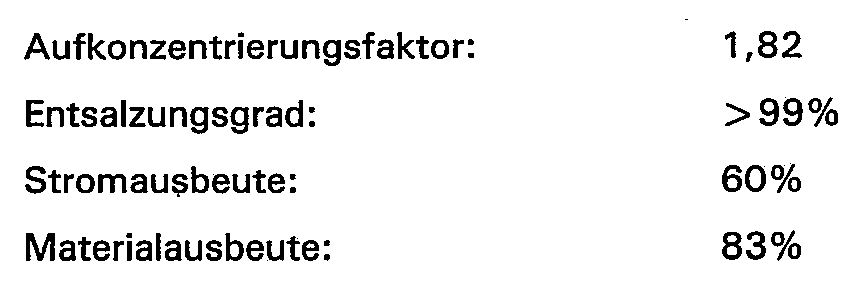
- Die in den Beispielen genannten Prozente sind Gewichtsprozente. Unter «Aufkonzentrierungsfaktor» wird der Quotient aus der Gewichtsmenge des eingesetzten Diluats und der Gewichtsmenge des erhaltenen Diluats und unter Entsalzungsgrad der Quotient aus den Gewichtsmengen an Salz im eingesetzten und erhaltenen Diluat verstanden.
- Die Elektrodialysezelle, deren Schema aus der Figur ersichtlich ist, ist über Polyethylenschläuche mit drei voneinander getrennten Kreisläufen verbunden, die die Zelle aus Vorratsbehältern mit dem Konzentrat (1), dem Diluat (2) und dem Elektrolyten (3) versorgen. Die Zelle besitzt zwei Platinelektroden (4) von je 0,35 dm2. Die Elektrodenräume (5) sind von den angrenzenden Konzentraträumen (6) durch Kationenaustauschermembranen (7), die im Handel unter der Bezeichnung °Nafion erhältlich sind, abgetrennt. Zwischen den Elektrodenräumen befinden sich sechs Konzentraträume (6) und 5 Diluaträume, (8) in alternierender Anordnung. Die Räume sind voneinander abwechselnd durch Kationenaustauschermembranen (9), die im Handel unter der Bezeichnung OSelemion CMV bzw. Anionenaustauschermembranen (10), die im Handel unter der Bezeichnung ®Selemion AMV erhältlich sind, getrennt. Die Membranen haben eine aktive Fläche von 0,37 dm2 und sind durch PVC-Rahmen so befestigt, dass sie einen Abstand voneinander von 2 mm aufweisen. An den Rahmen sind auch die Zulauf- und Ablaufanordnungen angebracht, über welche die Kreisläufe angeschlossen sind. Jeder der drei Kreisläufe ist mit einer Magnetkreiselpumpe und einem Wärmetauscher versehen. Die Apparatur ist mit Gleichstromversorgung, Temperatur-, pH- und Leitfähigkeitsmessung sowie mit Stickstoff-Spülung ausgerüstet. b) Durchführung der Elektrodialysen:
- Die drei Kreisläufe der Apparatur wurden mit den folgenden Lösungen beschickt:


- Die Farbstofflösung hatte einen Chloridgehalt von 0,58%.
- Die Elektrodialyse wurde bei 30°C und 25 V Klemmspannung durchgeführt. Dabei wurden die Lösungen umgepumpt. Die Anfangsstärke von ca. 1,2 A sank mit dem Fortschreiten der Entsalzung, die analytisch überprüft wurde (Cl⊖-Bestimmung), allmählich ab. Die Elektrodialyse wurde nach 18 h Laufzeit abgebrochen. Es wurde als Diluat eine aufkonzentrierte wässrige Lösung des Farbstoffes erhalten, die einen Chloridgehalt von 0,11 % aufwies. Dabei wurde folgendes Ergebnis erzielt:

- Man elektrodialysierte wie im Beispiel 1 beschrieben, wobei man jedoch als Konzentrat 1000 g einer 0,5%igen wässrigen NaCI-Lösung und als Diluat 1500 g einer 10%igen wässrigen Lösung des Farbstoffes mit einem Chloridgehalt von 0,31 % verwendete. Es wurde als Diluat eine weitgehend salzfreie Farbstofflösung erhalten, bei der aber so gut wie keine Aufkonzentrierung der Lösung eingetreten war. Erzieltes Ergebnis:

- 1500 g einer 5%igen wässrigen Lösung des Farbstoffes der Formel


- Die drei Kreisläufe der in Beispiel 1 verwendeten Apparatur wurden mit den folgenden Lösungen beschickt:


- Die drei Kreisläufe der in Beispiel 1 beschriebenen Apparatur wurden mit den folgenden Lösungen beschickt:

- Die drei Kreisläufe der in Beispiel 1 beschriebenen Apparatur wurden mit den folgenden Lösungen beschickt:

- Es wurde 18 h bei einer Zellspannung von ≤ 20 V und einer Stromstärke von <2 A elektrodialysiert, wobei alle 3 h das Konzentrat gewechselt wurde. Am Ende war die Diluatmenge auf 1233 g abgesunken. Das Diluat hatte einen Gehalt any-Aminobuttersäure von 3,62 Mol/kg und einen Chloridgehalt von 0,02%. Ergebnis:

- Die drei Kreisläufe der in Beispiel 1 beschriebenen Apparatur wurden mit den folgenden Lösungen beschickt:


- Es wurde wie in Beispiel 7 beschrieben elektrodialysiert, wobei jedoch als Diluat 2000 g einer 5,94%igen wässrigen Arabinoselösung mit einem Chloridgehalt (NaCI) von 7,02% und als Konzentrat eine 0,5%ige wässrige NaCI-Lösung verwendet wurde. Das Konzentrat wurde auch hier alle 3 h gewechselt (in technischen Anlagen wird das Konzentrat in der Regel kontinuierlich über einen Überlauf ausgetragen und mit Wasser aufgefüllt, um die Salzkonzentration in Konzentrat und Diluat nicht zu stark auseinandergehen zu lassen). Am Ende betrug die Endkonzentration an Chlorid im Konzentrat 0,38%. Die Diluatmenge war auf 1344 g abgesunken. Das Diluat hatte einen Gehalt an Arabinose von 8,17% und einen Chloridgehalt von 0,14%. Ergebnis:

- Bei einem Vergleich mit Beispiel 7 ersieht man, dass bei gleicher Versuchsdauer eine nahezu gleiche Materialausbeute und eine geringfügig schlechtere Stromausbeute erhalten wird, während nach Beispiel 7 ein um 35% erhöhter Aufkonzentrierungsfaktor erzielt wird.
- Es wurde eine ähnliche Apparatur wie in Beispiel 1 beschrieben verwendet, die anstelle von 6 Konzentraträumen 20 Konzentraträume und anstelle von 5 Diluaträumen 19 Diluaträume aufwies. Die aktive Membran- und Elektrodenfläche betrug 2 dm2. Als Kationenaustauschermembranen wurden die im Handel unter der Bezeichnung @Neosepta, CH-45 T-Membranen und als Anionenaustauschermembranen @Neosepta, ACH-45 T-Membranen verwendet. Die drei Kreisläufe wurden mit folgenden Lösungen beschickt:
-
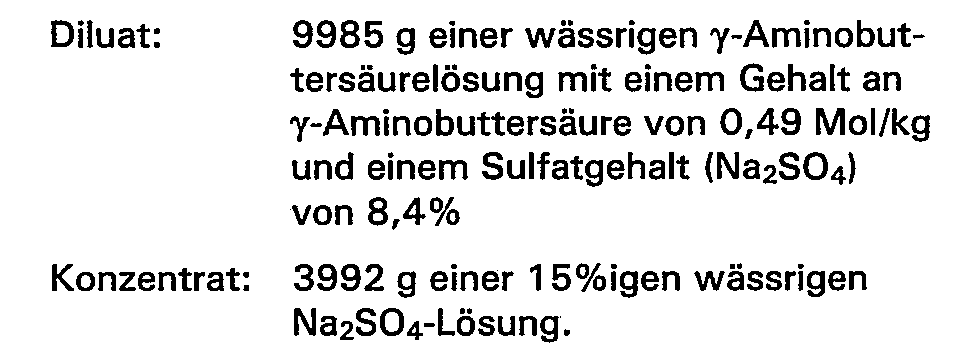

- Die drei Kreisläufe der in Beispiel 1 verwendeten Apparatur wurden mit den folgenden Lösungen beschickt:


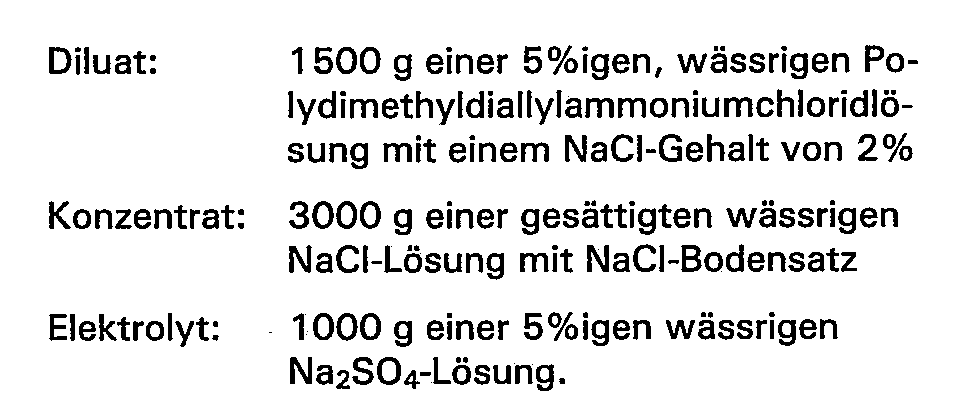
- Die drei Kreisläufe der in Beispiel 1 verwendeten Apparatur wurden mit den folgenden Lösungen beschickt:
-

Claims (7)
Applications Claiming Priority (2)
| Application Number | Priority Date | Filing Date | Title |
|---|---|---|---|
| DE3446695 | 1984-12-21 | ||
| DE19843446695 DE3446695A1 (de) | 1984-12-21 | 1984-12-21 | Verfahren zur aufkonzentrierung waessriger loesungen von organischen verbindungen, die salze enthalten, unter gleichzeitiger verringerung des salzgehaltes |
Publications (4)
| Publication Number | Publication Date |
|---|---|
| EP0186836A2 EP0186836A2 (de) | 1986-07-09 |
| EP0186836A3 EP0186836A3 (en) | 1987-08-26 |
| EP0186836B1 true EP0186836B1 (de) | 1988-08-03 |
| EP0186836B2 EP0186836B2 (de) | 1992-03-18 |
Family
ID=6253426
Family Applications (1)
| Application Number | Title | Priority Date | Filing Date |
|---|---|---|---|
| EP85115968A Expired - Lifetime EP0186836B2 (de) | 1984-12-21 | 1985-12-13 | Verfahren zur Aufkonzentrierung wässriger Lösungen von organischen Verbindungen, die Salze enthalten, unter gleichzeitiger Verringerung des Salzgehaltes |
Country Status (4)
| Country | Link |
|---|---|
| US (1) | US4802965A (de) |
| EP (1) | EP0186836B2 (de) |
| JP (1) | JPH0749097B2 (de) |
| DE (2) | DE3446695A1 (de) |
Families Citing this family (18)
| Publication number | Priority date | Publication date | Assignee | Title |
|---|---|---|---|---|
| DE3424506A1 (de) * | 1984-07-04 | 1986-01-09 | Hoechst Ag, 6230 Frankfurt | Verfahren zur herstellung salzarmer, fluessiger, waessriger zubereitungen von faserreaktiven farbstoffen |
| JPH0643378B2 (ja) * | 1987-04-09 | 1994-06-08 | ユニオン、カーバイド、コーポレーション | イオン交換膜を備えた電気透析槽を使用する水性アルカノールアミンからの塩の除去法 |
| DE3740785A1 (de) * | 1987-12-02 | 1989-06-15 | Basf Ag | Verfahren zum entfernen von saeure aus kathodischen elektrotauchlackier-baedern mittels elektrodialyse |
| US5282939A (en) * | 1988-09-20 | 1994-02-01 | Basf Aktiengesellschaft | Removal of salts by electrodialysis |
| DE3831848A1 (de) * | 1988-09-20 | 1990-03-29 | Basf Ag | Verfahren zur abtrennung von salzen mittels elektrodialyse |
| DE3903024A1 (de) * | 1989-02-02 | 1990-08-16 | Hoechst Ag | Verfahren zur entsalzung von loesemittelhaltigen elektrolytloesungen durch elektrodialyse |
| FR2644360B1 (fr) * | 1989-03-15 | 1991-07-05 | Morgane | Procede de concentration de dispersion ou de solution aqueuse de composes biochimiques |
| DE4110050A1 (de) * | 1991-03-27 | 1992-10-01 | Bayer Ag | Verfahren zur gewinnung fester farbstoffe |
| FR2682045B1 (fr) * | 1991-10-02 | 1993-12-10 | Elf Aquitaine Prod Ste Nale | Recuperation des solvants polaires aprotiques a partir de leurs solutions aqueuses salines. |
| DE4307388A1 (de) * | 1993-03-10 | 1994-09-15 | Zuckerindustrie Verein | Verfahren und Vorrichtung zur Herstellung von monooxydierten Produkten aus Kohlenhydraten, Kohlenhydratderivaten und primären Alkoholen |
| SE502632C2 (sv) * | 1994-02-03 | 1995-11-27 | Eka Nobel Ab | Förfarande för minskning av halter organiskt och oorganiskt halogen i en vattenlösning samt användning av en vattenlösning som framställts enligt förfarandet |
| DE4433823A1 (de) * | 1994-09-22 | 1996-03-28 | Huels Chemische Werke Ag | Verfahren zur Herstellung von Ketoverbindungen |
| US5525365A (en) * | 1994-12-22 | 1996-06-11 | Gray & Company | Method for processing food |
| WO2000008059A1 (en) * | 1998-08-04 | 2000-02-17 | Union Carbide Chemicals & Plastics Technology Corporation | Production of polysaccharide ethers |
| US6933381B2 (en) | 2001-02-02 | 2005-08-23 | Charles B. Mallon | Method of preparing modified cellulose ether |
| CN1313437C (zh) * | 2004-12-30 | 2007-05-02 | 刘一峰 | 水溶液中甘氨酸甜菜碱和盐类化合物的分离方法 |
| EP2216088A1 (de) * | 2009-02-04 | 2010-08-11 | Lonza Ltd. | Rückgewinnung von Produktverlusten aus ED-Abfallströmen |
| WO2011055381A1 (en) | 2009-11-04 | 2011-05-12 | Council Of Scientific & Industrial Research | Electrodialysis-distillation hybrid process for the recovery of dimethylsulfoxide (dmso) solvent from industrial effluent |
Family Cites Families (15)
| Publication number | Priority date | Publication date | Assignee | Title |
|---|---|---|---|---|
| CA597825A (en) * | 1960-05-10 | L. Tye Frank | Concentration of solutions | |
| NL104346C (de) * | 1954-05-06 | |||
| US2827428A (en) * | 1955-03-21 | 1958-03-18 | Ionics | Photographic emulsion purification |
| US2860091A (en) * | 1955-09-22 | 1958-11-11 | Ionics | Treatment of polyhydric solutions |
| US3136710A (en) * | 1960-09-07 | 1964-06-09 | Sulphite Products Corp | Electrodialysis |
| US3437580A (en) * | 1963-11-29 | 1969-04-08 | Mc Donnell Douglas Corp | Preparation of hydrous metal oxide membranes and acid salts thereof |
| US3440159A (en) * | 1965-08-26 | 1969-04-22 | Ionics | Separation of un-ionized substances by electro-osmosis |
| US3383245A (en) * | 1966-11-08 | 1968-05-14 | Anheuser Busch | Process of purifying high d. e.-very sweet syrups |
| US3718560A (en) * | 1972-05-30 | 1973-02-27 | Taito Co | Process for electrodialysis of sugar solutions |
| JPS4930907A (de) * | 1972-07-19 | 1974-03-19 | ||
| DE2805891C2 (de) * | 1978-02-13 | 1988-12-22 | Bayer Ag, 5090 Leverkusen | Konzentrierte Farbstoff- und Aufhellerlösungen, deren Herstellung und Verwendung |
| DE2948292A1 (de) * | 1979-11-30 | 1981-06-04 | Bayer Ag, 5090 Leverkusen | Waessrige, loesungsmittelfreie konzentrierte praeparationen von raktivfarbstoffen und verfahren zu ihrer herstellung |
| DE3315626A1 (de) * | 1983-04-29 | 1984-10-31 | Hoechst Ag, 6230 Frankfurt | Verfahren zur anreicherung von schwefelsaeure |
| DE3424506A1 (de) * | 1984-07-04 | 1986-01-09 | Hoechst Ag, 6230 Frankfurt | Verfahren zur herstellung salzarmer, fluessiger, waessriger zubereitungen von faserreaktiven farbstoffen |
| US4608141A (en) * | 1984-11-07 | 1986-08-26 | Allied Corporation | Multichamber two-compartment electrodialytic water splitter and method of using same for basification of aqueous soluble salts |
-
1984
- 1984-12-21 DE DE19843446695 patent/DE3446695A1/de not_active Withdrawn
-
1985
- 1985-12-13 EP EP85115968A patent/EP0186836B2/de not_active Expired - Lifetime
- 1985-12-13 DE DE8585115968T patent/DE3564076D1/de not_active Expired
- 1985-12-16 US US06/809,582 patent/US4802965A/en not_active Expired - Fee Related
- 1985-12-19 JP JP60284491A patent/JPH0749097B2/ja not_active Expired - Lifetime
Also Published As
| Publication number | Publication date |
|---|---|
| EP0186836A3 (en) | 1987-08-26 |
| JPH0749097B2 (ja) | 1995-05-31 |
| DE3564076D1 (en) | 1988-09-08 |
| EP0186836B2 (de) | 1992-03-18 |
| US4802965A (en) | 1989-02-07 |
| EP0186836A2 (de) | 1986-07-09 |
| JPS61149209A (ja) | 1986-07-07 |
| DE3446695A1 (de) | 1986-06-26 |
Similar Documents
| Publication | Publication Date | Title |
|---|---|---|
| EP0186836B2 (de) | Verfahren zur Aufkonzentrierung wässriger Lösungen von organischen Verbindungen, die Salze enthalten, unter gleichzeitiger Verringerung des Salzgehaltes | |
| EP0015481B1 (de) | Konzentrierte Dispersionen von Fluorpolymeren und Verfahren zu deren Herstellung | |
| DE2225283C3 (de) | Verfahren zur Herstellung von anisotropen semi-permeablen Membranen aus Polyarylaether/sulfonen | |
| EP0394858B1 (de) | Verfahren und Vorrichtung zur Entfernung von Nitraten aus einem Wasserstrom im Rahmen der Gebrauchswasser-Aufbereitung | |
| DE69912985T2 (de) | Verfahren zur kesselsteinverhinderung in elektroentionisierungsanlagen | |
| DE1442467A1 (de) | Verfahren zum Entfernen von Ionen aus Fluessigkeiten | |
| EP0194546B1 (de) | Porenmembranen | |
| DE3215818C2 (de) | ||
| DE3621781A1 (de) | Verfahren zur reinigung von l-ascorbinsaeure | |
| DE10106932A1 (de) | Verfahren zur Herstellung von Natriumpersulfat | |
| EP0381134B1 (de) | Verfahren zur Entsalzung von lösemittelhaltigen Elektrolytlösungen durch Elektrodialyse | |
| DE3410611A1 (de) | Verfahren zur herstellung von festen photoaktivatorpraeparaten | |
| DE1517518A1 (de) | Verfahren zur Behandlung von Loesungen | |
| EP0378081B1 (de) | Verfahren zur Reinigung wässriger Glyoxallösungen | |
| DE2428562B2 (de) | Verfahren zur Reinigung von Abwässern | |
| DE2807380C2 (de) | ||
| DE2807339A1 (de) | Verfahren zur behandlung eines sauren hydrolysats von pflanzlichen materialen | |
| EP0360093A2 (de) | Verfahren zur Abtrennung von Salzen mittels Elektrodialyse | |
| DE3410520A1 (de) | Verfahren zur herstellung von polyglycerinen durch reinigung und trennung einer waessrigen loesung eines polyglycerinhaltigen produktes | |
| DE19858544A1 (de) | Verfahren zur Herstellung von Natriumpersulfat | |
| DE4342668A1 (de) | Verfahren zur Gewinnung von Carbonsäuren aus ihren Salzen | |
| EP3466890A1 (de) | Verfahren zur aufbereitung von abwasser aus der milchindustrie | |
| DE2938424A1 (de) | Verfahren zur abtrenunng von mit destillatdaempfen uebergehenden saeuren und basen | |
| EP0473087A2 (de) | Verfahren zum Vermindern der Konzentration einer Lösung an einem bestimmten Ion oder einer bestimmten Gruppe von Ionen | |
| EP0123647B1 (de) | Verfahren zur Verhinderung des Gelierens von konzentrierten wässrigen Photoaktivatorlösungen |
Legal Events
| Date | Code | Title | Description |
|---|---|---|---|
| PUAI | Public reference made under article 153(3) epc to a published international application that has entered the european phase |
Free format text: ORIGINAL CODE: 0009012 |
|
| AK | Designated contracting states |
Kind code of ref document: A2 Designated state(s): BE CH DE FR GB IT LI NL |
|
| PUAL | Search report despatched |
Free format text: ORIGINAL CODE: 0009013 |
|
| AK | Designated contracting states |
Kind code of ref document: A3 Designated state(s): BE CH DE FR GB IT LI NL |
|
| 17P | Request for examination filed |
Effective date: 19870801 |
|
| 17Q | First examination report despatched |
Effective date: 19871222 |
|
| GRAA | (expected) grant |
Free format text: ORIGINAL CODE: 0009210 |
|
| AK | Designated contracting states |
Kind code of ref document: B1 Designated state(s): BE CH DE FR GB IT LI NL |
|
| ITF | It: translation for a ep patent filed | ||
| GBT | Gb: translation of ep patent filed (gb section 77(6)(a)/1977) | ||
| REF | Corresponds to: |
Ref document number: 3564076 Country of ref document: DE Date of ref document: 19880908 |
|
| ET | Fr: translation filed | ||
| PLBI | Opposition filed |
Free format text: ORIGINAL CODE: 0009260 |
|
| 26 | Opposition filed |
Opponent name: HUELS AKTIENGESELLSCHAFT Effective date: 19890503 |
|
| NLR1 | Nl: opposition has been filed with the epo |
Opponent name: HUELS AG |
|
| ITTA | It: last paid annual fee | ||
| PUAH | Patent maintained in amended form |
Free format text: ORIGINAL CODE: 0009272 |
|
| STAA | Information on the status of an ep patent application or granted ep patent |
Free format text: STATUS: PATENT MAINTAINED AS AMENDED |
|
| 27A | Patent maintained in amended form |
Effective date: 19920318 |
|
| AK | Designated contracting states |
Kind code of ref document: B2 Designated state(s): BE CH DE FR GB IT LI NL |
|
| ITF | It: translation for a ep patent filed | ||
| REG | Reference to a national code |
Ref country code: CH Ref legal event code: AEN |
|
| GBTA | Gb: translation of amended ep patent filed (gb section 77(6)(b)/1977) | ||
| ET3 | Fr: translation filed ** decision concerning opposition | ||
| NLR2 | Nl: decision of opposition | ||
| NLR3 | Nl: receipt of modified translations in the netherlands language after an opposition procedure | ||
| PGFP | Annual fee paid to national office [announced via postgrant information from national office to epo] |
Ref country code: FR Payment date: 19981127 Year of fee payment: 14 |
|
| PGFP | Annual fee paid to national office [announced via postgrant information from national office to epo] |
Ref country code: GB Payment date: 19981203 Year of fee payment: 14 |
|
| PGFP | Annual fee paid to national office [announced via postgrant information from national office to epo] |
Ref country code: CH Payment date: 19981208 Year of fee payment: 14 |
|
| PGFP | Annual fee paid to national office [announced via postgrant information from national office to epo] |
Ref country code: NL Payment date: 19981217 Year of fee payment: 14 |
|
| PGFP | Annual fee paid to national office [announced via postgrant information from national office to epo] |
Ref country code: BE Payment date: 19981223 Year of fee payment: 14 |
|
| PGFP | Annual fee paid to national office [announced via postgrant information from national office to epo] |
Ref country code: DE Payment date: 19981224 Year of fee payment: 14 |
|
| PG25 | Lapsed in a contracting state [announced via postgrant information from national office to epo] |
Ref country code: GB Free format text: LAPSE BECAUSE OF NON-PAYMENT OF DUE FEES Effective date: 19991213 |
|
| PG25 | Lapsed in a contracting state [announced via postgrant information from national office to epo] |
Ref country code: DE Free format text: LAPSE BECAUSE OF THE APPLICANT RENOUNCES Effective date: 19991216 |
|
| PG25 | Lapsed in a contracting state [announced via postgrant information from national office to epo] |
Ref country code: LI Free format text: LAPSE BECAUSE OF NON-PAYMENT OF DUE FEES Effective date: 19991231 Ref country code: CH Free format text: LAPSE BECAUSE OF NON-PAYMENT OF DUE FEES Effective date: 19991231 Ref country code: BE Free format text: LAPSE BECAUSE OF NON-PAYMENT OF DUE FEES Effective date: 19991231 |
|
| BERE | Be: lapsed |
Owner name: BASF A.G. Effective date: 19991231 |
|
| PG25 | Lapsed in a contracting state [announced via postgrant information from national office to epo] |
Ref country code: NL Free format text: LAPSE BECAUSE OF NON-PAYMENT OF DUE FEES Effective date: 20000701 |
|
| GBPC | Gb: european patent ceased through non-payment of renewal fee |
Effective date: 19991213 |
|
| PG25 | Lapsed in a contracting state [announced via postgrant information from national office to epo] |
Ref country code: FR Free format text: LAPSE BECAUSE OF NON-PAYMENT OF DUE FEES Effective date: 20000831 |
|
| NLV4 | Nl: lapsed or anulled due to non-payment of the annual fee |
Effective date: 20000701 |
|
| REG | Reference to a national code |
Ref country code: FR Ref legal event code: ST |