EP0187205B1 - Matériau céramique sensible à l'humidité et procédé de sa fabrication - Google Patents
Matériau céramique sensible à l'humidité et procédé de sa fabrication Download PDFInfo
- Publication number
- EP0187205B1 EP0187205B1 EP85112861A EP85112861A EP0187205B1 EP 0187205 B1 EP0187205 B1 EP 0187205B1 EP 85112861 A EP85112861 A EP 85112861A EP 85112861 A EP85112861 A EP 85112861A EP 0187205 B1 EP0187205 B1 EP 0187205B1
- Authority
- EP
- European Patent Office
- Prior art keywords
- moisture sensitive
- ions
- ceramic material
- moisture
- sensitive ceramic
- Prior art date
- Legal status (The legal status is an assumption and is not a legal conclusion. Google has not performed a legal analysis and makes no representation as to the accuracy of the status listed.)
- Expired
Links
Images



Classifications
-
- C—CHEMISTRY; METALLURGY
- C04—CEMENTS; CONCRETE; ARTIFICIAL STONE; CERAMICS; REFRACTORIES
- C04B—LIME, MAGNESIA; SLAG; CEMENTS; COMPOSITIONS THEREOF, e.g. MORTARS, CONCRETE OR LIKE BUILDING MATERIALS; ARTIFICIAL STONE; CERAMICS; REFRACTORIES; TREATMENT OF NATURAL STONE
- C04B41/00—After-treatment of mortars, concrete, artificial stone or ceramics; Treatment of natural stone
- C04B41/009—After-treatment of mortars, concrete, artificial stone or ceramics; Treatment of natural stone characterised by the material treated
-
- C—CHEMISTRY; METALLURGY
- C04—CEMENTS; CONCRETE; ARTIFICIAL STONE; CERAMICS; REFRACTORIES
- C04B—LIME, MAGNESIA; SLAG; CEMENTS; COMPOSITIONS THEREOF, e.g. MORTARS, CONCRETE OR LIKE BUILDING MATERIALS; ARTIFICIAL STONE; CERAMICS; REFRACTORIES; TREATMENT OF NATURAL STONE
- C04B41/00—After-treatment of mortars, concrete, artificial stone or ceramics; Treatment of natural stone
- C04B41/45—Coating or impregnating, e.g. injection in masonry, partial coating of green or fired ceramics, organic coating compositions for adhering together two concrete elements
- C04B41/50—Coating or impregnating, e.g. injection in masonry, partial coating of green or fired ceramics, organic coating compositions for adhering together two concrete elements with inorganic materials
- C04B41/5007—Coating or impregnating, e.g. injection in masonry, partial coating of green or fired ceramics, organic coating compositions for adhering together two concrete elements with inorganic materials with salts or salty compositions, e.g. for salt glazing
-
- C—CHEMISTRY; METALLURGY
- C04—CEMENTS; CONCRETE; ARTIFICIAL STONE; CERAMICS; REFRACTORIES
- C04B—LIME, MAGNESIA; SLAG; CEMENTS; COMPOSITIONS THEREOF, e.g. MORTARS, CONCRETE OR LIKE BUILDING MATERIALS; ARTIFICIAL STONE; CERAMICS; REFRACTORIES; TREATMENT OF NATURAL STONE
- C04B41/00—After-treatment of mortars, concrete, artificial stone or ceramics; Treatment of natural stone
- C04B41/45—Coating or impregnating, e.g. injection in masonry, partial coating of green or fired ceramics, organic coating compositions for adhering together two concrete elements
- C04B41/52—Multiple coating or impregnating multiple coating or impregnating with the same composition or with compositions only differing in the concentration of the constituents, is classified as single coating or impregnation
-
- C—CHEMISTRY; METALLURGY
- C04—CEMENTS; CONCRETE; ARTIFICIAL STONE; CERAMICS; REFRACTORIES
- C04B—LIME, MAGNESIA; SLAG; CEMENTS; COMPOSITIONS THEREOF, e.g. MORTARS, CONCRETE OR LIKE BUILDING MATERIALS; ARTIFICIAL STONE; CERAMICS; REFRACTORIES; TREATMENT OF NATURAL STONE
- C04B41/00—After-treatment of mortars, concrete, artificial stone or ceramics; Treatment of natural stone
- C04B41/80—After-treatment of mortars, concrete, artificial stone or ceramics; Treatment of natural stone of only ceramics
- C04B41/81—Coating or impregnation
- C04B41/85—Coating or impregnation with inorganic materials
-
- C—CHEMISTRY; METALLURGY
- C04—CEMENTS; CONCRETE; ARTIFICIAL STONE; CERAMICS; REFRACTORIES
- C04B—LIME, MAGNESIA; SLAG; CEMENTS; COMPOSITIONS THEREOF, e.g. MORTARS, CONCRETE OR LIKE BUILDING MATERIALS; ARTIFICIAL STONE; CERAMICS; REFRACTORIES; TREATMENT OF NATURAL STONE
- C04B41/00—After-treatment of mortars, concrete, artificial stone or ceramics; Treatment of natural stone
- C04B41/80—After-treatment of mortars, concrete, artificial stone or ceramics; Treatment of natural stone of only ceramics
- C04B41/81—Coating or impregnation
- C04B41/89—Coating or impregnation for obtaining at least two superposed coatings having different compositions
-
- G—PHYSICS
- G01—MEASURING; TESTING
- G01N—INVESTIGATING OR ANALYSING MATERIALS BY DETERMINING THEIR CHEMICAL OR PHYSICAL PROPERTIES
- G01N27/00—Investigating or analysing materials by the use of electric, electrochemical, or magnetic means
- G01N27/02—Investigating or analysing materials by the use of electric, electrochemical, or magnetic means by investigating impedance
- G01N27/04—Investigating or analysing materials by the use of electric, electrochemical, or magnetic means by investigating impedance by investigating resistance
- G01N27/12—Investigating or analysing materials by the use of electric, electrochemical, or magnetic means by investigating impedance by investigating resistance of a solid body in dependence upon absorption of a fluid; of a solid body in dependence upon reaction with a fluid, for detecting components in the fluid
- G01N27/121—Investigating or analysing materials by the use of electric, electrochemical, or magnetic means by investigating impedance by investigating resistance of a solid body in dependence upon absorption of a fluid; of a solid body in dependence upon reaction with a fluid, for detecting components in the fluid for determining moisture content, e.g. humidity, of the fluid
Definitions
- the present invention relates to a moisture sensitive ceramic material and a process for its production. More particularly the present invention relates to a moisture sensitive ceramic material for a moisture sensor which detects a relative humidity of an atmosphere by utilizing a change in the electrical resistance of the material and a process for its production.
- EP-A-0 090 048 describes a ceramic moisture sensitive element consisting of a moisture sensitive section on an insulating alumina substrate.
- the moisture sensitive section is made of a fired product of a blend of a polymerized organo-silicon compound and a metal oxide, for instance TiO2, ZnO or Cr2O3.
- EP-A-0 186 039 describes a process for producing a temperature and moisture sensitive element by applying a composition comprising a polymerized organo-silicon compound and an inorganic material onto an alumina substrate and heat-treating the coating layer.
- the inorganic material consists of metal oxide, metal powder, alloy powder, carbon powder, selenium powder or blendings thereof.
- a moisture sensitive material made of the above-mentioned conventional ceramic utilizes the electrical conduction by H+ to detect moisture.
- the electrical resistance of the moisture sensitive material had a lower limit (about 500 K ⁇ when the relative humidity is 50%, about 20 K ⁇ when the relative humidity is 90%).
- a moisture sensor made of the above-mentioned ceramic was employed for automatic moisture control for an air conditioner, the electrical resistance was too high from the viewpoints of the driving and adaptability in the detector circuit, and it was difficult to obtain a sensor having good adaptability.
- the present invention has been made to solve such a problem, and it is an object of the present invention to obtain a moisture sensitive material with its moisture sensitive characteristics stabilized for a long period of time without requiring a heating equipment (heater) for the prevention of deterioration with time.
- the present invention provides a moisture sensitive material comprising a fired product consisting essentially of at least one member selected from the group consisting of a metal oxide and graphite, and a polymerized organo-silicon compound, and at least one member selected from the group consisting of alkali metal ions and halogen ions, doped on the fired product.
- the present invention also provides a process for producing a moisture sensitive material, which comprises the step of mixing at least one member selected from the group consisting of a metal oxide and graphite, and polymerized organo-silicon compound, a step of firing the mixture to obtain a fired product, a step of applying at least one member selected from the group consisting or alkali metal ions and halogen ions to the fired product, and a step of firing the ion-doped product thereby obtained.
- the polymerized organo-silicon compound of the present invention there may be employed a substance which becomes porous by firing such as methyl silicone, methylphenyl silicone and ethyl silicate.
- the substance acts as a binding agent for the metal oxide and/or graphite.
- the effects of the metal oxide and/or the graphite in the moisture sensitive material of the present invention clearly appear, and water is adsorbed in a large quantity, whereby it is possible to obtain a moisture sensitive material having a low electrical resistance.
- the metal oxide of the present invention there may be employed, e.g. at least one member selected from the group consisting of oxides of Al, Cu, Ni, Cr and Ti.
- alkali metal ions of the present invention there may be employed, e.g. at least one type of ions selected from the group consisting of potassium ions, sodium ions and lithium ions in the form of one of compounds such as nitrates, sulfates, carbonates and halides of the respective alkali metals.
- halogen ions of the present invention there may be employed, e.g. at least one type of ions selected from the group consisting of chlorine ions and fluorine ions.
- the preferred amount of the doped ions is from 0.05 to 0.5 parts by weight relative to the fired product.
- the ion doping step is preferably conducted by dipping the fired product into a solution containing from 0.02 to 0.1 mols/liter of alkali metal or halogen ions.
- the fired product preferably contains from 250 to 350 parts by weight of at least one member selected from the group consisting of a metal oxide and graphite, and 100 parts by weight of a polymerized organo-silicon compound.
- the moisture sensitive material of the present invention from 50 to 100 parts by weight of at least one member selected from the group consisting of a metal oxide and graphite is preferably mixed with 100 parts by weight of the polymerized organo-silicon compound.
- the mixture is preferably fired at a temperature of from 450 to 600 o C for from 1 to 2 hours and the ion-doped product is preferably fired at a temperature of from 400 to 550 o C for from 0.5 to 1 hours.
- the moisture sensitive material of the present invention may contain a powder of inorganic material such as a metal oxide e.g. Al2O3 and mica, talc and SiO2 as an additive to improve the coat-forming effect, the acceleration of drying and curing, the prevention of cracking and to improve the bonding performance to the substrate.
- a powder of inorganic material such as a metal oxide e.g. Al2O3 and mica, talc and SiO2 as an additive to improve the coat-forming effect, the acceleration of drying and curing, the prevention of cracking and to improve the bonding performance to the substrate.
- Figure 1 is a perspective view of a moisture sensor employing the moisture sensitive material of the present invention.
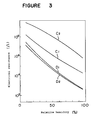
- FIGS 2 to 5 are graphs showing comparisons between moisture sensitive characteristics of sensors of the present invention and those of conventional moisture sensors.
- a Pt-Pd alloy paste was printed on an alumina insulating substrate by screen printing to form comb-shaped electrodes with ten teeth at intervals of 0.2 mm, and after a Pt lead was bonded to each electrode, the substrate was baked.
- a thinner was added to Composition 1 indicated below, and the mixture was stirred with a stirrer, and the substrate was dipped in the mixture to form a coat having a thickness of about 50 ⁇ m.
- the above-mentioned substrate was dipped into a 5% Na2CO3 solution in a solvent mixture of water-alcohol, at 25 o C for one minute, and then it was fired again at 450 o C for an hour to obtain a moisture sensitive coat.
- a moisture sensor shown in Figure 1 was prepared.
- reference numeral 1 indicates an insulating substrate
- numeral 2 is an electrode
- numeral 3 is a moisture sensitive coat
- numeral 4 is a lead wire.
- Composition 1 is a composition of Composition 1:
- curve A1 shows initial moisture sensitive characteristics of the conventional type moisture sensor and curve A2 shows the same characteristics after storage at room temperature for six months.
- Curve B1 shows initial moisture sensitive characteristics of the moisture sensor employing the moisture sensitive material of Example 1 of the present invention and curve B2 shows the same characteristics after storage at room temperature for six months.
- the moisture sensor employing the moisture sensitive material of Example 1 of the present invention has at most one tenth of the resistance value of the conventional moisture sensor and higher adaptability in a circuit and better moisture sensitivity.
- the moisture sensor employing the moisture sensitive material of Example 1 of the present invention shows the low resistance and the good sensitivity, because alkali metal ions (Na+ in this case) existing in the interlayer structure of graphite are fetched through the adsorbed water on the surface of the moisture sensitive section to participate in the surface electrical conduction and the moisture sensitive material becomes more porous by the second firing.
- alkali metal ions Na+ in this case
- Toluene was added to Composition 2 indicated below, and the mixture was stirred with a stirrer.
- the mixture was applied to a substrate similar to the one employed in Example 1, on which Pt-Pd type electrodes were formed and baked, by dipping treatment to form a coat having a thickness of 20 ⁇ m.
- the substrate was dried at a temperature of 80 o C for thirty minutes, and then it was fired at 580 o C for two hours, followed by dipping it into a 3% aqueous solution of FeCl2 at 25 o C for thirty seconds.
- Composition 2 is a composition of Composition 2:
- curve C1 shows initial moisture sensitive characteristics of the conventional type moisture sensor and curve C2 shows the same characteristics after storage at room temperature for six months.
- Curve D1 shows initial moisture sensitive characteristics of the moisture sensor employing the moisture sensitive material of the present invention and curve D2 shows the same characteristics after storage at room temperature for six months.
- Xylene was added to Composition 3 indicated below, and the mixture was stirred with a stirrer.
- the mixture was applied to a substrate similar to the one employed in Example 1, on which Pt-Pd type electrodes were formed and baked, by dipping treatment to form a coat having a thickness of 30 ⁇ m.
- the substrate was dried at 120 o C for thirty minutes, and then it was fired at 520 o C for two hours, followed by dipping it into a 2% aqueous solution of LiCl at 25 o C for twenty seconds.
- Composition 3 is a composition of Composition 3:
- curve E1 shows initial moisture sensitive characteristics of the conventional type moisture sensor and curve E2 shows the same characteristics after storage at room temperature for six months.
- Curve F1 shows initial moisture sensitive characteristics of the moisture sensor employing the moisture sensitive material of the present invention and curve F2 shows the same characteristics after storage at room temperature for six months.
- the sensors employing moisture sensitive materials of the present invention have about one tenth of the resistance value of the conventional moisture sensors.
- Example 3 it is believed that as alkali ions (Li+) and halogen ions participate in the electrical conduction, good results mentioned above can be obtained.
- a thinner was added to Composition 4 indicated below, and the mixture was stirred with a stirrer.
- the mixture was applied to the substrate similar to the one employed in Example 1, on which Pt-Pd type electrodes were formed and baked, by dipping treatment to form a coat having a thickness of about 50 ⁇ m.
- Composition 4 is a composition having Composition 4:
- Example 4 The same composition as employed in Example 4 was applied to a substrate, and the substrate was fired and dipped into a K2SO4 aqueous solution in the same manner as in Example 4.
- the substrate was fired at 400 o C for thirty minutes to produce a moisture sensor employing a moisture sensitive material of the present invention.
- curve A1 shows initial moisture sensitive characteristics of the conventional type moisture sensor and curve A2 shows the same characteristics after storage at room temperature for a year.
- Curve G1 shows initial moisture sensitive characteristics of the moisture sensor employing the moisture sensitive material of Example 4 of the present invention and curve G2 shows the same characteristics after storage at room temperature for a year.
- Curve H1 shows initial moisture sensitive characteristics of the moisture sensor employing the moisture sensitive material of Example 5 of the present invention and curve H2 shows the same characteristics after storage at room temperature for a year.
- the moisture sensor employing the moisture sensitive material of Example 4 or 5 of the present invention has at most one tenth of the resistance value of the conventional moisture sensor and higher adaptability in a circuit and better moisture sensitivity, particularly in the case of H1.
- the moisture sensor employing the moisture sensitive material of the present invention has the low resistance because the alkali metal ions (K+ in this case) are fetched through the adsorbed water on the surface of the moisture sensitive section to participate in the electrical conduction at the surface.
- the moisture sensitive material becomes more porous by the second firing, and the water adsorptivity increases, whereby the sensitivity is improved and the resistance hardly lowers with time.
- Alkali metal ions or halogen ions may be doped also by ion plantation, vacuum evaporation, etc. to obtain substantially the same effect as obtainable by the above-mentioned dipping method.
- the present invention it is possible to obtain a moisture sensitive material with its moisture sensitive characteristics being stable for a long period of time without requiring a heating equipment (heater) for the prevention of deterioration with time, and the moisture sensitive material is useful for e.g. a moisture sensor.
- the strength of the coat of the moisture sensitive material increases because of the presence of the metal oxide, whereby the quantity of water adsorbable in the moisture sensitive material becomes greater and the resistance of the matreial becomes lower.
- the alkali metal ions and halogen ions are fetched through the adsorbed water on the surface of the moisture sensitive section to participate in the electrical conduction at the surface, whereby the resistance of the moisture sensitive material becomes lower.
- the graphite in the present invention serves to stabilize the alkali metal ions and halogen ions, and to facilitate the adsorption and desorption of water.
Landscapes
- Chemical & Material Sciences (AREA)
- Engineering & Computer Science (AREA)
- Ceramic Engineering (AREA)
- Materials Engineering (AREA)
- Structural Engineering (AREA)
- Organic Chemistry (AREA)
- Inorganic Chemistry (AREA)
- Physics & Mathematics (AREA)
- Electrochemistry (AREA)
- Health & Medical Sciences (AREA)
- Life Sciences & Earth Sciences (AREA)
- Analytical Chemistry (AREA)
- Biochemistry (AREA)
- General Health & Medical Sciences (AREA)
- General Physics & Mathematics (AREA)
- Immunology (AREA)
- Pathology (AREA)
- Chemical Kinetics & Catalysis (AREA)
- Investigating Or Analyzing Materials By The Use Of Fluid Adsorption Or Reactions (AREA)
Claims (12)
- Matériau céramique sensible à l'humidité, comprenant un produit cuit, consistant essentiellement en :(a) au moins un élément choisi dans le groupe constitué par les oxydes métalliques et le graphite ;(b) un composé organo-silicique polymérisé, caractérisé par le fait que ledit produit cuit est dopé par au moins un élément choisi dans le groupe constitué par les ions de métaux alcalins et les ions halogène.
- Matériau céramique sensible à l'humidité selon la revendication 1, caractérisé par le fait que la quantité des ions de dopage est de 0,05 à 0,5 partie en poids par rapport au produit cuit.
- Matériau céramique sensible à l'humidité selon la revendication 1, caractérisé par le fait que les ions de métaux alcalins sont des ions potassium, des ions sodium et des ions lithium.
- Matériau céramique sensible à l'humidité selon la revendication 1, caractérisé par le fait que les ions halogène sont des ions chlore et des ions fluor.
- Matériau céramique sensible à l'humidité selon la revendication 1, caractérisé par le fait que le composé organo-silicique polymérisé est la méthyl silicone, la méthylphényl silicone ou le silicate d'éthyle.
- Matériau céramique sensible à l'humidité selon la revendication 1, caractérisé par le fait que le produit cuit contient de 250 à 350 parties en poids d'au moins un élément choisi dans le groupe constitué par un oxyde métallique et le graphite, et 100 parties en poids d'un composé organo-silicique polymérisé.
- Matériau céramique sensible à l'humidité selon la revendication 1, caractérisé par le fait que l'oxyde métallique est un oxyde d'Al, Cu, Ni, Cr ou Ti.
- Procédé de fabrication d'un matériau céramique sensible à l'humidité, qui comprend l'étape de mélange d'au moins un élément choisi dans le groupe constitué par un oxyde métallique et le graphite avec un composé organo-silicique polymérisé, et l'étape de cuisson du mélange pour obtenir un produit cuit, caractérisé par l'étape de dopage dudit produit cuit par au moins un élément choisi dans le groupe constitué par les ions de métaux alcalins et les ions halogène et la cuisson du produit dopé par lesdits ions, qui est ainsi obtenu.
- Procédé de fabrication d'un matériau céramique sensible à l'humidité selon la revendication 8, caractérisé par le fait que 50 à 100 parties en poids d'au moins un élément choisi dans le groupe constitué par un oxyde métallique et le graphite sont mélangées avec 100 parties en poids du composé organo-silicique polymérisé.
- Procédé de fabrication d'un matériau céramique sensible à l'humidité selon la revendication 8, caractérisé par le fait que le mélange est cuit à une température de 450 à 600°C.
- Procédé de fabrication d'un matériau céramique sensible à l'humidité selon la revendication 8, caractérisé par le fait que l'étape de dopage est conduite par immersion du produit cuit dans une solution contenant de 0,02 à 0,1 mole/litre d'ions de métaux alcalins ou halogène.
- Procédé de fabrication d'un matériau céramique sensible à l'humidité selon la revendication 8, caractérisé par le fait que le produit dopé par lesdits ions est cuit à une température de 400 à 550°C.
Applications Claiming Priority (4)
| Application Number | Priority Date | Filing Date | Title |
|---|---|---|---|
| JP268958/84 | 1984-12-20 | ||
| JP26895884A JPS61147141A (ja) | 1984-12-20 | 1984-12-20 | 感湿材料の製造方法 |
| JP26895184A JPS61147135A (ja) | 1984-12-20 | 1984-12-20 | 感湿材料の製造方法 |
| JP268951/84 | 1984-12-20 |
Publications (3)
| Publication Number | Publication Date |
|---|---|
| EP0187205A2 EP0187205A2 (fr) | 1986-07-16 |
| EP0187205A3 EP0187205A3 (en) | 1988-10-05 |
| EP0187205B1 true EP0187205B1 (fr) | 1992-05-06 |
Family
ID=26548546
Family Applications (1)
| Application Number | Title | Priority Date | Filing Date |
|---|---|---|---|
| EP85112861A Expired EP0187205B1 (fr) | 1984-12-20 | 1985-10-10 | Matériau céramique sensible à l'humidité et procédé de sa fabrication |
Country Status (3)
| Country | Link |
|---|---|
| US (1) | US4666628A (fr) |
| EP (1) | EP0187205B1 (fr) |
| DE (1) | DE3585997D1 (fr) |
Families Citing this family (8)
| Publication number | Priority date | Publication date | Assignee | Title |
|---|---|---|---|---|
| US4855706A (en) * | 1987-09-11 | 1989-08-08 | Hauptly Paul D | Organic liquid detector |
| US4893108A (en) * | 1988-06-24 | 1990-01-09 | The United States Of America As Represented By The Secretary Of The Air Force | Halogen detection with solid state sensor |
| DE59505670D1 (de) * | 1994-10-19 | 1999-05-20 | Bosch Gmbh Robert | Keramischer elektrischer widerstand und dessen verwendung |
| US5876687A (en) * | 1997-04-04 | 1999-03-02 | The United States Of America As Represented By The Administrator Of The National Aeronautics And Space Administration | Elemental metals or oxides distributed on a carbon substrate or self-supported and the manufacturing process using graphite oxide as template |
| EP1262767B1 (fr) * | 2001-05-31 | 2011-02-16 | Ngk Spark Plug Co., Ltd | Capteur d'humidité |
| BRPI0918200A2 (pt) * | 2008-12-23 | 2015-12-08 | 3M Innovative Properties Co | elemento de detecção e método de detecção de analitos químicos orgânicos |
| CN116654983A (zh) * | 2023-06-01 | 2023-08-29 | 大连民族大学 | 一种多金属氧酸盐湿敏材料及其制备方法与应用 |
| WO2025188351A2 (fr) * | 2023-08-31 | 2025-09-12 | The Trustees Of The University Of Pennsylvania | Capteurs environnementaux ayant des métasurfaces optiques |
Family Cites Families (9)
| Publication number | Priority date | Publication date | Assignee | Title |
|---|---|---|---|---|
| AU5805873A (en) * | 1972-07-25 | 1975-01-16 | Koichi Sugaya | Humidity sensor electrode assembly |
| US4157311A (en) * | 1977-09-01 | 1979-06-05 | General Electric Company | Method of making a halogen sensor |
| JPS5529774A (en) * | 1978-08-24 | 1980-03-03 | Shinei Kk | Relative humidity detector |
| US4263576A (en) * | 1978-07-10 | 1981-04-21 | Murata Manufacturing Co., Ltd. | Humidity sensitive device |
| US4378691A (en) * | 1980-02-04 | 1983-04-05 | Matsushita Electric Industrial Co., Ltd. | Multi-functional sensor |
| US4464647A (en) * | 1981-02-12 | 1984-08-07 | Marcon Electronics Co. Ltd. | Humidity sensor made of metal oxide |
| DE3176700D1 (en) * | 1981-09-30 | 1988-05-05 | Mitsubishi Electric Corp | Humidity sensor |
| GB2135781B (en) * | 1983-02-24 | 1986-04-23 | Murata Manufacturing Co | Humidity sensitive device |
| US4731257A (en) * | 1984-12-20 | 1988-03-15 | Mitsubishi Denki Kabushiki Kaisha | Process for producing a temperature and moisture sensitive element |
-
1985
- 1985-09-20 US US06/778,225 patent/US4666628A/en not_active Expired - Lifetime
- 1985-10-10 EP EP85112861A patent/EP0187205B1/fr not_active Expired
- 1985-10-10 DE DE8585112861T patent/DE3585997D1/de not_active Expired - Lifetime
Also Published As
| Publication number | Publication date |
|---|---|
| EP0187205A3 (en) | 1988-10-05 |
| EP0187205A2 (fr) | 1986-07-16 |
| US4666628A (en) | 1987-05-19 |
| DE3585997D1 (de) | 1992-06-11 |
Similar Documents
| Publication | Publication Date | Title |
|---|---|---|
| EP0090048B1 (fr) | Detecteur d'humidite | |
| US4357426A (en) | Humidity sensitive ceramics | |
| JPS6155061B2 (fr) | ||
| US4666628A (en) | Moisture sensitive material and process for its production | |
| US3703697A (en) | Relative humidity sensor | |
| CA1196990A (fr) | Detecteur de gaz | |
| EP0186039B1 (fr) | Procédé pour fabriquer un élément sensible à la température et à l'humidité | |
| JPH0244390B2 (ja) | Kanshitsuzairyo | |
| JPH0231842B2 (ja) | Kanshitsuzairyo | |
| JPH051421B2 (fr) | ||
| JPH052098B2 (fr) | ||
| JPS61147143A (ja) | 感湿材料の製造方法 | |
| JPH052100B2 (fr) | ||
| JPS60186747A (ja) | 感湿材料の製造方法 | |
| JPS6131418B2 (fr) | ||
| JPH0436561B2 (fr) | ||
| JPS61147138A (ja) | 感湿材料 | |
| JPH0464162B2 (fr) | ||
| JPH0464161B2 (fr) | ||
| JPS6350841B2 (fr) | ||
| JPH02209702A (ja) | 耐水性感湿素子 | |
| JPS58212101A (ja) | 湿度センサ | |
| JPS6349882B2 (fr) | ||
| JPS59186303A (ja) | 感湿素子 | |
| JPS61147139A (ja) | 感湿材料 |
Legal Events
| Date | Code | Title | Description |
|---|---|---|---|
| PUAI | Public reference made under article 153(3) epc to a published international application that has entered the european phase |
Free format text: ORIGINAL CODE: 0009012 |
|
| AK | Designated contracting states |
Kind code of ref document: A2 Designated state(s): DE FR GB |
|
| PUAL | Search report despatched |
Free format text: ORIGINAL CODE: 0009013 |
|
| AK | Designated contracting states |
Kind code of ref document: A3 Designated state(s): DE FR GB |
|
| 17P | Request for examination filed |
Effective date: 19881128 |
|
| 17Q | First examination report despatched |
Effective date: 19900607 |
|
| GRAA | (expected) grant |
Free format text: ORIGINAL CODE: 0009210 |
|
| AK | Designated contracting states |
Kind code of ref document: B1 Designated state(s): DE FR GB |
|
| REF | Corresponds to: |
Ref document number: 3585997 Country of ref document: DE Date of ref document: 19920611 |
|
| ET | Fr: translation filed | ||
| PLBE | No opposition filed within time limit |
Free format text: ORIGINAL CODE: 0009261 |
|
| STAA | Information on the status of an ep patent application or granted ep patent |
Free format text: STATUS: NO OPPOSITION FILED WITHIN TIME LIMIT |
|
| 26N | No opposition filed | ||
| REG | Reference to a national code |
Ref country code: GB Ref legal event code: 746 Effective date: 19960611 |
|
| REG | Reference to a national code |
Ref country code: FR Ref legal event code: D6 |
|
| PGFP | Annual fee paid to national office [announced via postgrant information from national office to epo] |
Ref country code: DE Payment date: 20001002 Year of fee payment: 16 |
|
| PGFP | Annual fee paid to national office [announced via postgrant information from national office to epo] |
Ref country code: GB Payment date: 20001004 Year of fee payment: 16 |
|
| PGFP | Annual fee paid to national office [announced via postgrant information from national office to epo] |
Ref country code: FR Payment date: 20001010 Year of fee payment: 16 |
|
| PG25 | Lapsed in a contracting state [announced via postgrant information from national office to epo] |
Ref country code: GB Free format text: LAPSE BECAUSE OF NON-PAYMENT OF DUE FEES Effective date: 20011010 |
|
| REG | Reference to a national code |
Ref country code: GB Ref legal event code: IF02 |
|
| GBPC | Gb: european patent ceased through non-payment of renewal fee |
Effective date: 20011010 |
|
| PG25 | Lapsed in a contracting state [announced via postgrant information from national office to epo] |
Ref country code: FR Free format text: LAPSE BECAUSE OF NON-PAYMENT OF DUE FEES Effective date: 20020628 |
|
| PG25 | Lapsed in a contracting state [announced via postgrant information from national office to epo] |
Ref country code: DE Free format text: LAPSE BECAUSE OF NON-PAYMENT OF DUE FEES Effective date: 20020702 |
|
| REG | Reference to a national code |
Ref country code: FR Ref legal event code: ST |