EP0187300A2 - Im Nulldurchgang synchron schaltende Wechselstromschaltkreise unter Verwendung von piezokeramischen Schaltvorrichtungen des Biegevorrichtungstyps - Google Patents
Im Nulldurchgang synchron schaltende Wechselstromschaltkreise unter Verwendung von piezokeramischen Schaltvorrichtungen des Biegevorrichtungstyps Download PDFInfo
- Publication number
- EP0187300A2 EP0187300A2 EP85115814A EP85115814A EP0187300A2 EP 0187300 A2 EP0187300 A2 EP 0187300A2 EP 85115814 A EP85115814 A EP 85115814A EP 85115814 A EP85115814 A EP 85115814A EP 0187300 A2 EP0187300 A2 EP 0187300A2
- Authority
- EP
- European Patent Office
- Prior art keywords
- bender
- zero crossing
- load current
- voltage
- current
- Prior art date
- Legal status (The legal status is an assumption and is not a legal conclusion. Google has not performed a legal analysis and makes no representation as to the accuracy of the status listed.)
- Withdrawn
Links
- 230000001360 synchronised effect Effects 0.000 title claims abstract description 115
- 239000000919 ceramic Substances 0.000 claims abstract description 73
- 230000010363 phase shift Effects 0.000 claims abstract description 73
- 239000004065 semiconductor Substances 0.000 claims description 38
- 239000004020 conductor Substances 0.000 claims description 34
- 230000005540 biological transmission Effects 0.000 claims description 27
- 230000000694 effects Effects 0.000 claims description 20
- 230000005284 excitation Effects 0.000 claims description 14
- 238000004804 winding Methods 0.000 claims description 14
- 230000008033 biological extinction Effects 0.000 claims description 13
- 230000004044 response Effects 0.000 claims description 11
- 230000008859 change Effects 0.000 claims description 10
- RYGMFSIKBFXOCR-UHFFFAOYSA-N Copper Chemical compound [Cu] RYGMFSIKBFXOCR-UHFFFAOYSA-N 0.000 claims description 6
- 239000010949 copper Substances 0.000 claims description 6
- 230000001052 transient effect Effects 0.000 claims description 6
- 229910044991 metal oxide Inorganic materials 0.000 claims description 5
- 150000004706 metal oxides Chemical class 0.000 claims description 5
- 229910052802 copper Inorganic materials 0.000 claims description 4
- 230000008878 coupling Effects 0.000 claims description 4
- 238000010168 coupling process Methods 0.000 claims description 4
- 238000005859 coupling reaction Methods 0.000 claims description 4
- 238000012545 processing Methods 0.000 claims description 4
- 230000001681 protective effect Effects 0.000 claims description 4
- 230000003213 activating effect Effects 0.000 claims description 2
- 239000012790 adhesive layer Substances 0.000 claims 2
- 239000000956 alloy Substances 0.000 claims 2
- 229910045601 alloy Inorganic materials 0.000 claims 2
- 229910052720 vanadium Inorganic materials 0.000 claims 2
- LEONUFNNVUYDNQ-UHFFFAOYSA-N vanadium atom Chemical compound [V] LEONUFNNVUYDNQ-UHFFFAOYSA-N 0.000 claims 2
- 230000001747 exhibiting effect Effects 0.000 claims 1
- 230000002035 prolonged effect Effects 0.000 claims 1
- 230000001939 inductive effect Effects 0.000 abstract description 9
- 239000003990 capacitor Substances 0.000 description 31
- 238000000926 separation method Methods 0.000 description 14
- 238000010586 diagram Methods 0.000 description 12
- 239000000463 material Substances 0.000 description 12
- 230000000903 blocking effect Effects 0.000 description 8
- 230000001976 improved effect Effects 0.000 description 7
- 230000000670 limiting effect Effects 0.000 description 7
- 230000002829 reductive effect Effects 0.000 description 7
- 230000002441 reversible effect Effects 0.000 description 6
- 238000010276 construction Methods 0.000 description 5
- 230000001965 increasing effect Effects 0.000 description 5
- 238000005452 bending Methods 0.000 description 4
- 238000013461 design Methods 0.000 description 4
- 238000004519 manufacturing process Methods 0.000 description 4
- 238000003466 welding Methods 0.000 description 4
- 230000008901 benefit Effects 0.000 description 3
- 230000007423 decrease Effects 0.000 description 3
- 230000001419 dependent effect Effects 0.000 description 3
- 230000006870 function Effects 0.000 description 3
- 229910000881 Cu alloy Inorganic materials 0.000 description 2
- 229910000756 V alloy Inorganic materials 0.000 description 2
- 230000003628 erosive effect Effects 0.000 description 2
- 230000000977 initiatory effect Effects 0.000 description 2
- 230000000063 preceeding effect Effects 0.000 description 2
- 230000035882 stress Effects 0.000 description 2
- 102220482253 tRNA pseudouridine synthase A_R16A_mutation Human genes 0.000 description 2
- 229910001316 Ag alloy Inorganic materials 0.000 description 1
- 238000003462 Bender reaction Methods 0.000 description 1
- ZOKXTWBITQBERF-UHFFFAOYSA-N Molybdenum Chemical compound [Mo] ZOKXTWBITQBERF-UHFFFAOYSA-N 0.000 description 1
- XUIMIQQOPSSXEZ-UHFFFAOYSA-N Silicon Chemical compound [Si] XUIMIQQOPSSXEZ-UHFFFAOYSA-N 0.000 description 1
- BQCADISMDOOEFD-UHFFFAOYSA-N Silver Chemical group [Ag] BQCADISMDOOEFD-UHFFFAOYSA-N 0.000 description 1
- 230000001133 acceleration Effects 0.000 description 1
- 230000009471 action Effects 0.000 description 1
- 230000032683 aging Effects 0.000 description 1
- 238000003491 array Methods 0.000 description 1
- 230000000712 assembly Effects 0.000 description 1
- 238000000429 assembly Methods 0.000 description 1
- 239000001996 bearing alloy Substances 0.000 description 1
- 230000000740 bleeding effect Effects 0.000 description 1
- 229910052793 cadmium Inorganic materials 0.000 description 1
- BDOSMKKIYDKNTQ-UHFFFAOYSA-N cadmium atom Chemical compound [Cd] BDOSMKKIYDKNTQ-UHFFFAOYSA-N 0.000 description 1
- 230000015556 catabolic process Effects 0.000 description 1
- 230000002301 combined effect Effects 0.000 description 1
- 230000006835 compression Effects 0.000 description 1
- 238000007906 compression Methods 0.000 description 1
- 230000001143 conditioned effect Effects 0.000 description 1
- 230000009849 deactivation Effects 0.000 description 1
- 238000006731 degradation reaction Methods 0.000 description 1
- 230000003111 delayed effect Effects 0.000 description 1
- 238000001514 detection method Methods 0.000 description 1
- 230000009977 dual effect Effects 0.000 description 1
- 238000005516 engineering process Methods 0.000 description 1
- 238000011156 evaluation Methods 0.000 description 1
- 230000005669 field effect Effects 0.000 description 1
- 238000009499 grossing Methods 0.000 description 1
- 238000010438 heat treatment Methods 0.000 description 1
- 230000000266 injurious effect Effects 0.000 description 1
- HFGPZNIAWCZYJU-UHFFFAOYSA-N lead zirconate titanate Chemical compound [O-2].[O-2].[O-2].[O-2].[O-2].[Ti+4].[Zr+4].[Pb+2] HFGPZNIAWCZYJU-UHFFFAOYSA-N 0.000 description 1
- 229910052451 lead zirconate titanate Inorganic materials 0.000 description 1
- 231100000518 lethal Toxicity 0.000 description 1
- 230000001665 lethal effect Effects 0.000 description 1
- 230000007774 longterm Effects 0.000 description 1
- 239000000696 magnetic material Substances 0.000 description 1
- 230000007246 mechanism Effects 0.000 description 1
- 238000000034 method Methods 0.000 description 1
- 238000012986 modification Methods 0.000 description 1
- 230000004048 modification Effects 0.000 description 1
- 229910052750 molybdenum Inorganic materials 0.000 description 1
- 239000011733 molybdenum Substances 0.000 description 1
- 238000007639 printing Methods 0.000 description 1
- 230000009467 reduction Effects 0.000 description 1
- 238000009877 rendering Methods 0.000 description 1
- 238000012552 review Methods 0.000 description 1
- 230000000630 rising effect Effects 0.000 description 1
- 229920006395 saturated elastomer Polymers 0.000 description 1
- 229910052710 silicon Inorganic materials 0.000 description 1
- 239000010703 silicon Substances 0.000 description 1
- 229910052709 silver Inorganic materials 0.000 description 1
- 239000004332 silver Substances 0.000 description 1
- 238000004513 sizing Methods 0.000 description 1
- 230000000087 stabilizing effect Effects 0.000 description 1
- 230000003068 static effect Effects 0.000 description 1
- 230000002459 sustained effect Effects 0.000 description 1
Images




Classifications
-
- H—ELECTRICITY
- H01—ELECTRIC ELEMENTS
- H01H—ELECTRIC SWITCHES; RELAYS; SELECTORS; EMERGENCY PROTECTIVE DEVICES
- H01H9/00—Details of switching devices, not covered by groups H01H1/00 - H01H7/00
- H01H9/54—Circuit arrangements not adapted to a particular application of the switching device and for which no provision exists elsewhere
- H01H9/56—Circuit arrangements not adapted to a particular application of the switching device and for which no provision exists elsewhere for ensuring operation of the switch at a predetermined point in the AC cycle
-
- H—ELECTRICITY
- H01—ELECTRIC ELEMENTS
- H01H—ELECTRIC SWITCHES; RELAYS; SELECTORS; EMERGENCY PROTECTIVE DEVICES
- H01H57/00—Electrostrictive relays; Piezoelectric relays
Definitions
- This invention relates to novel zero crossing synchronous AC switching circuits employing improved piezoceramic bender-type switching devices that open or close a set of load current carrying switch contacts to make or break alternating current flow supplied to a load through the switch contacts.
- the switch contacts in their open condition are separated by a circuit breaking open gap that is filled with an ambient atmosphere in which the contacts are mounted such as air, an inert protective gas or a vacuum so as to provide high voltage withstandability. With the contacts open the circuit possesses no inherent or prospective low value current leakage paths in contrast to switching systems employing contacts having parallel connected semiconductor devices for assisted commutation or turn-on purposes.
- the invention relates to zero crossing synchronous AC switching circuits having the above set forth characteristics which employ improved piezoceramic bender-type switching devices as disclosed in co-pending US patent application serial no. (attorney docket RD-16,068) entitled “Improved Piezoelectric Ceramic Switching Devices and Systems and Method of Making the Same", John D. Harnden, Jr. and William P. Kornrumpf, inventors and/or US patent application serial no.
- Patent No. 4,296,449 is not designed to operated as a zero crossing synchronous AC switching system, and it is not known at what point in the cycle of an applied alternating current supply potential, opening or closure of the relay contacts takes place. This is due in a great measure to the slow response characteristics of electromagnetic relays generally and to the further fact that EM relays experience shifts in magnetic material characteristics, heat and age related changes, contact surface and air-gap changes and changes in the manner of movement of the relay armature resulting from the combined effect of all of the above-noted factors. Attempts to force the EM relay to obtain faster response speeds serves to increase the magnitude of these effects.
- Zero current synchronous AC switching circuits are designed to effect closure or opening of a set of load current carrying switch contacts (corresponding to rendering a semiconductor switching device conductive or non-conductive, respectively) at the point in the cyclically varying alternating current waves when either the voltage or current, or both, are passing through their zero value or as close thereto as possible. This results in greatly reducing the sparking and arc inducing current and voltage stresses occurring across the switch contacts (power semiconductor switching device) as the contacts close or open (corresponding to a power semiconductor device being gated-on or turned-off) to establish or interrupt load current flow, respectively. While such zero current synchronous AC switching circuits employing power semiconductor switching devices are suitable for many applications, they still do not meet the U. L.
- Another object of the invention is to provide novel zero crossing synchronous AC switching circuits employing piezoelectric ceramic bender-type switching devices having the above-noted characteristics and which do not require semiconductor commutation and/or turn-off assistance circuitry or other components that would introduce high resistance current leakage paths in the AC supply current path to a load.
- a further object of the invention is to provide novel zero crossing synchronous AC switch circuits having the above-listed characteristics and which employ novel piezoelectric ceramic bender-type switching devices of the type described and claimed in the above-referenced co-pending U. S. patent application serial no. (attorney docket RD-16,068) and U. S. patent application serial no. (attorney docket RD-16,069), filed concurrently with this application.
- a still further object of the invention is to provide novel zero crossing synchronous AC switching circuits having the above-described characteristics which further include a novel piezoelectric ceramic bender-type switching device bender member energizing potential control circuit.
- the bender energizing potential control circuit includes means for initially impressing a relatively lower voltage electric energizing potential across the bender member of the piezoelectric ceramic switching device and load current controlled bender voltage control means responsive to low initial values of load current flow through the load current carrying contacts of the switching device for subsequently increasing substantially the voltage value of the energizing potential applied to the bender member to a relatively large value to enhance contact closure and reduce contact bounce and to increase contact compressive force after initial contact closure.
- a still further object of the invention is to provide a novel piezoelectric ceramic bender-type switching device bender member energizing potential control circuit having the characteristics listed in the preceeding paragraph.
- a novel zero crossing synchronous AC switching circuit for alternating current systems employs at least one piezoelectric ceramic bender-type switching device having load current carrying, mechanically movable electric switch contacts and at least one prepolarized piezoelectric ceramic bender member for selectively moving the contacts to close or open the electric switch and control load current flow to a load.
- Zero crossing sensing circuit means are provided for sensing the passage through zero value of a supply source of alternating current applied across the circuit and for deriving zero crossing timing signals representative of the occurrance of the zero crossings.
- Bender energizing potential control circuit means are provided which are responsive to the zero crossing timing signals for controlling selective application or removal of a bender energizing potential across the piezoelectric bender member of the bender-type switching device.
- the circuit is completed by phase shift circuit means effectively responsive to the applied alternating current for shifting the time of application or removal of the bender energizing potential by a preselected phase shift interval relative to the naturally occurring zero crossings of the applied alternating current.
- Another feature of the invention is the provision of a zero crossing synchronous AC switching circuit having the above-described features and which further includes at least one signal level user operated on-off switch connected to the bender energizing potential control circuit means for selectively activating or deactivation the bender energizing potential control circuit means upon user demand in conjunction with the zero crossing timing signals.
- Still another feature of the invention is the provision of a zero crossing synchronous AC switching circuit having the above characteristics wherein the period of time corresponding to the preselected phase shift interval introduced by the phase shift circuit means is sufficient to accommodate at least the capacitance charging time of the piezoelectric ceramic bender member and the time required for the bender-type switching device to move the bender member and close or open the set of load current carrying switch contacts to thereby supply or interrupt alternating current flow to a load.
- the preselected phase shift interval introducted by the phase shift circuit means leads the naturally occurring zero crossings of the applied alternating current and the period of time corresponding to the preselected phase shift interval further includes time required to accommodate any contact bounce that occurs during closure and/or opening of the load current carrying switch contacts and other microscopically occurring switch contact perturbations in order that current extinction during opening and establishment of current flow during closure of the switch contacts occurs at or close to the naturally occuring zero crossings of the applied alternating current.
- a further feature of the invention is the provision of a zero crossing synchronous AC switching circuit having the above features which further includes load current carrying terminal bus bar conductor means for interconnecting the load via the bender actuated load current carrying switch contacts across the source of applied alternating current at interconnection points in advance of the zero crossing sensing circuit means.
- the circuit thus provided further includes an input network interconnected between the source of applied alternating current and the zero crossing sensing means with the input network comprising a metal oxide varistor voltage transient suppressor and a filter network connected between the source of alternating current and the input to the zero crossing sensing circuit means.
- the terminal bus bar conductor means interconnecting the load and load current carrying switch contacts with the bender-type switching device are connected across the applied alternating current source in advance of the input network.
- Still a further feature of the invention is the provision of zero crossing synchronous AC switching circuit having the above-described features wherein the load being supplied is essentially resistive in nature and the voltage and current zero crossings are substantially in phase and occur substantially concurrently in time.
- a still further feature of the invention is the provision of zero crossing synchronous switching circuits having the above-described characteristics for use with loads that are reactive in nature and the current zero crossings either lag or lead the voltage zero crossings in phase and time of zero crossing.
- the zero crossing synchronous AC switching circuit includes both voltage and current zero crossing sensing circuit means and the energizing potential control circuit means includes logic circuit means responsive to the voltage zero crossing and current zero crossing timing signal and the user operated switch means for processing and utilizing the voltage zero crossing and current zero crossing timing signals to derive output electric energization potential for selective application and removal from the bender member of the piezoelectric ceramic bender-type switch device in response to the user operated switch means.
- a still further feature of the invention is the provision of zero crossing synchronous AC switching circuits as described above wherein the phase shift circuit means includes two separate phase shift circuits providing different phase shift intervals.
- the circuit also includes respectively connected steering diode means for interconnecting one of the phase shift circuit means in effective operating circuit relationship in the zero crossing synchronous AC switch during energization of the piezoceramic switching device bender member to close the load current carrying switch contacts and thereby provide load current flow after a first preselected phase shift interval, and for interconnecting the other of the phase shift circuits in effective operating circuit relationship during removal of energization potential from the bender member to thereby effect opening of the load current carrying switch contacts and terminate load current flow after a second different preselected phase shift interval.
- the two different phase shift intervals are provided in order to accommodate different phenomena effecting the switch contact closure and opening, respectively.
- a still further feature of the invention is the provision of zero crossing synchronous AC switching circuits having the above-described features wherein the energizing potential control circuit means includes means for initially impressing a relatively lower voltage electric energizing potential across the bender member of the piezoelectric ceramic switching device and load current controlled bender voltage control means responsive to low initial values of load current flow through the load current carrying contacts of the switching device for subsequently increasing substantially the voltage value of the energizing potential applied to the bender member to a relatively larger value to enhance contact closure and reduce contact bounce and increase contact compressive force after initial contact closure.
- the energizing potential control circuit means includes means for initially impressing a relatively lower voltage electric energizing potential across the bender member of the piezoelectric ceramic switching device and load current controlled bender voltage control means responsive to low initial values of load current flow through the load current carrying contacts of the switching device for subsequently increasing substantially the voltage value of the energizing potential applied to the bender member to a relatively larger value to enhance contact closure and reduce contact bounce and
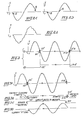
- Figure 1 of the drawings illustrates three different waveshapes depicting the voltage versus time characteristics of three alternating current voltages having peak voltage values of 130 volts, 95 volts and 15 volts, respectively. From a review of Figure 1, it will be observed that while each of the voltage waveshapes have different peak voltage values, they all cross through zero value at substantially the same point. In the case of zero crossing synchronous AC switching circuits employing semiconductor switching devices, because of the substantially instantaneous turn-on and turn-off characteristics of such semiconductor switching devices, a circuit such as that described in U. S. Patent No.
- FIG. 3381,226 - issued April 30, 1968 can appropriately be used in switching applications wherein the applied alternating current may have peak voltage values extending between the wide range of values depicted in Figure 1 or even over a greater range of values.
- Figure 2 of U. S. Patent No. 3,381,226 illustrates a typical voltage versus . time waveshape for an alternating current supplying a resistive load and shows at the respective zero crossings of the voltage waveshape acceptable limits within the region of the zero crossing wherein the zero crossing switching effectively can be achieved.
- a piezoelectric ceramic bender-type switching device may require a charging time of several milliseconds to effectively charge the piezoelectric ceramic plate element comprising a part of the bender member of the switching device to a sufficient voltage to cause it to move the bender member and close a set of load current carrying switch contacts that also comprise part of the piezoceramic switching device.
- the time required to charge the piezoceramic plate element of a bender-type switching device is of the order of 1 or 2 milliseconds, and that in a 60 hertz alternating current wave there are 8.3 milliseconds in each half cycle of the wave between the zero crossings, then it will be appreciated that a 1 or 2 millisecond charging time extends substantially further out in the phase of an applied alternating current voltage so as to be substantially effected by different peak voltage values of the applied alternating current as depicted in Figure 1. This is in contrast to power semiconductor switching devices whose turn-on and turn-off response times are of the order of only a few hundred microseconds or less.
- an acceptable "window" for turn-on and turn-off of a piezoceramic bender-type switching device must be designed into a suitable zero crossing synchronous AC switching circuit and is quite dependent upon the nature of the supply alternating current potential and in particular the peak voltage values expected to be used with any particular circuit design.
- a properly constructed zero crossing synchronous AC switching circuit according to the invention would be designed to accommodate as wide variations in peak voltage values of an applied alternating current potential as is feasible in the light of the physical characteristics of piezoceramic bender-type switching devices.
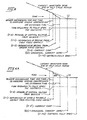
- Figure lA which is intended to depict a circuit according to the invention designed for nominal peak voltage values extending from 110 to 230 volts at a frequency of 60 hertz
- application of the leading edge of the bender energizing potential to the bender member shown at 11 leads the naturally occurring current zero by a predetermined angular phase interval related timewise to a 2 millisecond charging period required to charge the capacitance of the piezoceramic bender member to a sufficient value to cause it to bend and close the load current carrying contacts of the switching device either at the naturally occuring current zero or as near thereto as possible.
- the "window" 11, 11' within which successful zero crossing synchronous AC switching can be achieved does not necessarily have to occur precisely at the zero crossing, but can even lag the zero crossing by a finite time period of the order of a milisecond or less and still achieve proper switching action. It is preferred however that actual contact closing be ahead of the zero crossing for best performance of the switch especially where the inherent bounce in switching contacts will usually cause multiple arcs and contact erosion..
- Figure lB of the drawings illustrates what happens in the event that actual switch contact closure occurs too late after the zero crossing where the tailing end of the zero crossing "window" shown at 11' occurs at a point where the alternating current voltage value has built up substantially in advance of initial contact closure. Under these conditions, current flow at contact closure can be so large as to cause welding at any point during the remainder of the succeeding half cycle of the alternating current wave and severe erosion of the contact surface can result.
- Figure 1C of the drawings illustrates preferred positioning of the zero crossing window under conditions where load current carrying switch contacts are opened with the zero crossing switching circuit.
- opening of the switch contacts leads the naturally occurring zero crossing by a substantial amount in order to assure that current extinction across the contacts occurs at or as near to the first naturally occurring zero crossing as possible.
- the trailing edge of the window shown at 11' may lag the naturally occurring zero crossing by only a slight amount at the time of current extinction.
- Figure 2 of the drawings illustrates an idealized voltage versus time sinusoidal waveshape which hardly ever occurs in nature, but which nevertheless is the ideal voltage versus time waveform sought to be achieved in supplying alternating current excitation potential to switching devices of the type under consideration.
- Figure 2A illustrates what in fact can happen in the real world of switching devices used in residential, commercial and industrial environments in regard to the nature of the supply excitation potential supplied to such devices. This same comment also is true with respect to Figures 2B-2E.
- a supply excitation potential starts with the ideal waveform illustrated in Figure 2, but half way through a half cycle a severe interruption 12 occurred on the transmission line supplying the voltage which produces a steep decrease in voltage known as a voltage spike having high rate of change of voltage with respect to time (high dv/dt).
- this high dv/dt voltage spike applied across its load terminal will appear as a gating turn-on pulse 12' reproduced in curve 2A(2) below the voltage spike 12 in Figure 2A(1).
- FIGS 2B-2C show other forms of supply voltage and current perturbations which seriously can effect operation of switching devices and with respect to which the switching device constructed according to the invention must be designed to accommodate.
- FIG. 2B of the drawings illustrates what happens to the AC supply line voltage in the event that a phase control device such as a light dimmer is used on the same AC supply transmission line that supplies a switching current according to the invention.
- a substantial voltage dip shown at 13 occurs in the supply line AC voltage waveshape during each cycle or half cycle thereof at the point where the phase control device turns-on and supplies a portion of the cycle or half cycle supply current to a light or other apparatus being controlled via the dimmer switch phase control device.
- the sharp voltage dip 13 produced by operation of tne phase control device on the same AC voltage supply transmission line can move around with respect to its location in the phase of the supply alternating current potential dependent upon the nature and setting of the phase control device. As illustrated in Figure 2D it even can occur at or close to the naturally occurring zero crossing of the AC voltage wave. See, for example, an article entitled "Evaluation of Mains-Borne Harmonics Due to Phase-Controlled Switching" - by G. H. Haenen of the Central Application Laboratory - Electronic Components and Material Produce Division, N.V. Philips Gloeilampenfabrieken, Eindhoven, The Netherlands.
- This type of perturbation appearing upon the supply alternating current voltage applied to switching circuit constructed according to the invention also must be accommodated by the circuit without false turn-on or turn-off as can occur with semiconductor switching devices discussed earlier with respect to Figure 2A of the drawings.
- Figure 2E of the drawings shows still another distorted alternating current waveshape that can appear in supply alternating current potential sources and wherein harmonic distortion illustrated in Figure 2 as a higher frequency undulating wave superimposed on the fundamental frequency of the supply alternating current potential, is present.
- harmonic distortion can be produced, for example, at the output of an inverter circuit power supply that operates to convert direct current electric potential into an alternating current electric potential of a desired fundamental frequency such as 60 hertz.
- the inverter circuit may operate at a substantially higher frequency than the fundamental frequency and its output summed together to produce the desired output fundamental frequency having superimposed thereon harmonic distortion characteristics as shown in Figure 2E.
- Zero crossing synchronous AC switching circuits employing piezoceramic bender-type switching devices according to the invention also must be able to accommodate operation with supply AC voltage waveshapes possessing harmonic distortion characteristics as illustrated in Figure 2E.
- the present invention is designed so that it will apply bender excitation potential to the bender member of the piezoceramic bender-type switching device at a point in the phase of the supply alternating current shown at 11C in Figure 3(l) and the bender member closes at or prior to a point 11C' to establish current flow through the switch contacts as shown in Figure 3(2) at 11C'.
- the load current carrying contacts thereafter will remain closed and supply load current until it is desired to terminate load current flow.
- bender excitation potential is removed from the bender piezoceramic plate element so that it starts to open at 11-0 as shown in Figure 3(1) and actually interrupts current flow at 11-0' as shown in Figure 3(2).
- the bender member starts to open the contact as shown at 11-0 in Figure 3B and the contacts are open at 11-0' at which point current flow through the switch contacts is extinguished as shown in Figure 3D.
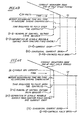
- Figures 4, 4A, 4B and 4C illustrate in even greater detail the physical and electrical phenomena occurring in the region of contact opening to interrupt current flow through the load current carrying switch contacts.
- the naturally occurring sinusoidal current zero is shown at CZ.
- the point of removal of the energization control voltage from the bender piezoceramic plate element is shown at 11-0 conforming to the same point shown in Figures 3A-3D.
- the current waveform shown in Figure 4 corresponds to that obtained with a contact system using bridging contacts wherein a movable bridging conductive bridge member moves to close on two fixed contacts to short circuit the contacts to initiate current flow and thereafter selectively is moved away from short circuiting position to interrupt current flow through the contacts.
- any such bridging contact arrangement movement of the bridging contact member away from the closed position to interrupt current flow will separate the bridging member from one or the other of the fixed contacts prior to separation from the other fixed contacts.
- Such a bridging contact arrangement is illustrated by the waveform shown in Figure 4 so that separation of the bridging member from the first fixed contact is shown at 11-1. Separation of the bridging member from the second fixed contact is shown at 11-2. From Figure 4 it is seen that the load current continues at its established normal sinusoidal level between the time 11-0 when the control energizing bender potential was removed to 11-1 where separation of the bridge member from the first fixed contact occurs.
- the current through the contact is reduced slightly due to an arc between the movable bridge and the first contact, and thereafter it is reduced at a greater rate after point 11-2 following separation of the bridge from both the first and second fixed contacts.
- the period of time extending between 11-2 and 11-0' is the period of time that an arc exists in the space separating both the first and second fixed contacts from the movable bridging member.
- the voltage across the separated switch contacts is no longer sufficient to maintain the arc as shown at the point 11-0' where current extinction occurs and is identified as current chop.
- the current will remain at zero but the applied alternating current voltage will pass through the naturally occurring sinusoidal voltage and current zero as is normal for resistive loads and will reappear as an increasing reverse polarity potential across the now open switch contacts.
- the voltage withstandability of the switch contacts is increased by the bender member continuing to separate the movable bridging member from the fixed contacts by continuing to drive the movable bridging member to its fully opened position shown at 11-FO.
- FIG 4A illustrates the conditions occurring where the load current carrying switch contacts of the piezoceramic bender-type switching device are comprised by a single fixed contact and a single movable contact which have been closed previously to initiate current flow and later opened to interrupt current flow.
- the control energizing potential applied to the bender member is removed at point 11-0 well in advance of the naturally occurring current zero CZ.
- the single movable contact separates from the coacting fixed contact.
- the time between points 11-0 and 11-1 are the times required for the bender to discharge sufficiently to be overcome by the bender member spring compression to start to open.
- Figure 4B of the drawings illustrates a condition where at the point of contact separation shown at 11-1 in Figure 4B, the voltage across a separating set of silver alloy contacts is less than approximately 20 volts.
- current chop shown at 11-0' will occur simultaneously with initiation of contact separation and current flow through the contacts will be extinguished due to the fact that there is insufficient voltage existing across the contacts to strike a stable arc.
- current extinction current chop
- Figure 4C depicts a more generalized version of the current extinction phenomenon illustrated in Figure 4B.
- the switching circuit is designed such that separation of the contacts at 11-1 occurs at a current value Ie which is below a stable arc holding current value for the particular material out of which the switch contacts are fabricated. If thus operated, current extinction (current chop) occurs simultaneously with separation of the switch contacts so that no arc current is produced and the wear and tear on the contacts is minimal or non-existent.
- materials whose material dependent values of Ie are as follows: molybdenum (Mo) whose Ie is typically less than 16-20 amperes, copper whose Ie is typically less that 6-10 amperes and cadmium whose Ie is less than 1-3 amperes.
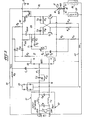
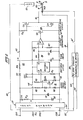
- FIG. 5 is a detailed schematic circuit diagram of an improved zero crossing synchronous AC switching circuit constructed according to the invention.
- the circuit shown in Figure 5 includes a piezoelectric ceramic bender-type switching device 15 which is similar in construction to the bender-type switching device shown and described with relation to Figure 8 or Figure 9 in co-pending U.S. application serial no. (attorney docket RD-16,068) or Figure 5 or Figure 8 of U.S. patent application serial no. (attorney docket RD-16,069).
- the piezoceramic bender-type switching device 15 is comprised by a bender member 16 fabricated from two piezoelectric ceramic plate elements 16A and 16B sandwiched together over separate central conductive surfaces 14U and 14L and having outer conductive surfaces (not shown) comprising an integral part of the plate elements 16A and 16B.
- Bender member 16 further includes a contact surface 18 formed on the movable end thereof which is designed upon bending to contact and close an electrical circuit through fixed contacts 19 or 21, respectively, depending upon the direction in which bender member 16 is caused to move. Bender member 16 is clamped at the opposite end thereof by clamping means (not shown).
- the central conductive surface 17 of bender member 16 is electrically connected at one end to the movable outer contact 18 at one end thereof and at its clamped end is electrically connected to a terminal bus bar conductor 22 whose remaining end is directly connected to an input terminal 23A supplied from an input 230 volt alternating current source of electric potential.
- the remaining input terminal 23B of the alternating current supply source is connected back through a terminal bus bar conductor 24 to one input terminal of a first load 25 and to one input terminal of a second load 26.
- the remaining input terminal to the loads 25 and 26 are connected respectively to the fixed contacts 19 and 21 of the piezoceramic bender-type switching device 15.
- zero crossing sensing circuit means shown generally at 31 are provided in the circuit of Figure 5.
- the zero crossing sensing circuit means 31 is comprised by a full wave rectifier 32 having one of its output terminals connected through a diode D01 to the positive terminal of a high voltage direct current source comprised by a second full wave rectifier 33, a resistor capacitor filter network RlCl and a voltage limiting zener diode Z.
- the remaining output terminal of zero crossing full wave rectifier 32 is connected through a negative terminal conductor 43 to the high voltage direct current fullwave rectifier 33.
- the zero crossing sensing circuit means 31 further includes a unijunction transistor UJ1 whose B2 base is connected through a resistor R2 to the positive terminal of zero crossing full wave rectifier 32 and whose Bl base is connected through voltage limiting resistors R3 and R4 in series to the negative DC voltage terminal bus bar conductor 43.
- the emitter of unijunction transistor UJ1 is connected directly to the movable contact of a potentiometer R5 and via a timing capacitor C2 to the junction of the voltage limiting resistors R3 and R4.
- UJ1 is locked out and prevented from conducting at all other times during the cycle by a positive bias applied hereto via resistor R8 and diode D02.
- lock out of UJ1 during most of the AC cycle does not prevent the continuous application of an energization potential across one or the other of the piezoceramic plate elements 16A or 16B whose capacitances are illustrated in the circuit of Figure 5 by the capacitors CB16A and CB16B, respectively, and which are discharged when not being energized through high resistance discharge resistors R16A and R16B, respectively.
- each bender element capacitor CB16A and CB16B Independent control of the charge on each bender element capacitor CB16A and CB16B is made possible by the insulatingly separated inner conductive surfaces (not shown) of the bender member which allow the bleeder resistors R16A or R16B to discharge whichever capacitor's associated charging transistor Ql or Q2 is turned-off.
- the production of an output pulse by the unijunction transistor UJ1 at any given zero crossing in the above-described manner is determined upon the state of charge of the timing capacitor C2. This in turn is determined by which steering diode Dl or D2 is effective to connect its timing resistor R6 or R7 in circuit relationship with a common potentiometer resistor R5 and thereby supply charging current to timing capacitor C2.
- the steering diode Dl will have its anode drawn down so that it becomes blocking and only diode D2 can then supply charging current through its timing resistor R7 and potentiometer R5 to the charging capacitor C2.
- Q2 is conducting and Ql blocking.
- the two transistors Ql and Q2 form a bistable flip-flop circuit that comprises a bender energizing potential control circuit means shown generally at 34 which is responsive to the zero crossing timing signal produced by UJ1 for selectively applying or removing an energizing potential across the piezoceramic plate elements 16A or 16B, alternately.
- the switching system provides a substantially constant period with a wide range of time ratio adjustments for the percentage of time during which movable contact 18 is closed on fixed switch contact 19 and vice versa.
- the bender energization potential control circuit 34 means comprised by the astable flip-flop circuit Ql and Q2 has the collector electrodes of transistors Ql and Q2, which are NPN bipolar transistors, connected directly to one plate of each of capacitors CB16A, CB16B, respectively, formed by the piezoceramic plate elements 16A and 16B.
- a common voltage limiting resistor R8 is connected to the remaining plates of capacitors CB16A and CB16B and is supplied from the positive terminal of the high voltage DC source comprised by full wave rectifier 33 filter circuit RlCl.
- the energizing potentials applied to the prepolarized piezoelectric plate elements 16A and 16B of bender member 16 always will be of the same polarity as the polarity of the prepolarization potentials used to initially prepolarize the bender plate elements.
- the emitter electrodes of transistors Q2 are connected via the series connected limiting resistors R3 and R4 to the negative terminal conductor 34 of the high voltage DC source 33. Feedback coupling from each of the transistors Ql and Q2 between the collector and bases thereof in order to assure astable flip-flop operation, is provided by feedback capacitors C3 and C4 together with resistors R9 and R10 and resistors Rll and R12, respectively.
- capacitor C3, resistor R9 and resistor R10 feedback the voltage appearing on the collector of transistor Ql to the base of transistor Q2 to cause Q2 either to turn-on or turn-off depending upon the conducting state of the opposite transistor Ql.
- C4, Rll and R12 couple potential on the collector of Q2 back to the base of Ql so that either one or the other is conducting or vice versa but neither is allowed to conduct simultaneously, therey forming a bistable circuit which changes state whenever UJl timing circuit 31 delivers an output pulse to R3 R4.
- While Ql is conducting piezoelectric plate element 16A of bender 16 is energized so as to close movable contact 18 on fixed contact 19 and supply load current flow through the load 25.
- load 26 is supplied with load current.
- phase shift circuit means shown generally at 36 is comprised by a capacitor C5 having a resistor R13 connected in parallel circuit relationship across it with the parallel circuit thus formed being connected in series with a resistor R14 between the input of the zero crossing detector 32 and the AC supply input terminals 23A and 23B.
- the phase shift circuit means 36 is designed so as to introduce a leading phase shift of the zero crossing timing signal pulses produced by the rectifier 32 and unijunction transistor UJ1 in advance of the naturally occurring zero crossings of the supply AC source.
- energization potential applied by the bender energizing potential control circuit means 24 by either of the transistors Ql or Q2 in response to the zero crossing timing signal pulses always occurs well in advance of the naturally occurring zero crossing sinusoidal AC signal being applied via switch contacts 18-19 or 18-20 to the loads 25 or 26 pursuant to the consideration set forth in the above discussion relating to Figures 1-4.
- an input network shown generally at 37 comprises a metal oxide varistor voltage transient suppressor MOV connected across the input terminals 23A and 23B.
- the input network 37 further includes a filter network comprised by conductors Ll and L2 and capacitors C5 and C6 connected across the input terminals 23A and 23B in the manner shown in series with the HOV voltage suppressor with the network being connected intermediate the input terminals 23A and 23B and the input to the zero crossing sensing circuit means 31.
- the smoothing input network 37 at this point in the circuit will help smooth many of the perturbations normally appearing in a supply alternating current voltage applied to the inputs 23A and 23B as discussed with relation to Figures 2 and 2A through 2E in particular.
- the AC terminal bus bar conductor means comprised by conductors 22 and 24 for connecting the piezoceramic switching device 15 and loads 25 and 26 across the AC supply input terminals, are connected to the AC supply input terminals at interconnection points in advance of both input network 37, phase shift network 36 and the zero crossing sensing circuit means 31.
- the electrical time constants (i.e., the product of RC) will be uniform from one operation cycle to the next over long periods of usage.
- time as a reference per se cannot be used. Zero crossing detection is more reliable for the reasons discussed with relation to the diagrams of Figures 1-4C showing distortion and notching as well as other perturbations in real AC supply sources.
- timing in order to alleviate the constant response time required of the RC timing systems employed in the bender excitation control circuits, it may also be possible to use that timing in order to provide a slower closing of the switch contacts 18, 19 by the bender member 16 whereby the inertia of the system is greatly reduced and the "window regions" will be made wider.
- Such a timing system will not be as precise, but on the other hand, since there will be greatly reduced bouncing due to the slower bender speed, the amount of arcing and restriking will be significantly reduced. This may give rise to an acceptable trade-off between high speed precision switching in a narrowly defined zero crossing "window region" and less wear and tear on the contacts made possible by slower and softer movement of the bender within a more widely defined zero crossing "window region".
- Figure 11 of the drawings illustrates a compromise between these two extremes by providing initial slow bender closure within a narrow window region to achieve precise switching with minimal contact bounce as will be described later with relation to Figure 11.
- FIG. 6 is a detailed schematic circuit diagram of another embodiment of the invention wherein a single piezoelectric ceramic bender-type switching device shown at 15 is employed to supply load current to a load 25 via the movable contact 18 formed on the movable end of the bender member 16 of switching device 15 and coacting with a fixed contact 19 to which a load 25 is connected.
- the load current carrying switch contacts 18 and 19 when closed connect load 25 across the output of a 230 volt AC voltage supply source via the input terminals 23A and 23B.
- Selectively applied energization potentials are applied to the upper plate element of bender member 16 via a conductor 41 supplied from the output from a bender energizing potential control circuit 34 to be described hereafter.
- the bender energizing potential is applied with the same polarity of the prepolarization potential used to initially prepolarize the prepolarized piezoceramic plate elements of the bender member 16.
- the bender energizing potential control circuit 34 is in turn controlled by zero crossing timing signals supplied thereto from a zero crossing sensing circuit means shown generally at 31 via a phase shift circuit means 36 for introducing a preselected phase shift interval into the timing of the application of the bender energization potential to the bender member 16 measured relative to the naturally occurring zero crossing of the sinusoidal AC input voltage supplied to input terminals 23A and 23B.
- a relatively high direct current energizing potential for use by the bender energizing potential control circuit means 34 is provided by a diode rectifier D7 connected through resistor R9 across a filter capacitor Cl and applied via high voltage DC positive bus bar conductor 42 and negative conductor 43 across the bender energization potential control circuit 34 for selective application via conductor 41 to the upper bender plate element of bender member 16 as shown in Figure 6.
- a low voltage direct current potential is developed by diode D6, resistor R10 and capacitor C2 across a low voltage bus bar conductor 44.
- This low voltage DC potential is stabilized by a zener diode D5 for use by the signal level components comprising part of the zero crossing sensing circuit means 31 as a low voltage signal level DC excitation source.
- the zero crossing sensing circuit means 31 is comprised by a set of series connected, opposed polarity diodes Dl and D2 connected in series circuit relationship with a voltage limiting resistor R2 across the alternating current output from the input network 37 ahead of the high voltage DC rectifier D7.
- the juncture of the cathode of diode Dl and the cathode of the diode of D2 is connected to the base of a bipolar NPN transistor Ql whose collector electrode is connected through a resistor R3 to the low voltage DC positive bus conductor 44.
- the emitter of transistor Ql is connected to the juncture of the anode of a second set of reverse polarity series connected diodes D3 and D4 connected in parallel circuit relationship across the first set of diodes Dl and D2 between the bottom of limiting resistor R2 and the negative polarity common bus conductor 43.
- transistor Q1 is rendered conductive only at the zero crossings of the input alternating current supply voltage at points where its base is biased positively relative to its emitter via diodes Dl and D3.
- Ql will put out a series of zero crossing timing pulses that appear across resistor R3 and are applied to the CK clock input of a bistable latch Ul.
- Bistable latch Ul is energized from the low voltage positive bus bar conductor 44 and in addition to the zero crossing timing clock signal pulses, has an enabling signal selectively applied to its D input terminal by a user operated switch SW1 via resistor Rll.
- Bistable latch Ul may comprise any known commercially available integrated bistable latching circuit such as the dual type B flip-flop manufactured and sold commercially by the Motorola Company under the product designation MC14016B, and illustrated and described in a product specification booklet entitled "CMOS Integrated Circuits - Series C", third printing, copyrighted by Motorola, Inc. in 1978.
- the bistable latch Ul upon the application of an enabling potential to its D input terminal from user switch SW1 simultaneously with the application of a zero crossing timing pulse to its CK input terminal, will produce a positive polarity output control signal at its Q output terminal.
- This positive output control signal is supplied via phase shift cicuit 36 comprised by resistor R4 and C3 to the positive input terminal of a comparator amplifier U2.
- phase shift circuit 36 introduces a phase shift interval relative to the zero crossings of the supply AC voltage, both with respect to the timing of the application of an energizing potential to the upper plate element 16A of bender member 16 and the timing of removal of such energizing potential, as will be explained more fully hereafter with relation to Figure 10 of the drawings and its related waveshapes.
- the comparator amplifier U2 may comprise any commercially available integrated circuit comparator such as the quad programmable comparator manufactured and sold commercially by Motorola, Inc. under the product identification number MC14574 and described in the above-noted specification sheet published by Motorola.
- the phase synchronized bender turn-on control signal from bistable latch Ol output terminal is supplied via phase shift circuit 36 is applied to the positive input terminal of the U2 comparator amplifier.
- a reference signal derived from a voltage dividing network R6 and R7 connected across the low voltage direct current supply source 44-43, is applied to the negative input terminal of U2 for comparison to the bender excitation control signal.
- a positive polarity turn-on signal Upon the bender excitation control signal exceeding this reference input signal by a predetermined amount, a positive polarity turn-on signal will be supplied to an output drive amplifier circuit comprised by field effect transistors Q2, Q3 and Q4 which together with the output comparator amplifier U2 comprise the bender energization potential control circuit means 34 for controlling application of a relatively high voltage direct current energization potential across conductor 41 to the upper plate element 16A of bender member 16.
- the zero crossing detector comprised by the diode network Dl, D2, D3 and D4 senses the occurrance of the zero crossing of the input applied alternating current potential and via resistor R2 and transistor Ql produces output zero crossing timing signal pulses that are applied to the clock input terminal CK of bistable latch Ul. If user operated switch Sill is open as shown in Figure 6, bistable latch Ul will remain in its off condition wherein no positive polarity output potential appears at its Ol output terminal. Upon closure of switch SIll by a user, an enabling potential is applied to the D input terminal of Ul which then causes bistable latch Ul to switch its operating condition and produce at output terminal Ol a positive polarity turn-on control signal simultaneously with the occurrence of one of the zero crossing timing pulses.
- This turn-on control signal is shifted in phase by phase shift network R4C3 by a preselected phase interval that corresponds in time to the time required to charge the upper piezoceramic plate element of bender member 16 together with sufficient time to accommodate any other perturbations occurring in the system, such as contact bounce, etc.
- the turn-on control signal from the output terminal of comparator U2 is caused to lead the naturally occurring zero crossings of the AC voltage being supplied through conductors 22 and 24 across load 25 and the switch contacts 19, 18 of the piezoceramic bender-type switching device 15.
- This leading turn-on control signal then is supplied to the FET output drive amplifier circuit comprised by FET transistor Q2, Q3 and Q4 which applies an energization potential through conductor 41 to the upper piezoceramic plate element of bender member 16.
- the movable contact 18 will be caused to close on fixed contact 19 substantially at or close to a naturally occurring zero crossing of the sinusoidal AC supply voltage and supply load current flow through load 25 with minimal stressing of the switch 18, 19 contacts.
- the second control circuit 50 is connected in common to the same AC supply terminals 23A and 23B that the first circuit is connected to and has its output DC energizing potential applied over a conductor 41' to the lower piezoceramic plate element 16B.
- the polarity of the DC energizing potential will be the same polarity as that of the prepolarizing potential used to prepolarize piezoceramic plate element 16B.
- Figure 7 is a detailed schematic circuit diagram of still another embodiment of a zero crossing synchronous AC switching circuit employing piezoceramic bender-type switching devices according to the invention.
- the circuit of Figure 7 is in many respects quite similar to the circuit of Figure 6 and accordingly like parts of the two circuits have been identified by the same reference numbers and operate in the same manner.
- the Figure 7 circuit has been designed for use with a lower voltage alternating current supply source such as a 120 volt AC system normally found in residences.
- the circuit of Figure 7 is provided with a high DC voltage doubler recitfier circuit comprised by diode Dll, capacitor C4, capacitor C5 and diode D10 connected in the manner shown for developing a high DC voltage of approximately 300 volts across the high voltage DC bus bar conductor 42 measured with respect to the bus bar conductor 42 1 .
- the circuit of Figure 7 has a differently designed phase shift circuit 36 whereby two different phase shifts can be inserted in the output control potential derived from output terminal Ol of bistable latch Ul.
- a first time constant resistor R4 is inserted in effective operating circuit relationship by a steering diode D8 whenever the output terminal 01 goes positive relative to its previous state.
- steering diode D9 Upon switching bistable latch Ul to its opposite condition where the output terminal Ol goes negative relative to its previous state, steering diode D9 inserts a second different time constant determining resistor R4A in effective operating circuit relationship.
- Figure 8 is a voltage and current versus time waveshape illustrating the lagging load current induced by an alternating current applied across a reactive load which is highly inductive in nature.
- the inductive nature of the load causes the load current to lag the applied line voltage by a predetermined number of electrical degrees which in the Figure 8 illustration is about 60 degrees lagging. From Figure 8 it will be appreciated therefor that the applied voltage will have different zero crossings from the load current flowing in the load and in the case shown lead the current zero crossing by a predetermined number of degrees.
- This situation increases the demand on the capabilities of zero crossings synchronous AC switching circuits intended for use with reactive loads, whether the reactive load is inductive in nature or capacitive in nature (lagging or momentarily leading).
- This demand is satisfied in the present invention by providing the switching circuit with a current zero crossing sensing capability and using that current zero crossing capability to achieve interruption of current flow when desired. Since the current zero crossing detector will dynamically track the changing phase of the current zero crossings, proper interruption is assured.
- the core of the current sensing transformer will be driven out of saturation in the negative direction, pass through its BH curve and then be driven into saturation in the positive going direction. While the core of the current sensing transformer is saturated, it is incapable of producing any output signal. However, while it is passing through its BH hysteresis curve and the core is unsaturated, it will produce output current pulses in a secondary winding coupled to the core which are used as the current zero crossing timing signals.
- Figure 9 illustrates a zero crossing synchronous AC switching circuit constructed according to the invention which is intended for use with reactive loads.
- the zero crossing switching circuit of Figure 9 is in many respects quite similar to that shown in Figure 7 of the drawings but differs therefrom in that it includes the capabilitiestiy of sensing current zero crossings for use in controlling current interruption of the zero crossing synchronous AC switching device.
- the Figure 9 circuit includes a current zero crossing detector comprised by a current transformer CT1 having a core 52 designed in the manner described in the preceeding paragraph so that it unsaturates as the reactive load current passes through the zero crossing region shown at 51 in Figure 8B.
- Core 52 has one turn of the reactive load current carrying conductor 24 wound around it for sensing purposes and is inductively coupled to a center-tapped secondary winding 53 whose center-tapped point is connected to the negative low voltage DC bus bar conductor 43.
- the free end of the secondary windings 53 are connected through respective diodes D12 and D13 to the input of a transmission gate T2.
- Transmission switch T2 and its counterpart Tl both comprise logic means for processing the current zero crossing signal pulses indicated at V2 and the voltage zero crossing pulses Vl derived from voltage zero crossing sensing circuit means 31 and supplying one or the other to the CK input terminal of bistable latch Ul in the bender energization potential control circuit means 33.
- the transmission switches Tl and T2 both preferably comprise commercially available logic transmission switches such as the CMOS Quad Analog switch number MC14016B manufactured and sold commercially by the Motorola, Inc.
- the characteristics of the transmission switches Tl and T2 are described in the above-referenced Motorola MCOS Integrated Circuit Product Specification handbook copyrighted in 1978 and reference is made to that handbook for a more detailed description of the construction and operating characteristics of the transmission switches.
- Figure 9A depicts the characteristics of the transmission switches Tl and T2 wherein it can be seen that if a positive polarity potential is applied to the upper inverted input to the Tl switch identified by the small circle and a negative potential is supplied to its lower input terminal, then the transmission switch is open and will not supply signal currents therethrough the same manner that the load current carrying switch 18, 19 with its switch contacts in an open state. Conversely, if a negative polarity potential is applied to the upper inverted input to the transmission switch and a positive polarity potential is applied to its lower input terminal, the switch is closed and it will conduct signals therethrough.
- bistable latch Ul While thus conditioned, if user operated switch SW1 is closed to provide an enabling potential to the D input terminal of Ul, upon the next successive voltage zero crossing signal pulse produced by the voltage zero crossing sensing circuit means 31 it will be supplied through transmission switch Tl to the CK input terminal of Ul and will cause bistable latch Ul to switch its conducting state so that a positive output control potential appears at its direct output terminal 01 and a negative potential appears at its inverse output terminal Ol .
- bistable latch Ul will remain in this set condition and only current zero crossing pulses derived by the current zero sensing circuit CT1 will be supplied to the CK clock input terminal of Ul.
- the current zero crossing timing signal supplied to the clock input terminal CK of bistable latch Ul will have no effect however until such time that the user operated switch SW1 is opened for the purpose of interrupting current flow to the load current carrying switch contacts 18 and 19A, 19B.
- the bender switch 15 shown in Figure 9 preferably comprises a switching device similar to that illustrated and described with relation to Figure 3A of above-referenced co-pending U.S. application serial no. (attorney docket RD-16,069) wherein the contact surface formed on the movable end of the bender member 16 is in the form of a conductive bar 18 which is designed to bridge between a set of two spaced apart fixed contacts 19A and 19B upon movement of the bender member 16 to close bridge member 18 on the two fixed contacts 19A and 19B.
- Load current flow will then take place from input terminal 23A through the load 25, fixed contact 19A, the bridging bar contact 18 and fixed contact 19B back through the load current sensing transformer core of CT1 to the input terminal 23B.
- the bridging bar contact 18 is electrically isolated from the bender member 15.
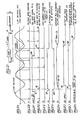
- Figure 10A is a voltage and current versus time waveform illustrating the lagging load current flow induced in a load by an applied alternating current potential.
- Figure 10B illustrates the Vl voltage zero crossing timing pulses produced by the voltage zero crossing sensing circuit 31 and supplied to the input of transmission switch Tl. By comparing Vl timing signal pulses to the solid line voltage waveform shown in Figure 10A it will be seen that these voltage pulses coincide with the zero crossing region of the voltage waveform.
- Figure 10C illustrates the enabling-on potential applied to the D input of bistable latch Ul by the user operated on/off switch SW1. From Figure 10C it will be noted that the user switch SW1 is turned on at 61 by the user and then turned off at 62. During the interval of time between 61 and 62 the high (on) enabling potential is supplied to the D input terminal of Ul.
- Figure 10D illustrates the clocking input pulses supplied to the CK input terminal to control operation of bistable latch Ul by either transmission switch Tl or transmission switch T2. It should be noted that the initial CK pulses coincide with the voltage zero crossing of the applied line voltage.
- bistable latch Ul After point 61 when the user on/off switch enables the D input terminal to the bistable latch Ul, the coincidence of the enabling potential shown in Figure 10C with the occurrance of the CK voltage zero crossing pulse shown at 63 in Figure 10D causes bistable latch Ul to be switched to its set condition wherein its output terminal 01 goes positive as shown in Figure 10F and its inverse output terminal 01 goes negative as shown in Figure 10G. Due to the phase shift induced by the phase shift circuit 36 with the timing resistor R4 operatively connected in the circuit via steering diode D8 a V3 output control potential having the characteristics shown in Figure 10H is produced at the input to the comparator amplifier U2 wherein the rise in potential to a level adequate to trigger an output from U2 is delayed by the time constant R4-C3.
- Q2 input potential illustrated in Figure 10I as shown at 64 at the point in time when the rise in voltage V3 exceeds the reference potential applied to comparator amplifier U2 and causes it to switch to its on conducting condition and apply an input to the Q2 amplifier.
- Q2, Q3, Q4 and Q5 form an output driver amplifier stage which comprises a part of the bender energizing potential control circuit 34 and serves to develop an amplifier bender energization potential VB that is supplied to the upper piezoceramic plate element of bender member 16 and coincides substantially with the point in time shown at 64.
- the bridging contact member 18 closes on fixed contacts 19A and 19B as shown at 65 to initiate current flow through the load 25.
- the interval of time between point 64 and point 65 is determined primarily by the time constant of the R-C charging circuit comprised by the capacitance of the bender 16 piezoceramic plate element and a timing resistor 66 connected in series circuit relationship with it and supplied from the output of the driver amplifier stage Q4.
- phase shift circuit 36 will be under the timing control of timing resistor R4A via the steering diode D9 so as to allow the bender energizing control potential V3 shown in Figure 10A to decrease in voltage value until it drops below the reference voltage value applied to comparator amplifier U2 and switches the comparator to its off condition at the point in time shown at 68 in Figure 10.
- FIG 11 is a functional schematic drawing of a preferred embodiment of the invention which includes a zero crossing synchronous AC switching circuit 10, by way of illustration, constructed as described with relation to any of Figures 6, 7 or 9 and which further includes a bender member energizing potential control circuit shown generally at 71.
- the control circuit 71 is comprised by a very high resistance resistor 72 that is connected in series circuit relationship with a relatively low value resistance timing resistor 66.
- the capacitor CB-16A is formed by the capacitance of the upper piezoceramic plate element 16A of bender member 16 shown physically in Figure 11 of the drawings below its schematic representation in the control circuit diagram.
- the high resistance resistor 72 which may have a resistance value of the order of 1 megohm introduces a long RC time constant charging network in the current path supplying electric energizing potential to the bender member piezoceramic plate element 16A that will considerably reduce the rate of charging the capacitance CB-16B of the bender plate capacitor element by the zero crossing synchronous AC switching circuit 10 as shown at 81 in Figure llB.
- Control circuit 71 further includes a current transformer saturable core CT2 having a primary winding wound therethrough formed by a loop in the alternating current power supply conductor 24 supplying AC load current to a load 25 via bender operated switch contacts 18 and 19 and conductor 22.
- the saturable core transformer CT2 further includes a secondary winding 73 that is connected to the control gate of a silicon control recitfier (SCR) 74.
- SCR 74 is connected in parallel circuit relationship across the high resistance value resistor 72 in a manner such that when it is rendered conductive, it effectively shorts out the high resistance resistor 72.
- a very large 2 megohm bleeding resistor 75 is connected in parallel circuit relationship across the capacitance CB-16A of the bender plate element 16A to assure that it is completely discharged after each energization thereof. Resistor 75 does not appreciably voltage divide the supply source voltage. Hence, upon turn-on of SCR 74, a stepped increase to the maximum available voltage from the supply source is applied to the bender member as shown in Figure 11B at 82.
- the bender force is applied to greatly increase the compressive force on the contacts and little or no acceleration forces are induced which otherwise would result in undesirable bounce. Further, the application of the full bender charging voltage at this point substantially increases the compressive force applied by the bender member to the contacts to keep them from separating (i.e. bouncing) after closure and also thereby minimizing contact welding phenomena that are associated with low contact compressive forces.
- Figure 11C is a plot of the load current versus time showing that as the load current builds up following initial contact engagement, it will saturate the core of the current transformer CT2 and thereby result in the production of the current pulse which turns on SCR 74 at the point in question.
- the SCR will remain conductive until there is full voltage on the bender capacitance and then automatically will reset to its open circuit condition due to lack of sufficient holding current. This will result in reinserting the 1 megohm resistor 72 into the circuit.
- the discharge rate of the bender capacitor CP16A will be controlled primarily by the bleeder resistor 75 when the energizing potential applied across conductor 41 is removed.
- the bleeder resistor 75 is proportioned to provide discharge of the bender plate capacitor CB16A at a rate sufficient to assure the separation or opening speed of about 1 inch per second when circuit 10 turns off. This speed of opening is adequate to assure that sufficient gap between the contacts is produced to prevent restriking and arcing between the contacts as they open. It should be noted that the circuit of Figure 11 can also operate with other DC energizing potential sources such as a rectifier supply and a user actuated switch.
- the invention makes available to the industry new and improved zero crossing synchronous AC switching circuits employing piezoceramic bender type switching devices that are relatively much faster responding than electromagnetic operated power switching circuits, and while considerably slower responding than switching circuits which employ power semiconductor devices, the switching circuits made available by the present invention in the off condition provide an open circuit ohmic break in circuit in which they are used to control electric current flow through a load in conformance with U.L. requirements.
- Switching circuits constructed according to the invention do not require semiconductor aided commutation or turn-off assistance circuitry or other components that would introduce high resistance current leakage paths in the AC supply current path to a load and/or additional circuit complexity, cost and power dissipation, such as a snubber.
- the novel zero crossing synchronous AC switching circuit preferably employ novel piezoelectric ceramic bender-type switching devices of the type described and claimed in co-pending U.S. application serial no. (attorney docket RD-16,068) and U.S. patent application serial no. (attorney docket RD-16,069), filed concurrently with this application.
- the novel zero crossing synchronous AC switching circuits further include piezoelectric ceramic bender-type switching device bender member energizing potential control circuit means that initially impresses a relatively low voltage electric energizing potential across the bender member of the switching device to soften its movement and curtail contact bounce and after initial contact closure increasing the energizing potential to increase contact compressive force after initial contact closure.
- the circuits be fabricated in microminiaturized integrated circuit package form (as shown at 91 and 91A in Figure 9) and be physically mounted on non-prepolarized portions of the piezoceramic plate elements 90.
- the portions 90 extend beyond the clamps in a direction away from the movable contact end 18 of the bender member in the manner explained more fully in the above-noted co-pending application serial no. (attorney docket RD-16,068).
- the invention provides a new family of zero crossing synchronous AC switching circuits employing piezoceramic bender-type switching devices for use in residential, commercial and industrial electrical supply systems.
- the novel switching circuits thus provided can be employed to operate both resistive and reactive loads either of an inductive or capacitive nature by the inclusion of a current zero crossing detector and appropriate adjustment of phase shift networks comprising an essential part of the switching circuits.
Landscapes
- Engineering & Computer Science (AREA)
- Power Engineering (AREA)
- Electronic Switches (AREA)
- Keying Circuit Devices (AREA)
- Control Of Voltage And Current In General (AREA)
- Inverter Devices (AREA)
Applications Claiming Priority (3)
| Application Number | Priority Date | Filing Date | Title |
|---|---|---|---|
| US685107 | 1984-12-21 | ||
| US06/685,107 US4626698A (en) | 1984-12-21 | 1984-12-21 | Zero crossing synchronous AC switching circuits employing piezoceramic bender-type switching devices |
| JP60290317A JPH0756767B2 (ja) | 1984-12-21 | 1985-12-23 | 圧電セラミツク撓み式スイツチング装置を用いたゼロクロス同期型acスイツチング回路 |
Publications (2)
| Publication Number | Publication Date |
|---|---|
| EP0187300A2 true EP0187300A2 (de) | 1986-07-16 |
| EP0187300A3 EP0187300A3 (de) | 1989-02-08 |
Family
ID=64556618
Family Applications (1)
| Application Number | Title | Priority Date | Filing Date |
|---|---|---|---|
| EP85115814A Withdrawn EP0187300A3 (de) | 1984-12-21 | 1985-12-11 | Im Nulldurchgang synchron schaltende Wechselstromschaltkreise unter Verwendung von piezokeramischen Schaltvorrichtungen des Biegevorrichtungstyps |
Country Status (5)
| Country | Link |
|---|---|
| US (1) | US4626698A (de) |
| EP (1) | EP0187300A3 (de) |
| JP (1) | JPH0756767B2 (de) |
| CA (1) | CA1250940A (de) |
| MX (1) | MX160702A (de) |
Cited By (2)
| Publication number | Priority date | Publication date | Assignee | Title |
|---|---|---|---|---|
| DE4231242A1 (de) * | 1992-09-18 | 1994-03-24 | Buderus Heiztechnik Gmbh | Verfahren zum Verringern des Verschleißes von elektromechanischen Relais |
| WO2011101193A1 (de) * | 2010-02-17 | 2011-08-25 | E.G.O. Elektro-Gerätebau GmbH | Verfahren und vorrichtung zum ausschalten eines schalters |
Families Citing this family (34)
| Publication number | Priority date | Publication date | Assignee | Title |
|---|---|---|---|---|
| DE3909262A1 (de) * | 1988-03-25 | 1989-10-12 | Gen Electric | Steuersystem, atmosphaerische kuehlvorrichtung und verfahren zum betreiben der kuehlvorrichtung |
| US5235159A (en) * | 1988-03-25 | 1993-08-10 | General Electric Company | Control system, method of operating a heating apparatus and controlled heating apparatus |
| US4967568A (en) * | 1988-03-25 | 1990-11-06 | General Electric Company | Control system, method of operating an atmospheric cooling apparatus and atmospheric cooling apparatus |
| US5008516A (en) * | 1988-08-04 | 1991-04-16 | Whirlpool Corporation | Relay control method and apparatus for a domestic appliance |
| US5410193A (en) * | 1992-10-02 | 1995-04-25 | Eastman Kodak Company | Apparatus and technique for connecting a source of zero crossing AC voltage to and disconnecting it from an AC load line |
| US5442335A (en) * | 1992-11-13 | 1995-08-15 | I.D. Tek Inc. | Controller for controlling operation of at least one electrical load operating on an AC supply, and a method thereof |
| US5394018A (en) * | 1992-12-31 | 1995-02-28 | Eaton Corporation | Microprocessor based electrical apparatrus with false AC input rejection |
| US5719447A (en) * | 1993-06-03 | 1998-02-17 | Intel Corporation | Metal alloy interconnections for integrated circuits |
| ATE197207T1 (de) * | 1993-07-19 | 2000-11-15 | Flux Pty Ltd T | Elektromagnetische maschine mit dauermagnetläufer |
| US5416404A (en) * | 1994-03-24 | 1995-05-16 | Hubbell Incorporated | Extremely low power zero crossing circuit |
| US5559426A (en) * | 1994-06-03 | 1996-09-24 | Eaton Corporation | Synchronous contactor |
| US6057520A (en) * | 1999-06-30 | 2000-05-02 | Mcnc | Arc resistant high voltage micromachined electrostatic switch |
| US6229683B1 (en) | 1999-06-30 | 2001-05-08 | Mcnc | High voltage micromachined electrostatic switch |
| US6359374B1 (en) | 1999-11-23 | 2002-03-19 | Mcnc | Miniature electrical relays using a piezoelectric thin film as an actuating element |
| DE10025561A1 (de) | 2000-05-24 | 2001-12-06 | Siemens Ag | Energieautarker Hochfrequenzsender |
| DE60139205D1 (de) * | 2000-07-13 | 2009-08-20 | Clark Davis Boyd | Selbstspeisendes schaltbauelement |
| EP1421632B2 (de) | 2001-07-03 | 2015-01-07 | Face International Corporation | Selbstversorgendes schalterinitialisierungssystem |
| US6731492B2 (en) | 2001-09-07 | 2004-05-04 | Mcnc Research And Development Institute | Overdrive structures for flexible electrostatic switch |
| DE10150128C2 (de) | 2001-10-11 | 2003-10-02 | Enocean Gmbh | Drahtloses Sensorsystem |
| DE10311447B4 (de) * | 2003-03-15 | 2007-06-06 | Schott Ag | Schaltungsanordnung für ein Elektrogerät |
| US7193337B2 (en) * | 2003-09-09 | 2007-03-20 | Honeywell International Inc. | System and method utilizing a solid state power controller (SSPC) for controlling an electrical load of a variable frequency three-phase power source |
| US7081735B1 (en) * | 2003-09-16 | 2006-07-25 | Rockwell Automation Technologies, Inc. | System and method for bypassing a motor drive |
| US8193787B2 (en) | 2010-07-06 | 2012-06-05 | V Square/R, LLC | System and method for regulating RMS voltage delivered to a load |
| US8878468B2 (en) | 2011-04-29 | 2014-11-04 | Pratt & Whitney Canada Corp. | Electric machine assembly with fail-safe arrangement |
| CA2925490C (en) | 2012-06-01 | 2020-04-14 | Bipco-Soft R3 Inc. | Power control device |
| AR087722A1 (es) * | 2012-08-29 | 2014-04-09 | Exo S A | Dispositivo electronico para conexion a la red electrica de corriente alterna de dos o mas cargas y procedimiento de conexion que este ejecuta |
| US10250032B2 (en) | 2015-04-24 | 2019-04-02 | Vertiv Corporation | Intelligent power strip with management of bistable relays to reduce current in-rush |
| US9991066B2 (en) * | 2016-01-11 | 2018-06-05 | Honeywell International Inc. | Synchronizing switching times of relays to a zero-crossing |
| CN110168391B (zh) | 2017-01-06 | 2021-11-16 | 维谛公司 | 识别通过智能电源板的剩余电流的路径的系统和方法 |
| CA3147955A1 (en) | 2017-02-15 | 2018-08-23 | Systemex Energies Inc. | Power control device |
| CN107332232B (zh) * | 2017-06-16 | 2019-11-22 | 清华大学 | 一种大型城市电网的类同步调相机的优选方法 |
| EP3948915B1 (de) | 2019-04-05 | 2026-06-03 | Blixt Tech Ab | Leistungsschalter und verfahren zum unterbrechen einer elektrischen schaltung |
| EP3948916B1 (de) * | 2019-04-05 | 2026-06-03 | Blixt Tech Ab | Leistungsschalter und verfahren zum unterbrechen einer elektrischen schaltung |
| CN114397935B (zh) * | 2021-12-21 | 2022-10-18 | 北京航空航天大学 | 一种高压高精度大电流压电陶瓷恒流驱动电路 |
Family Cites Families (30)
| Publication number | Priority date | Publication date | Assignee | Title |
|---|---|---|---|---|
| NL51407C (de) * | 1937-03-16 | |||
| BE472235A (de) * | 1946-09-06 | |||
| US2927255A (en) * | 1954-07-02 | 1960-03-01 | Erdco Inc | Electrostatic controls |
| US2975354A (en) * | 1956-11-30 | 1961-03-14 | Gen Electric | Electrical conversion apparatus |
| US3381226A (en) * | 1965-05-18 | 1968-04-30 | Gen Electric | Zero crossing synchronous switching circuits for power semiconductors |
| US3486042A (en) * | 1965-05-18 | 1969-12-23 | Gen Electric | Zero crossing synchronous switching circuits for power semiconductors supplying non-unity power factor loads |
| US3506852A (en) * | 1967-03-10 | 1970-04-14 | Barber Colman Co | Method and apparatus to provide zero angle firing of a static latching switch in a noise-free electric controller |
| US3555292A (en) * | 1968-08-26 | 1971-01-12 | Gulf & Western Industries | Zero swithching network for a triac swithcing circuit |
| US3633094A (en) * | 1970-04-15 | 1972-01-04 | Barber Colman Co | Burst length proportioning controller |
| US3673487A (en) * | 1970-09-08 | 1972-06-27 | Zenith Radio Corp | Regulated d.c. power supply |
| US3777093A (en) * | 1972-05-25 | 1973-12-04 | R Sterns | Electromechanical relay |
| US3890562A (en) * | 1972-11-13 | 1975-06-17 | Gen Electric | Regulated power supply utilizing a halfwave switch |
| US3879652A (en) * | 1973-08-13 | 1975-04-22 | Westinghouse Electric Corp | AC solid state power controller with minimized internal power supply requirements |
| US3936726A (en) * | 1974-09-03 | 1976-02-03 | General Electric Company | Gating control for a static switching arrangement with improved dynamic response |
| US3989964A (en) * | 1976-08-05 | 1976-11-02 | The United States Of America As Represented By The Secretary Of The Army | Piezoelectric switch activating means |
| US4334147A (en) * | 1979-02-01 | 1982-06-08 | General Electric Company | Power control for appliance using high inrush current element |
| US4245184A (en) * | 1979-03-23 | 1981-01-13 | Westinghouse Electric Corp. | AC Solid-state circuit breaker |
| US4296449A (en) * | 1979-08-27 | 1981-10-20 | General Electric Company | Relay switching apparatus |
| JPS6230773Y2 (de) * | 1980-12-19 | 1987-08-07 | ||
| DE3263323D1 (en) * | 1981-01-16 | 1985-06-05 | Omron Tateisi Electronics Co | Switch assembly |
| US4395651A (en) * | 1981-04-10 | 1983-07-26 | Yujiro Yamamoto | Low energy relay using piezoelectric bender elements |
| US4392171A (en) * | 1981-09-08 | 1983-07-05 | General Electric Company | Power relay with assisted commutation |
| DE3240114A1 (de) * | 1981-12-09 | 1983-06-16 | Black & Decker, Inc., 19711 Newark, Del. | Steuerschaltung fuer ein elektromagnetisch betaetigtes kraftwerkzeug, insbesondere eintreibgeraet |
| US4417199A (en) * | 1982-05-13 | 1983-11-22 | Dresser Industries, Inc. | Zero crossover triggering circuit for thyristor |
| JPS59186221A (ja) * | 1983-04-05 | 1984-10-23 | 富士ゼロックス株式会社 | リレ−接点の開閉制御装置 |
| JPS59164141U (ja) * | 1983-04-19 | 1984-11-02 | オムロン株式会社 | 圧電アクチユエ−タの駆動回路 |
| US4528494A (en) * | 1983-09-06 | 1985-07-09 | General Electric Company | Reverse-phase-control power switching circuit and method |
| JPS611278A (ja) * | 1984-06-11 | 1986-01-07 | Nippon Telegr & Teleph Corp <Ntt> | 圧電アクチユエ−タ |
| US4567425A (en) * | 1983-12-14 | 1986-01-28 | General Electric Company | Method of and apparatus for half-cycle-average or R.M.S. load voltage control |
| JPS60150532A (ja) * | 1984-01-17 | 1985-08-08 | オムロン株式会社 | 論理動作型リレ− |
-
1984
- 1984-12-21 US US06/685,107 patent/US4626698A/en not_active Expired - Fee Related
-
1985
- 1985-12-06 CA CA000497091A patent/CA1250940A/en not_active Expired
- 1985-12-11 EP EP85115814A patent/EP0187300A3/de not_active Withdrawn
- 1985-12-20 MX MX1049A patent/MX160702A/es unknown
- 1985-12-23 JP JP60290317A patent/JPH0756767B2/ja not_active Expired - Lifetime
Cited By (3)
| Publication number | Priority date | Publication date | Assignee | Title |
|---|---|---|---|---|
| DE4231242A1 (de) * | 1992-09-18 | 1994-03-24 | Buderus Heiztechnik Gmbh | Verfahren zum Verringern des Verschleißes von elektromechanischen Relais |
| WO2011101193A1 (de) * | 2010-02-17 | 2011-08-25 | E.G.O. Elektro-Gerätebau GmbH | Verfahren und vorrichtung zum ausschalten eines schalters |
| CN102834883A (zh) * | 2010-02-17 | 2012-12-19 | E.G.O.电气设备制造股份有限公司 | 用于断开开关的方法和装置 |
Also Published As
| Publication number | Publication date |
|---|---|
| MX160702A (es) | 1990-04-18 |
| EP0187300A3 (de) | 1989-02-08 |
| JPS62154421A (ja) | 1987-07-09 |
| US4626698A (en) | 1986-12-02 |
| CA1250940A (en) | 1989-03-07 |
| JPH0756767B2 (ja) | 1995-06-14 |
Similar Documents
| Publication | Publication Date | Title |
|---|---|---|
| US4626698A (en) | Zero crossing synchronous AC switching circuits employing piezoceramic bender-type switching devices | |
| US5559426A (en) | Synchronous contactor | |
| US5633540A (en) | Surge-resistant relay switching circuit | |
| CA2488446C (en) | Method and apparatus to independently control contactors in a multiple contactor configuration | |
| US5055962A (en) | Relay actuation circuitry | |
| JP2511923B2 (ja) | ハイブリツド電力制御装置 | |
| CN101227159B (zh) | 基于微机电系统的电动机起动器 | |
| US5267120A (en) | Relay control apparatus | |
| Zyborski et al. | Hybrid arcless low-voltage AC/DC current limiting interrupting device | |
| EP0179982A2 (de) | Hochleistungs-Gleichstrom-Schaltkreis | |
| US20180041021A1 (en) | Switching System For Breaking A Current And Method Of Performing A Current Breaking Operation | |
| CA2461314C (en) | Modular contactor assembly having independently controllable contactors | |
| EP1340238B1 (de) | Hybride elektrische schalteinrichtung | |
| WO2011094660A2 (en) | Switching circuit having delay for inrush current protection | |
| US3401303A (en) | Circuit closing and interrupting apparatus | |
| US4392171A (en) | Power relay with assisted commutation | |
| JPH01501431A (ja) | 電気回路におけるアーク放電のないスイッチング装置 | |
| CA2188979A1 (en) | Controlled switching | |
| GB1503867A (en) | Hybrid power switch | |
| EP1433188A1 (de) | Dreiphasensystem mit kontrolierter anschaltung eines lastnetz an eine drehstromversorgung | |
| US5517380A (en) | Method and apparatus for avoiding power-up current surge | |
| JP2550046B2 (ja) | 検査回路 | |
| Greitzke et al. | Commutation and erosion in hybrid contactor systems | |
| JPH0212367B2 (de) | ||
| SU864364A1 (ru) | Устройство дл коммутации в энергосистемах переменного тока |
Legal Events
| Date | Code | Title | Description |
|---|---|---|---|
| PUAI | Public reference made under article 153(3) epc to a published international application that has entered the european phase |
Free format text: ORIGINAL CODE: 0009012 |
|
| AK | Designated contracting states |
Kind code of ref document: A2 Designated state(s): DE FR GB NL |
|
| PUAL | Search report despatched |
Free format text: ORIGINAL CODE: 0009013 |
|
| AK | Designated contracting states |
Kind code of ref document: A3 Designated state(s): DE FR GB NL |
|
| 17P | Request for examination filed |
Effective date: 19890727 |
|
| 17Q | First examination report despatched |
Effective date: 19900716 |
|
| STAA | Information on the status of an ep patent application or granted ep patent |
Free format text: STATUS: THE APPLICATION HAS BEEN WITHDRAWN |
|
| 18W | Application withdrawn |
Withdrawal date: 19901220 |
|
| R18W | Application withdrawn (corrected) |
Effective date: 19901220 |
|
| RIN1 | Information on inventor provided before grant (corrected) |
Inventor name: HARNDEN, JOHN DAVID, JR. Inventor name: KORNRUMPF, WILLIAM PAUL Inventor name: FARRALL, GEORGE ALBERT |