EP0187345B1 - Substituierte Furane und deren Vorprodukte - Google Patents
Substituierte Furane und deren Vorprodukte Download PDFInfo
- Publication number
- EP0187345B1 EP0187345B1 EP85116323A EP85116323A EP0187345B1 EP 0187345 B1 EP0187345 B1 EP 0187345B1 EP 85116323 A EP85116323 A EP 85116323A EP 85116323 A EP85116323 A EP 85116323A EP 0187345 B1 EP0187345 B1 EP 0187345B1
- Authority
- EP
- European Patent Office
- Prior art keywords
- halogen
- alkoxycarbonyl
- blocked
- hydroxyl
- protective group
- Prior art date
- Legal status (The legal status is an assumption and is not a legal conclusion. Google has not performed a legal analysis and makes no representation as to the accuracy of the status listed.)
- Expired
Links
Classifications
-
- C—CHEMISTRY; METALLURGY
- C07—ORGANIC CHEMISTRY
- C07D—HETEROCYCLIC COMPOUNDS
- C07D307/00—Heterocyclic compounds containing five-membered rings having one oxygen atom as the only ring hetero atom
- C07D307/02—Heterocyclic compounds containing five-membered rings having one oxygen atom as the only ring hetero atom not condensed with other rings
- C07D307/34—Heterocyclic compounds containing five-membered rings having one oxygen atom as the only ring hetero atom not condensed with other rings having two or three double bonds between ring members or between ring members and non-ring members
- C07D307/38—Heterocyclic compounds containing five-membered rings having one oxygen atom as the only ring hetero atom not condensed with other rings having two or three double bonds between ring members or between ring members and non-ring members with substituted hydrocarbon radicals attached to ring carbon atoms
- C07D307/40—Radicals substituted by oxygen atoms
- C07D307/42—Singly bound oxygen atoms
-
- C—CHEMISTRY; METALLURGY
- C07—ORGANIC CHEMISTRY
- C07C—ACYCLIC OR CARBOCYCLIC COMPOUNDS
- C07C45/00—Preparation of compounds having >C = O groups bound only to carbon or hydrogen atoms; Preparation of chelates of such compounds
- C07C45/56—Preparation of compounds having >C = O groups bound only to carbon or hydrogen atoms; Preparation of chelates of such compounds from heterocyclic compounds
-
- C—CHEMISTRY; METALLURGY
- C07—ORGANIC CHEMISTRY
- C07D—HETEROCYCLIC COMPOUNDS
- C07D261/00—Heterocyclic compounds containing 1,2-oxazole or hydrogenated 1,2-oxazole rings
- C07D261/02—Heterocyclic compounds containing 1,2-oxazole or hydrogenated 1,2-oxazole rings not condensed with other rings
- C07D261/04—Heterocyclic compounds containing 1,2-oxazole or hydrogenated 1,2-oxazole rings not condensed with other rings having one double bond between ring members or between a ring member and a non-ring member
-
- C—CHEMISTRY; METALLURGY
- C07—ORGANIC CHEMISTRY
- C07D—HETEROCYCLIC COMPOUNDS
- C07D307/00—Heterocyclic compounds containing five-membered rings having one oxygen atom as the only ring hetero atom
- C07D307/02—Heterocyclic compounds containing five-membered rings having one oxygen atom as the only ring hetero atom not condensed with other rings
- C07D307/34—Heterocyclic compounds containing five-membered rings having one oxygen atom as the only ring hetero atom not condensed with other rings having two or three double bonds between ring members or between ring members and non-ring members
- C07D307/56—Heterocyclic compounds containing five-membered rings having one oxygen atom as the only ring hetero atom not condensed with other rings having two or three double bonds between ring members or between ring members and non-ring members with hetero atoms or with carbon atoms having three bonds to hetero atoms with at the most one bond to halogen, e.g. ester or nitrile radicals, directly attached to ring carbon atoms
- C07D307/68—Carbon atoms having three bonds to hetero atoms with at the most one bond to halogen
-
- C—CHEMISTRY; METALLURGY
- C07—ORGANIC CHEMISTRY
- C07F—ACYCLIC, CARBOCYCLIC OR HETEROCYCLIC COMPOUNDS CONTAINING ELEMENTS OTHER THAN CARBON, HYDROGEN, HALOGEN, OXYGEN, NITROGEN, SULFUR, SELENIUM OR TELLURIUM
- C07F9/00—Compounds containing elements of Groups 5 or 15 of the Periodic Table
- C07F9/02—Phosphorus compounds
- C07F9/547—Heterocyclic compounds, e.g. containing phosphorus as a ring hetero atom
- C07F9/6527—Heterocyclic compounds, e.g. containing phosphorus as a ring hetero atom having nitrogen and oxygen atoms as the only ring hetero atoms
- C07F9/653—Five-membered rings
-
- Y—GENERAL TAGGING OF NEW TECHNOLOGICAL DEVELOPMENTS; GENERAL TAGGING OF CROSS-SECTIONAL TECHNOLOGIES SPANNING OVER SEVERAL SECTIONS OF THE IPC; TECHNICAL SUBJECTS COVERED BY FORMER USPC CROSS-REFERENCE ART COLLECTIONS [XRACs] AND DIGESTS
- Y02—TECHNOLOGIES OR APPLICATIONS FOR MITIGATION OR ADAPTATION AGAINST CLIMATE CHANGE
- Y02P—CLIMATE CHANGE MITIGATION TECHNOLOGIES IN THE PRODUCTION OR PROCESSING OF GOODS
- Y02P20/00—Technologies relating to chemical industry
- Y02P20/50—Improvements relating to the production of bulk chemicals
- Y02P20/55—Design of synthesis routes, e.g. reducing the use of auxiliary or protecting groups
Definitions
- furans of the aforementioned type are advantageously obtained by using an appropriate isoxazoline of the formula II in which X is hydroxyl, halogen or hydroxy blocked by a removable protective group.
- Isoxazolines of the general formula II are new substances. It is understood that in the cases where both R 3 is an etherified or esterified hydroxymethyl and X is capped hydroxy, etherification or esterification with a respective bifunctional partner can have taken place with ring formation. Depending on the special procedure, this can be done directly or it can be used as an intermediate stage the hydroxyketone III isolated and the desired furan derivative I obtained in a subsequent step:
- isoxazoline II can e.g. B. by the method in Heterocycles Vol. 12, pp. 1243 ff. (1979) by reacting nitrile oxides with certain olefins
- X means hydroxy or through a removable protecting group, e.g. B. t-butyl, trimethylsilyl, acetyl, benzyl, masked hydroxy.
- B. can be substituted in the 3-position substituted 5,5-bis-hydroxy-methylisoxazoline on the hydroxyl groups with the aforementioned protective groups or they can be split off or z.
- B. hydroxy and halogen or halogen and a protective group can be replaced.
- the nitrile oxides required as starting materials can in turn z. B. can be obtained from corresponding oximes or from aliphatic nitro compounds.
- nitrile oxides of the formula I are not absolutely necessary. They are advantageously produced immediately in the presence of the alkenyl compounds with which they directly react to the isoxazolines of the formula II.
- nitrile oxides used to prepare the isoxazolines and the alkenyl compounds can be used in equimolar ratios or one of the reactants in excess.
- Suitable solvents for the reaction are, for. B. the respective alkenyl compound itself, also aromatic compounds (e.g. benzene, toluene, xylene), halogenated aromatic compounds, ketones (e.g. acetone, methyl ethyl ketone, diisopropyl ketone), ethers (e.g. dioxane, diethyl ether, THF ), chlorinated aliphatic hydrocarbons (e.g. dichloroethane, chloroform, methylene chloride).
- aromatic compounds e.g. benzene, toluene, xylene
- halogenated aromatic compounds e.g. acetone, methyl ethyl ketone, diisopropyl ketone
- ketones e.g. acetone, methyl ethyl ketone, diisopropyl ketone
- ethers e.g. dioxane, dieth
- phenylacetaldoxime and 202.5 g of isobutylene diacetate are dissolved in 500 ml of diethyl ether, and 1050 ml of a 10% strength sodium hypochlorite solution are added with vigorous stirring at 10 to 15 ° C. After stirring for several hours, the organic phase is shaken out with water, dried over sodium sulfate and freed from the solvent.
Landscapes
- Chemical & Material Sciences (AREA)
- Organic Chemistry (AREA)
- Health & Medical Sciences (AREA)
- Life Sciences & Earth Sciences (AREA)
- Biochemistry (AREA)
- General Health & Medical Sciences (AREA)
- Molecular Biology (AREA)
- Heterocyclic Carbon Compounds Containing A Hetero Ring Having Nitrogen And Oxygen As The Only Ring Hetero Atoms (AREA)
- Plural Heterocyclic Compounds (AREA)
Description
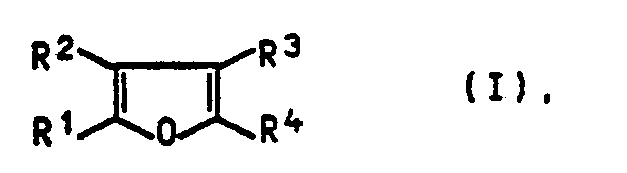
- Bis zu vierfach substituierte Furane der allgemeinen Formel (I)
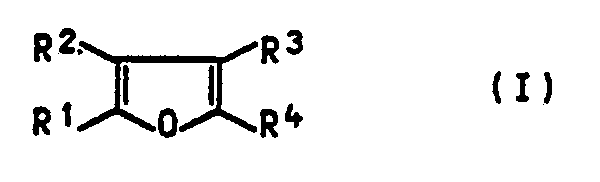
- R1 bis R4 Wasserstoff oder unsubstituiertes oder durch Halogen, Haloalkyl, Alkoxy, Haloalkoxy, Nitro, Cyano, Dialkylphosphonyl oder Alkoxycarbonyl substituiertes Alkyl, Aryl, Aralkyl, Alkoxycarbonyl oder Dialkoxyphosphonyl,
- R3 auch Hydroxyalkyl oder durch eine abspaltbare Schutzgruppe verkapptes Hydroxyalkyl bedeuten, werden als Vorprodukte, z. B. für die Herstellung von Pflanzenschutzmitteln benötigt: Es ist bekannt, daß Furane aus 1,4-Diketonen durch Cyclisierung hergestellt werden können (Comprehensive Heterocyclic Chemistry Vol. 4 657 ff, (1984). Bei der Synthese von insbesondere asymmetrisch substituierten Furanen (z. B. 2,4-Disubstitution) ist die Herstellung der erforderlichen Ausgangsprodukte schwierig. Aus diesem Grunde werden beispielsweise für die Herstellung von 2-Benzyl-4-hydroxymethylfuran, einem gesuchten Zwischenprodukt für Insektizidsynthesen, verschiedene Verfahren empfohlen (JCS (c) 1971, 2551; Wegler Vol. 7 (1981) S. 76; DOS 2 122 823). Alle diese Verfahren weisen jedoch schwerwiegende Nachteile auf (vielstufige Synthesen mit mäßiger Gesamtausbeute, Sicherheitsprobleme durch hohe Temperaturen, Isomerenbildung).
- Es ist eine Aufgabe der Erfindung, ein Verfahren zur Herstellung substituierter Furane anzugeben, das mit leicht zugänglichen Ausgangsstoffen auskommt und leicht durchzuführen ist.
- Es wurde gefunden, daß man Furane der vorgenannten Art vorteilhaft dadurch erhält, daß man ein entsprechendes Isoxazolin der Formel II

- Die Hydrierung substituierter Isoxazoline ist prinzipiell bekannt (J. Am. Chem. Soc. 104, 4024 (1982) Tetrahedron Lett. 23, 3123 (1982) und 24, 1337 (1983)) und wurde auch zur Heterocyclensynthese genutzt. So lassen sich beispielsweise aus geeignet substituierten Isoxazolinen durch hydrierende Spaltung Pyrone (US-Pat 4 136 114), Pyridine (J. Org. Chem. 36, 2784 (1971)) Pyrimidine bzw. Pyrimidone (J. Pharm. Soc. (Jap) 83, 471 (1963) oder Ann. Chimica 60, 393 (1970)), Pyrrole (Ann. Chimica 56, 858 (1966)), Pyrazole (Chem. Ber. 106, 332 (1973) oder TH 29, 4291 (1973)), Imidazole (Ann. Chimica 60, 343 (1970)) oder auch Furanone (Tetrahedron Lett. (1983) 2079 oder (1966) 233 oder (1967) 327 bzw. Gazetta (1966) 1073) erhalten.
- Die Bildung der erfindungsgemäßen Furane wird bei keiner dieser Hydrierungen beobachtet, obwohl geeignet substituierte Ausgangsprodukte (d. h. 5-hydroxymethylsubstituierte Isoxazoline - z. B. J. Ann. Chem. Soc. 105, 5826 - 5833 (1983); Verbindung 18 a) - durchaus in diese Reaktion eingesetzt wurden. Lediglich eine bei Acta chem. Scand B 36, 1 - 14 (1982) beschriebene sauer katalysierte Umlagerung von Isoxazolin unter nichthydrierenden Bedingungen ergab für eine spezielle Substitution über eine Diketon-Zwischenstufe ein Furan-Derivat. Leicht abweichende Substitutionsmuster gaben keine Furanderivate mehr, vielmehr Furanone bzw. Cyclopentenone.
- Die Hydrierung liefert in saurer Umsetzung unmittelbar die gewünschten Furane. Unter nicht-sauren Bedingungen entsteht zunächst ein entsprechendes offenkettiges Hydroxyketon, dem die allgemeine Formel III
- R1CO-CHR2-C(OH)R3-CH(X)R4
- lsoxazoline der allgemeinen Formel II, außer solchen, in denen R1 oder R3 Wasserstoff bedeutet, sind neue Stoffe. Es versteht sich, daß in den Fällen, wo sowohl R3 ein verethertes oder verestertes Hydroxymethyl als auch X verkapptes Hydroxy bedeutet, eine Veretherung bzw. Veresterung mit einem jeweils bifunktionellen Partner unter Ringbildung stattgefunden haben kann Abhängig von der speziellen Verfahrensweise kann dies direkt geschehen oder es kann als Zwischenstufe das Hydroxyketon III


- Für den Fall des oben erwähnten 2-Benzyl-4-hydroxymethylfurans läßt sich die Umsetzung wie folgt wiedergeben:

- Überraschend ist der glatte Verlauf dieser Reaktion u. a. auch deshalb, weil bislang durch Hydrierung speziell substituierter Isoxazole lediglich die Synthese von Dihydrofuran-3-onen beschrieben ist (THL (1983) 2079; THL (1966) 233; THL (1967) 327; Gazetta (1966) 1073):

- Weiterhin lieferte eine spezielle Isoxazolinsubstitution bei der Reduktion mit TiCl3 2,5-disubstituierte Furane (Acta Chem. Scand B 36 (1982):

- Zur Herstellung der neuen Vorprodukte II ist insbesondere das folgende zu sagen: Isoxazoline II


- In der vorstehenden Umsetzung bedeutet X Hydroxy oder durch eine abspaltbare Schutzgruppe, z. B. t-Butyl, Trimethylsilyl, Acetyl, Benzyl, verkapptes Hydroxy. Es lassen sich im übrigen manche der erfindungsgemäßen Isoxazoline aus anderen, nach der vorstehenden Methode zugänglichen Isoxazolinen erhalten: z. B. kann in 3-Stellung substituiertes 5,5-Bis-hydroxy-methylisoxazolin an den Hydroxygruppen mit den vorgenannten Schutzgruppen versehen oder diese abgespalten werden oder z. B. Hydroxy und Halogen oder Halogen und eine Schutzgruppe gegeneinander ausgetauscht werden.
- Die als Ausgangsstoffe benötigten Nitriloxide können ihrerseits z. B. aus entsprechenden Oximen erhalten werden oder aus aliphatischen Nitroverbindungen.
- Es wird hierzu auf Heterocycles, a. a. 0. und die dort aufgeführten Literaturhinweise, ferner auf Houben-Weyl, Methoden, 14. Aufl. Band 10/3, S. 83 und auf J. Org. Chem. 28, 1150 (1963) verwiesen. Ober spezielle Aspekte der asymmetrischen Induktion bei dieser Isoxazolinsynthese berichten Jäger und Schohe (Tetrahedron Lett. 24, 5501 - 04 (1983).
- Die Isolierung der Nitriloxide der Formel I) ist nicht unbedingt erforderlich. Sie werden vorteilhaft gleich in Anwesenheit der Alkenylverbindungen erzeugt, mit denen sie sich ummittelbar zu den Isoxazolinen der Formel II umsetzen.
- Die zur Darstellung der Isoxazoline verwendeten Nitriloxide und die Alkenylverbindungen können in äquimolaren Verhältnissen oder jeweils einer der Reaktionspartner im Überschuß eingesetzt werden.
- Als Lösungsmittel für die Umsetzung eignet sich z. B. die jeweilige Alkenylverbindung selbst, ferner aromatische Verbindungen (z. B. Benzol, Toluol, Xylol), halogenierte aromatische Verbindungen, Ketone (z. B. Aceton, Methylethylketon, Diisopropylketon), Ether (z. B. Dioxan, Diethylether, THF), chlorierte aliphatische Kohlenwasserstoffe (z. B. Dichlorethan, Chloroform, Methylenchlorid).
- Es ist darauf hinzuweisen, daß die Anlagerung der Olefine an diese Nitriloxide je nach der Art der Substituenten verläuft und daher u. U. Isomere bzw. Gemische von Isomeren erwartet werden können. Als allgemeine Regel ist anzunehmen, daß die an das Sauerstoffatom des Nitriloxids angelagerte Seite der olefinischen Bindung diejenige ist, die den - räumlich - größeren Substituenten trägt.
- Alle vorstehend beschriebenen Umsetzungen verlaufen gewöhnlich unterhalb von etwa 150°C mit ausreichender Geschwindigkeit.
-
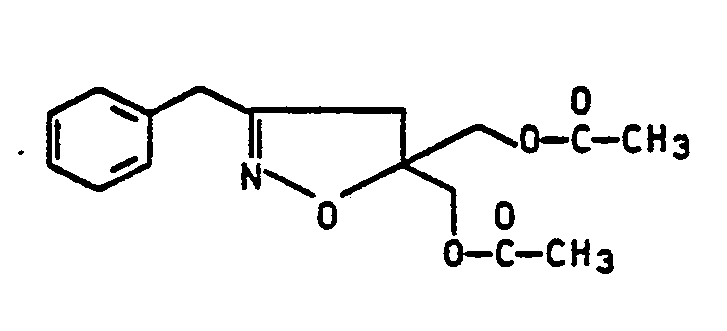
- Ausbeute 333 g = 92,8 % der berechneten Menge. Kristalle aus Ethanol-Petrolether schmelzen bei 78 bis 79° C.
- Zu 200 g Allylacetat und 242 g 2-Methylbutyraldoxim in 600 g Methylenchlorid werden 1960 g 10-%-ige NaOH-Lösung nach und nach zugegeben und 3 Stunden bei Raumtemperatur gerührt. Die organische Phase wird abgetrennt, mit Wasser gewaschen, über Na2S04 getrocknet und nach Filtration vom Lösungsmittel befreit. Das zurückbleibende ÖI (339 g) ist 3-sec.Butyl-5-acetoxymethyl-isoxazol.
- 300-MHz-NMR-Spektrum in CDCI3 (ppm): 0,95 (3H); 1 ,08 (3H); 1,2 - 1,3 (2H); 2,04 (3H); 2,3 (1H); 2,35 (1H); 3,0 (1 H); 4,0 - 4,1 (2H); 4,4 (1H).
- 88,4 g 3-Benzyl-5,5-bis(hydroxymethyl)isoxazolin werden in 550 ml Tetrahydrofuran, 40 ml Wasser und 80 ml Eisessig aufgenommen und mit 1,6 g Platinoxid versetzt. Beim Einleiten von Wasserstoff setzt eine leicht exotherme Reaktion ein; nach beendeter Wasserstoffaufnahme wird abfiltriert, eingeengt und der Rückstand mit Aceton verrührt. Das ungelöste Ammoniumacetat wird abfiltriert, das Filtrat wieder eingeengt kund dann in 300 ml Hethylenchlorid mit 300 ml 10-%-iger Salzsäure eine Stunde bei 20°C verrührt. Dann wird die Lösung in Methylenchlorid abgetrennt, mit Wasser gewaschen und eingeengt. Es verbleiben 59,2 g 2-Benzyl-4-hydroxy- methylfuran NMR-spektroskopisch praktisch rein (79 % bezogen auf Isoxazolin). Destillation (0,3 mm/125 - 128° liefert 52,0 g einer Substanz mit einem Schmelzpunkt von 37 bis 38° C).
- 100 g 3-sec.Butyl-5-acetoxymethylisoxazol in 400 g Methanol und 27 g Wasser werden mit 25 g Raney-Nickel bei 20 - 30° hydriert. Danach wird filtriert, vom Lösungsmittel befreit und destilliert. Die bei 70 - 80° C überdestillierende Flüssigkeit ist 2-sec. Butyl-furan. 200 MHz-NMR-Spektrum in CDCI3 (ppm) : 0,9 (3H); 1,25 (2H); 1,5 - 1,8 (2H); 2,78 (1 H); 6,0 (1 H); 6,3 (1 H); 7,35 (1 H).
- Nach den vorstehenden Vorschriften können aus entsprechenden Ausgangsstoffen weitere Isoxazoline hergestellt werden. So wurden die in der nachstehenden Tabelle aufgeführten Stoffe hergestellt, die eine Vorstellung von den vielseitigen Möglichkeiten des erfindungsgemäßen Verfahrens und der damit erhältlichen Wirkstoffe bzw. deren Vorprodukte vermitteln.

Claims (3)


Priority Applications (1)
| Application Number | Priority Date | Filing Date | Title |
|---|---|---|---|
| AT85116323T ATE37362T1 (de) | 1984-12-29 | 1985-12-20 | Substituierte furane und deren vorprodukte. |
Applications Claiming Priority (4)
| Application Number | Priority Date | Filing Date | Title |
|---|---|---|---|
| DE19843447793 DE3447793A1 (de) | 1984-12-29 | 1984-12-29 | Substituierte furane und deren vorprodukte |
| DE3447793 | 1984-12-29 | ||
| DE3514384 | 1985-04-20 | ||
| DE19853514384 DE3514384A1 (de) | 1985-04-20 | 1985-04-20 | Substituierte furane und deren vorprodukte |
Publications (2)
| Publication Number | Publication Date |
|---|---|
| EP0187345A1 EP0187345A1 (de) | 1986-07-16 |
| EP0187345B1 true EP0187345B1 (de) | 1988-09-21 |
Family
ID=25827876
Family Applications (1)
| Application Number | Title | Priority Date | Filing Date |
|---|---|---|---|
| EP85116323A Expired EP0187345B1 (de) | 1984-12-29 | 1985-12-20 | Substituierte Furane und deren Vorprodukte |
Country Status (8)
| Country | Link |
|---|---|
| US (1) | US4954633A (de) |
| EP (1) | EP0187345B1 (de) |
| AU (1) | AU579693B2 (de) |
| CA (1) | CA1268465A (de) |
| DE (1) | DE3565103D1 (de) |
| DK (1) | DK168335B1 (de) |
| HU (1) | HUT39734A (de) |
| IL (1) | IL77448A (de) |
Families Citing this family (4)
| Publication number | Priority date | Publication date | Assignee | Title |
|---|---|---|---|---|
| DE3546371A1 (de) * | 1985-12-31 | 1987-07-02 | Basf Ag | Pyrethroide, verfahren zu ihrer herstellung und ihre verwendung zur bekaempfung von schaedlingen sowie vorprodukte fuer die herstellung der pyrethroide |
| DE3809765A1 (de) * | 1988-03-23 | 1989-10-05 | Basf Ag | Isoxazoline, verfahren zu ihrer herstellung und ihre verwendung als herbizide |
| GB9110858D0 (en) * | 1991-05-20 | 1991-07-10 | Shell Int Research | Herbicidal compounds |
| ITMI20010914A1 (it) * | 2001-05-04 | 2002-11-04 | Endura Spa | Processo per la produzione di alcool 5-benzil-3-furfurilico |
Family Cites Families (5)
| Publication number | Priority date | Publication date | Assignee | Title |
|---|---|---|---|---|
| US3415821A (en) * | 1965-09-07 | 1968-12-10 | Norwich Pharma Co | 1-(5-substituted)furfurylideneamino hydantoins and imidazolidinones |
| DE2122823A1 (de) * | 1971-05-08 | 1972-11-23 | Badische Anilin- & Soda-Fabrik Ag, 6700 Ludwigshafen | Verfahren zur Herstellung von Furanderivaten |
| DE3514384A1 (de) * | 1985-04-20 | 1986-10-23 | Basf Ag, 6700 Ludwigshafen | Substituierte furane und deren vorprodukte |
| DE3447793A1 (de) * | 1984-12-29 | 1986-07-10 | Basf Ag, 6700 Ludwigshafen | Substituierte furane und deren vorprodukte |
| DE3546371A1 (de) * | 1985-12-31 | 1987-07-02 | Basf Ag | Pyrethroide, verfahren zu ihrer herstellung und ihre verwendung zur bekaempfung von schaedlingen sowie vorprodukte fuer die herstellung der pyrethroide |
-
1985
- 1985-12-20 DE DE8585116323T patent/DE3565103D1/de not_active Expired
- 1985-12-20 EP EP85116323A patent/EP0187345B1/de not_active Expired
- 1985-12-24 AU AU51679/85A patent/AU579693B2/en not_active Expired
- 1985-12-25 IL IL77448A patent/IL77448A/xx not_active IP Right Cessation
- 1985-12-27 HU HU854968A patent/HUT39734A/hu unknown
- 1985-12-27 CA CA000498662A patent/CA1268465A/en not_active Expired - Lifetime
- 1985-12-30 DK DK608185A patent/DK168335B1/da not_active IP Right Cessation
-
1989
- 1989-07-25 US US07/384,910 patent/US4954633A/en not_active Expired - Fee Related
Also Published As
| Publication number | Publication date |
|---|---|
| AU5167985A (en) | 1986-07-03 |
| EP0187345A1 (de) | 1986-07-16 |
| AU579693B2 (en) | 1988-12-08 |
| DK608185A (da) | 1986-06-30 |
| IL77448A (en) | 1989-10-31 |
| CA1268465A (en) | 1990-05-01 |
| HUT39734A (en) | 1986-10-29 |
| US4954633A (en) | 1990-09-04 |
| DK608185D0 (da) | 1985-12-30 |
| DE3565103D1 (en) | 1988-10-27 |
| DK168335B1 (da) | 1994-03-14 |
Similar Documents
| Publication | Publication Date | Title |
|---|---|---|
| DE2749825C2 (de) | Verfahren zur Herstellung von Furokumarinen und bestimmte, hierbei eingesetzte Zwischenprodukte | |
| DE2423485C2 (de) | 3-Oxotricyclo[2,2,1,0↑2↑↑,↑↑6↑]heptan-5-anti-carbonsäure und Verfahren zu ihrer Herstellung | |
| EP0187345A1 (de) | Substituierte Furane und deren Vorprodukte | |
| EP0001089B1 (de) | Verfahren zur Herstellung von halogenvinylsubstituierten Tetrahydrofuran-2-onen, bestimmte halogenvinylsubstituierte Tetrahydrofuran-2-one | |
| DE3827264A1 (de) | Verfahren zur herstellung von 4-amino-1,2,4-triazol-5-onen | |
| EP0074121B1 (de) | 2,3,4,5-Tetrahydro-1-benzoxepin-3,5-dion-Derivate und Verfahren zu deren Herstellung | |
| DE1104965B (de) | Verfahren zur Herstellung von Derivaten des Urazols | |
| DE1493793C3 (de) | Substituierte Tetrahydropyrane und Verfahren zu deren Herstellung | |
| DE3447793A1 (de) | Substituierte furane und deren vorprodukte | |
| EP0230018B1 (de) | Pyrethroide, Verfahren zu ihrer Herstellung und ihre Verwendung zur Bekämpfung von Schädlingen sowie Vorprodukte für die Herstellung der Pyrethroide | |
| DE1299001B (de) | Verfahren zur Herstellung von Tetrahydrothiapyran bzw. Tetrahydrothiapyran-3-on-1, 1-dioxiden | |
| EP0095696B1 (de) | Verfahren zur Herstellung von 2,2-Dimethyl-3-arylcyclopropan-carbonsäuren (carbonsäureestern), neue Zwischenprodukte hierfür und Verfahren zu deren Herstellung | |
| EP0219091B1 (de) | Pyranderivate und ein Verfahren zu ihrer Herstellung | |
| CH620666A5 (de) | ||
| EP0173190A2 (de) | Verfahren zur Herstellung von 5-Acylpyrimidinen | |
| EP0169439A2 (de) | Verfahren und Zwischenprodukte zur Synthese von diastereomeren Triazolyl-O,N-acetalen | |
| CA1271967A (en) | Process of preparing furans | |
| DE1149011B (de) | Verfahren zur Herstellung von 3, 5-disubstituierten 1, 2, 4-Oxdiazolen | |
| DE2351556C2 (de) | Verfahren zur Herstellung von N-Halogenformyl-carbamidsäurehalogeniden | |
| DE4005516A1 (de) | Verfahren zur umwandlung (alpha)-acetyl-substituierter lactone in (alpha)-alkyliden-substituierte lactone | |
| EP0453841A2 (de) | Verfahren zur Herstellung von 1-Alkoxyhexatrien-2-carbonsäureestern | |
| EP0492347B1 (de) | Verfahren zur Herstellung von threo-4-Alkoxy-5-(arylhydroxymethyl)-2(5H)-furanonen | |
| DE10047111A1 (de) | Verfahren zur Herstellung von DELTA·1·-Pyrrolinen | |
| DE2247030A1 (de) | Verfahren zur herstellung von substituierten 1,3-dioxanen | |
| AT381938B (de) | Verfahren zur herstellung von neuen spirobenzofuranonverbindungen |
Legal Events
| Date | Code | Title | Description |
|---|---|---|---|
| PUAI | Public reference made under article 153(3) epc to a published international application that has entered the european phase |
Free format text: ORIGINAL CODE: 0009012 |
|
| AK | Designated contracting states |
Kind code of ref document: A1 Designated state(s): AT BE CH DE FR GB IT LI NL SE |
|
| 17P | Request for examination filed |
Effective date: 19860725 |
|
| 17Q | First examination report despatched |
Effective date: 19871126 |
|
| GRAA | (expected) grant |
Free format text: ORIGINAL CODE: 0009210 |
|
| AK | Designated contracting states |
Kind code of ref document: B1 Designated state(s): AT BE CH DE FR GB IT LI NL SE |
|
| REF | Corresponds to: |
Ref document number: 37362 Country of ref document: AT Date of ref document: 19881015 Kind code of ref document: T |
|
| ITF | It: translation for a ep patent filed | ||
| REF | Corresponds to: |
Ref document number: 3565103 Country of ref document: DE Date of ref document: 19881027 |
|
| GBT | Gb: translation of ep patent filed (gb section 77(6)(a)/1977) | ||
| ET | Fr: translation filed | ||
| PLBE | No opposition filed within time limit |
Free format text: ORIGINAL CODE: 0009261 |
|
| STAA | Information on the status of an ep patent application or granted ep patent |
Free format text: STATUS: NO OPPOSITION FILED WITHIN TIME LIMIT |
|
| 26N | No opposition filed | ||
| ITTA | It: last paid annual fee | ||
| EAL | Se: european patent in force in sweden |
Ref document number: 85116323.8 |
|
| REG | Reference to a national code |
Ref country code: GB Ref legal event code: IF02 |
|
| PGFP | Annual fee paid to national office [announced via postgrant information from national office to epo] |
Ref country code: NL Payment date: 20041205 Year of fee payment: 20 |
|
| PGFP | Annual fee paid to national office [announced via postgrant information from national office to epo] |
Ref country code: SE Payment date: 20041206 Year of fee payment: 20 |
|
| PGFP | Annual fee paid to national office [announced via postgrant information from national office to epo] |
Ref country code: FR Payment date: 20041208 Year of fee payment: 20 |
|
| PGFP | Annual fee paid to national office [announced via postgrant information from national office to epo] |
Ref country code: AT Payment date: 20041213 Year of fee payment: 20 |
|
| PGFP | Annual fee paid to national office [announced via postgrant information from national office to epo] |
Ref country code: GB Payment date: 20041215 Year of fee payment: 20 |
|
| PGFP | Annual fee paid to national office [announced via postgrant information from national office to epo] |
Ref country code: DE Payment date: 20041216 Year of fee payment: 20 |
|
| PGFP | Annual fee paid to national office [announced via postgrant information from national office to epo] |
Ref country code: CH Payment date: 20041229 Year of fee payment: 20 |
|
| PGFP | Annual fee paid to national office [announced via postgrant information from national office to epo] |
Ref country code: BE Payment date: 20050629 Year of fee payment: 20 |
|
| PG25 | Lapsed in a contracting state [announced via postgrant information from national office to epo] |
Ref country code: GB Free format text: LAPSE BECAUSE OF EXPIRATION OF PROTECTION Effective date: 20051219 |
|
| PG25 | Lapsed in a contracting state [announced via postgrant information from national office to epo] |
Ref country code: NL Free format text: LAPSE BECAUSE OF EXPIRATION OF PROTECTION Effective date: 20051220 |
|
| REG | Reference to a national code |
Ref country code: GB Ref legal event code: PE20 |
|
| REG | Reference to a national code |
Ref country code: CH Ref legal event code: PL |
|
| NLV7 | Nl: ceased due to reaching the maximum lifetime of a patent |
Effective date: 20051220 |
|
| EUG | Se: european patent has lapsed | ||
| BE20 | Be: patent expired |
Owner name: *BASF A.G. Effective date: 20051220 |