EP0187432B1 - Nachbehandlung von Destilliertem Wasser - Google Patents
Nachbehandlung von Destilliertem Wasser Download PDFInfo
- Publication number
- EP0187432B1 EP0187432B1 EP85300177A EP85300177A EP0187432B1 EP 0187432 B1 EP0187432 B1 EP 0187432B1 EP 85300177 A EP85300177 A EP 85300177A EP 85300177 A EP85300177 A EP 85300177A EP 0187432 B1 EP0187432 B1 EP 0187432B1
- Authority
- EP
- European Patent Office
- Prior art keywords
- carbon dioxide
- water
- evaporator
- sea water
- distilled water
- Prior art date
- Legal status (The legal status is an assumption and is not a legal conclusion. Google has not performed a legal analysis and makes no representation as to the accuracy of the status listed.)
- Expired - Lifetime
Links
- XLYOFNOQVPJJNP-UHFFFAOYSA-N water Chemical compound O XLYOFNOQVPJJNP-UHFFFAOYSA-N 0.000 title claims description 56
- 239000012153 distilled water Substances 0.000 title claims description 33
- CURLTUGMZLYLDI-UHFFFAOYSA-N Carbon dioxide Chemical compound O=C=O CURLTUGMZLYLDI-UHFFFAOYSA-N 0.000 claims description 141
- 239000001569 carbon dioxide Substances 0.000 claims description 70
- 229910002092 carbon dioxide Inorganic materials 0.000 claims description 70
- 239000013535 sea water Substances 0.000 claims description 54
- 238000001704 evaporation Methods 0.000 claims description 34
- 230000008020 evaporation Effects 0.000 claims description 34
- 238000000034 method Methods 0.000 claims description 24
- 238000007789 sealing Methods 0.000 claims description 19
- 230000000694 effects Effects 0.000 claims description 18
- 238000011144 upstream manufacturing Methods 0.000 claims description 6
- 239000000203 mixture Substances 0.000 claims description 5
- 239000013505 freshwater Substances 0.000 claims description 3
- 238000004090 dissolution Methods 0.000 claims description 2
- 238000004821 distillation Methods 0.000 claims description 2
- 239000012223 aqueous fraction Substances 0.000 claims 3
- 238000000926 separation method Methods 0.000 claims 1
- 239000007789 gas Substances 0.000 description 17
- 238000010612 desalination reaction Methods 0.000 description 11
- VTYYLEPIZMXCLO-UHFFFAOYSA-L Calcium carbonate Chemical compound [Ca+2].[O-]C([O-])=O VTYYLEPIZMXCLO-UHFFFAOYSA-L 0.000 description 8
- 238000010438 heat treatment Methods 0.000 description 7
- 239000003795 chemical substances by application Substances 0.000 description 6
- 239000002253 acid Substances 0.000 description 5
- 229910000019 calcium carbonate Inorganic materials 0.000 description 4
- QGZKDVFQNNGYKY-UHFFFAOYSA-N Ammonia Chemical compound N QGZKDVFQNNGYKY-UHFFFAOYSA-N 0.000 description 3
- 230000008901 benefit Effects 0.000 description 3
- 239000012267 brine Substances 0.000 description 3
- AXCZMVOFGPJBDE-UHFFFAOYSA-L calcium dihydroxide Chemical compound [OH-].[OH-].[Ca+2] AXCZMVOFGPJBDE-UHFFFAOYSA-L 0.000 description 3
- 239000000920 calcium hydroxide Substances 0.000 description 3
- 229910001861 calcium hydroxide Inorganic materials 0.000 description 3
- 235000011116 calcium hydroxide Nutrition 0.000 description 3
- 238000010586 diagram Methods 0.000 description 3
- HPALAKNZSZLMCH-UHFFFAOYSA-M sodium;chloride;hydrate Chemical compound O.[Na+].[Cl-] HPALAKNZSZLMCH-UHFFFAOYSA-M 0.000 description 3
- OYPRJOBELJOOCE-UHFFFAOYSA-N Calcium Chemical compound [Ca] OYPRJOBELJOOCE-UHFFFAOYSA-N 0.000 description 2
- OAKJQQAXSVQMHS-UHFFFAOYSA-N Hydrazine Chemical compound NN OAKJQQAXSVQMHS-UHFFFAOYSA-N 0.000 description 2
- 239000011575 calcium Substances 0.000 description 2
- 229910052791 calcium Inorganic materials 0.000 description 2
- 238000007796 conventional method Methods 0.000 description 2
- 239000000498 cooling water Substances 0.000 description 2
- 238000000605 extraction Methods 0.000 description 2
- 238000010079 rubber tapping Methods 0.000 description 2
- 150000003839 salts Chemical class 0.000 description 2
- BVKZGUZCCUSVTD-UHFFFAOYSA-L Carbonate Chemical compound [O-]C([O-])=O BVKZGUZCCUSVTD-UHFFFAOYSA-L 0.000 description 1
- 238000013019 agitation Methods 0.000 description 1
- XKMRRTOUMJRJIA-UHFFFAOYSA-N ammonia nh3 Chemical compound N.N XKMRRTOUMJRJIA-UHFFFAOYSA-N 0.000 description 1
- -1 bicarbonate (HCO - 3 ) ions Chemical class 0.000 description 1
- 230000015572 biosynthetic process Effects 0.000 description 1
- 235000010216 calcium carbonate Nutrition 0.000 description 1
- 238000011109 contamination Methods 0.000 description 1
- 238000001816 cooling Methods 0.000 description 1
- 238000005260 corrosion Methods 0.000 description 1
- 230000007797 corrosion Effects 0.000 description 1
- 239000003651 drinking water Substances 0.000 description 1
- 235000020188 drinking water Nutrition 0.000 description 1
- 239000002737 fuel gas Substances 0.000 description 1
- 239000000295 fuel oil Substances 0.000 description 1
- 229910052500 inorganic mineral Inorganic materials 0.000 description 1
- 239000011707 mineral Substances 0.000 description 1
- 235000010755 mineral Nutrition 0.000 description 1
- 239000001205 polyphosphate Substances 0.000 description 1
- 235000011176 polyphosphates Nutrition 0.000 description 1
- 230000000135 prohibitive effect Effects 0.000 description 1
- 238000000197 pyrolysis Methods 0.000 description 1
- 239000000243 solution Substances 0.000 description 1
Images
Classifications
-
- C—CHEMISTRY; METALLURGY
- C02—TREATMENT OF WATER, WASTE WATER, SEWAGE, OR SLUDGE
- C02F—TREATMENT OF WATER, WASTE WATER, SEWAGE, OR SLUDGE
- C02F1/00—Treatment of water, waste water, or sewage
- C02F1/68—Treatment of water, waste water, or sewage by addition of specified substances, e.g. trace elements, for ameliorating potable water
-
- C—CHEMISTRY; METALLURGY
- C02—TREATMENT OF WATER, WASTE WATER, SEWAGE, OR SLUDGE
- C02F—TREATMENT OF WATER, WASTE WATER, SEWAGE, OR SLUDGE
- C02F1/00—Treatment of water, waste water, or sewage
-
- C—CHEMISTRY; METALLURGY
- C02—TREATMENT OF WATER, WASTE WATER, SEWAGE, OR SLUDGE
- C02F—TREATMENT OF WATER, WASTE WATER, SEWAGE, OR SLUDGE
- C02F1/00—Treatment of water, waste water, or sewage
- C02F1/02—Treatment of water, waste water, or sewage by heating
- C02F1/04—Treatment of water, waste water, or sewage by heating by distillation or evaporation
- C02F1/042—Prevention of deposits
-
- Y—GENERAL TAGGING OF NEW TECHNOLOGICAL DEVELOPMENTS; GENERAL TAGGING OF CROSS-SECTIONAL TECHNOLOGIES SPANNING OVER SEVERAL SECTIONS OF THE IPC; TECHNICAL SUBJECTS COVERED BY FORMER USPC CROSS-REFERENCE ART COLLECTIONS [XRACs] AND DIGESTS
- Y02—TECHNOLOGIES OR APPLICATIONS FOR MITIGATION OR ADAPTATION AGAINST CLIMATE CHANGE
- Y02A—TECHNOLOGIES FOR ADAPTATION TO CLIMATE CHANGE
- Y02A20/00—Water conservation; Efficient water supply; Efficient water use
- Y02A20/124—Water desalination
Definitions
- This invention relates generally to a method for treating the distilled water obtained from an evaporation process sea water desalination plant.
- the distilled water obtained as a result of evaporation desalination processes is devoid of minerals, leading to the corrosion of water handling apparatus and lacking taste as drinking water.
- a solution to the problem has been to convert the distilled water to a more suitable quality by dissolving carbon dioxide and calcium carbonate or calcium hydroxide into the distilled water.
- the expense of obtaining the quantity of carbon dioxide necessary to treat the water has been a disadvantage, however.
- ammonia gas resulting from pyrolysis of hydrazine from the use of deoxidizers typically found in high pressure steam systems may ultimately contaminate, with unacceptable levels of ammonia nitrogen, the distilled water to which carbon dioxide generated from this method is added.
- DE-A-1 955 571 there is a proposal to dissolve in distilled water produced by a multiple effect evaporator carbon dioxide generated from the sea water feed, but that proposal contemplates liberation of the CO2 from sea water upstream of the evaporator, such as by the addition of acid.
- DE-A-2 725 010 there is a further proposal to absorb carbon dioxide in the distilled water product from a flash evaporator and it is suggested that the carbon dioxide can be obtained by known methods such as the addition of acid or flash evaporation but the disclosure is otherwise silent as to how or where that is to be done.
- a method of obtaining potable distilled water by the multi-stage or multiple effect evaporation of sea water wherein carbon dioxide generated from the sea water passing through the evaporator is dissolved in the final distillate, characterised in that the carbon dioxide is extracted from the sea water after it has already been preheated in the same evaporator as that in which the sea water is distilled, from at least one chamber of said evaporator in which the temperature of the sea water is above 60°C.
- the invention further provides an apparatus for obtaining potable distilled water, comprising a multi-stage or multiple effect evaporator for the distillation of sea water, said evaporator having a succession of chambers including means for preheating the sea water feed entering the evaporator; and means for dissolution in the product distilled water of carbon dioxide also generated from sea water, characterised by means for extracting said carbon dioxide gas from chambers of the same evaporator as is used for distilling the sea water which chambers lie downstream of the evaporator sea water preheating means and in which during operation the temperature of the sea water is above 60°C.
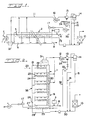
- the equipment shown includes a brine heater 1, multiple evaporation stages 2 and an antiscale agent feeder 3.
- Each evaporation stage 2 has an evaporation chamber 4 and a condenser 5.
- Sea water is supplied into the system through a pipe 6 and an antiscale agent is added through the antiscale agent feeder 3.
- Antiscale agents such as poly-phosphate, inhibit scale formation during the evaporation process.
- the sea water then flows sequentially from the lowest temperature evaporation stage to the highest temperature evaporation stage within the tubes of the condensers 5 of each evaporation chamber 4, the sea water being heated progressively by the vapor generated in each evaporation stage.
- the sea water is further heated in the brine heater 1 by high temperature steam supplied from, for example, a boiler through the pipe 7.
- the heated sea water is then fed back through the evaporation chambers 4,from the highest to the lowest evaporation stage, for flash evaporation. After the flash evaporation process, the unevaporated portion of the sea water is discharged out of the system through a pipe 8 from the final lowest temperature evaporation stage.
- each evaporation chamber 4 is maintained at a specific degree of vacuum by vacuum equipment such as steam ejector 17 connected to the lowest temperature evaporation chamber, although the pressure in the highest temperature evaporation chamber may be close to or even higher than atmospheric pressure.
- each evaporation stage is condensed on the outsides of the tubes of the respective condenser 5 to become distilled water, which is collected and discharged out of the system via calcium carbonate dissolving equipment 10 through a pipe 9.
- sea water contains carbonate ions (CO -- 3 ) and carbonic acid, typically 140 ppm, as bicarbonate (HCO - 3 ) ions which, when heated, decompose to produce carbon dioxide (CO2) in various ways, such as the following:- 2HCO - 3 ⁇ CO -- 3 +H2O+CO2 ⁇ CO -- 3 +H2O ⁇ 2OH ⁇ +CO2 ⁇
- CO2 carbonate ions
- HCO - 3 bicarbonate
- the carbon dioxide thus produced is extracted together with other noncondensing gases from the two highest temperature evaporation chambers 4 and fed to a pipe 11.
- the carbon dioxide gas mixture is compressed in a water-sealed compressor 13 and delivered into a separator 14.
- the mixture is separated into gases containing carbon dioxide and compressor sealing water in which a significant amount of carbon dioxide will be dissolved.
- the gases containing carbon dioxide and the sealing water in which carbon dioxide is dissolved are supplied into the pipe 9 delivering the product distilled water, through pipes 16 and 15, respectively.
- the sealing water of the water-sealed compressor 13 may be supplied through pipe 32 with distilled water pumped by a pump 33 from upstream of the introduction of carbon dioxide into the distilled water product line through pipes 15 and 16.
- fresh water may instead be used as sealing water and changeover valves are provided so that this may be supplied through pipe 34.
- a vent ejector for generating high vacuum is not particularly needed to extract the noncondensing gases including carbon dioxide from these evaporation chambers. If a vent ejector is used, a small one requiring little steam consumption is sufficient.
- the sealing water and gases containing carbon dioxide from the separator 14 When feeding the sealing water and gases containing carbon dioxide from the separator 14 into the delivery pipe 9 for the distilled water, it is preferable to supply the sealing water from the separator 14 through the pipe 15 downstream of the supply of the gases containing carbon dioxide through the pipe 16. If reversed, the volume of carbon dioxide gas dissolving into the distilled water would be lowered due to the presence of carbon dioxide supplied from the carbon dioxide dissolved in the sealing water. The carbon dioxide in the sealing water has, of course, already been effectively dissolved therein by the pressure and agitation in the compressor itself.
- the quantity of calcium dissolving may be increased by providing the dissolving equipment 10 downstream of the supply points of the carbon dioxide through pipes 15 and 16.
- FIG. 2 shows a flow diagram of the method as applied to a conventional multiple-effect type sea water desalination plant.
- Sea water is supplied into the system through pipe 18, and an antiscale agent is added through the antiscale agent feeder 3.
- the sea water flows from the lowest temperature stage to the highest temperature stage sequentially within the tubes of the preheater 20 of the evaporation tower 35, during which it is heated.
- the heated sea water is then sprayed over the outer surfaces of the heating tubes 22 of the first effect evaporator stage 21, and is partially evaporated by heat provided from steam supplied into the heating tubes 22 through pipe 23.
- the remaining unevaporated sea water is sprayed over the outer surfaces of the heating tubes 25 of the second effect evaporator stage 24.
- the remaining unevaporated sea water descends through the lower stages of the multiple effect evaporator tower and is discharged out of the system through a pipe 27 from the final effect evaporator stage 26.
- the vapor generated in the first effect evaporator stage 21 is supplied into the heating tubes of the second effect evaporator stage 24, and is condensed as the cooler sea water is sprayed over the outer surfaces of the heating tubes 25. Thereafter, the same action is repeated sequentially in each evaporator effect until the steam generated in the final effect evaporator stage 26 is cooled and condensed at the bottom of the tower in a condenser 28 by sea water flowing in the cooling tubes 29 of the condenser 28.
- This condensate is combined with the condensates from all the heating tubes of all the evaporator effects and is discharged out of the system as product distilled water through the delivery pipe 30 which feeds it to the calcium carbonate dissolving equipment 10.
- Carbon dioxide together with other noncondensing gases is extracted through the tube 11 from gas tapping connections at the upper part of the evaporator tower where the temperature of the sea water is higher than 60 o C; these gas tappings may withdraw gas that has been generated in the first and second effect evaporator stages 21 and 24.
- the carbon dioxide is compressed by compressor 13 of the same water sealed type as in Fig. 1. The mixture is then fed into the separator 14.
- the resulting carbon dioxide gas and sealing water containing dissolved carbon dioxide are supplied into the distilled water delivery pipe 30 through the pipes 16 and 15.
- a gas separator 31 indicated by chain lines, may be disposed immediately at the downstream side of the brine heater 11 in the multi-stage flash type desalination plant shown in Fig. 1, or immediately at the downstream side of the preheater 20 in the multiple-effect type desalination plant shown in Fig. 2.
- carbon dioxide may be separated, together with other noncondensing gases, from the high temperature sea water in this gas separator 31 and may then be supplied to the pipe 11.
- the load on the vacuum equipment for keeping the evaporation chambers under partial vacuum may be lessened advantageously.
- the carbon dioxide generated from the high temperature sea water is compressed by a water-sealed compressor, and is supplied into the distilled water together with the compressor sealing water.
Landscapes
- Chemical & Material Sciences (AREA)
- Life Sciences & Earth Sciences (AREA)
- Hydrology & Water Resources (AREA)
- Engineering & Computer Science (AREA)
- Environmental & Geological Engineering (AREA)
- Water Supply & Treatment (AREA)
- Organic Chemistry (AREA)
- Health & Medical Sciences (AREA)
- Medicinal Chemistry (AREA)
- Heat Treatment Of Water, Waste Water Or Sewage (AREA)
- Treating Waste Gases (AREA)
- Vaporization, Distillation, Condensation, Sublimation, And Cold Traps (AREA)
Claims (10)
- Verfahren zur Gewinnung von destiliertem Trinkwasser durch Mehrstufen- und Mehrkörper-Verdampfen von Meerwasser, wobei das vom durch den Verdampfer geführte Meerwasser erzeugte Kohlendioxid im Enddestillat gelöst wird, dadurch gekennzeichnet, daß des Kohlendioxid aus dem Meerwasser extrahiert wird, nachdem es bereits in demselben Verdampfer wie dem vorerhitzt wurde, in dem das Meerwasser destilliert wird, aus zumindest einer Kammer des Verdampfers, in der die Temperatur des Meerwassers über 60°C liegt.
- Verfahren nach Anspruch 1, dadurch gekennzeichnet, daß das Kohlendiox zumindest zum Teil extrahiert wird aus einer bzw. einem oder mehreren der Höhertemperaturstufen oder -mehrkörper des Mehrstufen- oder Mehrkörper-Verdampfers.
- Verfahren nach einem der vorhergehenden Ansprüche 1 oder 2 , dadurch gekennzeichnet, daß Kohlendioxid zumidnast zum Teil extrahiert wird aus einer der Vorerhitzungseinrichtung des Verdampfers nachgeschalteten und den Verdampfungskammern vorgeschalteten Abscheidekammer.
- Verfahren nach einem der vorhergehenden Ansprüche 1, 2 oder 3, dadurch gekennzeichnet, daß das extrahierte Kohlendioxid in einem wasserabgedichteten oder -umschlossenen Kompressor komprimiert wird, der von frischem oder distillierten Wasser umschlossen ist, so daß durch den Betrieb des Kompressors Kohlendioxid im umschließenden Wasser gelöst wird, des dann dem Destillierwasserprodukt aus dem Verdampfer hinzugefügt wird.
- Verfahren nach Anspruch 4, dadurch gekennzeichnet, daß das Kohlendioxid und das umschließende Wassergemisch aus dem Kompressor einem Abscheider zugeführt wird, aus dem die Umschließungswasserfraktion dem Produktdestillierwasser zugeführt wird, wobei auch die Kohlendioxidgesfraktion dem Produktdestillierwasser an einer Stelle zugeführt wird, die oberhalb des Zufürhpunktes der Umschließungswasserfraktion liegt.
- Vorrichtung zur Gewinnung von destilliertem Trinkwasser, bestehend aus einem Mehrstufen- und Mehrkörper-Verdampfer zum Destillieren von Meerwasser, wobei der Verdampfer eine Reihenfolge von Kammern einschließlich einer Einrichtung zum Vorheizen der in den Verdampfer eintretenden Meerwasserszufuhr aufweist, gekennzeichnet durch eine Einrichtung (11, 13) zum Extrahieren des Kohlendioxidgases aus den Kammern (4; 21, 24, 31) desselben Verdampfers 2, 19), der zum Destillieren von Meerwasser verwendet wird, und dadurch, daß die Kammern der Einrichtung (1,5; 20) zum Meerwasservorhoizen nachgeschaltet sind und daß die Temperatur des Meerwasser in ihnen während des Betriebs bei über 60°C liegt.
- Vorrichtung nach Anspruch 6, dadurch gekennzeichnet, daß zumindest ein Anteil des Kohlendioxids aus einer oder mehreren Höhertemperaturstufen oder -mehrkörpern (4; 21, 24) des Verdampfers extrahiert wird.
- Vorrichtung nach einem der vorhergehenden Ansprüche 6 oder 7,dadurch gekennzeichnet, daß zumindest ein Anteil des Kohlendioxids aus einer Abscheidungskammer (31) extrahiert wird, die der Meerwasser- Vorheizeinrichtung des Verdampfers nach- und den Meerwasserverdampfungskammern vorgeschaltet ist.
- Vorrichtung nach einem der vorhergehenden Ansprüche 6 bis 8, betehend aus einem wasserabgedichteten oder -umschlossenen Kompressor (13), der mit frischem oder destilliertem Wasser umschlossen ist und in dem das extrahierte Kohlendioxid komprimmiert wird, wobei durch den Betrieb des Kompressors ein Anteil des Kohlendioxids im Kompressorumschließungswasser zur Lösung gebracht und dieses dann in die Produktdestillatleitung (9, 30) aus dem Verdampfer eingeführt wird.
- Vorrichtung nach Anspruch 9, dadurch gekennzeichnet, daß das Kohlendioxidgas und das Umschließungswassergemisch aus dem Kompressor in den Abscheider (14) gegeben wird, aus dem die Umschließungswasserfraktion über eine Leitung (15) der Produktleitung (9,30) und die Kohlendioxidgasfraktion über eine getrennte Leitung (16) der Produktleitung zugeführt und letztere oberhalb der Einspeisungstelle der Umschließungswasserleitung in die Produktleitung eingeleitet wird.
Priority Applications (3)
| Application Number | Priority Date | Filing Date | Title |
|---|---|---|---|
| FR858500271A FR2575742B1 (fr) | 1985-01-10 | 1985-01-09 | Procede de post-traitement de l'eau distillee, par dissolution de calcium et de dioxyde de carbone dans l'eau distillee obtenue dans une installation de dessalement par evaporation |
| DE8585300177T DE3583798D1 (de) | 1985-01-10 | 1985-01-10 | Nachbehandlung von destilliertem wasser. |
| EP85300177A EP0187432B1 (de) | 1985-01-10 | 1985-01-10 | Nachbehandlung von Destilliertem Wasser |
Applications Claiming Priority (1)
| Application Number | Priority Date | Filing Date | Title |
|---|---|---|---|
| EP85300177A EP0187432B1 (de) | 1985-01-10 | 1985-01-10 | Nachbehandlung von Destilliertem Wasser |
Publications (2)
| Publication Number | Publication Date |
|---|---|
| EP0187432A1 EP0187432A1 (de) | 1986-07-16 |
| EP0187432B1 true EP0187432B1 (de) | 1991-08-14 |
Family
ID=8194113
Family Applications (1)
| Application Number | Title | Priority Date | Filing Date |
|---|---|---|---|
| EP85300177A Expired - Lifetime EP0187432B1 (de) | 1985-01-10 | 1985-01-10 | Nachbehandlung von Destilliertem Wasser |
Country Status (3)
| Country | Link |
|---|---|
| EP (1) | EP0187432B1 (de) |
| DE (1) | DE3583798D1 (de) |
| FR (1) | FR2575742B1 (de) |
Families Citing this family (9)
| Publication number | Priority date | Publication date | Assignee | Title |
|---|---|---|---|---|
| GB2256639A (en) * | 1991-06-13 | 1992-12-16 | York Nutritional Lab | Improvements relating to liquids |
| GB9113971D0 (en) * | 1991-06-28 | 1991-08-14 | Boc Group Plc | Treatment of water |
| IL147222A0 (en) * | 1999-06-25 | 2002-08-14 | Abiogen Pharma Spa | Preparation and metering of components with co2 |
| FR2810506B1 (fr) * | 2000-06-21 | 2002-09-27 | Gervais Danone Sa | Procede de fabrication d'une eau riche en calcium et eau obtenue par ce procede |
| ES2259562B1 (es) * | 2005-03-23 | 2008-03-01 | Pridesa Proyectos Y Servicios, S.A.U. | Sistema de preparacion y dosificacion en continuo de hidroxido calcico para sistemas de remineralizacion del agua aplicados a plantas desaladoras de agua. |
| EP2418177B9 (de) | 2010-08-13 | 2015-09-16 | Omya International AG | Mikronisiertes CaCO3-Schlamminjektionssystem zur Remineralisierung von salzbefreitem und frischem Wasser |
| ITUB20154766A1 (it) * | 2015-11-03 | 2017-05-03 | Fisia Italimpianti S P A | Impianto di ricarbonatazione di una miscela di acqua distillata proveniente da impianti di dissalazione di tipo termico e permeato proveniente impianti di dissalazione ad osmosi inversa |
| ITUB20155252A1 (it) * | 2015-11-03 | 2017-05-03 | Fisia Italimpianti S P A | Impianto di ricarbonatazione di acqua distillata e/o permeato mediante utilizzo di reattori a carbonato di calcio ed iniezione di anidride carbonica ed acidi forti |
| CN111252979A (zh) * | 2020-01-14 | 2020-06-09 | 自然资源部天津海水淡化与综合利用研究所 | 一种用于市政供水的热法海水淡化水后处理系统 |
Family Cites Families (2)
| Publication number | Priority date | Publication date | Assignee | Title |
|---|---|---|---|---|
| DE1955571A1 (de) * | 1969-11-05 | 1971-05-13 | Metallgesellschaft Ag | Verfahren zum Aufhaerten von destilliertem Wasser |
| NL7605952A (nl) * | 1976-06-02 | 1977-12-06 | Curacao Eilandgebied | Werkwijze en inrichting voor het behandelen van zee- en zoetwater. |
-
1985
- 1985-01-09 FR FR858500271A patent/FR2575742B1/fr not_active Expired - Fee Related
- 1985-01-10 DE DE8585300177T patent/DE3583798D1/de not_active Expired - Fee Related
- 1985-01-10 EP EP85300177A patent/EP0187432B1/de not_active Expired - Lifetime
Also Published As
| Publication number | Publication date |
|---|---|
| FR2575742B1 (fr) | 1990-11-30 |
| FR2575742A1 (fr) | 1986-07-11 |
| EP0187432A1 (de) | 1986-07-16 |
| DE3583798D1 (de) | 1991-09-19 |
Similar Documents
| Publication | Publication Date | Title |
|---|---|---|
| US3218241A (en) | Inhibiting scale formation in fresh water recovery | |
| US4434057A (en) | Water purification utilizing plural semipermeable membrane stages | |
| US4083781A (en) | Desalination process system and by-product recovery | |
| US3420775A (en) | Prevention of scale in saline water evaporators using carbon dioxide under special conditions | |
| CN101687668B (zh) | 脱盐装置和产生淡水的方法 | |
| US4444675A (en) | Alkaline scale abatement | |
| US3245883A (en) | Closed circuit distillant feed with indirect heat exchange condensation | |
| CN101679076B (zh) | 脱盐装置及脱盐方法 | |
| EP0187432B1 (de) | Nachbehandlung von Destilliertem Wasser | |
| US3389059A (en) | Method and apparatus for purifying water by distillation while preventing corrosionby selective phosphate and acid addition | |
| US3021265A (en) | Multiple effect evaporating system | |
| US4795532A (en) | Aftertreatment method and apparatus for distilled water | |
| US4319895A (en) | Optimizing the quality of steam from geothermal fluids | |
| US4102650A (en) | Process feed and effluent treatment systems | |
| US3501384A (en) | Low pressure degassing of feed water in multi-stage flash evaporators | |
| GB1260214A (en) | Method and apparatus for the desalination of water | |
| Al-Rqobah | A recarbonation process for treatment of distilled water produced by MSF plants in Kuwait | |
| US3901768A (en) | Distillation method and apparatus | |
| US1518784A (en) | Method and apparatus for purifying water | |
| US3607666A (en) | Method and apparatus for saline water evaporation | |
| CN103097300B (zh) | 用于海水脱盐的系统及方法 | |
| KR920002812B1 (ko) | 증류수의 후(後) 처리방법 | |
| Migliorini et al. | 40 MIGD potabilization plant at Ras Laffan: design and operating experience | |
| JPS6219238B2 (de) | ||
| US3984518A (en) | Process feed and effluent treatment systems |
Legal Events
| Date | Code | Title | Description |
|---|---|---|---|
| PUAI | Public reference made under article 153(3) epc to a published international application that has entered the european phase |
Free format text: ORIGINAL CODE: 0009012 |
|
| AK | Designated contracting states |
Kind code of ref document: A1 Designated state(s): DE GB NL |
|
| 17P | Request for examination filed |
Effective date: 19870108 |
|
| 17Q | First examination report despatched |
Effective date: 19880121 |
|
| GRAA | (expected) grant |
Free format text: ORIGINAL CODE: 0009210 |
|
| AK | Designated contracting states |
Kind code of ref document: B1 Designated state(s): DE GB NL |
|
| REF | Corresponds to: |
Ref document number: 3583798 Country of ref document: DE Date of ref document: 19910919 |
|
| PG25 | Lapsed in a contracting state [announced via postgrant information from national office to epo] |
Ref country code: GB Effective date: 19920110 |
|
| PLBE | No opposition filed within time limit |
Free format text: ORIGINAL CODE: 0009261 |
|
| STAA | Information on the status of an ep patent application or granted ep patent |
Free format text: STATUS: NO OPPOSITION FILED WITHIN TIME LIMIT |
|
| PG25 | Lapsed in a contracting state [announced via postgrant information from national office to epo] |
Ref country code: NL Effective date: 19920801 |
|
| 26N | No opposition filed | ||
| GBPC | Gb: european patent ceased through non-payment of renewal fee | ||
| NLV4 | Nl: lapsed or anulled due to non-payment of the annual fee | ||
| PG25 | Lapsed in a contracting state [announced via postgrant information from national office to epo] |
Ref country code: DE Effective date: 19921001 |