EP0187452A1 - Procédé pour la mise en oeuvre d'un alliage à mémoire à base de nickel-titane et pièce obtenue par ce procédé - Google Patents
Procédé pour la mise en oeuvre d'un alliage à mémoire à base de nickel-titane et pièce obtenue par ce procédé Download PDFInfo
- Publication number
- EP0187452A1 EP0187452A1 EP85308080A EP85308080A EP0187452A1 EP 0187452 A1 EP0187452 A1 EP 0187452A1 EP 85308080 A EP85308080 A EP 85308080A EP 85308080 A EP85308080 A EP 85308080A EP 0187452 A1 EP0187452 A1 EP 0187452A1
- Authority
- EP
- European Patent Office
- Prior art keywords
- alloy
- temperature
- nickel
- titanium
- hysteresis
- Prior art date
- Legal status (The legal status is an assumption and is not a legal conclusion. Google has not performed a legal analysis and makes no representation as to the accuracy of the status listed.)
- Granted
Links
Images


Classifications
-
- C—CHEMISTRY; METALLURGY
- C22—METALLURGY; FERROUS OR NON-FERROUS ALLOYS; TREATMENT OF ALLOYS OR NON-FERROUS METALS
- C22F—CHANGING THE PHYSICAL STRUCTURE OF NON-FERROUS METALS AND NON-FERROUS ALLOYS
- C22F1/00—Changing the physical structure of non-ferrous metals or alloys by heat treatment or by hot or cold working
- C22F1/006—Resulting in heat recoverable alloys with a memory effect
Definitions
- This invention relates to the field of processes suitable for producing a nickel/titanium-based shape memory alloy and a shape memory alloy article. This invention further relates to the field of methods and processes suitable for producing a nickel/titanium-based shape memory alloy composite coupling.
- the ability to possess shape memory is a result of the fact that the alloy undergoes a reversible transformation from an austenitic state to a martensitic state with a change of temperature. Also, the alloy is considerably stronger in its austenitic state than in its martensitic state. This transformation is sometimes referred to as a thermoelastic martensitic transformation.
- An article made from such an alloy for example, a hollow sleeve, is easily deformed from its original configuration to a new configuration when cooled below the temperature at which the alloy is transformed from the austenitic state to the martensitic state.
- the temperature at which this transformation .begins is usually referred to as M s and the temperature at which it finishes M f .
- Shape-memory alloys have found use in recent years in, for example, pipe couplings (such as are described in U.S.P. 4,035,007 and 4,198,081 to Harrison and Jervis), electrical connectors (such as are described in U.S.P. 3,740,839 to Otte and Fischer), switches (such as are described in U.S.P. 4,205,293 to Melton and Mercier), etc., the disclosures of which are incorporated herein by reference.
- the alloy austenitic at the service temperature which is often but not necessarily near room temperature, since the austenite phase is stronger than the martensite phase.
- Military Specification MIL-F-85421 requires a product that is functional to about -55°C. If the product comprises a shape memory alloy, then for convenience in shipping the product in the heat-unstable configuration, the product should not recover prior to about 50°C. It is a matter of commercial reality, within and without the military, that the product satisfy these requirements.
- the alloy be martensitic in the vicinity of room temperature so that the article can be fabricated, stored, and shipped at or near room temperature.
- the reason for this is that in the case of an article made from the alloy, a coupling, for example, the article would not recover prematurely.
- an alloy that is martensitic near room temperature and which is also austenitic over a large range of temperatures including room temperature is to have an alloy which exhibits a sufficiently wide tranformation hysteresis, say, greater than about 125°C. If the hysteresis were sufficiently wide and room temperature could be located near the middle of the hysteresis, then the alloy could be fabricated and conveniently stored while in the martensitic condition. Since the hysteresis is sufficiently wide, the alloy would not transform to austenite until heated substantially above room temperature. This heating would not be applied until the alloy (in the form of a coupling, for example) was installed in its intended environment.
- the alloy which would then be in the austenitic condition, would remain in the austenitic condition after cooling down since the service temperature (which may be above or below room temperature) would be substantially above the martensite transformation temperature.
- the service temperature which may be above or below room temperature
- the commercially viable near equiatomic binary nickel-titanium alloys can have a hysteresis width of about 30°C.
- the location of the hysteresis for this alloy is also extremely composition sensitive so that while the hysteresis can be shifted from sub-zero temperatures to above-zero temperatures, the width of the hysteresis does not appreciably change.
- the alloy were martensitic at room temperature, the service temperature must be above room temperature.
- the alloy would be martensitic below room temperature so that the alloy would require special cold-temperature equipment for fabrication, shipping, and storage.
- room temperature should be located near the middle of the transformation hysteresis.
- the width of the hysteresis in the binary alloy is so narrow, the range of service temperatures for any particular alloy is necessarily limited. As a practical matter, the alloy would have to be changed to accommodate any change in service temperatures.
- Nickel/titanium/iron alloys e.g., those in Harrison et al., USP 3,753,700, while having a wide hysteresis, up to about 70°C, are the typical cryogenic alloys which always undergo the martensite/austenite transformation at sub-zero temperatures.
- the colder shape-memory alloys such as the cryogenic alloys have a wider transformation hysteresis than the warmer shape memory alloys.
- the alloys In the case of the cryogenic alloys, the alloys must be kept very cold, usually in liquid nitrogen, to avoid the transformation from martensite to austenite. This makes the use of shape memory alloys inconvenient, if not uneconomical.
- the nickel/titanium/copper alloys of Harrison et al., U.S. Patent Application No. 537,316, filed September 28, 1983, and the nickel/titanium/vanadium alloys of Quin, U.S. Patent Application Serial No. 541,844, filed October 14, 1983, are not cryogenic but their hysteresis may be extremely narrow ⁇ 10-20°C) such that their utility is limited for couplings and similar articles.
- expansion of the hysteresis should generally be understood to mean that As and A f have been elevated to A s ' and A f ' while at least M s and usually also M f remain essentially constant. Aging, heat treatment, composition, and cold work can all effectively shift the hysteresis. For example, if the stress is applied to the shape memory alloy at room temperature the hysteresis may be shifted so that the martensite phase can exist at a temperature at which there would normally be austenite. Upon removal of the stress, the alloy would isothermally (or nearly isothermally) transform from martensite to austenite.
- the pipe coupling may be a monolithic pipe coupling as described in the earlier-mentioned Harrison and Jervis patents.
- the pipe coupling may be a composite coupling as described in the earlier-mentioned Clabburn patent and in U.S. Patent Nos. 4,379,575; 4,455,041; and 4,469,357 to Martin, the disclosures of which are incorporated herein by reference.
- the composite coupling comprises a driver member and a sleeve member.
- the sleeve may be assembled with the driver just after the expansion of the driver so as to take advantage of the elastic springback of the material.
- the driver and sleeve arrangement are then stored in a cryogenic fluid until ready for installation.
- the driver alone may be stored in a cryogenic fluid and then joined with the sleeve a the time of installation. Once joined with the sleeve, the driver is allowed to fully recover.
- the driver may be expanded and, after springback has occurred, joined with the sleeve while both are immersed in a cryogenic fluid. Since no recovery of the driver has occurred, the sleeve is only loosely joined and would, in fact, become separated from the driver if means were not provided to prevent this separation.
- the means to prevent this separation is usually provded in the form of a flaring of one end of the sleeve which makes for a slight interference fit between the sleeve and the driver.
- a keeper is utilized to apply a stress sufficient to temporarily raise the austenite transformation temperature.
- the shape-memory alloy remains in the martensitic state while the stress is applied. This method is known as constrained storage.
- This invention relates to a method of processing a nickel/titanium-based shape memory alloy.
- the purpose of the method is temporarily to raise the As and A f temperatures to A s ' and A f ', respectively.
- This method has been found useful in fabricating shape memory alloy articles such as couplings.
- the coupling has at least one heat recoverable driver member and at least one metallic insert.
- the driver member is made from a nickel/titanium-based shape memory alloy having a transformation hysteresis defined by Ms , M f, As, and Af temperatures.
- the method comprises overdeforming the driver member by applying a stress sufficient to cause nonrecoverable strain in the driver member so that the As and A f temperatures are temporarily raised to A S , and Af', respectively; removing the stress; engaging the driver member and insert; and warming the driver and insert to a temperature less than A s '.
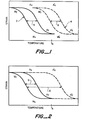
- Figure 1 illustrates the shifting of the transformation hysteresis as would occur if, for example, a stress was applied.
- the hysteresis has moved upwardly in temperature from position 2 to position 4, shown in dotted lines. While the entire hysteresis has moved upwardly in temperature it can be seen that the width of the hysteresis, indicated generally by 6 has remained approximately constant.
- M s , M f , As, and A f have all been translated to higher temperatures and are now denoted as M s ', M f ', A s ', and A f '.
- M s ', M f ', A s ', and A f ' are now denoted as M s ', M f ', A s ', and A f '.
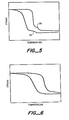
- Figure 2 now illustrates in general the expansion of the hysteresis. It can be seen that the martensite transformation temperatures remain constant but the austenite transition temperatures have been translated upwardly so that the width of the hysteresis indicated generally by 6 has now been expanded as indicated generally by 8. That is, M s and M f remain constant or nearly constant while As and A f have been translated to higher temperatures and are now denoted as A s ' and A f '.
- a coupling may be expanded and held in the expanded condition so as temporarily to raise, i.e., temporarily shift, the hysteresis. As long as the stress is applied, the hysteresis will be shifted. If it is desired, for example, to use this coupling in ambient temperature, indicated by T A , the coupling will not transform to austenite as long as temperature T A is below A s '. Upon the removal of the stress, the coupling will isothermally (or nearly isothermally) transform into austenite.
- the coupling will be at T A when the stress is removed but the hysteresis will have shifted from position 4 back to position 2.
- the coupling being martensitic before the shift from position 4 to position 2 must necessarily be austenitic after the shift.
- This method may be used for constrained storage (see, e.g., Clabburn, USP 4,149,911) wherein a coupling is expanded and then held on a mandrel in the expanded condition until it is ready to be used, at which time it is cooled to below the M s temperature so that it may be released from the mandrel and then installed.
- the problem with this method is that while the coupling is held (during shipping, for example) in the expanded position which is necessary to shift the hysteresis, the coupling may relax so that a certain, perhaps very substantial, amount of recovery motion will be permanently lost.
- the method comprises temporarily expanding the transformation hysteresis by elevating the As and A f temperatures to A s ' and A f ', respectively, so that the temperature difference between A s ' and M s is greater than the temperature difference between As and M s .
- The-means for expanding the transformation hysteresis may be removed and then the alloy is stored at a temperature less than A s '.
- both the M s and M f temperatures will remain essentially constant during the expansion of the hysteresis.
- either or both of the M s and M f temperatures may permanently change. This change may result from the varying of the slope or even movement of the martensitic part of the transformation hysteresis curve due to the interaction of certain metallurgical conditions.
- the important point to emphasize here is that there will always be a net increase of the width of the transformation hysteresis according to the method of the invention.
- the means for expanding the transformation hysteresis comprises overdeforming the alloy by applying a stress sufficient to cause nonrecoverable strain in the alloy.
- nonrecoverable strain means strain which is not recovered after deformation and subsequent no-load heating to at least the A f ' temperature.
- a stress is applied sufficient to cause at least 1% or more of nonrecoverable strain in the alloy. Usually (but not necessarily) after the alloy is overdeformed the stress will be removed.
- the overdeforming takes place at a temperature which is less than about the maximum temperature at which martensite can be stress-induced. To those skilled in the art this temperature is commonly known as:M d . It is preferred however that the overdeforming temperature be above M s .
- At least partial recovery of the alloy article can occur when the alloy is heated to a temperature greater than about A s '.
- the heating temperature be greater than A f ' so as to effect full recovery of the alloy.
- the nickel/titanium-based shape memory alloy may be a binary or it can be at least a ternary. If it is a ternary nickel/titanium-based shape memory alloy the ternary consists essentially of nickel, titanium and at least one other element selected from the group consisting of iron, cobalt, vanadium, aluminum, and niobium. The most preferred ternary, for reasons which will become apparent hereafter, consists essentially of nickel, titanium, and niobium.
- FIG. 7 schematically illustrates a stress-strain curve for a typical shape memory alloy which was overdeformed. The load was then removed. With overdeformation there is by definition a substantial amount of non-recoverable strain imparted to the alloy. Nonrecoverable strain will occur when the alloy, generally speaking, is strained past its second yield point indicated approximately by reference numerical 10. After removal of the stress, the alloy was heated.
- curve 12 illustrates the heating after the removal of the stress.
- the alloy was cooled down as illustrated by curve 14. During the cooling down under a small load and M s and M f temperatures were measured. The alloy was then reheated (curve 16) to measure the recovered austenitic transition temperatures As and Af.
- the martensitic and austenitic transformation temperatures there is more than one way to locate on a transformation hysteresis curve the martensitic and austenitic transformation temperatures.
- the literal starting and ending of the austenitic transformation may be indicated for example by points 18 and 20 respectively on curve 12.
- the austenitic transformation effectively begins at about point 24 (denoted as A s' ) and the austenitic transformation effectively ends at about point 26 (denoted as A f ').
- a s' the austenitic transformation effectively ends at about point 26 (denoted as A f ').
- the effective austenitic and martensitic transformation temperatures may be conveniently determined by the intersection of tangents to the transformation hysteresis curves. For example, tangents 22 on curve 12 locate A s ' and A f '.
- austenitic and martensitic transformation temperatures refer to the austentic and martensitic transformation temperatures determined by the above noted method of intersecting tangents.
- the literal starting and ending points of the martensitic and austentic transformations are indicated these temperatures will be referred to as the true martensitic and austenitic transformation temperatures.
- true A s ' and true A f ' are the literal starting and ending points of the austenitic transformation after expansion of the hysteresis.
- Curves 14 and 16 represent the shape memory alloy transformation hysteresis in the recovered state while curves 12 and 14 represent the shape memory alloy transformation hysteresis in the unrecovered state.
- a method of preassembling a composite coupling having at least one heat recoverable driver member and at least one metallic insert is made from a nickel/titanium-based shape memory alloy having a transformation hysteresis defined by M s , M f , As and A f temperatures.
- the method comprises overdeforming the driver member by applying a stress sufficient to cause nonrecoverable strain in the driver member so that the As and A f temperature are temporarily raised to A s ' and A f ', respectively.
- the method further comprises removing the stress; engaging the driver member and insert; and then warming the driver and insert to a temperature less than A s '.
- both the M s and M f temperatures will remain essentially constant during the expansion of the hysteresis.
- either or both of the M s and M f temperatures may permanently change. This change may result from the varying of the slope or even movement of the martensitic part of the transformation hysteresis curve due to the interaction of certain metallurgical conditions.
- the important point to emphasize here is that there will always be a net increase of the width of the transformation hysteresis according to the method of the invention. That is, the temperature difference between A s ' and M S will be greater than the temperature difference between As and M s .
- the metallic insert may take many forms.
- the insert may be tubular, tapered or slotted, all of which are disclosed in the above Martin patents.
- the insert may be single or multipiece.
- the insert may have an irregular shape such as to be x-shaped, y-shaped or t-shaped.
- the insert may also have sealing means as also disclosed in the above Martin patents.
- the sealing means any comprise, for example, teeth or gall-prone materials.
- driver member may take many forms. It is preferred, however, that the driver member be a tubular driver or a ring driver.
- a stress is applied sufficient to cause at least one percent of nonrecoverable strain in the driver member.
- the nonrecoverable strain may be much more than one percent which is usually the case but it is preferred that there be at least one percent strain.
- the overdeforming take place at a temperature which is less than about the maximum temperature at which martensite can be stress-induced.
- the temperature is also known as the M d temperature.
- M d temperature the maximum temperature at which martensite can be stress-induced.
- the nickel/titanium-based shape memory alloy has an M s temperature less than about 0°C.
- the nickel/titanium-based shape memory alloy is stable, does not contain an R phase and has an M s temperature less than about 0°C.
- the R phase is known as a transitional phase between the austentite and martensite and has a structure different than either. The effect of the R phase is to depress the austenitic and martensitic transformation temperatures. Alloys that are stable (i.e. exhibit temper stability) have an M s that does not change more than about 20°C after annealing and water quenching and subsequent aging between 300 and 500°C.
- the nickel/titanium-based shape memory alloy may be a binary or at least a ternary.
- the ternary may comprise nickel/titanium and at least one other element selected from the group consisting of iron, cobalt, vanadium, aluminum and niobium. It is most preferred that the ternary nickel/titanium-based shape memory alloy comprise nickel, titanium and niobium.
- the resulting ingots were hot swaged and hot rolled in air at approximately 850°C to produce a strip of approximately 0.025-in. thickness.
- Samples were cut from the strip, descaled and vacuum annealed at 850°C for 30 minutes and furnace cooled. The strip was then elongated. After elongation the stress was removed and the strip was heated unrestrained so as to effect recovery of the shape memory alloy. The recovery was monitored and plotted as a function of temperature. When the transformation was complete, the sample was cooled and then reheated so as to complete the measurement of the martensite and austenite transformation temperatures before recovery and after recovery. The results are tabulated below in Table 1.
- the measure As' minus Ms is very useful since M s is directly indicative of the lower functional limit of the alloy and the A s ' is directly indicative of the highest temperature which may be encountered (e.g. during storing and shipping) before the austenite transformation will effectively begin.
- a g ' minus M s defines the operating range of the alloy when processed according to the invention.
- This measure should be compared to As minus M s which defines the operating range of the alloy after the temporary expansion of the hysteresis has been recovered.
- As minus M s is also indicative of the operating range of the alloy if it were never processed according to the invention.
- comparing As' minus M s to As minus Ms provides useful indicia of the expansion of the hysteresis as well as the advantages of the invention.
- a s ' minus M s and As minus M s are about the same at 5% elongation; however, at 16% elongation, the difference becomes substantial. It is useful to note that A s ' after 16% elongation is above normal room temperature so that the alloy may now be handled at room temperature so that the alloy may now be hadled at room temperature without the necessity of providing a cold environment.
- M 50 , A 50 , and A 50 ' values are the martensite and austenite transformation temperatures at which the transformation is 50% complete.
- Table 1 it can be seen that the the sample was cooled and then reheated so as to complete the measurement of the martensite and austenite transformation temperatures before recovery and after recovery. The results are tabulated below in Table 1.
- the measure As ' minus M s is very useful since M s is directly indicative of the lower functional limit of the alloy and the A s ' is directly indicative of the highest temperature which may be encountered (e.g. during storing and shipping) before the austenite transformation will effectively begin.
- As ' minus M s defines the operating range of the alloy when processed according to the invention.
- This measure should be compared to As minus M s which defines the operating range of the alloy after the temporary expansion of the hysteresis has been recovered.
- As minus M s is also indicative of the operating range of the alloy if it were never processed according to the invention.
- comparing As ' minus M s to As minus M provides useful indicia of the expansion of the hysteresis as well as the advantages of the invention.
- a s ' minus M s and As minus M s are about the same at 5% elongation; however, at 16% elongation, the difference becomes substantial. It is useful to note that A s ' after 16% elongation is above normal room temperature so that the alloy may now be handled at room temperature so that the alloy may now be hadled at room temperature without the necessity of providing a cold environment.
- M 50 , A 50 , and A 50 ' values are Another useful measurement for indicating the expansion of the hysteresis. These are the martensite and austenite transformation temperatures at which the transformation is 50% complete.
- the difference between M 50 and A 50 the permanent width of the hysteresis, is about 60°C.
- the width of the hysteresis may be temporarily enlarged, i.e., A 50 ' minus M 50 , from 64°C at 5% elongation (at which there is no nonrecoverable strain) to 91°C at 16% elongation (at which there is substantial nonrecoverable strain).
- the M 50 , A 50 , and A 50 ' values are also useful because they are the most easily determined as will become apparent hereafter.
- Figure 3 illustrates a stress/strain curve for the binary alloy which was strained to 16%. The load was then removed. With 16% strain there is a substantial-amount of nonrecoverable strain imparted to the alloy. Nonrecoverable strain will occur when the alloy, generally speaking, is strained past its second yield point indicated approximately by reference numeral 10. After removal of the stress, the alloy was heated.
- curve 12 illustrates the heating after the removal of the stress.
- the alloy was cooled down as illustrated by curve 14. During the cooling down under a small load the M s and Mf temperatures were measured. The alloy was then reheated (curve 16) to measure the recovered austenite transition temperatures As and A f .
- tangents 22 on curve 12 locate A s ' and A f '.
- the mid-point of the transformation for example A 50 ' on curve 12, is simply vertically equidistant from the literal starting and ending points, for example 18 and 20 on curve 12, of the transformation.
- austenite and martensite transformation temperatures refer to the austenite and martensite transformation temperatures determined by the above-noted method of intersecting tangents.
- Curves 14 and 16 represent the shape memory alloy transformation hysteresis in the recovered state while curves 12 and 14 represent the shape memory alloy transformation hysteresis in the unrecovered state.
- the width of the hysteresis and the operating range have been enlarged as a result of the 16% elongation of the alloy.
- the import of this is that after elongation of the alloy, the alloy no longer has to be stored in liquid nitrogen to prevent it from transforming into austenite. Since A s ' has been raised to -88°C other forms of cold storage may now be used to store and ship the nickel/titanium/iron alloy prior to its final use. It is believed that this will result in greater utility of the alloy.
- the hysteresis width (A 50 -M 50 ) in the fully recovered state is about 55°C with As being -56°C.
- the austenite temperature in this range it is still necessary for the alloy to be cold stored in order to prevent transformation of the martensite into the austenite.
- the ring is now enlarged about 5%, the As temperature has been temporarily raised to -14°C which would still require cold storage.
- the As has been temporarily increased to 27°C.
- the alloy may be stored and shipped at room temperature. No cold storage provisions are required.
- the temperature of deformation be above M s .
- the importance of this limitation is illustrated in the next sample which was deformed at -70°C (compared to an Mg of -90°C). It can be seen that A s ', and A 50 '-M 50 and A s '-M s have all been increased more than any of the previous samples.
- the nickel/titanium/niobium ternary alloys are preferred alloys due to their ready susceptibility to expansion of the transformation hysteresis as illustrated above.
- those that are stable have an M s greater than 0°C and do not have an R phase are the most preferred.
- the R phase is a transitional phase between austenite and martensite. Since the R phase is not present, there is substantial uniformity in the martensite and austenite transformation temperatures from sample to sample. Alloys that are stable (i.e., exhibit temper stability) have an M s that does not change more than about 20°C after annealing and water quenching and subsequent aging between 300 and 500"C.
- compositions of: 46 atomic percent nickel, 49 atomic percent titanium, and 5 atomic percent vanadium; 49 atomic percent nickel, 49 atomic percent titanium, and 2 atomic percent cobalt; and 50 atomic percent nickel, 48.5 atomic percent titanium, and 1.5 atomic percent aluminum.
- Each of the compositions was melted and 0.025-in.-thick strips prepared in the same way as that previously stated with respect to the binary.
- the stress was removed and the strip was heated unrestrained so as to effect recovery which was monitored and plotted as a function of temperature.
- the sample was cooled and then reheated so as to complete the measurement of the martensite and austenite transformation temperatures before recovery and after recovery.
- the martensite and austenite transformation temperatures were measured with a load of 20 ksi and then extrapolated to 0 ksi. The results are tabulated below in Tables 4, 5, and 6.
- the large discrepancy between the martensite and austenite transformation temperatures at 5 and 16%, respectively, is believed due to the interference of the R-phase.
- the presence of the R phase 28 is most noticeable on the austenite leg of the transformation hysteresis for the alloy deformed 5%.
- the R phase is a transitional phase between the austenite and martensite and has a structure different than either.
- the effect of the R phase is to depress the austenite and martensite transformation temperatures.
- Figure 6 illustrates the transformation hysteresis curve for the same alloy, but after recovering from 16% deformation.
- the R phase is noticeably absent.
- the austenite and martensite transformation temperatures in Figure 6 are also noticeably higher.
- Example 6 the sample deformed 16%, and thus having substantial nonrecoverable strain, shows a marked expansion of the transformation hysteresis (as in the previous two examples) whereas the sample deformed at 5% shows essentially no expansion of the transformation hysteresis.
- the present invention has solved all the problems of the prior art and has now resulted in an alloy and article which at least in the case of the most preferred niobium ternary alloy can be deformed and stored at room temperature or at least can be deformed in cold temperatures but can be stored and shipped at room temperature without the provision of cold storage procedures.
- a cylindrical driver member was made from an alloy having the composition of 47 atomic percent nickel, 44 atomic percent itanium and 9 atomic percent niobium.
- nickel/titanium/niobium alloys in general, are the most preferred alloys. These alloys were described in our U.S. Patent Application Serial No. 668,777 filed November 6, 1984, entitled “Nickel/Titanium/Niobium Shape Memory Alloy and Article", the disclosure of which is incorporated by reference herein.
- the driver was melted and processed as noted in our patent application above except that a coupling was machined instead of a ring.
- the driver was machined to have an inside diameter of .847 inches, an outside diameter of 1.313 inches and a length of 2.12 inches.
- a cylindrical insert was then made to be eventually joined with the driver so as to form a composite coupling.
- the insert was machined from 316 stainless steel so as to have an inside diameter of .850 inches, an outside diameter of .970 inches and a length of 2.12 inches. It is not necessary to the invention that the insert be made from stainless steel. It is only necessary that the insert be made from a material that is sufficiently soft such that it may be crushed by the driver upon full recovery thereof.
- the M s temperature was -90°C
- the As temperature was -56°C
- the M d temperature was -10°C.
- such an alloy expanded about 16% at -50°C would be expected to have a true A s ' of -52°C and an A s ' of +52°C.
- the driver was near the literal starting temperature of the austenitic transformation of the temporarily expanded transformation hysteresis.
- the driver was removed from the cold fluid and placed on a work bench.
- the insert was then slipped into the driver. Thereafter, the driver and insert were allowed to warm to room temperature, which it is noted is substantially below A s '. It was found that the driver and insert were snugly engaged and could only be moved relative to each other with great difficulty.. It should be noted that while-the driver and insert became snugly engaged, there was no crushing of the insert.
- the driver prepared as described above, would be expected to have about 8% recoverable strain. About 1% of that recoverable strain was utilized in the preassembling of the driver and insert. Thus, about 7% recoverable strain remains for the actual coupling of the substrates.
- the composite coupling is now preassembled and ready for storage or use.
- the material be expanded at temperatures no higher than M d (-10°C in Table 1) since expansion at higher temperatures will cause a dramatic decrease in the amount of recoverable strain obtainable. However, expansion at temperatures higher than M d does not appear to affect the difference between true A s ' and A s '.
- compositions of 50.7 atomic percent nickel and 49.3 atomic percent titanium Commercially pure titanium and carbonyl nickel were weighed in proportions so as to give a composition of 50.7 atomic percent nickel and 49.3 atomic percent titanium. Additionally, commercially pure titanium, carbonyl nickel and amounts of vanadium, cobalt, aluminum and iron were weighed in proportions so as to give compositions of: 46 atomic percent nickel, 49 atomic percent titanium and 5 atomic percent vanadium; 49 atomic percent nickel, 49 atomic percent titanium and 2 atomic percent cobalt; 50 atomic percent nickel, 48.5 atomic percent titanium and 1.5 atomic percent aluminum; and 47 atomic percent nickel, 50 atomic percent titanium and 3 percent iron.
- the resulting iron-containing ingots were hot swaged at approximately 850°C. Round, tensile bars (1" in diameter) were then machined from the hot swaged ingot, vacuum annealed at 850°C for 30 minutes, and then furnace cooled. The tensile bars were then elongated. After elongation, the stress was removed and the bars were heated unrestrained so as to effect recovery of the shape memory alloy. The recovery was monitored and plotted as a function of temperature. When the transformation was complete, the sample was cooled and then reheated so as to complete the measurement of the martensitic and austenitic transformation temperatures before recovery and after recovery. The results are tabulated in Table 8.
- the remaining ingots were hot swaged and hot rolled in air at approximately 850°C to produce a strip of approximately 0.025-in. thickness.
- Samples were cut from the strip, descaled and vacuum annealed at 850°C for 30 minutes and furnace cooled. The stip was then elongated. After elongation, the stress was removed and the strip was heated unrestrained so as to effect recovery which was monitored and plotted as a function of temperature. When the transformation was complete, the sample was cooled and then reheated so as to complete the measurement of the martensitic and austenitic transformation temperatures before recovery and after recovery. In the case of the cobalt alloy, the martensitic and austenitic transformation temperatures were measured with a load of 20 ksi and then extrapolated to 0 ksi. The results are tabulated below in Tables 9 to 12.
Landscapes
- Chemical & Material Sciences (AREA)
- Physics & Mathematics (AREA)
- Thermal Sciences (AREA)
- Crystallography & Structural Chemistry (AREA)
- Engineering & Computer Science (AREA)
- Materials Engineering (AREA)
- Mechanical Engineering (AREA)
- Metallurgy (AREA)
- Organic Chemistry (AREA)
- Heat Treatment Of Articles (AREA)
- Heat Treatment Of Steel (AREA)
Priority Applications (1)
| Application Number | Priority Date | Filing Date | Title |
|---|---|---|---|
| AT85308080T ATE60811T1 (de) | 1984-11-06 | 1985-11-06 | Verfahren zur behandlung einer formgedaechtnislegierung auf nickel-titan-basis und daraus hergestellter gegenstand. |
Applications Claiming Priority (4)
| Application Number | Priority Date | Filing Date | Title |
|---|---|---|---|
| US668771 | 1984-11-06 | ||
| US06/668,771 US4631094A (en) | 1984-11-06 | 1984-11-06 | Method of processing a nickel/titanium-based shape memory alloy and article produced therefrom |
| US783371 | 1985-10-07 | ||
| US06/783,371 US4740253A (en) | 1985-10-07 | 1985-10-07 | Method for preassembling a composite coupling |
Publications (2)
| Publication Number | Publication Date |
|---|---|
| EP0187452A1 true EP0187452A1 (fr) | 1986-07-16 |
| EP0187452B1 EP0187452B1 (fr) | 1991-02-06 |
Family
ID=27099986
Family Applications (1)
| Application Number | Title | Priority Date | Filing Date |
|---|---|---|---|
| EP85308080A Expired - Lifetime EP0187452B1 (fr) | 1984-11-06 | 1985-11-06 | Procédé pour la mise en oeuvre d'un alliage à mémoire à base de nickel-titane et pièce obtenue par ce procédé |
Country Status (3)
| Country | Link |
|---|---|
| EP (1) | EP0187452B1 (fr) |
| CA (1) | CA1269915A (fr) |
| DE (1) | DE3581721D1 (fr) |
Cited By (9)
| Publication number | Priority date | Publication date | Assignee | Title |
|---|---|---|---|---|
| DE3821066A1 (de) * | 1988-06-22 | 1989-12-28 | Bayerische Motoren Werke Ag | Sicherheitsgurtschloss in einem kraftwagen |
| EP0353816A1 (fr) * | 1988-08-01 | 1990-02-07 | Matsushita Electric Works, Ltd. | Alliage en mémoire de forme et dispositif de détection pour circuit électrique utilisant cet alliage |
| EP0313070A3 (en) * | 1987-10-23 | 1990-03-14 | The Furukawa Electric Co., Ltd. | Ornament and method of manufacturing the same |
| EP0419789A1 (fr) * | 1989-08-12 | 1991-04-03 | Krupp Industrietechnik Gmbh | Alliage à mémoire de forme |
| EP0648856A1 (fr) * | 1993-09-22 | 1995-04-19 | The Furukawa Electric Co., Ltd. | Monture de lunettes et méthode de fabrication |
| GB2287955A (en) * | 1994-03-11 | 1995-10-04 | Nat Res Inst Metals | High specific strength, heat resistant Ni-Ti base alloy |
| ES2089958A2 (es) * | 1993-02-10 | 1996-10-01 | Gen Electric | Asegurador de cierre con memoria de forma. |
| EP1629134A4 (fr) * | 2003-03-25 | 2007-12-12 | Questek Innovations Llc | Alliages a memoire de forme renforces par nanodispersion et coherents |
| CN113481443A (zh) * | 2021-06-18 | 2021-10-08 | 武汉大学 | 一种制备变形量可调控的金属材料的方法及校核装置 |
Citations (4)
| Publication number | Priority date | Publication date | Assignee | Title |
|---|---|---|---|---|
| US3748197A (en) * | 1969-05-27 | 1973-07-24 | Robertshaw Controls Co | Method for stabilizing and employing temperature sensitive material exhibiting martensitic transistions |
| FR2255389A1 (fr) * | 1973-12-21 | 1975-07-18 | Texas Instruments Inc | |
| US3948688A (en) * | 1975-02-28 | 1976-04-06 | Texas Instruments Incorporated | Martensitic alloy conditioning |
| US4283233A (en) * | 1980-03-07 | 1981-08-11 | The United States Of America As Represented By The Secretary Of The Navy | Method of modifying the transition temperature range of TiNi base shape memory alloys |
-
1985
- 1985-11-05 CA CA000494649A patent/CA1269915A/fr not_active Expired - Fee Related
- 1985-11-06 DE DE8585308080T patent/DE3581721D1/de not_active Expired - Fee Related
- 1985-11-06 EP EP85308080A patent/EP0187452B1/fr not_active Expired - Lifetime
Patent Citations (4)
| Publication number | Priority date | Publication date | Assignee | Title |
|---|---|---|---|---|
| US3748197A (en) * | 1969-05-27 | 1973-07-24 | Robertshaw Controls Co | Method for stabilizing and employing temperature sensitive material exhibiting martensitic transistions |
| FR2255389A1 (fr) * | 1973-12-21 | 1975-07-18 | Texas Instruments Inc | |
| US3948688A (en) * | 1975-02-28 | 1976-04-06 | Texas Instruments Incorporated | Martensitic alloy conditioning |
| US4283233A (en) * | 1980-03-07 | 1981-08-11 | The United States Of America As Represented By The Secretary Of The Navy | Method of modifying the transition temperature range of TiNi base shape memory alloys |
Cited By (11)
| Publication number | Priority date | Publication date | Assignee | Title |
|---|---|---|---|---|
| EP0313070A3 (en) * | 1987-10-23 | 1990-03-14 | The Furukawa Electric Co., Ltd. | Ornament and method of manufacturing the same |
| DE3821066A1 (de) * | 1988-06-22 | 1989-12-28 | Bayerische Motoren Werke Ag | Sicherheitsgurtschloss in einem kraftwagen |
| EP0353816A1 (fr) * | 1988-08-01 | 1990-02-07 | Matsushita Electric Works, Ltd. | Alliage en mémoire de forme et dispositif de détection pour circuit électrique utilisant cet alliage |
| EP0419789A1 (fr) * | 1989-08-12 | 1991-04-03 | Krupp Industrietechnik Gmbh | Alliage à mémoire de forme |
| US5108523A (en) * | 1989-08-12 | 1992-04-28 | Fried. Krupp Gmbh | Shape memory alloy |
| ES2089958A2 (es) * | 1993-02-10 | 1996-10-01 | Gen Electric | Asegurador de cierre con memoria de forma. |
| EP0648856A1 (fr) * | 1993-09-22 | 1995-04-19 | The Furukawa Electric Co., Ltd. | Monture de lunettes et méthode de fabrication |
| GB2287955A (en) * | 1994-03-11 | 1995-10-04 | Nat Res Inst Metals | High specific strength, heat resistant Ni-Ti base alloy |
| GB2287955B (en) * | 1994-03-11 | 1998-02-11 | Nat Res Inst Metals | High specific strength, heat resistant NiTi-base alloys |
| EP1629134A4 (fr) * | 2003-03-25 | 2007-12-12 | Questek Innovations Llc | Alliages a memoire de forme renforces par nanodispersion et coherents |
| CN113481443A (zh) * | 2021-06-18 | 2021-10-08 | 武汉大学 | 一种制备变形量可调控的金属材料的方法及校核装置 |
Also Published As
| Publication number | Publication date |
|---|---|
| CA1269915A (fr) | 1990-06-05 |
| EP0187452B1 (fr) | 1991-02-06 |
| DE3581721D1 (de) | 1991-03-14 |
Similar Documents
| Publication | Publication Date | Title |
|---|---|---|
| US4631094A (en) | Method of processing a nickel/titanium-based shape memory alloy and article produced therefrom | |
| US4740253A (en) | Method for preassembling a composite coupling | |
| US4654092A (en) | Nickel-titanium-base shape-memory alloy composite structure | |
| US4533411A (en) | Method of processing nickel-titanium-base shape-memory alloys and structure | |
| US4770725A (en) | Nickel/titanium/niobium shape memory alloy & article | |
| EP0161066B1 (fr) | Alliages à base de nickel/titane | |
| CA1078293A (fr) | Traitement d'alliage | |
| JPS60121247A (ja) | 形状記憶合金 | |
| US4067752A (en) | Austenitic aging of metallic compositions | |
| EP0187452B1 (fr) | Procédé pour la mise en oeuvre d'un alliage à mémoire à base de nickel-titane et pièce obtenue par ce procédé | |
| US3802930A (en) | Alloys | |
| Otsuka | Fe-Mn-Si based shape memory alloys | |
| EP0185452A1 (fr) | Alliage à mémoire nickel-titane-niobium et pièce en cet alliage | |
| Duerig et al. | Wide hysteresis NiTiNb alloys | |
| US4166739A (en) | Quarternary β-brass type alloys capable of being rendered heat recoverable | |
| US4146392A (en) | Stable heat shrinkable ternary beta-brass type alloys containing manganese | |
| JPS6140741B2 (fr) | ||
| Miller et al. | Dynamic tensile plasticity and damage evolution in shape-memory Ni-Ti | |
| Zhao | Shape memory stainless steels | |
| Sun et al. | Two-way memory effect (TWME) in NiTi-Pd high-temperature shape memory alloys | |
| CA1155687A (fr) | Alliages | |
| Brook et al. | Alloys | |
| Goubaa et al. | Comparative internal friction and modulus evolutions in Ni-Ti and Ni-Ti-Cu shape memory alloys | |
| Middleton | The effect of ageing and thermal cycling on the shape memory properties of nickel-titanium | |
| Filip et al. | The evaluation of reactive stresses in TiNi shape memory alloys |
Legal Events
| Date | Code | Title | Description |
|---|---|---|---|
| PUAI | Public reference made under article 153(3) epc to a published international application that has entered the european phase |
Free format text: ORIGINAL CODE: 0009012 |
|
| 17P | Request for examination filed |
Effective date: 19851111 |
|
| AK | Designated contracting states |
Kind code of ref document: A1 Designated state(s): AT BE CH DE FR GB IT LI NL SE |
|
| 17Q | First examination report despatched |
Effective date: 19880208 |
|
| RAP1 | Party data changed (applicant data changed or rights of an application transferred) |
Owner name: RAYCHEM CORPORATION (A DELAWARE CORPORATION) |
|
| GRAA | (expected) grant |
Free format text: ORIGINAL CODE: 0009210 |
|
| AK | Designated contracting states |
Kind code of ref document: B1 Designated state(s): AT BE CH DE FR GB IT LI NL SE |
|
| PG25 | Lapsed in a contracting state [announced via postgrant information from national office to epo] |
Ref country code: SE Effective date: 19910206 Ref country code: NL Effective date: 19910206 Ref country code: LI Effective date: 19910206 Ref country code: CH Effective date: 19910206 Ref country code: AT Effective date: 19910206 |
|
| REF | Corresponds to: |
Ref document number: 60811 Country of ref document: AT Date of ref document: 19910215 Kind code of ref document: T |
|
| REF | Corresponds to: |
Ref document number: 3581721 Country of ref document: DE Date of ref document: 19910314 |
|
| ITF | It: translation for a ep patent filed | ||
| ET | Fr: translation filed | ||
| REG | Reference to a national code |
Ref country code: CH Ref legal event code: PL |
|
| NLV1 | Nl: lapsed or annulled due to failure to fulfill the requirements of art. 29p and 29m of the patents act | ||
| PLBE | No opposition filed within time limit |
Free format text: ORIGINAL CODE: 0009261 |
|
| STAA | Information on the status of an ep patent application or granted ep patent |
Free format text: STATUS: NO OPPOSITION FILED WITHIN TIME LIMIT |
|
| 26N | No opposition filed | ||
| REG | Reference to a national code |
Ref country code: GB Ref legal event code: 732E |
|
| PGFP | Annual fee paid to national office [announced via postgrant information from national office to epo] |
Ref country code: GB Payment date: 19941201 Year of fee payment: 10 |
|
| PGFP | Annual fee paid to national office [announced via postgrant information from national office to epo] |
Ref country code: BE Payment date: 19950104 Year of fee payment: 10 |
|
| PG25 | Lapsed in a contracting state [announced via postgrant information from national office to epo] |
Ref country code: GB Effective date: 19951106 |
|
| PG25 | Lapsed in a contracting state [announced via postgrant information from national office to epo] |
Ref country code: BE Effective date: 19951130 |
|
| PGFP | Annual fee paid to national office [announced via postgrant information from national office to epo] |
Ref country code: FR Payment date: 19960528 Year of fee payment: 11 |
|
| BERE | Be: lapsed |
Owner name: RAYCHEM CORP. (A DELAWARE CORP.) Effective date: 19951130 |
|
| GBPC | Gb: european patent ceased through non-payment of renewal fee |
Effective date: 19951106 |
|
| PGFP | Annual fee paid to national office [announced via postgrant information from national office to epo] |
Ref country code: DE Payment date: 19960731 Year of fee payment: 11 |
|
| PG25 | Lapsed in a contracting state [announced via postgrant information from national office to epo] |
Ref country code: FR Effective date: 19970731 |
|
| PG25 | Lapsed in a contracting state [announced via postgrant information from national office to epo] |
Ref country code: DE Effective date: 19970801 |
|
| REG | Reference to a national code |
Ref country code: FR Ref legal event code: ST |