EP0187455A2 - Elektrischer Apparat - Google Patents
Elektrischer Apparat Download PDFInfo
- Publication number
- EP0187455A2 EP0187455A2 EP85308387A EP85308387A EP0187455A2 EP 0187455 A2 EP0187455 A2 EP 0187455A2 EP 85308387 A EP85308387 A EP 85308387A EP 85308387 A EP85308387 A EP 85308387A EP 0187455 A2 EP0187455 A2 EP 0187455A2
- Authority
- EP
- European Patent Office
- Prior art keywords
- circuit
- electrical
- electrical apparatus
- generating
- rectifier circuit
- Prior art date
- Legal status (The legal status is an assumption and is not a legal conclusion. Google has not performed a legal analysis and makes no representation as to the accuracy of the status listed.)
- Withdrawn
Links
Images


Classifications
-
- H—ELECTRICITY
- H02—GENERATION; CONVERSION OR DISTRIBUTION OF ELECTRIC POWER
- H02H—EMERGENCY PROTECTIVE CIRCUIT ARRANGEMENTS
- H02H7/00—Emergency protective circuit arrangements specially adapted for specific types of electric machines or apparatus or for sectionalised protection of cable or line systems, and effecting automatic switching in the event of an undesired change from normal working conditions
- H02H7/10—Emergency protective circuit arrangements specially adapted for specific types of electric machines or apparatus or for sectionalised protection of cable or line systems, and effecting automatic switching in the event of an undesired change from normal working conditions for converters; for rectifiers
- H02H7/12—Emergency protective circuit arrangements specially adapted for specific types of electric machines or apparatus or for sectionalised protection of cable or line systems, and effecting automatic switching in the event of an undesired change from normal working conditions for converters; for rectifiers for static converters or rectifiers
- H02H7/125—Emergency protective circuit arrangements specially adapted for specific types of electric machines or apparatus or for sectionalised protection of cable or line systems, and effecting automatic switching in the event of an undesired change from normal working conditions for converters; for rectifiers for static converters or rectifiers for rectifiers
- H02H7/1255—Emergency protective circuit arrangements specially adapted for specific types of electric machines or apparatus or for sectionalised protection of cable or line systems, and effecting automatic switching in the event of an undesired change from normal working conditions for converters; for rectifiers for static converters or rectifiers for rectifiers responsive to internal faults, e.g. by monitoring ripple in output voltage
-
- G—PHYSICS
- G01—MEASURING; TESTING
- G01R—MEASURING ELECTRIC VARIABLES; MEASURING MAGNETIC VARIABLES
- G01R31/00—Arrangements for testing electric properties; Arrangements for locating electric faults; Arrangements for electrical testing characterised by what is being tested not provided for elsewhere
- G01R31/50—Testing of electric apparatus, lines, cables or components for short-circuits, continuity, leakage current or incorrect line connections
- G01R31/52—Testing for short-circuits, leakage current or ground faults
-
- G—PHYSICS
- G01—MEASURING; TESTING
- G01R—MEASURING ELECTRIC VARIABLES; MEASURING MAGNETIC VARIABLES
- G01R31/00—Arrangements for testing electric properties; Arrangements for locating electric faults; Arrangements for electrical testing characterised by what is being tested not provided for elsewhere
- G01R31/50—Testing of electric apparatus, lines, cables or components for short-circuits, continuity, leakage current or incorrect line connections
- G01R31/54—Testing for continuity
Definitions
- This invention relates to an electrical apparatus suitable for monitoring electrical continuity in an electrical circuit.
- the invention finds particular, though not exclusive, application in monitoring electrical continuity in an a.c. power supply, and especially in the rectifier circuit associated with a multi-phase power supply.
- Detection of a discontinuity in the rectifier circuit of a multi-phase power supply can be particularly important if an equipment being supplied performs a vital operational function - as in the case of equipment used in signalling or other supervisory systems, for example.
- a potentially hazardous situation could develop if a discontinuity occurs in one, or only some, of the input arms of the rectifier circuit since, in these circumstances, an associated equipment may continue to function, but its performance may be impaired.
- an electrical apparatus used to monitor electrical continuity should be relatively insensitive to transient effects which are of little inherent interest e.g. a temporary interruption in the mains supply.
- an electrical apparatus suitable for monitoring electrical continuity in an electrical circuit, the apparatus comprising means for generating a succession of pulses while an electrical signal prevails in the circuit and means for generating an alarm signal, to indicate an open circuit condition, if an interruption in said succession persists for at least a preset interval of time.
- the electrical apparatus includes a first timing circuit for generating a first electrical signal if said interruption persists at least for a first portion of said interval of time and a second timing signal, responsive to a said first electrical signal, to generate said alarm signal if the interruption persists for the remaining portion of said interval of time.
- the first and second timing circuits may include monostable circuits which have respective time constants related to said first and remaining portions of said interval of time.
- said succession of pulses has a periodicity of 20 ms and said first and remaining portions are respectivly of 70 ms and 150 ms duration.
- the said time interval is 220 ms and so an alarm will be generated if an open circuit condition persists for a minimum of 200 ms.
- the electrical apparatus is suitable for monitoring electrical continuity in respective input arms of a rectifier circuit.
- a respective said pulse generating means and a respective said first timing circuit may be provided to monitor an electrical signal prevailing in each input arm of the rectifier circuit and said second timing circuit is arranged to respond to a said first electrical signal generated by any one of the first timing circuits.
- said second electrical circuit can be arranged so as to be capable of generating an alarm signal provided also that the magnitude of an electrical signal in at least one of the input arms exceeds a threshold value.
- Respective current sensing means may be provided for connection in each input arm of the rectifier circuit or, alternatively, when space is limited, current sensing means may be provided to sense current in a supply line for respective input arms of the rectifier circuit, the current sensing means including a circuit capable of responding to the positive and negative half cycles of the supply waveform to generate, at different output locations, electrical signals corresponding to the current in said respective input arms.
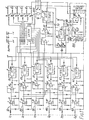
- an open circuit arm detector shown in Figure 1 is used to monitor electrical continuity in respective arms of a rectifier circuit.
- the rectifier circuit may be configured, as shown in Figure 2a, to receive power from a 3-phase supply or alternatively, as shown in Figure 2b, from a 6-phase, single way (half wave) supply.
- the input current i a1 ....i a6 prevailing in each arm A 1 ....A 6 of the rectifier circuit is monitored by means of a respective current transformer CT ....CT 6 .
- the primary winding W1 of each transformer is connected in series with a diode D 1 ....D 6 in a respective arm and a voltage, proportional to the input current in that arm, is developed across the secondary winding W2.
- the voltages developed in this manner are applied to respective input terminals I 1 ....I 6 of the detector shown in Figure 1.
- the detector operates on the received voltages and generates an alarm signal if a discontinuity in any one of the input arms persists for longer than a predetermined interval of time. If desired, the alarm signal may be used to de-energise the rectifier circuit thereby to disconnect an associated equipment which might otherwise be damaged or operate in an unreliable or dangerous manner.
- Voltages applied at input terminals I 1 ....I 6 are operated on, initially by respective circuits shown generally at 10, 20 .... 60. These circuits are identical and only one of them, circuit 10, will be described in detail.
- a voltage applied at input terminal I 1 of circuit 10 is used to drive a comparator 12.
- the comparator generates a train of CMOS trigger pulses P which are fed to the input of an monostable circuit 13.
- the trigger pulses have a periodicity of 20 ms and the monostable circuit is arranged to have a time constant of 70 ms.
- circuit 13 assumes the unstable condition if the pulse train is applied continuously at its input. However, if an interruption of more than 70 ms occurs the circuit reverts to the stable condition and its output goes low, indicating that an open circuit condition may have arisen in the associated input arm of the rectifier circuit.
- the amplitudes of the applied voltages are compared with a threshold voltage V T in a comparator 71.
- the threshold voltage is set at a suitable value corresponding to the minimum operating current imin in the input arms of the rectifier circuit. If the applied voltage, associated with any of the input arms, exceeds the threshold voltage V T comparator 71 generates an output signal which is fed to another monostable circuit 72 whose input and output locations are connected to respective input terminals of a NAND gate 73. With this arrangement a low produced at the output of gate 73 indicates that at least one of the input arms carries the minimum operating current.
- the output of gate 73 is coupled to one input terminal A of another NAND gate 80, the other input terminal B being coupled commonly to the outputs of the monostable circuits 13, 23 .... 63 in circuits 10 .... 60. If both inputs to gate 80 are simultaneously low a potential fault detected by one or more circuits 10 .... 60 is likely to be of significance. In these circumstances the output of gate 80 goes high and triggers a yet further monostable circuit 81.
- the input and output locations of circuit 81 are connected to respective input locations of a further NAND gate 82.
- monostable circuit 81 has a time constant of 150 ms; if both inputs to gate 80 remain low for this length of time, thereby indicating that an interruption in the pulse train, detected by one or more of circuits 10 .... 60, has persisted for 220 ms, NAND gate 82 produces an alarm signal AS suitable to cause a change of state in a bistable circuit 90.
- response circuit 90 renders a transistor 91 non-conductive thereby causing a relay 92 to de-energise and triggering a number of alarms which may be located at remote monitoring stations. If desired, the relay may also be used to de-energise the rectifier circuit.
- a signal generated at the output of bistable circuit 90 is also used to trigger a latch circuit 100 connected, as shown, to circuits 10 .... 60 so as to sample, and store data indicative of, the voltage levels prevailing at the inverted outputs of monostable circuits 13 .... 63.
- the latch when triggered, drives appropriate ones of a plurality of transistors T 1 .... T 6 in accordance with the stored data. If an open circuit condition is detected in an input arm of the rectifier circuit the latch drives the correspondiong transistor which, in turn, energises an associated LED (as shown).
- the LEDS provide a display capable, when energised, of showing the location of any detected fault.
- bistable circuit 90 is not used to control transistor 91; instead alarm signal AS triggers a timing circuit 301 directly, which, in turn, de-energises the transistor, after a preset delay of 1 second, for example.
- Bistable circuit 90 is used to trigger latch 100 as described hereinbefore.
- a capacitor 302 may be used as a "power-on-reset" for the bistable circuit.
- a further relay shown at 200 in Figure 1 may be provided which de-energises if the power supply to the circuit should fail.
- monostable circuit 81 is omitted, circuits 13 .... 63 having correspondingly larger time constants (220 ms, for example), as desired.
- gate 80 is coupled directly to bistable circuit 90.
- CT current transformers
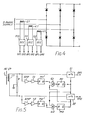
- the current sensed by a transformer CT located close to the supply line, is routed to output locations OP1, OP2 via respective solid state switching circuits S1, S2.
- the switching circuits are controlled by respective monostable circuits M1, M2 which are triggered by respective AND gates G1, G2.
- One input terminal of each gate is connected to a further monostable circuit M1', M2' which is driven by pulses generated in a comparator C1, C2 and derived from the positive and negative half cycles of the sensed current.
- the other input terminal of each gate Gl, G2 is cross-coupled, as shown, to the output of one of the monostable circuits M1, M2 in such a way that the switches S1, S2 can never assume the same state. In this manner the positive and negative half cycles of the a.c. input current are presented independently at the respective output locations OP1, OP2 for supply to respective input terminals of an associated continuity monitoring apparatus.
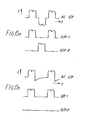
- Figures 6a and 6b show the output waveforms generated at OP1 and OP2 in response to different a.c. input waveforms.
- the circuit of Figure 5 proves to be particularly beneficial in that the open circuit arm detector of Figure 1 may be used even in circumstances when it is impracticable or inconvenient to locate current transformers in the input arm of a rectifier circuit.
Landscapes
- Engineering & Computer Science (AREA)
- Power Engineering (AREA)
- Physics & Mathematics (AREA)
- General Physics & Mathematics (AREA)
- Rectifiers (AREA)
- Measurement Of Current Or Voltage (AREA)
- Emergency Protection Circuit Devices (AREA)
- Testing Of Short-Circuits, Discontinuities, Leakage, Or Incorrect Line Connections (AREA)
Applications Claiming Priority (2)
| Application Number | Priority Date | Filing Date | Title |
|---|---|---|---|
| GB8429487 | 1984-11-22 | ||
| GB848429487A GB8429487D0 (en) | 1984-11-22 | 1984-11-22 | Electrical apparatus |
Publications (2)
| Publication Number | Publication Date |
|---|---|
| EP0187455A2 true EP0187455A2 (de) | 1986-07-16 |
| EP0187455A3 EP0187455A3 (de) | 1987-03-25 |
Family
ID=10570088
Family Applications (1)
| Application Number | Title | Priority Date | Filing Date |
|---|---|---|---|
| EP85308387A Withdrawn EP0187455A3 (de) | 1984-11-22 | 1985-11-18 | Elektrischer Apparat |
Country Status (6)
| Country | Link |
|---|---|
| US (1) | US4713652A (de) |
| EP (1) | EP0187455A3 (de) |
| AU (1) | AU574537B2 (de) |
| CA (1) | CA1257907A (de) |
| GB (1) | GB8429487D0 (de) |
| NZ (1) | NZ214279A (de) |
Families Citing this family (1)
| Publication number | Priority date | Publication date | Assignee | Title |
|---|---|---|---|---|
| FR2664706B1 (fr) * | 1990-07-11 | 1993-02-19 | Sextant Avionique | Dispositif de surveillance pour redresseur polyphase. |
Family Cites Families (13)
| Publication number | Priority date | Publication date | Assignee | Title |
|---|---|---|---|---|
| US3293605A (en) * | 1966-01-20 | 1966-12-20 | Moore Laurence | Digital monitoring system |
| CH495022A (de) * | 1969-09-16 | 1970-08-15 | Cerberus Ag | Feuermeldeanlage mit einer Vorrichtung zu deren Leitungsüberwachung |
| US3688293A (en) * | 1970-05-08 | 1972-08-29 | Standard Farrington Alarm & Si | Automatic time-controlled alarm system |
| US3728706A (en) * | 1970-09-28 | 1973-04-17 | Gen Signal Corp | System for indicating aerosols in the atmosphere |
| CA933592A (en) * | 1971-06-16 | 1973-09-11 | Canadian General Electric Company Limited | Cell surveillance monitor for a power converter |
| FR2186766B1 (de) * | 1972-04-28 | 1980-08-14 | Hazemeyer Sa | |
| GB1583244A (en) * | 1977-03-31 | 1981-01-21 | British Steel Corp | Electric arc steel processing unit including apparatus for detecting broken electrodes |
| US4222037A (en) * | 1978-12-05 | 1980-09-09 | General Electric Company | Cooking cycle timer |
| US4604607A (en) * | 1979-12-27 | 1986-08-05 | Protection Products Corporation | Security device simulating currency pack or the like |
| DE3117284A1 (de) * | 1981-04-30 | 1982-11-25 | Siemens AG, 1000 Berlin und 8000 München | Schaltungsanordnung zur ueberwachung eines symmetrischen dreiphasen-wechselstromes |
| GB2101784B (en) * | 1981-06-23 | 1985-11-27 | Chloride Group Plc | Fire alarms |
| FR2553943B1 (fr) * | 1983-10-24 | 1986-04-11 | Merlin Gerin | Dispositif differentiel residuel equipe d'un dispositif de surveillance de la source d'alimentation de l'electronique |
| FR2579159B1 (fr) * | 1985-03-25 | 1987-06-26 | Nacam | Dispositif de reglage d'une colonne de direction d'un vehicule automobile pourvu de moyens de blocage a genouillere |
-
1984
- 1984-11-22 GB GB848429487A patent/GB8429487D0/en active Pending
-
1985
- 1985-11-18 EP EP85308387A patent/EP0187455A3/de not_active Withdrawn
- 1985-11-19 US US06/799,643 patent/US4713652A/en not_active Expired - Fee Related
- 1985-11-20 CA CA000495770A patent/CA1257907A/en not_active Expired
- 1985-11-20 AU AU50267/85A patent/AU574537B2/en not_active Ceased
- 1985-11-21 NZ NZ214279A patent/NZ214279A/xx unknown
Also Published As
| Publication number | Publication date |
|---|---|
| NZ214279A (en) | 1988-08-30 |
| CA1257907A (en) | 1989-07-25 |
| GB8429487D0 (en) | 1985-01-03 |
| AU5026785A (en) | 1986-05-29 |
| EP0187455A3 (de) | 1987-03-25 |
| AU574537B2 (en) | 1988-07-07 |
| US4713652A (en) | 1987-12-15 |
Similar Documents
| Publication | Publication Date | Title |
|---|---|---|
| US4421976A (en) | System for monitoring heater elements of electric furnaces | |
| EP0708529A2 (de) | Leistungsschalter-Treiberanordnungen | |
| US6999326B2 (en) | Drive controller for a self-commutated converter | |
| US5552952A (en) | Detection and isolation circuit for a failed bridge power rectifier and an electrical system employing same | |
| US4713652A (en) | Electrical apparatus | |
| US6111736A (en) | Static relay with condition detecting | |
| US4380045A (en) | Thyristor convertor failure detection device | |
| US3968477A (en) | Control apparatus for electrical devices | |
| US11762039B2 (en) | Electrical installation comprising a monitoring module | |
| SU1319140A1 (ru) | Способ продольной дифференциальной токовой защиты линии электропередачи с соединительными проводами | |
| KR200315061Y1 (ko) | 3상 교류 전원의 돌입 전류 방지 장치 | |
| KR102899910B1 (ko) | 직렬 시스템의 고장 보호 장치 및 그 직렬 시스템 | |
| SU1480001A1 (ru) | Устройство дл обнаружени однофазного замыкани на землю в трехфазной сети с изолированной нейтралью | |
| US4628244A (en) | Electrical indicating circuit | |
| US11914002B2 (en) | Electrical installation comprising a monitoring module | |
| RU2109302C1 (ru) | Устройство контроля n переменных токов | |
| SU1317558A1 (ru) | Устройство дл питани потребителей посто нного тока с блоком защиты | |
| US3914664A (en) | Voltage balance relay | |
| SU1615843A1 (ru) | Устройство дл дифференциальной защиты электроустановок | |
| KR970010609B1 (ko) | 주상 변압기의 과부하 검출 및 경보 장치 | |
| SU951534A1 (ru) | Сигнализатор напр жени | |
| SU1043779A1 (ru) | Устройство дл дифференциальной защиты генератора | |
| SU1249643A1 (ru) | Способ защиты преобразовател | |
| SU1325617A1 (ru) | Устройство дл дифференциальной защиты электроустановки | |
| SU1403200A1 (ru) | Устройство дл сигнализации обрыва в трехфазной сети переменного тока |
Legal Events
| Date | Code | Title | Description |
|---|---|---|---|
| PUAI | Public reference made under article 153(3) epc to a published international application that has entered the european phase |
Free format text: ORIGINAL CODE: 0009012 |
|
| AK | Designated contracting states |
Kind code of ref document: A2 Designated state(s): AT BE CH DE FR GB IT LI LU NL SE |
|
| PUAL | Search report despatched |
Free format text: ORIGINAL CODE: 0009013 |
|
| AK | Designated contracting states |
Kind code of ref document: A3 Designated state(s): AT BE CH DE FR GB IT LI LU NL SE |
|
| 17P | Request for examination filed |
Effective date: 19871009 |
|
| 17Q | First examination report despatched |
Effective date: 19900115 |
|
| STAA | Information on the status of an ep patent application or granted ep patent |
Free format text: STATUS: THE APPLICATION HAS BEEN WITHDRAWN |
|
| 18W | Application withdrawn |
Withdrawal date: 19911202 |
|
| R18W | Application withdrawn (corrected) |
Effective date: 19911202 |
|
| RIN1 | Information on inventor provided before grant (corrected) |
Inventor name: FRENCH, STEVEN JOHN Inventor name: NEASHAM, DAVID LYNN |