EP0187929A2 - Kälteschlagzähe, thermoplastisch verarbeitbare Formmassen - Google Patents
Kälteschlagzähe, thermoplastisch verarbeitbare Formmassen Download PDFInfo
- Publication number
- EP0187929A2 EP0187929A2 EP85115043A EP85115043A EP0187929A2 EP 0187929 A2 EP0187929 A2 EP 0187929A2 EP 85115043 A EP85115043 A EP 85115043A EP 85115043 A EP85115043 A EP 85115043A EP 0187929 A2 EP0187929 A2 EP 0187929A2
- Authority
- EP
- European Patent Office
- Prior art keywords
- weight
- parts
- poly
- mass
- bis
- Prior art date
- Legal status (The legal status is an assumption and is not a legal conclusion. Google has not performed a legal analysis and makes no representation as to the accuracy of the status listed.)
- Withdrawn
Links
- 239000000206 moulding compound Substances 0.000 title 1
- 229920001169 thermoplastic Polymers 0.000 title 1
- 239000004416 thermosoftening plastic Substances 0.000 title 1
- 239000000203 mixture Substances 0.000 claims abstract description 31
- 229920001971 elastomer Polymers 0.000 claims abstract description 18
- 239000005060 rubber Substances 0.000 claims abstract description 18
- VZCYOOQTPOCHFL-OWOJBTEDSA-N Fumaric acid Chemical compound OC(=O)\C=C\C(O)=O VZCYOOQTPOCHFL-OWOJBTEDSA-N 0.000 claims abstract description 9
- QQONPFPTGQHPMA-UHFFFAOYSA-N Propene Chemical compound CC=C QQONPFPTGQHPMA-UHFFFAOYSA-N 0.000 claims abstract description 9
- VZCYOOQTPOCHFL-UHFFFAOYSA-N trans-butenedioic acid Natural products OC(=O)C=CC(O)=O VZCYOOQTPOCHFL-UHFFFAOYSA-N 0.000 claims abstract description 9
- FPYJFEHAWHCUMM-UHFFFAOYSA-N maleic anhydride Chemical compound O=C1OC(=O)C=C1 FPYJFEHAWHCUMM-UHFFFAOYSA-N 0.000 claims abstract description 7
- VXNZUUAINFGPBY-UHFFFAOYSA-N 1-Butene Chemical compound CCC=C VXNZUUAINFGPBY-UHFFFAOYSA-N 0.000 claims abstract description 6
- VGGSQFUCUMXWEO-UHFFFAOYSA-N Ethene Chemical compound C=C VGGSQFUCUMXWEO-UHFFFAOYSA-N 0.000 claims abstract description 5
- VZCYOOQTPOCHFL-UPHRSURJSA-N maleic acid Chemical compound OC(=O)\C=C/C(O)=O VZCYOOQTPOCHFL-UPHRSURJSA-N 0.000 claims abstract description 4
- 125000000008 (C1-C10) alkyl group Chemical group 0.000 claims abstract description 3
- -1 poly (ether ester amide Chemical class 0.000 claims description 25
- 238000000465 moulding Methods 0.000 claims description 22
- RTZKZFJDLAIYFH-UHFFFAOYSA-N ether Substances CCOCC RTZKZFJDLAIYFH-UHFFFAOYSA-N 0.000 claims description 16
- 239000000945 filler Substances 0.000 claims description 8
- 125000004432 carbon atom Chemical group C* 0.000 claims description 7
- 239000001530 fumaric acid Substances 0.000 claims description 4
- OFOBLEOULBTSOW-UHFFFAOYSA-N Propanedioic acid Natural products OC(=O)CC(O)=O OFOBLEOULBTSOW-UHFFFAOYSA-N 0.000 claims description 3
- 239000011976 maleic acid Substances 0.000 claims description 3
- IAQRGUVFOMOMEM-UHFFFAOYSA-N butene Natural products CC=CC IAQRGUVFOMOMEM-UHFFFAOYSA-N 0.000 claims description 2
- 229920013639 polyalphaolefin Polymers 0.000 abstract description 10
- 150000001875 compounds Chemical class 0.000 abstract description 6
- 150000004291 polyenes Chemical class 0.000 abstract 1
- 238000004519 manufacturing process Methods 0.000 description 5
- KKEYFWRCBNTPAC-UHFFFAOYSA-N Terephthalic acid Chemical compound OC(=O)C1=CC=C(C(O)=O)C=C1 KKEYFWRCBNTPAC-UHFFFAOYSA-N 0.000 description 4
- TVIDDXQYHWJXFK-UHFFFAOYSA-N dodecanedioic acid Chemical compound OC(=O)CCCCCCCCCCC(O)=O TVIDDXQYHWJXFK-UHFFFAOYSA-N 0.000 description 4
- 239000004952 Polyamide Substances 0.000 description 3
- 150000005690 diesters Chemical class 0.000 description 3
- 150000002009 diols Chemical class 0.000 description 3
- RLSSMJSEOOYNOY-UHFFFAOYSA-N m-cresol Chemical compound CC1=CC=CC(O)=C1 RLSSMJSEOOYNOY-UHFFFAOYSA-N 0.000 description 3
- 229920002647 polyamide Polymers 0.000 description 3
- 229920000098 polyolefin Polymers 0.000 description 3
- 229920000909 polytetrahydrofuran Polymers 0.000 description 3
- BBMCTIGTTCKYKF-UHFFFAOYSA-N 1-heptanol Chemical compound CCCCCCCO BBMCTIGTTCKYKF-UHFFFAOYSA-N 0.000 description 2
- PBLZLIFKVPJDCO-UHFFFAOYSA-N 12-aminododecanoic acid Chemical compound NCCCCCCCCCCCC(O)=O PBLZLIFKVPJDCO-UHFFFAOYSA-N 0.000 description 2
- KZDCMKVLEYCGQX-UDPGNSCCSA-N 2-(diethylamino)ethyl 4-aminobenzoate;(2s,5r,6r)-3,3-dimethyl-7-oxo-6-[(2-phenylacetyl)amino]-4-thia-1-azabicyclo[3.2.0]heptane-2-carboxylic acid;hydrate Chemical compound O.CCN(CC)CCOC(=O)C1=CC=C(N)C=C1.N([C@H]1[C@H]2SC([C@@H](N2C1=O)C(O)=O)(C)C)C(=O)CC1=CC=CC=C1 KZDCMKVLEYCGQX-UDPGNSCCSA-N 0.000 description 2
- KXDHJXZQYSOELW-UHFFFAOYSA-N Carbamic acid Chemical compound NC(O)=O KXDHJXZQYSOELW-UHFFFAOYSA-N 0.000 description 2
- JHWNWJKBPDFINM-UHFFFAOYSA-N Laurolactam Chemical compound O=C1CCCCCCCCCCCN1 JHWNWJKBPDFINM-UHFFFAOYSA-N 0.000 description 2
- LRHPLDYGYMQRHN-UHFFFAOYSA-N N-Butanol Chemical compound CCCCO LRHPLDYGYMQRHN-UHFFFAOYSA-N 0.000 description 2
- AMQJEAYHLZJPGS-UHFFFAOYSA-N N-Pentanol Chemical compound CCCCCO AMQJEAYHLZJPGS-UHFFFAOYSA-N 0.000 description 2
- 239000004698 Polyethylene Substances 0.000 description 2
- 239000004721 Polyphenylene oxide Substances 0.000 description 2
- WNLRTRBMVRJNCN-UHFFFAOYSA-N adipic acid Chemical compound OC(=O)CCCCC(O)=O WNLRTRBMVRJNCN-UHFFFAOYSA-N 0.000 description 2
- 125000001931 aliphatic group Chemical group 0.000 description 2
- 239000006229 carbon black Substances 0.000 description 2
- 238000006243 chemical reaction Methods 0.000 description 2
- 230000000694 effects Effects 0.000 description 2
- 238000002474 experimental method Methods 0.000 description 2
- 239000008187 granular material Substances 0.000 description 2
- 238000004898 kneading Methods 0.000 description 2
- 150000003951 lactams Chemical class 0.000 description 2
- BDJRBEYXGGNYIS-UHFFFAOYSA-N nonanedioic acid Chemical compound OC(=O)CCCCCCCC(O)=O BDJRBEYXGGNYIS-UHFFFAOYSA-N 0.000 description 2
- WLJVNTCWHIRURA-UHFFFAOYSA-N pimelic acid Chemical compound OC(=O)CCCCCC(O)=O WLJVNTCWHIRURA-UHFFFAOYSA-N 0.000 description 2
- 229920000570 polyether Polymers 0.000 description 2
- 229920000573 polyethylene Polymers 0.000 description 2
- 229920000642 polymer Polymers 0.000 description 2
- 239000000843 powder Substances 0.000 description 2
- 229920005989 resin Polymers 0.000 description 2
- 239000011347 resin Substances 0.000 description 2
- CXMXRPHRNRROMY-UHFFFAOYSA-N sebacic acid Chemical compound OC(=O)CCCCCCCCC(O)=O CXMXRPHRNRROMY-UHFFFAOYSA-N 0.000 description 2
- TYFQFVWCELRYAO-UHFFFAOYSA-N suberic acid Chemical compound OC(=O)CCCCCCC(O)=O TYFQFVWCELRYAO-UHFFFAOYSA-N 0.000 description 2
- OJOWICOBYCXEKR-KRXBUXKQSA-N (5e)-5-ethylidenebicyclo[2.2.1]hept-2-ene Chemical compound C1C2C(=C/C)/CC1C=C2 OJOWICOBYCXEKR-KRXBUXKQSA-N 0.000 description 1
- PXGZQGDTEZPERC-UHFFFAOYSA-N 1,4-cyclohexanedicarboxylic acid Chemical compound OC(=O)C1CCC(C(O)=O)CC1 PXGZQGDTEZPERC-UHFFFAOYSA-N 0.000 description 1
- QFGCFKJIPBRJGM-UHFFFAOYSA-N 12-[(2-methylpropan-2-yl)oxy]-12-oxododecanoic acid Chemical compound CC(C)(C)OC(=O)CCCCCCCCCCC(O)=O QFGCFKJIPBRJGM-UHFFFAOYSA-N 0.000 description 1
- 229910002012 Aerosil® Inorganic materials 0.000 description 1
- OKTJSMMVPCPJKN-UHFFFAOYSA-N Carbon Chemical group [C] OKTJSMMVPCPJKN-UHFFFAOYSA-N 0.000 description 1
- LFQSCWFLJHTTHZ-UHFFFAOYSA-N Ethanol Chemical compound CCO LFQSCWFLJHTTHZ-UHFFFAOYSA-N 0.000 description 1
- 239000005977 Ethylene Substances 0.000 description 1
- 239000004743 Polypropylene Substances 0.000 description 1
- VYPSYNLAJGMNEJ-UHFFFAOYSA-N Silicium dioxide Chemical compound O=[Si]=O VYPSYNLAJGMNEJ-UHFFFAOYSA-N 0.000 description 1
- 239000012963 UV stabilizer Substances 0.000 description 1
- 239000002253 acid Substances 0.000 description 1
- 150000007513 acids Chemical class 0.000 description 1
- 239000000654 additive Substances 0.000 description 1
- 239000001361 adipic acid Substances 0.000 description 1
- 235000011037 adipic acid Nutrition 0.000 description 1
- 150000001336 alkenes Chemical class 0.000 description 1
- 125000000217 alkyl group Chemical group 0.000 description 1
- 125000003178 carboxy group Chemical group [H]OC(*)=O 0.000 description 1
- 239000003795 chemical substances by application Substances 0.000 description 1
- 239000000470 constituent Substances 0.000 description 1
- 229920001577 copolymer Polymers 0.000 description 1
- 230000007423 decrease Effects 0.000 description 1
- 125000002704 decyl group Chemical group [H]C([H])([H])C([H])([H])C([H])([H])C([H])([H])C([H])([H])C([H])([H])C([H])([H])C([H])([H])C([H])([H])C([H])([H])* 0.000 description 1
- 238000007872 degassing Methods 0.000 description 1
- JBSLOWBPDRZSMB-BQYQJAHWSA-N dibutyl (e)-but-2-enedioate Chemical compound CCCCOC(=O)\C=C\C(=O)OCCCC JBSLOWBPDRZSMB-BQYQJAHWSA-N 0.000 description 1
- 150000002148 esters Chemical class 0.000 description 1
- LYCAIKOWRPUZTN-UHFFFAOYSA-N ethylene glycol Natural products OCCO LYCAIKOWRPUZTN-UHFFFAOYSA-N 0.000 description 1
- 239000000835 fiber Substances 0.000 description 1
- 238000007306 functionalization reaction Methods 0.000 description 1
- 238000010438 heat treatment Methods 0.000 description 1
- 230000007062 hydrolysis Effects 0.000 description 1
- 238000006460 hydrolysis reaction Methods 0.000 description 1
- 125000002887 hydroxy group Chemical group [H]O* 0.000 description 1
- WGCNASOHLSPBMP-UHFFFAOYSA-N hydroxyacetaldehyde Natural products OCC=O WGCNASOHLSPBMP-UHFFFAOYSA-N 0.000 description 1
- 239000003273 ketjen black Substances 0.000 description 1
- 238000000691 measurement method Methods 0.000 description 1
- 239000000155 melt Substances 0.000 description 1
- 238000000034 method Methods 0.000 description 1
- JRZJOMJEPLMPRA-UHFFFAOYSA-N olefin Natural products CCCCCCCC=C JRZJOMJEPLMPRA-UHFFFAOYSA-N 0.000 description 1
- 150000003022 phthalic acids Chemical class 0.000 description 1
- 239000000049 pigment Substances 0.000 description 1
- 239000004014 plasticizer Substances 0.000 description 1
- 229920001515 polyalkylene glycol Polymers 0.000 description 1
- 229920001223 polyethylene glycol Polymers 0.000 description 1
- 230000000379 polymerizing effect Effects 0.000 description 1
- 229920001155 polypropylene Polymers 0.000 description 1
- 229920001451 polypropylene glycol Polymers 0.000 description 1
- 238000002360 preparation method Methods 0.000 description 1
- 238000012545 processing Methods 0.000 description 1
- 125000004805 propylene group Chemical group [H]C([H])([H])C([H])([*:1])C([H])([H])[*:2] 0.000 description 1
- 239000012779 reinforcing material Substances 0.000 description 1
- 239000000454 talc Substances 0.000 description 1
- 229910052623 talc Inorganic materials 0.000 description 1
- 238000009864 tensile test Methods 0.000 description 1
- 239000004753 textile Substances 0.000 description 1
- 239000003017 thermal stabilizer Substances 0.000 description 1
- 238000004448 titration Methods 0.000 description 1
Classifications
-
- C—CHEMISTRY; METALLURGY
- C08—ORGANIC MACROMOLECULAR COMPOUNDS; THEIR PREPARATION OR CHEMICAL WORKING-UP; COMPOSITIONS BASED THEREON
- C08L—COMPOSITIONS OF MACROMOLECULAR COMPOUNDS
- C08L77/00—Compositions of polyamides obtained by reactions forming a carboxylic amide link in the main chain; Compositions of derivatives of such polymers
- C08L77/12—Polyester-amides
-
- C—CHEMISTRY; METALLURGY
- C08—ORGANIC MACROMOLECULAR COMPOUNDS; THEIR PREPARATION OR CHEMICAL WORKING-UP; COMPOSITIONS BASED THEREON
- C08K—Use of inorganic or non-macromolecular organic substances as compounding ingredients
- C08K3/00—Use of inorganic substances as compounding ingredients
- C08K3/02—Elements
- C08K3/04—Carbon
Definitions
- the invention relates to cold impact, thermoplastically processable molding compositions.
- Poly (ether ester amides) are known. It is also known that the polyether fractions act as internal plasticizers and so the impact strength of the poly (ether ester amides) is increased significantly above the level of the pure polyamide component (Angew. Makromol. Chem. 74, (1978) 49; DE-OSS 27 12 987, 29 30 343, 29 32 234, 29 36 976, 29 36 977). However, the modulus of elasticity of the molding compositions decreases sharply with increasing polyether content, and the impact strength of e.g. B. Molding compounds filled with carbon black do not reach the level required for many areas of application.
- DE-OS 32 42 827 teaches that molding compositions of 1 to 99 parts of poly (ether ester amide) and 99 to 1 part of polyolefin have an increased impact resistance compared to the poly (ether ester amide) component.
- the polyolefins are polypropylene, polyethylene, their mixtures or copolymers and also ionomeric resins.
- the level of properties of such molding compositions is not sufficient, since either the linkage of the non-functionalized olefin component is incomplete in the case of copolyolefins, or the impact-modifying effect is only slight in the case of ionomeric resins.
- EP-OS 84 277 describes textile fibers which contain 1 to 99 parts of polyolefin and 99 to 1 part of poly (ether ester amide).
- the object of the invention was to find molding compositions based on poly (ether ester amides) which achieve a high level of toughness without reducing the modulus of elasticity.
- a filler which could cause the embrittlement of the molding compositions, the Z should ähbuchshou not be lowered.
- polyamide-forming compound (A.1) ⁇ -aminocarboxylic acids or lactams having at least 6 C-atoms, preferably laurolactam, ⁇ -aminododecanoic acid or CJ A minoundecanchure used.
- Another preferred possibility is to use, instead of the monomolecular aminocarboxylic acids, their polymers with an average molecular weight of 500 to 20,000, preferably 4,000 to 10,000.
- Poly (alkylene glycols) of component A.2 are poly (ethylene glycol), poly (propylene glycol) or poly (tetrahydrofuran) diol, each with an average molecular weight (M n ; determined by end group titration) in the range from 160 to 3,000, preferably 300 to 2,200, in particular from 500 to 1,200. Preference is given to using poly (tetrahydrofuran) diol with an average molecular weight of 500 to 2,000.
- Component A.3 is formed by aliphatic, cycloaliphatic or aromatic dicarboxylic acids with 4 to 11 carbon atoms in the carbon skeleton. Examples include adipic acid, pimelic acid, suberic acid, azelaic acid, sebacic acid, dodecanedioic acid, hexahydroterephthalic acid or the phthalic acids. Terephthalic acid and dodecanedioic acid are preferably used for this component.
- the poly (ether ester amides) are constructed in such a way that the weight ratio of components A.1 and (A.2 + A.3) is in the range from 95: 5 to 50:50. A weight ratio in the range from 90-60 : 10-40 is preferred.
- the hydroxyl and carboxyl groups of (A.2 + A.3) are in approximately equivalent proportions, ie in a ratio of approximately 1: 0.95 to 1: 1.05.
- Preferred poly (ether ester amides) are prepared by reacting laurolactam, poly (tetrahydrofuran) diol with an average molecular weight of 500 to 2,000 and dodecanedioic acid or terephthalic acid.
- the average molecular weight of these products is in the range from 5,000 to 40,000, preferably 8,000 to 25,000.
- Poly (ether ester amides) suitable according to the invention have a relative solution viscosity ( ⁇ rel ) of at least 1.5, preferably from 1.8 to 2.3.
- the poly ( ⁇ -olefin) rubbers used for the production of component B can be in the form of an amorphous type, a sequence type or a mixed type. These products are commercially available.
- the rubbers are generally used as powder, crumbs or granules and can contain ⁇ 5% by mass, based on the rubber of a separating powder, such as, for example, polyethylene, talc or Aerosil.
- the proportion of these multienes in the rubber is 0.5 to 10 parts by weight, preferably 1 to 5 parts by weight. (Components a., B. And c. Should add up to 100 parts by weight). Depending on the proportion of multien component, the rubber has 0 to 15 double bonds / 100 carbon atoms.
- the Mooney viscosity (ML 1 + 4 ; 100 ° C; DIN 53 523) of the poly ( ⁇ -olefin) rubber is 30 to 130, preferably 35 to 110.
- a mixture of maleic anhydride and maleic and / or fumaric acid di (C 1 to C 10 alkyl) ester is added to the rubber.
- Diesters of fumaric acid are preferably used.
- the alcohol component used is preferably n-butanol, n-heptanol and n-pentanol.
- the mass ratio of maleic anhydride to diester is 1: 5 to 1: 0.5, preferably 1: 2 to 1: 0.5.
- the proportion of poly ( ⁇ -olefin) rubber in the adduct (component B.) is 92.5 to 99.5% by mass, preferably 96 to 99% by mass.
- a mixture of rubber, maleic anhydride and diester is first prepared at room temperature and then this mixture is produced in given the reactor in which the reaction takes place.
- the components are placed in different zones of an extruder, where the desired reaction then takes place.
- component B 95 to 60 parts by weight, preferably 90 to 70 parts by weight, of the poly (ether ester amides) are present in the molding compositions according to the invention.
- the rest of 100 parts by weight is formed by component B.
- molding compositions are produced in the melt and in a known manner; for example in a twin-screw kneader, which is advantageously equipped with kneading blocks, or in a degassing extruder.
- Customary additives and auxiliaries such as pigments, processing agents, other fillers and reinforcing materials, hydrolysis, thermal or UV stabilizers, can be incorporated both during production and into the finished molding compositions.
- the molding compositions according to the invention are particularly suitable when using fillers which easily lead to embrittlement of the filled molding compositions.
- Such fillers can be used in amounts of 1 to 30% by mass as from 5 to 15% by mass, and particularly preferably from 5 to 10% by mass.
- Preferred from this group of fillers is conductivity black.
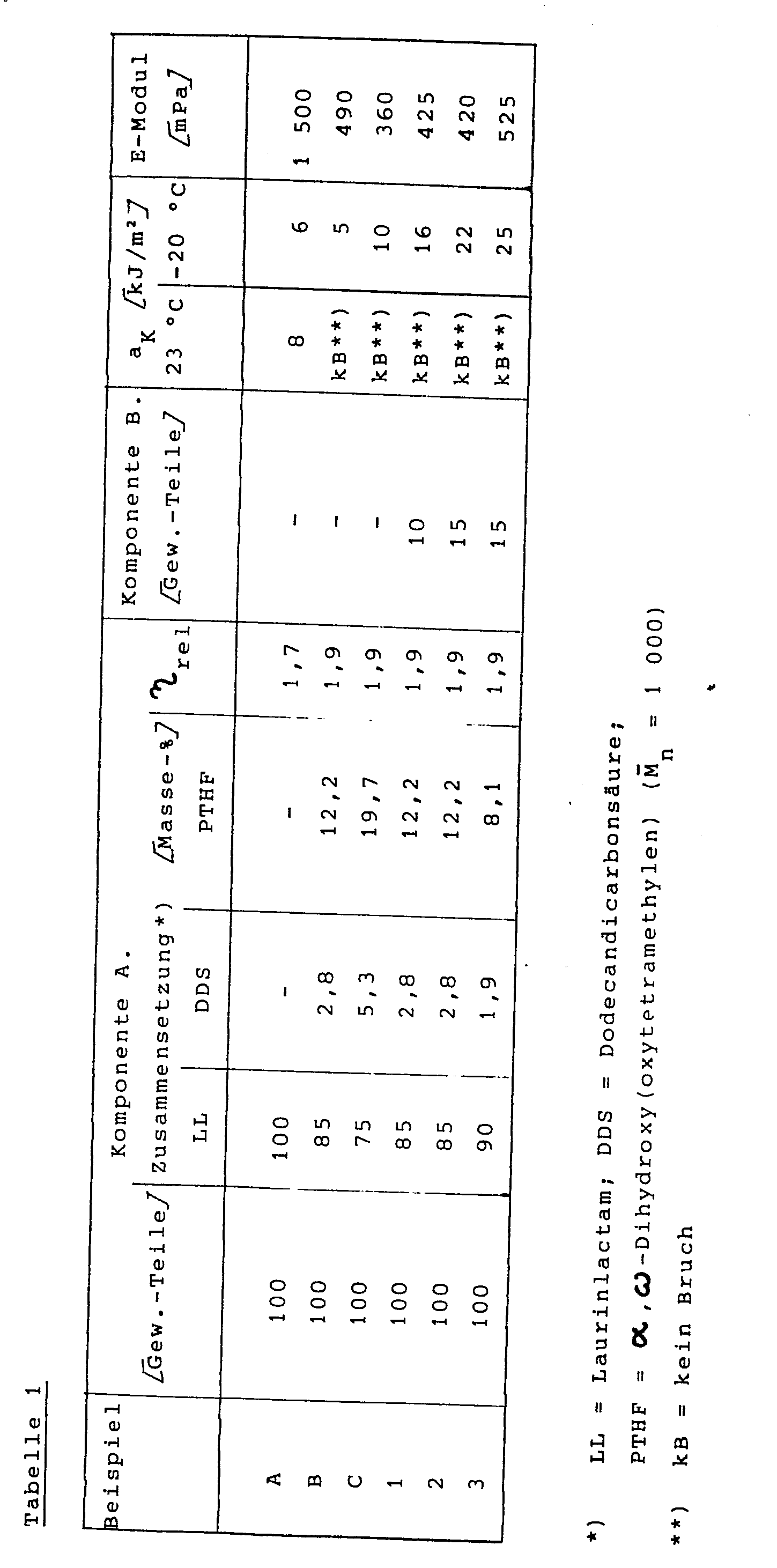
- the molding compositions according to the invention have a number of unexpected advantages: the toughness in the cold is greatly improved without the modulus of elasticity being significantly reduced, and fillers which cause the molding composition to become brittle can be incorporated, without the toughness level falling sharply.
- the Mooney viscosity of the poly ( ⁇ -olefin) rubber was determined in accordance with DIN 53 523, parts 1 to 3 (under the conditions ML 1 + 4 ; 100 ° C.).
- the notched impact strength (a K ) of the molding compositions was measured in accordance with DIN 53 453 on standard small bars with a rectangular notch.
- the E module is determined from the tensile test according to DIN 53 457.
- component B The granules of component B. are mixed with component A listed in Table 1, optionally also with commercially available conductivity carbon black (KETJENBLACK R EC) (Table 2) in the proportions given there, and the mixture is melted in a twin-screw kneader, the dispersing effect of which is enhanced by kneading blocks was on. It is granulated and dried to a residual moisture content of less than 0.5%. In experiments A to D, the components listed in the tables are remelted and granulated in the same way, without component B being present.
- KETJENBLACK R EC commercially available conductivity carbon black
Landscapes
- Chemical & Material Sciences (AREA)
- Health & Medical Sciences (AREA)
- Chemical Kinetics & Catalysis (AREA)
- Medicinal Chemistry (AREA)
- Polymers & Plastics (AREA)
- Organic Chemistry (AREA)
- Compositions Of Macromolecular Compounds (AREA)
Abstract
Kälteschlagzähe, thermoplastisch verarbeitbare Formmasse aus
- A. 95 bis 60 Gew.-Teilen Poly(etheresteramid) und
- B. 5 bis 40 Gew.-Teilen eines Adduktes aus 1. 92,5 bis 99,5 Masse-% eines Poly(α-olefin) - Kautschuks enthaltend
- a. 50 bis 85 Gew.-Teile Ethen
- b. 15 bis 50 Gew.-Teile Propen und/oder Buten-(1) und
- c. ggf. ein oder mehrere Multiene sowie
II. 0,5 bis 7,5 Masse- % eines Gemisches von Maleinsäureanhydrid und Maleinsäure- und/oder Fumarsäure-di-(C, bis C10-alkyl)-ester im Masseverhältnis 1 : 5 bis 1 : 0,5.
Description
- Gegenstand der Erfindung sind kälteschlagzähe, thermoplastisch verarbeitbare Formmassen.
- Poly(etheresteramide) sind bekannt. Es ist weiterhin bekannt, daß die Polyetheranteile als innere Weichmacher wirken und so die Schlagzähigkeit der Poly-(etheresteramide) deutlich über das Niveau der reinen Polyamidkomponente angehoben wird (Angew. Makromol. Chem. 74, (1978) 49; DE-OSS 27 12 987, 29 30 343, 29 32 234, 29 36 976, 29 36 977). Allerdings nimmt der E-Modul der Formmassen mit zunehmendem Polyethergehalt stark ab, und die Schlagzähigkeit von z. B. mit Leitfähigkeitsruß gefüllten Formmassen erreicht nicht das für viele Anwendungsbereiche notwendige Niveau.
- Die DE-OS 32 42 827 lehrt, daß Formmassen aus 1 bis 99 Teilen Poly(etheresteramid) und 99 bis 1 Teilen Polyolefin eine gegenüber der Poly(etheresteramid)-Komponente erhöhte Stoßfestigkeit besitzen. Allerdings handelt es sich bei den Polyolefinen um Polypropylen, Polyethylen, ihre Gemische oder Copolymere sowie um ionomere Harze. Solche Formmassen reichen in ihrem Eigenschaftsniveau nicht aus, da entweder im Falle der Copolyolefine die Anbindung der nicht funktionalisierten Olefinkomponente unvollständig ist, oder im Falle der ionomeren Harze die schlagzähmachende Wirkung nur gering ist.
- EP-OS 84 277 beschreibt Textilfasern, die 1 bis 99 Teile Polyolefin und 99 bis 1 Teile Poly(etherester- amid) enthalten.
- Aufgabe der Erfindung war es, Formmassen auf der Basis von Poly(etheresteramiden) aufzufinden, die ein hohes Zähigkeitsniveau erreichen, ohne daß der E-Modul herabgesetzt wird. Auch durch einen Füllstoff, der die Versprödung der Formmassen bewirken könnte, sollte das Zähigkeitsniveau nicht abgesenkt werden.
- Diese Aufgabe wurde gelöst durch Formmassen, bestehend aus
- A. 95 bis 60 Gew.-Teilen Poly(etheresteramid) mit einer relativen Viskosität von mindestens 1,5 und
- B. 5 bis 40 Gew.-Teilen eines Adduktes aus
- I. 92,5 bis 99,5 Masse-% eines Poly(α-olefin)-Kautschuks mit 0 bis 15 Doppelbindungen/ 100 C-Atome und einer Mooney-Viskosität (ML1+4; 100 °C; DIN 53 523) von 30 bis 130 enthaltend a. 50 bis 85 Gew.-Teilen Ethen b. 15 bis 50 Gew.-Teilen Propen und/oder Buten-(l) und c. ggf. ein oder mehrere Multiene mit isolierten Doppelbindungen, wobei die Komponenten a., b. und c. sich zu 100 Gew.-Teilen aufaddieren sollen,
sowie- II. 0,5 bis 7,5 Masse-% eines Gemisches von Maleinsäureanhydrid und Maleinsäure- und/oder Fumarsäure-di-(C bis C10-alkyl)-ester im Masseverhältnis 1 : 5 bis 1 : 0,5.
- Die Poly(etheresteramide) (Komponente A.) werden durch Kondensieren von
- 1. einer oder mehrerer polyamidbildender Verbindungen aus der Gruppe der GJ-Aminocarbonsäure bzw. Lactame mit 6 bis 20 C-Atomen, vorzugsweise mit 6 bis 12 C-Atomen,
- 2. einem Poly(alkylenglykol) mit einem Molekulargewicht im Bereich von 160 bis 3 000,
- 3. einer oder mehrerer weiterer aliphatischer, cycloaliphatischer oder aromatischer Dicarbonsäuren erhalten.
- Als polyamidbildende Verbindung (A.1) werden ω-Aminocarbonsäuren bzw. Lactame mit mindestens 6 C-Atomen, vorzugsweise Laurinlactam, ω-Aminododecansäure oder CJ-Aminoundecansäure, verwendet. Eine weitere bevorzugte Möglichkeit besteht darin, anstelle der monomolekularen Aminocarbonsäuren, deren Polymere mit einem mittleren Molekulargewicht von 500 bis 20 000, vorzugsweise von 4 000 bis 10 000, einzusetzen.
- Die angegebenen Werte für die mittleren Molekulargewichte ergeben sich durch Bestimmung der Viskositätszahl.
- Poly(alkylenglykole) der Komponente A.2 sind Poly-(ethylenglykol), Poly(propylenglykol) oder Poly-(tetrahydrofuran)diol mit jeweils einem mittleren Molekulargewicht (Mn; bestimmt durch Endgruppentitration) im Bereich von 160 bis 3 000, vorzugsweise 300 bis 2 200, insbesondere von 500 bis 1 200. Bevorzugt ist die Verwendung von Poly(tetrahydrofuran)diol mit einem mittleren Molekulargewicht von 500 bis 2 000.
- Die Komponente A.3 wird durch aliphatische, cycloaliphatische oder aromatische Dicarbonsäuren mit 4 bis 11 C-Atomen im Kohlenstoffgerüst gebildet. Beispielsweise seien Adipinsäure, Pimelinsäure, Korksäure, Azelainsäure, Sebazinsäure, Dodecandisäure, Hexahydroterephthalsäure oder die Phthalsäuren genannt. Bevorzugt für diese Komponente werden Terephthalsäure und Dodecandisäure eingesetzt.
- Die Poly(etheresteramide) sind in der Weise aufgebaut, daß sich das Gewichtsverhältnis der Komponente A.1 und (A.2 + A.3) im Bereich von 95 : 5 bis zu 50 : 50 bewegt. Bevorzugt ist ein Gewichtsverhältnis im Bereich von 90 - 60 : 10 - 40. Die Hydroxyl- und Carboxylgruppen von (A.2 + A.3) liegen in etwa äquivalenten Anteilen, d. h. in einem Verhältnis von etwa 1 : 0,95 bis 1 : 1,05, vor.
- Bevorzugte Poly(etheresteramide) werden durch Umsetzung von Laurinlactam, Poly(tetrahydrofuran)diol mit einem mittleren Molgewicht von 500 bis 2 000 und Dodecandisäure oder Terephthalsäure hergestellt. Das mittlere Molekulargewicht dieser Produkte liegt im Bereich von 5 000 bis 40 000, vorzugsweise 8 000 bis 25 000.
- Die Herstellung derartiger Poly(etheresteramide) ist beispielsweise aus DE-OSS 27 12 987, 29 30 343, 29 32 234, 29 36 976 bzw. 29 36 977 bekannt.
- Es können auch Gemische von Poly(etheresteramiden) eingesetzt werden, wobei die Mischungsverhältnisse für die Erfindung unkritisch sind.
- Erfindungsgemäß geeignete Poly(etheresteramide) weisen eine relative Lösungsviskosität (ηrel) von mindestens 1,5, vorzugsweise von 1,8 bis 2,3, auf.
- Die zur Herstellung der Komponente B. eingesetzten Poly(α-olefin)-Kautschuke können als amorpher Typ, Sequenz-Typ oder gemischter Typ vorliegen. Diese Produkte sind handelsüblich.
- Die Kautschuke werden im allgemeinen als Pulver, Krümel oder Granulat eingesetzt und können < 5 Masse-%, bezogen auf den Kautschuk eines Trennpulvers, wie beispielsweise Polyethylen, Talkum oder Aerosil, enthalten.
- Die Poly(α-olefin)-Kautschuktypen werden durch Polymerisation von
- a. 50 bis 85 Gew.-Teilen, vorzugsweise von 60 bis 80 Gew.-Teilen, Ethen,
- b. 15 bis 50 Gew.-Teilen, vorzugsweise von 20 bis 40 Gew.-Teilen Propen und/oder Buten-(1)
- erhalten. Daneben können bei der Polymerisation ggf. noch c. ein oder mehrere Multiene mit isolierten Doppelbindungen
- eingesetzt werden. Der Anteil an diesen Multienen im Kautschuk beträgt 0,5 bis 10 Gew.-Teile, vorzugsweise 1 bis 5 Gew.-Teile. (Die Komponenten a., b. und c. sollen sich zu 100 Gew.-Teilen aufaddieren). Entsprechend dem Anteil an Multien-Komponente weist der Kautschuk 0 bis 15 Doppelbindungen/100 C-Atome auf.
- Die Mooney-Viskosität (ML1+4; 100 °C; DIN 53 523) des Poly(α-olefin)-Kautschuks beträgt 30 bis 130, vorzugsweise 35 bis 110.
- Zur Funktionalisierung wird an den Kautschuk ein Gemisch von Maleinsäureanhydrid und Maleinsäure- und/oder Fumarsäure-di-(C1 bis C10-alkyl)-ester addiert. Bevorzugt verwendet werden Diester der Fumarsäure. Als Alkoholkomponente werden bevorzugt n-Butanol, n-Heptanol und n-Pentanol eingesetzt. Das Masseverhältnis von Maleinsäureanhydrid zu Diester beträgt 1 : 5 bis 1 : 0,5, vorzugsweise 1 : 2 bis 1 : 0,5.
- In dem Addukt (Komponente B.) beläuft sich der Anteil an Poly(α-olefin)-Kautschuk auf 92,5 bis 99,5 Masse-%, vorzugsweise auf 96 bis 99 Masse-%.
- Bei einer bevorzugten Verfahrensvariante zur Funktionalisierung des Kautschuks wird zunächst bei Raumtemperatur eine Mischung aus Kautschuk, Maleinsäureanhydrid und Diester hergestellt und anschließend diese Mischung in den Reaktor gegeben, in dem die Umsetzung stattfindet. In einer anderen bevorzugten Variante werden die Komponenten in verschiedene Zonen eines Extruders gegeben, wo dann die gewünschte Umsetzung stattfindet.
- Zusätzliche Einzelheiten im Hinblick auf die Herstellung des Adduktes können DE-OS 33 35 706 entnommen werden.
- Die Poly(etheresteramide) sind zu 95 bis 60 Gew.-Teilen, vorzugsweise zu 90 bis 70 Gew.-Teilen, in den erfindungsgemäßen Formmassen enthalten. Der Rest zu 100 Gew.-Teilen wird durch die Komponente B. gebildet.
- Die Herstellung dieser Formmassen erfolgt in der Schmelze und in bekannter Weise; beispielsweise in einem Doppelschneckenkneter, der vorteilhafterweise mit Knetblöcken ausgerüstet ist, oder in einem Entgasungsextruder.
- In die erfindungsgemäßen Formmassen können weitere Polymere, wie z. B. Polyamide (DE-OS 27 16 004) und Poly(alkylenterephthalate) (DE-OS 29 30 343), eingearbeitet werden. Diese angeführten Mischungsbestandteile sind in den so erhaltenen Mischungen zu 1 bis 40, vorzugsweise 5 bis 25 Gew.-Teilen enthalten.
- Übliche Zusatz- und Hilfsstoffe, wie Pigmente, Verarbeitungsmittel, weitere Füll- und Verstärkungsstoffe, Hydrolyse-, Thermo- oder UV-Stabilisatoren, können sowohl während der Herstellung als auch in die fertigen Formmassen eingearbeitet werden.
- Die erfindungsgemäßen Formmassen eignen sich besonders bei Anwendung von Füllstoffen, die leicht zur Versprödunj der gefüllten Formmassen führen. Derartige Füllstoffe können in Mengen von 1 bis 30 Masse-%, vorzugsweise von 5 bis 15 Masse-%, und insbesondere bevorzugt von 5 bis 10 Masse-%, eingearbeitet werden. Bevorzugt aus dieser Gruppe von Füllstoffen ist Leitfähigkeitsruß.
- Gegenüber dem Stand der Technik weisen die erfindungsgemäßen Formmassen eine Reihe von unerwarteten Vorteilen auf: Die zähigkeit in der Kälte wird stark verbessert, ohne daß der E-Modul wesentlich vermindert wird, und es können Füllstoffe, die eine Versprödung der Formmasse bewirken, eingearbeitet werden, ohne daß das Zähigkeitsniveau stark abfällt.
- Die in der Beschreibung und den Beispielen angeführten Parameter wurden mittels der nachstehend genannten Meßmethoden bestimmt:
- Die relative Viskosität (ηrel) der Poly(etheresteramide) und des Polyamids wurde in m-Kresol bei 25 °C (Konzentration: 0,5 g/dl) gemäß DIN 53 727 gemessen.
- Die Mooney-Viskosität des Poly(α-olefin)-Kautschuks wurde gemäß DIN 53 523, Teil 1 bis 3 (unter den Bedingungen ML1+4; 100 °C), bestimmt.
- Die Kerbschlagzähigkeit (aK) der Formmassen wurde nach DIN 53 453 an Normkleinstäben mit Rechteckkerbe gemessen.
- Der E-Modul wird aus dem Zugversuch nach DIN 53 457 bestimmt.
- Mit Buchstaben gekennzeichnete Versuche sind nicht erfindungsgemäß.
- 95 Gew.-Teile eines Poly(α-olefin)-Kautschuks (75 Masse-% Ethylen, 23 Masse-% Propylen, 2 Masse-% Ethylidennorbornen) mit einer Mooney-Viskosität von 85 werden in die Einzugszone eines Zweischneckenextruders eindosiert. In einer weiteren Einzugszone wird eine in einem Behälter hergestellte Mischung aus 2,5 Gew.-Teilen Maleinsäureanhydrid und 2,5 Gew.-Teilen Fumarsäure-di-n-butylester dem geschmolzenen Kautschuk zugegeben. Die Heizzonen des Extruders sind dabei, mit Ausnahme der ersten, gekühlten, auf 300 °C eingestellt. Es wird granuliert und auf eine Restfeuchte von weniger als 1 % getrocknet.
- Das Granulat der Komponente B. mischt man mit der in Tabelle 1 aufgeführten Komponente A., gegebenenfalls zusätzlich mit handelsüblichem Leitfähigkeitsruß (KETJENBLACKR EC) (Tabelle 2) in den dort angegebenen Mengenverhältnissen und schmilzt das Gemenge in einem Doppelschneckenkneter, dessen Dispergierwirkung durch Knetblöcke verstärkt wurde, auf. Es wird granuliert und auf eine Restfeuchte von weniger als 0,5 % getrocknet. Bei den Versuchen A bis D werden die in den Tabellen angegebenen Komponenten, ohne Anwesenheit der Komponente B, in gleicher Weise umgeschmolzen und granuliert.

Claims (3)
1. Kälteschlagzähe, thermoplastisch verarbeitbare Formmasse aus
A. 95 bis 60 Gew.-Teilen Poly(etheresteramid)
mit einer relativen Viskosität von mindestens 1,5 und
B. 5 bis 40 Gew.-Teilen eines Adduktes aus
sowie
I. 92,5 bis 99,5 Masse-% eines Poly(C4-olefin)-Kautschuks mit 0 bis 15 Doppelbindungen/ 100 C-Atome und einer Mooney-Viskosität (ML1+4; 100 °C; DIN 53 523) von 30 bis 130 enthaltend a. 50 bis 85 Gew.-Teilen Ethen b. 15 bis 50 Gew.-Teilen Propen und/oder Buten-(1) und c. ggf. ein oder mehrere Multiene mit isolierten Doppelbindungen, wobei die Komponenten a., b. und c. sich zu 100 Gew.-Teilen aufaddieren sollen,
sowie
II. 0,5 bis 7,5 Masse-% eines Gemisches von Maleinsäureanhydrid und Maleinsäure- und/oder Fumarsäure-di-(C1 bis C10-alkyl)-ester im Masseverhältnis 1 : 5 bis 1 : 0,5.
2. Formmasse nach Anspruch 1, dadurch gekennzeichnet, daß sie bis zu 30 Gew.-Teile (bezogen auf 100 Gew.-Teile der Formmasse) Füllstoffe enthalten.
3. Formmasse nach Anspruch 2, dadurch gekennzeichnet, daß als Füllstoff Leitfähigkeitsruß verwendet wird.
Applications Claiming Priority (2)
| Application Number | Priority Date | Filing Date | Title |
|---|---|---|---|
| DE3500829 | 1985-01-12 | ||
| DE19853500829 DE3500829A1 (de) | 1985-01-12 | 1985-01-12 | Kaelteschlagzaehe, thermoplastisch verarbeitbare formmassen |
Publications (1)
| Publication Number | Publication Date |
|---|---|
| EP0187929A2 true EP0187929A2 (de) | 1986-07-23 |
Family
ID=6259672
Family Applications (1)
| Application Number | Title | Priority Date | Filing Date |
|---|---|---|---|
| EP85115043A Withdrawn EP0187929A2 (de) | 1985-01-12 | 1985-11-27 | Kälteschlagzähe, thermoplastisch verarbeitbare Formmassen |
Country Status (3)
| Country | Link |
|---|---|
| EP (1) | EP0187929A2 (de) |
| JP (1) | JPS61163961A (de) |
| DE (1) | DE3500829A1 (de) |
Cited By (2)
| Publication number | Priority date | Publication date | Assignee | Title |
|---|---|---|---|---|
| EP0193720A3 (en) * | 1985-03-05 | 1987-08-05 | Huls Aktiengesellschaft | Low-temperature impact-resistant workable thermoplastic mouldings |
| KR101125499B1 (ko) * | 2008-01-31 | 2012-03-20 | 퀄컴 인코포레이티드 | 오디오 재생 디바이스에서 클릭 앤 팝 노이즈를 저감시키는 시스템 및 방법 |
-
1985
- 1985-01-12 DE DE19853500829 patent/DE3500829A1/de not_active Withdrawn
- 1985-11-27 EP EP85115043A patent/EP0187929A2/de not_active Withdrawn
-
1986
- 1986-01-09 JP JP149486A patent/JPS61163961A/ja active Pending
Cited By (2)
| Publication number | Priority date | Publication date | Assignee | Title |
|---|---|---|---|---|
| EP0193720A3 (en) * | 1985-03-05 | 1987-08-05 | Huls Aktiengesellschaft | Low-temperature impact-resistant workable thermoplastic mouldings |
| KR101125499B1 (ko) * | 2008-01-31 | 2012-03-20 | 퀄컴 인코포레이티드 | 오디오 재생 디바이스에서 클릭 앤 팝 노이즈를 저감시키는 시스템 및 방법 |
Also Published As
| Publication number | Publication date |
|---|---|
| DE3500829A1 (de) | 1986-07-17 |
| JPS61163961A (ja) | 1986-07-24 |
Similar Documents
| Publication | Publication Date | Title |
|---|---|---|
| DE3752171T2 (de) | Polyesterharzzusammensetzung | |
| EP2123694B1 (de) | Copolyamide | |
| DE3242827C2 (de) | ||
| DE3022295A1 (de) | Polyamidmasse | |
| EP0331001B1 (de) | Thermoplastische Formmassen auf der Basis von Polyamiden | |
| DE2426671B2 (de) | Schlagzaehe polymermischungen | |
| EP0106241B1 (de) | Schlagzähe Polyamide | |
| DE3785472T2 (de) | Thermoplastische zusammensetzung. | |
| DE3728334C2 (de) | ||
| DE2510111B2 (de) | Copolyätherestermischungen | |
| EP0388583B1 (de) | In der Kälte schlagzähe thermoplastische Formmassen | |
| EP0399415A2 (de) | Thermoplastische verarbeitbare elastomere Blockcopolyetheresteretheramide, Verfahren zu ihrer Herstellung und ihre Verwendung | |
| DE2524817C2 (de) | Nichtentflammbare thermoplastische Masse und deren Verwendung | |
| DE2728319A1 (de) | Polyester/nylon-cokondensat | |
| EP0103106A1 (de) | Verwendung eines Aminogruppen tragenden, niedermolekularen 1,3-Butadienpolymerisates als Stabilisierungsmittel für Kunststoffe | |
| EP0194523B1 (de) | Hydrophobierte, leichtfliessende thermoplastische Polyamide | |
| EP0193720B1 (de) | Kälteschlagzähe, thermoplastisch verarbeitbare Formmassen | |
| DE2703416A1 (de) | Gefuellte polyamidformmassen mit erhoehter zaehigkeit | |
| EP0275518B1 (de) | Thermoplastische Formmassen auf der Basis von Polyamiden und Ethylencopolymerisaten | |
| DE3500829A1 (de) | Kaelteschlagzaehe, thermoplastisch verarbeitbare formmassen | |
| DE3738876A1 (de) | Geformtes amidharz-produkt und verfahren zu dessen herstellung | |
| EP0325740B1 (de) | In der Kälte schlagzähe thermoplastische Formmassen | |
| DE69418791T2 (de) | Thermoplastische Harzzusammensetzung | |
| DE1494963C3 (de) | Verwendung von oxalkylierten Polyamiden als Antistatika in Polyamiden | |
| DE69306209T2 (de) | Thermoplastisches Polyamid mit verminderter Brennbarkeit |
Legal Events
| Date | Code | Title | Description |
|---|---|---|---|
| PUAI | Public reference made under article 153(3) epc to a published international application that has entered the european phase |
Free format text: ORIGINAL CODE: 0009012 |
|
| AK | Designated contracting states |
Kind code of ref document: A2 Designated state(s): AT BE CH DE FR GB IT LI NL SE |
|
| STAA | Information on the status of an ep patent application or granted ep patent |
Free format text: STATUS: THE APPLICATION HAS BEEN WITHDRAWN |
|
| 18W | Application withdrawn |
Withdrawal date: 19870330 |
|
| RIN1 | Information on inventor provided before grant (corrected) |
Inventor name: BURZIN, KLAUS, DR. Inventor name: HORLBECK, GERNOT, DR. Inventor name: DROESCHER, MICHAEL, DR. |