EP0188065A2 - Verfahren zur Herstellung eines Verbundwerkstoffes - Google Patents
Verfahren zur Herstellung eines Verbundwerkstoffes Download PDFInfo
- Publication number
- EP0188065A2 EP0188065A2 EP85307983A EP85307983A EP0188065A2 EP 0188065 A2 EP0188065 A2 EP 0188065A2 EP 85307983 A EP85307983 A EP 85307983A EP 85307983 A EP85307983 A EP 85307983A EP 0188065 A2 EP0188065 A2 EP 0188065A2
- Authority
- EP
- European Patent Office
- Prior art keywords
- glass
- stick
- substrate
- heat resistant
- resistant resin
- Prior art date
- Legal status (The legal status is an assumption and is not a legal conclusion. Google has not performed a legal analysis and makes no representation as to the accuracy of the status listed.)
- Granted
Links
Images

Classifications
-
- C—CHEMISTRY; METALLURGY
- C03—GLASS; MINERAL OR SLAG WOOL
- C03C—CHEMICAL COMPOSITION OF GLASSES, GLAZES OR VITREOUS ENAMELS; SURFACE TREATMENT OF GLASS; SURFACE TREATMENT OF FIBRES OR FILAMENTS MADE FROM GLASS, MINERALS OR SLAGS; JOINING GLASS TO GLASS OR OTHER MATERIALS
- C03C17/00—Surface treatment of glass, not in the form of fibres or filaments, by coating
- C03C17/28—Surface treatment of glass, not in the form of fibres or filaments, by coating with organic material
- C03C17/32—Surface treatment of glass, not in the form of fibres or filaments, by coating with organic material with synthetic or natural resins
-
- C—CHEMISTRY; METALLURGY
- C03—GLASS; MINERAL OR SLAG WOOL
- C03C—CHEMICAL COMPOSITION OF GLASSES, GLAZES OR VITREOUS ENAMELS; SURFACE TREATMENT OF GLASS; SURFACE TREATMENT OF FIBRES OR FILAMENTS MADE FROM GLASS, MINERALS OR SLAGS; JOINING GLASS TO GLASS OR OTHER MATERIALS
- C03C15/00—Surface treatment of glass, not in the form of fibres or filaments, by etching
Definitions
- the present invention relates to an improved method of applying and affixing polymeric compositions to relatively non-porous, hard, substrates, such as glass or glass ceramics, and to the composites produced by the method. More particularly, the present invention involves applying to a substrate having a closed, or heat polished, surface a heat resistant organic resin, which, after curing, provides the substrate with an anti-stick surface.
- the composites are particularly suited for a wide variety of cookware.
- the resin may be a polyamide; a polymer of a halogenated ethylene or a halogenated propylene; or a silicone.
- Polychlorotinfluoroethylene or mixtures containing preponderant amounts of polytetrafluoroethylene, such as mixtures of polytetrafluoroethylene with other polymerizable materials are particularly useful.
- a copolymer When a copolymer is used, it preferably is a copolymer of polytetrafluoroethylene and ethylene.
- Useful copolymers generally contain at least about 60 percent by weight of polytetrafluoroethylene (PTFE), as well as organic resins operable as binders.
- a particularly useful polymeric composition consists substantially entirely polytetrafluoroethylene.
- Coatings, or films, of non-stick, heat resistant organic resins, such as polytetrafluoroethylene, are generally applied in a liquid form, usually as an aqueous dispersion.
- the coating on the substrate is hardened, or cured, generally by heating at, or above, the fusion temperature of the resin and maintaining such temperature for a period of from about ten to about twenty minutes.
- the curing temperature will generally be around 380°C to 430°C with curing times in the vicinity of about twenty minutes.
- Patent 2,562,117 teaches the use of a mixture of polytetrafluoroethylene and chromic acid to overcome the bonding problem. That practice leaves chromate residues which, being toxic, would not receive approval from the Federal Food and Drug Administration for use on articles which will come into contact with food.
- U.S. Patents 3,837,895 and U.S. 3,372,053 teach the use of a preliminary layer of glass frit fused to the substrate to provide a bonding surface.
- U.S. Patent 3,522,075 teaches the use of a preliminary layer of metal oxides deposited on the substrate surface to provide a bonding surface.
- U.S. Patent 4,311,247 discloses means for sealing glass containers utilizing a membrane composed of an organic thermoplastic film.
- the process comprises first heating the glass container rim and then treating the rim portion with a thermally decomposable fluorine-containing compound, and thereafter the membrane is pressed against the rim at a temperature above the softening point of the thermoplastic material
- British Patent No. 1,360,222 describes means for improving the abrasion resistance of glass articles wherein the compositions thereof contain sodium ions.
- the method involves exposing the glass to copper halide vapors to replace sodium ions in the glass surface with copper ions and thereafter coating the surface of the glass with polyethylene, polyvinyl alcohol-carnauba wax, or a silicone resin.
- the resin is also suitable for use a base or primer coat for the application of a succeeding layer or layers of the same or other materials.
- It is a further objective to provide a composite comprising a base, or substrate, of glass or glass-ceramic having a surface layer of a bonded non-stick, heat resistant resin.
- a novel method for applying an adherent non-stick, heat resistant resin composition to a glass or glass-ceramic substrate having one or more differentially etchable components comprises differentially etching the substrate surface to which the resin will be applied to remove at least a portion of one component from the substrate to provide a bonding surface having interconnecting pores with a depth of from about 500 to 4000 Angstroms, depending upon the material involved and the application to which the final product will be employed; said pores having 0 relatively uniform diameters (,50-300A) and being relatively uniformly dispersed throughout the depth of the bonding surface.
- a non-stick, heat resistant resin composition is applied to the differentially etched surface.
- the resin composition is then heat cured to form a substantially continuous bonded layer on the surface.
- the invention also comprehends a composite comprising a substrate of glass or glass-ceramic having one or more differentially etchable components, said substrate having an etched surface resulting from differential etching of the surface, and a non-stick, heat resistant resin bonded to the etched surface.
- the etched surface on the substrate extends to a depth of between about 500 and about 4000 Angstroms and consists of interconnected pores of relatively uniform diameter ( ⁇ 50-300 ⁇ ) which are relatively homogeneously dispersed within the depth of the etched surface.
- the present invention relates to a method of applying a non-stick, heat resistant resin composition to a glass or glass-ceramic substrate.
- Suitable substrates are those which contain one or more differentially etchable components.
- One embodiment of the invention contemplates the presence of glass compositions which demonstrate phase separation upon heat treatment.
- some borosilicate glasses separate into two phases, viz., a silica-rich phase and a borate-rich phase, when heated to about 600°C and maintained at that temperature for about one hour.
- the borate phase is preferentially removed when the substrate is subjected to an acid etch.
- This etching provides a highly microporous surface of uniformly-sized, interconnecting pores for bonding a non-stick heat resistant resin composition.
- the resin composition is uniformly applied to the etched substrate in liquid form and subsequently hardened, suitably by fusion, to form a solid, substantially continuous film tightly adhered to the etched surface.
- the present invention also encompasses composites comprised of substrate materials, as described above, having one or more applications of non-stick, heat resistant resin composition successively layered over a differentially etched surface.
- operable substrates include phase separable glasses, such as borosilicate glasses, and more particularly alkali-borosilicates in which the silica rich phase and the borate rich phase have different solubilities.
- glass includes porcelain or enamel glass or glaze typically applied on metal substrates. Glass-ceramics are also useful substrates. Glass-ceramics typically consist of a myriad of relatively uniformly-sized, fine-grained crystals homogeneously dispersed through a residual glassy matrix. The solubility of the residual glass phase varies from the solubility of the crystallite phase.
- the etched layer decreases in porosity with depth.
- the pores obtained by the differential etching process are typically cone shaped. Pore diameter and depth of the porous surface are generally greater in glass substrates. Electron micrographic examination of the differentially etched surfaces of particularly useful surfaces of both glass and glass-ceramics shows a very uniform pore pattern over the entire treated surface.
- Such materials include glass-ceramics containing a glassy phase of molecular-sized dimensions which is preferentially soluble with respect to the crystal phase, and phase separable glasses wherein one phase is preferentially soluble with respect to another, the soluble phase being present in molecular size dimensions.
- phase separable glasses e.g., conventional soda lime glasses, will not take on a microporous surface when subjected to an etchant.
- Glass-ceramics wherein the average crystal size is quite large are not operable in the present invention, because they do not yield a porous structure, upon etching, of a size scale small enough to insure a diffusion-type adhesive interaction.
- the etchant is a solution which attacks one or more components, or phases, of glasses or glass-ceramics more readily than others.
- Etchants may suitably be selected from those generally known in the art, for example, those containing hydrofluoric acid as an active constituent. Particularly useful are solutions ranging from about 5 to 20, and more preferably from about 8 to 15, percent by weight of NH 4 F.HF in an aqueous solution.
- the etchant is typically applied to the substrate as a liquid by spraying, brushing or dipping. The etchant is maintained in contact with the substrate for a time sufficient to obtain the desired etch. Generally, a contact period at ambient temperatures of about 10 to 20 minutes using the above etchant strengths is sufficient.
- the non-stick, heat resistant resin composition preferably polytetrafluoroethylene (PTFE)
- PTFE polytetrafluoroethylene
- the resin composition is applied by any suitable means, e.g., in case of a liquid, by spraying, brushing or dipping. Spraying is convenient and generally yields a substantially uniform coating.
- the resin is formed into a substantially solid, continuous film by heating at or above the fusion temperature of the resin composition, typically about 410°C, for a period of about twenty minutes followed by cooling.
- the amount of resin in the liquid may be varied depending upon the thickness of the lamina desired.
- a thin ply may be applied using about 10 percent by weight resin.
- Thicker laminae may contain up to 85-90 percent by weight resin.
- the mixing and smoothness of the layer are improved by the use of small amounts of suitable wetting agents.
- Other ingredients may be added to the resin composition provided they do not significantly adversely interfere with the coating operation, adhesion, heat resistance, or non-stick properties.
- pigments, fillers, or solvents which are useful in imparting color or to provide other useful properties to the lamina may be added.
- the non-stick, heat resistant layer may advantageously be applied in a plurality of plies using an initial primer layer which will adhere better to the surface of the glass or glass-ceramic by having a lower percentage of PTFE, and subsequently applying an outer lamina consisting essentially of 100% PTFE for optimum non-stick performance.
- the non-stick, heat resistant layer is typically dried at relatively low temperatures prior to curing in order to remove liquid solvent and alleviate bubbling problems which may occur at curing temperatures.
- a preferred drying temperature ranges from about 100° to about 220°C for a time period from about three to about six minutes. If a plurality of plies are to be applied, the drying steps for each layer may be separately carried out and only a single hardening or curing step employed at the end.
- the composites of the present invention comprise a substrate of glass or glass-ceramic, having an etched surface layer.
- the etched layer has one or more overlay laminae of a non-stick, heat resistant resin bonded thereon.
- the glass or glass-ceramic substrate may itself be a part of a composite wherein it is a layer positioned atop and bonded to another substrate such as a metal or enamel base.
- Such composites are useful as oven or bakeware, permitting the article to be used at high temperatures, including a full range of cooking and baking temperatures, with no impairment of the bonded resin surface.
- the non-stick, heat resistant layer ranges in thickness from about 15 to 30 microns in thickness. Although lesser and greater thicknesses may be used, less than about 15 microns may not provide satisfactory wear resistance, and greater than about 30 microns does not provide additional benefits in relation to cost.
- the resin layer is commonly applied in two or more plies. In such cases, the initial, or primer, layer generally ranges from about 10 to 20 microns and the cover ply or plies generally range from about 10-20 microns.
- 7740 PYREX® glass (Pyrex is a registered trademark of Corning Glass Works, Corning, New York). 7740 Pyrex glass has the following approximate composition:
- the samples were heated to about 600°C and maintained at that temperature for about one hour to obtain a phase separation of the glass composition.
- the surface of the glass was etched with an- aqueous solution of 10 percent NH 4 F.HF for fifteen minutes at room temperature, washed, and dried.
- the second sample was grit blasted using 80 grit alumina to provide a matted surface.
- the third sample was untreated.
- a layer of polytetrafluoroethylene (XylanO resin 8333, a product of Whitford Corporation, West Chester, PA) was applied to each sample by air brush. The samples were then cured at 410° for about twenty minutes to provide each sample with a cured, fused, resin surface approximately 20 microns in thickness.
- the residual glass Upon contact of the samples with NH 4 F.HF, the residual glass is etched away. Because the average particle size of the beta-spodumene solid solution crystals is ⁇ 2 microns, a desirably fine microporous surface structure of uniform character is formed on the sample.
- FIGURE 1 constitutes a transmission electron micrograph illustrating the uniform character of the porous surface.
- the micrograph comprises an over-the-edge replica comparing an etched surface (top portion of FIGURE 1) with a fractured surface.
- the white bar at the base of the micrograph represents a distance of 1 micron.
- the etched region presents a relatively uniformly fine porous area characterized by pores having diameters of 0 about 500A (0.05 micron) and having a maximum depth of 0 about 600A, as evidenced at the intersection of the etched and fractured surfaces.
- Xylan@ resin 8333 was applied to those samples and cured in like manner to the description above in Example 1 to yield a layer having a thickness of about 20 microns.
- a glass-ceramic body was formed from a precursor glass base composition of Example 2, but wherein the precursor glass was heat treated in a manner to yield a transparent final product containing very fine-grained crystals of B-quartz solid solution as the predominant crystal phase.
- the surface of the glass-ceramic was etched with the aqueous solution of 10% NH 4 F.HF for 15 minutes at room temperature and then washed and dried.
- Three plies of PTFE were applied consisting of a primer, a midcoat, and a top coat (xylan® resins 8231, 8232, and 8233, respectively) utilizing a drying step of 200°C for 10 minutes after application of the primer coat, and a curing step of 400°C for 10 minutes after the application of the midcoat and again after application of the top coat.
- the samples were separated into two groups.
- the first group was tested immediately employing the standard cross hatch test described above.
- the second group was placed in a commercial dishwasher and subjected to a simulation of two years of dishwasher cycles. Thereafter, the second group was tested in accordance with the cross hatch procedure. No loss of surface resin was observed in either group of samples.
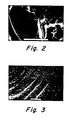
- FIGURES 2 and 3 are scanning electron micrographs derived from samples of Example III which serve to pictorially explain the mechanism underlying the present invention.
- the white bar at the bottom of FIGURE 2 represents a distance of 10 microns and the white bar at the bottom of FIGURE 3 represents a length of 1 micron.
- FIGURE 2 illustrates the surface porosity obtained through grit blasting the surface of the glass-ceramic
- FIGURE 3 depicts the surface porosity resulting from etching the surface of the glass-ceramic.
- the pores of the grit blasted surface pictured in FIGURE 2 are quite coarse and vary greatly in size and shape, generally with diameters in excess of five microns.
- the pores present in the etched surface exhibited in FIGURE 3 can be seen to be very small (,-0.5-1 micron in diameter) and remarkably uniform in size and shape such as to promote adhesive interaction at the molecular level.
Landscapes
- Chemical & Material Sciences (AREA)
- Materials Engineering (AREA)
- Engineering & Computer Science (AREA)
- Chemical Kinetics & Catalysis (AREA)
- General Chemical & Material Sciences (AREA)
- Geochemistry & Mineralogy (AREA)
- Life Sciences & Earth Sciences (AREA)
- Organic Chemistry (AREA)
- Laminated Bodies (AREA)
- Glass Compositions (AREA)
- Surface Treatment Of Glass (AREA)
- Manufacture Of Macromolecular Shaped Articles (AREA)
- Diaphragms For Electromechanical Transducers (AREA)
- Cookers (AREA)
- Joining Of Glass To Other Materials (AREA)
Priority Applications (1)
| Application Number | Priority Date | Filing Date | Title |
|---|---|---|---|
| AT85307983T ATE56201T1 (de) | 1985-01-10 | 1985-11-04 | Verfahren zur herstellung eines verbundwerkstoffes. |
Applications Claiming Priority (2)
| Application Number | Priority Date | Filing Date | Title |
|---|---|---|---|
| US69017285A | 1985-01-10 | 1985-01-10 | |
| US690172 | 1985-01-10 |
Publications (3)
| Publication Number | Publication Date |
|---|---|
| EP0188065A2 true EP0188065A2 (de) | 1986-07-23 |
| EP0188065A3 EP0188065A3 (en) | 1987-06-03 |
| EP0188065B1 EP0188065B1 (de) | 1990-09-05 |
Family
ID=24771391
Family Applications (1)
| Application Number | Title | Priority Date | Filing Date |
|---|---|---|---|
| EP85307983A Expired - Lifetime EP0188065B1 (de) | 1985-01-10 | 1985-11-04 | Verfahren zur Herstellung eines Verbundwerkstoffes |
Country Status (9)
| Country | Link |
|---|---|
| EP (1) | EP0188065B1 (de) |
| JP (1) | JP2525571B2 (de) |
| AT (1) | ATE56201T1 (de) |
| AU (1) | AU578498B2 (de) |
| DE (1) | DE3579579D1 (de) |
| ES (1) | ES8705906A1 (de) |
| HK (1) | HK7391A (de) |
| PT (1) | PT81811B (de) |
| SG (1) | SG2991G (de) |
Cited By (5)
| Publication number | Priority date | Publication date | Assignee | Title |
|---|---|---|---|---|
| US6177655B1 (en) * | 1999-12-08 | 2001-01-23 | Premark Wb Holdings, Inc. | Non-stick ceramic slow-cooker and method for making the same |
| EP1990331A2 (de) | 2007-05-04 | 2008-11-12 | Micro Systems Engineering GmbH | Keramisches Substratmaterial, Verfahren zur Herstellung und Verwendung desselben sowie Antenne oder Antennenarray |
| EP2181978A1 (de) * | 2008-10-31 | 2010-05-05 | Micro Systems Engineering GmbH | Keramisches Substratmaterial, Verfahren zur Herstellung und Verwendung desselben sowie Antenne oder Antennenarray |
| US8128885B2 (en) | 2007-10-13 | 2012-03-06 | Micro Systems Engineering Gmbh | Microreactor and method for manufacturing same and method for manufacturing a substrate for a microreactor |
| US9630206B2 (en) | 2005-05-12 | 2017-04-25 | Innovatech, Llc | Electrosurgical electrode and method of manufacturing same |
Families Citing this family (3)
| Publication number | Priority date | Publication date | Assignee | Title |
|---|---|---|---|---|
| US7147634B2 (en) | 2005-05-12 | 2006-12-12 | Orion Industries, Ltd. | Electrosurgical electrode and method of manufacturing same |
| JP5882690B2 (ja) | 2010-11-30 | 2016-03-09 | キヤノン株式会社 | 多孔質ガラス、その製造方法 |
| US8883314B2 (en) | 2011-01-25 | 2014-11-11 | Corning Incorporated | Coated articles with improved fingerprint resistance and methods of making same |
Family Cites Families (5)
| Publication number | Priority date | Publication date | Assignee | Title |
|---|---|---|---|---|
| DE1596873B2 (de) * | 1967-02-23 | 1971-06-16 | F Kuppersbusch & Sohne AG, 4650 Gelsenkirchen | Verfahren zur beschichtung von emailleoberflaechen mit polytetrafluoraethylen oder aehnlichen adhaesionsfeind lichen kunststoffen |
| CH562168A5 (de) * | 1970-08-25 | 1975-05-30 | Jenaer Glas Schott Gen Veb | |
| AU495954B2 (en) * | 1976-10-14 | 1977-01-20 | Glaverbel-Mecaniver | Laminated panels incorporating glass sheets |
| US4324601A (en) * | 1979-10-19 | 1982-04-13 | Brockway Glass Company, Inc. | Preparation of glass container for thermoplastic closure |
| FR2563754B1 (fr) * | 1984-05-02 | 1988-03-25 | Saint Gobain Vitrage | Procede et dispositif pour la pulverisation d'un melange reactionnel apte a former une couche de protection transparente de haute qualite optique |
-
1985
- 1985-10-31 AU AU49229/85A patent/AU578498B2/en not_active Ceased
- 1985-11-04 AT AT85307983T patent/ATE56201T1/de not_active IP Right Cessation
- 1985-11-04 EP EP85307983A patent/EP0188065B1/de not_active Expired - Lifetime
- 1985-11-04 DE DE8585307983T patent/DE3579579D1/de not_active Expired - Lifetime
- 1985-11-08 ES ES548711A patent/ES8705906A1/es not_active Expired
- 1985-12-13 JP JP60280879A patent/JP2525571B2/ja not_active Expired - Lifetime
-
1986
- 1986-01-08 PT PT81811A patent/PT81811B/pt not_active IP Right Cessation
-
1991
- 1991-01-17 SG SG29/91A patent/SG2991G/en unknown
- 1991-01-24 HK HK73/91A patent/HK7391A/en not_active IP Right Cessation
Cited By (13)
| Publication number | Priority date | Publication date | Assignee | Title |
|---|---|---|---|---|
| US6177655B1 (en) * | 1999-12-08 | 2001-01-23 | Premark Wb Holdings, Inc. | Non-stick ceramic slow-cooker and method for making the same |
| WO2001042157A1 (en) * | 1999-12-08 | 2001-06-14 | Premark Wb Holdings, Inc. | Non-stick ceramic slow-cooker and method for making the same |
| US6521872B2 (en) * | 1999-12-08 | 2003-02-18 | Premark Wb Holdings, Inc. | Non-stick ceramic slow-cooker and method for making the same |
| US11246645B2 (en) | 2005-05-12 | 2022-02-15 | Innovatech, Llc | Electrosurgical electrode and method of manufacturing same |
| US10463420B2 (en) | 2005-05-12 | 2019-11-05 | Innovatech Llc | Electrosurgical electrode and method of manufacturing same |
| US9630206B2 (en) | 2005-05-12 | 2017-04-25 | Innovatech, Llc | Electrosurgical electrode and method of manufacturing same |
| US7935265B2 (en) | 2007-05-04 | 2011-05-03 | Biotronik Crm Patent Ag | Ceramic substrate material, method for the production and use thereof, and antenna or antenna array |
| US8586178B2 (en) | 2007-05-04 | 2013-11-19 | Micro Systems Engineering Gmbh | Ceramic substrate material, method for the production and use thereof, and antenna or antenna array |
| EP1990331A3 (de) * | 2007-05-04 | 2010-03-17 | Micro Systems Engineering GmbH | Keramisches Substratmaterial, Verfahren zur Herstellung und Verwendung desselben sowie Antenne oder Antennenarray |
| EP1990331A2 (de) | 2007-05-04 | 2008-11-12 | Micro Systems Engineering GmbH | Keramisches Substratmaterial, Verfahren zur Herstellung und Verwendung desselben sowie Antenne oder Antennenarray |
| US8128885B2 (en) | 2007-10-13 | 2012-03-06 | Micro Systems Engineering Gmbh | Microreactor and method for manufacturing same and method for manufacturing a substrate for a microreactor |
| US8529780B2 (en) | 2008-10-31 | 2013-09-10 | Micro Systems Engineering Gmbh | Ceramic substrate material, method for the production and use thereof, and antenna or antenna array |
| EP2181978A1 (de) * | 2008-10-31 | 2010-05-05 | Micro Systems Engineering GmbH | Keramisches Substratmaterial, Verfahren zur Herstellung und Verwendung desselben sowie Antenne oder Antennenarray |
Also Published As
| Publication number | Publication date |
|---|---|
| EP0188065A3 (en) | 1987-06-03 |
| JP2525571B2 (ja) | 1996-08-21 |
| SG2991G (en) | 1991-04-05 |
| ES548711A0 (es) | 1987-05-16 |
| EP0188065B1 (de) | 1990-09-05 |
| PT81811B (pt) | 1988-05-27 |
| HK7391A (en) | 1991-02-01 |
| JPS61205638A (ja) | 1986-09-11 |
| DE3579579D1 (de) | 1990-10-11 |
| ES8705906A1 (es) | 1987-05-16 |
| AU578498B2 (en) | 1988-10-27 |
| AU4922985A (en) | 1986-07-17 |
| ATE56201T1 (de) | 1990-09-15 |
| PT81811A (en) | 1986-02-01 |
Similar Documents
| Publication | Publication Date | Title |
|---|---|---|
| US4683168A (en) | Method of producing a composite body | |
| US4961996A (en) | Non-stick coatings on glass | |
| CN102066011B (zh) | 包括具有改善的与基底粘接的性能的不粘涂层的烹饪用具 | |
| US3558345A (en) | Fluorocarbon resin to glass bonding | |
| EP0188065B1 (de) | Verfahren zur Herstellung eines Verbundwerkstoffes | |
| EP0489028B1 (de) | Nichthaftendes überzugssystem mit zwei dünnen grundbeschichtungen, die erste auf basis von polysiloxan | |
| US5677064A (en) | Water-based paint for glass sheets II | |
| WO2000009458A1 (en) | Decorated glass-ceramic plate and corresponding method of decoration | |
| WO1999025773A1 (en) | Water-based paint including glass particulate | |
| US4277522A (en) | Coating glass-ceramic surfaces | |
| US5037675A (en) | Method of coating aluminum surface | |
| JP2003089546A (ja) | 鉛を含まないエナメル組成物、対応するエナメルおよびガラスセラミック製品、新規の鉛を含まない鉱物ガラス | |
| US6054522A (en) | Coating for imparting non-stick, abrasion resistant and non-wetting properties to inorganic articles | |
| CA2222181C (en) | Material for imparting non-stick and non-wetting properties | |
| US3932681A (en) | Ceramic masking method | |
| JPS60176946A (ja) | ウイスカ−含有釉薬組成物 | |
| EP0386379B1 (de) | Gegenstand mit einer nichthaftenden Beschichtung mit einer verbesserten Adhäsion zum Substrat und Dauerhaftigkeit, Verfahren zu dessen Herstellung und in diesem Verfahren verwendete Zusammensetzung | |
| KR100551748B1 (ko) | 자기질층 및 플루오로중합체가 피복된 금속판 및 이의제조방법 | |
| US4440810A (en) | Method for decorating low-expansion ceramic articles | |
| EP0233345B1 (de) | Verfahren zum Auftragen von Polyvinylfluoriden | |
| EP0829308A1 (de) | Lösbarer wärmebeständiger film und verfahren zu dessen herstellung | |
| CN117461986A (zh) | 激光钛不粘锅具及制备方法 | |
| JPS6231626B2 (de) | ||
| JP2001097736A (ja) | ガラス組成物、調整絵具、転写紙及びホウロウ製品 | |
| JPH08144070A (ja) | Alめっき鋼板のホーロー被覆方法 |
Legal Events
| Date | Code | Title | Description |
|---|---|---|---|
| PUAI | Public reference made under article 153(3) epc to a published international application that has entered the european phase |
Free format text: ORIGINAL CODE: 0009012 |
|
| AK | Designated contracting states |
Kind code of ref document: A2 Designated state(s): AT BE CH DE FR GB IT LI NL SE |
|
| PUAL | Search report despatched |
Free format text: ORIGINAL CODE: 0009013 |
|
| AK | Designated contracting states |
Kind code of ref document: A3 Designated state(s): AT BE CH DE FR GB IT LI NL SE |
|
| 17P | Request for examination filed |
Effective date: 19871110 |
|
| 17Q | First examination report despatched |
Effective date: 19881214 |
|
| RAP1 | Party data changed (applicant data changed or rights of an application transferred) |
Owner name: CORNING GLASS WORKS |
|
| GRAA | (expected) grant |
Free format text: ORIGINAL CODE: 0009210 |
|
| AK | Designated contracting states |
Kind code of ref document: B1 Designated state(s): AT BE CH DE FR GB IT LI NL SE |
|
| REF | Corresponds to: |
Ref document number: 56201 Country of ref document: AT Date of ref document: 19900915 Kind code of ref document: T |
|
| ITF | It: translation for a ep patent filed | ||
| REF | Corresponds to: |
Ref document number: 3579579 Country of ref document: DE Date of ref document: 19901011 |
|
| ET | Fr: translation filed | ||
| PLBE | No opposition filed within time limit |
Free format text: ORIGINAL CODE: 0009261 |
|
| STAA | Information on the status of an ep patent application or granted ep patent |
Free format text: STATUS: NO OPPOSITION FILED WITHIN TIME LIMIT |
|
| 26N | No opposition filed | ||
| PGFP | Annual fee paid to national office [announced via postgrant information from national office to epo] |
Ref country code: AT Payment date: 19920923 Year of fee payment: 8 |
|
| PGFP | Annual fee paid to national office [announced via postgrant information from national office to epo] |
Ref country code: SE Payment date: 19921016 Year of fee payment: 8 |
|
| ITTA | It: last paid annual fee | ||
| PGFP | Annual fee paid to national office [announced via postgrant information from national office to epo] |
Ref country code: CH Payment date: 19921210 Year of fee payment: 8 Ref country code: BE Payment date: 19921210 Year of fee payment: 8 |
|
| PG25 | Lapsed in a contracting state [announced via postgrant information from national office to epo] |
Ref country code: AT Effective date: 19931104 |
|
| PG25 | Lapsed in a contracting state [announced via postgrant information from national office to epo] |
Ref country code: SE Effective date: 19931105 |
|
| PG25 | Lapsed in a contracting state [announced via postgrant information from national office to epo] |
Ref country code: LI Effective date: 19931130 Ref country code: CH Effective date: 19931130 Ref country code: BE Effective date: 19931130 |
|
| PGFP | Annual fee paid to national office [announced via postgrant information from national office to epo] |
Ref country code: NL Payment date: 19931130 Year of fee payment: 9 |
|
| BERE | Be: lapsed |
Owner name: CORNING GLASS WORKS Effective date: 19931130 |
|
| REG | Reference to a national code |
Ref country code: CH Ref legal event code: PL |
|
| EUG | Se: european patent has lapsed |
Ref document number: 85307983.8 Effective date: 19940610 |
|
| PG25 | Lapsed in a contracting state [announced via postgrant information from national office to epo] |
Ref country code: NL Effective date: 19950601 |
|
| NLV4 | Nl: lapsed or anulled due to non-payment of the annual fee | ||
| REG | Reference to a national code |
Ref country code: GB Ref legal event code: IF02 |
|
| PGFP | Annual fee paid to national office [announced via postgrant information from national office to epo] |
Ref country code: GB Payment date: 20041004 Year of fee payment: 20 |
|
| PGFP | Annual fee paid to national office [announced via postgrant information from national office to epo] |
Ref country code: FR Payment date: 20041105 Year of fee payment: 20 |
|
| PGFP | Annual fee paid to national office [announced via postgrant information from national office to epo] |
Ref country code: DE Payment date: 20041130 Year of fee payment: 20 |
|
| PG25 | Lapsed in a contracting state [announced via postgrant information from national office to epo] |
Ref country code: GB Free format text: LAPSE BECAUSE OF EXPIRATION OF PROTECTION Effective date: 20051103 |
|
| REG | Reference to a national code |
Ref country code: GB Ref legal event code: PE20 |