EP0189384B1 - Ro-Ro-Schiff - Google Patents
Ro-Ro-Schiff Download PDFInfo
- Publication number
- EP0189384B1 EP0189384B1 EP86850003A EP86850003A EP0189384B1 EP 0189384 B1 EP0189384 B1 EP 0189384B1 EP 86850003 A EP86850003 A EP 86850003A EP 86850003 A EP86850003 A EP 86850003A EP 0189384 B1 EP0189384 B1 EP 0189384B1
- Authority
- EP
- European Patent Office
- Prior art keywords
- deck
- cargo
- elevator
- vessel
- storey
- Prior art date
- Legal status (The legal status is an assumption and is not a legal conclusion. Google has not performed a legal analysis and makes no representation as to the accuracy of the status listed.)
- Expired
Links
- 238000004891 communication Methods 0.000 claims description 22
- XLYOFNOQVPJJNP-UHFFFAOYSA-N water Substances O XLYOFNOQVPJJNP-UHFFFAOYSA-N 0.000 claims description 9
- 239000012530 fluid Substances 0.000 description 3
- 230000000903 blocking effect Effects 0.000 description 1
- 239000000969 carrier Substances 0.000 description 1
- 238000006073 displacement reaction Methods 0.000 description 1
- 238000000034 method Methods 0.000 description 1
- 238000007747 plating Methods 0.000 description 1
Images

Classifications
-
- B—PERFORMING OPERATIONS; TRANSPORTING
- B63—SHIPS OR OTHER WATERBORNE VESSELS; RELATED EQUIPMENT
- B63B—SHIPS OR OTHER WATERBORNE VESSELS; EQUIPMENT FOR SHIPPING
- B63B25/00—Load-accommodating arrangements, e.g. stowing, trimming; Vessels characterised thereby
- B63B25/002—Load-accommodating arrangements, e.g. stowing, trimming; Vessels characterised thereby for goods other than bulk goods
-
- B—PERFORMING OPERATIONS; TRANSPORTING
- B63—SHIPS OR OTHER WATERBORNE VESSELS; RELATED EQUIPMENT
- B63B—SHIPS OR OTHER WATERBORNE VESSELS; EQUIPMENT FOR SHIPPING
- B63B27/00—Arrangement of ship-based loading or unloading equipment for cargo or passengers
- B63B27/16—Arrangement of ship-based loading or unloading equipment for cargo or passengers of lifts or hoists
Definitions
- the present invention refers to a RoRo-vessel having an upper cargo-carrying deck, and a double bottom located below the water line and adapted for carrying cargo.
- the communication deck of a RoRo-vessel is usually located at the level of the water line.
- either internal, vertically displaceable ramps, which require much space, or complicated lifting gear are required.
- the loading and unloading of spaces below the communication deck has therefore taken much time, compared with corresponding cargo handling at the communication deck.
- DE-A-1 756 073 shows a ship according to the first part of claim 1 having a number of superposed decks, and a single shaft, housing an elevator for communication with all decks.
- the intended cargo is containers mounted on trolleys or provided with wheels, so they can be moved along the decks.
- the single elevator will form a bottleneck with respect to the flow of cargo.
- the object of the present invention is to propose a RoRo-vessel, in which a rapid and rational loading and unloading of other cargo spaces than those located upon the communication deck is possible, and which includes simple and reliable operating gear.
- the invention is characterized by at least one cargo space extending from said upper deck to said double bottom, said cargo space in the longitudinal direction of the ship is provided with a series of two-storey cargo reception elevators, which are vertically displaceable by means of lifting gear, each elevator having two superposed platforms for stowing the cargo, either of which may be brought level with the communication deck.
- the lifting gear includes a pulling mechanism located below the upper deck, as well as means for selectively attaching the mechanism to lifting yokes associated with each elevator.
- the pulling mechanism includes wire means extending longitudinally in the vessel, and at one end being connected to a tensioning device and at its opposite end being attached to a pulling device.
- the pulling wire means is provided with fixed blocks, adapted to pass through the yokes or to be locked to either of them by drivers, when the associated elevator is to be operated.
- the yokes pulled by the wire means are preferably guided in a tunnel, the side walls of which are provided with fixed stops for the yokes corresponding to a lower position of the elevators, as well as movable stops corresponding to the upper position thereof.
- Transverse bulkheads extending somewhat above the water line, are advantageously provided in the cargo space, at least between some of the elevators.
- the upper deck is advantageously sheltered and the vessel includes at least one one-storey cargo elevator located between the communication deck and the cargo space, and attachable to a lifting gear in such a manner that it can be brought level with the lower deck or the upper cargo carrying deck, respectively.
- deck panels are pivotable from vertical positions to the side of the one-storey elevator to horizontal positions for bridging a well in the communication deck adjacent to the two-storey platforms, when the one-storey elevator has been raised level with the upper cargo carrying deck.
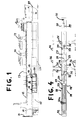
- the RoRo-vessel shown in Figures 1-3 is basically of conventional kind, with an aft communication ramp 10 also serving as rear closure door.
- the ramp is swingable in relation to a deck 11 adapted to receive wheeled cargo carriers, such as trailers or railway cars, and here referred to as the communication deck.
- the upper deck 12 of the vessel is adapted to receive LoLo-handled cargo containers 13 lifted by cranes 14, movable along the bulwark of the vessel.
- the communication deck 11 extends longitudinally from the ramp, above the engine room 15 of the vessel to a central cargo space 16, which . extends from the upper deck 12 down to the double bottom 17 of the vessel.
- This cargo space 16 houses a series of two-storey cargo receiving elevators 18, which are vertically displaceable, so either the upper 19, or the lower 20 platform thereof will be level with the communication deck.
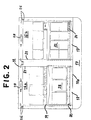
- the cargo receiving elevators 18 are better shown in Figures 2 and 3.
- Figure 2 indicates that the cargo space 16 is divided along the center line of the vessel by means of two longitudinal bulkheads 21, into a port half 16a, and a starboard half 16b.
- Each of these halves is provided with a series of identical cargo receiving elevators 18 and lifting means therefor. It is of course possible to design the ship with a single central cargo space only, or with more than two elevators abreast.
- Each platform 19, 20 in an elevator is designed to receive four ISO-containers 22 abreast, or alternatively three special containers 23 for forrest products. The headroom permits two superposed ISO-containers if they are handled by a low terminal trailer 24.
- Figure 3 shows one elevator lowered so it rests upon the top plate 17a of the double bottom, and a further elevator 18 raised to it upper position. Its lower platform 20 will then be level with the upper platform 19 of the first mentioned, lowered elevator.
- the lower platform 20 When the lower platform 20 is to be loaded, cargo carried by trailers is transferred by way of the ramp 10, the communication deck 11 and the upper platform of the first elevator.
- the lower platform 20 of the forward elevator When the lower platform 20 of the forward elevator is fully loaded, the elevator is lowered to the double bottom, while simultaneously the aft elevator 18 is raised so its lower platform can be loaded.
- the upper platforms 19 as well as the communication deck 11 can be filled with trailers.
- unloading the handling occurs in reverse order.
- the elevators 18 are operated by means of eight lifting wires 25, operating in parallel, and attached, four to each side of the platforms in vertical beams 18a.
- the lifting wires are led over pulleys 26 to a yoke 27, which is displaceably guided in a tunnel 28, which extends longitudinally, centrally above each cargo space half 16a, 16b.
- One yoke 27 is provided for each elevator 18 and pulling wire means 29 run through each tunnel 28 from a pulling device 30 at one of its ends, through a passage in the associated yoke 27 to a tensioning device 31 at the opposite end of the pulling wires.
- the pulling device includes four parallel pressure fluid rams 30a.
- the fluid pressure rams 30a located in the aft part of the ship can pull the wire aftwards, against the action of the tensioning device 31, located in the forward part of the vessel.
- the tensioning device is shown in Figure 5 and includes a vertical tackle 34 carrying a weight 35. The weight 35 will be raised somewhat when the pulling wire means 29 is brought aftwards, and will be lowered when the fluid pressure in the rams 30 is relieved.
- the yokes 27 cooperate with fixed drivers 36, which are selectively attachable to the wires 29, so either elevator 18 can be raised or lowered, while the other elevators are held stationary.
- the drivers may be designed in various ways, and may for instance include blocks on the wires 29, fixedly mounted at suitable positions. Normally they will pass through openings in the yokes 27, when the wires 29 are pulled, but will, in operating position, rest against an abutment at the yoke, which has been brought to blocking position.
- the driver 26 can be mounted on the yoke and be designed to grip the wires 29.
- the tunnel 28 is provided with stationary stops 37, which form abutments for the yokes 27 corresponding to the lower positions of the elevators 18, as well as with movable stops 38, which are operable from positions outside the tunnel 28, to positions within the latter for locking a selected yoke 27 in the upper position of the associated elevator 18.
- movable stops 38 which are operable from positions outside the tunnel 28, to positions within the latter for locking a selected yoke 27 in the upper position of the associated elevator 18.
- Corresponding operable stops are provided at the longitudinal bulkheads defining the cargo space halves 16a, 16b for locking the elevators therein in their upper positions. In this manner each elevator can be attached to the wires 29 and raised to its upper position, be locked therein, and finally released from the wires.
- the vessel shown in the drawings is designed to contain sixteen elevators and can receive sixty- four trailers on the lower platforms 20, eighty trailers on the communication deck 11 and upon the upper platforms 19, as well as three hundred and thirtyeight 40' containers upon the upper deck. Other combinations of cargo units is of course possible on this particular vessel.
- the loading or the unloading of the vessel is expected to be arranged in less than eight hours.
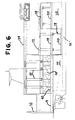
- Figure 6 shows a further development of the invention at a vessel adapted solely for the transportation of railway cars.
- the upper cargo-carrying deck 12 is provided with a weather shelter superstructure 39.
- a further, one-storey elevator 40 is provided above the engine room 15, between the communication deck 11 and the cargo space 16.
- the two-storey elevators 18 are here operated by lifting gears which pull in the forward direction.
- the one-storey elevator 40 is operable by a second set of lifting gear located below the top of the superstructure 39. In its lower position its platform fits into a well in the communication deck, so it will be level therewith. In its upper position it will be level with the upper cargo-carrying deck 12.
- the elevator 40 is dimensioned to handle four- axle railway cars by means of the double number of lifting wires 25, as is used with the elevators 18.
- the cars are pulled from the elevator and ranged over the upper deck by suitable traction means, when the elevator 40 is raised to its upper position a number of deck panels 41 may be swung from raised positions to the side of the elevator shaft, into horizontal positions in which they bridge the well in the communication deck 11 adjacent to the two rearmost elevators 18.
- one hundred and ninety two-axle railway cars can be carried upon the upper deck 12, the elevator 40, the upper and lower panels 19, 20 of the elevators and the swung-down deck panels.
Landscapes
- Chemical & Material Sciences (AREA)
- Engineering & Computer Science (AREA)
- Combustion & Propulsion (AREA)
- Mechanical Engineering (AREA)
- Ocean & Marine Engineering (AREA)
- Ship Loading And Unloading (AREA)
- Types And Forms Of Lifts (AREA)
- Warehouses Or Storage Devices (AREA)
Claims (8)
Applications Claiming Priority (2)
| Application Number | Priority Date | Filing Date | Title |
|---|---|---|---|
| SE8500152A SE455187B (sv) | 1985-01-14 | 1985-01-14 | Anordning vid ro-ro-fartyg |
| SE8500152 | 1985-04-01 |
Publications (3)
| Publication Number | Publication Date |
|---|---|
| EP0189384A2 EP0189384A2 (de) | 1986-07-30 |
| EP0189384A3 EP0189384A3 (en) | 1987-01-21 |
| EP0189384B1 true EP0189384B1 (de) | 1990-11-14 |
Family
ID=20358757
Family Applications (1)
| Application Number | Title | Priority Date | Filing Date |
|---|---|---|---|
| EP86850003A Expired EP0189384B1 (de) | 1985-01-14 | 1986-01-13 | Ro-Ro-Schiff |
Country Status (4)
| Country | Link |
|---|---|
| EP (1) | EP0189384B1 (de) |
| DE (1) | DE3675553D1 (de) |
| FI (1) | FI88383C (de) |
| SE (1) | SE455187B (de) |
Families Citing this family (5)
| Publication number | Priority date | Publication date | Assignee | Title |
|---|---|---|---|---|
| US8327785B2 (en) * | 2008-03-05 | 2012-12-11 | Nielsen Jens M | Ship |
| JP2010184631A (ja) * | 2009-02-13 | 2010-08-26 | Mitsui Eng & Shipbuild Co Ltd | 船舶 |
| CN104724255B (zh) * | 2015-01-23 | 2016-01-20 | 辽宁森淼海洋工程装备有限公司 | 一种远洋滚装重吊船 |
| CN107600317B (zh) * | 2017-08-23 | 2024-01-30 | 杭州现代船舶设计研究有限公司 | 一种千吨级全电力推进散货船 |
| CN110316317B (zh) * | 2019-07-15 | 2021-01-01 | 浙江海洋大学 | 一种货物运输船 |
Family Cites Families (3)
| Publication number | Priority date | Publication date | Assignee | Title |
|---|---|---|---|---|
| GB1219574A (en) * | 1967-03-31 | 1971-01-20 | Fedde Walda | A container ship and a process for loading and unloading same |
| JPS5323495A (en) * | 1976-08-17 | 1978-03-03 | Narasaki Shipbuilding Co Ltd | Combined roll onnoff and lift onnoff cargo boat |
| DE3025625C2 (de) * | 1980-07-05 | 1986-01-02 | MacGregor International S.A., Basel | Lastenaufzug für Schiffe, insbesondere für Ro-Ro-Schiffe |
-
1985
- 1985-01-14 SE SE8500152A patent/SE455187B/sv not_active IP Right Cessation
-
1986
- 1986-01-13 DE DE8686850003T patent/DE3675553D1/de not_active Expired - Fee Related
- 1986-01-13 EP EP86850003A patent/EP0189384B1/de not_active Expired
- 1986-01-13 FI FI860149A patent/FI88383C/fi not_active IP Right Cessation
Also Published As
| Publication number | Publication date |
|---|---|
| EP0189384A2 (de) | 1986-07-30 |
| DE3675553D1 (de) | 1990-12-20 |
| SE8500152L (sv) | 1986-07-15 |
| SE8500152D0 (sv) | 1985-01-14 |
| FI860149A0 (fi) | 1986-01-13 |
| FI860149L (fi) | 1986-07-15 |
| FI88383C (fi) | 1993-05-10 |
| EP0189384A3 (en) | 1987-01-21 |
| FI88383B (fi) | 1993-01-29 |
| SE455187B (sv) | 1988-06-27 |
Similar Documents
| Publication | Publication Date | Title |
|---|---|---|
| US4043285A (en) | Container ship | |
| US4158416A (en) | System for handling container cargo and a novel ship and lifting device | |
| EP2259962B1 (de) | Schiff | |
| US6516737B2 (en) | Autonomous container ship | |
| US20080107505A1 (en) | Container transportation system and method | |
| US4083319A (en) | Barge ship dual trucks to transport barges thereon | |
| US3498477A (en) | Apparatus for handling and stowing cargo on a cargo vessel | |
| US3168955A (en) | Apparatus for lightering cargo vessels | |
| US3139197A (en) | Structure for loading and unloading cargo | |
| US3138131A (en) | Inclined deck ship | |
| US4138961A (en) | Vessel for carrying steel slabs | |
| US2672840A (en) | Ship for transportation of wheeled containers | |
| US4008675A (en) | Ship of the type facilitating vehicle transport | |
| GB1560823A (en) | Roll on/off-lift on/off cargo vessel | |
| EP0189384A2 (de) | Ro-Ro-Schiff | |
| US5359952A (en) | Waterborne container carrier | |
| US4067284A (en) | Barge-carrying ship | |
| SU888809A3 (ru) | Судно дл перевозки накатных грузов | |
| US4077350A (en) | Barge-carrying ship | |
| US2970705A (en) | Cargo ships | |
| US3494487A (en) | Container cargo vessel | |
| US3941071A (en) | Shifting tween deck structure for cargo vessels | |
| WO2009109187A1 (en) | A ship | |
| JPS59318Y2 (ja) | 貨物船 | |
| BG62606B1 (bg) | Система за транспортиране и опериране на товари, базирана в морето |
Legal Events
| Date | Code | Title | Description |
|---|---|---|---|
| PUAI | Public reference made under article 153(3) epc to a published international application that has entered the european phase |
Free format text: ORIGINAL CODE: 0009012 |
|
| AK | Designated contracting states |
Kind code of ref document: A2 Designated state(s): BE DE FR GB IT |
|
| PUAL | Search report despatched |
Free format text: ORIGINAL CODE: 0009013 |
|
| AK | Designated contracting states |
Kind code of ref document: A3 Designated state(s): BE DE FR GB IT |
|
| RAP1 | Party data changed (applicant data changed or rights of an application transferred) |
Owner name: DAHLSTEDTS TERMINAL AB |
|
| RAP1 | Party data changed (applicant data changed or rights of an application transferred) |
Owner name: DAHLSTEDTS TERMINAL AB |
|
| 17P | Request for examination filed |
Effective date: 19870611 |
|
| 17Q | First examination report despatched |
Effective date: 19880721 |
|
| RAP1 | Party data changed (applicant data changed or rights of an application transferred) |
Owner name: GRANGAERDE INVEST AB |
|
| RAP1 | Party data changed (applicant data changed or rights of an application transferred) |
Owner name: GRANGAERDE ANGSAG PRODUKTIONS AB |
|
| GRAA | (expected) grant |
Free format text: ORIGINAL CODE: 0009210 |
|
| AK | Designated contracting states |
Kind code of ref document: B1 Designated state(s): BE DE FR GB IT |
|
| PG25 | Lapsed in a contracting state [announced via postgrant information from national office to epo] |
Ref country code: IT Free format text: LAPSE BECAUSE OF FAILURE TO SUBMIT A TRANSLATION OF THE DESCRIPTION OR TO PAY THE FEE WITHIN THE PRESCRIBED TIME-LIMIT;WARNING: LAPSES OF ITALIAN PATENTS WITH EFFECTIVE DATE BEFORE 2007 MAY HAVE OCCURRED AT ANY TIME BEFORE 2007. THE CORRECT EFFECTIVE DATE MAY BE DIFFERENT FROM THE ONE RECORDED. Effective date: 19901114 Ref country code: BE Effective date: 19901114 Ref country code: FR Effective date: 19901114 |
|
| REF | Corresponds to: |
Ref document number: 3675553 Country of ref document: DE Date of ref document: 19901220 |
|
| PG25 | Lapsed in a contracting state [announced via postgrant information from national office to epo] |
Ref country code: GB Effective date: 19910114 |
|
| EN | Fr: translation not filed | ||
| GBPC | Gb: european patent ceased through non-payment of renewal fee | ||
| PLBE | No opposition filed within time limit |
Free format text: ORIGINAL CODE: 0009261 |
|
| STAA | Information on the status of an ep patent application or granted ep patent |
Free format text: STATUS: NO OPPOSITION FILED WITHIN TIME LIMIT |
|
| PG25 | Lapsed in a contracting state [announced via postgrant information from national office to epo] |
Ref country code: DE Effective date: 19911001 |
|
| 26N | No opposition filed |