EP0189872A2 - Composition de chlorure de polyvinyle chloré ayant une transformabilité en état de fusion et procédé pour sa préparation - Google Patents
Composition de chlorure de polyvinyle chloré ayant une transformabilité en état de fusion et procédé pour sa préparation Download PDFInfo
- Publication number
- EP0189872A2 EP0189872A2 EP86100993A EP86100993A EP0189872A2 EP 0189872 A2 EP0189872 A2 EP 0189872A2 EP 86100993 A EP86100993 A EP 86100993A EP 86100993 A EP86100993 A EP 86100993A EP 0189872 A2 EP0189872 A2 EP 0189872A2
- Authority
- EP
- European Patent Office
- Prior art keywords
- composition
- weight
- cpvc
- san
- acrylonitrile
- Prior art date
- Legal status (The legal status is an assumption and is not a legal conclusion. Google has not performed a legal analysis and makes no representation as to the accuracy of the status listed.)
- Granted
Links
- 239000000203 mixture Substances 0.000 title claims abstract description 122
- 239000004801 Chlorinated PVC Substances 0.000 title claims abstract description 94
- 229920000457 chlorinated polyvinyl chloride Polymers 0.000 title claims abstract description 94
- 238000000034 method Methods 0.000 title claims description 15
- 239000000460 chlorine Substances 0.000 claims abstract description 20
- 229910052801 chlorine Inorganic materials 0.000 claims abstract description 20
- ZAMOUSCENKQFHK-UHFFFAOYSA-N Chlorine atom Chemical compound [Cl] ZAMOUSCENKQFHK-UHFFFAOYSA-N 0.000 claims abstract description 19
- 229920002285 poly(styrene-co-acrylonitrile) Polymers 0.000 claims abstract description 14
- 238000002156 mixing Methods 0.000 claims abstract description 12
- 229920000642 polymer Polymers 0.000 claims description 57
- NLHHRLWOUZZQLW-UHFFFAOYSA-N Acrylonitrile Chemical compound C=CC#N NLHHRLWOUZZQLW-UHFFFAOYSA-N 0.000 claims description 39
- 230000009477 glass transition Effects 0.000 claims description 35
- 239000000155 melt Substances 0.000 claims description 8
- 238000012935 Averaging Methods 0.000 claims description 6
- 238000001816 cooling Methods 0.000 claims description 3
- 238000010128 melt processing Methods 0.000 claims description 3
- 239000000463 material Substances 0.000 abstract description 11
- 229920001577 copolymer Polymers 0.000 abstract description 2
- 239000011145 styrene acrylonitrile resin Substances 0.000 description 84
- 229920000638 styrene acrylonitrile Polymers 0.000 description 82
- 239000004800 polyvinyl chloride Substances 0.000 description 16
- 229920000915 polyvinyl chloride Polymers 0.000 description 15
- 239000000243 solution Substances 0.000 description 12
- 238000004458 analytical method Methods 0.000 description 7
- 230000005540 biological transmission Effects 0.000 description 7
- 239000002244 precipitate Substances 0.000 description 7
- 229920002959 polymer blend Polymers 0.000 description 6
- 239000002904 solvent Substances 0.000 description 6
- 238000005660 chlorination reaction Methods 0.000 description 5
- 238000000113 differential scanning calorimetry Methods 0.000 description 4
- 238000001746 injection moulding Methods 0.000 description 4
- 229920005989 resin Polymers 0.000 description 4
- 239000011347 resin Substances 0.000 description 4
- 230000002195 synergetic effect Effects 0.000 description 4
- 238000012360 testing method Methods 0.000 description 4
- 230000007704 transition Effects 0.000 description 4
- OKKJLVBELUTLKV-UHFFFAOYSA-N Methanol Chemical compound OC OKKJLVBELUTLKV-UHFFFAOYSA-N 0.000 description 3
- 238000010438 heat treatment Methods 0.000 description 3
- 230000001965 increasing effect Effects 0.000 description 3
- 238000006116 polymerization reaction Methods 0.000 description 3
- 230000004580 weight loss Effects 0.000 description 3
- 239000004709 Chlorinated polyethylene Substances 0.000 description 2
- PPBRXRYQALVLMV-UHFFFAOYSA-N Styrene Chemical group C=CC1=CC=CC=C1 PPBRXRYQALVLMV-UHFFFAOYSA-N 0.000 description 2
- BZHJMEDXRYGGRV-UHFFFAOYSA-N Vinyl chloride Chemical compound ClC=C BZHJMEDXRYGGRV-UHFFFAOYSA-N 0.000 description 2
- 150000001875 compounds Chemical class 0.000 description 2
- 239000000470 constituent Substances 0.000 description 2
- 239000011557 critical solution Substances 0.000 description 2
- 230000001419 dependent effect Effects 0.000 description 2
- 230000001747 exhibiting effect Effects 0.000 description 2
- 239000001257 hydrogen Substances 0.000 description 2
- 229910052739 hydrogen Inorganic materials 0.000 description 2
- 238000002347 injection Methods 0.000 description 2
- 239000007924 injection Substances 0.000 description 2
- 238000002074 melt spinning Methods 0.000 description 2
- 238000001000 micrograph Methods 0.000 description 2
- 239000000178 monomer Substances 0.000 description 2
- 239000000047 product Substances 0.000 description 2
- SCUZVMOVTVSBLE-UHFFFAOYSA-N prop-2-enenitrile;styrene Chemical compound C=CC#N.C=CC1=CC=CC=C1 SCUZVMOVTVSBLE-UHFFFAOYSA-N 0.000 description 2
- 239000000725 suspension Substances 0.000 description 2
- WSLDOOZREJYCGB-UHFFFAOYSA-N 1,2-Dichloroethane Chemical compound ClCCCl WSLDOOZREJYCGB-UHFFFAOYSA-N 0.000 description 1
- KZBUYRJDOAKODT-UHFFFAOYSA-N Chlorine Chemical compound ClCl KZBUYRJDOAKODT-UHFFFAOYSA-N 0.000 description 1
- VEXZGXHMUGYJMC-UHFFFAOYSA-N Hydrochloric acid Chemical group Cl VEXZGXHMUGYJMC-UHFFFAOYSA-N 0.000 description 1
- 239000006057 Non-nutritive feed additive Substances 0.000 description 1
- 230000015572 biosynthetic process Effects 0.000 description 1
- 230000015556 catabolic process Effects 0.000 description 1
- 230000008859 change Effects 0.000 description 1
- 238000006243 chemical reaction Methods 0.000 description 1
- 238000000975 co-precipitation Methods 0.000 description 1
- 230000000295 complement effect Effects 0.000 description 1
- 239000000306 component Substances 0.000 description 1
- 238000002425 crystallisation Methods 0.000 description 1
- 230000008025 crystallization Effects 0.000 description 1
- 230000007547 defect Effects 0.000 description 1
- 238000006731 degradation reaction Methods 0.000 description 1
- 238000004090 dissolution Methods 0.000 description 1
- 230000009977 dual effect Effects 0.000 description 1
- 230000002708 enhancing effect Effects 0.000 description 1
- 238000011156 evaluation Methods 0.000 description 1
- 238000001914 filtration Methods 0.000 description 1
- 238000003990 inverse gas chromatography Methods 0.000 description 1
- 238000011835 investigation Methods 0.000 description 1
- 238000005304 joining Methods 0.000 description 1
- 229920002521 macromolecule Polymers 0.000 description 1
- 238000004519 manufacturing process Methods 0.000 description 1
- 238000000386 microscopy Methods 0.000 description 1
- 229920005623 miscible polymer blend Polymers 0.000 description 1
- 238000012986 modification Methods 0.000 description 1
- 230000004048 modification Effects 0.000 description 1
- 238000005191 phase separation Methods 0.000 description 1
- 230000000704 physical effect Effects 0.000 description 1
- 239000006069 physical mixture Substances 0.000 description 1
- 229920000515 polycarbonate Polymers 0.000 description 1
- 239000004417 polycarbonate Substances 0.000 description 1
- 229920000728 polyester Polymers 0.000 description 1
- 239000002952 polymeric resin Substances 0.000 description 1
- 230000000379 polymerizing effect Effects 0.000 description 1
- 239000000843 powder Substances 0.000 description 1
- 230000008569 process Effects 0.000 description 1
- 239000013557 residual solvent Substances 0.000 description 1
- 239000002002 slurry Substances 0.000 description 1
- 238000007614 solvation Methods 0.000 description 1
- 239000003381 stabilizer Substances 0.000 description 1
- 238000010186 staining Methods 0.000 description 1
- 239000000126 substance Substances 0.000 description 1
- 229920003002 synthetic resin Polymers 0.000 description 1
- 239000012815 thermoplastic material Substances 0.000 description 1
- 229920001187 thermosetting polymer Polymers 0.000 description 1
- 238000003466 welding Methods 0.000 description 1
Images



Classifications
-
- C—CHEMISTRY; METALLURGY
- C08—ORGANIC MACROMOLECULAR COMPOUNDS; THEIR PREPARATION OR CHEMICAL WORKING-UP; COMPOSITIONS BASED THEREON
- C08L—COMPOSITIONS OF MACROMOLECULAR COMPOUNDS
- C08L25/00—Compositions of, homopolymers or copolymers of compounds having one or more unsaturated aliphatic radicals, each having only one carbon-to-carbon double bond, and at least one being terminated by an aromatic carbocyclic ring; Compositions of derivatives of such polymers
- C08L25/02—Homopolymers or copolymers of hydrocarbons
- C08L25/04—Homopolymers or copolymers of styrene
- C08L25/08—Copolymers of styrene
- C08L25/12—Copolymers of styrene with unsaturated nitriles
-
- C—CHEMISTRY; METALLURGY
- C08—ORGANIC MACROMOLECULAR COMPOUNDS; THEIR PREPARATION OR CHEMICAL WORKING-UP; COMPOSITIONS BASED THEREON
- C08L—COMPOSITIONS OF MACROMOLECULAR COMPOUNDS
- C08L27/00—Compositions of homopolymers or copolymers of compounds having one or more unsaturated aliphatic radicals, each having only one carbon-to-carbon double bond, and at least one being terminated by a halogen; Compositions of derivatives of such polymers
- C08L27/22—Compositions of homopolymers or copolymers of compounds having one or more unsaturated aliphatic radicals, each having only one carbon-to-carbon double bond, and at least one being terminated by a halogen; Compositions of derivatives of such polymers modified by chemical after-treatment
- C08L27/24—Compositions of homopolymers or copolymers of compounds having one or more unsaturated aliphatic radicals, each having only one carbon-to-carbon double bond, and at least one being terminated by a halogen; Compositions of derivatives of such polymers modified by chemical after-treatment halogenated
Definitions
- This invention relates to chlorinated polyvinyl chloride and to methods for enhancing the melt processability of chlorinated polyvinyl chloride. More particularly, this invention relates to blends of chlorinated polyvinyl chloride with other polymeric materials providing enhanced melt processability. Specifically, this invention pertains to miscible blends of chlorinated polyvinyl chloride with other polymeric materials providing enhanced melt processability.
- miscibility is still an art in infancy; miscibility is believed dependent upon a number of factors that include reactions between functional moieties pendant from one or more of the polymers, hydrogen bonding, and the like.
- Various suggestions have appeared for assisting in the selection of miscible polymer pairs including an application of Flory's equation of state as set forth by L. P. McMaster, 6 Macromolecules, 760 (1973).
- miscible polymer pairs have included: two-dimensional solubility parameters, inverse gas chromatography; crystallization characteristics of polymer blends; and evaluation of glass transition temperature shifts, as suggested by L. M. Robeson, 24 Polymer Engineering and Science, p.p. 589 (June 1984). That the prediction of miscible polymer pairs is still an art, rather than a science, is indicated by, for example, by chlorinated polyethylene having 42 weight percent chlorine being miscible in polyvinyl chloride, while chlorinated polyethylene having a chlorine content less than 42% being immiscible in polyvinyl chloride as shown by Robeson, supra. at p.p. 588.
- miscible blends are also uncertain. While some blend properties such as tensile strength may follow simple additivity rules, for example as noted for polycarbonate/polyester blends by Joseph, E.A., et al, 23 Polymer, p.p. 112 (l982), other blends may show synergistic enhancement of tensile properties as discussed by Olabisi, O., et al, 176 Adv. Chem. Ser., p.p. 559 (1979).
- Blends characterized by the components being immiscible typically are found to exhibit a tensile strength minimum while blends having components characterized by slight miscibility and a dual glass transition temperature may exhibit both a tensile minimum and a maximum as discussed by Fried, J.R., et al, 50 Journal of Applied Physics, p.p. 6052 (1979).
- polymer blends tend to exhibit partial miscibility
- graphical depictions of such partial miscibility tend to be of the minimum solution temperature type, that is those solubility curves having a minimum critical solution temperature below which a polymer pair exists in miscible state and above which, two phases are present, one phase being rich in a first polymer and the second phase being rich in a second polymer; Robeson, supra. p.p. 588.
- One possible explanation for a lack of solubility between polymer pairs may, in some cases, be related to the minimum critical solution temperature being lower than a glass transition temperature for one or both of the polymers; the polymers being below a glass transition temperature; a melt state for one or both of the polymers being non existent.
- chlorinated polyvinyl chloride is possessed generally of performance characteristics and, particularly temperature performance characteristics, superior to polyvinyl chloride, enhanced performance characteristics associated with a blend of chlorinated polyvinyl chloride and a second polymer together in a miscible melt state could find substantial industrial utility.
- the present invention provides a composition of matter comprising slightly miscible to completely miscible blends of chlorinated polyvinyl chloride having a chlorine content of between about 60% and 67% by weight and a styrene-acrylonitrile copolymer having an acrylonitrile content greater than about 15% and not exceeding about 25% by weight.
- the composition of the instant invention is melt processable and is characterized by some mutual solubility of the components.
- the composition of the instant invention includes components mutually soluble to a greater or lesser extent notwithstanding heating to a temperature of at least 200°C and preferably, remain at least partially soluble to a temperature of not less than 230°C.
- the composition upon being formed into a structure by melt processing techniques and subsequent cooling at a rate not less than 40°C per minute, is substantially free of weld-lined weaknesses.
- the composition of the instant invention may include processing aids and stabilizers typically employed in the manufacturing of articles formed of CPVC.
- the resulting blend of chloropolyvinyl chloride possesses improved flow characteristics in the melt state, a substantially'singular glass transition temperature, enhanced tensile properties greater than a weight averaging of the tensile strengths of the polymers forming the composition, improved weld-lined fault properties, and improved opacity characteristics when compared to mere blends of chlorinated polyvinyl chloride and styrene-acrylonitrile copolymer in a range of compositions and acrylonitrile content and at a temperature and pressure whereby substantial miscibility between the chlorinated polyvinyl chloride and the styrene-acrylonitrile copolymer does not obtain.
- the present invention provides a composition of matter comprising a blend of chlorinated polyvinyl chloride and styrene-acrylonitrile copolymer, the blended composition exhibits properties of mutual solubility between the components of the blend, and preferably is characterized by substantial miscibility between the blended polymers.
- CPVC shall be taken to mean chlorinated polyvinyl chloride
- SAN shall be taken to mean styrene-acrylonitrile copolymer.
- CPVC is a widely commercially available polymeric material that can be prepared in commercially well known manner such as by suspension chlorination of polyvinyl chloride (PVC). More recently, techniques such as chlorination of PVC employing liquid chlorine, as set forth in U.S. Patent 4,377,459, have become available, and the use of CPVC prepared in any suitable or conventional manner is contemplated as within the purview of this invention.
- PVC polyvinyl chloride
- CPVC employed in the practice of the instant invention should be a PVC material chlorinated to include at least 60% by weight chlorine and not more than about 65% by weight chlorine.
- a particular sample of CPVC is typically characterized by an average molecular weight and an inherent viscosity associated with a particular degree of PVC polymerization.
- CPVC is produced by the chlorination of PVC; PVC is the product of polymerizing vinyl chloride monomer and the chain length of any final PVC polymer molecule produced by the polymerization of vinyl chloride monomer may vary somewhat from molecule to molecule.
- the weight of individual molecules of chlorinated polyvinyl chloride may differ from molecule to molecule so that CPVC also may be characterized by an average molecular weight and an inherent viscosity. It has been found, however, that the degree of chlorination of the CPVC appears to be the controlling factor in determining solubility between CPVC and styrene-acrylonitrile.
- CPVC employed in the practice of the instant invention typically possesses a weight average molecular weight of between about 73,000 and about 140,000.
- SAN employed in the practice of the instant invention is distinct from many commercial variations of SAN available in the marketplace which typically include about 30 weight percent acrylonitrile or more.
- the SAN suitable for use in the practice of the instant invention should preferably include not less than about 15% and not more than about 25% by weight acrylonitrile.
- the constituent percentage of acrylonitrile in the SAN is controlled by the ratio of acrylonitrile monomer introduced into a polymerization process with styrene monomer in forming SAN. Appropriate proportions of acrylonitrile monomer and styrene monomer suitable for producing a SAN product having an acrylonitrile content of between about 15% and 25% by weight are known to those skilled in the art of making SAN.
- the weight of individual molecules of SAN can vary from molecule to molecule, but in the practice of the instant invention it is preferable that the weight average molecular weight of SAN copolymer be between about 75,000 and about 150,000.
- the CPVC and the SAN are blended together in suitable or conventional manner.
- blending is conducted above the glass transition temperature for either the CPVC or the SAN to facilitate mixing to form a blend having a single glass transition temperature that may be relatively broad.
- Alternately solvation of the polymers in a common solvent followed by coprecipitation from the common solvent is a much preferred method for forming molecularly well mixed blends.
- glass transition temperature what is meant is the change in the amorphous region of a polymer from a hard and relatively brittle condition to a viscous or rubbery condition; usually brought about by changing the temperature.
- the CPVC and SAN be at least partially miscible one in the other.
- a substantially single, homogeneous phase should result representing a miscible state between the polymers, the SAN and CPVC essentially forming a true solution.
- the percentage of each polymer in the blend may vary from essentially zero to essentially 100%.
- the actual percentage represented by one of the polymers in the blend in practice will be a percentage producing desirable physical characteristics in a final structure formed from the blended polymers.
- Structures formed from the blended composition of the instant invention typically are formed by so called melt processing techniques such as melt spinning or injection molding from the composition in a melt phase. Structures produced from the composition of the instant invention display improved tensile strength characterized as greater than a weight averaging of the tensile strengths of the polymers forming the composition, desirable weld-line strength, that is, strength at joinder lines created particularly during an injection molding process or during heat welding of elements of structures formed from the melt phase composition.
- Good weld-line strength is typically a characteristic of substantially homogeneous thermoplastic materials and thermosetting resins and relatively and infrequently characterizes blends of polymers that are immiscible or only partially miscible.
- Blends of CPVC and SAN can be formed by direct blending of melt state polymeric materials at a temperature above the glass transition temperature for either pure polymer.
- achievement of a homogeneous state may be rendered difficult in such direct blending methods by the elevated viscosity demonstrated by resinous CPVC and SAN materials above a glass transition temperature but below a thermal degradation temperature for the respective materials.
- Example I A plurality of blends of CPVC and SAN were prepared in accordance with Table I.
- the CPVC was possessed of a weight average molecular weight of between about 73,000 and about 140,000 while the SAN was possessed of a weight average molecular weight of between about 75,000 and about 150,000.
- the CPVC and the SAN were blended in equal weight amounts and the equivalent acrylonitrile content by weight of the SAN is depicted.
- PVC admixtures with S A N were included as controls.
- the polymeric blends were prepared by first solution blending the CPVC and the SAN; the CPVC or PVC (0.25 grams) was added to styrene-acrylonitrile polymer (0.25 grams) in jars containing 50 milliliters of 1,2-dichloroethane, the jars were capped, and were heated to 60° in an oven for approximately six hours or until the polymer dissolved, and then poured into a rapidly stirred beaker of approximately 300 milliliters of methanol. A fine powdery precipitate resulted which, after filtration, was dried overnight in vacuum at 80°C. The resulting powdery precipitate was tested employing a thermogravametric analysis to ascertain whether residual solvent evolved in the 150-200° range. Typically, well dried powdery precipitates demonstrated less than a 0.3 weight percent weight loss due to solvent.
- the powdery precipitate sample was heated to the temperature selected and then quenched at 320°C per minute.
- the sample was deemed to be a completely miscible (noted as M in Table I) blend of the CPVC and SAN.
- a sample was considered as substantially miscible (noted as SM in Table I) where exhibiting a single glass transition temperature and the presence of a minor second phase under transmission electron miscroscopy.
- a sample was considered partially miscible (noted as PM in Table I) where a single glass transition temperature was exhibited together with a significant second phase under examination by transmission electron miscroscopy.
- the dispersed phase was diffuse in appearance indicating dissolution of both polymers in that dispersed phase.
- the blends were categorized as substantially immiscible (noted as SI in Table I).
- SI glass transition temperature associated with the pure components CPVC or SAN polymers
- the blends were categorized as substantially immiscible (noted as SI in Table I).
- a single glass transition temperature was observed owing to the closeness of the glass transition temperatures of the components, but transmission election microscopy showed well separated phases (such as Table I the blend of CPVC 64.1% Cl and SAN 24% AN) the blends were categorized as substantially immiscible.
- the notation DSV represents the intrinsic viscosity over so-called dilute solution viscosity, that is, the ratio of a solution's specific viscosity to the concentration of the solute, extrapolated to a zero concentration. Intrinsic viscosity is also, occasionally known as limiting viscosity number.
- T g in Table I refers to the glass transition temperature for each polymer constituent of the blend.
- a blend of CPVC and SAN be substantially a single, homogeneous phase, that is, that the CPVC and the SAN be completely miscible one in the other, in order to achieve optimal results in the performance of the polymers when fabricated into structures.
- satisfactory performance for the polymer blend has been obtained employing blends of CPVC and SAN substantially miscible (SM) as set forth in Table I.
- Blends of copolymeric SAN containing about 15% to 25% by weight and particularly between about 18% and 24% by weight acrylonitrile and CPVC polymeric material containing between about 60% and 65% by weight and particularly between about 60.5% and 64.5% chlorine can form blends characterized by complete or substantially complete miscibility between the polymers.
- Example II Example II.
- Example I was repeated employing a suspension chlorinated CPVC commercially available from B.F.Goodrich known as 627x563 and 686x5l2, (67% and 63.5% by weight chlorine respectively) however the CPVC comprised 60% by weight of the blends. These blends were then analyzed for tensile strength or to yield, and the result of such testing is displayed as Table II.
- Commercial CPVC's are prepared in slurry of fluidized bed processes and are known to be heterogeneous, that is, they are physical mixtures of fractions of different weight percent chlorine, which may vary by as much as 7%. Blends of these commercial resins with SAN would be expected only to approximate blends made from solution or homogeneously chlorinated resins of the same weight percent chlorine.
- CPVC 686x5l2 which contains an average of 63.5% chlorine, would be expected to have properties approximately intermediate between the 60.9 and 64.4% chlorine resins described in Table I.
- blends of 686x512 with SAN containing 18% AN by weight would be expected to be exhibit partial to substantial miscibility.
- blends with a SAN containing 31% AN would be substantially immiscible.
- Table II shows that the SAN's are brittle compared at least to CPVCs 686x5l2 and 627x563.
- both tensile stress and elongation to break were markedly below the yield and elongation values for the CPVC.
- 18% acrylonitrile containing SAN had a tensile stress about 2000 psi lower than 31% acrylonitrile containing SAN.
- a synergistic tensile stress was observed, greater than that of either component. This is an enhancement of physical property sometimes observed in partially or substantially miscible blends.
- blends of CPVC with 31% acrylonitrile containing SAN showed no enhancement of tensile stress, the value falling in-between those of the two components of the blend, CPVC and SAN. Furthermore, blends of 31% acrylonitrile containing S A N showed less elongation to break than those 18% acrylonitrile containing blends demonstrating partially miscibility. Since the optimum in property enhancement is a function of the blend composition and is not predictable, the value obtained here with the 60/40 composition may or may not represent an optimum enhancement.
- the blend with the 31% acrylonitrile containing SAN exhibited a tensile and elongation value no greater than that of the 31% acrylonitrile containing SAN alone.
- this result suggests that these blends might exhibit a minimum in tensile at some other composition (proportion to CPVC), which is characteristic of immiscible blends.
- the blends of Table I were obviously quite brittle as indicated by a less than 5% typical elongation to break and the scatter in breaking (tensile) values.
- Figure 5 is a depiction of differential scanning calorimeter data generated for the 50/50 CPVC/SAN blends of the solution chlorinated PVC containing 64.4% chlorine as set forth in Table I.
- the various blends were heated initially to 510K (237°C), except for the blend with 21% acrylonitrile containing S A N, cooled, and then reheated to the same temperature.
- Figure 5 includes an axis 40 plotting exothermic heat flow wherein a distance 41 along the axis 40 represents 4.2 mJ/sec, and an ordinate 42 plotting temperature in degrees Kelvin.
- a plurality of curves 51, 52, 53, 54, 55 plot the heat flow as a function of temperature for CPVC having 64.4 wt % chlorine and SAN in a 50/50 ratio with the SAN including 14.5; 18.0; 21.0; 24.0; and 31.0 wt % acrylonitrile respectively.
- Each curve 51-55 includes at least one glass transition temperature 51a, 51b, 52a, 53a, 54a, 55a, 55b, as indicated by midpoint dashes.
- the curves 51 and 55 show clearly two glass transitions 51a, 51b, 55a, 55b for the blends including SAN containing 14.5 and 31% acrylonitrile by weight. Since the lower or first transition 51a, 55a, arises from the SAN and is shifted to a slightly higher temperature than that of the corresponding pure SAN, these blends graphically depicted at 51, 55 are determined to be only slightly miscible, and from a more practical standpoint, are defined as being substantially immiscible.
- the curves 52-54 each demonstrate a single glass transition temperature 52a, 53a, 54a, indicating homogeneous or substantially single phased blends.
- Differential scanning calorimetry is not an unequivocal test for complete miscibility or the existence of a single phase, especially when glass transition temperatures of the component polymers of phases present in a blend are close together. It is often necessary to complement the D SC test with some other test such as transmission electron miscroscopy to determine if one or two phases exist.
- Example III Using the method of Example I, two families of blends were developed employing B.F. Goodrich Company 686x5l2 CPVC containing approximately 63.5% chlorine by weight.
- One blend family included SAN including 18% acrylonitrile in proportions of 0%, 20%, 40%, 60%, 80% and 100% by weight of the blend.
- the second blend family SAN including 31% acrylonitrile, the SAN being contained in the blend in proportions of 0%, 20%, 40%, 60%, 80% and 100% by weight of the blend.
- a plurality of specimens of each member of each blend family was tested for tensile strength with the results being depicted in Figures 6-7.
- Figure 6 is a graphical representation 60 of tensile/yield strength plotted-on an axis 61 versus weight percent CPVC contained in a blend with SAN including 18% by weight acrylonitrile plotted along on abscissa 62.
- Data points 63, 64, 65, 66, 67, 68 represent average tensile stress results for samples tested at a particular CPVC content. Parentheticals adjacent each data point represent the number of brittle versus ductile failures. Bar ranges 63a, 64a, 65a, 66a, 67a, 68a axially surround the data points and represent a 2 sigma range of tensile strength fitting the data for the associated data point.
- the curve 60 exhibits a maximum at the data point 66 but includes an end point minimum at data point 63.
- the curve 60 indicates a synergistic tensile strength enhancement for this blend CPVC and 18% acrylonitrile containing SAN, an enhancement frequently characterizing miscible polymer systems.
- the curve 60 represents tensile strengths greater than those predicted by a mere weight averaging of the tensile strengths of the pure polymers forming the composition. Such a prediction would be represented by a straight line joining the points 63 and 68.
- a curve 70 represents a relationship between tensile strength plotted on an axis 71 versus weight percent CPVC contained in blends formed with SAN containing 31% by weight acrylonitrile plotted on an abscissa 72.
- Data points 73, 74, 75, 76, 77, 78 represent average tensile stress results for samples tested at particular CPVC contents. Parentheticals adjacent each data point represent the number of brittle versus ductile failures. Bar ranges 73a, 74a, 75a, 76a, 77a, 78a axially surround the data points and represent a 2 sigma range of tensile strength fitting the data for the-associated data point.
- the curve 70 exhibits a minimum adjacent the data point 74 and may exhibit a slight maximum adjacent the data point 77, but does not indicate the synergistic strength enhancement of the curve 60 in Figure 6. Minimum exhibiting curves such as the curve 70 frequently are representative of insoluble polymer systems.
- Figure 1 is a transmission electron photomicrograph at a 25,000 magnification of the blend containing the 18% acrylonitrile containing SAN. (Curve 52 in Figure 5). No staining was employed to show the phase contrast in these micrographs; the dark regions are the higher density phase, which could be pure CPVC or a C P VC-rich phase.
- the micrograph of Figure 1 depicts two phases, a substantially continuous phase which appears as dark domains 11 somewhat diffuse in appearance constituting a CPVC or CPVC-rich phase.
- Lighter domains 13 constitute the SAN or SAN-rich phase as dispensed 0.02-0.04 um (micrometers) spheres.
- the diffuse appearance and relatively sparse concentration, for a 50/50 blend, of the S A N-rich phase domains 13 and the occurrence of a single Tg indicate that this blend is substantially miscible.
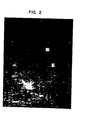
- Figure 2 is a photomicrograph of the blend depicted by curve 53 of Figure 5 and having 21% acrylonitrile containing SAN.
- Two phases, light 15 and dark 17 are present, both in roughly equal proportion which phases are very diffuse in appearance. This diffuseness plus the occurrence of a single glass transition temperature causes this blend to be designated as a partially miscible blend.
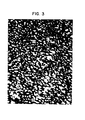
- Figure 3 is a photomicrograph of the blend depicted by curve 54 of Figure 5 having 24% acrylonitrile containing SAN and demonstrating one glass transition temperature. From the photomicrograph it is apparent that two well separated phases 21, 23 exist, however. This evident dichodomy can be explained by assuming that phase separation occurs gradually as temperature is increased. Initially one phase is rich in SAN and the other rich in CPVC. Thus the glass transition temperature of the SAN will be raised a little by the solution of some CPVC in that phase. On the other hand, the glass transition temperature of the CPVC phase will be lowered by the solution of some SAN in that phase.
- Figure 4 depicts a photomicrograph of the blend depicted in Figure 5 by the curve 55 having 31% acrylonitrile containing SAN which exhibited two glass transition temperatures 55a, 55b, by differential scanning calorimetry.
- Light 25 and dark 27 phases are well separated and exist in significantly larger domains than those of Figure 3.
- This blend would otherwise be considered immiscible if it were not for the observation that the glass transition temperature of the SAN phase was 122°C, a 4°C elevation from the transition temperature of pure SAN.
- some CPVC was dissolved in this SAN phase after heating to 237°C. This blend is therefore designated as substantially immiscible.
- the CPVC and SAN polymers are miscible (M) or substantially miscible (SM) or even partially miscible (PM)
- the relative proportions of CPVC and SAN in the blend is substantially irrelevant to the formation of the miscible phase.
- the CPVC and SAN can be present in any proportion and still provide desirable properties in finished structures attributable to the blending of CPVC and SAN in accordance with the invention.
Landscapes
- Chemical & Material Sciences (AREA)
- Health & Medical Sciences (AREA)
- Chemical Kinetics & Catalysis (AREA)
- Medicinal Chemistry (AREA)
- Polymers & Plastics (AREA)
- Organic Chemistry (AREA)
- General Chemical & Material Sciences (AREA)
- Compositions Of Macromolecular Compounds (AREA)
Applications Claiming Priority (2)
| Application Number | Priority Date | Filing Date | Title |
|---|---|---|---|
| US69576685A | 1985-01-28 | 1985-01-28 | |
| US695766 | 1985-01-28 |
Publications (3)
| Publication Number | Publication Date |
|---|---|
| EP0189872A2 true EP0189872A2 (fr) | 1986-08-06 |
| EP0189872A3 EP0189872A3 (en) | 1987-11-04 |
| EP0189872B1 EP0189872B1 (fr) | 1991-08-07 |
Family
ID=24794374
Family Applications (1)
| Application Number | Title | Priority Date | Filing Date |
|---|---|---|---|
| EP19860100993 Expired EP0189872B1 (fr) | 1985-01-28 | 1986-01-24 | Composition de chlorure de polyvinyle chloré ayant une transformabilité en état de fusion et procédé pour sa préparation |
Country Status (6)
| Country | Link |
|---|---|
| EP (1) | EP0189872B1 (fr) |
| JP (1) | JPS61228056A (fr) |
| BR (1) | BR8600314A (fr) |
| CA (1) | CA1281467C (fr) |
| DE (1) | DE3680683D1 (fr) |
| MX (1) | MX167482B (fr) |
Family Cites Families (3)
| Publication number | Priority date | Publication date | Assignee | Title |
|---|---|---|---|---|
| FR1375957A (fr) * | 1962-09-17 | 1964-10-23 | Goodrich Co B F | Compositions polymères de chlorure de vinyle post-chloré ayant une meilleure aptitude au traitement et une plus grande résistance aux chocs |
| US4304884A (en) * | 1979-12-14 | 1981-12-08 | The B. F. Goodrich Company | Chlorinated PVC blends with improved processability |
| US4370286A (en) * | 1981-09-14 | 1983-01-25 | The B. F. Goodrich Company | Chlorinated polyvinyl chloride composition |
-
1986
- 1986-01-23 CA CA000500220A patent/CA1281467C/fr not_active Expired - Fee Related
- 1986-01-24 DE DE8686100993T patent/DE3680683D1/de not_active Expired - Fee Related
- 1986-01-24 EP EP19860100993 patent/EP0189872B1/fr not_active Expired
- 1986-01-27 BR BR8600314A patent/BR8600314A/pt not_active IP Right Cessation
- 1986-01-27 MX MX135986A patent/MX167482B/es unknown
- 1986-01-27 JP JP1394986A patent/JPS61228056A/ja active Pending
Also Published As
| Publication number | Publication date |
|---|---|
| MX167482B (es) | 1993-03-25 |
| DE3680683D1 (de) | 1991-09-12 |
| BR8600314A (pt) | 1986-10-07 |
| JPS61228056A (ja) | 1986-10-11 |
| CA1281467C (fr) | 1991-03-12 |
| EP0189872A3 (en) | 1987-11-04 |
| EP0189872B1 (fr) | 1991-08-07 |
Similar Documents
| Publication | Publication Date | Title |
|---|---|---|
| Allard et al. | Miscibility of poly (caprolactone)/chlorinated polypropylene and poly (caprolactone)/poly (chlorostyrene) blends | |
| Bélorgey et al. | Miscibility of polycaprolactone/chlorinated polyethylene blends | |
| Siegmann et al. | Impact modification of poly (vinyl chloride) with chlorinated polyethylene I. Blend morphology | |
| Locke et al. | Chlorinated polyethylene modification of blends derived from waste plastics. Part II: Mechanism of modification | |
| US3442980A (en) | Flame-retardant abs graft polymer blends | |
| EP0189873B1 (fr) | Composition de chlorure de polyvinyle chloré ayant une transformabilité en état de fusion et son procédé de préparation | |
| US6376606B1 (en) | Semi-transparent blends of polyphenylene ether and styrenic copolymers | |
| US5502111A (en) | Process for making polyvinyl chloride compositions having high heat distortion temperatures | |
| US6040382A (en) | Polymer blend clarity | |
| US4647626A (en) | Method and composition for improved melt processability of chlorinated polyvinyl chloride | |
| Guo et al. | Phase behavior, crystallization, and nanostructures in thermoset blends of epoxy resin and amphiphilic star‐shaped block copolymers | |
| US6037410A (en) | Semi-transparent blends of polyphenylene ether and styrenic radial block copolymers | |
| EP0189872B1 (fr) | Composition de chlorure de polyvinyle chloré ayant une transformabilité en état de fusion et procédé pour sa préparation | |
| US4847331A (en) | Method and composition for improved melt processability of chlorinated polyvinyl chloride | |
| KR100243750B1 (ko) | 열가소성수지조성물 | |
| JPH0241546B2 (fr) | ||
| US4593063A (en) | High gloss, impact resistant polymer resins for injection molding | |
| Kulshreshtha et al. | Viscometric determination of compatibility in PVC/ABS polyblends. Part III. Choice of a common solvent and its effect on results | |
| US4629765A (en) | Method and composition for improved melt processability and impact properties of chlorinated poly(vinyl chloride) | |
| Lehr | Rheological and mechanical properties of poly (vinyl chloride)/chlorinated poly (vinyl chloride) miscible blends | |
| Rahma et al. | Study of compatibilizers for glass fibre reinforced nylon 6/polypropylene blends | |
| Zhong et al. | Miscibility, phase behavior, and mechanical properties of ternary blends of poly (vinyl chloride)/polystyrene/chlorinated polyethylene‐graft‐polystyrene | |
| US5106918A (en) | Method for dispersing miscible polymeric components | |
| de Zarraga et al. | Ternary blends to improve heat distortion temperature and rheological properties of PVC | |
| US5192479A (en) | Method for dispersing miscible polymeric components |
Legal Events
| Date | Code | Title | Description |
|---|---|---|---|
| PUAI | Public reference made under article 153(3) epc to a published international application that has entered the european phase |
Free format text: ORIGINAL CODE: 0009012 |
|
| AK | Designated contracting states |
Kind code of ref document: A2 Designated state(s): DE FR GB IT |
|
| PUAL | Search report despatched |
Free format text: ORIGINAL CODE: 0009013 |
|
| AK | Designated contracting states |
Kind code of ref document: A3 Designated state(s): DE FR GB IT |
|
| 17P | Request for examination filed |
Effective date: 19880419 |
|
| 17Q | First examination report despatched |
Effective date: 19890628 |
|
| GRAA | (expected) grant |
Free format text: ORIGINAL CODE: 0009210 |
|
| AK | Designated contracting states |
Kind code of ref document: B1 Designated state(s): DE FR GB IT |
|
| ITF | It: translation for a ep patent filed | ||
| ET | Fr: translation filed | ||
| REF | Corresponds to: |
Ref document number: 3680683 Country of ref document: DE Date of ref document: 19910912 |
|
| PLBE | No opposition filed within time limit |
Free format text: ORIGINAL CODE: 0009261 |
|
| STAA | Information on the status of an ep patent application or granted ep patent |
Free format text: STATUS: NO OPPOSITION FILED WITHIN TIME LIMIT |
|
| 26N | No opposition filed | ||
| PGFP | Annual fee paid to national office [announced via postgrant information from national office to epo] |
Ref country code: FR Payment date: 19971218 Year of fee payment: 13 |
|
| PGFP | Annual fee paid to national office [announced via postgrant information from national office to epo] |
Ref country code: DE Payment date: 19971222 Year of fee payment: 13 |
|
| PGFP | Annual fee paid to national office [announced via postgrant information from national office to epo] |
Ref country code: GB Payment date: 19971223 Year of fee payment: 13 |
|
| PG25 | Lapsed in a contracting state [announced via postgrant information from national office to epo] |
Ref country code: GB Free format text: LAPSE BECAUSE OF NON-PAYMENT OF DUE FEES Effective date: 19990124 |
|
| GBPC | Gb: european patent ceased through non-payment of renewal fee |
Effective date: 19990124 |
|
| PG25 | Lapsed in a contracting state [announced via postgrant information from national office to epo] |
Ref country code: FR Free format text: LAPSE BECAUSE OF NON-PAYMENT OF DUE FEES Effective date: 19990930 |
|
| PG25 | Lapsed in a contracting state [announced via postgrant information from national office to epo] |
Ref country code: DE Free format text: LAPSE BECAUSE OF NON-PAYMENT OF DUE FEES Effective date: 19991103 |
|
| REG | Reference to a national code |
Ref country code: FR Ref legal event code: ST |
|
| PG25 | Lapsed in a contracting state [announced via postgrant information from national office to epo] |
Ref country code: IT Free format text: LAPSE BECAUSE OF NON-PAYMENT OF DUE FEES;WARNING: LAPSES OF ITALIAN PATENTS WITH EFFECTIVE DATE BEFORE 2007 MAY HAVE OCCURRED AT ANY TIME BEFORE 2007. THE CORRECT EFFECTIVE DATE MAY BE DIFFERENT FROM THE ONE RECORDED. Effective date: 20050124 |