EP0189953A1 - Système combiné de détection d'intrusion présentant des sous-systèmes de détection par ultrasons et micro-ondes agissant en corrélation - Google Patents
Système combiné de détection d'intrusion présentant des sous-systèmes de détection par ultrasons et micro-ondes agissant en corrélation Download PDFInfo
- Publication number
- EP0189953A1 EP0189953A1 EP86200052A EP86200052A EP0189953A1 EP 0189953 A1 EP0189953 A1 EP 0189953A1 EP 86200052 A EP86200052 A EP 86200052A EP 86200052 A EP86200052 A EP 86200052A EP 0189953 A1 EP0189953 A1 EP 0189953A1
- Authority
- EP
- European Patent Office
- Prior art keywords
- signal
- detection
- ultrasonic
- signals
- microwave
- Prior art date
- Legal status (The legal status is an assumption and is not a legal conclusion. Google has not performed a legal analysis and makes no representation as to the accuracy of the status listed.)
- Withdrawn
Links
Images


Classifications
-
- G—PHYSICS
- G08—SIGNALLING
- G08B—SIGNALLING SYSTEMS, e.g. PERSONAL CALLING SYSTEMS; ORDER TELEGRAPHS; ALARM SYSTEMS
- G08B13/00—Burglar, theft or intruder alarms
- G08B13/16—Actuation by interference with mechanical vibrations in air or other fluid
- G08B13/1609—Actuation by interference with mechanical vibrations in air or other fluid using active vibration detection systems
- G08B13/1645—Actuation by interference with mechanical vibrations in air or other fluid using active vibration detection systems using ultrasonic detection means and other detection means, e.g. microwave or infrared radiation
-
- G—PHYSICS
- G01—MEASURING; TESTING
- G01S—RADIO DIRECTION-FINDING; RADIO NAVIGATION; DETERMINING DISTANCE OR VELOCITY BY USE OF RADIO WAVES; LOCATING OR PRESENCE-DETECTING BY USE OF THE REFLECTION OR RERADIATION OF RADIO WAVES; ANALOGOUS ARRANGEMENTS USING OTHER WAVES
- G01S13/00—Systems using the reflection or reradiation of radio waves, e.g. radar systems; Analogous systems using reflection or reradiation of waves whose nature or wavelength is irrelevant or unspecified
- G01S13/86—Combinations of radar systems with non-radar systems, e.g. sonar, direction finder
- G01S13/862—Combination of radar systems with sonar systems
Definitions
- the instant invention is directed to the field of intrusion detection and alarm systems, and more particularly, to a novel combination intrusion detection system that substantially eliminates both false alarms and failure of alarm situations.
- Ultrasonic intrusion detection systems are not only subject to false alarm indications in response to drafts and air movements as well as in response to ultrasonic noises such as caused by bells and hissing but also are subject to failure of alarm situations in response to changes from nominal range occasioned by variations in the ultrasonic propagation medium.
- Microwave intrusion detection systems produce false alarms in response to water movement in plastic pipes, in response to energy received from beyond the protected area due to wall and window penetration, and also in response to unwanted reflections, among other things.
- Galvin United States Patent No. 4,195,286, issued March 25, 1980 and assigned to the same assignee as the instant invention, discloses a combination detection system providing both a high and a low probability system ouput signal.
- the high probability output signal system is produced by a logical AND circuit coupled to the output of at least two independent sensors that is only operative in response to the simultaneous presence of the several sensor outputs. The occurrence of any one of the error producing sources for less than all of the independent sensors thus fails to produce a system alarm signal indication.
- Combination detectidn systems based on an AND detection principle produce a system alarm signal whenever its inputs are simultaneously present irrespectively of whether the inputs represent true intruder motion or arise from error producing sources, so that they often produce an erroneous alarm indication.
- Such an event could occur, for example, if a microwave system in penetrating the walls of a protected area returns an indication of someone present on the street beyond, while an ultrasonic system simultaneously produces an erroneous indication of intruder presence in response to an air conditioner being turned on in the protected area.
- the present invention contemplates an intrusion detection system having two or more detection sub-systems each based on a different detection principle and each producing a sub-system detection output signal having identifiable and distinguishable characteristics, contemplates means for interdependently combining the several sub-system outputs to provide a system event signal having an identifiable characteristic that varies both in dependence on the simultaneous presence of the several different sub-system outputs and in dependence on a preselected correlation between the identifiable and distinguishable characteristics of the several detector sub-system outputs, and further contemplates means responsive to whether the characteristic of the system event detection signal meets a predetermined criteria to provide an alarm signal indication of an unauthorized intruder.
- the intrusion detection system of the present invention in preferred embodiment includes an ultrasonic detection sub-system and a microwave detection sub-system.
- the ultrasonic detection sub-system includes means responsive to ultrasonic energy received from the protected space to provide Doppler bi-directional intruder motion detection signals.
- the microwave sub-system includes means responsive to received microwave energy to provide a Doppler radar intrusion detection signal.
- Means are provided responsive to the ultrasonic sub-system Doppler bi-directional intruder motion detection signals and to the microwave sub-system Doppler radar intruder detection signal to produce a bi-polar system event detection signal that is present only when the Doppler radar detection signal and either of the ultrasonic bi-directional motion signals are simultaneously present, and that has a temporarily varying magnitude that varies in dependence on the correlation between the Doppler radar detector signal and both of the bi-directional motion detection signals.
- Means are provided for processing the bi-polar system event detection signal to provide an alarm signal indication of intruder presence only when the magnitude of the bi-polar system event detection signal exceeds a predetermined bi-polar threshold level.
- Means operative to enable the microwave sub-system in response to a predetermined characteristic of said ultrasonic intrusion detection signals are provided to conserve electrical power usage.
- the microwave sub-system need not be continuously active but only if and in the event of a possible detection by the ultrasonic sub-system.Multiple detectors emboding the invention in this manner may advantageously be utilized in and around a given protected area, since any potentially interfering radar most probably is in its inactive state.
- the present invention substantially elimi 1 1f:es both failure of alarm situations and false alarms.
- the occasion of any one of the sources of alarm indication error for either the ultrasonic sub-system or for the microwave sub-system alone but not in combination cannot produce an alarm indication of intruder presence. False alarm indications are prevented by the responsiveness of the system event detection signal providing means only to the simultaneous presence of the several detector sub-system outputs.
- the simultaneous presence of any one of the sources of microwave sub-system error producing sources together with any one of the ultrasonic sub-system error producing sources also cannot produce a false alarm indication of intruder presence.
- the intrusion detection system of the present invention is reliable in use and readily installable with a minimum of installation steps.
- the present invention eliminates the need for walk-testing of the sub-systems individually, it being only necessary to have a single walk-test that establishes the operability of the whole system.
- the intrusion detector system of the present invention moreover, is substantially insensitive to atmospheric induced range variations, and is responsive to substantially one event only, a true unauthorized intruder.
- the present invention in its broad aspect relates to a combination detector system in which several detection sub-systems outputs based on distinct detection prineples are correlated to produce a combined system event detection signal having an identifiable characteristic representative of a true detectable condition.
- the present invention further relates to detection means selected to be responsive to the identifiable characteristic of the combined system event detection signal to distinguish true system events from false and/or failure of alarms. While the system of the invention thus has wide application, it has particular utility for a combination ultrasonic and microwave detection system.
- the system 10 includes a microwave transceiver 12 having a gunn supply 14 associated therewith in the usual manner for transmitting microwave energy into, and receiving return microwave energy from, a protected volume such as a corridor, a room, a warehouse, and the like.
- the microwave energy may be continuously supplied or pulsed, and the term "simultaneous" as used herein is meant to include both possibilities.
- Energy at microwave frequency that is received by the transceiver 12 is filtered, to separate the Doppler component representative of intruder motion within the protected volume, and amplified in a Doppler filter and amplifier 16.
- a signal conditioning circuit 18 conditions the amplified analog Doppler detection signal to remove undesirable noise, such as high frequency flourescent light effects and low frequency insect effects.
- the amplified and selectively conditioned radar Doppler detection signal is applied to a two quadrant integrator 20.
- the ultrasonic energy may be transmitted either simultaneously into the protected volume together with the microwave energy or it may be transmitted thereinto singly but in such a way that the microwave system is actuated in the event of ultrasonic sub-system intrusion detection so that overan system power usage is conserved.
- An ultrasonic receiving transducer 26 is provided, for example, on a wall confronting the protected volume, for receiving ultrasonic energy from the protected volume.
- the received ultrasonic energy is amplified by an amplifier 28, and the amplified received ultrasonic energy is. applied to a balanced signal processor 30 to be described.
- the balanced signal processor 30 is operative in response to the received and amplified ultrasonic energy, and to the carrier frequency, to provide Doppler bi-directional intruder motion detection signals designated "IN+", "OUT-" representative of the radial component of intruder motion within the protected volume respectively towards and away from the receiver 26.
- a comparator 32 having a preselected reference (“REF”) input voltage is coupled to the microwave transceiver 12 and the balanced signal processor 30 to actuate the transceiver 12 in response to received ultrasonic energy having a magnitude that exceeds the preselected reference.
- REF preselected reference
- the two quadrant integrator 20 is responsive to the conditioned radar Doppler detection signal and to the Doppler bi-directional ultrasonic detection signals to produce a system event detection signal having a magnitude that depends upon the simultaneous presence of the sub-system inputs as well as upon the correlation between the inputs.
- the correlated system event detection signal is applied to a bi-polar dual comparator generally designated 32 having preselected bi-polar thresholds designated "V1", "V2". Should the magnitude of the correlated system event detector signal exceed either one of the preselected thresholds, the corresponding comparator is actuated producing an alarm signal indication of unauthorized intruder motion.
- the correlated system event detection signal produced by the integrator 20 has a magnitude insufficient to cross either of the predetermined comparator thresholds.
- the system 10 of the present invention thus effectively substantially eliminates both false alarms and failure of alarm situations providing true volume protection and constant day-to-day performance characteristics with a high system confidence level.
- the system 10 eliminates the need for range control adjustments, and requires but a single walk-test to determine the operability of the whole system during its installation and routine maintenance.
- the balanced signal processor includes a phase shift network 42 and a phase shift network 44 that are operative in response to the ultrasonic amplified signal produced by the amplifier 28 ( Figure 1) to provide quadrature ultrasonic detection signals.
- the quadrature ultrasonic detection signals are mixed with the carrier frequency signal produced by the oscillator 24 and synchronously detected to baseband by mixers 46, 48.
- the quadrature detected baseband signals are individually Doppler bandpass filtered by amplifier and filter circuitry 50, 52. As illustrated at 54 in solid line and 56 in dashed line, a 180° phase relation subsists between the Doppler detected signals respectively representative of radial motion towards and away from the ultrasonic receiver 26 ( Figure 1).
- the Doppler quadrature signal produced by the amplifier and filter 50 is fed in parallel circuit legs through resistors 58, 60 respectively to sample and hold devices 62, 64.
- the other Doppler quadrature signal produced by the amplifier and filter 52 is fed to a symmetrical limiter 66 that is operative to produce therefrom a square-wave signal 68 synchronous with and in 90° phase offset to the Doppler detected quadrature signal produced at the output of the amplifier and filter 50.
- the square wave signal 68 is inverted in an invertor 70, that is operative to produce a square wave signal 72 at its output in 180° phase offset to the signal 68.
- the square wave signals 68, 72 are synchronously applied as sampling enabling pulses to the sample and hold devices 62, 64 respectively.
- the sample and hold devices 62, 64 are enabled by the positive edge of the respective square-wave signals 68, 72 synchronously with the signals 54, 56.
- a respective one of the sample and hold circuits 62, 64 will be consistently enabled producing a corresponding one of the Doppler bi-directional ultrasonic detection sub-system signals designated "IN+", "OUT-" much more often statistically than the other one of the sample and hold circuits in correspondence with the sense of the intruder motion.
- individual ones of the bi-directional signals will be more or less produced in random relation to the other one of the signals and in such a way that neither of the bi-directional detection signals will be statistically present more often than the other.
- Galvin United States Patent No. 3,760,400, issued September 18, 1983 and assigned to the same assignee as the instant invention, incorporated herein by reference, for a disclosure of alternate exemplary balanced signal processor embodiments.
- the bi-polar rectifying network 74 preferably includes diodes 84 connected in a standard bridge arrangement, an analog invertor 86 connected across the diode bridge, and diode pre-biasing resistors 88 and transient-dumping capacitors 90 connected in series with the diode bridge.
- the bi-polar full-wave rectified radar Doppler detector signals 80, 82 appearing on the legs 76, 78 are respectively applied to mixers 92, 94, and the ultrasonic sub-system Doppler bi-directional motion detection signals designated "OUT-", "IN+” are respectively applied thereto.
- the output of the mixer 92 is coupled to a capacitor 96 via a resistor 98, and the output of the mixer 94 is coupled to the capacitor 96 via a resistor 100.
- the capacitor 96 together with a corresponding one of the resistors 98, 100 functions as a bi-polar two quadrant integrator.
- the mixers 92, 94 are preferably gate enabled switches.
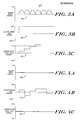
- Figure 3 which illustrates system operation in detecting a true system event
- 102 in Figure 3A is the postive Doppler radar rectified detection signal
- generally designated at 104 in Figure 3B is the "IN" ultrasonic Doppler detection signal
- generally designated at 106 in Figure 3C is the correlated system output signal of the bi - polar two quadrant integrator.
- the output of the balanced integrator will be a wave having an essentially constant amplitude as illustrated at 104 in Figure 3B, while the ultrasonic detection sub-system output, not shown, representative of intruder motion radially away from the ultrasonic receiver will essentially have a constant negative magnitude.
- the "IN" ultrasonic detection signal 104 enables the mixer 92 ( Figure 2) for the positive full-wave rectified Doppler radar detection signal.
- the bi-polar integrator 98, 96 ( Figure 2) produces the signal 106 having a magnitude that uniformly increases so long as the two detection sub-system signals applied to the mixer are both simultaneously present and are correlated.
- the microwave detection sub-system is producing no detection output.
- the example may, for instance, either correspond to moving air currents such as from an air processing system or may correspond to a source of ultrasonic noise being present in the protected volume such as a bell.
- the radar rectification signal produced by the microwave detection sub-system will be a horizontal line generally designated 108 in Figure 4A and the bi-directional output signals produced by the ultrasonic detector sub-system will be a randomly varying stepped wave form generally designated 110 in Figure 4B.
- the bi-polar integrator is operative in response to the inputs 108, 110 to provide a horizontal output generally designated 112 in Figure 4C, since, as will be appreciated, the absence of any received radar Doppler energy precludes the possibility of charge and voltage build-up on the bi-polar integrator.
- FIG 5 illustrates the case where a microwave sub-system error producing source such as water flowing through a plastic pipe is occuring but there is no similar detectable event for the ultrasonic detection sub-system.
- the microwave detection sub-system produces an exemplary positive full wave rectified radar Doppler detection signal generally designated 114 in Figure 5A
- the ultrasonic detection sub-system produces a generally horizontal bi-directional output signal generally designated 116 in Figure 5B.
- the absence of the simultaneous occurrence of detectable signals from the several detection sub-systems precludes the possibility of charge and voltage build-up on the bi-polar integrator which produces a generally horizontal correlated system event output signal generally designated 118 in Figure 5C.
- FIG. 6 which illustrates the simultaneous occurrence of both an error source for the microwave sub-system as well for the ultrasonic sub-system but not for a true event
- 120 in Figure 6A is a wave-form illustrating the Doppler detected radar return energy such as from outside motion
- generally designated at 122 in Figure 6B is a waveform illustrating the bi-directional ultrasonic motion detector signals such as from ultrasonic hissing
- generally designated at 124 in Figure 6C is the correlated system output signal produced by the two quadrant integrator according to the present invention.
- the randomly varying nature of the noise waveform 122 produced by the ultrasonic detection sub-system has insufficient correlation either "IN” or "OUT” to provide a two quadrant integrator output signal having sufficient correlation gain to cross either of the bi-polar thresholds.
- the combination intrusion detector system having correlated ultrasonic and microwave detection sub-systems of the present invention is thus capable of distinguishing true intruder motion from simultaneously occuring error producing sources for each of the several sub-systems thereby providing a very high confidence level motion detection system.
Landscapes
- Engineering & Computer Science (AREA)
- Radar, Positioning & Navigation (AREA)
- Remote Sensing (AREA)
- Physics & Mathematics (AREA)
- General Physics & Mathematics (AREA)
- Computer Networks & Wireless Communication (AREA)
- Health & Medical Sciences (AREA)
- General Health & Medical Sciences (AREA)
- Toxicology (AREA)
- Burglar Alarm Systems (AREA)
- Measurement Of Velocity Or Position Using Acoustic Or Ultrasonic Waves (AREA)
- Radar Systems Or Details Thereof (AREA)
Applications Claiming Priority (2)
| Application Number | Priority Date | Filing Date | Title |
|---|---|---|---|
| US691156 | 1985-01-14 | ||
| US06/691,156 US4625199A (en) | 1985-01-14 | 1985-01-14 | Combination intrusion detector system having correlated ultrasonic and microwave detection sub-systems |
Publications (1)
| Publication Number | Publication Date |
|---|---|
| EP0189953A1 true EP0189953A1 (fr) | 1986-08-06 |
Family
ID=24775382
Family Applications (1)
| Application Number | Title | Priority Date | Filing Date |
|---|---|---|---|
| EP86200052A Withdrawn EP0189953A1 (fr) | 1985-01-14 | 1986-01-13 | Système combiné de détection d'intrusion présentant des sous-systèmes de détection par ultrasons et micro-ondes agissant en corrélation |
Country Status (5)
| Country | Link |
|---|---|
| US (1) | US4625199A (fr) |
| EP (1) | EP0189953A1 (fr) |
| JP (1) | JPS61200489A (fr) |
| AU (1) | AU575288B2 (fr) |
| ES (1) | ES8800472A1 (fr) |
Cited By (4)
| Publication number | Priority date | Publication date | Assignee | Title |
|---|---|---|---|---|
| FR2611957A1 (fr) * | 1987-03-04 | 1988-09-09 | Dreuilhe Jacqueline | Radar detecteur de mouvement a effet " doppler " bivolumetrique |
| EP0294532A1 (fr) * | 1986-04-11 | 1988-12-14 | ADT, Inc. | Moniteur assurant l'intégrité et procédé pour une installation de sécurité |
| DE10100806A1 (de) * | 2001-01-10 | 2002-07-11 | Delphi Tech Inc | System und Verfahren zur Überwachung eines von Wänden umschlossenen Raumes |
| US20250076497A1 (en) * | 2023-08-28 | 2025-03-06 | International Business Machines Corporation | Auditory-based environment monitoring |
Families Citing this family (32)
| Publication number | Priority date | Publication date | Assignee | Title |
|---|---|---|---|---|
| US4710750A (en) * | 1986-08-05 | 1987-12-01 | C & K Systems, Inc. | Fault detecting intrusion detection device |
| US4833450A (en) * | 1988-04-15 | 1989-05-23 | Napco Security Systems, Inc. | Fault detection in combination intrusion detection systems |
| US5093656A (en) * | 1990-03-12 | 1992-03-03 | Dipoala William S | Active supervision of motion-detection systems |
| US5196826A (en) * | 1991-06-26 | 1993-03-23 | C & K Systems, Inc. | Sensor for detecting the passage of a person or an animal in a field of view |
| CA2113026A1 (fr) * | 1993-01-28 | 1994-07-29 | Paul Michael Hoseit | Methodes et appareil de detection d'intrusion a protection amelioree contre les fausses alertes |
| US5450060A (en) * | 1993-02-05 | 1995-09-12 | Parkhurst; Neil E. | Motion detection |
| US5473311A (en) * | 1994-09-16 | 1995-12-05 | C&K Systems, Inc. | Method and apparatus to distinguish human intruder and animal intruder |
| US5450062A (en) * | 1994-09-23 | 1995-09-12 | Detection Systems, Inc. | Detection system with reduced sensitivity to pin diode effect |
| US5576977A (en) * | 1995-04-27 | 1996-11-19 | Alarm Device Manufacturing Company | Filter for eliminating the effects of fluorescent lights on microwave transceivers |
| US5684458A (en) * | 1996-02-26 | 1997-11-04 | Napco Security Systems, Inc. | Microwave sensor with adjustable sampling frequency based on environmental conditions |
| US5828626A (en) * | 1997-01-30 | 1998-10-27 | Otincon Corporation | Acoustic object detection system and method |
| IL121068A (en) * | 1997-06-12 | 2000-11-21 | Visonic Ltd | Method and apparatus for detecting the presence of a moving object in a detection area |
| IT1297990B1 (it) * | 1997-10-28 | 1999-12-20 | Meta System Spa | Sistema di allarme a doppia tecnologia combinata, a consumo contenuto e controllato |
| DE19809763A1 (de) * | 1998-03-06 | 1999-12-02 | Siemens Ag | Verfahren und Sensor zur Brandmeldung |
| GB2370118B (en) | 1999-05-07 | 2003-10-22 | Honeywell Inc | Glass-break detector and method of alarm discrimination |
| US6593850B1 (en) * | 2000-01-27 | 2003-07-15 | Pittway Corp. | Wireless intrusion detector with test mode |
| DE60021193T8 (de) * | 2000-05-30 | 2008-06-26 | Ford Global Technologies, LLC, Dearborn | Eindringdetektor mit gesteuertem Energieverbrauch und Verfahren zur Eindringdetektion |
| CA2363915A1 (fr) * | 2001-11-27 | 2003-05-27 | J.J. Mackay Canada Limited | Dispositif de remise a zero pour parcometres |
| US20030210139A1 (en) * | 2001-12-03 | 2003-11-13 | Stephen Brooks | Method and system for improved security |
| KR100470203B1 (ko) * | 2001-12-17 | 2005-02-21 | (주)태성엠아이에스 | 마이크로 웨이브(m/w)를 이용한 보안시스템 |
| US6862253B2 (en) * | 2002-10-23 | 2005-03-01 | Robert L. Blosser | Sonic identification system and method |
| US6909397B1 (en) * | 2003-12-10 | 2005-06-21 | Georgia Tech Research Corporation | Stabilizing motion in a radar detection system using ultrasonic radar range information |
| GB2415557A (en) * | 2004-04-02 | 2005-12-28 | Scorpion Vehicle Security Syst | Microwave based intrusion detection system for use in a vehicle |
| GB2422041B (en) * | 2005-01-10 | 2006-12-27 | May And Scofield Ltd | Detection system and method for determining an alarm condition therein |
| US7541923B2 (en) * | 2005-01-12 | 2009-06-02 | Industrial Technology Research Institute | Method for and system of intrusion detection by using ultrasonic signals |
| US7680283B2 (en) * | 2005-02-07 | 2010-03-16 | Honeywell International Inc. | Method and system for detecting a predetermined sound event such as the sound of breaking glass |
| US7423530B2 (en) * | 2005-09-22 | 2008-09-09 | Honeywell International Inc. | Cross-zone supervision for a security system |
| US8102259B2 (en) * | 2006-10-17 | 2012-01-24 | Honeywell International Inc. | Fluorescent light immunity through synchronous sampling |
| US7965833B2 (en) * | 2007-01-09 | 2011-06-21 | Ronen Meir | Febrile convulsion alarm |
| US8880376B2 (en) * | 2010-02-18 | 2014-11-04 | Electronics And Telecommunications Research Institute | Apparatus and method for distinguishing between human being and animal using selective stimuli |
| US9733356B1 (en) * | 2016-02-17 | 2017-08-15 | Secure Bubble Ltd | Detection of animate presence with an ultrasonic signal |
| CA3058796C (fr) * | 2017-04-03 | 2023-10-03 | GE Lighting Solutions, LLC | Systeme et procede de detection de presence |
Citations (7)
| Publication number | Priority date | Publication date | Assignee | Title |
|---|---|---|---|---|
| US3727216A (en) * | 1971-01-28 | 1973-04-10 | Mosler Safe Co | Electromagnetic and ultrasonic doppler correlation intrusion alarm system |
| US3760400A (en) * | 1972-02-10 | 1973-09-18 | Aerospace Res | Intrusion detection system employing quadrature sampling |
| US3801978A (en) * | 1972-07-20 | 1974-04-02 | E Systems Inc | Ultrasonic-microwave doppler intrusion alarm system |
| US3846778A (en) * | 1973-06-21 | 1974-11-05 | Aerospace Res | Combined ultrasonic and electromagnetic intrusion alarm system |
| DE2525375A1 (de) * | 1975-06-06 | 1976-12-16 | Alsthom Cgee | Alarmanlage |
| US4195286A (en) * | 1978-01-06 | 1980-03-25 | American District Telegraph Company | Alarm system having improved false alarm rate and detection reliability |
| US4275390A (en) * | 1976-03-31 | 1981-06-23 | Siemens Aktiengesellschaft | Burglar alarm device |
Family Cites Families (5)
| Publication number | Priority date | Publication date | Assignee | Title |
|---|---|---|---|---|
| US3074053A (en) * | 1960-03-01 | 1963-01-15 | American District Telegraph Co | Electrical system and method for protecting premises subject to varying ambient conditions |
| US3074054A (en) * | 1960-11-16 | 1963-01-15 | American District Telegraph Co | Electrical system and method for protecting premises subject to varying ambient conditions |
| US3946376A (en) * | 1974-06-11 | 1976-03-23 | American District Telegraph Company | Multiple zone intrusion alarm system |
| DE3001452A1 (de) * | 1980-01-16 | 1981-07-23 | Hans-Günther 8100 Garmisch-Partenkirchen Stadelmayr | Alarm-, sicherungs- und ueberwachungsanlage |
| EP0039761A3 (fr) * | 1980-05-09 | 1981-11-25 | Cerberus Ag | Méthode et installation d'avertissement d'incendie |
-
1985
- 1985-01-14 US US06/691,156 patent/US4625199A/en not_active Expired - Fee Related
-
1986
- 1986-01-08 AU AU51900/86A patent/AU575288B2/en not_active Ceased
- 1986-01-13 ES ES550823A patent/ES8800472A1/es not_active Expired
- 1986-01-13 EP EP86200052A patent/EP0189953A1/fr not_active Withdrawn
- 1986-01-14 JP JP61006124A patent/JPS61200489A/ja active Pending
Patent Citations (7)
| Publication number | Priority date | Publication date | Assignee | Title |
|---|---|---|---|---|
| US3727216A (en) * | 1971-01-28 | 1973-04-10 | Mosler Safe Co | Electromagnetic and ultrasonic doppler correlation intrusion alarm system |
| US3760400A (en) * | 1972-02-10 | 1973-09-18 | Aerospace Res | Intrusion detection system employing quadrature sampling |
| US3801978A (en) * | 1972-07-20 | 1974-04-02 | E Systems Inc | Ultrasonic-microwave doppler intrusion alarm system |
| US3846778A (en) * | 1973-06-21 | 1974-11-05 | Aerospace Res | Combined ultrasonic and electromagnetic intrusion alarm system |
| DE2525375A1 (de) * | 1975-06-06 | 1976-12-16 | Alsthom Cgee | Alarmanlage |
| US4275390A (en) * | 1976-03-31 | 1981-06-23 | Siemens Aktiengesellschaft | Burglar alarm device |
| US4195286A (en) * | 1978-01-06 | 1980-03-25 | American District Telegraph Company | Alarm system having improved false alarm rate and detection reliability |
Cited By (5)
| Publication number | Priority date | Publication date | Assignee | Title |
|---|---|---|---|---|
| EP0294532A1 (fr) * | 1986-04-11 | 1988-12-14 | ADT, Inc. | Moniteur assurant l'intégrité et procédé pour une installation de sécurité |
| FR2611957A1 (fr) * | 1987-03-04 | 1988-09-09 | Dreuilhe Jacqueline | Radar detecteur de mouvement a effet " doppler " bivolumetrique |
| DE10100806A1 (de) * | 2001-01-10 | 2002-07-11 | Delphi Tech Inc | System und Verfahren zur Überwachung eines von Wänden umschlossenen Raumes |
| US20250076497A1 (en) * | 2023-08-28 | 2025-03-06 | International Business Machines Corporation | Auditory-based environment monitoring |
| US12560711B2 (en) * | 2023-08-28 | 2026-02-24 | International Business Machines Corporation | Auditory-based environment monitoring |
Also Published As
| Publication number | Publication date |
|---|---|
| AU5190086A (en) | 1986-07-17 |
| ES550823A0 (es) | 1987-11-01 |
| JPS61200489A (ja) | 1986-09-05 |
| US4625199A (en) | 1986-11-25 |
| ES8800472A1 (es) | 1987-11-01 |
| AU575288B2 (en) | 1988-07-21 |
Similar Documents
| Publication | Publication Date | Title |
|---|---|---|
| US4625199A (en) | Combination intrusion detector system having correlated ultrasonic and microwave detection sub-systems | |
| US4833450A (en) | Fault detection in combination intrusion detection systems | |
| US4660024A (en) | Dual technology intruder detection system | |
| US4636774A (en) | Variable sensitivity motion detector | |
| EP1793356B1 (fr) | Détecteur de mouvement intelligent à micro-ondes pour applications de sécurité | |
| US7679509B2 (en) | System and method for improving infrared detector performance in dual detector system | |
| US5287111A (en) | Doppler shift motion detector with variable power | |
| US4193055A (en) | Automatic sensitivity level adjustment | |
| US4275390A (en) | Burglar alarm device | |
| US4942384A (en) | Composite type crime preventive sensor | |
| US4003045A (en) | Intrusion detection systems with turbulence discrimination | |
| US3815131A (en) | Cw surveillance radar system | |
| US4028690A (en) | Intruder detection device | |
| US3331065A (en) | Signal processing circuit for intrusion alarm system | |
| US7671739B2 (en) | System and method for implementing ranging microwave for detector range reduction | |
| US20040090328A1 (en) | Microwave sensor | |
| US3378834A (en) | Perimeter intrusion detection system | |
| JP4448974B2 (ja) | マイクロウエーブセンサ | |
| EP1288879B1 (fr) | Système de détection par barrière de micro-onde | |
| US3617998A (en) | Noise signal detector | |
| US3673590A (en) | Device to detect motion | |
| EP0213619B1 (fr) | Discriminateur de distance pour véhicules légers | |
| RU2117962C1 (ru) | Доплеровский радиоволновой извещатель для охранной тревожной сигнализации | |
| GB2081545A (en) | Radar apparatus | |
| EP0452354B1 (fr) | Systeme d'alarme volumetrique ultrasonore |
Legal Events
| Date | Code | Title | Description |
|---|---|---|---|
| PUAI | Public reference made under article 153(3) epc to a published international application that has entered the european phase |
Free format text: ORIGINAL CODE: 0009012 |
|
| AK | Designated contracting states |
Kind code of ref document: A1 Designated state(s): AT BE CH DE FR GB IT LI LU NL SE |
|
| RBV | Designated contracting states (corrected) |
Designated state(s): BE DE FR GB IT NL SE |
|
| 17P | Request for examination filed |
Effective date: 19861128 |
|
| 17Q | First examination report despatched |
Effective date: 19880725 |
|
| STAA | Information on the status of an ep patent application or granted ep patent |
Free format text: STATUS: THE APPLICATION IS DEEMED TO BE WITHDRAWN |
|
| 18D | Application deemed to be withdrawn |
Effective date: 19900618 |
|
| RIN1 | Information on inventor provided before grant (corrected) |
Inventor name: PANTUS, MATH M.J. |