EP0189994B1 - Elastomerische elektroleitfähige Vorrichtungen - Google Patents
Elastomerische elektroleitfähige Vorrichtungen Download PDFInfo
- Publication number
- EP0189994B1 EP0189994B1 EP86300350A EP86300350A EP0189994B1 EP 0189994 B1 EP0189994 B1 EP 0189994B1 EP 86300350 A EP86300350 A EP 86300350A EP 86300350 A EP86300350 A EP 86300350A EP 0189994 B1 EP0189994 B1 EP 0189994B1
- Authority
- EP
- European Patent Office
- Prior art keywords
- conductive
- elastomeric
- electro
- length
- conductor means
- Prior art date
- Legal status (The legal status is an assumption and is not a legal conclusion. Google has not performed a legal analysis and makes no representation as to the accuracy of the status listed.)
- Expired
Links
Images
Classifications
-
- H—ELECTRICITY
- H01—ELECTRIC ELEMENTS
- H01B—CABLES; CONDUCTORS; INSULATORS; SELECTION OF MATERIALS FOR THEIR CONDUCTIVE, INSULATING OR DIELECTRIC PROPERTIES
- H01B1/00—Conductors or conductive bodies characterised by the conductive materials; Selection of materials as conductors
- H01B1/20—Conductive material dispersed in non-conductive organic material
- H01B1/24—Conductive material dispersed in non-conductive organic material the conductive material comprising carbon-silicon compounds, carbon or silicon
-
- H—ELECTRICITY
- H05—ELECTRIC TECHNIQUES NOT OTHERWISE PROVIDED FOR
- H05K—PRINTED CIRCUITS; CASINGS OR CONSTRUCTIONAL DETAILS OF ELECTRIC APPARATUS; MANUFACTURE OF ASSEMBLAGES OF ELECTRICAL COMPONENTS
- H05K1/00—Printed circuits
- H05K1/02—Details
- H05K1/09—Use of materials for the conductive, e.g. metallic pattern
- H05K1/092—Dispersed materials, e.g. conductive pastes or inks
- H05K1/095—Dispersed materials, e.g. conductive pastes or inks for polymer thick films, i.e. having a permanent organic polymeric binder
Definitions
- This invention relates to elastomeric electro-conductive devices.
- each of these devices comprising an elastomeric electro-conductive member and conductor means electrically interconnecting the device with a resistance-sensitive electrical network.
- the operation of these devices is such that movement of the joint gives rise to extension and contraction of the elastomeric electro-conductive member as a result of which the electrical resistance of the member varies and this variation is measured by the resistance-sensitive electrical network.
- an elastomeric electro-conductive device comprising an elastomeric electro-conductive member and conductor means connected to said member for enabling interconnection of the device to an electrical network, wherein each said conductor means is in the form of a length of H.T.V. conductive polymer which is adhesively connected to said member by bonding material being a room temperature vulcanisable silicone elastomer composition having the same electrical characteristics as said member.
- the bonding material and said member incorporate the same constituents in identical proportions whereby the physical and electrical characteristics of the bonding material and said member are identical.
- the elastomeric electro-conductive member has a composition and characteristics as disclosed in our EPC Patent Specification No. 89 843.
- the H.T.V. conductive polymer lengths which form the conductor means are inherently suited to a crimped or other mechanical connection with copper or other metal wires in order to extend the conductor means to any desired length for coupling to an electrical network. Further, the H.T.V. conductive polymer lengths may conveniently be as made and sold by J-Sil Ltd.
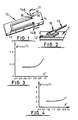
- an elastomeric electro-conductive device 10 comprises a non-conductive elastomeric substrate 11 on which is mounted a U-shaped member 12 which is electro-conductive, the free ends of the limbs of the U-shape being respectively connected to connector means 14A, 14B.
- the means 14A, 14B are essentially identical and therefore only one will be further described.
- Conductor means 14A comprises a length 15 of H.T.V. conductive polymer which at one end is connected by way of a crimped connector 16 to a length of copper wire 17 (externally insulated), and at its other end length 15 is adhesively bonded to member 12 by a body 18 of bonding material as is more clearly shown in Fig. 2.
- the body 18 has the same constituents as and in identical proportions to the constituents of the member 12 and by virtue of the body 18 the conductor means 14A is effectively chemically welded to the member 12 across the entire width of the member 12 so that a superior electrical connection is provided therebetween in comparison to that achieved by sewing or stitching copper wire directly to the member 11.
- the conductor means 14A is made of a length 15 of H.T.V. conductive polymer a limited degree of resiliency is provided in the length itself in comparison to the relative rigidity evident from copper wire.
- member 12 preferably has a composition of 100 g silicone polymer gum (C2501), 70 g graphite (having a particle size of the order of 50 micrometres or less) and 20 g Arachis oil vulcanised at room temperature using 2 g of DBTL (di-butyl-tin-dilaurate) as curing agent, 5 g of Silester OS as cross-linking agent. Accordingly member 12 has an ultimate tensile strength of 0.65 M Nm- 2 , an elongation at break of 87 %, and a volume resistivity of 0.073 Qm.
- H.T.V. polymer length 15 utilises a methyl vinyl polysiloxane polymer such as EP-494 (made and sold by J-Sil Ltd.) and containing about 30 % carbon black to render the polymer conductive, the polymer being vulcanised at high temperature utilising di-cumyl-peroxide as curing agent.
- EP-494 made and sold by J-Sil Ltd.
- the body 18 of bonding material has a composition of 100 g silicone polymer gum (C2501), 70 g graphite (having a particle size of the order of 50 micrometres or less) and 20 g Arachis oil vulcanised at room temperature using 2 g of DBTL as curing agent and 5 g of Silester OS as cross-linking agent.
- Fig. 3 The characteristics of the material forming body 18 and member 12 as specified by way of example are illustrated in Fig. 3 in the form of a Mooney plot which is a well known technique for representing the physical characteristics of an elastomeric material.
- Fig. 4 The characteristics of the HTV polymer forming length 15 are comparably illustrated in Fig. 4 by way of a Mooney Plot and it will be evident that in terms of elongation ( ⁇ ) both Fig. 3 and Fig. 4 have regions where 0, which is representative of resistance to extension, is substantially constant (but at respective values) and it is preferred that the device 10 is constrained to operational extensions within this range.
- the non-conductive elastomer is substrate 11 is initially manufactured, preferably using silicone polymer gum (C2501), DBTL and Silester OS the mixed materials being cast to form a slab of suitable width, length and thickness as required for the substrate 11.
- Member 12 and body 18 are independently manufactured, for example utilising the method detailed in the aforesaid EPC Patent Specification No. 89 843.
- the manufacturing method is modified by introducing to the unvulcanised mixture of constituents a volume of a volatile additive (such as Toluene) in which the oil and gum dissolve and/or disperse miscibly since the additive renders the mixture less viscous and therefore more controllable for casting purposes.
- a volatile additive such as Toluene
- the body 18 and the member 12 may each be manufactured from a mixture of 100 g silicone polymer gum (C2501), 70 g graphite carbon particles, 20 g Arachis oil, 5 g Silester OS cross-linker, 2 g DBTL curing agent, and 100 ml Toluene.
- the member 12 is cast to shape in a mould and after vulcanising at room temperature is released from the mould and is adhesively bonded to the substrate 11 using as an adhesive agent a volume of an identical mixture as that from which member 12 was cast, the adhesive agent being uniformly and sparingly applied to member 12 prior to member 12 being positioned as required on substrate 11.
- the adhesive agent is utilised as such during its vulcanisation process and when vulcanisation is complete member 12 is chemically welded to substrate 11.
- the body 18, in accordance with the present invention is provided with the same electrical characteristics as the member 12 so that there is no electrical discontinuity between body 18 and member 12 and because the bonding material is a silicone polymer, therefore being vulcanised at room temperature, the process of adhesion between body 18 and member 12 is effected without varying the electrical characteristics of member 12 during fabrication of the device 10.
Landscapes
- Chemical & Material Sciences (AREA)
- Dispersion Chemistry (AREA)
- Physics & Mathematics (AREA)
- Spectroscopy & Molecular Physics (AREA)
- Engineering & Computer Science (AREA)
- Microelectronics & Electronic Packaging (AREA)
- Compositions Of Macromolecular Compounds (AREA)
- Conductive Materials (AREA)
- Spinning Or Twisting Of Yarns (AREA)
- Push-Button Switches (AREA)
- Liquid Crystal (AREA)
- Silicon Polymers (AREA)
- Measurement Of Length, Angles, Or The Like Using Electric Or Magnetic Means (AREA)
- Connections Effected By Soldering, Adhesion, Or Permanent Deformation (AREA)
- Electrostatic Charge, Transfer And Separation In Electrography (AREA)
- Discharging, Photosensitive Material Shape In Electrophotography (AREA)
- Photoreceptors In Electrophotography (AREA)
- Measurement And Recording Of Electrical Phenomena And Electrical Characteristics Of The Living Body (AREA)
- Adhesives Or Adhesive Processes (AREA)
Claims (4)
Priority Applications (1)
| Application Number | Priority Date | Filing Date | Title |
|---|---|---|---|
| AT86300350T ATE43746T1 (de) | 1985-01-29 | 1986-01-20 | Elastomerische elektroleitfaehige vorrichtungen. |
Applications Claiming Priority (2)
| Application Number | Priority Date | Filing Date | Title |
|---|---|---|---|
| GB858502203A GB8502203D0 (en) | 1985-01-29 | 1985-01-29 | Elastomeric electro-conductive materials |
| GB8502203 | 1985-01-29 |
Publications (3)
| Publication Number | Publication Date |
|---|---|
| EP0189994A2 EP0189994A2 (de) | 1986-08-06 |
| EP0189994A3 EP0189994A3 (en) | 1986-12-30 |
| EP0189994B1 true EP0189994B1 (de) | 1989-05-31 |
Family
ID=10573586
Family Applications (1)
| Application Number | Title | Priority Date | Filing Date |
|---|---|---|---|
| EP86300350A Expired EP0189994B1 (de) | 1985-01-29 | 1986-01-20 | Elastomerische elektroleitfähige Vorrichtungen |
Country Status (8)
| Country | Link |
|---|---|
| US (1) | US4654475A (de) |
| EP (1) | EP0189994B1 (de) |
| JP (1) | JPS61198501A (de) |
| AT (1) | ATE43746T1 (de) |
| AU (1) | AU580840B2 (de) |
| DE (1) | DE3663758D1 (de) |
| ES (1) | ES9200015A1 (de) |
| GB (1) | GB8502203D0 (de) |
Families Citing this family (6)
| Publication number | Priority date | Publication date | Assignee | Title |
|---|---|---|---|---|
| GB8502197D0 (en) * | 1985-01-29 | 1985-02-27 | Univ Strathclyde | Electro-conductive elastomeric devices |
| US4729166A (en) * | 1985-07-22 | 1988-03-08 | Digital Equipment Corporation | Method of fabricating electrical connector for surface mounting |
| NO173878C (no) * | 1987-10-21 | 1994-02-16 | Ask Heating Kk | Ledende oppvarmingsenhet omfattende en eksotern, lendende belegningsfilm paa en fast overflate |
| GB2224400B (en) * | 1988-09-14 | 1992-07-08 | Gates Rubber Co | Electrical sensing element |
| WO1990010296A1 (en) * | 1989-03-03 | 1990-09-07 | Japan Synthetic Rubber Company, Ltd. | Applications for graphite fibrils |
| US7248142B2 (en) * | 2005-08-02 | 2007-07-24 | Sensitron, Inc. | Thin deflectable resistor |
Family Cites Families (13)
| Publication number | Priority date | Publication date | Assignee | Title |
|---|---|---|---|---|
| US2734978A (en) * | 1956-02-14 | Bulgin | ||
| US3124769A (en) * | 1964-03-10 | High elongation strain gage | ||
| GB720602A (en) * | 1952-02-21 | 1954-12-22 | Dunlop Rubber Co | Electric resistance elements |
| GB1040871A (en) * | 1964-05-04 | 1966-09-01 | Midland Silicones Ltd | Method of making electrical connections |
| US3572322A (en) * | 1968-10-11 | 1971-03-23 | Hoffmann La Roche | Transducer assembly |
| US3719913A (en) * | 1969-05-02 | 1973-03-06 | North American Rockwell | Viscous strain gage |
| DE2240286A1 (de) * | 1972-08-16 | 1974-03-14 | Matsushita Electric Ind Co Ltd | Druckempfindliches widerstandselement und verfahren zu seiner herstellung |
| US3820529A (en) * | 1972-11-07 | 1974-06-28 | Nasa | Conductive elastomeric extensometer |
| DE2307776C3 (de) * | 1973-02-16 | 1979-08-30 | Wacker-Chemie Gmbh, 8000 Muenchen | Verwendung von Gemischen auf Basis von OrganopolysUoxanen als Klebstoffe |
| US4020014A (en) * | 1976-01-21 | 1977-04-26 | General Electric Company | Semi-conductive silicone elastomers |
| JPS55120656A (en) * | 1979-03-09 | 1980-09-17 | Toray Silicone Co Ltd | Curable liquid organopolysiloxane composition |
| US4444205A (en) * | 1980-05-31 | 1984-04-24 | University Of Strathclyde | Apparatus for assessing joint mobility |
| US4505847A (en) * | 1982-03-02 | 1985-03-19 | University Of Strathclyde | Electrically-conductive materials |
-
1985
- 1985-01-29 GB GB858502203A patent/GB8502203D0/en active Pending
-
1986
- 1986-01-20 AT AT86300350T patent/ATE43746T1/de not_active IP Right Cessation
- 1986-01-20 DE DE8686300350T patent/DE3663758D1/de not_active Expired
- 1986-01-20 EP EP86300350A patent/EP0189994B1/de not_active Expired
- 1986-01-22 US US06/821,443 patent/US4654475A/en not_active Expired - Fee Related
- 1986-01-28 AU AU52781/86A patent/AU580840B2/en not_active Expired - Fee Related
- 1986-01-28 ES ES551330A patent/ES9200015A1/es not_active Expired
- 1986-01-29 JP JP61016002A patent/JPS61198501A/ja active Pending
Also Published As
| Publication number | Publication date |
|---|---|
| JPS61198501A (ja) | 1986-09-02 |
| ATE43746T1 (de) | 1989-06-15 |
| AU580840B2 (en) | 1989-02-02 |
| ES9200015A1 (es) | 1989-03-01 |
| GB8502203D0 (en) | 1985-02-27 |
| AU5278186A (en) | 1986-08-07 |
| EP0189994A2 (de) | 1986-08-06 |
| DE3663758D1 (en) | 1989-07-06 |
| ES551330A0 (es) | 1989-03-01 |
| EP0189994A3 (en) | 1986-12-30 |
| US4654475A (en) | 1987-03-31 |
Similar Documents
| Publication | Publication Date | Title |
|---|---|---|
| EP0191555B1 (de) | Elektroleitfähige elastomerische Vorrichtungen | |
| US4820376A (en) | Fabrication of CPI layers | |
| US4209481A (en) | Process for producing an anisotropically electroconductive sheet | |
| US4634207A (en) | Apparatus and method for protection of a substrate | |
| KR0149738B1 (ko) | 시일드플래트케이블 | |
| JP3038859B2 (ja) | 異方導電性シート | |
| US5664953A (en) | Elastomeric locking taper connector with randomly placeable intermeshing member | |
| US4790968A (en) | Process for producing pressure-sensitive electroconductive sheet | |
| US5348686A (en) | Electrically conductive gel | |
| US2701867A (en) | Cable connector | |
| US4647402A (en) | Electro-optic display device and a method of producing the same | |
| EP0189994B1 (de) | Elastomerische elektroleitfähige Vorrichtungen | |
| GB2168363A (en) | Apparatus and method for protection of a substrate | |
| Novak et al. | Investigation of the correlation between electrical conductivity and elongation at break in polyurethane-based adhesives | |
| IE852265L (en) | Interconnection means | |
| US5975922A (en) | Device containing directionally conductive composite medium | |
| JPS6032285B2 (ja) | 加圧導電性エラストマ−の製造方法 | |
| EP0413335A3 (en) | Method of mutually connecting electrode terminals | |
| EP0277362B1 (de) | Verfahren zur Herstellung von elektrischen Widerständen mit weiten Werten der spezifischen Widerstände | |
| US4584431A (en) | High voltage RF coaxial cable | |
| Lutz et al. | High performance electrically conductive silicone adhesives | |
| EP0449970B1 (de) | Wärmeschrumpfbare lötvorrichtung | |
| GB2160718A (en) | Elastomeric screen for coaxial cable | |
| RU2033476C1 (ru) | Анодное заземление | |
| DE4114701A1 (de) | Elektrischer verbinder in flachbauweise |
Legal Events
| Date | Code | Title | Description |
|---|---|---|---|
| PUAI | Public reference made under article 153(3) epc to a published international application that has entered the european phase |
Free format text: ORIGINAL CODE: 0009012 |
|
| AK | Designated contracting states |
Kind code of ref document: A2 Designated state(s): AT BE CH DE FR GB IT LI LU NL SE |
|
| PUAL | Search report despatched |
Free format text: ORIGINAL CODE: 0009013 |
|
| AK | Designated contracting states |
Kind code of ref document: A3 Designated state(s): AT BE CH DE FR GB IT LI LU NL SE |
|
| 17P | Request for examination filed |
Effective date: 19870216 |
|
| 17Q | First examination report despatched |
Effective date: 19880421 |
|
| GRAA | (expected) grant |
Free format text: ORIGINAL CODE: 0009210 |
|
| AK | Designated contracting states |
Kind code of ref document: B1 Designated state(s): AT BE CH DE FR GB IT LI LU NL SE |
|
| PG25 | Lapsed in a contracting state [announced via postgrant information from national office to epo] |
Ref country code: IT Free format text: LAPSE BECAUSE OF FAILURE TO SUBMIT A TRANSLATION OF THE DESCRIPTION OR TO PAY THE FEE WITHIN THE PRE;WARNING: LAPSES OF ITALIAN PATENTS WITH EFFECTIVE DATE BEFORE 2007 MAY HAVE OCCURRED AT ANY TIME BEFORE 2007. THE CORRECT EFFECTIVE DATE MAY BE DIFFERENT FROM THE ONE RECORDED.SCRIBED TIME-LIMIT Effective date: 19890531 Ref country code: BE Effective date: 19890531 Ref country code: AT Effective date: 19890531 Ref country code: LI Effective date: 19890531 Ref country code: FR Free format text: THE PATENT HAS BEEN ANNULLED BY A DECISION OF A NATIONAL AUTHORITY Effective date: 19890531 Ref country code: SE Effective date: 19890531 Ref country code: NL Effective date: 19890531 Ref country code: CH Effective date: 19890531 |
|
| REF | Corresponds to: |
Ref document number: 43746 Country of ref document: AT Date of ref document: 19890615 Kind code of ref document: T |
|
| REF | Corresponds to: |
Ref document number: 3663758 Country of ref document: DE Date of ref document: 19890706 |
|
| REG | Reference to a national code |
Ref country code: CH Ref legal event code: PL |
|
| EN | Fr: translation not filed | ||
| NLV1 | Nl: lapsed or annulled due to failure to fulfill the requirements of art. 29p and 29m of the patents act | ||
| PG25 | Lapsed in a contracting state [announced via postgrant information from national office to epo] |
Ref country code: LU Free format text: LAPSE BECAUSE OF NON-PAYMENT OF DUE FEES Effective date: 19900131 |
|
| PGFP | Annual fee paid to national office [announced via postgrant information from national office to epo] |
Ref country code: GB Payment date: 19900228 Year of fee payment: 5 |
|
| PLBE | No opposition filed within time limit |
Free format text: ORIGINAL CODE: 0009261 |
|
| STAA | Information on the status of an ep patent application or granted ep patent |
Free format text: STATUS: NO OPPOSITION FILED WITHIN TIME LIMIT |
|
| 26N | No opposition filed | ||
| PG25 | Lapsed in a contracting state [announced via postgrant information from national office to epo] |
Ref country code: DE Effective date: 19901002 |
|
| PG25 | Lapsed in a contracting state [announced via postgrant information from national office to epo] |
Ref country code: GB Effective date: 19910120 |
|
| GBPC | Gb: european patent ceased through non-payment of renewal fee |