EP0190611A2 - Acylharnstoffe, insektizide Mittel enthaltend diese Verbindungen sowie Verfahren zu ihrer Herstellung - Google Patents
Acylharnstoffe, insektizide Mittel enthaltend diese Verbindungen sowie Verfahren zu ihrer Herstellung Download PDFInfo
- Publication number
- EP0190611A2 EP0190611A2 EP86100837A EP86100837A EP0190611A2 EP 0190611 A2 EP0190611 A2 EP 0190611A2 EP 86100837 A EP86100837 A EP 86100837A EP 86100837 A EP86100837 A EP 86100837A EP 0190611 A2 EP0190611 A2 EP 0190611A2
- Authority
- EP
- European Patent Office
- Prior art keywords
- hydrogen
- halogen
- oder
- alkyl
- general formula
- Prior art date
- Legal status (The legal status is an assumption and is not a legal conclusion. Google has not performed a legal analysis and makes no representation as to the accuracy of the status listed.)
- Withdrawn
Links
- 0 Cc1ccc(*=I)cc1* Chemical compound Cc1ccc(*=I)cc1* 0.000 description 4
- YRFOIBUTERWJHP-UHFFFAOYSA-N CC(C1(C)[ClH]C)C1(F)F Chemical compound CC(C1(C)[ClH]C)C1(F)F YRFOIBUTERWJHP-UHFFFAOYSA-N 0.000 description 1
Classifications
-
- A—HUMAN NECESSITIES
- A01—AGRICULTURE; FORESTRY; ANIMAL HUSBANDRY; HUNTING; TRAPPING; FISHING
- A01N—PRESERVATION OF BODIES OF HUMANS OR ANIMALS OR PLANTS OR PARTS THEREOF; BIOCIDES, e.g. AS DISINFECTANTS, AS PESTICIDES OR AS HERBICIDES; PEST REPELLANTS OR ATTRACTANTS; PLANT GROWTH REGULATORS
- A01N47/00—Biocides, pest repellants or attractants, or plant growth regulators containing organic compounds containing a carbon atom not being member of a ring and having no bond to a carbon or hydrogen atom, e.g. derivatives of carbonic acid
- A01N47/08—Biocides, pest repellants or attractants, or plant growth regulators containing organic compounds containing a carbon atom not being member of a ring and having no bond to a carbon or hydrogen atom, e.g. derivatives of carbonic acid the carbon atom having one or more single bonds to nitrogen atoms
- A01N47/28—Ureas or thioureas containing the groups >N—CO—N< or >N—CS—N<
- A01N47/34—Ureas or thioureas containing the groups >N—CO—N< or >N—CS—N< containing the groups, e.g. biuret; Thio analogues thereof; Urea-aldehyde condensation products
-
- C—CHEMISTRY; METALLURGY
- C07—ORGANIC CHEMISTRY
- C07C—ACYCLIC OR CARBOCYCLIC COMPOUNDS
- C07C273/00—Preparation of urea or its derivatives, i.e. compounds containing any of the groups, the nitrogen atoms not being part of nitro or nitroso groups
- C07C273/02—Preparation of urea or its derivatives, i.e. compounds containing any of the groups, the nitrogen atoms not being part of nitro or nitroso groups of urea, its salts, complexes or addition compounds
Definitions
- the invention relates to new acylureas, insecticidal compositions comprising these compounds and processes for their preparation.
- the object of the present invention is to provide compounds which fight insects much better than the compounds known for this purpose.
- C 1 -C 6 alkyl includes, for example, the radicals methyl, ethyl, propyl, isopropyl, n-butyl, isobutyl, n-pentyl, n-hexyl and others.
- Aryl is intended to mean, for example, phenyl or naphthyl, optionally substituted, for example by halogen, such as chlorine, or alkyl, such as methyl.
- Halogen can be fluorine, chlorine, bromine or iodine.
- the compounds according to the invention can be used in concentrations of 0.005 to 5.0%, preferably 0.001 to 0.1%.
- the compounds according to the invention can be used either alone, as a mixture with one another or with other insecticidal active ingredients. If necessary, other crop protection or pesticides such as acaricides or fungicides can be added depending on the desired purpose.
- the intensity and speed of action can be promoted, for example, by additives which increase the effect, such as organic solvents, wetting agents and oils. Such additives may therefore allow the active ingredient dosage to be reduced.
- the labeled active ingredients or their mixtures are expediently in the form of preparations, such as powders, scattering agents, granules, solutions, emulsions or suspensions, with the addition of liquid and / or solid carriers or diluents and, if appropriate, network adhesives, emulsifiers and / or Dispersing aids applied.
- Suitable liquid carriers are, for example, water, aliphatic and aromatic hydrocarbons, also cyclohexanone, isophorone, dimethyl sulfoxide, dimethylformamide and mineral oil fractions.
- Mineral earths for example Tonsil, silica gel, talc, kaolin, Attaklay, limestone, silica and vegetable products, for example flours, are suitable as solid carriers.
- On surface active examples of substances to be mentioned are: calcium ligninsulfonate, polyoxyethylene alkylphenyl ether, naphthalenesulfonic acids and their salts, phenolsulfonic acids and their salts, formaldehyde condensates, fatty alcohol sulfates and substituted benzenesulfonic acids and their salts.
- the proportion of the active ingredient (s) in the various preparations can vary within wide limits.
- the agents contain about 5 to 80 percent by weight of active ingredients, about 95 to 20 percent by weight of liquid or solid carriers and optionally up to 20 percent by weight of surfactants.
- the agents can be applied in the customary manner, for example using water as a carrier in spray liquor amounts of about 100 to 3000 liters / ha.
- Use of the agents in the so-called low-volume and ultra-low-volume process is just as possible as their application in the form of so-called microgranules.
- preparations can be produced in a manner known per se, for example by grinding or mixing processes. If desired, the individual components can also be mixed shortly before they are used, as is done in practice, for example, in the so-called tank mix process.
- Inert substances such as aliphatic, alicyclic and aromatic hydrocarbons, which can optionally be chlorinated such as hexane, cyclohexane, petroleum ether, benzenes toluene, xylene, methylene chloride, trichlorethylene and chlorobenzene; Ethers such as diethyl ether, methyl ethyl ether, diisopropyl ether, dibutyl ether, propylene oxide, dioxane and tetrahydrofuran; Ketones such as acetone, methyl ethyl ketone; Nitriles such as acetonitrile, propionitrile and benzonitrile; Esters such as ethyl acetate and amyl acetate; Acid amides such as dimethylformamide and dimethylacetamide; Sulfones and sulfoxides such as dimethyl sulfoxide and sulfolane.
- Ethers
- the reaction variant a) can be carried out within a wide temperature range. In general, it is carried out at a temperature between -20 ° C. and the boiling point of the reaction mixture, preferably between 20 ° C. and 200 ° C.
- the reaction variant is preferably carried out under the pressure of the environment, although it can also be carried out under increased or reduced pressure.
- Reaction variant b) can be carried out under the same reaction conditions in terms of temperature and pressure as was mentioned above for reaction variant a).
- acylureas according to the invention are colorless and odorless crystalline compounds. They dissolve very poorly in water or toluene, better in ethyl acetate and good in dimethylformamide.
- benzamides of the general formula V to be used as starting materials and the benzoyl isocyanates and benzoyl isothiocyanates of the general formula III are known per se or can be prepared by known methods.
- the vinyl ethers mentioned can also be prepared in a two-stage reaction by first reacting the phenols with 1,2-dibromoethane in the presence of a weak base such as potassium carbonate to give bromoethyl ether and this with a strong base such as potassium hydroxide or potassium tert-butoxide dehydrobrominated to vinyl ether.
- a weak base such as potassium carbonate
- a strong base such as potassium hydroxide or potassium tert-butoxide dehydrobrominated to vinyl ether.
- Bicyclic amidines such as 1,5-diazabicyclo [4.3.0] non-5-ene (DBN) and 1,8-diazabicyclo [5.4.0] undec-7-ene (DBU) and tert are particularly suitable for the last reaction.
- Amines such as triethylamine and 1,4-diazabicyclo [2.2.2] octane (DABCO).
- a suspension of 4.45 g (25 mmol) of 4-amino-2,6-dichlorophenol, 4.54 g (33 mmol) of potassium carbonate and 0.5 g of potassium iodide in 50 ml of dimethylformamide is added dropwise at 100 ° C. (bath temperature) 5.0 g (25 mmol) of 2,2-difluoro-3,3-dimethylcyclopropylmethyl bromide dissolved in 15 ml of dimethylformamide. After one hour, the mixture is concentrated in vacuo. The residue is taken up in ethyl acetate and washed with water (twice). After drying, column chromatography (hexane / ethyl acetate, 7: 3) provides a colorless oil.
- the substances according to the invention were used as aqueous emulsions with the active ingredient concentration 0.1% or 0.01%.
- Feathery leaves of broad bean (Vicia faba) were dipped into these drug preparations. After the preparation broth had dried on the immersed leaflets, 10 caterpillars of the Egyptian cotton owl (Spodoptera littoralis) in the 2nd larval stage were enclosed together with three pairs of leaflets in a glass petri dish ( ⁇ 12 cm). These test elements were set up in the laboratory for 5 days under long day conditions.
- the criterion for the effectiveness assessment was the mortality of the caterpillars in% after a 5-day test period.
- the substances according to the invention were used as aqueous emulsions with the active ingredient concentrations 0.01% and 0.001%.
- the comparative agents were also used as aqueous suspensions.
- Bush bean plants (Phaseolus vulgaris) in the primary leaf stage were immersed in these active substance preparations.
- three plant stems with a total of 6 primary leaves were placed in glass vases filled with water and caged in glass cylinders.
- 5 larvae of the Mexican bean beetle (Epilachna varivestis) in the 3rd larval stage were counted into the glass cylinders and kept in them for 5 days under long-day conditions.
- the criterion for the efficacy assessment was the mortality of the larvae in% after a 5-day test period.
- the compounds according to the invention were used as aqueous emulsions with an active ingredient concentration of 0.01%.
- the comparative agents were also used as aqueous suspensions.
- the criterion for the effectiveness assessment was the percentage hatching in comparison to untreated egg layers.
- the compounds of the invention were used as aqueous emulsions with an active ingredient concentration of 0.0016%.
- the comparative agents were also used as aqueous suspensions. In this preparation of active ingredients, egg day eggs, 1 day old, which had been deposited on filter paper by fertilized female butterflies, were immersed until completely wetted and deposited in closed petri dishes for 4 days.
- the criterion for the effectiveness assessment was the percentage prevention of hatching compared to untreated egg layers.
- the substances are used as aqueous emulsions with an active ingredient concentration of 0.1%.
- Bush bean plants Phaseolus vulgaris
- three plant stems with a total of 6 primary leaves are placed in glass vases filled with water and caged in glass cylinders.
- 5 larvae of the Mexican bean beetle Epilachna varivestis
- the criterion for the assessment of effectiveness is the mortality of the larvae in% after a 5-day test period.
Landscapes
- Chemical & Material Sciences (AREA)
- Organic Chemistry (AREA)
- Life Sciences & Earth Sciences (AREA)
- Agronomy & Crop Science (AREA)
- Pest Control & Pesticides (AREA)
- Plant Pathology (AREA)
- Health & Medical Sciences (AREA)
- Engineering & Computer Science (AREA)
- Dentistry (AREA)
- General Health & Medical Sciences (AREA)
- Wood Science & Technology (AREA)
- Zoology (AREA)
- Environmental Sciences (AREA)
- Organic Low-Molecular-Weight Compounds And Preparation Thereof (AREA)
- Low-Molecular Organic Synthesis Reactions Using Catalysts (AREA)
- Agricultural Chemicals And Associated Chemicals (AREA)
Abstract

- R1 Halogen, C1-C6alkyl oder C1-C6-Halogenalkyl,
- R2 Wasserstoff oder Halogen,
- R3, R4 und R5 jeweils Wasserstoff, Halogen oder C1-C6-Alkyl,
- R6, R7 und R8 jeweils Wasserstoff, Cl-C6-Alkyl, Aryl oder Halogen,
- R9, R10 gleich oder verschieden sind und Wasserstoff oder Fluor,
- X Sauerstoff oder Schwefel und
- n 0, 1, 2 oder 3 bedeuten,
insektizide Mittel enthaltend diese Verbindungen sowie Verfahren zu ihrer Herstellung.
Description
- Die Erfindung betrifft neue Acylharnstoffe, insektizide Mittel enthaltend diese Verbindungen sowie Verfahren zu ihrer Herstellung.
- Es ist bereits bekannt, daß bestimmte Acylharnstoffe insektizide Eigenschaften besitzen (DE-OS 21 23 236; DE-OS 26 01 780; DE-OS 29 28 410).
- Aufgabe der vorliegenden Erfindung ist die Zurverfügunastellung von Verbindungen,die Insekten wesentlich besser bekämpfen als die für diesen Zweck bekannten Verbindungen.
- Es wurde nun gefunden, daß Verbindungen der allgemeinen Formel

- R1 Halogen, C1-C6Alkyl oder C1-C6-Halogrenalkyl,
- R2 Wasserstoff oder Halogen,
- R3, R4 und R5 jeweils Wasserstoff, Halogen oder C1-C6-Alkyl,
- R6, R7 und R jeweils Wasserstoff, C1-C6-Alkyl, Aryl oder Halogen,
- R9 und R10 gleich oder verschieden sind und Wasserstoff oder Fluor, X Sauerstoff oder Schwefel und
- n 0, 1, 2 oder 3
- bedeuten, eine wesentlich bessere insektizide Wirkung als bekannte, wirkungsähnliche Verbindungen analoger Konstitution besitzen.
- Überraschenderweise lassen sich mit den erfindungsgemäßen Verbindungen bedeutende Insektenschädlinge, insbesondere aus den Ordnungen der Dipteren, Coleopteren, Lepidopteren und Hymenopteren selektiv bekämpfen.
- Die Bezeichnung C1-C6-Alkyl umfaßt zum Beispiel die Radikale Methyl, Äthyl, Propyl, Isopropyl, n-Butyl, Isobutyl, n-Pentyl, n-Hexyl und andere.
- Aryl soll zum Beispiel Phenyl oder Naphthyl gegebenenfalls substituiert zum Beispiel durch Halogen, wie Chlor, oder Alkyl, wie Methyl, bedeuten.
- Halogen kann Fluor, Chlor, Brom oder Jod darstellen.
- Als Verbindungen mit besonderer insektizider Wirkung sind solche zu nennen, bei denen in der allgemeinen Formel I
- R1 Chlor oder Fluor,;
- R2 Wasserstoff, Chlor oder Fluor,
- R3 Wasserstoff, Chlor oder Methyl,
- R4 Wasserstoff, Chlor oder Methyl,
- R5 Wasserstoff, Chlor oder Methyl,
- R6 Wasserstoff, Chlor oder Methyl,
- R7 Wasserstoff oder Methyl,
- R8 Wasserstoff oder Methyl,
- Rq und R10 Fluor,
- X Sauerstoff und
- n 0, 1, 2 und 3 bedeuten.
- Die Anwendung der erfindungsgemäßen Verbindungen kann in Konzentrationen von 0;0005 bis 5,0 %, vorzugsweise von 0,001 bis 0,1 % erfolgen.
- Die erfindungsgemäßen Verbindungen können entweder allein, in Mischung miteinander oder mit anderen insektiziden Wirkstoffen angewendet werden. Gegebenenfalls können andere Pflanzenschutz- oder Schädlingsbekämpfungsmittel wie zum Beispiel Akarizide oder Fungizide je nach dem gewünschten Zweck zugesetzt werden.
- Eine Förderung der Wirkungsintensität und der Wirkungsgeschwindigkeit kann zum Beispiel durch wirkungssteigernde Zusätze, wie organische Lösungsmittel, Netzmittel und Öle, erzielt werden. Solche Zusätze lassen daher gegebenenfalls eine Verringerung der Wirkstoffdosierung zu.
- Zweckmäßig werden die gekennzeichneten Wirkstoffe oder deren Mischungen in Form von Zubereitungen, wie Pulvern, Streumitteln, Granulaten, Lösungen, Emulsionen oder Suspensionen, unter Zusatz von flüssigen und/oder festen Trägerstoffen beziehungsweise Verdünnungsmitteln und gegebenenfalls von Netz-Haft-, Emulgier- und/oder Dispergierhilfsmitteln angewandt.
- Geeignete flüssige Trägerstoffe sind zum Beispiel Wasser, aliphatische und aromatische Kohlenwasserstoffe, weiterhin Cyclohexanon, Isophoron, Dimethylsulfoxid, Dimethylformamid und Mineralölfraktionen.
- Als feste Trägerstoffe eignen sich Mineralerden, zum Beispiel Tonsil, Silikagel, Talkum, Kaolin, Attaklay, Kalkstein, Kieselsäure und pflanzliche Produkte, zum Beispiel Mehle.
- An oberflächenaktiven. Stoffen sind zum Beispiel zu nennen: Calciumligninsulfonat, Polyoxyäthylen-alkylphenyläther, Naphthalinsulfonsäuren und deren Salze, Phenolsulfonsäuren und deren Salze, Formaldehydkondensate, Fettalkoholsulfate sowie substituierte Benzolsulfonsäuren und deren Salze.
- Der Anteil der bzw. des Wirkstoffe(s) in den verschiedenen Zubereitungen kann in weiten Grenzen variieren. Beispielsweise enthalten die Mittel etwa 5 bis 80 Gewichtsprozent Wirkstoffe, etwa 95 bis 20 Gewichtsprozent flüssige oder feste Trägerstoffe sowie gegebenenfalls bis zu 20 Gewichtsprozente oberflächenaktive Stoffe.
- Die Ausbringung der Mittel kann in üblicher Weise erfolgen, zum Beispiel mit Wasser als Träger in Spritzbrühmengen von etwa 100 bis 3000 Liter/ha. Eine Anwendung der Mittel im sogenannten Low-Volume- und Ultra-Low-Volume-Verfahren ist ebenso möglich wie ihre Applikation in Form von sogenannten Mikrogranulaten.
- Die Herstellung dieser Zubereitungen kann in an sich bekannter Art und Weise zum Beispiel durch Mahl- oder Mischverfahren, durchgeführt werden. Gewünschtenfalls können die Einzelkomponenten auch erst kurz vor ihrer Verwendung gemischt werden, wie es zum Beispiel im sogenannten Tankmixverfahren in der Praxis durchgeführt wird.
- Zur Herstellung der Zubereitungen werden zum Beispiel die folgenden Bestandteile eingesetzt:
- A) 20 Gewichtsprozent Wirkstoff
- 35 Gewichtsprozent Bentonit
- 8 Gewichtsprozent Calciumsalz der Ligninsulfonsäure
- 2 Gewichtsprozent Natriumsalz des N-Methyl-N-olein-taurins
- 35 Gewichtsprozent Kieselsäure
- B) 45 Gewichtsprozent Wirkstoff .
- 5 Gewichtsprozent Natrimnaluminiumsilikat
- 15 Gewichtsprozent Cetylpolyglykoläther mit 8 Mol Äthylenoxid
- 2 Gewichtsprozent Spindelöl
- 10 Gewichtsprozent Polyäthylenglycol
- 23 Teile Wasser
- C) 20 Gewichtsprozent Wirkstoff
- 75 Gewichtsorozent Isophoron
- 5 Gewichtsprozent Mischung aus ionischen und nichtionischen Tensiden
- Die erfindungsgemäßen Verbindungen lassen sich herstellen, indem man
- a) Alkoxyaniline der allgemeinen Formel


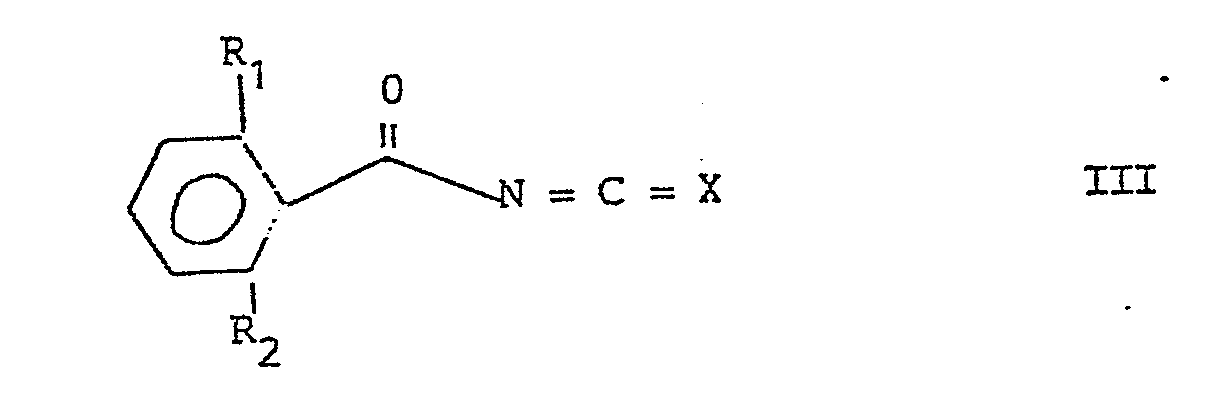
- b) Alkoxyphenylisocyanate oder Alkoxyphenylisothiccyanate der allgemeinen Formel


- Als Lösungsmittel eignen sich gegenübenden Reaktanden inerte Stoffe wie aliphatische, alicyclische und aromatische Kohlenwasserstoffe, die jeweils gegebenenfalls chloriert sein können wie Hexan, Cyclohexan, Petrolether, Benzole Toluol, Xylol, Methylenchlorid, Trichlorethylen und Chlorbenzol; Ether, wie Diethylether, Methylethylether, Diisopropylether, Dibutylether, Propylenoxid, Dioxan und Tetrahydrofuran; Ketone, wie Aceton, Methylethylketon; Nitrile wie Acetonitril, Propionitril und Benzonitril; Ester,wie Ethylacetat und Amylacetat; Säureamide, wie Dimethylformamid und Dimethylacetamid; Sulfone und Sulfoxide, wie Dimethylsulfoxid und Sulfolan.
- Die Reaktionsvariante a) kann innerhalb eines breiten Temperaturbereichs durchgeführt werden. Im allgemeinen wird sie bei einer Temperatur zwischen -20°C und dem Siedepunkt der Reaktionsmischung, vorzugsweise zwischen 20°C und 200°C durchgeführt.
- Die Reaktionsvariante wird vorzugsweise unter dem Druck der Umgebung durchgeführt, wenngleich sie auch bei erhöhtem oder vermindertem Druck durchgeführt werden kann.
- Die Reaktionsvariante b) kann unter den gleichen Reaktionsbedingungen in Bezug auf Temperatur und Druck durchgeführt werden, wie sie für die Reaktionsvariante a) im Vorstehenden genannt wurde.
- Die erfindungsgemäßen Acylharnstoffe sind farb- und geruchlose kristalline Verbindungen. Sie lösen sich nur sehr schlecht in .Wasser oder Toluol, bessar in Essigester und gut in Dimethylformamid.
- Die als Ausgangsmaterialien zu verwendenden Benzamide der allgemeinen Formel V und die Benzoylisocyanate und Benzoylisothiocyanate der allgemeinen Formel III sind an sich bekannt oder können nach bekannten Methoden hergestellt werden.
- Die Ausgangsprodukte der allgemeinen Formel II erhält man beispielsweise nach den folgenden Herstellungsverfahren:
- Aniline der allgemeinen Formel

- lassen sich herstellen, indem man Nitrophenole der allgemeinen Formel


- verethert. Die Umsetzung mit Difluorcarben und die anschließende Reduktion nach gängigen Verfahren liefert das gewünschte Anilin.
- Aniline der allgemeinen Formel II, wobei n = 0 bedeutet, lassen sich herstellen, indem man Nitrophenole der allgemeinen Formel VI mit Essigsäurevinylester in Gegenwart katalytischer Mengen Quecksilberacetat und Säuren wie zum Beispiel konz. H2SO4, p-Toluolsulfonsäure oder BF3-Etherat zu Vinylethern umsetzt. Anschließend wird mit Difluorcarben umgesetzt und durch Reduktion in das gewünschte Anilin überführt.
- Die angeführten Vinylether lassen sich auch in einer Zweistufenreaktion herstellen, indem man die Phenole zunächst mit 1,2-Dibromethan in Gegenwart einer schwachen Base wie zum Beispiel Kaliumcarbonat zum Bromethylether umsetzt und diesen mit einer starken Base wie zum Beispiel Kaliumhydroxid oder Kalium-tert-butylat zum Vinylether dehydrobromiert.
- Besonders geeignet für die letzte Umsetzung sind bicyclische Amidine wie 1,5-Diazabicyclo[4.3.0]non-5-en (DBN) und 1,8-Diazabicyclo[5.4.0]undec-7-en (DBU) und tert.-Amine wie Triethylamin und 1,4-Diazabicyclo[2.2.2]-octan (DABCO).
- Aniline der allgemeinen Formel II, wobei n = 1, 2 und 3 bedeutet, können aucl durch direkte Veretherung von Aminophenolen hergestellt werden, indem man Aminophenole der allgemeinen Formel


- Die folgenden Beispiele erläutern die Herstellung der erfindungsgmäßen Verbindungen.
- 1,0 g (5,4 mMol) 4-(2,2-Difluorcyclopropyloxy)-anilin werden in 10 ml THF gelöst und bei Raumtemperatur mit 988 mg (5,4 mMol) 2,6-Difluorbenzoylisocyanat, in 10 ml THF gelöst, versetzt.
- Nach einer Stunde fügt man 150 ml Pentan hinzu und saugt den Niederschlag ab. Es wird mit Pentan nachgewaschen und bei 50°C im Vakuum (200 Torr) getrocknet.
- Ausbeute: 1,8 g (92 % der Theorie)
- Fp.: 194 - 195°C
- DC.: Laufmittel: CH2Cl2 : MeOH = 95 : 5 Rf-Wert: 0, 71
- Analyse: Berechnet: C 55,44 H 3,29 N 7,61 F 20,64 Gefunden : C 55,06 H 3,33 N 7,28. F 20,52
- 2,1 g (9,2 mMol) 4-(2,2-Difluorcyclopropylmethoxy)-3,5-dimethylanilin werden in 10 ml Tetrahydrofuran gelöst und bei Raumtemperatur mit 1,82 g -(10,2 mMol) 2-Chlorbenzoylisocyanat, in 10 ml Tetrahydrofuran gelöst, versetzt.
- Nach einer Stunde fügt man 150 ml Pentan hinzu und saugt den Niederschlag ab. Es wird mit Pentan nachgewaschen und bei 50°C im Vakuum (200 Torr) getrocknet.
- Ausbeute: 2,9 g = 77% der Theorie
- Fp.: 164-165°C
- DC : Laufmittel: CH2Cl2: MeOH = 95:5 Rf-Wert: 0,81
- Analyse: Berechnet: C 58,75 H 4,68 N 6,85 Cl 8,67 F 9,29 % Gefunden: C 58,57 H 4,78 N 6,40 Cl 8,30 F 9,36 %
- 1,25 g (4,8 m Mol) 4-(1-Chlor-2,2-difluorcyclopropyl- methoxy)-3,5-dimethylanilin werden in 10 ml Tetrahydrofuran (THF) gelöst und bei Raumtemperatur mit 0,87 g
- (4,8 m Mol) 2,6-Difluorbenzoylisocyanat, in 10 ml THF gelöst, versetzt. Nach einer Stunde fügt man 150 ml Pentan
- hinzu und saugt den Niederschlag ab. Es wird mit Pentan nachgewaschen und bei 50 °C im Vakuum (200 Torr) getrocknet.
- Ausbeute: 1,55 g = 73 % der Theorie
- Fp.: 176-177° C
- DC: Laufmittel: CH2Cl2:MeOH = 95:5 Rf-Wert: 0,74
- Analvse: Berechnet: C 53,99 H 3,85 N 6,29 Cl 7,97 F 17,08 Gefunden: C 53,95 H. 3,88 N 6,06 Cl 8,03 F 16,85 In analoger Weise wurden auch die folgenden Verbindungen hergestellt:


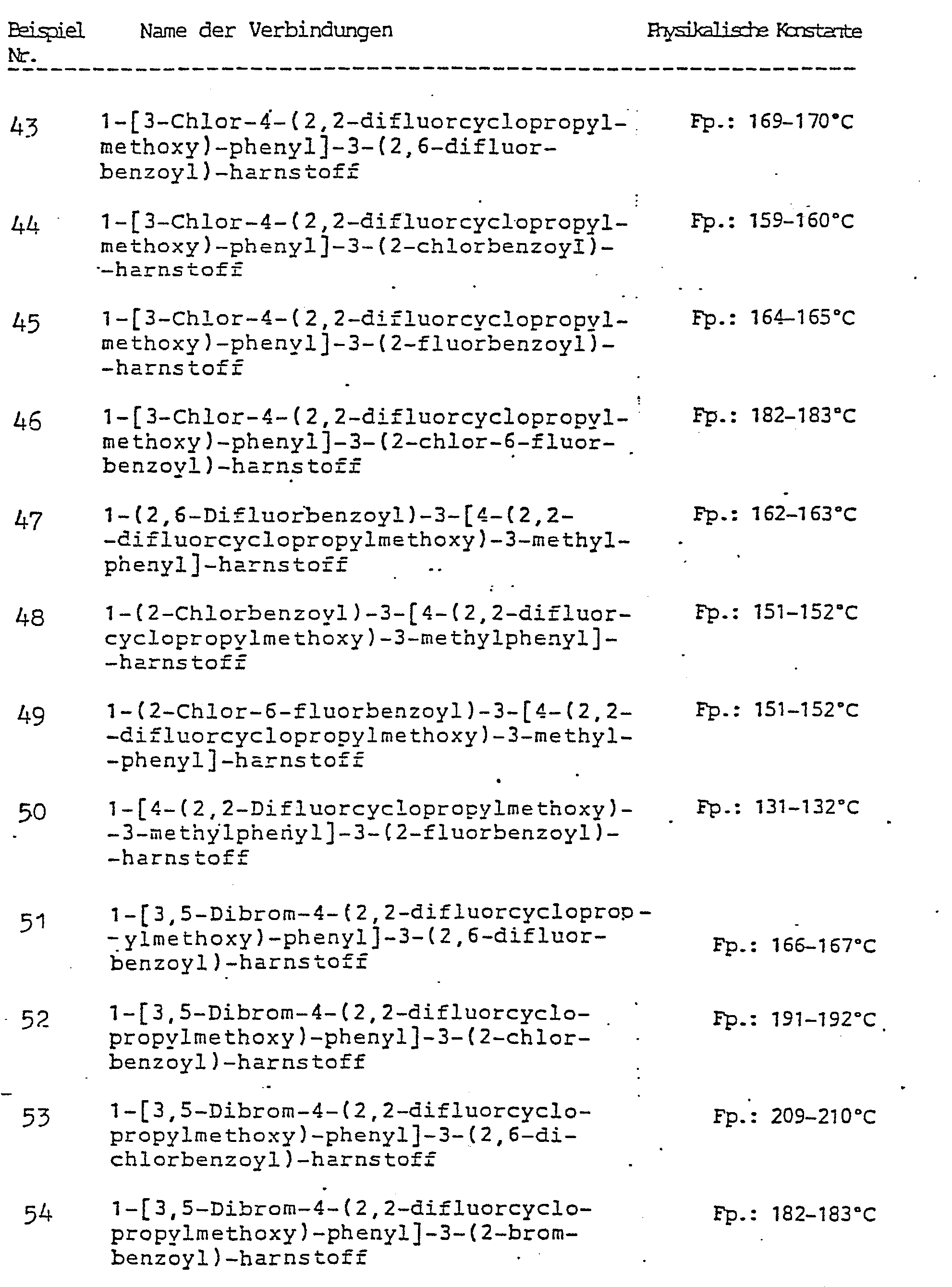


- Die folgenden Beispiele erläutern die Herstellung der Ausgangsverbindungen der allgemeinen Formel II.
- 50 g (0,30 Mol) 4-Nitro-2,6-dimethylphenol, 45,4 g (0,33 Mol) Kaliumcarbonat und 1,5 g 18-Krone-6 versetzt man mit 250 ml 1,2-Dibremethan und rührt 8 Stunden bei 100 °C. Anschließend gibt man auf Eiswasser und extrahiert mit Chloroform. Die Chloroformphase wird mit 10%iger Natronlauge und viermal mit Wasser gewaschen, über Magnesiumsulfat getrocknet und im Vakuum eingedampft. Aus Hexan erhält man 67 g (82% der Theorie; 0,24 Mol) 2-Bromethyl-2,6-di- .methyl-4-nitrophenylether (Fp.: 86-87°C).
- Die gesamte Substanzmenge wird in 300 ml Toluol gelöst, mit 2 g 18-Krone-6 und 30 g (0,54 Mol) Kaliumhydroxid versetzt und 6 Stunden bei 60°C gerührt. Nach dem Abkühlen wird die Toluolphase mit Wasser gewaschen, getrocknet und im Vakuum eingeengt. Aus Hexan erhält man 31,6 g (67 % der Theorie) 2,6-Dimethyl-4-nitrophenylvinylether (Fp.: 78°C) 15 g (78 mMol) dieses Vinylethers, in 100 ml Diglym gelöst, versetzt man bei 165°C Innentemperatur innerhalb von 2 Stunden mit einer Lösung von 59,1 g (388 mMol) Natriumchloridfluoracetat in 100 ml Diglym. Man rünrt 1 Stunde bei 165°C nach, läßt abkühlen, filtriert die anorganischen Bestandteile ab und engt im Vakuum (0,1 Torr; 50°C) ein. Der Rückstand, der durch Säulenchromato- graphie (Hexan:Toluol, 9:1) gereinigt wird, ergibt 14,6 g (77 % der Theorie) 4-(2,2-Difluorcyclopropyloxy)-3,5-dimethylnitrobenzol (Fp.: 63-64°C)
- 8 g (33mMol) 4-(2,2-Difluorcycl,opropyloxy)-3,5-dimethylnitrobenzol suspendiert man in 45 ml Wasser und 75 ml Ethanol und fügt nach Zugabe von 3,27 g (61,8 mMol) Ammoniumchlorid innerhalb von 10 Minuten portionsweise 16,5 g (248 mMol) Zinkpulver hinzu. Dabei steigt die Temperatur auf 40-50°C an. Nach einer Stunde wird das Zinkhydroxid abgesatugt, Ethanol vorsichtig im Vakuum entfernt und der Rückstand in Essigester aufgenommen. Die wäßrige Phase wird abgetrennt und das Lösungsmittel im Vakuum verdampft. Aus Hexan erhält man farblose Kristalle, die bei Raumtemperatur (200 Torr) getrocknet werden. Ausbeute: 6,5 g = 93 % der Theorie
- Fp: 78-79°C
- DC: Laufmittel: CH2Cl2:MeOH = 95:5 Rf-Wert: 0,61
- Analyse: Berechnet: C 61,96 % H 6,14 % N 6,56 % F 17,82 % Gefunden : C 62,33 % H 6,02 % N 6,49 % F 17,52 % - 22 -
- Zu 50 g (0,30 Mol) 2,6-Dimethyl-4-nitrophenol, 55,6 g (0,40 Mol) Kaliumcarbonat und 7,5 g Kaliumjodid in 400 ml Dimethylformamid addiert man bei Raumtemperatur 28,3 ml (0,33 Mol) Allylbromid. Man rührt 1,5 h bei 70°C, läßt abkühlen und filtriert die aocrganïschen Bestandteile ab.
- Anschließend verdampft man im Vakuum, versetzt mit Essigester und wäscht die organische Phase mit Wasser.
- Nach Einengen und Trocknen (Raumtemperatur; 0,1 torr) erhält man 61,9 g (100%) kristallinen 2;6-Dimethyl-4-nitrophenyl-3-propenylether; Fp.: 35°C
- 20 g (96,5 mMol) dieses Allylethers, in 120 ml Diglym gelöst, versetzt man bei 165°C Innentemperatur innerhalb von 2 Stunden mit einer Lösung von 73,6 g (482 mMol) Natriumchlordïfluoracetat in 150 ml Diglym. Man rührt 1 Stunde bei 165°C nach, läßt abkühlen, filtriert die enocgaïschen Bestandteile ab und engt im Vakuum (0,1 Torr; 50°C) ein. Der Rückstand, der durch Säulenchromatographie (Hexan:Toluol, 9:1) gereinigt wird, ergibt 6,3 g (26% der Theorie) 4-(2,2-Difluorcyclopropylmethoxy)-3,5-dimethylnitrobenzol (nD20 = 1,5198)und 7 g (35%) Ausgangsmaterial.
- 5,04 g (19,6 mMol) 4-(2,2-Difluorcyclopropylmethoxy)-3,5-dimethylnitrobenzol suspendiert man in 30 ml Wasser und 50 ml Ethanol und fügt. nach Zugabe von 1,91 g (36,7 mMol) Ammoniumchlorid innerhalb von 10 Minuten portionsweise 9,77 g (147 mMol) Zinkpulver hinzu. Dabei steigt die Temperatur auf 40 bis 50°C an. Nach einer Stunde wird das Zinkhydroxid abgesaugt, Ethanol vorsichtig im Vakuum entfernt und der Rückstand in Essigester aufgenommen. Die wäßrige Phase wird abgetrennt und das Lösungsmittel im Vakuum verdampft. Aus Hexan erhält man farblose Kristalle, die bei Raumtemperatur (200 Torr) getrocknet werden.
- Ausbeute: 3,5 g = 79% der Theorie Fp.: 71-72°C DC: Laufmittel: CH2Cl2:MeOH = 95:5; Rf-Wert: 0,73 Analyse: Berechnet: C 63,41 % H 6,65 % N 6,16 % F 16,72 % Gefunden : C 63,29 % H 6,70 % N 5,91 % F 16,76 %
- Zu einer Suspension von 4,16 g (23,4 mMol) 4-Amino-2,6-dichlorphenol, 3,54 g (25,7 mMol) Kaliumcarbonat und 0,74 g Kaliumjodid in Dimethylformamid (50 ml) tropft man bei 100°C (Badtemperatur) 4,0 g (23,4 mMol) 2,2-Difluorcyclopropylmethylbrormid gelöst in 15 ml Dimethylformamid.
- Nach einer Stunde wird im Vakuum eingeengt. Der.Rückstand wird mit Essigester aufgenommen und mit Wasser gewaschen (2x). Nach dem Trocknen über Magnesiumsulfat versetzt man mit Pentan und saugt die Kristalle ab.
- Ausbeute: 2,9 g = 46% der Theorie
- Fp.: 89 - 90°C
- DC: Laufmittel: CH2Cl2:MeOH = 95:5 Rf-Wert: 0,61
- Analyse: Berechnet: C 44,79% H 3,38% N 5,22% F 14,17% Gefunden: C 44,51% H 3,70% N 5,03% F 14,32%
- Zu 20 g (96,8 mMol) 2,6-Dichlor-4-nitrophenol, 17,9 g (0,13 Mol) Kaliumcarbonat und 2,4 g Kaliumjodid in 200 ml Dimethylformamid addiert man bei Raumtemperatur 11,8 g (0,1 Mol) 2,3-Dichlor-1-propen. Man rührt 1,5 h bei 70 °C, läßt abkühlen und filtriert die organischen Bestandteile ab. Anschließend verdampft man im Vakuum, versetzt mit Essigester und wäscht die organische Phase mit Wasser. Nach Einengen, Umkristallisation aus Isopropanol und Trocknen (Raumtemperatur; 0,1 Torr) erhält man 12,0 g (44 % d. Th.) kristallines 4-(2-Chlor-2-propenyl- oxy)-3,5-dichlornitrobenzol (Fp.: 53-54 °C).
- 12 g (42,5 mMol) dieses Phenolethers, in 150 ml Diglym gelöst, versetzt man bei 165 °C Innentemperatur innerhalb von 2 Stunden mit einer Lösung von 32,4 g (212 mMol) Natriumchlordifluoracetat in 150 ml Diglym. Man rührt 1 Stunde bei 165 °C nach, läßt abkühlen, filtriert die anorganischen Bestandteile ab und engt im Vakuum (0,1 Torr; 50 °C) ein. Der Rückstand, der durch Säulenchromatographie (Hexan:Toluol, 9:1) gereinigt wird, ergibt 10,5 g (74,8 % d. Th.) 4-(1-Chlor-2,2-difluorcyclopropylmethoxy)- 3,5-dichlornitrobenzol (Fp.: 44-45 °C).
- 7,1 g (21,4 mMol) 4-(1-Chlor-2,2-difluorcyclopropylmethoxy)-3,5-dichlornitrobenzol suspendiert man in 35 ml Wasser und 50 ml Ethanol und fügt nach Zugabe von 2 g (40 mMol) Ammoniumchlorid innerhalb von 10 Minuten portionsweise 10,65 g (160 mMol) Zinkpulver hinzu. Dabei steigt die Temperatur auf 40-50 °C an. Nach einer Stunde wird das Zinkhydroxid abgesaugt, Ethanol vorsichtig im Vakuum entfernt und der Rückstand in Essigester aufgenommen. Die wäßrige Phase wird abgetrennt und das Lösungsmittel im Vakuum verdampft. Man erhält ein farbloses Ö1, das nach dem Trocknen (0,1 Torr; RT) gleich weiter eingesetzt wird.
- Ausbeute: 6,3 g = 97 % der Theorie
- DC: Laufmittel: Hexan/Essigester 8:2 Rf-Wert: 0,30
- 1H-NMR: (CDCl3; TMS; 80 MHz) S 6,52 ppm (2H, Ar-H) Sbr. 4,17 ppm (2H, -0-CH 2-) Sbr. 3,5 ppm (2H, -NH 2) m 1.6-2.4 ppm
-

- Zu einer Suspension von 4,45 g (25 mMol) 4-Amino-2,6-dichlorphenol, 4,54 g (33 mMol) Kaliumcarbonat und 0,5 g Kaliumjodid in 50 ml Dimethylformamid tropft man bei 100 °C (Badtemperatur) 5,0 g (25 mMol) 2,2-Difluor-3,3-dimethylcyclopropylmethylbromid gelöst in 15 ml Dimethylformamid. Nach einer Stunde wird im Vakuum eingeengt. Der Rückstand wird mit Essigester aufgenommen und mit Wasser gewaschen (2mal). Nach dem Trocknen liefert die Säulenchromatographie(Hexan/Essigester, 7:3) ein farbloses Öl.
- Ausbeute: 4,1 g = 55 % der Theorie
- DC: Laufmittel = Hexan/Essigester 1:1 Rf-Wert: 0,79-
- Analyse: Berechnet: C 48,67% H 4,42% N 4,73% F 12,83% Gefunden: C 48.46% H 4,40% N 4,43% F 12,65%
- Die folgenden Beispiele dienen zur Erläuterung der Anwendungsmöglichkeiten der erfindungsgemäßen Verbindungen, die in Form ihrer Zubereitungen erfolgte.
- Abtötende Wirkung auf Larven (L2) der Ägyptischen Baumwolleule (Spodoptera littoralis)
- Die erfindungsgemäßen Substanzen wurden als wäßrige Emulsionen mit der Wirkstoffkonzentration 0,1 % bzw. 0,01 % eingesetzt.
- In diese Wirkstoffzubereitungen wurden Fiederblätter der Puffbohne (Vicia faba) getaucht. Nach dem Antrocknen der Präparatebrühe auf den getauchten Fiederblättern wurden je Versuchsglied 10 Raupen der Ägyptischen Baumwoll- Eule (Spodoptera littoralis) im 2. Larvenstadium zusammen mit drei Fiederblattpaaren in einer Glaspetrischale (φ 12 cm) eingeschlossen. Diese Versuchsglieder wurden für 5 Tage unter Langtagbedingungen im Labor aufgestellt.
- Kriterium für die Wirkuncsbeurteilung war die Mortalität der Raupen in % nach 5-tägiger Versuchsdauer.


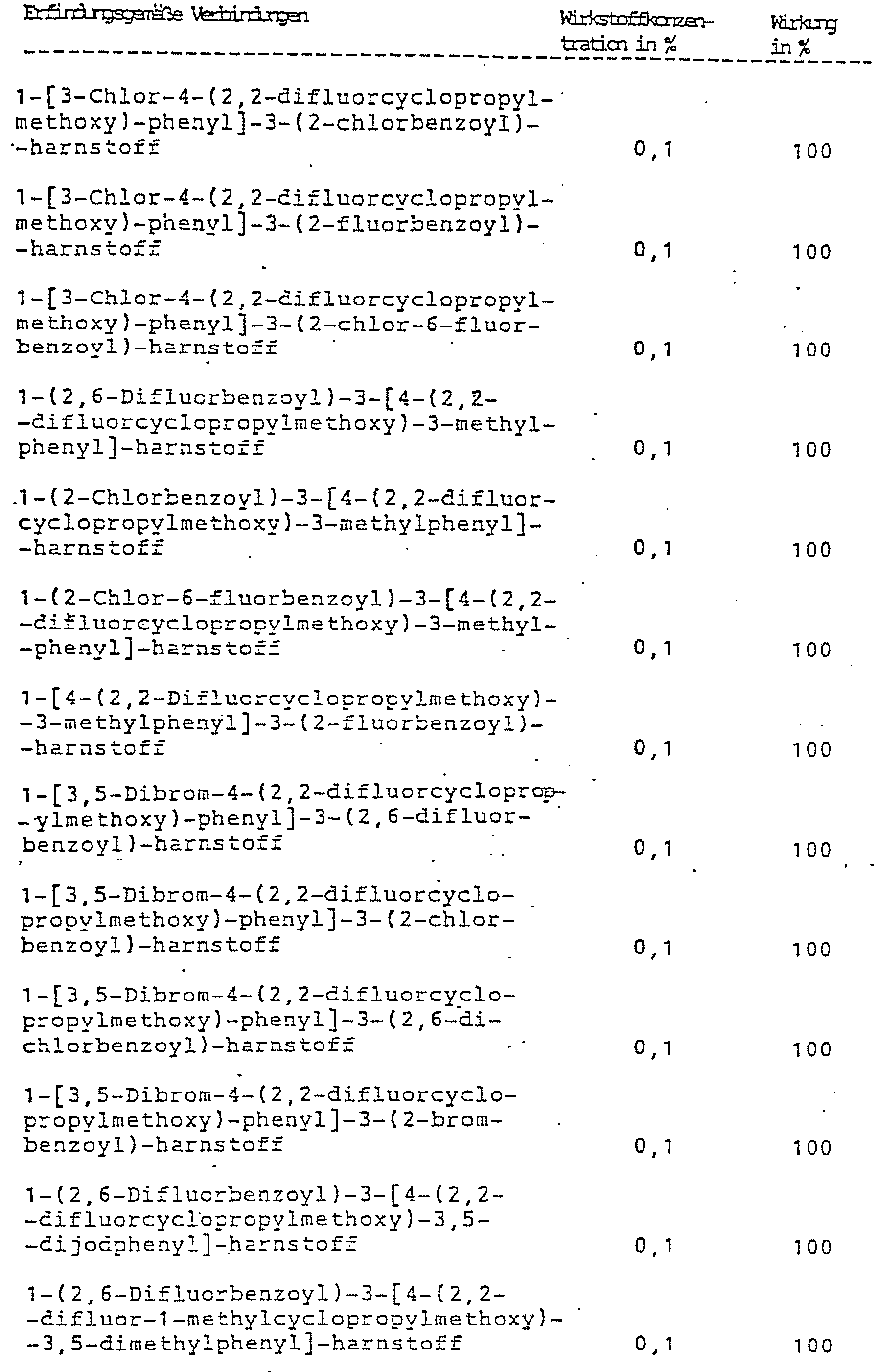


- Die erfindungsgemäßen Substanzen wurden als wäßrige Emulsionen mit den Wirkstoffkonzentrationen 0,01% und 0,001% eingesetzt. Ebenso wurden die Vergleichsmittel als wäßrige Suspensionen eingesetzt.
- In diese Wirkstoffzubereitungen wurden Buschbohnenpflanzen (Phaseolus vulgaris) im Primärblattstadium getaucht. Pro Versuchsglied wurden drei Pflanzenstengel mit insgesamt 6 Primärblättern in mit Wasser gefüllte Glasvasen eingestellt und in Glaszylindern eingekäfigt. Nach dem Antrocknen der Präparatebrühe auf den behandelten Blättern wurden je 5 Larven des Mexikanischen Bohnenkäfers (Epilachna varivestis) im 3. Larvenstadium in die Glaszylinder eingezählt und für 5 Tage darin unter Langtagbedingungen gehalten.
- Kriterium für die wirkurgsbeurteilung war die Mortalität der Larven in % nach 5-tägiger Versuchsdauer.


- Ovizide Wirkung auf Eigelege des Mexikanischen Bohnenkäfers (Epilachna varivestis)
- Die erfindungsgemäßen Verbindungen wurden als wäßrige Emulsionen mit der Wirkstoffkonzentration 0,01 % eingesetzt. Ebenso wurden die Vergleichsmittel als wäßrige Suspensionen eingesetzt.
- In diese Wirkstoffzubereitungen wurden 1 Tag alte Eigelege, die von befruchteten Käferweibchen auf Buschbohnenblätter abgesetzt worden waren, bis zur völligen Benetzung getaucht und für 7 Tage in geschlossenen Petrischalen deponiert.
- Kriterium für die Wirkungsbeurteilung war die Prozentuale Schlupfverbinderung im Vergleich zu unbehandelten Eigelegen.


- Ovizide Wirkung auf Eigelege der Ägyptischen Baumwoll-Eule (Spodoptera littoralis)
- Die' erfindungsgemäßen Verbindungen wurden als wäßrige Emulsionen mit der Wirkstoffkonzentration 0,0016 % eingesetzt. Ebenso wurden die Vergleichsmittel als wäßrige Suspensionen eingesetzt. In diese Wirkstoffzubereitung wurden 1 Tage alte Eigelege, die von befruchteten Falterweibchen auf Filterpapier abgesetzt worden waren, bis zur völligen Benetzung getaucht und für 4 Tage in geschlossenen Petrischalen deponiert.
- Kriterium für die Wirkungsbeurteilung war die prozentuale Schlupfverhinderung im Vergleich zu unbehandleten Eigelegen.
-


- Abtötende Wirkung auf Larven (L 3) des Mexikanischen Bohnenkäfers (Epilachna varivestis)
- Die Substanzen werden als wäßrige Emulsionen mit der Wirkstoffkonzentration 0,1 % eingesetzt. In diese Wirkstoffzubereitungen werden Buschbohnenpflanzen (Phaseolus vulgaris) im Primärblattstadium getaucht. Pro Versuchsglied werden drei Pflanzenstengel mit insgesamt'6 Primärblättern in mit Wasser gefüllte Glasvasen eingestellt und in Glaszylindern eingekäfigt. Nach dem Antrocknen der Präparatebrühen auf den behandelten Blättern werden je 5 Larven des Mexikanischen Bohnenkäfers (Epilachna varivestis) im dritten Larvenstadium in die Glaszylinder eingezählt und für 5 Tage unter Langtagbedingungen darin gehalten. Kriterium für die Wirkungsbeurteilung ist die Mortalität der Larven in % nach 5-tägiger Versuchsdauer.


Claims (6)




Applications Claiming Priority (6)
| Application Number | Priority Date | Filing Date | Title |
|---|---|---|---|
| DE3504749 | 1985-02-08 | ||
| DE19853504749 DE3504749A1 (de) | 1985-02-08 | 1985-02-08 | Acylharnstoffe, insektizide mittel enthaltend diese verbindungen sowie verfahren zu ihrer herstellung |
| DE3510556 | 1985-03-21 | ||
| DE19853510556 DE3510556A1 (de) | 1985-03-21 | 1985-03-21 | Acylharnstoffe, insektizide und ovizide mittel enthaltend diese verbindungen sowie verfahren zu ihrer herstellung |
| DE3529343 | 1985-08-15 | ||
| DE19853529343 DE3529343A1 (de) | 1985-08-15 | 1985-08-15 | Acylharnstoffe, verfahren zu ihrer herstellung sowie ihre verwendung als insektizide enthaltend diese verbindungen |
Publications (2)
| Publication Number | Publication Date |
|---|---|
| EP0190611A2 true EP0190611A2 (de) | 1986-08-13 |
| EP0190611A3 EP0190611A3 (de) | 1987-02-04 |
Family
ID=27192806
Family Applications (1)
| Application Number | Title | Priority Date | Filing Date |
|---|---|---|---|
| EP86100837A Withdrawn EP0190611A3 (de) | 1985-02-08 | 1986-01-22 | Acylharnstoffe, insektizide Mittel enthaltend diese Verbindungen sowie Verfahren zu ihrer Herstellung |
Country Status (9)
| Country | Link |
|---|---|
| EP (1) | EP0190611A3 (de) |
| KR (1) | KR860006437A (de) |
| CN (1) | CN86100630A (de) |
| AU (1) | AU5299886A (de) |
| BR (1) | BR8600558A (de) |
| DK (1) | DK56186A (de) |
| ES (1) | ES8701719A1 (de) |
| FI (1) | FI860371A7 (de) |
| HU (1) | HUT39972A (de) |
Family Cites Families (2)
| Publication number | Priority date | Publication date | Assignee | Title |
|---|---|---|---|---|
| DE2928410A1 (de) * | 1979-07-11 | 1981-01-29 | Schering Ag | Acylharnstoffe, insektizide mittel enthaltend diese verbindungen sowie verfahren zu ihrer herstellung |
| DE3046672A1 (de) * | 1980-12-08 | 1982-07-08 | Schering Ag, 1000 Berlin Und 4619 Bergkamen | Acylharnstoffe, insektizide mittel enthaltend diese verbindungen sowie verfahren zu ihrer herstellung |
-
1986
- 1986-01-22 EP EP86100837A patent/EP0190611A3/de not_active Withdrawn
- 1986-01-25 CN CN198686100630A patent/CN86100630A/zh active Pending
- 1986-01-27 FI FI860371A patent/FI860371A7/fi not_active Application Discontinuation
- 1986-02-04 AU AU52998/86A patent/AU5299886A/en not_active Withdrawn
- 1986-02-04 ES ES551623A patent/ES8701719A1/es not_active Expired
- 1986-02-05 DK DK56186A patent/DK56186A/da not_active Application Discontinuation
- 1986-02-07 BR BR8600558A patent/BR8600558A/pt unknown
- 1986-02-07 HU HU86524A patent/HUT39972A/hu unknown
- 1986-02-07 KR KR1019860000868A patent/KR860006437A/ko not_active Withdrawn
Also Published As
| Publication number | Publication date |
|---|---|
| ES551623A0 (es) | 1986-12-16 |
| EP0190611A3 (de) | 1987-02-04 |
| AU5299886A (en) | 1986-08-14 |
| ES8701719A1 (es) | 1986-12-16 |
| HUT39972A (en) | 1986-11-28 |
| FI860371L (fi) | 1986-08-09 |
| FI860371A7 (fi) | 1986-08-09 |
| DK56186D0 (da) | 1986-02-05 |
| BR8600558A (pt) | 1986-10-21 |
| CN86100630A (zh) | 1986-09-03 |
| DK56186A (da) | 1986-08-09 |
| KR860006437A (ko) | 1986-09-11 |
| FI860371A0 (fi) | 1986-01-27 |
Similar Documents
| Publication | Publication Date | Title |
|---|---|---|
| EP0077759B1 (de) | Phenylharnstoffe | |
| DE2530439A1 (de) | Neue bis-(0-1-alkylthio-aethylimino) -n-methylcarbaminsaeure)-n,n'-sulfide, verfahren zu ihrer herstellung und schaedlingsbekaempfungsmittel | |
| EP0001203A1 (de) | N-Phenyl-N'-Benzoylharnstoffe, Verfahren zu ihrer Herstellung, diese enthaltende Mittel und ihre Verwendung in der Schädlingsbekämpfung | |
| EP0023884B1 (de) | N-Phenyl-N'-benzoylharnstoffe, Verfahren zu ihrer Herstellung, diese Verbindungen enthaltende Mittel und ihre Verwendung zur Bekämpfung von Schädlingen | |
| EP0235089B1 (de) | N-Benzoyl-N'-phenylharnstoffe, ihre Herstellung und Verwendung bei der Kontrolle von Schädlingen | |
| DE2928410A1 (de) | Acylharnstoffe, insektizide mittel enthaltend diese verbindungen sowie verfahren zu ihrer herstellung | |
| EP0179021A2 (de) | Benzoylphenylharnstoffe | |
| EP0072528B1 (de) | (Thio-) Harnstoffe, ein Verfahren zu ihrer Herstellung und ihre Verwendung als Pflanzenschutzmittel | |
| EP0040179B1 (de) | Phenylbenzoylharnstoffe | |
| EP0008071B1 (de) | 1-Iminomethylen-substituierte 2-(Phenoxy-alkyl)-2-imidazolinderivate, Verfahren zu ihrer Herstellung, Mittel, welche diese Derivate als aktive Komponente enthalten und ihre Verwendung zur Bekämpfung von Schädlingen | |
| DE3783070T2 (de) | Phenylharnstoffe. | |
| EP0055213B1 (de) | Phenylharnstoffe | |
| DE3046672A1 (de) | Acylharnstoffe, insektizide mittel enthaltend diese verbindungen sowie verfahren zu ihrer herstellung | |
| EP0044278B1 (de) | Phenylharnstoffe | |
| EP0014674B1 (de) | Substituierte N-Phenyl-N'-benzoylharnstoffe, Verfahren zu ihrer Herstellung, diese Verbindungen enthaltende Mittel und ihre Verwendung zur Bekämpfung von Schädlingen; substituierte 4-(Propenyloxy)-aniline | |
| EP0008565A1 (de) | Bis-(phenoxy-alkyl-2-imidazolin)-1,1'-sulfide, Verfahren zu ihrer Herstellung, Mittel welche diese Sulfide als aktive Komponente enthalten und deren Verwendung zur Bekämpfung von Schädlingen | |
| DE3782362T2 (de) | Cyanacetamid-derivate mit fungizider wirkung. | |
| EP0190611A2 (de) | Acylharnstoffe, insektizide Mittel enthaltend diese Verbindungen sowie Verfahren zu ihrer Herstellung | |
| EP0118392B1 (de) | Benzoylharnstoff-Verbindungen als Schädlingsbekämpfungsmittel | |
| EP0014675A2 (de) | Substituierte N-Phenyl-N'-benzoylharnstoffe, Verfahren zu ihrer Herstellung, diese Verbindungen enthaltende Mittel und ihre Verwendung zur Bekämpfung von Schädlingen | |
| DE3504749A1 (de) | Acylharnstoffe, insektizide mittel enthaltend diese verbindungen sowie verfahren zu ihrer herstellung | |
| DE2328728A1 (de) | Systemisch-fungizide mittel | |
| EP0142667B1 (de) | N-Benzoyl-N'-alkoxyphenylharnstoffe und ihre Verwendung zur Bekämpfung von Insekten und Akariden | |
| DD235996A5 (de) | Pesticide benzoylharnstoffverbindung | |
| DE3529343A1 (de) | Acylharnstoffe, verfahren zu ihrer herstellung sowie ihre verwendung als insektizide enthaltend diese verbindungen |
Legal Events
| Date | Code | Title | Description |
|---|---|---|---|
| PUAI | Public reference made under article 153(3) epc to a published international application that has entered the european phase |
Free format text: ORIGINAL CODE: 0009012 |
|
| 17P | Request for examination filed |
Effective date: 19860122 |
|
| AK | Designated contracting states |
Kind code of ref document: A2 Designated state(s): AT BE CH DE FR GB IT LI LU NL SE |
|
| PUAL | Search report despatched |
Free format text: ORIGINAL CODE: 0009013 |
|
| AK | Designated contracting states |
Kind code of ref document: A3 Designated state(s): AT BE CH DE FR GB IT LI LU NL SE |
|
| 17Q | First examination report despatched |
Effective date: 19870921 |
|
| STAA | Information on the status of an ep patent application or granted ep patent |
Free format text: STATUS: THE APPLICATION HAS BEEN WITHDRAWN |
|
| 18W | Application withdrawn |
Withdrawal date: 19880206 |
|
| RIN1 | Information on inventor provided before grant (corrected) |
Inventor name: JOPPIEN, HARTMUT, DR. Inventor name: FRANKE, HEINRICH, DR. Inventor name: KRUEGER, HANS-RUDOLF, DR. Inventor name: WEGNER, PETER, DR. |