EP0191025B1 - Derives de carboxamidoadenosine substituee n-6 et 5'-n utiles comme vaso-dilateurs et agents d'antihypertension, et leur procede de preparation - Google Patents
Derives de carboxamidoadenosine substituee n-6 et 5'-n utiles comme vaso-dilateurs et agents d'antihypertension, et leur procede de preparation Download PDFInfo
- Publication number
- EP0191025B1 EP0191025B1 EP85903162A EP85903162A EP0191025B1 EP 0191025 B1 EP0191025 B1 EP 0191025B1 EP 85903162 A EP85903162 A EP 85903162A EP 85903162 A EP85903162 A EP 85903162A EP 0191025 B1 EP0191025 B1 EP 0191025B1
- Authority
- EP
- European Patent Office
- Prior art keywords
- substituted
- alkyl
- compounds
- hydroxy
- halogen
- Prior art date
- Legal status (The legal status is an assumption and is not a legal conclusion. Google has not performed a legal analysis and makes no representation as to the accuracy of the status listed.)
- Expired - Lifetime
Links
- 0 *C(C(C(C[n]1c2ncnc(N*)c2nc1)OC*(*)=O)O)O Chemical compound *C(C(C(C[n]1c2ncnc(N*)c2nc1)OC*(*)=O)O)O 0.000 description 1
- OEPNRMGHWKRTNT-UHFFFAOYSA-N CC1(C)NC=NC2N(C)C=NC12 Chemical compound CC1(C)NC=NC2N(C)C=NC12 OEPNRMGHWKRTNT-UHFFFAOYSA-N 0.000 description 1
Classifications
-
- C—CHEMISTRY; METALLURGY
- C07—ORGANIC CHEMISTRY
- C07H—SUGARS; DERIVATIVES THEREOF; NUCLEOSIDES; NUCLEOTIDES; NUCLEIC ACIDS
- C07H19/00—Compounds containing a hetero ring sharing one ring hetero atom with a saccharide radical; Nucleosides; Mononucleotides; Anhydro-derivatives thereof
- C07H19/02—Compounds containing a hetero ring sharing one ring hetero atom with a saccharide radical; Nucleosides; Mononucleotides; Anhydro-derivatives thereof sharing nitrogen
- C07H19/04—Heterocyclic radicals containing only nitrogen atoms as ring hetero atom
- C07H19/16—Purine radicals
Definitions
- the present invention is directed to certain N-6 and 5'-N substituted carboxamidoadenosine derivatives which have beneficial cardiovascular and antihypertensive activity in mammals, including humans and domestic animals.
- the present invention is also directed to a process for making said compounds.
- Adenosine has been known for a long time to possess certain cardiovascular, and particularly coronary dilator, activity. In an effort to obtain adenosine analogs of greater potency, or longer duration of activity, or both, many analogs of this naturally occurring nucleoside have been synthesized and tested.
- German Offenlegungschrift Nos. 2133273, 2426682,1795761, 191818, 2007273, 2238923, 2060189, 2244328, 1814711, 2136614, South African Patent Application No. 677630 (filed on December 20, 1967) and British Patent Specification No. 1,123,245 describe adenosine derivatives which have cardiovascular, coronary dilator, or antilipolytic activities. Still more adenosine derivatives having beneficial cardiovascular activity are described in another application for United States Letters Patent of the present inventors, Serial No. 601,435, filed on April 18, 1984 (EP-A 180614).
- the short duration of the beneficial cardiovascular effects of adenosine and those of its analogs which have an unsubstituted hydroxyl group of C-5 of the ribofuranose moiety is usually attributed to rapid penetration into cells followed by enzymatic conversion into less active or impermeant metabolites.
- adenosine deaminase converts adenosine into inosine, which is a weak cardiovascular agonist.
- phosphorylation catalyzed by adenosine kinase, forms adenylic acid (5'-AMP). Ionization of the phosphate group under physiological conditions prevents the escape of 5'-AMP from the cells in which it is formed. Thus trapped, 5'-AMP cannot exert its cardiovascular actions, which are mediated by cell surface receptors, as is discussed below.
- NECA 5'-N-Ethylcarboxamidoadenosine
- Compound 1 in General Formula 1 is an example of such an adenosine analog incapable of phosphorylation by adenosine kinase. Nevertheless, this compound binds potently to certain andenosine receptor sites and exhibits substantial cardiovascular activity.
- Other examples of known derivatives of adenosine-5'-carboxamide (Compound 2), and of adenosine-5'-carboxylic acid (Compound 9) are shown below in General Formulae 1 and 2.
- the 5'-carboxylate or 5'-carboxamide group of the uronic acid moiety is substituted with lower alkyl or lower acyl groups.
- Some of the edenosine-5'-carboxamide derivaties shown in General Formula 1 are disclosed in Chemical Abstracts Volume 100, 68652c and 68653d (1984) and in the corresponding published Japanese Patent Application Nos. 58-167599 and 58-167600.
- adenosine-5'-carboxamide-derivatives such as NECA
- NECA cell surface adenosine-5'-carboxamide-derivatives
- Ra cell surface adenosine receptor
- A2 cell surface adenosine receptor
- Adenosine analogs possessing certain N-6 alkyl or aralkyl substituents, such as cyclohexyl or R-1-phenyl-2-propyl, are selective agonists at R, receptors.
- Many mammalian and human cells contain both R a and R, receptors; examples of exceptions are fat cells which contain R, receptors only, and blood platelets and human placenta, in which R a receptors predominate.
- agonists are only selective, not absolutely specific, for R a and R, receptors. Because the two types of receptors coexist in many organs, including brain and heart, even a selective agonist will activate both to a certin degree.
- a goal of pharmaceutical chemistry is the development of agonists which are as nearly specific as possible because unselectivity can be a source of side effects.
- adenosine derivatives including the above-noted N-6 substituted and the 5'-carboxamide derivatives, are less than satisfactory as cardiovascular or antihypertensive drugs for animal and human use. This is either because of low activity, short duration of the desired activity, undue toxicity, or undesirable side effects. Undesirable side effects of cardiovascularly active adenosine analogs often include cardiac depression.
- the pharmaceutical industry is still striving to obtain adenosine analogs having high cardiovascular and hypotensive potency coupled with other optimal physiological characteristics, such as relatively long duration of the desired activity, low toxicity, and minimal side effects.
- the compounds of the present invention constitute a step in this direction.
- R 1 represents secondary alkyl; hydroxy, lower alkoxy or halogen substituted secondary alkyl; aralkyl; aralkyl substituted in the aromatic nucleus with hydroxy, halogen, lower alkoxy or lower alkyl groups; cycloalkyl; hydroxy, lower alkoxy, lower alkyl or halogen substituted cycloalkyl; para-substituted phenyl; heteroaryl substituted alkyl; heteroaryl substituted alkyl substituted in the heteroaryl nucleus with hydroxy, halogen, lower alkoxy or lower alkyl groups; norbornyl, and hydroxy, alkyl or halogen substituted norbornyl groups.
- the substituent R 2 and R 3 groups in the compounds of the present invention are hydrogen, or pharmacologically acceptable organic acyl groups, or inorganic acid radicals, such as N0 2 groups, which esterify the hydroxyl groups of the ribofuranose moiety.
- the R 2 and R 3 groups are preferably of the type which are relatively readily hydrolyzed under physiological conditions.
- the R 2 and R 3 substituents need not be identical with one another.
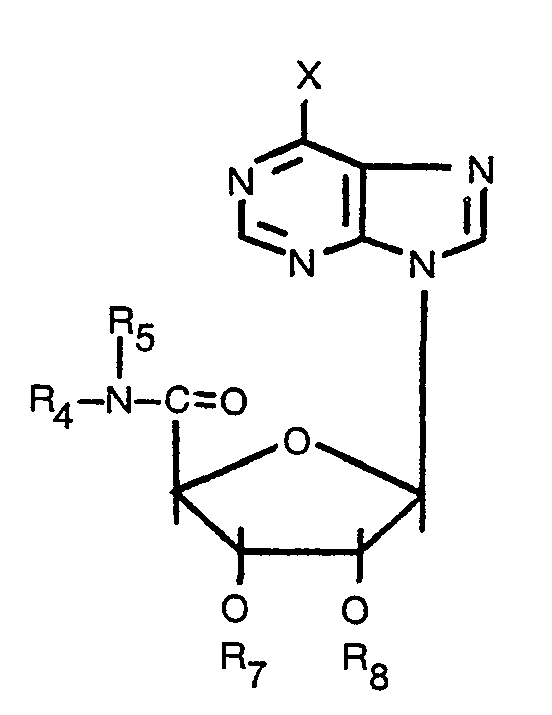
- the substituent R 4 is straight chain lower alkyl having 1-4 carbon atoms; hydroxy, lower alkoxy or halogen substituted straight chain lower alkyl having 1-4 carbon atoms; cyclopropyl; secondary alkyl having 3-6 carbon atoms; hydroxy, lower alkoxy or halogen substituted secondary alkyl having 3-6 carbon atoms; alkenyl having 3 to 6 carbon atoms; aralkyl having 1 to 4 carbons in the alkyl chain; aralkyl having 1 to 4 carbons in the alkyl chain and substituted in the aryl nucleus with hydroxy, halogen, lower alkoxy or lower alkyl groups; heteroarylalkyl having 1 to 4 carbons in the alkyl chain; and heteroarylalkyl having 1 to 4 carbons in the alkyl chain and substituted in the heteroaryl nucleus with hydroxy, halogen, lower alkoxy or lower alkyl groups.
- R 5 is hydrogen, or straight chain
- the compounds of the present invention are resistant to enzymatic phosphorylation and to deamination by adenosine deaminase.
- the compounds exhibit significant cardiovascular activity.
- the compounds of General Formula 3 are obtained from 2', 3'-O-isopropylideneinosine-5'-uronic acid by treatment with a suitable inorganic acid halide, such as thionyl chloride, to yield the intermediate, 6-chloro-9-[2,3-O-isopropylidene-Py-D-ribofuranosyl-5-uronic acid chloride]-9H-purine.
- a suitable inorganic acid halide such as thionyl chloride
- the acid chloride moiety of 6-chloro-9-[2,3-O-isopropylidene-Py-D-ribofuranosyl-5-uronic acid chloride]-9H-purine (or the acid bromide of the corresponding bromo-analog) is significantly more readily displaced by nucleophilic reagents that the halide group in the 6 position of the purine moiety.
- 6-chloro-9-[2,3-0-isopropylidene-Py-D-ribofuranosyl-5-uronic acid chloride]-9H-purine is reacted with a first nucleophilic reagent having the formula R 4 ,R 5 -NH (General Formula 4) to yield an intermediate substituted carboxamide shown in General Formula 5, wherein the halide is retained in the 6 position of the purine mpiety.
- the intermediate of General Formula 5 is subsequently reacted with a nucleophile having the formula R,-NH 2 (General Formula 6) and the isopropylidene blocking group is removed with acid to yield the compounds of the invention (General Formula 3), having free hydroxyl groups in the 2' and 3' positions of the ribofuranose moiety.
- a nucleophile having the formula R,-NH 2 General Formula 6
- the isopropylidene blocking group is removed with acid to yield the compounds of the invention (General Formula 3), having free hydroxyl groups in the 2' and 3' positions of the ribofuranose moiety.
- other acid stable blocking groups can also be used to protect the 2'-OH and 3'-OH groups of the ribofuranose moiety during the step of treatment with the inorganic acid halide.
- a preferred subclass of the compounds of the present invention consists of N-6 substituted derivatives of 5'-N-ethylcarboxamidoadenosine shown in General Formula 7, wherein the R 1 substituents of the N-6 amino nitrogen comprise: secondary alkyl; hydroxy, lower alkoxy or halogen substituted secondary alkyl; aralkyl; aralkyl substituted in the aromatic nucleus with hydroxy, halogen, lower alkoxy or lower alkyl groups; cycloalkyl; hydroxy, lower alkoxy, lower alkyl or halogen substituted cycloalkyl; para-substituted phenyl; heteroaryl substituted alkyl; heteroaryl substituted alkyl substituted in the heteroaryl nucleus with hydroxy, halogen, lower alkoxy or lower alkyl groups.
- the R 2 and R 3 substituent groups on the 2' and 3' positions of the ribufuranose moiety are hydrogen, or pharmaceutically acceptable acyl groups, such as acetyl, propionyl, butyryl and benzoyl groups. Especially preferred, in this regard, are those acyl groups which are relatively readily split off the ribofuranose moiety under physiological conditions.
- the R 2 and R 3 substituent groups can also represent inorganic acid radicals, such as N0 2 groups, which esterify the hydroxyl groups of the ribofuranose moiety.
- R 4 substituent in the foregoing subclass of compounds, shown in General Formula 7, is hydrogen, methyl or ethyl.
- Another preferred subclass of the compounds of the present invention consists of derivatives of 5'-carboxamidoadenosine, compounds of General Formula 8, wherein both the N-6 and 5 '-carboxamido nitrogens are monosubstituted with the substituents R, and R 4 , respectively, and where the R 2 and R 3 substituents are defined the same as for the compounds of General Formula 7.
- the R 1 substituents are: secondary alkyl; hydroxy, lower alkoxy or halogen substituted secondary alkyl; aralkyl; aralkyl substituted in the aromatic nucleus with hydroxy, halogen, lower alkoxy or lower alkyl groups; cycloalkyl; hydroxy, lower alkoxy, lower alkyl or halogen substituted cycloalkyl; para-substituted phenyl; heteroaryl substituted alkyl; heteroaryl substituted alkyl substituted in the heteroaryl nucleus with hydroxy, halogen, lower alkoxy or lower alkyl groups.
- the substituents R 4 of the preferred subclass shown in General Formula 8 are: straight chain lower alkyl having 1-4 carbon atoms; hydroxy, lower alkoxy or halogen substituted straight chain lower alkyl having 1-4 carbon atoms; cyclopropyl; secondary alkyl having 3-6 carbon atoms hydroxy, lower alkoxy or halogen substituted secondary alkyl having 3-6 carbon atoms; alkenyl having 3 to 6 carbon atoms.
- R 1 (N-6) and R 4 (5'-carboxamido) substituents are as follows, with R 2 and R 3 being hydrogen:
- a preferred subgroup within the subclass shown by General Formula 8 comprise compounds in which the 5'-carboxamido group is ethyl substituted.
- specific examples of compounds of this subgroup are:
- the 5'-carboxamido substituents groups comprise, in this subclass of compounds, aralkyl having 1 to 4 carbons in the alkyl chain, unsubstituted or substituted in the aryl nucleus with hydroxy, halogen, lower alkoxy or lower alkyl groups; heteroarylalkyl having 1 to 4 carbons in the alkyl chain; and heteroarylalkyl having 1 to 4 carbons in the alkyl chain, unsubstituted or substituted in the heteroaryl nucleus with hydroxy, halogen, lower alkoxy or lower alkyl groups.
- n is an integer having the values of 1 to 4, and Q is an aromatic nucleus, or aromatic heterocycle, and Z is one or more H, hydroxy, halogen, lower alkoxy or lower alkyl.
- Q is an aromatic nucleus, or aromatic heterocycle
- Z is one or more H, hydroxy, halogen, lower alkoxy or lower alkyl.
- N-6 amino group of the purine moiety is substituted with a 3-pentyl group
- R 1 substituent of the 5'-carboxamido group is straight chain lower alkyl having 1-4 carbon atoms; hydroxy, lower alkoxy or halogen substituted straight chain lower alkyl having 1-4 carbon atoms; cyclopropyl; secondary alkyl having 3-6 carbon atoms; hydroxy, lower alkoxy or halogen substituted secondary alkyl having 3-6 carbon atoms; alkenyl having 3 to 6 carbon atoms; aralkyl having 1 to 4 carbons in the alkyl chain; aralkyl having 1 to 4 carbons in the alkyl chain and substituted in the aryl nucleus with hydroxy, halogen, lower alkoxy or lower alkyl groups; heteroarylalkyl having 1 to 4 carbons in the alkyl chain; and heteroarylalkyl
- the second substituent on the 5'-carboxamido nitrogen, R 4 is hydrogen, or straight chain lower alkyl having 1 to 4 carbons.
- the R 2 and R 3 substituents on the hydroxyl groups of the ribofuranose moiety are the same as described above in connection with the compounds of General Formulae 7, 8 and 9.
- EthylN 6 -4-methoxyphenyladenosine-5'-uronamide (Compound 20), mp 189-190; uv A max( ⁇ )287 nm (19.4 x 10 3 ) at pH 7; Anal. Calculated for C 19 H 22 N 6 O 4 (414.42): C, 55.07; H, 5.35; N, 20.28. Found: C, 55.16; H, 5.45; N, 20.23. Anti-hypertensive activity at 10 mg/kg (40, 47, 52) + .
- Ethyl N 6 -2-(2-pyridyl)ethyladenosine-5'-uronamide (Compound 24), mp 126 ⁇ 127; uv A max(e)268.5 nm (20.5 x 10 3 ) at pH 7; Anal. Calculated for C 19 H 23 N 7 O 4 (413.44): C, 55.20; H, 5.61; N, 23.71. Found: C, 55.38; H, 5.82; N, 23.87. Anti-hypertensive activity at 10 mg/kg (31, 16, 21 ) + .
- Ethyl N 6 -(2-chlorophenyl)methyladenosine-5'-uronamide (Compound 25), mp 134 ⁇ 136; uv ⁇ max( ⁇ )265.5 nm (19.4 x 10 3 ) at pH 7; Anal. Calculated for C 19 H 21 CIN 6 O 4 .H 2 O (450.89): C, 50.61; H, 5.14; N, 18.64. Found: C, 50.85; H, 5.04; N, 18.49. Anti-hypertensive activity at 5 mg/kg, no detectable signal of blood pressure.
- Methyl N 6 -pentyladenosine-5'-uronamide (Compound 28), mp 126 ⁇ 128; uv ⁇ max( ⁇ )269 nm (18.5 x 10 3 ) at pH 7; Anal. Calculated for C 16 H 24 N 6 O 4 (364.41): C, 52.74; H, 6.64; N, 23.06. Found: C, 52.66; H, 6.70; N, 23.16. Anti-hypertensive activity at 0.5 mg/kg (14,17, 17).
- Phenylmethyl N 6 -3-penthyladenosine-5'-uronamide (Compound 35), mp 174-175; uv A max(e)269 nm (17.4 x 10 3 ) at pH 7; Anal. Calculated for C 22 H 28 N 6 O 4 (440.51): C, 59.99; H, 6.41; N, 19.08. Found: C, 59.76; H, 6.34; N, 19.07. Anti-hypertensive activity at 5 mg/kg (18.26, 22).
- Methyl, n-butylN 6 -3-pentyladenosine-5'-uronamide (Compound 40), mp 139-141; uv ⁇ max(e)270 nm (19.2 x 10 3 ) at pH 7; Anal. Calculated for C 20 H 32 N 6 O 4 (420.52): C, 57.13; H, 7.67; N, 19.98. Found: C, 57.26; H, 7.50; N, 19.92. Anti-hypertensive activity at 1 mg/kg (31, 21, 27).
- the compounds of the present invention are prepared in accordance with a novel process of the invention from a suitably blocked derivative of inosine-5'-uronic acid, such as 2',3'-O-isopropylideneinsine-5'-uronic acid (Compound 43).
- inosine-5'-uronic acid such as 2',3'-O-isopropylideneinsine-5'-uronic acid (Compound 43).
- 2',3'-O-isopropylideneinosine-5'-uronic acid (Compound 43) is readily obtained from inosine by treatment with acetone to block the 2'- and 3'-hydroxy groups of the ribofuranose moiety, followed by oxidation with chromic acid, in accordance with the published procedure of R. R. Schmidt and H. J. Fritz, Chemische Berichte., 103, 1867 (1970).
- 2',3'-O-isopropylideneinosine-5'-uronic acid (Compound 43) is treated in accordance with the process of the present invention, with a suitable inorganic acid halide, such as thionyl chloride, to convert, in the same reaction step, the uronic acid moiety into a uronic acid halide and to introduce a halogen substituent into the 6 position of the purine moiety.
- a suitable inorganic acid halide such as thionyl chloride
- the isopropylidene blocking group serves well for this purpose. Nevertheless, other ketal, acetal or even acyl blocking groups are also suitable. Instead of thionyl chloride, other inorganic acid halides, such as thionyl bromide, may also be used.
- the product of the just-described first step of the novel reaction sequence is 6-chloro-9-[2,3-0-isopropylidene- ⁇ -D-ribofuranosyl 5 uronic acid chloride]-9H-purine (Compound 44).
- 6-chloro-9-[2,3-0-isopropylidene-(3-D-ribofuranosyl-5-uronic acid chloride]-9H-purine (Compound 44) is preferably not isolated in a pure state. Rather, it is reacted with an amine of the General Formula 4 to displace the halide of the uronic acid moiety and to provide compounds of the General Formula 5, wherein the halogen in the 6-position of the purine nucleus is retained.
- This selective displacement of the "acid chloride” group is readily conducted in neutral solvents, such as chloroform, preferably at low temperature.
- the intermediates of General Formula 5 may be isolated in a purified state. They are subsequently reacted with a nucleophilic amide of General Formula 6 in a suitable solvent, such as ethyl alcohol, to displace the halogen substituent in the 6 position of the purine nucleus.
- the displacement reaction is preferably conducted in the presence of an acid acceptor, such as triethyl amine.
- the blocking groups of the 2' and 3' hydroxyls of the ribofuranose moiety are thereafter removed to provide the compounds of the invention (General Formula 3). Removal of the isopropylidene blocking groups is affected, for example, by heating with aqueous hydrochloric acid.
- the invention of the herein-disclosed novel process is broader than the preparation of the herein-disclosed compounds having beneficial cardiovascular or anti-hypertensive properties.
- a multitude of N-6 and 5'-N substituted adenosine 5'-uronamides can be synthesized in accordance with the process of the present invention.
- the compounds which are obtained by the process of the present invention include, in addition to the compounds described above, those compounds wherein the carboxamido nitrogen is mono or di substituted with alkyl, alkenyl, cycloalkyl, aralkyl, and heterocyclyl groups.
- the carboxamido nitrogen (5'-N) can also be a member of a saturated heterocyclic ring, such as a piperidine or morpholine ring.
- An alternative process for the preparation of at least some of the compounds of the present invention comprises the steps of oxidizing N-6 substituted adenosine derivatives which are suitably protected (for example, by isopropylidene or benzyl groups) on the 2' and 3' hydroxyl groups.
- the step of oxidation is conducted in analogy to the procedure published by R. R. Schmidt and H. J. Fritz in Chemische Berichte, 103,1867 (1970).
- the N-6 substituted adenosine derivatives can be obtained by reaction of 6-chloro-9-a-D-ribofuranosyl-9H-purine with the suitable amine.
- the resulting uronic acid is then converted to the corresponding acid halide by treatment, for example, with thionyl chloride, in analogy to the process which was described above.
- the resulting uronic acid halide is thereafter reacted with a primary amine bearing the desired R 4 and R 5 substituents. After removal of the protecting groups from the ribocuranosyl moiety, the compounds of the present invention are obtained.
- the mixture was stirred for 15 minutes after the addition was complete, and thereafter poured into cold water (300 ml).
- the organic phase was separated and washed successively with water (1 x 100 ml), 10% aqueous hydrochloric acid solution (2 x 100 ml), saturated aqueous sodium bicarbonate solution, and was therafter dried with anhydrous magnesium sulfate.
- the chloroform solvent was removed in vacuo to give a syrup.
- the syrup was refluxed for 48 hours (or until thin layer chromatography indicated complete reaction) with 3-pentylamine (2.3 ml; 20 mmols), triethylamine (2.8 ml, 20 mmols) and anhydrous ethanol (100 mI).
- cardiovascular and anti-hypertensive activities of the compounds of the present invention were determined in bioassays conducted on dogs and spontaneously hypertensive rats.
- the compounds to be tested are infused intracoronarily into either open-chest anesthetized or conscious dogs.
- Adenosine has a demonstrable coronary dilator effect under these conditions.
- the concentration of the test compound in coronary plasma which causes half-maximal vasodilation is designated ED-50.
- ED-50 is determined in the following manner. Late diastolic coronary conductance (LDCC) of the experimental dog is monitored through suitable instrumentation. Late diastolic coronary conductance is measured at maximum coronary vasodilation (peak reactive hyperemia), and is designated LDCC Late diastolic coronary conductance is also measured at basal coronary vasodilation, and is designated LDCC o .
- LDCC Late diastolic coronary conductance
- LDCC instantaneously measured late diastolic coronary conductance
- LDCC o basal late diastolic coronary conductance
- LDCC max maximum late diastolic coronary conductance
- LDCC a basal late diastolic coronary conductance
- molar potency ratio (mpr) is a useful measure of the cardiovascular vasodilatory effect, and hence of the utility of the tested compounds. The greater the vasodilatory effect of a treated compound, the larger the corresponding molar potency ratio (mpr).
- blood pressure of unanesthetized, unheated spontaneously hypertensive rats is measured indirectly (through a tail cuff) usually at 2,4 and 6 hours after oral administration of a single dose of the compounds of the invention. Reduction in mean blood pressure by more than ten percent (10%) indicates anti-hypertensive activity.
- SHR spontaneously hypertensive rats
- the data obtained in the hypertensive rat (SHR) assay are indicated next to the description of the compounds.
- the percentage reduction of blood pressure in 2,4, and 6 hours after the single oral dose is indicated in parentheses.
- a * sign after the data shows that the measured reduction of blood pressure occurred 1, 2, and 3 hours after the oral dose;
- a + sign indicates that the measured reduction occurred in 1, and 2.5 hours after the oral dose.
- the data demonstrate the anti-hypertensive activity of the compounds of the invention.
- an assay for the affinity of some of the compounds of the present invention for R a receptors employs a modification of the radioligand displacement method described by Fox and Kurpis in The Journal of Biological Chemistry, Volume 258, pages 6952-55 (1983). Briefly, this method comprises the steps of incubating [ 3 H]NECA and the analogs to be tested, with human placenta membrane particles, a source of R a receptors. The particles are then filtered, washed with a buffer to remove unbound ligand, and then the amount of bound radioligand is measured. By varying the concentration of the competing analog, one may estimate an index of binding affinity IC-50, the concentration of which causes half-maximum displacement of [ 3 H]NECA. Using [ 3 H]NECA in this assay instead of [ 3 H]-2-chloroadenosine is a modification of the original method.
- the compounds of the present invention were found to compete weakly, or not at all, with [ 3 H]ethyladenosine-5'-uronamide at R a receptor sites of human placenta.
- the compounds of the present invention include their inability to undergo phosphorylation in the 5' position, and their stability to acid. Therefore, the therapeutic effect of the compounds of the present invention is unlikely to be eliminated by the action of phosphorylating enzymes, and the compounds are unlikely to be incorporated into DNA or RNA. As is known, incorporation into RNA and DNA is likely to cause teratogenic, mutagenic, or carcinogenic effects.
- the compounds of the present invention are stable to acid (they survive heating with 1 N aqueous HCI for 1.5 hours at 70°C), they are capable of surviving the acidic conditions prevailing in the stomach. Therefore, they are suitable as drugs for oral administration to humans and animals.
- the compounds of the present invention may be administered as pharmaceutically acceptable salts.
- the compounds of the present invention are useful as Cardiac vasodilators, cardiovasular, and particularly as anti-hypertensive agents in mammals, domestic animals, and humans
- modes of administering the compounds include oral and topical administration, and intravenous infusion.
- One having average skill in the art may readily prepare suitable formulations for the above-mentioned and other modes of administering the compounds of the invention.
Landscapes
- Chemical & Material Sciences (AREA)
- Organic Chemistry (AREA)
- Engineering & Computer Science (AREA)
- Health & Medical Sciences (AREA)
- Biochemistry (AREA)
- Biotechnology (AREA)
- General Health & Medical Sciences (AREA)
- Genetics & Genomics (AREA)
- Molecular Biology (AREA)
- Life Sciences & Earth Sciences (AREA)
- Pharmaceuticals Containing Other Organic And Inorganic Compounds (AREA)
- Saccharide Compounds (AREA)
- Peptides Or Proteins (AREA)
Abstract
Claims (40)


Priority Applications (1)
| Application Number | Priority Date | Filing Date | Title |
|---|---|---|---|
| AT85903162T ATE50778T1 (de) | 1984-06-28 | 1985-06-19 | N-6- und 5'-n-substituierte carboxamidoadenosinderivate als herzvasodilatatoren und antihypertensive stoffe und verfahren zur herstellung dieser verbindungen. |
Applications Claiming Priority (4)
| Application Number | Priority Date | Filing Date | Title |
|---|---|---|---|
| US62545084A | 1984-06-28 | 1984-06-28 | |
| US625450 | 1984-06-28 | ||
| US742565 | 1985-06-12 | ||
| US06/742,565 US5310731A (en) | 1984-06-28 | 1985-06-12 | N-6 substituted-5'-(N-substitutedcarboxamido)adenosines as cardiac vasodilators and antihypertensive agents |
Publications (2)
| Publication Number | Publication Date |
|---|---|
| EP0191025A1 EP0191025A1 (fr) | 1986-08-20 |
| EP0191025B1 true EP0191025B1 (fr) | 1990-03-07 |
Family
ID=27089928
Family Applications (1)
| Application Number | Title | Priority Date | Filing Date |
|---|---|---|---|
| EP85903162A Expired - Lifetime EP0191025B1 (fr) | 1984-06-28 | 1985-06-19 | Derives de carboxamidoadenosine substituee n-6 et 5'-n utiles comme vaso-dilateurs et agents d'antihypertension, et leur procede de preparation |
Country Status (8)
| Country | Link |
|---|---|
| US (2) | US5310731A (fr) |
| EP (1) | EP0191025B1 (fr) |
| AU (1) | AU590724B2 (fr) |
| CA (1) | CA1285557C (fr) |
| DE (1) | DE3576345D1 (fr) |
| ES (1) | ES8609359A1 (fr) |
| IE (1) | IE58495B1 (fr) |
| WO (1) | WO1986000310A1 (fr) |
Families Citing this family (78)
| Publication number | Priority date | Publication date | Assignee | Title |
|---|---|---|---|---|
| AU575438B2 (en) * | 1984-10-26 | 1988-07-28 | Warner-Lambert Company | N6 - substituted deoxyribose analogues of adenosines |
| US4738954A (en) * | 1985-11-06 | 1988-04-19 | Warner-Lambert Company | Novel N6 -substituted-5'-oxidized adenosine analogs |
| US4868160A (en) * | 1985-11-06 | 1989-09-19 | Warner-Lambert Company | Method of treating psychosis using N6 -substituted -5'-oxidized adenosine analogs |
| NL8702926A (nl) * | 1986-12-15 | 1988-07-01 | Sandoz Ag | Nieuwe furanuronzuurderivaten en werkwijzen voor het bereiden en toepassen van deze derivaten. |
| US4968697A (en) * | 1987-02-04 | 1990-11-06 | Ciba-Geigy Corporation | 2-substituted adenosine 5'-carboxamides as antihypertensive agents |
| US5219840A (en) * | 1987-04-06 | 1993-06-15 | Sandoz Ltd. | Antihypertensive 9-(2,N6 -disubstituted adenyl) ribofuranuronic acid derivatives |
| US5561134A (en) * | 1990-09-25 | 1996-10-01 | Rhone-Poulenc Rorer Pharmaceuticals Inc. | Compounds having antihypertensive, cardioprotective, anti-ischemic and antilipolytic properties |
| US5652366A (en) * | 1990-09-25 | 1997-07-29 | Rhone-Poulenc Rorer Pharmaceuticals Inc. | DI (1R)-(-)camphosulfonic acid) salt, preparation thereof and use thereof |
| FR2685918B1 (fr) * | 1992-01-08 | 1995-06-23 | Union Pharma Scient Appl | Nouveaux derives de l'adenosine, leurs procedes de preparation, compositions pharmaceutiques les contenant. |
| FR2687678B1 (fr) * | 1992-01-31 | 1995-03-31 | Union Pharma Scient Appl | Nouveaux derives de l'adenosine, leurs procedes de preparation, compositions pharmaceutiques les contenant. |
| DE69428536T2 (de) * | 1993-07-13 | 2002-06-06 | The United States Of America, As Represented By The Secretary Of The Department Of Health And Human Services | A3 -adenosin -rezeptor agonisten |
| US6107300A (en) * | 1996-03-27 | 2000-08-22 | Dupont Pharmaceuticals | Arylamino fused pyrimidines |
| AU2603197A (en) | 1996-04-10 | 1997-10-29 | United States Of America, Represented By The Secretary, Department Of Health And Human Services, The | Use of an a1 adenosine receptor agonist to treat cerebral ischaemia |
| TW528755B (en) | 1996-12-24 | 2003-04-21 | Glaxo Group Ltd | 2-(purin-9-yl)-tetrahydrofuran-3,4-diol derivatives |
| AU8764398A (en) * | 1997-07-29 | 1999-02-22 | Medco Research, Inc. | N6-substituted-adenosine-5'-uronamides as adenosine receptor modulators |
| US6048865A (en) * | 1997-07-29 | 2000-04-11 | Medco Research, Inc. | N6 -substituted-adenosine-5'-uronamides as adenosine receptor modulator |
| YU44900A (sh) * | 1998-01-31 | 2003-01-31 | Glaxo Group Limited | Derivati 2-(purin-9-il)tetrahidrofuran-3,4-diola |
| AU750462B2 (en) | 1998-06-23 | 2002-07-18 | Glaxo Group Limited | 2-(purin-9-yl)-tetrahydrofuran-3,4-diol derivatives |
| AU4980999A (en) | 1998-07-10 | 2000-02-01 | United States Of America, Represented By The Secretary, Department Of Health And Human Services, The | A3 adenosine receptor antagonists |
| US6784165B1 (en) * | 1999-11-23 | 2004-08-31 | Aderis Pharmaceuticals, Inc. | Treatment of heart rhythm disturbances with N6-substituted-5′-(N-substituted) carboxamidoadenosines |
| JP2003514863A (ja) * | 1999-11-23 | 2003-04-22 | アデリス ファーマシューティカルズ, インコーポレイテッド | N6置換5’−(n−置換)カルボキサミドアデノシンを用いた心臓調律障害の処置 |
| US7087589B2 (en) | 2000-01-14 | 2006-08-08 | The United States Of America As Represented By The Department Of Health And Human Services | Methanocarba cycloakyl nucleoside analogues |
| DE10041478A1 (de) * | 2000-08-24 | 2002-03-14 | Sanol Arznei Schwarz Gmbh | Neue pharmazeutische Zusammensetzung |
| WO2002040481A2 (fr) * | 2000-11-20 | 2002-05-23 | Millennium Pharmaceuticals, Inc. | Inhibiteurs d'adenylyle cyclase a base d'adenine, compositions pharmaceutiques et procede d'utilisation |
| US6995148B2 (en) * | 2001-04-05 | 2006-02-07 | University Of Pittsburgh | Adenosine cyclic ketals: novel adenosine analogues for pharmacotherapy |
| US20030026830A1 (en) * | 2001-05-08 | 2003-02-06 | Thomas Lauterback | Transdermal therapeutic system for parkinson's disease inducing high plasma levels of rotigotine |
| US20030027793A1 (en) * | 2001-05-08 | 2003-02-06 | Thomas Lauterback | Transdermal treatment of parkinson's disease |
| JP4202250B2 (ja) | 2001-07-25 | 2008-12-24 | バイオマリン ファーマシューティカル インコーポレイテッド | 血液脳関門輸送を調節するための組成物および方法 |
| US7414036B2 (en) | 2002-01-25 | 2008-08-19 | Muscagen Limited | Compounds useful as A3 adenosine receptor agonists |
| MXPA05011428A (es) * | 2003-04-24 | 2006-05-31 | Aderis Pharmaceuticals Inc | Metodo de tratamiento de fibrilacion atrial o trepidacion auricular. |
| US20050118262A1 (en) * | 2003-09-17 | 2005-06-02 | Jack Aurora | Controlled release formulation |
| AR049384A1 (es) | 2004-05-24 | 2006-07-26 | Glaxo Group Ltd | Derivados de purina |
| CN101437526A (zh) * | 2004-09-20 | 2009-05-20 | 伊诺泰克制药公司 | 嘌呤衍生物及其用法 |
| US20060079479A1 (en) * | 2004-10-13 | 2006-04-13 | Italo Biaggioni | Methods of inducing vasodilation |
| US9512125B2 (en) * | 2004-11-19 | 2016-12-06 | The Regents Of The University Of California | Substituted pyrazolo[3.4-D] pyrimidines as anti-inflammatory agents |
| EP2671507A3 (fr) | 2005-04-28 | 2014-02-19 | Proteus Digital Health, Inc. | Système pharma-informatique |
| GB0514809D0 (en) | 2005-07-19 | 2005-08-24 | Glaxo Group Ltd | Compounds |
| WO2007114926A2 (fr) | 2006-04-04 | 2007-10-11 | The Regents Of The University Of California | Antagonistes de la kinase |
| MX2009002893A (es) | 2006-09-18 | 2009-07-10 | Raptor Pharmaceutical Inc | Tratamiento de trastornos hepaticos mediante la administracion de conjugados de la proteina asociada al receptor (rap). |
| GB2467670B (en) | 2007-10-04 | 2012-08-01 | Intellikine Inc | Chemical entities and therapeutic uses thereof |
| EP3613743B1 (fr) | 2008-01-04 | 2022-03-16 | Intellikine, LLC | Procédés de préparation de dérivés de 1h-pyrazolo[3,4-d]pyrimidin-4-amine |
| US8193182B2 (en) | 2008-01-04 | 2012-06-05 | Intellikine, Inc. | Substituted isoquinolin-1(2H)-ones, and methods of use thereof |
| US8637542B2 (en) * | 2008-03-14 | 2014-01-28 | Intellikine, Inc. | Kinase inhibitors and methods of use |
| US8993580B2 (en) | 2008-03-14 | 2015-03-31 | Intellikine Llc | Benzothiazole kinase inhibitors and methods of use |
| US20110224223A1 (en) * | 2008-07-08 | 2011-09-15 | The Regents Of The University Of California, A California Corporation | MTOR Modulators and Uses Thereof |
| JP5788316B2 (ja) * | 2008-07-08 | 2015-09-30 | インテリカイン, エルエルシー | キナーゼインヒビターおよび使用方法 |
| US8703778B2 (en) | 2008-09-26 | 2014-04-22 | Intellikine Llc | Heterocyclic kinase inhibitors |
| WO2010045542A2 (fr) | 2008-10-16 | 2010-04-22 | The Regents Of The University Of California | Inhibiteurs d'hétéroarylkinase à noyau fusionné |
| US8476431B2 (en) | 2008-11-03 | 2013-07-02 | Itellikine LLC | Benzoxazole kinase inhibitors and methods of use |
| CA2752373C (fr) | 2009-02-20 | 2017-10-10 | To-Bbb Holding B.V. | Systeme d'administration de medicament a base de glutathionne |
| CN101857622B (zh) * | 2009-04-07 | 2014-12-03 | 中国医学科学院药物研究所 | 一种腺苷衍生物及其制备方法和应用 |
| IL255113B (en) | 2009-05-06 | 2022-09-01 | Laboratory Skin Care Inc | Dermal delivery compositions comprising active agent-calcium phosphate particle complexes and methods of using the same |
| EP2427195B1 (fr) | 2009-05-07 | 2019-05-01 | Intellikine, LLC | Composés hétérocycliques et leurs utilisations |
| US8980899B2 (en) | 2009-10-16 | 2015-03-17 | The Regents Of The University Of California | Methods of inhibiting Ire1 |
| WO2011068978A1 (fr) | 2009-12-02 | 2011-06-09 | The United States Of America, As Represented By The Secretary, Department Of Health And Human Services | Dérivés de méthanocarba-adénosine et conjugués de dendrimère de ceux-ci |
| CA2799579A1 (fr) | 2010-05-21 | 2011-11-24 | Intellikine, Inc. | Composes chimiques, compositions et procedes pour modulation de kinases |
| US20120077778A1 (en) | 2010-09-29 | 2012-03-29 | Andrea Bourdelais | Ladder-Frame Polyether Conjugates |
| JP2013545749A (ja) | 2010-11-10 | 2013-12-26 | インフィニティー ファーマシューティカルズ, インコーポレイテッド | 複素環化合物及びその使用 |
| TWI674262B (zh) | 2011-01-10 | 2019-10-11 | 美商英菲尼提製藥股份有限公司 | 製備異喹啉酮之方法及異喹啉酮之固體形式 |
| US9295673B2 (en) | 2011-02-23 | 2016-03-29 | Intellikine Llc | Combination of mTOR inhibitors and P13-kinase inhibitors, and uses thereof |
| WO2013012915A1 (fr) | 2011-07-19 | 2013-01-24 | Infinity Pharmaceuticals Inc. | Composés hétérocycliques et leurs utilisations |
| MX2014000648A (es) | 2011-07-19 | 2014-09-25 | Infinity Pharmaceuticals Inc | Compuestos heterociclicos y sus usos. |
| KR20140075693A (ko) | 2011-08-29 | 2014-06-19 | 인피니티 파마슈티칼스, 인코포레이티드 | 헤테로사이클릭 화합물 및 그의 용도 |
| MX370814B (es) | 2011-09-02 | 2020-01-08 | Univ California | Pirazolo[3,4-d]pirimidinas sustituidas y usos de las mismas. |
| US8940742B2 (en) | 2012-04-10 | 2015-01-27 | Infinity Pharmaceuticals, Inc. | Heterocyclic compounds and uses thereof |
| US8828998B2 (en) | 2012-06-25 | 2014-09-09 | Infinity Pharmaceuticals, Inc. | Treatment of lupus, fibrotic conditions, and inflammatory myopathies and other disorders using PI3 kinase inhibitors |
| MX2015003874A (es) | 2012-09-26 | 2015-12-16 | Univ California | Modulacion de ire1. |
| EP2914296B2 (fr) | 2012-11-01 | 2021-09-29 | Infinity Pharmaceuticals, Inc. | Traitement de cancers à l'aide de modulateurs d'isoforme de pi3 kinase |
| US9481667B2 (en) | 2013-03-15 | 2016-11-01 | Infinity Pharmaceuticals, Inc. | Salts and solid forms of isoquinolinones and composition comprising and methods of using the same |
| WO2015051241A1 (fr) | 2013-10-04 | 2015-04-09 | Infinity Pharmaceuticals, Inc. | Composés hétérocycliques et leurs utilisations |
| MX2021012208A (es) | 2013-10-04 | 2023-01-19 | Infinity Pharmaceuticals Inc | Compuestos heterocíclicos y usos de los mismos. |
| NZ724368A (en) | 2014-03-19 | 2023-07-28 | Infinity Pharmaceuticals Inc | Heterocyclic compounds for use in the treatment of pi3k-gamma mediated disorders |
| WO2015160975A2 (fr) | 2014-04-16 | 2015-10-22 | Infinity Pharmaceuticals, Inc. | Polythérapies |
| WO2016054491A1 (fr) | 2014-10-03 | 2016-04-07 | Infinity Pharmaceuticals, Inc. | Composés hétérocycliques et leurs utilisations |
| EP4585268A3 (fr) | 2015-09-14 | 2025-10-15 | Twelve Therapeutics, Inc. | Formes solides de dérivés d'isoquinolinone, procédé de fabrication, compositions comprenant celles-ci et leurs procédés d'utilisation |
| US10759806B2 (en) | 2016-03-17 | 2020-09-01 | Infinity Pharmaceuticals, Inc. | Isotopologues of isoquinolinone and quinazolinone compounds and uses thereof as PI3K kinase inhibitors |
| WO2017214269A1 (fr) | 2016-06-08 | 2017-12-14 | Infinity Pharmaceuticals, Inc. | Composés hétérocycliques et leurs utilisations |
| RU2754507C2 (ru) | 2016-06-24 | 2021-09-02 | Инфинити Фармасьютикалз, Инк. | Комбинированная терапия |
Family Cites Families (19)
| Publication number | Priority date | Publication date | Assignee | Title |
|---|---|---|---|---|
| NL128629C (fr) * | 1966-05-07 | |||
| NL130136C (fr) * | 1966-10-20 | |||
| SE329623B (fr) * | 1967-06-08 | 1970-10-19 | C F Boehringer Soehne Gmbh | |
| DE1670265A1 (de) * | 1967-08-25 | 1971-01-28 | Boehringer Mannheim Gmbh | 2-Amino-Adenosinderivate und Verfahren zu deren Herstellung |
| DE2007273A1 (de) * | 1970-02-18 | 1971-08-26 | Boehnnger Mannheim GmbH, 6800 Mann heim Waldhof | N(6) Aralkyl adenosin Derivate und Verfahren zur Herstellung derselben |
| US4224438A (en) * | 1970-07-14 | 1980-09-23 | Boehringer Mannheim Gmbh | Adenosine-5'-carboxylic acid amides |
| DE2052596A1 (de) * | 1970-10-27 | 1972-05-04 | Boehringer Mannheim Gmbh, 6800 Mannheim | Neuartige Verwendung von N(6)-substituierten Adenosin-Derivaten |
| US4029884A (en) * | 1971-03-18 | 1977-06-14 | Abbott Laboratories | Adenosine-5'-carboxylic acid amides |
| BE788958A (fr) * | 1971-09-18 | 1973-03-19 | Schering Ag | Derives d'adenosine et leur procede de preparation |
| US4090021A (en) * | 1971-10-08 | 1978-05-16 | Schering Aktiengesellschaft | Process for the production of N6 -substituted adenosine nucleotides and products resulting therefrom |
| US3864483A (en) * | 1972-03-22 | 1975-02-04 | Abbott Lab | Adenosine-5{40 -carboxylic acid amides |
| US3966916A (en) * | 1972-09-09 | 1976-06-29 | Boehringer Mannheim G.M.B.H. | N(6)-disubstituted adenoisine compounds and therapeutic compositions |
| US3931401A (en) * | 1972-10-21 | 1976-01-06 | Abbott Laboratories | 1,N6 -etheno-5'-adenosine carboxamides for increasing coronary sinus partial pressure of oxygen |
| IL48854A (en) * | 1975-02-18 | 1979-12-30 | Sparamedica Ag | Adenosine nitrates,their manufacture and pharmaceutical compositions containing them |
| LU75374A1 (fr) * | 1976-07-13 | 1978-02-08 | ||
| US4167565A (en) * | 1976-11-08 | 1979-09-11 | Abbott Laboratories | Adenosine-5'-carboxamides and method of use |
| US4514405A (en) * | 1981-09-17 | 1985-04-30 | Merck Patent Gesellschaft Mit Beschrankter Haftung | Use of adenosine derivatives as anticonvulsants |
| JPS58167599A (ja) | 1982-03-29 | 1983-10-03 | Tanabe Seiyaku Co Ltd | アデノシン誘導体及びその製法 |
| EP0300145A3 (fr) * | 1984-04-18 | 1989-08-30 | Whitby Research Incorporated | Dérivés d'adénosine N-6-phényle substitué comme vaso-dilatateurs cardiaques |
-
1985
- 1985-06-12 US US06/742,565 patent/US5310731A/en not_active Ceased
- 1985-06-19 WO PCT/US1985/001135 patent/WO1986000310A1/fr not_active Ceased
- 1985-06-19 AU AU44972/85A patent/AU590724B2/en not_active Ceased
- 1985-06-19 EP EP85903162A patent/EP0191025B1/fr not_active Expired - Lifetime
- 1985-06-19 DE DE8585903162T patent/DE3576345D1/de not_active Expired - Lifetime
- 1985-06-24 IE IE156585A patent/IE58495B1/en not_active IP Right Cessation
- 1985-06-25 CA CA000485200A patent/CA1285557C/fr not_active Expired - Fee Related
- 1985-06-27 ES ES544644A patent/ES8609359A1/es not_active Expired
-
1999
- 1999-01-21 US US09/234,501 patent/USRE37045E1/en not_active Expired - Lifetime
Non-Patent Citations (1)
| Title |
|---|
| Journal of Medicinal Chemistry Vol. 25 (1982), pages 196-207 * |
Also Published As
| Publication number | Publication date |
|---|---|
| ES544644A0 (es) | 1986-09-01 |
| AU590724B2 (en) | 1989-11-16 |
| ES8609359A1 (es) | 1986-09-01 |
| IE851565L (en) | 1985-12-28 |
| US5310731A (en) | 1994-05-10 |
| EP0191025A1 (fr) | 1986-08-20 |
| DE3576345D1 (de) | 1990-04-12 |
| USRE37045E1 (en) | 2001-02-06 |
| IE58495B1 (en) | 1993-10-06 |
| CA1285557C (fr) | 1991-07-02 |
| AU4497285A (en) | 1986-01-24 |
| WO1986000310A1 (fr) | 1986-01-16 |
Similar Documents
| Publication | Publication Date | Title |
|---|---|---|
| EP0191025B1 (fr) | Derives de carboxamidoadenosine substituee n-6 et 5'-n utiles comme vaso-dilateurs et agents d'antihypertension, et leur procede de preparation | |
| CA2074853C (fr) | Derives de 2-aralkoxy et de 2-alkoxyadenosine comme vasodilatateurs coronaires et agents antihypertenseurs | |
| Cook et al. | Fluorinated pyrimidine nucleosides. 3. Synthesis and antitumor activity of a series of 5'-deoxy-5-fluoropyrimidine nucleosides | |
| US4918179A (en) | 2'-fluoro-arabinofuranosyl purine nucleosides | |
| AU764106B2 (en) | Purine derivatives | |
| US5561120A (en) | Method for treating HBV infections with L-2',3'-didehydro-dideoxy-5-fluorocytidine | |
| US5010060A (en) | Method of treating herpes simplex viral infection employing pyrimidine derivatives | |
| US20030144501A1 (en) | Conformationally constrained L-nucleosides | |
| SK281826B6 (sk) | Deriváty fosfolipidov nukleozidov, ich použitie a farmaceutický prostriedok na ich báze | |
| AU2001286959A1 (en) | Methods for synthesizing nucleosides, nucleoside derivatives and non-nucleoside derivatives | |
| EP1313752A2 (fr) | Procede de synthese de nucleosides, de nucleosides en derivant, et de leurs derives non nucleosides | |
| US5661136A (en) | 2-halo-2'-fluoro ARA adenosines as antinoplastic agents | |
| USRE36494E (en) | 2-aralkoxy and 2-alkoxy adenosine derivatives as coronary vasodilators and antihypertensive agents | |
| US5159067A (en) | 5'-Diphosphohexose nucleoside pharmaceutical compositions | |
| Kelley et al. | Pyrimidine acyclic nucleosides. 1-[(2-Hydroxyethoxy) methyl] pyrimidines as candidate antivirals | |
| US3845035A (en) | Novel n(6)-substituted adenosine compounds and therapeutic compositions | |
| EP0129984A1 (fr) | Dérivés de 2'-désoxy uridines substituées, leur méthode de préparation et agent antitumorial les contenant | |
| US5256650A (en) | Selective adenosine receptor agents | |
| EP0491793B1 (fr) | 2'-desoxy-4'-thioribonucleosides utiles comme agents antiviraux et anticancereux | |
| US4210639A (en) | 5'-Deoxy-5'-(isobutylthio)-3-deazaadenosine, method of making same and its antiviral effect on Rous sarcoma virus and Gross murine leukemia virus | |
| US5446031A (en) | 1-β-D-arabinofuranosyl-(E)-5-(2-halogenovinyl)uracil derivatives | |
| WO2000064918A1 (fr) | Procede de production de 2-chloro-2'-desoxyadenosine (cladribine) et son derive 3,5-di-o-p-toluoyle | |
| EP0572669A1 (fr) | DERIVE DE 1-$g(b)-D-ARABINOFURANOSYL-(E)-5-(2-HALOGENOVINYL)-URACILE | |
| WO2002004475A1 (fr) | Derives d'adenine 9-substitues utilises comme regulateurs promedicamenteux des fonctions cellulaire et tissulaire | |
| US5817639A (en) | Purine 4'-thioarabinonucleosides |
Legal Events
| Date | Code | Title | Description |
|---|---|---|---|
| PUAI | Public reference made under article 153(3) epc to a published international application that has entered the european phase |
Free format text: ORIGINAL CODE: 0009012 |
|
| AK | Designated contracting states |
Kind code of ref document: A1 Designated state(s): AT BE CH DE FR GB IT LI LU NL SE |
|
| 17P | Request for examination filed |
Effective date: 19860618 |
|
| 17Q | First examination report despatched |
Effective date: 19871008 |
|
| GRAA | (expected) grant |
Free format text: ORIGINAL CODE: 0009210 |
|
| RAP3 | Party data changed (applicant data changed or rights of an application transferred) |
Owner name: WHITBY RESEARCH INCORPORATED |
|
| AK | Designated contracting states |
Kind code of ref document: B1 Designated state(s): AT BE CH DE FR GB IT LI LU NL SE |
|
| REF | Corresponds to: |
Ref document number: 50778 Country of ref document: AT Date of ref document: 19900315 Kind code of ref document: T |
|
| REF | Corresponds to: |
Ref document number: 3576345 Country of ref document: DE Date of ref document: 19900412 |
|
| ET | Fr: translation filed | ||
| ITF | It: translation for a ep patent filed | ||
| PLBE | No opposition filed within time limit |
Free format text: ORIGINAL CODE: 0009261 |
|
| STAA | Information on the status of an ep patent application or granted ep patent |
Free format text: STATUS: NO OPPOSITION FILED WITHIN TIME LIMIT |
|
| 26N | No opposition filed | ||
| PGFP | Annual fee paid to national office [announced via postgrant information from national office to epo] |
Ref country code: SE Payment date: 19920518 Year of fee payment: 8 |
|
| PGFP | Annual fee paid to national office [announced via postgrant information from national office to epo] |
Ref country code: CH Payment date: 19920519 Year of fee payment: 8 Ref country code: AT Payment date: 19920519 Year of fee payment: 8 |
|
| PGFP | Annual fee paid to national office [announced via postgrant information from national office to epo] |
Ref country code: LU Payment date: 19920520 Year of fee payment: 8 |
|
| PGFP | Annual fee paid to national office [announced via postgrant information from national office to epo] |
Ref country code: BE Payment date: 19920522 Year of fee payment: 8 |
|
| PGFP | Annual fee paid to national office [announced via postgrant information from national office to epo] |
Ref country code: NL Payment date: 19920630 Year of fee payment: 8 |
|
| EPTA | Lu: last paid annual fee | ||
| PG25 | Lapsed in a contracting state [announced via postgrant information from national office to epo] |
Ref country code: LU Free format text: LAPSE BECAUSE OF NON-PAYMENT OF DUE FEES Effective date: 19930619 Ref country code: AT Effective date: 19930619 |
|
| PG25 | Lapsed in a contracting state [announced via postgrant information from national office to epo] |
Ref country code: SE Effective date: 19930620 |
|
| ITTA | It: last paid annual fee | ||
| PG25 | Lapsed in a contracting state [announced via postgrant information from national office to epo] |
Ref country code: LI Effective date: 19930630 Ref country code: CH Effective date: 19930630 Ref country code: BE Effective date: 19930630 |
|
| BERE | Be: lapsed |
Owner name: WHITBY RESEARCH INC. Effective date: 19930630 |
|
| PG25 | Lapsed in a contracting state [announced via postgrant information from national office to epo] |
Ref country code: NL Effective date: 19940101 |
|
| NLV4 | Nl: lapsed or anulled due to non-payment of the annual fee | ||
| REG | Reference to a national code |
Ref country code: CH Ref legal event code: PL |
|
| EUG | Se: european patent has lapsed |
Ref document number: 85903162.7 Effective date: 19940110 |
|
| REG | Reference to a national code |
Ref country code: GB Ref legal event code: 727 |
|
| REG | Reference to a national code |
Ref country code: GB Ref legal event code: 727A |
|
| REG | Reference to a national code |
Ref country code: GB Ref legal event code: 727B |
|
| REG | Reference to a national code |
Ref country code: GB Ref legal event code: IF02 |
|
| REG | Reference to a national code |
Ref country code: GB Ref legal event code: 732E |
|
| REG | Reference to a national code |
Ref country code: FR Ref legal event code: TP |
|
| REG | Reference to a national code |
Ref country code: FR Ref legal event code: CD |
|
| PGFP | Annual fee paid to national office [announced via postgrant information from national office to epo] |
Ref country code: GB Payment date: 20040616 Year of fee payment: 20 |
|
| PGFP | Annual fee paid to national office [announced via postgrant information from national office to epo] |
Ref country code: FR Payment date: 20040618 Year of fee payment: 20 |
|
| PGFP | Annual fee paid to national office [announced via postgrant information from national office to epo] |
Ref country code: DE Payment date: 20040802 Year of fee payment: 20 |
|
| PG25 | Lapsed in a contracting state [announced via postgrant information from national office to epo] |
Ref country code: GB Free format text: LAPSE BECAUSE OF EXPIRATION OF PROTECTION Effective date: 20050618 |
|
| REG | Reference to a national code |
Ref country code: GB Ref legal event code: PE20 |