EP0192009B1 - Procédé de prèparation d'un poudre à base de formiate d'indium pour la formation d'une couche mince sur un substrat, notamment en verre. - Google Patents
Procédé de prèparation d'un poudre à base de formiate d'indium pour la formation d'une couche mince sur un substrat, notamment en verre. Download PDFInfo
- Publication number
- EP0192009B1 EP0192009B1 EP85402606A EP85402606A EP0192009B1 EP 0192009 B1 EP0192009 B1 EP 0192009B1 EP 85402606 A EP85402606 A EP 85402606A EP 85402606 A EP85402606 A EP 85402606A EP 0192009 B1 EP0192009 B1 EP 0192009B1
- Authority
- EP
- European Patent Office
- Prior art keywords
- indium
- layer
- substrate
- glass
- treatment
- Prior art date
- Legal status (The legal status is an assumption and is not a legal conclusion. Google has not performed a legal analysis and makes no representation as to the accuracy of the status listed.)
- Expired - Lifetime
Links
- 239000000843 powder Substances 0.000 title claims description 28
- 229910052738 indium Inorganic materials 0.000 title claims description 8
- 238000000034 method Methods 0.000 title claims description 8
- APFVFJFRJDLVQX-UHFFFAOYSA-N indium atom Chemical compound [In] APFVFJFRJDLVQX-UHFFFAOYSA-N 0.000 title claims description 7
- 238000002360 preparation method Methods 0.000 title claims description 6
- 230000008569 process Effects 0.000 title claims description 5
- 239000000758 substrate Substances 0.000 title description 42
- 239000011521 glass Substances 0.000 title description 24
- BDAGIHXWWSANSR-UHFFFAOYSA-M Formate Chemical compound [O-]C=O BDAGIHXWWSANSR-UHFFFAOYSA-M 0.000 title description 2
- SBFKENUEAOCRNR-UHFFFAOYSA-K indium(3+);triformate Chemical compound [In+3].[O-]C=O.[O-]C=O.[O-]C=O SBFKENUEAOCRNR-UHFFFAOYSA-K 0.000 claims description 21
- VEXZGXHMUGYJMC-UHFFFAOYSA-N Hydrochloric acid Chemical compound Cl VEXZGXHMUGYJMC-UHFFFAOYSA-N 0.000 claims description 6
- BDAGIHXWWSANSR-UHFFFAOYSA-N methanoic acid Natural products OC=O BDAGIHXWWSANSR-UHFFFAOYSA-N 0.000 claims description 6
- QGZKDVFQNNGYKY-UHFFFAOYSA-N Ammonia Chemical compound N QGZKDVFQNNGYKY-UHFFFAOYSA-N 0.000 claims description 4
- 239000002253 acid Substances 0.000 claims description 4
- OSWFIVFLDKOXQC-UHFFFAOYSA-N 4-(3-methoxyphenyl)aniline Chemical compound COC1=CC=CC(C=2C=CC(N)=CC=2)=C1 OSWFIVFLDKOXQC-UHFFFAOYSA-N 0.000 claims description 3
- 238000009835 boiling Methods 0.000 claims description 3
- 235000019253 formic acid Nutrition 0.000 claims description 3
- IGUXCTSQIGAGSV-UHFFFAOYSA-K indium(iii) hydroxide Chemical compound [OH-].[OH-].[OH-].[In+3] IGUXCTSQIGAGSV-UHFFFAOYSA-K 0.000 claims description 3
- GRYLNZFGIOXLOG-UHFFFAOYSA-N Nitric acid Chemical compound O[N+]([O-])=O GRYLNZFGIOXLOG-UHFFFAOYSA-N 0.000 claims description 2
- 229910021529 ammonia Inorganic materials 0.000 claims description 2
- 238000001035 drying Methods 0.000 claims description 2
- 150000002471 indium Chemical class 0.000 claims description 2
- 229910017604 nitric acid Inorganic materials 0.000 claims description 2
- 239000002244 precipitate Substances 0.000 claims description 2
- 230000001376 precipitating effect Effects 0.000 claims description 2
- 238000005406 washing Methods 0.000 claims 1
- 239000010410 layer Substances 0.000 description 74
- 238000010438 heat treatment Methods 0.000 description 36
- 239000007789 gas Substances 0.000 description 26
- 238000011282 treatment Methods 0.000 description 24
- 230000001590 oxidative effect Effects 0.000 description 16
- 239000000203 mixture Substances 0.000 description 15
- 238000004519 manufacturing process Methods 0.000 description 11
- QVGXLLKOCUKJST-UHFFFAOYSA-N atomic oxygen Chemical compound [O] QVGXLLKOCUKJST-UHFFFAOYSA-N 0.000 description 10
- 239000001301 oxygen Substances 0.000 description 10
- 229910052760 oxygen Inorganic materials 0.000 description 10
- 238000000197 pyrolysis Methods 0.000 description 10
- 239000001257 hydrogen Substances 0.000 description 9
- 229910052739 hydrogen Inorganic materials 0.000 description 9
- UFHFLCQGNIYNRP-UHFFFAOYSA-N Hydrogen Chemical compound [H][H] UFHFLCQGNIYNRP-UHFFFAOYSA-N 0.000 description 8
- 150000001875 compounds Chemical class 0.000 description 8
- 229910003437 indium oxide Inorganic materials 0.000 description 8
- PJXISJQVUVHSOJ-UHFFFAOYSA-N indium(iii) oxide Chemical compound [O-2].[O-2].[O-2].[In+3].[In+3] PJXISJQVUVHSOJ-UHFFFAOYSA-N 0.000 description 8
- 230000007935 neutral effect Effects 0.000 description 8
- JGFBRKRYDCGYKD-UHFFFAOYSA-N dibutyl(oxo)tin Chemical compound CCCC[Sn](=O)CCCC JGFBRKRYDCGYKD-UHFFFAOYSA-N 0.000 description 7
- IJGRMHOSHXDMSA-UHFFFAOYSA-N Atomic nitrogen Chemical compound N#N IJGRMHOSHXDMSA-UHFFFAOYSA-N 0.000 description 6
- UTLYKVGGKZYRRQ-UHFFFAOYSA-L dibutyltin(2+);difluoride Chemical compound CCCC[Sn](F)(F)CCCC UTLYKVGGKZYRRQ-UHFFFAOYSA-L 0.000 description 6
- 238000009434 installation Methods 0.000 description 6
- 229910052751 metal Inorganic materials 0.000 description 6
- 239000002184 metal Substances 0.000 description 6
- 229910044991 metal oxide Inorganic materials 0.000 description 6
- 239000011248 coating agent Substances 0.000 description 5
- 238000000576 coating method Methods 0.000 description 5
- 150000004706 metal oxides Chemical class 0.000 description 5
- 230000003287 optical effect Effects 0.000 description 5
- 238000010791 quenching Methods 0.000 description 5
- 230000000171 quenching effect Effects 0.000 description 5
- 230000015572 biosynthetic process Effects 0.000 description 4
- 229910052718 tin Inorganic materials 0.000 description 4
- OKKJLVBELUTLKV-UHFFFAOYSA-N Methanol Chemical compound OC OKKJLVBELUTLKV-UHFFFAOYSA-N 0.000 description 3
- ATJFFYVFTNAWJD-UHFFFAOYSA-N Tin Chemical group [Sn] ATJFFYVFTNAWJD-UHFFFAOYSA-N 0.000 description 3
- 238000000137 annealing Methods 0.000 description 3
- 239000002019 doping agent Substances 0.000 description 3
- 229910000765 intermetallic Inorganic materials 0.000 description 3
- 239000000463 material Substances 0.000 description 3
- 229910052757 nitrogen Inorganic materials 0.000 description 3
- VYPSYNLAJGMNEJ-UHFFFAOYSA-N Silicium dioxide Chemical compound O=[Si]=O VYPSYNLAJGMNEJ-UHFFFAOYSA-N 0.000 description 2
- 230000009471 action Effects 0.000 description 2
- 239000002800 charge carrier Substances 0.000 description 2
- 238000004320 controlled atmosphere Methods 0.000 description 2
- 238000001816 cooling Methods 0.000 description 2
- 230000008021 deposition Effects 0.000 description 2
- 238000009826 distribution Methods 0.000 description 2
- 239000007788 liquid Substances 0.000 description 2
- 238000002310 reflectometry Methods 0.000 description 2
- XOLBLPGZBRYERU-UHFFFAOYSA-N tin dioxide Chemical compound O=[Sn]=O XOLBLPGZBRYERU-UHFFFAOYSA-N 0.000 description 2
- 229910001887 tin oxide Inorganic materials 0.000 description 2
- OKTJSMMVPCPJKN-UHFFFAOYSA-N Carbon Chemical compound [C] OKTJSMMVPCPJKN-UHFFFAOYSA-N 0.000 description 1
- UGFAIRIUMAVXCW-UHFFFAOYSA-N Carbon monoxide Chemical compound [O+]#[C-] UGFAIRIUMAVXCW-UHFFFAOYSA-N 0.000 description 1
- 229910021627 Tin(IV) chloride Inorganic materials 0.000 description 1
- XHCLAFWTIXFWPH-UHFFFAOYSA-N [O-2].[O-2].[O-2].[O-2].[O-2].[V+5].[V+5] Chemical compound [O-2].[O-2].[O-2].[O-2].[O-2].[V+5].[V+5] XHCLAFWTIXFWPH-UHFFFAOYSA-N 0.000 description 1
- LBIYFFRZCGONHN-UHFFFAOYSA-G [Sn+4].C(=O)[O-].[In+3].C(=O)[O-].C(=O)[O-].C(=O)[O-].C(=O)[O-].C(=O)[O-].C(=O)[O-] Chemical class [Sn+4].C(=O)[O-].[In+3].C(=O)[O-].C(=O)[O-].C(=O)[O-].C(=O)[O-].C(=O)[O-].C(=O)[O-] LBIYFFRZCGONHN-UHFFFAOYSA-G 0.000 description 1
- 230000001464 adherent effect Effects 0.000 description 1
- 150000001335 aliphatic alkanes Chemical class 0.000 description 1
- 150000001336 alkenes Chemical class 0.000 description 1
- 150000001345 alkine derivatives Chemical class 0.000 description 1
- 230000004075 alteration Effects 0.000 description 1
- PNEYBMLMFCGWSK-UHFFFAOYSA-N aluminium oxide Inorganic materials [O-2].[O-2].[O-2].[Al+3].[Al+3] PNEYBMLMFCGWSK-UHFFFAOYSA-N 0.000 description 1
- 125000000129 anionic group Chemical group 0.000 description 1
- 238000005452 bending Methods 0.000 description 1
- 230000008901 benefit Effects 0.000 description 1
- 230000033228 biological regulation Effects 0.000 description 1
- 230000005540 biological transmission Effects 0.000 description 1
- 238000007664 blowing Methods 0.000 description 1
- 229910052799 carbon Inorganic materials 0.000 description 1
- 229910002091 carbon monoxide Inorganic materials 0.000 description 1
- 150000001732 carboxylic acid derivatives Chemical class 0.000 description 1
- 239000000969 carrier Substances 0.000 description 1
- 125000002091 cationic group Chemical group 0.000 description 1
- 239000013078 crystal Substances 0.000 description 1
- 238000000354 decomposition reaction Methods 0.000 description 1
- AYOHIQLKSOJJQH-UHFFFAOYSA-N dibutyltin Chemical compound CCCC[Sn]CCCC AYOHIQLKSOJJQH-UHFFFAOYSA-N 0.000 description 1
- 239000012799 electrically-conductive coating Substances 0.000 description 1
- 230000002349 favourable effect Effects 0.000 description 1
- 239000011152 fibreglass Substances 0.000 description 1
- 238000013467 fragmentation Methods 0.000 description 1
- 238000006062 fragmentation reaction Methods 0.000 description 1
- 239000003574 free electron Substances 0.000 description 1
- 239000000446 fuel Substances 0.000 description 1
- 150000002431 hydrogen Chemical class 0.000 description 1
- -1 indium carboxylate Chemical class 0.000 description 1
- 150000002472 indium compounds Chemical class 0.000 description 1
- 229910052500 inorganic mineral Inorganic materials 0.000 description 1
- 239000012212 insulator Substances 0.000 description 1
- 150000002736 metal compounds Chemical class 0.000 description 1
- 239000011707 mineral Substances 0.000 description 1
- 238000002156 mixing Methods 0.000 description 1
- 239000007800 oxidant agent Substances 0.000 description 1
- 229920002037 poly(vinyl butyral) polymer Polymers 0.000 description 1
- 229940098458 powder spray Drugs 0.000 description 1
- 239000012255 powdered metal Substances 0.000 description 1
- 230000000750 progressive effect Effects 0.000 description 1
- 230000009467 reduction Effects 0.000 description 1
- 239000011819 refractory material Substances 0.000 description 1
- 239000000377 silicon dioxide Substances 0.000 description 1
- 239000007787 solid Substances 0.000 description 1
- 239000007921 spray Substances 0.000 description 1
- 239000007858 starting material Substances 0.000 description 1
- 239000000725 suspension Substances 0.000 description 1
- 238000005496 tempering Methods 0.000 description 1
- 150000003606 tin compounds Chemical class 0.000 description 1
- HPGGPRDJHPYFRM-UHFFFAOYSA-J tin(iv) chloride Chemical compound Cl[Sn](Cl)(Cl)Cl HPGGPRDJHPYFRM-UHFFFAOYSA-J 0.000 description 1
- 239000005341 toughened glass Substances 0.000 description 1
- SWGJCIMEBVHMTA-UHFFFAOYSA-K trisodium;6-oxido-4-sulfo-5-[(4-sulfonatonaphthalen-1-yl)diazenyl]naphthalene-2-sulfonate Chemical compound [Na+].[Na+].[Na+].C1=CC=C2C(N=NC3=C4C(=CC(=CC4=CC=C3O)S([O-])(=O)=O)S([O-])(=O)=O)=CC=C(S([O-])(=O)=O)C2=C1 SWGJCIMEBVHMTA-UHFFFAOYSA-K 0.000 description 1
- 229910001935 vanadium oxide Inorganic materials 0.000 description 1
- 238000009834 vaporization Methods 0.000 description 1
- 230000008016 vaporization Effects 0.000 description 1
- 229910052725 zinc Inorganic materials 0.000 description 1
Images
Classifications
-
- H—ELECTRICITY
- H10—SEMICONDUCTOR DEVICES; ELECTRIC SOLID-STATE DEVICES NOT OTHERWISE PROVIDED FOR
- H10F—INORGANIC SEMICONDUCTOR DEVICES SENSITIVE TO INFRARED RADIATION, LIGHT, ELECTROMAGNETIC RADIATION OF SHORTER WAVELENGTH OR CORPUSCULAR RADIATION
- H10F71/00—Manufacture or treatment of devices covered by this subclass
- H10F71/138—Manufacture of transparent electrodes, e.g. transparent conductive oxides [TCO] or indium tin oxide [ITO] electrodes
-
- C—CHEMISTRY; METALLURGY
- C03—GLASS; MINERAL OR SLAG WOOL
- C03C—CHEMICAL COMPOSITION OF GLASSES, GLAZES OR VITREOUS ENAMELS; SURFACE TREATMENT OF GLASS; SURFACE TREATMENT OF FIBRES OR FILAMENTS MADE FROM GLASS, MINERALS OR SLAGS; JOINING GLASS TO GLASS OR OTHER MATERIALS
- C03C17/00—Surface treatment of glass, not in the form of fibres or filaments, by coating
- C03C17/22—Surface treatment of glass, not in the form of fibres or filaments, by coating with other inorganic material
- C03C17/23—Oxides
-
- C—CHEMISTRY; METALLURGY
- C03—GLASS; MINERAL OR SLAG WOOL
- C03C—CHEMICAL COMPOSITION OF GLASSES, GLAZES OR VITREOUS ENAMELS; SURFACE TREATMENT OF GLASS; SURFACE TREATMENT OF FIBRES OR FILAMENTS MADE FROM GLASS, MINERALS OR SLAGS; JOINING GLASS TO GLASS OR OTHER MATERIALS
- C03C17/00—Surface treatment of glass, not in the form of fibres or filaments, by coating
- C03C17/22—Surface treatment of glass, not in the form of fibres or filaments, by coating with other inorganic material
- C03C17/23—Oxides
- C03C17/25—Oxides by deposition from the liquid phase
-
- C—CHEMISTRY; METALLURGY
- C07—ORGANIC CHEMISTRY
- C07C—ACYCLIC OR CARBOCYCLIC COMPOUNDS
- C07C51/00—Preparation of carboxylic acids or their salts, halides or anhydrides
- C07C51/41—Preparation of salts of carboxylic acids
- C07C51/412—Preparation of salts of carboxylic acids by conversion of the acids, their salts, esters or anhydrides with the same carboxylic acid part
-
- C—CHEMISTRY; METALLURGY
- C07—ORGANIC CHEMISTRY
- C07C—ACYCLIC OR CARBOCYCLIC COMPOUNDS
- C07C53/00—Saturated compounds having only one carboxyl group bound to an acyclic carbon atom or hydrogen
- C07C53/02—Formic acid
- C07C53/06—Salts thereof
-
- C—CHEMISTRY; METALLURGY
- C03—GLASS; MINERAL OR SLAG WOOL
- C03C—CHEMICAL COMPOSITION OF GLASSES, GLAZES OR VITREOUS ENAMELS; SURFACE TREATMENT OF GLASS; SURFACE TREATMENT OF FIBRES OR FILAMENTS MADE FROM GLASS, MINERALS OR SLAGS; JOINING GLASS TO GLASS OR OTHER MATERIALS
- C03C2217/00—Coatings on glass
- C03C2217/20—Materials for coating a single layer on glass
- C03C2217/21—Oxides
- C03C2217/215—In2O3
-
- C—CHEMISTRY; METALLURGY
- C03—GLASS; MINERAL OR SLAG WOOL
- C03C—CHEMICAL COMPOSITION OF GLASSES, GLAZES OR VITREOUS ENAMELS; SURFACE TREATMENT OF GLASS; SURFACE TREATMENT OF FIBRES OR FILAMENTS MADE FROM GLASS, MINERALS OR SLAGS; JOINING GLASS TO GLASS OR OTHER MATERIALS
- C03C2217/00—Coatings on glass
- C03C2217/20—Materials for coating a single layer on glass
- C03C2217/21—Oxides
- C03C2217/23—Mixtures
- C03C2217/231—In2O3/SnO2
-
- C—CHEMISTRY; METALLURGY
- C03—GLASS; MINERAL OR SLAG WOOL
- C03C—CHEMICAL COMPOSITION OF GLASSES, GLAZES OR VITREOUS ENAMELS; SURFACE TREATMENT OF GLASS; SURFACE TREATMENT OF FIBRES OR FILAMENTS MADE FROM GLASS, MINERALS OR SLAGS; JOINING GLASS TO GLASS OR OTHER MATERIALS
- C03C2218/00—Methods for coating glass
- C03C2218/10—Deposition methods
- C03C2218/11—Deposition methods from solutions or suspensions
- C03C2218/112—Deposition methods from solutions or suspensions by spraying
-
- C—CHEMISTRY; METALLURGY
- C03—GLASS; MINERAL OR SLAG WOOL
- C03C—CHEMICAL COMPOSITION OF GLASSES, GLAZES OR VITREOUS ENAMELS; SURFACE TREATMENT OF GLASS; SURFACE TREATMENT OF FIBRES OR FILAMENTS MADE FROM GLASS, MINERALS OR SLAGS; JOINING GLASS TO GLASS OR OTHER MATERIALS
- C03C2218/00—Methods for coating glass
- C03C2218/10—Deposition methods
- C03C2218/17—Deposition methods from a solid phase
-
- Y—GENERAL TAGGING OF NEW TECHNOLOGICAL DEVELOPMENTS; GENERAL TAGGING OF CROSS-SECTIONAL TECHNOLOGIES SPANNING OVER SEVERAL SECTIONS OF THE IPC; TECHNICAL SUBJECTS COVERED BY FORMER USPC CROSS-REFERENCE ART COLLECTIONS [XRACs] AND DIGESTS
- Y02—TECHNOLOGIES OR APPLICATIONS FOR MITIGATION OR ADAPTATION AGAINST CLIMATE CHANGE
- Y02E—REDUCTION OF GREENHOUSE GAS [GHG] EMISSIONS, RELATED TO ENERGY GENERATION, TRANSMISSION OR DISTRIBUTION
- Y02E10/00—Energy generation through renewable energy sources
- Y02E10/50—Photovoltaic [PV] energy
Definitions
- the present invention relates to the manufacture of indium formate powder.
- Powdered indium formate is intended for the formation, by pyrolysis, of thin layers based on indium oxide on a substrate, in particular made of glass.
- a powdery metallic compound In order for a powdery metallic compound to form a good quality coating on a substrate, it must be able to be distributed regularly, to decompose with a sufficient yield and at a temperature not exceeding 650 ° C or 700 ° C if the substrate to be coated is made of glass and that it contains a sufficient proportion of metal to lead to a layer of metallic oxide of appreciable thickness in a short instant (in particular if this substrate moves quickly compared to means for distributing the powder, as is the case for a glass ribbon leaving a so-called "float" bath).
- Indium compounds have also been used, not in powder, but in solution, in particular indium acetylacetonates, to make thin layers on glass.
- these compounds in the form of a liquid only pyrolyze at insufficient speeds. They are therefore not suitable for being applied to a ribbon of glass moving at high speed after leaving a "float bath”.
- the present invention aims to provide a powdered metal compound which is capable of being distributed on a substrate at high temperature, such as a ribbon of glass moving past the outlet of a "float bath", with a view to constituting after pyrolysis , a thin, transparent and electrically conductive coating layer.
- a powdered metal compound which is capable of being distributed on a substrate at high temperature, such as a ribbon of glass moving past the outlet of a "float bath”
- the pyrolysis of this metallic compound must be able to be carried out at a sufficiently high yield to be compatible with the rapid movement of the substrate.
- the layer obtained from this compound must have satisfactory electrical and optical performance for thicknesses corresponding to a neutral color in order to avoid the drawbacks of the colored layers of tin oxide of the prior art .
- the invention provides a process for the manufacture of indium formate which consists in attacking indium with an acid, then in precipitating indium hydroxide by reacting on the indium salt thus obtained, from ammonia to at a temperature close to boiling, wash and dry the precipitate and react the latter with formic acid.
- nitric acid instead of hydrochloric acid, nitric acid or another acid can be used as well.
- Indium formate is useful for forming thin layers based on indium oxide by pyrolysis.
- indium formate can be the only metallic compound in the powder, but advantageously it can be combined with one or more other compounds having decomposition temperatures of the same order as those of indium formate.
- indium formate tin compounds and in particular DBTO and / or DBTF which then occur in weight proportions of up to 30%.
- These compounds carry out a cationic doping of indium oxide. Indeed, the replacement of an indium atom by a tin atom introduced into the layer a free electron. By this doping, the density of the charge carriers and the conductivity of the layer are therefore increased.
- the indium formate powder or the mixture of powders can be sprayed onto the substrate, in particular a glass ribbon using a nozzle, for example by one of the nozzles described in the French patent applications published under No. 2,542,636 and 2,542,637 preceded by the distribution device described in the French patent application published under No. 2,548,556.
- Doping can also be carried out with gaseous compounds, such as SnCl4 or gaseous organotins, such as BuSnCl3.
- gaseous compounds such as SnCl4 or gaseous organotins, such as BuSnCl3.
- the dopant is mixed with the gas in which the powder is in suspension, and / or with the gases which serve to accelerate and / or homogenize the powder.
- the dopant can also be sucked by the nozzle into the control chamber described in the French patent application published under No. 2,542,636 and / or can also be brought to the exit of the projection nozzle by a special pipe.
- This treatment generally seeks to increase the number of oxygen vacancies in the layer so as to lower the emissivity of said layer, therefore to improve its low emissivity properties.
- this heat treatment consists of a stay of the coated substrate in a heated enclosure, under a controlled atmosphere, stay which is more or less long, which depends on the temperature, on the reducing nature of the atmosphere, and which can range from a few seconds to several hours.
- Improving the low emissivity properties will require heat treatment in a reducing or possibly neutral atmosphere.
- this can consist of an atmosphere of composition identical to that of the "float bath", namely 90% nitrogen and 10% hydrogen.
- the concentration of oxygen vacancies in the layer is increased, which results in an anionic doping favorable to the increase of the electrical conduction and the infrared reflection of the layer.
- the density of charge carriers can be varied considerably, for example from 1.1020 to 20.1020 carriers per cm3 and their mobility, for example from 10 to 50cm.V ⁇ 1.s ⁇ 1.
- This treatment can be carried out immediately after the formation of the oxide layer, directly on the glass production line, for example in an annealing drying rack, so as to take advantage of the heat of the glass.
- the coated substrate is heated to a temperature of at least 300 ° C. compatible with the substrate, it is maintained in a reducing or neutral atmosphere at this elevated temperature for a time that is all the shorter as the temperature is higher and the atmosphere is more reducing (this holding time can range from a few seconds to several hours), then it is cooled under a reducing or neutral atmosphere at least to a temperature where contact with an oxidizing atmosphere no longer affects the performance of the layer.
- the controlled cooling under a reducing or neutral atmosphere is carried out up to a temperature which is at most of the order of 300 ° C.
- the quenching gas blowing nozzles are supplied with the reducing or neutral gas necessary for the treatment.
- this heat treatment is obtained by intense heating in a controlled, reducing or, on the contrary, oxidizing atmosphere depending on the desired purpose, for a time less than one second.
- This is achieved by subjecting the substrate coated with the layer to be treated to the action of at least a flame, reducing or, on the contrary, oxidizing, as desired, increasing or, on the contrary, reducing the low emissivity properties of the layer thus treated, reducing the metal oxide or, on the contrary, oxidizing the metal.
- This treatment is then advantageously carried out by movement of the substrate coated in the flame of at least one burner supplied with gas, the reducing or oxidizing characteristics of which are controlled and adapted to the desired reducing or oxidizing nature of said treatment.
- the heating of the substrate to the flame may be low (less than 70 ° C.) insofar as the flame is arranged relative to said substrate on the coating side, so that the level of quenching of a previously tempered glass substrate is preserved, or that substrates sensitive to heat, in material other than glass or comprising in combination with glass other materials such as polyvinylbutytal (PVB), are not altered.
- PVB polyvinylbutytal
- the burner or burners necessary for treating the layer are supplied with a mixture of oxidizing gas (oxygen or mixture of neutral gas and oxygen) and combustible gas containing hydrogen and / or carbon (hydrogen, carbon monoxide , alkane, alkene or alkyne gas).
- oxidizing gas oxygen or mixture of neutral gas and oxygen
- combustible gas containing hydrogen and / or carbon hydrogen and / or carbon
- the proportions of oxidizer and of fuels are such that the mixture is not shoichiometric but on the contrary contains either an excess of reducing gas, or an excess of oxidizing gas, depending on whether one wishes to carry out a reducing treatment or an oxidizing treatment.
- the burners that can be used are, preferably for reasons of safety and ease of use, linear burners with external mixing.
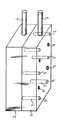
- These burners are of the type illustrated in the attached figure, that is to say that they have two chambers 1 and 2 for supplying combustible and oxidizing gases, themselves supplied by the pipes 3 and 4.
- Each of these chambers 1 and 2 opens to the outside of the burner through holes 5 and 6, the holes 5 delivering the gas from the upper chamber 2 being connected to this chamber 2 by pipes 7 which pass through the lower chamber 1 in leaktight fashion. good mix gases, holes 5 and 6 are staggered.
- deflectors not shown, or a bevelled shape of the chambers 1 and 2 can be provided to ensure equal distribution of the gases from one end to the other of the burner.
- Burners of this type are distributed by the French company "AIR LIQUIDE” under the name “FMT burners”.
- the oxide layer obtained on a heated substrate, by projection of an indium formate powder, associated or not with tin compounds capable of acting as dopants with respect to indium, such as oxide dibutyl tin (DBTO), and / or dibutyl tin difluoride (DBTF), is by manufacturing too oxidized to have good characteristics of low emissivity and low resistivity. It can be subjected to the "burning" treatment according to the invention, so as to improve its characteristics.
- the adjustment of the flow rates and the proportions of oxidizing and reducing gas depends on the nature of the gases, on the installation and on the operating conditions, and is a function of the emissivity and the resistivity desired for the layer.
- the respective proportions of oxidizing gas and reducing gas are adjusted so as to have a slightly more reducing mixture than the stoichiometric mixture, that is to say approximately 10% more reducing gas compared to the flow rate corresponding to the stoeohiometric mixture.
- the flame treatment of the layer is practiced on various samples by gradually increasing the overall flow rate of the mixture until the reduction of the layer in the metallic state.
- an indium formate powder was used, mixed with 4% by weight of DBTO, which was distributed on a ribbon of scrolling glass at 18 m / min, the surface temperature of which was 600 ° C.
- the glass substrate thus coated was subjected to a heat treatment consisting of annealing in an enclosure at 600 ° C for 2 min under atmosphere nitrogen then progressive cooling to 300 ° C, still under a non-oxidizing atmosphere, nitrogen for 2 min.
- Example II The same layer was subjected as that of Example II, then of Example III, before heat treatment, to the flame of a burner supplied with a mixture of oxygen and hydrogen as described above.
- a burner supplied with a mixture of oxygen and hydrogen as described above.
- this treatment by intense but short heating, for example in the flame of a burner, can be practiced immediately after the manufacture and coating of the green, for example on the float line itself , but it can just as easily be done later. This is what is inevitable when the glass must be tempered or laminated. In this case, the coated glass is cut, tempered or laminated, then heat treated.
- the running speed of the coated substrate to be treated is varied relative to the burner as a function of the desired result.
- a burner arranged transversely to the running direction of the substrate by modulating the running speed of said substrate, layers with transverse bands were obtained having differentiated properties.
- the second mode of heat treatment proposed authorizes as already said the manufacture of toughened or laminated glazing with thin layers.
- the second mode of heat treatment proposed is so brief that the substrate does not have time to be heated, in particular if the heating means is arranged on the side of the diaper. Consequently the dividers in P.V.B. (polyvinyl butyral) or others, laminated glazing, non-heat resistant substrates, the stresses obtained by tempering, are preserved without alteration.
- P.V.B. polyvinyl butyral
- This second mode of heat treatment is therefore particularly suitable for the manufacture of toughened glazings with thin layers, the level of toughening being high and authorizing in particular the use of such glazing as glazing for cars (that is to say with a fragmentation as defined in regulation 43 of the United Nations for the approval of automobile glazing) the level of emissivity and resistivity being also of good quality, that is to say an emissivity lower than 0.15 and a resistivity less than 3. 10 ⁇ 4 ohm.cm.
- laminated glazing comprising at least one glass sheet coated with a thin layer requiring heat treatment to acquire its final characteristics.
- This second mode of heat treatment has been described using one or more gas burners, remarkable for their simplicity, but other heating means capable of providing high energy in less than a second can also be used; thus, for example, a microwave plasma torch supplied with reducing gas or, on the contrary, oxidizing gas, depending on whether it is desired, as already said, either to reduce the oxide or to lower the emissivity and the resistivity of the layer, or, on the contrary, to oxidize. the metal or increase the emissivity and resistivity of the layer.
- the invention has been described by taking glazing, intended for example for buildings (low-emissivity glazing, heated glazing, and in general glazing using the optical and / or electrical properties of the layers), or for the automobile (heated glazing, glazing security using the conduction properties of the layer to detect a break-in, antenna glazing, etc.), but it can also find an interesting application in the coating of various substrates, insulators in particular, glass articles such as bottles, flasks, various glassware, optical elements, lighting lamps, fiberglass, or even silica articles, refractory materials, alumina.
- the material used to spray the powder or the mixture of powders onto separate objects is therefore generally different from the nozzles to which reference has been made above.
- conventional powder spray guns will be used.
- these powders based on indium formate can also be processed and used in a phase other than solid and pulverulent.
- the powder can be dissolved, in particular in methanol and the compound based on indium formate in solution, can be distributed on a substrate, be pyrolyzed therein and thus form a layer of metal oxide which may undergo a heat treatment capable of modifying the characteristics of the initial layer.
- Heat treatments performed after deposition of the layer have been described as being applied to a layer of indium oxide doped or not with tin obtained by pyrolysis of a powder based on indium formate; but they can also be applied successfully to any layer based on indium oxide, doped or not, with tin or other, obtained by another route, for example liquid pyrolysis, CVD, or vacuum technique, whether the starting compound is formate or the like.
- heat treatments can even be applied to any other metallic layer which, like the layer based on indium oxide, is non-stoichiometric, thus for example the layers based on vanadium oxide, Zn, Sn, etc.
- Heat treatments can also be used to recrystallize a poorly crystallized or amorphous layer, in particular to modify its electronic properties.
Landscapes
- Chemical & Material Sciences (AREA)
- Organic Chemistry (AREA)
- Engineering & Computer Science (AREA)
- Life Sciences & Earth Sciences (AREA)
- Chemical Kinetics & Catalysis (AREA)
- General Chemical & Material Sciences (AREA)
- Geochemistry & Mineralogy (AREA)
- Materials Engineering (AREA)
- Oil, Petroleum & Natural Gas (AREA)
- Surface Treatment Of Glass (AREA)
Description
- La présente invention concerne la fabrication de formiate d'indium en poudre.
- Le formiate d'indium en poudre est destiné à la formation, par pyrolyse, de couches minces à base d'oxyde d'indium sur un substrat, notamment en verre.
- Il est connu de former des couches minces d'oxydes métalliques sur un substrat, notamment en verre, par pyrolyse de poudres de composés métalliques projetés sur ledit substrat, ces couches minces, colorées ou non, ayant essentiellement des propriétés de basse émissivité, de conduction électrique et de transparence.
- Pour qu'un composé métallique pulvérulent puisse former un revêtement de bonne qualité sur un substrat, il faut qu'il puisse être distribué régulièrement, qu'il se décompose avec un rendement suffisant et ce, à une température ne dépassant pas 650°C ou 700°C si le substrat à revêtir est en verre et qu'il contienne une proportion de métal suffisante pour conduire à une couche d'oxyde métallique d'épaisseur notable en un court instant (en particulier si ce substrat se déplace rapidement par rapport aux moyens distributeurs de la poudre, comme c'est le cas pour un ruban de verre à la sortie d'un bain dit "float").
- On sait déjà réaliser sur des substrats en verre un revêtement d'oxyde d'étain que l'on forme en distribuant sur le substrat, de l'oxyde de dibutylétain en poudre (DBTO) (voir par exemple les publications françaises de brevets FR 2 380 997 et 2 391 966), ou du difluorure de dibutylétain en poudre (DBTF) (voir par exemple le brevet européen 0 039 256 et la publication française de brevet n° 2 542 636).
- Ces poudres conduisent certes à des couches satisfaisantes ; cependant, elles sont colorées en réflexion pour les épaisseurs nécessaires à l'obtention de propriétés électroniques intéressantes. Or, la couleur peut ne pas plaire ou ne pas être adaptée au style de la structure environnante. Par ailleurs, de légères variations d'épaisseur de couches entraînent des irrégularités de couleur.
- Pour obtenir une parfaite uniformité de la couleur, il faut respecter scrupuleusement certaines conditions, en particulier une qualité constante et bien déterminée de la poudre, et des réglages très précis des installations servant à la distribuer.
- La couleur elle-même et les conditions opératoires qu'il est nécessaire de respecter pour qu'elle soit parfaitement uniforme constituent des inconvénients de ces couches à base d'oxyde d'étain.
- On a aussi utilisé des composés d'indium, non pas en poudre, mais en solution, en particulier des acétylacétonates d'indium, pour fabriquer des couches minces sur du verre. Mais ces composés sous forme de liquide, ne se pyrolysent qu'a des vitesses insuffisantes. Ils ne conviennent donc pas pour être appliqués sur un ruban de verre défilant à vitesse élevée à la sortie d'un "bain float".
- Différents documents ont décrits la préparation du formiate d'indium.
- Le document "Zeitschrift für anorganische und allgemeine Chemie", 1974, 408 (2) - W. Lindel et F. Huber (pages 167 à 179) décrit la préparation de carboxylate d'indium, par exemple de formiate d'indium, par action d'acide carboxylique anhydre bouillant sur des copeaux d'indium.
- Gmelins Handbuch der anorganischen Chemie", Indium, édition 8, 1936, n° 37 pages 46, 48, 49, 107 et le document "Annalen der chemie und pharmacie" 150, 1869 pages 145-146 R.E. Meyer décrivent la préparation de cristaux de formiate d'indium très solubles, par vaporisation d'une solution d'hydroxyde d'indium dans l'acide formique. Dans le nouveau traité de chimie minérale de Pascal, tome VI, pages 886-889, il est cependant indiqué que de la poudre de formiate d'indium n'a pu être isolée selon la méthode décrit dans les documents précédents.
- La présente invention vise à fournir un composé métallique en poudre qui soit susceptible d'être distribuée sur un substrat à température élevée, tel qu'un ruban de verre défilant à la sortie d'un "bain float", en vue de constituer après pyrolyse, une couche de revêtement mince, transparente et électroconductrice. De plus, la pyrolyse de ce composé métallique doit pouvoir s'effectuer à rendement suffisamment élevé pour être compatible avec le défilement rapide du substrat. D'autre part, la couche obtenue à partir de ce composé doit présenter des performances électriques et optiques satisfaisantes pour des épaisseurs correspondant à une couleur neutre en vue d'éviter les inconvénients des couches colorées d'oxyde d'étain de l'art antérieur.
- On a trouvé, selon l'invention, un procédé de préparation de formiate d'indium en poudre, convenant pour la formation de telles couches.
- L'invention propose un procédé de fabrication du formiate d'indium qui consiste à attaquer l'indium par un acide, puis à précipiter l'hydroxyde d'indium en faisant réagir sur le sel d'indium ainsi obtenu, de l'ammoniaque à une température voisine de l'ébullition, à laver et sécher le précipité et à faire réagir ce dernier avec l'acide formique.
- Ainsi, en utilisant de l'acide chlorhydrique comme acide, le procédé de fabrication peut être résumé par les équations suivantes :

- Au lieu de l'acide chlorhydrique, on peut aussi bien utiliser l'acide nitrique ou un autre acide.
- Le formiate d'indium, comme indiqué précédemment, est utile pour former des couches minces à base d'oxyde d'indium par pyrolyse. Dans ce cas, le formiate d'indium peut être le seul composé métallique de la poudre, mais avantageusement il peut être associé à un ou plusieurs autres composés ayant des températures de décomposition du même ordre que celles du formiate d'indium.
- Pour obtenir des couches très conductrices, on peut associer au formiate d'indium des composés d'étain et en particulier DBTO et/ou DBTF qui interviennent alors dans des proportions pondérales pouvant aller jusqu'à 30 %. Ces composés effectuent un dopage cationique de l'oxyde d'indium. En effet, le remplacement d'un atome d'indium par un atome d'étain introduit dans la couche un électron libre. Par ce dopage, on augmente donc la densité des porteurs de charge et la conductivité de la couche.
- La poudre de formiate d'indium ou le mélange de poudres peut être projeté sur le substrat, notamment un ruban de verre à l'aide d'une buse, par exemple par l'une des buses décrites dans les demandes de brevets français publiées sous les n° 2 542 636 et 2 542 637 précédée du dispositif de répartition décrit dans la demande de brevet français publiée sous le n° 2 548 556.
- Le dopage peut également être effectué avec des composés gazeux, tels que SnCl₄ ou des organo-stanniques gazeux, tels que BuSnCl₃. Dans ce cas, le dopant est mélangé avec le gaz dans lequel la poudre est en suspension, et/ou avec les gaz qui servent à l'accélération et/ou à l'homogénéisation de la poudre. Le dopant peut encore être aspiré par la buse dans la chambre de contrôle décrite dans la demande de brevet français publiée sous le n° 2 542 636 et/ou encore être amené à la sortie de la buse de projection par une conduite spéciale.
- Avantageusement après dépôt et formation de la couche d'oxyde métallique sur le substrat, celle-ci subit un traitement thermique.
- Par ce traitement généralement on cherche à augmenter le nombre de lacunes d'oxygène de la couche de façon à abaisser l'émissivité de ladite couche, donc à améliorer ses propriétés de basse émissivité. Mais on peut aussi, au contraire diminuer le nombre de lacunes d'oxygène de la couche de façon à augmenter l'émissivité de ladite couche donc à amoindrir ses propriétés de basse émissivité qu'elle possédait préalablement.
- Suivant un premier mode de réalisation ce traitement thermique est constitué par un séjour du substrat revêtu dans une enceinte chauffée, sous atmosphère controlée, séjour qui est plus ou moins long, qui dépend de la température, du caractère réducteur de l'atmosphère, et qui peut s'échelonner de quelques secondes à plusieurs heures.
- L'amélioration des propriétés de basse émissivité demandera un traitement thermique en atmosphère réductrice ou éventuellement neutre.
- Dans le cas d'une atmosphère réductrice, celle-ci peut être constituée par une atmosphère de composition identique à celle du "bain float", à savoir 90% d'azote et 10% d'hydrogène.
- Par ce traitement en atmosphère réductrice ou neutre, on augmente la concentration en lacunes d'oxygène dans la couche, ce qui entraîne un dopage anionique favorable à l'augmentation de la conduction électrique et de la réflexion infrarouge de la couche. Selon la durée et la température du traitement, on peut faire varier considérablement la densité des porteurs de charges, par exemple de 1.1020 à 20.1020 porteurs par cm³ et leur mobilité, par exemple de 10 à 50cm.V⁻¹.s⁻¹.
- Ce traitement peut être pratiqué immédiatement après la formation de la couche d'oxyde, directement sur la ligne de fabrication du verre, par exemple dans une étenderie de recuisson, de manière à profiter de la chaleur du verre.
- Il peut être également pratiqué plus tard sur une installation séparée de la ligne de fabrication du verre (arche de recuisson annexe, ligne de trempe, de bombage).
- Dans ce cas, on réchauffe le substrat revêtu jusqu'à une température d'au moins 300°C compatible avec le substrat, on le maintient en atmosphère réductrice ou neutre à cette température élevée pendant un temps d'autant plus court que la température est plus élevée et que l'atmosphère est plus réductrice (ce temps de maintien pouvant s'échelonner de quelques secondes à plusieurs heures), puis on le refroidit sous atmosphère réductrice ou neutre au moins jusqu'à une température où le contact avec une atmosphère oxydante n'altère plus les performances de la couche.
- Avantageusement, le refroidissement contrôlé sous atmosphère réductrice ou neutre est pratiqué jusqu'à une température qui est au maximum de l'ordre de 300°C. Dans le cas de traitement simultané à la trempe, les buses de soufflage du gaz de trempe sont alimentées par le gaz réducteur ou neutre nécessaire au traitement.
- En résumé, l'efficacité du traitement de la couche augmente avec :
- . le caractère réducteur de l'atmosphère de traitement, par exemple avec le pourcentage d'hydrogène d'un mélange N₂ + X % H₂ où X, est positif ou nul, notamment X = 10 ou X = 0,
- . la température, celle-ci étant comprise entre 300 et 650°C,
- . le temps, qui peut varier de quelques secondes à quelques heures.
- Suivant un second mode de réalisation, ce traitement thermique est obtenu par un chauffage intense en atmosphère contrôlée, réductrice ou au contraire oxydante suivant la finalité recherchée, pendant un temps inférieur à la seconde. Matériellement cela est obtenu en soumettant le substrat revêtu de la couche à traiter à l'action d'au moins une flamme, réductrice ou au contraire oxydante suivant qu l'on désire, augmenter ou au contraire amoindrir les propriétés de basse émissivité de la couche ainsi traitée, réduire l'oxyde en métal ou au contraire oxyder le métal.
- Ce traitement est alors avantageusement réalisé par défilement du substrat revêtu dans la flamme d'au moins un brûleur alimenté en gaz dont les caractéristiques réductrices ou oxydantes sont contrôlées et adaptées à la nature réductrice ou oxydante souhaitée dudit traitement.
- Il s'agit donc d'un traitement immédiat (temps de traitement inférieur à la seconde), ne nécessitant qu'une installation réduite, simple, peu coûteuse et facile à conduire.
- L'échauffement du substrat à la flamme peut être faible (inférieure à 70°C) dans la mesure où la flamme est disposée par rapport audit substrat du côté du revêtement, si bien que le niveau de trempe d'un substrat en verre préalablement trempé est conservé, ou que des substrats sensibles à la chaleur, en matériau autre que le verre ou comportant en association avec le verre d'autres matériaux tels que le polyvinylbutytal (PVB), ne sont pas altérés.
- Le ou les brûleurs nécessaires au traitement de la couche sont alimentés en un mélange de gaz comburant (oxygène ou mélange de gaz neutre et d'oxygène) et de gaz combustible contenant de l'hydrogène et/ou du carbone (hydrogène, monoxyde de carbone, alcane, alcène ou alcyne gazeux).
- Les proportions de comburant et de combustibles sont telles que le mélange n'est pas shoechiométrique mais contient au contraire soit un excès de gaz réducteur, soit un excès de gaz oxydant, suivant que l'on désire effectuer un traitement réducteur ou un traitement oxydant.
- Les brûleurs utilisables sont, de préférence pour des raisons de sécurité et de facilité d'emploi, des brûleurs linéaires à mélange externe.
- Ces brûleurs sont du type illustré par la figure jointe, c'est-à-dire qu'ils possèdent deux chambres 1 et 2 d'amenée des gaz combustible et comburant, elles mêmes alimentées par les tuyauteries 3 et 4. Chacune de ces chambres 1 et 2 débouche à l'extérieur du brûleur par des trous 5 et 6, les trous 5 délivrant le gaz de la chambre supérieure 2 étant reliés à cette chambre 2 par des conduites 7 qui traversent de façon étanche la chambre inférieure 1. Pour un bon mélange des gaz, les trous 5 et 6 sont disposés en quinconce. Dans La mesure où de grandes longueurs de brûleurs sont nécessaires, des déflecteurs non figurés, ou une forme en biseau des chambres 1 et 2 peuvent être prévus pour assurer une égalité de distribution des gaz d'un bout à l'autre du brûleur.
- Des brûleurs de ce type sont distribués par la Société française "AIR LIQUIDE" sous la dénomination "brûleurs FMT".
- La couche d'oxyde obtenue sur un substrat chauffé, par projection d'une poudre de formiate d'indium, associée ou non à des composés d'étain aptes à agir comme dopants vis à vis de l'indium, tels que l'oxyde de dibutyl étain (DBTO), et/ou le difluorure de dibutyl étain (DBTF), est par fabrication trop oxydée pour posséder de bonnes caractéristiques de basse émissivité et de basse résistivité. On peut lui faire subir le traitement de "brûlage" selon l'invention, de façon à améliorer ses caractéristiques. Le réglage des débits et des proportions de gaz oxydant et réducteur dépend de la nature des gaz, de l'installation et des conditions opératoires, et est fonction de l'émissivité et de la résistivité désirées pour la couche.
- Il est possible de déterminer expérimentalement pour une installation donnée et pour des conditions opératoires données (vitesse de défilement du substrat, distance vis-à-vis des brûleurs) les réglages de débit de gaz de façon à établir les débits limites pour réduire totalement la couche à l'état métallique, l'apparition de cet état métallique se reconnaissant à ce que la couche change d'aspect, acquiert une certaine réflectivité dans le visible qui peut aller jusqu'à la réflectivité d'un miroir et peut dans certains cas, en particulier pour l'oxyde d'indium transformé, devenir peu adhérente au substrat.
- Pour cela on règle les proportions respectives de gaz oxydant et de gaz réducteur de façon à disposer d'un mélange légèrement plus réducteur que le mélange stoechiométrique, soit 10 % environ en plus de gaz réducteur par rapport au débit correspondant au mélange stoeohiométrique. Ensuite on pratique le traitement à la flamme de la couche sur divers échantillons en augmentant progressivement le débit global du mélange jusqu'à obtenir la réduction de la couche à l'état métallique. Ce réglage de débits limites étant obtenu, on sait que les réglages permettant d'atteindre les niveaux de basse émissivité et de basse résistivité désirés s'obtiendront en diminuant le débit de gaz réducteur par rapport au débit limite préalablement déterminé.
- Grâce à cette technique d'échauffement rapide en atmosphère contrôlée, on a pu obtenir les propriétés optimales de basse émissivité et de basse résistivité d'une couche à base d'oxyde d'indium, déposée par pyrolyse de poudre comme indiqué précédemment, en faisant défiler le substrat revêtu de sa couche, à 1 cm sous un brûleur linéaire à mélange externe, ayant comme longueur la largeur de la couche à traiter, à une vitesse de 3 cm/s, le débit d'oxygène étant de 1,9 1 par minute et par centimètre de longueur de brûleur, le débit d'hydrogène étant de 4 l/min.cm.
- En variant la vitesse de défilement d'un même substrat et en la portant à 5 cm/s, on a eu besoin d'un débit d'oxygène de 2,3 l/min.cm. et un débit d'hydrogène de 4,7 l/min.cm.
- En augmentant encore la vitesse de défilement de façon à ce qu'elle atteigne la vitesse de défilement du ruban de verre dans les installations "float" par exemple 20 cm/s, on a eu besoin pour obtenir les performances maximales de la couche, de l'ordre de 6 l/min.cm d'oxygène et 13 l/min.cm d'hydrogène.
- Avec l'un ou l'autre de ces traitements thermiques on a pu traiter des couches obtenues par pyrolyse d'une poudre de formiate d'indium et de 4% en poids de DBTO et obtenir les résultats énumérés dans les exemples qui suivent :
-

- Pour obtenir une telle couche on a utilisé une poudre à base de formiate d'indium mélangée avec 4% en poids de DBTO, qu'on a distribuée sur un ruban de verre défilant à 18m/min, dont la température de surface était de 600°C. Après pyrolyse de la poudre, on a soumis le substrat en verre ainsi revêtu à un traitement thermique consistant en une recuisson dans une enceinte à 600°C pendant 2 min sous atmosphère d'azote puis en un refroidissement progressif jusqu'à 300°C, toujours sous atmosphère non oxydante, d'azote pendant 2 min.
-

- Dans les mêmes conditions que pour les exemples I et II, sauf en ce qui concerne le débit de poudre distribué sur le substrat en verre, on a réalisé une couche rouge mauve en réflexion, légèrement verte en transmission, dont les caractéristiques avant et après traitement thermique en enceinte sous atmosphère non oxydante sont les suivants :

- On a soumis la même couche que celle de l'exemple II, puis de l'exemple III, avant traitement thermique, à la flamme d'un brûleur alimenté en un mélange d'oxygène et d'hydrogène comme décrit précédemment. Quelle que soit la vitesse de défilement sous la flamme du substrat revêtu, avec bien entendu des débits de gaz adaptés, on a obtenu après traitement, des couches ayant les mêmes caractéristiques que celles obtenues après traitement, respectivement dans les exemples II et III.
- De la même façon que le premier type de traitement thermique, ce traitement par échauffement intense mais court, par exemple dans la flamme d'un brûleur, peut être pratiqué immédiatement après la fabrication et le revêtement du verte, par exemple sur la ligne float même, mais il peut tout aussi bien être réalisé plus tard. C'est d'ailleurs ce qui est inévitable lorsque le verre doit être trempé ou feuilleté. Dans ce cas, le verre revêtu est découpé, trempé ou feuilleté, puis traité thermiquement.
- Ainsi donc, avec l'un ou l'autre des deux traitements thermiques proposés, on a pu obtenir des couches à base de formiate d'indium et d'un ajout de DBTO ou de DBTF, ayant des résistivités électriques de l'ordre de 2 à 10⁻⁴ cm. On a pu également en modulant l'intensité du traitement thermique, obtenir des performances des couches, intermédiaires entre les performances de la couche non traitée et des performances optimales mesurées sur une couche ayant subi le traitement le plus intense.
- Avec de tels traitements thermiques on peut aussi, au lieu d'abaisser la résistivité et l'émissivité d'une couche, au contraire l'augmenter. Ainsi, à partir d'un substrat revêtu ayant une résistance carré de 15 ohms, on a pu atteindre une résistance de 16 ohms, ou de 2000 ohms en faisant défiler le substrat à 1 cm sous le brûleur, respectivement à 10 cm/s et à 6 cm/s, le débit d'oxygène dans les deux cas étant de 2,4 l/min.cm et celui d'hydrogène étant de 3 l/min.cm. Un tel traitement conduisant à l'abaissement de la résistivité et de l'émissivité est bien entendu également possible avec le premier mode de traitement thermique, il suffit de prévoir une atmosphère contrôlée non plus réductrice, mais oxydante.
- On peut également avec l'un ou l'autre des deux modes de traitement thermique proposés, créer sur un même vitrage revêtu des zones de conductions électriques différentes par application de traitements thermiques différents. Ce genre de traitements thermiques différenciés suivant les zones d'un même vitrage est particulièrement aisé quand on met en oeuvre le second type de traitement thermique. Pour cela, on modifie localement ou momentanément les conditions d'exposition de la couche aux moyens de chauffage.
- Dans cet ordre d'idée, on fait varier la vitesse de défilement du substrat revêtu à traiter par rapport au brûleur en fonction du résultat désiré. Avec un brûleur disposé transversalement par rapport à la direction de défilement du substrat, en modulant la vitesse de défilement dudit substrat, on a obtenu des couches à bandes transversales ayant des propriétés différenciées.
- On a pu obtenir aussi des bandes longitudinales dans le sens de déplacement du substrat, à caractéristiques électriques et optiques différentes en ajoutant face à ces zones des brûleurs supplémentaires ou en effectuant le traitement sur toute la largeur du substrat à l'aide d'une pluralité de brûleurs réglés différemment les uns des autres.
- Ces traitements thermiques et en particulier celui par brûleurs sont donc particulièrement adaptés à la fabrication de vitrages à couches ayant des zones à propriétés électriques, thermiques, optiques, différenciées. Ainsi, par exemple, des vitrages chauffants à couches minces possédant des résistances plus ou moins importantes suivant les zones pourront être fabriqués.
- Le second mode de traitement thermique proposé, autorise comme déjà dit la fabrication de vitrages trempés ou feuilletés à couches minces.
- En effet, alors que le premier mode de traitement thermique proposé altère la trempe, empêche le traitement de feuilletés ou de substrats non résistants à la température, le second mode de traitement thermique proposé est si bref que le substrat n'a pas le temps d'être échauffé, en particulier si le moyen de chauffage est disposé du côté de la couche. En conséquence les intercalaires en P.V.B. (polyvinylbutyral) ou autres, des vitrages feuilletés, les substrats non résistants à la chaleur, les contraintes obtenues par la trempe, sont conservés sans altération.
- Ce second mode de traitement thermique est donc particulièrement adapté à la fabrication de vitrages trempés à couches minces, le niveau de trempe étant élevé et autorisant en particulier l'usage de tels vitrages en tant que vitrages pour automobiles (c'est-à-dire avec une fragmentation telle que définie dans le règlement 43 des Nations Unies pour l'homologation des vitrages automobiles) le niveau d'émissivité et de résistivité étant également de bonne qualité, c'est-à-dire une émissivité inférieure à 0,15 et une résistivité inférieure à 3. 10⁻⁴ ohm.cm.
- Il est donc également particulièrement adapté à la fabrication de vitrages feuilletés comportant au moins une feuille de verre revêtue d'une couche mince nécessitant un traitement thermique pour acquérir ses caractéristiques définitives.
- Ce second mode de traitement thermique a été décrit en utilisant un ou plus brûleurs à gaz, remarquables pour leur simplicité, mais d'autres moyens de chauffage aptes à fournir en moins d'une seconde une énergie élevée peuvent aussi être utilisés ; ainsi par exemple une torche à plasma micro-onde alimentée en gaz réducteur ou au contraire oxydant suivant que l'on désire, comme déjà dit, soit réduire l'oxyde ou abaisser l'émissivité et la résistivité de la couche, soit au contraire oxyder le métal ou augmenter l'émissivité et la résistivité de la couche.
- L'invention a été décrite en prenant des vitrages, destinés par exemple aux bâtiments (vitrages bas émissifs, vitrages chauffants, et en général vitrages utilisant les propriétés optiques et/ou électriques des couches), ou à l'automobile (vitrages chauffants, vitrages de sécurité utilisant les propriétés de conduction de la couche pour détecter une effraction, vitrages antenne...), mais elle peut aussi trouver une application intéressante dans le revêtements de substrats divers, isolants en particulier, articles en verre tels que bouteilles, flacons, verreries diverses, éléments d'optique, lampes d'éclairage, fibre de verre, ou encore articles en silice, matériaux réfractaires, alumine.
- Le matériel utilisé pour projeter la poudre ou le mélange de poudres sur des objets séparés est alors généralement différent des buses auxquelles on s'est référé ci-dessus. On utilisera par exemple des pistolets classiques de pulvérisation de poudres.
- La description ci-dessus a exclusivement concerné des composés en poudre, à base de formiate d'indium et leur emploi sous forme de poudre.
- Cependant, ces poudres à base de formiate d'indium peuvent également être transformées et être employées en phase autre que solide et pulvérulente.
- En particulier, la poudre peut être mise en solution, notamment dans du méthanol et le composé à base de formiate d'indium en solution, peut être distribué sur un substrat, y être pyrolysé et former ainsi une couche d'oxyde métallique qui pourra subir un traitement thermique apte à modifier les caractéristiques de la couche initiale.
- Les traitements thermiques pratiqués postérieurement au dépôt de la couche ont été décrits comme étant appliqués à une couche d'oxyde d'indium dopée ou non à l'étain obtenue par pyrolyse d'une poudre à base de formiate d'indium ; mais ils peuvent également s'appliquer avec succès à toute couche à base d'oxyde d'indium, dopée ou non, à l'étain ou autre, obtenue par une autre voie, par exemple pyrolyse liquide, CVD, ou technique sous vide, que le composé de départ soit du formiate ou autre.
- Ces traitements thermiques peuvent même s'appliquer à toute autre couche métallique qui comme la couche à base d'oxyde d'indium est non stoechiométrique, ainsi par exemple les couches à base d'oxyde de vanadium, de Zn, de Sn...
- Ces traitements thermiques peuvent même permettre d'obtenir, à partir de couches d'oxyde métallique, des couches de métal. L'obtention d'une couche de métal à partir d'une couche d'oxyde a été décrite comme une phase du réglage des brûleurs servant aux traitements thermiques, mais l'obtention d'une telle couche de métal peut être le but final.
- Les traitements thermiques peuvent également être mis en oeuvre pour recristalliser une couche mal cristallisée ou amorphe, en particulier pour modifier ses propriétés électroniques.
Claims (2)
- Procédé de préparation de formiate d'indium en poudre, caractérisé en ce qu'il consiste à attaquer l'indium par un acide, puis à précipiter l'hydroxyde d'indium en faisant réagir sur le sel d'indium ainsi obtenu, de l'ammoniaque à une température voisine de l'ébullition, à laver, à sécher le précipité et à faire réagir ce dernier avec l'acide formique.
- Procédé conforme à la revendication 1, caractérisé en ce qu'on utilise de l'acide chlorhydrique ou de l'acide nitrique.
Priority Applications (2)
| Application Number | Priority Date | Filing Date | Title |
|---|---|---|---|
| AT90201811T ATE88449T1 (de) | 1985-01-22 | 1985-12-23 | Verfahren zur herstellung einer duennen metalloxidbeschichtung auf einem substrat, insbesondere glas und deren verwendung als verglasung. |
| AT85402606T ATE66907T1 (de) | 1985-01-22 | 1985-12-23 | Verfahren zur herstellung eines pulvers auf basis von indium-formiat zur herstellung einer duennen beschichtung auf einem substrat, insbesondere auf glas. |
Applications Claiming Priority (4)
| Application Number | Priority Date | Filing Date | Title |
|---|---|---|---|
| FR8500854 | 1985-01-22 | ||
| FR8500854A FR2576324B1 (fr) | 1985-01-22 | 1985-01-22 | Poudre a base de formiate d'indium pour la formation d'une couche mince sur un substrat, notamment en verre, son procede de preparation et procede de formation d'une couche a partir d'une telle poudre |
| FR8510145 | 1985-07-03 | ||
| FR8510145A FR2584392B1 (fr) | 1985-07-03 | 1985-07-03 | Traitement de couches minces d'oxyde metallique ou de metal en vue de modifier leurs caracteristiques |
Related Child Applications (1)
| Application Number | Title | Priority Date | Filing Date |
|---|---|---|---|
| EP90201811.8 Division-Into | 1990-07-06 |
Publications (3)
| Publication Number | Publication Date |
|---|---|
| EP0192009A2 EP0192009A2 (fr) | 1986-08-27 |
| EP0192009A3 EP0192009A3 (en) | 1986-11-26 |
| EP0192009B1 true EP0192009B1 (fr) | 1991-09-04 |
Family
ID=26224341
Family Applications (2)
| Application Number | Title | Priority Date | Filing Date |
|---|---|---|---|
| EP90201811A Expired - Lifetime EP0397292B1 (fr) | 1985-01-22 | 1985-12-23 | Procédé pour la formation d'une couche mince d'oxydes métalliques sur un substrat, notamment en verre, et son utilisation comme vitrage |
| EP85402606A Expired - Lifetime EP0192009B1 (fr) | 1985-01-22 | 1985-12-23 | Procédé de prèparation d'un poudre à base de formiate d'indium pour la formation d'une couche mince sur un substrat, notamment en verre. |
Family Applications Before (1)
| Application Number | Title | Priority Date | Filing Date |
|---|---|---|---|
| EP90201811A Expired - Lifetime EP0397292B1 (fr) | 1985-01-22 | 1985-12-23 | Procédé pour la formation d'une couche mince d'oxydes métalliques sur un substrat, notamment en verre, et son utilisation comme vitrage |
Country Status (4)
| Country | Link |
|---|---|
| US (1) | US4859499A (fr) |
| EP (2) | EP0397292B1 (fr) |
| DE (2) | DE3584012D1 (fr) |
| ES (1) | ES8702315A1 (fr) |
Cited By (1)
| Publication number | Priority date | Publication date | Assignee | Title |
|---|---|---|---|---|
| US7867606B2 (en) | 2007-03-20 | 2011-01-11 | Evonik Degussa Gmbh | Transparent, electrically conductive layer, a process for producing the layer and its use |
Families Citing this family (44)
| Publication number | Priority date | Publication date | Assignee | Title |
|---|---|---|---|---|
| JPS63184210A (ja) * | 1987-01-27 | 1988-07-29 | 日本板硝子株式会社 | 透明導電体の製造方法 |
| WO1988006331A1 (fr) * | 1987-02-10 | 1988-08-25 | Catalysts & Chemicals Industries Co., Ltd. | Fluide d'enduction servant a former un enduit electroconducteur |
| WO1989003114A1 (fr) * | 1987-09-30 | 1989-04-06 | Catalysts & Chemicals Industries Co., Ltd. | Base revetue de ceramique conductive transparente, procede de production et son utilisation |
| DE3744368C1 (de) * | 1987-12-29 | 1989-08-03 | Schott Glaswerke | Verfahren zur Herstellung von festen optischen Einfach- und Mehrfach-Interferenz-Schichten |
| FR2625754B1 (fr) * | 1988-01-08 | 1992-01-10 | Saint Gobain Vitrage | Synthese de sels metalliques d'acides faibles et en particulier du formiate d'indium |
| FR2631330A1 (fr) * | 1988-05-10 | 1989-11-17 | Saint Gobain Vitrage | Verre a couche conductrice transparente pour photopile en couche mince et son procede d'obtention |
| US5149351A (en) * | 1988-05-24 | 1992-09-22 | Asahi Glass Company Ltd. | Method for making a curved solar panel for an automobile |
| US5324374A (en) * | 1988-07-27 | 1994-06-28 | Saint Gobain Vitrage | Laminated glass with an electroconductive layer |
| FR2634753B1 (fr) * | 1988-07-27 | 1992-08-21 | Saint Gobain Vitrage | Vitrage a couche electro-conductrice obtenue par pyrolyse de composes en poudre, utilisable en tant que pare-brise pour automobile |
| WO1990002157A1 (fr) * | 1988-08-24 | 1990-03-08 | Catalysts & Chemicals Industries Co., Ltd. | Fluide de revetement formant un revetement ceramique conducteur transparent, materiau de base revetu de ceramique conductrice transparente, production dudit materiau et applications de ce materiau de base revetu de ceramique conductrice transparente |
| US6017628A (en) * | 1989-12-11 | 2000-01-25 | Alliant Defense Electronics Systems, Inc. | Metal-coated substrate articles responsive to electromagnetic radiation, and method of making and using the same |
| US5034274A (en) * | 1989-12-11 | 1991-07-23 | Advanced Technology Materials, Inc. | Salt-doped chaff fiber having an evanescent electromagnetic detection signature, and method of making the same |
| US5686178A (en) * | 1989-12-11 | 1997-11-11 | Advanced Technology Materials, Inc. | Metal-coated substrate articles responsive to electromagnetic radiation, and method of making the same |
| US5147688A (en) * | 1990-04-24 | 1992-09-15 | Cvd, Inc. | MOCVD of indium oxide and indium/tin oxide films on substrates |
| FR2670199B1 (fr) * | 1990-12-06 | 1993-01-29 | Saint Gobain Vitrage Int | Procede de formation d'une couche a base d'oxyde d'aluminium sur du verre, produit obtenu et son utilisation dans des vitrages a couche conductrice. |
| FR2675139B1 (fr) * | 1991-04-09 | 1993-11-26 | Saint Gobain Vitrage Internal | Depot de couches pyrolysees a performances ameliorees et vitrage revetu d'une telle couche. |
| FR2683219A1 (fr) * | 1991-10-30 | 1993-05-07 | Saint Gobain Vitrage Int | Substrat en verre muni d'une couche mince conductrice. |
| AU655119B2 (en) * | 1992-07-11 | 1994-12-01 | Pilkington Glass Limited | Coatings on glass |
| FR2695117B1 (fr) * | 1992-08-28 | 1994-12-02 | Saint Gobain Vitrage Int | Procédé de traitement de couches minces à propriétés de conduction électrique et/ou de réflexion dans l'infra-rouge. |
| FR2706462B1 (fr) * | 1993-06-17 | 1995-09-22 | Saint Gobain Vitrage Int | Composés pulvérulents organo-métalliques destinés à former une couche d'oxyde d'étain sur un substrat, procédé de mise en Óoeuvre et substrat ainsi revêtu. |
| US5643369A (en) * | 1993-06-24 | 1997-07-01 | Fuji Xerox Co., Ltd. | Photoelectric conversion element having an infrared transmissive indium-tin oxide film |
| GB9400319D0 (en) * | 1994-01-10 | 1994-03-09 | Pilkington Glass Ltd | Coatings on glass |
| GB9400320D0 (en) * | 1994-01-10 | 1994-03-09 | Pilkington Glass Ltd | Coating on glass |
| GB9400323D0 (en) * | 1994-01-10 | 1994-03-09 | Pilkington Glass Ltd | Coatings on glass |
| FR2736632B1 (fr) | 1995-07-12 | 1997-10-24 | Saint Gobain Vitrage | Vitrage muni d'une couche conductrice et/ou bas-emissive |
| US5756192A (en) * | 1996-01-16 | 1998-05-26 | Ford Motor Company | Multilayer coating for defrosting glass |
| US5773086A (en) * | 1996-08-13 | 1998-06-30 | Libbey-Owens-Ford Co. | Method of coating flat glass with indium oxide |
| GB9702777D0 (en) * | 1997-02-11 | 1997-04-02 | Pilkington Plc | Improvements relating to glass and glazing |
| WO2000015572A2 (fr) | 1998-09-17 | 2000-03-23 | Libbey-Owens-Ford Co. | Article en verre a resistance accrue par traitement thermique et procede de fabrication dudit article |
| GB9825402D0 (en) | 1998-11-19 | 1999-01-13 | Pfizer Ltd | Antiparasitic formulations |
| FR2835205B1 (fr) * | 2002-01-25 | 2007-02-16 | Saint Gobain | Traitement de pollution organique sur un substrat inorganique |
| RU2218244C1 (ru) * | 2002-04-05 | 2003-12-10 | Акционерное общество открытого типа "Челябинский электролитный цинковый завод" | Способ получения индиевого порошка высокой чистоты |
| GB0411883D0 (en) * | 2004-05-28 | 2004-06-30 | Ici Plc | Mixed metal oxides |
| DE102004034667A1 (de) * | 2004-07-18 | 2006-02-09 | Heraeus Quarzglas Gmbh & Co. Kg | Synthetische Diamantpartikel und Verfahren zur Herstellung von synthetischen Diamantpartikeln |
| US7811572B2 (en) | 2005-08-24 | 2010-10-12 | Immunogen, Inc. | Process for preparing purified drug conjugates |
| US20110166319A1 (en) * | 2005-02-11 | 2011-07-07 | Immunogen, Inc. | Process for preparing purified drug conjugates |
| US7744955B2 (en) * | 2005-08-02 | 2010-06-29 | Guardian Industries Corp. | Method of thermally tempering coated article with transparent conductive oxide (TCO) coating using flame(s) in tempering furnace adjacent TCO to burn off oxygen and product made using same |
| DE202008005553U1 (de) | 2008-04-22 | 2008-08-14 | Evonik Degussa Gmbh | Hochleitfähige, transparente Metalloxid-Schichten durch Plasmaimmersion |
| JP5784592B2 (ja) | 2009-06-03 | 2015-09-24 | イミュノジェン・インコーポレーテッド | 抱合方法 |
| DK2278851T3 (da) | 2009-07-24 | 2013-08-26 | Therm Ic Products Gmbh Nfg & Co Kg | Elektrisk opvarmbart vinduesglas, fremgangsmåde til fremstilling deraf og vindue |
| EA033468B1 (ru) | 2011-03-29 | 2019-10-31 | Immunogen Inc | Способы получения конъюгата "антитело-майтансиноид" |
| US20130334089A1 (en) * | 2012-06-15 | 2013-12-19 | Michael P. Remington, Jr. | Glass Container Insulative Coating |
| EP2904089A4 (fr) | 2012-10-04 | 2016-05-25 | Immunogen Inc | Utilisation d'une membrane de pvdf pour purifier des conjugués d'agent de liaison cellulaire-agent cytotoxique |
| WO2016062768A2 (fr) * | 2014-10-21 | 2016-04-28 | Dsm Ip Assets B.V. | Procédé de revêtement d'un substrat |
Family Cites Families (16)
| Publication number | Priority date | Publication date | Assignee | Title |
|---|---|---|---|---|
| US3676729A (en) * | 1969-06-23 | 1972-07-11 | Sylvania Electric Prod | Arc discharge lamp having a thin continuous film of indium oxide on the inner surface thereof |
| US3666534A (en) * | 1970-04-13 | 1972-05-30 | Philips Corp | Method of manufacturing glass articles having a heat-reflecting film |
| SU454198A1 (ru) * | 1973-01-23 | 1974-12-25 | Предприятие П/Я В-8130 | Способ получени основных формиата или ацетата инди |
| US3949259A (en) * | 1973-08-17 | 1976-04-06 | U.S. Philips Corporation | Light-transmitting, thermal-radiation reflecting filter |
| DE2441862B2 (de) * | 1974-08-31 | 1979-06-28 | Philips Patentverwaltung Gmbh, 2000 Hamburg | Verfahren zur Herstellung einer transparenten, wärmereflektierenden Schicht aus dotiertem Indiumoxid auf Flachglas |
| FR2380997A1 (fr) * | 1977-02-16 | 1978-09-15 | Saint Gobain | Procede de fabrication de vitrages protegeant de la chaleur |
| JPS54150417A (en) * | 1978-05-19 | 1979-11-26 | Hitachi Ltd | Production of transparent conductive layer |
| US4263335A (en) * | 1978-07-26 | 1981-04-21 | Ppg Industries, Inc. | Airless spray method for depositing electroconductive tin oxide coatings |
| JPS5854089B2 (ja) * | 1979-06-22 | 1983-12-02 | 株式会社日立製作所 | 透明導電膜の形成方法 |
| US4344986A (en) * | 1980-08-08 | 1982-08-17 | Ppg Industries, Inc. | Method of delivering powder coating reactants |
| US4325988A (en) * | 1980-08-08 | 1982-04-20 | Ppg Industries, Inc. | Deposition of coatings from fine powder reactants |
| US4374156A (en) * | 1981-11-30 | 1983-02-15 | Ford Motor Company | Method for obtaining a coating of a preferred composition on a surface of a glass substrate |
| US4490227A (en) * | 1982-11-03 | 1984-12-25 | Donnelly Mirrors, Inc. | Process for making a curved, conductively coated glass member and the product thereof |
| FR2542637B1 (fr) * | 1983-03-14 | 1985-07-12 | Saint Gobain Vitrage | Distribution reguliere d'un solide pulverulent sur un support en vue de son revetement |
| FR2542636B1 (fr) * | 1983-03-14 | 1985-07-12 | Saint Gobain Vitrage | Procede et dispositif de distribution reguliere d'un solide pulverulent sur un substrat en vue de son revetement et substrat ainsi revetu |
| US4547400A (en) * | 1985-02-25 | 1985-10-15 | Ford Motor Company | Method of making infrared reflective glass sheet-I |
-
1985
- 1985-12-23 EP EP90201811A patent/EP0397292B1/fr not_active Expired - Lifetime
- 1985-12-23 DE DE8585402606T patent/DE3584012D1/de not_active Expired - Fee Related
- 1985-12-23 EP EP85402606A patent/EP0192009B1/fr not_active Expired - Lifetime
- 1985-12-23 DE DE90201811T patent/DE3587294T2/de not_active Expired - Fee Related
-
1986
- 1986-01-17 ES ES551004A patent/ES8702315A1/es not_active Expired
- 1986-01-22 US US06/821,365 patent/US4859499A/en not_active Expired - Fee Related
Non-Patent Citations (4)
| Title |
|---|
| CHEMICAL ABSTRACTS, vol. 81, no. 24, 16 décembre 1974, page 645, réf. No. 16278h; Columbus, Ohio, US. W. Lindel et al.: "Preparation and some properties of indium (III) carboxylates." & Z. ANORG. ALLG. CHEM. 1974, 408 (2), 167-74 * |
| P. Pascal, Nouveau Traité de Chimie Minérale, Tome VI, Masson et Cie., Editeurs, Paris, (1961), p. 886-89 * |
| R. E. Mayer, Ann. Chem. Pharm. 150, 145-6, (1869) * |
| W. Lindel, F. Huber, zeitschrift für anorg. u. allg. Chemie, 408 (2), 167-179 (1974) * |
Cited By (2)
| Publication number | Priority date | Publication date | Assignee | Title |
|---|---|---|---|---|
| US7867606B2 (en) | 2007-03-20 | 2011-01-11 | Evonik Degussa Gmbh | Transparent, electrically conductive layer, a process for producing the layer and its use |
| US8137794B2 (en) | 2007-03-20 | 2012-03-20 | Evonik Degussa Gmbh | Transparent electrically conductive layer, a process for producing the layer and its use |
Also Published As
| Publication number | Publication date |
|---|---|
| EP0397292A3 (en) | 1990-12-27 |
| US4859499A (en) | 1989-08-22 |
| DE3587294D1 (de) | 1993-05-27 |
| ES8702315A1 (es) | 1986-12-16 |
| DE3587294T2 (de) | 1993-09-30 |
| DE3584012D1 (de) | 1991-10-10 |
| ES551004A0 (es) | 1986-12-16 |
| EP0192009A2 (fr) | 1986-08-27 |
| EP0192009A3 (en) | 1986-11-26 |
| EP0397292B1 (fr) | 1993-04-21 |
| EP0397292A2 (fr) | 1990-11-14 |
Similar Documents
| Publication | Publication Date | Title |
|---|---|---|
| EP0397292B1 (fr) | Procédé pour la formation d'une couche mince d'oxydes métalliques sur un substrat, notamment en verre, et son utilisation comme vitrage | |
| CA2061026C (fr) | Couche protectrice sur un substrat conducteur | |
| EP2438024B1 (fr) | Procede de depot de couche mince | |
| US5322540A (en) | Method of depositing pyrolyzed films having improved performance and glazing pane coated with the same | |
| EP0781257B1 (fr) | Vitrage muni d'une couche conductrice et/ou bas-emissive | |
| EP2118031A2 (fr) | Procede de depot de couche mince et produit obtenu | |
| FR2704545A1 (fr) | Vitrage muni d'une couche fonctionnelle conductrice et/ou basse-émissive. | |
| JPH11509895A (ja) | 板ガラスにスズ酸化物被膜を形成する方法 | |
| EP0638527A1 (fr) | Procédé de dépôt d'une couche à base de nitrure métallique sur un substrat transparent | |
| EP0585166A1 (fr) | Procédé de traitement de couches minces à propriétés de conduction électrique et/ou de réflexion dans l'infra-rouge | |
| EP2406196A1 (fr) | Procédé de dépôt de couche mince | |
| FR2670199A1 (fr) | Procede de formation d'une couche a base d'oxyde d'aluminium sur du verre, produit obtenu et son utilisation dans des vitrages a couche conductrice. | |
| EP0965571B1 (fr) | Procédé de dépôt d'une couche à base d'oxyde métallique sur un substrat verrier, substrat verrier ainsi revétu | |
| EP2755927A1 (fr) | Materiau photocatalytique et vitrage ou cellule photovoltaique comprenant ce materiau | |
| BE1010321A5 (fr) | Vitrage de protection solaire et procede de fabrication d'un tel vitrage. | |
| US5851642A (en) | Product produced by coating a substrate with an electrically conductive layer | |
| EP0457651B1 (fr) | Produit à substrat en verre portant une couche conductrice transparente contenant du zinc et de l'indium et procédé pour l'obtenir | |
| CA1286315C (fr) | Poudre a base de formiate d'indium pour la formation d'une couche mince sur un substrat, notamment en verre, son procede de preparation et procede de formation d'une couche a partir d'une telle poudre | |
| FR2670200A1 (fr) | Procede de formation d'une couche semi-conductrice d'oxyde de zinc dope a l'aluminium sur du verre, vitrage ainsi obtenu. | |
| FR2584392A1 (fr) | Traitement de couches minces d'oxyde metallique ou de metal en vue de modifier leurs caracteristiques | |
| EP0023471A1 (fr) | Procédé pour déposer sur un substrat de verre un revêtement adhérent d'oxyde d'étain | |
| Seki et al. | Indium–Tin–Oxide Thin Films Prepared by Dip Coating; Dependence of Resistivity on Film Thickness and Annealing Atmosphere | |
| FR2683219A1 (fr) | Substrat en verre muni d'une couche mince conductrice. | |
| FR2664259A1 (fr) | Procede pour former une couche d'oxydes d'aluminium et de titane sur du verre, produit obtenu et son utilisation comme verre de couleur neutre en reflexion. |
Legal Events
| Date | Code | Title | Description |
|---|---|---|---|
| PUAI | Public reference made under article 153(3) epc to a published international application that has entered the european phase |
Free format text: ORIGINAL CODE: 0009012 |
|
| AK | Designated contracting states |
Kind code of ref document: A2 Designated state(s): AT BE CH DE FR GB IT LI LU NL SE |
|
| PUAL | Search report despatched |
Free format text: ORIGINAL CODE: 0009013 |
|
| AK | Designated contracting states |
Kind code of ref document: A3 Designated state(s): AT BE CH DE FR GB IT LI LU NL SE |
|
| 17P | Request for examination filed |
Effective date: 19870309 |
|
| 17Q | First examination report despatched |
Effective date: 19880817 |
|
| RAP1 | Party data changed (applicant data changed or rights of an application transferred) |
Owner name: SAINT-GOBAIN VITRAGE INTERNATIONAL |
|
| GRAA | (expected) grant |
Free format text: ORIGINAL CODE: 0009210 |
|
| AK | Designated contracting states |
Kind code of ref document: B1 Designated state(s): AT BE CH DE FR GB IT LI LU NL SE |
|
| REF | Corresponds to: |
Ref document number: 66907 Country of ref document: AT Date of ref document: 19910915 Kind code of ref document: T |
|
| XX | Miscellaneous (additional remarks) |
Free format text: TEILANMELDUNG 90201811.8 EINGEREICHT AM 23/12/85. |
|
| REF | Corresponds to: |
Ref document number: 3584012 Country of ref document: DE Date of ref document: 19911010 |
|
| ITF | It: translation for a ep patent filed | ||
| GBT | Gb: translation of ep patent filed (gb section 77(6)(a)/1977) | ||
| PLBE | No opposition filed within time limit |
Free format text: ORIGINAL CODE: 0009261 |
|
| STAA | Information on the status of an ep patent application or granted ep patent |
Free format text: STATUS: NO OPPOSITION FILED WITHIN TIME LIMIT |
|
| 26N | No opposition filed | ||
| EPTA | Lu: last paid annual fee | ||
| PGFP | Annual fee paid to national office [announced via postgrant information from national office to epo] |
Ref country code: AT Payment date: 19941212 Year of fee payment: 10 |
|
| EAL | Se: european patent in force in sweden |
Ref document number: 85402606.9 |
|
| PG25 | Lapsed in a contracting state [announced via postgrant information from national office to epo] |
Ref country code: AT Effective date: 19951223 |
|
| PGFP | Annual fee paid to national office [announced via postgrant information from national office to epo] |
Ref country code: SE Payment date: 19981116 Year of fee payment: 14 |
|
| PGFP | Annual fee paid to national office [announced via postgrant information from national office to epo] |
Ref country code: GB Payment date: 19981119 Year of fee payment: 14 |
|
| PGFP | Annual fee paid to national office [announced via postgrant information from national office to epo] |
Ref country code: FR Payment date: 19981203 Year of fee payment: 14 |
|
| PGFP | Annual fee paid to national office [announced via postgrant information from national office to epo] |
Ref country code: LU Payment date: 19981209 Year of fee payment: 14 |
|
| PGFP | Annual fee paid to national office [announced via postgrant information from national office to epo] |
Ref country code: NL Payment date: 19981231 Year of fee payment: 14 |
|
| PGFP | Annual fee paid to national office [announced via postgrant information from national office to epo] |
Ref country code: BE Payment date: 19990112 Year of fee payment: 14 |
|
| PGFP | Annual fee paid to national office [announced via postgrant information from national office to epo] |
Ref country code: DE Payment date: 19990123 Year of fee payment: 14 |
|
| PGFP | Annual fee paid to national office [announced via postgrant information from national office to epo] |
Ref country code: CH Payment date: 19990323 Year of fee payment: 14 |
|
| PG25 | Lapsed in a contracting state [announced via postgrant information from national office to epo] |
Ref country code: LU Free format text: LAPSE BECAUSE OF NON-PAYMENT OF DUE FEES Effective date: 19991223 Ref country code: GB Free format text: LAPSE BECAUSE OF NON-PAYMENT OF DUE FEES Effective date: 19991223 |
|
| PG25 | Lapsed in a contracting state [announced via postgrant information from national office to epo] |
Ref country code: SE Free format text: LAPSE BECAUSE OF NON-PAYMENT OF DUE FEES Effective date: 19991224 |
|
| PG25 | Lapsed in a contracting state [announced via postgrant information from national office to epo] |
Ref country code: LI Free format text: LAPSE BECAUSE OF NON-PAYMENT OF DUE FEES Effective date: 19991231 Ref country code: CH Free format text: LAPSE BECAUSE OF NON-PAYMENT OF DUE FEES Effective date: 19991231 Ref country code: BE Free format text: LAPSE BECAUSE OF NON-PAYMENT OF DUE FEES Effective date: 19991231 |
|
| BERE | Be: lapsed |
Owner name: SAINT-GOBAIN VITRAGE INTERNATIONAL Effective date: 19991231 |
|
| PG25 | Lapsed in a contracting state [announced via postgrant information from national office to epo] |
Ref country code: NL Free format text: LAPSE BECAUSE OF NON-PAYMENT OF DUE FEES Effective date: 20000701 |
|
| EUG | Se: european patent has lapsed |
Ref document number: 85402606.9 |
|
| GBPC | Gb: european patent ceased through non-payment of renewal fee |
Effective date: 19991223 |
|
| PG25 | Lapsed in a contracting state [announced via postgrant information from national office to epo] |
Ref country code: FR Free format text: LAPSE BECAUSE OF NON-PAYMENT OF DUE FEES Effective date: 20000831 |
|
| NLV4 | Nl: lapsed or anulled due to non-payment of the annual fee |
Effective date: 20000701 |
|
| PG25 | Lapsed in a contracting state [announced via postgrant information from national office to epo] |
Ref country code: DE Free format text: LAPSE BECAUSE OF NON-PAYMENT OF DUE FEES Effective date: 20001003 |
|
| REG | Reference to a national code |
Ref country code: FR Ref legal event code: ST |