EP0192105A1 - Méthode pour former à chaud au moins une feuille de métal d'une matière difficilement déformable - Google Patents
Méthode pour former à chaud au moins une feuille de métal d'une matière difficilement déformable Download PDFInfo
- Publication number
- EP0192105A1 EP0192105A1 EP86101314A EP86101314A EP0192105A1 EP 0192105 A1 EP0192105 A1 EP 0192105A1 EP 86101314 A EP86101314 A EP 86101314A EP 86101314 A EP86101314 A EP 86101314A EP 0192105 A1 EP0192105 A1 EP 0192105A1
- Authority
- EP
- European Patent Office
- Prior art keywords
- die
- forming
- isostatic pressing
- container
- hot
- Prior art date
- Legal status (The legal status is an assumption and is not a legal conclusion. Google has not performed a legal analysis and makes no representation as to the accuracy of the status listed.)
- Granted
Links
Images



Classifications
-
- B—PERFORMING OPERATIONS; TRANSPORTING
- B21—MECHANICAL METAL-WORKING WITHOUT ESSENTIALLY REMOVING MATERIAL; PUNCHING METAL
- B21D—WORKING OR PROCESSING OF SHEET METAL OR METAL TUBES, RODS OR PROFILES WITHOUT ESSENTIALLY REMOVING MATERIAL; PUNCHING METAL
- B21D26/00—Shaping without cutting otherwise than using rigid devices or tools or yieldable or resilient pads, i.e. applying fluid pressure or magnetic forces
- B21D26/02—Shaping without cutting otherwise than using rigid devices or tools or yieldable or resilient pads, i.e. applying fluid pressure or magnetic forces by applying fluid pressure
- B21D26/053—Shaping without cutting otherwise than using rigid devices or tools or yieldable or resilient pads, i.e. applying fluid pressure or magnetic forces by applying fluid pressure characterised by the material of the blanks
- B21D26/055—Blanks having super-plastic properties
-
- B—PERFORMING OPERATIONS; TRANSPORTING
- B23—MACHINE TOOLS; METAL-WORKING NOT OTHERWISE PROVIDED FOR
- B23K—SOLDERING OR UNSOLDERING; WELDING; CLADDING OR PLATING BY SOLDERING OR WELDING; CUTTING BY APPLYING HEAT LOCALLY, e.g. FLAME CUTTING; WORKING BY LASER BEAM
- B23K20/00—Non-electric welding by applying impact or other pressure, with or without the application of heat, e.g. cladding or plating
- B23K20/02—Non-electric welding by applying impact or other pressure, with or without the application of heat, e.g. cladding or plating by means of a press ; Diffusion bonding
- B23K20/021—Isostatic pressure welding
-
- C—CHEMISTRY; METALLURGY
- C04—CEMENTS; CONCRETE; ARTIFICIAL STONE; CERAMICS; REFRACTORIES
- C04B—LIME, MAGNESIA; SLAG; CEMENTS; COMPOSITIONS THEREOF, e.g. MORTARS, CONCRETE OR LIKE BUILDING MATERIALS; ARTIFICIAL STONE; CERAMICS; REFRACTORIES; TREATMENT OF NATURAL STONE
- C04B35/00—Shaped ceramic products characterised by their composition; Ceramics compositions; Processing powders of inorganic compounds preparatory to the manufacturing of ceramic products
- C04B35/622—Forming processes; Processing powders of inorganic compounds preparatory to the manufacturing of ceramic products
- C04B35/64—Burning or sintering processes
- C04B35/645—Pressure sintering
- C04B35/6455—Hot isostatic pressing
-
- C—CHEMISTRY; METALLURGY
- C22—METALLURGY; FERROUS OR NON-FERROUS ALLOYS; TREATMENT OF ALLOYS OR NON-FERROUS METALS
- C22C—ALLOYS
- C22C1/00—Making non-ferrous alloys
- C22C1/04—Making non-ferrous alloys by powder metallurgy
- C22C1/05—Mixtures of metal powder with non-metallic powder
- C22C1/059—Making alloys comprising less than 5% by weight of dispersed reinforcing phases
-
- Y—GENERAL TAGGING OF NEW TECHNOLOGICAL DEVELOPMENTS; GENERAL TAGGING OF CROSS-SECTIONAL TECHNOLOGIES SPANNING OVER SEVERAL SECTIONS OF THE IPC; TECHNICAL SUBJECTS COVERED BY FORMER USPC CROSS-REFERENCE ART COLLECTIONS [XRACs] AND DIGESTS
- Y10—TECHNICAL SUBJECTS COVERED BY FORMER USPC
- Y10T—TECHNICAL SUBJECTS COVERED BY FORMER US CLASSIFICATION
- Y10T29/00—Metal working
- Y10T29/49—Method of mechanical manufacture
- Y10T29/4981—Utilizing transitory attached element or associated separate material
Definitions
- the invention is based on a method for hot forming at least one sheet of a difficult-to-deform material according to the preamble of claim 1.
- Hot isostatic pressing is also known from technology. It is used more and more in general in powder metallurgy, especially for heat-resistant alloys (cf. G.H. Gessinger, Powder Metallurgy of Superalloys, Butterworths 1984, University Press Cambridge, especially chapter 3.2.2. HIP, page 70 ff).
- the hot isostatic pressing process is used with great success in addition to powder compaction in the manufacture of compact bodies for a number of other manufacturing processes. This includes, among other things, the diffusion joining of components by hot isostatic pressing (see Ch. Nissel, HIP Diffusion Bonding; Powder metallurgy international vol. 16, no. 3, 1984, p. 113 ff; W. Werdecker, F. Aldinger , Joining of refractory metals by HIP Technology, R & HM March 1982, Trends in Refractory Metals, Hard Metals and Special Materials and Their Technology ", Vol. 2, 10th Plansee Seminar, Reutte, Austria, June 1-5, 1981, Pages 161-193)
- isostatic pressing in general (e.g. D. Ermel, Isostatic Pressing and its Applications, Consultation Hall, Vol. 116, No. 3, 1983, pages 170-177).
- the invention is based on the object of specifying a method for hot-forming sheet metal from a difficult-to-deform material, in particular from an oxide-dispersion-hardened superalloy, which allows comparatively high temperatures to be used and which is economically suitable for industrial large-scale and mass production of complex workpiece shapes.
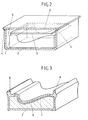
- 1 is a prismatic die in the lower part and a concave negative form in the upper part for the workpiece to be formed.
- the die 1 can consist of a metallic or ceramic high-temperature material.
- 2 is a container in the initial state (before forming), which consists of a ductile metallic material whose melting point is high enough not to melt at the forming temperature.
- the container 2 is preferably made of a soft carbon steel.
- a lid 3 seals the container 3 hermetically and vacuum-tight via a weld seam 4.
- Container 2, lid 3 and weld 4 are cut on the front side (shown as an elevation cut).
- Sheet to be formed (workpiece before forming) to be placed on the side of the negative form of the die 1, in the present case delivered as a flat sheet.
- the container 2 is evacuated after the lid 3 has been welded and finally welded.
- the vacuum is indicated by reference number 6.
- Fig. 3 shows the tool and the workpiece of Fig. 1 after forming, partly in perspective, partly (front) as an elevation section.
- 1 is the unchanged form of the die
- 7 is the deformed container with its beads 8 (material accumulation due to compression effects) after hot isostatic pressing.
- the formed sheet 9 (workpiece after the forming) conforms completely to the contours of the negative form of the die 1.
- FIG. 4 shows an elevation section (cross section) through another form of tool and workpiece before the forming.
- 1 is the die provided in the upper part with a convex negative shape for the workpiece.
- the container 2 here essentially consists of a tube of rectangular cross-section, which can be squeezed and welded on the end faces (not shown) or sealed vacuum-tight by welded lids.
- the remaining reference numerals correspond to those in FIG. 2.
- FIG. 5 shows an elevation section (cross section) through a shape of the tool and workpiece according to FIG. 4, but after the forming.
- the reference numerals correspond to those in FIG. 3.
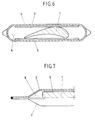
- the die 1 has the shape of a complete blade profile and acts as a core, so to speak.
- the container 2 consists of a flattened, squeezed and welded tube on the end faces. The two sheets 5 to be formed and to be joined in a subsequent phase in the same heat by diffusion joining are inserted as workpieces.
- the vacuum is indicated by reference number 6.
- Fig. 7 shows a side / longitudinal section of a tool and workpieces to be connected before forming. Only half of the bodies symmetrical to the center line are shown. The lower half shows the sheet metal body in view, the upper half shows the different bodies in section.
- the container 2, which is designed as a flat tube, is squeezed flat on its end faces and sealed off by a weld seam. All reference numerals correspond to those in FIG. 6.
- FIG. 8 relates to an elevation section (cross section) through the tool and the connected workpieces according to FIG. 6, but after the forming. Due to the hot isostatic pressing, the formed sheets 9 lay against the contours of the die 1 acting as the core and completely envelop them. In the same heat, the ends of the sheets 9 were firmly connected to one another by diffusion joining. The virtual joining surfaces 10, which will later no longer be crystallographically recognizable, are indicated by dashed lines. The upset material of the container 7 forms the beads 8 after the hot isostatic pressing. The longitudinal section of the body after the shaping remains essentially unchanged and corresponds approximately to FIG. 7, which is why it has not been shown again.
- a blade half-shell corresponding to the convex blade side was produced from a heat-resistant coarse-grained sheet 5 made of an oxide dispersion-hardened nickel-base superalloy by hot forming.
- the material with the trade name MA 6000 (International Nickel Co.) had the following composition:
- the dimensions of the sheet 5 having stem crystals stretched in the longitudinal direction were as follows:
- a die 1 containing the negative shape of the one-sided blade profile as a concave surface was produced from a heat-resistant ceramic material.
- a container 2 with a wall thickness of 2 mm was made from low-carbon soft steel with less than 0.1% C content.
- the sheet 5 to be formed, the die 1 and the inside of container 2 were now coated with an anti-wetting agent / release agent. In the present case, A1 2 0 3 was applied to the surfaces by plasma spraying.
- the die 1 was then placed in the container 2, the sheet 5 to be formed was placed flat thereon and the whole thing was covered with a cover 3 made of the same carbon steel as the container 2. Then the lid 3 was connected all round to the container 2 by means of a vacuum-tight weld 4, evacuated and the free passage for the suction of the air was finally closed by electron beam welding.
- the sheet 9 had the shape of a half-shell with the following inner dimensions:
- the container 7 was removed mechanically by cutting the weld seams, bending and peeling off the container walls and grinding away the remains.
- the die 1 can generally continue to be used.
- the metal sheets 5, the die 1 and the inside of the container 2 were coated with a release agent which contained colloidal graphite in water. The metal sheets 5 and the die 1 were then pushed axially into the container 2 and the end face of the latter was squeezed, welded, evacuated and finally closed (vacuum 6).
- the container 2 and its contents were brought to a temperature of 1340 ° C. in a press and hot isostatically formed at this temperature under a pressure of 200 MPa for 3 hours.
- the ends of the sheets 9 lay on top of one another and in the last phase of this thermomechanical treatment were firmly welded in the joining surfaces 10 by diffusion and local deformation.
- the inner surface of the workpiece had taken on the shape and dimensions of the die 1 (inner dimensions):
- the container 7 was removed by severing the edges of the narrow sides carrying the beads 8, bending and detaching the container walls and working away the remnants.
- the die 1 was partly removed from the hollow body in a mechanical, partly in a chemical manner.
- the invention is not restricted to the exemplary embodiments. Materials other than those specified in the examples can also be formed and / or joined using this method. This basically applies to precipitation and / or dispersion hardened alloys based on Ni, Co or Fe. Furthermore, sheets or plates made of Mo or W or their alloys can preferably be processed with or without dispersoids. The process is also suitable for forming plates made of ceramic material (sialone).
- the forming and / or joining temperatures for hot iso Static pressing should be between 5 ° C above the recrystallization temperature and 5 ° C below the solidus temperature.
- the pressure should fall in the range between 100 and 200 MPa.
- the total forming or joining time is preferably 1 to 3 hours.
- a suitable container material is a material that is ductile at the forming temperature but is still sufficiently firm and not sensitive to hot cracks, the melting point of which is sufficiently high above the forming temperature to remain tight under all circumstances during the entire hot isostatic pressing process.
- a soft, low-carbon unalloyed or alloyed (for example stainless) steel can preferably be used for this.
- Anti-wetting / separating / lubricants are preferably colloidal graphite in water, Al 2 0 3 or commercially available agents, mostly based on MgO.
- High-temperature alloys in particular nickel or cobalt-based alloys and ceramic materials, in particular those that can be leached with alkalis, are suitable as the matrix material.
- the advantages of the new process are the cost reduction, especially in the case of limited quantities, the possibility of shaping complicated workpieces in a single operation, the use of already coarse-grained recrystallized starting material with optimal microstructure formation (stem crystals) for high-temperature operation and thus the elimination of cumbersome additional coarse grain annealing operations.
Landscapes
- Chemical & Material Sciences (AREA)
- Engineering & Computer Science (AREA)
- Mechanical Engineering (AREA)
- Ceramic Engineering (AREA)
- Materials Engineering (AREA)
- Manufacturing & Machinery (AREA)
- Organic Chemistry (AREA)
- Fluid Mechanics (AREA)
- Physics & Mathematics (AREA)
- Inorganic Chemistry (AREA)
- Metallurgy (AREA)
- Dispersion Chemistry (AREA)
- Structural Engineering (AREA)
- Pressure Welding/Diffusion-Bonding (AREA)
- Press Drives And Press Lines (AREA)
- Shaping Metal By Deep-Drawing, Or The Like (AREA)
Applications Claiming Priority (2)
| Application Number | Priority Date | Filing Date | Title |
|---|---|---|---|
| CH795/85 | 1985-02-21 | ||
| CH79585 | 1985-02-21 |
Publications (2)
| Publication Number | Publication Date |
|---|---|
| EP0192105A1 true EP0192105A1 (fr) | 1986-08-27 |
| EP0192105B1 EP0192105B1 (fr) | 1989-05-03 |
Family
ID=4195363
Family Applications (1)
| Application Number | Title | Priority Date | Filing Date |
|---|---|---|---|
| EP86101314A Expired EP0192105B1 (fr) | 1985-02-21 | 1986-02-01 | Méthode pour former à chaud au moins une feuille de métal d'une matière difficilement déformable |
Country Status (4)
| Country | Link |
|---|---|
| US (1) | US4706361A (fr) |
| EP (1) | EP0192105B1 (fr) |
| JP (1) | JPS61195717A (fr) |
| DE (1) | DE3663117D1 (fr) |
Cited By (7)
| Publication number | Priority date | Publication date | Assignee | Title |
|---|---|---|---|---|
| EP0290898A1 (fr) * | 1987-05-13 | 1988-11-17 | BBC Brown Boveri AG | Procédé de fabrication de pièces de dimensions quelconques en superalliage à base de nickel durci par dispersion d'oxydes à cristaux basaltiques grossiers orientés |
| WO1989008001A1 (fr) * | 1988-02-27 | 1989-09-08 | Robert Bosch Gmbh | Procede de soudage de petits composants |
| EP0384629A3 (fr) * | 1989-02-22 | 1991-01-16 | LUCAS INDUSTRIES public limited company | Articles composites et procédé pour leur préparation |
| WO2011114073A1 (fr) | 2010-03-19 | 2011-09-22 | Snecma | Procede de realisation d'un insert metallique pour la protection d'un bord d'attaque en materiau composite |
| FR2970196A1 (fr) * | 2011-01-10 | 2012-07-13 | Snecma | Procede de realisation d'un renfort metallique |
| FR2970668A1 (fr) * | 2011-01-24 | 2012-07-27 | Snecma | Procede de realisation d'un renfort metallique |
| CN106363068A (zh) * | 2016-11-15 | 2017-02-01 | 沈阳航空航天大学 | 一种基于粘性介质温热成形的提高粘性介质导热率的方法 |
Families Citing this family (27)
| Publication number | Priority date | Publication date | Assignee | Title |
|---|---|---|---|---|
| US5144825A (en) * | 1990-09-27 | 1992-09-08 | The Boeing Company | Elevated temperature envelope forming |
| US5420400A (en) * | 1991-10-15 | 1995-05-30 | The Boeing Company | Combined inductive heating cycle for sequential forming the brazing |
| US5645744A (en) | 1991-04-05 | 1997-07-08 | The Boeing Company | Retort for achieving thermal uniformity in induction processing of organic matrix composites or metals |
| US5728309A (en) | 1991-04-05 | 1998-03-17 | The Boeing Company | Method for achieving thermal uniformity in induction processing of organic matrix composites or metals |
| US5641422A (en) * | 1991-04-05 | 1997-06-24 | The Boeing Company | Thermoplastic welding of organic resin composites using a fixed coil induction heater |
| US5710414A (en) * | 1991-04-05 | 1998-01-20 | The Boeing Company | Internal tooling for induction heating |
| US5808281A (en) | 1991-04-05 | 1998-09-15 | The Boeing Company | Multilayer susceptors for achieving thermal uniformity in induction processing of organic matrix composites or metals |
| US7126096B1 (en) | 1991-04-05 | 2006-10-24 | Th Boeing Company | Resistance welding of thermoplastics in aerospace structure |
| US5599472A (en) * | 1991-04-05 | 1997-02-04 | The Boeing Company | Resealable retort for induction processing of organic matrix composites or metals |
| US5624594A (en) * | 1991-04-05 | 1997-04-29 | The Boeing Company | Fixed coil induction heater for thermoplastic welding |
| US5410132A (en) * | 1991-10-15 | 1995-04-25 | The Boeing Company | Superplastic forming using induction heating |
| US5591369A (en) * | 1991-04-05 | 1997-01-07 | The Boeing Company | Method and apparatus for consolidating organic matrix composites using induction heating |
| US5705794A (en) * | 1991-10-15 | 1998-01-06 | The Boeing Company | Combined heating cycles to improve efficiency in inductive heating operations |
| US5467626A (en) * | 1993-10-01 | 1995-11-21 | The Boeing Company | Integral forming die system for superplastic metal forming |
| US5819572A (en) * | 1997-07-22 | 1998-10-13 | General Motors Corporation | Lubrication system for hot forming |
| GB9820225D0 (en) * | 1998-09-18 | 1998-11-11 | Rolls Laval Heat Exchangers Li | A method of manufacturing an article by hot forming |
| US6202277B1 (en) | 1999-10-28 | 2001-03-20 | General Electric Company | Reusable hard tooling for article consolidation and consolidation method |
| US20050139581A1 (en) * | 2003-12-24 | 2005-06-30 | Yiping Hu | High-strength superalloy joining method for repairing turbine blades |
| US7086268B2 (en) * | 2004-03-16 | 2006-08-08 | Ford Global Technologies, Llc | Apparatus and method for removing and cooling a part from a forming tool |
| US8381631B2 (en) | 2008-12-01 | 2013-02-26 | Battelle Energy Alliance, Llc | Laminate armor and related methods |
| DE102011102087A1 (de) * | 2011-05-19 | 2012-11-22 | Formtech Gmbh | Verfahren zur Bearbeitung eines Flächenelements |
| US20130121868A1 (en) * | 2011-05-24 | 2013-05-16 | Electric Power Research Institute, Inc. | Method of manufacturing a weld-free apparatus for connection of dissimilar metals using functionally graded compositionally control powder metallurgy and hot isostatic processing methods |
| CN103612007B (zh) * | 2013-11-21 | 2016-04-13 | 中国航空工业集团公司北京航空制造工程研究所 | 一种高温合金三维点阵夹层结构的制备方法 |
| CN105195989B (zh) * | 2015-09-28 | 2017-08-22 | 安泰科技股份有限公司 | 制备核电站中主泵的推力盘的方法 |
| ES2819886T3 (es) * | 2016-02-24 | 2021-04-19 | Punker Gmbh | Alabe perfilado, rodete de ventilador y procedimiento para fabricar un álabe perfilado |
| US12599953B2 (en) * | 2022-02-28 | 2026-04-14 | Spirit Aerosystems, Inc. | Method for forming and heat treating near net shape complex structures from sheet metal |
| CN119347084B (zh) * | 2024-11-06 | 2025-09-30 | 中国航发沈阳黎明航空发动机有限责任公司 | 一种高温合金内流道换热板的扩散连接-等静压强化复合工艺制造方法 |
Citations (8)
| Publication number | Priority date | Publication date | Assignee | Title |
|---|---|---|---|---|
| DE201136C (fr) * | ||||
| US2728317A (en) * | 1951-10-23 | 1955-12-27 | Walton S Clevenger | Apparatus for hydraulic die forming |
| US3054035A (en) * | 1956-05-17 | 1962-09-11 | Gulton Ind Inc | Ceramic components and method of making same |
| GB1398929A (en) * | 1972-07-07 | 1975-06-25 | British Aircraft Corp Ltd | Joining and forming sheet metal members |
| US3928901A (en) * | 1974-10-10 | 1975-12-30 | Gen Electric | Forming a cladding sheet to a convex/concave substrate |
| DE2551768A1 (de) * | 1974-11-18 | 1976-05-20 | Ici Ltd | Verfahren zur herstellung einer pressform oder eines presswerkzeugs aus einer platte einer superplastischen legierung |
| DE2742816A1 (de) * | 1977-09-23 | 1979-03-29 | Motoren Turbinen Union | Bauteile aus si-keramik mit hohlraum und verfahren zur herstellung solcher bauteile |
| EP0089155A2 (fr) * | 1982-03-05 | 1983-09-21 | Rolls-Royce Plc | Articles composites et leur procédé de fabrication |
Family Cites Families (6)
| Publication number | Priority date | Publication date | Assignee | Title |
|---|---|---|---|---|
| US3071853A (en) * | 1955-10-17 | 1963-01-08 | Solar Aircraft Co | Method and apparatus for making brazed honeycomb |
| US3068565A (en) * | 1958-10-16 | 1962-12-18 | Nat Distillers Chem Corp | Method of making honeycomb laminate |
| US3739617A (en) * | 1970-09-21 | 1973-06-19 | Boeing Co | High temperature vacuum creep forming fixture |
| US4117970A (en) * | 1976-11-16 | 1978-10-03 | Rockwell International Corporation | Method for fabrication of honeycomb structures |
| US4333216A (en) * | 1981-03-23 | 1982-06-08 | United Technologies Corporation | Method for manufacturing a sandwich panel structure |
| US4559797A (en) * | 1983-08-02 | 1985-12-24 | Delaware | Method for forming structural parts |
-
1986
- 1986-02-01 EP EP86101314A patent/EP0192105B1/fr not_active Expired
- 1986-02-01 DE DE8686101314T patent/DE3663117D1/de not_active Expired
- 1986-02-12 US US06/828,707 patent/US4706361A/en not_active Expired - Fee Related
- 1986-02-21 JP JP61035401A patent/JPS61195717A/ja active Pending
Patent Citations (8)
| Publication number | Priority date | Publication date | Assignee | Title |
|---|---|---|---|---|
| DE201136C (fr) * | ||||
| US2728317A (en) * | 1951-10-23 | 1955-12-27 | Walton S Clevenger | Apparatus for hydraulic die forming |
| US3054035A (en) * | 1956-05-17 | 1962-09-11 | Gulton Ind Inc | Ceramic components and method of making same |
| GB1398929A (en) * | 1972-07-07 | 1975-06-25 | British Aircraft Corp Ltd | Joining and forming sheet metal members |
| US3928901A (en) * | 1974-10-10 | 1975-12-30 | Gen Electric | Forming a cladding sheet to a convex/concave substrate |
| DE2551768A1 (de) * | 1974-11-18 | 1976-05-20 | Ici Ltd | Verfahren zur herstellung einer pressform oder eines presswerkzeugs aus einer platte einer superplastischen legierung |
| DE2742816A1 (de) * | 1977-09-23 | 1979-03-29 | Motoren Turbinen Union | Bauteile aus si-keramik mit hohlraum und verfahren zur herstellung solcher bauteile |
| EP0089155A2 (fr) * | 1982-03-05 | 1983-09-21 | Rolls-Royce Plc | Articles composites et leur procédé de fabrication |
Cited By (17)
| Publication number | Priority date | Publication date | Assignee | Title |
|---|---|---|---|---|
| EP0290898A1 (fr) * | 1987-05-13 | 1988-11-17 | BBC Brown Boveri AG | Procédé de fabrication de pièces de dimensions quelconques en superalliage à base de nickel durci par dispersion d'oxydes à cristaux basaltiques grossiers orientés |
| US4817858A (en) * | 1987-05-13 | 1989-04-04 | Bbc Brown Boveri Ag | Method of manufacturing a workpiece of any given cross-sectional dimensions from an oxide-dispersion-hardened nickel-based superalloy with directional coarse columnar crystals |
| CH672450A5 (fr) * | 1987-05-13 | 1989-11-30 | Bbc Brown Boveri & Cie | |
| WO1989008001A1 (fr) * | 1988-02-27 | 1989-09-08 | Robert Bosch Gmbh | Procede de soudage de petits composants |
| GB2224966A (en) * | 1988-02-27 | 1990-05-23 | Bosch Gmbh Robert | Process for joint welding of small components |
| GB2224966B (en) * | 1988-02-27 | 1992-01-29 | Bosch Gmbh Robert | Process for joint welding of small components |
| US5113054A (en) * | 1988-02-27 | 1992-05-12 | Robert Bosch Gmbh | Method for joint welding of small structural component parts |
| EP0384629A3 (fr) * | 1989-02-22 | 1991-01-16 | LUCAS INDUSTRIES public limited company | Articles composites et procédé pour leur préparation |
| WO2011114073A1 (fr) | 2010-03-19 | 2011-09-22 | Snecma | Procede de realisation d'un insert metallique pour la protection d'un bord d'attaque en materiau composite |
| FR2957545A1 (fr) * | 2010-03-19 | 2011-09-23 | Snecma | Procede de realisation d'un insert metallique pour la protection d'un bord d'attaque en materiau composite |
| US8782887B2 (en) | 2010-03-19 | 2014-07-22 | Snecma | Method for producing a metal insert to protect a leading edge made of a composite material |
| RU2563907C2 (ru) * | 2010-03-19 | 2015-09-27 | Снекма | Способ изготовления металлической вставки для защиты передней кромки из композитного материала |
| FR2970196A1 (fr) * | 2011-01-10 | 2012-07-13 | Snecma | Procede de realisation d'un renfort metallique |
| WO2012095574A1 (fr) * | 2011-01-10 | 2012-07-19 | Snecma | Procédé de réalisation d'un renfort métallique |
| US9120189B2 (en) | 2011-01-10 | 2015-09-01 | Snecma | Method of making a piece of metal reinforcement |
| FR2970668A1 (fr) * | 2011-01-24 | 2012-07-27 | Snecma | Procede de realisation d'un renfort metallique |
| CN106363068A (zh) * | 2016-11-15 | 2017-02-01 | 沈阳航空航天大学 | 一种基于粘性介质温热成形的提高粘性介质导热率的方法 |
Also Published As
| Publication number | Publication date |
|---|---|
| JPS61195717A (ja) | 1986-08-30 |
| US4706361A (en) | 1987-11-17 |
| EP0192105B1 (fr) | 1989-05-03 |
| DE3663117D1 (en) | 1989-06-08 |
Similar Documents
| Publication | Publication Date | Title |
|---|---|---|
| EP0192105B1 (fr) | Méthode pour former à chaud au moins une feuille de métal d'une matière difficilement déformable | |
| EP0086013B1 (fr) | Matériau, constitué au moins partiellement d'un composant présentant un effet de mémoire à une voie et procédé pour sa fabrication | |
| EP0513407B1 (fr) | Procédé de fabrication d' une aube de turbine | |
| DE68916383T2 (de) | Verfahren zur Herstellung eines plattierten Metallrohres. | |
| DE69201319T2 (de) | Verfahren zur Herstellung von Sandwich-Strukturen aus Titan-Aluminium-Legierung. | |
| DE69624274T2 (de) | Verbundene Gegenstände, korrosionsbeständiges Verbindungsmaterial und Herstellungsverfahren dieser Gegenstände | |
| DE2616448A1 (de) | Zusammengesetzte metallgegenstaende und verfahren zu ihrer herstellung | |
| DE69302219T2 (de) | Verfahren zum Anbringen von Schutzüberzügen bildenden Einsätzen auf Gegenständen aus martensitischens Stahl oder aus Titanlegierungen | |
| DE3151499C2 (de) | Metallbehälter, insbesondere für den chemischen Apparatebau, und Verfahren zur Herstellung solcher Metallbehälter | |
| DE2362499C2 (de) | Verfahren zur pulvermetallurgischen Herstellung von Strangprßkörpern | |
| DE68905688T2 (de) | Verfahren zur erzeugung von zusammengesetzten metallteilen. | |
| DE69005024T2 (de) | Diffusionsschweissen von Aluminium und Aluminiumlegierungen. | |
| DE1758162A1 (de) | Verfahren zum Herstellen von mit einer korrosionsbestaendigen Plattierung versehenen Gegenstaenden aus unedlen Metallen | |
| DE2156440A1 (de) | Verfahren zur Herstellung von Werkstücken aus Werkstoffen mit verschiedenen Eigenschaften | |
| DE68925015T2 (de) | Formkörper aus einem schwerschmelzbarem Metall mit bestimmter Form und Verfahren zu seiner Herstellung. | |
| EP0090887B1 (fr) | Procédé pour la jonction par diffusion de matériaux résistant au fluage à température élevée | |
| DE2724524B2 (de) | Behalter zum Heißpressen von Formkörpern verwickelter Gestalt aus Pulver | |
| DE3113733C2 (de) | Verfahren zur Rückgewinnung von hochwertigen Werkstoffen | |
| EP0364430A1 (fr) | Ebauche pour la production des matériaux composites | |
| DE3787510T2 (de) | Mit Titan überzogener Stahl und Verfahren zu dessen Herstellung. | |
| DE2311400A1 (de) | Lotlegierung | |
| DE1045305B (de) | Verfahren zum Verbinden nichtmetallischer Stoffe, wie Keramik, mit Metallen und danach hergestellte elektrische Entladungsroehre | |
| DE2821429C2 (de) | Streifen-, Draht-, Stangen- oder Plattengegenstand mit einer Plattierung aus Edelstahl | |
| EP0192100B1 (fr) | Procédé pour relier des éléments de construction en superalliage | |
| EP0045984B1 (fr) | Procédé pour la fabrication de pièces en un alliage résistant aux températures élevées |
Legal Events
| Date | Code | Title | Description |
|---|---|---|---|
| PUAI | Public reference made under article 153(3) epc to a published international application that has entered the european phase |
Free format text: ORIGINAL CODE: 0009012 |
|
| AK | Designated contracting states |
Kind code of ref document: A1 Designated state(s): CH DE FR GB LI SE |
|
| 17P | Request for examination filed |
Effective date: 19860906 |
|
| RAP1 | Party data changed (applicant data changed or rights of an application transferred) |
Owner name: BBC BROWN BOVERI AG |
|
| 17Q | First examination report despatched |
Effective date: 19871113 |
|
| GRAA | (expected) grant |
Free format text: ORIGINAL CODE: 0009210 |
|
| AK | Designated contracting states |
Kind code of ref document: B1 Designated state(s): CH DE FR GB LI SE |
|
| PG25 | Lapsed in a contracting state [announced via postgrant information from national office to epo] |
Ref country code: GB Effective date: 19890503 Ref country code: FR Free format text: THE PATENT HAS BEEN ANNULLED BY A DECISION OF A NATIONAL AUTHORITY Effective date: 19890503 |
|
| REF | Corresponds to: |
Ref document number: 3663117 Country of ref document: DE Date of ref document: 19890608 |
|
| EN | Fr: translation not filed | ||
| GBV | Gb: ep patent (uk) treated as always having been void in accordance with gb section 77(7)/1977 [no translation filed] | ||
| PG25 | Lapsed in a contracting state [announced via postgrant information from national office to epo] |
Ref country code: SE Effective date: 19900202 |
|
| PG25 | Lapsed in a contracting state [announced via postgrant information from national office to epo] |
Ref country code: LI Effective date: 19900228 Ref country code: CH Effective date: 19900228 |
|
| PLBE | No opposition filed within time limit |
Free format text: ORIGINAL CODE: 0009261 |
|
| STAA | Information on the status of an ep patent application or granted ep patent |
Free format text: STATUS: NO OPPOSITION FILED WITHIN TIME LIMIT |
|
| 26N | No opposition filed | ||
| REG | Reference to a national code |
Ref country code: CH Ref legal event code: PL |
|
| PG25 | Lapsed in a contracting state [announced via postgrant information from national office to epo] |
Ref country code: DE Effective date: 19901101 |
|
| EUG | Se: european patent has lapsed |
Ref document number: 86101314.2 Effective date: 19901107 |