EP0192196A2 - Luftbereiftes Fahrzeugrad - Google Patents
Luftbereiftes Fahrzeugrad Download PDFInfo
- Publication number
- EP0192196A2 EP0192196A2 EP86101876A EP86101876A EP0192196A2 EP 0192196 A2 EP0192196 A2 EP 0192196A2 EP 86101876 A EP86101876 A EP 86101876A EP 86101876 A EP86101876 A EP 86101876A EP 0192196 A2 EP0192196 A2 EP 0192196A2
- Authority
- EP
- European Patent Office
- Prior art keywords
- tire
- carcass
- vehicle wheel
- bead cores
- bead
- Prior art date
- Legal status (The legal status is an assumption and is not a legal conclusion. Google has not performed a legal analysis and makes no representation as to the accuracy of the status listed.)
- Granted
Links
- 239000011324 bead Substances 0.000 claims abstract description 61
- 239000004033 plastic Substances 0.000 claims abstract description 3
- 229920003023 plastic Polymers 0.000 claims abstract description 3
- 239000000725 suspension Substances 0.000 description 3
- 230000000694 effects Effects 0.000 description 2
- 230000002349 favourable effect Effects 0.000 description 2
- 230000002787 reinforcement Effects 0.000 description 2
- 230000007547 defect Effects 0.000 description 1
- 238000007789 sealing Methods 0.000 description 1
Images

Classifications
-
- B—PERFORMING OPERATIONS; TRANSPORTING
- B60—VEHICLES IN GENERAL
- B60C—VEHICLE TYRES; TYRE INFLATION; TYRE CHANGING; CONNECTING VALVES TO INFLATABLE ELASTIC BODIES IN GENERAL; DEVICES OR ARRANGEMENTS RELATED TO TYRES
- B60C15/00—Tyre beads, e.g. ply turn-up or overlap
- B60C15/02—Seating or securing beads on rims
- B60C15/0203—Seating or securing beads on rims using axially extending bead seating, i.e. the bead and the lower sidewall portion extend in the axial direction
Definitions
- the invention relates to a luftbereiftes vehicle with a loading substantially of rubber or gumniähnlichen plastics "standing tire with tensile strength, flat bead cores in the tire beads, wherein the transverse extension of the bead cores is substantially greater than the radial extension, wherein the carcass by being looped around the bead cores is anchored in the beads and in which the turned-up carcass sections are guided radially outward from the bead cores essentially parallel to them axially inwards.
- a tire for such a vehicle wheel is known from US Pat. No. 3,964,532.
- the tire described there which passes from the beads into the side walls at a very steep angle. is very stiff in the lower side wall area, which results in a rather unfavorable suspension behavior.
- the known tire is not suitable for emergency running.
- the invention is therefore based on the object of specifying a vehicle wheel with a tire which on the one hand tolerates a high load and on the other hand is distinguished by great flexibility in the lower side wall area, so that the tire has a particularly favorable suspension behavior.
- the vehicle wheel should be suitable for emergency running, i.e. H. the tire should be able to withstand a longer distance without air pressure without permanent damage remaining.
- This object is achieved in that the carcass coming from the tire sidewall runs flat into the bead area and that it lies directly on the folded end of the carcass.
- the flat profile and the thin design of the lower tire sidewalls have the advantage that the tire becomes very flexible in this area, so that this area has a positive influence on the suspension behavior of the tire.
- the thin design of this area without bead reinforcement and other reinforcement inserts is made possible by the fact that the turned-up carcass section on the bead core is returned axially inward and is practically clamped by the flat carcass. This measure allows the large forces that are generated in truck tires due to the high internal pressure on the carcass to be absorbed.
- rim rings are proposed which are located radially outside of the tire beads and which cause the tire beads to be clamped.
- an emergency running saddle is used, which can be inextricably linked to the rim rings or can be designed as a separate component, which is optionally designed such that it includes part of the tire bead in a clamped manner.
- the rim rings k ön- nen are used not only for clamping the tire beads also for centering the tire and for airtight concern.
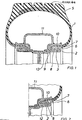
- the tire used in the vehicle wheel of FIG. 1 has a carcass 1, which is anchored in the beads 3 by wrapping tension-resistant bead cores 2.
- a conventional belt 5 is located below the tread 4.
- the tire is mounted on a multi-part rim 13.
- the tire beads 3 are arranged on the radially outer circumference of the rim 13 next to rim flanges 6.
- the carcass 1 runs almost horizontally, then wraps around the bead core 2 in such a way that the folded-over carcass section 8 is returned radially outside from the bead core 2 to the inside axially, so that it runs parallel to the bead core 2 and the carcass 1 and is clamped between them.
- the folded-over carcass end 9 preferably ends in the axially inner and radially outer corner region of the bead core 2.
- the bead core has an approximately oval cross-section, the cross-sectional width being three to six times the cross-sectional height.
- the bead core 2 consists of several layers of wires arranged side by side, which are wound endlessly.
- the clamping rings 10 are permanently connected to a emergency running saddle 11 which serves for supporting a tire defect 'of the crown region. During tire assembly, the individual parts of the rim 13 are assembled in a known manner. It should be noted that the clamping rings 10 have a centering and sealing effect in addition to a clamping effect.
- FIG. 2 differs from that in FIG. 1 by a bead core 2 with a hexagonal cross section and by a rim seat surface 12 which is inclined in the transverse direction and thereby forms an angle with the horizontal base of the bead core 2 which can be 5 to 15 degrees .
- the clamping ring 10 runs parallel to the rim seat surface 12 in the transverse direction, so that the distance between the rim flange 6 and the clamping ring 10 corresponds approximately to the tire wall thickness in the lower side wall region 7, as in the example in FIG. All other parts of the vehicle wheel can be taken from that of Figure 1.
- FIG. 3 shows a vehicle wheel with a likewise multipart rim 13 which, in addition to the rim flanges 6, has horizontal seating surfaces 12 for the tire beads 3.
- the carcass 1 and the lower side wall region 7 of the tire run in the same way as in the example in FIG. 1. This also applies to the folded-over carcass section 8 and the carcass end 9.
- the endlessly wound bead core 2 is, however, made up of a flat strip, which gives it a certain radial flexibility and extremely high rigidity.
- the emergency running saddle 11 is designed such that it encompasses the axially inner and part of the radially outer region of each tire bead 3, so that the latter is held securely on the rim in all driving situations.
- the structure of the vehicle wheel of FIG. 4 corresponds to that of FIG. 1, while the rim 13 is formed in one piece.
- a horizontal rim seat surface 12 Next to the rim flange 6 there is a horizontal rim seat surface 12 and next to this a drop center 14 which is used for mounting the tires.
- the one-piece rim of FIG. 4 can also have inclined seat surfaces 12, and the base of the bead core V can in such a case run parallel to the seat surface 12 or - in line with the example of FIG. 2 - run horizontally.
Landscapes
- Engineering & Computer Science (AREA)
- Mechanical Engineering (AREA)
- Tires In General (AREA)
- Pharmaceuticals Containing Other Organic And Inorganic Compounds (AREA)
- Motorcycle And Bicycle Frame (AREA)
Abstract
Description
- Die Erfindung betrifft ein luftbereiftes Fahrzeugrad mit einem im wesentlichen aus Gummi oder gumniähnlichen Kunststoffen be-" stehenden Reifen mit zugfesten, flachen Wulstkernen in den Reifenwülsten,bei dem die Quererstreckung der Wulstkerne wesentlich größer ist als die Radialerstreckung, bei dem die Karkasse durch Umschlingen der Wulstkerne in den Wülsten verankert ist und bei dem die umgeschlagenen Karkaßabschnitte radial außen von den Wulstkernen im wesentlichen parallel zu diesen nach axial innen hin zurückgeführt sind.
- Aus der US-PS 3 964 532 ist ein Reifen für ein solches Fahrzeugrad bekannt. Der dort beschriebene Reifen, der unter sehr steilem Winkel von den Wülsten in die Seitenwände übergeht. ist im unterem Seitenwandbereich sehr steif ausgebildet, was ein recht ungünstiges Federungsverhalten zur Folge hat. Weiterhin ist der bekannte Reifen nicht für einen Notlauf geeignet.
- Der Erfindung liegt deshalb die Aufgabe zugrunde, ein Fahrzeugrad mit einem Reifen anzugeben, der einerseits eine hohe Belastung verträgt und der sich auf der anderen Seite durch eine große Flexibilität im unterem Seitenwandbereich auszeichnet, so daß der Reifen ein besonders günstiges Federungsverhalten aufweist.
- Weiterhin sollte das Fahrzeugrad für einen Notlauf geeignet sein, d. h. der Reifen sollte eine größere Fahrstrecke ohne Luftdruck vertragen, ohne daß dauerhafte Schäden zurückbleiben.
- Diese Aufgabe wird erfindungsgemäß dadurch gelöst, daß die Karkasse von der Reifenseitenwand kommend flach in den Wulstbereich einläuft, und daß sie unmittelbar am umgeschlagenen Karkaßende anliegt.
- Durch den flachen Verlauf und die dünne Ausgestaltung der unteren Reifenseitenwände erzielt man den Vorteil, daß der Reifen in diesem Bereich sehr biegsam wird, so daß dieser Bereich das Federungsverhalten des Reifens positiv beeinflußt. Die dünne Ausgestaltung dieses Bereichs ohne Wulstverstärker und andere Verstärkungseinlagen wird dadurch möglich, daß man den umgeschlagenen Karkaßabschnitt am Wulstkern nach axial innen zurückführt und ihn durch die flach verlaufende Karkasse praktisch klemmt. Durch diese Maßnahme können die großen Kräfte aufgefangen werden, die bei LKW-Reifen aufgrund des hohen Innendrucks an die Karkasse erzeugt werden.
- Als zusätzliche Maßnahme zur Verbesserung des Reifensitzes werden Felgenringe vorgeschlagen, die sich radial außen von den Reifenwülsten befinden und die eine Klemmung der Reifenwülste bewirken. Zur Gewährleistung eines Notlaufs dient ein Notlaufsattel, der unlösbar mit den Felgenringen verbungen oder als separates Bauteil ausgebildet sein kann, das gegebenenfalls so gestaltet ist, daß es einen Teil des Reifenwulstes klemmend umfaßt. Die Felgenringe kön- nen außer zum Klemmen der Reifenwülste auch zum Zentrieren des Reifens und zum luftdichten Anliegen eingesetzt werden.
- Vorteilhafte Ausgestaltungen sind den Unteransprüchen zu entnehmen.
- Nachfolgend wird ein Ausführungsbeispiel der Erfindung anhand einer Zeichnung näher erläutert. Es zeigt:
- Fig. 1 ein Fahrzeugrad mit einem ersten Reifen und einem Notlaufsattel in einem radialen Teilschnitt,
- Fig. 2 ein Fahrzeugrad mit einem zweiten Reifen, der sich im Wulstbereich von dem der Figur 1 unterscheidet, und mit einer anderen Unterlage, in einem radialen Teilschnitt.
- Fig. 3 ein Fahrzeugrad, bei dem die Reifenwülste durch Teile des Notlaufsattels teilweise geklemmt werden, in einem radialen Teilschnitt,
- Fig. 4 ein Fahrzeugrad, bei dem der Reifen auf einer einteiligen Felge montiert ist, in einem radialen Teilschnitt.
- Der beim Fahrzeugrad der Figur 1 verwendete Reifen weist eine Karkasse 1 auf, die durch Umschlingen von zugfesten Wulstkernen 2 in den Wülsten 3 verankert ist.
- Unterhalb des Laufstreifens 4 befindet sich ein üblicher Gürtel 5.
- Vorliegend ist der Reifen auf einer mehrteiligen Felge 13 montiert. Die Reifenwülste 3 sind am radialäußeren Umfang der Felge 13 neben Felgenhörnern 6 angeordnet.
- Im unterem Seitenwandbereich 7 des Reifens verläuft die Karkasse 1 nahezu waagerecht, umschlingt dann den Wulstkern 2 in der Weise, daß der umgeschlagene Karkaßabschnitt 8 radial außen vom Wulstkern 2 nach axial innen zurückgeführt ist, so daß er parallel zum Wulstkern 2 und zur Karkasse 1 verläuft und zwischen diesen geklemmt wird. Das umgeschlagene Karkaßende 9 endet bevorzugt im axial inneren und radial äußeren Eckbereich des Wulstkerns 2. Der Wulstkern weist vorliegend einen annähernd ovalen Querschnitt auf, wobei die Querschnittsbreite drei- bis sechsmal so groß ist wie die Querschnittshöhe. Der Wulstkern 2 besteht aus mehreren Lagen von nebeneinander angeordneten Drähten, die endlos gewickelt sind.
- Um den Reifensitz auf der Felge 13 bei extrem hohen Belastungen noch zu verbessern, ist es günstig eine Klemmung der Reifenwülste 3 mit Hilfe von radial außen befindlichen Klemmringen 10 vorzusehen, die in axialer Richtung etwa bis zur Höhe der Felgenhörner 6 reichen und die axial innen ebenfalls an den Reifenwülsten 3 anliegen.
- Im Beispiel der Figur 1 sind die Klemmringe 10 unlösbar mit einem Notlaufsattel 11 verbunden, der bei einem Reifendefekt zur Abstützung ' des Zenitbereichs dient. Bei der Reifenmontage werden die einzelnen Teile der Felge 13 in bekannter Weise zusammengesetzt. Es sollte angemerkt werden, daß die Klemmringe 10 außer einer Klemm- ` wirkung auch eine Zentrier- und Dichtwirkung aufweisen.
- Das Beispiel der Figur 2 unterscheidet sich von dem der Figur 1 durch einen im Querschnitt sechseckigen Wulstkern 2 und durch eine Felgensitzfläche 12, die in Querrichtung geneigt verläuft und dadurch mit der waagerechten Basis des Wulstkerns 2 einen Winkel einschließt, der 5 bis 15 Grad betragen kann. Der Klemmring 10 verläuft in Querrichtung parallel zur Felgensitzfläche 12, so daß der Abstand zwischen Felgenhorn 6 und dem Klemmring 10 wie beim Beispiel der Figur 1 etwa der Reifenwandstärke im unterem Seitenwandbereich 7 entspricht. Alle übrigen Teile des Fahrzeugrades können von dem der Figur 1 entnommen werden.
- In Figur 3 ist ein Fahrzeugrad mit einer ebenfalls mehrteiligen Felge 13 dargestellt, die neben den Felgenhörnern 6 waagerechte Sitzflächen 12 für die Reifenwülste 3 aufweist.
- Die Karkasse 1 und der untere Seitenwandbereich 7 des Reifens verlaufen ebenso wie beim Beispiel der Figur 1. Dies gilt auch für den umgeschlagenen Karkaßabschnitt 8 und das Karkaßende 9.
- Der endlos gewickelte Wulstkern 2 ist jedoch aus einem Flachband aufgebaut, das ihm eine gewisse radiale Flexibilität und eine extrem hohe Steifigkeit verleiht.
- Der Notlaufsattel 11 ist derart ausgestaltet, daß er den axial inneren und einen Teil des radial äußeren Bereichs eines jeden Reifenwulstes 3 umfaßt, so daß letzterer in allen Fahrsituationen sicher auf der Felge gehalten wird.
- Beim Fahrzeugrad der Figur 4 entspricht der Reifen in seinem Aufbau dem der Figur 1, während die Felge 13 einteilig ausgebildet ist. Neben dem Felgenhorn 6 befindet sich eine waagerechte Felgensitzfläche 12 und neben dieser ein Tiefbett 14, das der Reifenmontage dient.
- Es sollte angemerkt werden, daß einzelne Elemente der vorstehenden Beispiele untereinander austauschbar bzw. kombinierbar sind. So kann selbstverständlich die einteilige Felge der Figur 4 bei Bedarf auch schräge Sitzflächen 12 aufweisen, und die Basis des WulstkernsVkann in einem solchem Falle parallel zur Sitzfläche 12 oder - in Anlehnung an das Beispiel der Figur 2 - waagerecht verlaufen.
Claims (9)
Priority Applications (1)
| Application Number | Priority Date | Filing Date | Title |
|---|---|---|---|
| AT86101876T ATE52222T1 (de) | 1985-02-20 | 1986-02-14 | Luftbereiftes fahrzeugrad. |
Applications Claiming Priority (2)
| Application Number | Priority Date | Filing Date | Title |
|---|---|---|---|
| DE19853505832 DE3505832A1 (de) | 1985-02-20 | 1985-02-20 | Luftbereiftes fahrzeugrad |
| DE3505832 | 1985-02-20 |
Publications (3)
| Publication Number | Publication Date |
|---|---|
| EP0192196A2 true EP0192196A2 (de) | 1986-08-27 |
| EP0192196A3 EP0192196A3 (en) | 1987-10-14 |
| EP0192196B1 EP0192196B1 (de) | 1990-04-25 |
Family
ID=6263018
Family Applications (1)
| Application Number | Title | Priority Date | Filing Date |
|---|---|---|---|
| EP86101876A Expired - Lifetime EP0192196B1 (de) | 1985-02-20 | 1986-02-14 | Luftbereiftes Fahrzeugrad |
Country Status (3)
| Country | Link |
|---|---|
| EP (1) | EP0192196B1 (de) |
| AT (1) | ATE52222T1 (de) |
| DE (2) | DE3505832A1 (de) |
Families Citing this family (3)
| Publication number | Priority date | Publication date | Assignee | Title |
|---|---|---|---|---|
| DE3942286A1 (de) * | 1989-12-21 | 1991-06-27 | Klaus D Dipl Ing Debus | Virtuelle felgenverbreiterung bei innen montierten reifensystemen |
| FR2707923A1 (fr) * | 1993-07-19 | 1995-01-27 | Michelin & Cie | Dispositif de soutien d'une bande de roulement de pneumatique. |
| US6896021B1 (en) * | 2003-03-31 | 2005-05-24 | The Goodyear Tire & Rubber Company | Tire bead geometry |
Family Cites Families (7)
| Publication number | Priority date | Publication date | Assignee | Title |
|---|---|---|---|---|
| US1335411A (en) * | 1917-02-17 | 1920-03-30 | James H Wagenhorst | Tire-shoe and rim therefor |
| GB359110A (en) * | 1930-08-21 | 1931-10-22 | Dunlop Rubber Co | An improved design and construction of pneumatic tyre |
| DE1082822B (de) * | 1958-10-16 | 1960-06-02 | John Deere Lanz Ag | Laufrad mit elastisch verformbarem schlauchlosem Gummireifen |
| NL129169C (de) * | 1963-05-04 | Michelin & Cie | ||
| DE1605627A1 (de) * | 1967-01-25 | 1970-01-08 | Continental Gummi Werke Ag | Fahrzeugluftreifen |
| GB1491197A (en) * | 1973-11-07 | 1977-11-09 | Dunlop Ltd | Pneumatic tyres |
| AT359849B (de) * | 1978-11-07 | 1980-12-10 | Semperit Ag | Fahrzeugluftreifen |
-
1985
- 1985-02-20 DE DE19853505832 patent/DE3505832A1/de not_active Withdrawn
-
1986
- 1986-02-14 DE DE8686101876T patent/DE3670599D1/de not_active Expired - Lifetime
- 1986-02-14 AT AT86101876T patent/ATE52222T1/de not_active IP Right Cessation
- 1986-02-14 EP EP86101876A patent/EP0192196B1/de not_active Expired - Lifetime
Also Published As
| Publication number | Publication date |
|---|---|
| EP0192196B1 (de) | 1990-04-25 |
| DE3670599D1 (de) | 1990-05-31 |
| DE3505832A1 (de) | 1986-08-21 |
| EP0192196A3 (en) | 1987-10-14 |
| ATE52222T1 (de) | 1990-05-15 |
Similar Documents
| Publication | Publication Date | Title |
|---|---|---|
| DE3045775C2 (de) | Reifen/Felgenanordnung | |
| DE69905037T2 (de) | Verstärkter radialreifenwulst | |
| DE2657446C2 (de) | Flugzeugreifen | |
| DE69315164T2 (de) | Luftreifen | |
| DE68907444T2 (de) | Luftreifen. | |
| DE2724996B2 (de) | Reifen-Felgen-Anordnung | |
| EP0156009B1 (de) | Fahrzeugrad | |
| DE2026874B2 (de) | Wulstkern fuer fahrzeugluftreifen | |
| DE2649814A1 (de) | Reifen-felgen-anordnung und verfahren zu ihrer herstellung | |
| DE69901113T2 (de) | Reifen mit trianguliertem verstärkungsgürtel | |
| DE2653655A1 (de) | Entfernbare laufgurtanordnung fuer reifen | |
| EP0079454B1 (de) | Fahrzeugrad | |
| EP0326123A2 (de) | Fahrzeugluftreifen | |
| DE3752326T2 (de) | Radialer Luftreifen für LKW | |
| DE2923966C2 (de) | Diagonalluftreifen | |
| EP0881105B1 (de) | Fahrzeugluftreifen | |
| DE2847198A1 (de) | Guertelreifen | |
| EP0192196B1 (de) | Luftbereiftes Fahrzeugrad | |
| EP0052737B1 (de) | Fahrzeugluftreifen | |
| DE3200926A1 (de) | Fahrzeugrad | |
| DE69812191T2 (de) | Felge und felgen-reifen zusammenbau | |
| DE2224015C2 (de) | Fahrzeugluftreifen | |
| DE3420402A1 (de) | Fahrzeugrad | |
| EP0217078A1 (de) | Luftbereiftes Fahrzeugrad | |
| EP0199969B1 (de) | Felge für einen Fahrzeugluftreifen |
Legal Events
| Date | Code | Title | Description |
|---|---|---|---|
| PUAI | Public reference made under article 153(3) epc to a published international application that has entered the european phase |
Free format text: ORIGINAL CODE: 0009012 |
|
| AK | Designated contracting states |
Kind code of ref document: A2 Designated state(s): AT BE CH DE FR GB IT LI LU NL SE |
|
| PUAL | Search report despatched |
Free format text: ORIGINAL CODE: 0009013 |
|
| AK | Designated contracting states |
Kind code of ref document: A3 Designated state(s): AT BE CH DE FR GB IT LI LU NL SE |
|
| 17P | Request for examination filed |
Effective date: 19871105 |
|
| 17Q | First examination report despatched |
Effective date: 19890913 |
|
| RAP1 | Party data changed (applicant data changed or rights of an application transferred) |
Owner name: CONTINENTAL AKTIENGESELLSCHAFT |
|
| GRAA | (expected) grant |
Free format text: ORIGINAL CODE: 0009210 |
|
| AK | Designated contracting states |
Kind code of ref document: B1 Designated state(s): AT BE CH DE FR GB IT LI LU NL SE |
|
| REF | Corresponds to: |
Ref document number: 52222 Country of ref document: AT Date of ref document: 19900515 Kind code of ref document: T |
|
| REF | Corresponds to: |
Ref document number: 3670599 Country of ref document: DE Date of ref document: 19900531 |
|
| ITF | It: translation for a ep patent filed | ||
| ET | Fr: translation filed | ||
| GBT | Gb: translation of ep patent filed (gb section 77(6)(a)/1977) | ||
| PGFP | Annual fee paid to national office [announced via postgrant information from national office to epo] |
Ref country code: LU Payment date: 19910206 Year of fee payment: 6 |
|
| PGFP | Annual fee paid to national office [announced via postgrant information from national office to epo] |
Ref country code: CH Payment date: 19910208 Year of fee payment: 6 |
|
| PLBE | No opposition filed within time limit |
Free format text: ORIGINAL CODE: 0009261 |
|
| STAA | Information on the status of an ep patent application or granted ep patent |
Free format text: STATUS: NO OPPOSITION FILED WITHIN TIME LIMIT |
|
| PGFP | Annual fee paid to national office [announced via postgrant information from national office to epo] |
Ref country code: SE Payment date: 19910222 Year of fee payment: 6 |
|
| PGFP | Annual fee paid to national office [announced via postgrant information from national office to epo] |
Ref country code: FR Payment date: 19910225 Year of fee payment: 6 |
|
| ITTA | It: last paid annual fee | ||
| PGFP | Annual fee paid to national office [announced via postgrant information from national office to epo] |
Ref country code: NL Payment date: 19910228 Year of fee payment: 6 |
|
| PGFP | Annual fee paid to national office [announced via postgrant information from national office to epo] |
Ref country code: BE Payment date: 19910305 Year of fee payment: 6 |
|
| 26N | No opposition filed | ||
| PGFP | Annual fee paid to national office [announced via postgrant information from national office to epo] |
Ref country code: DE Payment date: 19910422 Year of fee payment: 6 |
|
| EPTA | Lu: last paid annual fee | ||
| PGFP | Annual fee paid to national office [announced via postgrant information from national office to epo] |
Ref country code: GB Payment date: 19920107 Year of fee payment: 7 |
|
| PGFP | Annual fee paid to national office [announced via postgrant information from national office to epo] |
Ref country code: AT Payment date: 19920204 Year of fee payment: 7 |
|
| PG25 | Lapsed in a contracting state [announced via postgrant information from national office to epo] |
Ref country code: LU Free format text: LAPSE BECAUSE OF NON-PAYMENT OF DUE FEES Effective date: 19920214 |
|
| PG25 | Lapsed in a contracting state [announced via postgrant information from national office to epo] |
Ref country code: SE Effective date: 19920215 |
|
| PG25 | Lapsed in a contracting state [announced via postgrant information from national office to epo] |
Ref country code: BE Effective date: 19920228 |
|
| PG25 | Lapsed in a contracting state [announced via postgrant information from national office to epo] |
Ref country code: LI Effective date: 19920229 Ref country code: CH Effective date: 19920229 |
|
| BERE | Be: lapsed |
Owner name: CONTINENTAL A.G. Effective date: 19920228 |
|
| PG25 | Lapsed in a contracting state [announced via postgrant information from national office to epo] |
Ref country code: NL Effective date: 19920901 |
|
| NLV4 | Nl: lapsed or anulled due to non-payment of the annual fee | ||
| PG25 | Lapsed in a contracting state [announced via postgrant information from national office to epo] |
Ref country code: FR Effective date: 19921030 |
|
| REG | Reference to a national code |
Ref country code: CH Ref legal event code: PL |
|
| PG25 | Lapsed in a contracting state [announced via postgrant information from national office to epo] |
Ref country code: DE Effective date: 19921103 |
|
| REG | Reference to a national code |
Ref country code: FR Ref legal event code: ST |
|
| PG25 | Lapsed in a contracting state [announced via postgrant information from national office to epo] |
Ref country code: GB Effective date: 19930214 Ref country code: AT Effective date: 19930214 |
|
| GBPC | Gb: european patent ceased through non-payment of renewal fee |
Effective date: 19930214 |
|
| EUG | Se: european patent has lapsed |
Ref document number: 86101876.0 Effective date: 19920904 |
|
| PG25 | Lapsed in a contracting state [announced via postgrant information from national office to epo] |
Ref country code: IT Free format text: LAPSE BECAUSE OF NON-PAYMENT OF DUE FEES;WARNING: LAPSES OF ITALIAN PATENTS WITH EFFECTIVE DATE BEFORE 2007 MAY HAVE OCCURRED AT ANY TIME BEFORE 2007. THE CORRECT EFFECTIVE DATE MAY BE DIFFERENT FROM THE ONE RECORDED. Effective date: 20050214 |