EP0192460A2 - Comprimé à mâcher se liquéfiant rapidement - Google Patents
Comprimé à mâcher se liquéfiant rapidement Download PDFInfo
- Publication number
- EP0192460A2 EP0192460A2 EP86301125A EP86301125A EP0192460A2 EP 0192460 A2 EP0192460 A2 EP 0192460A2 EP 86301125 A EP86301125 A EP 86301125A EP 86301125 A EP86301125 A EP 86301125A EP 0192460 A2 EP0192460 A2 EP 0192460A2
- Authority
- EP
- European Patent Office
- Prior art keywords
- tablet
- agglomerate
- carbohydrate
- binder
- particles
- Prior art date
- Legal status (The legal status is an assumption and is not a legal conclusion. Google has not performed a legal analysis and makes no representation as to the accuracy of the status listed.)
- Granted
Links
Images

Classifications
-
- A—HUMAN NECESSITIES
- A61—MEDICAL OR VETERINARY SCIENCE; HYGIENE
- A61K—PREPARATIONS FOR MEDICAL, DENTAL OR TOILETRY PURPOSES
- A61K9/00—Medicinal preparations characterised by special physical form
- A61K9/0012—Galenical forms characterised by the site of application
- A61K9/0053—Mouth and digestive tract, i.e. intraoral and peroral administration
- A61K9/0056—Mouth soluble or dispersible forms; Suckable, eatable, chewable coherent forms; Forms rapidly disintegrating in the mouth; Lozenges; Lollipops; Bite capsules; Baked products; Baits or other oral forms for animals
-
- A—HUMAN NECESSITIES
- A61—MEDICAL OR VETERINARY SCIENCE; HYGIENE
- A61K—PREPARATIONS FOR MEDICAL, DENTAL OR TOILETRY PURPOSES
- A61K9/00—Medicinal preparations characterised by special physical form
- A61K9/20—Pills, tablets, discs, rods
- A61K9/2095—Tabletting processes
Definitions
- the present invention relates generally to tablets which quickly liquify upon being broken and subjected to a liquid, and to agglomerates from which such tablets are made, and to processes for making the agglomerates and tablets.
- the present invention more particularly relates to tablets which quickly liquify in the mouth when chewed and to processes for their manufacture.
- Liquids are desirable because the active ingredients are already liquified, they can be swallowed easily, and, in the case of preparations such as antacids and cough medicines, soothe the throat and esophagus on the way to the stomach.
- liquids are not easily portable, often require refrigeration and require some utensil to measure and administer the dosage.
- Solid dosage forms, such as tablets usually are portable and easily stored, but a liquid such as water is usually required as an aid in swallowing, and they are generally not as fast acting or as efficacious as liquids. While some tablets, such as antacid tablets, can be chewed to begin dissolution which is completed in the stomach, they do not liquify in the mouth and are swallowed as gritty particles.
- Antacid preparations are sold in both liquid and solid form to treat a wide range of disorders such as simple upset stomach, heartburn, acid or nervous indigestion and ulcers.
- Liquids while being generally preferred because they are perceived to be faster acting and better tasting, and because they react more quickly with excess gastric acid and immediately soothe esophagal heartburn or nervous indigestion, suffer from the previously mentioned drawbacks.
- solid antacid tablets are quite portable and convenient to take, but do not liquify well in the mouth, are not perceived to be as effective as the liquids and do not soothe esophagal heartburn or nervous indigestion on the way to the stomach.
- solid antacid tablets are not particularly good tasting and do not sweeten the breath, which would be extremely desirable for those who suffer from esophagal reflux or sour breath.
- solid antacid tablets when chewed produce gritty and chalky particles which are unpleasant tasting and quite unpallatable.
- a tablet according to the present invention is directly compressed from specially formed high surface area, carbohydrate-based agglomerate particles and comprises a relatively soft, quick-liquifying interior and a relatively hard, protective outer shell which resists liquification even though it is formed from the same agglomerate particles which form the tablet interior.
- At least some of the ingredients of the agglomerate particles in the interior of the tablet quickly dissolve or partially dissolve when contacted with small amounts of a liquid, particularly water and/or saliva, and any remaining ingredients which do not dissolve in the liquid become dispersed in the liquid and dissolved ingredients, so that the resulting liquid is smooth and essentially without perceivable grit.
- the agglomerate particles which form the tablet interior are rapidly liquified when the tablet is broken up, as for example during mastication, and the parti-cles are contacted with small amounts of a liquid including. for example, the saliva normally available in the mouth.
- a liquid including. for example, the saliva normally available in the mouth.
- the relatively hard outer shell resists l iquification until it is broken, for example by chewing.
- the overall tablet structure is such that the tablet is not only stable and easily portable, thereby providing a unit dose in the most convenient form, but is also readily liquified and melts in the saliva of the mouth during mastication without requiring water or some other liquid, so that the tablet provides all of the benefits normally associated only with liquid dosage forms.
- the carbohydrate-based agglomerates comprise carbohydrate particles selected from the group consisting of dextrose, dextrose monohydrate, maltodextrine, fructose, sucrose, lactose, maltose and xylose; and a water-soluble binder selected from the group consisting of maltodextrine, corn syrup solids, dextrose, sucrose, polyvinylpyrollidone and cooked starch paste.
- the quantity of water-soluble binder is somewhat critical and should be in the range of from about 1 percent to about 10 percent by weight of the agglomerate (without active ingredient), and preferably from about 1.percent to about 5 percent, with the carbohydrate-based particles comprising from about 90 percent to about 99 percent by weight of the agglomerate (without active ingredient).
- the particle size of the materials used to make the agglomerates and the tablet have been found to be important, as described below.
- the agglomerates from which the tablets are made have an open pore or duct-like structure and a resulting large surface area to volume ratio wh$,ch causes the particles to readily dissolve on contact with small amounts of any liquid, including saliva, in which the agglomerate is at least partially soluble.
- the pores or ducts of the agglomerate structure which are believed to provide the large surface area are capable of entraining relatively large quantities of an active ingredient.
- the agglomerate structure is thus honeycomb in nature and resembles that of zeolite.
- the large surface area of the agglomerate becomes accessible for contact by a liquid in which at least the carbohydrate binder dissolves so that the agglomerate particles quickly liquify and entrain or dissolve the active ingredient depending on its solubility.
- This agglomerate structure is believed not to be substantially destroyed in the interior of the tablet by compression, while the relatively hard outer shell of the tablet, although made from the same material as the interior of the tablet, appears to be formed from partial destruction or blockage of the agglomerate pore structure at the tablet surface as a result of the compressive forces which are applied by the smooth walls of the mold cavity during formation of the tablet.
- the shell thus acts as a protective mechanism which not only mechanically assists in holding the tablet together but also blocks the open pore structure in the interior of the tablet from the exterior of the tablet and thereby inhibits penetration of a liquid solvent into the interior of the tablet. It was quite surprising and unexpected to find that the agglomerates could be subjected to a pressure sufficient to cause the agglomerate particles to adhere and form a mechanically stable tablet which included a relatively hard outer shell, and yet retain the quick-liquifying characteristics of the agglomerate in the interior of the tablet.
- an active ingredient is used herein in a broad sense and encompasses any material which can be carried by or entrained in the agglomerate.
- an active ingredient can be a pharmaceutical such as an antacid, analgesic or drug; or a flavor, breath sweetener vitamin, dietary supplement, or nutrient; or the like and combinations thereof.
- Active ingredients include but are not limited to food acids; insoluble metal and mineral hydroxides, carbonates, oxides, polycarbophils and salts thereof;adsorbates of active drugs on a magnesium trisilicate base and on a magnesium aluminum silicate bae.
- the agglomerate can be formed from the carbohydrate particles and the water-soluble binder without an active ingredient, and the active ingredient and agglomerate can be mixed to cause the active ingredient to be entrained by and dispersed in the agglomerate.
- the agglomerate as formed i.e., without the active ingredient
- the bulk density of the agglomerate itself is relatively low and in the range of from about 0.2 gm/cc to about 0.5 gm/cc (12.5 lbs/ft 3 to 31. 2 lbs/ft3).
- a substantial part of the agglomerate consists of voids, i.e., pores or ducts, which provide an extremely large surface area capable of entraining and dispersing substantial quantities of active ingredients, ordinarily about 10 per cent to about 50 percent by weight of the finished agglomerate (which includes the entrained active ingredient).
- the agglomerate and entrained active ingredient have particular utility as a direct compression agglomerate from which tablets according to the invention can be made, particularly chewable tablets which liquify in saliva.
- a process for making the carbohydrate-based agglomerate comprises the steps of forming a fluidized bed of the carbohydrate particles, intermittently spraying a solution of the water soluble binder in a droplet size of from about 20 microns to about 100 microns into the fluidized bed so as to cause intimate comingling of solution and carbohydrate particles and adhesion together of carbohydrate particles to form agglomerated particles, drying the particles in the fluidized bed between intermittent sprayings, and continuing spraying and drying until the desired amount of solution has been sprayed into the bed. Thereafter, the agglomerated particles are dried to a desired moisture content or the equilibrium moisture content.
- the amount of liquid binder solution sprayed corresponds to a binder content in the agglomerate of from about 1 percent to about 10 percent by weight of the agglomerate (excluding active ingredient).
- the carbohydrate-based agglomerate, and an active ingredient * are mixed, preferably in a low shear blender, in the following proportion by weight of the finished agglomerate (including active ingredient): agglomerate, about 50 per cent to about 90 per cent; active ingrdient, from about 10 per cent to about 50 per cent.
- a lubricant is also mixed together with the agglomerate and the active ingredient in the proportion of from about 0.4 per cent to about 1 per cent by weight of the finished agglomerate (including active ingredient).
- Flavors can also be mixed with the agglomerate and active ingredient.
- the agglomerate can, as formed, entrain the active ingredient and other materials such as a lubricant and flavors.
- an agglomerate including the entrained active ingredient can be formed by the process described above for the agglomerate formed without an active ingredient, except the active ingredient is mixed with the carbohydrate particles and a fluidized bed is formed of this mixture.
- the active ingredient can comprise up to about 75 per cent of the weight of the finished agglomerate (including active ingredient). Physical evidence shows that agglomerates formed with an active ingredient have a structure similar to that of agglomerates formed without an active ingredient.
- tablets made from carbohydrate particles passing about 50 mesh (particle size less than about 300 microns) and water insoluble active ingredients passing about 300 mesh (particle size less than about 50 microns) liquify quickly and melt in the mouth without perceivable grit upon chewing.
- Active ingredients can have a particle size larger than about 50 microns if they are water-soluble, although smaller particle sizes are desired. It has also been determined that the agglomerate particl-es should pass about 22 mesh (particle size less than about 800 microns) and be retained on about 100 mesh (particle size greater than about 150 microns).
- a process for making a tablet from the finished carbohydrate-based agglomerates described above including from about 0.4 percent to about 1.0 per cent of a lubricant comprises compressing the agglomerate particles with entrained active ingredient and lubricant in conventional tablet-forming apparatus to a hardness sufficient to hold the tablet together and substantially destroy the open pore structure of the agglomerate at the surface of the tablet while substantially maintaining the open pore, i.e., large surface area, structure of the agglomerate in the interior of the tablet.
- the agglomerate is compressed so that the interior of the tablet retains the essential porous structure and other physical characteristics of the agglomerate which enable it to liquify quickly, while the physical characteristics of the agglomerate are changed primarily at the surface of the tablet.
- tablets compressed to a hardness of from about 6 kp to about 18 kp have an interior which essentially retains the physical structure of the agglomerate.
- a thinner outer shell is preferred since more force is required to break a tablet with a thicker shell and less material is provided in the interior of a tablet having a thicker shell. Since the thickness of the outer shell has been found to increase with tablet hardness, a preferred range for compression of the agglomerate is to a hardness of from about 6 kp to about 14 kp.
- Tablets compressed to a hardness in the range of about 6 kp to about 10 kp have been found to have an outer shell believed to be of micron thickness which is sufficient to close off the interior open pore structure of the tablet, and thereby inhibit penetration of liquid through the outer shell into the interior of the tablet, and yet thick enough to provide mechanical strength to the tablet to resist breaking during manufacture and shipping.
- a tablet compressed to a hardness of from about 6 kp to about 14 kp requires little force to crack, and once the tablet is broken into pieces upon chewing,liquifies rapidly in the saliva of the mouth.
- Tablets compressed at a hardness of from about 1 4 kp to about 18 kp were found to have interiors in which the agglomerate substantially retained its physical characteristics, but the shell thickness was such that the tablet as a whole was hard and not as easy to chew as were tablets compressed to hardnesses of less than about 14 kp.
- the shell thickness was such that there was perceptively less material in the interior of the tablet with the desirable quick-liquifying characteristics.
- Pressures applied to compress the agglomerates into tablets having a hardness of from about 6 kp to about 18 kp were found to be in the order of about one-third the pressures ordinarily used to make tablets.
- the invention is broadly applicable to making a wide variety of tablets including but not limited to, antacid tablets, cough medicine tablets, sore throat tablets, breath freshener tablets, vitamin tablets, calcium tablets, dietary supplement and nutrient tablets, laxative tablets, cold tablets, analgesic tablets, anti-diarrhea tablets, reducing tablets, pain reliever tablets, sleeping tablets, and many prescription and non-prescription drug and pharmaceutical tablets.
- Agglomerates according to the invention can be formed by a fluidized bed/agglomeration process in which the particles to be agglomerated are maintained in a gaseous suspension, and binder in a fine spray is applied to the suspended particles to cause them to adhere together and build into agglomerated particles having the open pore, large surface area structure described herein.
- the suspended carbohydrate particles from which the agglomerates are made pass 50 mesh, while water insoluble active ingredients and lubricants are fine powders, for example, passing 300 mesh. Other ingredients such as flavors pass 100 mesh. It was found convenient to use commercially available micropulverized powders (-325 mesh, less than 44 micron particle size) for active ingredients such as calcium carbonate and a lubricant such as magnesium stearate. Where desired, these materials were screened to smaller particle sizes.
- the binder is applied in a mist-like or atomized spray having a droplet size of from about 20 microns to about 100 microns in diameter.
- the spray is applied intermittently and the bed particles are dried between sprayings while they are continuously maintained suspended and in a fluidized state. Intermittent spraying and drying continues until the required amount of binder solution has been sprayed into the bed.
- the moisture content of the bed is thereafter reduced, preferably directly to the final desired moisture content or the equilibrium moisture content, and the agglomerated particles are removed from the bed and sized.
- a spray granulator suitable for making agglomerates of the invention is a Freund Model FL80 pilot-production flow coater.
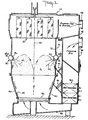
- a schematic diagram of the Freund Model FL80 flow coater is depicted in FIG. 1 and designated by reference number 10.
- the flow coater 10 includes a gas intake section 12, a frustro-conical body 14 into which gas from the intake section 12 is drawn to suspend particles 16 therein in a fluidized bed, and an exhaust section 18 for exhausting the gas used to fluidize the bed particles 16.
- Three binary-type nozzles 20 are equally-spaced about the circumference of an upper cylindrical portion 22 of the body 14, and spray binder solution into the bed particles 16.
- the binary nozzles 20 utilize gas flows for atomizing the binder solution and for controlling the geometric pattern of the spray.
- air be used as the gas for atomizing the binder solution (“atomizing air”), as the gas for controlling the pattern of the spray (“spray pattern air”), and as the gas for suspending and fluidizing the particles 16 in body 14 (“fluidizing air”).
- atomizing air the gas for atomizing the binder solution
- spray pattern air the gas for controlling the pattern of the spray
- fluidizing air the gas for suspending and fluidizing the particles 16 in body 14
- the gas intake section 12 includes a gas inlet 24 communicated with the atmosphere through which air is drawn into the flow coater 10. Disposed in the gas intake section 12 are heat exchangers 26 through which the incoming air is forced before being introduced into a plenum 28 connected to the conical bottom portion 30 of the flow coater body 14.
- the heat exchangers 26 can be conventional, and steam/air heat exchangers are preferred.
- the fluidizing air, after suspending and fluidizing the bed particles 16, is drawn through a micron filter 32 disposed in the exhaust section 18.
- An exhaust blower (not shown) is communicated with the exhaust outlet 34 of section 18 to draw air through the gas intake section 12, the plenum 28 and the body 14.
- the entire flow coater 10 is grounded by grounding connectors 35.
- the conical bottom portion 30 is a removable bowl having a bottom 36 which supports the particles 16 to be agglomerated while permitting the passage of air therethrough.
- the bottom 36 can comprise a screen sandwich or other structure capable of supporting powdered material while permitting air to flow through it and lift the powdered material.
- the bowl 30 includes an opening 38 closed by a transparent cover 40 to permit viewing into the bowl while agglomeration is proceeding.
- the binary nozzles 20 are disposed in the cylindrical portion 22 of the body 14 equally spaced about the circumference thereof.
- the axes 42 of the binary nozzles 20 are disposed at an angle with the horizontal such that the axes intersect at a point generally along the central axis 44 of the body 14 at or below the nozzles.
- the nozzles 20 are preferably aligned so that the spray ejected therefrom strikes the rising particles perpendicularly.
- the spherical body portion 46 of the nozzles 20 permits the nozzles to be adjusted and aligned along desired axes in the cylindrical portion 22 of the flow coater body.
- each binary nozzle 20 includes openings 60,62 and 64 through which liquid binder, atomizing air and pattern air are respectively expressed from the nozzle.
- a plurality of openings 62 for the atomizing air are disposed on each side of opening 60 including an annular opening surrounding opening 60, while a single opening 64 for the pattern air is provided on each side of opening 60.
- Passage 66 through which the liquid binder is delivered to opening 60 projects from the binary nozzle 20.
- the atomizing air and pattern air are expressed from the binary nozzle through a cap 68 which is threaded to the body 46 of the binary nozzle 20 and is adjustable thereon with respect to the position of the pattern air openings 64.
- the atomizing air and pattern air are introduced into the binary nozzle 20 through input openings 70,71, respectively, and are communicated with regulators 72, 73, respectively, via passages 74, 75 respectively.
- the atomizing air and pattern air are delivered to openings 62, 64 from the regulators 72, 73 through passages 76, 77 respectively, extending through the body 46 of the nozzle 20 to the cap 68.
- Passage 66 for the liquid binder solution is connected via input opening 78 to a fine-toothed, relatively pulseless gear pump 79 which pumps liquid binder solution from a tank 80 to input opening 78 at a constant, pulseless rate, and recycles the solution to the tank 80 from output opening 81 when spraying is discontinued.
- Input openings 70 and 71 are connected with an air compressor 83 via respective air pressure valves 85, 86, to control the volume of air to output openings 62, 64, respectively. Such valves may form part of the nozzle 20.
- the pressure and flow rate of the air expressed through openings 62 controls atomization and particle size of the liquid binder solution expressed from opening 60, and the pressure and flow rate of the air expressed through openings 64 control the pattern of the atomized liquid binder solution.
- the direction of the spray pattern can be controlled by adjustment of the pattern air pressure and/or flow rate, and the atomized particle size can be controlled by adjustment of the atomizing air pressure and flow rate, and the liquid binder pump rate.
- the nozzles 20 are commercially available as part of the Freund Model FL80 flow coater, and the construction and operation of the nozzles 4s understood by those of skill in the art.
- the air pressure of the atomizing air and pattern air and the pumping rate of the liquid binder solution are set and controlled in accordance with the particular agglomerate being produced. Also controlled are the quantity of fluidizing air being drawn to fluidize the bed particles, and the heat exchangers 26 to set the temperature of the air introduced into the flow coater.
- the bowl 30 charged with particles to be agglomerated is secured to the body 14 and the exhaust blower is activated to cause air to enter the inlet 14, pass through the heat exchangers 26 and enter into the body 14 after passing through the bowl 30.
- the incoming air lifts the particles 16 from the bowl and carries them upwardly into the central cylindrical portion 22 of the body 14 with some of the particles rising even higher into the exhaust section where they are trapped by the micron filter 32.
- a negative pressure is created in the body 14 and the lift created by the exhaust blower is controlled by the volume of air introduced so that the particles are lifted and maintained suspended in a fluidized state in the cylindrical portion 22, and the particles fall along the periphery of the body to be lifted again by the rising air. The particles are thus lifted and suspended and fall, continuously.
- the binary nozzles 20 are activated to spray binder solution onto the fluidized particles.
- the axes of the nozzles are positioned and the geometric spray pattern selected so that the upper part of the composite spray of the three nozzles is located at about the middle of the cylindrical lportion 22 and strikes the rising particles perpendicularly.
- the individual spray patterns are preferably generally fan-like in shape and the width of the individual spray patterns are such that substantially all of the cylindrical portion below and adjacent to the spray nozzles are covered by spray droplets.
- the spray nozzles 20 are activated intermittently to spray the fluidized particles 16 with binder solution and the particles are maintained in a fluidized state to effect partial drying of the particles between intermittent sprayings.
- the micron filter 32 is periodically shaken to return particles it has trapped back to the body 14. Afte-r the desired amount of solution has been sprayed by the nozzles 20, the particles are dried to a desired moisture content after which fluidization is stopped and the agglomerated particles fall into the bowl 30 which is removed from the flow coater. The agglomerate particles are then sized when they are to be used to make tablets.
- the atomizing air pressure and the pattern air pressure can be in the general range of from 1..5 atm to about 6 atm, the atomizing air flow in the general range of from about 100 m 3 /hr to about 200 m 3 /hr, the pattern air flow in the general range of from about 10 m 3 /hr to about 40 m 3 /hr, and the liquid binder flow rate in the general range of from about 60 ml/min to about 1,200 ml/min.
- atomizing air pressure and pattern air pressure 4-5 atm; atomizing air flow, 170 m 3 / hr ; pattern air flow, 20 m 3 /hr; liquid binder flow rate 300 ml/min; air pressure within the flow coater, -0.5 atm; fluidizing air temperature, about 80°.
- process parameters described above can be set and individually controlled by visual observation and manual setting, or by control systems which semi-automatically or automatically sense and regulate the parameters in accordance with a given control sequence.
- Process parameters for a particular agglomerate can be programmed into or manually set into such control systems.
- Computerized control systems can be used, if desired, and the construction and operation of control systems for controlling the foregoing process is within the skill of those in the computer and control system arts.
- Apparatus other than the Freund FL80 flow coater can be used to produce agglomerates according to the invention.
- One such apparatus is commercially available as a Freund mini-flow coater.
- This apparatus includes a single, centrally-disposed nozzle which sprays atomized binder solution into a fluidized bed from above the bed.
- Agglomerates have been made in accordance with the process described above using a Freund Model FL 80 flow coater.
- the agglomerates were made from a liquid binder solution and carbohydrate particles of the following materials: dextrose monohydrate; dextrose monohydrate and maltodextrin; fructose; fructose and maltodextrin; sucrose; sucrose and maltodextrin; lactose; lactose and maltodextrin; maltose; maltose and maltodextrin; xylose; xylose and maltodextrin.
- Aqueous solutions of the following materials were used as the liquid binder solution: corn syrup solids; dextrose; sucrose; polyvinylpyrollidone; cooked starch paste; and combinations of the foregoing, any of which may also include maltodextrin.
- the maltodextrin binder material has a D E of less than about 20% and preferably in the range of from about 5% to about 12%.
- the carbohydrate particles passed 50 mesh (particle size less than about 300 microns), and the water-insoluble active ingredients passed 325 mesh (particle size less than about 44 microns).
- Lubricant particles passed 325 mesh and other materials such as flavors passed 100 mesh.
- the precise size of the carbohydrate particles is not critical, but agglomerates made from materials having sizes larger than about 50 mesh for the carbohydrate particles and larger than about 300 mesh for the active ingredient do not produce tablets which liquify and melt in the mouth as quickly and as completely as those made with smaller particles.
- a preferred particle size for such active ingredients is from about 3 microns to about 10 microns.
- the agglomerate particles are sized -22 mesh, +100 mesh (between about 150 microns and about 800 microns).
- the agglomerate particle size is also not critical and particles in the above range produce tablets having preferred characteristics.
- Agglomerates made in accordance with the invention have a honeycomb or zeolite-like structure as described above, in which there are large amounts of voids and surface area. This structure is evident from the following physical characteristics of the agglomerates:
- Tablets made in accordance with the invention were found to be hard and smooth on the outside but rough, granular and soft on the inside, normally resistant to moisture on the outside and liquid-reactive on the inside. When masticated, the tablets liquified without perceivable grit within about 10 seconds.
- the maltodextrin was Maltrin M-100 (-100 mesh).
- Example I-XII the compressed air was supplied to thew binary nozzies at about room temperature (e.g., 20-25°C), and the binder' solution was supplied to the binary nozzles at about room temperature.
- the temperature of the particles charged in the flow coater (which may be at room temperature) was brought up to the bed temperature specified in the Examples by the fluidized air.
- the pressure in the flow coater in Examples I- XII was about -0.5 atmospheres.
- the agglomerates were dried to the specified moisture content, although they can be dried to the equilibrium moisture content if desired.
- the agglomerate is made as follows. Charge the flow coater with the dextrose monohydrate; begin fluidization and raise the bed temperature to 35° C. Begin spraying, with intermittent filter shaking and drying, until 10 liters of solution has been delivered through the nozzles onto the bed. Spraying is discontinuous, i.e., spraying followed by drying followed by spraying, to obtain low density particles and to maintain the bed in dynamic motion. To this end, spraying is controlled to prevent overwetting, which could disrupt the bed dynamics and/or produce higher density particles. Dry the product to a moisture content of 7.5% and remove the dextrose monohydrate/maltodextrin agglomerate from the flow coater. Pass the dextrose monohydrate/ maltodextrin agglomerates through a Sweeco sieve bank and crop particles from -22 mesh to +88 mesh.
- Example II The agglomerate produced according to Examples II-XII in Table A below, were made as generally described in connection with Example I.
- the pressure of the atomizing air and the pattern air was 5 atmospheres.
- the pressure of the atomizing air and the pattern air was 4 atmospheres.
- the liquid binder flow rate was 300 ml/min.
- the fluidizing air temperature was 80° C
- the agglomerate density was 0.4 gm/cc
- the agglomerate particle distribution was sized to -22 mesh, + 88 mesh.
- the agglomerates of Examples I-XII exhibited the quick-liquifying characteristics described herein and were suitable for making the inventive tablets described herein.
- the agglomerates exhibited good flow characteristics, did not lump in high humidity, liquified in water within 30 seconds with minimal stirring and were capable of entraining up to 50% by weight of an active ingredient.
- Example XIII a direct compression agglomerate including an active ingredient was processed directly, as generally described for Example I.
- the process parameters were as follows: The particles were dried to a moisture content of 4.0% and screened -22 mesh, +88 mesh.
- XIII A-C the charge was 60 kg and in XVII D and E, the charge was 300 gm.
- XIII A-D the flavors, the citric acid and the magnesium stearate, were added after the agglomerate was formed.
- the particle size of the calcium carbonate was about 3 microns to about 10 microns.
- the magnesium stearate passed -325 mesh and the flavors passed -100 mesh.
- Example XIII The agglomerates of Example XIII were observed to have generally the characteristics of the agglomerates of Examples I-XII except that they entrained up to about 76.6% by weight of an active ingredient.
- Example XIV through XVIII the specified active ingredient and lubricants and flavors such as citric acid were milled and weighed, and the specified agglomerate was weighed. These raw materials were then charged, in the pre-weighed quantities falling within the range of about 10% to about 50% by weight of the active ingredient and additives and from about 50% to about 90% by weight of the carbohydrate-based agglomerate, into a low shear blender, e.g., a low intensity ribbon-type mixer or a double trough sigma-type low intensity mixer. The raw materials were mixed in the low shear blender until the active and other ingredients were substantially entrained within the agglomerate.
- a low shear blender e.g., a low intensity ribbon-type mixer or a double trough sigma-type low intensity mixer.
- the resulting or finished agglomerate was discharged from the mixer and after validation was ready to be compressed into tablets.
- the aluminum hydroxide gel and the calcium carbonate had a particle size of from about 3 microns to about 10 microns while the dextromethophan adsorbate passed 100 mesh.
- the magnesium stearate passed 325 mesh and the flavors passed 100 mesh.
- the agglomerates of Examples XII-XVIII exhibited the quick-liquifying characteristics described herein and were suitable for making the inventive tablets described herein.
- the agglomerates exhibited good flow characteristics, did not lump in high humidity, and liquified in water at room temperature within 30 seconds with minimal stirring.
- Examples XIX through XXIV the finished agglomerate was introduced into standard tabletting apparatus and compressed at reduced pressures over those used conventially. The pressure was selected to yield tablets having hardnesses of from about 6 kp to about 8 kp and from 12 kp to about 14 kp, which produced tablets having an outer shell in which the large surface area structure of the agglomerate was essentially destroyed and an interior which retained the open-pore structure.
- the finished agglomerate was compressed into 1.5 gm flat-faced, bevelled-edge tablets.
- the calcium carbonate had a particle size of from about 3 microns to about 10 microns and the oyster shell passed 300 mesh.
- the magnesium sterate and citric acid passed 325 mesh.
- the flavors passed 100 mesh.
- the tablets of Examples XIX-XXV were found to have the characteristics described herein, i.e., a relatively hard outer shell and a relatively soft interior.
- the outer shell resisted liquification and unbroken tablets were generally non-hygroscopic. However, once the outer shell was broken and the tablet broken into pieces, it liquified quickly in water, and when masticated, it liquified in the mouth within a few seconds to about 10 seconds into a smooth liquid without perceivable grit.
Landscapes
- Health & Medical Sciences (AREA)
- Life Sciences & Earth Sciences (AREA)
- Veterinary Medicine (AREA)
- Public Health (AREA)
- Epidemiology (AREA)
- Pharmacology & Pharmacy (AREA)
- Animal Behavior & Ethology (AREA)
- General Health & Medical Sciences (AREA)
- Medicinal Chemistry (AREA)
- Chemical & Material Sciences (AREA)
- Zoology (AREA)
- Nutrition Science (AREA)
- Physiology (AREA)
- Medicinal Preparation (AREA)
- Pharmaceuticals Containing Other Organic And Inorganic Compounds (AREA)
- Saccharide Compounds (AREA)
- Acyclic And Carbocyclic Compounds In Medicinal Compositions (AREA)
Priority Applications (1)
| Application Number | Priority Date | Filing Date | Title |
|---|---|---|---|
| AT86301125T ATE66368T1 (de) | 1985-02-19 | 1986-02-18 | Sich schnell verfluessigende kautablette. |
Applications Claiming Priority (2)
| Application Number | Priority Date | Filing Date | Title |
|---|---|---|---|
| US702818 | 1985-02-19 | ||
| US06/702,818 US4684534A (en) | 1985-02-19 | 1985-02-19 | Quick-liquifying, chewable tablet |
Publications (3)
| Publication Number | Publication Date |
|---|---|
| EP0192460A2 true EP0192460A2 (fr) | 1986-08-27 |
| EP0192460A3 EP0192460A3 (en) | 1988-01-27 |
| EP0192460B1 EP0192460B1 (fr) | 1991-08-21 |
Family
ID=24822731
Family Applications (1)
| Application Number | Title | Priority Date | Filing Date |
|---|---|---|---|
| EP19860301125 Expired - Lifetime EP0192460B1 (fr) | 1985-02-19 | 1986-02-18 | Comprimé à mâcher se liquéfiant rapidement |
Country Status (7)
| Country | Link |
|---|---|
| US (1) | US4684534A (fr) |
| EP (1) | EP0192460B1 (fr) |
| JP (1) | JP2540131B2 (fr) |
| AT (1) | ATE66368T1 (fr) |
| AU (1) | AU584674B2 (fr) |
| CA (1) | CA1256028A (fr) |
| DE (1) | DE3680930D1 (fr) |
Cited By (8)
| Publication number | Priority date | Publication date | Assignee | Title |
|---|---|---|---|---|
| EP0193651A3 (en) * | 1985-03-06 | 1987-08-12 | Suomen Sokeri Oy | Binder-diluent composition and method |
| EP0471967A1 (fr) * | 1990-07-19 | 1992-02-26 | MERCK PATENT GmbH | Comprimé à mâcher à base de sucralfate |
| US5213806A (en) * | 1990-11-29 | 1993-05-25 | Hokuriku Pharmaceutical Co., Ltd. | Pharmaceutical composition comprising calcium polycarbophil |
| EP0553777A3 (en) * | 1992-01-29 | 1994-12-14 | Takeda Chemical Industries Ltd | Fast dissolving tablet and its production |
| DE19811167A1 (de) * | 1998-03-14 | 1999-09-16 | Findusfit Sportdiaetetika Gmbh | Tablette, Lutschtablette zur Kohlenhydratversorgung mit Langzeitwirkung |
| WO2000028973A1 (fr) * | 1998-11-13 | 2000-05-25 | Nycomed Pharma As | Procede de preparation de compositions orales a base de calcium |
| DE19931708A1 (de) * | 1999-07-08 | 2001-01-18 | Bayer Ag | Verfahren zur Herstellung schnell zerfallender, fester pharmazeutischer Zubereitungen |
| EP1108792A1 (fr) * | 1999-12-17 | 2001-06-20 | Roquette FrÀ¨res | Dextrose hydrate pulvérulent et son procédé de préparation |
Families Citing this family (94)
| Publication number | Priority date | Publication date | Assignee | Title |
|---|---|---|---|---|
| US5286748A (en) * | 1981-01-05 | 1994-02-15 | Eby Iii George A | General method of shortening the duration of common colds by application of medicaments to tissues of oral cavity |
| EP0273209B1 (fr) * | 1986-12-30 | 1992-01-15 | American Cyanamid Company | Composition contenant un polycarbophile |
| US4789546A (en) * | 1987-02-19 | 1988-12-06 | Consumer Products Corp. | Multiple-layer tablet with contrasting organoleptic characteristics |
| US5387431A (en) * | 1991-10-25 | 1995-02-07 | Fuisz Technologies Ltd. | Saccharide-based matrix |
| US4808411A (en) * | 1987-06-05 | 1989-02-28 | Abbott Laboratories | Antibiotic-polymer compositions |
| US4853236A (en) * | 1988-03-18 | 1989-08-01 | General Mills, Inc. | Dual textured food piece of enhanced stability |
| US4847098A (en) * | 1988-03-18 | 1989-07-11 | General Mills, Inc. | Dual textured food piece of enhanced stability |
| US5417985A (en) * | 1989-07-20 | 1995-05-23 | Farmalyoc | Solid and porous single dosage form comprising particles in the form of beads and its preparation |
| USRE35893E (en) * | 1989-10-19 | 1998-09-08 | Valentine Enterprises, Inc. | Defoaming composition |
| US5275822A (en) * | 1989-10-19 | 1994-01-04 | Valentine Enterprises, Inc. | Defoaming composition |
| US5073384A (en) * | 1989-10-19 | 1991-12-17 | Valentine Enterprises, Inc. | Maltodextrin/defoaming composition combinate |
| DE69111287T2 (de) * | 1990-04-18 | 1995-12-21 | Asahi Chemical Ind | Kugelförmige Keimkerne, kugelförmige Granulate sowie Verfahren zu deren Herstellung. |
| NZ239802A (en) * | 1990-09-21 | 1993-09-27 | Merrell Dow Pharma | A superior tasting pharmaceutical composition having porous particles produced through in situ gas generation and a process for its production |
| US5629013A (en) * | 1991-04-04 | 1997-05-13 | The Procter & Gamble Company | Chewable calcium carbonate antacid tablet compositions |
| US5576042A (en) * | 1991-10-25 | 1996-11-19 | Fuisz Technologies Ltd. | High intensity particulate polysaccharide based liquids |
| PL170554B1 (pl) * | 1991-12-17 | 1996-12-31 | Fuisz Technologies Ltd | Sposób wytwarzania kompozycji przeciwwrzodowej PL PL PL |
| FI103442B1 (fi) * | 1993-09-24 | 1999-06-30 | Nokia Telecommunications Oy | Digitaalinen radiolinkkijärjestelmä ja radiolinkkilaite |
| US5976570A (en) * | 1993-12-21 | 1999-11-02 | Applied Analytical Industries, Inc. | Method for preparing low dose pharmaceutical products |
| US5928668A (en) * | 1993-12-21 | 1999-07-27 | Applied Analytical Industries, Inc. | Method for dry blend compression of medicaments |
| US5582855A (en) * | 1994-07-01 | 1996-12-10 | Fuisz Technologies Ltd. | Flash flow formed solloid delivery systems |
| US5556652A (en) * | 1994-08-05 | 1996-09-17 | Fuisz Technologies Ltd. | Comestibles containing stabilized highly odorous flavor component delivery systems |
| US5609883A (en) * | 1994-09-16 | 1997-03-11 | Advanced Technology Pharmaceuticals Corporation | Compressed tablet transitory lubricant system |
| US5587198A (en) * | 1995-05-31 | 1996-12-24 | Fuisz Technologies Ltd. | Positive hydration method of preparing confectionery and product therefrom |
| US6001408A (en) | 1995-10-13 | 1999-12-14 | Corn Products International, Inc. | Starch products having hot or cold water dispersibility and hot or cold swelling viscosity |
| US6312756B1 (en) | 1995-10-13 | 2001-11-06 | Corn Products International, Inc. | Starch products having hot or cold water dispersibility and hot or cold swelling viscosity |
| US5807577A (en) * | 1995-11-22 | 1998-09-15 | Lab Pharmaceutical Research International Inc. | Fast-melt tablet and method of making same |
| JP4090529B2 (ja) * | 1996-01-24 | 2008-05-28 | フロイント産業株式会社 | 乳糖の球形粒及びその製造方法 |
| ATE260646T1 (de) * | 1996-04-16 | 2004-03-15 | Novartis Consumer Health Sa | Schnell zerfallende orale dosierungsform |
| US5939091A (en) * | 1997-05-20 | 1999-08-17 | Warner Lambert Company | Method for making fast-melt tablets |
| US6465009B1 (en) | 1998-03-18 | 2002-10-15 | Yamanouchi Pharmaceutical Co., Ltd. | Water soluble polymer-based rapidly dissolving tablets and production processes thereof |
| US6296868B1 (en) | 1998-11-19 | 2001-10-02 | Advanced Technology Pharmaceuticals Corporation | Chewable tablets containing mannitol and aspartame |
| FR2790387B1 (fr) * | 1999-03-01 | 2001-05-18 | Prographarm Laboratoires | Comprime orodispersible presentant une faible friabilite et son procede de preparation |
| US6667050B1 (en) | 1999-04-06 | 2003-12-23 | Galen (Chemicals) Limited | Chewable oral contraceptive |
| US6495177B1 (en) * | 1999-08-13 | 2002-12-17 | Warner Chilcott Laboratories Ireland Limited | Orally dissolvable nutritional supplement |
| US6399591B1 (en) | 2000-01-19 | 2002-06-04 | Yung-Shin Pharmaceutical Ind. Co., Ltd. | Chargeable pharmaceutical tablets |
| US6258381B1 (en) | 2000-02-11 | 2001-07-10 | Mcneil-Ppc, Inc. | Tablet and process for making the same |
| US6277409B1 (en) | 2000-02-11 | 2001-08-21 | Mcneil-Ppc, Inc. | Protective coating for tablet |
| US6375982B1 (en) | 2000-07-05 | 2002-04-23 | Capricorn Pharma, Inc. | Rapid-melt semi-solid compositions, methods of making same and method of using same |
| AU2001279284A1 (en) * | 2000-07-05 | 2002-01-14 | Capricorn Pharma, Inc | Rapid-melt semi-solid compositions, methods of making same and methods of using same |
| US20020122823A1 (en) * | 2000-12-29 | 2002-09-05 | Bunick Frank J. | Soft tablet containing dextrose monohydrate |
| GB0114746D0 (en) * | 2001-06-16 | 2001-08-08 | Boots Co Plc | Medicinal composition |
| US7914811B2 (en) * | 2001-06-29 | 2011-03-29 | Mcneil-Ppc, Inc. | Brittle-coating, soft core dosage form |
| US20040013732A1 (en) * | 2001-09-25 | 2004-01-22 | Michael Farber | Starch-based delivery system for creatine |
| CA2461616A1 (fr) * | 2001-09-28 | 2003-04-03 | Mcneil-Ppc, Inc. | Forme pharmaceutique composite ayant une partie incrustee |
| US7122143B2 (en) | 2001-09-28 | 2006-10-17 | Mcneil-Ppc, Inc. | Methods for manufacturing dosage forms |
| US7838026B2 (en) | 2001-09-28 | 2010-11-23 | Mcneil-Ppc, Inc. | Burst-release polymer composition and dosage forms comprising the same |
| US7067150B2 (en) * | 2002-04-16 | 2006-06-27 | Scepter Holdings, Inc. | Delivery systems for functional ingredients |
| US20030215498A1 (en) * | 2002-05-17 | 2003-11-20 | Harland Ronald S. | Rapidly disintegrating comressed tablets comprising biologically active compounds |
| US8617617B2 (en) * | 2002-12-10 | 2013-12-31 | Everett Laboratories, Inc. | Methods and kits for co-administration of nutritional supplements |
| US7198653B2 (en) * | 2003-07-31 | 2007-04-03 | Delavau Llc | Calcium carbonate granulation |
| US7282217B1 (en) | 2003-08-29 | 2007-10-16 | Kv Pharmaceutical Company | Rapidly disintegrable tablets |
| EP1687358B1 (fr) * | 2003-10-10 | 2011-06-22 | Dow Corning Corporation | Resines de silicium a fonction carbinol |
| US7452956B2 (en) * | 2003-10-10 | 2008-11-18 | Dow Corning Corporation | Urethane compositions containing carbinol-functional silicone resins |
| US20080160086A1 (en) * | 2004-02-19 | 2008-07-03 | Scepter Holdings, Inc. | Delivery Systems For Calcium |
| EP1582221A1 (fr) * | 2004-03-31 | 2005-10-05 | Chiesi S.A. | Composition pharmaceutique pour masquer le gout de principes actifs |
| MXPA06013608A (es) * | 2004-05-24 | 2007-04-26 | Nycomed Pharma As | Particulado que comprende un compuesto que contiene calcio y un alcohol de azucar. |
| JP4996458B2 (ja) * | 2004-06-01 | 2012-08-08 | ニコメド ファーマ エイエス | 活性物質としてカルシウム含有化合物を含み、咀嚼し、舐め、飲み込むことのできる錠剤 |
| ATE430559T1 (de) * | 2005-03-04 | 2009-05-15 | Nycomed Pharma As | Verfahren zur herstellung von calciumzusammensetzungen im kontinuierlichen fliessbett |
| US20070207093A1 (en) * | 2005-11-03 | 2007-09-06 | Linquagen Corp. | Hydrazone derivatives and uses thereof |
| US8679545B2 (en) | 2005-11-12 | 2014-03-25 | The Regents Of The University Of California | Topical corticosteroids for the treatment of inflammatory diseases of the gastrointestinal tract |
| US8324192B2 (en) | 2005-11-12 | 2012-12-04 | The Regents Of The University Of California | Viscous budesonide for the treatment of inflammatory diseases of the gastrointestinal tract |
| US8497258B2 (en) | 2005-11-12 | 2013-07-30 | The Regents Of The University Of California | Viscous budesonide for the treatment of inflammatory diseases of the gastrointestinal tract |
| UA95093C2 (uk) | 2005-12-07 | 2011-07-11 | Нікомед Фарма Ас | Спосіб одержання кальцієвмісної сполуки |
| SG160335A1 (en) * | 2006-08-22 | 2010-04-29 | Redpoint Bio Corp | Heterocyclic compounds as sweetener enhancers |
| WO2008033545A2 (fr) * | 2006-09-15 | 2008-03-20 | Redpoint Bio Corporation | Dérivés de l'oxyde de triphénylphosphine et utilisation de ceux-ci |
| US20080153845A1 (en) * | 2006-10-27 | 2008-06-26 | Redpoint Bio Corporation | Trpv1 antagonists and uses thereof |
| JP2010518008A (ja) * | 2007-02-02 | 2010-05-27 | レッドポイント バイオ コーポレイション | インスリンおよびglp−1の放出を調節するtrpm5阻害物質 |
| US20080254119A1 (en) * | 2007-04-16 | 2008-10-16 | Wyeth | Imbedded liquid lubricants for tableting |
| EP2175740B1 (fr) * | 2007-07-31 | 2018-06-06 | Cargill, Incorporated | Dextrose pouvant être soumise à une compression directe et comprimés la comprenant |
| US20090060983A1 (en) * | 2007-08-30 | 2009-03-05 | Bunick Frank J | Method And Composition For Making An Orally Disintegrating Dosage Form |
| AU2008318851B2 (en) * | 2007-10-31 | 2014-04-17 | Mcneil-Ppc, Inc. | Orally disintegrated dosage form |
| US20100216754A1 (en) * | 2007-11-13 | 2010-08-26 | Meritage Pharma, Inc. | Compositions for the treatment of inflammation of the gastrointestinal tract |
| EP2214679B1 (fr) | 2007-11-13 | 2019-03-27 | Meritage Pharma, Inc. | Compositions corticostéroïdiennes |
| US20090143343A1 (en) * | 2007-11-13 | 2009-06-04 | Meritage Pharma, Inc. | Compositions for the treatment of inflammation of the gastrointestinal tract |
| US20090123551A1 (en) * | 2007-11-13 | 2009-05-14 | Meritage Pharma, Inc. | Gastrointestinal delivery systems |
| BRPI0819571A2 (pt) | 2007-12-20 | 2019-09-24 | Teva Womenss Health Inc | "método para contracepção de emergência, pacote farmacêutico para contracepção de emergência e composição farmacêutica" |
| US20090264392A1 (en) * | 2008-04-21 | 2009-10-22 | Meritage Pharma, Inc. | Treating eosinophilic esophagitis |
| CN102573521B (zh) | 2009-09-04 | 2014-04-09 | 红点生物公司 | 包括莱鲍迪苷a或d的甜度增强剂 |
| AU2010298437B2 (en) | 2009-09-22 | 2014-06-19 | Redpoint Bio Corporation | Novel polymorphs of rebaudioside C and methods for making and using the same |
| US20110070286A1 (en) * | 2009-09-24 | 2011-03-24 | Andreas Hugerth | Process for the manufacture of nicotine-comprising chewing gum and nicotine-comprising chewing gum manufactured according to said process |
| US20110318411A1 (en) | 2010-06-24 | 2011-12-29 | Luber Joseph R | Multi-layered orally disintegrating tablet and the manufacture thereof |
| US8313768B2 (en) | 2009-09-24 | 2012-11-20 | Mcneil-Ppc, Inc. | Manufacture of tablet having immediate release region and sustained release region |
| US8871263B2 (en) | 2009-09-24 | 2014-10-28 | Mcneil-Ppc, Inc. | Manufacture of tablet in a die utilizing radiofrequency energy and meltable binder |
| US8657483B2 (en) * | 2010-09-03 | 2014-02-25 | Cabot Norit Americas, Inc. | Apparatuses for dilute phase impregnation of a milled sorbent with a chemical compound in an aqueous solution |
| CN105063104B (zh) | 2011-08-08 | 2019-08-13 | 国际香料香精公司 | 用于香草醛或香草醛β-D-葡萄糖苷的生物合成的组合物和方法 |
| US9511028B2 (en) | 2012-05-01 | 2016-12-06 | Johnson & Johnson Consumer Inc. | Orally disintegrating tablet |
| US9233491B2 (en) | 2012-05-01 | 2016-01-12 | Johnson & Johnson Consumer Inc. | Machine for production of solid dosage forms |
| US9445971B2 (en) | 2012-05-01 | 2016-09-20 | Johnson & Johnson Consumer Inc. | Method of manufacturing solid dosage form |
| US9820944B1 (en) * | 2013-07-23 | 2017-11-21 | The Mbp Company Llc | (citric) acid/maltodextrin co-agglomerate |
| EP2880992A3 (fr) | 2013-12-05 | 2015-06-17 | International Flavors & Fragrances Inc. | Rébaudioside C et ses stéréoisomères utilisables en tant que renforçateurs de goût sucré de produits naturels |
| WO2015105992A1 (fr) | 2014-01-10 | 2015-07-16 | Mcneil-Ppc, Inc. | Procédé pour fabriquer un comprimé par radiofréquence et particules revêtues à perte |
| US10493026B2 (en) | 2017-03-20 | 2019-12-03 | Johnson & Johnson Consumer Inc. | Process for making tablet using radiofrequency and lossy coated particles |
| EP4464335A3 (fr) | 2018-10-18 | 2025-03-05 | Kenvue Brands LLC | Nouvelle forme posologique |
| CN109674063A (zh) * | 2019-01-10 | 2019-04-26 | 宁波博丰生物科技有限公司 | 一种牡蛎多肽泡腾片及其制备方法 |
Family Cites Families (38)
| Publication number | Priority date | Publication date | Assignee | Title |
|---|---|---|---|---|
| US2421801A (en) * | 1941-09-22 | 1947-06-10 | Gromiller Inc | Apparatus for fusing the coating on tablets |
| GB736591A (en) * | 1952-03-31 | 1955-09-14 | Micro Proc Equipment Inc | Method and apparatus for compacting pulverized solid materials |
| US2996431A (en) * | 1953-12-16 | 1961-08-15 | Barry Richard Henry | Friable tablet and process for manufacturing same |
| US2830010A (en) * | 1956-05-14 | 1958-04-08 | American Cyanamid Co | Powder-filled hexylresorcinol capsules |
| US2813123A (en) * | 1956-05-14 | 1957-11-12 | American Cyanamid Co | Stable dry powder compositions containing pantothenyl alcohol and methods of preparing same |
| US2879161A (en) * | 1956-05-14 | 1959-03-24 | American Cyanamid Co | Stable dry powder compositions containing choline chloride and methods of preparing same |
| US2946724A (en) * | 1957-05-29 | 1960-07-26 | American Cyanamid Co | Stable poliomyelitis live virus vaccine |
| US3085944A (en) * | 1960-04-19 | 1963-04-16 | American Cyanamid Co | Free-flowing intrinsic factor concentrate |
| US3055804A (en) * | 1961-03-29 | 1962-09-25 | American Cyanamid Co | Mange powders |
| US3305447A (en) * | 1963-06-12 | 1967-02-21 | American Sugar | Tabletting sugar and method of preparing same |
| BR6570825D0 (pt) * | 1964-07-04 | 1973-08-16 | Shiryo Kogyo Co Inc Nippon | Processo para produzir granulos cristalizados a partir de solucoes de acucares e outros cristaloides |
| US3365331A (en) * | 1964-07-06 | 1968-01-23 | American Sugar | Sugar process and product |
| GB1063535A (en) * | 1965-06-16 | 1967-03-30 | Gen Foods Corp | Method of agglomerating food powders |
| US3849194A (en) * | 1966-12-19 | 1974-11-19 | Cpc International Inc | Low d.e. starch conversion products |
| US3619292A (en) * | 1968-07-15 | 1971-11-09 | Penick & Ford Ltd | Tablets and method of forming |
| US3619294A (en) * | 1968-07-15 | 1971-11-09 | Penick & Ford Ltd | Method of combining crystalline sugar with impregnating agents and products produced thereby |
| GB1286275A (en) * | 1968-10-14 | 1972-08-23 | Cpc International Inc | Agglomerable sugar composition |
| US4013775A (en) * | 1968-10-14 | 1977-03-22 | Cpc International Inc. | Process for preparing a sugar tablet |
| US3639169A (en) * | 1969-04-29 | 1972-02-01 | Sucrest Corp | Direct compression vehicles and method therefor |
| US3627583A (en) * | 1969-04-29 | 1971-12-14 | Sucrest Corp | Direct compression vehicles |
| US3639168A (en) * | 1969-04-29 | 1972-02-01 | Sucrest Corp | Direct compression vehicles |
| US3622677A (en) * | 1969-07-07 | 1971-11-23 | Staley Mfg Co A E | Compressed tablets containing compacted starch as binder-disintegrant ingredient |
| US3642535A (en) * | 1970-01-21 | 1972-02-15 | American Sugar | Tabletting sugar, method of preparing compositions containing same |
| US3619293A (en) * | 1970-02-18 | 1971-11-09 | Nippon Shiryo Kogyo Kk | Granular sucrose products and process for producing same |
| US3674555A (en) * | 1970-06-24 | 1972-07-04 | Cpc International Inc | Low density starch hydrolysates |
| US3725556A (en) * | 1970-11-12 | 1973-04-03 | D Hanssen | Method of manufacturing rapidly disintegrating pharmaceutical tablets |
| US3873694A (en) * | 1973-09-27 | 1975-03-25 | Cpc International Inc | Direct compression tabletting composition and pharmaceutical tablets produced therefrom |
| JPS5239580A (en) * | 1975-09-25 | 1977-03-26 | Sankyo Co Ltd | Method of grain making for fluidizing bed |
| FR2364059A1 (fr) * | 1976-09-08 | 1978-04-07 | Cazaux Michel | Procede de transformation de substances liquides ou solides ou de leurs melanges en des adsorbats solides |
| US4349542A (en) * | 1979-06-08 | 1982-09-14 | National Research Development Corporation | Mixture containing active ingredient and dendritic crystalline sugar for tableting |
| JPS5759803A (en) * | 1980-09-30 | 1982-04-10 | Takeda Chem Ind Ltd | Granule of l-sodium ascorbate, its preparation, and tablet comprising it |
| US4327077A (en) * | 1981-05-29 | 1982-04-27 | Life Savers, Inc. | Compressed chewable antacid tablet and method for forming same |
| IE53474B1 (en) * | 1981-09-17 | 1988-11-23 | Warner Lambert Co | A chewable comestible product and process for its production |
| CH664691A5 (it) * | 1982-03-15 | 1988-03-31 | Eurand France S A | Compressa a forma di capsula, procedimento e dispositivo per la sua preparazione. |
| US4447532A (en) * | 1982-04-29 | 1984-05-08 | H. J. Heinz Company | Process for the manufacture of low D.E. maltodextrins |
| US4517179A (en) * | 1983-04-29 | 1985-05-14 | Pennwalt Corporation | Rapid dissolving, uniform drug compositions and their preparation |
| EP0124663A1 (fr) * | 1983-05-04 | 1984-11-14 | General Foods Corporation | Tablettes comprimées |
| US4829907A (en) * | 1986-10-13 | 1989-05-16 | Franz Plasser Bahnbaumaschinen-Industriegesellschaft M.B.H. | Mobile installation for loading, transporting and unloading as well as exchanging railroad ties |
-
1985
- 1985-02-19 US US06/702,818 patent/US4684534A/en not_active Expired - Lifetime
- 1985-11-04 CA CA000494529A patent/CA1256028A/fr not_active Expired
-
1986
- 1986-02-18 AT AT86301125T patent/ATE66368T1/de not_active IP Right Cessation
- 1986-02-18 DE DE8686301125T patent/DE3680930D1/de not_active Expired - Lifetime
- 1986-02-18 EP EP19860301125 patent/EP0192460B1/fr not_active Expired - Lifetime
- 1986-02-19 JP JP61034949A patent/JP2540131B2/ja not_active Expired - Lifetime
- 1986-02-19 AU AU53772/86A patent/AU584674B2/en not_active Ceased
Cited By (17)
| Publication number | Priority date | Publication date | Assignee | Title |
|---|---|---|---|---|
| EP0193651A3 (en) * | 1985-03-06 | 1987-08-12 | Suomen Sokeri Oy | Binder-diluent composition and method |
| EP0471967A1 (fr) * | 1990-07-19 | 1992-02-26 | MERCK PATENT GmbH | Comprimé à mâcher à base de sucralfate |
| US5213806A (en) * | 1990-11-29 | 1993-05-25 | Hokuriku Pharmaceutical Co., Ltd. | Pharmaceutical composition comprising calcium polycarbophil |
| EP0553777A3 (en) * | 1992-01-29 | 1994-12-14 | Takeda Chemical Industries Ltd | Fast dissolving tablet and its production |
| US5501861A (en) * | 1992-01-29 | 1996-03-26 | Takeda Chemical Industries, Ltd. | Fast dissolving tablet and its production |
| US5720974A (en) * | 1992-01-29 | 1998-02-24 | Takeda Chemical Industries, Ltd. | Fast dissolving tablet and its production |
| DE19811167A1 (de) * | 1998-03-14 | 1999-09-16 | Findusfit Sportdiaetetika Gmbh | Tablette, Lutschtablette zur Kohlenhydratversorgung mit Langzeitwirkung |
| EP1743629A1 (fr) * | 1998-11-13 | 2007-01-17 | Nycomed Pharma AS | Procédé pour préparer des compositions orales à base de calcium |
| WO2000028973A1 (fr) * | 1998-11-13 | 2000-05-25 | Nycomed Pharma As | Procede de preparation de compositions orales a base de calcium |
| NO331462B1 (no) * | 1998-11-13 | 2012-01-09 | Nycomed Pharma As | Fremgangsmåte for fremstilling av en oralt administrerbar kalsiumblanding i tablettform |
| US8007752B2 (en) | 1998-11-13 | 2011-08-30 | Nycomed Pharma As | Process for preparing oral calcium compositions |
| US7638143B2 (en) * | 1998-11-13 | 2009-12-29 | Nycomed Pharma As | Process for preparing oral calcium compositions |
| DE19931708A1 (de) * | 1999-07-08 | 2001-01-18 | Bayer Ag | Verfahren zur Herstellung schnell zerfallender, fester pharmazeutischer Zubereitungen |
| US6602520B1 (en) | 1999-07-08 | 2003-08-05 | Bayer Ag | Method for producing quickly decomposable solid pharmaceutical preparations |
| US6881432B2 (en) | 1999-12-17 | 2005-04-19 | Roquette Freres | Dextrose hydrate in powder form and a process for the preparation thereof |
| FR2802551A1 (fr) * | 1999-12-17 | 2001-06-22 | Roquette Freres | Dextrose hydrate pulverulent et son procede de preparation |
| EP1108792A1 (fr) * | 1999-12-17 | 2001-06-20 | Roquette FrÀ¨res | Dextrose hydrate pulvérulent et son procédé de préparation |
Also Published As
| Publication number | Publication date |
|---|---|
| JP2540131B2 (ja) | 1996-10-02 |
| DE3680930D1 (de) | 1991-09-26 |
| AU584674B2 (en) | 1989-06-01 |
| EP0192460A3 (en) | 1988-01-27 |
| JPS61225119A (ja) | 1986-10-06 |
| US4684534A (en) | 1987-08-04 |
| ATE66368T1 (de) | 1991-09-15 |
| CA1256028A (fr) | 1989-06-20 |
| EP0192460B1 (fr) | 1991-08-21 |
| AU5377286A (en) | 1986-08-28 |
Similar Documents
| Publication | Publication Date | Title |
|---|---|---|
| US4684534A (en) | Quick-liquifying, chewable tablet | |
| US6296868B1 (en) | Chewable tablets containing mannitol and aspartame | |
| RU2180560C2 (ru) | Способ улучшения вкуса твердых препаратов, состав и твердый препарат с улучшенным вкусом | |
| EP1001748B1 (fr) | Procede de preparation de granules servant a produire des comprimes solubles dans la bouche a desintegration rapide | |
| JP4213867B2 (ja) | 経口用カルシウム組成物の調製方法 | |
| AU669952B2 (en) | Taste-masking compositions of ranitidine | |
| CA2082137C (fr) | Utilisation d'esters aliphatiques pour l'enrobage sans solvant de produits pharmaceutiques | |
| US4797288A (en) | Novel drug delivery system | |
| CA2131285C (fr) | Compositions pharmaceutiques pour inhalation | |
| CA2061998C (fr) | Carbonate de magnesium et produit facilitant la compression de l'huile | |
| US4327076A (en) | Compressed chewable antacid tablet and method for forming same | |
| US4835188A (en) | Spray dried ibuprofen | |
| US5609883A (en) | Compressed tablet transitory lubricant system | |
| HUT76551A (en) | Quickly dispersing comestible unit and product | |
| US4933183A (en) | Novel drug delivery system for mineral supplements | |
| JP2005232260A (ja) | セルロース無機化合物多孔質複合粒子 | |
| AU643703B2 (en) | Magnesium carbonate and oil tableting aid | |
| US4352821A (en) | Sweet tableting agent | |
| GB2353933A (en) | Compositions comprising trehalose for forming tablets | |
| KR100466897B1 (ko) | 약제학적활성성분의향미개선 | |
| US11033497B2 (en) | (Citric) acid/maltodextrin co-agglomerate | |
| TW508240B (en) | Process for improving the taste picture of solid formulations |
Legal Events
| Date | Code | Title | Description |
|---|---|---|---|
| PUAI | Public reference made under article 153(3) epc to a published international application that has entered the european phase |
Free format text: ORIGINAL CODE: 0009012 |
|
| AK | Designated contracting states |
Kind code of ref document: A2 Designated state(s): AT BE CH DE FR GB IT LI LU NL SE |
|
| PUAL | Search report despatched |
Free format text: ORIGINAL CODE: 0009013 |
|
| AK | Designated contracting states |
Kind code of ref document: A3 Designated state(s): AT BE CH DE FR GB IT LI LU NL SE |
|
| 17P | Request for examination filed |
Effective date: 19880715 |
|
| 17Q | First examination report despatched |
Effective date: 19900402 |
|
| GRAA | (expected) grant |
Free format text: ORIGINAL CODE: 0009210 |
|
| AK | Designated contracting states |
Kind code of ref document: B1 Designated state(s): AT BE CH DE FR GB IT LI LU NL SE |
|
| REF | Corresponds to: |
Ref document number: 66368 Country of ref document: AT Date of ref document: 19910915 Kind code of ref document: T |
|
| REF | Corresponds to: |
Ref document number: 3680930 Country of ref document: DE Date of ref document: 19910926 |
|
| ITF | It: translation for a ep patent filed | ||
| ET | Fr: translation filed | ||
| RAP4 | Party data changed (patent owner data changed or rights of a patent transferred) |
Owner name: DYNAGRAN CORPORATION OF AMERICA |
|
| REG | Reference to a national code |
Ref country code: CH Ref legal event code: PFA Free format text: DYNAGRAN CORPORATION OF AMERICA |
|
| PLBE | No opposition filed within time limit |
Free format text: ORIGINAL CODE: 0009261 |
|
| STAA | Information on the status of an ep patent application or granted ep patent |
Free format text: STATUS: NO OPPOSITION FILED WITHIN TIME LIMIT |
|
| 26N | No opposition filed | ||
| PGFP | Annual fee paid to national office [announced via postgrant information from national office to epo] |
Ref country code: CH Payment date: 19940208 Year of fee payment: 9 |
|
| PGFP | Annual fee paid to national office [announced via postgrant information from national office to epo] |
Ref country code: AT Payment date: 19940216 Year of fee payment: 9 |
|
| PGFP | Annual fee paid to national office [announced via postgrant information from national office to epo] |
Ref country code: SE Payment date: 19940225 Year of fee payment: 9 |
|
| PGFP | Annual fee paid to national office [announced via postgrant information from national office to epo] |
Ref country code: NL Payment date: 19940228 Year of fee payment: 9 Ref country code: LU Payment date: 19940228 Year of fee payment: 9 |
|
| PGFP | Annual fee paid to national office [announced via postgrant information from national office to epo] |
Ref country code: BE Payment date: 19940303 Year of fee payment: 9 |
|
| EPTA | Lu: last paid annual fee | ||
| REG | Reference to a national code |
Ref country code: CH Ref legal event code: PFA Free format text: ADVANCED TECHNOLOGY PHARMACEUTICALS CORPORATION |
|
| REG | Reference to a national code |
Ref country code: GB Ref legal event code: 732E |
|
| ITPR | It: changes in ownership of a european patent |
Owner name: CAMBIO RAGIONE SOCIA;ADVANCED TECHNOLOGY PHARMACEU |
|
| EAL | Se: european patent in force in sweden |
Ref document number: 86301125.0 |
|
| PG25 | Lapsed in a contracting state [announced via postgrant information from national office to epo] |
Ref country code: LU Free format text: LAPSE BECAUSE OF NON-PAYMENT OF DUE FEES Effective date: 19950218 Ref country code: AT Effective date: 19950218 |
|
| PG25 | Lapsed in a contracting state [announced via postgrant information from national office to epo] |
Ref country code: SE Effective date: 19950219 |
|
| PG25 | Lapsed in a contracting state [announced via postgrant information from national office to epo] |
Ref country code: LI Effective date: 19950228 Ref country code: CH Effective date: 19950228 Ref country code: BE Effective date: 19950228 |
|
| REG | Reference to a national code |
Ref country code: FR Ref legal event code: CD |
|
| NLT1 | Nl: modifications of names registered in virtue of documents presented to the patent office pursuant to art. 16 a, paragraph 1 |
Owner name: ADVANCED TECHNOLOGY PHARMACEUTICALS CORPORATION TE |
|
| BERE | Be: lapsed |
Owner name: DYNAGRAN CORP. OF AMERICA Effective date: 19950228 |
|
| PG25 | Lapsed in a contracting state [announced via postgrant information from national office to epo] |
Ref country code: NL Effective date: 19950901 |
|
| NLV4 | Nl: lapsed or anulled due to non-payment of the annual fee |
Effective date: 19950901 |
|
| EUG | Se: european patent has lapsed |
Ref document number: 86301125.0 |
|
| PGFP | Annual fee paid to national office [announced via postgrant information from national office to epo] |
Ref country code: GB Payment date: 19970214 Year of fee payment: 12 |
|
| PGFP | Annual fee paid to national office [announced via postgrant information from national office to epo] |
Ref country code: FR Payment date: 19970219 Year of fee payment: 12 |
|
| PGFP | Annual fee paid to national office [announced via postgrant information from national office to epo] |
Ref country code: DE Payment date: 19970417 Year of fee payment: 12 |
|
| REG | Reference to a national code |
Ref country code: GB Ref legal event code: 732E |
|
| PG25 | Lapsed in a contracting state [announced via postgrant information from national office to epo] |
Ref country code: GB Free format text: LAPSE BECAUSE OF NON-PAYMENT OF DUE FEES Effective date: 19980218 |
|
| PG25 | Lapsed in a contracting state [announced via postgrant information from national office to epo] |
Ref country code: FR Free format text: THE PATENT HAS BEEN ANNULLED BY A DECISION OF A NATIONAL AUTHORITY Effective date: 19980228 |
|
| REG | Reference to a national code |
Ref country code: FR Ref legal event code: TP Ref country code: FR Ref legal event code: CD |
|
| GBPC | Gb: european patent ceased through non-payment of renewal fee |
Effective date: 19980218 |
|
| PG25 | Lapsed in a contracting state [announced via postgrant information from national office to epo] |
Ref country code: DE Free format text: LAPSE BECAUSE OF NON-PAYMENT OF DUE FEES Effective date: 19981103 |
|
| REG | Reference to a national code |
Ref country code: FR Ref legal event code: ST |
|
| PG25 | Lapsed in a contracting state [announced via postgrant information from national office to epo] |
Ref country code: IT Free format text: LAPSE BECAUSE OF NON-PAYMENT OF DUE FEES Effective date: 20050218 |