EP0192485A2 - Particules de dioxyde de titane et leur procédé de préparation - Google Patents
Particules de dioxyde de titane et leur procédé de préparation Download PDFInfo
- Publication number
- EP0192485A2 EP0192485A2 EP86301220A EP86301220A EP0192485A2 EP 0192485 A2 EP0192485 A2 EP 0192485A2 EP 86301220 A EP86301220 A EP 86301220A EP 86301220 A EP86301220 A EP 86301220A EP 0192485 A2 EP0192485 A2 EP 0192485A2
- Authority
- EP
- European Patent Office
- Prior art keywords
- particles
- titanium dioxide
- suspension
- temperature
- tio
- Prior art date
- Legal status (The legal status is an assumption and is not a legal conclusion. Google has not performed a legal analysis and makes no representation as to the accuracy of the status listed.)
- Granted
Links
Images


Classifications
-
- B—PERFORMING OPERATIONS; TRANSPORTING
- B82—NANOTECHNOLOGY
- B82Y—SPECIFIC USES OR APPLICATIONS OF NANOSTRUCTURES; MEASUREMENT OR ANALYSIS OF NANOSTRUCTURES; MANUFACTURE OR TREATMENT OF NANOSTRUCTURES
- B82Y30/00—Nanotechnology for materials or surface science, e.g. nanocomposites
-
- C—CHEMISTRY; METALLURGY
- C09—DYES; PAINTS; POLISHES; NATURAL RESINS; ADHESIVES; COMPOSITIONS NOT OTHERWISE PROVIDED FOR; APPLICATIONS OF MATERIALS NOT OTHERWISE PROVIDED FOR
- C09C—TREATMENT OF INORGANIC MATERIALS, OTHER THAN FIBROUS FILLERS, TO ENHANCE THEIR PIGMENTING OR FILLING PROPERTIES ; PREPARATION OF CARBON BLACK ; PREPARATION OF INORGANIC MATERIALS WHICH ARE NO SINGLE CHEMICAL COMPOUNDS AND WHICH ARE MAINLY USED AS PIGMENTS OR FILLERS
- C09C1/00—Treatment of specific inorganic materials other than fibrous fillers; Preparation of carbon black
- C09C1/36—Compounds of titanium
-
- B—PERFORMING OPERATIONS; TRANSPORTING
- B01—PHYSICAL OR CHEMICAL PROCESSES OR APPARATUS IN GENERAL
- B01J—CHEMICAL OR PHYSICAL PROCESSES, e.g. CATALYSIS OR COLLOID CHEMISTRY; THEIR RELEVANT APPARATUS
- B01J21/00—Catalysts comprising the elements, oxides, or hydroxides of magnesium, boron, aluminium, carbon, silicon, titanium, zirconium, or hafnium
- B01J21/06—Silicon, titanium, zirconium or hafnium; Oxides or hydroxides thereof
- B01J21/063—Titanium; Oxides or hydroxides thereof
-
- C—CHEMISTRY; METALLURGY
- C09—DYES; PAINTS; POLISHES; NATURAL RESINS; ADHESIVES; COMPOSITIONS NOT OTHERWISE PROVIDED FOR; APPLICATIONS OF MATERIALS NOT OTHERWISE PROVIDED FOR
- C09C—TREATMENT OF INORGANIC MATERIALS, OTHER THAN FIBROUS FILLERS, TO ENHANCE THEIR PIGMENTING OR FILLING PROPERTIES ; PREPARATION OF CARBON BLACK ; PREPARATION OF INORGANIC MATERIALS WHICH ARE NO SINGLE CHEMICAL COMPOUNDS AND WHICH ARE MAINLY USED AS PIGMENTS OR FILLERS
- C09C1/00—Treatment of specific inorganic materials other than fibrous fillers; Preparation of carbon black
- C09C1/36—Compounds of titanium
- C09C1/3607—Titanium dioxide
- C09C1/3653—Treatment with inorganic compounds
- C09C1/3661—Coating
-
- C—CHEMISTRY; METALLURGY
- C01—INORGANIC CHEMISTRY
- C01P—INDEXING SCHEME RELATING TO STRUCTURAL AND PHYSICAL ASPECTS OF SOLID INORGANIC COMPOUNDS
- C01P2002/00—Crystal-structural characteristics
- C01P2002/50—Solid solutions
- C01P2002/52—Solid solutions containing elements as dopants
-
- C—CHEMISTRY; METALLURGY
- C01—INORGANIC CHEMISTRY
- C01P—INDEXING SCHEME RELATING TO STRUCTURAL AND PHYSICAL ASPECTS OF SOLID INORGANIC COMPOUNDS
- C01P2002/00—Crystal-structural characteristics
- C01P2002/70—Crystal-structural characteristics defined by measured X-ray, neutron or electron diffraction data
-
- C—CHEMISTRY; METALLURGY
- C01—INORGANIC CHEMISTRY
- C01P—INDEXING SCHEME RELATING TO STRUCTURAL AND PHYSICAL ASPECTS OF SOLID INORGANIC COMPOUNDS
- C01P2004/00—Particle morphology
- C01P2004/01—Particle morphology depicted by an image
- C01P2004/04—Particle morphology depicted by an image obtained by TEM, STEM, STM or AFM
-
- C—CHEMISTRY; METALLURGY
- C01—INORGANIC CHEMISTRY
- C01P—INDEXING SCHEME RELATING TO STRUCTURAL AND PHYSICAL ASPECTS OF SOLID INORGANIC COMPOUNDS
- C01P2004/00—Particle morphology
- C01P2004/30—Particle morphology extending in three dimensions
- C01P2004/32—Spheres
-
- C—CHEMISTRY; METALLURGY
- C01—INORGANIC CHEMISTRY
- C01P—INDEXING SCHEME RELATING TO STRUCTURAL AND PHYSICAL ASPECTS OF SOLID INORGANIC COMPOUNDS
- C01P2004/00—Particle morphology
- C01P2004/51—Particles with a specific particle size distribution
-
- C—CHEMISTRY; METALLURGY
- C01—INORGANIC CHEMISTRY
- C01P—INDEXING SCHEME RELATING TO STRUCTURAL AND PHYSICAL ASPECTS OF SOLID INORGANIC COMPOUNDS
- C01P2004/00—Particle morphology
- C01P2004/60—Particles characterised by their size
- C01P2004/61—Micrometer sized, i.e. from 1-100 micrometer
-
- C—CHEMISTRY; METALLURGY
- C01—INORGANIC CHEMISTRY
- C01P—INDEXING SCHEME RELATING TO STRUCTURAL AND PHYSICAL ASPECTS OF SOLID INORGANIC COMPOUNDS
- C01P2004/00—Particle morphology
- C01P2004/60—Particles characterised by their size
- C01P2004/64—Nanometer sized, i.e. from 1-100 nanometer
-
- C—CHEMISTRY; METALLURGY
- C01—INORGANIC CHEMISTRY
- C01P—INDEXING SCHEME RELATING TO STRUCTURAL AND PHYSICAL ASPECTS OF SOLID INORGANIC COMPOUNDS
- C01P2004/00—Particle morphology
- C01P2004/80—Particles consisting of a mixture of two or more inorganic phases
- C01P2004/82—Particles consisting of a mixture of two or more inorganic phases two phases having the same anion, e.g. both oxidic phases
-
- C—CHEMISTRY; METALLURGY
- C01—INORGANIC CHEMISTRY
- C01P—INDEXING SCHEME RELATING TO STRUCTURAL AND PHYSICAL ASPECTS OF SOLID INORGANIC COMPOUNDS
- C01P2004/00—Particle morphology
- C01P2004/80—Particles consisting of a mixture of two or more inorganic phases
- C01P2004/82—Particles consisting of a mixture of two or more inorganic phases two phases having the same anion, e.g. both oxidic phases
- C01P2004/84—Particles consisting of a mixture of two or more inorganic phases two phases having the same anion, e.g. both oxidic phases one phase coated with the other
- C01P2004/86—Thin layer coatings, i.e. the coating thickness being less than 0.1 time the particle radius
-
- C—CHEMISTRY; METALLURGY
- C01—INORGANIC CHEMISTRY
- C01P—INDEXING SCHEME RELATING TO STRUCTURAL AND PHYSICAL ASPECTS OF SOLID INORGANIC COMPOUNDS
- C01P2006/00—Physical properties of inorganic compounds
- C01P2006/12—Surface area
-
- C—CHEMISTRY; METALLURGY
- C01—INORGANIC CHEMISTRY
- C01P—INDEXING SCHEME RELATING TO STRUCTURAL AND PHYSICAL ASPECTS OF SOLID INORGANIC COMPOUNDS
- C01P2006/00—Physical properties of inorganic compounds
- C01P2006/42—Magnetic properties
-
- C—CHEMISTRY; METALLURGY
- C01—INORGANIC CHEMISTRY
- C01P—INDEXING SCHEME RELATING TO STRUCTURAL AND PHYSICAL ASPECTS OF SOLID INORGANIC COMPOUNDS
- C01P2006/00—Physical properties of inorganic compounds
- C01P2006/60—Optical properties, e.g. expressed in CIELAB-values
-
- Y—GENERAL TAGGING OF NEW TECHNOLOGICAL DEVELOPMENTS; GENERAL TAGGING OF CROSS-SECTIONAL TECHNOLOGIES SPANNING OVER SEVERAL SECTIONS OF THE IPC; TECHNICAL SUBJECTS COVERED BY FORMER USPC CROSS-REFERENCE ART COLLECTIONS [XRACs] AND DIGESTS
- Y10—TECHNICAL SUBJECTS COVERED BY FORMER USPC
- Y10T—TECHNICAL SUBJECTS COVERED BY FORMER US CLASSIFICATION
- Y10T428/00—Stock material or miscellaneous articles
- Y10T428/29—Coated or structually defined flake, particle, cell, strand, strand portion, rod, filament, macroscopic fiber or mass thereof
- Y10T428/2982—Particulate matter [e.g., sphere, flake, etc.]
- Y10T428/2991—Coated
- Y10T428/2993—Silicic or refractory material containing [e.g., tungsten oxide, glass, cement, etc.]
Definitions
- This invention relates to titanium dioxide particles, and in particular to solid, non-aggregated particles of titanium dioxide coated with iron oxides, and to a process for preparing such particles.
- the invention relates to spherical titanium dioxide particles having a low polydispersion index, as defined hereinafter, and sizes below one micron or at maximum a few microns.
- titanium dioxide can be prepared in the form of spherical, non-aggregated, monodispersed or polydispersed particles having a low polydispersion index, the sizes of such particles ranging from 0.05 to about 3 ⁇ m.
- the properties of the titanium dioxide pigments are improved as regards the purity of the colour and the optical characteristics.
- the titanium dioxide having the above-mentioned characteristics is utilizable as a catalyst since, if it consists of very small particles, it has a very great specific surface area and, as a consequence, a higher catalytic activity.
- titanium dioxide When titanium dioxide is utilized for preparing coloured pigments, it is mechanically or chemically mixed with various substances, in particular oxides, which impart the colour.
- the pigmentary properties of the mixtures depend on the particle size of the added coloured oxides.
- Iron oxides in the form of spherical, non-aggregated, sub-micronic particles are also known.
- coloured pigments exhibiting colour shades other than those of the starting iron oxide are to be obtained, it is necessary to mix them with white pigments, generally with titanium dioxide.
- the mechanical or chemical mixtures of the described oxides give rise to the same drawbacks mentioned before, in particular non-homogeneity and lower colour intensity phenomena due to the low homogeneity of the mixtures.
- An attempt at improving the uniformity of the mixtures by carrying out very fine grindings leads to a disgregation of the uniform spherical particles of the oxides employed as precursors with consequent loss of all the desirable characteristics which are due to the morphology of the starting particles.
- the non-homogeneities of the pigment occur even if various oxides having nearly the same morphological and granulometric characteristics are mixed together.
- the products contain impurities deriving from the mechanical means utilized to carry out the mixing.
- the present invention makes it possible to overcome the above-mentioned drawbacks and provides spherical, non-aggregated particles having a narrow size distribution, which can be utilized in the pigmentary field in order to obtain differently coloured pigments and which, if subjected to particular treatments, permit particles to be obtained consisting of an inert core coated with a magnetic material, which can be utilized in the diagnostic field or as a toner for photostatic reproductions.
- the spherical particles of the present invention it is possible to obtain systems which combine the properties of the titanium dioxide consisting essentially of spherical particles having a narrow size distribution with the properties of the supported oxides, which leads to a considerable increase in the magnetic and pigmentary properties as compared with those obtained in the prior art by using mixtures of the abovesaid oxides.
- the present invention provides spherical non-aggregated particles having a number average diameter of from 0.05 to 3.04 um, a polydispersion index dw/dn less than or equal to 2.0, in which dw is the weight average diameter and dn is the number average diameter, consisting essentially of titanium dioxide coated with a uniform layer having a thickness up to 400 0 A and consisting essentially of ⁇ - or ⁇ - Fe 2 0 3 , or magnetite or mixture thereof.
- spherical particles of the invention having a polydispersion index less than or equal to 1.20 and a diameter of from 0.2 to 0.8 ⁇ m are preferably used.
- microdispersed particles means particles having a polydispersion index dw/dn less than or equal to 1.20.
- the surface layer may vary from a few A to about 400 A, preferably from 10 to 3 00 A.
- the average dimensions (dw and dn) as well as the morphological and granulometric characteristics are determined under the electron microscope by means of the transmission technique (TEM). The method of determining dw and dn is described by E.A. Collins, J.A. Davidson and C.A. Daniels in "Review of Common Methods of Particle Size Measurement", Journal of Paint Technology, vol. 47, No. 604, May 1975.
- the titanium dioxide utilized can be in the form of crystalline anatase, or rutile, or mixtures thereof, as is described in U.S. Patent No. 4,241,042.
- the thickness of the iron oxide surface layer deposited onto the Ti0 2 and its uniformity are measured by the Auger technique accompanied by an ionic bombardment, by operating under the following conditions.
- a sample of the powder of the invention is introduced into an Auger spectrometer, the device being subjected to such conditions as to obtain an Auger spectrum of the sample surface.
- An ionic cannon is then started in order to hit the same sample area with a beam of positive Argon ions such as to cause the erosion of the sample.
- various Auger spectra are drawn, by means of which a curve of the intensities (heights) of the Auger peaks in the spectrum versus the bombardment time is plotted.
- the composition profile has been so obtained, it is possible to substitute the time variable in the abscissa with the erosion depth by means of a proper calibration and operating under the same test conditions on a layer having a known thickness.
- the thickness of the surface layer corresponds to the point, measured at the half height, of a variable (height of an Auger peak), which increases (or decreases) as a function of the thickness, between two stable starting and ending levels.
- the particles of titanium dioxide coated with ⁇ -Fe 2 O 3 can be subjected to treatments in order to transform ⁇ -Fe 2 O 3 into an oxide having magnetic characteristics, while still retaining the above-mentioned morphological and granulometric characteristics.
- the oxide coated with ⁇ -Fe 2 O 3 at a temperature of about 400°C, in particular ranging from 300 to 500°C, in a hydrogen stream diluted with inert gas, containing water vapour and carbon monoxide, titanium dioxide coated by a magnetite layer may be obtained.
- titanium dioxide coated with ⁇ -Fe 2 O 3 may be obtained.
- oxidation is accomplished according to conventional methods at temperatures of the order of 300 to 400°C during a few hours.
- the magnetic characteristics of the Ti0 2 powders coated with magnetite Fe 3 0 4 or ⁇ -Fe 2 O 3 have been measured by a vibrating sample magnetometer produced by Varian.
- the measured magnitudes are:
- ⁇ S is influenced by the material purity, while Hci is the magnetic force required to demagnetize the material. The higher the Hci value, the better the magnetic characteristics of the material.
- ⁇ S in the present invention cannot be correlated to the theoretical ⁇ S as the material is not pure but contains a core of TiO 2 .
- the as values are then compared with the values obtained for mechanical or chemical mixtures of TiO 2 and ⁇ -Fe 2 O 3 subjected to treatments suitable to transform a-Fe 2 0 3 into ⁇ -Fe 2 O 3 and/or magnetite, as described hereinbefore.
- the Hci values of the titanium oxides coated with magnetite in accordance with the present invention are surprisingly higher than those of the mechanical mixtures, because Ti0 2 probably exerts a certain influence on the growth of the crystalline structure of a-Fe203, and subsequently on the growth of the magnetite obtained by reduction, as explained above.
- the Hci depends on the shape of the particles (shape anisotropy) and on the structure of the magnetic material (magnetocrystalline anisotropy), as it is an extrinsic property.
- the products of the invention since they consist of particles which are all homogeneously coated with magnetic material, are employable also for diagnostic uses, as the particles can be obtained also in a monodispersed form and with sizes far below one micron.
- the Hci values of the titanium dioxide coated with ⁇ -Fe 2 O 3 are lower than those of titanium dioxide coated with magnetite, since in the case of ⁇ -Fe 2 0 3 the magnetic values depend on the needle-like shape of the particles, such shape being probably not obtained in the presence of Ti0 2 .
- the TiO 2 particles coated with ⁇ -Fe 2 O 3 or mixtures thereof with magnetite can be utilized for diagnostic purposes or as toners.
- the spherical particles of the present invention are suitably prepared from Fe(III) solutions in the presence of spherical, non-aggregated particles, monodispersed or polydispersed with a polydispersion index less than or equal to 2.0, provided the amount of Fe (III) with respect to TiO 2 is less than or equal to 40% by weight and the pH of the suspension is in the range from 1.0 to 2.8, extremes excluded, by heating the suspension to a temperature (T) of from 80 to 100°C and by aging the suspension at said temperature for at least 30 minutes.
- T temperature
- the invention in another aspect provides a process for preparing spherical particles according to the invention, wherein an iron oxide is caused to precipitate from solution of a Fe(III) salt onto titanium dioxide, consisting essentially of solid, non-aggregated particles having a number average diameter of from 0.05 to 3 ⁇ m and a polydispersion index dw/dn less than or equal to 2.0, in which dw and dn are as hereinbefore defined, the said particles having a spherical form, by using an amount of Fe (III) less than or equal to 40% by weight calculated on the basis of TiO 2 , the pH value of the suspension being from greater than 1.0 to less than 2.8, and by subsequently heating the suspension to a temperature of from 80 to 100°C and by aging the suspension at said temperature for at least 30 minutes.
- a Fe(III) salt onto titanium dioxide consisting essentially of solid, non-aggregated particles having a number average diameter of from 0.05 to 3 ⁇ m and a polydispersion index dw
- the process of the invention is operated at temperatures from 90 to 100°C and for times of about 2 hours, and the time during which the precipitation occurs is preferably at least 30 hours.
- the salts of Fe(III) which can be utilized are preferably selected from sulphates, chlorides, perchlorates and nitrates. It is particularly preferred when Fed solutions are used and the pH is brought to the desired value with HC1 or HC10 4 .
- the titanium dioxide utilized in the present invention can be in the crystalline forms anatase, rutile or mixtures thereof.
- the titanium dioxide may be prepared according to known methods,. such as for example those described in U.S. Patent No. 4,241,042 or in European Patent Application No. EP-A-117,755.
- the heteropolyacids which can be employed are preferably H 7 PW 12 0 42 (tungstophosphoric acid) and H 4 SiW 12 O 40 (tungstosilicic acid): the heteropolyacid concentration is preferably from 10 -5 to 10 -4 moles/1.
- titanium oxides coated with the iron oxides in accordance with the present invention are utilizable also as pigments having superior properties with respect to those obtained by mechanically mixing ⁇ -Fe 2 O 3 or ⁇ -Fe 2 O 3 , or magnetite or mixtures thereof with TiO 2 , also if TiO 2 is in the monodispersed or polydispersed form, as already hereinbefore described.
- the TiO 2 oxides coated with ⁇ -Fe 2 O 3 in accordance with the invention exhibit, when they are utilized as pigments, a higher homogeneity, a low permeability to gases, no colour change due to exposure to light, and a good brightness.
- Such pigmentary films moreover, retain these characteristics over long periods of time and do not exhibit peeling off phenomena, i.e. the surface layer of the iron oxide does not detach from the supporting particles.
- the hiding power of the particles according to the invention is higher and the colour is improved as. compared with mere mixtures of the oxide components thereof.
- TiO 2 oxides having the characteristics indicated hereinabove, when they are coated with a magnetic layer of Fe 3 0 4 , are useful as toners or in the diagnostic field, as already explained.
- the particles of the invention based on TiO 2 and coated with ⁇ -Fe 2 O 3 can be further subjected to doping treatments by Co, Ni, Cr oxides in order to improve the magnetic properties of the product in a subsequent magnetization step.
- the amounts of the metal oxides utilized as doping agents can generally vary from 0.05 to 10% by weight calculated as metal with respect to the amounts of Fe supported on TiO 2 .
- Doping is preferably carried out by treating the particles of the invention, which are already preformed, with solutions of Co, Ni or Cr salts, operating at temperatures from 50° to 100°C for a time of a few hours, and at basic pH values of the order of 8.
- the product After the doping step the product retains the morphological and granulometric characteristics of the coated oxides according to the present invention.
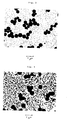
- Figures 1 to 5 are TEM micrographs of the products of Examples 1, lA, 2, 5 and 6 respectively.
- 1 cc of suspension A was transferred, after homogenization by ultrasonication, into a test tube, and was additioned with 1.5 cc of 0.2 M HC1 and 0.42 cc of a solution prepared by diluting 1 cc of solution B to 250 cc with bidistilled water filtered on a Nuclepore filter 0.2 ⁇ m.
- the TEM analysis of the product is shown in Figure 1.
- the Ti0 2 was found to be coated by a uniform a-Fe 2 0 3 layer about 350 ⁇ thick.
- Example 1 There was carried out the same procedure as described in Example 1, but without addition of TiO 2 .
- the TEM analysis of the product is shown in Figure 2, from which it is apparent that in these operating conditions the iron oxide precipitated.
- a comparison between Example 1 and Example 1 A reveals that in Example 1 all the iron oxide precipitates onto the TiO 2 surface.
- Example 5 (comparative test)
- Example 1 was repeated, but using 4.2 cc of FeCl 3 solution obtained by diluting 1 cc of solution B to 250 cc with bidistilled H 2 0 filtered on Nuclepore filter 0.2 ⁇ m. A TEM micrograph of the product obtained is shown in Figure 4, from which it is apparent that complete surface precipitation was not obtained since the presence of an excess of ⁇ -Fe 2 O 3 can be observed.
- Example 5 was repeated, but using 2.5 cc of HC1 0.2 M. A TEM micrograph of the product obtained is shown in Figure 5. It is noted that there was an increase in the surface precipitation: the polydispersion, however, was higher than 2.0 and aggregates were present.
- Example 6 was repeated, using 15 cc of suspension A and maintaining all the other parameters unaltered. The final total volume was maintained at 30 cc and the results obtained were similar to those shown in Figure 1. The percentage by weight of Fe (III) on Ti0 2 was 20% and the thickness, measured by Auger analysis, was equal to 250 A.
- Example 7 A sample prepared according to the procedure of Example 7 was subdivided into various fractions; in each fraction the pH was changed by addition of a NaOH solution in order to plot the electrophoretic mobility curve of the sample.
- the curve shows that the surface electric behaviour of the sample was identical with that of a sol of ⁇ -Fe 2 O 3 prepared according to Example 6 , not using TiO 2 .
- Example 1 was repeated, carrying out a forced hydrolysis at a temperature of 75°C during 24 hours.
- TEM micrographs showed that ⁇ -Fe 2 O 3 did not homogeneously deposit onto the Ti0 2 particles.
- the same test, repeated during a time of 7 days gave the same result and the particles lost their spherical characteristic.
- ⁇ -Al 2 O 3 was prepared as follows.
- the aerosol was formed at a temperature of 53°C.
- the contact time in the hydrolysis chamber was 57 seconds, the ratio: moles of H20/moles of Al sec.butoxide being equal to 8.
- the product so prepared was subjected to a heat treatment at 800°C during a time of 4 hours.
- Example 1A The procedure of Example 1A was repeated under the same conditions, and to the iron oxide suspension so obtained there was added 1 mg of the TiO 2 powder utilized in the preceding tests.
- the mixture of the two sols was brought to a temperature of 100°C ⁇ 1°C during 24 hours.
- the obtained result shows a heterocoagulation of the particles, i.e. a chemical mixing of the two oxides without uniform deposition of a-Fe 2 0 3 onto TiO 2 .
- the discharged sample appeared, under X-ray analysis, to consist of TiO 2 (anatase) and Fe 3 0 4 (magnetite).
- the sample subjected to TEM analysis, exhibited the same granulometric and morphological characteristics as that of Example 7.
- Example 10 was repeated employing the Fed and HC1 concentrations of Example 7; 15 mg of Ti0 2 were added to the suspension obtained. The sample was reduced under the same conditions indicated in Example 11.
- the sample of TiO 2 coated with Fe 3 0 4 obtained according to Example 11 was reoxidized, under controlled conditions, to ⁇ -Fe 2 O 3 .
- the treatment was accomplished by heating the sample in an air flow (10 1/h) to 350°C (1 hour 30 minutes), maintaining a temperature of 350°C during 30 minutes and allowing the product to cool.
- the discharged material appeared, under X-ray analysis, to consist of TiO 2 (anatase) and of a uniform coating layer consisting of Fe 3 0 4 (about 30%) and ⁇ -Fe 2 O 3 (about 70%).
- the TiO 2 was obtained according to the technique described in U.S. Patent No. 4,241,042.
- the TiO 2 was prepared according to the technique described in U.S. Patent No. 4,242,042.
- Example 41 The product obtained according to Example 41 was subjected to the same oxidizing treatment indicated in
- Example 42 The product obtained according to Example 42 was subjected to the same oxidizing treatment indicated in
Landscapes
- Chemical & Material Sciences (AREA)
- Engineering & Computer Science (AREA)
- Organic Chemistry (AREA)
- Materials Engineering (AREA)
- Nanotechnology (AREA)
- Composite Materials (AREA)
- Physics & Mathematics (AREA)
- Condensed Matter Physics & Semiconductors (AREA)
- General Physics & Mathematics (AREA)
- Crystallography & Structural Chemistry (AREA)
- Chemical Kinetics & Catalysis (AREA)
- Compounds Of Iron (AREA)
- Inorganic Compounds Of Heavy Metals (AREA)
- Pigments, Carbon Blacks, Or Wood Stains (AREA)
Applications Claiming Priority (2)
| Application Number | Priority Date | Filing Date | Title |
|---|---|---|---|
| IT19578/85A IT1183382B (it) | 1985-02-20 | 1985-02-20 | Partecelle sferiche a distribuzione granulometrica ristretta di biossi do di titanio ricoperto da uno strato uniforme di ossidi di ferro e processo per la loro preparazione |
| IT1957885 | 1985-02-20 |
Publications (3)
| Publication Number | Publication Date |
|---|---|
| EP0192485A2 true EP0192485A2 (fr) | 1986-08-27 |
| EP0192485A3 EP0192485A3 (en) | 1988-04-20 |
| EP0192485B1 EP0192485B1 (fr) | 1991-07-17 |
Family
ID=11159190
Family Applications (1)
| Application Number | Title | Priority Date | Filing Date |
|---|---|---|---|
| EP86301220A Expired - Lifetime EP0192485B1 (fr) | 1985-02-20 | 1986-02-20 | Particules de dioxyde de titane et leur procédé de préparation |
Country Status (7)
| Country | Link |
|---|---|
| US (1) | US4675251A (fr) |
| EP (1) | EP0192485B1 (fr) |
| JP (1) | JPS61235464A (fr) |
| KR (1) | KR940003573B1 (fr) |
| CA (1) | CA1236345A (fr) |
| DE (1) | DE3680216D1 (fr) |
| IT (1) | IT1183382B (fr) |
Cited By (5)
| Publication number | Priority date | Publication date | Assignee | Title |
|---|---|---|---|---|
| EP0612516A1 (fr) * | 1993-02-02 | 1994-08-31 | Degussa Aktiengesellschaft | Cosmétiques pour la peau |
| EP0684208A4 (fr) * | 1993-12-13 | 1996-10-16 | Ishihara Sangyo Kaisha | Particule de dioxyde de titane a base de rutile contenant du fer ultra-fin et procede pour sa production. |
| US5837050A (en) * | 1995-08-11 | 1998-11-17 | Ishihara Sangyo Kaisha, Ltd. | Ultrafine iron-containing rutile titanium oxide and process for producing the same |
| US7396587B2 (en) * | 2005-04-27 | 2008-07-08 | Mitsubishi Polyester Film Gmbh | Black film comprised of thermoplastic polyester |
| CN105551709A (zh) * | 2015-11-05 | 2016-05-04 | 上海大学 | 利用废弃硒鼓墨粉来制备γ-Fe2O3磁性材料的方法 |
Families Citing this family (14)
| Publication number | Priority date | Publication date | Assignee | Title |
|---|---|---|---|---|
| IT1197814B (it) * | 1986-09-16 | 1988-12-06 | Montedison Spa | Processo per la preparazione di biossido di titanio sotto forma di particelle sferiche per idrolisi di ti (iv) |
| DE3915496C1 (fr) * | 1989-05-12 | 1990-11-15 | Bayer Ag, 5090 Leverkusen, De | |
| DE4137764A1 (de) * | 1991-11-16 | 1993-05-19 | Merck Patent Gmbh | Eisenoxidpigmente |
| US5885343A (en) * | 1997-05-30 | 1999-03-23 | Shipley Company, L.L.C. | Dyed silica pigments and products made from same |
| US5871872A (en) * | 1997-05-30 | 1999-02-16 | Shipley Company, Ll.C. | Dye incorporated pigments and products made from same |
| WO2001017667A1 (fr) * | 1999-09-09 | 2001-03-15 | Eichrom Technologies, Inc. | Procede d'obtention de particules d'oxyde metallique |
| JP4660678B2 (ja) * | 2001-06-18 | 2011-03-30 | 三井金属鉱業株式会社 | 白色磁性粉末及びその製造方法 |
| DE102004032799A1 (de) * | 2003-07-21 | 2005-02-17 | Merck Patent Gmbh | Effektpigmente mit einheitlicher Form und Grösse |
| EP1867414B1 (fr) * | 2005-03-22 | 2014-04-30 | Hitachi Metals, Ltd. | Fines particules metalliques revetues et procede pour les produire |
| CN100410333C (zh) * | 2006-05-12 | 2008-08-13 | 南京钛白化工有限责任公司 | 氧化物包覆二氧化钛材料及其制备方法 |
| EP2128095A4 (fr) * | 2007-01-05 | 2011-12-21 | Tokyo Inst Tech | Nanoparticules sphériques de ferrite et leur procédé de fabrication |
| US20090298617A1 (en) * | 2008-05-28 | 2009-12-03 | Bridgestone Sports Co., Ltd. | Golf ball material and golf ball |
| CN103249783B (zh) * | 2010-12-09 | 2015-04-15 | 默克专利股份有限公司 | 磁性颜料 |
| CN103249782B (zh) * | 2010-12-09 | 2015-05-20 | 默克专利股份有限公司 | 亮黑色颜料 |
Family Cites Families (10)
| Publication number | Priority date | Publication date | Assignee | Title |
|---|---|---|---|---|
| NL42143C (fr) * | 1934-05-19 | |||
| BE439907A (fr) * | 1939-10-04 | |||
| US3115470A (en) * | 1961-03-29 | 1963-12-24 | Georgia Kaolin Co | Magnetic material, magnetic impulse recording members, and methods of making magnetic material |
| DE1467482A1 (de) * | 1965-12-18 | 1969-11-27 | Pigment Chemie Gmbh | Verfahren zur Herstellung eines fuer die Mattierung von Spinnfasern geeigneten Anatas-Pigmentes |
| GB1229441A (fr) * | 1967-07-06 | 1971-04-21 | ||
| NL7004679A (fr) * | 1970-04-02 | 1971-10-05 | ||
| GB1582956A (en) * | 1976-07-30 | 1981-01-21 | Ici Ltd | Composite magnetic particles |
| US4241042A (en) * | 1978-06-19 | 1980-12-23 | Montedison S.P.A. | Spherical titanium dioxide particles and process of manufacture |
| US4309480A (en) * | 1980-02-28 | 1982-01-05 | The Mearl Corporation | Iron blue nacreous pigments |
| IT1161200B (it) * | 1983-02-25 | 1987-03-18 | Montedison Spa | Processo e apparecchio per la preparazione di particelle di ossidi metallici monodisperse, sferiche, non aggregate e di dimensione inferiore al micron |
-
1985
- 1985-02-20 IT IT19578/85A patent/IT1183382B/it active
-
1986
- 1986-02-17 KR KR1019860001077A patent/KR940003573B1/ko not_active Expired - Lifetime
- 1986-02-18 US US06/829,962 patent/US4675251A/en not_active Expired - Fee Related
- 1986-02-19 JP JP61033108A patent/JPS61235464A/ja active Pending
- 1986-02-19 CA CA000502209A patent/CA1236345A/fr not_active Expired
- 1986-02-20 DE DE8686301220T patent/DE3680216D1/de not_active Expired - Lifetime
- 1986-02-20 EP EP86301220A patent/EP0192485B1/fr not_active Expired - Lifetime
Cited By (6)
| Publication number | Priority date | Publication date | Assignee | Title |
|---|---|---|---|---|
| EP0612516A1 (fr) * | 1993-02-02 | 1994-08-31 | Degussa Aktiengesellschaft | Cosmétiques pour la peau |
| EP0684208A4 (fr) * | 1993-12-13 | 1996-10-16 | Ishihara Sangyo Kaisha | Particule de dioxyde de titane a base de rutile contenant du fer ultra-fin et procede pour sa production. |
| US5714260A (en) * | 1993-12-13 | 1998-02-03 | Ishihara Sangyo Kaisha, Ltd. | Ultrafine iron-containing rutile titanium oxide and process for producing the same |
| US5837050A (en) * | 1995-08-11 | 1998-11-17 | Ishihara Sangyo Kaisha, Ltd. | Ultrafine iron-containing rutile titanium oxide and process for producing the same |
| US7396587B2 (en) * | 2005-04-27 | 2008-07-08 | Mitsubishi Polyester Film Gmbh | Black film comprised of thermoplastic polyester |
| CN105551709A (zh) * | 2015-11-05 | 2016-05-04 | 上海大学 | 利用废弃硒鼓墨粉来制备γ-Fe2O3磁性材料的方法 |
Also Published As
| Publication number | Publication date |
|---|---|
| US4675251A (en) | 1987-06-23 |
| KR860006720A (ko) | 1986-09-13 |
| EP0192485A3 (en) | 1988-04-20 |
| EP0192485B1 (fr) | 1991-07-17 |
| IT8519578A0 (it) | 1985-02-20 |
| IT1183382B (it) | 1987-10-22 |
| DE3680216D1 (de) | 1991-08-22 |
| JPS61235464A (ja) | 1986-10-20 |
| KR940003573B1 (ko) | 1994-04-25 |
| CA1236345A (fr) | 1988-05-10 |
Similar Documents
| Publication | Publication Date | Title |
|---|---|---|
| EP0192485B1 (fr) | Particules de dioxyde de titane et leur procédé de préparation | |
| Hsu et al. | Preparation and properties of monodispersed colloidal particles of lanthanide compounds. 2. Cerium (IV) | |
| Neveu et al. | Size-selective chemical synthesis of tartrate stabilized cobalt ferrite ionic magnetic fluid | |
| Sugimoto et al. | Preparation of monodisperse platelet-type hematite particles from a highly condensed β-FeOOH suspension | |
| EP4039650B1 (fr) | Poudre magnétique d'oxyde à base de fer et son procédé de fabrication | |
| EP3309128A1 (fr) | Oxyde de fer epsilon et procédé de production associé, peinture magnétique, et support d'enregistrement magnétique | |
| US4729846A (en) | Method for manufacturing lepidocrocite | |
| EP3780023A1 (fr) | Poudre magnétique d'oxyde à base de fer et procédé de production | |
| JPH0125213B2 (fr) | ||
| US5604015A (en) | Non-magnetic undercoat layer for magnetic recording medium, magnetic recording medium and non-magnetic particles | |
| Wind et al. | Adsorption of polyethylene oxide on surface modified silica–stability of bare and covered particles in suspension | |
| US6048412A (en) | Spindle-shaped goethite particles, spindle-shaped hematite particles and spindle-shaped magnetic iron based alloy particles | |
| EP0160496A2 (fr) | Particules magnétiques d'oxyde de fer | |
| EP1681271A1 (fr) | Particules d'oxydes noirs composite, procede de fabrication, materiau de revetement noir et matrice noire | |
| US5188898A (en) | Ferromagnetic metal particles and preparation process thereof | |
| EP0148634B1 (fr) | Particules en alliage ferromagnétique pour porteurs d'enregistrement magnétique et procédé pour leur fabrication | |
| KR0163819B1 (ko) | 마그네타이트 입자 및 그 제조방법 | |
| Yue-Hua et al. | Preparation and surface chemistry characteristics of pure and coated acicular α-FeOOH particles | |
| Dzeranov et al. | Humic acids-modified mesoporous silica encapsulating magnetite: crystal and surface characteristics | |
| EP0940369A2 (fr) | Particules de goethite sous forme d'une broche et procédé pour sa fabrication | |
| EP0480696A1 (fr) | Procédé pour la fabrication de particules métalliques ferromagnétiques pour l'enregistrement magnétique | |
| EP1529017A1 (fr) | Poudre d'oxyde de fer pour sous-couche d'un support d'enregistrement magnetique a structure multicouche et procede de production de cette poudre | |
| EP0076462B2 (fr) | Procédé de fabrication de particules magnétiques | |
| DE202025108039U1 (de) | Carbonyl-Eisenpulver | |
| JP3428197B2 (ja) | 針状磁性酸化鉄粒子粉末及びその製造法 |
Legal Events
| Date | Code | Title | Description |
|---|---|---|---|
| PUAI | Public reference made under article 153(3) epc to a published international application that has entered the european phase |
Free format text: ORIGINAL CODE: 0009012 |
|
| AK | Designated contracting states |
Kind code of ref document: A2 Designated state(s): BE DE FR GB IT NL SE |
|
| PUAL | Search report despatched |
Free format text: ORIGINAL CODE: 0009013 |
|
| AK | Designated contracting states |
Kind code of ref document: A3 Designated state(s): BE DE FR GB IT NL SE |
|
| 17P | Request for examination filed |
Effective date: 19880428 |
|
| 17Q | First examination report despatched |
Effective date: 19890810 |
|
| ITF | It: translation for a ep patent filed | ||
| GRAA | (expected) grant |
Free format text: ORIGINAL CODE: 0009210 |
|
| AK | Designated contracting states |
Kind code of ref document: B1 Designated state(s): BE DE FR GB IT NL SE |
|
| ET | Fr: translation filed | ||
| REF | Corresponds to: |
Ref document number: 3680216 Country of ref document: DE Date of ref document: 19910822 |
|
| PLBE | No opposition filed within time limit |
Free format text: ORIGINAL CODE: 0009261 |
|
| STAA | Information on the status of an ep patent application or granted ep patent |
Free format text: STATUS: NO OPPOSITION FILED WITHIN TIME LIMIT |
|
| 26N | No opposition filed | ||
| PGFP | Annual fee paid to national office [announced via postgrant information from national office to epo] |
Ref country code: FR Payment date: 19930209 Year of fee payment: 8 |
|
| PGFP | Annual fee paid to national office [announced via postgrant information from national office to epo] |
Ref country code: GB Payment date: 19930210 Year of fee payment: 8 |
|
| PGFP | Annual fee paid to national office [announced via postgrant information from national office to epo] |
Ref country code: SE Payment date: 19930215 Year of fee payment: 8 |
|
| PGFP | Annual fee paid to national office [announced via postgrant information from national office to epo] |
Ref country code: NL Payment date: 19930228 Year of fee payment: 8 |
|
| PGFP | Annual fee paid to national office [announced via postgrant information from national office to epo] |
Ref country code: DE Payment date: 19930308 Year of fee payment: 8 |
|
| PGFP | Annual fee paid to national office [announced via postgrant information from national office to epo] |
Ref country code: BE Payment date: 19930330 Year of fee payment: 8 |
|
| PG25 | Lapsed in a contracting state [announced via postgrant information from national office to epo] |
Ref country code: GB Effective date: 19940220 |
|
| PG25 | Lapsed in a contracting state [announced via postgrant information from national office to epo] |
Ref country code: SE Effective date: 19940221 |
|
| PG25 | Lapsed in a contracting state [announced via postgrant information from national office to epo] |
Ref country code: BE Effective date: 19940228 |
|
| BERE | Be: lapsed |
Owner name: MONTEDISON S.P.A. Effective date: 19940228 |
|
| PG25 | Lapsed in a contracting state [announced via postgrant information from national office to epo] |
Ref country code: NL Effective date: 19940901 |
|
| NLV4 | Nl: lapsed or anulled due to non-payment of the annual fee | ||
| GBPC | Gb: european patent ceased through non-payment of renewal fee |
Effective date: 19940220 |
|
| PG25 | Lapsed in a contracting state [announced via postgrant information from national office to epo] |
Ref country code: FR Effective date: 19941031 |
|
| PG25 | Lapsed in a contracting state [announced via postgrant information from national office to epo] |
Ref country code: DE Effective date: 19941101 |
|
| REG | Reference to a national code |
Ref country code: FR Ref legal event code: ST |
|
| EUG | Se: european patent has lapsed |
Ref document number: 86301220.9 Effective date: 19940910 |
|
| PG25 | Lapsed in a contracting state [announced via postgrant information from national office to epo] |
Ref country code: IT Free format text: LAPSE BECAUSE OF NON-PAYMENT OF DUE FEES Effective date: 20050220 |