EP0192806A2 - Verbundmaterial einer metallischen Matrix verstärkt mit einem Gemisch von amorphen Aluminiumoxid-Siliciumoxid-Fasern und minerale Fasern - Google Patents
Verbundmaterial einer metallischen Matrix verstärkt mit einem Gemisch von amorphen Aluminiumoxid-Siliciumoxid-Fasern und minerale Fasern Download PDFInfo
- Publication number
- EP0192806A2 EP0192806A2 EP85106622A EP85106622A EP0192806A2 EP 0192806 A2 EP0192806 A2 EP 0192806A2 EP 85106622 A EP85106622 A EP 85106622A EP 85106622 A EP85106622 A EP 85106622A EP 0192806 A2 EP0192806 A2 EP 0192806A2
- Authority
- EP
- European Patent Office
- Prior art keywords
- weight
- composite material
- equal
- fibers
- less
- Prior art date
- Legal status (The legal status is an assumption and is not a legal conclusion. Google has not performed a legal analysis and makes no representation as to the accuracy of the status listed.)
- Granted
Links
- VYPSYNLAJGMNEJ-UHFFFAOYSA-N silicon dioxide Inorganic materials O=[Si]=O VYPSYNLAJGMNEJ-UHFFFAOYSA-N 0.000 title claims abstract description 167
- 239000000835 fiber Substances 0.000 title claims abstract description 159
- 239000000377 silicon dioxide Substances 0.000 title claims abstract description 137
- 239000002131 composite material Substances 0.000 title claims abstract description 133
- 239000002557 mineral fiber Substances 0.000 title claims abstract description 85
- 229910052751 metal Inorganic materials 0.000 title claims abstract description 50
- 239000002184 metal Substances 0.000 title claims abstract description 50
- 239000011159 matrix material Substances 0.000 title claims abstract description 46
- MXRIRQGCELJRSN-UHFFFAOYSA-N O.O.O.[Al] Chemical compound O.O.O.[Al] MXRIRQGCELJRSN-UHFFFAOYSA-N 0.000 claims abstract description 96
- 239000000463 material Substances 0.000 claims abstract description 77
- 239000000203 mixture Substances 0.000 claims abstract description 67
- 239000002245 particle Substances 0.000 claims abstract description 64
- PNEYBMLMFCGWSK-UHFFFAOYSA-N aluminium oxide Inorganic materials [O-2].[O-2].[O-2].[Al+3].[Al+3] PNEYBMLMFCGWSK-UHFFFAOYSA-N 0.000 claims abstract description 59
- 239000002657 fibrous material Substances 0.000 claims abstract description 57
- 229910052681 coesite Inorganic materials 0.000 claims abstract description 18
- 229910052906 cristobalite Inorganic materials 0.000 claims abstract description 18
- 229910052682 stishovite Inorganic materials 0.000 claims abstract description 18
- 229910052905 tridymite Inorganic materials 0.000 claims abstract description 18
- 229910052593 corundum Inorganic materials 0.000 claims abstract description 17
- 229910001845 yogo sapphire Inorganic materials 0.000 claims abstract description 17
- ODINCKMPIJJUCX-UHFFFAOYSA-N calcium oxide Inorganic materials [Ca]=O ODINCKMPIJJUCX-UHFFFAOYSA-N 0.000 claims abstract description 11
- 239000011133 lead Substances 0.000 claims abstract description 10
- 229910045601 alloy Inorganic materials 0.000 claims abstract description 8
- 239000000956 alloy Substances 0.000 claims abstract description 8
- 229910052782 aluminium Inorganic materials 0.000 claims abstract description 7
- XAGFODPZIPBFFR-UHFFFAOYSA-N aluminium Chemical compound [Al] XAGFODPZIPBFFR-UHFFFAOYSA-N 0.000 claims abstract description 7
- 239000000126 substance Substances 0.000 claims abstract description 7
- RYGMFSIKBFXOCR-UHFFFAOYSA-N Copper Chemical compound [Cu] RYGMFSIKBFXOCR-UHFFFAOYSA-N 0.000 claims abstract description 6
- FYYHWMGAXLPEAU-UHFFFAOYSA-N Magnesium Chemical compound [Mg] FYYHWMGAXLPEAU-UHFFFAOYSA-N 0.000 claims abstract description 6
- ATJFFYVFTNAWJD-UHFFFAOYSA-N Tin Chemical compound [Sn] ATJFFYVFTNAWJD-UHFFFAOYSA-N 0.000 claims abstract description 6
- HCHKCACWOHOZIP-UHFFFAOYSA-N Zinc Chemical compound [Zn] HCHKCACWOHOZIP-UHFFFAOYSA-N 0.000 claims abstract description 6
- 239000010949 copper Substances 0.000 claims abstract description 6
- 229910052802 copper Inorganic materials 0.000 claims abstract description 6
- 239000011777 magnesium Substances 0.000 claims abstract description 6
- 229910052749 magnesium Inorganic materials 0.000 claims abstract description 6
- 239000011135 tin Substances 0.000 claims abstract description 6
- 239000011701 zinc Substances 0.000 claims abstract description 6
- 229910052725 zinc Inorganic materials 0.000 claims abstract description 6
- JEIPFZHSYJVQDO-UHFFFAOYSA-N iron(III) oxide Inorganic materials O=[Fe]O[Fe]=O JEIPFZHSYJVQDO-UHFFFAOYSA-N 0.000 claims abstract description 5
- 239000012779 reinforcing material Substances 0.000 claims description 21
- 229910000838 Al alloy Inorganic materials 0.000 claims description 10
- 229910000861 Mg alloy Inorganic materials 0.000 claims description 4
- 229910001128 Sn alloy Inorganic materials 0.000 claims description 4
- 229910001297 Zn alloy Inorganic materials 0.000 claims description 4
- 238000005452 bending Methods 0.000 abstract description 19
- 230000003014 reinforcing effect Effects 0.000 abstract description 6
- 238000012360 testing method Methods 0.000 description 98
- 239000012783 reinforcing fiber Substances 0.000 description 41
- 230000013011 mating Effects 0.000 description 29
- 238000013329 compounding Methods 0.000 description 15
- 229910000831 Steel Inorganic materials 0.000 description 14
- 239000010959 steel Substances 0.000 description 14
- 238000011160 research Methods 0.000 description 13
- 238000004519 manufacturing process Methods 0.000 description 11
- 238000000034 method Methods 0.000 description 11
- 238000005266 casting Methods 0.000 description 9
- 230000008030 elimination Effects 0.000 description 8
- 238000003379 elimination reaction Methods 0.000 description 8
- 238000012545 processing Methods 0.000 description 8
- 238000001914 filtration Methods 0.000 description 7
- 239000011230 binding agent Substances 0.000 description 6
- 238000002844 melting Methods 0.000 description 6
- 230000008018 melting Effects 0.000 description 6
- 229910001141 Ductile iron Inorganic materials 0.000 description 5
- CPLXHLVBOLITMK-UHFFFAOYSA-N Magnesium oxide Chemical compound [Mg]=O CPLXHLVBOLITMK-UHFFFAOYSA-N 0.000 description 5
- 150000002739 metals Chemical class 0.000 description 5
- XEEYBQQBJWHFJM-UHFFFAOYSA-N Iron Chemical compound [Fe] XEEYBQQBJWHFJM-UHFFFAOYSA-N 0.000 description 4
- 230000002159 abnormal effect Effects 0.000 description 4
- 239000008119 colloidal silica Substances 0.000 description 4
- 230000000694 effects Effects 0.000 description 4
- 239000012784 inorganic fiber Substances 0.000 description 4
- 238000006748 scratching Methods 0.000 description 4
- 230000002393 scratching effect Effects 0.000 description 4
- 238000007666 vacuum forming Methods 0.000 description 4
- 238000007664 blowing Methods 0.000 description 3
- 238000006243 chemical reaction Methods 0.000 description 3
- 230000002939 deleterious effect Effects 0.000 description 3
- 238000009396 hybridization Methods 0.000 description 3
- 239000011490 mineral wool Substances 0.000 description 3
- 239000011435 rock Substances 0.000 description 3
- 239000002893 slag Substances 0.000 description 3
- 238000009987 spinning Methods 0.000 description 3
- OKTJSMMVPCPJKN-UHFFFAOYSA-N Carbon Chemical compound [C] OKTJSMMVPCPJKN-UHFFFAOYSA-N 0.000 description 2
- 229910001018 Cast iron Inorganic materials 0.000 description 2
- 229910000978 Pb alloy Inorganic materials 0.000 description 2
- GWEVSGVZZGPLCZ-UHFFFAOYSA-N Titan oxide Chemical compound O=[Ti]=O GWEVSGVZZGPLCZ-UHFFFAOYSA-N 0.000 description 2
- XLOMVQKBTHCTTD-UHFFFAOYSA-N Zinc monoxide Chemical compound [Zn]=O XLOMVQKBTHCTTD-UHFFFAOYSA-N 0.000 description 2
- MCMNRKCIXSYSNV-UHFFFAOYSA-N Zirconium dioxide Chemical compound O=[Zr]=O MCMNRKCIXSYSNV-UHFFFAOYSA-N 0.000 description 2
- 238000013461 design Methods 0.000 description 2
- QDOXWKRWXJOMAK-UHFFFAOYSA-N dichromium trioxide Chemical compound O=[Cr]O[Cr]=O QDOXWKRWXJOMAK-UHFFFAOYSA-N 0.000 description 2
- 239000010439 graphite Substances 0.000 description 2
- 229910002804 graphite Inorganic materials 0.000 description 2
- 238000010438 heat treatment Methods 0.000 description 2
- 239000012535 impurity Substances 0.000 description 2
- 229910052742 iron Inorganic materials 0.000 description 2
- 230000001050 lubricating effect Effects 0.000 description 2
- NUJOXMJBOLGQSY-UHFFFAOYSA-N manganese dioxide Chemical compound O=[Mn]=O NUJOXMJBOLGQSY-UHFFFAOYSA-N 0.000 description 2
- JKQOBWVOAYFWKG-UHFFFAOYSA-N molybdenum trioxide Chemical compound O=[Mo](=O)=O JKQOBWVOAYFWKG-UHFFFAOYSA-N 0.000 description 2
- 238000010791 quenching Methods 0.000 description 2
- 229920000049 Carbon (fiber) Polymers 0.000 description 1
- 229920001410 Microfiber Polymers 0.000 description 1
- KKCBUQHMOMHUOY-UHFFFAOYSA-N Na2O Inorganic materials [O-2].[Na+].[Na+] KKCBUQHMOMHUOY-UHFFFAOYSA-N 0.000 description 1
- 229910052581 Si3N4 Inorganic materials 0.000 description 1
- 229910004298 SiO 2 Inorganic materials 0.000 description 1
- -1 Sno2 Chemical compound 0.000 description 1
- 239000000654 additive Substances 0.000 description 1
- 230000000996 additive effect Effects 0.000 description 1
- 230000004075 alteration Effects 0.000 description 1
- KFVBMBOOLFSJHV-UHFFFAOYSA-K aluminum;sodium;hexane-1,2,3,4,5,6-hexol;carbonate;hydroxide Chemical compound [OH-].[Na+].[Al+3].[O-]C([O-])=O.OCC(O)C(O)C(O)C(O)CO KFVBMBOOLFSJHV-UHFFFAOYSA-K 0.000 description 1
- 239000004917 carbon fiber Substances 0.000 description 1
- 150000001875 compounds Chemical class 0.000 description 1
- 239000000470 constituent Substances 0.000 description 1
- 238000010276 construction Methods 0.000 description 1
- 238000010586 diagram Methods 0.000 description 1
- NJLLQSBAHIKGKF-UHFFFAOYSA-N dipotassium dioxido(oxo)titanium Chemical compound [K+].[K+].[O-][Ti]([O-])=O NJLLQSBAHIKGKF-UHFFFAOYSA-N 0.000 description 1
- 230000006872 improvement Effects 0.000 description 1
- 229910052500 inorganic mineral Inorganic materials 0.000 description 1
- 229910017053 inorganic salt Inorganic materials 0.000 description 1
- 238000009413 insulation Methods 0.000 description 1
- HTUMBQDCCIXGCV-UHFFFAOYSA-N lead oxide Chemical compound [O-2].[Pb+2] HTUMBQDCCIXGCV-UHFFFAOYSA-N 0.000 description 1
- YEXPOXQUZXUXJW-UHFFFAOYSA-N lead(II) oxide Inorganic materials [Pb]=O YEXPOXQUZXUXJW-UHFFFAOYSA-N 0.000 description 1
- 239000010687 lubricating oil Substances 0.000 description 1
- 229910044991 metal oxide Inorganic materials 0.000 description 1
- 150000004706 metal oxides Chemical class 0.000 description 1
- VNWKTOKETHGBQD-UHFFFAOYSA-N methane Chemical compound C VNWKTOKETHGBQD-UHFFFAOYSA-N 0.000 description 1
- 239000003658 microfiber Substances 0.000 description 1
- 239000011707 mineral Substances 0.000 description 1
- 238000012986 modification Methods 0.000 description 1
- 230000004048 modification Effects 0.000 description 1
- 239000010705 motor oil Substances 0.000 description 1
- GNRSAWUEBMWBQH-UHFFFAOYSA-N nickel(II) oxide Inorganic materials [Ni]=O GNRSAWUEBMWBQH-UHFFFAOYSA-N 0.000 description 1
- 230000001590 oxidative effect Effects 0.000 description 1
- 239000013618 particulate matter Substances 0.000 description 1
- 238000013001 point bending Methods 0.000 description 1
- NOTVAPJNGZMVSD-UHFFFAOYSA-N potassium monoxide Inorganic materials [K]O[K] NOTVAPJNGZMVSD-UHFFFAOYSA-N 0.000 description 1
- 238000004663 powder metallurgy Methods 0.000 description 1
- 230000008569 process Effects 0.000 description 1
- HBMJWWWQQXIZIP-UHFFFAOYSA-N silicon carbide Chemical compound [Si+]#[C-] HBMJWWWQQXIZIP-UHFFFAOYSA-N 0.000 description 1
- 229910010271 silicon carbide Inorganic materials 0.000 description 1
- HQVNEWCFYHHQES-UHFFFAOYSA-N silicon nitride Chemical compound N12[Si]34N5[Si]62N3[Si]51N64 HQVNEWCFYHHQES-UHFFFAOYSA-N 0.000 description 1
- 230000002195 synergetic effect Effects 0.000 description 1
- 229920002994 synthetic fiber Polymers 0.000 description 1
Images




Classifications
-
- C—CHEMISTRY; METALLURGY
- C22—METALLURGY; FERROUS OR NON-FERROUS ALLOYS; TREATMENT OF ALLOYS OR NON-FERROUS METALS
- C22C—ALLOYS
- C22C47/00—Making alloys containing metallic or non-metallic fibres or filaments
- C22C47/08—Making alloys containing metallic or non-metallic fibres or filaments by contacting the fibres or filaments with molten metal, e.g. by infiltrating the fibres or filaments placed in a mould
-
- C—CHEMISTRY; METALLURGY
- C22—METALLURGY; FERROUS OR NON-FERROUS ALLOYS; TREATMENT OF ALLOYS OR NON-FERROUS METALS
- C22C—ALLOYS
- C22C49/00—Alloys containing metallic or non-metallic fibres or filaments
-
- Y—GENERAL TAGGING OF NEW TECHNOLOGICAL DEVELOPMENTS; GENERAL TAGGING OF CROSS-SECTIONAL TECHNOLOGIES SPANNING OVER SEVERAL SECTIONS OF THE IPC; TECHNICAL SUBJECTS COVERED BY FORMER USPC CROSS-REFERENCE ART COLLECTIONS [XRACs] AND DIGESTS
- Y10—TECHNICAL SUBJECTS COVERED BY FORMER USPC
- Y10T—TECHNICAL SUBJECTS COVERED BY FORMER US CLASSIFICATION
- Y10T428/00—Stock material or miscellaneous articles
- Y10T428/12—All metal or with adjacent metals
- Y10T428/12444—Embodying fibers interengaged or between layers [e.g., paper, etc.]
-
- Y—GENERAL TAGGING OF NEW TECHNOLOGICAL DEVELOPMENTS; GENERAL TAGGING OF CROSS-SECTIONAL TECHNOLOGIES SPANNING OVER SEVERAL SECTIONS OF THE IPC; TECHNICAL SUBJECTS COVERED BY FORMER USPC CROSS-REFERENCE ART COLLECTIONS [XRACs] AND DIGESTS
- Y10—TECHNICAL SUBJECTS COVERED BY FORMER USPC
- Y10T—TECHNICAL SUBJECTS COVERED BY FORMER US CLASSIFICATION
- Y10T428/00—Stock material or miscellaneous articles
- Y10T428/12—All metal or with adjacent metals
- Y10T428/12458—All metal or with adjacent metals having composition, density, or hardness gradient
-
- Y—GENERAL TAGGING OF NEW TECHNOLOGICAL DEVELOPMENTS; GENERAL TAGGING OF CROSS-SECTIONAL TECHNOLOGIES SPANNING OVER SEVERAL SECTIONS OF THE IPC; TECHNICAL SUBJECTS COVERED BY FORMER USPC CROSS-REFERENCE ART COLLECTIONS [XRACs] AND DIGESTS
- Y10—TECHNICAL SUBJECTS COVERED BY FORMER USPC
- Y10T—TECHNICAL SUBJECTS COVERED BY FORMER US CLASSIFICATION
- Y10T428/00—Stock material or miscellaneous articles
- Y10T428/12—All metal or with adjacent metals
- Y10T428/12486—Laterally noncoextensive components [e.g., embedded, etc.]
Definitions
- the present invention relates to a type of composite material which includes fiber material as reinforcing material embedded in a mass of matrix metal, and more particularly relates to such a type of composite material in which the reinforcing material is a mixture of amorphous alumina - silica fiber material and mineral fiber material and the matrix metal is aluminum, magnesium, copper, zinc, lead, tin, or an alloy having one or more of these as principal component or components.
- alumina - silica fibers whose principal components are alumina and silica are quite inexpensive, and have conventionally for example been used in quantity as heat insulation fibers, in which case, particularly in view of their handling characteristics, they are normally used in the amorphous amorphous form; therefore, if such alumina - silica fibers could satisfactorily be used as reinforcing fiber material for a composite material, then the cost could be very much reduced.
- so called mineral fibers of which the principal components are SiO 2 , CaO, and A1 2 Q 3 , are very much less costly than the above mentioned other types of inorganic fibers, and therefore if such mineral fibers are used as reinforcing fibers the cost of the resulting composite material can be very much reduced.
- such mineral fibers have good wettability with respect to molten matrix metals of the types detailed above, and deleterious reactions with such molten matrix metals are generally slight, therefore, as contrasted with the case in which the reinforcing fibers are fibers which have poor wettability with respect to the molten matrix metal and undergo a deleterious reaction therewith, it is possible to obtain a composite material with excellent mechanical characteristics such as strength.
- the inventors of the present invention have considered in depth the above detailed problems with regard to the manufacture of composite materials, and particularly with regard to the use of alumina - silica fiber material or mineral fiber material as reinforcing material for a composite material, and as a result of various experimental researches (the results of some of which will be given later) have discovered that it is effective to use as reinforcing fiber material for the composite material a mixture of amorphous alumina - silica fiber material and mineral fiber material.
- the present inventors have discovered that such a composite material utilizing a mixture of reinforcing fibers has much superior wear characteristics to those which are expected from a composite material having only amorphous alumina - silica fibers as reinforcing material, or from a composite material having only mineral fibers as reinforcing material.
- the properties of a such a composite material utilizing such a mixture of reinforcing fibers are not merely the linear combination of the properties of composite materials utilizing each of the components of said mixture on its own, but exhibit some non additive non linear synergistic effect by the combination of the reinforcing amorphous alumina - silica fibers and the reinforcing mineral fibers.
- the present invention is based upon knowledge gained as a result of these experimental researches by the present inventors, and its primary object is to provide a composite material including reinforcing fibers embedded in matrix metal, which has the advantages detailed above including good mechanical characteristics, while overcoming the above explained disadvantages.
- a composite material comprising: (a) reinforcing material which is a hybrid fiber mixture material comprising: (al) a substantial amount of amorphous alumina - silica fiber material with principal components about 35% to about 80% by weight of Al203 and about 65% to about 20% by weight of Si0 2 , and with a content of other substances of less than or equal to about 10% by weight, with the percentage of non fibrous particles included therein being less than or equal to about 17% by weight, and with the percentage of non fibrous particles with diameters greater than about 150 microns included therein being less than or equal to about 7% by weight; and (a2) a substantial amount of mineral fiber material having as principal components Si0 2 , CaO, and A1203, the content of included MgO therein being less than or equal to about 10% by weight, the content of included Fe 2 O 3 therein being less than or equal to about 5% by weight, and the content of other inorganic substances included therein being less than or equal
- the matrix metal is reinforced with a volume proportion of at least 1% of this hybrid fiber mixture material, which consists of amorphous alumina - silica fibers which are hard and stable and are very much cheaper than alumina fibers, mixed with mineral fibers, which are even more cheap than alumina fibers, which have good wettability with respect to these kinds of matrix metal and have little deteriorability with respect to molten such matrix metals as described above.
- the wear resistance characteristics of the composite material are remarkably improved by the use of such hybrid reinforcing fiber material, a composite material which has excellent mechanical characteristics such as wear resistance and strength, and of exceptionally low cost, is obtained.
- the percentage of non fibrous particles included in the amorphous alumina - silica fiber material is less than or equal to about 17% by weight and also the percentage of non fibrous particles with diameters greater than about 150 microns included in said amorphous alumina - silica fiber material is less than or equal to about 7% by weight, and further the percentage of non fibrous particles included in the mineral fiber material is less than or equal to about 20% by weight and also the percentage of non fibrous particles with diameters greater than about 150 microns included in said mineral fiber material is less than or equal to about 7% by weight, a composite material with superior strength and machinability properties is obtained, and further there is no substantial danger of abnormal wear such as scratching being caused to a mating member which is in frictional contact with a member made of this composite material during use, due to such non fibrous particulate matter becoming detached from said member made of this composite material.
- alumina - silica type fibers may be categorized into alumina fibers or alumina - silica fibers on the basis of their composition and their method of manufacture.
- So called alumina fibers including at least 70% by weight of A1 2 0 3 and not more than 30% by weight of Si0 2 , are formed into fibers from a mixture of a viscous organic solution with an aluminum inorganic salt; they are formed in an oxidizing furnace at high temperature, so that they have superior qualities as reinforcing fibers, but are extremely expensive.
- alumina - silica fibers which have-about 35% to 65% by weight of Al 2 O 3 and about 65% to 35% by weight of SiO 2 , can be made relatively cheaply and in large quantity, since the melting point of a mixture of alumina and silica has lower melting point than alumina, so that a mixture of alumina and silica can be melted in for example an electric furnace, and the molten mixture can be formed into fibers by either the blowing method or the spinning method.
- the included amount of Al 2 O 3 is 65% by weight or more, and the included amount of Si0 2 is 35% by weight or less, the melting point of the mixture of alumina and silica becomes too high, and the viscosity of the molten mixture is low; on the other hand, if the included amount of Al 2 O 3 is 35% by weight or less, and the included amount of SiO Z is 65% by weight or more, a viscosity suitable for blowing or spinning cannot be obtained, and, for reasons such as these, such low cost methods of manufacture are difficult to apply in these cases.
- alumina - silica fibers with an included amount of Al 2 0 3 of 65% by weight or more are not as inexpensive as alumina - silica fibers with an included amount of Al 2 O 3 of 65% by weight or less
- a reasonably inexpensive composite material can be obtained with excellent mechanical properties such as wear resistance and strength.
- the Al 2 O 3 content of the amorphous alumina - silica fiber material included in the hybrid reinforcing fiber material for the composite material of the present invention should be between about 35% to about 80% by weight.
- alumina and silica such metal oxides as CaO, MgO, Na 2 O, Fe 2 O 3 , Cr 2 O 3 , ZrO 2 , TiO 2 , PbO, Sno2, ZnO, MoO 3 , NiO, K 2 O, MnO 2 , b 2 O 3 , V 2 O 5 , CuO, Co 8 0 4 , and so forth. According to the results of certain experimental researches carried out by the inventors of the present invention, it has been confirmed that it is preferable to restrict such constituents to not more tha 10% by weight.
- the composition of the amorphous alumina - silica fibers used for the reinforcing fibers in the composite material of the present invention has been determined as being required to be from 35% to 80% by weight Al 2 O 3 , from 65% to 20% by weight SiO 2 , and from 0% to 10% by weight of other components.
- these non fibrous particles and particularly the very large non fibrous particles having a particle diameter greater than or equal to 150 microns, if they remain by a large amount in the composite material produced, impair the mechanical properties of said composite material, and are a source of lowered strength for the composite material, and moreover tend to produce problems such as abnormal wear in and scratching on a mating element which is frictionally cooperating with a member made of said composite material, due to these large and hard particles becoming detached from the composite material. Also, such large and hard non fibrous particles tend to deteriorate the machinability of the composite material.
- the amount of non fibrous particles included in the amorphous alumina - silica fiber material incorporated in the hybrid fiber material used as reinforcing material is required to be limited to a maximum of 17% by weight, and preferably further is desired to be limited to not more than 10% by weight, and even more preferably is desired to be limited to not more than 7% by weight; and the amount of non fibrous particles of particle diameter greater than or equal to 150 microns included in said amorphous alumina - silica fiber material incorporated in the hybrid fiber material used as reinforcing material is required to be limited to a maximum of 7% by weight, and preferably further is desired to be limited to not more than 296 by weight, and even more preferably is desired to be limited to not more than 1% by weight.
- Mineral fiber is a generic name for artificial fiber material including rock wool (or rock fiber) made by forming molten rock into fibers, slag wool (or slag fiber) made by forming iron slag into fibers, and mineral wool (or mineral fiber) made by forming a molten mixture of rock and slag into fibers.
- Such mineral fiber generally has a composition of about 35% to about 50% by weight of SiO 2 , about 20% to about 40% by weight of CaO, about 10% to about 20% by weight of A1203, about 3% to about 7% by weight of MgO, about 1% to about 5% by weight of Fe 2 O 3 , and up to about 10% by weight of other inorganic substances.
- These mineral fibers are also generally produced by a method such as the spinning method, and therefore in the manufacture of such mineral fibers inevitably a quantity of non fibrous particles are also produced together with the fibers. Again, these non fibrous particles are extremely hard, and tend to be large compared to the average diameter of the fibers. Thus, just as in the case of the non fibrous particles included in the amorphous alumina - silica fiber material, they tend to be a source of damage.
- the total amount of non fibrous particles included in the mineral fiber material incorporated in the hybrid fiber material used as reinforcing material is required to be limited to a maximum of 20% by weight, and preferably further is desired to be limited to not more than 10% by weight; and the amount of such non fibrous particles of particle diameter greater than or equal to 150 microns included in said mineral fiber material incorporated in the hybrid fiber material used as reinforcing material is required to be limited to a maximum of 7% by weight, and preferably further is desired to be limited to not more than 2% by weight.
- a composite material in which reinforcing fibers are a mixture of amorphous alumina - silica fibers and mineral fibers has the above described superior characteristics, and, when the matrix metal is aluminum, magnesium, copper, zinc, lead, tin, or an alloy having these as principal components, even if the volume proportion of the reinforcing hybrid fiber mixture material is around 1%, there is a remarkable increase in the wear resistance of the composite material, and, even if the volume proportion of said hybrid fiber mixture material is increased, there is not an enormous increase in the wear on a mating element which is frictionally cooperating with a member made of said composite material.
- the total volume proportion of the reinforcing hybrid fiber-mixture material is required to be- at least 1%, and preferably is desired to be not less than 2%, and even more preferably is desired to be not less than 4%.
- the effect of improvement of wear resistance of a composite material by using as reinforcing material a hybrid combination of amorphous alumina - silica fibers and mineral fibers is, as will be described below in detail, most noticeable when the ratio of the volume proportion of said amorphous alumina - silica fiber material to the total volume proportion of said hybrid fiber mixture material is between about 5% and about 80%, and particularly when said ratio is between about 10% and about 60%.
- said ratio of the volume proportion of said amorphous alumina - silica fiber material to the total volume proportion of said hybrid fiber mixture material should be between about 596 and about 80%, and it is considered to be even more preferable that said ratio should be between about 10% and about 60%.
- the ratio of the volume proportion of said amorphous alumina - silica fiber material to the total volume proportion of said hybrid fiber mixture material is relatively low, and the corresponding volume proportion of the mineral fibers is relatively high - for example, if the ratio of the volume proportion of said amorphous alumina - silica fiber material to the total volume proportion of said hybrid fiber mixture material is from about 5% to about 40% - then, unless the total volume proportion of said hybrid fiber mixture material in the composite material is at least 2% and even more preferably is at least 496, it is difficult to maintain an adequate wear resistance in the composite material.
- the ratio of the volume proportion of said amorphous alumina - silica fiber material to the total volume proportion of said hybrid fiber mixture material should be between about 5% and about 40%, and even more preferably should be between about 10% and about 40%; and that the total volume proportion of said hybrid fiber mixture material should be in the range from about 2% to about 40%, and even more preferably should be in the range from about 4% to about 35%.
- the composite material of the present invention regardless of the value of the ratio of the volume proportion of said amorphous alumina - silica fiber material to the total volume proportion of said hybrid fiber mixture material, that the total volume proportion of said mineral fiber material in the composite material should be less than about 25%, and even more preferably that said total volume proportion should be less than about 20%.
- the amorphous alumina - silica fibers included as reinforcing material in said composite material should, according to the results of the experimental researches carried out by the inventors of'the present invention, preferably have in the case of short fibers an average fiber diameter of approximately 1.5 to 5.0 microns and a fiber length of 20 microns to 3 millimeters, and in the case of long fibers an average fiber diameter of approximately 3 to 30 microns.
- the mineral which is the material forming the mineral fibers also included as reinforcing material in said composite material has a relatively low viscosity in the molten state, and, since the mineral fibers are relatively fragile when compared with other fibers, these mineral fibers are typically made in the form of short fibers (non continuous fibers) with a fiber diameter of about 1 to 10 microns and with a fiber length of about 10 microns to about 10 cm. Therefore, when the availability of low cost mineral fibers is considered, it is desirable that the mineral fibers used in the composite material of the present invention should have an average fiber diameter of about 2 to 8 microns and an average fiber length of about 20 microns to about 5 em.
- the average fiber length of the mineral fibers used in the composite material of the present invention should be about 100 microns to about 5 cm, and, in the case of the powder metallurgy method, should be preferably about 20 microns to about 2 mm.
- the parameters of this alumina - silica fiber material, which was of the amorphous type were brought to be as given in Table 1, which is given at the end of this specification and before the claims thereof.
- AO a quantity of the amorphous alumina - silica fibers with composition as per Table 1 and a quantity of the mineral fibers with composition as per Table 2 were dispersed together in colloidal silica, which acted as a binder: the relative proportions of the amorphous alumina - silica fibers and of the mineral fibers were different in each case (and in one case no amorphous alumina - silica fibers were utilized, while in another case no mineral fibers were utilized).
- the mixture was then well stirred up so that the alumina - silica fibers and the mineral fibers were evenly dispersed therein and were well mixed together, and then the preform was formed by vacuum forming from the mixture, said preform having dimensions of 80 by 80 by 20 millimeters, as shown in perspective view in Fig. 1, wherein it is designated by the reference numeral 1.
- Fig. 1 perspective view in Fig. 1, wherein it is designated by the reference numeral 1.
- each preform was fired in a furnace at about 600°C, so that the silica bonded together the individual amorphous alumina - silica fibers 2 and mineral fibers 2a, acting as a binder.
- each of the preforms 1 was placed into the mold cavity 4 of a casting mold 3, and then a quantity of molten metal for serving as the matrix metal for the resultant composite material, in the case of this first preferred embodiment being molten aluminum alloy of type JIS (Japan Industrial Standard) AC8A and being heated to about 730°C, was poured into the mold cavity 4 over and arond the preform 1.
- molten metal for serving as the matrix metal for the resultant composite material in the case of this first preferred embodiment being molten aluminum alloy of type JIS (Japan Industrial Standard) AC8A and being heated to about 730°C
- a piston 6, which closely cooperated with the defining surface of the mold cavity 4 was forced into said mold cavity 4 and was forced inwards, so as to pressurize the molten matrix metal to a pressure of about 1500 kg/cm 2 and thus to force it into the interstices between the fibers 2 and 2a of the preform 1.
- This pressure was maintained until the mass 5 of matrix metal was completely solidified, and then the resultant cast form 7, schematically shown in Fig. 3, was removed from the mold cavity 4.
- This cast form 7 was cylindrical, with diameter about 110 millimeters and height about 50 millimeters.
- heat treatment of type T7 was applied to this cast form 7, and from the part 1 1 of it (shown by phantom lines in Fig.
- each of these five wear test sample pieces AO through A100 was mounted in an LFW friction wear test machine, and its test surface was brought into contact with the outer cylindrical surface of a mating element, which was a cylinder of spheroidal graphite cast iron of type JIS (Japanese Industrial Standard) FCD70.
- a mating element which was a cylinder of spheroidal graphite cast iron of type JIS (Japanese Industrial Standard) FCD70.
- lubricating oil Castle Motor Oil (this is a trademark) of grade 511-30
- a friction wear test was carried out by rotating the cylindrical mating element for one hour, using a contact pressure of about 20 kg/mm and a relative sliding speed of about 0.3 meters per second. It should be noted that in these wear tests the surface of the test piece which was contacted to the mating element was a plane perpendicular to the x-y plane as shown in Fig. 1.
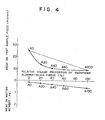
- Fig. 4 is a two sided graph, for each of the five wear test samples AO through A100, the upper half shows along the vertical axis the amount of wear on the actual test sample of composite material in microns, and the lower half shows along the vertical axis the amount of wear on the mating member (i.e., the spheroidal graphite cast iron cylinder) in milligrams.
- the volume proportion in percent of the total reinforcing fiber volume incorporated in said sample pieces which consists of amorphous alumina - silica fibers, i.e. the so called relative volume proportion of amorphous alumina - silica fibers is shown along the horizontal axis.
- the wear amount of the test piece dropped along with increase in the relative volume proportion of amorphous alumina - silica fibers incorporated in said test piece, and particularly dropped very quickly along with increase in said relative volume proportion when said relative volume proportion was in the range of 0% to about 30%, i.e. in the range of fairly low relative volume proportion of amorphous alumina - silica fibers, but on the other hand had a relatively small variation when said relative volume proportion of amorphous alumina - silica fibers was greater than about 40%.
- the wear amount of the mating member (the spheroidal graphite cast iron cylinder) was substantially independent of the relative volume proportion of amorphous alumina - silica fibers, and was fairly low in all eases.
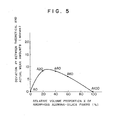
- the so called compounding rule would be assumed to hold. If this rule were to be applied to the present case, taking X% to represent the relative volume proportion of the amorphous alumina - silica fibers incorporated in each of said test samples, as defined above, since when X% was equal to 0% the wear amount of the test sample piece was equal to about 25 microns, whereas when X% was equal to 100% the wear amount of the test sample piece was equal to about 10 microns, then by the compounding rule the wear amount Y of the block test piece for arbitrary values of X% would be determined by the equation:
- Fig. 5 the value of this deviation dY between the linear approximation derived according to the compounding rule and the actual measured wear values is shown plotted on the vertical axis, while the relative volume proportion of the amorphous alumina - silica fibers incorporated in the test samples is shown along the horizontal axis. From this figure, is is confirmed that when the relative volume proportion of the amorphous alumina - silica fibers is in the range of 5% to 80%, and particularly when said relative volume proportion of the amorphous alumina - silica fibers is in the range of 10% to 60%, the actual wear amount of the test sample piece is very much reduced from the wear amount value predicted by the compounding rule.
- the relative volume proportion of the amorphous alumina - silica fibers in the hybrid fiber mixture material incorporated as fibrous reinforcing material for the composite material according to this invention should be in the range of 5% to 80%, and preferably should be in the range of 10% to 60%.
- the parameters of this alumina - silica fiber material, which was of the amorphous type were brought to be as given in Table 4, which is given at the end of this specification and before the claims thereof.
- the mixture was then well stirred up so that the amorphous alumina - silica fibers and the mineral fibers were evenly dispersed therein and were well mixed together, and then the preform as shown in Fig. 1 was formed by vacuum forming from the mixture, said preform again having dimensions of 80 by 80 by 20 millimeters.
- the individual amorphous alumina - silica fibers 2 and the individual mineral fibers 2a were largely oriented parallel to the longer sides of the cuboidal preforms 1, i.e. in the x-y plane as shown in Fig. 1, and were substantially randomly oriented in this plane.
- each preform was fired in a furnace at about 600°C, so that the silica bonded together the individual alumina - silica fibers 2 and mineral fibers 2a, acting as a binder.
- each of the preforms 1 was placed into the mold cavity 4 of the casting mold 3, and then a quantity of molten metal for serving as the matrix metal for the resultant composite material, in the case of this second preferred embodiment being molten magnesium alloy of type JIS (Japan Industrial Standard) AZ91 and this time being heated to about 690°C, was poured into the mold cavity 4 over and arond the preform 1.
- molten metal for serving as the matrix metal for the resultant composite material in the case of this second preferred embodiment being molten magnesium alloy of type JIS (Japan Industrial Standard) AZ91 and this time being heated to about 690°C
- each of these five wear test samples BO through B100 was mounted in a LFW friction wear test machine, and was subjected to a wear test under the same test conditions as in the case of the first preferred embodiment described above, except that the mating element employed was a cylinder of quench tempered bearing steel of type JIS (Japanese Industrial Standard) SUJ2, of hardness about 810 Hv.
- the results of these friction wear tests are shown in Fig. 6. In this figure, which is a two sided graph similar to Fig.
- the upper half shows along the vertical axis the amount of wear on the actual test sample of composite material in microns
- the lower half shows along the vertical axis the amount of wear on the mating member (i.e., the quench tempered bearing steel cylinder) in milligrams.
- the wear amount of the test piece dropped along with increase in the relative volume proportion of the amorphous alumina - silica fibers incorporated in said test piece, and particularly dropped very quickly along with increase in said relative volume proportion when said relative volume proportion was in the range of 0% to about 40%, i.e. in the range of fairly low relative volume proportion of amorphous alumina - silica fibers, but on the other hand had a relatively small variation when said relative volume proportion of amorphous alumina - silica fibers was greater than about 60%.
- the wear amount of the mating member was substantially independent of the relative volume proportion of amorphous alumina - silica fibers, and was fairly low in all cases.
- this second preferred embodiment which utilized as cooperating member a bearing steel cylinder with the first preferred embodiment described above which utilized as cooperating member a spheroidal graphite cast iron cylinder, it will be understood that, in the case of using such spheroidal graphite cast iron as the material for the cooperating member, since such spheroidal graphite east iron has a certain self lubricating property and has superior lubricating quality, the total amount of reinforcing fibers may be much reduced.
- the parameters of this alumina - silica fiber material, which was of the amorphous type were brought to be as given in Table 7, which is given at the end of this specification and before the claims thereof.
- a quantity of mineral fiber material of the type used in the first preferred embodiment described above, of the type manufactured by the Jim Walter Resources Company, with trade name "PMF" (Processed Mineral Fiber), having a nominal composition of 45% by weight of Si0 2 , 38% by weight of CaO, 9% by weight of Al 2 O 3 , and remainder 2%, with a quantity of non fibrous material intermingled therewith, was as in the first preferred embodiment subjected to per se known particle elimination processing such as filtration or the like, so that the total amount of non fibrous particles included therein was brought to be about 2.5% by weight, and so that the included weight percentage of non fibrous particles with a diameter greater than or equal to 150 microns was about 0.1%; thus, the parameters of this mineral fiber material were again brought to be as previously given in Table 2.
- PMF Processing Mineral Fiber
- preforms which will be designated as C0, C20, C40, C60, C80, and C100, in a similar way to that practiced in the case of the first preferred embodiment described above.
- a quantity of the alumina - silica fibers with composition as per Table 7 and a quantity of the mineral fibers with composition as per Table 2 were well and evenly mixed together in colloidal silica in various different volume proportions, and then the preform as shown in Fig. 1 was formed by vacuum forming from the mixture, said preform again having dimensions of 80 by 80 by 20 millimeters.
- each preform was fired in a furnace at about 600°C, so that the silica bonded together the individual alumina - silica fibers 2 and mineral fibers 2a, acting as a binder.
- a casting process was performed on each of the preforms, as schematically shown in Fig. 2, using as the matrix metal for the resultant composite material, in the case of this third preferred embodiment, molten aluminum alloy of type JIS (Japan Industrial Standard) AC8A, which in this case was heated to about 730°C, and pressurizing this molten matrix metal by the piston 6 to a pressure again of about 1500 kg/cm 2, so as to force it into the interstices between the fibers 2 and 2a of the preform 1. This pressure was maintained until the mass 5 of. matrix metal was completely solidified, and then the resultant cast form 7, schematically shown in Fig. 3, was removed from the mold cavity 4.
- JIS Japanese Industrial Standard
- This cast form 7 again was cylindrical, with diameter about 110 millimeters and height about 50 millimeters.
- a test piece of composite material incorporating amorphous alumina - silica fibers and mineral fibers as the reinforcing fiber material and aluminum alloy as the matrix metal of dimensions correspondingly again about 80 by 80 by 20 millimeters; thus, in all, this time, six such test pieces of composite material were manufactured, each corresponding to one of the preforms CO through C100, and each of which will be hereinafter referred to by the reference symbol CO through C100 of its parent preform since no confusion will arise therefrom.
- each of these six wear test samples CO through C100 was mounted in a LFW friction wear test machine, and was subjected to a wear test under the same test conditions as in the case of the first preferred embodiment described above, using however as in the case of that embodiment a mating element which was a cylinder of bearing steel of type JIS (Japanese Industrial Standard) SUJ2, with hardness Hv equal to about 810.
- a mating element which was a cylinder of bearing steel of type JIS (Japanese Industrial Standard) SUJ2
- hardness Hv hardness
- the upper half shows along the vertical axis the amount of wear on the actual test sample of composite material in microns
- the lower half shows along the vertical axis the amount of wear on the mating member (i.e., the bearing steel cylinder) in milligrams.
- the wear amount of the test piece dropped along with increase in the relative volume proportion of the amorphous alumina - silica fibers incorporated in said test piece, and particularly dropped very quickly along with increase in said relative volume proportion when said relative volume proportion was in the range of 096 to about 60%, i.e. in the range of fairly low relative volume proportion of amorphous alumina - silica fibers, but on the other hand had a relatively small variation when said relative volume proportion of amorphous alumina - silica fibers was greater than about 60%.
- the wear amount of the mating member was substantially independent of the relative volume proportion of amorphous alumina - silica fibers, and was fairly low in all cases, as with the first two preferred embodiments described above.
- a bending strength test block sample each of which will also be hereinafter referred to by the reference symbol AO through A100 of its parent preform.
- Each of these bending strength test samples had dimensions about 50 mm by 10 mm by 2 mm, and its 50 mm by 10 mm surface was cut parallel to the x-y plane as seen in Fig. 1 of the composite material mass.
- each of these bending strength test samples AO through A100 was subjected to a three point bending test at a temperature of about 350°C, with the gap between the support points being set to about 39 mm.
- a similar bending test was carried out upon a similarly cut piece of pure matrix metal, i.e. of aluminum alloy of type JIS (Japan Industrial Standard) AC8A, to which heat treatment of type T7 had been applied.
- the bending strength in each case was measured as the surface stress at breaking point of the test piece M/Z (M is the bending moment at breaking point, and Z is the cross sectional coefficient of the bending strength test sample piece). The results of these bending strength tests are shown in Fig.
- a quantity of amorphous alumina - silica fiber material of the type manufactured by Isolite Babcock Taika K.K Company, with trade name "Kaowool", having a nominal composition of 39% by weight of Al Z 0 3 and 60% by weight of SiO Z (remainder impurities), with a quantity of non fibrous material intermingled therewith, was subjected to particle elimination processing, so that the total proportion of non fibrous particles included therein was reduced so as to be about 3% by weight, and so that the included weight percentage of non fibrous particles with a diameter greater than or equal to 150 microns was reduced to be equal to about 0.3%; thus the parameters of this amorphous alumina - silica fiber material were again as shown in Table 1.
- a quantity of mineral fiber material of the type manufactured by the Jim Walter Resources Company, with trade name "PMF" (Processed Mineral Fiber), having a nominal composition of 45% by weight of Si0 2 , 38% by weight of CaO, 9% by weight of Al 2 O 3 , and remainder 2%, with a quantity of non fibrous material intermingled therewith, was subjected to per se known particle elimination processing such as filtration or the like, so that the total amount of non fibrous particles was brought to be about 2.5% by weight, and so that the included weight percentage of non fibrous particles with a diameter greater than or equal to 150 microns was about 0.1%; thus, the parameters of this mineral fiber material again were as given in Table 2.
- this mixed reinforcing fiber material made up from amorphous alumina - silica fiber material and mineral fiber material as the fibrous reinforcing material for the composite material, also in these cases of using zinc alloy, lead, or tin alloy as matrix metal, the characteristics of the composite material with regard to wear resistance are very much improved, as compared to the characteristics of pure matrix metal only.
Landscapes
- Chemical & Material Sciences (AREA)
- Engineering & Computer Science (AREA)
- Materials Engineering (AREA)
- Mechanical Engineering (AREA)
- Metallurgy (AREA)
- Organic Chemistry (AREA)
- Manufacture Of Alloys Or Alloy Compounds (AREA)
Applications Claiming Priority (2)
| Application Number | Priority Date | Filing Date | Title |
|---|---|---|---|
| JP60040906A JPS61201744A (ja) | 1985-03-01 | 1985-03-01 | アルミナ−シリカ繊維及び鉱物繊維強化金属複合材料 |
| JP40906/85 | 1985-03-01 |
Publications (3)
| Publication Number | Publication Date |
|---|---|
| EP0192806A2 true EP0192806A2 (de) | 1986-09-03 |
| EP0192806A3 EP0192806A3 (en) | 1987-10-21 |
| EP0192806B1 EP0192806B1 (de) | 1990-03-28 |
Family
ID=12593549
Family Applications (1)
| Application Number | Title | Priority Date | Filing Date |
|---|---|---|---|
| EP85106622A Expired - Lifetime EP0192806B1 (de) | 1985-03-01 | 1985-05-29 | Verbundmaterial einer metallischen Matrix verstärkt mit einem Gemisch von amorphen Aluminiumoxid-Siliciumoxid-Fasern und minerale Fasern |
Country Status (4)
| Country | Link |
|---|---|
| US (1) | US4601956A (de) |
| EP (1) | EP0192806B1 (de) |
| JP (1) | JPS61201744A (de) |
| DE (1) | DE3576832D1 (de) |
Families Citing this family (14)
| Publication number | Priority date | Publication date | Assignee | Title |
|---|---|---|---|---|
| US4889774A (en) * | 1985-06-03 | 1989-12-26 | Honda Giken Kogyo Kabushiki Kaisha | Carbon-fiber-reinforced metallic material and method of producing the same |
| EP0206647B1 (de) * | 1985-06-21 | 1992-07-29 | Imperial Chemical Industries Plc | Faserverstärkte Verbundwerkstoffe mit metallischer Matrix |
| DE3686239T2 (de) * | 1985-11-14 | 1993-03-18 | Ici Plc | Faserverstaerkter verbundwerkstoff mit metallmatrix. |
| JPS62156938A (ja) * | 1985-12-28 | 1987-07-11 | 航空宇宙技術研究所 | 傾斜機能材料の製造方法 |
| CA1335044C (en) * | 1986-01-31 | 1995-04-04 | Masahiro Kubo | Composite material including alumina-silica short fiber reinforcing material and aluminum alloy matrix metal with moderate copper and magnesium contents |
| JPS62240727A (ja) * | 1986-04-11 | 1987-10-21 | Toyota Motor Corp | 短繊維及びチタン酸カリウムホイスカ強化金属複合材料 |
| GB2193786B (en) * | 1986-07-31 | 1990-10-31 | Honda Motor Co Ltd | Internal combustion engine |
| JPS6342859A (ja) * | 1986-08-08 | 1988-02-24 | 航空宇宙技術研究所長 | 傾斜機能材料の製造方法 |
| JPH01263233A (ja) * | 1988-04-15 | 1989-10-19 | Ube Ind Ltd | β型窒化珪素ウイスカ強化金属複合材料の製法 |
| DE68906740T2 (de) * | 1988-08-29 | 1993-12-16 | Matsushita Electric Ind Co Ltd | Metallische Zusammensetzung enthaltend Zinkoxyd-Whisker. |
| US5108964A (en) * | 1989-02-15 | 1992-04-28 | Technical Ceramics Laboratories, Inc. | Shaped bodies containing short inorganic fibers or whiskers and methods of forming such bodies |
| US6265335B1 (en) * | 1999-03-22 | 2001-07-24 | Armstrong World Industries, Inc. | Mineral wool composition with enhanced biosolubility and thermostabilty |
| US8808412B2 (en) | 2006-09-15 | 2014-08-19 | Saint-Gobain Abrasives, Inc. | Microfiber reinforcement for abrasive tools |
| JP6764451B2 (ja) * | 2018-09-12 | 2020-09-30 | イビデン株式会社 | ハニカム構造体の製造方法 |
Family Cites Families (7)
| Publication number | Priority date | Publication date | Assignee | Title |
|---|---|---|---|---|
| US3788935A (en) * | 1970-05-27 | 1974-01-29 | Gen Technologies Corp | High shear-strength fiber-reinforced composite body |
| US4152149A (en) * | 1974-02-08 | 1979-05-01 | Sumitomo Chemical Company, Ltd. | Composite material comprising reinforced aluminum or aluminum-base alloy |
| US4223075A (en) * | 1977-01-21 | 1980-09-16 | The Aerospace Corporation | Graphite fiber, metal matrix composite |
| US4157409A (en) * | 1978-08-28 | 1979-06-05 | The United States Of America As Represented By The Secretary Of The Army | Method of making metal impregnated graphite fibers |
| JPS5623242A (en) * | 1979-08-02 | 1981-03-05 | Sumitomo Chem Co Ltd | Fiber reinforced metal composite material and parts for aircraft parts |
| JPS5893841A (ja) * | 1981-11-30 | 1983-06-03 | Toyota Motor Corp | 繊維強化金属型複合材料 |
| JPS5893837A (ja) * | 1981-11-30 | 1983-06-03 | Toyota Motor Corp | 複合材料及びその製造方法 |
-
1985
- 1985-03-01 JP JP60040906A patent/JPS61201744A/ja active Pending
- 1985-05-16 US US06/734,655 patent/US4601956A/en not_active Expired - Fee Related
- 1985-05-29 EP EP85106622A patent/EP0192806B1/de not_active Expired - Lifetime
- 1985-05-29 DE DE8585106622T patent/DE3576832D1/de not_active Expired - Lifetime
Also Published As
| Publication number | Publication date |
|---|---|
| EP0192806B1 (de) | 1990-03-28 |
| EP0192806A3 (en) | 1987-10-21 |
| DE3576832D1 (de) | 1990-05-03 |
| US4601956A (en) | 1986-07-22 |
| JPS61201744A (ja) | 1986-09-06 |
Similar Documents
| Publication | Publication Date | Title |
|---|---|---|
| EP0182959B1 (de) | Verbundwerkstoff mit Innenarmierung in Form von Tonerdesilikatfasern die kristallinen Mullit enthalten | |
| EP0192804B1 (de) | Verbundmaterial einer metallischen Matrix verstärkt mit einem Gemisch von Aluminiumoxidfasern und mineralen Fasern | |
| US4664704A (en) | Composite material made from matrix metal reinforced with mixed crystalline alumina-silica fibers and mineral fibers | |
| EP0192806B1 (de) | Verbundmaterial einer metallischen Matrix verstärkt mit einem Gemisch von amorphen Aluminiumoxid-Siliciumoxid-Fasern und minerale Fasern | |
| US4615733A (en) | Composite material including reinforcing mineral fibers embedded in matrix metal | |
| JPS5893837A (ja) | 複合材料及びその製造方法 | |
| JPH0635626B2 (ja) | アルミナ繊維・アルミナ−シリカ繊維強化金属複合材料 | |
| JPH0362776B2 (de) | ||
| JPH07116537B2 (ja) | 高強度および高靭性を有する耐摩耗性Cu合金 | |
| KR0165171B1 (ko) | 윤활재가 첨가된 Al2O3-SiO2-ZrO2 섬유 강화 금속 복합재료 | |
| JPH0475300B2 (de) | ||
| JPH0629473B2 (ja) | 摺動用部材 | |
| JPH0472892B2 (de) | ||
| JPS63103034A (ja) | 摺動用部材 | |
| JPH07107182B2 (ja) | 高強度および高靭性を有する耐摩耗性Cu合金 | |
| JPS5839757A (ja) | 複合体の製造方法 | |
| JPH0533295B2 (de) | ||
| JPS61207533A (ja) | 部材の組合せ | |
| JPS63103033A (ja) | 摺動用部材 | |
| JP2002155327A (ja) | 摺動部材用アルミニウム合金 | |
| JPS61194135A (ja) | 部材の組合せ | |
| JPS63192831A (ja) | 摺動用部材 | |
| JPH06240305A (ja) | 自己潤滑型複合材料の製造方法 | |
| JPS63192832A (ja) | 摺動用部材 | |
| JPS63103035A (ja) | 摺動用部材 |
Legal Events
| Date | Code | Title | Description |
|---|---|---|---|
| PUAI | Public reference made under article 153(3) epc to a published international application that has entered the european phase |
Free format text: ORIGINAL CODE: 0009012 |
|
| AK | Designated contracting states |
Kind code of ref document: A2 Designated state(s): DE FR GB |
|
| PUAL | Search report despatched |
Free format text: ORIGINAL CODE: 0009013 |
|
| AK | Designated contracting states |
Kind code of ref document: A3 Designated state(s): DE FR GB |
|
| 17P | Request for examination filed |
Effective date: 19871119 |
|
| 17Q | First examination report despatched |
Effective date: 19881025 |
|
| GRAA | (expected) grant |
Free format text: ORIGINAL CODE: 0009210 |
|
| AK | Designated contracting states |
Kind code of ref document: B1 Designated state(s): DE FR GB |
|
| PGFP | Annual fee paid to national office [announced via postgrant information from national office to epo] |
Ref country code: FR Payment date: 19900405 Year of fee payment: 6 |
|
| REF | Corresponds to: |
Ref document number: 3576832 Country of ref document: DE Date of ref document: 19900503 |
|
| ET | Fr: translation filed | ||
| PGFP | Annual fee paid to national office [announced via postgrant information from national office to epo] |
Ref country code: GB Payment date: 19900521 Year of fee payment: 6 |
|
| PLBE | No opposition filed within time limit |
Free format text: ORIGINAL CODE: 0009261 |
|
| STAA | Information on the status of an ep patent application or granted ep patent |
Free format text: STATUS: NO OPPOSITION FILED WITHIN TIME LIMIT |
|
| PG25 | Lapsed in a contracting state [announced via postgrant information from national office to epo] |
Ref country code: DE Effective date: 19910201 |
|
| 26N | No opposition filed | ||
| PG25 | Lapsed in a contracting state [announced via postgrant information from national office to epo] |
Ref country code: GB Effective date: 19910529 |
|
| GBPC | Gb: european patent ceased through non-payment of renewal fee | ||
| PG25 | Lapsed in a contracting state [announced via postgrant information from national office to epo] |
Ref country code: FR Effective date: 19920131 |
|
| REG | Reference to a national code |
Ref country code: FR Ref legal event code: ST |