EP0192879A1 - Verfahren für die Methangärung von Verdampferkondensaten aus der Papierstoffherstellung - Google Patents
Verfahren für die Methangärung von Verdampferkondensaten aus der Papierstoffherstellung Download PDFInfo
- Publication number
- EP0192879A1 EP0192879A1 EP19850307435 EP85307435A EP0192879A1 EP 0192879 A1 EP0192879 A1 EP 0192879A1 EP 19850307435 EP19850307435 EP 19850307435 EP 85307435 A EP85307435 A EP 85307435A EP 0192879 A1 EP0192879 A1 EP 0192879A1
- Authority
- EP
- European Patent Office
- Prior art keywords
- methane fermentation
- inhibitors
- methane
- fermentation
- acid
- Prior art date
- Legal status (The legal status is an assumption and is not a legal conclusion. Google has not performed a legal analysis and makes no representation as to the accuracy of the status listed.)
- Granted
Links
- VNWKTOKETHGBQD-UHFFFAOYSA-N methane Chemical compound C VNWKTOKETHGBQD-UHFFFAOYSA-N 0.000 title claims abstract description 122
- 238000000855 fermentation Methods 0.000 title claims abstract description 69
- 230000004151 fermentation Effects 0.000 title claims abstract description 68
- 239000002699 waste material Substances 0.000 claims abstract description 55
- 239000003112 inhibitor Substances 0.000 claims abstract description 17
- 239000012530 fluid Substances 0.000 claims abstract description 11
- 238000002203 pretreatment Methods 0.000 claims abstract description 9
- 239000002253 acid Substances 0.000 claims abstract description 8
- 238000012545 processing Methods 0.000 claims abstract description 8
- 238000004519 manufacturing process Methods 0.000 claims abstract description 4
- 230000003472 neutralizing effect Effects 0.000 claims abstract description 3
- 239000004575 stone Substances 0.000 claims description 12
- VEXZGXHMUGYJMC-UHFFFAOYSA-N Hydrochloric acid Chemical compound Cl VEXZGXHMUGYJMC-UHFFFAOYSA-N 0.000 claims description 8
- 230000000694 effects Effects 0.000 claims description 3
- 238000001914 filtration Methods 0.000 claims description 3
- 230000015271 coagulation Effects 0.000 claims description 2
- 238000005345 coagulation Methods 0.000 claims description 2
- 239000002245 particle Substances 0.000 claims description 2
- BDAGIHXWWSANSR-UHFFFAOYSA-N methanoic acid Natural products OC=O BDAGIHXWWSANSR-UHFFFAOYSA-N 0.000 claims 2
- OSWFIVFLDKOXQC-UHFFFAOYSA-N 4-(3-methoxyphenyl)aniline Chemical compound COC1=CC=CC(C=2C=CC(N)=CC=2)=C1 OSWFIVFLDKOXQC-UHFFFAOYSA-N 0.000 claims 1
- 235000019253 formic acid Nutrition 0.000 claims 1
- ZODDGFAZWTZOSI-UHFFFAOYSA-N nitric acid;sulfuric acid Chemical compound O[N+]([O-])=O.OS(O)(=O)=O ZODDGFAZWTZOSI-UHFFFAOYSA-N 0.000 claims 1
- 238000000034 method Methods 0.000 abstract description 17
- OKKJLVBELUTLKV-UHFFFAOYSA-N Methanol Chemical compound OC OKKJLVBELUTLKV-UHFFFAOYSA-N 0.000 description 33
- 239000007789 gas Substances 0.000 description 16
- 239000000463 material Substances 0.000 description 13
- 150000003464 sulfur compounds Chemical class 0.000 description 13
- 239000000706 filtrate Substances 0.000 description 12
- 239000011368 organic material Substances 0.000 description 11
- 230000020477 pH reduction Effects 0.000 description 11
- 239000000203 mixture Substances 0.000 description 9
- XLYOFNOQVPJJNP-UHFFFAOYSA-N water Substances O XLYOFNOQVPJJNP-UHFFFAOYSA-N 0.000 description 9
- 239000007788 liquid Substances 0.000 description 8
- 239000002994 raw material Substances 0.000 description 8
- QMMFVYPAHWMCMS-UHFFFAOYSA-N Dimethyl sulfide Chemical compound CSC QMMFVYPAHWMCMS-UHFFFAOYSA-N 0.000 description 6
- 239000002585 base Substances 0.000 description 6
- 238000006243 chemical reaction Methods 0.000 description 6
- 239000001963 growth medium Substances 0.000 description 6
- 238000002347 injection Methods 0.000 description 6
- 239000007924 injection Substances 0.000 description 6
- 241000894006 Bacteria Species 0.000 description 5
- LSDPWZHWYPCBBB-UHFFFAOYSA-N Methanethiol Chemical compound SC LSDPWZHWYPCBBB-UHFFFAOYSA-N 0.000 description 4
- 238000001704 evaporation Methods 0.000 description 4
- 239000000123 paper Substances 0.000 description 4
- 239000010802 sludge Substances 0.000 description 4
- 239000007858 starting material Substances 0.000 description 4
- 239000003513 alkali Substances 0.000 description 3
- 238000010790 dilution Methods 0.000 description 3
- 239000012895 dilution Substances 0.000 description 3
- 230000008020 evaporation Effects 0.000 description 3
- 238000002474 experimental method Methods 0.000 description 3
- 239000004615 ingredient Substances 0.000 description 3
- 239000002655 kraft paper Substances 0.000 description 3
- 239000000126 substance Substances 0.000 description 3
- 230000031068 symbiosis, encompassing mutualism through parasitism Effects 0.000 description 3
- WQOXQRCZOLPYPM-UHFFFAOYSA-N dimethyl disulfide Chemical compound CSSC WQOXQRCZOLPYPM-UHFFFAOYSA-N 0.000 description 2
- 239000011521 glass Substances 0.000 description 2
- 229920005610 lignin Polymers 0.000 description 2
- 238000004088 simulation Methods 0.000 description 2
- HEMHJVSKTPXQMS-UHFFFAOYSA-M sodium hydroxide Inorganic materials [OH-].[Na+] HEMHJVSKTPXQMS-UHFFFAOYSA-M 0.000 description 2
- 239000007787 solid Substances 0.000 description 2
- 150000007513 acids Chemical class 0.000 description 1
- 238000013019 agitation Methods 0.000 description 1
- BFNBIHQBYMNNAN-UHFFFAOYSA-N ammonium sulfate Chemical compound N.N.OS(O)(=O)=O BFNBIHQBYMNNAN-UHFFFAOYSA-N 0.000 description 1
- 229910052921 ammonium sulfate Inorganic materials 0.000 description 1
- 238000004458 analytical method Methods 0.000 description 1
- 229940041514 candida albicans extract Drugs 0.000 description 1
- 239000012876 carrier material Substances 0.000 description 1
- 229920002678 cellulose Polymers 0.000 description 1
- 239000001913 cellulose Substances 0.000 description 1
- 239000012295 chemical reaction liquid Substances 0.000 description 1
- HGAZMNJKRQFZKS-UHFFFAOYSA-N chloroethene;ethenyl acetate Chemical compound ClC=C.CC(=O)OC=C HGAZMNJKRQFZKS-UHFFFAOYSA-N 0.000 description 1
- 150000001875 compounds Chemical class 0.000 description 1
- 238000011109 contamination Methods 0.000 description 1
- 238000000354 decomposition reaction Methods 0.000 description 1
- JLMRTOYEEWHPER-UHFFFAOYSA-N dimethoxy-oxo-sulfanylidene-$l^{6}-sulfane Chemical compound COS(=O)(=S)OC JLMRTOYEEWHPER-UHFFFAOYSA-N 0.000 description 1
- 229910000396 dipotassium phosphate Inorganic materials 0.000 description 1
- 238000004821 distillation Methods 0.000 description 1
- 239000000839 emulsion Substances 0.000 description 1
- 229910052564 epsomite Inorganic materials 0.000 description 1
- 239000002921 fermentation waste Substances 0.000 description 1
- 238000004817 gas chromatography Methods 0.000 description 1
- 239000008187 granular material Substances 0.000 description 1
- 230000005484 gravity Effects 0.000 description 1
- 230000005764 inhibitory process Effects 0.000 description 1
- 230000000977 initiatory effect Effects 0.000 description 1
- 238000011835 investigation Methods 0.000 description 1
- 238000005342 ion exchange Methods 0.000 description 1
- 238000011068 loading method Methods 0.000 description 1
- 239000002075 main ingredient Substances 0.000 description 1
- 244000005700 microbiome Species 0.000 description 1
- 238000002156 mixing Methods 0.000 description 1
- 229910000402 monopotassium phosphate Inorganic materials 0.000 description 1
- 230000033116 oxidation-reduction process Effects 0.000 description 1
- 238000010979 pH adjustment Methods 0.000 description 1
- 229920000915 polyvinyl chloride Polymers 0.000 description 1
- 239000004800 polyvinyl chloride Substances 0.000 description 1
- 239000002244 precipitate Substances 0.000 description 1
- 238000003672 processing method Methods 0.000 description 1
- 239000000047 product Substances 0.000 description 1
- 230000002035 prolonged effect Effects 0.000 description 1
- 238000004537 pulping Methods 0.000 description 1
- 239000008262 pumice Substances 0.000 description 1
- 239000011435 rock Substances 0.000 description 1
- 239000013049 sediment Substances 0.000 description 1
- 238000004062 sedimentation Methods 0.000 description 1
- 239000000243 solution Substances 0.000 description 1
- 229910052572 stoneware Inorganic materials 0.000 description 1
- 238000003860 storage Methods 0.000 description 1
- 239000004094 surface-active agent Substances 0.000 description 1
- 238000012360 testing method Methods 0.000 description 1
- 239000012138 yeast extract Substances 0.000 description 1
Images


Classifications
-
- C—CHEMISTRY; METALLURGY
- C02—TREATMENT OF WATER, WASTE WATER, SEWAGE, OR SLUDGE
- C02F—TREATMENT OF WATER, WASTE WATER, SEWAGE, OR SLUDGE
- C02F3/00—Biological treatment of water, waste water, or sewage
- C02F3/28—Anaerobic digestion processes
- C02F3/2806—Anaerobic processes using solid supports for microorganisms
-
- Y—GENERAL TAGGING OF NEW TECHNOLOGICAL DEVELOPMENTS; GENERAL TAGGING OF CROSS-SECTIONAL TECHNOLOGIES SPANNING OVER SEVERAL SECTIONS OF THE IPC; TECHNICAL SUBJECTS COVERED BY FORMER USPC CROSS-REFERENCE ART COLLECTIONS [XRACs] AND DIGESTS
- Y02—TECHNOLOGIES OR APPLICATIONS FOR MITIGATION OR ADAPTATION AGAINST CLIMATE CHANGE
- Y02E—REDUCTION OF GREENHOUSE GAS [GHG] EMISSIONS, RELATED TO ENERGY GENERATION, TRANSMISSION OR DISTRIBUTION
- Y02E50/00—Technologies for the production of fuel of non-fossil origin
- Y02E50/30—Fuel from waste, e.g. synthetic alcohol or diesel
-
- Y—GENERAL TAGGING OF NEW TECHNOLOGICAL DEVELOPMENTS; GENERAL TAGGING OF CROSS-SECTIONAL TECHNOLOGIES SPANNING OVER SEVERAL SECTIONS OF THE IPC; TECHNICAL SUBJECTS COVERED BY FORMER USPC CROSS-REFERENCE ART COLLECTIONS [XRACs] AND DIGESTS
- Y10—TECHNICAL SUBJECTS COVERED BY FORMER USPC
- Y10S—TECHNICAL SUBJECTS COVERED BY FORMER USPC CROSS-REFERENCE ART COLLECTIONS [XRACs] AND DIGESTS
- Y10S210/00—Liquid purification or separation
- Y10S210/928—Paper mill waste, e.g. white water, black liquor treated
Definitions
- the present invention relates generally to a process for the treatment of waste fluids, and more particularly to a process for treating the waste discharged from paper making factories in an enormous quantity in a manner such that the organic substances contained in the waste are fermented efficiently to generate methane which may be used as an economical resource.
- Kraft pulps are predominantly prepared and used in the paper making industry. Particularly in Japan, the share of the kraft pulps reaches more than 70% of the total yield of pulps.
- 1 ton of kraft pulp about 2 tons of wooden material and about 0.5 tons of an alkali are put into a pulping kettle or pulper with a large volume of water.
- materials other than cellulose are dissolved in water to form the so-called black liquor or cooked liquor, the main ingredient of the black liquor being lignin.
- the black liquor is concentrated by evaporating water in a boiler so that the alkali and alkali compounds are recovered so as not to cause pollution problem due to contamination thereby.
- the liquid extracted from the black liquor at the evaporation step is commonly referred to as evaporator condensate.
- the amount of the evaporator condensate discharged from the paper or pulp making factory is so large that a factory having a capacity of producing pulp of 1000 tons/day, for example, discharges the evaporator condensate in an amount of about 6000 to 7000 tons/day. Under these circumstances, it becomes an important problem to treat the waste in a manner such that the profitable materials contained therein is converted into useful substances of some form and water can be reused in the pulp making step.
- the waste from the pulp making step containing several thousand ppm of organic materials has been processed through the activated sludge process together with other wastes.
- the concentration of organic materials contained therein is generally too high to be conveniently processed through the activated sludge process; while the concentration of organic materials adapted for successful processing by the activated sludge process is not less than about 1000 ppm, that in the waste from the pulp making system ranges, in general, from 3000 to 8000 ppm. It has been, therefore, necessitated either to dilute the waste to lower the concentration of organic materials contained therein or the residence time of such waste in the processing tank or vessel must be prolonged, leading to enormous increase in cost.
- the waste can be used as a raw material for a methane fermentation system, the concentration of organic materials in a raw material required for such fermentation being normally about 20000 ppm or more, the waste may be used as an energy source in addition to the advantageous result that the loading on the conventional activated sludge process can be reduced, whereby favourite economical interests including saving of natural resources and saving of energy are attainable.
- the object in view it has been eagerly investigated to develop a methane fermentation process using a bio-reactor in recent years.
- a satisfactory methane fermentation process for the treatment of the waste from the pulp making system with our best knowledge.
- a primary object of this invention is to provide a process wherein a waste from a pulp making system (the waste being referred to simply as "pulp waste” hereinafter in the specification and some of the appended claims) containing organic materials in a content which is somewhat lower than that conveniently used for a raw material in the conventional methane fermentation process can be processed to generate methane readily.
- a more specific object of this invention is to provide a process including a pre-treatment step for removing inhibitors which inhibit or hinder the subsequent methane fermentation step.
- Another object of this invention is to provide such a process wherein inhibitors for subsequent methane fermentation step are removed by the addition of an acid to the pulp waste to bring the pH value thereof to pH 3 or lower thereby to precipitate the lignin-base materials entrained in the pulp waste during the evaporation step and serving as surface active agents.
- a further object of this invention is to provide a process for treating the pulp waste whereby the organic materials contained therein are converted into methane which can be used as useful energy source.
- a still further object of this invention is to provide a process for treating the pulp waste whereby the water recovered from the waste may be returned back to the pulp making step for re-use.
- Yet a further object of this invention is to provide a process for treating the pulp waste, which can be operated at low cost in a small size processing facility.
- a further object of this invention is to provide a process for treating the pulp waste wherein the stripping step for the removal of undesirable sulfur-origin odor can be omitted to simplify the overall procedure otherwise necessary in the prior art pulp waste processing methods.
- the present invention has been accomplished in view of the findings found in our eager pursuit for developing a novel process for enabling methane fermentation by the use of the pulp waste as the raw or staring material, the course of our investigation will be described hereinbelow for better understanding of this invention.
- the pulp waste contains, other than methanol which is a decomposition product of lignin, oily materials having wood-like odor and extracted by distillation, lignin-base materials entrained during the evaporation step and the sulfur compounds, such as methyl mercaptan, dimethyl sulfide and dimethyl disulfide, the presence of the last mentioned sulfur compound being pointed out as those acting as inhibitors for methane fermentation.
- All of these materials form an emulsion or are partly dissolved in water under the surface active actions of the lignin-base materials entrained in the pulp waste.
- the pH value of the pulp waste is lowered to, for instance, pH 3 or lower
- the lignin-base materials are sedimented and coagulated so that the aforementioned oily materials and a portion of sulfur compounds are precipitated while being coagulated with or confined in the sedimented lignin-base materials as the lignin-base materials are sedimented, resulting in reduction of surface activity of the waste liquid
- This mixed precipitate or coagulation sediment may be formed at a relatively high temperature of 80°C, and may be easily removed by ordinary filtration.
- the content of inhibitors for methane fermentation can be reduced appreciably by once acidifying the pulp waste, whereby a raw material for successful methane fermentation having a relatively high content of organic materials can be prepared from a pulp waste.
- the present invention resides broadly in the methane fermentation process for processing an evaporator condensate of a waste fluid from a pulp production system, comprising:
- the fermentation step is carried out in a bio-reactor charged with lumps or granules of a porous fire-resisting stone or rock such as a pumice.
- a porous fire-resisting stone By the use of such a porous fire-resisting stone, symbiosis, growth and adherence of bacteria participating in the fermentation reaction are enhanced by the favourite action of the packed porous fire-resisting stone, the methane fermentation reaction rate can be increased so that the pulp waste containing relatively low content of fermentative organic materials can be readily treated economically within a short period of time, for example, within a time period of shorter than one day. This is a remarkable improvement over the prior art process in which the pulp waste must be treated over a residence time of 10 to 30 days due to low concentration of the organic materials and microorganisms.
- filtrate after acidification The filtrate will be referred to hereinafter as "filtrate after acidification”.
- a bio-reactor packed with a porous fire-resisting stone was prepared in the following manner. Into a wide mouth glass bottle (2l capacity) provided with a rid and packed with 1l of a crushed porous fire-resisting stone, charged was 1l of a high temperature methane fermentation waste picked out of a facility for processing a waste from a food production process.
- the content in the glass bottle had been maintained at 53°C, and 300 ml of the cultivated liquid was removed from the bottle at every 5 day intervals and 300 m l of a culture medium, the composition of which is set forth in the following Table 3, was added into the bottle in place of the removed cultivated liquid, so that the bacteria participating in the methane fermentation reaction was acclimatized to methanol for 50 days.
- the bio-reactor packed with the crushed porous fire-resisting stone on which the acclimatized methane fermentation bacteria were adhering and living in symbiosis was, thus, prepared.
- a separate second injection syringe was charged with 40 ml of the "filtrate after acidification" prepared by the preceding step (ii) and having a pH value of 7.4; and then added with the same quantity of same composition as contained in the first injection syringe.
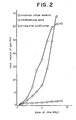
- a separate third injection syringe was charged with 400 m Y- of the culture medium having the composition as set forth in Table 3. After expelling air in the syringes, those syringes were placed in a constant temperature bath 14 maintained at 53°C, and the volumes of gases generated in respective tubes were measured. The results, i.e. the total volume of gases generated in each of the syringe tubes as the lapse of time are shown in Fig. 2.
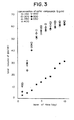
- the "filtrate after acidification" prepared in accordance with the step (ii) of Example 1 was added with the ingredients contained in the culture medium of Table 3 except in that methanol and water were omitted, the mixing ratio of the ingredients being the same as in the composition of Table 3, and then the pH value of the admixture was adjusted to 7.4; thereafter equivalent amounts of methyl mercaptan, dimethyl sulfide and dimethyl thiosulphate were added to prepare seven sample liquors containing, respectively, 100, 200, 350, 400, 450, 500 and 550 ppm of total sulfur compounds.
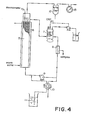
- the illustrated apparatus comprises a reaction tower 5 packed with crushed porous fire-resisting stone lumps 6 each having a diameter of 10 to 12 cm, the effective volume of the tower 5 being 1 liter.
- the effluent from the reactor was subjected to tests for the determination of the pH value and the ORP value oxidation-reduction potential), followed by adjusting the pH value thereof to 7.0 to 7.4, and recirculated by a recirculation pump 9 through an ultrafilter 8 for picking up samples. A portion of the recirculated effluent was picked out of the system by means of a discharge-and-supply pump 10.
- the raw material liquid, or the evaporator condensate fluid, was supplied into the reactor tower 5 heated to 53°C from a storage tank 11 by means of the discharge-and-supply pump 10. The amount or volume of the supplied raw material liquid was equalized to that discharged by the same pump 10.
- the gases emitted from the system was passed from the top of the reactor tower 5 and through a gas seal reservoir 12, and the volume thereof was measured by a gas meter 13.
- composition of the gas was determined by a gas chromatography, and the compositions of the samples picked up from the sample ports and from the raw pulp waste were determined by means of ion-exchange type liquid chromatograms.
- the pH values of the samples were adjusted by using a IN-NaOH solution.
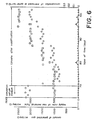
- the pulp waste fluid was supplied after the fermentation on the simulation culture medium, and when methanol was detected at the outlet of the reactor tower 5, the raw material supply was stopped and the reaction liquid was recirculated to continue fermentation in a continuous mode (see Fig. 5).
- porous fire-resisting stone was packed in the bio-reactor in the examples demonstrated hereinbefore, it was used with the aim to further facilitating the methane fermentation of pulp waste since the bacteria participating in methane fermentation were improved in their symbiosis, growth and adherence, and it should be noted that any carrier materials other than porous fire-resisting stone may be used conveniently in the system according to the present invention.
Landscapes
- Life Sciences & Earth Sciences (AREA)
- Microbiology (AREA)
- Water Supply & Treatment (AREA)
- Hydrology & Water Resources (AREA)
- Engineering & Computer Science (AREA)
- Environmental & Geological Engineering (AREA)
- Biodiversity & Conservation Biology (AREA)
- Chemical & Material Sciences (AREA)
- Organic Chemistry (AREA)
- Treatment Of Sludge (AREA)
- Paper (AREA)
- Biological Treatment Of Waste Water (AREA)
- Purification Treatments By Anaerobic Or Anaerobic And Aerobic Bacteria Or Animals (AREA)
- Processing Of Solid Wastes (AREA)
Applications Claiming Priority (2)
| Application Number | Priority Date | Filing Date | Title |
|---|---|---|---|
| JP35056/85 | 1985-02-23 | ||
| JP60035056A JPS61197096A (ja) | 1985-02-23 | 1985-02-23 | パルプ製紙廃水蒸発凝縮液のメタン発酵処理法 |
Publications (2)
| Publication Number | Publication Date |
|---|---|
| EP0192879A1 true EP0192879A1 (de) | 1986-09-03 |
| EP0192879B1 EP0192879B1 (de) | 1991-02-06 |
Family
ID=12431374
Family Applications (1)
| Application Number | Title | Priority Date | Filing Date |
|---|---|---|---|
| EP19850307435 Expired - Lifetime EP0192879B1 (de) | 1985-02-23 | 1985-10-16 | Verfahren für die Methangärung von Verdampferkondensaten aus der Papierstoffherstellung |
Country Status (5)
| Country | Link |
|---|---|
| US (1) | US4666605A (de) |
| EP (1) | EP0192879B1 (de) |
| JP (1) | JPS61197096A (de) |
| CA (1) | CA1256603A (de) |
| DE (1) | DE3581726D1 (de) |
Cited By (2)
| Publication number | Priority date | Publication date | Assignee | Title |
|---|---|---|---|---|
| EP0286358A3 (en) * | 1987-04-08 | 1989-01-11 | Imatran Voima Oy | Procedure and bioreactor for treating low activity organic wastes from nuclear power plants with the aid of anaerobic fermentation |
| CN112093960A (zh) * | 2020-09-01 | 2020-12-18 | 北京理工大学 | 一种硝化竹纤维素洗涤废水的处理方法 |
Families Citing this family (24)
| Publication number | Priority date | Publication date | Assignee | Title |
|---|---|---|---|---|
| NL8600723A (nl) * | 1986-03-20 | 1987-10-16 | Pacques Bv | Werkwijze voor het zuiveren van afvalwater. |
| US5424195A (en) * | 1990-06-20 | 1995-06-13 | Secretary Of The Interior | Method for in situ biological conversion of coal to methane |
| SE526875C2 (sv) * | 2002-08-14 | 2005-11-15 | Tekniska Verken Linkoeping Ab | Sätt och anordning för att framställa biogas ur ett organiskt material |
| SE522262C2 (sv) * | 2002-08-14 | 2004-01-27 | Tekniska Verken Linkoeping Ab | Sätt och anordning för framställning av biogas |
| US8092559B2 (en) | 2004-05-12 | 2012-01-10 | Luca Technologies, Inc. | Generation of hydrogen from hydrocarbon bearing materials |
| US20060223160A1 (en) * | 2005-04-05 | 2006-10-05 | Luca Technologies, Llc | Systems and methods for the isolation and identification of microorganisms from hydrocarbon deposits |
| US20060223153A1 (en) * | 2005-04-05 | 2006-10-05 | Luca Technologies, Llc | Generation of materials with enhanced hydrogen content from anaerobic microbial consortia |
| US20060223159A1 (en) * | 2005-04-05 | 2006-10-05 | Luca Technologies, Llc | Generation of materials with enhanced hydrogen content from microbial consortia including thermotoga |
| US7426960B2 (en) * | 2005-05-03 | 2008-09-23 | Luca Technologies, Inc. | Biogenic fuel gas generation in geologic hydrocarbon deposits |
| CA2523513A1 (en) * | 2005-10-14 | 2007-04-14 | Amsco Cast Products (Canada) Inc. | Tooth and adaptor assembly for a dipper bucket |
| US7416879B2 (en) * | 2006-01-11 | 2008-08-26 | Luca Technologies, Inc. | Thermacetogenium phaeum consortium for the production of materials with enhanced hydrogen content |
| US20100248322A1 (en) * | 2006-04-05 | 2010-09-30 | Luca Technologies, Inc. | Chemical amendments for the stimulation of biogenic gas generation in deposits of carbonaceous material |
| US7977282B2 (en) | 2006-04-05 | 2011-07-12 | Luca Technologies, Inc. | Chemical amendments for the stimulation of biogenic gas generation in deposits of carbonaceous material |
| US7696132B2 (en) * | 2006-04-05 | 2010-04-13 | Luca Technologies, Inc. | Chemical amendments for the stimulation of biogenic gas generation in deposits of carbonaceous material |
| EP2428492A1 (de) | 2007-05-11 | 2012-03-14 | Kurita Water Industries Ltd. | Anaerobes Behandlungsverfahren und anaerobe Behandlungsvorrichtung |
| US20100035309A1 (en) * | 2008-08-06 | 2010-02-11 | Luca Technologies, Inc. | Analysis and enhancement of metabolic pathways for methanogenesis |
| US20100248321A1 (en) * | 2009-03-27 | 2010-09-30 | Luca Technologies, Inc. | Surfactant amendments for the stimulation of biogenic gas generation in deposits of carbonaceous materials |
| US8479813B2 (en) * | 2009-12-16 | 2013-07-09 | Luca Technologies, Inc. | Biogenic fuel gas generation in geologic hydrocarbon deposits |
| JP5471748B2 (ja) * | 2010-04-09 | 2014-04-16 | 株式会社Ihi | 嫌気性処理設備及び嫌気性処理方法 |
| JP5680479B2 (ja) * | 2011-05-17 | 2015-03-04 | 住友重機械工業株式会社 | 嫌気性処理装置及び嫌気性処理方法 |
| US9004162B2 (en) | 2012-03-23 | 2015-04-14 | Transworld Technologies Inc. | Methods of stimulating acetoclastic methanogenesis in subterranean deposits of carbonaceous material |
| JP2014030827A (ja) * | 2013-11-21 | 2014-02-20 | Ihi Corp | 嫌気性処理設備及び嫌気性処理方法 |
| US12416024B2 (en) | 2018-03-29 | 2025-09-16 | Transworld Technologies Inc. | Biologically enhanced oil recovery methods |
| CN110482781B (zh) * | 2019-08-01 | 2021-12-10 | 广西大学 | 一种利用乳清预酸处理高钙造纸工业废水来促进厌氧反应以及抑制钙化的方法 |
Citations (2)
| Publication number | Priority date | Publication date | Assignee | Title |
|---|---|---|---|---|
| FR2340909A1 (fr) * | 1976-02-10 | 1977-09-09 | Omnium Assainissement | Materiaux-supports de fermentation biologique |
| US4213857A (en) * | 1977-09-14 | 1980-07-22 | The Agency Of Industrial Science And Technology | Anaerobic digestion process |
Family Cites Families (4)
| Publication number | Priority date | Publication date | Assignee | Title |
|---|---|---|---|---|
| JPS555998B2 (de) * | 1975-01-22 | 1980-02-12 | ||
| JPS57138382A (en) * | 1981-02-21 | 1982-08-26 | Oji Paper Co Ltd | Preparation of microbial cell |
| JPS5841118B2 (ja) * | 1981-11-12 | 1983-09-09 | 荏原インフイルコ株式会社 | バルブドレ−ンの脱臭法 |
| DE3326939A1 (de) * | 1983-07-26 | 1985-02-07 | Linde Ag, 6200 Wiesbaden | Verfahren und vorrichtung zur anaeroben biologischen reinigung von abwasser |
-
1985
- 1985-02-23 JP JP60035056A patent/JPS61197096A/ja active Granted
- 1985-10-16 CA CA000493113A patent/CA1256603A/en not_active Expired
- 1985-10-16 DE DE8585307435T patent/DE3581726D1/de not_active Expired - Lifetime
- 1985-10-16 EP EP19850307435 patent/EP0192879B1/de not_active Expired - Lifetime
- 1985-10-17 US US06/788,235 patent/US4666605A/en not_active Expired - Lifetime
Patent Citations (2)
| Publication number | Priority date | Publication date | Assignee | Title |
|---|---|---|---|---|
| FR2340909A1 (fr) * | 1976-02-10 | 1977-09-09 | Omnium Assainissement | Materiaux-supports de fermentation biologique |
| US4213857A (en) * | 1977-09-14 | 1980-07-22 | The Agency Of Industrial Science And Technology | Anaerobic digestion process |
Non-Patent Citations (2)
| Title |
|---|
| BIOTECHNOLOGY ADVANCES, vol. 2, no. 2, 1984, pages 357-375, Pergamon Press Ltd., Oxford, GB; M. SALKINOJA et al.: "Anaerobic fluidised bed for the purification of effluents from chemical and mechanical pulping" * |
| CHEMICAL ABSTRACTS, vol. 81, no. 18, 4th November 1974, page 120, no. 107629m, Columbus, Ohio, US; G.S. MUKHINA: "Precipitation of lignin from black liquors", & NAUCH. TR., LENINGRAD. LESOTEKH. AKAD. 1973, 158, 80-5 * |
Cited By (3)
| Publication number | Priority date | Publication date | Assignee | Title |
|---|---|---|---|---|
| EP0286358A3 (en) * | 1987-04-08 | 1989-01-11 | Imatran Voima Oy | Procedure and bioreactor for treating low activity organic wastes from nuclear power plants with the aid of anaerobic fermentation |
| CN112093960A (zh) * | 2020-09-01 | 2020-12-18 | 北京理工大学 | 一种硝化竹纤维素洗涤废水的处理方法 |
| CN112093960B (zh) * | 2020-09-01 | 2021-10-29 | 北京理工大学 | 一种硝化竹纤维素洗涤废水的处理方法 |
Also Published As
| Publication number | Publication date |
|---|---|
| EP0192879B1 (de) | 1991-02-06 |
| US4666605A (en) | 1987-05-19 |
| DE3581726D1 (de) | 1991-03-14 |
| JPH0232958B2 (de) | 1990-07-24 |
| CA1256603A (en) | 1989-06-27 |
| JPS61197096A (ja) | 1986-09-01 |
Similar Documents
| Publication | Publication Date | Title |
|---|---|---|
| US4666605A (en) | Methane fermentation process for treating evaporator condensate from pulp making system | |
| CA1231184A (en) | Method at anaerobic wastewater treatment | |
| RU2692731C1 (ru) | Способ извлечения фосфата | |
| Hamdi | Effects of agitation and pretreatment on the batch anaerobic digestion of olive mil | |
| FI97218C (fi) | Jäteveden puhdistusprosessi | |
| Chyi et al. | Effects of particulate size in anaerobic acidogenesis using cellulose as a sole carbon source | |
| Fiestas et al. | Influence of immobilization supports on the kinetic constants of anaerobic purification of olive mill wastewater | |
| US4039438A (en) | Biological denitrification of water | |
| Som et al. | Kinetics and performance study of ultrasonic-assisted membrane anaerobic system using Monod Model for Palm Oil Mill Effluent (POME) treatment | |
| Tamilchelvan et al. | Anaerobic digestion treatment of tannery waste water | |
| US3241943A (en) | Method for the production of a fertilizer or soil improvement agent from sulfite waste liquor while recovering acids and combustible gases formed in the process | |
| Burgess et al. | Pilot‐plant studies in production of sulphur from sulphate‐enriched sewage sludge | |
| US4026793A (en) | Aerobic sewerage digestion process (42 C. process) | |
| RU2628437C1 (ru) | Способ утилизации жидкой фракции навозных стоков свиноводческих хозяйств | |
| Dangcong et al. | Anaerobic digestion of alkaline black liquor using an up‐flow anaerobic sludge blanket reactor | |
| Anderson et al. | Research and application of anaerobic processes | |
| Maree et al. | Treatment of gelatine factory effluent | |
| Van den Berg et al. | Anaerobic digestion of pear waste: laboratory equipment design and preliminary results | |
| Lane | Anaerobic digestion of citrus peel press liquors | |
| Alonso et al. | Anaerobic digestion of wastewater produced in the manufacture of cellulosic pulp from wheat straw in immobilised cell bioreactors | |
| SE1950637A1 (en) | Method for the production of biogas | |
| EP0085421B1 (de) | Verfahren und Einrichtung zur biologischen Schlammbehandlung | |
| US3067107A (en) | Propionic acid fermentation | |
| Mohan et al. | New technique for effluent treatment in sulphitation sugar factories. | |
| Gove | Pulp and paper industry effluent management |
Legal Events
| Date | Code | Title | Description |
|---|---|---|---|
| PUAI | Public reference made under article 153(3) epc to a published international application that has entered the european phase |
Free format text: ORIGINAL CODE: 0009012 |
|
| AK | Designated contracting states |
Kind code of ref document: A1 Designated state(s): DE FR GB IT |
|
| 17P | Request for examination filed |
Effective date: 19870223 |
|
| 17Q | First examination report despatched |
Effective date: 19880118 |
|
| GRAA | (expected) grant |
Free format text: ORIGINAL CODE: 0009210 |
|
| AK | Designated contracting states |
Kind code of ref document: B1 Designated state(s): DE FR GB IT |
|
| ITF | It: translation for a ep patent filed | ||
| REF | Corresponds to: |
Ref document number: 3581726 Country of ref document: DE Date of ref document: 19910314 |
|
| ET | Fr: translation filed | ||
| PLBE | No opposition filed within time limit |
Free format text: ORIGINAL CODE: 0009261 |
|
| STAA | Information on the status of an ep patent application or granted ep patent |
Free format text: STATUS: NO OPPOSITION FILED WITHIN TIME LIMIT |
|
| 26N | No opposition filed | ||
| REG | Reference to a national code |
Ref country code: GB Ref legal event code: 732 |
|
| ITPR | It: changes in ownership of a european patent |
Owner name: CESSIONE;NEW ENERGY AND INDUSTRIAL TECHNOLOGY DEVE |
|
| REG | Reference to a national code |
Ref country code: FR Ref legal event code: TP |
|
| REG | Reference to a national code |
Ref country code: GB Ref legal event code: IF02 |
|
| PGFP | Annual fee paid to national office [announced via postgrant information from national office to epo] |
Ref country code: FR Payment date: 20031003 Year of fee payment: 19 |
|
| PGFP | Annual fee paid to national office [announced via postgrant information from national office to epo] |
Ref country code: GB Payment date: 20031016 Year of fee payment: 19 |
|
| PGFP | Annual fee paid to national office [announced via postgrant information from national office to epo] |
Ref country code: DE Payment date: 20031023 Year of fee payment: 19 |
|
| PG25 | Lapsed in a contracting state [announced via postgrant information from national office to epo] |
Ref country code: GB Free format text: LAPSE BECAUSE OF NON-PAYMENT OF DUE FEES Effective date: 20041016 |
|
| PG25 | Lapsed in a contracting state [announced via postgrant information from national office to epo] |
Ref country code: DE Free format text: LAPSE BECAUSE OF NON-PAYMENT OF DUE FEES Effective date: 20050503 |
|
| GBPC | Gb: european patent ceased through non-payment of renewal fee |
Effective date: 20041016 |
|
| PG25 | Lapsed in a contracting state [announced via postgrant information from national office to epo] |
Ref country code: FR Free format text: LAPSE BECAUSE OF NON-PAYMENT OF DUE FEES Effective date: 20050630 |
|
| REG | Reference to a national code |
Ref country code: FR Ref legal event code: ST |