EP0192929A1 - Appareil pour la détermination autonome de réactions en fonction de situations - Google Patents
Appareil pour la détermination autonome de réactions en fonction de situations Download PDFInfo
- Publication number
- EP0192929A1 EP0192929A1 EP86100161A EP86100161A EP0192929A1 EP 0192929 A1 EP0192929 A1 EP 0192929A1 EP 86100161 A EP86100161 A EP 86100161A EP 86100161 A EP86100161 A EP 86100161A EP 0192929 A1 EP0192929 A1 EP 0192929A1
- Authority
- EP
- European Patent Office
- Prior art keywords
- variables
- situations
- coefficients
- values
- reactions
- Prior art date
- Legal status (The legal status is an assumption and is not a legal conclusion. Google has not performed a legal analysis and makes no representation as to the accuracy of the status listed.)
- Withdrawn
Links
Images

Classifications
-
- G—PHYSICS
- G06—COMPUTING OR CALCULATING; COUNTING
- G06K—GRAPHICAL DATA READING; PRESENTATION OF DATA; RECORD CARRIERS; HANDLING RECORD CARRIERS
- G06K15/00—Arrangements for producing a permanent visual presentation of the output data, e.g. computer output printers
- G06K15/02—Arrangements for producing a permanent visual presentation of the output data, e.g. computer output printers using printers
- G06K15/10—Arrangements for producing a permanent visual presentation of the output data, e.g. computer output printers using printers by matrix printers
-
- G—PHYSICS
- G06—COMPUTING OR CALCULATING; COUNTING
- G06K—GRAPHICAL DATA READING; PRESENTATION OF DATA; RECORD CARRIERS; HANDLING RECORD CARRIERS
- G06K2215/00—Arrangements for producing a permanent visual presentation of the output data
- G06K2215/0002—Handling the output data
- G06K2215/002—Generic data access
- G06K2215/0028—Generic data access characterised by the format per se
-
- G—PHYSICS
- G06—COMPUTING OR CALCULATING; COUNTING
- G06N—COMPUTING ARRANGEMENTS BASED ON SPECIFIC COMPUTATIONAL MODELS
- G06N20/00—Machine learning
Definitions
- the invention relates to a method for automatically determining reactions as a function of situations according to the preamble of patent claim 1.
- the invention is therefore based on the object of specifying a method which makes it possible to automatically determine suitable reactions depending on situations even when the situations are unknown.
- the object is achieved in the method of the type mentioned at the outset by the features specified in the characterizing part of patent claim 1.
- a recoder is introduced from a set of adaptable coefficients.
- the coefficient values that are determined during a learning phase can be referred to as intelligent coefficients, because they contain the success during learning, whereby the word learning primarily means progress through trial and error in the computer system.
- the lem phase is dominated by the numerical optimization of the set of coefficients, while the coefficients remain constant in the can phase and calculate reactions directly from situations.
- the method is generally applicable when an arbitrary situation is interpreted and expressed as a set of variables with arbitrary values. These variables are then linked arithmetically with the coefficients and converted into a reaction value
- the method according to the invention has the advantage that suitable reactions can be assigned to any similar situation in a short time, since no stock is to be searched for sample situations.
- the processing during the learning phase may take a long time, because the only thing that matters is that the processing is as short as possible during the can phase.
- the target reactions to which the coefficients are taught need not be able to be described analytically, that is to say they arise in the computer system and are evaluated by calculation. They can also be drawn up together with the situations as a list outside the computer system with human (natural) intelligence and specified for the learning phase in the computer system.
- the method can be used wherever a device or machine should react appropriately and quickly to changing situations that cannot be fully programmed in advance.
- the method can, for example, be used advantageously for coding characters in a character generator of a matrix printer.
- the coefficients are determined during the coding phase when coding a small subset of characters of a certain style.
- the coding of any characters of this style can then run automatically in the optional phase.
- the procedure is usually such that the outlines of the characters are displayed and then the outlines are filled with matrix points as best as possible, the properties of the matrix printer, such as the number of print elements of the print head and the possible step size and the Possibilities of positioning the printhead in the horizontal direction and even the ink flow behavior on the paper are taken into account in the best possible way.
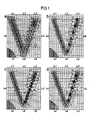
- the illustration in FIG. 1 shows, for example, the outline of a character V which has been filled in by a plurality of points.
- Each line of the grid shown in FIG. 1a is assigned to the movement of a printing element relative to the recording medium and the characters are displayed, for example, using 32 printing elements.
- the vertical rulers represent whole steps, but the pressure points in the horizontal direction can also be represented in partial steps of these whole steps.
- the method according to the invention is not limited to the coding of characters, but can be used wherever a device or a machine is to react appropriately and quickly to changing situations which cannot be exhaustively preprogrammed.
- n 9 integer variables s i .
- v allows the whole variety of k "possible situations to be clearly distinguished.
- the coefficients c j modify or distort the variables s i and deliver where k is subtracted as soon as s i exceeds the threshold k. This is based on the idea of enabling the system to change every possible numerical value s i between 1 and k into every other numerical value s i between 1 and k and thus to be able to obtain any desired reaction r from any possible situation, i.e. the function r ( s ;, c j ).
- the task of the coefficients is similar to that of nerve cells, which are supposed to bring information elements stored in an organism into any connection with one another.
- the coefficients do not have to be an integer or be between 0 and 9.
- the coefficients can now decide by simply numbering a response choose.
- This equation is able to calculate k "different reactions for k" different situations.
- the method is illustrated using the example of three different situations which are possible from 10 9 and which occur, for example, when coding the letters A, B and C.
- Each character is recognized by the numerical values of its nine sub-matrices.
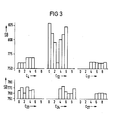
- the numerical values of the submatrices s to s 9 are then linked to the coefficients c to c 90 , which have the numerical values shown in FIG. 2, for example. If the variables s to s 9 , which signal the character A, are combined with the coefficients c to c 90 , z. B.
- the coding of the character is started at a point which is 83% of the developed character length, that is at the right end of the character and that Jumps to points in the last third are to be carried out at 70% of the processed character length.
- the coefficients c, to c 90 were optimally determined in the learning phase and are now constant in order to be linked to the variables s, to s 9 assigned to the various characters.
- the developed length of characters here means the points lined up within the columns of a drawing field, for example the dots starting from top to bottom and from left to right in the drawing field, as shown in FIG. 1 a, are lined up.
- the coefficients c, to c 90 are determined using a numerical optimization method. Depending on the procedure you start e.g. B. with a set of random numbers and then searches for the minimum the objective function In the present case, the total number of memory cells required for coding the character is declared the objective function value. A small subset of the characters of a particular style are picked out for learning.
- the computing system is programmed in such a way that the coordinates of each character are encoded according to the strategy which the current coefficient values are currently selecting after they have just been varied by the optimization program. The total number of memory cells for coding the character must be as small as possible.
- the determination of the coefficients in the lem phase takes a very long time compared to the determination of a reaction in the can phase. It is possible to take the adapted coefficients from the computer system after the learning phase and to transplant them into another device or another machine, so that in the optional phase, independent coding of individually designed characters of the same character style can run there independently.
- the method to populate the character outlines with dots, as shown in FIG. 1a.
- the intelligence of the font array which filled in these outlines for some characters, can be tapped, since the situation, namely the outlines and the corresponding reactions, i.e. the arrangement of the points, are present.
- a window can be moved across each character matrix to determine the coefficients, and the coefficients will assume numerical values such that they match the corresponding outline situation in the window with the arrangement of the dots of the type designer in the window. They can then be used to generate a wide variety of character styles for printers in a short time at low cost, automatically taking into account special properties of the printer.
- the method fC is suitable for a large number of applications. For example, it is possible to carry out speech or pattern recognition if, in the learning phase, the coefficients are optimized with regard to a selection of known sounds or patterns. In the can phase, it is then possible to recognize sounds or patterns of any kind.
Landscapes
- Physics & Mathematics (AREA)
- Engineering & Computer Science (AREA)
- Mathematical Physics (AREA)
- General Engineering & Computer Science (AREA)
- General Physics & Mathematics (AREA)
- Theoretical Computer Science (AREA)
- Machine Translation (AREA)
Applications Claiming Priority (2)
| Application Number | Priority Date | Filing Date | Title |
|---|---|---|---|
| DE3504230 | 1985-02-07 | ||
| DE3504230 | 1985-02-07 |
Publications (1)
| Publication Number | Publication Date |
|---|---|
| EP0192929A1 true EP0192929A1 (fr) | 1986-09-03 |
Family
ID=6261953
Family Applications (1)
| Application Number | Title | Priority Date | Filing Date |
|---|---|---|---|
| EP86100161A Withdrawn EP0192929A1 (fr) | 1985-02-07 | 1986-01-08 | Appareil pour la détermination autonome de réactions en fonction de situations |
Country Status (1)
| Country | Link |
|---|---|
| EP (1) | EP0192929A1 (fr) |
Cited By (3)
| Publication number | Priority date | Publication date | Assignee | Title |
|---|---|---|---|---|
| WO1988004084A1 (fr) * | 1986-11-20 | 1988-06-02 | British Telecommunications Public Limited Company | Traitement de configurations |
| WO2004006166A3 (fr) * | 2002-07-03 | 2004-04-08 | Ontario Inc 2012244 | Systeme relatif a une police de caracteres par traits a echelle modifiable et technique afferente |
| US7251365B2 (en) | 2002-07-03 | 2007-07-31 | Vadim Fux | Scalable stroke font system and method |
Citations (3)
| Publication number | Priority date | Publication date | Assignee | Title |
|---|---|---|---|---|
| GB1011685A (en) * | 1962-07-12 | 1965-12-01 | Standard Telephones Cables Ltd | Learning machine |
| US3317900A (en) * | 1963-12-19 | 1967-05-02 | Ibm | Adaptive logic system |
| EP0056948A1 (fr) * | 1981-01-20 | 1982-08-04 | Licentia Patent-Verwaltungs-GmbH | Système de communication pour bureaux |
-
1986
- 1986-01-08 EP EP86100161A patent/EP0192929A1/fr not_active Withdrawn
Patent Citations (3)
| Publication number | Priority date | Publication date | Assignee | Title |
|---|---|---|---|---|
| GB1011685A (en) * | 1962-07-12 | 1965-12-01 | Standard Telephones Cables Ltd | Learning machine |
| US3317900A (en) * | 1963-12-19 | 1967-05-02 | Ibm | Adaptive logic system |
| EP0056948A1 (fr) * | 1981-01-20 | 1982-08-04 | Licentia Patent-Verwaltungs-GmbH | Système de communication pour bureaux |
Non-Patent Citations (2)
| Title |
|---|
| IBM TECHNICAL DISCLOSURE BULLETIN, Band 14, Nr. 4, September 1971, Seiten 1305-1311, New York, US; H. KOBAYASKI: "Adaptive data compression scheme" * |
| K. STEINBUCH et al.: "Neuere Ergebnisse der Kybernetik", 1964, Seiten 313-325, R. Oldenburg Verlag, München, DE; P. MÜLLER: "Lernmatrix für nichtbinäre Signale" * |
Cited By (8)
| Publication number | Priority date | Publication date | Assignee | Title |
|---|---|---|---|---|
| WO1988004084A1 (fr) * | 1986-11-20 | 1988-06-02 | British Telecommunications Public Limited Company | Traitement de configurations |
| EP0272794A1 (fr) * | 1986-11-20 | 1988-06-29 | BRITISH TELECOMMUNICATIONS public limited company | Traitement de modèles |
| US4930013A (en) * | 1986-11-20 | 1990-05-29 | British Telecommunications Public Limited Company | Pattern processing |
| WO2004006166A3 (fr) * | 2002-07-03 | 2004-04-08 | Ontario Inc 2012244 | Systeme relatif a une police de caracteres par traits a echelle modifiable et technique afferente |
| US7251365B2 (en) | 2002-07-03 | 2007-07-31 | Vadim Fux | Scalable stroke font system and method |
| US7362898B2 (en) | 2002-07-03 | 2008-04-22 | Research In Motion Limited | Scalable stroke font system and method |
| CN100595751C (zh) * | 2002-07-03 | 2010-03-24 | 2012244安大略公司 | 可缩放笔划字体的系统和方法 |
| US7787694B2 (en) | 2002-07-03 | 2010-08-31 | Research In Motion Limited | Scalable stroke font system and method |
Similar Documents
| Publication | Publication Date | Title |
|---|---|---|
| DE3686051T2 (de) | Mustererkennungssystem. | |
| DE68921611T2 (de) | Steuerung eines seitenspeichers in einem rasterfarbbilsprozessor. | |
| DE3339666A1 (de) | Informations-display-system | |
| DE3707112A1 (de) | Zeichenbilderzeugungsschaltung | |
| DE3408337A1 (de) | Bildverarbeitungsgeraet | |
| DE69423171T2 (de) | Gerät und Verfahren zum Bedrucken eines Streifens mit Buchstaben | |
| DE2549792A1 (de) | Zeilendrucker mit gemischter zeichenteilung | |
| DE68922870T2 (de) | Textverarbeitungseinrichtung für europäische Sprachen mit Rechtschreibungs-Korrekturfunktion. | |
| DE2746969C2 (de) | Einrichtung zum Vergleichen von Mustern | |
| EP0048941A2 (fr) | Procédé de réduction d'échantillons graphiques | |
| DE3932024C2 (de) | Datenverarbeitungsanlage zur Umwandlung einer Gruppe von Umrißdaten | |
| DE68927008T2 (de) | Verfahren zum komprimieren und dekomprimieren von punktmatrixzeichen | |
| EP0901658A1 (fr) | Procede d'optimisation d'un ensemble de regles floues au moyen d'un ordinateur | |
| DE3851872T2 (de) | Wortkettenerkennungssysteme mit längs einer Signalzeitachse angeordneten neuralen Netzen. | |
| DE2401672C3 (de) | Vorrichtung zur Kontrolle der Bildqualität eines in einem Reproduktions- und Druckverfahren zu verarbeitenden Bildes und Verfahren zur Herstellung der Vorrichtung | |
| DE3935558C2 (de) | Datenkonvertierungsvorrichtung | |
| DE68925312T2 (de) | Verfahren zur Pixelfarbenwahrscheinlichkeitsbestimmung zur Verwendung in OCR-Logik | |
| WO1991001888A1 (fr) | Procede pour la commande d'elements d'impression | |
| DE68910096T2 (de) | Verfahren und Gerät zur Bildung von Buchstabenumrisslinien. | |
| EP0192929A1 (fr) | Appareil pour la détermination autonome de réactions en fonction de situations | |
| DE3836789A1 (de) | Vorrichtung zur erzeugung von helligkeitsstufen auf einem anzeigeschirm | |
| DE69028970T2 (de) | Bildverarbeitungsgerät | |
| DE3688439T2 (de) | Geteilter druck von punktmustern mit hoher dichte. | |
| DE102019214308A1 (de) | Schnelles quantisiertes Training trainierbarer Module | |
| DE69026599T2 (de) | Verfahren zum verdichten von charakterdaten und verfahren zur änderung der charakter |
Legal Events
| Date | Code | Title | Description |
|---|---|---|---|
| PUAI | Public reference made under article 153(3) epc to a published international application that has entered the european phase |
Free format text: ORIGINAL CODE: 0009012 |
|
| AK | Designated contracting states |
Kind code of ref document: A1 Designated state(s): CH DE FR GB IT LI NL SE |
|
| 17P | Request for examination filed |
Effective date: 19861106 |
|
| 17Q | First examination report despatched |
Effective date: 19891116 |
|
| STAA | Information on the status of an ep patent application or granted ep patent |
Free format text: STATUS: THE APPLICATION IS DEEMED TO BE WITHDRAWN |
|
| 18D | Application deemed to be withdrawn |
Effective date: 19900529 |
|
| RIN1 | Information on inventor provided before grant (corrected) |
Inventor name: NOOSS, WOLFGANG |