EP0193018A2 - Dispositif pour dégager un appareil de sauvetage - Google Patents
Dispositif pour dégager un appareil de sauvetage Download PDFInfo
- Publication number
- EP0193018A2 EP0193018A2 EP86101680A EP86101680A EP0193018A2 EP 0193018 A2 EP0193018 A2 EP 0193018A2 EP 86101680 A EP86101680 A EP 86101680A EP 86101680 A EP86101680 A EP 86101680A EP 0193018 A2 EP0193018 A2 EP 0193018A2
- Authority
- EP
- European Patent Office
- Prior art keywords
- casing
- tension element
- thickening
- handle
- gag
- Prior art date
- Legal status (The legal status is an assumption and is not a legal conclusion. Google has not performed a legal analysis and makes no representation as to the accuracy of the status listed.)
- Granted
Links
- 230000008719 thickening Effects 0.000 claims description 37
- 239000011324 bead Substances 0.000 claims description 3
- 230000000694 effects Effects 0.000 abstract description 4
- 230000001960 triggered effect Effects 0.000 description 2
- 230000001427 coherent effect Effects 0.000 description 1
- 238000006073 displacement reaction Methods 0.000 description 1
- 230000035515 penetration Effects 0.000 description 1
- XLYOFNOQVPJJNP-UHFFFAOYSA-N water Substances O XLYOFNOQVPJJNP-UHFFFAOYSA-N 0.000 description 1
- 238000009941 weaving Methods 0.000 description 1
Images

Classifications
-
- B—PERFORMING OPERATIONS; TRANSPORTING
- B63—SHIPS OR OTHER WATERBORNE VESSELS; RELATED EQUIPMENT
- B63C—LAUNCHING, HAULING-OUT, OR DRY-DOCKING OF VESSELS; LIFE-SAVING IN WATER; EQUIPMENT FOR DWELLING OR WORKING UNDER WATER; MEANS FOR SALVAGING OR SEARCHING FOR UNDERWATER OBJECTS
- B63C9/00—Life-saving in water
- B63C9/24—Arrangements of inflating valves or of controls thereof
Definitions
- the invention relates to a device for triggering an opening device, which is located in a casing under vacuum together with a rescue device and which opened the casing by pulling a first pulling element enclosed by the casing, a second pulling element extending outside the casing being provided in the the the first tension element extends in a tubular extension of the casing and is provided or connected at its point remote from the opening device with a thickening, the cross-sectional area of which is perpendicular to the direction of extension of the first tension element is substantially larger than that of the first tension element, and around the first Traction element between the opening device and the thickening, including the hose shaped approach of the envelope, the second tension element is placed with a loop, the cross-sectional area of which is larger than that of the first tension element and smaller than that of the thickening.
- a device of this type (DE-PS 33 41 164.6) is intended for rescue devices (e.g. parachutes, life rafts, life jackets and the like), which are packed in a vacuum-tight envelope under vacuum, in order to obtain a particularly compact package and to check by Vacuum to be able to determine whether the casing and the rescue device are still intact.
- rescue devices e.g. parachutes, life rafts, life jackets and the like
- the rescue devices are triggered by actuating a first pulling element, which is located inside the casing, via a second pulling element, which is located outside the casing, that is to say can have a corresponding length, so that it can be easily gripped or attached anywhere.
- the device described in the main patent is a particularly simple and expedient connection of the two tension elements.
- the envelope Since the envelope is evacuated, its individual parts lie very firmly on top of one another, so that a very rigid package is obtained. If you pull on the second tension element, considerable forces may have to be applied. This is due to the fact that the opposite parts of the tubular extension are pressed against one another by the external air pressure, so that considerable friction when pulling must be overcome. In particular, however, great forces are required if, like this if described in the main patent, the tubular approach has a gathering that is then very difficult to pull apart, since under the effect of the external air pressure the gathering forms a relatively compact unit with a relatively large cross-section.
- the object of the invention is to improve the device of the main patent so that the opening device can be operated more easily.
- the solution according to the invention is that the device has an additional device for releasing the vacuum due to damage to the envelope, which becomes effective when the second pulling element is actuated.
- the vacuum has been released by pulling on the second pulling element, by tearing the cover (e.g. in the case of a parachute), or by pulling open the valve of a compressed gas bottle, so that the rescue device has been inflated, causing the cover to burst.
- an additional device is only actuated when the second tension element is actuated, so that the vacuum is eliminated.
- the second traction element can then be pulled further without great effort, so that the entire casing, which is no longer as rigid, tears with a parachute.
- the additional device according to the invention is particularly expedient in the case of inflatable rescue devices, in particular if the tubular attachment has a gathering, since after actuation of the additional device and removal of the vacuum, practically only the force that is required to actuate the valve of the compressed gas bottle has to be applied.
- the additional device expediently takes effect before the full tensile force is reached on the first tension element.
- a particularly simple structure is characterized in that the additional device has a further tension element which is connected to the second, the effective length between the connection point of the tension elements and the point of application on the casing for the further tension element being smaller than for the second.
- the further tension element can be arranged, for example, at a point on the film where only two layers of this film lie one above the other, so that only one force has to be applied to tear the double film and not the much greater force that would have to be applied in the area of the gathering to tighten the slide here.
- the covering can be torn more easily if the further tension element is connected to the covering near a predetermined breaking point thereof.
- an embodiment is particularly advantageous in which a gag-shaped element is arranged on the side of the thickening that is remote from the first pulling element and is likewise enclosed by the covering, the covering between the thickening and gag-shaped element being formed contiguously on only one side and the space are connected to each other for the gag with the space for the thickening, and wherein the further tension element wraps around the gag-shaped element between two lateral beads.
- the additional tension element is securely connected to the release device for the first time. Because the wrapping between the thickening and the gag-shaped element only on one side is coherent, a leverage occurs, so that the force required to tear the cover is less here. Finally, the covering between the thickening and the gag-shaped element cannot lie flat on one another so that the effect cannot occur that two opposite surfaces of the covering lie flat on one another in the vicinity of the location of the damage, so that air only very slowly enters the covering can penetrate. Rather, in this embodiment, the covering is torn open at a point where no surfaces lie flat on one another, so that the air can flow into the covering very quickly, so that the vacuum quickly disappears.
- the thickening is formed in two parts, a first part of the thickening being connected to the first tension element.
- a second part of the thickening is arranged on the first part essentially displaceably in the actuating direction, spring-loaded to the first tension element and provided with a tip or cutting edge which pierces or cuts through the casing against the spring force when the second part is displaced.
- the second pulling element in this embodiment, you do not initially pull the entire thickening outwards, but only the second, movable part, which is moved in relation to the first part, until the tip or cutting edge pierces or cuts through the covering, as a result of which the vacuum is released.
- the tip or cutting edge is provided with superficial grooves or the like, so that the covering cannot lay flat against the surface of the tip or cutting edge again so that the air can only flow in slowly.
- the object of the invention is to improve the device of the main patent so that the opening device can be operated more easily.
- the second outer traction element is in many cases expedient, especially if it is to be attached somewhere (for example on the ship), that the rescue device is automatically activated when it is thrown into the water, for example. But if you want to pull this second outer tension element by hand, the rope or wire cuts into your hand.
- the first traction element extending in a tubular extension of the casing and is provided or connected with a thickening at its point remote from the opening device, the cross-sectional area of which is perpendicular to the direction of extension of the first tension element is substantially larger than that of the first tension element (DE-PS 33 41 164.6)
- the thickening is designed as a handle and that its cross-sectional area arranged perpendicular to the direction of extension of the first tension element is substantially larger than that of the tubular extension.
- the handle can be gripped directly and pulled directly against it, the tubular casing then being torn, either by the pulling force or by the fact that the rescue device is inflated.
- the mode of operation is similar to that already described above in connection with a second tension element, so that further explanations are not necessary for this.
- the additional device can have a further pulling element which is pulled before the opening device is triggered with the aid of the handle.
- the additional tension element can be connected to the sheathing in the vicinity of a predetermined breaking point.
- the handle can also be made for the handle to have a device for damage to the casing which can be actuated from outside the casing.
- a separate button or the like can be provided in the handle, which is first pressed, in which case a tip or cutting edge sticks into the covering, so that the latter is damaged and the vacuum is released.
- the handle is formed in two parts, a first part of the handle being connected to the first tension element and a second part the same is arranged on the first part, essentially displaceable in the actuating direction, is spring-loaded to the first tension element and is provided with a point or cutting edge which pierces or cuts through the casing against the spring force when the second part is displaced.
- the invention thus achieves that the vacuum is first released with a relatively low actuating force, so that the total actuating force required is very much less than was previously the case.
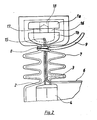
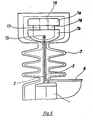
- two pull cables 2, 3 for a valve 4 of a compressed gas bottle and a connecting cable 5 are connected to a thickening 1, which leads to the rescue device, not shown. These parts are surrounded by a flexible envelope 6, which is evacuated. Between the main part of the sheathing 6, in which the rescue device is located, and the thickening 1, the sheathing 6 has a gathering 7, around which a loop 8 of an outer traction cable 9 is looped.
- a gag-shaped element 10 is now arranged in the covering 6 on the side of the thickening 1, which faces away from the side with the inner traction cables 2, 3.
- the envelope has a substantially wedge-shaped between thickening 1 and gag-shaped element 10 Incision 11, which extends over most of the length of the gag-shaped element 10, so that around the thinner ' middle part 12 of the gag-shaped element a thinner further pulling rope 13 can be looped, which is knotted there, for example with a weaving stitch with two half strokes.
- the entire arrangement of the covering 6 in this area is such that the covering is vacuum-tight everywhere, including in the area of the recess 11.
- the spaces for gags and thickening within the covering 6 are connected to one another.
- the other end of the additional traction cable 13 is fastened to the second traction element 9 in such a way that when the traction element 9 is pulled, only the further traction element 13 is tightened.
- the gag-shaped element 10 is then pivoted clockwise in the illustration in FIG. 1.
- a side thickening 14 that in the area opposite the recess 11
- the film 6 in this area at the end of the recess 11 with the aid of Leverage is torn.
- the gag-shaped element 10 and also the thickening 1 have a corresponding thickness, the covering cannot lie on one another at the point of their damage, so that the air can flow in unhindered.
- the covering 6, in particular the gathering 7, ceases to be a rigid structure, so that no great tensile force is required to pull the gathering 7 apart and to actuate the valve 4.
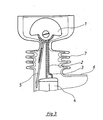
- the thickening consists of two parts. On the first part 1a, the inner pull cables 2 and 3 and the connecting cable 5, not shown, are fastened at 15.
- a second part 1b of the thickening slidably sits on a tapered central section 16 of the first part 1a of the thickening, which has essentially flat side walls.
- First part 1a and second part 1b are spring-loaded in the direction of possible displacement away from each other.
- On the second part 1b there is also a tip 17 which is pushed upwards by a channel 18 in the first part 1a in FIG. 2 when the second part 1b is pressed upwards. If one now pulls on the outer tension element 9, a force directed upwards in FIG. 2 is exerted on the movable second part 1b.
- This part 1b is thereby moved upwards relative to the first part 1a, so that the tip 17 is pressed upward by the channel 18 until it breaks the covering 6 there, so that air can penetrate here.
- the penetration can be facilitated by appropriate training of the tip or a corresponding cutting edge.
- the entire envelope fills with air, as in the previously described embodiment, so that the gathering 7 can be easily separated and the valve 4 can be actuated easily.
- other types of guiding the second part 1b on the first part 1a are also possible, for example on pins, in which case the springs on these pins in particular can sit between the two parts.
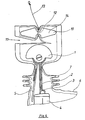
- Fig. 3 shows an embodiment in which the thickening 1 is designed as a handle. Since the handle has a larger cross-sectional area than the gathering 7, you can touch and pull directly on the thickening or handle 1 in order to actuate the valve 4.
- an additional device for destroying the vacuum is again provided. You will first be on the other pull rope 13 pull to destroy the vacuum. Then you can then more easily operate the valve 4 using the handle 1.
- the handle is formed in two parts. If you want to open the valve 4 and pulls the handle 1a, 1b accordingly, the movable part 1b of the handle is pulled away from the valve 4 against a spring force, as a result of which the knife or cutting edge 17 sticks into the sheath 6, so that the vacuum will be annulled. Then the gathering can then be tightened slightly, the valve 4 then being actuated during this movement outward via the pulling cables 2, 3.
Landscapes
- Engineering & Computer Science (AREA)
- Mechanical Engineering (AREA)
- Ocean & Marine Engineering (AREA)
- Scissors And Nippers (AREA)
- Emergency Lowering Means (AREA)
- Knives (AREA)
Applications Claiming Priority (2)
| Application Number | Priority Date | Filing Date | Title |
|---|---|---|---|
| DE19853506611 DE3506611C2 (de) | 1983-11-14 | 1985-02-25 | Vorrichtung zum Auslösen eines Rettungsgeräts |
| DE3506611 | 1985-02-25 |
Publications (3)
| Publication Number | Publication Date |
|---|---|
| EP0193018A2 true EP0193018A2 (fr) | 1986-09-03 |
| EP0193018A3 EP0193018A3 (en) | 1986-12-30 |
| EP0193018B1 EP0193018B1 (fr) | 1989-06-07 |
Family
ID=6263518
Family Applications (1)
| Application Number | Title | Priority Date | Filing Date |
|---|---|---|---|
| EP19860101680 Expired EP0193018B1 (fr) | 1985-02-25 | 1986-02-10 | Dispositif pour dégager un appareil de sauvetage |
Country Status (2)
| Country | Link |
|---|---|
| EP (1) | EP0193018B1 (fr) |
| DK (1) | DK172028B1 (fr) |
Cited By (2)
| Publication number | Priority date | Publication date | Assignee | Title |
|---|---|---|---|---|
| CN100491194C (zh) * | 2006-05-06 | 2009-05-27 | 梁洪 | 一种便携式自动充气水上救生装置 |
| US8192243B2 (en) | 2004-08-09 | 2012-06-05 | Viking Life-Saving Equipment A/S | Container for storing an inflatable liferaft |
Family Cites Families (3)
| Publication number | Priority date | Publication date | Assignee | Title |
|---|---|---|---|---|
| DE3036796C2 (de) * | 1980-09-30 | 1983-01-13 | Ballonfabrik See- und Luftausrüstung GmbH & Co KG, 8900 Augsburg | Vorrichtung zum Überprüfen der Unversehrtheit und Einsatzfähigkeit von in Bereitschaft befindlichen Rettungsgeräten |
| US4457730A (en) * | 1981-07-20 | 1984-07-03 | Gulf & Western Manufacturing Company | Vacuum packaged inflatable flotation device |
| DE3341164C2 (de) * | 1983-11-14 | 1985-09-19 | Autoflug Gmbh, 2084 Rellingen | Einrichtung zum Auslösen einer Öffnungsvorrichtung bei einem Rettungsgerät |
-
1986
- 1986-01-30 DK DK46786A patent/DK172028B1/da not_active IP Right Cessation
- 1986-02-10 EP EP19860101680 patent/EP0193018B1/fr not_active Expired
Cited By (2)
| Publication number | Priority date | Publication date | Assignee | Title |
|---|---|---|---|---|
| US8192243B2 (en) | 2004-08-09 | 2012-06-05 | Viking Life-Saving Equipment A/S | Container for storing an inflatable liferaft |
| CN100491194C (zh) * | 2006-05-06 | 2009-05-27 | 梁洪 | 一种便携式自动充气水上救生装置 |
Also Published As
| Publication number | Publication date |
|---|---|
| DK46786A (da) | 1986-08-26 |
| DK46786D0 (da) | 1986-01-30 |
| EP0193018B1 (fr) | 1989-06-07 |
| DK172028B1 (da) | 1997-09-22 |
| EP0193018A3 (en) | 1986-12-30 |
Similar Documents
| Publication | Publication Date | Title |
|---|---|---|
| DE4041401C2 (de) | Rettungswerkzeug | |
| DE2059443C3 (de) | Zerbrechbare Leitungskupplung | |
| DE2257073B2 (de) | Biopsiegerät zur Entnahme von Zellgewebe aus Körperhohlräumen | |
| DE1206664B (de) | Blindniet | |
| DE2114279C3 (de) | Seilschneidvorrichtung | |
| DE3308177A1 (de) | Anordnung zum trennen einer last von gurtzeug | |
| DE9210849U1 (de) | Anzeigeeinrichtung für eine Vorrichtung zum Aufblasen, insbesondere eines Behälters oder eines Schwimmkörpers eines Rettungsgerätes | |
| EP0907157A1 (fr) | Plombage de sécurité à languette insérable | |
| EP0193018B1 (fr) | Dispositif pour dégager un appareil de sauvetage | |
| DE2214674A1 (de) | Trennvorrichtung fur eine Nabelver bindung zwischen einer Waffe und ihrer Abschußvorrichtung | |
| DE3506611C2 (de) | Vorrichtung zum Auslösen eines Rettungsgeräts | |
| DE3517741C2 (de) | Kletterhilfe, insbesondere für Bergsteiger | |
| DE19542377C2 (de) | Anordnung zum Räumen von Ankertauminen | |
| DE102016001396B4 (de) | Variabel einsetzbare Zugseilklemme | |
| DE69515727T2 (de) | Verfahren und Vorrichtung zur Steuerung der Speisung eines Stellgliedes für ein hydraulisches Werkzeug | |
| DE202018104718U1 (de) | Vorrichtung zum Halten und Öffnen einer Gaspatrone und Rettungsvorrichtung mit einem aufblasbaren Körper und einer solchen Vorrichtung | |
| DE3700616C2 (fr) | ||
| DE7205611U (de) | Klemmzange insbesondere für Kabelverbindungen | |
| EP0097804B1 (fr) | Stoppeur pour chaînes d'ancre | |
| DE589193C (de) | Einrichtung an Abspannklemmen fuer elektrische Leitungen | |
| EP0146737B1 (fr) | Dispositif de déclanchement d'un système d'ouverture pour appareil de sauvetage | |
| DE102022104427B4 (de) | Salzblock-Haltegriff | |
| DE19615928C1 (de) | Überlastungsschutzeinrichtung für mechanische Pressen | |
| DE68907855T2 (de) | Betätigungsvorrichtung für den Abfluss eines unter Druck stehenden Mediums aus einem Behälter. | |
| DE102018129667B3 (de) | Klebefahne für die Aktivierung einer Rettungstrennstelle zur Deaktivierung eines Hochvoltsystems eines Fahrzeugs sowie Verfahren für die Ausstattung einer Rettungstrennstelle |
Legal Events
| Date | Code | Title | Description |
|---|---|---|---|
| PUAI | Public reference made under article 153(3) epc to a published international application that has entered the european phase |
Free format text: ORIGINAL CODE: 0009012 |
|
| AK | Designated contracting states |
Kind code of ref document: A2 Designated state(s): FR GB IT |
|
| PUAL | Search report despatched |
Free format text: ORIGINAL CODE: 0009013 |
|
| AK | Designated contracting states |
Kind code of ref document: A3 Designated state(s): FR GB IT |
|
| 17P | Request for examination filed |
Effective date: 19870521 |
|
| 17Q | First examination report despatched |
Effective date: 19880301 |
|
| GRAA | (expected) grant |
Free format text: ORIGINAL CODE: 0009210 |
|
| RAP1 | Party data changed (applicant data changed or rights of an application transferred) |
Owner name: AUTOFLUG GMBH & CO |
|
| AK | Designated contracting states |
Kind code of ref document: B1 Designated state(s): FR GB IT |
|
| ITF | It: translation for a ep patent filed | ||
| ET | Fr: translation filed | ||
| GBT | Gb: translation of ep patent filed (gb section 77(6)(a)/1977) | ||
| PLBE | No opposition filed within time limit |
Free format text: ORIGINAL CODE: 0009261 |
|
| STAA | Information on the status of an ep patent application or granted ep patent |
Free format text: STATUS: NO OPPOSITION FILED WITHIN TIME LIMIT |
|
| 26N | No opposition filed | ||
| ITTA | It: last paid annual fee | ||
| PGFP | Annual fee paid to national office [announced via postgrant information from national office to epo] |
Ref country code: GB Payment date: 19980302 Year of fee payment: 13 |
|
| PGFP | Annual fee paid to national office [announced via postgrant information from national office to epo] |
Ref country code: FR Payment date: 19980317 Year of fee payment: 13 |
|
| PG25 | Lapsed in a contracting state [announced via postgrant information from national office to epo] |
Ref country code: GB Free format text: LAPSE BECAUSE OF NON-PAYMENT OF DUE FEES Effective date: 19990210 |
|
| GBPC | Gb: european patent ceased through non-payment of renewal fee |
Effective date: 19990210 |
|
| PG25 | Lapsed in a contracting state [announced via postgrant information from national office to epo] |
Ref country code: FR Free format text: LAPSE BECAUSE OF NON-PAYMENT OF DUE FEES Effective date: 19991029 |
|
| REG | Reference to a national code |
Ref country code: FR Ref legal event code: ST |
|
| PG25 | Lapsed in a contracting state [announced via postgrant information from national office to epo] |
Ref country code: IT Free format text: LAPSE BECAUSE OF NON-PAYMENT OF DUE FEES;WARNING: LAPSES OF ITALIAN PATENTS WITH EFFECTIVE DATE BEFORE 2007 MAY HAVE OCCURRED AT ANY TIME BEFORE 2007. THE CORRECT EFFECTIVE DATE MAY BE DIFFERENT FROM THE ONE RECORDED. Effective date: 20050210 |