EP0193097A2 - Tige amovible et procédés de son utilisation - Google Patents
Tige amovible et procédés de son utilisation Download PDFInfo
- Publication number
- EP0193097A2 EP0193097A2 EP86102151A EP86102151A EP0193097A2 EP 0193097 A2 EP0193097 A2 EP 0193097A2 EP 86102151 A EP86102151 A EP 86102151A EP 86102151 A EP86102151 A EP 86102151A EP 0193097 A2 EP0193097 A2 EP 0193097A2
- Authority
- EP
- European Patent Office
- Prior art keywords
- key
- holder
- groove
- ball
- cross
- Prior art date
- Legal status (The legal status is an assumption and is not a legal conclusion. Google has not performed a legal analysis and makes no representation as to the accuracy of the status listed.)
- Granted
Links
Images


Classifications
-
- B—PERFORMING OPERATIONS; TRANSPORTING
- B25—HAND TOOLS; PORTABLE POWER-DRIVEN TOOLS; MANIPULATORS
- B25G—HANDLES FOR HAND IMPLEMENTS
- B25G3/00—Attaching handles to the implements
- B25G3/02—Socket, tang, or like fixings
- B25G3/12—Locking and securing devices
- B25G3/18—Locking and securing devices comprising catches or pawls
-
- B—PERFORMING OPERATIONS; TRANSPORTING
- B25—HAND TOOLS; PORTABLE POWER-DRIVEN TOOLS; MANIPULATORS
- B25B—TOOLS OR BENCH DEVICES NOT OTHERWISE PROVIDED FOR, FOR FASTENING, CONNECTING, DISENGAGING, OR HOLDING
- B25B21/00—Portable power-driven screw or nut setting or loosening tools; Attachments for drilling apparatus serving the same purpose
- B25B21/002—Portable power-driven screw or nut setting or loosening tools; Attachments for drilling apparatus serving the same purpose for special purposes
-
- B—PERFORMING OPERATIONS; TRANSPORTING
- B25—HAND TOOLS; PORTABLE POWER-DRIVEN TOOLS; MANIPULATORS
- B25B—TOOLS OR BENCH DEVICES NOT OTHERWISE PROVIDED FOR, FOR FASTENING, CONNECTING, DISENGAGING, OR HOLDING
- B25B23/00—Details of, or accessories for, spanners, wrenches, screwdrivers
- B25B23/0007—Connections or joints between tool parts
- B25B23/0035—Connection means between socket or screwdriver bit and tool
-
- B—PERFORMING OPERATIONS; TRANSPORTING
- B25—HAND TOOLS; PORTABLE POWER-DRIVEN TOOLS; MANIPULATORS
- B25B—TOOLS OR BENCH DEVICES NOT OTHERWISE PROVIDED FOR, FOR FASTENING, CONNECTING, DISENGAGING, OR HOLDING
- B25B23/00—Details of, or accessories for, spanners, wrenches, screwdrivers
- B25B23/14—Arrangement of torque limiters or torque indicators in wrenches or screwdrivers
- B25B23/1415—Break members; Arrangements specially adapted for break-bolts
-
- Y—GENERAL TAGGING OF NEW TECHNOLOGICAL DEVELOPMENTS; GENERAL TAGGING OF CROSS-SECTIONAL TECHNOLOGIES SPANNING OVER SEVERAL SECTIONS OF THE IPC; TECHNICAL SUBJECTS COVERED BY FORMER USPC CROSS-REFERENCE ART COLLECTIONS [XRACs] AND DIGESTS
- Y10—TECHNICAL SUBJECTS COVERED BY FORMER USPC
- Y10T—TECHNICAL SUBJECTS COVERED BY FORMER US CLASSIFICATION
- Y10T403/00—Joints and connections
- Y10T403/55—Member ends joined by inserted section
- Y10T403/559—Fluted or splined section
-
- Y—GENERAL TAGGING OF NEW TECHNOLOGICAL DEVELOPMENTS; GENERAL TAGGING OF CROSS-SECTIONAL TECHNOLOGIES SPANNING OVER SEVERAL SECTIONS OF THE IPC; TECHNICAL SUBJECTS COVERED BY FORMER USPC CROSS-REFERENCE ART COLLECTIONS [XRACs] AND DIGESTS
- Y10—TECHNICAL SUBJECTS COVERED BY FORMER USPC
- Y10T—TECHNICAL SUBJECTS COVERED BY FORMER US CLASSIFICATION
- Y10T403/00—Joints and connections
- Y10T403/70—Interfitted members
- Y10T403/7026—Longitudinally splined or fluted rod
- Y10T403/7033—Longitudinally splined or fluted rod including a lock or retainer
-
- Y—GENERAL TAGGING OF NEW TECHNOLOGICAL DEVELOPMENTS; GENERAL TAGGING OF CROSS-SECTIONAL TECHNOLOGIES SPANNING OVER SEVERAL SECTIONS OF THE IPC; TECHNICAL SUBJECTS COVERED BY FORMER USPC CROSS-REFERENCE ART COLLECTIONS [XRACs] AND DIGESTS
- Y10—TECHNICAL SUBJECTS COVERED BY FORMER USPC
- Y10T—TECHNICAL SUBJECTS COVERED BY FORMER US CLASSIFICATION
- Y10T403/00—Joints and connections
- Y10T403/70—Interfitted members
- Y10T403/7098—Non-circular rod section is joint component
Definitions
- This invention relates to a removable key for a wrenching tool, and in particular, to a key and methods for its use in a wrenching tool for attachment of frangible fasteners.
- This invention comprises a torque-transmitting body, more particularly a key, and methods for its use with a wrenching tool.
- the tool has a subassembly of an outer socket member and an elongated key holder slidably mounted therein under spring resistance.
- a keyway is formed by a center bore in the key holder which is broached to a non-circular cross-section conforming to the shape of the key, and a cross bore is also provided in the holder to form a receptacle which receives a detent member, such as a detent ball.
- a recess is provided in the outer socket member to receive the ball detent when inserting or removing the key.
- the key has a main shaft portion with a distal, torque-transmitting head and, at its opposite end, has a reduced thickness and a non-circular cross section which indexes in the receiving keyway of the holder.
- a transverse groove is provided in the key to seat the detent ball between its reduced thickness end and the main shaft portion.
- the key has stop means such as a shoulder which limits its axial displacement in said receiving keyway when the detent ball is seated in the transverse groove of the key.
- the reduced thickness end of the key can be placed in the holder and an axial force applied to insert the key fully and seat the ball in its transverse groove.
- the holder can be aligned with its cross bore opposite the ball recess in the outer socket member, the spring resistance disengaged, and the key can then be slipped into the holder, and the spring resistance released to lock the key in the holder.
- the key Once the key has been inserted in the holder, and the detent ball seated in its transverse groove, it can be extracted only by releasing the detent ball, a procedure which requires that the holder be aligned with the ball opposite the ball recess in the outer socket member and immobilized against the spring bias in this position, preferably with a spacer block which can be a attached to the tool.
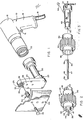
- the wrenching tool comprises a motor assembly 10 with a motor housing 12 and an integral, dependent hand grip 14 having a trigger 16.
- the motor assembly 10 is supplied with a motive fluid, commonly compressed air, through c flexible hose 18.
- the particularly illustrated wrenching tool includes a torque control assembly 20 which is threadably engaged on the threaded boss 22 of the housing 12 and which has an internal shaft, not shown, that is connected to the motor drive shaft.
- the torque control assembly 20 contains an internal friction clutch which is preloaded to a predetermined torque and this assembly is commonly used with the non-frangible fasteners to provide a control on the tightening torque applied to the fasteners. It is not needed when the tool is to be used with frangible fasteners.
- the torque control assembly is attached to the tool head assembly 23.
- This head assembly has a housing 24 which contains a plurality of gears that provide a gear train with the appropriate speed reduction characteristic for the particular tool.
- the head assembly 23 supports a socket assembly 24.
- a number of interchangeable socket assemblies can be used to provide a variable extension from the face 28 of the head assembly housing 24.
- the particular socket assembly illustrated is flush with this plate and receives in its socket 30, the wrenching ring 32 of A... frangible fastener 34.
- the socket assembly is also illustrated with the key 36 of the invention restrained in the receiving keyway of the holder member 38.
- the wor-kpiece is generally indicated at 40 and comprises two members to be retained by a bolt fastener 42 and a threaded collar fastener 44 of the frangible fastener ' unit.
- the socket assembly 26 removed from the head asembly 23.
- the socket assembly comprises three major parts; the key 36, the holder member 38, and the outer, socket member 50.
- the key 36 has a main shaft portion 47 having one or more flats 46 and is received within a broached keyway concentric in the core 48 of the holder member 38.
- the holder member 38 is slidably received within a through bore of the outer, driven member 50 which has a plurality of sprocket gear teeth 52 about its periphery. These gear teeth 52 engage with gears within the head assembly 23.
- the forward end of the driven member 50 has a socket 30 for receiving the wrenching ring 32 previously mentioned with regard to FIGURE 1.
- the holder member 38 has a transverse bore 54 which receives a spring retainer that restrains this member against rotation and biases it forward, towards the workpiece, while permitting its relative axial displacement within the driven member 50.
- key 36 has flats 46 coextensive the length of its main shaft portion 47 with one end chamfered at 56 and with a peripheral groove adjacent the chamfererd end.
- the aforementioned sprocket gear teeth 52 preferably are integral with the driven member 50 and this member has a socket end 30 which is in communication with a through bore, not shown, having a sufficient inside diameter to slideably receive the central core 48 of the holder member 38.
- the holder member 38 has a center keyway 60 which is formed by a bore that is broached to provide flated surfaces which mate the flatted surfaces 46 of key 36.
- the holder member has a cross bore 62 which intersects the longitudinal keyway 60. This cross bore 62 is of sufficient diameter to receive the ball 64 which serves as a detent member, cooperatively engaging the groove 58 of the key 36.
- FIGURE 4 the wrenching tool and fastener system is shown in greater detail.
- the bolt 42 is shown in a loose fit extending through plates 41 and 43 and with its threaded end enterng into the internally threaded fastener collar 44.
- the wrenching ring 32 at the opposite end of the frangible fastener 34 is shown engaged in the socket 30 of the driven member 50.
- the holder unit 38 is shown in its fully extended position and the key 36 is shown restrained by the ball 64 that is received in the cross bore 62 and projects into the central keyway 60 of the holder member 38.
- ball 64 is captured in cross bore 62, by staked means such as a distal annular lip 65 on the inside wall of cross bore 62.
- the key 36 is secured by ball 64 which seats in the peripheral groove 58 of the key.
- the ball 64 is held in this . position by the driven member 50, surrounding the holder member 38.
- the driven member 50 is illustrated with its sprocket gear teeth 52 meshed with the drive teeth of a driving sprocket gear 70 contained within the housing 24 of the head assembly 23.
- the holder member 38 is restrained against rotation in this assembly by the end of spring 66 which extends into the cross bore 64, all as previously described.
- FIGURE 5 illustrates the wrenching tool immediately upon separation of the frangible wrenching ring 32 from the fastener collar 44. This occurs when the fastening collar is advanced sufficiently on bolt 42 to achieve a predetermined tension in bolt 42, compressing the workpiece 40.
- the wrenching tool is retracted from the work, extracting the key 36 from the broached keyway 68 in the end of bolt 42.
- spring 66 resiliently biases the holder mmeber 38 towards the workpiece, advancing this unit until the shoulder 72 abuts the wrenching ring 32 and ejects this ring from the socket.
- the key 36 can be readily extracted from the socket assembly 26 in the manner shown in FIGURE 6.
- the embodiment shown in FIGURES 6 & 7 is substantially the same as previously described, except the annular groove in the outer socket member 26 has a rectancular, rather than arcuate, cross section.
- the annular groove 73 is positioned in exact alignment with the cross bore .62 of the holder member 38, permitting ball 64 to move laterally, retracting the ball from its engagement with groove 58 in the end of key 36. This frees key 36 for extraction from the assembly, as shown in FIGURE 6.
- shoulder 63 is visible in receiving keyway 60 which provides an abutment stop for key 36.
- the annular groove 74 can be aligned with cross bore 62, and the bias of spring 66 can be released from holder 38 in the aligned position by placing a spacer block 75 between the back of housing 24 of the head assembly and the head 76 of the holder member 38. If desired, the spacer block can be permanently attacted to the tool by a cylindrical boss 77 which is received in bore 79 of spacer block 75. A machine screw 81 is threaded into the boss 77 on housing 24 and washer 83 and spring washer 85 are placed over the spacer block 75 to permit it to be swung into the ' illustrated position when needed and retained to one side when the tool is in use.
- the key 36 can be set in the socket assembly in its restrained position within holder 38 by forcefully advancing the key 36 in the manner illustrated in FIGURE 7:
- the ball 64 is in its inwardly displaced position, restrained therein by the driven member 50.
- the inboard end of key 36 encounters the ball and its inward movement is interfered by the ball.
- the key has adequate resiliency to flex sufficiently to permit its head end to advance past the ball 64.
- the head end of key 36 is chamfered as shown at 56 at an angle of 10 to about 65 degrees, preferably 45 degrees, with its longitudinal axis, and the peripheral groove 58 is located within a distance from 0.2 to about 0.5 times the diameter of ball 64.
- the head end of the key should have a length which is from 1.1 to about 1.3, preferably from 1.223 to about 1.243 times its thickness, to insure sufficient strength and flexibility. Additonally, there should be a slight tolerance in the fit between the key and its receiving keyway 60. Since this provides a facile and fast manner for seating the key 36 in the socket assembly, it constitutes a preferred embodiment of the key 36 for use in the invention.
- FIGURES 8-10 Another preferred structure of the key and the manner of seating the key in the tool of the invention is shown in FIGURES 8-10.
- the preferred key 37 has a main shaft portion 35 with a distal, torque-transmitting head 33, and a non-circular, hexagonal cross section to index in the receiving keyway 61 of the holder 39.
- the opposite, or received, end 31 of the key 37 has a reduced thickness to permit it to be canted in the receiving keyway 61 and a sufficient length that it engages the ball 64 in its canted position.
- a transverse groove 58 is provided to seat the detent ball between the reduced thickness end 31 and the main shaft portion 35.
- the key in its canted position, exert.s sufficient frictional drag on holder 39 to slide the holder in the outer member 26 towards the ball releasing position.
- the holder is in the ball releasing position, and the ball has been urged laterally outwardly by the end of key 37.
- the key will be forced past the ball until the end 58 of key 37 abuts the bottom of keyway 61 in holder 39.
- the end 31 of key 37 thereby provides the abutment stop to limit axial displacement of the key 37 in receiving keyway 61 when the detent.... ball is aligned with its transverse groove.
- the axial force applied to the key will also seat the ball in the transverse groove and free the holder for sliding movement in said outer member with said key positively interlocked therein.
- the keyway 61 in the center of holder 39 is intersected with an angular bore 80 to permit insertion of a pin or other tool to clear keyway 61 of any jammed portion of key 37.
- FIGURE 11 shows another, preferred embodiment of the key.
- the key 86 has a main shank portion 85 with a torque transmitting head 83 and reduced thickness at its opposite end 94, with a transverse square groove 88 on side 87. At its opposite end 81, key 86 is reduced, or flatted to a thickness less than the main shank portion 85 only on side, 87.
- the important design parameters of the key are shown in the illustration, with reference to the detent member, ball 64, and the receiving keyway 61 of the holder 38, shown in phanton lines.
- the detent ball 64 is shown in its seated position, where it restrains the key 86 in keyway 61.
- the torque transmitting head 83 should have a length, C, which is from 50 to 75, preferably 67, percent of the basic diameter of the fas- tener.
- the clearance, T, between the ball and the shoulders such as 90 of groove 88 is equal to or greater than 0.005 inch, and the clearance between the ball and the bottom surface of groove 88 is from 5 to about 10 percent of the diameter of the ball 64.
- the latter tolerance can be provided by milling an arcuate depression 92 in the center of the bottom of groove 88, directly beneath ball 64.
- the length of the reduced thickness end 94 beyond the center line of groove 88 should be sufficient that the end of the pin bears against the bottom of the keyway 61 in the holder 38.
- the relationship between these elements can be expressed mathematically, by a simple triangulation, as follows: Wherein:
- the key shown in FIGURE 11 also can be inserted with an axial force.
- the key On initial engagement of the end 94 of the key 86 with the ball 64, the key will cause the holder to slide axially until its cross bore 62 is aligned with the annular groove of the outer socket member. In this aligned position, the ball moves into the annular groove, clearing the keyway and permitting full entry of the key until its forward end seats against the end of the keyway bore 61.
- the ball 64 also seats in .pa transverse groove 88 of key 86, and the holder and key are interlocked.
- the holder and key will slide together without any lateral force being exerted on the ball 64, since the key is bottomed against the end wall of bore 61, causing the two to move together in one direction, and since spring 66 (shown in FIGURES 4 & 5) will cause the holder to move with the key in the opposite direction.
- a key 98 is shown as received in a holder 108, the latter illustrated in phantom lines.
- the key 98 has a torque-transmitting end 33 which has the appropriate dimensions for the particular fastener.
- the holder has a receiving keyway 61 of standard dimensions, for a plurality of keys with torque-transmitting heads of various dimensions, thereby avoiding the necessity of changing holders when the key size is to be changed.
- the holder Since the opposite end, 99, of the key is asymetrical, and has groove 88 only on one side 101 (as with the key described in FIGURE 11), the holder is provided with an indexing indicia to identify the location of the detent member 65 and thereby inform the user of the correct orientation of the groove 88 when the key is inserted into the receiving keyway 61.
- This can be a mark scribed on the end 103 of the holder 108, or can be a groove 105 cut into the end 103 at a preselected angular relationship to the detent member, e.g., on the same side of holder 108 as the member 65, or, as illustrated, on the opposite side, at 180 degrees rotation from the detent member location.
- the detent member. ⁇ 65 is shown in FIGURE 12 with a circular cross section, and can be a ball, as previously described, or can be a cylinder. In the latter case, the detent member receptacle 63 is a slot with a rectangular or square cross-section, rather than the circular cross bore 62, previously described. Also, more than one detenting member, e.g., two, three, or more detent balls can be used, preferably spaced at equal angular increments about the periphery of the keyway. This construction is useful when it is desired to enhance the retention force of the key in the holder.
- the torque-transmitting end 33 of the key 98 can have a variety of shapes, i.e., lengths and cross- sections, depending on the configuration of the work element such as a fastener.
- FIGURE 13 illustrates the conventional hexagonal cross section of end 33 and this configuration has been described throughout this description.
- Other shapes can be used such as a shape having a splined cross-section as shown in FIGURE 14.
- Other shapes, such as the flat bladed, or Phillips bladed, screw driver can also be used.
- the holder and key configuration of this invention can. be adapted to the chuck of a drill, by using a twist drill configuration for the torque-transmitting head.
- the key has also been illustrated throughout this description as having a hexagonal cross-section which indexes with the receiving keyway of the holder. Any non-circular cross-section can be used for this purpose, and a particular useful cross-section to index with a mating keyway in the holder is shown in FIGURE 15, which shows three lobes 110, 112 and 114 having an arcuate shape.
- the invention can also be adapted to provide a quick connect/disconnect coupling for flexible hoses in pneumatic or hydraulic service, similar to the Hansen quick disconnect coupling presently in use, but providing the advantage of single-handed operation.
- the holder and key described herein are replaced, respectively, by female and male, terminal hose connectors with the same operative elements such as the detent member, the spring, outer member, holder member and the transverse groove in the male connector to seat the detent member.
- the invention may be summarized as follows:
Landscapes
- Engineering & Computer Science (AREA)
- Mechanical Engineering (AREA)
- Gripping On Spindles (AREA)
- Telephone Set Structure (AREA)
- Snaps, Bayonet Connections, Set Pins, And Snap Rings (AREA)
- Nitrogen And Oxygen Or Sulfur-Condensed Heterocyclic Ring Systems (AREA)
- Hand Tools For Fitting Together And Separating, Or Other Hand Tools (AREA)
- Mounting, Exchange, And Manufacturing Of Dies (AREA)
Priority Applications (1)
| Application Number | Priority Date | Filing Date | Title |
|---|---|---|---|
| AT86102151T ATE64562T1 (de) | 1985-02-19 | 1986-02-19 | Auswechselbarer stab und verfahren zu seiner anwendung. |
Applications Claiming Priority (2)
| Application Number | Priority Date | Filing Date | Title |
|---|---|---|---|
| US06/702,959 US4617844A (en) | 1983-07-18 | 1985-02-19 | Removable key for wrenching tool |
| US702959 | 1985-02-19 |
Publications (3)
| Publication Number | Publication Date |
|---|---|
| EP0193097A2 true EP0193097A2 (fr) | 1986-09-03 |
| EP0193097A3 EP0193097A3 (en) | 1988-05-18 |
| EP0193097B1 EP0193097B1 (fr) | 1991-06-19 |
Family
ID=24823340
Family Applications (1)
| Application Number | Title | Priority Date | Filing Date |
|---|---|---|---|
| EP86102151A Expired - Lifetime EP0193097B1 (fr) | 1985-02-19 | 1986-02-19 | Tige amovible et procédés de son utilisation |
Country Status (5)
| Country | Link |
|---|---|
| US (1) | US4617844A (fr) |
| EP (1) | EP0193097B1 (fr) |
| JP (1) | JPS61236476A (fr) |
| AT (1) | ATE64562T1 (fr) |
| DE (1) | DE3679840D1 (fr) |
Cited By (1)
| Publication number | Priority date | Publication date | Assignee | Title |
|---|---|---|---|---|
| EP1108900A1 (fr) * | 1992-05-07 | 2001-06-20 | John K. Junkers | Outil actionné par fluide pour allonger ou comprimer un raccord fileté |
Families Citing this family (29)
| Publication number | Priority date | Publication date | Assignee | Title |
|---|---|---|---|---|
| US4617844A (en) * | 1983-07-18 | 1986-10-21 | Vsi Corporation | Removable key for wrenching tool |
| US5141355A (en) * | 1989-03-22 | 1992-08-25 | Star Lock Systems, Inc. | Lock and release apparatus |
| US5022243A (en) * | 1989-09-06 | 1991-06-11 | Star Lock Company | Latching system |
| US4900182A (en) * | 1989-03-22 | 1990-02-13 | Stillwagon Applied Techonology Incorporated | Lock and release apparatus |
| US5467619A (en) * | 1989-03-22 | 1995-11-21 | Star Lock Systems, Inc. | Post latching systems |
| US5027630A (en) * | 1989-03-22 | 1991-07-02 | Star Lock Company | Door latch with lock and release for vending machines and the like |
| US5272894A (en) * | 1989-03-22 | 1993-12-28 | Star Lock Systems, Inc. | Fractional-rotation latching system with retrofit capability |
| US5109735A (en) * | 1989-07-25 | 1992-05-05 | Hi-Shear Corporation | High strength quick change key type installation tool |
| US5269161A (en) * | 1989-09-06 | 1993-12-14 | Star Lock Systems, Inc. | Latching system |
| US5305666A (en) * | 1990-03-28 | 1994-04-26 | Latorre Joseph S | Installation tool system for Hi-Lok-type fasteners |
| US5165311A (en) * | 1990-06-21 | 1992-11-24 | Vsi Corporation | Pneumatic nut installation tool |
| US5044225A (en) * | 1990-06-21 | 1991-09-03 | Vsi Corporation | Pneumatic nut installation tool |
| USD329582S (en) | 1990-06-27 | 1992-09-22 | Bowling Donald W | Angle drive for cordless screwdriver |
| US5643366A (en) * | 1994-01-31 | 1997-07-01 | Applied Materials, Inc. | Wafer handling within a vacuum chamber using vacuum |
| US6276885B1 (en) | 1996-07-25 | 2001-08-21 | Shimano, Inc. | Bicycle crank arm parts/assembly and assembly tools |
| JP3526683B2 (ja) * | 1995-08-04 | 2004-05-17 | 株式会社シマノ | 自転車用クランク組立体、自転車用組立工具および自転車組立用補助具 |
| US5658087A (en) * | 1995-12-20 | 1997-08-19 | Case Corporation | Locking mechanism for releasably retaining a power take-off shaft within an output shaft hub |
| US5967693A (en) * | 1997-06-09 | 1999-10-19 | Clark Equipment Company | Adapters for auger drive shaft |
| US6223375B1 (en) | 1999-08-24 | 2001-05-01 | Illinois Tool Works Inc | Drilling and fastener driving tool |
| US6935209B2 (en) * | 2003-09-02 | 2005-08-30 | Alcoa Global Fasteners, Inc. | Key and key holder for fastener installation tool |
| US7874232B2 (en) * | 2008-10-16 | 2011-01-25 | Huck Patents, Inc. | Quick-change socket and hex key retainer assembly for a fastener installation tool |
| JP6272758B2 (ja) * | 2011-08-26 | 2018-01-31 | ハイトーク ディビジョン ユネックス コーポレイション | ネジ込み式ファスナーを締めるための器具 |
| US8671804B2 (en) | 2012-01-16 | 2014-03-18 | Michael Edward Galat | Fastener installation tool with quick change key |
| US9789592B2 (en) | 2014-10-03 | 2017-10-17 | Vcc Structures, Inc. | Rotary tool |
| US20190022838A1 (en) * | 2017-07-20 | 2019-01-24 | Snap-On Incorporated | Bearing race and seal driver handle |
| FR3070290B1 (fr) | 2017-08-22 | 2020-02-21 | Illinois Tool Works Inc | Outil de percage et son utilisation pour une operation de vissage |
| US10495128B2 (en) * | 2017-10-19 | 2019-12-03 | The Boeing Company | Tooling assembly and method for installation of a frangible fastener |
| SE545361C2 (en) * | 2021-08-23 | 2023-07-18 | Atlas Copco Ind Technique Ab | Arrangement for power tool, front part attachment and power tool |
| DE202023107578U1 (de) * | 2023-12-21 | 2024-01-29 | Atlas Copco Industrial Technique Ab | Angetriebenes Werkzeug und Adapterbaugruppe für ein angetriebenes Werkzeug |
Family Cites Families (26)
| Publication number | Priority date | Publication date | Assignee | Title |
|---|---|---|---|---|
| US1642490A (en) * | 1926-10-09 | 1927-09-13 | Black & Decker Mfg Co | Portable power-driven screw driver and wrench-clutch cup |
| US2239072A (en) * | 1939-03-02 | 1941-04-22 | Dill Mfg Co | Tool |
| US2726091A (en) * | 1953-05-22 | 1955-12-06 | Louis P Topar | Tool holder |
| US2789597A (en) * | 1955-01-03 | 1957-04-23 | Torre Joseph La | Driving and setting tool for blind fasteners |
| DE1161817B (de) * | 1955-01-17 | 1964-01-23 | Licentia Gmbh | Elektrowerkzeug, z.B. Elektroschrauber mit einer Vorrichtung zum Einsetzen, zum Loesen und zum Haltern von Einsteckwerkzeugen |
| US2762403A (en) * | 1955-03-01 | 1956-09-11 | Gardner Denver Co | Power operated screw setter |
| US2776681A (en) * | 1955-08-15 | 1957-01-08 | Nat Screw & Mfg Company | Power operated tool for use with blind fasteners |
| US2955496A (en) * | 1958-12-15 | 1960-10-11 | Torre Kathryn S La | Power-operated, bolt-holding wrench |
| US3027789A (en) * | 1960-03-24 | 1962-04-03 | Hi Shear Rivet Tool Company | Portable power-driven gear-actuated offset torquing tool |
| US3156142A (en) * | 1961-06-30 | 1964-11-10 | Wedgelock Corp Of California | Nut runner attachment |
| US3324747A (en) * | 1965-04-23 | 1967-06-13 | Sweeney Mfg Co B K | Bolt tightening tool |
| US3323394A (en) * | 1965-10-20 | 1967-06-06 | Ingersoll Rand Co | Fastener holding power tool |
| US3428327A (en) * | 1966-09-19 | 1969-02-18 | Black & Decker Mfg Co | Quick release rotary tool chuck |
| US3416582A (en) * | 1966-10-10 | 1968-12-17 | Mc Donnell Douglas Corp | Reduction driver |
| DE1628079A1 (de) * | 1967-01-31 | 1971-06-09 | Licentia Gmbh | Zum Schrauben oder Bohren geeignetes Getriebe |
| US3584527A (en) * | 1968-07-29 | 1971-06-15 | Rockwell Mfg Co | Tools and attachments therefor |
| DE2345454A1 (de) * | 1973-09-08 | 1975-03-20 | Bosch Gmbh Robert | Werkzeugkopf |
| US3990550A (en) * | 1975-07-10 | 1976-11-09 | Recker Florian B | Shaft coupling |
| US4289414A (en) * | 1979-12-06 | 1981-09-15 | Recker Florian B | Torque transmitting coupling |
| JPS57118172U (fr) * | 1981-01-12 | 1982-07-22 | ||
| US4462281A (en) * | 1982-10-21 | 1984-07-31 | Russell, Burdsall & Ward Corporation | Bolt holding wrench |
| DE3324756A1 (de) * | 1983-07-08 | 1985-01-17 | Hilti Ag, Schaan | Motorisch betriebenes schraubgeraet |
| US4538483A (en) * | 1983-07-18 | 1985-09-03 | V.S.I. Corporation | Fastener wrenching means |
| US4617844A (en) * | 1983-07-18 | 1986-10-21 | Vsi Corporation | Removable key for wrenching tool |
| JPS59187471A (ja) * | 1984-03-12 | 1984-10-24 | 室金属工業株式会社 | 電動ねじ回しのビツト保持装置 |
| WO1986004853A1 (fr) * | 1985-02-19 | 1986-08-28 | Batten Ronald W | Cle de serrage amelioree |
-
1985
- 1985-02-19 US US06/702,959 patent/US4617844A/en not_active Expired - Lifetime
-
1986
- 1986-02-18 JP JP61034945A patent/JPS61236476A/ja active Pending
- 1986-02-19 AT AT86102151T patent/ATE64562T1/de not_active IP Right Cessation
- 1986-02-19 EP EP86102151A patent/EP0193097B1/fr not_active Expired - Lifetime
- 1986-02-19 DE DE8686102151T patent/DE3679840D1/de not_active Expired - Lifetime
Cited By (1)
| Publication number | Priority date | Publication date | Assignee | Title |
|---|---|---|---|---|
| EP1108900A1 (fr) * | 1992-05-07 | 2001-06-20 | John K. Junkers | Outil actionné par fluide pour allonger ou comprimer un raccord fileté |
Also Published As
| Publication number | Publication date |
|---|---|
| US4617844A (en) | 1986-10-21 |
| JPS61236476A (ja) | 1986-10-21 |
| EP0193097B1 (fr) | 1991-06-19 |
| DE3679840D1 (de) | 1991-07-25 |
| EP0193097A3 (en) | 1988-05-18 |
| ATE64562T1 (de) | 1991-07-15 |
Similar Documents
| Publication | Publication Date | Title |
|---|---|---|
| US4617844A (en) | Removable key for wrenching tool | |
| US4538483A (en) | Fastener wrenching means | |
| US11407088B2 (en) | Multifunction socket tool | |
| US4536113A (en) | Automatic jaw control for reversible power tool | |
| EP1667819B1 (fr) | Outil d'installation d'éléments de fixation et kit de rattrapage de l'outil d'installation d'éléments | |
| US4768405A (en) | Locking socket wrench drive device | |
| AU676044B2 (en) | Screwdriver with replaceable bit assembly | |
| DE69623857T2 (de) | Tiefenanschlagsystem für krattangetriebenes Werkzeug | |
| US4862773A (en) | Collet type fastener removal tool | |
| WO2022082177A1 (fr) | Systèmes, dispositifs, procédés et kits d'installation d'éléments de fixation | |
| EP3479962B1 (fr) | Ensemble d'outillage et procédé d'installation d'un dispositif de fixation frangible | |
| US4630510A (en) | Tactile engaging wrenching mechanism | |
| EP0691184B1 (fr) | Outil pour enlever des moyens de serrage du type collet | |
| US4721022A (en) | Wrenching tool | |
| US5461947A (en) | Tool holder with ejection slot | |
| US5676028A (en) | Socket adapter device | |
| US5114264A (en) | Coupling | |
| WO1990002634A1 (fr) | Dispositif de blocage de l'entrainement d'une cle a douille | |
| EP0213121B1 (fr) | Cle de serrage amelioree | |
| US4292863A (en) | Automatic socket ejector | |
| EP3750669B1 (fr) | Outil manuel | |
| EP0433284B1 (fr) | Dispositif de blocage de l'entrainement d'une cle a douille | |
| US20260091471A1 (en) | Depth setting bit drivers, systems and related methods | |
| CA2275131C (fr) | Manchon pour enlever le levier d'un foret de tournevis | |
| GB2151964A (en) | Improved screw driving tool |
Legal Events
| Date | Code | Title | Description |
|---|---|---|---|
| PUAI | Public reference made under article 153(3) epc to a published international application that has entered the european phase |
Free format text: ORIGINAL CODE: 0009012 |
|
| AK | Designated contracting states |
Kind code of ref document: A2 Designated state(s): AT BE CH DE FR GB IT LI NL SE |
|
| PUAL | Search report despatched |
Free format text: ORIGINAL CODE: 0009013 |
|
| AK | Designated contracting states |
Kind code of ref document: A3 Designated state(s): AT BE CH DE FR GB IT LI NL SE |
|
| 17P | Request for examination filed |
Effective date: 19881118 |
|
| 17Q | First examination report despatched |
Effective date: 19890621 |
|
| GRAA | (expected) grant |
Free format text: ORIGINAL CODE: 0009210 |
|
| ITF | It: translation for a ep patent filed | ||
| AK | Designated contracting states |
Kind code of ref document: B1 Designated state(s): AT BE CH DE FR GB IT LI NL SE |
|
| PG25 | Lapsed in a contracting state [announced via postgrant information from national office to epo] |
Ref country code: LI Effective date: 19910619 Ref country code: CH Effective date: 19910619 Ref country code: AT Effective date: 19910619 |
|
| REF | Corresponds to: |
Ref document number: 64562 Country of ref document: AT Date of ref document: 19910715 Kind code of ref document: T |
|
| REF | Corresponds to: |
Ref document number: 3679840 Country of ref document: DE Date of ref document: 19910725 |
|
| ET | Fr: translation filed | ||
| REG | Reference to a national code |
Ref country code: CH Ref legal event code: PL |
|
| PG25 | Lapsed in a contracting state [announced via postgrant information from national office to epo] |
Ref country code: GB Effective date: 19920219 |
|
| PLBE | No opposition filed within time limit |
Free format text: ORIGINAL CODE: 0009261 |
|
| STAA | Information on the status of an ep patent application or granted ep patent |
Free format text: STATUS: NO OPPOSITION FILED WITHIN TIME LIMIT |
|
| 26N | No opposition filed | ||
| GBPC | Gb: european patent ceased through non-payment of renewal fee | ||
| EAL | Se: european patent in force in sweden |
Ref document number: 86102151.7 |
|
| BECA | Be: change of holder's address |
Owner name: *FAIRCHILD HOLDING CORP.45025 AVIATION DRIVE, SUIT Effective date: 20021217 |
|
| BECH | Be: change of holder |
Owner name: *FAIRCHILD HOLDING CORP. Effective date: 20021217 |
|
| NLS | Nl: assignments of ep-patents |
Owner name: FAIRCHILD HOLDING CORP. |
|
| NLT1 | Nl: modifications of names registered in virtue of documents presented to the patent office pursuant to art. 16 a, paragraph 1 |
Owner name: SHARED TECHNOLOGIES FAIRCHILD TELECOM, INC. |
|
| PGFP | Annual fee paid to national office [announced via postgrant information from national office to epo] |
Ref country code: SE Payment date: 20030203 Year of fee payment: 18 |
|
| PGFP | Annual fee paid to national office [announced via postgrant information from national office to epo] |
Ref country code: BE Payment date: 20030306 Year of fee payment: 18 |
|
| REG | Reference to a national code |
Ref country code: FR Ref legal event code: TP Ref country code: FR Ref legal event code: CD Ref country code: FR Ref legal event code: CA |
|
| NLS | Nl: assignments of ep-patents |
Owner name: HUCK PATENTS, INC. |
|
| PG25 | Lapsed in a contracting state [announced via postgrant information from national office to epo] |
Ref country code: SE Free format text: LAPSE BECAUSE OF NON-PAYMENT OF DUE FEES Effective date: 20040220 |
|
| PG25 | Lapsed in a contracting state [announced via postgrant information from national office to epo] |
Ref country code: BE Free format text: LAPSE BECAUSE OF NON-PAYMENT OF DUE FEES Effective date: 20040228 |
|
| BERE | Be: lapsed |
Owner name: *FAIRCHILD HOLDING CORP. Effective date: 20040228 |
|
| REG | Reference to a national code |
Ref country code: FR Ref legal event code: TP |
|
| EUG | Se: european patent has lapsed | ||
| PGFP | Annual fee paid to national office [announced via postgrant information from national office to epo] |
Ref country code: NL Payment date: 20050110 Year of fee payment: 20 |
|
| PGFP | Annual fee paid to national office [announced via postgrant information from national office to epo] |
Ref country code: FR Payment date: 20050202 Year of fee payment: 20 |
|
| PGFP | Annual fee paid to national office [announced via postgrant information from national office to epo] |
Ref country code: IT Payment date: 20050215 Year of fee payment: 20 |
|
| PGFP | Annual fee paid to national office [announced via postgrant information from national office to epo] |
Ref country code: DE Payment date: 20050228 Year of fee payment: 20 |
|
| PG25 | Lapsed in a contracting state [announced via postgrant information from national office to epo] |
Ref country code: NL Free format text: LAPSE BECAUSE OF EXPIRATION OF PROTECTION Effective date: 20060219 |
|
| NLV7 | Nl: ceased due to reaching the maximum lifetime of a patent |
Effective date: 20060219 |