EP0193130B1 - Récipient-distributeur pour contenus secs et humides ainsi que son procédé de fabrication - Google Patents
Récipient-distributeur pour contenus secs et humides ainsi que son procédé de fabrication Download PDFInfo
- Publication number
- EP0193130B1 EP0193130B1 EP86102273A EP86102273A EP0193130B1 EP 0193130 B1 EP0193130 B1 EP 0193130B1 EP 86102273 A EP86102273 A EP 86102273A EP 86102273 A EP86102273 A EP 86102273A EP 0193130 B1 EP0193130 B1 EP 0193130B1
- Authority
- EP
- European Patent Office
- Prior art keywords
- container
- opening
- dispenser
- continuous sheet
- materials
- Prior art date
- Legal status (The legal status is an assumption and is not a legal conclusion. Google has not performed a legal analysis and makes no representation as to the accuracy of the status listed.)
- Expired
Links
- 238000000034 method Methods 0.000 title claims description 23
- 238000004519 manufacturing process Methods 0.000 title description 17
- 239000000463 material Substances 0.000 claims description 99
- 239000002657 fibrous material Substances 0.000 claims description 69
- 239000004820 Pressure-sensitive adhesive Substances 0.000 claims description 21
- 238000007789 sealing Methods 0.000 claims description 18
- 239000000853 adhesive Substances 0.000 claims description 5
- 230000001070 adhesive effect Effects 0.000 claims description 5
- 239000002654 heat shrinkable material Substances 0.000 claims 1
- 239000007788 liquid Substances 0.000 description 16
- 239000002537 cosmetic Substances 0.000 description 7
- 239000010408 film Substances 0.000 description 7
- 238000004080 punching Methods 0.000 description 7
- 229920000742 Cotton Polymers 0.000 description 5
- 206010052428 Wound Diseases 0.000 description 5
- 208000027418 Wounds and injury Diseases 0.000 description 5
- 239000010410 layer Substances 0.000 description 5
- 239000006210 lotion Substances 0.000 description 5
- 238000010586 diagram Methods 0.000 description 4
- 239000004745 nonwoven fabric Substances 0.000 description 4
- XLYOFNOQVPJJNP-UHFFFAOYSA-N water Substances O XLYOFNOQVPJJNP-UHFFFAOYSA-N 0.000 description 4
- 238000005299 abrasion Methods 0.000 description 3
- 238000004140 cleaning Methods 0.000 description 3
- 238000010276 construction Methods 0.000 description 3
- 239000000645 desinfectant Substances 0.000 description 3
- -1 for example Substances 0.000 description 3
- 230000015572 biosynthetic process Effects 0.000 description 2
- 239000008338 calamine lotion Substances 0.000 description 2
- 238000012856 packing Methods 0.000 description 2
- 229920003002 synthetic resin Polymers 0.000 description 2
- 239000000057 synthetic resin Substances 0.000 description 2
- CPYIZQLXMGRKSW-UHFFFAOYSA-N zinc;iron(3+);oxygen(2-) Chemical compound [O-2].[O-2].[O-2].[O-2].[Fe+3].[Fe+3].[Zn+2] CPYIZQLXMGRKSW-UHFFFAOYSA-N 0.000 description 2
- 229920000298 Cellophane Polymers 0.000 description 1
- LFQSCWFLJHTTHZ-UHFFFAOYSA-N Ethanol Chemical compound CCO LFQSCWFLJHTTHZ-UHFFFAOYSA-N 0.000 description 1
- 239000004952 Polyamide Substances 0.000 description 1
- 239000004698 Polyethylene Substances 0.000 description 1
- 239000004743 Polypropylene Substances 0.000 description 1
- 239000002390 adhesive tape Substances 0.000 description 1
- XAGFODPZIPBFFR-UHFFFAOYSA-N aluminium Chemical compound [Al] XAGFODPZIPBFFR-UHFFFAOYSA-N 0.000 description 1
- 229910052782 aluminium Inorganic materials 0.000 description 1
- 239000003795 chemical substances by application Substances 0.000 description 1
- 230000003292 diminished effect Effects 0.000 description 1
- 230000000694 effects Effects 0.000 description 1
- 239000000839 emulsion Substances 0.000 description 1
- 238000010438 heat treatment Methods 0.000 description 1
- 230000003020 moisturizing effect Effects 0.000 description 1
- 238000004806 packaging method and process Methods 0.000 description 1
- 229920002647 polyamide Polymers 0.000 description 1
- 229920000728 polyester Polymers 0.000 description 1
- 229920000573 polyethylene Polymers 0.000 description 1
- 229920001155 polypropylene Polymers 0.000 description 1
- 229920000915 polyvinyl chloride Polymers 0.000 description 1
- 239000004800 polyvinyl chloride Substances 0.000 description 1
- 239000002356 single layer Substances 0.000 description 1
- 239000004094 surface-active agent Substances 0.000 description 1
- 239000010409 thin film Substances 0.000 description 1
Images




Classifications
-
- B—PERFORMING OPERATIONS; TRANSPORTING
- B65—CONVEYING; PACKING; STORING; HANDLING THIN OR FILAMENTARY MATERIAL
- B65B—MACHINES, APPARATUS OR DEVICES FOR, OR METHODS OF, PACKAGING ARTICLES OR MATERIALS; UNPACKING
- B65B25/00—Packaging other articles presenting special problems
- B65B25/14—Packaging paper or like sheets, envelopes, or newspapers, in flat, folded, or rolled form
- B65B25/145—Packaging paper or like sheets, envelopes, or newspapers, in flat, folded, or rolled form packaging folded articles
-
- B—PERFORMING OPERATIONS; TRANSPORTING
- B65—CONVEYING; PACKING; STORING; HANDLING THIN OR FILAMENTARY MATERIAL
- B65B—MACHINES, APPARATUS OR DEVICES FOR, OR METHODS OF, PACKAGING ARTICLES OR MATERIALS; UNPACKING
- B65B9/00—Enclosing successive articles, or quantities of material, e.g. liquids or semiliquids, in flat, folded, or tubular webs of flexible sheet material; Subdividing filled flexible tubes to form packages
- B65B9/06—Enclosing successive articles, or quantities of material, in a longitudinally-folded web, or in a web folded into a tube about the articles or quantities of material placed upon it
- B65B9/073—Enclosing successive articles, or quantities of material, in a longitudinally-folded web, or in a web folded into a tube about the articles or quantities of material placed upon it the web having intermittent motion
-
- B—PERFORMING OPERATIONS; TRANSPORTING
- B65—CONVEYING; PACKING; STORING; HANDLING THIN OR FILAMENTARY MATERIAL
- B65D—CONTAINERS FOR STORAGE OR TRANSPORT OF ARTICLES OR MATERIALS, e.g. BAGS, BARRELS, BOTTLES, BOXES, CANS, CARTONS, CRATES, DRUMS, JARS, TANKS, HOPPERS, FORWARDING CONTAINERS; ACCESSORIES, CLOSURES, OR FITTINGS THEREFOR; PACKAGING ELEMENTS; PACKAGES
- B65D75/00—Packages comprising articles or materials partially or wholly enclosed in strips, sheets, blanks, tubes or webs of flexible sheet material, e.g. in folded wrappers
- B65D75/52—Details
- B65D75/58—Opening or contents-removing devices added or incorporated during package manufacture
- B65D75/5827—Tear-lines provided in a wall portion
- B65D75/5833—Tear-lines provided in a wall portion for tearing out a portion of the wall
- B65D75/5838—Tear-lines provided in a wall portion for tearing out a portion of the wall combined with separate fixed tearing means, e.g. tabs
-
- B—PERFORMING OPERATIONS; TRANSPORTING
- B65—CONVEYING; PACKING; STORING; HANDLING THIN OR FILAMENTARY MATERIAL
- B65D—CONTAINERS FOR STORAGE OR TRANSPORT OF ARTICLES OR MATERIALS, e.g. BAGS, BARRELS, BOTTLES, BOXES, CANS, CARTONS, CRATES, DRUMS, JARS, TANKS, HOPPERS, FORWARDING CONTAINERS; ACCESSORIES, CLOSURES, OR FITTINGS THEREFOR; PACKAGING ELEMENTS; PACKAGES
- B65D81/00—Containers, packaging elements, or packages, for contents presenting particular transport or storage problems, or adapted to be used for non-packaging purposes after removal of contents
- B65D81/32—Containers, packaging elements, or packages, for contents presenting particular transport or storage problems, or adapted to be used for non-packaging purposes after removal of contents for packaging two or more different materials which must be maintained separate prior to use in admixture
- B65D81/3261—Flexible containers having several compartments
-
- B—PERFORMING OPERATIONS; TRANSPORTING
- B65—CONVEYING; PACKING; STORING; HANDLING THIN OR FILAMENTARY MATERIAL
- B65B—MACHINES, APPARATUS OR DEVICES FOR, OR METHODS OF, PACKAGING ARTICLES OR MATERIALS; UNPACKING
- B65B2220/00—Specific aspects of the packaging operation
- B65B2220/16—Packaging contents into primary and secondary packaging
- B65B2220/20—Packaging contents into primary and secondary packaging the primary packaging being bags, the secondary packaging being further bags, the primary bags being either finished or formed concurrently with the secondary bags
-
- B—PERFORMING OPERATIONS; TRANSPORTING
- B65—CONVEYING; PACKING; STORING; HANDLING THIN OR FILAMENTARY MATERIAL
- B65D—CONTAINERS FOR STORAGE OR TRANSPORT OF ARTICLES OR MATERIALS, e.g. BAGS, BARRELS, BOTTLES, BOXES, CANS, CARTONS, CRATES, DRUMS, JARS, TANKS, HOPPERS, FORWARDING CONTAINERS; ACCESSORIES, CLOSURES, OR FITTINGS THEREFOR; PACKAGING ELEMENTS; PACKAGES
- B65D2575/00—Packages comprising articles or materials partially or wholly enclosed in strips, sheets, blanks, tubes or webs of flexible sheet material, e.g. in folded wrappers
- B65D2575/52—Details
- B65D2575/58—Opening or contents-removing devices added or incorporated during package manufacture
- B65D2575/586—Opening or contents-removing devices added or incorporated during package manufacture with means for reclosing
-
- B—PERFORMING OPERATIONS; TRANSPORTING
- B65—CONVEYING; PACKING; STORING; HANDLING THIN OR FILAMENTARY MATERIAL
- B65D—CONTAINERS FOR STORAGE OR TRANSPORT OF ARTICLES OR MATERIALS, e.g. BAGS, BARRELS, BOTTLES, BOXES, CANS, CARTONS, CRATES, DRUMS, JARS, TANKS, HOPPERS, FORWARDING CONTAINERS; ACCESSORIES, CLOSURES, OR FITTINGS THEREFOR; PACKAGING ELEMENTS; PACKAGES
- B65D75/00—Packages comprising articles or materials partially or wholly enclosed in strips, sheets, blanks, tubes or webs of flexible sheet material, e.g. in folded wrappers
- B65D75/38—Articles or materials enclosed in two or more wrappers disposed one inside the other
-
- Y—GENERAL TAGGING OF NEW TECHNOLOGICAL DEVELOPMENTS; GENERAL TAGGING OF CROSS-SECTIONAL TECHNOLOGIES SPANNING OVER SEVERAL SECTIONS OF THE IPC; TECHNICAL SUBJECTS COVERED BY FORMER USPC CROSS-REFERENCE ART COLLECTIONS [XRACs] AND DIGESTS
- Y10—TECHNICAL SUBJECTS COVERED BY FORMER USPC
- Y10S—TECHNICAL SUBJECTS COVERED BY FORMER USPC CROSS-REFERENCE ART COLLECTIONS [XRACs] AND DIGESTS
- Y10S206/00—Special receptacle or package
- Y10S206/813—Adhesive
-
- Y—GENERAL TAGGING OF NEW TECHNOLOGICAL DEVELOPMENTS; GENERAL TAGGING OF CROSS-SECTIONAL TECHNOLOGIES SPANNING OVER SEVERAL SECTIONS OF THE IPC; TECHNICAL SUBJECTS COVERED BY FORMER USPC CROSS-REFERENCE ART COLLECTIONS [XRACs] AND DIGESTS
- Y10—TECHNICAL SUBJECTS COVERED BY FORMER USPC
- Y10S—TECHNICAL SUBJECTS COVERED BY FORMER USPC CROSS-REFERENCE ART COLLECTIONS [XRACs] AND DIGESTS
- Y10S493/00—Manufacturing container or tube from paper; or other manufacturing from a sheet or web
- Y10S493/916—Pliable container
- Y10S493/931—Pliable container having plural compartments
Definitions
- the present invention relates to a dispenser-container containing wet and dry contents, especially, wet contents required to be hermetically sealed and the dry contents which do not require to be hermetically sealed.
- the present invention also relates to a method for manufacturing the dispenser-containers.
- the present invention relates to a dispenser-container suitable for containing fibrous materials wetted with cosmetic in a liquid or milky lotion state, which materials are required to be hermetically sealed together with fibrous materials in a dry condition, which materials do not need to be hermetically sealed.
- the contained fibrous materials can be individually dispensed from the dispenser-container, and the dispenser-container is able to repeatedly and reliably seal, especially the fibrous materials wetted with cosmetic, which materials need to be hermetically sealed.
- fibrous materials for example, non-woven fabrics have been utilized widely for cleaning skin or for make up, the fibrous materials being impregnated with cosmetic, containing alcohol,, moisturizing agent, surfactant and so on, and having a cleaning effect.
- Such fibrous materials impregnated with toilet water are packed in a cylindrical container or in a small dispenser-container for portable use.
- a small dispenser-container containing non-woven fabrics impregnated with calamine lotion is used for a portable toilet article.
- Such small dispenser-containers containing fibrous materials impregnated with cosmetic as described above are convenient for portable us. Upon make up, fibrous materials in a dry condition, such as a cut cotton layer for toilet use or tissue papers, are simultaneously used, and therefore, it will be more convenient if fibrous materials impregnated with cosmetic and fibrous'materials in a dry condition can be carried together.
- a product in which prepared bandages of the "Band-Aid" type and a gauze or cotton impregnated with disinfectant are combined together and which is portable, may be convenient for the treatment of a wound in the open air.
- a product has not been manufactured nor sold.
- this dispenser-container containing wet and dry contents three sheets are superposed, and the peripheries of the sheets are sealed while the contents to be contained are inserted into spaces between the sheets. Openings are formed in the outer two sheets, respectively, of the three sheet for dispensing the contents therethrough, and the opening formed in one of the outer sheets is formed in an outer sheet and is covered by a flap having pressure sensitive adhesive applied thereon.
- one of the compartments has a flap, and therefore, it is suitable for containing fibrous materials impregnated with cosmetic in a liquid or milky lotion state and fibrous materials in a dry condition, however, it is relatively difficult to manufacture.
- the dispenser-containers are continuously manufactured, the wet fibrous materials are placed on the first sheet, and the second sheet is supplied over them, and then, the materials in a dry condition are placed on the second sheet in such manner that the materials in a dry condition overlie the wet fibrous materials, and further the third sheet is supplied over them so that the wet and dry contents are placed at spaces sandwiched by the three sheets, i.e., the first through third sheets, and the overlain three sheets are heat sealed to form dispenser-containers.
- the impregnated liquid may leak out or flow out while the contents are transferred, and as a result, the leaked liquid may wet other kinds of contents and diminish the commercial value of the dispenser-container, or the portion to be heat sealed is wetted and cannot be easily sealed.
- An object of the present invention is to provide a dispenser-container containing wet and dry contents, by which the above-described problems inherent in the prior art can be obviated, and the continuous manufacture of which can be done easily, and the manufacturing cost of which can be low.
- Another object of the present invention is to provide a method for continuously manufacturing such a dispenser-container.
- a dispenser-container containing wet fibrous materials and dry materials separated from each other comprising:
- the first method of producing a dispenser-container containing wet fibrous materials and dry materials separated from each other comprising the steps of:
- Another method of producing a dispenser-container containing wet fibrous materials and dry materials separated from each other comprising the steps of:
- the remaining method of producing a dispenser-container containing wet fibrous materials and dry materials separated from each other comprising the steps of:
- the dispenser-container containing wet and dry contents of the present invention comprises: a first container 1 containing fibrous materials 3 impregnated with liquid, for example, a liquid or milky lotion type cosmetic, disinfectant, etc. (which materials will be referred to as wet fibrous materials); and a second container 2 containing both the first container 1 and materials 4 in a dry condition.
- liquid for example, a liquid or milky lotion type cosmetic, disinfectant, etc.
- the liquid used to impregnate the wet fibrous materials is not limited as long as it is in a liquid state or it is an emulsion of sufficiently low viscosity to be pourable, such as a milky lotion.
- the liquid may be softening toilet water, freshening toilet water or cleaning toilet water, calamine lotion, moisture lotion, disinfectant and so on.
- Soft non-woven fabrics, cut cotton layers for toilet use, gauze, absorbent cotton, and so on may be used for the wet fibrous materials.
- Soft non-woven fabrics, cut cotton layers for toilet use, gauze, tissue papers, prepared bandages of the "Band-Aid" type and so on may be used for the materials in a dry condition.
- the first container 1 is made of an impervious sheet which prevents gas and liquid from escaping and is substantially flat.
- container 1 hermetically contains the wet fibrous materials.
- the gas impervious sheet may be a film made of synthetic resin such as polyethylene, polypropylene, polyamide, polyester, and polyvinyl chloride, and the film may be a single layer or a laminated layer.
- the film may be a laminated layer of the above-mentioned film and an aluminum sheet.
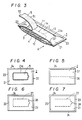
- the first container 1 has a perforated line 13 formed in the (outer) surface 11 thereof contacting the second container 2; and flap 5 made of a flexible sheet-like material similar to the material of the first container 1 and covering the perforated line 13.
- the flap 5 has a pressure sensitive adhesive 51 applied to the inside surface thereof, i.e., the side contacting the outer surface 11 of the first container, 1 except for a grip portion 52. Due to the pressure sensitive adhesive 51, the flap can be repeatedly adhered to and removed from the first container 1.
- the perforated line 13 is covered by the flap 5. Once the flap 5 is taken up from the first container 1, the portion 14 surrounded by the perforated line 13 is removed from the first container 1 and is adhered to the pressure sensitive adhesive 51 as illustrated in Fig. 1. Accordingly, the space formed by the removal of the portion 14 is used as an opening 11a for dispensing the wet fibrous materials 3.
- perforated line 13 With perforated line 13, the user is assured that nobody has taken the contents out of the first container 1 before the user uses it. Instead of the perforated line 13, a hole may be formed in the first container for dispensing the wet fibrous materials 3.
- the second container 2 is a package simultaneously containing the first container 1 and the materials 4 in a dry condition
- the material of the second container 2 may be a single layered or laminated layered film made of the same synthetic resins as mentioned above in connection with the material of the first container 1, or cellophane. Since impervious ability against gas and liquid is not required for the second container 2, a sheet-like material having a thickness thinner than that of the first container 1 can be used for the second container 2.
- the first container 1 and the materials 4 in a dry condition are stacked with each other in such a manner that the inner surface 12, i.e., the surface opposite to the surface 11 having the perforated line 13, contacts the materials 4 in a dry condition, and the materials 4 are contained in the second container 2.
- an opening 21 a is formed in the surface 21 of the container 2, which surface contacts the outer surface 11 of the first container 1, at a portion corresponding to the flap 5 attached to the first container 1. Accordingly, if the flap 5 of the first container 1 is opened at the opening 21a as illustrated in Fig. 1, the wet fibrous materials 3 can be removed through the opening 11a of the first container 1.
- a perforated line 26 is formed in the surface 22 of the second container 2 opposite to the surface 21 and will be used to form an opening for dispensing the materials 4 in a dry condition.
- An opening may be formed instead of the perforated line 26.
- the perforated line is more preferable, because the second container 2 assures a user that nobody has taken the contents out of the second container before the-user uses it.
- the second container 2 is a three sided seal package formed by heat sealing the edges 23 and a longitudinal side edge 24.
- the grip portion 52 of the flap is pulled up to open the opening 11a of the first container 1, and the wet fibrous materials 3 are taken out through the opening 11a. Then, the opening 11a is covered by the flap 5. If the materials 4 in a dry condition are desired to be removed, the dispenser-container containing wet and dry contents is first turned upside down, an opening is formed along the perforated line 26, and then the materials 4 in a dry condition are taken out.
- FIG. 6 through 11 Various alternative embodiments of the second container 2 are illustrated in Figs. 6 through 11.
- Fig. 6 is a plan view illustrating the surface 21 of the second container 2, which surface contacts the outer surface 11 of the first container 1.
- the illustrated embodiment has a perforated line 27 and a continuous punched line 28 connected to the perforated line 27, which are formed instead of the opening 21a.
- the two kinds of lines 27 and 28 form a closed loop.
- the continuously punched portion 28 is gripped by means of fingers and is pulled up along the perforated line 27, the portion encircled by the closed loop is removed from the main body of the second container 2, and an opening is formed.
- the second container is then in a condition similar to that illustrated in Fig. 4. Accordingly, if the flap 5 of the first container 1 is opened through the thus formed opening, the wet fibrous materials 3 can be removed through the opening 11 a formed in the first container 1.
- the second container 2 per se has a sealing function, i.e., the user is assured that nobody has taken the contents out of the second container 2 before the user uses it. Accordingly, the first container 1 is not required to have such a sealing function. Therefore, the embodiment illustrated in Fig. 6 is suitable for containing a first container 1 having a hole for dispensing the wet fibrous materials 3 in place of a perforated line 13 illustrated in Fig. 3.
- Fig. 7 is similar to Fig. 6 and is a plan view illustrating the surface 21 of the second container 2, which surface contacts the outer surface 11 of the first container 1.
- a perforated line 27 and a continuous punched line 28 connected to the perforated line 27 are formed instead of the opening 21a.
- the two kinds of lines 27 and 28 draw a U-shaped open loop. Accordingly, even if the perforated line 27 is cut, the portion surrounded by the open loop is not removed from the main body of the second container 2. Further, the continuously punched line 28 in Fig. 7 is so short that only the fingers can grip it, and the line 28 is prevented from being erroneously opened, while the continuously punched line 28 in Fig. 6 is relatively long to facilitate easy removal of the closed loop portion.
- the dispenser-container containing wet and dry contents is a four sided seal package wherein all the peripheries 23 and 24 of the second container 2 are heat sealed. The process for manufacturing this dispenser-container will be explained later with reference to Fig. 24.
- Fig. 8 is a rear view illustrating another embodiment of the second container 2
- Fig. 9 is a cross sectional view taken along line IX-IX in Fig. 8.
- the second container 2 of this embodiment is formed in a pillow type package.
- the dispenser-container containing wet and dry contents of this embodiment has heat sealed portions 23 at the edges and a longitudinal heat sealed portion 31 on the surface 22 which contacts the materials 4 in a dry condition.
- the longitudinal sealed portion 31 is located at a position deviating a small distance from the center, and a perforated line 26 which will be used to form an opening for dispensing the materials 4 in a dry condition therethrough is located at the center.
- Fig. 9 illustrates an embodiment which has an opening 21a formed in the front surface 21 of second container 2 as shown in the first embodiment, however, a perforated line 27 or 28 may be formed instead of the opening as shown in the embodiments illustrated in Figs. 6 and 7.
- Fig. 10 is a rear view of another embodiment of the second container 2
- Fig. 11 is a cross sectional view taken along line XI-XI in Fig. 10.
- the second container 2 of this embodiment is of a pillow configuration. However, only the edges 23 are sealed, and there is no longitudinal heat sealed portion.
- the longitudinal edges 32 and 33 overlap with each other at the side 22 contacting the materials 4 in a dry condition, as clearly illustrated in Fig. 11. Accordingly, the portion between the longitudinal edges 32 and 33 serves the function of an opening for dispensing the materials 4 in a dry condition, and the materials 4 in a dry condition can be removed therethrough.
- Fig. 11 illustrates an embodiment wherein an opening 21a is formed in the outer surface 21 of the second container 2, however, a perforated line 27 or 28 may be formed as illustrated in Figs. 6 or 7.
- the positional relationship of the flap 5 of the first container 1 and the opening 21 a or the weakened lines 27 or 28 of the second container 2 will not be changed. It is preferable to provide a means for fixing the positional relationship between the first container 1 and the second container 2 in order to completely prevent any change in the positional relationship between the flap 5 of the first container 1 and the opening 21a or the weakened lines 27 or 28 of the second container 2 from occurring.
- parts of the heat sealed portions 23 at the edges of the second container 2 are attached to parts of the heat sealed portions 11 b at the edges of the first container 1 by means of heat sealing.
- This can be done as follows. For example, when the second container 2 is packed while the first container 1 and the materials 4 in a dry condition are wrapped, the heater used for heating the surface 21 of the second container 2 is widened so that the edges 11b of the surface 11 of the first container 1 are simultaneously heated, and then, the edges 11b of the surface 11 of the first container 1 and the surface 21 of the second container 2 are thermally attached together.
- a second container 2 of a shrink dispenser-container containing wet and dry contents may be used.
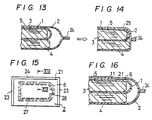
- a film which can be shrunk by heat is first used to form a dispenser-container containing wet and dry contents by wrapping both a first container 1 and materials 4 in a dry condition (Fig. 13), and then, the dispenser-container containing wet and dry contents is heated in a shrink tunnel so as to shrink the second container 2 (Fig. 14).
- the second container 2 tightly contacts the first container 1 and the material 4 in a dry condition. Accordingly, the change of the positional relationship between the first container 1 and the second container 2 is prevented from occurring.
- a uniaxial oriented film is used so that it shrinks only in a transverse direction or a longitudinal direction of the dispenser-container containing wet and dry contents.
- the second container 2 shrinks only in one direction, and accordingly, the position of the opening 21 a or the weakened lines 27 or 28 of the second container becomes approximately constant after the dispenser-container containing wet and dry contents is shrunk. Accordingly, when the second container 2 is shrunk, it is assured that the positional relationship between the flap 5 of the first container 1 and the opening or weakened line of the second container will coincide with each other.
- Fig. 15 shows another embodiment which is used to explain a fixing means
- Fig. 16 is a cross sectional view taken along line XVI-XVI in Fig. 15.
- the first container and the second container 2 are attached to each other by means of an adhesive 6, such as a pressure sensitive adhesive.
- the adhesive 6 may be applied to any portion as long as the surface 11 of the first container 1 and the surface 21 of the second container 2 are in contact with each other at the portion, and the adhesive may be applied to the first container 1 or the second container 2. It is preferable that the adhesive is applied to a portion around an opening or a weakened line 27 or 28 of the second container 2 by, for example, printing.
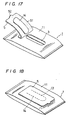
- the first container illustrated in Fig. 17 is a package of a pillow configuration.
- the constructions of the flap 5 and the opening are substantially the same as those illustrated in Fig. 3. More specifically, a perforated line drawn in a closed loop (which corresponds to that designated by 13 in Fig. 3) is formed in the surface 11 of the first container 1, and a flap having a pressure sensitive adhesive 51 applied thereto is attached to the surface 11.
- a perforated line drawn in a closed loop (which corresponds to that designated by 13 in Fig. 3) is formed in the surface 11 of the first container 1, and a flap having a pressure sensitive adhesive 51 applied thereto is attached to the surface 11.
- the flap 5 is taken up, the portion 14 surrounded by the perforated line is removed from the first container 1 and is adhered to the pressure sensitive adhesive 51. Accordingly, an opening 11a a is formed for dispensing the wet fibrous materials 3.
- the first container 1 illustrated in Fig. 18 has a construction substantially the same as that illustrated in Fig. 17, however, a perforated line drawn in a U-shape is formed in place of the perforated line drawn in a closed loop.
- the pressure sensitive adhesive is similarly applied to the inner side of the flap 5.
- Fig. 19 is a perspective view illustrating a first container of another type
- Fig. 20 is a cross sectional view taken along line XX-XX in Fig. 19.
- a sheet 7 having a pressure sensitive adhesive applied to the upper surface thereof is located inside of the container 1 and is attached to the rear side of the surface 11 of the first container 1.
- a continuous weakened line 15 is formed in the surface 11 of the first container 1, and the ends of the weakened line 15 are formed in an arc.
- the portion 72 surrounded by the closed loop 71 in the sheet 7 is removed together with the portion 16 surrounded by the weakened line 15 in the first container 1 while it is adhered to the latter.
- the space in the sheet 7 formed by the removal of the portion 72 surrounded by the closed loop 71 is used as an opening for dispensing the wet fibrous materials 3, and the portion 16 in the first container surrounded by the weakened line 15 serves as a flap.
- Each first container 1 illustrated in Figs. 17 through 20 is of a pillow type, however, a three sided seal package or a four sided seal package may be used as a first container.
- a flap is attached to the first container or is formed by a part of the first container 1. Contrary to this, in the embodiment illustrated in Fig. 21, a flap is not attached to the first container, but a flap is formed by a part of the surface of the second container 2.
- a punching line 13 is formed in the surface 11 contacting to the second container to a depth half of the thickness of the sheet as illustrated in Fig. 22 in place of the perforated line, and said punching line will be referred to as a "half punching line" hereinbelow.
- a U-shaped perforated line 34 is formed at a portion of surface 21 corresponding to the half punching line 13, and a pressure sensitive adhesive 35 is applied to the inside of the surface 21 of the second container 2, which surface contacts the first container 1. It is preferable that a part 36 of the inside of the surface 21 remains uncoated with the pressure sensitive adhesive so as to form a gripping portion and so as to facilitate easy pulling of the portion surrounded by the U-shape in the second container 2.
- the bottom of the half punching line 13 does not reach the inside of the first container 1, and accordingly, the first container 1 can be hermetically sealed against gas or liquid, even if it is not provided with a flap.
- the portion surrounded by the U-shaped perforated line 34 in the second container 2 is taken up, the portion 14 in the first container surrounded by the punching line 13 is pulled up together therewith and is removed from the first container 1, and the space formed by removal is used as an opening for dispensing wet fibrous materials 3.
- first container 1 is not limited to the embodiments described above. Any conventionally known package may be used as a first container as long as it is made of a gas impervious sheet and has an opening for dispensing the wet fibrous materials therethrough or a weakened line for forming the opening, and as long as the opening or weakened line can be resealably covered by a flexible flap, which is capable of being repeatedly opened and closed.
- Fig. 23 is a flow diagram of an embodiment of a process according to the present invention for manufacturing dispenser-containers illustrated in Figs. 1 through 5.
- first containers 1 containing wet fibrous materials 3 are prepared, and materials in a dry condition, which were described above are also prepared.
- Fig. 23 illustrates an embodiment of a process for manufacturing the first containers 1 which have a construction similar to that illustrated in Fig. 17.
- perforated lines 13 are formed at positions, where openings will be formed, in the gas impervious sheet 10 used for forming the first container 1, by means of a press 101, and thereafter, flaps 5 are attached to the gas impervious sheet 10 by means of a labeler 102 or by a human hand so as to cover the perforated lines 13 formed in the gas impervious sheet 10.
- the flap 5 has a pressure sensitive adhesive 51 applied to the surface contacting the gas impervious sheet 10 except for a grip portion 52, as illustrated in Fig. 3. It is preferable that one end of the flap 5 is fixed to the sheet 10 by means of a heat sealer 103, as illustrated in Fig. 23. As described above, the first containers 1 are prepared first.
- wet fibrous materials 3 are placed on the perforated line 13 on the surface opposite to the surface where the flaps 5 are attached. Then, the wet fibrous materials 3 are wrapped by means of a packaging apparatus which comprises a guide member 104, center heat sealer 105 and a transverse beat sealer 106. The sheet 10 is cut in a transverse direction by means of a cutter 107 to form individual dispenser-containers, and thus first container 1 containing the wet fibrous materials 3 is obtained.
- an opening may be formed by completely punching the gas impervious sheet by means of a press 101, or a perforated line may be formed in a U-shape so as to form a first container as illustrated in Fig. 18.
- a weakened line of an open loop for example, of a U-shape, is formed in the gas impervious sheet.
- a piece of sheet which has a perforated line formed in a closed loop and a pressure sensitive adhesive applied on one side thereof, is attached to the surface of the gas impervious sheet which is inside of the first container in such a manner that it covers the open looped weakened line formed in the gas impervious sheet for a first container.
- Wet fibrous materials are placed on the piece of sheet, and then, they are wrapped and packed by the gas impervious sheet.
- the first container 1 illustrated in Fig. 1, is of a pillow type configuration, however, a three sided seal package or four sided seal package may be used as a first container.
- the first container is not limited to those described above. Any conventionally known package may be used as a first container as long as it is made of a gas impervious sheet and has an opening for dispensing the wet fibrous materials therethrough or a weakened line for forming the opening, and as long as the opening or weakened line can be covered by a flexible flap, which is capable of being repeatedly opened and closed.
- the size of the materials in a dry condition is almost the same as the size of the wet fibrous materials so as to facilitate their easy stacking.
- the materials in a dry condition are, for example, prepared bandages of the "Band-Aid" type, which are used as small individual pieces, it is preferable that a group of prepared bandages of the "Band-Aid” type are connected together having perforated lines therebetween so as to be able to be individually cut rather than individually packing the same.
- the materials in a dry condition are made of a sheet-like material such as a tissue paper, it is preferable that the sheet-like materials are folded in a size harmonizing with the size of the first container containing wet fibrous materials.
- both the first containers 1 and the materials in a dry condition 4 are wrapped by the second container 2, as illustrated in Fig. 1. More specifically, openings 21a for dispensing the wet fibrous materials are formed at a predetermined distance on a continuous sheet 20 used for the second containers 2 by means of a press 201.
- a perforated line 26 is formed so that it extends in a longitudinal direction of the continuous sheet 20 and it is parallel to the openings 21a.
- the first containers 1 are placed on the continuous sheet 20. In this case, they are directed so that the flaps 5 of the first containers 1 are located at the underside of the first container and are made coincident with the openings 21a formed in the continuous sheet 20.
- the materials in a dry condition 4 are supplied onto the first containers 1.
- the continuous sheet 20 is guided by a guide member 202, and the first containers 1 and the materials in a dry condition 4 are wrapped by the continuous sheet 20 while they are stacked with each other.
- a heat sealer 203 seals the longitudinal edges 24 of the continuous sheet 20.
- a transverse heat sealer 204 transversely heat seals the continuous sheet 20 at the portion 23, and forms a second container connected to the continuous sheet 20 at the heat sealed portions 23.
- a cutter 205 transversely cuts the heat sealed portions 23 or the portions near the heat sealed portions 23 to form individual dispenser-containers 7.
- openings may be formed at a portion parallel to the openings 21 a in a suitable shape, for example, a length of perforated lines or a length of slits, so as to use for dispensing the materials in a dry condition 4 therethrough.
- the first container With respect to the supply of the first container 1 and the materials in a dry condition 4 onto the continuous sheet 20, in Fig. 4, the first container is supplied prior to the materials in a dry condition 4. However, contrary to this, the materials in a dry condition 4 may be placed first on the perforated line 26 corresponding to the opening 21a, and then, the first container 1 is placed on the materials in a dry condition 4, and thereafter, they may be wrapped by the continuous sheet.
- the second container 2 of the embodiment illustrated in Figs. 8 and 9 may be manufactured as follows. In the manufacturing process illustrated in Fig. 23, the positions of openings 21a and the perforated line 26 formed in the continuous sheet 20 are displaced a small distance in a transverse direction of the continuous sheet 20, and the longitudinal seal by the heat sealer 203 is performed at a position near the center of the width of the second container 2.
- Fig. 24 is a flow diagram of a process of the present invention for manufacturing such a foursided seal package as illustrated in Fig. 7.
- a first container 1 and materials in a dry condition 4 are previously prepared similar to the case in the embodiment illustrated in Fig. 23.
- a second container 2 consists of two continuous sheets, and openings 21a for dispensing the wet fibrous materials are formed in a first continuous sheet 20 by means of a press 201 at an approximate center of the width of the first continuous sheet 20 and at a predetermined distance in a longitudinal direction of the first continuous sheet.
- a perforated line or a weakened line 27 or 28 as shown in Fig. 6 or 7 may be formed.
- the first containers 1 are placed on the continuous sheet 20 in such a manner that the flaps 5 of the first containers 1 are located at the underside of the first containers 1 and are made coincident with the openings 21a a formed in the first continuous sheet 20.
- the materials in a dry condition 4 are supplied onto the first containers 1, and a second continuous sheet 30 is guided over them.
- openings are formed in parallel with the openings 21a for dispensing the materials in a dry condition therethrough or weakened lines are formed for forming the openings, such as a perforated line 36 extending in the longitudinal direction of the second continuous sheet 30, or a length of slits.
- the first container 1 and the materials in a dry condition 4 overlap each other and are sandwiched by the first and second continuous sheets 20 and 30.
- the materials in a dry condition 4 are supplied onto the second continuous sheet 30, and then, the first containers 1 are placed on the materials in a dry condition 4 in such a manner that the flaps 5 of the first containers 1 are directed upwardly, and thereafter, the first continuous sheet 20 is supplied onto them. Also in this case, the first containers 1 should be placed on the materials in a dry condition 4 in such a manner that the flaps 5 are made coincident with the openings 21a formed in the first continuous sheet 20.
- a heat sealer 203 seals the longitudinal edges of the first and second continuous sheets 20 and 30 to form heat sealed portions 24.
- a transverse heat sealer 204 transversely heat seals the continuous sheets 20 and 30, and forms a second container with heat sealed portions 23.
- a cutter 205 transversely cuts the heat sealed portions 23 or the portions near the heat sealed portions 23 to form individual dispenser-containers 7.
- Fig. 25 is a flow diagram of another embodiment of a manufacturing process according to the present invention for manufacturing a dispenser-container illustrated in Figs. 10 and 11.
- first containers 1 and materials in a dry condition 4 are previously prepared similar to the embodiment illustrated in Fig. 23.
- Openings 21a for dispensing the wet fibrous materials are formed in a continuous sheet 20 used for the second container 2 by means of a press 201 at an approximate center of the width of the continuous sheet 20 and at a predetermined distance in a longitudinal direction of the continuous sheet.
- a perforated line or a weakened line 27 or 28 as shown in Fig. 6 or 7 may be formed.
- the first containers 1 are placed on the continuous sheet 20 in such a manner that the flaps 5 of the first containers 1 are located at the underside of the first containers 1 and are made coincident with the openings 21a formed in the continuous sheet 20.
- the continuous sheet 20 is guided by the guide member 202 which wraps both the first containers 1 and the materials in a dry condition 4 while they are stacked with each other. Although the longitudinal edges 24 of the continuous sheet 20 are gathered together and are overlapped, they are not heat sealed in this embodiment.
- a transverse heat sealer 204 transversely heat seals the continuous sheet 20 and forms a second container connected to the continuous sheet 20 at heat sealed portions 23.
- a cutter 205 transversely cuts the heat sealed portions 23 or portions near the heat sealed portions 23 to form individual dispenser-containers 7.
- the dispenser-container of the present invention is suitable for containing wet fibrous materials together with materials in a dry condition, and it is very compact and portable.
- a dispenser-container containing wet and dry contents can be easily and continuously manufactured. More specifically, contents in a wetted condition are packed first in a first container, and then, a second container is used to pack both the inner contents and the wet fibrous materials.
- the first container and the materials in a dry condition are packed by the second container, the first container can be treated like the usual dry contents. Therefore, the packing process comprising supplying, transferring and wrapping steps can be simplified.
- the liquid contained in the wet fibrous materials does not leak out during the wrapping step by the second container. Therefore, the liquid does not wet the materials in a dry condition, and the commercial value of the dispenser is not diminished.
- the portion to be heat sealed is not wetted and can be easily heat sealed.
- the dispenser-container containing wet and dry contents a relatively thick sheet is used for the first container so as to be impervious against gas and liquid, however, the sheet for the second container can be relatively thin. As a result, the cost of the sheets used for the whole dispenser-container containing wet and dry contents can be minimized.
- the second container is heat sealed while it is overlapped with the heat sealed portions of the first container as illustrated in Fig. 12, the heat sealing step can be surely conducted because the thermal energy can be transferred through a thin film.
- the dispenser-container containing wet and dry contents of the present invention is easy to manufacture and can be continuously manufactured, and the cost of sheets can be low. As a result, the products of low price can be presented.
Landscapes
- Engineering & Computer Science (AREA)
- Mechanical Engineering (AREA)
- Packages (AREA)
Claims (17)
Applications Claiming Priority (4)
| Application Number | Priority Date | Filing Date | Title |
|---|---|---|---|
| JP27024/85U | 1985-02-26 | ||
| JP2702485U JPH0121619Y2 (fr) | 1985-02-26 | 1985-02-26 | |
| JP60037074A JPS61203305A (ja) | 1985-02-26 | 1985-02-26 | 二種類の品物を収納した包装体の製造方法 |
| JP37074/85 | 1985-02-26 |
Publications (3)
| Publication Number | Publication Date |
|---|---|
| EP0193130A2 EP0193130A2 (fr) | 1986-09-03 |
| EP0193130A3 EP0193130A3 (en) | 1988-03-02 |
| EP0193130B1 true EP0193130B1 (fr) | 1990-05-02 |
Family
ID=26364891
Family Applications (1)
| Application Number | Title | Priority Date | Filing Date |
|---|---|---|---|
| EP86102273A Expired EP0193130B1 (fr) | 1985-02-26 | 1986-02-21 | Récipient-distributeur pour contenus secs et humides ainsi que son procédé de fabrication |
Country Status (4)
| Country | Link |
|---|---|
| US (2) | US4610357A (fr) |
| EP (1) | EP0193130B1 (fr) |
| CA (1) | CA1255640A (fr) |
| DE (1) | DE3670814D1 (fr) |
Cited By (3)
| Publication number | Priority date | Publication date | Assignee | Title |
|---|---|---|---|---|
| US7293738B2 (en) | 2003-11-26 | 2007-11-13 | Kimberly-Clark Worldwide, Inc. | Freestanding dispenser for dispensing two different substrates |
| US7354598B2 (en) | 2002-12-20 | 2008-04-08 | Kimberly-Clark Worldwide, Inc. | Packaging two different substrates |
| NO20065189L (no) * | 2006-11-13 | 2008-05-14 | Padtech As | Pad med rivekant samt fremgangsmåte for anvendelse av paden |
Families Citing this family (153)
| Publication number | Priority date | Publication date | Assignee | Title |
|---|---|---|---|---|
| DE3514943A1 (de) * | 1985-04-25 | 1986-10-30 | Virgunia Verpackung Inh. Herr Fidelis Frank, 8000 München | Verpackung |
| US4679693A (en) * | 1986-05-14 | 1987-07-14 | Harold Forman | Label resealing container |
| US4848572A (en) * | 1986-06-09 | 1989-07-18 | Herrera Patricio B | Feminine hygiene device |
| JPH07102868B2 (ja) * | 1986-06-23 | 1995-11-08 | 憲司 中村 | 包装体 |
| US4918904A (en) * | 1987-08-25 | 1990-04-24 | Pharo Daniel A | Method for forming clam-like packaging system |
| US4848575A (en) * | 1988-03-02 | 1989-07-18 | Eluci Company Inc. | Resealable dispenser-container for wet tissues |
| DE3823395A1 (de) * | 1988-07-09 | 1990-03-15 | Holzapfel Boeving Partner Werb | Mit einem wirkstoff getraenktes tuch |
| US5161350A (en) * | 1988-11-09 | 1992-11-10 | Kennak U.S.A. Inc. | Process and apparatus for manufacturing a dispenser-container |
| EP0368240B1 (fr) * | 1988-11-09 | 1995-01-18 | Kenji Nakamura | Emballage de distribution ainsi que le procédé pour sa fabrication |
| JP2688634B2 (ja) * | 1988-11-30 | 1997-12-10 | 日本テトラパック株式会社 | 包装機における包装容器の開口部形成装置 |
| US4982845A (en) * | 1989-06-19 | 1991-01-08 | James River Corporation | Resealable enclosure |
| US5012931A (en) * | 1989-08-22 | 1991-05-07 | John Ferrera | Z-shaped dual-compartment resealable dispensing container |
| DE4007649C1 (fr) * | 1990-03-10 | 1991-09-19 | Kloeckner Pentapack Zweigniederlassung Der Kloeckner Pentaplast Gmbh, 6479 Ranstadt, De | |
| DE9014065U1 (de) * | 1990-10-10 | 1991-02-28 | Focke & Co (GmbH & Co), 2810 Verden | Verpackung aus (Kunststoff-) Folie |
| US5111934A (en) * | 1991-07-22 | 1992-05-12 | Eugene Morin | Portable cleaning kit |
| US5531325A (en) * | 1992-03-13 | 1996-07-02 | The Procter & Gamble Company | Storing and dispensing system for products packed in a sealed pouch |
| US5310262A (en) * | 1992-06-02 | 1994-05-10 | Bemis Company, Inc. | Flexible package with an easy open arrangement |
| US5464096A (en) * | 1992-08-25 | 1995-11-07 | Hurwitz; Robert | Kit for cleaning radiological cassettes |
| GB9223558D0 (en) * | 1992-11-10 | 1992-12-23 | Jeyes Group Plc | Containers |
| US5335478A (en) * | 1993-01-08 | 1994-08-09 | Aronsen Arthur N | Multi-compartment dispenser pouch and method of making |
| DE4312446A1 (de) * | 1993-04-16 | 1994-12-15 | Beiersdorf Ag | Etikett mit Anfasserlasche |
| US5765682A (en) * | 1994-10-13 | 1998-06-16 | Menlo Care, Inc. | Restrictive package for expandable or shape memory medical devices and method of preventing premature change of same |
| SE505294C2 (sv) * | 1994-12-13 | 1997-07-28 | Regath Hb | Återförslutbar förpackning med organ för indikering om förpackningen är bruten |
| CA2213403C (fr) * | 1995-02-22 | 2007-01-16 | Menlo Care, Inc. | Prothese endovasculaire a treillis dilatable revetu |
| IT1288152B1 (it) * | 1996-03-27 | 1998-09-11 | Giorgio Trani | Confezione multistrato a perdere provvista di apertura di erogazione. |
| DE19720777A1 (de) | 1997-05-17 | 1998-11-19 | Barbara Panzner | Mehrphasenauflagesystem mit Verpackung |
| US5947275A (en) * | 1997-07-09 | 1999-09-07 | Hess; Elizabeth R. | Personal disinfection system |
| US5906278A (en) * | 1997-10-06 | 1999-05-25 | Sage Products, Inc. | Patient bathing system |
| FR2772011B3 (fr) * | 1997-12-10 | 2000-01-28 | Denis Guibert | Etui pour produits, et article obtenu |
| CA2254270C (fr) * | 1997-12-31 | 2007-01-30 | Kimberly-Clark Worldwide, Inc. | Systeme de distribution de mouchoirs portatif a emballage souple |
| CA2254323C (fr) * | 1997-12-31 | 2008-01-15 | Kimberly-Clark Worldwide, Inc. | Systeme de distribution de mouchoirs portatif et flexible |
| US6164441A (en) * | 1998-08-12 | 2000-12-26 | Guy & O'neill, Inc. | Skin cleansing device with re-sealable container |
| US5996797A (en) * | 1998-08-31 | 1999-12-07 | Chesebrough-Pond's Usa Co. Division Of Conopco, Inc. | Towelette pouches with outer container or saddle |
| US6315448B1 (en) | 1998-11-12 | 2001-11-13 | Bemis Company, Inc. | Multiwall bag with peelable opening |
| US6145155A (en) * | 1999-01-11 | 2000-11-14 | James; Glenn P. | Double sided cleaning pad mitt with sealed package |
| US6048100A (en) | 1999-03-10 | 2000-04-11 | Industrial Label Corp. | Resealable closure for a bag |
| US6113271A (en) * | 1999-03-11 | 2000-09-05 | Prime Label & Screen, Inc. | Resealable label flap including label stop |
| US6427839B1 (en) * | 1999-04-21 | 2002-08-06 | Beverly Helfer-Grand | Hands-free portable towelette dispenser apparatus |
| JP3784204B2 (ja) * | 1999-05-24 | 2006-06-07 | ユニ・チャーム株式会社 | 軟質シートで形成された包装体の製造方法 |
| US6635039B1 (en) * | 2000-07-19 | 2003-10-21 | Tyco Healthcare Retail Services Ag | Package for carrying plural pantiliners |
| NZ507414A (en) * | 2000-10-11 | 2003-02-28 | Michael Clements Markham | Method of forming a valve bag |
| US6604651B2 (en) | 2001-01-24 | 2003-08-12 | Kimberly-Clark Worldwide, Inc. | Storage and dispensing package for wipes |
| GB2373234B (en) * | 2001-03-16 | 2004-09-29 | Stickpack Europ Ltd | Apparatus for manufacturing packaged products |
| GB2373233A (en) * | 2001-03-16 | 2002-09-18 | Stickpack Europ Ltd | Packaging with resealable closure patch |
| US6616334B2 (en) | 2001-11-30 | 2003-09-09 | Playtex Products, Inc. | Die cut resealable flap |
| US20030116464A1 (en) * | 2001-12-21 | 2003-06-26 | Koenig David William | Wet-dry cleaning system |
| US6599016B1 (en) | 2002-02-14 | 2003-07-29 | Stone Container Corporation | Pinch bottom bag with tear strip |
| GB2387587A (en) * | 2002-04-19 | 2003-10-22 | Sca Hygiene Prod Gmbh | Gastight package containing a protective gas |
| US6910579B2 (en) | 2002-05-28 | 2005-06-28 | Georgia-Pacific Corporation | Refillable flexible sheet dispenser |
| JP3901592B2 (ja) * | 2002-06-24 | 2007-04-04 | 株式会社フジキカイ | 再封性包装袋と製袋充填機 |
| FR2841537B1 (fr) * | 2002-06-28 | 2005-04-15 | Soplaril Sa | Sachet a compartiments multiples |
| US20040144796A1 (en) * | 2002-07-26 | 2004-07-29 | Kang Na Hsiung Enterprise Co. Ltd. | Moist paper towel package |
| US6889483B2 (en) * | 2002-10-31 | 2005-05-10 | Cryovac, Inc. | Easy-opening feature for flexible packages and process and apparatus for forming same |
| US6857540B2 (en) * | 2002-11-26 | 2005-02-22 | Kimberly-Clark Worldwide, Inc. | Interfolded tissue sheet dispenser with adjustable attaching mechanism |
| US7059493B2 (en) * | 2002-11-26 | 2006-06-13 | Kimberly-Clark Worldwide, Inc. | Dispenser for wet and dry interfolded tissue |
| US7040502B2 (en) * | 2002-11-26 | 2006-05-09 | Kinberly-Clark Worldwide, Inc. | Dispenser for wet and dry interfolded sheets |
| US6840401B2 (en) * | 2002-12-19 | 2005-01-11 | Kimberly-Clark Worldwide, Inc. | Multiple layer baffle structure for dispenser for wipes |
| US20040124202A1 (en) * | 2002-12-26 | 2004-07-01 | Joseph Mitchell | Dispenser for wet and/or dry products |
| US7240797B1 (en) | 2003-01-27 | 2007-07-10 | Grossman Victor A | Packaging and dispensing system for sandwich food products |
| PT1449789E (pt) * | 2003-02-19 | 2007-10-26 | Alcan Tech & Man Ltd | Recipiente de embalagem com uma película de embalagem com sistema integrado de abertura e refecho |
| US6969196B2 (en) * | 2003-03-07 | 2005-11-29 | Exopack-Technology, Llc | Bag having reclosable seal and associated methods |
| US9150342B2 (en) | 2003-04-16 | 2015-10-06 | Intercontinental Great Brands Llc | Resealable tray container |
| US7213710B2 (en) * | 2003-05-13 | 2007-05-08 | The Procter & Gamble Company | Package for compressible flat articles |
| US6997342B2 (en) * | 2003-05-16 | 2006-02-14 | Kimberly-Clark Worldwide, Inc. | Dispenser for sheet material |
| US6997345B2 (en) * | 2003-05-16 | 2006-02-14 | Kimberly-Clark Worldwide, Inc. | Dispenser for sheet material |
| US6976605B2 (en) | 2003-05-16 | 2005-12-20 | Kimberly-Clark Worldwide, Inc. | Dispenser for sheet material |
| US7207461B2 (en) * | 2003-05-16 | 2007-04-24 | Kimberly-Clark Worldwide, Inc. | Dispenser for sheet material |
| US20050011906A1 (en) * | 2003-07-15 | 2005-01-20 | Kimberly-Clark Worldwide, Inc. | Storing and dispensing container for product |
| US7140513B2 (en) * | 2003-12-22 | 2006-11-28 | Kimberly-Clark Worldwide, Inc. | Convertible dispenser for sheet material |
| US7125457B2 (en) * | 2003-12-31 | 2006-10-24 | General Electric Company | Method for removing oxide from cracks in turbine components |
| US7665629B2 (en) * | 2004-01-12 | 2010-02-23 | Nice-Pak Products, Inc. | Resealable perforated label for consumer products |
| US7971718B2 (en) | 2005-05-09 | 2011-07-05 | Kraft Foods Global Brands Llc | Package for dispensing and retaining gum slabs with adhesive securement |
| JP4295339B2 (ja) | 2004-05-11 | 2009-07-15 | キャドバリー・アダムズ・ユーエスエイ・エルエルシー | フラップ保持部を備えるガムスラブパッケージ体 |
| BRPI0510029A (pt) | 2004-05-11 | 2007-09-25 | Cadbury Adams Usa Llc | pacote de placa e goma tendo um elemento de retenção de produto que pode ser inserido |
| EP1598284A1 (fr) * | 2004-05-18 | 2005-11-23 | The Procter & Gamble Company | Emballage pour lingettes |
| US7717620B2 (en) * | 2004-06-11 | 2010-05-18 | Sonoco Development, Inc. | Flexible packaging structure with a built-in opening and reclose feature, and method for making same |
| US7533773B2 (en) | 2004-07-08 | 2009-05-19 | Cadbury Adams Llc | Reclosable consumable product package assembly |
| US7371008B2 (en) * | 2004-07-23 | 2008-05-13 | Kraft Foods Holdings, Inc. | Tamper-indicating resealable closure |
| US7216764B2 (en) * | 2004-08-16 | 2007-05-15 | Sealstrip Corporation | Easy-open packages |
| US20060151351A1 (en) * | 2005-01-07 | 2006-07-13 | Hughes Lillian S | Wet and dry wipes with packaging |
| US11807438B2 (en) | 2005-04-05 | 2023-11-07 | Sonoco Development, Inc. | Flexible packaging structure with a built-in opening and reclose feature |
| DE602005011572D1 (de) | 2005-04-15 | 2009-01-22 | Regath Hb | Flexible Verpackung und Verfahren zu ihrer Herstellung |
| US20060266760A1 (en) * | 2005-05-31 | 2006-11-30 | Rodriguez Luis A | Twin pack tissue-wipe container |
| US7823727B2 (en) * | 2005-06-29 | 2010-11-02 | Sage Products, Inc. | Patient check system |
| US20070023436A1 (en) * | 2005-08-01 | 2007-02-01 | Sierra-Gomez Gladys O | Resealable food container |
| US20070034534A1 (en) * | 2005-08-09 | 2007-02-15 | Kimberly-Clark Worldwide, Inc. | Product providing sheet samples |
| US20070095708A1 (en) * | 2005-10-27 | 2007-05-03 | Allen Tsai | Cleansing wipe pack |
| US20070119742A1 (en) * | 2005-11-28 | 2007-05-31 | The Procter & Gamble Company | Packaging incorporating sensory elements |
| WO2007064326A1 (fr) * | 2005-12-02 | 2007-06-07 | Sealstrip Corporation | Paquets à ouverture facile |
| US20070221529A1 (en) * | 2006-03-27 | 2007-09-27 | Marlene Gioia-Smickle | Packet containing moistened towelette used for cleaning pruning tools |
| US8740052B2 (en) * | 2006-04-07 | 2014-06-03 | Sonoco Development, Inc. | Membrane closure for container |
| US8308363B2 (en) | 2006-05-23 | 2012-11-13 | Kraft Foods Global Brands Llc | Package integrity indicator for container closure |
| US7963413B2 (en) | 2006-05-23 | 2011-06-21 | Kraft Foods Global Brands Llc | Tamper evident resealable closure |
| US8684175B2 (en) * | 2006-09-22 | 2014-04-01 | Covidien Lp | Method for shipping and protecting an endotracheal tube with an inflated cuff |
| CA2663560C (fr) * | 2006-09-26 | 2015-12-08 | Cadbury Adams Usa Llc | Emballage alveolaire pouvant etre rompu |
| US9216850B2 (en) | 2006-09-26 | 2015-12-22 | Intercontinental Great Brands Llc | Rupturable substrate |
| WO2008051813A1 (fr) * | 2006-10-19 | 2008-05-02 | Wm. Wrigley, Jr. Company | Emballages refermables pour des produits de pâtisserie |
| US8114451B2 (en) | 2006-12-27 | 2012-02-14 | Kraft Foods Global Brands Llc | Resealable closure with package integrity feature |
| WO2008086390A2 (fr) * | 2007-01-10 | 2008-07-17 | Avery Dennison Corporation | Contenant refermable |
| US8408792B2 (en) | 2007-03-30 | 2013-04-02 | Kraft Foods Global Brands Llc | Package integrity indicating closure |
| US20080269708A1 (en) * | 2007-04-27 | 2008-10-30 | The Procter & Gamble Company | Sanitary napkin having a wipe and powdered substrate combination |
| US20080264807A1 (en) * | 2007-04-27 | 2008-10-30 | The Procter & Gamble Company | Wipe and powdered substrate combination |
| US20080269710A1 (en) * | 2007-04-27 | 2008-10-30 | The Procter & Gamble Company | Hygiene article having a wipe and powdered substrate combination |
| WO2009065120A1 (fr) * | 2007-11-16 | 2009-05-22 | Hickey Charles P | Fermeture refermable par collage |
| US7681732B2 (en) | 2008-01-11 | 2010-03-23 | Cryovac, Inc. | Laminated lidstock |
| US10493688B2 (en) | 2008-03-06 | 2019-12-03 | Sonoco Development, Inc. | Flexible packaging structure with built-in tamper-evidence features and method for making same |
| US9975290B2 (en) | 2008-03-06 | 2018-05-22 | Sonoco Development, Inc. | Flexible packaging structure with built-in tamper-evidence features and method for making same |
| TW200940412A (en) * | 2008-03-17 | 2009-10-01 | Kang Na Hsiung Entpr Co Ltd | Packaging bag and manufacturing method and manufacturing device thereof |
| US8354132B2 (en) * | 2008-06-06 | 2013-01-15 | Cryovac, Inc. | Laminated lidstock and package made therefrom |
| US20100018974A1 (en) | 2008-07-24 | 2010-01-28 | Deborah Lyzenga | Package integrity indicating closure |
| GB2462150B (en) * | 2008-08-01 | 2012-09-12 | James Aiden O'brien | A Flat pack of solvent impregnated wipes |
| GB0819200D0 (en) | 2008-10-20 | 2008-11-26 | Cadbury Holdings Ltd | Packaging |
| US20100111453A1 (en) * | 2008-10-31 | 2010-05-06 | Frito-Lay North America, Inc. | Two Side Cut Reseal With Pressure Sensitive Adhesive and the Method for Making Same |
| US20100147724A1 (en) * | 2008-12-12 | 2010-06-17 | Ujjaini Mitra-Shah | Tamper indicator for reclosable packages |
| WO2010088492A1 (fr) | 2009-02-02 | 2010-08-05 | Cadbury Adams Usa Llc | Conditionnement scellé ouvrable et refermable pour des produits de confiserie |
| US20100278454A1 (en) * | 2009-04-29 | 2010-11-04 | Sonoco Development, Inc. | Tamper-evident laminate structure |
| US20100288764A1 (en) * | 2009-05-14 | 2010-11-18 | Douglas Neil Frost | Packaging membrane with built-in opening feature |
| US20110103718A1 (en) * | 2009-10-30 | 2011-05-05 | Sonoco Development, Inc. | Vented package |
| US20110127319A1 (en) * | 2009-12-01 | 2011-06-02 | Kraft Foods Global Brands Llc | Resealable flexible film packaging products and methods of manufacture |
| DK2762413T3 (da) * | 2010-01-14 | 2017-11-13 | Frieslandcampina Nederland Bv | Fremgangsmåde og system til emballering af et produkt |
| DK2347971T3 (da) | 2010-01-26 | 2012-09-17 | Gen Biscuit | Genlukkelig emballage til fødevarer og fremgangsmåde til fremstilling |
| US20110204082A1 (en) * | 2010-02-19 | 2011-08-25 | Spagnolo Angelina T | Hanging apparatus for dispensing items |
| ES2390568T3 (es) | 2010-03-23 | 2012-11-14 | Generale Biscuit | Envase que se puede volver a cerrar para productos alimenticios y método de fabricación |
| US9656783B2 (en) * | 2010-05-18 | 2017-05-23 | Intercontinental Great Brands Llc | Reclosable flexible packaging and methods for manufacturing same |
| ES2555259T3 (es) * | 2010-05-18 | 2015-12-30 | Intercontinental Great Brands Llc | Productos de envasado de película flexible de fácil apertura y métodos de fabricación |
| PL2571766T3 (pl) * | 2010-05-18 | 2015-02-27 | Intercontinental Great Brands Llc | Elastyczne opakowanie z możliwością wielokrotnego zamykania oraz sposoby jego wytwarzania |
| JP5732223B2 (ja) * | 2010-09-30 | 2015-06-10 | ユニ・チャーム株式会社 | ウェットワイプスの製造方法及び製造装置 |
| EP3109172B1 (fr) | 2011-03-17 | 2018-08-15 | Intercontinental Great Brands LLC | Produits d'emballage à film souple à ouverture et fermeture faciles et procédés de fabrication |
| JP5988545B2 (ja) * | 2011-03-29 | 2016-09-07 | ユニ・チャーム株式会社 | ウェットティッシュ包装体の製造方法 |
| US10081473B2 (en) | 2011-04-08 | 2018-09-25 | Ampac Holdings, Llc | Packaging container with pull tab |
| EP2508445A1 (fr) * | 2011-04-08 | 2012-10-10 | Elag Verpackungen AG | Sachet d'emballage doté d'une fermeture contre le déchirement |
| PH12013502248A1 (en) * | 2011-05-08 | 2014-01-13 | Intercontinental Great Brands Llc | Reclosable flexible film packaging and methods of manufacture |
| GB201113868D0 (en) * | 2011-08-12 | 2011-09-28 | Kraft Foods Global Brands Llc | Packaging |
| US9422080B2 (en) * | 2012-05-22 | 2016-08-23 | LaserSharp FlexPak Services, LLC | Process to manufacture peel-reclose packaging film using laser scoring and pressure sensitive labels |
| DE102012112217A1 (de) * | 2012-12-13 | 2014-06-18 | Vollmar Gmbh | Wiederverschließbare Verpackung für stückiges, stapelbares Gut, Verfahren zu ihrer Herstellung und Vorrichtung zur Durchführung des Verfahrens |
| EP2769929A1 (fr) | 2013-02-22 | 2014-08-27 | Amcor Flexibles | Systèmes de refermeture à ouverture facile pour emballage de cigarettes |
| EP2769930A1 (fr) | 2013-02-22 | 2014-08-27 | Amcor Flexibles | Systèmes de refermeture à ouverture facile pour emballage de cigarettes |
| ITMI20131583A1 (it) * | 2013-09-25 | 2015-03-26 | Masterpack S P A | Dispositivo di formazione di un'apertura di prelievo richiudibile nella pellicola di una confezione sigillata e confezione-dispensatore |
| US20150336713A1 (en) * | 2014-05-26 | 2015-11-26 | Mark Gum | Film bag |
| US10183801B2 (en) * | 2014-10-20 | 2019-01-22 | Medline Industries, Inc. | Sheet package assembly and method for making the same |
| US10279976B2 (en) * | 2014-10-30 | 2019-05-07 | Veltek Associates, Inc. | Wipe container |
| US10273068B2 (en) | 2014-12-23 | 2019-04-30 | Sonoco Development, Inc. | Die cut opening for multi-layer flexible package |
| WO2016131742A1 (fr) | 2015-02-20 | 2016-08-25 | Amcor Flexibles Burgdorf Gmbh | Emballage refermable |
| ES2765202T3 (es) | 2015-02-20 | 2020-06-08 | Amcor Flexibles Burgdorf Gmbh | Embalaje que se puede volver a cerrar |
| WO2016131740A1 (fr) | 2015-02-20 | 2016-08-25 | Amcor Flexibles Burgdorf Gmbh | Emballage refermable |
| ES2681234T3 (es) | 2016-01-14 | 2018-09-12 | Amcor Flexibles Burgdorf Gmbh | Envase recerrable y método para producir el mismo |
| US11662279B2 (en) | 2016-08-15 | 2023-05-30 | Veltek Associates, Inc. | Portable air sampler |
| US11091286B2 (en) * | 2017-03-16 | 2021-08-17 | Sealed Air Corporation (Us) | Method of forming heat-shrunk packing with opening features |
| JP6767298B2 (ja) * | 2017-03-31 | 2020-10-14 | 大王製紙株式会社 | フィルム包装ティシュー |
| EP3774576B1 (fr) | 2018-05-11 | 2023-03-08 | Sonoco Development Inc. | Emballage stratifié à l'épreuve des enfants et procédés de réalisation d'un emballage stratifié à l'épreuve des enfants |
| US12083305B1 (en) * | 2022-01-04 | 2024-09-10 | II James Kohr | Disposable personal towel cleaning kit |
| US20230312210A1 (en) * | 2022-03-29 | 2023-10-05 | Sonoco Development, Inc. | Flexible packaging structure |
| USD1064843S1 (en) * | 2022-04-07 | 2025-03-04 | Rockline Industries, Inc. | Wipe package |
Family Cites Families (16)
| Publication number | Priority date | Publication date | Assignee | Title |
|---|---|---|---|---|
| US3438565A (en) * | 1967-12-26 | 1969-04-15 | Brown Co | Recloseable carton with tear open spout |
| US3580466A (en) * | 1969-01-31 | 1971-05-25 | Packaging Corp America | Sanitary package |
| US3851762A (en) * | 1969-11-12 | 1974-12-03 | Distribu U Mat Inc | Packaging assembly |
| US3730739A (en) * | 1971-09-29 | 1973-05-01 | Mayer & Co Inc O | Package for interleaved products |
| US3807118A (en) * | 1972-03-31 | 1974-04-30 | Schneider W | Method of forming a package |
| US3819043A (en) * | 1972-10-10 | 1974-06-25 | Sterling Drug Inc | Dispenser pack for pre-moistened towelettes |
| US3940905A (en) * | 1973-06-25 | 1976-03-02 | Perry 3Rd Thomas William | Method and apparatus for making a thermal compress |
| US3951331A (en) * | 1974-05-29 | 1976-04-20 | Phillips Petroleum Company | Reclosable closure |
| CA1072062A (fr) * | 1976-09-02 | 1980-02-19 | Scott Paper Company | Emballage jetable et a l'epreuve de l'humidite pour les serviettes humides |
| US4192420A (en) * | 1978-11-30 | 1980-03-11 | Scott Paper Company | Flexible and pliable moisture-impervious package |
| AU536262B2 (en) * | 1979-12-03 | 1984-05-03 | Kenji Nakamura | Resealable dispenser container |
| EP0119314B1 (fr) * | 1979-12-03 | 1991-06-19 | Kenji Nakamura | Récipient distributeur rescellable |
| EP0049978A1 (fr) * | 1980-10-14 | 1982-04-21 | Frank John Rowell | Conteneur et méthode et machine pour sa fabrication |
| US4487318A (en) * | 1981-12-07 | 1984-12-11 | T. C. Manufacturing Co. | Bag dispensing package |
| US4458810A (en) * | 1983-03-18 | 1984-07-10 | Pamela Mahoney | Package of scent impregnated tissues |
| NL8301128A (nl) * | 1983-03-30 | 1984-10-16 | Codi International B V | Dampdichte tast-toe verpakking. |
-
1985
- 1985-02-26 CA CA000502792A patent/CA1255640A/fr not_active Expired
- 1985-05-08 US US06/731,836 patent/US4610357A/en not_active Expired - Lifetime
-
1986
- 1986-02-21 EP EP86102273A patent/EP0193130B1/fr not_active Expired
- 1986-02-21 DE DE8686102273T patent/DE3670814D1/de not_active Expired - Lifetime
- 1986-03-28 US US06/845,885 patent/US4653250A/en not_active Expired - Lifetime
Cited By (4)
| Publication number | Priority date | Publication date | Assignee | Title |
|---|---|---|---|---|
| US7354598B2 (en) | 2002-12-20 | 2008-04-08 | Kimberly-Clark Worldwide, Inc. | Packaging two different substrates |
| US7559434B2 (en) | 2002-12-20 | 2009-07-14 | Kimberly-Clark Worldwide, Inc. | Packaging two different substrates |
| US7293738B2 (en) | 2003-11-26 | 2007-11-13 | Kimberly-Clark Worldwide, Inc. | Freestanding dispenser for dispensing two different substrates |
| NO20065189L (no) * | 2006-11-13 | 2008-05-14 | Padtech As | Pad med rivekant samt fremgangsmåte for anvendelse av paden |
Also Published As
| Publication number | Publication date |
|---|---|
| EP0193130A2 (fr) | 1986-09-03 |
| EP0193130A3 (en) | 1988-03-02 |
| US4610357A (en) | 1986-09-09 |
| CA1255640A (fr) | 1989-06-13 |
| DE3670814D1 (de) | 1990-06-07 |
| US4653250A (en) | 1987-03-31 |
Similar Documents
| Publication | Publication Date | Title |
|---|---|---|
| US4610357A (en) | Dispenser-container containing wet and dry contents and process for manufacturing the same | |
| EP0030348B1 (fr) | Procédé de fabrication d'un récipient-distributeur rescellable et récipient-distributeur correspondant | |
| US4616470A (en) | Method of forming re-sealable dispenser-container | |
| EP0368240B1 (fr) | Emballage de distribution ainsi que le procédé pour sa fabrication | |
| US4538396A (en) | Process for producing a re-sealable dispenser-container | |
| JP3195305B2 (ja) | シート状開閉蓋を有する包装体およびその製造方法 | |
| US5161350A (en) | Process and apparatus for manufacturing a dispenser-container | |
| EP0119314A2 (fr) | Récipient distributeur rescellable | |
| US5217772A (en) | Breather pouch for surgical suture packages | |
| AU694846B2 (en) | A flexible tubular package | |
| US5178277A (en) | Breather pouch for surgical suture packages | |
| EP1309498B1 (fr) | Combinaison de un emballage et des plusieurs tampons absorbant | |
| JPH0321404B2 (fr) | ||
| JPS5831822Y2 (ja) | 密封包装体 | |
| JP2767213B2 (ja) | 包装体 | |
| EP0420301B1 (fr) | Récipient distributeur rescellable | |
| JPH0121619Y2 (fr) | ||
| JPH03664A (ja) | 包装体、その製造方法および製造装置 | |
| JPH0219415Y2 (fr) | ||
| JP2676134B2 (ja) | シート状開閉蓋を有する包装体 | |
| JP2804902B2 (ja) | 包装体およびその製造方法 | |
| JPH0464948B2 (fr) | ||
| GB1559843A (en) | Sterilising bag | |
| JP3026316U (ja) | 包装体 | |
| JPS643722B2 (fr) |
Legal Events
| Date | Code | Title | Description |
|---|---|---|---|
| PUAI | Public reference made under article 153(3) epc to a published international application that has entered the european phase |
Free format text: ORIGINAL CODE: 0009012 |
|
| AK | Designated contracting states |
Kind code of ref document: A2 Designated state(s): BE CH DE FR GB IT LI NL |
|
| PUAL | Search report despatched |
Free format text: ORIGINAL CODE: 0009013 |
|
| AK | Designated contracting states |
Kind code of ref document: A3 Designated state(s): BE CH DE FR GB IT LI NL |
|
| 17P | Request for examination filed |
Effective date: 19880205 |
|
| 17Q | First examination report despatched |
Effective date: 19880823 |
|
| GRAA | (expected) grant |
Free format text: ORIGINAL CODE: 0009210 |
|
| AK | Designated contracting states |
Kind code of ref document: B1 Designated state(s): BE CH DE FR GB IT LI NL |
|
| REF | Corresponds to: |
Ref document number: 3670814 Country of ref document: DE Date of ref document: 19900607 |
|
| ITF | It: translation for a ep patent filed | ||
| ET | Fr: translation filed | ||
| PLBI | Opposition filed |
Free format text: ORIGINAL CODE: 0009260 |
|
| 26 | Opposition filed |
Opponent name: KLOECKNER PENTAPACK ZWEIGNIEDERLASSUNG DER KLOECKN Effective date: 19910201 |
|
| NLR1 | Nl: opposition has been filed with the epo |
Opponent name: KLOECKNER PENTAPACK ZWEIGNIEDERLASSUNG DER KLOECKN |
|
| ITTA | It: last paid annual fee | ||
| PLBN | Opposition rejected |
Free format text: ORIGINAL CODE: 0009273 |
|
| STAA | Information on the status of an ep patent application or granted ep patent |
Free format text: STATUS: OPPOSITION REJECTED |
|
| 27O | Opposition rejected |
Effective date: 19930805 |
|
| NLR2 | Nl: decision of opposition | ||
| PGFP | Annual fee paid to national office [announced via postgrant information from national office to epo] |
Ref country code: FR Payment date: 19980202 Year of fee payment: 13 |
|
| PGFP | Annual fee paid to national office [announced via postgrant information from national office to epo] |
Ref country code: GB Payment date: 19980210 Year of fee payment: 13 Ref country code: DE Payment date: 19980210 Year of fee payment: 13 |
|
| PGFP | Annual fee paid to national office [announced via postgrant information from national office to epo] |
Ref country code: CH Payment date: 19980217 Year of fee payment: 13 |
|
| PGFP | Annual fee paid to national office [announced via postgrant information from national office to epo] |
Ref country code: NL Payment date: 19980228 Year of fee payment: 13 |
|
| PGFP | Annual fee paid to national office [announced via postgrant information from national office to epo] |
Ref country code: BE Payment date: 19980304 Year of fee payment: 13 |
|
| PG25 | Lapsed in a contracting state [announced via postgrant information from national office to epo] |
Ref country code: GB Free format text: LAPSE BECAUSE OF NON-PAYMENT OF DUE FEES Effective date: 19990221 |
|
| PG25 | Lapsed in a contracting state [announced via postgrant information from national office to epo] |
Ref country code: LI Free format text: LAPSE BECAUSE OF NON-PAYMENT OF DUE FEES Effective date: 19990228 Ref country code: CH Free format text: LAPSE BECAUSE OF NON-PAYMENT OF DUE FEES Effective date: 19990228 Ref country code: BE Free format text: LAPSE BECAUSE OF NON-PAYMENT OF DUE FEES Effective date: 19990228 |
|
| BERE | Be: lapsed |
Owner name: NAKAMURA KENJI Effective date: 19990228 |
|
| PG25 | Lapsed in a contracting state [announced via postgrant information from national office to epo] |
Ref country code: NL Free format text: LAPSE BECAUSE OF NON-PAYMENT OF DUE FEES Effective date: 19990901 |
|
| GBPC | Gb: european patent ceased through non-payment of renewal fee |
Effective date: 19990221 |
|
| REG | Reference to a national code |
Ref country code: CH Ref legal event code: PL |
|
| PG25 | Lapsed in a contracting state [announced via postgrant information from national office to epo] |
Ref country code: FR Free format text: LAPSE BECAUSE OF NON-PAYMENT OF DUE FEES Effective date: 19991029 |
|
| PG25 | Lapsed in a contracting state [announced via postgrant information from national office to epo] |
Ref country code: DE Free format text: LAPSE BECAUSE OF NON-PAYMENT OF DUE FEES Effective date: 19991201 |
|
| REG | Reference to a national code |
Ref country code: FR Ref legal event code: ST |
|
| PG25 | Lapsed in a contracting state [announced via postgrant information from national office to epo] |
Ref country code: IT Free format text: LAPSE BECAUSE OF NON-PAYMENT OF DUE FEES;WARNING: LAPSES OF ITALIAN PATENTS WITH EFFECTIVE DATE BEFORE 2007 MAY HAVE OCCURRED AT ANY TIME BEFORE 2007. THE CORRECT EFFECTIVE DATE MAY BE DIFFERENT FROM THE ONE RECORDED. Effective date: 20050221 |
|
| APAH | Appeal reference modified |
Free format text: ORIGINAL CODE: EPIDOSCREFNO |