EP0193846A2 - Procédé pour la fabrication de membranes étanches pourvues d'une structure de renforcement en fibres de verre - Google Patents
Procédé pour la fabrication de membranes étanches pourvues d'une structure de renforcement en fibres de verre Download PDFInfo
- Publication number
- EP0193846A2 EP0193846A2 EP86102439A EP86102439A EP0193846A2 EP 0193846 A2 EP0193846 A2 EP 0193846A2 EP 86102439 A EP86102439 A EP 86102439A EP 86102439 A EP86102439 A EP 86102439A EP 0193846 A2 EP0193846 A2 EP 0193846A2
- Authority
- EP
- European Patent Office
- Prior art keywords
- impermeabilizing
- mat
- preparation
- membranes
- filaments
- Prior art date
- Legal status (The legal status is an assumption and is not a legal conclusion. Google has not performed a legal analysis and makes no representation as to the accuracy of the status listed.)
- Withdrawn
Links
Images

Classifications
-
- B—PERFORMING OPERATIONS; TRANSPORTING
- B29—WORKING OF PLASTICS; WORKING OF SUBSTANCES IN A PLASTIC STATE IN GENERAL
- B29C—SHAPING OR JOINING OF PLASTICS; SHAPING OF MATERIAL IN A PLASTIC STATE, NOT OTHERWISE PROVIDED FOR; AFTER-TREATMENT OF THE SHAPED PRODUCTS, e.g. REPAIRING
- B29C70/00—Shaping composites, i.e. plastics material comprising reinforcements, fillers or preformed parts, e.g. inserts
- B29C70/04—Shaping composites, i.e. plastics material comprising reinforcements, fillers or preformed parts, e.g. inserts comprising reinforcements only, e.g. self-reinforcing plastics
- B29C70/28—Shaping operations therefor
- B29C70/30—Shaping by lay-up, i.e. applying fibres, tape or broadsheet on a mould, former or core; Shaping by spray-up, i.e. spraying of fibres on a mould, former or core
- B29C70/38—Automated lay-up, e.g. using robots, laying filaments according to predetermined patterns
- B29C70/382—Automated fiber placement [AFP]
-
- B—PERFORMING OPERATIONS; TRANSPORTING
- B29—WORKING OF PLASTICS; WORKING OF SUBSTANCES IN A PLASTIC STATE IN GENERAL
- B29C—SHAPING OR JOINING OF PLASTICS; SHAPING OF MATERIAL IN A PLASTIC STATE, NOT OTHERWISE PROVIDED FOR; AFTER-TREATMENT OF THE SHAPED PRODUCTS, e.g. REPAIRING
- B29C70/00—Shaping composites, i.e. plastics material comprising reinforcements, fillers or preformed parts, e.g. inserts
- B29C70/04—Shaping composites, i.e. plastics material comprising reinforcements, fillers or preformed parts, e.g. inserts comprising reinforcements only, e.g. self-reinforcing plastics
- B29C70/28—Shaping operations therefor
- B29C70/40—Shaping or impregnating by compression not applied
- B29C70/50—Shaping or impregnating by compression not applied for producing articles of indefinite length, e.g. prepregs, sheet moulding compounds [SMC] or cross moulding compounds [XMC]
-
- B—PERFORMING OPERATIONS; TRANSPORTING
- B29—WORKING OF PLASTICS; WORKING OF SUBSTANCES IN A PLASTIC STATE IN GENERAL
- B29C—SHAPING OR JOINING OF PLASTICS; SHAPING OF MATERIAL IN A PLASTIC STATE, NOT OTHERWISE PROVIDED FOR; AFTER-TREATMENT OF THE SHAPED PRODUCTS, e.g. REPAIRING
- B29C70/00—Shaping composites, i.e. plastics material comprising reinforcements, fillers or preformed parts, e.g. inserts
- B29C70/04—Shaping composites, i.e. plastics material comprising reinforcements, fillers or preformed parts, e.g. inserts comprising reinforcements only, e.g. self-reinforcing plastics
- B29C70/28—Shaping operations therefor
- B29C70/54—Component parts, details or accessories; Auxiliary operations, e.g. feeding or storage of prepregs or SMC after impregnation or during ageing
- B29C70/545—Perforating, cutting or machining during or after moulding
-
- B—PERFORMING OPERATIONS; TRANSPORTING
- B29—WORKING OF PLASTICS; WORKING OF SUBSTANCES IN A PLASTIC STATE IN GENERAL
- B29K—INDEXING SCHEME ASSOCIATED WITH SUBCLASSES B29B, B29C OR B29D, RELATING TO MOULDING MATERIALS OR TO MATERIALS FOR MOULDS, REINFORCEMENTS, FILLERS OR PREFORMED PARTS, e.g. INSERTS
- B29K2095/00—Use of bituminous materials as moulding material
Definitions
- the present invention concerns a process for the preparation of impermeabilizing membranes endowed with an internal reinforcing structure of glass fibres.
- the impermeabilizing membranes are products quite known in the Art They consist of a mass of waterproof material and of an internal structure having the task of stabilizing mechanically the impermeabilizing masses.
- the impermeabilizing mass itself, in general, consists of poly- mersasuch as: polyvinyl chloride, polypropylene, etc., or, and this is the greater part, of polymers such as poly- propyfene, SBS, modified with oxidized bitumen. Because of the great importance these membranes have on the market, we shall, in the following, consider the applications this new product may have in the manufacture of said membranes.
- the reinforcing structures consist of non-woven fabrics such as felt board, of non-woven glass fibre fabrics, of organic fibres, both natural, such as jute, as well as of synthetic fibres such as polyesters, of fabrics of fibres of the cited type, and so on.
- a characteristic common to all these materials is that they have always a reduced thickness with respect to the final thickness of the membrane, and that there is no bond to the impermeabilizing mass to form an integrated materiaL
- the formation of the mat according to operation (1) is carried out by depositing glass filaments onto a layer of fluid impermeabilizing material, preformed on the conveyor belt
- the deposition of glass filaments in the form of a spiral, according to operation (1) is realized by exploiting the relaxation of the tensile force arising in a yam and caused by the unwinding operation of the yam from the inside of cops kept still.
- a similar device to that schematically shown in Fig. 2 allows to unwind cops 1 arranged on creels 9, conveying the yam through devices 3, 4 and 5 to the pair of cylinders 6.
- the filament passes through the pair of cylinders 6 then freely dropping upon the conveyer belt 7.
- the twists induced by the unwinding relax themselves, imparting to the filament a circular motion which gradually grows as it gets away from the pair of cylinders 6. Since the speed of the filament is greater than the traverse speed of conveyor 8, the filament will deposit on this latter in the form of a spiral or, since there is a plurality of filaments, of superimposed spirals interlacing with each other, thereby giving place to a mat
- the sizes or dressings with which the glass filaments are treated in order to form the mat are applied in general, in the spinning phase and, thus, cover uniformly the single fibre of elementary staple. They must be adjusted in order to obtain the best possible wettability of the glass by the polymer or polymers which constitute the impermeabilizing mix. It is therefore possible to use for each polymer or for each family of polymers the most suited size formulation. Moreover, in the technology of production of the glass- based filaments the size to gather filament and filament - (staple and staple) is known. These accumulations favour the penetration of the polymer just at the points of greatest difficulty, the mutual position of the single filaments remaining however unaltered.
- the sizes should be adjusted in every case, when one wants to obtain best results, as a function of the polymer.
- plastomeric impermeabilizing mixes in the practice based on atactic polypropylene, sometimes with small admixtures of crystalline polymer in order to vary its rigidity or stiffness, there may be used formulations containing isotactic carboxylated polypropylene, amorphous-carboxylated polypropylene, a base, a possibly cationic surfactant agent and water, not forgetting the bridge-forming agents such as sifanes.
- elastomeric mixes for instance, based on SBS resins, a size based on styrene polymers may conveniently be used.
- the impermeabilizing material which deposits itself upon the mat, according to operation (2) may be fluidized by means of heat when thermoplastic material, or bitumen or mixtures thereof are involved, otherwise it may already be in the fluid form at the temperature of use when for example, polymers in the form of sols are used, as in the case of polyvinyl chloride.
- poiyisobutyienic and isoprenic copolymers vulcanized chloroprenic rubbers, partially vulcanized chlorosulphonated polyethylene, vulcanized nitrilic rubbers, ethylenevinyl copolymers, polyethylene chloride, polyvinyl chloride, polyvinyl fluoride, mixes of oxidized bitumen with styrene-butadiene rubbers, mixes of oxidized bitumen with isoprene, mixes of oxidized bitumen with atactic polypropylene, etc.
- the fluid impermeabilizing material After its depositions onto the mat, the fluid impermeabilizing material preferably flows along the base filaments and, thus, is easily diffused throughout the whole volume of the mat.
- the solidification of the impermeabilizing material may be achieved by cooling, in the case of material applied in the molten state, or by heating it up, in the case, for instance, of material used in the form of a solution or a sol.
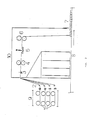
- Fig. 1 represents schematically one of the devices that may be used for realizing this new type of impermeabilizing membranes, in praticular of the bituminous type, for which one disposes a cooling system, while for other impermeabilizing materials there would be necessary a heating system.
- the illustrated device consists essentially of two continuous conveyor belts, marked by 4 and 5, respectively, and which are made of metal or of any material fit to endure continuous sudden thermal changes and from which the mix may be detached easily and it should not adhere to the belt Proceeding from left to right on Fig. 1: on the lower conveyor belt 4, cooled by devices not shown in the drawing, and carried by two big cylinders 3, the dispenser 1 deposits a continuous gauged layer of bituminous mix.
- the pair of calenders, or tapering device, 6 correct possible differences in thickness and bring the mix to the desired width.
- the continuous base filaments drop from the hood 2, described in more detail later on, and illustrated in Fig. 2, and deposit themselves on the first layer of bituminous mass and start to sink into the same.
- the product is practically completed and may now be cooled down, for instance, by means of a water bath, before being conveyed to the possible finishing stations for e. g. chalking, sandings (sand blastings), etc., whereafter it may be wound up.
- finished or end products are obtained by depositing an anti-adhesive layer, consisting, for instance, of a polyethylene film 7, on conveyor belt 4 and 5, or a layer of anti-adhesive powder on the mentioned conveyor belts, and so on.
- an anti-adhesive layer consisting, for instance, of a polyethylene film 7, on conveyor belt 4 and 5, or a layer of anti-adhesive powder on the mentioned conveyor belts, and so on.
- the deposition system for the continuous filaments contained in hood may be replaced with a cutting apparatus, wherefore it becomes possible to obtain cutup filaments (staples) arranged isotropically and with lengths up to 20 cm. A few modifications are possible to eventually further reduce the cutting length.
- the pair of conveyor belts 4 and 5 may be shortened in such a way that after the last calendering operation the membrane enters a cooling system made of multi-level cooling vats, thereby solving a lot of operational problems for the running of the machine.
- a further modification which would allow to eliminate possible conveyor belts or metal ribbons consists of substituting the lower conveyor belt 4 with a non-woven fabrik belt, in particular of glass fibres for its dimensional stability, on which the continuous filament mat will drop. Dispenser 1 will then spill directly upon the mat and on the non-woven fabrik ribbon the mix in a quantity metered in such a way that after the passage through the tapering calenders 6 there will be obtained the finished product in just the desired thickness. Thereupon the product is conveyed to cooling with water.
- Fig. 2 represents schematically the device for forming the continuous fibre mat, repeatedly mentioned before, supposing that the base filaments are wound on cops 1, arranged on creels 9. From there filaments 2, conveniently braked by means of known devices used for said purpose in the textile field, enter forming hood 10 where they meet a moving comb 3 which alternatively shifts their position under the dragging rollers 4. They then proceed to meet a tensioning device 5 and go on to the cutting or trimming device 6; in the latter the blade-carrying cylinder may be replaced by a bladeless cylinder.
- the filaments then drop onto conveyor belt 8, their speed being adjustable, but always greater than that of conveyor belt 8, they will form a mat 7, with a variable thickness or mass per surface unit.
- the material thus obtained shows a greater isotropism of the mechanical characteristics, in particular of the tensile resistance or strength measured on test pieces obtained transversally and longitudinally to the advancing motion of the machine.
- the quantity of reinforcing material, in particular of glass fibres, may be considerably increased with respect to that of the webs of the same material used usually.
- a 1-1.5 mm thick layer of a mix of 60% by weight of atactic polypropylene and of 40% by weight of oxidized bitumen was deposited, at a temperature of 190°C.
- a mat 3.5 mm thick formed of continuous glass filaments with a titre of 50 tex, consisting of elementary filaments with a diameter of 15u, and previously treated with a size consisting of components similar to those previously mentioned.
- the deposition of the filaments was carried out at an unwinding speed of about 0.63 m/sec, starting from 16 cops, while the conveyor belt advanced at a speed of 2 m/min.
- test pieces were taken, five in the longitudinal sense and 5 in the transversal sense, for each meter of development following a predetermined sampling plan. On these test pieces the following mean values for the tensile at break strength at room temperature, were ascertained: .
- an impermeabilizing membrane was prepared in which the mass of glass per surface unit was increased up to about 350 g m- 2 . After having sampled the same number of test pieces, from these the following tensile strength at break values were obtained:
- test piece 150 mm wide and 350 mm long was then fixed, so that at least 70 mm are left free and projecting beyond the rods which enclose said membrane test piece.
- the second pair of plates still with the rods facing the membrane, is fixed at 5 or 10 mm distance from the first one, parallel to it and engaging only 50 mm of the membrane.
- the first pair of plates is then fixed on a horizontal plane so that the membrane and the second pair of plates be free to move: at the one end of the second pair of plates, not engaged by the membrane, forces tending to lift said membrane were applied.
- the reference consists of an impermeabilizing membrane formed with the same type of mix but for a weave of a non-woven fabric of fibres of polyester resins of 120 g m - 2.
- Test pieces drawn from the same impermeabilizing membranes (defined type 1 and 2) were subjected to an aging period of 28 days in water kept at a temperature of 333°K, and subsequently submitted to a tensile stress.
- the influence of the glass surface in contact with the polymer of the impermeabilizing mass could be observed, and results from the following values which represent percentually the mechanical tensile characteristics in comparison with the untreated material.
Landscapes
- Engineering & Computer Science (AREA)
- Chemical & Material Sciences (AREA)
- Composite Materials (AREA)
- Mechanical Engineering (AREA)
- Robotics (AREA)
- Glass Compositions (AREA)
- Reinforced Plastic Materials (AREA)
Applications Claiming Priority (2)
| Application Number | Priority Date | Filing Date | Title |
|---|---|---|---|
| IT1963785 | 1985-02-25 | ||
| IT19637/85A IT1183418B (it) | 1985-02-25 | 1985-02-25 | Procedimento per la preparazione di membrane impermeabilizzanti con armatura in fili di vetro |
Publications (2)
| Publication Number | Publication Date |
|---|---|
| EP0193846A2 true EP0193846A2 (fr) | 1986-09-10 |
| EP0193846A3 EP0193846A3 (fr) | 1987-09-02 |
Family
ID=11159957
Family Applications (1)
| Application Number | Title | Priority Date | Filing Date |
|---|---|---|---|
| EP86102439A Withdrawn EP0193846A3 (fr) | 1985-02-25 | 1986-02-25 | Procédé pour la fabrication de membranes étanches pourvues d'une structure de renforcement en fibres de verre |
Country Status (2)
| Country | Link |
|---|---|
| EP (1) | EP0193846A3 (fr) |
| IT (1) | IT1183418B (fr) |
Cited By (3)
| Publication number | Priority date | Publication date | Assignee | Title |
|---|---|---|---|---|
| WO1996019337A1 (fr) * | 1994-12-22 | 1996-06-27 | Owens Corning | Incorporation d'asphalte dans des fibres de renfort |
| US5948196A (en) * | 1995-08-09 | 1999-09-07 | Owens Corning Fiberglas Technology, Inc. | Layered ceramic reinforcing fibers for use in composites |
| CN118721945A (zh) * | 2024-07-29 | 2024-10-01 | 云南欣城防水科技有限公司 | 无胎基防水材料生产装置 |
Family Cites Families (5)
| Publication number | Priority date | Publication date | Assignee | Title |
|---|---|---|---|---|
| US2771387A (en) * | 1951-11-21 | 1956-11-20 | Owens Corning Fiberglass Corp | Bituminous treated glass fiber structures and methods of producing them |
| US3231540A (en) * | 1962-08-17 | 1966-01-25 | Exxon Research Engineering Co | Polymeric sizes for siliceous fibrous materials and reinforced plastic compositions produced therefrom |
| DE2105955A1 (de) * | 1971-02-09 | 1972-08-17 | Bayer | Verfahren und Vorrichtung zum Herstellen von Hohlkörpern aus Reak tionsharzen, die mit Fasern verstärkt sind |
| US4220497A (en) * | 1979-02-01 | 1980-09-02 | Ppg Industries, Inc. | High strength composite of resin, helically wound fibers and swirled continuous fibers and method of its formation |
| JPS55108434A (en) * | 1979-02-12 | 1980-08-20 | Ppg Industries Inc | Emulsion composition and use for treatment of glass fiber |
-
1985
- 1985-02-25 IT IT19637/85A patent/IT1183418B/it active
-
1986
- 1986-02-25 EP EP86102439A patent/EP0193846A3/fr not_active Withdrawn
Cited By (4)
| Publication number | Priority date | Publication date | Assignee | Title |
|---|---|---|---|---|
| WO1996019337A1 (fr) * | 1994-12-22 | 1996-06-27 | Owens Corning | Incorporation d'asphalte dans des fibres de renfort |
| US5869413A (en) * | 1994-12-22 | 1999-02-09 | Gallagher; Kevin P. | Integration of asphalt and reinforcement fibers |
| US5948196A (en) * | 1995-08-09 | 1999-09-07 | Owens Corning Fiberglas Technology, Inc. | Layered ceramic reinforcing fibers for use in composites |
| CN118721945A (zh) * | 2024-07-29 | 2024-10-01 | 云南欣城防水科技有限公司 | 无胎基防水材料生产装置 |
Also Published As
| Publication number | Publication date |
|---|---|
| EP0193846A3 (fr) | 1987-09-02 |
| IT1183418B (it) | 1987-10-22 |
| IT8519637A0 (it) | 1985-02-25 |
Similar Documents
| Publication | Publication Date | Title |
|---|---|---|
| US7005024B2 (en) | Process and device for the manufacture of a composite material | |
| US5118550A (en) | Substrate based on a nonwoven sheet made of chemical textile | |
| US2477555A (en) | Mineral fiber mat and process of manufacture | |
| US5355567A (en) | Process for preparing engineered fiber blend | |
| US3276944A (en) | Non-woven sheet of synthetic organic polymeric filaments and method of preparing same | |
| US3442740A (en) | Process for producing a bonded non-woven sheet | |
| US2704734A (en) | Method for producing non-woven glass fabric | |
| US3639195A (en) | Bonded fibrous materials and method for making them | |
| US2794759A (en) | Method of making a resin impregnated fiber glass mat and product | |
| US7402268B2 (en) | Method for making a composite extruded profile formed with thermoplastic organic material reinforced with reinforcing fibres | |
| EP3727811B1 (fr) | Methode de fabrication d'une bande d'une pluralité de brins multifilaments continus gainés | |
| US5225237A (en) | Building sheets of cement material reinforced with plastics mesh and glass fibers | |
| US20020150752A1 (en) | Process for manufacturing a composite tape formed from reinforcing fibres and fibres of a thermoplastic organic material | |
| US4158557A (en) | Method and apparatus for forming fiber mat | |
| EP0465917B1 (fr) | Procédé et appareil pour fabriquer d'une manière continue des mattes renforcées de faisceaux de fibres de verres | |
| US5667882A (en) | Textile reinforcement which can be used for producing composite materials | |
| NO801811L (no) | Fremgangsmaate og apparat for fremstilling av bjelker, plater eller lignende gjenstander av armert betong | |
| RU2345183C1 (ru) | Способ изготовления нетканого иглопробивного материала | |
| EP0193846A2 (fr) | Procédé pour la fabrication de membranes étanches pourvues d'une structure de renforcement en fibres de verre | |
| KR19980702060A (ko) | 유리 매트의 제조방법 및 생성된 제품 | |
| US2794238A (en) | Fiber glass mat | |
| US4518658A (en) | Waterproof membrane with fuse bonded non-woven reinforcement | |
| US2931421A (en) | Apparatus for the production of a thin sheet or mat from glass fibres | |
| US20050118390A1 (en) | Continuous strand mats, methods of producing continuous strand mats, and systems for producing continuous strand mats | |
| CN114007842B (zh) | 生产纤维增强带材的方法 |
Legal Events
| Date | Code | Title | Description |
|---|---|---|---|
| PUAI | Public reference made under article 153(3) epc to a published international application that has entered the european phase |
Free format text: ORIGINAL CODE: 0009012 |
|
| AK | Designated contracting states |
Kind code of ref document: A2 Designated state(s): AT BE CH DE FR GB LI NL SE |
|
| PUAL | Search report despatched |
Free format text: ORIGINAL CODE: 0009013 |
|
| AK | Designated contracting states |
Kind code of ref document: A3 Designated state(s): AT BE CH DE FR GB LI NL SE |
|
| 17P | Request for examination filed |
Effective date: 19880121 |
|
| 17Q | First examination report despatched |
Effective date: 19881212 |
|
| STAA | Information on the status of an ep patent application or granted ep patent |
Free format text: STATUS: THE APPLICATION IS DEEMED TO BE WITHDRAWN |
|
| 18D | Application deemed to be withdrawn |
Effective date: 19890425 |
|
| RIN1 | Information on inventor provided before grant (corrected) |
Inventor name: TETTAMANZI, NATALE |