EP0194449A2 - Procédé de préparation de solutions aqueuses de sulfocyanures d'ammonium - Google Patents
Procédé de préparation de solutions aqueuses de sulfocyanures d'ammonium Download PDFInfo
- Publication number
- EP0194449A2 EP0194449A2 EP86101580A EP86101580A EP0194449A2 EP 0194449 A2 EP0194449 A2 EP 0194449A2 EP 86101580 A EP86101580 A EP 86101580A EP 86101580 A EP86101580 A EP 86101580A EP 0194449 A2 EP0194449 A2 EP 0194449A2
- Authority
- EP
- European Patent Office
- Prior art keywords
- ammonia
- reaction
- carbon disulfide
- ammonium rhodanide
- ammonium
- Prior art date
- Legal status (The legal status is an assumption and is not a legal conclusion. Google has not performed a legal analysis and makes no representation as to the accuracy of the status listed.)
- Granted
Links
Images

Classifications
-
- C—CHEMISTRY; METALLURGY
- C01—INORGANIC CHEMISTRY
- C01C—AMMONIA; CYANOGEN; COMPOUNDS THEREOF
- C01C3/00—Cyanogen; Compounds thereof
- C01C3/20—Thiocyanic acid; Salts thereof
Definitions
- the invention relates to a process for the continuous production of aqueous ammonium rhodanide solutions by reacting ammonia and carbon disulfide in the presence of water using activated carbon as a catalyst.
- R hodanides in the form of their alkali or ammonium salts are not only chemicals frequently used in the chemical laboratory, but are also of considerable importance in other technical fields. For example, with the N ouverspinnung polyacrylonitrile often an aqueous thiocyanate solution used as coagulation bath. Rhodanides can also be used to prepare polyacrylonitrile solutions. High purity requirements are imposed on the rhodanides used for this.
- rhodanides Some known processes for the production of rhodanides are that an aqueous solution of ammonium rhodanide is first prepared. This can then be further processed in a known manner to give solid ammonium rhodanide or can be reacted with the hydroxide of an alkali metal to form alkali metal rhodanide.
- US Pat. No. 2,850,356 describes the reaction of ammonia and carbon disulfide in a reactor which consists of three zones and is provided with a filling, for example Raschig rings. Even if this patent specification mentions that processes for the conversion of ammonia and carbon disulphide are known which work under pressure, so will Working under normal pressure is recommended for this procedure, if necessary under slightly increased pressure up to about 1.7 bar. The reaction is carried out in such a way that temperatures of 35, 55 and 80 ° C. are established in the three stages (zones). The process works without a catalyst.
- DE-AS 1 297 088 describes a process in which activated carbon is used as a catalyst. Here too, implementation is carried out in three stages.
- DE-AS 1 592 341 which represents a further development of the process described in DE-AS 1 297 038, describes the reaction with gaseous carbon disulfide at temperatures of 70 to 90 ° C.
- Another object of the invention was to provide a method that is as simple as possible to handle continuously have and works with less energy than is the case with the previously known methods.
- This object is achieved by a process for the continuous production of aqueous ammonium rhodanide solutions by reacting ammonia and carbon disulfide in the presence of water or aqueous ammonium rhodanide solutions using activated carbon as a catalyst, which is characterized in that the reaction of ammonia and carbon disulfide and the decomposition occurring Intermediates carried out at a temperature of 90 to 150 ° C and at a pressure in the range between 2 and 7 bar. Gaseous carbon disulfide is preferably used for the reaction.
- the reaction of ammonia and carbon disulphide and the decomposition of the intermediates is carried out at a temperature between 110 and 120 ° C.
- a pressure range from 5 to 5.5 bar is particularly preferred. It is advantageous to decompose the intermediate products formed during the reaction in situ.
- the reaction of ammonia and carbon disulfide and the decomposition of the intermediates can be carried out in a zone, the temperature and pressure in the zone being advantageously maintained during the reaction and the decomposition and the reaction zone being extended to the entire catalyst bed. It is particularly advantageous if the heat released in the reaction of ammonia and carbon disulfide is used to decompose the intermediate products formed.
- the resulting ammonium rhodanide solution can be drawn off continuously and let down to atmospheric pressure, the gases escaping can be dissolved in water and returned to the reaction.
- the resulting ammonium rhodanide solution can also be drawn off continuously and at normal pressure are relaxed, the escaping gases being compressed and fed back to the reaction.
- aqueous ammonium rhodanide solution is circulated and passed through a heat exchanger to remove heat of reaction.
- a packed bed reactor with recycle of the ammonium rhodanide solution is used to convert carbon disulfide and ammonia.
- Ammonia can be metered into the reaction vessel in liquid form.
- Ammonia can also be metered into the reaction vessel in gaseous form.
- liquid or gaseous ammonia is metered into the ammonium rhodanide circuit.
- Ammonia or an aqueous ammonia solution containing ammonium rhodanide can be metered into the reaction vessel in countercurrent with carbon disulphide.
- Ammonia or an aqueous solution containing ammonium rhodanide can also be metered into the reaction vessel in cocurrent with carbon disulphide.
- the amount of water used is preferably such that the resulting aqueous ammonium rhodanide solution contains 40 to 50% by weight of ammonium rhodanide.
- the process according to the invention thus consists in continuously adding carbon disulphide, ammonia and water to a suitable reactor which contains the desired amount of activated carbon and continuously withdrawing the ammonium rhodanide solution formed during the reaction.
- Ammonia and carbon disulfide are preferably brought to the pressure and temperature in the reactor before they are fed into the reactor.
- the carbon disulfide is preferably evaporated completely before metering.
- Ammonia can be dosed in liquid or gaseous form.
- gaseous carbon disulfide means that the carbon disulphide in the reactor has a partial pressure below which carbon disulphide is gaseous.
- the vapor pressure values of carbon disulfide depending on the temperature are e.g. reproduced in Ullmann's Encyclopedia of Technical Chemistry 4th edition, Verlag Chemie Weinheim, Volume 21, page 87 ff.
- Constant temperature and pressure in the sense of the invention as they are maintained in a particularly advantageous embodiment of the process according to the invention, means that balanced (homogeneous) pressure and temperature conditions are present in the reactor zone, with normal fluctuations caused by apparatus and control technology being tolerated, of course .
- Zone in the sense of the invention is a spatial section in a reactor in which a certain process takes place under essentially constant conditions.
- the reactor shown in DE-AS 1 297 088 is divided into three zones in the form of a reaction tube, namely into zone c, in which the reaction between ammonia and carbon disulfide takes place in a first stage, into zone b, which is used to feed ammonia and carbon disulfide and into zone a, where the decomposition of dithiocarbamate and trithiocarbonate takes place.
- Zone c should be filled with activated carbon to catalyze the reaction of ammonia and carbon disulphide.
- the required starting materials can be metered into a zone b through one or more metering lines 18.
- zone a the decomposition of ammonium thiocarbanate and ammonium trithiocarbonate can be carried out.
- the line 19 serves to discharge the ammonium rhodanide solution formed.
- the exhaust gases such as hydrogen sulfide and unreacted carbon disulfide etc. are discharged through line 20.
- the first (exothermic) step of the reaction is an addition of a molecule of ammonia to a molecule of carbon disulfide, ammonium dithiocarbamate being formed with another molecule of ammonia.
- the ammonium dithiocarbamate is decomposed to ammonium rhodanide and hydrogen sulfide.
- ammonium trithiocarbonate is formed from ammonia, carbon disulfide and hydrogen sulfide and decomposed in situ at the specified temperatures to form ammonium rhodanide and hydrogen sulfide.
- the hydrogen sulfide is drawn off at the end of the catalyst bed and can be fed to a Claus plant. Since such a system normally also works under increased pressure, compression or expansion of the hydrogen sulfide drawn off can be omitted.
- the hydrogen sulfide drawn off from the reactor then also contains some carbon disulfide and some water.
- the water fed to the reactor should be free of oxygen in order to prevent the hydrogen sulfide formed from being partially oxidized to sulfur, which would be deposited on the catalyst.
- the primary purpose of using water in the reaction is to remove the ammonium rhodanide formed as a solution from the surface of the activated carbon and from the reactor.
- the continuously drawn off ammonium rhodanide solution is depressurized to normal pressure, and the gases escaping are dissolved in water and returned to the reaction.
- These gases consist of small amounts of hydrogen sulfide and ammonia. In this way, complete conversion of the ammonia used is achieved. It was surprisingly found that even when using pressures of 2-7 bar during the reaction, the ammonium rhodanide solution formed contained only relatively small amounts of dissolved H 2 S and NH 2 .
- the total amount of these gases for example at 5.5 bar, was a maximum of 1% by weight, based on the weight of the solution. This amount can be removed quantitatively by relaxing to normal pressure.
- the liberated gases A mmoniumrhodanidates can be further processed in a desired manner, for example to Alkalimetallrhodanid or solid ammonium thiocyanate.
- the reaction is carried out at a pressure in the range between 2 and 7 bar, that is to say a pressure higher than normal pressure (which is approximately 1 bar).
- a pressure higher than normal pressure which is approximately 1 bar.
- Applying a higher pressure provides advantages over a process performed at normal pressure, which are described below. These advantages are already available at only relatively low overpressure values, e.g. to achieve already at a pressure of 2 bar; however, they are more pronounced at pressures of about 3 bar and more.
- very high pressures on the other hand, no significant improvement can be achieved, so that i.a. economic reasons speak against the use of very high pressures. It has proven particularly favorable to carry out the process according to the invention at a pressure in the range from 5 to 5.5 bar.
- the use of increased pressure during the reaction not only leads to faster adsorption and increased loading of the catalyst, but also enables the reaction temperatures to be set higher than can be used in a process with activated carbon under normal pressure. If you work under normal pressure, the upper temperature limit is; which is expediently not exceeded for the first reaction step of the addition of ammonia to carbon disulfide in the upper reactor region at about 90 ° C. When using higher pressures, on the other hand, the temperature can be raised to 100 ° C. and more without a decrease in the space-time yield.
- the higher temperature leads to an increase in the rate of addition of ammonia to carbon disulfide.
- Setting a higher temperature for the addition step brings yet another advantage: Since higher temperatures are desirable for the (endothermic) decomposition of ammonium dithiocarbamate than for the addition of NH 3 to CS 2 , uniform temperatures can be maintained throughout the reactor . It is then not necessary to subdivide the reactor into different temperature zones. This division into several zones is common in the process with normal pressure, since the reaction step of adding NH 3 to CS 2 is carried out at a lower temperature than the decomposition of the ammonium dithiocarbamate.
- a preferred embodiment of the process according to the invention is characterized in that the reaction is carried out at temperatures between 100 ° C and 130 ° C.
- the lower limit of 100 ° C results from this version form from the mentioned fact that above this temperature the ammonium dithiocarbamate formed in the first step decomposes quantitatively to ammonium rhodanide in a short time.
- the upper limit of 130 ° C is expediently observed because above this temperature, side reactions were increasingly observed.
- inventive method when it is carried out at a temperature ranging from 110 ° C to 120 ° C, A mmoniumrhodanid a purity of at least 99.7% was obtained.
- a preferred embodiment of the method thus consists in carrying out the reaction at a temperature in the range between 110 ° C. and 120 ° C.
- the first step of the reaction the addition of ammonia to carbon disulphide, is exothermic and the second step, which leads to rhodanide, is endothermic, is advantageously used the heat released in the first step to decompose the ammonium dithiocarbamate.
- Working in a one-step process in which the reactor has a uniform temperature, thus makes it possible to work without complex external devices in order to achieve different reaction temperatures.
- the operating temperature is maintained by the heat generated in the system itself. This enables the use of a relatively inexpensive packed bed reactor.
- a preferred embodiment of the method according to the invention consists in dissipating the heat generated by an ammonium rhodanide circuit with heat exchangers.
- the excess heat largely results from the heat of solution of gaseous ammonia in the reaction solution and can be removed particularly easily if gaseous ammonia is already metered into the ammonium rhodanide circuit outside the reactor.
- the carbon disulphide is partly in liquid or gaseous form in the reactor.
- the process is preferably carried out under conditions in which the carbon disulfide is in gaseous form.
- Pressure and temperature must be selected so that the water present in the reactor is in the liquid state and a solution of ammonium rhodanide can be formed.
- the activated carbon used as a catalyst is preferably used in granular form.
- An active carbon suitable for the process according to the invention is, inter alia, the product Supersorbon K (manufacturer: Lurgigro und Chemotechnik GmbH), grain size 4 mm, vibrating density 400 kg / m 3 , BET surface area 1200 m 2 / g.
- the starting components, carbon disulphide and ammonia or ammoniacal ammonium thiocyanate in cocurrent and countercurrent to the K ataly- be supplied sator bed.
- a preferred embodiment of the method according to the invention consists in supplying ammonia and gaseous carbon disulfide dissolved in the above-mentioned circulation stream in cocurrent to the catalyst bed from above and passing the exhaust gas, hydrogen sulfide, after the catalyst layer with a riser pipe through a cooler.
- the reactor diameter of a technical plant can be chosen to be relatively small, with the advantage of a significant cost saving for one of the pressure reactors mentioned above.
- the gas and F are lüsstechniks Kunststoffen by the flooding point is limited with the consequence of a necessary larger reactor diameter.
- the amount of water continuously metered in for the exhaust gas cooler and the residual gas absorption is such that the resulting ammonium rhodanide solution contains 40 to 50% by weight of ammonium rhodanide. At lower concentrations of rhodanide, the further processing to solid product is more expensive.
- the gases escaping when the aqueous ammonium rhodanide solution is depressurized to normal pressure can also be compressed and thus returned to the reaction.
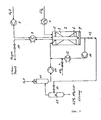
- FIG. 2 shows a simplified schematic representation of a device in which this process variant takes place.
- Carbon disulfide is fed to the reaction vessel 2 above the catalyst bed layer 3 after an evaporator 1 at reaction pressure.
- Ammonia is released to the reaction pressure with valve 4, dissolved in an ammonium rhodanide circuit and added to the catalyst layer with a distributor ring 5.
- the exhaust gas formed, hydrogen sulfide is fed to a cooler 7 in a riser pipe 6, cooled and washed out with ammonia and by-products.
- the oxygen-free water required for this is metered with a pump 8 into the exhaust gas cooler and then duxch the riser pipe into the bottom of the reactor 9.
- the exhaust gas can be fed to a Claus process for reprocessing at reaction pressure via valve 10.
- ammonium rhodanide solution formed is circulated with the pump 11 and heat exchanger 12 to remove the heat of reaction.
- the fill level of the reactor sump 9 is regulated with valve 13.
- the ammonium rhodanide solution is completely degassed with ammonia and hydrogen sulfide by expansion to atmospheric pressure with valve 14.
- the cleaned ammonium rhodanide solution can be removed from the degaser 15.
- the degaser exhaust gas is dissolved in water in an absorber and fed to the ammonium rhodanide circuit with a pump 17.
- This reaction procedure advantageously requires only 1 reactor zone, which is very easy to handle in terms of process and control technology.
- V to the invention allows to know both the reaction of carbon disulfide and ammonia as well as the decomposition of the resulting intermediates at the same place to carry out that in a zone in which it substantially constant temperature and constant pressure maintains.
- the method according to the invention can therefore be carried out very easily and brings considerable savings in energy costs, since the heat released during the implementation can be used immediately to decompose the intermediate products formed. The purity of the resulting products is further improved, and yield increases are achieved.
- a thermostattable glass autoclave 2 with an inner diameter of 81 mm and a length of 480 mm is filled with 611 g of granular activated carbon Supersorbon K (grain size approx. 4 mm).
- the entire system is flushed with an oxygen-free inert gas and oxygen-free water is metered into the bottom of the reactor 9 via the pump 8.
- the glass autoclave must be heated to the reaction temperature of 115 ° C with a heat transfer oil for the low conversions on a laboratory scale.
- the resulting heat of reaction is so well removed by radiation in the case of the laboratory system that a separate heat exchanger 12 can be dispensed with.
- the desired pressure is set with inert gas and the cycle is set at 80 1 h.
- the following material flows are metered in:
- ammonium rhodanide solution is withdrawn from the degaser 15 in accordance with the selected amount of water.
Landscapes
- Chemical & Material Sciences (AREA)
- Organic Chemistry (AREA)
- Inorganic Chemistry (AREA)
- Organic Low-Molecular-Weight Compounds And Preparation Thereof (AREA)
- Catalysts (AREA)
- Low-Molecular Organic Synthesis Reactions Using Catalysts (AREA)
- Detergent Compositions (AREA)
Priority Applications (1)
| Application Number | Priority Date | Filing Date | Title |
|---|---|---|---|
| AT86101580T ATE42732T1 (de) | 1985-03-08 | 1986-02-07 | Verfahren zur herstellung waessriger ammoniumrhodanidloesungen. |
Applications Claiming Priority (2)
| Application Number | Priority Date | Filing Date | Title |
|---|---|---|---|
| DE19853508404 DE3508404A1 (de) | 1985-03-08 | 1985-03-08 | Verfahren zur herstellung waessriger ammoniumrhodanidloesungen |
| DE3508404 | 1985-03-08 |
Publications (3)
| Publication Number | Publication Date |
|---|---|
| EP0194449A2 true EP0194449A2 (fr) | 1986-09-17 |
| EP0194449A3 EP0194449A3 (en) | 1987-08-19 |
| EP0194449B1 EP0194449B1 (fr) | 1989-05-03 |
Family
ID=6264685
Family Applications (1)
| Application Number | Title | Priority Date | Filing Date |
|---|---|---|---|
| EP86101580A Expired EP0194449B1 (fr) | 1985-03-08 | 1986-02-07 | Procédé de préparation de solutions aqueuses de sulfocyanures d'ammonium |
Country Status (8)
| Country | Link |
|---|---|
| US (1) | US5026534A (fr) |
| EP (1) | EP0194449B1 (fr) |
| JP (1) | JPH0676210B2 (fr) |
| AT (1) | ATE42732T1 (fr) |
| CA (1) | CA1329316C (fr) |
| DE (2) | DE3508404A1 (fr) |
| ES (1) | ES8706094A1 (fr) |
| ZA (1) | ZA861729B (fr) |
Families Citing this family (1)
| Publication number | Priority date | Publication date | Assignee | Title |
|---|---|---|---|---|
| CN115180636B (zh) * | 2022-07-22 | 2023-06-06 | 河北北方学院 | 一种提高CuSCN可见光吸收范围的方法 |
Family Cites Families (8)
| Publication number | Priority date | Publication date | Assignee | Title |
|---|---|---|---|---|
| US2286273A (en) * | 1939-08-25 | 1942-06-16 | American Cyanamid Co | Production of ammonium thiocyanate |
| US2249962A (en) * | 1940-01-27 | 1941-07-22 | American Cyanamid Co | Preparation of ammonium thiocyanate |
| FR905943A (fr) * | 1942-11-19 | 1945-12-18 | Ig Farbenindustrie Ag | Procédé de préparation du thio-cyanate d'ammonium |
| US2850356A (en) * | 1956-07-23 | 1958-09-02 | American Cyanamid Co | Ammonium thiocyanate manufacture |
| US3615177A (en) * | 1967-10-21 | 1971-10-26 | Glanzstoff Ag | Production of aqueous ammonium thiocyanate solutions and thiocyanate compounds |
| DE1592339B2 (de) * | 1967-10-21 | 1975-08-21 | Enka Glanzstoff Ag, 5600 Wuppertal | Verfahren zur kontinuierlichen Herstellung wäßriger Lösungen von Rhodaniden der Alkalimetalle sowie von Calcium, Strontium und Barium |
| JPS49121800A (fr) * | 1973-03-22 | 1974-11-21 | ||
| DE2362923C3 (de) * | 1973-12-18 | 1981-04-30 | Dr. Jacob, Chemische Fabrik Kg, 6550 Bad Kreuznach | Verfahren zur Herstellung von Ammoniumrhodanid |
-
1985
- 1985-03-08 DE DE19853508404 patent/DE3508404A1/de active Granted
-
1986
- 1986-02-07 AT AT86101580T patent/ATE42732T1/de not_active IP Right Cessation
- 1986-02-07 EP EP86101580A patent/EP0194449B1/fr not_active Expired
- 1986-02-07 DE DE8686101580T patent/DE3663131D1/de not_active Expired
- 1986-03-06 JP JP61047479A patent/JPH0676210B2/ja not_active Expired - Lifetime
- 1986-03-07 ES ES552766A patent/ES8706094A1/es not_active Expired
- 1986-03-07 CA CA000503577A patent/CA1329316C/fr not_active Expired - Fee Related
- 1986-03-07 ZA ZA861729A patent/ZA861729B/xx unknown
-
1990
- 1990-04-20 US US07/512,497 patent/US5026534A/en not_active Expired - Fee Related
Also Published As
| Publication number | Publication date |
|---|---|
| JPS61205616A (ja) | 1986-09-11 |
| ZA861729B (en) | 1986-10-29 |
| JPH0676210B2 (ja) | 1994-09-28 |
| DE3663131D1 (en) | 1989-06-08 |
| DE3508404C2 (fr) | 1988-09-08 |
| EP0194449B1 (fr) | 1989-05-03 |
| DE3508404A1 (de) | 1986-09-18 |
| US5026534A (en) | 1991-06-25 |
| ES552766A0 (es) | 1987-06-01 |
| ATE42732T1 (de) | 1989-05-15 |
| EP0194449A3 (en) | 1987-08-19 |
| ES8706094A1 (es) | 1987-06-01 |
| CA1329316C (fr) | 1994-05-10 |
Similar Documents
| Publication | Publication Date | Title |
|---|---|---|
| DE2656803C2 (de) | Verfahren zur Entfernung von in einem Gas oder in einer Flüssigkeit vorhandenem Quecksilber | |
| DE2748643A1 (de) | Verfahren zur oxidation von schwefel und schwefelverbindungen | |
| DE2166779A1 (de) | Verfahren zur herstellung eines hydrierungskatalysators hoher druckfestigkeit | |
| DE2522501A1 (de) | Verfahren zum herstellen von natriumbicarbonat aus dem ablauf der chlor-alkali elektrolysezelle und vorrichtung hierfuer | |
| CH634553A5 (de) | Verfahren zur herstellung von harnstoff. | |
| CH631956A5 (de) | Verfahren zur herstellung von 2,5-dichlorphenol. | |
| DE2529654A1 (de) | Verfahren zur herstellung von dimethylsulfoxid | |
| DE69314021T2 (de) | Verfahren mit hohem nutzeffekt zur herstellung von cyclohexanol und cyclohexanon | |
| DE3435299C2 (fr) | ||
| DE1070170B (de) | Verfahren zur Herstellung von ungesättigten Nitrilen | |
| EP0194449B1 (fr) | Procédé de préparation de solutions aqueuses de sulfocyanures d'ammonium | |
| DE2642458B2 (de) | Verfahren zur Gewinnung von kristallinem Acrylamid | |
| DE69015152T2 (de) | Verfahren zur Herstellung von Chlordioxyd. | |
| DE2455678B2 (de) | Verfahren zur Herstellung von Tetramethyläthylendiamin | |
| DE2706182C3 (de) | Katalysatorbett für die Verwendung bei der Oxidation von Ammoniakgas | |
| DE3788575T2 (de) | Verfahren zum Anlassen und Abstellen eines Acrylamidreaktors. | |
| DE2136744C3 (de) | Verfahren zur Herstellung von Cyclohexylhydroperoxid enthaltenden Oxidationsprodukten | |
| DE3122285A1 (de) | Verfahren zur herstellung von 2-mercaptoaethanol | |
| DE2364095C3 (de) | Verfahren zur technischen Herstellung von 1,2-Dichloräthan | |
| DE2362923C3 (de) | Verfahren zur Herstellung von Ammoniumrhodanid | |
| DD266083A5 (de) | Verfahren zur herstellung von chlor | |
| EP0021073B1 (fr) | Catalyseur au cobalt, sa préparation et son utilisation, en particulier pour la production d'amines | |
| DE2326285A1 (de) | Verfahren zur herstellung von schwefelwasserstoff | |
| DE2646129C3 (de) | Verfahren und Vorrichtung zur Herstellung von Vinylchlorid | |
| DE2813520C2 (fr) |
Legal Events
| Date | Code | Title | Description |
|---|---|---|---|
| PUAI | Public reference made under article 153(3) epc to a published international application that has entered the european phase |
Free format text: ORIGINAL CODE: 0009012 |
|
| AK | Designated contracting states |
Kind code of ref document: A2 Designated state(s): AT BE DE FR GB IT NL |
|
| PUAL | Search report despatched |
Free format text: ORIGINAL CODE: 0009013 |
|
| AK | Designated contracting states |
Kind code of ref document: A3 Designated state(s): AT BE DE FR GB IT NL |
|
| 17P | Request for examination filed |
Effective date: 19870706 |
|
| RAP1 | Party data changed (applicant data changed or rights of an application transferred) |
Owner name: AKZO PATENTE GMBH |
|
| 17Q | First examination report despatched |
Effective date: 19881017 |
|
| ITF | It: translation for a ep patent filed | ||
| GRAA | (expected) grant |
Free format text: ORIGINAL CODE: 0009210 |
|
| AK | Designated contracting states |
Kind code of ref document: B1 Designated state(s): AT BE DE FR GB IT NL |
|
| REF | Corresponds to: |
Ref document number: 42732 Country of ref document: AT Date of ref document: 19890515 Kind code of ref document: T |
|
| GBT | Gb: translation of ep patent filed (gb section 77(6)(a)/1977) | ||
| REF | Corresponds to: |
Ref document number: 3663131 Country of ref document: DE Date of ref document: 19890608 |
|
| ET | Fr: translation filed | ||
| PLBE | No opposition filed within time limit |
Free format text: ORIGINAL CODE: 0009261 |
|
| STAA | Information on the status of an ep patent application or granted ep patent |
Free format text: STATUS: NO OPPOSITION FILED WITHIN TIME LIMIT |
|
| 26N | No opposition filed | ||
| ITTA | It: last paid annual fee | ||
| PGFP | Annual fee paid to national office [announced via postgrant information from national office to epo] |
Ref country code: FR Payment date: 19981223 Year of fee payment: 14 |
|
| PGFP | Annual fee paid to national office [announced via postgrant information from national office to epo] |
Ref country code: GB Payment date: 19981229 Year of fee payment: 14 |
|
| PGFP | Annual fee paid to national office [announced via postgrant information from national office to epo] |
Ref country code: BE Payment date: 19990104 Year of fee payment: 14 |
|
| PGFP | Annual fee paid to national office [announced via postgrant information from national office to epo] |
Ref country code: DE Payment date: 19990108 Year of fee payment: 14 |
|
| PGFP | Annual fee paid to national office [announced via postgrant information from national office to epo] |
Ref country code: AT Payment date: 19990218 Year of fee payment: 14 |
|
| PGFP | Annual fee paid to national office [announced via postgrant information from national office to epo] |
Ref country code: NL Payment date: 19990228 Year of fee payment: 14 |
|
| PG25 | Lapsed in a contracting state [announced via postgrant information from national office to epo] |
Ref country code: GB Free format text: LAPSE BECAUSE OF NON-PAYMENT OF DUE FEES Effective date: 20000207 Ref country code: AT Free format text: LAPSE BECAUSE OF NON-PAYMENT OF DUE FEES Effective date: 20000207 |
|
| PG25 | Lapsed in a contracting state [announced via postgrant information from national office to epo] |
Ref country code: BE Free format text: LAPSE BECAUSE OF NON-PAYMENT OF DUE FEES Effective date: 20000228 |
|
| BERE | Be: lapsed |
Owner name: AKZO PATENTE G.M.B.H. Effective date: 20000228 |
|
| PG25 | Lapsed in a contracting state [announced via postgrant information from national office to epo] |
Ref country code: NL Free format text: LAPSE BECAUSE OF NON-PAYMENT OF DUE FEES Effective date: 20000901 |
|
| GBPC | Gb: european patent ceased through non-payment of renewal fee |
Effective date: 20000207 |
|
| PG25 | Lapsed in a contracting state [announced via postgrant information from national office to epo] |
Ref country code: FR Free format text: LAPSE BECAUSE OF NON-PAYMENT OF DUE FEES Effective date: 20001031 |
|
| NLV4 | Nl: lapsed or anulled due to non-payment of the annual fee |
Effective date: 20000901 |
|
| PG25 | Lapsed in a contracting state [announced via postgrant information from national office to epo] |
Ref country code: DE Free format text: LAPSE BECAUSE OF NON-PAYMENT OF DUE FEES Effective date: 20001201 |
|
| REG | Reference to a national code |
Ref country code: FR Ref legal event code: ST |
|
| PG25 | Lapsed in a contracting state [announced via postgrant information from national office to epo] |
Ref country code: IT Free format text: LAPSE BECAUSE OF NON-PAYMENT OF DUE FEES;WARNING: LAPSES OF ITALIAN PATENTS WITH EFFECTIVE DATE BEFORE 2007 MAY HAVE OCCURRED AT ANY TIME BEFORE 2007. THE CORRECT EFFECTIVE DATE MAY BE DIFFERENT FROM THE ONE RECORDED. Effective date: 20050207 |