EP0196044A2 - Système d'entrée d'images - Google Patents
Système d'entrée d'images Download PDFInfo
- Publication number
- EP0196044A2 EP0196044A2 EP86104004A EP86104004A EP0196044A2 EP 0196044 A2 EP0196044 A2 EP 0196044A2 EP 86104004 A EP86104004 A EP 86104004A EP 86104004 A EP86104004 A EP 86104004A EP 0196044 A2 EP0196044 A2 EP 0196044A2
- Authority
- EP
- European Patent Office
- Prior art keywords
- values
- image
- bit digital
- digital signals
- transformation
- Prior art date
- Legal status (The legal status is an assumption and is not a legal conclusion. Google has not performed a legal analysis and makes no representation as to the accuracy of the status listed.)
- Withdrawn
Links
Images



Classifications
-
- H—ELECTRICITY
- H04—ELECTRIC COMMUNICATION TECHNIQUE
- H04N—PICTORIAL COMMUNICATION, e.g. TELEVISION
- H04N1/00—Scanning, transmission or reproduction of documents or the like, e.g. facsimile transmission; Details thereof
- H04N1/40—Picture signal circuits
- H04N1/407—Control or modification of tonal gradation or of extreme levels, e.g. background level
Definitions
- the present invention relates to an image input system, and more particularly to an image input system which optically reads an image of an object and converts the same into digital signals to be supplied to an image processing system.
- an image is generally photoelectrically read by a photoelectric converter such as a photomultiplier, an optical diode or a charge coupled device (CCD).
- a photoelectric converter such as a photomultiplier, an optical diode or a charge coupled device (CCD).
- CCD charge coupled device
- the analog output signals from the photoelectric converter have generally been logarithmically transformed by means such as an analog operational amplifier to obtain output signals which are in linear relation to the optical density of the original image, in order to simplify the processing in the image processing system and improve gradation reproducibility.
- a circuit employing such an analog operational amplifier is relatively simple in construction, because it can be formed by one operational amplifier and a diode when an operational amplifier (so-called LOG amplifier) performing the said logarithmic transformation is utilized.
- an analog operational amplifier formed by a semiconductor integrated circuit is inferior in frequency response and is not appropriate to high-speed processing. Further, the characteristics of the operational amplifier are generally unstable by temperature drift etc., and hence the gradation cannot be correctly reproduced. In addition, such a circuit employing the analog element cannot be easily adjusted, leading to inferior productivity.
- the present invention aims to provide an improved image input system which photoelectrically reads the image of an object to supply signals representing the image to an image processing system.
- the present invention provides an image input system for photoelectrically reading the image of an object and supplying electric signals representing the image to an image processing system
- image input system comprises: photoelectric conversion means for photoelectrically reading the image to convert the image into electric analog signals analog-to-digital converter means for converting the analog signals into N-bit digital signals; and digital data transformation means for transforming the N-bit digital signals into M-bit digital signals indicating values in a prescribed linear relation to the optical density of the image and delivering the M-bit digital signals to the image processing system, N and M being integers satisfying N>M.
- the image read by the photoelectric conversion means is thus converted into N-bit digital signals, which in turn are transformed to M-bit signals by the digital data transformation means.
- the N-bit digital signals are nonlinear with respect to the optical density of the image being input, while the M-bit digital signals are linear with respect to the optical density of the original image. Since such transformation is performed between digital signals, high speed processing and stable transformation characteristics are obtained.
- Such an image input system further comprises a transformation characteristic specifying means for inputting linear relation specifying data for selecting a desired linear relation to supply transformation characteristics corresponding to the desired linear relation to the digital transformation means.
- an optimum linear relation is selected in response to the optical density range of the image being input and the N-bit digital signals are transformed into the M-bit digital signals in the optimum linear relation to the optical density.
- the present invention thus enables the provision of an image input system having stable and highly improved gradation reproductibility, and which can perform high-speed processing with excellent productivity.
- Fig. 1 shows the structure of an image input system according to a first embodiment of the present invention.
- reading light is emitted from a reflection light source 2a or a transmission light source 2b on an original 1-to be inputted, which is recorded with an image having gradation.
- the light reflected by or transmitted through the original 1 is incident upon a photoelectric converter 3 included in the image input system through a well-known optical system (not shown).
- the image is sequentially inputted along the scanning direction of a well-known scanning mechanism (not shown) per fine pixel of the original 1.
- N integer
- the photoelectric converter 3 and the A-D converter 4 are coupled to be hereinafter referred to as an "input/conversion section 5".
- the N-bit digital signals outputted from the input/conversion section 5 serve as address signals for a semiconductor memory 6 provided in a subsequent stage.
- the M-bit digital signals corresponding to the M-bit digital data are outputted from addresses designated by the inputted N-bit, digital signals, to be supplied to an image processing system 7.
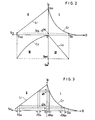
- the first quadrant I shows relation between the optical density D of the inputted image and outputs I from the photoelectric converter 3.
- This functional form is depicted by symbol C 1 in Fig. 2.
- the second quadrant II in Fig. 2 shows the relation between outputs I D from the photoelectric converter 3 and outputs S N from the A-D converter 4, i.e.,the input/output characteristics of the A-D converter 4.
- the outputs S N are supplied as the N-bit digital signals, as hereinabove described. It is well known in the art that A-D conversion characteristics of the A-D converter 4 are substantially linear, and can be expressed by a straight line L 1 as shown in Fig. 2.
- the functional form of the straight line L can be obtained from the following conditions, assuming that S NO represents the output value S N corresponding to the aforementioned maximum value D 0 :
- the N-bit digital signals after the A-D conversion are also nonlinear with respect to the optical density D.
- a digital data transformation means (memory 6) is provided in order that the gradation reproductibility in the input/conversion section 5 may be obtained by performing processing with relatively large data length and that the image processing system 7 may perform processing with smaller data length while maintaining the good reproductibility.
- the memory 6 serving as the digital data transformation means is adapted to transform the N-bit digital signals received in the same into M-bit digital signals (N>M) indicating values S M in a prescribed linear relation to the optical density D, as shown by a functional form L 2 in the fourth quadrant IV of Fig. 2.
- the memory 6 may be so structured as to output the functional value f(S N ) upon receiving the inputs S N .
- M-bits values f(x 1 ),f(x 2 ),... previously calculated on the basis of the expression (5) are stored in addresses (N - bit) respectively corresponding to all possible values x 1 ,x 2 ,... of the inputs S N in this embodiment.
- the value S M stored in the address designated by the received signal S N is read out and is outputted to the image processing system7. This is an application of the so-called look-up table memory.
- the quantization errors ⁇ S M in the M-bit digital signals S m correspond to a prescribed density error ⁇ D Q in respective regions of the optical density D. Therefore, even if the value M employed is relatively small, sufficient gradation reproductibility is ensured even in high-density regions.
- the density error ⁇ D Q in this embodiment is obtained as 0.008 (independent ofD) on the basis of the expression (4).
- the gradation reproducibility is remarkably improved in this embodiment.
- the employment of a look-up table memory enables high-speed operation while productivity and stability are improved through the digital processing.
- FIG. 6 A description will now be given with reference to Figure 6 of a second embodiment of the present invention.
- the system as shown in Fig. 6 is different from that of Fig. 1 in the following points: First, the memory 6 as shown in Fig. 1 is replaced by a RAM 16, so as to enable reloading of a look-up table stored therein. Further, the system as shown in Fig. 6 includes a CPU 9 which operates to give data required for transforming N-bit digital signals into M-bit digital signals in response to a program stored in memory 10 and data (linear relation specifying data) inputted through a keyboard 11 as hereinafter described in detail. The data thus obtained are previously stored in addresses of the RAM 16 designated by outputs from an address generator 8.
- the data range of the M-bit digital data S M (B) is inevitably narrowed as S min ⁇ S M ⁇ S max as shown at Fig. 7. Therefore, the M-bit digital data S M are only partially utilized although the same have the wide data range of 0 ⁇ S M ⁇ S M0 .
- the density range corresponds to most parts of the range of the M-bit digital data S M as shown by L 3 in Fig. 7.
- the RAM 16 fixedly stores such transformation data based on the linear relation L 3 , originals in wider density ranges cannot be treated.
- the system is so constructed that the linear relation can be varied to enable appropriate selection.
- the linear relation L 3 is considered in such a manner that the end points (D max , S max ) and (D min , S min ) thereof are variable. Then, data of these end points are arbitarily inputted through the keyboard 11 as shown in Fig. 6 as "linear relation specifying data" to fetch respective values S N corresponding to D max and D min .
- the CPU 9 operates to obtain transformation data based on a linear functional form passing through the two end points.
- An expression for giving the transformation data is obtained in the following manner:
- variable transformation relation represented by the expression (7) may be properly specified by specifying the values D min , D max ,S min and S max according to the conditions of original 1 to perform transformation corresponding thereto.
- the amount of change of S M with respect to constant change in the optical density is always constant to prevent jumps etc. of gradation.
- a program for operating the expression (7) is stored in the memory 10 with the parameters D min , D max , S min and S max .
- An operator inputs the optical density range of the original 1 to be inputted and the data range of the data S M to be outputted in correspondence to the optical density range as the end point values D min , D max , S min and S max , through the keyboard 11.
- the CPU 9 concretely specifies the expression (7) to operate the same with respect to all possible values x 1 , x 2 ,... for S N .
- the CPU 9 supplies writing signals to a read/write selection signal input pin R/W of the RAM 16 while generating N-bit address signals corresponding to respective values of the N-bit digital data S N through an address generator 8 to supply the same to the address part of the RAM 16.
- corresponding M-bit data S M obtained by the CPU 9 based on the expression (7) is stored.
- This storage relation is similar to that shown in Fig.4. Namely, stored are M-bit digital data f(x 1 ),f(x 2 ),... corresponding to the respective ones of x 1 , x 2 , ..., assuming that f(S N ) represents the functional form in the right side of the expression (7).
- the CPU 9 supplies reading signals to the RAM 16.
- N-bit digital signals after A-D conversion are supplied to the address part of the RAM 16, which in turn outputs the M-bit digital data corresponding to the N-bit values.
- image input operation is completed with respect to one original 1.
- the said values D min , D max , S min and S max are inputted anew to perform similar operation, storage and reading.
- the number of gradation levels is remarkably increased in comparison with 57 levels in the case of fixedly employing the linear relation L 2 as shown in Fig. 2. Therefore, it is understood that, in addition to improvement by transformation based on the linear relation, a further effect is obtained by varying the linear relation to perform transformation in consideration of the range of density distribution of the original image.
- the values k 1 and k are treated as variables and determined by the linear relation specifying data.
- the second embodiment can be carried out as follows:
- the density ranges etc. of the images to be inputted are restricted to several types. Under the ciramstances, linear relationships corresponding to the respective density ranges are derived and transformation data obtained therefrom are previously stored separarely in a plurality of memories or different areas of a mass storage memory. Simple selection switches etc. may be used as the "transformation characteristic specifying means". In response to the selection by the selection switches, a memory receiving the N-bit digital signals is selected to output the M-bit digital data stored therein. In this case, the variable range of the linear relation is over the aforementioned several types.
- the term "variable" used in connection with the present invention includes such discrete variability as well as continuous variability.
- the data D max may be less than the data D .
- the expression (7) becomes the following expression (13) corresponding to linear relation as shown by L . in Fig. 9:
- the present invention having the aforementioned characteristics is also applicable to an input system for television video signals, in addition to the facsimile and the process scanner.
- the gradation level can be changed through use of another look-up table after the M-bit digital signals are obtained.
Landscapes
- Engineering & Computer Science (AREA)
- Multimedia (AREA)
- Signal Processing (AREA)
- Image Processing (AREA)
- Facsimile Image Signal Circuits (AREA)
Applications Claiming Priority (4)
| Application Number | Priority Date | Filing Date | Title |
|---|---|---|---|
| JP60062685A JPS61220562A (ja) | 1985-03-26 | 1985-03-26 | 画像入力装置 |
| JP60062684A JPS61220561A (ja) | 1985-03-26 | 1985-03-26 | 画像入力装置 |
| JP62684/85 | 1985-03-26 | ||
| JP62685/85 | 1985-03-26 |
Publications (2)
| Publication Number | Publication Date |
|---|---|
| EP0196044A2 true EP0196044A2 (fr) | 1986-10-01 |
| EP0196044A3 EP0196044A3 (fr) | 1989-04-26 |
Family
ID=26403729
Family Applications (1)
| Application Number | Title | Priority Date | Filing Date |
|---|---|---|---|
| EP86104004A Withdrawn EP0196044A3 (fr) | 1985-03-26 | 1986-03-24 | Système d'entrée d'images |
Country Status (2)
| Country | Link |
|---|---|
| US (1) | US4829584A (fr) |
| EP (1) | EP0196044A3 (fr) |
Cited By (6)
| Publication number | Priority date | Publication date | Assignee | Title |
|---|---|---|---|---|
| FR2633077A1 (fr) * | 1988-06-20 | 1989-12-22 | Sanyo Electric Co | Procede et circuit de conversion de gradation d'une image numerique, dispositif de reglage de densite d'impression pour une imprimante et imprimante utilisant ce procede |
| US5191444A (en) * | 1988-06-20 | 1993-03-02 | Sanyo Electric Co., Ltd. | Method of converting gradation of a digital image and a circuit thereof and a print density controlling apparatus for a printer and a printer using this method |
| EP0620678A1 (fr) * | 1993-04-14 | 1994-10-19 | Quantel Limited | Procédé et appareil de traitement d'image |
| US5568596A (en) * | 1993-02-25 | 1996-10-22 | Quantel Limited | Image processing system with improved color compensation when transferring between color formats |
| US7315640B1 (en) | 1999-03-01 | 2008-01-01 | Mirada Solutions Limited | X-ray image processing |
| US7519206B2 (en) | 2000-11-22 | 2009-04-14 | Siemens Medical Solutions Usa, Inc. | Detection of features in images |
Families Citing this family (4)
| Publication number | Priority date | Publication date | Assignee | Title |
|---|---|---|---|---|
| US5592161A (en) * | 1992-12-16 | 1997-01-07 | Victor Company Of Japan, Ltd. | Method and apparatus for processing data signals in high quality without deterioration of signal-noise ratio |
| US6667758B2 (en) * | 2001-09-04 | 2003-12-23 | Eastman Kodak Company | Image processing apparatus and method for simultaneously scanning and proofing |
| US7630910B2 (en) * | 2001-12-31 | 2009-12-08 | Genworth Financial, Inc. | System for case-based insurance underwriting suitable for use by an automated system |
| JP2007256251A (ja) * | 2006-02-24 | 2007-10-04 | Hitachi High-Technologies Corp | データ収集処理装置 |
Family Cites Families (14)
| Publication number | Priority date | Publication date | Assignee | Title |
|---|---|---|---|---|
| US3800078A (en) * | 1972-12-18 | 1974-03-26 | Ibm | Digitally compensated scanning system |
| US3988602A (en) * | 1975-02-03 | 1976-10-26 | Goodyear Aerospace Corporation | Method and apparatus for enhancing data |
| JPS55116340A (en) * | 1979-02-28 | 1980-09-06 | Fuji Photo Film Co Ltd | Method and device for processing gradation of radiation picture |
| FR2452221A1 (fr) * | 1979-03-23 | 1980-10-17 | Radiologie Cie Gle | Dispositif de correction des demi-teintes dans un systeme de visualisation d'images numeriques, notamment pour leur reproduction par photographie, et systeme de visualisation comportant un tel dispositif |
| DE3020201A1 (de) * | 1979-05-30 | 1980-12-11 | Crosfield Electronics Ltd | Bildreproduktionsvorrichtung |
| IL58119A (en) * | 1979-08-27 | 1983-03-31 | Yeda Res & Dev | Histogram image enhancement system |
| JPS56104645A (en) * | 1979-12-25 | 1981-08-20 | Fuji Photo Film Co Ltd | Radiation picture treating method and its device |
| US4493106A (en) * | 1981-12-24 | 1985-01-08 | International Computers Limited | Image digitizing systems |
| US4491961A (en) * | 1982-02-12 | 1985-01-01 | Burroughs Corporation | Pixel correction logic circuit |
| US4586089A (en) * | 1982-08-18 | 1986-04-29 | Matsushita Electric Industrial Co., Ltd. | Image processor |
| US4584606A (en) * | 1983-09-01 | 1986-04-22 | Olympus Optical Co., Ltd. | Image pickup means |
| JPS6091762A (ja) * | 1983-10-26 | 1985-05-23 | Canon Inc | 画像処理装置 |
| JPS60154244A (ja) * | 1984-01-24 | 1985-08-13 | Fuji Photo Film Co Ltd | 写真画像情報検出装置 |
| US4697236A (en) * | 1985-03-11 | 1987-09-29 | Helena Laboratories Corporation | Densitometer with automatic gain and reference value adjustment of analog waveform |
-
1986
- 1986-03-17 US US06/840,999 patent/US4829584A/en not_active Expired - Fee Related
- 1986-03-24 EP EP86104004A patent/EP0196044A3/fr not_active Withdrawn
Cited By (7)
| Publication number | Priority date | Publication date | Assignee | Title |
|---|---|---|---|---|
| FR2633077A1 (fr) * | 1988-06-20 | 1989-12-22 | Sanyo Electric Co | Procede et circuit de conversion de gradation d'une image numerique, dispositif de reglage de densite d'impression pour une imprimante et imprimante utilisant ce procede |
| US5191444A (en) * | 1988-06-20 | 1993-03-02 | Sanyo Electric Co., Ltd. | Method of converting gradation of a digital image and a circuit thereof and a print density controlling apparatus for a printer and a printer using this method |
| US5568596A (en) * | 1993-02-25 | 1996-10-22 | Quantel Limited | Image processing system with improved color compensation when transferring between color formats |
| EP0620678A1 (fr) * | 1993-04-14 | 1994-10-19 | Quantel Limited | Procédé et appareil de traitement d'image |
| US5832133A (en) * | 1993-04-14 | 1998-11-03 | Quantel, Ltd. | Apparatus and method for altering and displaying attributes of the image |
| US7315640B1 (en) | 1999-03-01 | 2008-01-01 | Mirada Solutions Limited | X-ray image processing |
| US7519206B2 (en) | 2000-11-22 | 2009-04-14 | Siemens Medical Solutions Usa, Inc. | Detection of features in images |
Also Published As
| Publication number | Publication date |
|---|---|
| EP0196044A3 (fr) | 1989-04-26 |
| US4829584A (en) | 1989-05-09 |
Similar Documents
| Publication | Publication Date | Title |
|---|---|---|
| US5053771A (en) | Adaptive dual range analog to digital converter | |
| US5267053A (en) | Automatic reference control for image scanners | |
| EP0310021B1 (fr) | Circuit de conversion de gradation utilisant une table de consultation | |
| US4647981A (en) | Automatic white level control for a RIS | |
| US4897734A (en) | Image processing apparatus | |
| US4578711A (en) | Video data signal digitization and correction system | |
| US5243426A (en) | Circuit for gamma correction of a digital video signal and having a memory for storing data defining a desired gamma correction characteristic | |
| EP0196044A2 (fr) | Système d'entrée d'images | |
| EP0484924B1 (fr) | Circuit de correction de signaux d'image utilisé dans un appareil de traitement de données d'image | |
| US4764751A (en) | Method of nonlinear A/D conversion | |
| US4570186A (en) | Binary transformation method | |
| US5191445A (en) | Image reader | |
| US5329111A (en) | Image reader with adjustable contrast range | |
| US5452403A (en) | Process for selecting output levels for multi-level halftone in the presence of an unstable display device | |
| US5249068A (en) | Image reading apparatus | |
| US4467367A (en) | Half-tone picture recording device | |
| US7443546B2 (en) | Method for generating a calibration curve | |
| KR100194262B1 (ko) | 화상조정장치 | |
| EP0220069B1 (fr) | Appareil de correction/lecture basé sur l'enregistrement antérieur | |
| US5325311A (en) | Image reading system | |
| JP2635318B2 (ja) | 画像処理装置 | |
| JP2529193B2 (ja) | 前歴補正読取装置 | |
| GB2135852A (en) | Arrangement for converting an analog video signal into a two-level signal | |
| US5909517A (en) | Image reading device with digitizing condition adjusting capability | |
| JP3105936B2 (ja) | 画像読取装置 |
Legal Events
| Date | Code | Title | Description |
|---|---|---|---|
| PUAI | Public reference made under article 153(3) epc to a published international application that has entered the european phase |
Free format text: ORIGINAL CODE: 0009012 |
|
| AK | Designated contracting states |
Kind code of ref document: A2 Designated state(s): DE FR GB |
|
| PUAL | Search report despatched |
Free format text: ORIGINAL CODE: 0009013 |
|
| AK | Designated contracting states |
Kind code of ref document: A3 Designated state(s): DE FR GB |
|
| 17P | Request for examination filed |
Effective date: 19890509 |
|
| 17Q | First examination report despatched |
Effective date: 19920511 |
|
| STAA | Information on the status of an ep patent application or granted ep patent |
Free format text: STATUS: THE APPLICATION IS DEEMED TO BE WITHDRAWN |
|
| 18D | Application deemed to be withdrawn |
Effective date: 19920922 |
|
| RIN1 | Information on inventor provided before grant (corrected) |
Inventor name: SHIMANO, NORIYUKI |