EP0196596B1 - Verzweigte Sulfosuccinamidsäure-Emulgatoren zur Herstellung besonders scherstabiler Dispersionen - Google Patents
Verzweigte Sulfosuccinamidsäure-Emulgatoren zur Herstellung besonders scherstabiler Dispersionen Download PDFInfo
- Publication number
- EP0196596B1 EP0196596B1 EP86104042A EP86104042A EP0196596B1 EP 0196596 B1 EP0196596 B1 EP 0196596B1 EP 86104042 A EP86104042 A EP 86104042A EP 86104042 A EP86104042 A EP 86104042A EP 0196596 B1 EP0196596 B1 EP 0196596B1
- Authority
- EP
- European Patent Office
- Prior art keywords
- formula
- latex
- parts
- emulsifiers
- shear
- Prior art date
- Legal status (The legal status is an assumption and is not a legal conclusion. Google has not performed a legal analysis and makes no representation as to the accuracy of the status listed.)
- Expired
Links
- 239000003995 emulsifying agent Substances 0.000 title claims description 22
- 239000002253 acid Substances 0.000 title claims description 6
- 239000006185 dispersion Substances 0.000 title description 17
- 238000004519 manufacturing process Methods 0.000 title description 6
- DFQDHMNSUGBBCW-UHFFFAOYSA-N 1,4-diamino-1,4-dioxobutane-2-sulfonic acid Chemical compound NC(=O)CC(C(N)=O)S(O)(=O)=O DFQDHMNSUGBBCW-UHFFFAOYSA-N 0.000 title 1
- UFHFLCQGNIYNRP-UHFFFAOYSA-N Hydrogen Chemical compound [H][H] UFHFLCQGNIYNRP-UHFFFAOYSA-N 0.000 claims description 6
- 229910052739 hydrogen Inorganic materials 0.000 claims description 6
- 239000001257 hydrogen Substances 0.000 claims description 6
- QGZKDVFQNNGYKY-UHFFFAOYSA-O Ammonium Chemical compound [NH4+] QGZKDVFQNNGYKY-UHFFFAOYSA-O 0.000 claims description 4
- -1 Sulfosuccinamido acids Chemical class 0.000 claims description 3
- 125000000217 alkyl group Chemical group 0.000 claims description 3
- 229910006146 SO3M1 Inorganic materials 0.000 claims description 2
- 229910052783 alkali metal Inorganic materials 0.000 claims description 2
- 150000001340 alkali metals Chemical class 0.000 claims description 2
- 229920006395 saturated elastomer Polymers 0.000 claims description 2
- 125000005210 alkyl ammonium group Chemical group 0.000 claims 1
- 125000004435 hydrogen atom Chemical group [H]* 0.000 claims 1
- 125000002768 hydroxyalkyl group Chemical group 0.000 claims 1
- 125000001424 substituent group Chemical group 0.000 claims 1
- 229920000126 latex Polymers 0.000 description 27
- 239000004816 latex Substances 0.000 description 20
- YXFVVABEGXRONW-UHFFFAOYSA-N Toluene Chemical compound CC1=CC=CC=C1 YXFVVABEGXRONW-UHFFFAOYSA-N 0.000 description 18
- 150000001875 compounds Chemical class 0.000 description 17
- 239000000243 solution Substances 0.000 description 11
- 238000000034 method Methods 0.000 description 8
- 239000000178 monomer Substances 0.000 description 8
- GEHJYWRUCIMESM-UHFFFAOYSA-L sodium sulfite Chemical compound [Na+].[Na+].[O-]S([O-])=O GEHJYWRUCIMESM-UHFFFAOYSA-L 0.000 description 8
- FPYJFEHAWHCUMM-UHFFFAOYSA-N maleic anhydride Chemical compound O=C1OC(=O)C=C1 FPYJFEHAWHCUMM-UHFFFAOYSA-N 0.000 description 7
- KFZMGEQAYNKOFK-UHFFFAOYSA-N Isopropanol Chemical compound CC(C)O KFZMGEQAYNKOFK-UHFFFAOYSA-N 0.000 description 6
- 239000002245 particle Substances 0.000 description 6
- 238000006116 polymerization reaction Methods 0.000 description 6
- XLYOFNOQVPJJNP-UHFFFAOYSA-N water Substances O XLYOFNOQVPJJNP-UHFFFAOYSA-N 0.000 description 6
- BCFOOQRXUXKJCL-UHFFFAOYSA-N 4-amino-4-oxo-2-sulfobutanoic acid Chemical class NC(=O)CC(C(O)=O)S(O)(=O)=O BCFOOQRXUXKJCL-UHFFFAOYSA-N 0.000 description 5
- 230000002378 acidificating effect Effects 0.000 description 5
- 239000000654 additive Substances 0.000 description 5
- 229910052751 metal Inorganic materials 0.000 description 5
- 239000002184 metal Substances 0.000 description 5
- 239000000203 mixture Substances 0.000 description 5
- 239000004033 plastic Substances 0.000 description 5
- 229920003023 plastic Polymers 0.000 description 5
- 238000003756 stirring Methods 0.000 description 5
- KAKZBPTYRLMSJV-UHFFFAOYSA-N Butadiene Chemical compound C=CC=C KAKZBPTYRLMSJV-UHFFFAOYSA-N 0.000 description 4
- 239000011230 binding agent Substances 0.000 description 4
- 239000006260 foam Substances 0.000 description 4
- 125000001165 hydrophobic group Chemical group 0.000 description 4
- 235000010265 sodium sulphite Nutrition 0.000 description 4
- 239000007787 solid Substances 0.000 description 4
- 229910001220 stainless steel Inorganic materials 0.000 description 4
- 239000010935 stainless steel Substances 0.000 description 4
- QTBSBXVTEAMEQO-UHFFFAOYSA-N Acetic acid Chemical compound CC(O)=O QTBSBXVTEAMEQO-UHFFFAOYSA-N 0.000 description 3
- PQUCIEFHOVEZAU-UHFFFAOYSA-N Diammonium sulfite Chemical class [NH4+].[NH4+].[O-]S([O-])=O PQUCIEFHOVEZAU-UHFFFAOYSA-N 0.000 description 3
- LSNNMFCWUKXFEE-UHFFFAOYSA-N Sulfurous acid Chemical compound OS(O)=O LSNNMFCWUKXFEE-UHFFFAOYSA-N 0.000 description 3
- 239000012190 activator Substances 0.000 description 3
- 238000007792 addition Methods 0.000 description 3
- 239000003513 alkali Substances 0.000 description 3
- 150000001412 amines Chemical class 0.000 description 3
- 125000000129 anionic group Chemical group 0.000 description 3
- 239000007864 aqueous solution Substances 0.000 description 3
- 229920000642 polymer Polymers 0.000 description 3
- 239000000126 substance Substances 0.000 description 3
- QGZKDVFQNNGYKY-UHFFFAOYSA-N Ammonia Chemical compound N QGZKDVFQNNGYKY-UHFFFAOYSA-N 0.000 description 2
- NLXLAEXVIDQMFP-UHFFFAOYSA-N Ammonium chloride Substances [NH4+].[Cl-] NLXLAEXVIDQMFP-UHFFFAOYSA-N 0.000 description 2
- VHUUQVKOLVNVRT-UHFFFAOYSA-N Ammonium hydroxide Chemical compound [NH4+].[OH-] VHUUQVKOLVNVRT-UHFFFAOYSA-N 0.000 description 2
- SOGAXMICEFXMKE-UHFFFAOYSA-N Butylmethacrylate Chemical compound CCCCOC(=O)C(C)=C SOGAXMICEFXMKE-UHFFFAOYSA-N 0.000 description 2
- DGAQECJNVWCQMB-PUAWFVPOSA-M Ilexoside XXIX Chemical compound C[C@@H]1CC[C@@]2(CC[C@@]3(C(=CC[C@H]4[C@]3(CC[C@@H]5[C@@]4(CC[C@@H](C5(C)C)OS(=O)(=O)[O-])C)C)[C@@H]2[C@]1(C)O)C)C(=O)O[C@H]6[C@@H]([C@H]([C@@H]([C@H](O6)CO)O)O)O.[Na+] DGAQECJNVWCQMB-PUAWFVPOSA-M 0.000 description 2
- RRHGJUQNOFWUDK-UHFFFAOYSA-N Isoprene Chemical compound CC(=C)C=C RRHGJUQNOFWUDK-UHFFFAOYSA-N 0.000 description 2
- BAPJBEWLBFYGME-UHFFFAOYSA-N Methyl acrylate Chemical compound COC(=O)C=C BAPJBEWLBFYGME-UHFFFAOYSA-N 0.000 description 2
- 239000005062 Polybutadiene Substances 0.000 description 2
- PPBRXRYQALVLMV-UHFFFAOYSA-N Styrene Chemical compound C=CC1=CC=CC=C1 PPBRXRYQALVLMV-UHFFFAOYSA-N 0.000 description 2
- XTXRWKRVRITETP-UHFFFAOYSA-N Vinyl acetate Chemical compound CC(=O)OC=C XTXRWKRVRITETP-UHFFFAOYSA-N 0.000 description 2
- 230000000996 additive effect Effects 0.000 description 2
- 235000011114 ammonium hydroxide Nutrition 0.000 description 2
- QVGXLLKOCUKJST-UHFFFAOYSA-N atomic oxygen Chemical compound [O] QVGXLLKOCUKJST-UHFFFAOYSA-N 0.000 description 2
- 230000002902 bimodal effect Effects 0.000 description 2
- 125000004432 carbon atom Chemical group C* 0.000 description 2
- 239000011248 coating agent Substances 0.000 description 2
- 238000000576 coating method Methods 0.000 description 2
- 229920001577 copolymer Polymers 0.000 description 2
- 238000007720 emulsion polymerization reaction Methods 0.000 description 2
- 230000007717 exclusion Effects 0.000 description 2
- 239000000976 ink Substances 0.000 description 2
- 239000010985 leather Substances 0.000 description 2
- 239000003921 oil Substances 0.000 description 2
- 229910052760 oxygen Inorganic materials 0.000 description 2
- 239000001301 oxygen Substances 0.000 description 2
- 229920002857 polybutadiene Polymers 0.000 description 2
- USHAGKDGDHPEEY-UHFFFAOYSA-L potassium persulfate Chemical compound [K+].[K+].[O-]S(=O)(=O)OOS([O-])(=O)=O USHAGKDGDHPEEY-UHFFFAOYSA-L 0.000 description 2
- 230000008569 process Effects 0.000 description 2
- 239000000047 product Substances 0.000 description 2
- 229910052708 sodium Inorganic materials 0.000 description 2
- 239000011734 sodium Substances 0.000 description 2
- 125000004079 stearyl group Chemical group [H]C([*])([H])C([H])([H])C([H])([H])C([H])([H])C([H])([H])C([H])([H])C([H])([H])C([H])([H])C([H])([H])C([H])([H])C([H])([H])C([H])([H])C([H])([H])C([H])([H])C([H])([H])C([H])([H])C([H])([H])C([H])([H])[H] 0.000 description 2
- 239000004094 surface-active agent Substances 0.000 description 2
- 239000003760 tallow Substances 0.000 description 2
- 239000004753 textile Substances 0.000 description 2
- 125000000391 vinyl group Chemical group [H]C([*])=C([H])[H] 0.000 description 2
- 229920002554 vinyl polymer Polymers 0.000 description 2
- WACOXJIKAWSNCA-VMNXYWKNSA-N (z)-4-[3-[[(z)-3-carboxyprop-2-enoyl]-dodecylamino]propylamino]-4-oxobut-2-enoic acid Chemical compound CCCCCCCCCCCCN(C(=O)\C=C/C(O)=O)CCCNC(=O)\C=C/C(O)=O WACOXJIKAWSNCA-VMNXYWKNSA-N 0.000 description 1
- XSZYESUNPWGWFQ-UHFFFAOYSA-N 1-(2-hydroperoxypropan-2-yl)-4-methylcyclohexane Chemical compound CC1CCC(C(C)(C)OO)CC1 XSZYESUNPWGWFQ-UHFFFAOYSA-N 0.000 description 1
- OZCMOJQQLBXBKI-UHFFFAOYSA-N 1-ethenoxy-2-methylpropane Chemical compound CC(C)COC=C OZCMOJQQLBXBKI-UHFFFAOYSA-N 0.000 description 1
- SMZOUWXMTYCWNB-UHFFFAOYSA-N 2-(2-methoxy-5-methylphenyl)ethanamine Chemical compound COC1=CC=C(C)C=C1CCN SMZOUWXMTYCWNB-UHFFFAOYSA-N 0.000 description 1
- OEPOKWHJYJXUGD-UHFFFAOYSA-N 2-(3-phenylmethoxyphenyl)-1,3-thiazole-4-carbaldehyde Chemical compound O=CC1=CSC(C=2C=C(OCC=3C=CC=CC=3)C=CC=2)=N1 OEPOKWHJYJXUGD-UHFFFAOYSA-N 0.000 description 1
- GOXQRTZXKQZDDN-UHFFFAOYSA-N 2-Ethylhexyl acrylate Chemical compound CCCCC(CC)COC(=O)C=C GOXQRTZXKQZDDN-UHFFFAOYSA-N 0.000 description 1
- NIXOWILDQLNWCW-UHFFFAOYSA-N 2-Propenoic acid Natural products OC(=O)C=C NIXOWILDQLNWCW-UHFFFAOYSA-N 0.000 description 1
- HKLYDUXIXBVZOQ-UHFFFAOYSA-N 2-aminoethane-1,1,1-triol Chemical compound NCC(O)(O)O HKLYDUXIXBVZOQ-UHFFFAOYSA-N 0.000 description 1
- VACJHIUSZPBOOF-UHFFFAOYSA-N 3-aminopropane-1,1-diol Chemical compound NCCC(O)O VACJHIUSZPBOOF-UHFFFAOYSA-N 0.000 description 1
- OUVFWIHVZPQHJF-UHFFFAOYSA-N 5-ethenyl-5-methylcyclohexa-1,3-diene Chemical compound C=CC1(C)CC=CC=C1 OUVFWIHVZPQHJF-UHFFFAOYSA-N 0.000 description 1
- HRPVXLWXLXDGHG-UHFFFAOYSA-N Acrylamide Chemical compound NC(=O)C=C HRPVXLWXLXDGHG-UHFFFAOYSA-N 0.000 description 1
- NLHHRLWOUZZQLW-UHFFFAOYSA-N Acrylonitrile Chemical compound C=CC#N NLHHRLWOUZZQLW-UHFFFAOYSA-N 0.000 description 1
- 0 CC(C)C(*)(CCC(C)(C)*N*)C(C)(C)* Chemical compound CC(C)C(*)(CCC(C)(C)*N*)C(C)(C)* 0.000 description 1
- 239000004215 Carbon black (E152) Substances 0.000 description 1
- 235000008733 Citrus aurantifolia Nutrition 0.000 description 1
- SNRUBQQJIBEYMU-UHFFFAOYSA-N Dodecane Natural products CCCCCCCCCCCC SNRUBQQJIBEYMU-UHFFFAOYSA-N 0.000 description 1
- VGGSQFUCUMXWEO-UHFFFAOYSA-N Ethene Chemical compound C=C VGGSQFUCUMXWEO-UHFFFAOYSA-N 0.000 description 1
- JIGUQPWFLRLWPJ-UHFFFAOYSA-N Ethyl acrylate Chemical compound CCOC(=O)C=C JIGUQPWFLRLWPJ-UHFFFAOYSA-N 0.000 description 1
- 239000005977 Ethylene Substances 0.000 description 1
- IAYPIBMASNFSPL-UHFFFAOYSA-N Ethylene oxide Chemical group C1CO1 IAYPIBMASNFSPL-UHFFFAOYSA-N 0.000 description 1
- 241001076195 Lampsilis ovata Species 0.000 description 1
- CERQOIWHTDAKMF-UHFFFAOYSA-N Methacrylic acid Chemical compound CC(=C)C(O)=O CERQOIWHTDAKMF-UHFFFAOYSA-N 0.000 description 1
- VVQNEPGJFQJSBK-UHFFFAOYSA-N Methyl methacrylate Chemical compound COC(=O)C(C)=C VVQNEPGJFQJSBK-UHFFFAOYSA-N 0.000 description 1
- GYCMBHHDWRMZGG-UHFFFAOYSA-N Methylacrylonitrile Chemical compound CC(=C)C#N GYCMBHHDWRMZGG-UHFFFAOYSA-N 0.000 description 1
- 229910019142 PO4 Inorganic materials 0.000 description 1
- ABLZXFCXXLZCGV-UHFFFAOYSA-N Phosphorous acid Chemical group OP(O)=O ABLZXFCXXLZCGV-UHFFFAOYSA-N 0.000 description 1
- ZLMJMSJWJFRBEC-UHFFFAOYSA-N Potassium Chemical compound [K] ZLMJMSJWJFRBEC-UHFFFAOYSA-N 0.000 description 1
- GOOHAUXETOMSMM-UHFFFAOYSA-N Propylene oxide Chemical group CC1CO1 GOOHAUXETOMSMM-UHFFFAOYSA-N 0.000 description 1
- 229920000297 Rayon Polymers 0.000 description 1
- 238000003723 Smelting Methods 0.000 description 1
- DBMJMQXJHONAFJ-UHFFFAOYSA-M Sodium laurylsulphate Chemical compound [Na+].CCCCCCCCCCCCOS([O-])(=O)=O DBMJMQXJHONAFJ-UHFFFAOYSA-M 0.000 description 1
- QAOWNCQODCNURD-UHFFFAOYSA-L Sulfate Chemical compound [O-]S([O-])(=O)=O QAOWNCQODCNURD-UHFFFAOYSA-L 0.000 description 1
- 235000011941 Tilia x europaea Nutrition 0.000 description 1
- BZHJMEDXRYGGRV-UHFFFAOYSA-N Vinyl chloride Chemical compound ClC=C BZHJMEDXRYGGRV-UHFFFAOYSA-N 0.000 description 1
- 230000009471 action Effects 0.000 description 1
- 238000005054 agglomeration Methods 0.000 description 1
- 230000002776 aggregation Effects 0.000 description 1
- 150000003863 ammonium salts Chemical class 0.000 description 1
- 239000003945 anionic surfactant Substances 0.000 description 1
- 239000002585 base Substances 0.000 description 1
- CQEYYJKEWSMYFG-UHFFFAOYSA-N butyl acrylate Chemical compound CCCCOC(=O)C=C CQEYYJKEWSMYFG-UHFFFAOYSA-N 0.000 description 1
- 238000011088 calibration curve Methods 0.000 description 1
- 125000003178 carboxy group Chemical group [H]OC(*)=O 0.000 description 1
- 150000007942 carboxylates Chemical class 0.000 description 1
- 238000006243 chemical reaction Methods 0.000 description 1
- 239000007795 chemical reaction product Substances 0.000 description 1
- 239000003638 chemical reducing agent Substances 0.000 description 1
- YACLQRRMGMJLJV-UHFFFAOYSA-N chloroprene Chemical compound ClC(=C)C=C YACLQRRMGMJLJV-UHFFFAOYSA-N 0.000 description 1
- 238000004140 cleaning Methods 0.000 description 1
- 239000012459 cleaning agent Substances 0.000 description 1
- 230000001609 comparable effect Effects 0.000 description 1
- 238000001816 cooling Methods 0.000 description 1
- 238000007334 copolymerization reaction Methods 0.000 description 1
- 230000007423 decrease Effects 0.000 description 1
- 125000002704 decyl group Chemical group [H]C([H])([H])C([H])([H])C([H])([H])C([H])([H])C([H])([H])C([H])([H])C([H])([H])C([H])([H])C([H])([H])C([H])([H])* 0.000 description 1
- 238000005238 degreasing Methods 0.000 description 1
- 239000003599 detergent Substances 0.000 description 1
- 150000005690 diesters Chemical class 0.000 description 1
- 238000010790 dilution Methods 0.000 description 1
- 239000012895 dilution Substances 0.000 description 1
- 125000003438 dodecyl group Chemical group [H]C([H])([H])C([H])([H])C([H])([H])C([H])([H])C([H])([H])C([H])([H])C([H])([H])C([H])([H])C([H])([H])C([H])([H])C([H])([H])C([H])([H])* 0.000 description 1
- 238000004043 dyeing Methods 0.000 description 1
- 230000000694 effects Effects 0.000 description 1
- 150000002148 esters Chemical class 0.000 description 1
- UIWXSTHGICQLQT-UHFFFAOYSA-N ethenyl propanoate Chemical compound CCC(=O)OC=C UIWXSTHGICQLQT-UHFFFAOYSA-N 0.000 description 1
- SUPCQIBBMFXVTL-UHFFFAOYSA-N ethyl 2-methylprop-2-enoate Chemical compound CCOC(=O)C(C)=C SUPCQIBBMFXVTL-UHFFFAOYSA-N 0.000 description 1
- 238000001704 evaporation Methods 0.000 description 1
- 238000005188 flotation Methods 0.000 description 1
- 238000005187 foaming Methods 0.000 description 1
- 125000000524 functional group Chemical group 0.000 description 1
- 230000009477 glass transition Effects 0.000 description 1
- 229930195733 hydrocarbon Natural products 0.000 description 1
- 150000002430 hydrocarbons Chemical class 0.000 description 1
- 150000002431 hydrogen Chemical class 0.000 description 1
- 230000002209 hydrophobic effect Effects 0.000 description 1
- 239000003999 initiator Substances 0.000 description 1
- 239000004571 lime Substances 0.000 description 1
- 238000005259 measurement Methods 0.000 description 1
- 229910021645 metal ion Inorganic materials 0.000 description 1
- FQPSGWSUVKBHSU-UHFFFAOYSA-N methacrylamide Chemical compound CC(=C)C(N)=O FQPSGWSUVKBHSU-UHFFFAOYSA-N 0.000 description 1
- 239000000693 micelle Substances 0.000 description 1
- 238000003801 milling Methods 0.000 description 1
- 238000005065 mining Methods 0.000 description 1
- 125000001421 myristyl group Chemical group [H]C([*])([H])C([H])([H])C([H])([H])C([H])([H])C([H])([H])C([H])([H])C([H])([H])C([H])([H])C([H])([H])C([H])([H])C([H])([H])C([H])([H])C([H])([H])C([H])([H])[H] 0.000 description 1
- OJKYUUWWSXGVAM-UHFFFAOYSA-N n'-(3-aminopropyl)-n'-octadecylpropane-1,3-diamine Chemical compound CCCCCCCCCCCCCCCCCCN(CCCN)CCCN OJKYUUWWSXGVAM-UHFFFAOYSA-N 0.000 description 1
- XMMDVXFQGOEOKH-UHFFFAOYSA-N n'-dodecylpropane-1,3-diamine Chemical compound CCCCCCCCCCCCNCCCN XMMDVXFQGOEOKH-UHFFFAOYSA-N 0.000 description 1
- 230000007935 neutral effect Effects 0.000 description 1
- 125000005064 octadecenyl group Chemical group C(=CCCCCCCCCCCCCCCCC)* 0.000 description 1
- 238000005580 one pot reaction Methods 0.000 description 1
- 150000001451 organic peroxides Chemical class 0.000 description 1
- 239000003973 paint Substances 0.000 description 1
- 125000000913 palmityl group Chemical group [H]C([*])([H])C([H])([H])C([H])([H])C([H])([H])C([H])([H])C([H])([H])C([H])([H])C([H])([H])C([H])([H])C([H])([H])C([H])([H])C([H])([H])C([H])([H])C([H])([H])C([H])([H])C([H])([H])[H] 0.000 description 1
- PNJWIWWMYCMZRO-UHFFFAOYSA-N pent‐4‐en‐2‐one Natural products CC(=O)CC=C PNJWIWWMYCMZRO-UHFFFAOYSA-N 0.000 description 1
- 239000000575 pesticide Substances 0.000 description 1
- NBIIXXVUZAFLBC-UHFFFAOYSA-K phosphate Chemical compound [O-]P([O-])([O-])=O NBIIXXVUZAFLBC-UHFFFAOYSA-K 0.000 description 1
- 239000010452 phosphate Substances 0.000 description 1
- 239000000049 pigment Substances 0.000 description 1
- 229920000768 polyamine Polymers 0.000 description 1
- 229910052700 potassium Inorganic materials 0.000 description 1
- 239000011591 potassium Substances 0.000 description 1
- 229940096992 potassium oleate Drugs 0.000 description 1
- 159000000001 potassium salts Chemical class 0.000 description 1
- MLICVSDCCDDWMD-KVVVOXFISA-M potassium;(z)-octadec-9-enoate Chemical compound [K+].CCCCCCCC\C=C/CCCCCCCC([O-])=O MLICVSDCCDDWMD-KVVVOXFISA-M 0.000 description 1
- 125000002924 primary amino group Chemical group [H]N([H])* 0.000 description 1
- AOHJOMMDDJHIJH-UHFFFAOYSA-N propylenediamine Chemical compound CC(N)CN AOHJOMMDDJHIJH-UHFFFAOYSA-N 0.000 description 1
- XWGJFPHUCFXLBL-UHFFFAOYSA-M rongalite Chemical compound [Na+].OCS([O-])=O XWGJFPHUCFXLBL-UHFFFAOYSA-M 0.000 description 1
- 150000003839 salts Chemical class 0.000 description 1
- 235000013580 sausages Nutrition 0.000 description 1
- 125000000467 secondary amino group Chemical group [H]N([*:1])[*:2] 0.000 description 1
- 238000010008 shearing Methods 0.000 description 1
- 239000000344 soap Substances 0.000 description 1
- 235000019333 sodium laurylsulphate Nutrition 0.000 description 1
- 238000004659 sterilization and disinfection Methods 0.000 description 1
- 238000005728 strengthening Methods 0.000 description 1
- 150000003440 styrenes Chemical class 0.000 description 1
- BDHFUVZGWQCTTF-UHFFFAOYSA-M sulfonate Chemical compound [O-]S(=O)=O BDHFUVZGWQCTTF-UHFFFAOYSA-M 0.000 description 1
- 239000000725 suspension Substances 0.000 description 1
- ZMANZCXQSJIPKH-UHFFFAOYSA-O triethylammonium ion Chemical compound CC[NH+](CC)CC ZMANZCXQSJIPKH-UHFFFAOYSA-O 0.000 description 1
- GETQZCLCWQTVFV-UHFFFAOYSA-N trimethylamine Chemical compound CN(C)C GETQZCLCWQTVFV-UHFFFAOYSA-N 0.000 description 1
- 238000009736 wetting Methods 0.000 description 1
Classifications
-
- C—CHEMISTRY; METALLURGY
- C09—DYES; PAINTS; POLISHES; NATURAL RESINS; ADHESIVES; COMPOSITIONS NOT OTHERWISE PROVIDED FOR; APPLICATIONS OF MATERIALS NOT OTHERWISE PROVIDED FOR
- C09K—MATERIALS FOR MISCELLANEOUS APPLICATIONS, NOT PROVIDED FOR ELSEWHERE
- C09K23/00—Use of substances as emulsifying, wetting, dispersing, or foam-producing agents
- C09K23/10—Derivatives of low-molecular-weight sulfocarboxylic acids or sulfopolycarboxylic acids
-
- C—CHEMISTRY; METALLURGY
- C08—ORGANIC MACROMOLECULAR COMPOUNDS; THEIR PREPARATION OR CHEMICAL WORKING-UP; COMPOSITIONS BASED THEREON
- C08F—MACROMOLECULAR COMPOUNDS OBTAINED BY REACTIONS ONLY INVOLVING CARBON-TO-CARBON UNSATURATED BONDS
- C08F2/00—Processes of polymerisation
- C08F2/12—Polymerisation in non-solvents
- C08F2/16—Aqueous medium
- C08F2/22—Emulsion polymerisation
- C08F2/24—Emulsion polymerisation with the aid of emulsifying agents
- C08F2/26—Emulsion polymerisation with the aid of emulsifying agents anionic
-
- C—CHEMISTRY; METALLURGY
- C09—DYES; PAINTS; POLISHES; NATURAL RESINS; ADHESIVES; COMPOSITIONS NOT OTHERWISE PROVIDED FOR; APPLICATIONS OF MATERIALS NOT OTHERWISE PROVIDED FOR
- C09K—MATERIALS FOR MISCELLANEOUS APPLICATIONS, NOT PROVIDED FOR ELSEWHERE
- C09K23/00—Use of substances as emulsifying, wetting, dispersing, or foam-producing agents
-
- Y—GENERAL TAGGING OF NEW TECHNOLOGICAL DEVELOPMENTS; GENERAL TAGGING OF CROSS-SECTIONAL TECHNOLOGIES SPANNING OVER SEVERAL SECTIONS OF THE IPC; TECHNICAL SUBJECTS COVERED BY FORMER USPC CROSS-REFERENCE ART COLLECTIONS [XRACs] AND DIGESTS
- Y10—TECHNICAL SUBJECTS COVERED BY FORMER USPC
- Y10S—TECHNICAL SUBJECTS COVERED BY FORMER USPC CROSS-REFERENCE ART COLLECTIONS [XRACs] AND DIGESTS
- Y10S516/00—Colloid systems and wetting agents; subcombinations thereof; processes of
- Y10S516/01—Wetting, emulsifying, dispersing, or stabilizing agents
- Y10S516/03—Organic sulfoxy compound containing
- Y10S516/04—Protein or carboxylic compound containing
Definitions
- Another object is the use of the compounds of the formula I as surfactants and emulsifiers in aqueous systems.
- R examples of R are the 2-ethylhexyl, decyl, dodecyl, tetradecyl, hexadecyl, octadecyl, octadecenyl, dodecyloxypropyl and octadecyloxypropyl radical.
- M and M ' are sodium, potassium, ammonium, mono-, di- or trimethylammonium, mono-, di- or triethylammonium, mono-, di- or trihydroxyethylammonium and mono- or di-hydroxypropylammonium.
- the compounds of the formula can be prepared by processes known per se, for example by using polyamines of the formula II in which R and n have the meaning given above and
- R 5 represents hydrogen or - (CH 2 ) n -NH 2 , are reacted with maleic anhydride, the molar ratio of the sum of primary and secondary amino groups to maleic anhydride being 1: 0.9 to 1: 1.1, preferably 1: 1 , is and then the reaction products obtained are reacted with alkali or ammonium sulfites.
- the amount of alkali or ammonium sulfite is chosen so that 0.95 to 1.05 mol of alkali or ammonium sulfite are used per mole of maleic anhydride used.
- Amines of the formula II in which R 5 represents hydrogen are described, for example, in J. Org. Chem. Vol. 15 (1950), pp. 51 ff. And J. Am. Chem. Soc., Vol. 67 (1945), p. 1581.
- Amines of the formula II in which R 5 is - (CH 2 ) n -NH 2 can be prepared according to US Pat. No. 3,028,415 and US Pat. No. 3,615,797.
- emulsifiers consist of a hydrophobic hydrocarbon or alkylaryl radical with a hydrophilic group, for example a sulfonate, sulfate, carboxylate, phosphate or phosphonate group.
- a hydrophilic group for example a sulfonate, sulfate, carboxylate, phosphate or phosphonate group.
- Units of ethylene oxide or propylene oxide can also be fused to a hydrophobic residue via suitable reactive groups, as a result of which surfactant properties are likewise achieved.
- hydrophobic residues can also be bound to a hydrophilic group, as in the sulfosuccinic diesters.
- emulsifiers and manufacturers can be found e.g. in "Mc Cutcheon's Detergents and Emulsifiers" 1971, 1972 and 1973.
- Emulsifiers with several hydrophilic groups on a hydrophobic residue are known and e.g. in U.S. Patents 2,206,249, 2,438,092 and 2,435,810.
- emulsifiers with several hydrophilic anionic groups only the tetrasodium salt of the formula is of greater importance reached, where R is octadecyl.
- This compound is said to be particularly suitable, for example, for the production of finely divided plastic dispersions (with the exception of vinyl acetate), and this emulsifier is also said to be particularly suitable for improving the mechanical stability of the dispersions. It is also recommended for subsequent addition.
- the new compounds of formula 1 outperform the known compound of formula III in its unique appearing property to improve the shear stability and show other advantages. It is known, for example, that the compound of the formula III becomes cloudy in acidic media, in particular at elevated temperature, and therefore also causes difficulties in the polymerization of those monomers which are preferably polymerized in the acidic pH range.
- the new compounds of the formula show an excellent action which improves the shear stability of plastic dispersions and are also effective in an acidic environment.
- the water solubility of the compounds according to the invention is excellent, they have good wetting power, the tendency to foam, in particular to form a stable fine-bubble foam, is restricted.
- the compounds according to the invention have special properties suitable for emulsion polymerization, they can also be used for the production of writing and drawing inks, inks, all kinds of cleaning agents, for smelting, milling, mercerizing, preparing, as textile softeners, for dyeing, for chemical cleaning, as a spin bath additive in the manufacture of viscose, for licker oils, for the cold greasing of leather, for the dispersion of lime soaps, as an aid in carpeting, paper coating, for degreasing metal surfaces, as an aid in flotation and oil production, as an additive to pesticides, in the photo industry, for disinfection , as building aids and in mining (cf. technical application of the surface-active compounds in Chemical Pocket Books No. 14, Verlag Chemie Weinheim, authors H. Bueren and H. Grossmann 1971).
- the glass transition temperature of the copolymers obtainable in this way can also be calculated using known equations.
- the plastic dispersions obtainable in this way can be film-forming or non-film-forming.
- acrylic acid, methacrylic acid, acrylamide, methacrylamide and vinyl monomers with additional functional groups can be copolymerized in a known manner.
- Such monomers are e.g. tabulated in F. Hölscher “Dispersions of Synthetic High Polymers”, Part I, Springer Verlag Berlin Heidelberg, page 56.
- the compounds of the formula according to the invention give the plastic dispersions prepared with them excellent stability, they are also recommended as additives for dispersing the various pigments in plastic dispersions. They can also be widely used in paint binders, paper binders, leather binders and textile print binders, where good redispersibility is required. It is also possible to help dispersions which have been prepared with customary anionic or nonionic emulsifiers to have excellent shear stability by subsequently adding the emulsifiers according to the invention.
- the polymerization in the presence of the compounds of the formula according to the invention can be carried out batchwise, semi-continuously, fully continuously by methods known per se. In principle, you can also work with seed latex templates.
- the compounds of the formula according to the invention when used in quantities of 0.5 to a maximum of 8% based on monomers, lead to comparatively finely divided suspensions or dispersions.
- Dispersions of particles with an average diameter of approximately 25 nm to 500 nm can be produced using the usual polymerization methods.
- finely divided butadiene homo- and copolymer dispersions for example, a low viscosity was found even at solids contents of more than 40%.
- the finely divided components of bimodal systems can be produced in a particularly advantageous manner, as has recently become increasing interest in the production of pigmented, highly filled coating slips.
- the finely divided latices can be produced using the compounds according to the invention and then mixed with coarsely divided latices, the diameter of which is 1.5 to 4 times larger.
- the emulsifiers according to the invention can be condensed in combinations which react, for example, with carboxyl groups. It is then expedient to use the ammonium salts of the emulsifiers according to the invention instead of the sodium or potassium salts.
- the mean latex particle diameter given in the following examples has been determined turbimetrically.
- the specific turbidity K is determined and d is determined with the aid of a calibration curve, which represents the relationship between K and d.
- d stands for DAV (see DIN 53 206).
- the product obtained was mixed with 140 parts of isopropanol and a solution of 126 parts of sodium sulfite in 550 parts of water and stirred at 80-90 ° C for 4 hours. The sulfite concentration was then 0.004%.
- the sulfosuccinamic acid of the formula is obtained in an analogous manner from N-dodecylethyldiamine by reaction with maleic anhydride and sodium sulfite
- the temperature (inside) is controlled electrically and kept accurate to approx. 1 degree. After 6 hours the temperature is increased to 62 ° C, after 12 hours from 62 ° C to 65 ° C, after 17 hours from 65 ° C to 68 ° C.
- Evaporating samples are taken every hour, determining the solids content of the latex, measuring its surface tension, determining its pH and measuring its particle size.
- the latex can be easily freed of residual monomers, with no foaming.
- the latex is thin and completely free of specks and microcoagulate.
- a stirrer consisting of a simple disc 2 mm thick and 2 cm in diameter, dipped into the inside of the cup and the latex.
- the disc was attached to an approximately 8 cm long, near the disc approximately 5 mm, upward-strengthening shaft, which was driven by a high-speed motor.
- the device had an exact speed measurement and the number of revolutions could be adjusted exactly to a certain value, here 20,000 revolutions per minute.
- the engine was switched off.
- the entire device was in a soundproof box. After this shear stress, the contents of the metal beaker were filtered through a fine sieve made of stainless steel with a square mesh size of 50 micrometers, the coagulum portion remaining in the sieve was dried to constant weight and weighed out.
- latices With the two alkalized latices, practically no coagulum (approx. 0.01 g) remained after this procedure. These latices are therefore extremely shear stable. When reducing the pH e.g. by adding acetic acid, the stability of the dispersions decreases noticeably so that they can be compared with the usual emulsifiers in the weakly acidic pH range.
- the above-mentioned latices can be agglomerated by adding polyvalent metal ions; Agglomeration due to mechanical shear stress is also possible in the neutral to weakly acidified state.
- a 41% demonomerized polybutadiene latex with an average particle diameter of 110 nm was used as the model substance.
- the latex was produced by a semi-continuous feed process at 50 ° C. using a total of 1.8% by weight of an emulsified mixture consisting of equal proportions of potassium oleate and sodium lauryl sulfate, the initiator system being a redox system composed of a water-insoluble organic peroxide (p-menthane hydroperoxide), a water-soluble reducing agent (sodium formaldehyde sulfoxylate) and Fe 11 complexonate solution was used.
- the stirring stability was then determined by the method mentioned in Example 6, 80 g of the approximately 35% latices being subjected to mechanical stress for 20 minutes at 20,000 revolutions per minute while maintaining the temperature at 25 ° C. in the apparatus mentioned in Example 6.
Landscapes
- Chemical & Material Sciences (AREA)
- Organic Chemistry (AREA)
- Engineering & Computer Science (AREA)
- Materials Engineering (AREA)
- Health & Medical Sciences (AREA)
- Chemical Kinetics & Catalysis (AREA)
- Medicinal Chemistry (AREA)
- Polymers & Plastics (AREA)
- Emulsifying, Dispersing, Foam-Producing Or Wetting Agents (AREA)
- Polymerisation Methods In General (AREA)
- Organic Low-Molecular-Weight Compounds And Preparation Thereof (AREA)
Description
- Gegenstand der Erfindung sind neue Sulfosuccinamidsäuren und -Derivate der Formel (I)

- R für einen geradkettigen oder verzweigten gesättigten oder ungesättigten Alkylrest mit 8-22 Kohlenstoffatomen oder einen Rest der Formel R4-O--(CH2)3-, (R4 = Alkyl mit 8-22 C-Atomen) von den Resten
- R1 und R2 der eine für Wasserstoff, der andere für -SO3M1 und
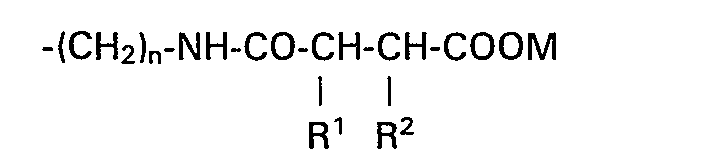
- R3 für einen Rest der Formel


- n eine ganze Zahl von 2-4 und M und M' unabhängig voneinander Wasserstoff oder ein Alkali-Metall, eine Ammonium-, C, bis C4-Alkylammonium- oder C2 bis C3-Hydroxyalkylammoniumgruppe bedeuten.
- Ein weiterer Gegenstand ist die Verwendung der Verbindungen der Formel I als Tenside und Emulgatoren in wässrigen Systemen.
- Beispiele für R sind der 2-Ethylhexyl-, Decyl-, Dodecyl-, Tetradecyl-, Hexadecyl-, Octadecyl-, Octadecenyl-, Dodecyloxypropyl- und Octadecyloxypropyl-Rest.
- Beispiele für M und M' sind Natrium, Kalium, Ammonium, Mono-, Di- oder Trimethylammonium, Mono-, Di-oder Triethylammonium, Mono-, Di-oder Trihydroxyethylammonium und Mono- oder Di-hydroxypropylammonium.
- Die Verbindungen der Formel können nach an sich bekannten Verfahren hergestellt werden, indem beispielsweise Polyamine der Formel II

- R5 für Wasserstoff oder für -(CH2)n-NH2 steht, mit Maleinsäureanhydrid umgesetzt werden, wobei das Molverhältnis der Summe von primären und sekundären Aminogruppen zu Maleinsäureanhydrid 1:0,9 bis 1:1,1, vorzugsweise 1: 1, beträgt und anschliessend die erhaltenen Umsetzungsprodukte mit Alkali-oder Ammoniumsulfiten zur Reaktion gebracht werden.
- Die Menge an Alkali- oder Ammoniumsulfit wird dabei so gewählt, dass pro Mol eingesetztes Maleinsäureanhydrid 0,95 bis 1,05 Mol Alkali-oder Ammoniumsulfit zur Anwendung gelangen. Amine der Formel II, in denen R5 für Wasserstoff steht, sind beispielsweise in J. Org. Chem. Bd. 15 (1950), S. 51 ff. und J. Am. Chem. Soc., Bd. 67 (1945), S. 1581 beschrieben. Amine der Formel II, in denen R5 für -(CH2)n-NH2 steht, können nach US-PS 3 028 415 und US-PS 3 615 797 hergestellt werden.
- Die meisten der handelsüblichen und bekannten Emulgatoren bestehen aus einem hydrophoben Kohlenwasserstoff- oder Alkylarylrest mit einer hydrophilen Gruppe, beispielsweise einer Sulfonat-, Sulfat-, Carboxylat-, Phosphat- oder Phosphonat-Gruppe. Es können auch an einen hydrophoben Rest Einheiten von Ethylenoxid oder Propylenoxid über geeignete reaktive Gruppen ankondensiert sein, wodurch man ebenfalls Tensideigenschaften erzielt.
- Statt einem hydrophoben Rest können auch, wie in den Sulfobernsteinsäurediestern, zwei hydrophobe Reste an eine hydrophile Gruppe gebunden sein. Eine Zusammenstellung von verschiedenen Emulgatoren und Herstellern findet sich z.B. in «Mc Cutcheon's Detergents and Emulsifiers» 1971, 1972 und 1973.
- Emulgatoren mit mehreren hydrophilen Gruppen an einem hydrophoben Rest sind bekannt und z.B. in den US-PSen 2 206 249, 2 438 092 und 2 435 810 beschrieben.
- Eine grössere Bedeutung hat von den Emulgatoren mit mehreren hydrophilen anionischen Gruppen lediglich das Tetranatriumsalz der Formel

- Die neuen Verbindungen der Formel 1 übertreffen die an sich bekannte Verbindung der Formel III in ihrer einzigartig erscheinenden Eigenschaft, die Scherstabilität zu verbessern und zeigen dabei noch andere Vorteile. So ist bekannt, dass die Verbindung der Formel III sich in sauren Medien, insbesondere bei erhöhterTemperatur, trübt und daher auch bei der Polymerisation jener Monomerer Schwierigkeiten macht, welche vorzugsweise im sauren pH-Bereich polymerisiert werden.
- Die neuen Verbindungen der Formel zeigen eine ausgezeichnete, die Scherstabilität von Kunststoffdispersionen verbessernde Wirkung und sind auch in saurem Milieu wirksam.
- Darüber hinaus ergeben sich feinteilige Dispersionen mit einer besonders niedrigen Viskosität, welche zudem beim Entmonomerisieren nicht schäumen.
- Die Wasserlöslichkeit der erfindungsgemässen Verbindungen ist ausgezeichnet, sie besitzen ein gutes Netzvermögen, die Tendenz zur Schaumbildung, insbesondere zur Bildung eines stabilen feinblasigen Schaums ist eingeschränkt. Obwohl die erfindungsgemässen Verbindungen spezielle für die Emulsionspolymerisation geeignete Eigenschaften besitzen, können sie auch zur Herstellung von Schreib- und Zeichentinten, Tuschen, Reinigungsmittel aller Art, zum Schmälzen, Walken, Mercerisieren, Präparieren, als Textilweichmacher, zum Färben, zur chemischen Reinigung, als Spinnbadzusatz bei der Viskoseherstellung, für Lickeröle, für die Kaltfettung des Leders, zur Dispergierung von Kalkseifen, als Hilfsmittel bei der Teppichrückenbeschichtung, Papierbeschichtung, zum Entfetten von Metalloberflächen, als Hilfsmittel bei der Flotation und Erdölförderung, als Zusätze zu Pflanzenschutzmittel, in der Photoindustrie, zur Desinfektion, als Bauhilfsstoffe und im Bergbau (vgl. Technische Anwendung der grenzflächenaktiven Verbindungen in Chemische Taschenbücher Nr. 14, Verlag Chemie Weinheim, Verfasser H. Bueren und H. Grossmann 1971) Verwendung finden.
- Grundsätzlich lassen sich alle technisch wichtigen Monomeren, deren Eignung für die Emulsionspolymerisation bekannt ist, in Gegenwart der erfindungsgemässen Verbindungen in schwach saurem bis alkalischen pH-Bereich polymerisieren. Insbesondere seien genannt Ethylen, Butadien-(1,3), Isopren, Chloropren, Styrol, substituierte Styrole wie 1-Methylstyrol (in Kombination mit anderen Monomeren), Vinylchlorid, Vinylidenchlorid, Vinylacetat, Vinylpropionat, Vinylversatic-Ester, Vinylisobutylether, Acrylnitril, Methacrylnitril, Methylacrylat, Ethylacrylat, n-Butylacrylat, 2-Ethylhexylacrylat, Methylmethacrylat, Ethylmethacrylat, n-Butylmethacrylat und deren Mischmengen, deren Copolymerisierbarkeit sich nach bekannten Copolymerisationsparametern abschätzen lässt. Die Glastemperatur der so erhältlichen Copolymerisate lässt sich ebenfalls nach bekannten Gleichungen rechnerisch abschätzen. Die so erhältlichen Kunststoffdispersionen können filmbildend oder nichtfilmbildend sein. Neben den genannten Monomeren können in bekannter Weise Acrylsäure, Methacrylsäure, Acrylamid, Methacrylamid sowie Vinylmonomere mit zusätzlichen funktionellen Gruppen einpolymerisiert werden. Solche Monomere sind z.B. in F. Hölscher «Dispersionen synthetischer Hochpolymerer», Teil I, Springer Verlag Berlin Heidelberg, Seite 56 tabelliert.
- Da die erfindungsgemässen Verbindungen der Formel den mit ihnen hergestellten Kunststoffdispersionen eine ausgezeichnete Stabilität verleihen, empfehlen sie sich auch als Zusätze zur Dispergierung der verschiedenen Pigmente in Kunststoffdispersionen. So können sie auch breite Verwendung finden in Anstrichbindern, Papierbindern, Lederbindern und Textildruckbindern, wo gute Redispergierbarkeit verlangt wird. Es ist auch möglich, Dispersionen, welche mit üblichen anionischen oder nichtionischen Emulgatoren hergestellt wurden, durch nachträglichen Zusatz der erfindungsgemässen Emulgatoren zu einer ausgezeichneten Scherstabilität zu verhelfen.
- Die Polymerisation in Gegenwart der erfindungsgemässen Verbindungen der Formel kann nach an sich bekannten Methoden diskontinuierlich, halbkontinuierlich, vollkontinuierlich durchgeführt werden. Hierbei kann grundsätzlich auch mit Saatlatexvorlagen gearbeitet werden.
- Die erfindungsgemässen Verbindungen der Formel führen, in Mengen von 0,5 bis maximal 8% bezogen auf Monomere, eingesetzt, zu vergleichsweise feinteiligen Suspensionen bzw. Dispersionen. So sind Dispersionen von Teilchen eines mittleren Durchmessers von ca. 25 nm bis 500 nm unter Anwendung der üblichen Polymerisationsmethoden herstellbar. Bei feinteiligen Butadien-Homo- und Copolymerisatdispersionen wurde beispielsweise eine niedrige Viskosität auch bei Feststoffgehalten von höher als 40% gefunden. Besonders vorteilhaft können mit Hilfe der erfindungsgemässen Verbindungen der Formel 1 die feinteiligen Komponenten bimodaler Systeme hergestellt werden, wie sie neuerdings steigendes Interesse zur Herstellung pigmentierter hochgefüllter Streichmassen finden. Hierbei können die feinteiligen Latice mit Hilfe der erfindungsgemässen Verbindungen hergestellt und anschliessend mit grobteiligeren Latices, deren Durchmesser um den Faktor 1,5 bis 4 grösser ist, abgemischt werden.
- Es ist aber auch möglich, eine Polymerisation eines Latex bis zu grossen mittleren Teilchendurchmessern durchzuführen und danach durch Zugabe einer erfindungsgemässen Verbindung die kritische Mizellkonzentration zu erreichen und danach neue Teilchen zu bilden, so dass bimodale Systeme in einem Eintopfverfahren entstehen können.
- Aufgrund der multifunktionellen hydrophilen Gruppen können die erfindungsgemässen Emulgatoren in Kombinationen, welche beispielsweise mit Carboxylgruppen reagieren, einkondensiert werden. Man setzt dann zweckmässigerweise statt den Natrium- oder Kaliumsalzen die Ammoniumsalze der erfindungsgemässen Emulgatoren ein.
- Der in den nachfolgenden Beispielen angegebene mittlere Latexteilchendurchmesser ist turbimetrisch ermittelt worden. Bei dieser Methode wird die spezifische Trübung K bestimmt und mit Hilfe einer Eichkurve, welche den Zusammenhang zwischen K und d darstellt, d ermittelt. d steht für DAV (vgl. DIN 53 206).
- 121 Teile N-Dodecyl-propandiyldiamin wurden in 80 Teilen Toluol gelöst und bei 50-60°C mit 98 Teilen Maleinsäureanhydrid versetzt. Nach 30 Minuten Rühren bei einer Temperatur von 50-60°C wurde das Toluol unter vermindertem Druck bei 50-60°C abdestilliert. Es wurden 221 Teile der rohen N-Dodecyl-N,N'-propan-diyl-bismaleamidsäure
-

- 210 Teile des vorstehend genannten Produktes wurden mit 100 Teilen Isopropanol und einer Lösung von 120 Teilen Natriumsulfit in 400 Teilen Wasser versetzt und bei 80-90 °C gerührt, bis die titrimetrisch ermittelte Konzentration an Sulfit unter 0,02% gesunken war.
- Man erhielt 830 Teile einer klaren, viskosen, wässrigen Lösung der Sulfosuccinamidsäure der Formel

- 98 Teile Maleinsäureanhydrid wurden in 120 ml Toluol bei 50-60°C gelöst und bei gleicher Temperatur mit 163 Teilen eines technischen Talgfettpropylendiamins (Aminäquivalent 162) versetzt. Nach 30 Minuten Rühren bei 50-60DC wurde das Toluol bei vermindertem Druck abdestilliert. Man erhielt als Rückstand 261 Teile der rohen N-Talgfettalkyl-N,N'--propandiyl-bis-maleamidsäure
-

- Das erhaltene Produkt wurde mit 140 Teilen Isopropanol und einer Lösung von 126 Teilen Natriumsulfit in 550Teilen Wasser versetzt und bei 80-90°C 4 Stunden gerührt. Die Sulfitkonzentration betrug danach noch 0,004%.
- Es wurden 1077 Teile einer klaren viskosen wässrigen Lösung der Sulfosuccinamidsäure der Formel
-

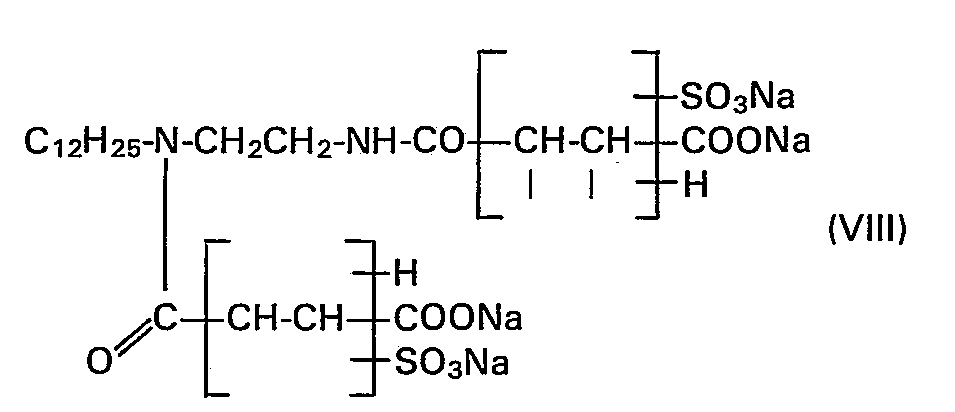
- In analoger Weise erhält man aus N-Dodecyl-ethyldiamin durch Umsetzung mit Maleinsäureanhydrid und Natriumsulfit die Sulfosuccinamidsäure der Formel
- 53 Teile Maleinsäureanhydrid wurden in Toluol gelöst und bei 40-50°C mit einer Lösung von 100 Teilen N-(3-Aminopropyl)-N-octadecyl-1,3-propandiyldiamin versetzt. Nach zweistündigem Rühren bei 40-50°C wurde das Toluol unter vermindertem Druck abdestilliert. Als Rückstand wurden 152 Teile der rohen Bismaleamidsäure der Formel
-

- 145 Teile der rohen Bis-maleamidsäure wurden mit 190 Teilen Isopropanol und einer Lösung von 64 Teilen Natriumsulfit in 250 Teilen Wasser 6 Stunden bei 80-90°C gerührt, bis die Konzentration an Sulfit unter 0,1 % abgesunken war. Man erhielt eine klare viskose wässrige Lösung der Sulfosuccinamidsäure der Formel

- In einen 40 Liter Edelstahlautoklaven, ausgerüstet mit Blattrührer, Druck- und Temperaturschreiber und pH Messgerät werden unter Ausschluss von Luftsauerstoff eingefüllt:

- Hierbei werden alle Komponenten ausser der Kaliumpersulfatlösung vorgelegt, das Gemisch wird auf 60°C aufgeheizt, danach wird die Kaliumpersulfatlösung auf einmal hinzugegeben. Die Temperatur (innen) wird elektrisch geregelt und auf ca. 1 Grad genau gehalten. Nach 6 Stunden wird die Temperatur auf 62°C, nach 12 Sunden von 62°C auf 65°C, nach 17 Stunden von 65°C auf 68°C erhöht.
- Stündlich werden Eindampfproben genommen, dabei der Feststoffgehalt des Latex bestimmt, seine Oberflächenspannung gemessen, sein pH-Wert ermittelt und seine Teilchengrösse gemessen.
- Es ergeben sich folgende Werte (vgl. Tabelle I):

- Im Reaktor befindet sich nach der Polymerisation kein Koagulat. Der Latex lässt sich leicht von Restmonomeren befreien, wobei keine Schaumbildung auftritt. Der Latex ist dünnflüssig und vollkommen frei von Stippen und Mikrokoagulat.
- In einen 6 Liter Edelstahlautoklaven, ausgerüstet mit Blattrührer, Druck- und Temperaturschreiber sowie pH-Messgerät werden unter Ausschluss von Luftsauerstoff gefüllt:


- Alle Komponenten ausser den Aktivatorlösungen werden vorgelegt, das Gemisch bei 150 Umdrehungen pro Minute auf 60°C aufgeheizt. Ist die Temperatur von 60°C erreicht, wird die erste Aktivatorlösung (59,5 g) in den Autoklaven eingeführt, die zweite Aktivatorlösung wird im Verlauf von 14 Stunden zudosiert. Stündlich werden Proben genommen. Der Verlauf der Polymerisation geht aus nachfolgender Tabelle hervor:

- Bei der Polymerisation entstand keinerlei Koagulat und der Latex erwies sich als stippenfrei und frei von Mikrokoagulat. Beim Entmonomerisieren schäumte der Latex nicht und die Auslaufzeit des entmonomerisierten Latex lag bei einem Feststoffgehalt von ca. 41 % bei ca. 30 Sekunden in dem Auslaufbecher nach DIN 53 211 (100 ccm Dispersion, 20 Grad C, 4 mm Düse).
- Die nach Beispiel 4 und 5 hergestellten, entmonomerisierten Polybutadienlatices können zwischen den Fingerkuppen durch einfaches Scheren nicht zu Koagulatwürstchen zerrieben werden. Zur exakteren Beurteilung der Scherstabilität wurde wie folgt verfahren:
- 500 g Latex wurden durch Zugabe von wässriger Ammoniaklösung auf pH = 10 eingestellt. Danach wurde der Latex auf einen Feststoffgehalt von 35 Gew.-% verdünnt.
- 80 g dieses 35%igen Latex füllte man in einen 21 cm hohen, aussen mit Kühlmantel versehenen zylindrischen Metallbecher mit lichtem Durchmesser 6 cm. Der Metallbecher war in einen Edelstahlklotz der Breite 13 cm, der Länge 13 cm und der Höhe 5 cm mit zylindrischer Aussparung eingebettet und in diesem durch Rändelschrauben befestigt. Im Inneren des Metallbechers befanden sich, gleichmässig verteilt und mit Spannringen an den Wänden befestigt, 4 vom Boden über den Gefässrand führende Wellenbrecher, welche rechtwinklig zur Oberfläche der Gefässwand standen und 4mm breit waren.
- In das Innere des Bechers und den Latex tauchte ein Rührorgan, bestehend aus einer einfachen Scheibe der Dicke 2 mm und des Durchmessers 2 cm. Die Scheibe war an einem ca. 8 cm langen, in Scheibennähe ca. 5 mm, nach oben sich verstärkenden Schaft angebracht, der von einem hochtourigen Motor angetrieben wurde. Die Vorrichtung besass eine exakte Drehzahlmessung und die Umdrehungszahl liess sich exakt auf einen bestimmten Wert, hier 20 000 Umdrehungen pro Minute, einregulieren. Nach einer von einer elektronischen Stoppuhr vorgegebenen Zeit, hier genau 20 Minuten, wurde der Motor abgestellt. Die gesamte Vorrichtung befand sich in einem schallisolierten Kasten. Nach dieser Scherbeanspruchung wurde der Inhalt des Metallbechers durch ein feines Sieb aus Edelstahl mit der quadratischen Maschenweite 50 Mikrometer filtriert, der im Sieb verbleibende Koagulatanteil bis zur Gewichtskonstanz getrocknet und zurückgewogen.
- Bei den beiden alkalisierten Latices blieb nach dieser Prozedur praktisch kein Koagulat (ca. 0,01 g) zurück. Diese Latices sind mithin ausserordentlich scherstabil. Beim Reduzieren des pH-Wertes z.B. durch Zugabe von Essigsäure nimmt die Stabilität der Dispersionen merklich ab, um im schwach sauren pH-Bereich mit den üblichen Emulgatoren vergleichbar zu werden. Durch Zusätze von mehrwertigen Metallionen lassen sich die oben genannten Latices agglomerieren; auch eine Agglomeration durch mechanische Scherbeanspruchung ist im neutralen bis schwach angesäuerten Zustand möglich.
- Es soll gezeigt werden, dass Zusätze der erfindungsgemässen Emulgatoren zu einer mit an sich bekannten anionischen Emulgatoren hergestellten Dispersion deren Scherstabilität wesentlich verbessern. Ferner wird nachgewiesen, dass entsprechende Zusätze an sich bekannter anionischer Tenside einen vergleichbaren Effekt nicht bewirken können.
- Als Modellsubstanz wurde ein 41 %iger entmonomerisierter Polybutadienlatex des mittleren Teilchendurchmessers 110 nm verwendet. Der Latex wurde nach einem halbkontinuierlichen Zulaufverfahren bei 50° C mit Hilfe von insgesamt 1,8 Gew.-% eines Emulgatofgemisches, bestehend aus gleichen Anteilen Kaliumoleat und Natriumlaurylsulfat hergestellt, wobei als Initiatorsystem ein Redoxsystem aus einem wasserunlöslichen organischen Peroxid (p-Menthanhydroperoxid), einem wasserlöslichen Reduktionsmittel (Natriumformaldehydsulfoxylat) und Fe 11 Komplexonatlösung verwendet wurde.
- 85 g dieses Latex wurden in ein Becherglas eingewogen, eine der in untenstehender Tabelle genannte Lösung eines Emulgators X in Wasser (5 gew.%ig) unter Rühren hinzugefügt, mit 5 gew. %iger Ammoniaklösung ein pH-Wert von 10 eingestellt und mit Wasser auf 100 g aufgefüllt. Das Gemisch wurde danach noch ca. 30 Minuten langsam gerührt.
- Die Rührstabilität wurde danach nach der in Beispiel 6 genannten Methode bestimmt, wobei 80 g der ca. 35%igen Latices 20 Minuten bei 20 000 Umdrehungen pro Minute unter Konstanthaltung der Temperatur von 25°C in der in Beispiel 6 genannten Apparatur mechanisch beansprucht wurden.
- Um einen Vergleich der Wirksamkeit der verschiedenen Emulgatorzusätze zu ermöglichen, wurden zum Testlatex vor dem Verdünnen
- a) eine kleinere Menge (2,22 x 10⁻⁴ Mol Emulgator X / 100 g Polymerisat)
- b) eine grössere Menge (8,57 x 10⁻³ Mol Emulgator X / 100 g Polymerisat zugesetzt. Der Effekt der kleineren (a) und der grösseren (b) Zugaben geht aus nachstehender Tabelle hervor:


Claims (2)


Applications Claiming Priority (2)
| Application Number | Priority Date | Filing Date | Title |
|---|---|---|---|
| DE19853512335 DE3512335A1 (de) | 1985-04-04 | 1985-04-04 | Verzweigte sulfosuccinamidsaeure-emulgatoren zur herstellung besonders scherstabiler dispersionen |
| DE3512335 | 1985-04-04 |
Publications (2)
| Publication Number | Publication Date |
|---|---|
| EP0196596A1 EP0196596A1 (de) | 1986-10-08 |
| EP0196596B1 true EP0196596B1 (de) | 1988-08-24 |
Family
ID=6267299
Family Applications (1)
| Application Number | Title | Priority Date | Filing Date |
|---|---|---|---|
| EP86104042A Expired EP0196596B1 (de) | 1985-04-04 | 1986-03-24 | Verzweigte Sulfosuccinamidsäure-Emulgatoren zur Herstellung besonders scherstabiler Dispersionen |
Country Status (4)
| Country | Link |
|---|---|
| US (1) | US4701284A (de) |
| EP (1) | EP0196596B1 (de) |
| JP (1) | JPS61243058A (de) |
| DE (2) | DE3512335A1 (de) |
Families Citing this family (3)
| Publication number | Priority date | Publication date | Assignee | Title |
|---|---|---|---|---|
| DE3707439A1 (de) * | 1987-03-07 | 1988-09-15 | Bayer Ag | Sulfosuccinamidsaeuren von polyoxypropylendiaminen und ihre verwendung als emulgatoren |
| FI933763L (fi) * | 1992-08-29 | 1994-03-01 | Hoechst Ag | Graensytaktiva foereningar baserade pao alkoxylerade fettaminer |
| US5472642A (en) * | 1994-12-22 | 1995-12-05 | Lever Brothers Company, Division Of Conopco Inc. | Diaminoalkyl di(sulfosuccinates) and their use as builders |
Family Cites Families (8)
| Publication number | Priority date | Publication date | Assignee | Title |
|---|---|---|---|---|
| DE552758C (de) * | 1930-12-28 | 1932-06-28 | I G Farbenindustrie Akt Ges | Verfahren zur Herstellung von Netz-, Reinigungs- und Dispergiermitteln |
| US2917431A (en) * | 1957-08-01 | 1959-12-15 | American Cyanamid Co | Aqueous inorganic salt-sulfosuccinate solutions |
| DE2123534C3 (de) * | 1971-05-12 | 1975-03-20 | Deutsche Gold- Und Silber-Scheideanstalt Vormals Roessler, 6000 Frankfurt | Herstellung von Salzen von Sulfobernsteinsäureestern und deren Verwendung als waschaktive Substanzen |
| US4192817A (en) * | 1977-05-23 | 1980-03-11 | Kewanee Industries, Inc. | Amphoteric surfactants |
| US4076744A (en) * | 1977-05-23 | 1978-02-28 | Kewanne Industries, Inc. | Amphoteric surfactants |
| DK560378A (da) * | 1977-12-14 | 1979-06-15 | Albright & Wilson | Gummilatexskumstof |
| US4490308A (en) * | 1983-06-30 | 1984-12-25 | Nalco Chemical Company | New water-soluble sulfonated monomers |
| US4462808A (en) * | 1983-08-04 | 1984-07-31 | Nalco Chemical Company | Dispersant for high solids coal-water slurries |
-
1985
- 1985-04-04 DE DE19853512335 patent/DE3512335A1/de not_active Withdrawn
-
1986
- 1986-03-24 EP EP86104042A patent/EP0196596B1/de not_active Expired
- 1986-03-24 US US06/843,305 patent/US4701284A/en not_active Expired - Fee Related
- 1986-03-24 DE DE8686104042T patent/DE3660592D1/de not_active Expired
- 1986-04-04 JP JP61076877A patent/JPS61243058A/ja active Pending
Also Published As
| Publication number | Publication date |
|---|---|
| DE3660592D1 (en) | 1988-09-29 |
| DE3512335A1 (de) | 1986-10-16 |
| EP0196596A1 (de) | 1986-10-08 |
| JPS61243058A (ja) | 1986-10-29 |
| US4701284A (en) | 1987-10-20 |
Similar Documents
| Publication | Publication Date | Title |
|---|---|---|
| DE3319340C2 (de) | ||
| DE923333C (de) | Polymerisationsverfahren | |
| DE2025696B2 (de) | Verfahren zur Herstellung einer stabilen Latex-Dispersion | |
| EP0081083A2 (de) | Verfahren zur Herstellung von wässrigen, hochkonzentrierten bimodalen Kunststoffdispersionen | |
| DE1189275B (de) | Verfahren zur Herstellung von loeslichen, kationenaktiven Copolymerisaten | |
| DE2823640B2 (de) | Flüssige Polymerzusammensetzung | |
| EP0257413A2 (de) | Verwendung von speziellen Ethylen-Vinylacetat-Copolymeren zur Modifizierung von PVC | |
| DE3123732A1 (de) | Mahlhilfsmittel und dispergiermittel fuer pigmente | |
| EP0567819A1 (de) | Wässrige Polymerisatdispersion | |
| EP0048320A1 (de) | Emulgiermittelfreie wässrige Kunststoffdispersion | |
| DE2418419A1 (de) | Carboxylgruppen enthaltende styrolbutadien-copolymerisat latices | |
| EP0195328B1 (de) | Aminobernsteinsäurederivate und ihre Verwendung als Emulgatoren für Polymerdispersionen | |
| DE2319853A1 (de) | Koazervierung eines anionen enthaltenden waessrigen dispersen systems mit amphoteren polyelektrolyten | |
| EP0250896B1 (de) | Herstellung eines geruchsarmen wasserlöslichen Polymerisats oder Copolymerisats | |
| EP0007042A1 (de) | Verfahren zur Herstellung von emulgatorfreien Kautschuklatices | |
| DE1910532C3 (de) | Frost- und elektrolytbeständige wäßrige Kunststoffdispersionen | |
| EP0196596B1 (de) | Verzweigte Sulfosuccinamidsäure-Emulgatoren zur Herstellung besonders scherstabiler Dispersionen | |
| DE3134222C2 (de) | ||
| EP0025979A1 (de) | Wässrige Lösung oder Dispersion eines Styrol/Maleinsäureanhydrid-Copolymers, Verfahren zu ihrer Herstellung und ihre Verwendung | |
| EP0234416B1 (de) | Zitronensäurederivate als Emulgatoren für die Emulsationspolymerisation | |
| DE3605800A1 (de) | 2-phosphonobutan-1,2,4-tricarbonsaeurederivate als emulgatoren | |
| EP0004062A2 (de) | Wässrige Kunststoffdispersion auf Basis von Vinylpolymeren, Verfahren zu ihrer Herstellung und ihre Verwendung | |
| DE69211224T3 (de) | Microdispersionen von Polymeren mit Hydroxamsäuregruppen | |
| DE3047084A1 (de) | Carboxylgruppen enthaltende synthesekautschukdispersionen, verfahren zu ihrer herstellung und ihre verwendung | |
| DE1720897C3 (de) | Verfahren zum Polymerisieren von äthylenisch ungesättigten Monomeren in wäßriger Emulsion |
Legal Events
| Date | Code | Title | Description |
|---|---|---|---|
| PUAI | Public reference made under article 153(3) epc to a published international application that has entered the european phase |
Free format text: ORIGINAL CODE: 0009012 |
|
| 17P | Request for examination filed |
Effective date: 19860324 |
|
| AK | Designated contracting states |
Kind code of ref document: A1 Designated state(s): DE FR GB IT |
|
| 17Q | First examination report despatched |
Effective date: 19880210 |
|
| GRAA | (expected) grant |
Free format text: ORIGINAL CODE: 0009210 |
|
| AK | Designated contracting states |
Kind code of ref document: B1 Designated state(s): DE FR GB IT |
|
| ITF | It: translation for a ep patent filed | ||
| GBT | Gb: translation of ep patent filed (gb section 77(6)(a)/1977) | ||
| REF | Corresponds to: |
Ref document number: 3660592 Country of ref document: DE Date of ref document: 19880929 |
|
| ET | Fr: translation filed | ||
| PLBE | No opposition filed within time limit |
Free format text: ORIGINAL CODE: 0009261 |
|
| STAA | Information on the status of an ep patent application or granted ep patent |
Free format text: STATUS: NO OPPOSITION FILED WITHIN TIME LIMIT |
|
| 26N | No opposition filed | ||
| PGFP | Annual fee paid to national office [announced via postgrant information from national office to epo] |
Ref country code: FR Payment date: 19910226 Year of fee payment: 6 |
|
| PGFP | Annual fee paid to national office [announced via postgrant information from national office to epo] |
Ref country code: DE Payment date: 19910228 Year of fee payment: 6 |
|
| PGFP | Annual fee paid to national office [announced via postgrant information from national office to epo] |
Ref country code: GB Payment date: 19910313 Year of fee payment: 6 |
|
| ITTA | It: last paid annual fee | ||
| PG25 | Lapsed in a contracting state [announced via postgrant information from national office to epo] |
Ref country code: GB Effective date: 19920324 |
|
| GBPC | Gb: european patent ceased through non-payment of renewal fee | ||
| PG25 | Lapsed in a contracting state [announced via postgrant information from national office to epo] |
Ref country code: FR Effective date: 19921130 |
|
| PG25 | Lapsed in a contracting state [announced via postgrant information from national office to epo] |
Ref country code: DE Effective date: 19921201 |
|
| REG | Reference to a national code |
Ref country code: FR Ref legal event code: ST |
|
| PG25 | Lapsed in a contracting state [announced via postgrant information from national office to epo] |
Ref country code: IT Free format text: LAPSE BECAUSE OF NON-PAYMENT OF DUE FEES;WARNING: LAPSES OF ITALIAN PATENTS WITH EFFECTIVE DATE BEFORE 2007 MAY HAVE OCCURRED AT ANY TIME BEFORE 2007. THE CORRECT EFFECTIVE DATE MAY BE DIFFERENT FROM THE ONE RECORDED. Effective date: 20050324 |