EP0196692A1 - Support de carte - Google Patents
Support de carte Download PDFInfo
- Publication number
- EP0196692A1 EP0196692A1 EP86200315A EP86200315A EP0196692A1 EP 0196692 A1 EP0196692 A1 EP 0196692A1 EP 86200315 A EP86200315 A EP 86200315A EP 86200315 A EP86200315 A EP 86200315A EP 0196692 A1 EP0196692 A1 EP 0196692A1
- Authority
- EP
- European Patent Office
- Prior art keywords
- spring
- contact
- card
- holder
- holder according
- Prior art date
- Legal status (The legal status is an assumption and is not a legal conclusion. Google has not performed a legal analysis and makes no representation as to the accuracy of the status listed.)
- Withdrawn
Links
- 238000005452 bending Methods 0.000 claims abstract description 9
- 230000001154 acute effect Effects 0.000 claims description 2
- 238000005192 partition Methods 0.000 claims description 2
- 238000006073 displacement reaction Methods 0.000 description 7
- 239000004020 conductor Substances 0.000 description 4
- 230000008901 benefit Effects 0.000 description 3
- 238000003780 insertion Methods 0.000 description 3
- 230000037431 insertion Effects 0.000 description 3
- 239000000428 dust Substances 0.000 description 2
- 238000000034 method Methods 0.000 description 2
- 238000012986 modification Methods 0.000 description 2
- 230000004048 modification Effects 0.000 description 2
- 238000005476 soldering Methods 0.000 description 2
- 238000009825 accumulation Methods 0.000 description 1
- 230000009471 action Effects 0.000 description 1
- 238000007792 addition Methods 0.000 description 1
- 230000001419 dependent effect Effects 0.000 description 1
- 230000005611 electricity Effects 0.000 description 1
- 239000000463 material Substances 0.000 description 1
- 239000002184 metal Substances 0.000 description 1
- 238000004377 microelectronic Methods 0.000 description 1
- 239000002245 particle Substances 0.000 description 1
- 230000008569 process Effects 0.000 description 1
- 238000004080 punching Methods 0.000 description 1
- 230000008054 signal transmission Effects 0.000 description 1
- 230000003068 static effect Effects 0.000 description 1
- 230000007704 transition Effects 0.000 description 1
Images


Classifications
-
- H—ELECTRICITY
- H01—ELECTRIC ELEMENTS
- H01R—ELECTRICALLY-CONDUCTIVE CONNECTIONS; STRUCTURAL ASSOCIATIONS OF A PLURALITY OF MUTUALLY-INSULATED ELECTRICAL CONNECTING ELEMENTS; COUPLING DEVICES; CURRENT COLLECTORS
- H01R9/00—Structural associations of a plurality of mutually-insulated electrical connecting elements, e.g. terminal strips or terminal blocks; Terminals or binding posts mounted upon a base or in a case; Bases therefor
-
- H—ELECTRICITY
- H01—ELECTRIC ELEMENTS
- H01R—ELECTRICALLY-CONDUCTIVE CONNECTIONS; STRUCTURAL ASSOCIATIONS OF A PLURALITY OF MUTUALLY-INSULATED ELECTRICAL CONNECTING ELEMENTS; COUPLING DEVICES; CURRENT COLLECTORS
- H01R12/00—Structural associations of a plurality of mutually-insulated electrical connecting elements, specially adapted for printed circuits, e.g. printed circuit boards [PCB], flat or ribbon cables, or like generally planar structures, e.g. terminal strips, terminal blocks; Coupling devices specially adapted for printed circuits, flat or ribbon cables, or like generally planar structures; Terminals specially adapted for contact with, or insertion into, printed circuits, flat or ribbon cables, or like generally planar structures
- H01R12/70—Coupling devices
- H01R12/71—Coupling devices for rigid printing circuits or like structures
- H01R12/72—Coupling devices for rigid printing circuits or like structures coupling with the edge of the rigid printed circuits or like structures
- H01R12/721—Coupling devices for rigid printing circuits or like structures coupling with the edge of the rigid printed circuits or like structures cooperating directly with the edge of the rigid printed circuits
Definitions
- the invention relates to credit and other cards with electronically stored data which can be read and printed circuit boards, and more particular to a holder provided with guide means to receive such cards.
- connection strips are preferably in the form of edge contacts.
- the object of the invention is to provide a holder of the type described above which avoid the above problem.
- each contact spring has a first spring end part which is adjacent to the movable end of the contact spring, an intermediate spring part and a second clamped spring end part serving as connection terminal; said first contact spring part being disposed substantially perpendicular tot the intermediate spring part, and said intermediate part being substantially perpendicular to the infeed plane of the holder; that the first spring part is spaced from the shifting plane of the connection strips; and that a stop element is located at the point where the first spring end part and the intermediate spring part join, said stop element extending from the plane of the first spring end part into the infeed plane of the holder.
- the contact spring parts and their respective stop elements are preferably bent from one piece.
- the intermediate spring part continues past the first spring end part and, after successively bending back through 180 degrees and bending through 90 degrees, the intermediate spring part merges into the first.
- the stop element is formed by at leasdt one extension piece of the intermediate spring part continuing along the first spring end part.
- An embodiment which is particularly suitable for adjustment of the contact spring is characterized in that the extension piece is bent in the direction of the first spring part along a bending line which runs substantially parallel to the center line of the intermediate spring part. Adjustment of the contact pressure takes place by setting the width of the extension piece or the angle thereof relative to the intermediate spring part.
- the end of the first spring part is bent back through less than 180 degrees and can make contact with a connection strip of an inserted card.
- the intermediate spring part after successively bending back through 180 degrees and bending through 90 degrees, merges into the second spring end part which is parallel to the first spring part.
- the contact springs cannot be soldered in customary fashion into a plate with printed wiring.
- An embodiment which solves this problem is cahracterised in that the second contact spring part is provided at the clamped end with forced-out points. When these points have been pushed through a ribbon cable, they are bent back against the ribbon cable. This procudes a reliable contact between contact spring and a conductor of the ribbon cable.
- each contact spring has a first spring end part which is adjacent to the movable end of the contact spring, an intermediate spring part bent into a U-shape and a second clamped spring end part serving as connection terminal, in which the one and the other legs of the U join the first and second spring end parts respectively, said first spring part being disposed substantially perpendicular to the intermediate spring, part, and said intermediate part being substantially perpendicular to the infeed plane of the holder; that a stop element is located at the point where the first spring end part and the intermediate spring part join, said stop element extending from the plane of the first spring end part into the infeed plane of the holder; that in the rest condition, the legs of the intermediate spring part converge slightly to each other in the direction of their ends; that the first spring end part extends slantingly past the shifting plane of the connection strips of the card; that a biasing rod
- An embodiment according to the second aspect of the invention is characterized in that one or more first spring end parts are pre-bent to the infeed plane of the card more as to the remaining first spring end parts, so that the contact points thereof make earlier respectively disconnect later the contact with the contacting strips of the card than the contact points of the said remaining end parts when the rod is rotated by a fourth of one revolution for making respectively disconnecting the contact.
- a further embodiment is characterized in that the second spring end parts extend in upright position from the other U-leg of the contact springs through the bottom of the connector and project parallel to each other out of the connector at the side facing from the insert side.
- Yet a further embodiment of the invention is characterized in that the contact springs are separated from each other by insulating partitions accomodated in the connector.
- the connector is provided with a non-conductive support located between the first spring end parts and the infeed plane of the holder and presenting a support face parallel to the holder infeed plane for supporting the said end parts in the rest position, that the said support has at its free end facing to the intermediate spring parts an inclined race for the first spring parts; and that the tip of said first spring end parts extends under an acute angle as to the support face.
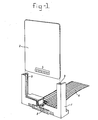
- Fig. 1 illustrates a card reader holder 1, above which is a card 2 to be inserted.
- the card may be an identity or credit card or the like.
- connection strips 4 in the form of edge contacts, which are connected to a memory chip or other similar integrated circuit (not illustrated).
- the card reader holder 1 is provided with guide grooves 3 for the card 2 to be inserted.
- the clamped end of the contact spring 4 is connected to a conductor of the ribbon cable 6, which in turn is connected to the reader device (not shown).
- Fig. 2a to 2d show different embodiments of the contact spring 5.
- the contact springs consist of two parts 7 and 8 which are at right angles to each other.
- the first contact spring part 7 has a contact face 9 which canes to rest against an edge contact 4 of an inserted card 2 and makes contact with it.
- the second contact spring part 8 of the embodiments shown in Figs. 2a, 2b and 2c is clamped in the holder.
- the contact spring can be clamped by means of a soldering connection pin 10.
- the contact springs of Figs. 2a to 2d all have a stop element 11, which an inserted card comes up against.
- the stop element 11 Fig. 2a is formed by an extension piece 12 of the second contact spring part 8, which is bent back through 180 degrees and, after a bend of virtually 90 degrees, merges into the first contact
- extension pieces 13 of contact spring part 8 use is made of two extension pieces 13 of contact spring part 8. Extension pieces 13 run through on either side of the contact spring part 7. These extension pieces 13 serve as the stop element 11 for the card 2 to be inserted. Although two extension pieces 13 are shown here, one could do with one extension piece if necessary. Owing to the fact that two extension pieces 13 are used here, tilting of the contact spring part 7 in its plane is avoided.
- the contact spring of Fig. 2b has only one extension piece 14 as a stop element, which is bent along the bending line 15 in the direction of the contact spring part 7.
- the pressure of the contact face 9 against an edge contact of an inserted card can be adjusted by setting the dimension of the extension piece 14 in the direction of the contact spring part 7, or by setting the angle of the extension piece 14 relative to the contact spring part 8.
- the contact springs consist of two parts 7 and 8, at right angles to each other with a stop element 11 near the transition point, when the card 2 is inserted to a particular depth its front edge will come up against the stop element.
- the clamped part 8 undergoes angular rotation.
- the other contact spring part 7 thereby undergoes a displacement and is pressed with increasing pressure against the edge contacts 4 of the card 2, without the contact point between edge contact and contact spring shifting in relation to the edge contact or contact spring face 9.
- the contact pressure will be determined dependent on the vertical displacement of the card and thus of the contact spring parts 7 and 8.
- the card 2 On insertion, the card 2 is guided in the guide grooves 3 for this purpose, so that the card undergoes no horizontal displacement. It is clear that during insertion of the card 2 wear is restricted to a minimum through the fact that the abovementioned contact point undergoes no relative displacement when the contact pressure is being built up.
- openings are provided in the bottom of the guide holder, so that no accumulation of dust can occur.
- the clamped contact spring part 8 is provided on its end with forced-out points 16 such as shown in Fig. 2a. It can be seen from Figs. 3a and 3b that this connection is produced by the sharp points 16 being pressed through the film of the ribbon cable and then being flanged back. The connection thereby obtained is produced at four points 16 simultaneously, through these four points partially cut through the signal track. An important part for the signal transmission is still present, particularly in the center of the shrink connection.
- the displacement of the partially cut away film has caused the central part to bulge out and, with a force developed in the process, to lie against the inner side of the contact points.
- the film is cut through by rigid material parts and is subsequently deformed in such a way that elastic action of the film on the metal parts is not possible anymore or inadequate.
- the contact spring according to Fig. 2d is provided with a soldering pin 10. It should also be said that the shape of the contact spring according to Fig. 2d will be important if the contacts are to be in line with the card 2.
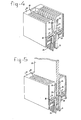
- Fig. 4 shows a perspective view of a cut out edge connector, in which a number of parallel spring members are accanodated for engaging contact faces at the insert edge of a printed circuit board.
- Each contact member consists of two individual opposing contact springs 21 and 22.
- Each contact spring consists of an intermediate spring part bent in an U-shape, one first spring end part 23 extending in upright position from the one U-leg and a second spring end part 24 implemented as contact pin and extending from the other U-leg.
- the second spring end parts are clamped in any suitable way in the bottom of the housing 18 0 f the edge connector. They may project both in upstanding position and parallel to each other fran the bottom and through the sidewalls in clamped condition out of the connector.
- the contact pressure is built up during inserting.
- the printed circuit board 19 its insert edge abuts against a fixed stop element provided by both of the rows of opposing stop lips 28 of the U-shaped intermediate spring parts of the contact springs 21,22.
- the contact points 26 of the contact springs will engage the opposing contact faces of the printed circuit board and a contact will result. Thereby no or nearly no relative displacements between both spots occur.
- the printed circuit board is locked now by means of an external locking device and thereby, is kept in its place. By unlocking the printed circuit board this will be pushed away by a common spring force from the individual contact springs, so that the printed circuit board may be removed readily.
- Figs. 6a and 6b present a front view of an individual contact spring member
- the inserting of the printed circuit board is realized without contact pressure or with zero force.
- the individual contact springs of each contact spring member are rebent such that the U-legs of the intermediate spring part of each contact spring converge in some extent to each other in unbiased condition and without inserted printed circuit board.
- a rod to be inserted and/or operated from the outside has been received between e.g. the bottom of the housing of the edge connector and both of the stop lips of the one legs of the intermediate spring parts.
- both of the U-legs and consequently also both of the first spring end parts 23 of both of the contact springs are bent from each other.
- the subsequent inserting of the insert edge of the printed circuit board it is not required to generate a force and the printed circuit board will ultimately rest against the row of both opposing stop lips.
- the biasing rod By rotating the biasing rod from the outside by a fourth of a revolution the contact points of both of the first spring end parts 23 will make contact to the contact faces of the printed circuit board without requirement of building up a contact force during inserting.
- By rotating the biasing rod by a fourth of a revolution for releasing the printed circuit board said board may be removed from a connector without a further force.
- the advantage of said second embodiment is that an additional locking of the printed circuit board is not required anymore. Furthermore, by the absence of the inserting force required otherwise, a higher number of contacts per connector may be employed, e.g. 2 x 200 contacts per connector having a mutual distance of 1.0 mm.
- one or more contact spring members as indicated in Fig. 7 may be prebent additionally so that the contact points thereof make earlier respectively disconnect later the contact with the contact faces of the printed circuit board (first make, last break) then the contact points of the remaining contact spring members.
- FIGs. 8a and b some different possible embodiments of the contact points of the individual contact springs are illustrated.
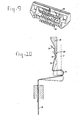
- Fig. 9 shows a further embodiment of a connector which may be used in e.g. a card reader holder or printed circuit board holder.
- Fig. 10 a detail of said connector is shown in cross-section.
- the connector is provided with a number of springs 21, 23, 24 for the connection with contact surfaces on a card of board to be inserted.
- the free ends 23 of the springs are supported by a support face of a support element 29.
- the intermediate part 21 of each spring is urged downwards and the free ends 23 of the springs slide from the support 29. Then the contacts 30 of the springs engage the corresponding connecting surfaces of the card.
- Fig. 10 the spring 21,23,24 is shown by a solid line in the rest position and by a dashed line in the operation condition.
Landscapes
- Coupling Device And Connection With Printed Circuit (AREA)
- Credit Cards Or The Like (AREA)
Applications Claiming Priority (2)
| Application Number | Priority Date | Filing Date | Title |
|---|---|---|---|
| NL8500587 | 1985-03-01 | ||
| NL8500587A NL8500587A (nl) | 1985-03-01 | 1985-03-01 | Kaartleeshouder. |
Publications (1)
| Publication Number | Publication Date |
|---|---|
| EP0196692A1 true EP0196692A1 (fr) | 1986-10-08 |
Family
ID=19845609
Family Applications (1)
| Application Number | Title | Priority Date | Filing Date |
|---|---|---|---|
| EP86200315A Withdrawn EP0196692A1 (fr) | 1985-03-01 | 1986-02-28 | Support de carte |
Country Status (8)
| Country | Link |
|---|---|
| US (2) | US4696529A (fr) |
| EP (1) | EP0196692A1 (fr) |
| JP (1) | JPS61281484A (fr) |
| KR (1) | KR860007759A (fr) |
| AU (1) | AU579975B2 (fr) |
| BR (1) | BR8600825A (fr) |
| CA (1) | CA1241396A (fr) |
| NL (1) | NL8500587A (fr) |
Cited By (2)
| Publication number | Priority date | Publication date | Assignee | Title |
|---|---|---|---|---|
| EP0420009A1 (fr) * | 1989-09-25 | 1991-04-03 | The Whitaker Corporation | Connecteur à force d'insertion nulle pour connecter des câbles à des plaques de circuit |
| FR3003704A1 (fr) * | 2013-10-04 | 2014-09-26 | Schneider Electric Ind Sas | Contact electrique et equipement electrique ou electronique equipe de ce contact |
Families Citing this family (19)
| Publication number | Priority date | Publication date | Assignee | Title |
|---|---|---|---|---|
| NL8503347A (nl) * | 1985-12-04 | 1987-07-01 | Du Pont Nederland | Connector. |
| DE3801610A1 (de) * | 1988-01-21 | 1989-08-03 | Diehl Gmbh & Co | Vielfachverbinder |
| GB2240224A (en) * | 1989-12-20 | 1991-07-24 | Souriau Electric Gmbh | Plug-in electrical adaptor |
| US5066241A (en) * | 1990-06-18 | 1991-11-19 | Eastman Kodak Company | Electrical connector apparatus for use with an integrated circuit card |
| US5020999A (en) * | 1990-07-19 | 1991-06-04 | International Business Machines Corporation | Personal computer with connector assembly having integral retainer |
| US5037239A (en) * | 1991-02-05 | 1991-08-06 | Olsen-Beal Associates | Underground concrete vault structure for hazardous liquid storage tanks |
| US5270964A (en) * | 1992-05-19 | 1993-12-14 | Sun Microsystems, Inc. | Single in-line memory module |
| US5667397A (en) * | 1994-12-01 | 1997-09-16 | The Whitaker Corporation | Smart card connector |
| US6062889A (en) * | 1997-01-13 | 2000-05-16 | The Whitaker Corporation | Module connector having a switching mechanism |
| US6402542B1 (en) * | 2001-02-28 | 2002-06-11 | Hon Hai Precision Ind. Co., Ltd. | Electrical connector |
| US7641777B2 (en) * | 2004-09-07 | 2010-01-05 | Roche Diagnostics Operations, Inc. | Biological testing system |
| US7527235B2 (en) * | 2005-06-30 | 2009-05-05 | Hummel Timothy B | Greeting card holder |
| US20070221591A1 (en) * | 2006-03-24 | 2007-09-27 | Yang-Yuan Hsu | Wedged sliding trough structure |
| US8398443B2 (en) * | 2006-04-21 | 2013-03-19 | Roche Diagnostics Operations, Inc. | Biological testing system and connector therefor |
| US7371094B1 (en) * | 2006-12-22 | 2008-05-13 | Ddk Ltd. | Aligned contact group and electrical connector for flexible substrate |
| US20090235564A1 (en) * | 2008-03-21 | 2009-09-24 | Hummel Timothy B | Greeting card holder with display support member |
| TW200950218A (en) * | 2008-05-23 | 2009-12-01 | Chant Sincere Co Ltd | Card reader |
| JP5897065B2 (ja) * | 2014-05-28 | 2016-03-30 | 三菱電機株式会社 | 電子機器ユニット |
| CN109982507A (zh) * | 2017-12-28 | 2019-07-05 | 鸿富锦精密工业(武汉)有限公司 | 电路板组件 |
Citations (8)
| Publication number | Priority date | Publication date | Assignee | Title |
|---|---|---|---|---|
| FR1292664A (fr) * | 1960-06-22 | 1962-05-04 | Amp Inc | Bloc à connecteurs électriques |
| GB977982A (en) * | 1961-07-06 | 1964-12-16 | Walter Stanley Cator | Electrical connector units for use with printed circuit boards |
| FR1391864A (fr) * | 1964-01-25 | 1965-03-12 | Perfectionnements apportés aux connecteurs électriques | |
| DE1465687A1 (de) * | 1964-10-23 | 1969-05-22 | Harting Elektro W | Steckvorrichtung mit auf einem Tragelement angeordneten Kontaktfedern,insbesondere zur Aufnahme steckbarer gedruckter Schaltungstraeger |
| FR2125428A1 (fr) * | 1971-02-12 | 1972-09-29 | Amp Inc | |
| FR2185914A1 (fr) * | 1972-05-26 | 1974-01-04 | Souriau & Cie | |
| FR2276758A1 (fr) * | 1974-06-28 | 1976-01-23 | Amerace Corp | Connecteur pour plaquette de connexion |
| DE2952442A1 (de) * | 1978-12-27 | 1980-07-17 | Cii Honeywell Bull | Abtastgeraet fuer tragbare datentraeger, wie kreditkarten o.dgl. |
Family Cites Families (14)
| Publication number | Priority date | Publication date | Assignee | Title |
|---|---|---|---|---|
| NL124377C (fr) * | 1960-06-22 | |||
| JPS4422981Y1 (fr) * | 1967-10-14 | 1969-09-29 | ||
| US3567998A (en) * | 1968-05-13 | 1971-03-02 | Rca Corp | Corner edge connector for printed circuit boards |
| BE754252A (fr) * | 1969-07-31 | 1970-12-31 | Bunker Ramo | Receptacle a force d'introduction nulle pour elements plats porteurs decircuits |
| US3937403A (en) * | 1973-10-05 | 1976-02-10 | Amp Incorporated | Electrical terminals for flat wire |
| US3980376A (en) * | 1975-07-24 | 1976-09-14 | Sanders Associates, Inc. | Zero insertion/retraction force connector |
| US3980377A (en) * | 1975-08-25 | 1976-09-14 | Gte Laboratories Incorporated | Printed circuit connector |
| US4118094A (en) * | 1977-03-31 | 1978-10-03 | Trw Inc. | Zero-entry force connector |
| FR2395676A1 (fr) * | 1977-06-23 | 1979-01-19 | Doloise Metallurgique | Connecteur pour carte imprimee |
| US4449775A (en) * | 1978-12-27 | 1984-05-22 | Compaganie Internationale Pour L'informatique Cii-Honeywell Bull (Societe Anonyme) | Connector for portable objects such as credit cards |
| US4275944A (en) * | 1979-07-09 | 1981-06-30 | Sochor Jerzy R | Miniature connector receptacles employing contacts with bowed tines and parallel mounting arms |
| GB8319019D0 (en) * | 1983-07-14 | 1983-08-17 | Amp Gmbh | Electrical edge connector |
| EP0162109B1 (fr) * | 1983-11-23 | 1990-12-27 | Burndy Corporation | Assemblage de connecteur de carte de circuit a faible force d'insertion |
| AU600026B2 (en) * | 1987-09-16 | 1990-08-02 | E.I. Du Pont De Nemours And Company | Zero insertion force connector |
-
1985
- 1985-03-01 NL NL8500587A patent/NL8500587A/nl not_active Application Discontinuation
-
1986
- 1986-02-19 US US06/830,841 patent/US4696529A/en not_active Expired - Lifetime
- 1986-02-25 CA CA000502694A patent/CA1241396A/fr not_active Expired
- 1986-02-26 BR BR8600825A patent/BR8600825A/pt unknown
- 1986-02-27 AU AU54147/86A patent/AU579975B2/en not_active Ceased
- 1986-02-28 JP JP61043912A patent/JPS61281484A/ja active Pending
- 1986-02-28 EP EP86200315A patent/EP0196692A1/fr not_active Withdrawn
- 1986-02-28 KR KR1019860001437A patent/KR860007759A/ko not_active Withdrawn
-
1988
- 1988-09-13 US US07/246,881 patent/US4826445A/en not_active Expired - Fee Related
Patent Citations (8)
| Publication number | Priority date | Publication date | Assignee | Title |
|---|---|---|---|---|
| FR1292664A (fr) * | 1960-06-22 | 1962-05-04 | Amp Inc | Bloc à connecteurs électriques |
| GB977982A (en) * | 1961-07-06 | 1964-12-16 | Walter Stanley Cator | Electrical connector units for use with printed circuit boards |
| FR1391864A (fr) * | 1964-01-25 | 1965-03-12 | Perfectionnements apportés aux connecteurs électriques | |
| DE1465687A1 (de) * | 1964-10-23 | 1969-05-22 | Harting Elektro W | Steckvorrichtung mit auf einem Tragelement angeordneten Kontaktfedern,insbesondere zur Aufnahme steckbarer gedruckter Schaltungstraeger |
| FR2125428A1 (fr) * | 1971-02-12 | 1972-09-29 | Amp Inc | |
| FR2185914A1 (fr) * | 1972-05-26 | 1974-01-04 | Souriau & Cie | |
| FR2276758A1 (fr) * | 1974-06-28 | 1976-01-23 | Amerace Corp | Connecteur pour plaquette de connexion |
| DE2952442A1 (de) * | 1978-12-27 | 1980-07-17 | Cii Honeywell Bull | Abtastgeraet fuer tragbare datentraeger, wie kreditkarten o.dgl. |
Cited By (3)
| Publication number | Priority date | Publication date | Assignee | Title |
|---|---|---|---|---|
| EP0420009A1 (fr) * | 1989-09-25 | 1991-04-03 | The Whitaker Corporation | Connecteur à force d'insertion nulle pour connecter des câbles à des plaques de circuit |
| US5102346A (en) * | 1989-09-25 | 1992-04-07 | Amp Incorporated | Zero insertion force connector for cable-to-board applications |
| FR3003704A1 (fr) * | 2013-10-04 | 2014-09-26 | Schneider Electric Ind Sas | Contact electrique et equipement electrique ou electronique equipe de ce contact |
Also Published As
| Publication number | Publication date |
|---|---|
| BR8600825A (pt) | 1986-11-11 |
| KR860007759A (ko) | 1986-10-17 |
| NL8500587A (nl) | 1986-10-01 |
| AU579975B2 (en) | 1988-12-15 |
| US4696529A (en) | 1987-09-29 |
| US4826445A (en) | 1989-05-02 |
| AU5414786A (en) | 1986-10-16 |
| JPS61281484A (ja) | 1986-12-11 |
| CA1241396A (fr) | 1988-08-30 |
Similar Documents
| Publication | Publication Date | Title |
|---|---|---|
| US4696529A (en) | Card holder | |
| TW421899B (en) | Very thin electrical connector for connecting a smart card | |
| EP0361370B1 (fr) | Lecteur de carte à circuit intégré | |
| EP0213041B1 (fr) | Dispositif récepteur de carte électronique | |
| TW301074B (fr) | ||
| US5366382A (en) | Electrical connector with shorting contacts | |
| US4872853A (en) | Circuit card retaining device | |
| US6135809A (en) | Card connector | |
| US5393234A (en) | Edge connectors and contacts used therein | |
| US5823828A (en) | Smart card connector with slidable cover | |
| US7628653B2 (en) | Electrical card connector with improved card restriction structure | |
| EP1039406A2 (fr) | Connecteur de carte à microcircuit | |
| US7438598B1 (en) | Card connector | |
| JP2957174B1 (ja) | Icカードコネクタ | |
| EP0617488A1 (fr) | Connecteur pour carte à puce | |
| US6053757A (en) | Printed circuit board edge card connector having two non-redundant rows of contacts | |
| US4692120A (en) | Electronic card for sharing the same edgeboard connector with another electronic edgeboard | |
| CN115275680B (zh) | 卡座组件及电子设备 | |
| US6102744A (en) | Card edge connector and contact | |
| US6050857A (en) | SIM connector and related contact | |
| GB2298743A (en) | A connector for making surface electrical connections to IC cards | |
| US4918813A (en) | Method of shaping plug receptacle | |
| GB2220777A (en) | Card reader | |
| US4776805A (en) | Card biasing device for card edge connectors | |
| US5969330A (en) | Smart card reader with hinged cover and cover actuating surface |
Legal Events
| Date | Code | Title | Description |
|---|---|---|---|
| PUAI | Public reference made under article 153(3) epc to a published international application that has entered the european phase |
Free format text: ORIGINAL CODE: 0009012 |
|
| AK | Designated contracting states |
Kind code of ref document: A1 Designated state(s): AT BE CH DE FR GB IT LI LU NL SE |
|
| 17P | Request for examination filed |
Effective date: 19870407 |
|
| 17Q | First examination report despatched |
Effective date: 19880823 |
|
| STAA | Information on the status of an ep patent application or granted ep patent |
Free format text: STATUS: THE APPLICATION IS DEEMED TO BE WITHDRAWN |
|
| 18D | Application deemed to be withdrawn |
Effective date: 19890303 |
|
| RIN1 | Information on inventor provided before grant (corrected) |
Inventor name: VAN NES, CORNELIS GILBERTUS JOHANNES Inventor name: VERHOEVEN, LAURENTIUS MARIA |