EP0196741B1 - Verfahren zur Elektrolyse einer Sulfat enthaltenden Salzlösung - Google Patents
Verfahren zur Elektrolyse einer Sulfat enthaltenden Salzlösung Download PDFInfo
- Publication number
- EP0196741B1 EP0196741B1 EP86300511A EP86300511A EP0196741B1 EP 0196741 B1 EP0196741 B1 EP 0196741B1 EP 86300511 A EP86300511 A EP 86300511A EP 86300511 A EP86300511 A EP 86300511A EP 0196741 B1 EP0196741 B1 EP 0196741B1
- Authority
- EP
- European Patent Office
- Prior art keywords
- membrane
- sulfate
- brine
- thickness
- range
- Prior art date
- Legal status (The legal status is an assumption and is not a legal conclusion. Google has not performed a legal analysis and makes no representation as to the accuracy of the status listed.)
- Expired
Links
Images
Classifications
-
- C—CHEMISTRY; METALLURGY
- C25—ELECTROLYTIC OR ELECTROPHORETIC PROCESSES; APPARATUS THEREFOR
- C25B—ELECTROLYTIC OR ELECTROPHORETIC PROCESSES FOR THE PRODUCTION OF COMPOUNDS OR NON-METALS; APPARATUS THEREFOR
- C25B1/00—Electrolytic production of inorganic compounds or non-metals
- C25B1/01—Products
- C25B1/34—Simultaneous production of alkali metal hydroxides and chlorine, oxyacids or salts of chlorine, e.g. by chlor-alkali electrolysis
- C25B1/46—Simultaneous production of alkali metal hydroxides and chlorine, oxyacids or salts of chlorine, e.g. by chlor-alkali electrolysis in diaphragm cells
Definitions
- perfluorinated ion-exchange membranes are rapidly expanding as the preferred energy- efficient technology for the electrolysis of brine to produce caustic and chlorine.
- Typical electrolytic cells used for this purpose comprise an anode and a cathode, an anode compartment and a cathode compartment, and the perfluorinated ion-exchange membrane situated so as to separate the two compartments. Brine is fed into the anode compartment, and a current is caused to flow through the cell.
- J56/33488 assigned to Asahi Glass Co., Ltd., and published April 3, 1981, discloses that it is necessary to keep the concentration of sodium sulfate in the brine below 10 g/liter, preferably below 5 g/liter, and ideally below 3 g/liter.
- This practice is not entirely satisfactory, however, because it does not prevent membrane damage in all circumstances and it often causes the cell operator to go to added expense to remove excess sulfate from the brine.
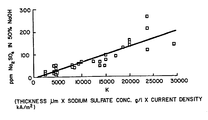
- a process has now been found for reducing the transport rate of sulfate through ion-exchange membranes when sulfate-containing brine is electrolyzed in a membrane cell. It has been found that the transport rate of sulfate through a membrane increases with the current density through the membrane and also increases with the thickness of the membrane. It has been further found that damage to membranes caused by sulfate can be minimized if the thickness of the membrane (T), the concentration of sodium sulfate in the brine (S) and the current density (CD) in the operating cell are all maintained within certain limits.
- the essential features of the invention are the subject-matter of independent claim 1; preferred features are set out in the dependent claims 2-6.
- the cation exchange membranes used in this invention are known in the art and are prepared from perfluorinated polymers which have carboxylic acid and/or sulfonic acid functional groups.
- Perfluorinated polymers having carboxylic acid functional groups and from which cation exchange membranes can be prepared are disclosed in U.S. 3,852,326, U.S. 3,506,635, U.S. 4,267,364, U.S. 3,641,104, U.S. 4,178,218, U.S. 4,116,888, U.S. 4,065,366, U.S. 4,138,426, British 2,053,902A, British 1,518,387 and U.S. 4,487,668.
- Perfluorinated polymers having sulfonic acid functional groups and from which cation-exchange membranes can be prepared are disclosed in U.S. 3,718,627, U.S. 3,282,875 and British 2,053,902A.
- a laminar film of two or more layers in making the membrane.
- the membrane may be unreinforced, but for dimensional stability and greater notched tear resistance, membranes are commonly reinforced with a material such as polytetrafluoroethylene or a copolymer of tetrafluoroethylene perfluoro(propyl vinyl ether).
- the membranes may also be modified on either or both surfaces so as to have enhanced gas release properties, for example, by providing optimum surface roughness or, preferably, by providing thereon a gas- and liquid-permeable porous non-electrode layer.
- suitable cation-exchange membranes are those sold as Nafion® perfluorinated membranes by E. I. du Pont de Nemours and Company.
- variable T the thickness of the membrane film
- T is by convention the thickness of the film in the melt processible state, i.e., before the carboxyl and sulfonyl side chains are hydrolyzed to the sodium or potassium salt form. If the membrane surface is to be modified, e.g., by roughening or by coating, T must be measured prior to such modification.
- the open area of fabric, a can be measured in a number of ways. It is possible to make actual measurements and calculations from a magnified picture of the membrane. Alternatively, one can measure the light transmission through a membrane and calculate a by comparison with light transmission through a sample without fabric reinforcement.
- Fabric thickness, t is preferably measured on the fabric before the fabric is laminated with the polymer membrane. Alternatively, one can cut the membrane and microscopically measure the fabric thickness at the crossover point of two yarns.
- relatively thin membranes i.e., membranes for which T is in the range of about 50 to 200 ⁇ m, preferably about 75 to 150 ⁇ m.
- the concentration of sulfate ion in the brine feed, S can vary from negligible amounts (e.g. less than 1 gram/liter) to as high as 50 grams/liter. Since the advantage of this invention is that it enables one to use brine with a high sulfate content, it is preferred that the sulfate content be at least about 10 g/I to 15 g/l.
- the current density, CD, of a membrane is expressed in kA/m 2 of membrane active area. It is desirable, for reasons of economy, to operate a cell at the highest current density possible. Usually, this is in the range of about 1 to 6 kA/m 2 . In order to electrolyze brine solutions with high sulfate content, it is preferred that the CD be in the range of about 1 to 3 kA/m 2 .
- the process of this invention can be operated within a broad range of exit brine concentrations, e.g., about 100 to 220 g/I.
- exit brine concentration will generally be within the range of 170-210 g/I.
- caustic concentration on sulfate transport also appears to be minor in comparison with the factors cited above.
- the process of this invention is operable within a broad range of caustic concentrations, e.g., about 20-42% caustic. Sulfate transport does not appear to be much of a problem at caustic concentrations below 20%. Typical caustic concentrations in commercial operations are about 32-35%.
- a series of five bilayer membranes varying in total film thickness from 80 ⁇ m to 240 11 m was prepared.
- the laminates contained as a major component a layer of copolymer of TFE and PSEPVE of 1080 EW and as a minor component a layer of TFE and EVE of 1050 EW.
- a coating of Zr0 2 particles and a functional binder as taught in U.S. 4,437,951 was applied to the TFE/EVE layer which is the cathode side of the membrane.
- the three membranes can be identified as follows:
- the film thickness is 200 ⁇ m
- the fabric thickness (t) is 200 ⁇ m
- the open area (a) is .68, leading to a corrected T value of 264.
- the average decay rate for four cell tests operated for 100+ days was 0.008% CE/day. This would extrapolate to a current efficiency decline of 5.8% over a two-year period. This is an acceptable rate of decline representing an average performance of about 92-93% over the expected two-year lifetime of the membrane.
- Duplicate cell tests declined from 95% to 93% current efficiency (CE) in 24 days compared to 94.6% for a control (no sulfate). This is a current efficiency decline of 0.066% CE/day attributable to sulfate damage and indicates an unacceptable rate of performance decline since this would extrapolate to a 48% decrease in two years.
- the membranes were examined microscopically and found to have significant damage to the cathode surface of the type characteristic of sulfate damage.
- the membrane used was similar to that described above as membrane A except that it was coated on the cathode side with Zr0 2 particles and a functional binder as taught in U.S. 4,437,951.
- the membrane was operated in a test cell at 3.1 kA/m 2 with a feed brine containing 10 g/l Na 2 SO 4 .
- K 4340 .
- the current efficiency/decline averaged 0.003% CE/day. This extrapolates to only 2.2% CE decline in two years. Examination of the used membrane showed no evidence of sulfate precipitation damage.
- the film thickness is 125 pm
- the fabric thickness is 75 ⁇ m
- the open area is .82, leading to a corrected T value of 138.5.
- the membranes were operated in laboratory test cells for 200 days at 3.1 kA/m 2 current density with a feed brine containing 10 g/I Na 2 SO 4 . Thus K is 5200.
- the average current efficiency decline over this period was 0.5% compared to controls which had negligible amounts of sodium sulfate in the brine feed. This represents a decline of 0.0025% CE/day or a total of 1.8% CE in two years. Examination of the used membrane from this test showed no evidence of sulfate precipitation damage.
Landscapes
- Chemical & Material Sciences (AREA)
- Inorganic Chemistry (AREA)
- Engineering & Computer Science (AREA)
- Chemical Kinetics & Catalysis (AREA)
- Electrochemistry (AREA)
- Materials Engineering (AREA)
- Metallurgy (AREA)
- Organic Chemistry (AREA)
- Electrolytic Production Of Non-Metals, Compounds, Apparatuses Therefor (AREA)
- Meat, Egg Or Seafood Products (AREA)
Claims (6)
Priority Applications (1)
| Application Number | Priority Date | Filing Date | Title |
|---|---|---|---|
| AT86300511T ATE44164T1 (de) | 1985-01-28 | 1986-01-27 | Verfahren zur elektrolyse einer sulfat enthaltenden salzloesung. |
Applications Claiming Priority (2)
| Application Number | Priority Date | Filing Date | Title |
|---|---|---|---|
| US06/695,247 US4722772A (en) | 1985-01-28 | 1985-01-28 | Process for electrolysis of sulfate-containing brine |
| US695247 | 2000-10-25 |
Publications (2)
| Publication Number | Publication Date |
|---|---|
| EP0196741A1 EP0196741A1 (de) | 1986-10-08 |
| EP0196741B1 true EP0196741B1 (de) | 1989-06-21 |
Family
ID=24792226
Family Applications (1)
| Application Number | Title | Priority Date | Filing Date |
|---|---|---|---|
| EP86300511A Expired EP0196741B1 (de) | 1985-01-28 | 1986-01-27 | Verfahren zur Elektrolyse einer Sulfat enthaltenden Salzlösung |
Country Status (8)
| Country | Link |
|---|---|
| US (1) | US4722772A (de) |
| EP (1) | EP0196741B1 (de) |
| JP (1) | JPS61194189A (de) |
| AT (1) | ATE44164T1 (de) |
| AU (1) | AU575707B2 (de) |
| BR (1) | BR8600245A (de) |
| CA (1) | CA1283624C (de) |
| DE (1) | DE3664057D1 (de) |
Families Citing this family (2)
| Publication number | Priority date | Publication date | Assignee | Title |
|---|---|---|---|---|
| ES2044762B1 (es) * | 1991-08-05 | 1994-09-01 | Aragonesas Energ & Ind | Procedimiento integrado para el aprovechamiento de las purgas de salmuera en la fabricacion de cloro-sosa, por combinacion de la tecnologia de membranas y la de catodo de mercurio. |
| US5650060A (en) * | 1994-01-28 | 1997-07-22 | Minnesota Mining And Manufacturing Company | Ionically conductive agent, system for cathodic protection of galvanically active metals, and method and apparatus for using same |
Family Cites Families (18)
| Publication number | Priority date | Publication date | Assignee | Title |
|---|---|---|---|---|
| CA528331A (en) * | 1956-07-24 | C. Davis Walter | Production of caustic soda | |
| US2902418A (en) * | 1959-03-10 | 1959-09-01 | Morton Salt Co | Preparation of pure sodium chloride brines |
| US3017245A (en) * | 1960-01-14 | 1962-01-16 | Dow Chemical Co | Removal of sodium sulfate from caustic salt |
| JPS5341555B2 (de) * | 1972-06-30 | 1978-11-04 | ||
| US4169023A (en) * | 1974-02-04 | 1979-09-25 | Tokuyama Soda Kabushiki Kaisha | Electrolytic diaphragms, and method of electrolysis using the same |
| JPS551351B2 (de) * | 1974-03-07 | 1980-01-12 | ||
| DE2450259B2 (de) * | 1974-10-23 | 1979-03-29 | Bayer Ag, 5090 Leverkusen | Verfahren zur Reinigung von Elektrolysesole |
| JPS529700A (en) * | 1975-07-15 | 1977-01-25 | Asahi Chem Ind Co Ltd | Manufacturing method of high purity caustic soda solution |
| DE2609828A1 (de) * | 1976-03-10 | 1977-09-15 | Bayer Ag | Verfahren zur reinigung von elektrolysesolen fuer diaphragmazellen |
| DE2709728C2 (de) * | 1977-03-05 | 1981-10-29 | Bayer Ag, 5090 Leverkusen | Verfahren zur Herstellung von Chlor und Alkalihydroxid durch Elektrolyse unter Einsatz von calcium- und/oder sulfathaltigem Rohsalz |
| JPS5460294A (en) * | 1977-10-21 | 1979-05-15 | Asahi Glass Co Ltd | Electrolysis of aqueous alkali chrolide |
| US4146445A (en) * | 1977-12-27 | 1979-03-27 | Hooker Chemicals & Plastics Corp. | Method of electrolytically producing a purified alkali metal hydroxide solution |
| JPS5946316B2 (ja) * | 1978-12-28 | 1984-11-12 | 鐘淵化学工業株式会社 | 電解法 |
| JPS5633488A (en) * | 1979-08-22 | 1981-04-03 | Asahi Glass Co Ltd | Method for electrolysis of aqueous solution of alkali chloride |
| JPS5647576A (en) * | 1979-09-27 | 1981-04-30 | Tokuyama Soda Co Ltd | Preparation of sodium sulphate, sodium hydroxide and chlorine from mixed solution of sodium chloride and sodium sulphate |
| US4323437A (en) * | 1981-02-09 | 1982-04-06 | Fmc Corporation | Treatment of brine |
| US4410404A (en) * | 1981-06-26 | 1983-10-18 | Diamond Shamrock Corporation | Membrane cell at increased caustic concentration |
| US4488949A (en) * | 1981-10-02 | 1984-12-18 | The Dow Chemical Company | Removal of sulfate ions from brine |
-
1985
- 1985-01-28 US US06/695,247 patent/US4722772A/en not_active Expired - Lifetime
-
1986
- 1986-01-21 CA CA000499936A patent/CA1283624C/en not_active Expired - Lifetime
- 1986-01-22 BR BR8600245A patent/BR8600245A/pt not_active IP Right Cessation
- 1986-01-23 AU AU52674/86A patent/AU575707B2/en not_active Ceased
- 1986-01-24 JP JP61012284A patent/JPS61194189A/ja active Granted
- 1986-01-27 EP EP86300511A patent/EP0196741B1/de not_active Expired
- 1986-01-27 DE DE8686300511T patent/DE3664057D1/de not_active Expired
- 1986-01-27 AT AT86300511T patent/ATE44164T1/de not_active IP Right Cessation
Also Published As
| Publication number | Publication date |
|---|---|
| AU575707B2 (en) | 1988-08-04 |
| EP0196741A1 (de) | 1986-10-08 |
| JPS6252034B2 (de) | 1987-11-02 |
| JPS61194189A (ja) | 1986-08-28 |
| ATE44164T1 (de) | 1989-07-15 |
| US4722772A (en) | 1988-02-02 |
| AU5267486A (en) | 1986-07-31 |
| DE3664057D1 (en) | 1989-07-27 |
| CA1283624C (en) | 1991-04-30 |
| BR8600245A (pt) | 1986-09-30 |
Similar Documents
| Publication | Publication Date | Title |
|---|---|---|
| US4478695A (en) | Sulfonic acid electrolytic cell membranes and use thereof in the electrolysis of sodium chloride | |
| US4358545A (en) | Sulfonic acid electrolytic cell having flourinated polymer membrane with hydration product less than 22,000 | |
| US4417969A (en) | Sulfonic acid electrolytic cell membranes | |
| US4470889A (en) | Electrolytic cell having an improved ion exchange membrane and process for operating | |
| KR840001538B1 (ko) | 불소화 혼성막 | |
| US4062753A (en) | Electrolysis method and apparatus | |
| IL40630A (en) | Electrolytic production of high purity alkali metal hydroxide | |
| EP3444384B1 (de) | Ionenaustauschmembran für die alkalichloridelektrolyse, verfahren zu ihrer herstellung und apparatur für die alkalichloridelektrolyse | |
| CA1073847A (en) | Method of operating a three compartment electrolytic cell for the production of alkali metal hydroxides | |
| EP0229321B1 (de) | Verfahren zur Herstellung von Alkalimetallhydroxid und Elektrolysezelle dafür | |
| EP0753534A2 (de) | Kationenaustauschermembran für Elektrolyse und Verfahren zur Herstellung von hochreinem Kaliumhydroxyd | |
| EP0196741B1 (de) | Verfahren zur Elektrolyse einer Sulfat enthaltenden Salzlösung | |
| JPS59100278A (ja) | ナロ−・ギヤツプガス電極型電解槽 | |
| US4313805A (en) | Chlorine cell catholyte series flow | |
| US4584071A (en) | Process for electrolysis of brine with iodide impurities | |
| EP0057065B1 (de) | Herstellung einer Kationenaustauschermembran und diese Membran enthaltende Elektrolysezelle | |
| EP0093114B1 (de) | Kationaustauschmembran mit einer komponente hohen äquivalentgewichts | |
| US4276130A (en) | Process for the production of high purity aqueous alkali hydroxide solution | |
| US4648949A (en) | Process for electrolysis of silica-containing brine | |
| US5512143A (en) | Electrolysis method using polymer additive for membrane cell operation where the polymer additive is ionomeric and added to the catholyte | |
| Jorné | The Anolyte Diffusion Layer and Its Effect on Hydroxyl Transport Through Nafion Membrane in Chlor‐Alkali Cell | |
| JPH0470399B2 (de) | ||
| CA1059942A (en) | Process and apparatus for electrolysis | |
| Tanaka | Electrolysis | |
| CN101775617A (zh) | 一种含氟离子交换膜及其在制碱工业中的应用 |
Legal Events
| Date | Code | Title | Description |
|---|---|---|---|
| PUAI | Public reference made under article 153(3) epc to a published international application that has entered the european phase |
Free format text: ORIGINAL CODE: 0009012 |
|
| 17P | Request for examination filed |
Effective date: 19860725 |
|
| AK | Designated contracting states |
Kind code of ref document: A1 Designated state(s): AT BE CH DE FR GB IT LI LU NL SE |
|
| 17Q | First examination report despatched |
Effective date: 19870810 |
|
| GRAA | (expected) grant |
Free format text: ORIGINAL CODE: 0009210 |
|
| AK | Designated contracting states |
Kind code of ref document: B1 Designated state(s): AT BE CH DE FR GB IT LI LU NL SE |
|
| REF | Corresponds to: |
Ref document number: 44164 Country of ref document: AT Date of ref document: 19890715 Kind code of ref document: T |
|
| ITF | It: translation for a ep patent filed | ||
| REF | Corresponds to: |
Ref document number: 3664057 Country of ref document: DE Date of ref document: 19890727 |
|
| ET | Fr: translation filed | ||
| PLBE | No opposition filed within time limit |
Free format text: ORIGINAL CODE: 0009261 |
|
| 26N | No opposition filed | ||
| ITTA | It: last paid annual fee | ||
| PGFP | Annual fee paid to national office [announced via postgrant information from national office to epo] |
Ref country code: FR Payment date: 19911202 Year of fee payment: 7 Ref country code: CH Payment date: 19911202 Year of fee payment: 7 |
|
| PGFP | Annual fee paid to national office [announced via postgrant information from national office to epo] |
Ref country code: BE Payment date: 19911227 Year of fee payment: 7 |
|
| PGFP | Annual fee paid to national office [announced via postgrant information from national office to epo] |
Ref country code: GB Payment date: 19911230 Year of fee payment: 7 |
|
| PGFP | Annual fee paid to national office [announced via postgrant information from national office to epo] |
Ref country code: AT Payment date: 19920102 Year of fee payment: 7 |
|
| PGFP | Annual fee paid to national office [announced via postgrant information from national office to epo] |
Ref country code: LU Payment date: 19920106 Year of fee payment: 7 |
|
| PGFP | Annual fee paid to national office [announced via postgrant information from national office to epo] |
Ref country code: SE Payment date: 19920107 Year of fee payment: 7 |
|
| PGFP | Annual fee paid to national office [announced via postgrant information from national office to epo] |
Ref country code: NL Payment date: 19920131 Year of fee payment: 7 |
|
| EPTA | Lu: last paid annual fee | ||
| PG25 | Lapsed in a contracting state [announced via postgrant information from national office to epo] |
Ref country code: LU Free format text: LAPSE BECAUSE OF NON-PAYMENT OF DUE FEES Effective date: 19930127 Ref country code: GB Effective date: 19930127 Ref country code: AT Effective date: 19930127 |
|
| PG25 | Lapsed in a contracting state [announced via postgrant information from national office to epo] |
Ref country code: SE Effective date: 19930128 |
|
| PG25 | Lapsed in a contracting state [announced via postgrant information from national office to epo] |
Ref country code: LI Effective date: 19930131 Ref country code: CH Effective date: 19930131 Ref country code: BE Effective date: 19930131 |
|
| BERE | Be: lapsed |
Owner name: E.I. DU PONT DE NEMOURS AND CY Effective date: 19930131 |
|
| PG25 | Lapsed in a contracting state [announced via postgrant information from national office to epo] |
Ref country code: NL Effective date: 19930801 |
|
| NLV4 | Nl: lapsed or anulled due to non-payment of the annual fee | ||
| GBPC | Gb: european patent ceased through non-payment of renewal fee |
Effective date: 19930127 |
|
| PG25 | Lapsed in a contracting state [announced via postgrant information from national office to epo] |
Ref country code: FR Effective date: 19930930 |
|
| REG | Reference to a national code |
Ref country code: CH Ref legal event code: PL |
|
| REG | Reference to a national code |
Ref country code: FR Ref legal event code: ST |
|
| EUG | Se: european patent has lapsed |
Ref document number: 86300511.2 Effective date: 19930810 |
|
| PGFP | Annual fee paid to national office [announced via postgrant information from national office to epo] |
Ref country code: DE Payment date: 19961210 Year of fee payment: 12 |
|
| PG25 | Lapsed in a contracting state [announced via postgrant information from national office to epo] |
Ref country code: DE Free format text: LAPSE BECAUSE OF NON-PAYMENT OF DUE FEES Effective date: 19981001 |
|
| PG25 | Lapsed in a contracting state [announced via postgrant information from national office to epo] |
Ref country code: IT Free format text: LAPSE BECAUSE OF NON-PAYMENT OF DUE FEES;WARNING: LAPSES OF ITALIAN PATENTS WITH EFFECTIVE DATE BEFORE 2007 MAY HAVE OCCURRED AT ANY TIME BEFORE 2007. THE CORRECT EFFECTIVE DATE MAY BE DIFFERENT FROM THE ONE RECORDED. Effective date: 20050127 |