EP0196836B1 - Abschreckmittel für Metalle - Google Patents
Abschreckmittel für Metalle Download PDFInfo
- Publication number
- EP0196836B1 EP0196836B1 EP86302092A EP86302092A EP0196836B1 EP 0196836 B1 EP0196836 B1 EP 0196836B1 EP 86302092 A EP86302092 A EP 86302092A EP 86302092 A EP86302092 A EP 86302092A EP 0196836 B1 EP0196836 B1 EP 0196836B1
- Authority
- EP
- European Patent Office
- Prior art keywords
- quenchant
- metal
- quenchants
- oxazoline polymer
- polyoxyalkylene glycol
- Prior art date
- Legal status (The legal status is an assumption and is not a legal conclusion. Google has not performed a legal analysis and makes no representation as to the accuracy of the status listed.)
- Expired
Links
- 229910052751 metal Inorganic materials 0.000 title claims abstract description 27
- 239000002184 metal Substances 0.000 title claims abstract description 27
- LYCAIKOWRPUZTN-UHFFFAOYSA-N Ethylene glycol Chemical compound OCCO LYCAIKOWRPUZTN-UHFFFAOYSA-N 0.000 claims abstract description 40
- IMSODMZESSGVBE-UHFFFAOYSA-N 2-Oxazoline Chemical compound C1CN=CO1 IMSODMZESSGVBE-UHFFFAOYSA-N 0.000 claims abstract description 23
- 229920000642 polymer Polymers 0.000 claims abstract description 23
- WGCNASOHLSPBMP-UHFFFAOYSA-N hydroxyacetaldehyde Natural products OCC=O WGCNASOHLSPBMP-UHFFFAOYSA-N 0.000 claims abstract description 20
- 229910000831 Steel Inorganic materials 0.000 claims abstract description 17
- 239000010959 steel Substances 0.000 claims abstract description 17
- 238000010791 quenching Methods 0.000 claims abstract description 11
- 230000000171 quenching effect Effects 0.000 claims abstract description 10
- 239000007864 aqueous solution Substances 0.000 claims abstract description 7
- 150000002739 metals Chemical class 0.000 claims abstract description 5
- XLYOFNOQVPJJNP-UHFFFAOYSA-N water Substances O XLYOFNOQVPJJNP-UHFFFAOYSA-N 0.000 claims description 13
- 238000000034 method Methods 0.000 claims description 9
- 229910045601 alloy Inorganic materials 0.000 claims description 8
- 239000000956 alloy Substances 0.000 claims description 8
- 229920006187 aquazol Polymers 0.000 claims description 7
- 238000010438 heat treatment Methods 0.000 claims description 7
- 230000008569 process Effects 0.000 claims description 6
- 239000012141 concentrate Substances 0.000 claims description 5
- 125000000816 ethylene group Chemical group [H]C([H])([*:1])C([H])([H])[*:2] 0.000 claims description 3
- 238000005266 casting Methods 0.000 claims description 2
- 239000000203 mixture Substances 0.000 claims description 2
- 125000000217 alkyl group Chemical group 0.000 claims 1
- 229920001515 polyalkylene glycol Polymers 0.000 claims 1
- 239000000523 sample Substances 0.000 description 8
- 238000001816 cooling Methods 0.000 description 6
- 229910001566 austenite Inorganic materials 0.000 description 5
- 229910000734 martensite Inorganic materials 0.000 description 5
- 230000009466 transformation Effects 0.000 description 5
- 230000000052 comparative effect Effects 0.000 description 4
- 230000035882 stress Effects 0.000 description 4
- 239000012861 aquazol Substances 0.000 description 3
- LFQSCWFLJHTTHZ-UHFFFAOYSA-N Ethanol Chemical compound CCO LFQSCWFLJHTTHZ-UHFFFAOYSA-N 0.000 description 2
- IAYPIBMASNFSPL-UHFFFAOYSA-N Ethylene oxide Chemical compound C1CO1 IAYPIBMASNFSPL-UHFFFAOYSA-N 0.000 description 2
- 229920001577 copolymer Polymers 0.000 description 2
- 230000007423 decrease Effects 0.000 description 2
- 125000001997 phenyl group Chemical group [H]C1=C([H])C([H])=C(*)C([H])=C1[H] 0.000 description 2
- -1 poly(oxyethylene)(oxypropylene) Polymers 0.000 description 2
- LPXPTNMVRIOKMN-UHFFFAOYSA-M sodium nitrite Chemical compound [Na+].[O-]N=O LPXPTNMVRIOKMN-UHFFFAOYSA-M 0.000 description 2
- 230000007704 transition Effects 0.000 description 2
- 125000006273 (C1-C3) alkyl group Chemical group 0.000 description 1
- GOOHAUXETOMSMM-UHFFFAOYSA-N Propylene oxide Chemical compound CC1CO1 GOOHAUXETOMSMM-UHFFFAOYSA-N 0.000 description 1
- 239000003139 biocide Substances 0.000 description 1
- 229920001400 block copolymer Polymers 0.000 description 1
- 125000000484 butyl group Chemical group [H]C([*])([H])C([H])([H])C([H])([H])C([H])([H])[H] 0.000 description 1
- 239000003054 catalyst Substances 0.000 description 1
- VNNRSPGTAMTISX-UHFFFAOYSA-N chromium nickel Chemical compound [Cr].[Ni] VNNRSPGTAMTISX-UHFFFAOYSA-N 0.000 description 1
- 230000007797 corrosion Effects 0.000 description 1
- 238000005260 corrosion Methods 0.000 description 1
- 238000010790 dilution Methods 0.000 description 1
- 239000012895 dilution Substances 0.000 description 1
- 150000002009 diols Chemical class 0.000 description 1
- 230000000694 effects Effects 0.000 description 1
- 125000001495 ethyl group Chemical group [H]C([H])([H])C([H])([H])* 0.000 description 1
- 239000012530 fluid Substances 0.000 description 1
- 229920001519 homopolymer Polymers 0.000 description 1
- 229910001026 inconel Inorganic materials 0.000 description 1
- 239000003112 inhibitor Substances 0.000 description 1
- 125000000959 isobutyl group Chemical group [H]C([H])([H])C([H])(C([H])([H])[H])C([H])([H])* 0.000 description 1
- 239000007788 liquid Substances 0.000 description 1
- 238000002844 melting Methods 0.000 description 1
- 230000008018 melting Effects 0.000 description 1
- 239000006078 metal deactivator Substances 0.000 description 1
- 125000002496 methyl group Chemical group [H]C([H])([H])* 0.000 description 1
- 238000012986 modification Methods 0.000 description 1
- 230000004048 modification Effects 0.000 description 1
- 239000000178 monomer Substances 0.000 description 1
- 229910001120 nichrome Inorganic materials 0.000 description 1
- 125000000962 organic group Chemical group 0.000 description 1
- 150000002918 oxazolines Chemical class 0.000 description 1
- 230000000704 physical effect Effects 0.000 description 1
- 125000001436 propyl group Chemical group [H]C([*])([H])C([H])([H])C([H])([H])[H] 0.000 description 1
- 229920005604 random copolymer Polymers 0.000 description 1
- 235000010288 sodium nitrite Nutrition 0.000 description 1
- 239000007858 starting material Substances 0.000 description 1
- 230000008646 thermal stress Effects 0.000 description 1
- 238000011282 treatment Methods 0.000 description 1
Images



Classifications
-
- C—CHEMISTRY; METALLURGY
- C21—METALLURGY OF IRON
- C21D—MODIFYING THE PHYSICAL STRUCTURE OF FERROUS METALS; GENERAL DEVICES FOR HEAT TREATMENT OF FERROUS OR NON-FERROUS METALS OR ALLOYS; MAKING METAL MALLEABLE, e.g. BY DECARBURISATION OR TEMPERING
- C21D1/00—General methods or devices for heat treatment, e.g. annealing, hardening, quenching or tempering
- C21D1/56—General methods or devices for heat treatment, e.g. annealing, hardening, quenching or tempering characterised by the quenching agents
- C21D1/60—Aqueous agents
Definitions
- the present invention relates to metal quenchants which are used in the heat treatment of metals.
- the present invention relates to novel metal quenchants containing oxazoline polymers and to heat treatment processes which employ such metal quenchants.
- Transformation stresses in steels arise because during quenching, the steel transforms from a high temperature stable Austenite phase having one structure to a low temperature stable Martensite phase having a different physical structure. Since the Austenite phase is denser than the Martensite phase the overall effect of the transformation is to cause the metal to expand. If however the steel is quenched to rapidly, transformation of Austenite to Martensite occurs initially at the metal surface only, resulting in a steel having regimes of the Martensite phase surrounding the Austenite phase. Subsequent transformation of the residual Austenite phase then generates surface tensile stresses in the cold steel thereby increasing the likelihood that the steel will crack or deform.
- oil can be used as an alternative to water.
- oil quenches metal at a slower rate than water does, it suffers from the disadvantages of (1) being flammable and (2) of being prone to faul the metal surface. It is desirable, therefore, to produce a quenchant having quenchant properties similar to those of oil without the associated drawbacks.
- US 4,486,246 discloses an aqueous based metal quenchant fluid which has properties more comparable with oil than water while avoiding flammability and fouling problems.
- the quenchant comprises an aqueous solution of a nonionic water-soluble or water-dispersable sub-' stituted oxazoline polymer having recurring units of the formula -[N(COR)CH 2 CH 2] - where R is an organic radical.
- the quenchants are claimed to be of lower viscosity than, for example, aqueous polyoxyalkylene quenchants such as are described in US 3,220,893.
- the present invention provides a quenchant for use in the heat treatment of metals or alloys characterised in that the quenchant comprises an aqueous solution of a polyoxyalkylene glycol and an oxazoline polymer.
- poly(oxyethylene)(oxypropylene) glycol this is suitably a poly(oxyethylene)(oxypropylene) glycol, known in the art as a PAG, made by polymerising ethylene oxide and propylene oxide on an alcohol or polyfunctional alcohol starter.
- the poly(oxyethylene)oxypropylene)glycol can be either a random or block copolymer.
- the polyoxyalkylene glycol should preferably have a viscosity in the range 15-30,000 centi- stokes at 40°C (corresponding to a molecular weight in the range 10,000-20,000).
- the polyoxyalkylene glycol suitably constitutes between 2 and 25% by weight of the quenchant preferably between 5 and 20%.
- oxazoline polymers which can be used in the quenchants of the present invention have been disclosed in US 4,486,246. These oxazoline polymers are water soluble or water dispersable and are suitably constructed of units having the formula -[N(COR)CH 2 CH 2] - where R is an organic group selected from the group consisting of substituted or unsaturated phenyl groups and C l -C 7 alkyl groups. It is preferable that the oxazoline polymer has a molecular weight in the range 5000-1,000,000 most preferably 50,000-750,000 and that at least 50% of the R groups are a C 1 -C 3 alkyl groups.
- R groups include methyl, ethyl, propyl, butyl, isobutyl, phenyl and substituted, e.g. halogenated and alkoxylated, derivatives thereof.
- the oxazoline polymer may be either a homopolymer or a copolymer made from one or more types of the units mentioned.
- Oxazoline polymers can be prepared by polymerising unsaturated oxazoline monomers under an inert atmosphere in the presence of a catalyst. A method which may be used to carry out a polymerisation is described in US 3,483,141. Certain oxazoline polymers, e.g. polyethyloxazoline, are commercially available.
- the oxazoline polymer should be present in the quenchant in amounts corresponding to between 0.1 and 5% by weight of the quenchant. Preferably between 0.5 and 2% by weight oxazoline polymer should be used.
- the rate of quenching decreases as the concentration of the oxazoline polymer in the quenchant increases.
- rate of quenching decreases as the concentration of polyoxyalkylene glycol in the quenchant increases.
- the presence of large quantities of polyoxyalkylene glycol should be avoided if possible, however, in order to avoid the quenchant becoming too viscous.
- components described above may optionally be added to improve the performance of the quenchant.
- Such components include corrosion inhibitors, for example sodium nitrite and alkanolamines, defoamers, biocides and metal deactivators.
- the quenchants of the present invention are particularly suitable for the quenching of steels and especially so far those which have been heated above their Austenite-Martensite transition temperature. The exact temperature of this transition will depend upon the exact composition of the steel.
- the quenching is carried out by immersing an ingot or casting of the hot steel in a large bath or vat of the quenchant. Once the steel is cool, it is removed and washed to remove any quenchant adhering to it.
- the quenchants of the present invention may be supplied to those who use it as an aqueous solution. However it may also be supplied in the form of a concentrate comprising the polyoxyalkylene glycol and the oxazoline polymer which is suitable for dilution with water immediately prior to use. Suitably, such concentrates have polyoxyalkylene glycol to oxazoline polymer weight ratios in the range 1:2.5-250:1 preferably 2.5:1-40:1.
- a probe manufactured of lnconel 600 (Inconel is a registered trade mark), which was 60 mm long and 12.5 mm in diameter was heated to 850°C and soaked at temperature for 5 minutes. The temperature of the probe was measured by means of an NiCr/NiAI thermocouple mounted at the geometric centre of the probe.
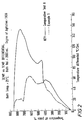
- Example 1 The method used in Example 1 was followed except that water was used in place of the polyoxyalkylene glycol in the quenchant. Time-temperature and temperature-temperature differential plots are also shown in Figure 1.
- Example 1 The method of Example 1 was repeated except that 2% by weight PEOX was used.
- the time-temperature and temperature-temperature differential plots are shown in Figures 3 and 4 respectively.
- Example was repeated except that the PEOX was omitted from the quenchant.
- the time-temperature and temperature-temperature differential plots are shown in Figures 3 and 4 respectively.
- Example 1 was repeated except that a sample of a cold quenching oil after a period of industrial service was used as quenchant.
- the time-temperature and temperature-temperature differential plots are shown in Figures 3 and 4 respectively.
- Figures 3 and 4 show that the quenchants of the present invention are more oil-like in their behaviour than the polyoxyalkylene glycol/water or the oil quenchants of the prior art. Hence the quenchants of the better invention will be better for cooling steels and the like.
Landscapes
- Chemical & Material Sciences (AREA)
- Engineering & Computer Science (AREA)
- Materials Engineering (AREA)
- Thermal Sciences (AREA)
- Crystallography & Structural Chemistry (AREA)
- Mechanical Engineering (AREA)
- Physics & Mathematics (AREA)
- Metallurgy (AREA)
- Organic Chemistry (AREA)
- Superconductors And Manufacturing Methods Therefor (AREA)
- Manufacture And Refinement Of Metals (AREA)
- Macromolecular Compounds Obtained By Forming Nitrogen-Containing Linkages In General (AREA)
- Organic Low-Molecular-Weight Compounds And Preparation Thereof (AREA)
Claims (10)
Priority Applications (1)
| Application Number | Priority Date | Filing Date | Title |
|---|---|---|---|
| AT86302092T ATE42768T1 (de) | 1985-03-29 | 1986-03-21 | Abschreckmittel fuer metalle. |
Applications Claiming Priority (2)
| Application Number | Priority Date | Filing Date | Title |
|---|---|---|---|
| GB8508317 | 1985-03-29 | ||
| GB858508317A GB8508317D0 (en) | 1985-03-29 | 1985-03-29 | Metal quenchants |
Publications (2)
| Publication Number | Publication Date |
|---|---|
| EP0196836A1 EP0196836A1 (de) | 1986-10-08 |
| EP0196836B1 true EP0196836B1 (de) | 1989-05-03 |
Family
ID=10576920
Family Applications (1)
| Application Number | Title | Priority Date | Filing Date |
|---|---|---|---|
| EP86302092A Expired EP0196836B1 (de) | 1985-03-29 | 1986-03-21 | Abschreckmittel für Metalle |
Country Status (4)
| Country | Link |
|---|---|
| EP (1) | EP0196836B1 (de) |
| AT (1) | ATE42768T1 (de) |
| DE (1) | DE3663149D1 (de) |
| GB (1) | GB8508317D0 (de) |
Families Citing this family (1)
| Publication number | Priority date | Publication date | Assignee | Title |
|---|---|---|---|---|
| CN102643963B (zh) * | 2012-05-09 | 2014-05-07 | 上海福岛化工科技发展有限公司 | 环保水溶性淬火液 |
Family Cites Families (3)
| Publication number | Priority date | Publication date | Assignee | Title |
|---|---|---|---|---|
| US3220893A (en) * | 1963-11-29 | 1965-11-30 | Union Carbide Corp | Metal quenching medium |
| US3483141A (en) * | 1964-07-13 | 1969-12-09 | Allied Chem | Carbon-nitrogen backbone chain polymers |
| US4486246A (en) * | 1983-05-18 | 1984-12-04 | E. F. Houghton & Co. | Polyoxazolines in aqueous quenchants |
-
1985
- 1985-03-29 GB GB858508317A patent/GB8508317D0/en active Pending
-
1986
- 1986-03-21 EP EP86302092A patent/EP0196836B1/de not_active Expired
- 1986-03-21 AT AT86302092T patent/ATE42768T1/de not_active IP Right Cessation
- 1986-03-21 DE DE8686302092T patent/DE3663149D1/de not_active Expired
Also Published As
| Publication number | Publication date |
|---|---|
| DE3663149D1 (en) | 1989-06-08 |
| GB8508317D0 (en) | 1985-05-09 |
| EP0196836A1 (de) | 1986-10-08 |
| ATE42768T1 (de) | 1989-05-15 |
Similar Documents
| Publication | Publication Date | Title |
|---|---|---|
| CA1225009A (en) | Polyoxazolines in aqueous quenchants | |
| US4087290A (en) | Process for the controlled cooling of ferrous metal | |
| CA1038735A (en) | Method of quenching | |
| US3220893A (en) | Metal quenching medium | |
| EP0179545B1 (de) | Polyoxazolin und N-vinylheterocyclische Polymere enthaltende wässrige Abschreckflüssigkeiten | |
| US4381205A (en) | Metal quenching process | |
| CA1197444A (en) | Method of quenching | |
| EP0196836B1 (de) | Abschreckmittel für Metalle | |
| EP0206347B1 (de) | Abschreckverfahren | |
| JP3824695B2 (ja) | 水溶性焼入剤の冷却特性回復方法及び冷却特性が回復した水溶性焼入剤 | |
| EP3751012A1 (de) | Abschreckmittel | |
| Totten et al. | Quenching Fundamentals: Stability & Drag-Out of Polymers. | |
| USRE33445E (en) | Method of quenching | |
| Totten | Polymer quenchants for induction heat treating applications: the basics | |
| JPH0470366B2 (de) | ||
| US3236684A (en) | Alloy diffusion coating process | |
| Prabhu et al. | Polymer Quenchants for Industrial Heat Treatment | |
| SU1296603A1 (ru) | Среда дл закалки сталей | |
| SU1294845A1 (ru) | Способ термической обработки крупногабаритных изделий | |
| SU863670A1 (ru) | Способ закалки изделий | |
| SU1016377A1 (ru) | Закалочна среда | |
| SU1516496A1 (ru) | Способ изотермической закалки изделий | |
| SU761579A1 (ru) | Закалочная среда 1 | |
| JPH09104925A (ja) | 中・高炭素含有鋼管の焼入れ方法 | |
| SU817074A1 (ru) | Закалочна среда |
Legal Events
| Date | Code | Title | Description |
|---|---|---|---|
| PUAI | Public reference made under article 153(3) epc to a published international application that has entered the european phase |
Free format text: ORIGINAL CODE: 0009012 |
|
| AK | Designated contracting states |
Kind code of ref document: A1 Designated state(s): AT BE CH DE FR GB IT LI NL SE |
|
| 17P | Request for examination filed |
Effective date: 19870309 |
|
| 17Q | First examination report despatched |
Effective date: 19880601 |
|
| GRAA | (expected) grant |
Free format text: ORIGINAL CODE: 0009210 |
|
| AK | Designated contracting states |
Kind code of ref document: B1 Designated state(s): AT BE CH DE FR GB IT LI NL SE |
|
| REF | Corresponds to: |
Ref document number: 42768 Country of ref document: AT Date of ref document: 19890515 Kind code of ref document: T |
|
| ITF | It: translation for a ep patent filed | ||
| REF | Corresponds to: |
Ref document number: 3663149 Country of ref document: DE Date of ref document: 19890608 |
|
| ET | Fr: translation filed | ||
| PLBE | No opposition filed within time limit |
Free format text: ORIGINAL CODE: 0009261 |
|
| STAA | Information on the status of an ep patent application or granted ep patent |
Free format text: STATUS: NO OPPOSITION FILED WITHIN TIME LIMIT |
|
| 26N | No opposition filed | ||
| ITTA | It: last paid annual fee | ||
| REG | Reference to a national code |
Ref country code: GB Ref legal event code: 732E |
|
| ITPR | It: changes in ownership of a european patent |
Owner name: CESSIONE;INTERNATIONAL SPECIALITY CHEMICALS LIMITE |
|
| REG | Reference to a national code |
Ref country code: FR Ref legal event code: TP |
|
| BECA | Be: change of holder's address |
Free format text: 940726 *INTERNATIONAL SPECIALITY CHEMICALS LTD:CHARLESTON INDUSTRIAL ESTATE, HYTHE GB-SOUTHAMPTON S04 6ZG |
|
| NLS | Nl: assignments of ep-patents |
Owner name: INTERNATIONAL SPECIALTY CHEMICALS LIMITED TE SOUTH |
|
| EAL | Se: european patent in force in sweden |
Ref document number: 86302092.1 |
|
| REG | Reference to a national code |
Ref country code: CH Ref legal event code: PUE Owner name: INTERNATIONAL SPECIALITY CHEMICALS LIMITED |
|
| PGFP | Annual fee paid to national office [announced via postgrant information from national office to epo] |
Ref country code: NL Payment date: 19990209 Year of fee payment: 14 |
|
| PGFP | Annual fee paid to national office [announced via postgrant information from national office to epo] |
Ref country code: FR Payment date: 19990212 Year of fee payment: 14 Ref country code: DE Payment date: 19990212 Year of fee payment: 14 |
|
| PGFP | Annual fee paid to national office [announced via postgrant information from national office to epo] |
Ref country code: SE Payment date: 19990215 Year of fee payment: 14 |
|
| PGFP | Annual fee paid to national office [announced via postgrant information from national office to epo] |
Ref country code: GB Payment date: 19990217 Year of fee payment: 14 |
|
| PGFP | Annual fee paid to national office [announced via postgrant information from national office to epo] |
Ref country code: CH Payment date: 19990222 Year of fee payment: 14 |
|
| PGFP | Annual fee paid to national office [announced via postgrant information from national office to epo] |
Ref country code: AT Payment date: 19990331 Year of fee payment: 14 |
|
| PGFP | Annual fee paid to national office [announced via postgrant information from national office to epo] |
Ref country code: BE Payment date: 19990407 Year of fee payment: 14 |
|
| PG25 | Lapsed in a contracting state [announced via postgrant information from national office to epo] |
Ref country code: GB Free format text: LAPSE BECAUSE OF NON-PAYMENT OF DUE FEES Effective date: 20000321 Ref country code: AT Free format text: LAPSE BECAUSE OF NON-PAYMENT OF DUE FEES Effective date: 20000321 |
|
| PG25 | Lapsed in a contracting state [announced via postgrant information from national office to epo] |
Ref country code: SE Free format text: LAPSE BECAUSE OF NON-PAYMENT OF DUE FEES Effective date: 20000322 |
|
| PG25 | Lapsed in a contracting state [announced via postgrant information from national office to epo] |
Ref country code: LI Free format text: LAPSE BECAUSE OF NON-PAYMENT OF DUE FEES Effective date: 20000331 Ref country code: CH Free format text: LAPSE BECAUSE OF NON-PAYMENT OF DUE FEES Effective date: 20000331 Ref country code: BE Free format text: LAPSE BECAUSE OF NON-PAYMENT OF DUE FEES Effective date: 20000331 |
|
| BERE | Be: lapsed |
Owner name: INTERNATIONAL SPECIALITY CHEMICALS LTD Effective date: 20000331 |
|
| PG25 | Lapsed in a contracting state [announced via postgrant information from national office to epo] |
Ref country code: NL Free format text: LAPSE BECAUSE OF NON-PAYMENT OF DUE FEES Effective date: 20001001 |
|
| EUG | Se: european patent has lapsed |
Ref document number: 86302092.1 |
|
| GBPC | Gb: european patent ceased through non-payment of renewal fee |
Effective date: 20000321 |
|
| REG | Reference to a national code |
Ref country code: CH Ref legal event code: PL |
|
| PG25 | Lapsed in a contracting state [announced via postgrant information from national office to epo] |
Ref country code: FR Free format text: LAPSE BECAUSE OF NON-PAYMENT OF DUE FEES Effective date: 20001130 |
|
| NLV4 | Nl: lapsed or anulled due to non-payment of the annual fee |
Effective date: 20001001 |
|
| REG | Reference to a national code |
Ref country code: FR Ref legal event code: ST |
|
| PG25 | Lapsed in a contracting state [announced via postgrant information from national office to epo] |
Ref country code: DE Free format text: LAPSE BECAUSE OF NON-PAYMENT OF DUE FEES Effective date: 20010103 |
|
| PG25 | Lapsed in a contracting state [announced via postgrant information from national office to epo] |
Ref country code: IT Free format text: LAPSE BECAUSE OF NON-PAYMENT OF DUE FEES;WARNING: LAPSES OF ITALIAN PATENTS WITH EFFECTIVE DATE BEFORE 2007 MAY HAVE OCCURRED AT ANY TIME BEFORE 2007. THE CORRECT EFFECTIVE DATE MAY BE DIFFERENT FROM THE ONE RECORDED. Effective date: 20050321 |