EP0197395A2 - Verstärkte Kautschukmischungen, Verfahren zu ihrer Herstellung und ihre Verwendung - Google Patents
Verstärkte Kautschukmischungen, Verfahren zu ihrer Herstellung und ihre Verwendung Download PDFInfo
- Publication number
- EP0197395A2 EP0197395A2 EP86103888A EP86103888A EP0197395A2 EP 0197395 A2 EP0197395 A2 EP 0197395A2 EP 86103888 A EP86103888 A EP 86103888A EP 86103888 A EP86103888 A EP 86103888A EP 0197395 A2 EP0197395 A2 EP 0197395A2
- Authority
- EP
- European Patent Office
- Prior art keywords
- rubber
- weight
- nitrile
- mixture
- curing agent
- Prior art date
- Legal status (The legal status is an assumption and is not a legal conclusion. Google has not performed a legal analysis and makes no representation as to the accuracy of the status listed.)
- Granted
Links
Classifications
-
- C—CHEMISTRY; METALLURGY
- C08—ORGANIC MACROMOLECULAR COMPOUNDS; THEIR PREPARATION OR CHEMICAL WORKING-UP; COMPOSITIONS BASED THEREON
- C08L—COMPOSITIONS OF MACROMOLECULAR COMPOUNDS
- C08L21/00—Compositions of unspecified rubbers
-
- C—CHEMISTRY; METALLURGY
- C08—ORGANIC MACROMOLECULAR COMPOUNDS; THEIR PREPARATION OR CHEMICAL WORKING-UP; COMPOSITIONS BASED THEREON
- C08L—COMPOSITIONS OF MACROMOLECULAR COMPOUNDS
- C08L61/00—Compositions of condensation polymers of aldehydes or ketones; Compositions of derivatives of such polymers
-
- C—CHEMISTRY; METALLURGY
- C08—ORGANIC MACROMOLECULAR COMPOUNDS; THEIR PREPARATION OR CHEMICAL WORKING-UP; COMPOSITIONS BASED THEREON
- C08L—COMPOSITIONS OF MACROMOLECULAR COMPOUNDS
- C08L61/00—Compositions of condensation polymers of aldehydes or ketones; Compositions of derivatives of such polymers
- C08L61/04—Condensation polymers of aldehydes or ketones with phenols only
- C08L61/06—Condensation polymers of aldehydes or ketones with phenols only of aldehydes with phenols
-
- Y—GENERAL TAGGING OF NEW TECHNOLOGICAL DEVELOPMENTS; GENERAL TAGGING OF CROSS-SECTIONAL TECHNOLOGIES SPANNING OVER SEVERAL SECTIONS OF THE IPC; TECHNICAL SUBJECTS COVERED BY FORMER USPC CROSS-REFERENCE ART COLLECTIONS [XRACs] AND DIGESTS
- Y10—TECHNICAL SUBJECTS COVERED BY FORMER USPC
- Y10T—TECHNICAL SUBJECTS COVERED BY FORMER US CLASSIFICATION
- Y10T152/00—Resilient tires and wheels
- Y10T152/10—Tires, resilient
-
- Y—GENERAL TAGGING OF NEW TECHNOLOGICAL DEVELOPMENTS; GENERAL TAGGING OF CROSS-SECTIONAL TECHNOLOGIES SPANNING OVER SEVERAL SECTIONS OF THE IPC; TECHNICAL SUBJECTS COVERED BY FORMER USPC CROSS-REFERENCE ART COLLECTIONS [XRACs] AND DIGESTS
- Y10—TECHNICAL SUBJECTS COVERED BY FORMER USPC
- Y10T—TECHNICAL SUBJECTS COVERED BY FORMER US CLASSIFICATION
- Y10T428/00—Stock material or miscellaneous articles
- Y10T428/13—Hollow or container type article [e.g., tube, vase, etc.]
- Y10T428/1352—Polymer or resin containing [i.e., natural or synthetic]
- Y10T428/1386—Natural or synthetic rubber or rubber-like compound containing
Definitions
- nitrile rubber is used as the elastomer base
- an unmodified novolak based on unsubstituted phenol can be achieved by curing with 10% hexamethylenetetramine, based on the resin-hardener mixture, a quantity of this hardener that is generally used in rubber reinforcement worse reinforcing effect than with lower, about half as high dosages of the curing agent.
- other criteria must therefore be responsible.
- a leather-hard rubber mixture is known from US Pat. No. 4,383,072 which can be used to produce a so-called "composite profile" which is produced by extrusion and vulcanization of two different rubber qualities.
- the leather-hard mixture is composed of 20 to 50 parts by weight of a polar rubber that splits off acid groups under vulcanization conditions, such as polychloroprene (CR), chlorosulfonated polyethylene (CSM) or chlorinated polyethylene and 60 to 80 parts by weight of a non-polar rubber that does not belong to these groups splits off e.g. Natural or Butadiene rubber.
- CR polychloroprene
- CSM chlorosulfonated polyethylene
- the publication also refers to nitrile rubber as a non-polar rubber type.
- the invention relates to a reinforced rubber mixture of A) at least one natural, styrene-butadiene-polybutadiene, polyisoprene, transpolyoctenylene, ethylene-propylene-diene terpolymer and butyl rubber, B) at least one novolak resin and / or reactive polyphenol, C) hardening agents and, if appropriate, D) customary additives, which is characterized in that the rubber mixture as additional component E) comprises at least one polar, chlorine-free rubber in the form of nitrile rubber with at least 32% nitrile content or polyurethane rubber in a proportion by weight of 1 to 49, preferably 2 to 39, in particular 3 to 30% by weight, based on the total amount of rubber.
- a reduction in the amount of soot which in the vulcanizates with a high degree of reinforcement that have been customary up to now must generally be well above 60 parts by weight, based on 100 parts by weight of rubber, means a reduction in the energy requirement during the mixing process and better processability, e.g. in extrusion.
- a reduction in the amount of soot also results in a reduction in the weight of corresponding finished parts or components of a finished product, which e.g. benefits for car tires.
- the invention also relates to a process for the preparation of the reinforced rubber mixtures and their use.
- Suitable reinforceable rubber types A) are, for example, natural rubber (NR), styrene-butadiene rubber (SBR), polybutadiene, polyisoprene, transpolyoctenylene-butyl rubber, ethylene-propylene-diene terpolymer rubber or mixtures thereof, as are usually used in the tire industry or for the production of technical products Rubber goods are used. Styrene-butadiene and natural rubber or mixtures of these types of rubber with minor amounts of other types of rubber are preferred. You can use any delivery form, e.g. as bales or powder and e.g. find application with soot.
- At least one polar, chlorine-free rubber e.g. Nitrile rubber (NBR) - (copolymer of acrylonitrile with butadiene or isoprene) or polyurethane rubber (PU) is used.
- NBR Nitrile rubber
- PU polyurethane rubber
- the use of NBR rubber i.e. a copolymer consisting predominantly of acrylonitrile and butadiene with an acrylonitrile content of at least 32 and generally not more than 60, preferably not more than 50% by weight. Mixtures of the individual rubber types, e.g. the various nitrile rubbers can be used.
- the polar chlorine-free rubber can be in the usual delivery form and, in the process according to the invention, can either be incorporated directly into the rubber mixture or as a modifier in the reinforcing resin or another mixture component, e.g. a master batch.
- a modifier for the resin it can e.g. be physically admixed to it in a known manner or else be attached to the reinforcing resin by chemical bonding.
- Resins B) suitable for reinforcing rubber are generally phenol novolaks or other active polyphenols or multinuclear phenols such as resorcinol, diphenylolpropane or methane or naphthols and analogous compounds.
- Particularly suitable novolak resins are, for example, those composed of phenol and / or polyvalent mono- or multinuclear phenols, such as resorcinol, bisphenols, eg diphenylolpropane and / or diphenylolmethane, or mono- or polyvalent phenols substituted with a hydrocarbon group, such as alkyl- or aralkylphenols, with eg 1 to 20, preferably 4 to 18 carbon atoms in the substituent, such as tert.
- a hydrocarbon group such as alkyl- or aralkylphenols, with eg 1 to 20, preferably 4 to 18 carbon atoms in the substituent, such as tert.
- Phenolic resins modified with inorganic constituents can also be used to reinforce rubber, for example types modified with silicon, aluminum or boron compounds.
- the novolaks can also contain plasticizing components, such as polyethylene glycols, tall oil or other conventional plasticizers.
- novolaks can also be used exclusively from phenols substituted with hydrocarbon groups and carrying an alkyl group of 1 to 20 carbon atoms; this applies in particular to those with an alkyl radical having, for example, 1 to 4 carbon atoms in the m position to the phenolic hydroxyl group.
- Novolaks from such phenols alone, which contain a substituent in the ortho or para position, are only of limited use, since they are less easily curable. They are therefore preferably used in mixtures with trifunctional phenols, such as m-Kre sol, but especially with phenol.
- trifunctional phenols denotes those in which the ortho and para positions to the phenolic hydroxyl groups are accessible for reactions with aldehydes.
- the phenol component of the novolaks may have additions of phenols containing several alkyl groups, the amount of which is, for example, up to 20 mol%.
- the proportion of substituted phenols in the novolak can vary, although the novolak should still be curable. In general, the proportion of the non-trifunctional phenols in the total content of the phenols is not more than 80, preferably not more than 65 mol%.
- any formaldehyde-releasing and / or free or etherified methylol group-containing compounds can be used as hardener C), e.g. Amine resins such as urea resins or benzoguanamine resins. However, preference is given to hexamethylenetetramine (hereinafter referred to as "hexa”) and melamine resins, the latter in the form of non-or partially or largely etherified and possibly more highly condensed multinuclear products.
- the degree of condensation of the aldehyde, especially formaldehyde resins and their content of free methylol groups can vary within further limits.
- the free methylol groups can be etherified with monohydric alcohols having 1 to 12, preferably 1 to 8, carbon atoms, such as methanol, ethanol, the various propanols, butanols, hexanols, octanols, such as ethylhexanol and n-octanol, nonanols, dodecyl alcohol.
- monohydric alcohols having 1 to 12, preferably 1 to 8, carbon atoms, such as methanol, ethanol, the various propanols, butanols, hexanols, octanols, such as ethylhexanol and n-octanol, nonanols, dodecyl alcohol.
- monohydric alcohols having 1 to 12, preferably 1 to 8, carbon atoms, such as methanol, ethanol, the various propanols, butanols, hexano
- the optimum amounts of curing agent required to cure the Novolak resins must be determined in preliminary tests which are easy to carry out. In general, about 2 to 60, preferably 5 to 50% by weight of melamine resin or 2 to 30, preferably 2 to 25% by weight of hexamethylenetetramine, based on novolak, are used.
- Common additives D are fillers, vulcanizing agents, accelerators, activators and processing aids.
- kaolins, chalk and / or other conventional materials and pigments can also be used as fillers.
- carbon black is particularly preferred.
- the use of fillers is completely or largely dispensed with (e.g. in transparent mixtures).
- Oils or plasticizers can be used as processing aids, the amount by weight of which can also be above 10% by weight, based on the rubber used, in order to achieve special effects.
- the vulcanization can take place without sulfur and with vulcanization resins. Vulcanization in the presence of sulfur is preferred. Their course can be adapted to practical requirements by selecting suitable accelerators, activators and regulators customary in rubber technology. Furthermore, anti-aging agents are advantageously added to improve the properties of the vulcanizates.
- the starting mixtures used according to the invention can be prepared in a conventional manner in an internal mixer or on mixing rollers.
- the resins When the resins are incorporated, it may be advantageous if the mixing temperature exceeds the melting point of the resins in any phase of the preparation of the mixture, but formulations in which the mixing temperature is below the melting point after the addition of the resins may also achieve higher hardnesses. It is also important that the hardening agents are incorporated in such a way that there is no premature self-condensation or premature reaction with the novolak to be hardened. This is possible if the hardening agents are incorporated at the end of the mixing process at temperatures that are not too high (generally at 80 to 120 ° C.).
- the vulcanizates obtained according to the invention can e.g. used as technical rubber goods such as damping elements, rubber sleeves, pads, conveyor belts but also for tires.
- the mixtures according to the invention can also be used in the layers which must have good adhesion to inlaid fabrics or braids.
- adhesion promoters such as cobalt or other metal compounds and / or combinations of silicic acid, resorcinol and hardening agent can additionally be used.
- the accelerators (a) and (b) were used in amounts of 1 T or 0.2 T and 2 T sulfur and in the test series 7 only 1 T phenyl-ß-naphthylamine as an anti-aging agent .
- the formulation according to the invention according to Example 1 contains natural rubber, NBR rubber and a reinforcing resin with hexa as the curing agent, while the comparative tests A, B and C accordingly comprise natural rubber alone, natural rubber and resin with curing agent, and natural rubber and nitrile rubber.
- Test series 2 (examples 2 to 5, comparisons D and E)
- test series 1 The phenolic novolak and the rubber types of test series 1 were used.
- the formulations according to the invention of Examples 2 to 5 show, in comparison to unreinforced or resin-containing mixtures D or E, an analogous result to test series 1.
- the highest reinforcing effect with 20 parts by weight of resin addition (resin + hardener) is in the range from 5 to 10% nitrile rubber -Share found in the elastomer mixture, while with 2.5% nitrile rubber share already high hardnesses, but still no increased stress values are obtained.
- the results when using a nitrile chew Schuk-modified phenolic resin (Example 5) practically do not differ from those in the separate mixing of nitrile rubber and phenolic resin (Example 4).
- a commercial novolak with a melting range of 83 to 88 ° C (capillary method DIN 53 736) and a viscosity at 20 ° C of 170 to 250 mPa.s (40% in ethylene glycol monoethyl ether) was used in this test series.
- example 6 compared to comparative experiments F and G, a proportion of 5 parts by weight of natural rubber was replaced according to the invention by a commercially available NBR rubber with 34% acrylonitrile content from example 1.
- comparison test H 5 parts by weight of a commercially available chloroprene rubber (Neoprene AC soft from Du Pont) was used instead of 5 parts by weight of natural rubber. The doses of resin and hardener were reduced in half compared to test series 1 and 2.
- the comparative test G shows the reinforcing effect of the resin system compared to the resin-free formulation F due to the increased tension values and the hardness. Only slightly better results are obtained with the comparison mixture H, so that the low effectiveness of the polychloroprene addition on the reinforcement is evident. However, the test values in Example 6 are significantly higher for the hardness and the tension values when nitrile rubber is used in the rubber mixture.
- Example 8 1 part by weight of benzoic acid was used as an additional accelerator for resin crosslinking.
- a commercially available polyurethane rubber (Desmocoll 400 from Bayer AG) was also used as the polar rubber in Example 8.
- Comparative experiment 1 contains no polar rubber, while in comparative experiment J 5 parts by weight of natural rubber are replaced by chlorosulfonated polyethylene (Hypalon 20 from Du Pont). In these examples with a different curing agent, the significantly higher 'strengthening effect of the formulations according to the invention compared to comparative experiments I and J can be seen.
- the addition of chlorosulfonated polyethylene according to comparative test J has no reinforcing effect compared to a pure natural rubber formulation according to comparative test 1.
- Test series 5 (example 9 and comparisons K to M)
- the commercially available styrene butadiene rubber. with 23.5% by weight bound styrene (BUNA 1620 from Huls AG) was in the form of a masterbatch with carbon black (100: 50 parts by weight).
- the same novolak as in test series 3 was used as the phenolic resin and a commercially available type with 34% by weight of acrylonitrile content as in the previous examples was used as the nitrile rubber.
- the comparative test L showed an increase in the stress values compared to the comparative test K, but no increase in hardness.
- Example 9 shows a significantly greater increase in the tension values and the hardness of the vulcanizates compared to the comparisons K, L and M.
- the measurement results reach surprisingly high values.
- Test series 6 (examples 10 and 11 and comparisons L, N and 0)
- Example 10 shows, the combined use of NBR rubber (34% nitrile content) and the reinforcing resin system consisting of recorcinol and hexa leads to significantly higher chips value and hardening as the sole use of one of these two components in the SBR rubber according to comparative experiments L and N. Furthermore, example 11 shows that the use of polyurethane rubber instead of NBR rubber without addition of resin according to comparison 0 only a small, with simultaneous addition of resin gives a high reinforcing effect.
- Test series 7 (example 12 and comparison P to S)
- test series the same NBR rubber and phenolic novolak as in test series 3 were used and, in addition to carbon black, precipitated silica was used as the filler.
- the mixture according to the invention shows according to example 12, compared to comparison S, the tension values are still over 30% higher (up to 100% elongation) and the hardness is 13 units higher.
- Test series 8 (examples 13, 14 and 15 as comparisons T, U and V)
- NR and NBR rubber at least 32% acrylonitrile content with phenolic novolak and hexa, soot-filled
- the reinforcement without addition of resin is low, in experiment V using phenolic novolak significantly higher.
- NBR rubber additives lead to an even higher reinforcing effect in parallel with the increasing acrylonitrile content.
- the hardness increases from 79 units according to test V by 8 units to 87, when using NBR rubber with 32% acrylonitrile content, and when using NBR rubber with 38% acrylonitrile content, even 12 units to 91.
- Correspondingly good values also become the method according to the invention obtained at the stress values at 10% elongation.
- Test series 9 and 10 (examples 16 -21 and comparisons W -Z)
- Tables 1 to 10 below show the mixing ratios of the individual test series and the test results obtained.
Landscapes
- Chemical & Material Sciences (AREA)
- Health & Medical Sciences (AREA)
- Chemical Kinetics & Catalysis (AREA)
- Medicinal Chemistry (AREA)
- Polymers & Plastics (AREA)
- Organic Chemistry (AREA)
- Compositions Of Macromolecular Compounds (AREA)
Abstract
Description
- Es ist Stand der Technik, Mischungen aus Natur-und/oder Synthesekautschuk durch Zusatz von härtenden Kunstharzen, insbesondere Phenolharzen zu verstärken. Bei der Herstellung der Mischungen, vorzugsweise aber während der Vukanisation gehen die zugegebenen Harze in den vernetzten Zustand über und verbessern dabei einige wichtige mechanische Eigenschaften der Vulkanisate, z.B. die Härte und die Spannungswerte. Im allgemeinen verwendet man als verstärkend wirkende Phenolharze Produkte vom Novofak-Typ, d.h. thermoplastische, schmelzbare Harze, die durch Zusatz von Härtungsmitteln zur Vernetzung gebracht werden können. Als Härtungsmittel werden Formaldehyd abspaltende bzw. über Methylen-oder Methylolgruppen reagierende Substanzen wie Hexamethylentetramin und Methylolgruppen enthaltende teil-bzw. vollverätherte Melamin-und Harnstoffharze eingesetzt. Auf diese Weise lassen sich harzverstärkte Gummimischungen auf Basis von Natur-, Styrolbutadien-, Polybutadien-Kautschuk und anderen synthetischen Kautschuktypen herstellen.
- Wird Nitrilkautschuk als Elastomerbasis zugrunde gelegt, erreicht-man bei Einsatz eines unmodifizierten Novolaks auf Grundlage von unsubstituiertem Phenol durch Härtung mit 10 % Hexamethylentetramin, bezogen auf das Harz-Härter-Gemisch, einer im allgemeinen bei der Kautschukverstärkung üblicherweise verwendeten Menge dieses Härters, einen deutlich schlechteren Verstärkungseffekt als bei niedrigeren, etwa halb so hohen Dosierungen des Härtungsmittels. Zur Erzielung einer optimalen Verstärkerwirkung von Nitrilkautschuk müssen daher andere Kriterien verantwortlich sein.
- Aus der US-PS 4,383,072 ist eine lederharte Kautschukmischung bekannt, die zur Herstellung eines sogenannten "Verbundprofils" verwendet werden kann, das durch gemeinsame Extrusion und Vulkanisation von zwei verschiedenen Gummiqualitäten angefertigt wird. Die lederharte Mischung setzt sich zusammen aus 20 bis 50 Gewichtsteilen eines polaren Kautschukes, der unter Vulkanisationsbedingungen Säuregruppen abspaltet, wie Polychloropren (CR), chlorsulfoniertes Polyethylen (CSM) oder chloriertes Polyethylen und 60 bis 80 Gewichtsteilen eines nicht-polaren Kautschuks, der diese Gruppen nicht abspaltet z.B. Natur-bzw. Butadien-Kautschuk. Als nicht-polarer Kautschuktyp wird in der Veröffentlichung auch Nitrilkautschuk bezeichnet. Der Zusatz der angeführten säureabspaltenden chlorhaltigen Kautschuke ist für die Erzielung besonderer gewünschter Eigenschaften wie Porenfreiheit, Härte, Zähigkeit und Splitterbeständigkeit erforderlich. Diese Mischungen sind daher auf ein enges Spezialgebiet beschränkt, sie können aber nicht zur Herstellung von vielen technischen Gummiwaren z.B. Reifen eingesetzt werden.
- In einer Firmenschift der Fa. Hooker Chemical Corporation, USA, mit dem Titel "Durez Resins for the Rubber Industry", Ausgabe 1968 ist erwähnt worden, daß der Ersatz von einem Teil eines SBR-Kautschuks durch Acrylnitrilkautschuk in phenolharzverstärkten, nicht mit Ruß gefüllten Gummimischungen zu einer höheren Härte und besseren Spannungswerten führt. Als Acrylnitrilkautschuk wird gemäß dieser Literaturstelle ein Typ mit 31% Acrylnitrilgehalt eingesetzt.
- Überraschenderweise wurde nun gefunden, daß verstärkende Phenolharzsysteme bei der Vulkanisation von Mischungen auf Basis von unpolaren Kautschuken, z.B. Natur-oder Styrol-Butadien-Kautschuk in Gegenwart von chlorfreien, polaren Polymeren, d.h. Kautschuk wie Nitrilkautschuk und zwar mit mindestens 32% Acrylnitrilgehalt, Polyurethankautschuk einen wesentlich höheren Verstärkungseffekt bewirken als bei Abwesenheit der polaren Kautschukypen oder bei Einsatz von Nitrilkautschuktypen mit bis zu 31% Acrylnitrilgehalt.
- Gegenstand der Erfindung ist eine verstärkte Kautschukmischung aus A) mindestens einem Natur-, Styrolbutadien-Polybutadien-, Polyisopren-, Transpolyoctenylen-, Ethylen-Propylen-Dien-Terpolymer-und Butylkautschuk, B) mindestens einem Novolak-Harz und/oder reaktivem Polyphenol, C) Härtungsmitteln und gegebenenfalls D) üblichen Zusatzstoffen, die dadurch gekennzeichnet ist, daß die Kautschukmischung als zusätzliche Komponente E) mindestens einen polaren, chlorfreien Kautschuk in Form von Nitrilkautschuk mit mindestens 32% Nitrilgehalt oder Polyurethankautschuk in einem Gewichtsanteil von 1 bis 49, vorzugsweise 2 bis 39, insbesondere 3 bis 30 Gew.- %, bezogen auf die Gesamtmenge an Kautschuk enthält.
- Mit Hilfe der Erfindung lassen sich nun Gummimischungen mit einer optimalen Harzvemetzung auf Basis von Natur-kautschuk und/oder anderen unpolaren Kautschuktypen. herstellen, die infolge des Zusatzes von polaren, chiorfreieh Kautschukarten und einem Verstärkerharzsystem noch höhere Härten und Spannungswerte aufweisen als bei alleiniger Verwendung des Verstärkerharzsystems. Die Möglichkeit zur Steigerung des Verstärkungseffektes an einer Gummimischung beispielsweise ohne Erhöhung der Anteile der bisher üblicherweise eingesetzten, verstärkend wirkenden Komponenten wie Ruß-oder Phenolharzsystemen oder ohne Änderung der Art der verstärkenden Komponente z.B. der Einsatz von feinteiligem Ruß, der eine höhere Verstärkung bewirkt, ist unerwartet und war bisher nicht bekannt.
- Es war auch nicht zu erwarten, daß Zusätze von chlorhaltigen Polymeren, wie beispielsweise chlorsulfoniertem Polyethylen, überhaupt keine Verstärkerwirkung oder, wie Poly chloropren, eine deutlich geringere Verstärkung als Nitrilkautschuk ergeben. Der erfindungsgemäße Verstärkungseffekt beruht somit nicht auf dem Chlorgehalt und der Säureabspaltung der zugesetzten Kautschukomponenten, da lediglich chlorfreie Polymere, z.B. Nitril-und Polyurethan-Kautschuke die erwünschte hohe Verstärkung bewirken, sondern beispielsweise auf dem Acrylnitrilgehalt in einem Nitrilkautschuk.
- Als Vorteile ergeben sich somit Möglichkeiten zur Herstellung einer Gummimischung mit hoher Härte unter Verwendung geringerer Rußmengen als nach der bisherigen Arbeitsweise. Eine Reduzierung der Rußmenge, die bei den bisher üblichen Vulkanisaten mit hohem Verstärkungsgrad im allgemeinen deutlich über 60 Gewichtsteilen, bezogen auf 100 Gewichtsteile Kautschuk liegen muß, bedeutet aber eine Verringerung des Energiebedarfs beim Mischvorgang und eine bessere Verarbeitbarkeit, z.B. bei der Extrusion. Eine Verminderung der Rußmenge bewirkt daher aber auch eine Herabsetzung des Gewichts von entsprechenden Fertigteilen oder Komponenten eines Fertigproduktes, was z.B. für Autoreifen Vorteile mit sich bringt.
- Gegenstand der Erfindung ist auch ein Verfahren zur Herstellung der verstärkten Kautschukmischungen und deren Verwendung.
- Geeignete verstärkbare Kautschuktypen A) sind beispielsweise Naturkautschuk (NR), StyrolButadien-Kautschuk (SBR), Polybutadien, Polyisopren, Transpolyoctenylen-Butylkautschuk, Ethylen-Propylen-Dien-Terpolymer-Kautschuk oder deren Gemische, wie sie gewöhnlich in der Reifenindustrie oder zur Herstellung technischer Gummiwaren verwendet werden. StyolButadien-und Naturkautschuk oder Mischungen dieser Kautschuktypen mit untergeordneten Mengen an anderen Kautschuktypen sind bevorzugt. Sie können in beliebiger Lieferform, z.B. als Ballen oder Pulver sowie .z.B. mit Ruß Anwendung finden.
- Als Komponente E) wird bei der erfindungsgemäßen Mischung mindestens ein polarer, chlorfreier Kautschuk z.B. Nitrilkautschuk (NBR) - (Copolymer von Acrylnitril mit Butadien oder lsopren) oder Polyurethankautschuk (PU) eingesetzt. Besonders vorteilhaft ist die Verwendung von NBR-Kautschuk, d.h. einem Copolymeren, überwiegend bestehend aus Acrylnitril und Butadien mit einem Gehalt an Acrylnitril von mindestens 32 und im allgemeinen nicht mehr als 60, vorzugsweise nicht mehr als 50 Gew.-%. Auch Mischungen der einzelnen Kautschuktypen z.B. der verschiedenen Nitrilkautschuke können eingesetzt werden.
- Der polare chlorfreie Kautschuk kann in üblicher Lieferform vorliegen und bei dem erfindungsgemäßen Verfahren entweder direkt in die Kautschukmischung eingearbeitet werden oder als Modifizierungsmittel in dem Verstärkerharz oder einer anderen Mischungskomponente, z.B. einem Masterbatch, enthalten sein. Als Modifizierungsmittel für das Harz kann er z.B. auf bekannte Weise diesem physikalisch zugemischt werden oder aber durch chemische Bindung an das Verstärkerharz angelagert sein.
- Zur Verstärkung von Kautschuk geeignete Harze B) sind im allgemeinen Phenolnovolake oder andere aktive Polyphenole bzw. Mehrkernphenole wie Resorcin, Diphenylolpropan oder -methan bzw. Naphthole und analoge Verbindungen. Besonders geeignete Novolakharze sind z.B. solche, die aus Phenol und/oder mehrwertigen Ein-oder Mehrkernphenolen, wie Resorcin, Bisphenolen, z.B. Diphenylolpropan und/oder Diphenylolmethan, oder mit einer Kohlenwasserstoffgruppe substituierten ein-oder mehrwertigen Phenolen, wie Alkyl-oder Aralkylphenolen mit z.B. 1 bis 20, vorzugsweise 4 bis 18 C-Atomen im Substituenten, wie tert. Butylphenol, Octylphenol, Nonylphenol, Nierenbaum-(Cashew- )Nußschalenöl, styrolysiertem oder mit Fettsäuren, wie Leinölfettsäuren, modifiziertem Phenol, oder Phenylphenol und Aldehyden, wie Acetaldehyd, vorzugsweise aber Formaldehyd, im sauren Medium erhalten werden. Einsetzbar sind auch mit anorganischen Bestandteilen modifizierte Phenolharze zur Verstärkung von Kautschuk z.B. mit Silizium-, Aluminium-oder Bor-Verbindungen modifizierte Typen. Die Novolake können außerdem weichmachende Anteile, wie Polyethylenglykole, Tallöl oder andere übliche Plastifiziermittel enthalten. Grundsätzlich können auch Novolake ausschließlich aus mit Kohlenwasserstoffgruppen substituierten Phenolen, die eine Alkylgruppe von 1 bis 20 C-Atomen tragen, verwendet werden; dies gilt insbesondere für solche mit einem Alkylrest mit z.B. 1 bis 4 C-Atomen in m-Stellung zur phenolischen Hydroxylgruppe. Novolake aus solchen Phenolen allein, die einen Substituenten in ortho-oder para-Stellung enthalten, kommen jedoch nur bedingt in Frage, da sie weniger gut härtbar sind. Man verwendet diese daher bevorzugt in Mischungen mit trifunktionellen Phenolen, wie m-Kresol, insbesondere aber mit Phenol. Der Begriff "trifunktionelle Phenole" bezeichnet solche, in denen die ortho-und para-Stellungen zur phenolischen Hydroxylgruppen für Reaktionen mit Aldehyden zugänglich sind. Ferner kann die Phenolkomponente der Novolake Zusätze von mehrere Alkylgruppen enthaltenden Phenolen aufweisen, wobei deren Menge z.B. bis zu 20 Mol % beträgt. Für den praktischen Gebrauch sind Novolake aus Phenol sowie Gemischen aus Phenol und mit einer Kohlenwasserstoffgruppe substituierten Phenolen mit 4 bis 18 C-Atomen im Substituenten einschließlich Nierenbaum-Nußschalenöl bevorzugt. Der Anteil der substituierten Phenole im Novolak kann dabei variieren, wobei jedoch der Novolak noch härtbar sein soll. Im allgemeinen liegt der Anteil der nicht-trifunktionellen Phenole im Gesamtgehalt der Phenole nicht höher als 80, vorzugsweise nicht höher als 65 Mol %.
- Als Härter C) können beliebige Formaldehyd abspaltende und/oder freie oder veretherte Methylolgruppen enthaltende Verbindungen verwendet werden, z.B. Aminharze, wie Hamstoffharze oder Benzoguanaminharze. Bevorzugt sind aber Hexamethylentetramin (im nachfolgenden mit "Hexa" bezeichnet) sowie Melaminharze, letztere in Form von nicht bzw. teilweise oder weitgehend veretherten und ggf. höherkondensierten mehrkernigen Produkten. Der Kondensationsgrad der Aldehyd-, insbesondere Formaldehyd-Harze und ihr Gehalt an freien Methylolgruppen kann in weiteren Grenzen schwanken. Die freien Methylolgruppen können mit einwertigen Alkoholen mit 1 bis 12, vorzugsweise mit 1 bis 8 C-Atomen verethert sein, wie Methanol, Ethanol, den verschiedenen Propanolen, Butanolen, Hexanolen, Octanolen, wie Ethylhexanol und n-Octanol, Nonanolen, Dodecylalkohol. Verbreiteten Einsatz findet z.B. Hexamethoxymethylmelamin.
- Die zur Härtung der Novolak-Harze erforderlichen optimalen Mengen Härtungsmittel müssen in Vorversuchen, die einfach durchzuführen sind, ermittelt werden. Im allgemeinen werden etwa 2 bis 60, vorzugsweise 5 bis 50 Gew.-% Melaminharz oder 2 bis 30, vorzugsweise 2 bis 25 Gew.-% Hexamethylentetramin verwendet, bezogen auf Novolak.
- Übliche Zusatzstoffe D) sind Füllstoffe, Vulkanisationsmittel, Beschleuniger, Aktivatoren und Verarbeitungshilfsmittel.
- Als Füllstoffe können neben aktiven Rußen und Kieselsäuren auch Kaoline, Kreide und/oder andere übliche Materialien Einsatz finden sowie auch Pigmente. Der Einsatz von Ruß ist besonders bevorzugt. In manchen Fällen wird auf den Einsatz von Füllstoffen ganz oder weitgehend verzichtet (z.B. in transparenten Mischungen). Als Verarbeitungshilfsmittel können Öle oder Weichmacher verwendet werden, deren Gewichtsmenge zur Erzielung besonderer Effekte auch über 10 Gew.-%, bezogen auf eingesetztem Kautschuk liegen kann.
- Die Vulkanisation kann ohne Schwefel und mit Vulkanisationsharzen erfolgen. Die Vulkanisation in Gegenwart von Schwefel ist aber bevorzugt. Ihr Verlauf kann durch Auswahl geeigneter, in der Kautschuktechnologie üblicher Beschleuniger, Aktivatoren und Regler den praktischen Erfordernissen angepaßt werden. Ferner werden vorteilhaft noch Alterungsschutzmittel zur Verbesserung der Eigenschaften der Vulkanisate zugesetzt.
- Die erfindungsgemäß eingesetzten Ausgangsmischungen können in üblicher Weise in Innenmischem oder auf Mischwalzen hergestellt werden. Beim Einarbeiten der Harze kann es von Vorteil sein, wenn die Mischungstemperatur in irgendeiner Phase der Mischungsherstellung den Schmelzpunkt der Harze überschreitet, jedoch können ggf. auch ,Formulierungen, bei denen nach Zugabe der Harze die Mischtemperatur unterhalb des Schmelzpunktes beibt, höhere Härten erzielen. Ferner ist wichtig, daß die Härtungsmittel so eingearbeitet werden, daß es nicht zu einer vorzeitigen Eigenkondensation oder zu einer vorzeitigen Reaktion mit dem zu härtenden Novolak kommt. Das ist möglich, wenn die Härtungsmittel am Ende des Mischvorganges bei nicht zu hohen Temperaturen (im allgemeinen bei 80 bis 120°C) eingearbeitet werden.
- Die erfindungsgemäß erhaltenen Vulkanisate können z.B. als technische Gummiwaren wie Dämpfungselemente, Gummimanschetten, Beläge, Förderbänder aber auch für Reifen verwendet werden. Dabei kann der Einsatz der erfindungsgemäßen Mischungen auch in den Schichten erfolgen, die eine gute Haftung zu eingelegten Geweben oder Geflechten haben müssen. Zur Verbesserung der Haftung kann zusätzlich die Anwendung von Haftvermittlem wie Kobalt-oder anderen Metallverbindungen und/oder Kombinationen aus Kieselsäure, Resorcin und Härtungsmittel erfolgen.
- Die nachfolgend beschriebenen Versuche dienen zur Erläuterung der Zusammensetzung und der Eigenschaften der erfindungsgemäßen Gummimischungen. Es wurden Versuchsreihen mit rußfreien und rußhaltigen Formulierungen durchgeführt, wobei für die rußhaltigen Formulierungen jeweils ein Masterbatch aus dem entsprechenden Kautschuk mit 50 Gewichtsteilen Ruß, bezogen auf 100 Gewichtsteile Kautschuk verwendet wurde. Beim Mischvorgang wurden dann zum Kautschuk, bzw. zum Masterbatch die weiteren Komponenten in der Reihenfolge Stearinsäure, Zinkoxid, Alterungsschutzmittel, Schwefel und Phenolharz bei Temperaturen zwischen ca. 90 und 100°C und anschließend bei Temperaturen unter 100°C das Härtungsmittel und der Beschleuniger zugegeben.
- Nach der Vulkanisation, durchgeführt unter den bei der jeweiligen Versuchsserie angegebenen Bedingungen, wurden die erhaltenen Probekörper auf folgende Eigenschaften nach den in der Praxis üblichen Methoden untersucht:
- Reißfestigkeit, Reißdehnung und Spannungswerte
- (bei 10 % bis 300 % Dehnung) gemäß DIN 53 504,
- Härte Shore A nach DIN 53 505 und
- Rückprallelastizität nach DIN 53 512.
- Die in den Tabellen 1 bis 10 genannten Gummimischungen enthielten neben den dort angegebenen Komponenten folgende übliche Zusatzstoffe (in Gewichtsteilen):
- 1,5 T Stearinsäure
- 5 T Zinkoxid
- 1 T N-isopropyl-N-phenyl-p-phenylendiamin
- 1 T 2,2,4-Trimethyl-1,2-dihydrochinolin
- 2,5 T Schwefel
- 0,9 T Benzothiazol-2-cyclohexylsulfenamid (a)"
- 0,3 T Tetramethylthiurammonosulfid (b)**
- als Alterungsschutzmittel
- als Beschleuniger
- Zu den Versuchsreihen 5 und 6 wurden abweichend davon die Beschleuniger (a) bzw. (b) in Mengen von 1 T bzw. 0,2 T sowie 2 T Schwefel und in der Versuchsreihe 7 als Alterungsschutzmittel nur 1 T Phenyl-ß-naphthylamin eingesetzt.
- In den Beispielen beziehen sich die Mengenangaben stets auf Gewichtsteile und Gewichtsprozent.
- Beispiele:
- Versuchsreihe 1 (Beispiel 1, Vergleiche A, B und C)
- NR-und NBR-Kautschuk mit Phenolnovolak und Hexa, rußfrei
- Die erfindungsgemäße Formulierung nach Beispiel 1 enthält Naturkautschuk, NBR-Kautschuk und ein Verstärkerharz mit Hexa als Härtungmittel, während die Vergleichsversuche A, B und C entsprechend Naturkautschuk allein, Naturkautschuk und Harz mit Härtungsmittel sowie Naturkautschuk und Nitrilkautschuk aufweisen. Als Harz wurde ein handelsüblicher Phenolnovolak mit einem Schmelzbereich zwischen 60 und 80°C (Kapillar-Verfahren DIN 53 736) und einer Viskosität bei 20°C von 170 bis 220 mPa.s (40 %ig in Ethlyenglykolmonoethylether) verwendet und als Nitrilkautschuk ein handelsübliches Produkt mit 34 % Acrylnitrilgehalt.
- Aus der Tabelle 1 ist ersichtlich, daß sowohl der Nitrilkautschuk-Zusatz im Vergleich C als auch der Harzzusatz im Vergleich B zu einer Naturkautschuk-Gummimischung eine Steigerung der Härte und der Spannungswerte gegenüber dem Vergleich A, in der Naturkautschuk allein eingesetzt wurde, bewirkt, jedoch in beiden Fällen bei weitem nicht die Werte vom Beispiel 1 erreicht werden. Durch den Harzzusatz im Vergleich B werden beispielsweise die Spannungswerte bei 10 % bzw. 50 % Dehnung gegenüber reinem Naturkautschuk von 0,6 bzw. 0,8 MPa auf 0,9 bzw. 1,5 MPa und die Härte von 40 auf 44 Einheiten gesteigert. Überraschenderweise tritt aber in Beispiel 1 für die entsprechenden Spannungswerte eine Erhöhung auf 2,1 bzw. 3,2 MPa und für die Härte auf 58 gegenüber dem Vergleich A ein.
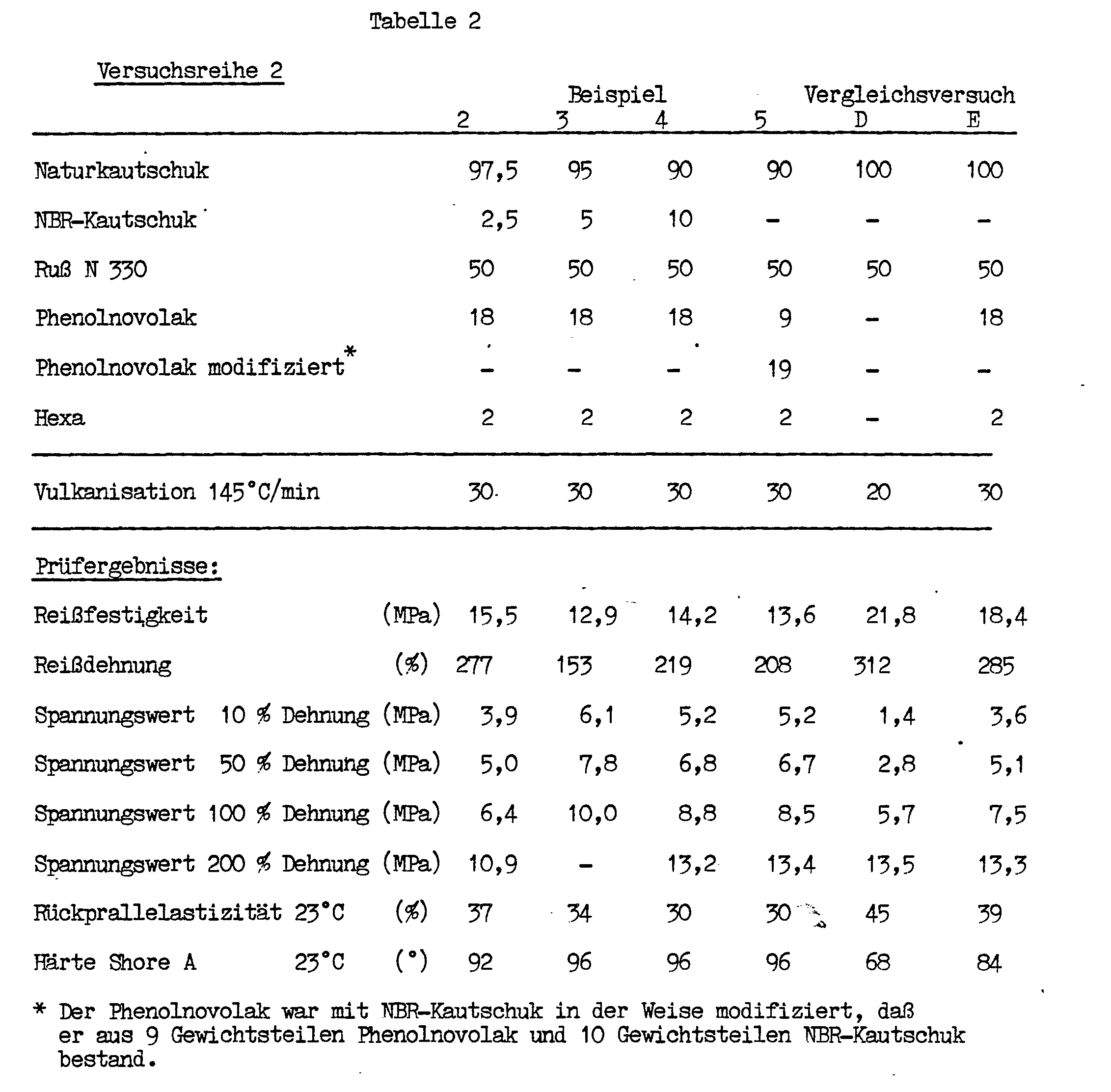
- Versuchsreihe 2 (Beispiel 2 bis 5, Vergleiche D und E)
- NR-und NBR-Kautschuk mit Phenolnovolak und Hexa, rußgefüllt
- Eingesetzt wurde der Phenolnovolak und die Kautschuktypen der Versuchsreihe 1.
- Die erfindungsgemäßen Formulierungen der Beispiele 2 bis 5 zeigen im Vergleich zu nicht verstärkten bzw. harzhaltigen Mischungen D bzw. E ein analoges Ergebnis wie Versuchsreihe 1. Die höchste Verstärkungswirkung bei 20 Gewichtsteilen Harzzusatz (Harz + Härter) wird im Bereich von 5 bis 10 % Nitrilkautschuk-Anteil in der Elastomermischung gefunden, während bei 2,5 % Nitrilkautschuk-Anteil zwar schon hohe Härten, aber noch keine erhöhten Spannungswerte erhalten werden. Die Ergebnisse bei Verwendung eines Nitrilkautschuk-modifizierten Phenolharzes (Beispiel 5) unterscheiden sich praktisch nicht von denen bei der separaten Einmischung von Nitrilkautschuk und Phenolharz (Beispiel 4).
- Versuchsreihe 3 (Beispiel 6 und Vergleiche F bis H)
- NR-und NBR-bzw. CR-Kautschuk mit Novolak und Hexa, rußgefüllt
- In dieser Versuchsreihe wurde ein handelsüblicher Novolak mit einem Schmelzbereich von 83 bis 88°C (Kapillar-Verfahren DIN 53 736) und einer Viskosität bei 20°C von 170 bis 250 mPa.s (40 %ig in Ethylenglykolmonoethylether) verwendet. In Beispiel 6 wurde gegenüber den Vergleichsversuchen F und G erfindungsgemäß ein Anteil von 5 Gewichtsteilen Na turkautschuk durch einen handelsüblichen NBR-Kautschuk mit 34 % Acrylnitrilgehalt aus Beispiel 1 ersetzt. Im Vergleichsversuch H erfolgte der Einsatz von 5 Gewichtsteilen eines handelsüblichen Chloroprenkautschuks (Neopren AC weich der Fa. Du Pont) anstelle von 5 Gewichtsteilen Naturkautschuk. Die Dosierungen von Harz und Härtungsmittel wurden im Vergleich zu den Versuchsreihen 1 und 2 auf die Hälfte reduziert.
- Der Vergleichsversuch G zeigt die verstärkende Wirkung des Harzsystems im Vergleich zu der harzfreien Formulierung F durch die gesteigerten Spannungswerte und der Härte. Nur unwesentlich bessere Ergebnisse werden mit der Vergleichsmischung H erhalten, so daß hieraus die geringe Wirksamkeit der Polychloropren-Zusatzes auf die Verstärkung ersichtlich ist. Die Prüfwerte im Beispiel 6 liegen aber bei Anwendung von Nitrilkautschuk in der Gummimischung sowohl für die Härte als auch für die Spannungswerte deutlich höher.
- Versuchsreihe 4 (Beispiele 7 und 8, Vergleiche I und J)
- NR-und NBR-bzw. PU-oder CSM-Kautschuk mit Phenotnovolak und Melaminharz, rußgefüllt
- Als zusätzlicher Beschleuniger für die Harzvernetzung wurde 1 Gewichtsteil Benzoesäure mitverwendet. Außer einem handelsublichen Nitrilkautschuk mit 34 % Acrylnitrilgehalt gemäß Beispiel 1 wurde als polarer Kautschuk auch ein handelsüblicher Polyurethankautschuk (Desmocoll 400 der Fa. Bayer AG) in Beispiel 8 verwendet. Der Vergleichsversuch 1 enthält keinen polaren Kautschuk, während im Vergleichsversuch J 5 Gewichtsteile Naturkautschuk durch chlorsulfoniertes Polyethylen (Hypalon 20 der Fa. Du Pont) ersetzt sind. Auch bei diesen Beispielen mit einem anderen Härtungs mittel ist die deutlich höhere' Verstärkungswirkung der erfindungsgemäßen Formulierungen gegenüber den Vergleichsversuchen I und J zu erkennen. Der Zusatz von Chlorsulfoniertem Polyethylen gemäß Vergleichsversuch J bewirkt gegenüber einer reinen Naturkautschuk-Formulierung entsprechend Vergleichsversuch 1 keinen Verstärkungseffekt.
- Versuchsreihe 5 (Beispiel 9 und Vergleiche K bis M)
- SBR-und NBR-Kautschuk mit Phenolnovolak und Hexa, rußgefüllt
- Der handelsübliche Styrolbutadien-Kautschuk . mit 23,5 Gew.-% gebundenem Styrol (BUNA 1620 der Fa. Hüls AG) lag in Form eines Masterbatch mit Ruß (100 : 50 Gewichtsteile) vor. Als Phenolharz wurde der gleiche Novolak wie in Versuchsreihe 3 und als Nitrilkautschuk ein handelsüblicher Typ mit 34 Gew.-% Acrylnitrilgehalt wie in den früheren Beispielen verwendet. Beim Zusatz des Nitrilkautschuks zum SBR-Kautschuk läßt der Vergleichsversuch L gegenüber dem Vergleichsversuch K einen Anstieg der Spannungswerte, aber keinen Härteanstieg erkennen. In Vergleich M führt der Zusatz des Verstärkerharzes zum SBR-Kautschuk zu einer Steigerung der Spannungswerte, insbesondere bei geringen Dehnungen und zu einem deutlichen Härteanstieg. Das erfindungsgemäße Beispiel 9 mit gemeinsamen Einsatz von Nitrilkautschuk und Verstärkerharzsystem im SBR-Kautschuk zeigt jedoch gegenüber den Vergleichen K, L und M eine wesentlich stärkere Erhöhung der Spannungswerte und der Härte der Vulkanisate.
- Die Meßergebnisse erreichen überraschend hohe Werte.
- Versuchsreihe 6 (Beispiele 10 und 11 und Vergleiche L, N und 0)
- SBR-und NBR-bzw. PU-Kautschuk mit Phenolnovolak bzw. Resorcin und Hexa, rußgefüllt
- Wie Beispiel 10 zeigt, führt die gemeinsame Anwendung von NBR-Kautschuk (34% Nitrilgehalt) und dem Verstärkerharzsy stem bestehend aus Recorcin und Hexa zu deutlich höheren Spannungswerteri und Härten als die alleinige Anwendung einer dieser beiden Komponenten im SBR-Kautschuk gemäß den Vergleichsversuchen L und N. Weiterhin zeigt Beispiel 11, daß der Einsatz von Polyurethan-Kautschuk anstelle von NBR-Kautschuk ohne Harzzusatz gemäß Vergleich 0 nur einen geringen, mit'gleichzeitigen Harzzusatz aber einen hohen Verstärungseffekt ergibt.
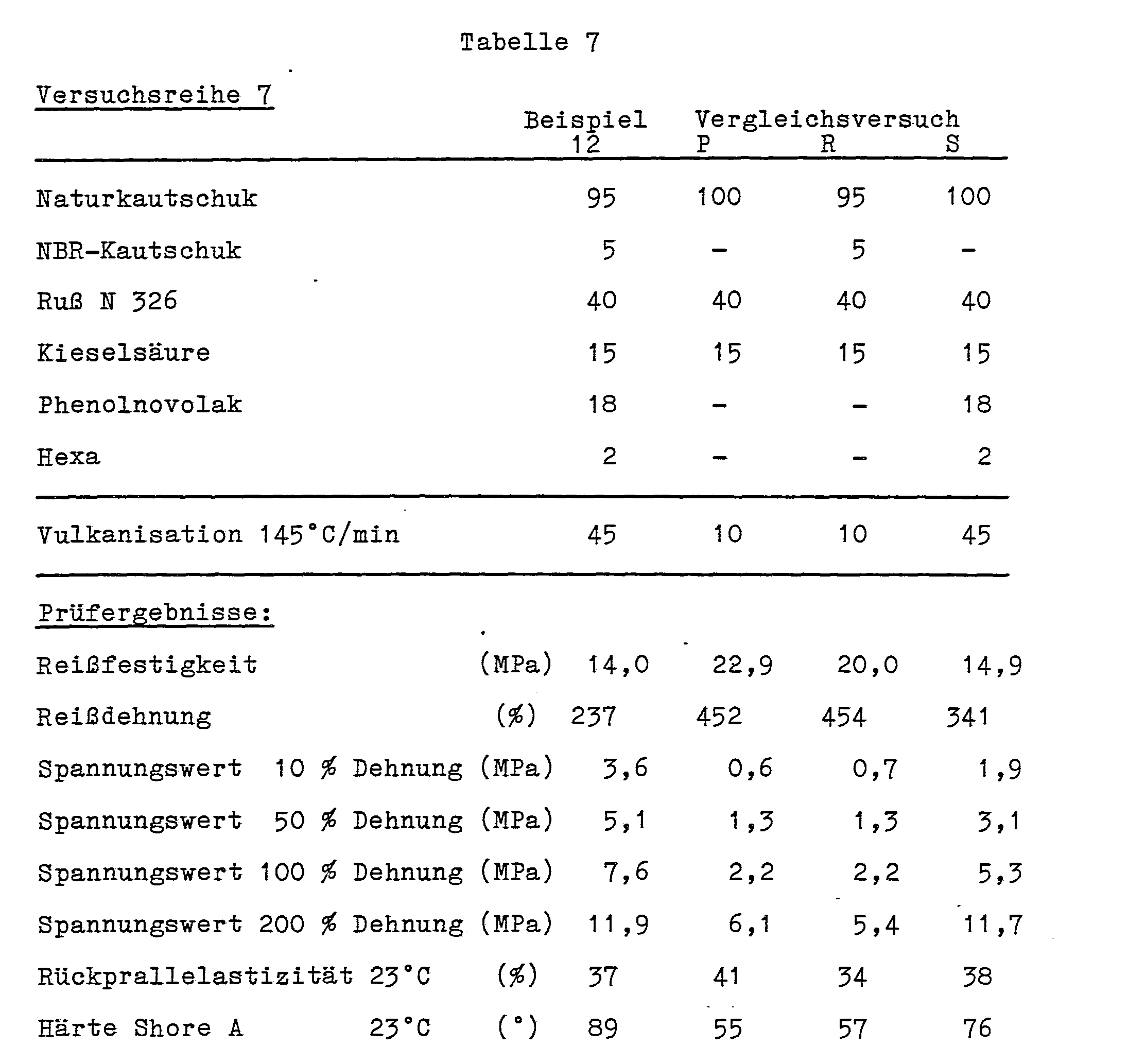
- . Versuchreihe 7 (Beispiel 12 und Vergleich P bis S)
- NR-und NBR-Kautschuk mit Phenolnovolak und Hexa, mit Ruß und Kieselsäure als Füllstoff
- In dieser Versuchsreihe wurde derselbe NBR-Kautschuk und Phenolnovolak wie in Versuchsreihe 3 eingesetzt und außer Ruß noch gefällte Kieselsäure als Füllstoff verwendet.
- Während der Ersatz von 5 Gewichtsteilen Naturkautschuk durch den NBR-Kautschuk im Vergleich S gegenüber dem Vergleich P keine oder nur geringere Erhöhungen von Härte und Spannungswerten bewirkt und der alleinige Zusatz eines Phenolharzsystems im Vergleich S zu einer deutlichen Steigerung der Prüfwerte führt, weist die erfindungsgemäße Mischung nach Beispiel 12 gegenüber dem Vergleich S noch um über 30 % höhere Spannungswerte (bis zu 100 % Dehnung) und eine um 13 Einheiten höhere Härte auf.
- Versuchsreihe 8 (Beispiele 13, 14 und 15 wie Vergleiche T, U und V)
- NR-und NBR-Kautschuk mindestens 32% Acrylnitrilgehalt mit Phenolnovolak und Hexa, rußgefüllt
- Gemäß den Ergebnissen T und U ist die Verstärkung ohne Harzzusatz gering, im Versuch V bei Anwendung von Phenolnovolak deutlich höher. NBR-Kautschukzusäzte führen aber parallel zu steigendem Acrylnitrilgehalt zu noch höherer Verstärkerwirkung. So steigt beispielsweise die Härte von 79 Einheiten gemäß Versuch V um 8 Einheiten auf 87, bei Verwendung von NBR-Kautschuk mit 32% Acrylnitrilgehalt, bei Verwendung von NBR-Kautschuk mit 38% Acrylnitrilgehalt sogar 12 Einheiten auf 91. Entsprechend gute Werte werden auch nach dem erfindungsgemäßen Verfahren bei den Spannungswerten bei 10% Dehnung erhalten.
- Versuchsreihen 9 und 10 (Beispiele 16 -21 sowie Vergleiche W -Z)
- NR-und NBR-Kautschuk mit mehr als 29% Acrylnitrilgehalt mit Phenolnovolak und Hexa bzw. Hexamethoxymethylmelamin (Versuchsreihe 10), rußgefüllt
- Die Ergebnisse zeigen, daß mit Zusatz eines NBR-Kautschuks mit 32 und mehr % Acrylnitrilgehalt eine deutliche Steigerung der Verstärkungswirkung eintreten kann. In Abhängigkeit vom Härtungsmittelsystem können sich zwar unterschiedliche Veränderungen der Eigenschaften, Spannungswerte und Härte ergeben, jedoch zeigt sich generell, daß mit 32% Acrylnitrilgehalt des NBR-Kautschuks eine Erhöhung der Wirkung beginnt und mit weiter zunehmendem Acrylnitrilgehalt eine bedeutende Steigerung des Verstärkungseffekts auftritt.
- In den nachfolgenden Tabellen 1 bis 10 werden die Mischungsverhältnisse der einzelnen Versuchsreihen und die erhaltenen Prüfergebnisse angeführt.





Claims (26)
Priority Applications (1)
| Application Number | Priority Date | Filing Date | Title |
|---|---|---|---|
| AT86103888T ATE58387T1 (de) | 1985-03-29 | 1986-03-21 | Verstaerkte kautschukmischungen, verfahren zu ihrer herstellung und ihre verwendung. |
Applications Claiming Priority (4)
| Application Number | Priority Date | Filing Date | Title |
|---|---|---|---|
| DE3511549 | 1985-03-29 | ||
| DE3511549 | 1985-03-29 | ||
| DE3604744 | 1986-02-14 | ||
| DE19863604744 DE3604744A1 (de) | 1985-03-29 | 1986-02-14 | Verstaerkte kautschukmischungen, verfahren zu ihrer herstellung und ihre verwendung |
Publications (3)
| Publication Number | Publication Date |
|---|---|
| EP0197395A2 true EP0197395A2 (de) | 1986-10-15 |
| EP0197395A3 EP0197395A3 (en) | 1987-01-07 |
| EP0197395B1 EP0197395B1 (de) | 1990-11-14 |
Family
ID=25830901
Family Applications (1)
| Application Number | Title | Priority Date | Filing Date |
|---|---|---|---|
| EP86103888A Expired - Lifetime EP0197395B1 (de) | 1985-03-29 | 1986-03-21 | Verstärkte Kautschukmischungen, Verfahren zu ihrer Herstellung und ihre Verwendung |
Country Status (5)
| Country | Link |
|---|---|
| US (1) | US4699832A (de) |
| EP (1) | EP0197395B1 (de) |
| JP (1) | JPH0781037B2 (de) |
| CA (1) | CA1247268A (de) |
| DE (2) | DE3604744A1 (de) |
Cited By (6)
| Publication number | Priority date | Publication date | Assignee | Title |
|---|---|---|---|---|
| EP0385033A1 (de) * | 1989-02-23 | 1990-09-05 | Bridgestone Corporation | Kautschukmischungen |
| EP0401796A3 (de) * | 1989-06-08 | 1992-04-08 | Sumitomo Durez Company, Ltd. | Verfahren zur Herstellung einer Phenolharzzusammensetzung und diese enthaltende Kautschuk-Zusammensetzung |
| EP0545445A1 (de) * | 1991-12-06 | 1993-06-09 | Bridgestone Corporation | Gummi |
| EP0563710A1 (de) * | 1992-03-28 | 1993-10-06 | Hoechst Aktiengesellschaft | Kautschukmischungen |
| FR2693467A1 (fr) * | 1992-07-08 | 1994-01-14 | Michelin & Cie | Procédé et composition permettant l'emploi de mélamines substituées comme durcisseurs de résines novolaques. |
| EP1075966A1 (de) * | 1999-08-11 | 2001-02-14 | The Goodyear Tire & Rubber Company | Reifen mit Apexmischung aus Gummi |
Families Citing this family (28)
| Publication number | Priority date | Publication date | Assignee | Title |
|---|---|---|---|---|
| GB8627905D0 (en) * | 1986-11-21 | 1986-12-31 | Exxon Chemical Patents Inc | Curable rubber composition |
| DE3641344A1 (de) * | 1986-12-03 | 1988-06-16 | Hoechst Ag | Kautschukvulkanisate mit verminderter waermeentwicklung bei dynamischer verformung, verfahren zu ihrer herstellung und ihre verwendung |
| US4820753A (en) * | 1988-03-15 | 1989-04-11 | The B. F. Goodrich Company | Acoustic window and material therefor |
| EP0451983B1 (de) * | 1990-03-29 | 1995-12-13 | Mitsuboshi Belting Ltd. | Treibriemen |
| ES2134805T3 (es) * | 1991-04-12 | 1999-10-16 | Procter & Gamble | Estructuras absorbentes que contienen distribuciones especificas del tamaño de las particulas de materiales superabsorbentes formadores de hidrogel. |
| US5430084A (en) * | 1992-06-15 | 1995-07-04 | The Goodyear Tire & Rubber Company | Rubber containing silica and tire and tread thereof |
| US5718788A (en) * | 1992-07-08 | 1998-02-17 | Compagnie Generale Establissements Michelin - Michelin & Cie | Process and composition for the use of substituted melamines as hardeners of novola resins |
| JP3382514B2 (ja) * | 1997-07-18 | 2003-03-04 | 住友ゴム工業株式会社 | 紙送り用ゴムローラ |
| US5990204A (en) * | 1997-10-31 | 1999-11-23 | Onizawa; Masao | Crosslinking isoprene-isobutylene rubber with alkyphenol-formaldehyde and epoxy resins |
| GB2320916B (en) * | 1997-12-08 | 1998-11-18 | Maurice Philip Chapman | Tracking of conveyor belts |
| DE19860362A1 (de) * | 1998-12-24 | 2000-06-29 | Dunlop Gmbh | Fahrzeugluftreifen |
| KR100474575B1 (ko) * | 1998-12-31 | 2005-06-08 | 한국타이어 주식회사 | 고열전도성을 갖는 타이어의 가류블래더용 고무 조성물 |
| EP1311600A2 (de) * | 2000-07-31 | 2003-05-21 | Société de Technologie Michelin | Reifenlauffläche |
| AU2003234652A1 (en) * | 2002-05-23 | 2003-12-12 | Rubbermaid Incorporated | Slip-resistant step stool and a method of manufacturing the same |
| WO2004094550A1 (en) * | 2003-04-10 | 2004-11-04 | 3M Innovative Properties Company | Heat-activatable adhesive |
| HUE025685T2 (en) * | 2003-11-20 | 2016-04-28 | Si Group Inc | Novolak resins and rubber compositions containing it |
| JP4511231B2 (ja) * | 2004-04-05 | 2010-07-28 | 株式会社ブリヂストン | 空気入りタイヤ |
| KR100810038B1 (ko) | 2006-04-08 | 2008-03-05 | 구경환 | 컨베이어 벨트 스커트 조성물 및 그의 제조방법 |
| US20080115874A1 (en) * | 2006-11-21 | 2008-05-22 | Georges Marcel Victor Thielen | Tire with apex containing in-situ resin and rubber with pendant hydroxyl groups |
| JP5004904B2 (ja) * | 2008-07-29 | 2012-08-22 | 田岡化学工業株式会社 | クレゾール・ホルムアルデヒド樹脂の製造方法およびクレゾール・ホルムアルデヒド樹脂並びにそれを含有するゴム組成物 |
| JP5731771B2 (ja) * | 2010-08-27 | 2015-06-10 | 株式会社ブリヂストン | ゴム組成物の製造方法、ゴム組成物及びそれを用いたタイヤ |
| JP5309275B1 (ja) * | 2011-12-14 | 2013-10-09 | バンドー化学株式会社 | 摩擦伝動ベルト及びその製造方法 |
| ES2666797T3 (es) * | 2012-06-13 | 2018-05-07 | Continental Reifen Deutschland Gmbh | Mezcla de engomado reticulable con azufre |
| JP2015533884A (ja) * | 2012-09-10 | 2015-11-26 | コンパニー ゼネラール デ エタブリッスマン ミシュラン | 強化樹脂を含むゴム組成物の製造方法 |
| CN103031858B (zh) * | 2012-12-22 | 2015-01-07 | 解忠深 | 一种反应性橡胶复合防水卷材及其生产方法 |
| CN107429002B (zh) * | 2015-03-06 | 2020-01-24 | 株式会社普利司通 | 橡胶组合物和使用其的轮胎 |
| JP6758027B2 (ja) * | 2015-06-22 | 2020-09-23 | 株式会社ブリヂストン | ゴム組成物、積層体、及びコンベアベルト |
| DE102017121303A1 (de) | 2017-09-14 | 2019-03-14 | Arntz Beteiligungs Gmbh & Co. Kg | Gummiertes Textilmaterial für eine Riemenlage, zugehörige Kautschukmischung und Riemen |
Family Cites Families (12)
| Publication number | Priority date | Publication date | Assignee | Title |
|---|---|---|---|---|
| US2659706A (en) * | 1950-10-07 | 1953-11-17 | Us Rubber Co | Compounding process and product thereof from a mixture of a phenol-formaldehyde resin, butadiene-acrylonitrile copolymer, and a nonsolvent hydrocarbon plasticizer |
| US3586735A (en) * | 1965-04-29 | 1971-06-22 | Albert Ag Chem Werke | Rubber mixtures reinforced by phenol novolac resins and process for preparing phenol novolac resins suitable therefor |
| NL6606553A (de) * | 1965-06-18 | 1967-11-13 | ||
| AT276744B (de) * | 1967-06-06 | 1969-12-10 | Semperit Ag | Verfahren zur Herstellung verstärkter Elastomermischungen |
| FR1585214A (de) * | 1967-06-22 | 1970-01-16 | ||
| US3738948A (en) * | 1970-12-21 | 1973-06-12 | Ppg Industries Inc | Rubber compositions |
| DE2444433A1 (de) * | 1974-09-17 | 1976-03-25 | Ignaz Favini | Bremsgummi |
| GB1569814A (en) * | 1977-05-27 | 1980-06-18 | Coal Industry Patents Ltd | Reinforced rubber |
| DE3020746C2 (de) * | 1980-05-31 | 1983-12-22 | Metzeler Kautschuk GmbH, 8000 München | Verfahren zur Herstellung eines Verbundprofils aus lederhartem Gummi/weichem Gummi |
| DE3035510C2 (de) * | 1980-09-19 | 1983-07-21 | Metzeler Kautschuk GmbH, 8000 München | Vulkanisierbare Kautschuk-Mischung |
| GB2114579A (en) * | 1982-02-05 | 1983-08-24 | Coal Ind | Method of reinforcing rubber |
| DE3211917A1 (de) * | 1982-03-31 | 1983-10-13 | Hoechst Ag, 6230 Frankfurt | Kautschukvulkanisate mit relativ niedriger haerte und verfahren zur verminderung des bei dynamischer verformung in waerme umgewandelten energieanteils der vulkanisate |
-
1986
- 1986-02-14 DE DE19863604744 patent/DE3604744A1/de not_active Withdrawn
- 1986-03-21 DE DE8686103888T patent/DE3675567D1/de not_active Expired - Fee Related
- 1986-03-21 EP EP86103888A patent/EP0197395B1/de not_active Expired - Lifetime
- 1986-03-27 US US06/844,808 patent/US4699832A/en not_active Expired - Fee Related
- 1986-03-27 CA CA000505347A patent/CA1247268A/en not_active Expired
- 1986-03-28 JP JP61068835A patent/JPH0781037B2/ja not_active Expired - Lifetime
Cited By (7)
| Publication number | Priority date | Publication date | Assignee | Title |
|---|---|---|---|---|
| EP0385033A1 (de) * | 1989-02-23 | 1990-09-05 | Bridgestone Corporation | Kautschukmischungen |
| EP0401796A3 (de) * | 1989-06-08 | 1992-04-08 | Sumitomo Durez Company, Ltd. | Verfahren zur Herstellung einer Phenolharzzusammensetzung und diese enthaltende Kautschuk-Zusammensetzung |
| EP0545445A1 (de) * | 1991-12-06 | 1993-06-09 | Bridgestone Corporation | Gummi |
| EP0563710A1 (de) * | 1992-03-28 | 1993-10-06 | Hoechst Aktiengesellschaft | Kautschukmischungen |
| FR2693467A1 (fr) * | 1992-07-08 | 1994-01-14 | Michelin & Cie | Procédé et composition permettant l'emploi de mélamines substituées comme durcisseurs de résines novolaques. |
| WO1994001493A1 (fr) * | 1992-07-08 | 1994-01-20 | Compagnie Generale Des Etablissements Michelin - Michelin & Cie | Procede et composition permettant l'emploi de melamines substituees comme durcisseurs de resines novolaques |
| EP1075966A1 (de) * | 1999-08-11 | 2001-02-14 | The Goodyear Tire & Rubber Company | Reifen mit Apexmischung aus Gummi |
Also Published As
| Publication number | Publication date |
|---|---|
| EP0197395A3 (en) | 1987-01-07 |
| EP0197395B1 (de) | 1990-11-14 |
| DE3604744A1 (de) | 1986-10-09 |
| CA1247268A (en) | 1988-12-20 |
| JPH0781037B2 (ja) | 1995-08-30 |
| US4699832A (en) | 1987-10-13 |
| DE3675567D1 (de) | 1990-12-20 |
| JPS61225231A (ja) | 1986-10-07 |
Similar Documents
| Publication | Publication Date | Title |
|---|---|---|
| EP0197395B1 (de) | Verstärkte Kautschukmischungen, Verfahren zu ihrer Herstellung und ihre Verwendung | |
| DE2414798B2 (de) | Kautschukmasse | |
| EP0052286B1 (de) | Kautschukmischungen und daraus hergestellte Vulkanisate | |
| EP2674452B1 (de) | Schwefelvernetzbare Gummierungsmischung | |
| EP0013330B1 (de) | Verfahren zur Herstellung verstärkter Kautschukvulkanisate sowie die so erhaltenen Artikel | |
| EP0090387B1 (de) | Kautschukvulkanisate mit relativ niedriger Härte, Verfahren zur Herstellung von Vulkanisaten mit Shore A Härten unter 65 Grad, in denen bei dynamischer Verformung nur ein verminderter Energieanteil in Wärme umgewandelt wird, sowie technische Gummimischungen und Reifen | |
| EP0563710B1 (de) | Kautschukmischungen | |
| EP4126560A1 (de) | Schwefelvernetzbare gummierungsmischung | |
| DE69030530T2 (de) | Verfahren zur Herstellung einer Phenolharzzusammensetzung und diese enthaltende Kautschuk-Zusammensetzung | |
| EP4126561B1 (de) | Schwefelvernetzbare gummierungsmischung | |
| EP0036515B1 (de) | Verfahren zur Herstellung von verstärkten Kautschukvulkanisaten | |
| EP3649191A1 (de) | Schwefelvernetzbare kautschukmischung | |
| EP1323776B1 (de) | Verwendung von plastifizierten Novolaken als Zusatz zu Kautschukmischungen | |
| DE69211103T2 (de) | Gummi | |
| DE1231423B (de) | Hitzehaertbare Formmassen auf Novolak-Kautschuk-Grundlage | |
| EP0270073B1 (de) | Kautschukvulkanisate mit verminderter Wärmeentwicklung bei dynamischer Verformung, Verfahren zu ihrer Herstellung und ihre Verwendung | |
| EP1174464A2 (de) | Gummiartikel mit niedriger Wärmeentwicklung | |
| EP3636451B1 (de) | Schwefelvernetzbare kautschukmischung | |
| DE102018212821B4 (de) | Schwefelvernetzbare Kautschukmischung und Fahrzeugluftreifen | |
| DE102018213701A1 (de) | Schwefelvernetzbare Kautschukmischung | |
| DE19624432A1 (de) | Kieselsäurehaltige Kautschukmischungen | |
| JP2000154302A (ja) | ゴム配合用樹脂組成物 | |
| DE102018213702B4 (de) | Schwefelvernetzbare Kautschukmischung und Fahrzeugluftreifen | |
| DE2950940A1 (de) | Reifencordklebstoffe | |
| DE102012102954A1 (de) | Kautschukmischung und gummierter Festigkeitsträger |
Legal Events
| Date | Code | Title | Description |
|---|---|---|---|
| PUAI | Public reference made under article 153(3) epc to a published international application that has entered the european phase |
Free format text: ORIGINAL CODE: 0009012 |
|
| AK | Designated contracting states |
Kind code of ref document: A2 Designated state(s): AT BE CH DE FR GB IT LI LU NL |
|
| PUAL | Search report despatched |
Free format text: ORIGINAL CODE: 0009013 |
|
| AK | Designated contracting states |
Kind code of ref document: A3 Designated state(s): AT BE CH DE FR GB IT LI LU NL |
|
| 17P | Request for examination filed |
Effective date: 19870211 |
|
| 17Q | First examination report despatched |
Effective date: 19880503 |
|
| GRAA | (expected) grant |
Free format text: ORIGINAL CODE: 0009210 |
|
| AK | Designated contracting states |
Kind code of ref document: B1 Designated state(s): AT BE CH DE FR GB IT LI LU NL |
|
| REF | Corresponds to: |
Ref document number: 58387 Country of ref document: AT Date of ref document: 19901115 Kind code of ref document: T |
|
| REF | Corresponds to: |
Ref document number: 3675567 Country of ref document: DE Date of ref document: 19901220 |
|
| ET | Fr: translation filed | ||
| ITF | It: translation for a ep patent filed | ||
| GBT | Gb: translation of ep patent filed (gb section 77(6)(a)/1977) | ||
| ITTA | It: last paid annual fee | ||
| PLBE | No opposition filed within time limit |
Free format text: ORIGINAL CODE: 0009261 |
|
| STAA | Information on the status of an ep patent application or granted ep patent |
Free format text: STATUS: NO OPPOSITION FILED WITHIN TIME LIMIT |
|
| 26N | No opposition filed | ||
| EPTA | Lu: last paid annual fee | ||
| PGFP | Annual fee paid to national office [announced via postgrant information from national office to epo] |
Ref country code: FR Payment date: 19960212 Year of fee payment: 11 |
|
| PGFP | Annual fee paid to national office [announced via postgrant information from national office to epo] |
Ref country code: CH Payment date: 19960216 Year of fee payment: 11 |
|
| PGFP | Annual fee paid to national office [announced via postgrant information from national office to epo] |
Ref country code: GB Payment date: 19960221 Year of fee payment: 11 |
|
| PGFP | Annual fee paid to national office [announced via postgrant information from national office to epo] |
Ref country code: AT Payment date: 19960226 Year of fee payment: 11 |
|
| PGFP | Annual fee paid to national office [announced via postgrant information from national office to epo] |
Ref country code: NL Payment date: 19960229 Year of fee payment: 11 |
|
| PGFP | Annual fee paid to national office [announced via postgrant information from national office to epo] |
Ref country code: LU Payment date: 19960301 Year of fee payment: 11 |
|
| PGFP | Annual fee paid to national office [announced via postgrant information from national office to epo] |
Ref country code: BE Payment date: 19960312 Year of fee payment: 11 |
|
| PGFP | Annual fee paid to national office [announced via postgrant information from national office to epo] |
Ref country code: DE Payment date: 19960515 Year of fee payment: 11 |
|
| PG25 | Lapsed in a contracting state [announced via postgrant information from national office to epo] |
Ref country code: LU Free format text: LAPSE BECAUSE OF NON-PAYMENT OF DUE FEES Effective date: 19970321 Ref country code: GB Effective date: 19970321 Ref country code: AT Effective date: 19970321 |
|
| PG25 | Lapsed in a contracting state [announced via postgrant information from national office to epo] |
Ref country code: LI Effective date: 19970331 Ref country code: CH Effective date: 19970331 Ref country code: BE Effective date: 19970331 |
|
| BERE | Be: lapsed |
Owner name: HOECHST A.G. Effective date: 19970331 |
|
| PG25 | Lapsed in a contracting state [announced via postgrant information from national office to epo] |
Ref country code: NL Effective date: 19971001 |
|
| GBPC | Gb: european patent ceased through non-payment of renewal fee |
Effective date: 19970321 |
|
| REG | Reference to a national code |
Ref country code: CH Ref legal event code: PL |
|
| PG25 | Lapsed in a contracting state [announced via postgrant information from national office to epo] |
Ref country code: FR Free format text: LAPSE BECAUSE OF NON-PAYMENT OF DUE FEES Effective date: 19971128 |
|
| NLV4 | Nl: lapsed or anulled due to non-payment of the annual fee |
Effective date: 19971001 |
|
| PG25 | Lapsed in a contracting state [announced via postgrant information from national office to epo] |
Ref country code: DE Effective date: 19971202 |
|
| REG | Reference to a national code |
Ref country code: FR Ref legal event code: ST |
|
| PG25 | Lapsed in a contracting state [announced via postgrant information from national office to epo] |
Ref country code: IT Free format text: LAPSE BECAUSE OF NON-PAYMENT OF DUE FEES;WARNING: LAPSES OF ITALIAN PATENTS WITH EFFECTIVE DATE BEFORE 2007 MAY HAVE OCCURRED AT ANY TIME BEFORE 2007. THE CORRECT EFFECTIVE DATE MAY BE DIFFERENT FROM THE ONE RECORDED. Effective date: 20050321 |