EP0197745A1 - Matériaux conducteurs - Google Patents
Matériaux conducteurs Download PDFInfo
- Publication number
- EP0197745A1 EP0197745A1 EP86302386A EP86302386A EP0197745A1 EP 0197745 A1 EP0197745 A1 EP 0197745A1 EP 86302386 A EP86302386 A EP 86302386A EP 86302386 A EP86302386 A EP 86302386A EP 0197745 A1 EP0197745 A1 EP 0197745A1
- Authority
- EP
- European Patent Office
- Prior art keywords
- tape
- fabric
- polymer
- conductors
- conductive material
- Prior art date
- Legal status (The legal status is an assumption and is not a legal conclusion. Google has not performed a legal analysis and makes no representation as to the accuracy of the status listed.)
- Withdrawn
Links
- 239000004020 conductor Substances 0.000 title claims abstract description 63
- 239000004744 fabric Substances 0.000 claims abstract description 36
- OKTJSMMVPCPJKN-UHFFFAOYSA-N Carbon Chemical compound [C] OKTJSMMVPCPJKN-UHFFFAOYSA-N 0.000 claims abstract description 25
- 238000010438 heat treatment Methods 0.000 claims abstract description 23
- 229920000642 polymer Polymers 0.000 claims abstract description 18
- 239000002245 particle Substances 0.000 claims abstract description 8
- 239000010439 graphite Substances 0.000 claims abstract description 6
- 229910002804 graphite Inorganic materials 0.000 claims abstract description 6
- 229920002239 polyacrylonitrile Polymers 0.000 claims abstract description 5
- 239000004952 Polyamide Substances 0.000 claims abstract description 4
- 229920002647 polyamide Polymers 0.000 claims abstract description 4
- 229920002635 polyurethane Polymers 0.000 claims abstract description 4
- 239000004814 polyurethane Substances 0.000 claims abstract description 4
- 239000000463 material Substances 0.000 claims description 20
- 229910052799 carbon Inorganic materials 0.000 claims description 19
- 239000000654 additive Substances 0.000 claims description 5
- 125000001931 aliphatic group Chemical group 0.000 claims description 5
- ADCOVFLJGNWWNZ-UHFFFAOYSA-N antimony trioxide Chemical compound O=[Sb]O[Sb]=O ADCOVFLJGNWWNZ-UHFFFAOYSA-N 0.000 claims description 4
- 239000002184 metal Substances 0.000 claims description 4
- 229910052751 metal Inorganic materials 0.000 claims description 4
- 239000000843 powder Substances 0.000 claims description 3
- 239000007787 solid Substances 0.000 claims description 3
- XLYOFNOQVPJJNP-UHFFFAOYSA-N water Substances O XLYOFNOQVPJJNP-UHFFFAOYSA-N 0.000 claims description 3
- 125000003118 aryl group Chemical group 0.000 claims description 2
- WHHGLZMJPXIBIX-UHFFFAOYSA-N decabromodiphenyl ether Chemical group BrC1=C(Br)C(Br)=C(Br)C(Br)=C1OC1=C(Br)C(Br)=C(Br)C(Br)=C1Br WHHGLZMJPXIBIX-UHFFFAOYSA-N 0.000 claims description 2
- 230000000996 additive effect Effects 0.000 claims 3
- 230000000979 retarding effect Effects 0.000 claims 3
- RYGMFSIKBFXOCR-UHFFFAOYSA-N Copper Chemical group [Cu] RYGMFSIKBFXOCR-UHFFFAOYSA-N 0.000 claims 1
- 238000000576 coating method Methods 0.000 abstract description 9
- 239000011248 coating agent Substances 0.000 abstract description 5
- 239000000969 carrier Substances 0.000 description 7
- 238000004519 manufacturing process Methods 0.000 description 6
- 239000000203 mixture Substances 0.000 description 6
- 239000004753 textile Substances 0.000 description 6
- 230000005611 electricity Effects 0.000 description 5
- 239000002861 polymer material Substances 0.000 description 5
- 239000012792 core layer Substances 0.000 description 4
- 238000000605 extraction Methods 0.000 description 4
- 238000000034 method Methods 0.000 description 3
- 230000001681 protective effect Effects 0.000 description 3
- 239000002904 solvent Substances 0.000 description 3
- 239000000758 substrate Substances 0.000 description 3
- PMZURENOXWZQFD-UHFFFAOYSA-L Sodium Sulfate Chemical compound [Na+].[Na+].[O-]S([O-])(=O)=O PMZURENOXWZQFD-UHFFFAOYSA-L 0.000 description 2
- 239000004760 aramid Substances 0.000 description 2
- 229920003235 aromatic polyamide Polymers 0.000 description 2
- 239000003575 carbonaceous material Substances 0.000 description 2
- 238000010276 construction Methods 0.000 description 2
- 230000000875 corresponding effect Effects 0.000 description 2
- 239000006185 dispersion Substances 0.000 description 2
- 238000001125 extrusion Methods 0.000 description 2
- 238000009413 insulation Methods 0.000 description 2
- 239000012774 insulation material Substances 0.000 description 2
- 239000010410 layer Substances 0.000 description 2
- 239000004033 plastic Substances 0.000 description 2
- 229920003023 plastic Polymers 0.000 description 2
- 239000002243 precursor Substances 0.000 description 2
- 229920002379 silicone rubber Polymers 0.000 description 2
- 239000004945 silicone rubber Substances 0.000 description 2
- 230000001225 therapeutic effect Effects 0.000 description 2
- 229910000570 Cupronickel Inorganic materials 0.000 description 1
- 229910020284 Na2SO4.10H2O Inorganic materials 0.000 description 1
- 238000005299 abrasion Methods 0.000 description 1
- 239000002253 acid Substances 0.000 description 1
- 150000007513 acids Chemical class 0.000 description 1
- 230000002411 adverse Effects 0.000 description 1
- QVGXLLKOCUKJST-UHFFFAOYSA-N atomic oxygen Chemical compound [O] QVGXLLKOCUKJST-UHFFFAOYSA-N 0.000 description 1
- 230000015572 biosynthetic process Effects 0.000 description 1
- 229920001940 conductive polymer Polymers 0.000 description 1
- 230000002596 correlated effect Effects 0.000 description 1
- 239000013078 crystal Substances 0.000 description 1
- 230000001419 dependent effect Effects 0.000 description 1
- 238000009826 distribution Methods 0.000 description 1
- 238000001035 drying Methods 0.000 description 1
- 229920001971 elastomer Polymers 0.000 description 1
- 230000005284 excitation Effects 0.000 description 1
- 239000003000 extruded plastic Substances 0.000 description 1
- 238000005755 formation reaction Methods 0.000 description 1
- 239000012634 fragment Substances 0.000 description 1
- 239000004519 grease Substances 0.000 description 1
- 230000020169 heat generation Effects 0.000 description 1
- 230000007062 hydrolysis Effects 0.000 description 1
- 238000006460 hydrolysis reaction Methods 0.000 description 1
- 239000011810 insulating material Substances 0.000 description 1
- 230000010354 integration Effects 0.000 description 1
- 230000002687 intercalation Effects 0.000 description 1
- 238000009830 intercalation Methods 0.000 description 1
- 239000007788 liquid Substances 0.000 description 1
- 238000003801 milling Methods 0.000 description 1
- 239000002480 mineral oil Substances 0.000 description 1
- 230000007935 neutral effect Effects 0.000 description 1
- 239000003921 oil Substances 0.000 description 1
- 230000010355 oscillation Effects 0.000 description 1
- 229910052760 oxygen Inorganic materials 0.000 description 1
- 239000001301 oxygen Substances 0.000 description 1
- 230000005855 radiation Effects 0.000 description 1
- 239000012779 reinforcing material Substances 0.000 description 1
- 239000005060 rubber Substances 0.000 description 1
- 229910052938 sodium sulfate Inorganic materials 0.000 description 1
- RSIJVJUOQBWMIM-UHFFFAOYSA-L sodium sulfate decahydrate Chemical compound O.O.O.O.O.O.O.O.O.O.[Na+].[Na+].[O-]S([O-])(=O)=O RSIJVJUOQBWMIM-UHFFFAOYSA-L 0.000 description 1
- 235000011152 sodium sulphate Nutrition 0.000 description 1
- 230000003068 static effect Effects 0.000 description 1
- 239000011232 storage material Substances 0.000 description 1
- 229920001059 synthetic polymer Polymers 0.000 description 1
- 238000003466 welding Methods 0.000 description 1
Images


Classifications
-
- H—ELECTRICITY
- H01—ELECTRIC ELEMENTS
- H01C—RESISTORS
- H01C7/00—Non-adjustable resistors formed as one or more layers or coatings; Non-adjustable resistors made from powdered conducting material or powdered semi-conducting material with or without insulating material
- H01C7/02—Non-adjustable resistors formed as one or more layers or coatings; Non-adjustable resistors made from powdered conducting material or powdered semi-conducting material with or without insulating material having positive temperature coefficient
- H01C7/027—Non-adjustable resistors formed as one or more layers or coatings; Non-adjustable resistors made from powdered conducting material or powdered semi-conducting material with or without insulating material having positive temperature coefficient consisting of conducting or semi-conducting material dispersed in a non-conductive organic material
-
- H—ELECTRICITY
- H01—ELECTRIC ELEMENTS
- H01B—CABLES; CONDUCTORS; INSULATORS; SELECTION OF MATERIALS FOR THEIR CONDUCTIVE, INSULATING OR DIELECTRIC PROPERTIES
- H01B1/00—Conductors or conductive bodies characterised by the conductive materials; Selection of materials as conductors
- H01B1/20—Conductive material dispersed in non-conductive organic material
- H01B1/24—Conductive material dispersed in non-conductive organic material the conductive material comprising carbon-silicon compounds, carbon or silicon
Definitions
- This invention relates to conductive materials for use for example in the manufacture of protective screens, electrically heated fabric for tapes, panels, underblankets, garments and for other purposes.
- An object of the invention is to provide an effective and versatile conductive material which is relatively simple and inexpensive to manufacture and is capable of withstanding adverse conditions of use.
- a conductive material comprising carbon/graphite particles dispersed .within and held together by a body of, preferably water-soluble, aliphatic and/or aromatic polymer.
- the polymer chosen may depend on the end use of the conductive material. For example, for uses in connection with a high voltage, such as used for mains electricity in the U. K., aliphatic polymers, such as polyacrylonitrile, are preferred. However, for uses in connection with a lower voltage, such as used for mains electricity in the U.S.A. or D.C., a polyurethane, particularly an aliphatic polyurethane is preferred.
- conductive and protective properties can be obtained in a particularly simple and convenient manner whilst at the same time it is possible to achieve good resistance to abrasion, to corrosive materials (such as acids and alkalis), and to moisture.
- the conductive and protective properties can be maintained generally constant (or at least can be maintained within an acceptance range) throughout a range of operating conditions (e.g. over a temperature range of say -40°C to 150°C).
- the material may have a high modulus of elasticity and good resistance to hydrolysis.
- the polymer and the carbon/graphite (which may comprise the carbon material identified as Vulcan CX72R or Corax L6) may be uniformly mixed for example by a milling process to give a precursor dispersion.
- the carbon/graphite particles comprise 12 to 55% of the solid polymer by weight.
- Additives such as to enhance flame retardancy, may also be incorporated in the material. Examples of such additives are decabromodiphenyl oxide DE-83R at 20 to 40%, preferably 25 to 40%, by weight or antimony trioxide.
- the precursor dispersion may be processed, to give the conductive material in the form of a flexible film or yarn or tape, and this may be in conjunction with any suitable substrate, supporting material or reinforcing material.
- the conductive material mixture is deposited at a suitable viscosity onto both sides of, or integrated into a suitable fabric.
- a preferred fabric is an aromatic polyamide fabric.
- the fabric preferably has desired properties, such as inflammability and flame resistance.
- Another suitable fabric is disclosed in U.S. Patent No. 4251589 and U.K. Patent No. 1593246.
- the resulting textile material obtained as explained above can be extremely stable to ultra violet rays, oxygen in general, and to heat and may have excellent resistance to water, solvents, mineral oils and grease.
- the conductive material of the invention compares favourably with, for example, cupro-nickel wire as a heating medium since it does not produce a magnetic field and may be inflammable.
- the conductive material of the invention can be used in a variety of items as a heating medium. Examples of such items include therapeutic heating pads, domestic underblankets and heated mattresses, heated seats for motor vehicles, heated blankets for truck drivers and heated clothing. As can be seen some of the above will require mains electricity and others battery power.
- the conductive material of the invention can be used for both electricity sources subject to the provision of a suitable interface.
- the conductive fabric of the invention may be constructed to give a square law circuit having a closed path for the electrical energy in which the current functions equally and uniformly due to the ohmic resistance within the heated fabric.
- basic fabric can be chosen to have no fire hazard or wettability, and so be an ideal medium for the conductive material to form an infra red (far) energy emitter for far infra red radiation (wavelength of the order of microns).
- Typical mechanical properties for the basic fabric may be as follows:
- Exploiting electrical conductivity/resistance to pass electrical currents for example in safe, reliable heating whether either directly or indirectly via an associated storage material, such as sodium sulphate crystals Na 2 SO 4 .10H 2 O say for warming-pads.
- an associated storage material such as sodium sulphate crystals Na 2 SO 4 .10H 2 O say for warming-pads.
- the area and space between electrodes which transfer the supply of electrical energy over the heating area is approximately four to twelve inches apart.
- the electrical energy flow between adjacent electrodes occurs only through the conductive field of resistive material comprising woven or non-woven film in between the electrodes.
- a heating tape comprising a textile fabric base or core tape impregnated and/or intimately coated with a carbon-containing synthetic polymer material that is electrically conductive.
- Preferred heating tapes hereof are capable of being energised at satisfactorily high electrical resistance when driven by mains A.C. electricity and the frequency of oscillation causes the electrical energy to be distributed over the whole length of the tape.
- One such feature relates to the difficulty using tape of only about 25 mm width of achieving adequate electrical resistance if energising conductors are applied simply at sides of the tape as then, only the width of the tape contributes to electrical resistance and is too short for the primary purposes hereof. Accordingly, it is proposed that areas of the conductive material be used to develop the required electrical resistance, and to do so using selective insulation of conductors from conductive material at either, preferably both, faces of the tape and effective selective interconnection of feed and return conductors relative to such areas.
- edge-adjacent runs of conductors which may be tinsel, are electrically insulated from the carbon-containing material, and excursions of.such conductors across the tape are made to define said areas, then with conduction through the carbon material thereof from excursions of the feed conductor to excursions of the return-conductor, i.e. along the length of the tape rather than across its width and with overall electrical resistance for a particular carbon containing material then set by the spacings of said excursions.
- Electrical supply can be connected simply to each end of the conductors.
- Heating tapes hereof are quite simple to manufacture, as will become clear from later description of specific implementation, and can afford substantially uniform electrical characteristics per unit area of the tape. Additionally, the possibility presents itself of the heating tapes being controlled with a substantial degree of self-regulation/limitation arising from the fact that the electrical resistance of the carbon containing polymer material can be temperature-dependent, i.e. it will consume and convert to heat less electrical energy at higher temperatures, and such action can be correlated to achieving a desired temperature of whatever is heated by the tapes hereof.
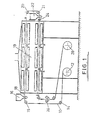
- polyamide fabric 10 travels from a main roller 12 over rollers 14, 15 to pass beneath a hopper 16 from which a coating of a mixture comprising carbon particles in an aliphatic polymer, such as polyacrylonitrile, is deposited onto one side of the fabric 10.
- a scraper 18 controls the depth of mixture on the fabric.
- the coated fabric then travels through an extraction zone 19, wherein solvent, probably water, is drawn off by heating to facilitate drying of the coating.
- the fabric leaves the extraction zone 19 and travels over a pair of rollers 20, 21 so that the uncoated side thereof is uppermost. This side is then coated with a mixture comprising carbon particles in polyacrylonitrile from a hopper 22.
- a scraper 24 regulates the depth of coating on the fabric.
- the fabric is then returned to the extraction zone 19 for further removal of solvent. After leaving the extraction zone 19, the fabric passes through an air cooler 26 and then is wound onto a final roller 28.
- the fabric produced by this process can be used in a variety of ways such as in making the heated tapes described below.
- Surfaces of the fabric tape 32 are then coated with electrically conductive carbon-containing polymer material, which may lie thereon as surface coatings 34A, 34B in mutual juncture via filled interstices of the fabric core tape 30.
- the cured electrically conductive coatings 34A, 34B have attached thereto at edge-adjacent positions parallel lengthwise strips of insulating tape material 36A, 36B, such as of pvc or silicone rubber, say by ultrasonic welding. Those insulating strips 36A, 36B are shown to layers 34A, 34B at opposite sides of the tape 32 so as to rely on conduction/resistance through the thickness of the tape 32.
- Electrical conductors 38A, 38B which it is preferred be of tinsel, are then laid along the insulating strips 36A, 36B with side extensions 40A, 40B intervals corresponding to twice the intended lengths of the electrically conducting areas to be defined, the extensions 40A, 40B to each side being shown staggered into a symmetrical intercalation pattern for such definition, conveniently relative to area lengths of about 40 centimetres.
- such comb-like conductor formations 38A, 40A and 38B, 40B are readily formed from flexible tinsel conductors that are taken out across the width of the tape and back at the aforesaid intervals.
- the purpose of the conductor extensions/loops 40A, 40B in their comb-like relation to feed and return conductors 38A, 38B along each edge of the overall tape, normally for live and neutral of mains electrical supply, is to utilise regions of the conductive material of the tape between those extensions 40A, 40B for primary electrical conduction along the lengths of the areas of those regions in order to give the required power dissipation/heat generation for the overall tape so as to get about 10-12 watts per metre, as would apply for resistances of 5000 ohms and currents of 0.04 amps at 220 volts.
- the whole of the tape is encased in insulating material, whether between further wider strips of insulation tape or by extrusion, see 46 in the drawing.
- comb-like conductors for feed and return may be done relative to the same surface coating of the tape, i.e. to a tape coated only to one side (34A or 34B), or separately for each major surface of the textile tape 32 in which case the textile core substrate tape 32 need not provide a uniform average mutual juncture of the coatings 34A, 34B, indeed any such juncture of the coatings 34A, 34B.
- end connectors 48A, 48B for the feed and return conductor 38A, 38B.
- Such end connectors may be made at each end of the tape 30 so that lengths thereof can, if desired, be connected in series.
- heating tapes hereof have been mentioned above, and we now turn to further explanation of the advantages of having carbon as the electrically conductive element. Its uniform presence not only aids achievement of uniform, if required temperature-sensitive, electrical characteristics but also uniform thermal characteristics and the capability to absorb energy. Moreover, any tendency for creating static that arose previously using metal conductors is removed.
- a heating tape 50 having a similar core layer 52 i.e. impregnated with carbon-containing polymer material
- the conductor on one side, see 58A crosses from side to side of the tape at suitably spaced intervals along its length in order to provide excursions, see 60A, across the width of the tape 50.
- the conductor 58A thus runs alternately along opposite edges of the tape for distances corresponding to said intervals. At such edge-adjacent runs, the conductor is electrically insulated from the core layer 52, whether by tape as aforesaid or by suitable L-or channel-section conductor carriers of insulation material, or both.
- the conductor 58B (see dashed fragments) is indicated on the other side of the tape in staggered relation to the conductor 58A.
- Suitable insulation material for the conductor carriers can be extruded plastics or rubber material, for example silicone rubber or aromatic polyamide textile. Only alternate lengths of such conductor carriers are specially shown as 56A, 56A' at opposite edges of the tape 50, but it will be understood that same can each be of the full length of the tape 50 with suitable notching of inner sides of channel-section carriers or with the upstand of L-section carriers outermost, otherwise using tape or equivalent to prevent through-conduction between the conductors 58A, 58B at corners to their excursions 60A, 60B.
- extruded carriers 56A etc. can assist in avoiding any appearance of bumps over the conductors 58A, 58B in the finished product, i.e. if corner side or sides upstand by the thickness of the conductor, for which braided tinsel is preferred.
- final covering of the finished tape can then be via plastics extrusion then overlying the conductor carriers, conveniently using the same plastics material.
- the excurisons 60A, 60B are secured in intimate electrical connection with the carbon-containing polymer of the core layer 52 by application thereover of the same carbon-containing polymer, i.e. before the final extruded cover is applied.
- braided tinsel conductors can afford satisfactory electrical conduction over up to 100 metres'of the tape 50, and that excursion spacings of 2 metres for each of the conductors 58A, 58B with a 1 metre offset or stagger; i.e. setting up consecutive 1 metre long resistance regions of the tape 50, are satisfactory for achieving 11 to 12 watts per metre energy release as heat from A.C. mains electric supplies.
- the effective resistances of such 1 metre by 25 centimetre regions should be about 1200 ohms for a 125-volt supply and about 4500 ohms for a 240-volt supply.
- transverse grooves 70 can be formed in tape 72 (similar to the tapes 10 and 50) in to which a mixture 74 of metal powder and polymer can be fixed with clip like connections 75 between the mixture 74 and the side conductors 76.
Landscapes
- Engineering & Computer Science (AREA)
- Physics & Mathematics (AREA)
- Chemical & Material Sciences (AREA)
- Dispersion Chemistry (AREA)
- Microelectronics & Electronic Packaging (AREA)
- Spectroscopy & Molecular Physics (AREA)
- Ceramic Engineering (AREA)
- Electromagnetism (AREA)
- Surface Heating Bodies (AREA)
- Resistance Heating (AREA)
Applications Claiming Priority (6)
| Application Number | Priority Date | Filing Date | Title |
|---|---|---|---|
| GB8508411 | 1985-03-30 | ||
| GB8508411 | 1985-03-30 | ||
| GB8512873 | 1985-05-21 | ||
| GB858512873A GB8512873D0 (en) | 1985-05-21 | 1985-05-21 | Electric heating tape |
| GB8516995 | 1985-07-04 | ||
| GB858516995A GB8516995D0 (en) | 1985-07-04 | 1985-07-04 | Electric heating tapes |
Publications (1)
| Publication Number | Publication Date |
|---|---|
| EP0197745A1 true EP0197745A1 (fr) | 1986-10-15 |
Family
ID=27262636
Family Applications (1)
| Application Number | Title | Priority Date | Filing Date |
|---|---|---|---|
| EP86302386A Withdrawn EP0197745A1 (fr) | 1985-03-30 | 1986-04-01 | Matériaux conducteurs |
Country Status (2)
| Country | Link |
|---|---|
| EP (1) | EP0197745A1 (fr) |
| GB (1) | GB2173200B (fr) |
Cited By (4)
| Publication number | Priority date | Publication date | Assignee | Title |
|---|---|---|---|---|
| WO1991003822A1 (fr) * | 1989-09-08 | 1991-03-21 | Raychem Corporation | Dispositif a polymere conducteur |
| GB2242682A (en) * | 1990-04-06 | 1991-10-09 | Belzona Molecular Ltd | Coating composition |
| EP0488898A1 (fr) * | 1990-11-29 | 1992-06-03 | Centre Technique Industriel dit: INSTITUT TEXTILE DE FRANCE | Ruban enduit conducteur et procédé de fabrication |
| US5925276A (en) * | 1989-09-08 | 1999-07-20 | Raychem Corporation | Conductive polymer device with fuse capable of arc suppression |
Citations (3)
| Publication number | Priority date | Publication date | Assignee | Title |
|---|---|---|---|---|
| FR1595245A (fr) * | 1967-12-18 | 1970-06-08 | ||
| US4534886A (en) * | 1981-01-15 | 1985-08-13 | International Paper Company | Non-woven heating element |
| EP0129193B1 (fr) * | 1983-06-15 | 1989-06-14 | BASF Aktiengesellschaft | Procédé pour la fabrication de polyurethanes thermoplastiques antistatiques et/ou conducteurs de l'electricité et leur utilisation |
Family Cites Families (17)
| Publication number | Priority date | Publication date | Assignee | Title |
|---|---|---|---|---|
| GB671881A (en) * | 1949-08-11 | 1952-05-14 | Asea Ab | Electrically heated curtains or blinds |
| GB1029949A (en) * | 1963-06-13 | 1966-05-18 | Vickers Ltd | Improvements relating to electrical heating elements |
| GB1109095A (en) * | 1963-11-13 | 1968-04-10 | Coal Industry Patents Ltd | Electrically conductive sheets or films |
| GB1077798A (en) * | 1964-10-08 | 1967-08-02 | Ici Ltd | Electrically heated chairs |
| GB1211793A (en) * | 1968-03-21 | 1970-11-11 | Midland Silicones Ltd | Organopolysiloxane elastomers |
| DE7005202U (de) * | 1970-02-14 | 1970-06-04 | Glanzstoff Ag | Elektrisches heizelement fuer deckenstrahlungsheizung. |
| GB1315617A (en) * | 1970-12-14 | 1973-05-02 | Allied Chem | Electrically conductive film |
| FR2139653B1 (fr) * | 1971-05-28 | 1973-05-25 | Rhone Poulenc Sa | |
| CA973248A (en) * | 1971-07-20 | 1975-08-19 | Yoshinosuke Kanaya | Flexible heating sheet |
| GB1587279A (en) * | 1976-10-29 | 1981-04-01 | Balamundi Genval | Flexible heating sheet and a process for its manufacture |
| US4233191A (en) * | 1978-03-23 | 1980-11-11 | Reuter Technologie Gmbh | Electrically conductive plastics materials and process for their production |
| GB1605005A (en) * | 1978-05-28 | 1981-12-16 | Raychem Ltd | Electrical heating strip |
| US4351745A (en) * | 1980-01-09 | 1982-09-28 | E. I. Du Pont De Nemours And Company | Electrically conductive polyetherester elastomers |
| DE3274400D1 (en) * | 1981-02-20 | 1987-01-08 | Mitsui Toatsu Chemicals | Electroconductive polyolefin resin composition |
| KR840002869A (ko) * | 1981-12-24 | 1984-07-21 | 티모시 이이 틴클러 | 성형 및 압출조성물 |
| JPS58132058A (ja) * | 1982-01-30 | 1983-08-06 | Daikin Ind Ltd | 導電性塗料組成物の調製方法 |
| EP0123540A3 (fr) * | 1983-04-20 | 1985-01-02 | RAYCHEM CORPORATION (a California corporation) | Polymères conducteurs et dispositifs contenant ceux-ci |
-
1986
- 1986-04-01 GB GB8607954A patent/GB2173200B/en not_active Expired
- 1986-04-01 EP EP86302386A patent/EP0197745A1/fr not_active Withdrawn
Patent Citations (3)
| Publication number | Priority date | Publication date | Assignee | Title |
|---|---|---|---|---|
| FR1595245A (fr) * | 1967-12-18 | 1970-06-08 | ||
| US4534886A (en) * | 1981-01-15 | 1985-08-13 | International Paper Company | Non-woven heating element |
| EP0129193B1 (fr) * | 1983-06-15 | 1989-06-14 | BASF Aktiengesellschaft | Procédé pour la fabrication de polyurethanes thermoplastiques antistatiques et/ou conducteurs de l'electricité et leur utilisation |
Cited By (5)
| Publication number | Priority date | Publication date | Assignee | Title |
|---|---|---|---|---|
| WO1991003822A1 (fr) * | 1989-09-08 | 1991-03-21 | Raychem Corporation | Dispositif a polymere conducteur |
| US5925276A (en) * | 1989-09-08 | 1999-07-20 | Raychem Corporation | Conductive polymer device with fuse capable of arc suppression |
| GB2242682A (en) * | 1990-04-06 | 1991-10-09 | Belzona Molecular Ltd | Coating composition |
| EP0488898A1 (fr) * | 1990-11-29 | 1992-06-03 | Centre Technique Industriel dit: INSTITUT TEXTILE DE FRANCE | Ruban enduit conducteur et procédé de fabrication |
| FR2669852A1 (fr) * | 1990-11-29 | 1992-06-05 | Inst Textile De France | Ruban enduit conducteur et procede de fabrication. |
Also Published As
| Publication number | Publication date |
|---|---|
| GB2173200B (en) | 1989-10-11 |
| GB8607954D0 (en) | 1986-05-08 |
| GB2173200A (en) | 1986-10-08 |
Similar Documents
| Publication | Publication Date | Title |
|---|---|---|
| KR100337609B1 (ko) | 세라믹 탄소섬유지 면상발열체 | |
| US4700054A (en) | Electrical devices comprising fabrics | |
| US3627981A (en) | Areal heating element | |
| US4534886A (en) | Non-woven heating element | |
| US3417229A (en) | Electrical resistance heating articles | |
| US4845343A (en) | Electrical devices comprising fabrics | |
| US5422462A (en) | Electric heating sheet | |
| US3935422A (en) | Electrically heated laminate with a glass heating fabric | |
| US3721799A (en) | Electric heating source for seats and mattresses and methods of application of the same | |
| CA2236024C (fr) | Element chauffant et son procede de production | |
| US4063069A (en) | Electrically heatable floor carpet | |
| US20010025846A1 (en) | Soft heating element and method of its electrical termination | |
| WO2007023493A2 (fr) | Armature chauffante souple | |
| KR20030017583A (ko) | 탄소섬유사 발열직물과 이를 이용한 원적외선 방사면상발열체 | |
| GB2173200A (en) | Conductive materials | |
| US3691349A (en) | Electrical heating sheet with series of eyelets connections | |
| JPS58220377A (ja) | 線状発熱体 | |
| CA1055094A (fr) | Tapis electrique chauffant | |
| RU2182406C1 (ru) | Электронагревательная ткань (варианты), электропроводная нить для этой ткани и способ изготовления этой нити | |
| JP2000323266A (ja) | 高強度面状発熱体 | |
| US3595720A (en) | Heating elements | |
| KR100689990B1 (ko) | 난연성 도전사를 이용한 망상 선면 발열체 | |
| CA1234597A (fr) | Dispositifs electriques comprenant des elements a compensation thermique positive | |
| KR102108679B1 (ko) | 원적외선 온열매트 및 그 제조방법 | |
| EP2525625A1 (fr) | Revêtement textile chauffable |
Legal Events
| Date | Code | Title | Description |
|---|---|---|---|
| PUAI | Public reference made under article 153(3) epc to a published international application that has entered the european phase |
Free format text: ORIGINAL CODE: 0009012 |
|
| AK | Designated contracting states |
Kind code of ref document: A1 Designated state(s): AT BE CH DE FR IT LI LU NL SE |
|
| STAA | Information on the status of an ep patent application or granted ep patent |
Free format text: STATUS: THE APPLICATION IS DEEMED TO BE WITHDRAWN |
|
| 18D | Application deemed to be withdrawn |
Effective date: 19870416 |