EP0198206A1 - Azofarbstoffe - Google Patents
Azofarbstoffe Download PDFInfo
- Publication number
- EP0198206A1 EP0198206A1 EP86103101A EP86103101A EP0198206A1 EP 0198206 A1 EP0198206 A1 EP 0198206A1 EP 86103101 A EP86103101 A EP 86103101A EP 86103101 A EP86103101 A EP 86103101A EP 0198206 A1 EP0198206 A1 EP 0198206A1
- Authority
- EP
- European Patent Office
- Prior art keywords
- alkyl
- aryl
- hydrogen
- radicals
- aralkyl
- Prior art date
- Legal status (The legal status is an assumption and is not a legal conclusion. Google has not performed a legal analysis and makes no representation as to the accuracy of the status listed.)
- Granted
Links
- KIGMMDGUSLVOEC-LGMDPLHJSA-N C/C(/C1=CCC(S(O)(=O)=O)=CC=C1C)=C(\c1ccccc1)/N Chemical compound C/C(/C1=CCC(S(O)(=O)=O)=CC=C1C)=C(\c1ccccc1)/N KIGMMDGUSLVOEC-LGMDPLHJSA-N 0.000 description 1
- 0 CC(C=C(c1ccccc1)S)=*C=[O+] Chemical compound CC(C=C(c1ccccc1)S)=*C=[O+] 0.000 description 1
Classifications
-
- C—CHEMISTRY; METALLURGY
- C09—DYES; PAINTS; POLISHES; NATURAL RESINS; ADHESIVES; COMPOSITIONS NOT OTHERWISE PROVIDED FOR; APPLICATIONS OF MATERIALS NOT OTHERWISE PROVIDED FOR
- C09B—ORGANIC DYES OR CLOSELY-RELATED COMPOUNDS FOR PRODUCING DYES, e.g. PIGMENTS; MORDANTS; LAKES
- C09B29/00—Monoazo dyes prepared by diazotising and coupling
- C09B29/0025—Monoazo dyes prepared by diazotising and coupling from diazotized amino heterocyclic compounds
- C09B29/0059—Monoazo dyes prepared by diazotising and coupling from diazotized amino heterocyclic compounds the heterocyclic ring containing only sulfur as heteroatom
Definitions
- Suitable water-solubilizing groups are those of the formulas -OSO 3 H, -SSO 3 H and especially -SO3H, of which generally 1 to 3, preferably one, are present.
- the new dyes can be present both in the form of the free acid and in the form of their alkali or ammonium salts.
- alkyl radicals mentioned above in any context were preferably understood to mean those having 1 to 8, in particular 1 to 4, carbon atoms, which may be substituted by OH, C1, F, CN or C 1 -C 4 -alkoxy.
- Suitable aryl radicals are, above all, phenyl radicals which can be substituted by C 1 -C 4 alkyl, halogen, CO 2 -C 1 -C 4 alkyl, NO., COCH 3 , C 1 -C 4 alkoxy or CN.
- Suitable aralkyl radicals are phenyl-C 1 -C 3 -alkyl-. leftovers.
- Suitable cycloalkyl radicals are cyclohexyl radicals.
- the alkenyl radicals mentioned preferably have 3 to 6 carbon atoms.
- Halogen means in particular Br and Cl.
- Suitable coupling components are those from the series of the aniline, naphthylamine, pyrazolone, pyridone, indole and in particular the aminonaphthol compounds which contain 1 to 3 of the abovementioned acid groups.
- Dyes of the formulas (I) or (11) are particularly preferred, in which K or, K 'stands for the 2-amino-8-hydroxy-naphthalene-6-solfonic acid residue (" ⁇ -acid").
- Another method for the preparation of (IV) corresponds to the process according to DE-PS 1 055 007, which is characterized in that compounds of the formula condensed with compounds of the formula HS-CH 2 -COOX (VIII) in the presence of bases.
- Alkaline alcoholates are preferred as basic condensing agents in all three cases.
- the new acid dyes are very strong in color and are suitable for dyeing natural and synthetic fiber materials containing amide groups, preferably those made of wool, silk and synthetic superpolyamides.
- This diazonium salt solution is added to a solution of 7.73 g of 2-amino-8-hydroxynaphthalene-6-sulfonic acid in 100 ml of dimethylformamide, which has been cooled to 5 ° C. and has previously been adjusted to pH 1 by adding about 5 ml of concentrated hydrochloric acid. to run. To complete the coupling, slowly adjust the pH to 1.5 with soda solution. The mixture is stirred for 3 hours and then the reaction product is suction filtered and dried. 12.5 g of a red dye of the formula are obtained
- a diazonium salt solution is prepared from 8.16 g of 5- (p-chlorophenyl) -3-amino-2-ethoxycarbonylthiophene as described in Example 1. This is allowed to flow into an aqueous solution of 7.1 g of N-ethyl-N-sulfato-ethylaniline. With dilute sodium carbonate solution, the pH is reduced to 4, the mixture is left to stir for hours and the dye is isolated by suction. After drying, 14.5 g of an orange dye of the formula are obtained dyes the polyamide fibers and wool from an aqueous bath in clear yellowish red tones ( ⁇ max : 465 nm in DMF).
Landscapes
- Chemical & Material Sciences (AREA)
- Organic Chemistry (AREA)
- Coloring (AREA)
- Investigating Or Analysing Biological Materials (AREA)
- Photoreceptors In Electrophotography (AREA)
Abstract
Description
- Gegenstand der Erfindung sind Azofarbstoffe, die mindestens eine wasserlöslich-machende Gruppe enthalten, der Formel

- K für den Rest einer Kupplungskomponente,
- R, für CN, COOX, CONXY oder COZ,
- R2 für Wasserstoff, Halogen, CN, Alkyl oder Aryl,
- R3 für Alkyl oder Aryl,
- X für H, Alkyl, Alkenyl, Cycloalkyl, Aryl oder Aralkyl und
- Y für H oder Alkyl und
- Z für Alkyl oder Aryl stehen,
- Geeignete wasserlöslich-machende Gruppen sind solche der Formeln -OSO3H, -SSO3H und vor allem -SO3H, von denen im allgemeinen 1 bis 3, vorzugsweise eine, anwesend sind.
- Die neuen Farbstoffe können sowohl in Form der freien Säure als auch in Form ihrer Alkali-oder Ammoniumsalze vorliegen.
- Unter den vorstehend im beliebigen Zusammenhang genannten Alkylresten wurden vorzugsweise solche mit 1 bis 8, insbesondere 1 bis 4 C-Atomen verstanden, die durch OH, C1, F, CN oder C1-C4-Alkoxy substituiert sein können.
- Geeignete Arylreste sind vor allem Phenylreste, die durch C1-C4-Alkyl, Halogen, CO2-C1-C4-Alkyl, NO., COCH3, C1-C4-Alkoxy oder CN substituiert sein können.
- Geeignete Aralkylreste sind Phenyl-C1-C3-alkyl-. reste.
- Geeignete Cycloalkylreste sind Cyclohexylreste.
- Die genannten Alkenylreste haben vorzugsweise 3 bis 6 C-Atome.
- Unter "Halogen" wird insbesondere Br und Cl verstanden.
- Geeignete Kupplungskomponenten sind solche aus der Reihe der Anilin-, Naphthylamin-, Pyrazolon-, Pyridon-, Indol-und insbesondere der Aminonaphtholverbindungen, die 1 bis 3 der obengenannten Säuregruppen enthalten.
- Beispielsweise seien Kupplungskomponenten der folgenden Formeln genannt

- R4 Wasserstoff, Alkyl, Alkenyl, Aralkyl oder Aryl,
- Rs Wasserstoff, Alkyl oder Aralkyl,
- R6 Wassersstoff, Alkyl, Alkoxy, Halogen, COOX, CONXY, -SO2Z oder -NHCOZ,
- R, Wasserstoff, Alkyl, SO3H, Alkoxy, Halogen oder - NHCOZ,
- Ra Wasserstoff, Alkyl, Alkoxy, Halogen, CN oder SO3H,
- R9 Wasserstoff, Alkyl oder Aryl,
- R,o Wasserstoff oder Alkyl,
- R11 Wasserstoff, Alkyl, Aryl, CN, COOX oder CONXY,
- R12 Wasserstoff, Alkyl, Aralkyl oder Aryl,
- R13 Wasserstoff, Alkyl, Aralkyl oder Aryl,
- R14 Wasserstoff, Methyl, OH, Aryl oder COOX,
- R15 SO3H, CN, COOX oder CONXY und
- R16 Wasserstoff, Alkyl, Aralkyl, Cycloalkyl oder Aryl,
- R17 Wasserstoff oder Alkyl,
- Z Alkyl oder Aryl sind,
- Bevorzugte Farbstoffe entsprechen der Formel

- R,' für CN, COOX' oder CONX'Y',
- R2' für unsubstituiertes Alkyl, Aryl oder vorzugsweise H,
- R3' für Aryl und unsubstituiertes Alkyl,
- K' für einen Rest der Formeln
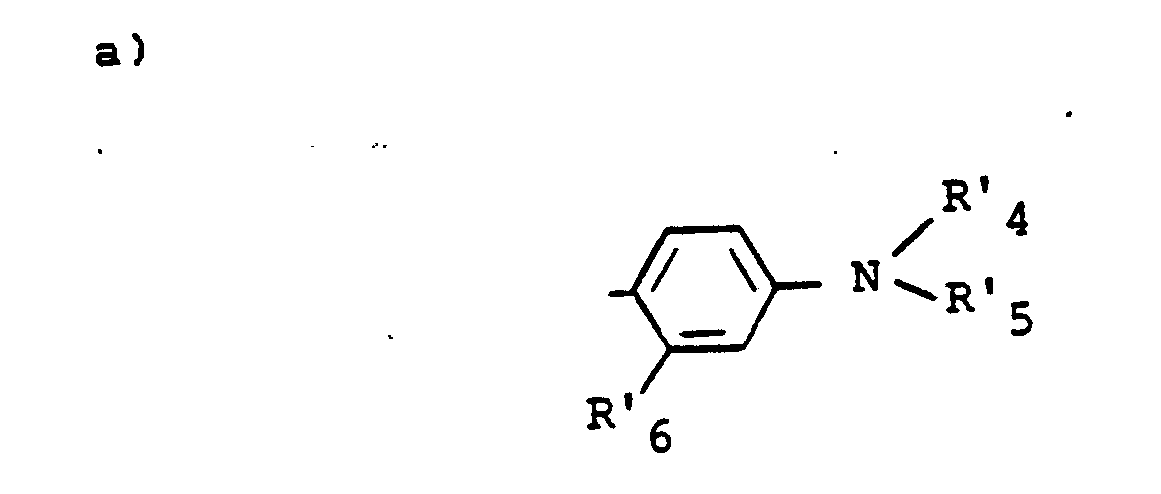


- R'4 unsubstituiertes Alkyl, vorzugsweise C2H5,
- R's Sulfatoalkyl, Sulfoalkyl oder Sulfoaralkyl,
- R'6 Wasserstoff, unsubstituiertes Alkyl oder NH-COX',
- R'9 Wasserstoff, unsubstituiertes Alkyl oder Aryl,
- R'10 Wasserstoff oder unsubstituiertes Alkyl,
- R'11 CH3 oder CONH2,
- R'13 unsubstituiertes Alkyl oder Sulfoalkyl,
- R',6 Wasserstoff, unsubstituiertes Alkyl, Cyclohexyl oder Aryl,
- R'17 Wasserstoff oder unsubstituiertes Alkyl und
- X' unsubstituiertes Alkyl oder Cyclohexyl bedeuten,
- Y' unsubstituiertes Alkyl oder Cylohexyl oder Sulfoalkyl bedeuten,
- Besonders bevorzugt sind Farbstoffe der Formeln (I) oder (11), worin K bzw, K' für den 2-Amino-8-hydroxy-naphthalin-6-solfonsäurerest ("γ-Säure") steht.
- Im Rahmen .dieser Formeln gelten als ganz besonders bevorzugt Farbstoffe der Formel

- X" für C1-C4-Alkyl oder Cyclohexyl und
- R"3 für
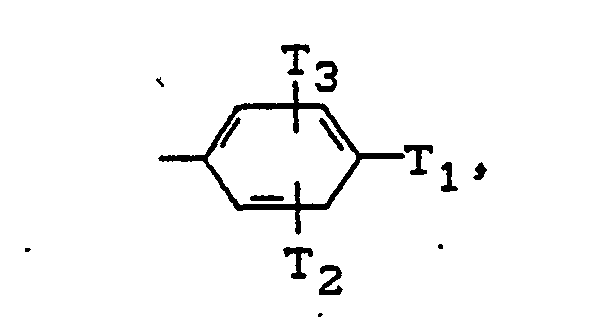
- T1-3 für CH3, Cl, OCH3, OC2H5, CF3 oder C2H4OCF3 stehen.
- Aus diesen Farbstoffen sind wiederum solche Verbindungen der angegebenen Formel hervorzuheben, worin
- X" für C2Hs, n-Propyl oder Cyclohexyl und
- R", für CH3, C2H5 oder t-C4H9 stehen.
- Die neuen Farbstoffe erhält man z.B. dadurch, daß man diazotierte 3-Aminothiophene der Formel

- A für Wasserstoff oder eine Abgangsgruppe (z.B. COOH, CHO, OH oder SO3H) steht,
- in an sich bekannter Weise (vgl. z.B. GB-A 2 011 937) kuppelt.
- Die 3-Aminothiophene der Formel (IV) sind entweder bekannt oder nach in der Literatur beschriebenen Methoden leicht zugänglich. (vgl. "The Chemistry of Heterocyclic Compounds", Thiophene and its Derivatives; Vol. 44, p.1 ff)
- So gewinnt man einige dieser Diazokomponenten beispielsweise gemäß "Synthesis-Communications", March 1984, 275 ff durch Umsetzung von Verbindungen der Formel

- (R" = H, Alkyl oder Aryl; V = Cl, Br)
- R1-CH2-SH (VI)
- in Gegenwart von Basen und -falls R2" = H - gegebenenfalls anschließende Einführung des Halogens in 4-Stellung mittels üblicher Halogenierungsmittel.
- Eine weitere Methode zur Herstellung von (IV) entspricht dem Verfahren gemäß DE-PS 1 055 007, welches dadurch gekennzeichnet ist, daß man Verbindungen der Formel

- Verbindungen der Formel (IV) mit R2 = CN erhält man z.B. durch Umsetzung von 1,3-Oxathioliumsalzen der Formel

- Als basische Kondensationsmittel kommen in allen drei Fällen vorzugsweise Alkalialkoholate in Betracht.
- Die neuen Säurefarbstoffe sind sehr farbstark und eignen sich zum Färben von amidgruppenhaltigen natürlichen und synthetischen Fasermaterialien, vorzugsweise solchen aus Wolle, Seide und synthetischen Superpolyamiden.
- Man erhält egale Färbungen in gelben bis violetten Farbtönen mit guten Allgemeinechtheiten, insbesondere guten Naβ-und Lichtechtheiten.
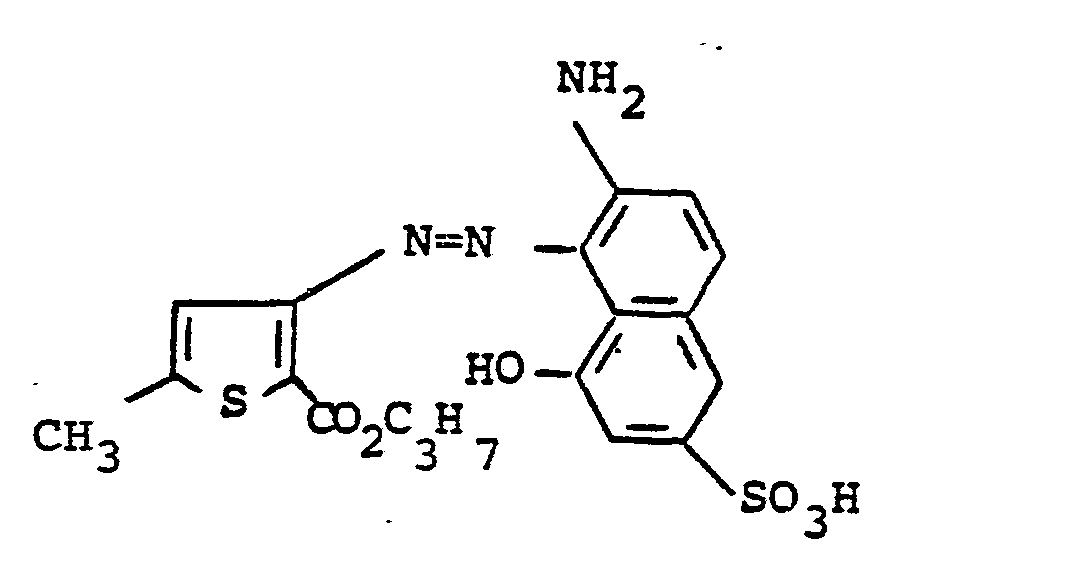
- 7,16 g 5-Phenyl-3-amino-2-ethoxycarbonyl-thiophen werden in einer Mischung aus 30 ml Essigsäure, 5 ml Propionsäure und 30 ml 80 %iger Phosphorsäure gelöst. Man kühlt die Lösung auf - 5° C ab und diazotiert bei dieser Temperatur mit 9,3 ml einer 40 %igen Nitrosylschwefelsäure. Nach 45 Minuten gibt man die Reaktionslösung auf Es und entfernt den Nitritüberschuß mit Amidosulfonsäure. Diese Diazoniumsalzlösung läßt man zu einer auf 5° C gekülten Lösung von 7,73 g 2-Amino-8-hydroxynaphthalin-6-sulfonsäure in 100 ml Dimethylformamid, die zuvor durch Zugabe von ca. 5 ml konzentrierter Salzsäure auf pH 1 gestellt wurde, laufen. Zur Vervollständigung der Kupplung stellt man langsam mit Sodalösung einen pH-Wert von 1,5 ein. Es wird 3 Stunden nachgerührt und dann das Umsetzungsprodukt abgesaugt und getrocknet. Man erhält 12,5 g eines roten Farbstoffs der Formel
-

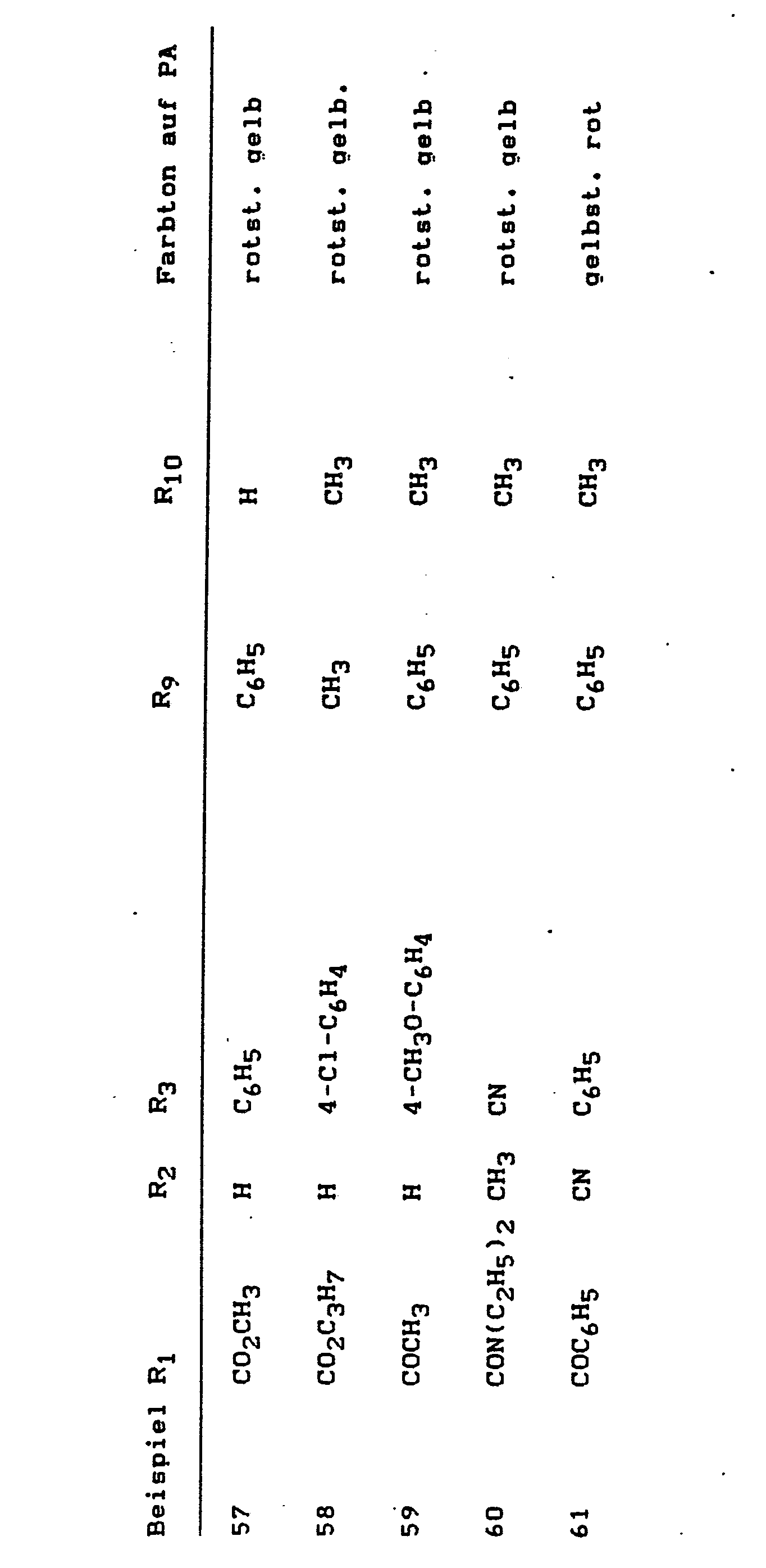
- In analoger Weise werden die in folgender Tabelle aufgeführten Farbstoffe I erhalten, wobei K =


- 6,26 g 5-Phenyl-3-amino-2-acetyl-thiophen werden in 30 ml Essigsäure, 10 ml Propionsäure und 30 ml 85 %iger Phosphorsäure gelöst und bei -5° C mit 9,3 ml einer 40 %igen Nitroylschwefelsäure diazotiert. Nach 45 Minuten gibt man die Lösung auf Eis, entfernt den Nitritüberschuß mit Amidosulfonsäure, und fügt die Diazoniumsalzlösung dann zu einer wäßrigen sauren Lösung von 7,73 g 2-Amino-8-hydroxy-naphthalin-6-sulfonsäure hinzu. Mit einer gesättigten Natriumacetat-Lösung stumpfte man auf den pH-Wert 2 ab und rührt noch 3 Stunden nach. Das Umsetzungsprodukt wird abgesaugt und getrocknet. Man erhält 12 g eines roten Farbstoffs der Formel

- Das als Diazokomponente verwendete 5-Phenyl-3-amino-2-acetyl-thiophen wird wie folgt erhalten:
- Zu einer aus 11,5 g Natrium und 350 ml Ethanol hergestellten Lösung gibt man 45 g Mercaptoaceton und danach 81,75 g ß-Chlor-zimtsäurenitril. Zur Vervollständigung der Reaktion erhitzt man noch 30 Minuten zum Sieden. Die Reaktionsmischung wird auf Eis ausgetragen und das Produkt durch Absaugen isoliert. Nach Umkristalligieren aus Ethanol erhält man gelbe Kristalle (Fp. 136° C).
- 5,36 g 5-Methyl-3-amino-2-ethoxycarbonyl-thiophen werden in 100 ml Essigsäure und 20 ml konzentrierter Salzsäure bei 0° C mit einer Lösung von 2,2 g Natriumnitrit in 80 ml Wasser diazotiert. Nach 45 Minuten entfernt man mit Amidosulfonsäure den Nitritüberschuß und kuppelt in der oben beschriebenen Weise auf 7,73 g 2-Amino-8- .hydroxy-naphthalin-6-sulfonsäure. Man isoliert 11 g eines roten Pulvers der Formel

- Das als Diazokomponente verwendete 5-Methyl-3-amino-2-ethoxycarbonyl-thiophen wird wie folgt hergestellt:
- Man löst 11,5 g Natrium in 350 ml Ethanol und gibt dann 62,5 g α-Mercapto-essigsäureethylester hinzu. In diese Lösung tropft man dann eine Mischung von 50,75 g β-Chlor-crotonsäurenitril in 50 mi Ethanol. Man kocht 1 Stunde unter Rückfluß, trägt auf Eis aus und saugt den Niederschlag ab. Die Verbindung zeigt folgende charakteristische IR-Absorptionslinien in KBr 1660, 3400 und 3350 cm-1 (Schmp.: 41° C).
- Aus 8,16 g 5-(p-Chlorphenyl)-3-amino-2-etho- xycarbonylthiophen wird wie in Beispiel 1 beschrieben eine Diazoniumsalzlösung bereitet. Diese läßt man zu einer wäßrigen Lösung von 7,1 g N-Ethyl-N-sulfato-ethylanilin fließen. Mit verdünnter Soda-Lösung stumpft man auf einem pH-Wert von 4 ab, läßt Stunden nachrühren und isoliert den Farbstoff durch Absaugen. Nach dem Trocknen erhält man 14,5 g eines orangefarbenen Farbstoffs der Formel

- In analoger Weise werden die folgenden Farbstoffe der angegebenen Formel erhalten.


- Auch die nachstehenden Naphthylaminderivate werden in analoger Weise hergestellt. Diese Farbstoffe entsprechen der Formel


- - 3,13 g 5-Phenyl-3-amino-2-acetyl-thiophen werden in 10 ml DMF, 20 ml Essigsäure, 5 ml Propionsäure und 20 ml 85 %iger Phosphorsäure bei - 5° C mit 4,7 ml Nitrosylschwefelsäure diazotiert.
- Man rührt 60 Minuten nach, gibt auf Eis, zerstört den Nitritüberschuß mit Amidosulfonsäure und läßt die Mischung zu einer wäßrigen Lösung von 3,95 g 2-Phenyl-indol-sulfonsäure laufen. Durch Abstumpfen mit Natriumacetat läßt man den Farbstoff auskuppeln. Nach Absaugen und Trocknen erhält man 7,0 g eines roten Pulvers der Formel


- 8,16 g 5-(p-Chlor-phenyl)-3-amino-2- ethoxycarbonyl-thiophen werden in einer Mischung aus 30 ml 85 %iger Phosphorsäure, 30 ml Essigsäure und 5 ml Propionsäure bei -5° C mit 9,3 ml Nitrosylschwefelsäure diazotiert. Nach 60 Minuten gibt man die Lösung auf Eis, entfernt den Nitritüberschuß mit Amidosulfonsäure und läßt das Gemisch dann mit einer wäßrigen Lösung von 7,3 g 3-(5-Amino-3-methyl-1H-pyrazol-1-yl)-benzolsulfonsäure unter Abstumpfen mit Natriumacetat reagieren. Nach dem Abstumpfen wird abgesaugt und getrocknet. Man erhält 14,0 g eines gelben Farbstoffs der Formel

- In analoger Weise erhält man die folgenden Farbstoffe der Formel


- 40,2 g 5-(p-Methoxy-phenyl)-3-amino-2-ethoxy- carbonylthiophen werden in der oben beschriebenen Weise diazotiert. Diese DiazoniumsalzLösung läßt man bei neutralem pH-Wert zu 5,92 g 6-Hydroxy-1,4-dimethyl-3-sulfomethyl-pyridon-2 laufen. Man rührt noch 3 Stunden nach, säuert an und saugt ab. Nach dem Trocknen erhält man 8,5 g eines gelben Farbstoffs der Formel

- In analoger Weise erhält man die folgenden Farbstoffe der Formel


wobei die vorstehend genannten cyclischen und acyclischen Reste durch weitere in der Farbstoffchemie übliche Substituenten substituiert sein können.
wobei die wasserlöslich machenden Gruppen - OSO3H und SSO3H .vorzugsweise in den Alkylresten R4, Rs, R10, R12 und R13 und die SO3H-Gruppen außer in den vorstehend genannten Alkylresten in den Aryl-(vorzugsweise Phenyl)-Resten oder Aralkyl-(vorzugsweise Benzyl-), R4, Rs, R12 und R13 enthalten sind, sofern nicht bereits oben andere Positionen angegeben sind.
wobei die genannten Alkylreste vorzugsweise 1 bis 4 C-Atome aufweisen und die Arylreste vorzugsweise Phenylreste und die Aralkylreste vorzugsweise Benzylreste sind, die im Phenylkem vorzugsweise 1-bis 3-mal durch C,-C4-Alkyl, Cl oder C1-G4-Alkoxy oder 1-mal durch SO3H substituiert sein können, mit der Maßgabe, daß die Farbstoffe mindestens eine SO3H-oder OSO3H-Gruppe enthalten.
mit Verbindungen der Formel
Claims (8)

wobei die vorstehend genannten cyclischen und acyclischen Reste durch weitere in der Farbstoffchemie übliche Substituenten substituiert sein können..

wobei die wasserlöslich machenden Gruppen - OSO3H und -SSO3H vorzugsweise in den Alkylresten R., Rs, R10, R12 und R,3 und die -SO3H-Gruppen außer in den vorstehend genannten Alkylresten in den Arylresten oder Aralkylresten, R4, Rs, R12 und R13 enthalten sind, sofern nicht bereits andere Positionen angegeben sind.



Applications Claiming Priority (2)
| Application Number | Priority Date | Filing Date | Title |
|---|---|---|---|
| DE3510410 | 1985-03-22 | ||
| DE19853510410 DE3510410A1 (de) | 1985-03-22 | 1985-03-22 | Azofarbstoffe |
Publications (2)
| Publication Number | Publication Date |
|---|---|
| EP0198206A1 true EP0198206A1 (de) | 1986-10-22 |
| EP0198206B1 EP0198206B1 (de) | 1988-10-26 |
Family
ID=6266032
Family Applications (1)
| Application Number | Title | Priority Date | Filing Date |
|---|---|---|---|
| EP86103101A Expired EP0198206B1 (de) | 1985-03-22 | 1986-03-08 | Azofarbstoffe |
Country Status (4)
| Country | Link |
|---|---|
| US (1) | US4711954A (de) |
| EP (1) | EP0198206B1 (de) |
| JP (1) | JPS61221266A (de) |
| DE (2) | DE3510410A1 (de) |
Cited By (1)
| Publication number | Priority date | Publication date | Assignee | Title |
|---|---|---|---|---|
| EP0315899A3 (en) * | 1987-11-12 | 1990-01-17 | Basf Aktiengesellschaft | Thien-3-yl azo dyes |
Families Citing this family (3)
| Publication number | Priority date | Publication date | Assignee | Title |
|---|---|---|---|---|
| DE19521195A1 (de) * | 1994-06-21 | 1996-01-04 | Sandoz Ag | Saure Monoazofarbstoffe |
| US6582502B2 (en) * | 2000-01-25 | 2003-06-24 | Fuji Photo Film Co., Ltd. | Dye, ink for ink jet recording, and ink jet recording method |
| US9068081B2 (en) | 2010-11-12 | 2015-06-30 | Milliken & Company | Thiophene azo dyes and laundry care compositions containing the same |
Citations (2)
| Publication number | Priority date | Publication date | Assignee | Title |
|---|---|---|---|---|
| GB837086A (en) * | 1957-08-29 | 1960-06-09 | Hoechst Ag | New 3-amino-thiophene-2-carboxylic acids and the esters thereof and a process of preparing said acids and esters |
| GB2011937A (en) * | 1977-12-29 | 1979-07-18 | Ici Ltd | Disperse monoazo dyestuffs |
Family Cites Families (3)
| Publication number | Priority date | Publication date | Assignee | Title |
|---|---|---|---|---|
| GB1394365A (en) * | 1972-01-28 | 1975-05-14 | Impperial Chemical Ind Ltd | Disperse azo dyestuffs |
| US4264495A (en) * | 1972-05-15 | 1981-04-28 | Eastman Kodak Company | 2-Thienyl azo dyestuff compounds |
| US4400318A (en) * | 1980-05-19 | 1983-08-23 | Eastman Kodak Company | Substituted 5-acyl-3-carbamoyl-2-thienyl azo dyes with aniline, tetrahydroquinoline, and benzomorpholine couplers, process of manufacture, and polyamide testile materials dyed therewith |
-
1985
- 1985-03-22 DE DE19853510410 patent/DE3510410A1/de not_active Withdrawn
-
1986
- 1986-03-04 US US06/836,047 patent/US4711954A/en not_active Expired - Fee Related
- 1986-03-08 EP EP86103101A patent/EP0198206B1/de not_active Expired
- 1986-03-08 DE DE8686103101T patent/DE3661022D1/de not_active Expired
- 1986-03-18 JP JP61058427A patent/JPS61221266A/ja active Pending
Patent Citations (2)
| Publication number | Priority date | Publication date | Assignee | Title |
|---|---|---|---|---|
| GB837086A (en) * | 1957-08-29 | 1960-06-09 | Hoechst Ag | New 3-amino-thiophene-2-carboxylic acids and the esters thereof and a process of preparing said acids and esters |
| GB2011937A (en) * | 1977-12-29 | 1979-07-18 | Ici Ltd | Disperse monoazo dyestuffs |
Non-Patent Citations (1)
| Title |
|---|
| CHEMICAL ABSTRACTS, Band 101, Nr. 22, November 1984, Seite 83, Zusammenfassung Nr. 193660a, Columbus, Ohio, US; & DD - A - 157 911 (HARRY SCHAEFER et al.) 15-12-1982 * |
Cited By (1)
| Publication number | Priority date | Publication date | Assignee | Title |
|---|---|---|---|---|
| EP0315899A3 (en) * | 1987-11-12 | 1990-01-17 | Basf Aktiengesellschaft | Thien-3-yl azo dyes |
Also Published As
| Publication number | Publication date |
|---|---|
| US4711954A (en) | 1987-12-08 |
| DE3510410A1 (de) | 1986-09-25 |
| EP0198206B1 (de) | 1988-10-26 |
| JPS61221266A (ja) | 1986-10-01 |
| DE3661022D1 (en) | 1988-12-01 |
Similar Documents
| Publication | Publication Date | Title |
|---|---|---|
| DE1098125B (de) | Verfahren zur Herstellung von fluoreszierenden Verbindungen | |
| EP0014344A1 (de) | Cumarinverbindungen, Verfahren zu ihrer Herstellung und deren Verwendung als Weisstöner und Laserfarbstoffe | |
| DE1069313B (de) | ||
| DE2912428A1 (de) | Neue dispersionsfarbstoffe, deren herstellung und verwendung | |
| DE1901422C3 (de) | Trisazofarbstoffe, Verfahren zu ihrer Herstellung und ihre Verwendung in photographischen Materialien | |
| DE2238378B2 (de) | Perinonfarbstoffe und Verfahren zu ihrer Herstellung | |
| DE2531445B2 (de) | Sulfogruppenfreie wasserloesliche azofarbstoffe und deren verwendung zum faerben und/oder bedrucken von synthetischen textilfasern | |
| DE2842186A1 (de) | Azofarbstoffe | |
| EP0198206B1 (de) | Azofarbstoffe | |
| DE2017764C3 (de) | Benzoxanthen- und Benzothioxanthenfarbstoffe, Verfahren zu ihrer Herstellung und ihre Verwendung. Anmi Farbwerke Hoechst AG, vormals Meister Lucius & Brüning, 6000 Frankfurt | |
| DE2433260B2 (de) | In wasser schwer loesliche monoazoverbindungen, verfahren zu ihrer herstellung und ihre verwendung zum faerben oder bedrucken | |
| DE2657218A1 (de) | Unsymmetrische xanthenfarbstoffe, verfahren zu ihrer herstellung und ihre verwendung | |
| DE2222639A1 (de) | In Wasser schwer loesliche Azoverbindungen,ihre Herstellung und Verwendung als Dispersionsfarbstoffe | |
| DE2557523A1 (de) | Beta-anilinoaethansulfonylfluoride | |
| DE2608020A1 (de) | Naphthostyrilfarbstoffe | |
| DE1769025A1 (de) | Monoazofarbstoffe | |
| DE2603592C3 (de) | ||
| DE1276844B (de) | Verfahren zur Herstellung von wasserloeslichen Azofarbstoffen | |
| CH343560A (de) | Verfahren zur Herstellung wasserunlöslicher Monoazofarbstoffe | |
| DE2162858A1 (de) | 3-Sulfoalkyl-6-hydroxy-pyridone-(2), deren Herstellung und Verwendung | |
| EP0624628A1 (de) | Kationische Diazacyaninfarbstoffe | |
| DE2212755A1 (de) | Wasserunloesliche monoazofarbstoffe und verfahren zu ihrer herstellung | |
| DE2347124A1 (de) | Azoverbindungen | |
| DE2106648B2 (de) | Wasserlösliche Azo- und Anthrachinonfarbstoffe, Verfahren zu ihrer Herstellung und ihre Verwendung zum Färben oder Bedrucken von Fasermaterialien aus Cellulose 2,5-acetat, Cellulosetriacetat, Polyamiden, Polyurethanen, Polyestern, Cellulose, Wolle oder Seide | |
| DE2708441A1 (de) | 2-amino-5-thiocyanato-thiadiazol- (1,3,4), dessen herstellung und verwendung zum aufbau von azofarbstoffen |
Legal Events
| Date | Code | Title | Description |
|---|---|---|---|
| PUAI | Public reference made under article 153(3) epc to a published international application that has entered the european phase |
Free format text: ORIGINAL CODE: 0009012 |
|
| 17P | Request for examination filed |
Effective date: 19860308 |
|
| AK | Designated contracting states |
Kind code of ref document: A1 Designated state(s): CH DE FR GB LI |
|
| 17Q | First examination report despatched |
Effective date: 19870709 |
|
| GRAA | (expected) grant |
Free format text: ORIGINAL CODE: 0009210 |
|
| AK | Designated contracting states |
Kind code of ref document: B1 Designated state(s): CH DE FR GB LI |
|
| GBT | Gb: translation of ep patent filed (gb section 77(6)(a)/1977) | ||
| REF | Corresponds to: |
Ref document number: 3661022 Country of ref document: DE Date of ref document: 19881201 |
|
| ET | Fr: translation filed | ||
| PLBE | No opposition filed within time limit |
Free format text: ORIGINAL CODE: 0009261 |
|
| STAA | Information on the status of an ep patent application or granted ep patent |
Free format text: STATUS: NO OPPOSITION FILED WITHIN TIME LIMIT |
|
| 26N | No opposition filed | ||
| PGFP | Annual fee paid to national office [announced via postgrant information from national office to epo] |
Ref country code: DE Payment date: 19920221 Year of fee payment: 7 |
|
| PGFP | Annual fee paid to national office [announced via postgrant information from national office to epo] |
Ref country code: GB Payment date: 19920225 Year of fee payment: 7 |
|
| PGFP | Annual fee paid to national office [announced via postgrant information from national office to epo] |
Ref country code: FR Payment date: 19920317 Year of fee payment: 7 |
|
| PGFP | Annual fee paid to national office [announced via postgrant information from national office to epo] |
Ref country code: CH Payment date: 19920327 Year of fee payment: 7 |
|
| PG25 | Lapsed in a contracting state [announced via postgrant information from national office to epo] |
Ref country code: GB Effective date: 19930308 |
|
| PG25 | Lapsed in a contracting state [announced via postgrant information from national office to epo] |
Ref country code: LI Effective date: 19930331 Ref country code: CH Effective date: 19930331 |
|
| GBPC | Gb: european patent ceased through non-payment of renewal fee |
Effective date: 19930308 |
|
| PG25 | Lapsed in a contracting state [announced via postgrant information from national office to epo] |
Ref country code: FR Effective date: 19931130 |
|
| REG | Reference to a national code |
Ref country code: CH Ref legal event code: PL |
|
| PG25 | Lapsed in a contracting state [announced via postgrant information from national office to epo] |
Ref country code: DE Effective date: 19931201 |
|
| REG | Reference to a national code |
Ref country code: FR Ref legal event code: ST |