EP0198226A2 - Härter für pulverförmige Überzugsmittel auf der Basis von Epoxyharzen - Google Patents
Härter für pulverförmige Überzugsmittel auf der Basis von Epoxyharzen Download PDFInfo
- Publication number
- EP0198226A2 EP0198226A2 EP86103388A EP86103388A EP0198226A2 EP 0198226 A2 EP0198226 A2 EP 0198226A2 EP 86103388 A EP86103388 A EP 86103388A EP 86103388 A EP86103388 A EP 86103388A EP 0198226 A2 EP0198226 A2 EP 0198226A2
- Authority
- EP
- European Patent Office
- Prior art keywords
- bis
- powdery coating
- imidazoline
- atoms
- mit
- Prior art date
- Legal status (The legal status is an assumption and is not a legal conclusion. Google has not performed a legal analysis and makes no representation as to the accuracy of the status listed.)
- Withdrawn
Links
- 239000003822 epoxy resin Substances 0.000 title claims description 9
- 229920000647 polyepoxide Polymers 0.000 title claims description 9
- 238000000576 coating method Methods 0.000 title abstract description 11
- 239000011248 coating agent Substances 0.000 title description 7
- 239000003795 chemical substances by application Substances 0.000 title description 4
- -1 cyclic amidine Chemical class 0.000 claims abstract description 28
- 239000004848 polyfunctional curative Substances 0.000 claims abstract description 14
- 150000000000 tetracarboxylic acids Chemical class 0.000 claims abstract description 10
- 239000008199 coating composition Substances 0.000 claims abstract description 7
- MWPLVEDNUUSJAV-UHFFFAOYSA-N anthracene Chemical compound C1=CC=CC2=CC3=CC=CC=C3C=C21 MWPLVEDNUUSJAV-UHFFFAOYSA-N 0.000 claims abstract description 6
- YNPNZTXNASCQKK-UHFFFAOYSA-N phenanthrene Chemical compound C1=CC=C2C3=CC=CC=C3C=CC2=C1 YNPNZTXNASCQKK-UHFFFAOYSA-N 0.000 claims abstract description 6
- 230000003472 neutralizing effect Effects 0.000 claims abstract description 4
- 150000002790 naphthalenes Chemical class 0.000 claims abstract description 3
- 239000002253 acid Substances 0.000 claims description 8
- LNEPOXFFQSENCJ-UHFFFAOYSA-N haloperidol Chemical compound C1CC(O)(C=2C=CC(Cl)=CC=2)CCN1CCCC(=O)C1=CC=C(F)C=C1 LNEPOXFFQSENCJ-UHFFFAOYSA-N 0.000 claims description 7
- 150000002462 imidazolines Chemical class 0.000 claims description 6
- 239000011230 binding agent Substances 0.000 claims description 4
- 238000006386 neutralization reaction Methods 0.000 claims description 2
- CXWXQJXEFPUFDZ-UHFFFAOYSA-N tetralin Chemical compound C1=CC=C2CCCCC2=C1 CXWXQJXEFPUFDZ-UHFFFAOYSA-N 0.000 claims 1
- 238000004519 manufacturing process Methods 0.000 abstract description 5
- 125000003700 epoxy group Chemical group 0.000 abstract description 2
- 125000004432 carbon atom Chemical group C* 0.000 description 16
- OKKJLVBELUTLKV-UHFFFAOYSA-N Methanol Chemical compound OC OKKJLVBELUTLKV-UHFFFAOYSA-N 0.000 description 9
- PEDCQBHIVMGVHV-UHFFFAOYSA-N Glycerine Chemical compound OCC(O)CO PEDCQBHIVMGVHV-UHFFFAOYSA-N 0.000 description 5
- 125000004435 hydrogen atom Chemical group [H]* 0.000 description 5
- 229920006395 saturated elastomer Polymers 0.000 description 5
- MYRTYDVEIRVNKP-UHFFFAOYSA-N 1,2-Divinylbenzene Chemical compound C=CC1=CC=CC=C1C=C MYRTYDVEIRVNKP-UHFFFAOYSA-N 0.000 description 4
- BKCCAYLNRIRKDJ-UHFFFAOYSA-N 2-phenyl-4,5-dihydro-1h-imidazole Chemical compound N1CCN=C1C1=CC=CC=C1 BKCCAYLNRIRKDJ-UHFFFAOYSA-N 0.000 description 4
- IJGRMHOSHXDMSA-UHFFFAOYSA-N Atomic nitrogen Chemical compound N#N IJGRMHOSHXDMSA-UHFFFAOYSA-N 0.000 description 4
- 239000000654 additive Substances 0.000 description 4
- 150000005840 aryl radicals Chemical class 0.000 description 4
- 239000000203 mixture Substances 0.000 description 4
- 150000002924 oxiranes Chemical class 0.000 description 4
- 239000000843 powder Substances 0.000 description 4
- 239000000758 substrate Substances 0.000 description 4
- 150000005326 tetrahydropyrimidines Chemical class 0.000 description 4
- KAKZBPTYRLMSJV-UHFFFAOYSA-N Butadiene Chemical compound C=CC=C KAKZBPTYRLMSJV-UHFFFAOYSA-N 0.000 description 3
- 239000004593 Epoxy Substances 0.000 description 3
- QIGBRXMKCJKVMJ-UHFFFAOYSA-N Hydroquinone Chemical compound OC1=CC=C(O)C=C1 QIGBRXMKCJKVMJ-UHFFFAOYSA-N 0.000 description 3
- RRHGJUQNOFWUDK-UHFFFAOYSA-N Isoprene Chemical compound CC(=C)C=C RRHGJUQNOFWUDK-UHFFFAOYSA-N 0.000 description 3
- 125000000217 alkyl group Chemical group 0.000 description 3
- 238000000034 method Methods 0.000 description 3
- 239000003973 paint Substances 0.000 description 3
- GHMLBKRAJCXXBS-UHFFFAOYSA-N resorcinol Chemical compound OC1=CC=CC(O)=C1 GHMLBKRAJCXXBS-UHFFFAOYSA-N 0.000 description 3
- SDRZFSPCVYEJTP-UHFFFAOYSA-N 1-ethenylcyclohexene Chemical compound C=CC1=CCCCC1 SDRZFSPCVYEJTP-UHFFFAOYSA-N 0.000 description 2
- WIFDRXSVRSCMMY-UHFFFAOYSA-N 2,6-dichloro-4-[(3,5-dichloro-4-hydroxyphenyl)methyl]phenol Chemical compound C1=C(Cl)C(O)=C(Cl)C=C1CC1=CC(Cl)=C(O)C(Cl)=C1 WIFDRXSVRSCMMY-UHFFFAOYSA-N 0.000 description 2
- VWSLLSXLURJCDF-UHFFFAOYSA-N 2-methyl-4,5-dihydro-1h-imidazole Chemical compound CC1=NCCN1 VWSLLSXLURJCDF-UHFFFAOYSA-N 0.000 description 2
- SQNMHJHUPDEXMS-UHFFFAOYSA-N 4-(1,2-dicarboxyethyl)-1,2,3,4-tetrahydronaphthalene-1,2-dicarboxylic acid Chemical compound C1=CC=C2C(C(CC(=O)O)C(O)=O)CC(C(O)=O)C(C(O)=O)C2=C1 SQNMHJHUPDEXMS-UHFFFAOYSA-N 0.000 description 2
- BATCUENAARTUKW-UHFFFAOYSA-N 4-[(4-hydroxyphenyl)-diphenylmethyl]phenol Chemical compound C1=CC(O)=CC=C1C(C=1C=CC(O)=CC=1)(C=1C=CC=CC=1)C1=CC=CC=C1 BATCUENAARTUKW-UHFFFAOYSA-N 0.000 description 2
- RSSGMIIGVQRGDS-UHFFFAOYSA-N 4-[(4-hydroxyphenyl)-phenylmethyl]phenol Chemical compound C1=CC(O)=CC=C1C(C=1C=CC(O)=CC=1)C1=CC=CC=C1 RSSGMIIGVQRGDS-UHFFFAOYSA-N 0.000 description 2
- YZYGDZRBLOLVDY-UHFFFAOYSA-N 4-[cyclohexyl-(4-hydroxyphenyl)methyl]phenol Chemical compound C1=CC(O)=CC=C1C(C=1C=CC(O)=CC=1)C1CCCCC1 YZYGDZRBLOLVDY-UHFFFAOYSA-N 0.000 description 2
- STFIZEBRSSCPKA-UHFFFAOYSA-N 5-methyl-4,5-dihydro-1h-imidazole Chemical compound CC1CNC=N1 STFIZEBRSSCPKA-UHFFFAOYSA-N 0.000 description 2
- ATUOYWHBWRKTHZ-UHFFFAOYSA-N Propane Chemical compound CCC ATUOYWHBWRKTHZ-UHFFFAOYSA-N 0.000 description 2
- 229910000831 Steel Inorganic materials 0.000 description 2
- GWEVSGVZZGPLCZ-UHFFFAOYSA-N Titan oxide Chemical compound O=[Ti]=O GWEVSGVZZGPLCZ-UHFFFAOYSA-N 0.000 description 2
- 241000251539 Vertebrata <Metazoa> Species 0.000 description 2
- QVGXLLKOCUKJST-UHFFFAOYSA-N atomic oxygen Chemical compound [O] QVGXLLKOCUKJST-UHFFFAOYSA-N 0.000 description 2
- IISBACLAFKSPIT-UHFFFAOYSA-N bisphenol A Chemical compound C=1C=C(O)C=CC=1C(C)(C)C1=CC=C(O)C=C1 IISBACLAFKSPIT-UHFFFAOYSA-N 0.000 description 2
- 150000001875 compounds Chemical class 0.000 description 2
- MGNZXYYWBUKAII-UHFFFAOYSA-N cyclohexa-1,3-diene Chemical compound C1CC=CC=C1 MGNZXYYWBUKAII-UHFFFAOYSA-N 0.000 description 2
- 150000002170 ethers Chemical class 0.000 description 2
- 235000011187 glycerol Nutrition 0.000 description 2
- 238000002844 melting Methods 0.000 description 2
- 230000008018 melting Effects 0.000 description 2
- VNWKTOKETHGBQD-UHFFFAOYSA-N methane Chemical compound C VNWKTOKETHGBQD-UHFFFAOYSA-N 0.000 description 2
- 229910052757 nitrogen Inorganic materials 0.000 description 2
- 229910052760 oxygen Inorganic materials 0.000 description 2
- 239000001301 oxygen Substances 0.000 description 2
- 239000002245 particle Substances 0.000 description 2
- 239000000049 pigment Substances 0.000 description 2
- 229920002857 polybutadiene Polymers 0.000 description 2
- 229960001755 resorcinol Drugs 0.000 description 2
- 238000005507 spraying Methods 0.000 description 2
- 239000010959 steel Substances 0.000 description 2
- 125000001424 substituent group Chemical group 0.000 description 2
- 125000004434 sulfur atom Chemical group 0.000 description 2
- PUPZLCDOIYMWBV-UHFFFAOYSA-N (+/-)-1,3-Butanediol Chemical compound CC(O)CCO PUPZLCDOIYMWBV-UHFFFAOYSA-N 0.000 description 1
- RZUNIXAGSKNOIB-HSFFGMMNSA-N (1z,3e)-cyclododeca-1,3-diene Chemical compound C1CCCC\C=C/C=C/CCC1 RZUNIXAGSKNOIB-HSFFGMMNSA-N 0.000 description 1
- OUPZKGBUJRBPGC-UHFFFAOYSA-N 1,3,5-tris(oxiran-2-ylmethyl)-1,3,5-triazinane-2,4,6-trione Chemical compound O=C1N(CC2OC2)C(=O)N(CC2OC2)C(=O)N1CC1CO1 OUPZKGBUJRBPGC-UHFFFAOYSA-N 0.000 description 1
- DPVAXLIXQRRYKZ-UHFFFAOYSA-N 1-[2-(4,5-dihydroimidazol-1-yl)phenyl]-4,5-dihydroimidazole Chemical compound C1=NCCN1C1=CC=CC=C1N1C=NCC1 DPVAXLIXQRRYKZ-UHFFFAOYSA-N 0.000 description 1
- HECLRDQVFMWTQS-RGOKHQFPSA-N 1755-01-7 Chemical compound C1[C@H]2[C@@H]3CC=C[C@@H]3[C@@H]1C=C2 HECLRDQVFMWTQS-RGOKHQFPSA-N 0.000 description 1
- CZOUBLCZKPGNPI-UHFFFAOYSA-N 2,6-dimethyl-1,2,3,4-tetrahydropyrimidine Chemical compound CC1NCC=C(C)N1 CZOUBLCZKPGNPI-UHFFFAOYSA-N 0.000 description 1
- ZNWOXGIEIAGCQA-UHFFFAOYSA-N 2-(2-methylphenyl)-4,5-dihydro-1h-imidazole Chemical compound CC1=CC=CC=C1C1=NCCN1 ZNWOXGIEIAGCQA-UHFFFAOYSA-N 0.000 description 1
- VDGKMJYQQUTBQD-UHFFFAOYSA-N 2-(4-methylphenyl)-4,5-dihydro-1h-imidazole Chemical compound C1=CC(C)=CC=C1C1=NCCN1 VDGKMJYQQUTBQD-UHFFFAOYSA-N 0.000 description 1
- CMBVSYQSELVHQA-UHFFFAOYSA-N 2-benzyl-1,2,3,4-tetrahydropyrimidine Chemical compound C=1C=CC=CC=1CC1NCC=CN1 CMBVSYQSELVHQA-UHFFFAOYSA-N 0.000 description 1
- GVPLALUKJMMFAU-UHFFFAOYSA-N 2-ethyl-1,2,3,4-tetrahydropyrimidine Chemical compound CCC1NCC=CN1 GVPLALUKJMMFAU-UHFFFAOYSA-N 0.000 description 1
- QUPKCFBHJFNUEW-UHFFFAOYSA-N 2-ethyl-4,5-dihydro-1h-imidazole Chemical compound CCC1=NCCN1 QUPKCFBHJFNUEW-UHFFFAOYSA-N 0.000 description 1
- GKUYEWXKJWAGHB-UHFFFAOYSA-N 2-ethyl-4-methyl-1,2,3,4-tetrahydropyrimidine Chemical compound CCC1NC=CC(C)N1 GKUYEWXKJWAGHB-UHFFFAOYSA-N 0.000 description 1
- SHYARJUKNREDGB-UHFFFAOYSA-N 2-ethyl-5-methyl-4,5-dihydro-1h-imidazole Chemical compound CCC1=NCC(C)N1 SHYARJUKNREDGB-UHFFFAOYSA-N 0.000 description 1
- FEJIGNDKURQIRD-UHFFFAOYSA-N 2-methyl-1,2,3,4-tetrahydropyrimidine Chemical compound CC1NCC=CN1 FEJIGNDKURQIRD-UHFFFAOYSA-N 0.000 description 1
- LDQYTDPXIMNESL-UHFFFAOYSA-N 2-methyl-4-propylphenol Chemical compound CCCC1=CC=C(O)C(C)=C1 LDQYTDPXIMNESL-UHFFFAOYSA-N 0.000 description 1
- HALGJUKFQIYBHW-UHFFFAOYSA-N 2-phenyl-1,2,3,4-tetrahydropyrimidine Chemical compound N1C=CCNC1C1=CC=CC=C1 HALGJUKFQIYBHW-UHFFFAOYSA-N 0.000 description 1
- MBRFGGHJIHPHGK-UHFFFAOYSA-N 3-(4,5-dihydro-1h-imidazol-2-yl)pyridine Chemical compound N1CCN=C1C1=CC=CN=C1 MBRFGGHJIHPHGK-UHFFFAOYSA-N 0.000 description 1
- HXDOZKJGKXYMEW-UHFFFAOYSA-N 4-ethylphenol Chemical compound CCC1=CC=C(O)C=C1 HXDOZKJGKXYMEW-UHFFFAOYSA-N 0.000 description 1
- RLZNMLHGYCBGQN-UHFFFAOYSA-N 4-methyl-1-[3-(4-methyl-4,5-dihydroimidazol-1-yl)phenyl]-4,5-dihydroimidazole Chemical compound C1=NC(C)CN1C1=CC=CC(N2C=NC(C)C2)=C1 RLZNMLHGYCBGQN-UHFFFAOYSA-N 0.000 description 1
- JPKWOUABJRCSLE-UHFFFAOYSA-N 5-methyl-2-(3-methylphenyl)-4,5-dihydro-1h-imidazole Chemical compound CC1CNC(C=2C=C(C)C=CC=2)=N1 JPKWOUABJRCSLE-UHFFFAOYSA-N 0.000 description 1
- JJUVAPMVTXLLFR-UHFFFAOYSA-N 5-methyl-2-phenyl-4,5-dihydro-1h-imidazole Chemical compound N1C(C)CN=C1C1=CC=CC=C1 JJUVAPMVTXLLFR-UHFFFAOYSA-N 0.000 description 1
- FBPFZTCFMRRESA-FSIIMWSLSA-N D-Glucitol Natural products OC[C@H](O)[C@H](O)[C@@H](O)[C@H](O)CO FBPFZTCFMRRESA-FSIIMWSLSA-N 0.000 description 1
- FBPFZTCFMRRESA-JGWLITMVSA-N D-glucitol Chemical compound OC[C@H](O)[C@@H](O)[C@H](O)[C@H](O)CO FBPFZTCFMRRESA-JGWLITMVSA-N 0.000 description 1
- 239000005062 Polybutadiene Substances 0.000 description 1
- 125000001931 aliphatic group Chemical group 0.000 description 1
- IMHDGJOMLMDPJN-UHFFFAOYSA-N biphenyl-2,2'-diol Chemical group OC1=CC=CC=C1C1=CC=CC=C1O IMHDGJOMLMDPJN-UHFFFAOYSA-N 0.000 description 1
- VCCBEIPGXKNHFW-UHFFFAOYSA-N biphenyl-4,4'-diol Chemical group C1=CC(O)=CC=C1C1=CC=C(O)C=C1 VCCBEIPGXKNHFW-UHFFFAOYSA-N 0.000 description 1
- 229910052799 carbon Inorganic materials 0.000 description 1
- 239000003054 catalyst Substances 0.000 description 1
- 239000000919 ceramic Substances 0.000 description 1
- 238000004140 cleaning Methods 0.000 description 1
- 125000000753 cycloalkyl group Chemical group 0.000 description 1
- RZUNIXAGSKNOIB-UHFFFAOYSA-N cyclododeca-1,3-diene Chemical class C1CCCCC=CC=CCCC1 RZUNIXAGSKNOIB-UHFFFAOYSA-N 0.000 description 1
- 238000009826 distribution Methods 0.000 description 1
- 239000000975 dye Substances 0.000 description 1
- 230000000694 effects Effects 0.000 description 1
- 238000001125 extrusion Methods 0.000 description 1
- 239000000945 filler Substances 0.000 description 1
- 239000011521 glass Substances 0.000 description 1
- 238000000227 grinding Methods 0.000 description 1
- 125000000623 heterocyclic group Chemical group 0.000 description 1
- AHAREKHAZNPPMI-UHFFFAOYSA-N hexa-1,3-diene Chemical compound CCC=CC=C AHAREKHAZNPPMI-UHFFFAOYSA-N 0.000 description 1
- 229930195733 hydrocarbon Natural products 0.000 description 1
- 150000002430 hydrocarbons Chemical class 0.000 description 1
- 230000007062 hydrolysis Effects 0.000 description 1
- 238000006460 hydrolysis reaction Methods 0.000 description 1
- MTNDZQHUAFNZQY-UHFFFAOYSA-N imidazoline Chemical compound C1CN=CN1 MTNDZQHUAFNZQY-UHFFFAOYSA-N 0.000 description 1
- 238000009863 impact test Methods 0.000 description 1
- 239000006115 industrial coating Substances 0.000 description 1
- FPYJFEHAWHCUMM-UHFFFAOYSA-N maleic anhydride Chemical compound O=C1OC(=O)C=C1 FPYJFEHAWHCUMM-UHFFFAOYSA-N 0.000 description 1
- 239000002184 metal Substances 0.000 description 1
- 229910052751 metal Inorganic materials 0.000 description 1
- 150000002739 metals Chemical class 0.000 description 1
- 238000002156 mixing Methods 0.000 description 1
- 230000003287 optical effect Effects 0.000 description 1
- 230000003647 oxidation Effects 0.000 description 1
- 238000007254 oxidation reaction Methods 0.000 description 1
- WXZMFSXDPGVJKK-UHFFFAOYSA-N pentaerythritol Chemical compound OCC(CO)(CO)CO WXZMFSXDPGVJKK-UHFFFAOYSA-N 0.000 description 1
- 229940083254 peripheral vasodilators imidazoline derivative Drugs 0.000 description 1
- 239000004033 plastic Substances 0.000 description 1
- 229920003023 plastic Polymers 0.000 description 1
- 229920002451 polyvinyl alcohol Polymers 0.000 description 1
- 235000019422 polyvinyl alcohol Nutrition 0.000 description 1
- 238000002360 preparation method Methods 0.000 description 1
- 239000001294 propane Substances 0.000 description 1
- 238000010992 reflux Methods 0.000 description 1
- 239000000600 sorbitol Substances 0.000 description 1
- 239000003381 stabilizer Substances 0.000 description 1
- 150000005846 sugar alcohols Polymers 0.000 description 1
- 239000000725 suspension Substances 0.000 description 1
- 238000010998 test method Methods 0.000 description 1
- 239000013008 thixotropic agent Substances 0.000 description 1
- 239000004408 titanium dioxide Substances 0.000 description 1
- JIVZKJJQOZQXQB-UHFFFAOYSA-N tolazoline Chemical compound C=1C=CC=CC=1CC1=NCCN1 JIVZKJJQOZQXQB-UHFFFAOYSA-N 0.000 description 1
- 150000005671 trienes Chemical class 0.000 description 1
- 125000000391 vinyl group Chemical group [H]C([*])=C([H])[H] 0.000 description 1
- 229920002554 vinyl polymer Polymers 0.000 description 1
- DIHAURBCYGTGCV-UHFFFAOYSA-N xi-4,5-Dihydro-2,4(5)-dimethyl-1H-imidazole Chemical compound CC1CN=C(C)N1 DIHAURBCYGTGCV-UHFFFAOYSA-N 0.000 description 1
Classifications
-
- C—CHEMISTRY; METALLURGY
- C08—ORGANIC MACROMOLECULAR COMPOUNDS; THEIR PREPARATION OR CHEMICAL WORKING-UP; COMPOSITIONS BASED THEREON
- C08G—MACROMOLECULAR COMPOUNDS OBTAINED OTHERWISE THAN BY REACTIONS ONLY INVOLVING UNSATURATED CARBON-TO-CARBON BONDS
- C08G59/00—Polycondensates containing more than one epoxy group per molecule; Macromolecules obtained by polymerising compounds containing more than one epoxy group per molecule using curing agents or catalysts which react with the epoxy groups
- C08G59/18—Macromolecules obtained by polymerising compounds containing more than one epoxy group per molecule using curing agents or catalysts which react with the epoxy groups ; e.g. general methods of curing
- C08G59/40—Macromolecules obtained by polymerising compounds containing more than one epoxy group per molecule using curing agents or catalysts which react with the epoxy groups ; e.g. general methods of curing characterised by the curing agents used
- C08G59/50—Amines
- C08G59/5093—Complexes of amines
-
- C—CHEMISTRY; METALLURGY
- C08—ORGANIC MACROMOLECULAR COMPOUNDS; THEIR PREPARATION OR CHEMICAL WORKING-UP; COMPOSITIONS BASED THEREON
- C08G—MACROMOLECULAR COMPOUNDS OBTAINED OTHERWISE THAN BY REACTIONS ONLY INVOLVING UNSATURATED CARBON-TO-CARBON BONDS
- C08G59/00—Polycondensates containing more than one epoxy group per molecule; Macromolecules obtained by polymerising compounds containing more than one epoxy group per molecule using curing agents or catalysts which react with the epoxy groups
- C08G59/18—Macromolecules obtained by polymerising compounds containing more than one epoxy group per molecule using curing agents or catalysts which react with the epoxy groups ; e.g. general methods of curing
- C08G59/40—Macromolecules obtained by polymerising compounds containing more than one epoxy group per molecule using curing agents or catalysts which react with the epoxy groups ; e.g. general methods of curing characterised by the curing agents used
- C08G59/42—Polycarboxylic acids; Anhydrides, halides or low molecular weight esters thereof
- C08G59/4215—Polycarboxylic acids; Anhydrides, halides or low molecular weight esters thereof cycloaliphatic
Definitions
- the invention relates to hardeners obtained by neutralizing a polycarboxylic acid with a cyclic amidine for powdery coating compositions based on epoxy resins as binders.
- the object of the present invention was to develop hardeners for powdery coating compositions, which lead to matt coatings with good optical properties even on problematic substrate surfaces, while avoiding the disadvantages of the prior art. It was essential in solving the problem that the paint properties of the coatings at least did not deteriorate.
- This object was achieved by a hardener by neutralizing 1 mol of a tetracarboxylic acid of a partially hydrogenated naphthalene, anthracene or phenanthrene with at least 1 mol of a cyclic amidine.
- R can independently of one another denote a hydrogen atom or an alkyl radical having 1 to 4 carbon atoms.
- substituents designated as R include 3.4-dicarboxy-1.2.3.4-tetrahydro-1-naphthalenesuccinic acid, 3.4-dicarboxy-1-methyl-1.2.3.4-tetrahydro-1-naphthalenesuccinic acid and 3.4.7.8-tetracarboxy-1.2.3.4.5.6.7.8- octahydrophenanthrene called.
- Cyclic amidines are used to neutralize the tetracarboxylic acids.
- Imidazolines or tetrahydropyrimidines are particularly suitable as cyclic amidines.
- Preferred imidazolines of the general formula (A) are e.g. B. 2-phenyl-imidazoline, 2-phenyl-4-methyl-imidazoline, 2- (m-tolyl) -4-methyl-imidazoline, 2- (m-pyridyl) imidazoline, 1,4-tetramethylene-bis- (4-methylimidazoline), 2-methylimidazoline, 2,4-dimethylimidazoline, 2-ethylimidazoline, 2-ethyl-4-methylimidazoline, 2-benzylimidazoline, 2- (o-tolyl) - imidazoline, 2- (p-tolyl) imidazoline, tetramethylene-bis- (imidazoline), 1,1,3-trimethyl-1,4-tetramethylene-bis-imidazoline, 1,1,3-trimethyl-1,4- tetramethylene-bis- (4-methyl-imidazoline), 1,3,3-trimethyl-1,4-tetram
- Preferred tetrahydropyrimidines are e.g. B. 2-methyl-tetrahydropyrimidine, 2,4-, 2.5-and 2,6-dimethyltetrahydropyrimidine, 2-ethyl-tetrahydropyrimidine, 2-ethyl-4-methyl-tetrahydropyrimidine, 2-benzyl-tetrahydropyrimidine, 2-phenyl-tetrahydropyrimidine, 2-phenyl 4-methyl-, 5-methyl-and -6-methyl-tetrahydropyrimidine, 2.4-diaza-3-phenyl-7.9.9-and -7.7.9-trimethyl-bicyclo (4.3.0) -nonen-2, 2.4- Diaza-3-methyl-7.9.9- and 7.7.9-trimethylbicyclo- (4.3.0) -nonen-2 as well as mixtures of these tetrahydropyrimidines.
- B 2-methyl-tetrahydropyrimidine, 2,4
- the hardeners according to the invention are produced by reacting the tetracarboxylic acid with the cyclic amidine.
- the mixing ratio of the two components is chosen so that 1 mol of tetracarboxylic acid is neutralized with at least 1 mol, preferably with 1 to 2 mol, of a cyclic amidine. If necessary, the tetracarboxylic acid can also be completely neutralized.
- Epoxides based on bisphenol A with an epoxy equivalent of 500 to 2,000 and a melting point of 70 to 140 ° C. have proven to be particularly suitable.
- additives such as leveling agents, pigments, dyes, fillers, catalysts, thixotropic agents, UV and oxidation stabilizers can also be used in the production of the powdery coating compositions.
- the amount of these additives can vary within a wide range, based on the amount of binder.
- the coating compositions are produced, for example, by grinding the individual components (epoxy resins, hardeners and, if appropriate, additives). mixes and extrudes at 90 to 110 ° C. After extrusion, the mixture is cooled and ground to a grain size smaller than 100 ⁇ m.
- the application to the substrates to be coated can be done by known methods, e.g. B. by electrostatic powder spraying, vertebrate or electrostatic vertebrate.
- the applied coating agent is cured for 5 to 35 minutes in the temperature range between 160 to 240 ° C., preferably 10 to 20 minutes between 180 to 220 ° C.
- All substrates which are stable at the specified curing temperatures e.g. Metals, glass, ceramic or plastic, are.
- the coatings produced with the aid of the hardeners according to the invention have a uniform structure or a matt sheen. According to the Gardner determination method (60 °), gloss levels in the range from 6 to 25 can be achieved. In an unexpected way, other paint properties remain at a high level. -
- the epoxy resins used were with the hardeners according to the invention, the pigments and the additives, such as. B. leveling agent, mixed in the weight ratios given below, extruded and then ground.
- the particle diameter of the powder coating components was ⁇ 100 ⁇ .
- the frequency distribution of the particle diameters had a maximum in the range from 30 to 50 u.
- This coating medium was applied by electrostatic powder spraying on degreased steel sheets (1 mm) and then cured at the specified temperatures and times. The properties of the coatings obtained were subjected to the tests below.
- a saturated methanolic solution (about 300 ml of methanol) was prepared at 60 ° C. with 1 mol of 3,4-dicarboxy-1.2.3.4-tetrahydro-1-naphthalenesuccinic acid. This was then mixed with a saturated methanolic solution of 1 mol of 2-phenylimidazoline (approx. 40 ml of Ch 3 0H), also prepared at 60 ° C., in the heat. The solution obtained was refluxed for a further 4 hours and then concentrated to dryness.
- the hardener was processed with titanium dioxide, epoxy resin and leveling agent in the following ratio to a powdery coating agent.
- the coating agent obtained is applied to steel sheets as described above.
- test results can be found in the table.
- a saturated methanolic solution (about 300 ml of methanol) was prepared at 60 ° C. with 1 mol of 3,4-dicarboxy-1.2.3.4-tetrahydro-1-naphthalenesuccinic acid. This was then mixed with a saturated methanolic solution of 2 mol of 2-phenylimidazoline (about 80 ml of methanol), also prepared at 60 ° C., in the heat. The suspension obtained was boiled under reflux for a further 4 hours and then evaporated to dryness.
- the powdery coating composition was prepared and processed analogously to Example 1.
- test results can be found in the table.
Landscapes
- Chemical & Material Sciences (AREA)
- Health & Medical Sciences (AREA)
- Chemical Kinetics & Catalysis (AREA)
- Medicinal Chemistry (AREA)
- Polymers & Plastics (AREA)
- Organic Chemistry (AREA)
- Epoxy Resins (AREA)
- Organic Low-Molecular-Weight Compounds And Preparation Thereof (AREA)
- Paints Or Removers (AREA)
Abstract
Description
- Gegenstand der Erfindung sind Härter erhalten durch Neutralisation einer Polycarbonsäure mit einem cyclischen Amidin für pulverförmige Überzugsmittel auf der Basis von Epoxiharzen als Bindemittel.
- Insbesondere im Industrielacksektor besteht ein großer Bedarf an Pulverlacken zur Herstellung matter Überzüge. Die Gründe hierfür sind überwiegend praktischer Natur. Strukturierte bzw. matte Oberflächen erfordern ein weitaus geringeres Maß an Reinigung als glänzende Oberflächen. Darüber hinaus ist es aus sicherheitstechnischen Gründen notwendig, stark reflektierende Oberflächen zu vermeiden.
- Um den gewünschten Effekt zu erreichen, sind eine Reihe von Maßnahmen bekannt geworden. Für die Herstellung von matten Überzügen auf Basis von Epoxiharzen als Bindemittel hat sich die Verwendung von speziellen Härtem als eine günstige Arbeitsweise (DE-PS 23 24 696) herausgestellt. Nachteil des hier beschriebenen Verfahrens ist, daß Ungleichmäßigkeiten der Substratoberfläche sichtbar bleiben.
- Aufgabe der vorliegenden Erfindung war es, unter Vermeidung der Nachteile des Standes der Technik Härter für pulverförmige Überzugsmittel zu entwickeln, die auch bei problematischen Substratoberflächen zu matten Überzügen mit guten optischen Eigenschaften führen. Wesentlich bei der Lösung der Aufgabe war es, daß sich die lacktechnischen Eigenschaften der Überzüge dabei zumindest nicht verschlechtem.
- Diese Aufgabe wurde durch einen Härter gelöst, indem 1 Mol einer Tetracarbonsäure eines teilhydrierten Naphthalins, Anthracens oder Phenanthrens mit mindestens 1 Mol eines cyclischen Amidins neutralisiert worden ist.
- Als Tetracarbonsäuren kommen z. B. Verbindungen der nachstehenden allgemeinen Formeln infrage:


- Die als R bezeichneten Substituenten können unabhängig voneinander ein Wasserstoffatom oder einen Alkylrest mit 1 bis 4 C-Atomen bedeuten. Als Beispiel seien 3.4-Dicarboxy-1.2.3.4-tetrahydro-1-naphthalinbernsteinsäure, 3.4-Dicarboxy-1-methyl-1.2.3.4-tetrahydro-1-naphthalinbernsteinsäure und 3.4.7.8-tetracarboxy-1.2.3.4.5.6.7.8- octahydrophenanthren genannt.
- Die Herstellung derartiger Tetracarbonsäuren ist bekannt (US-PS 3 769 304, DE-OS 34 35 429). Als Beispiel für eine Herstellungsmethode sei die Addition von 2 Mol Maleinsäureanhydrid an 1 Mol eines ggf. kern-oder seitenkettensubstituierten Vinyloder Divinylbenzols -bei anschließender Hydrolyse -genannt.
- Zur Neutralisation der Tetracarbonsäuren werden cyclische Amidine eingesetzt. Als cyclische Amidine eignen sich insbesondere Imidazoline oder Tetrahydropyrimidine.
- Als Imidazoline werden Verbindungen der allgemeinen Formel
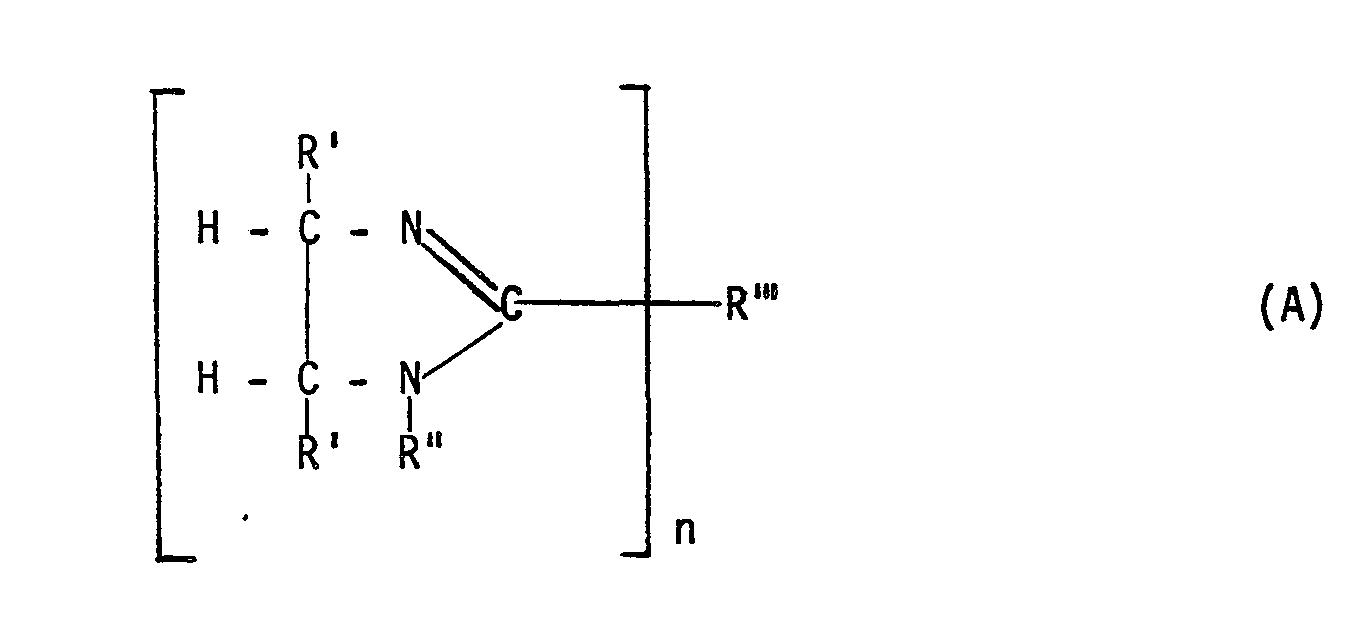
- R' unabhängig voneinander ein Wasserstoffatom, einen Alkylrest mit 1 bis 6 C-Atomen, einen Cycloalkylrest mit 5 bis 10 C-Atomen, einen Aralkylrest mit 7 bis 12 C-Atomen, einen Arylrest mit 6 bis 15 C-Atomen oder einen heterocyclischen Rest mit 5 bis 10 C-Atomen und 1 bis 2 Sauerstoff-, Stickstoff-und/oder Schwefelatomen,
- R" ein Wasserstoffatom, ein Alkyl-oder Arylrest - (wie unter R' definiert), ein Cycloalkylrest mit 5 bis 10 C-Atomen oder ein heterocyclischer Rest mit 5 bis 10 C-Atomen und 1 bis 2 Sauerstoff-, Stickstoff-und/oder Schwefelatomen,
- R" einen Alkylenrest mit 1 bis 6 C-Atomen oder einen Arylenrest mit 6 bis 15 C-Atomen, wobei diese jeweils durch Alkyl-, Cycloalkyl-oder Arylreste (wie für R bzw. R" definiert) substituiert sein können,
- n 1 oder 2
- bedeuten und für den Fall n = 1 auch ein Wasserstoffatom bedeuten kann.
- Bevorzugte Imidazoline der allgemeinen Formel (A) sind z. B. 2-Phenyl-imidazolin, 2-Phenyl-4-methyl-imidazolin, 2-(m-Tolyl)-4-methyl-imidazolin, 2-(m-Pyridyl)-imidazolin, 1,4-Tetramethylen-bis-(4-methyl-imidazolin), 2-Methyl-imidazolin, 2,4-Dimethylimidazolin, 2-Ethyl-imidazolin, 2-Ethyl-4-methyl-imidazolin, 2-Benzyl-imidazolin, 2-(o-Tolyl)-imidazolin, 2-(p-Tolyl)-imidazolin, Tetramethylen-bis-(imidazolin), 1,1,3-Trimethyl-1,4-tetramethylen-bis- imidazolin, 1,1,3-Trimethyl-1,4-tetramethylen-bis-(4-methyl-imidazolin), 1,3,3-Trimethyl-1,4-tetramethylen-bis-(4-methyl-imidazolin), 1,2-Phenylen-bis-imidazolin, 1,3-Phenylen-bis-(4-methyl-imidazolin). Es können auch Gemische der Imidazolin-Derivate eingesetzt werden; besonders bevorzugt werden 2-Phenyl-imidazolin und 2-Methyl-imidazolin.
- Es können auch Gemische der genannten Imidazoline eingesetzt werden.
- Als cyclische Amidine können auch Tetrahydropyrimidine der allgemeinen Formel

- R' bis R7 unabhängig voneinander ein Wasserstoffatom, einen Alkylrest mit 1 bis 6 C-Atomen, einen Cycloalkylrest mit 5 bis 10 C-Atomen, einen Aralkylrest mit 7 bis 12 C-Atomen und einen Arylrest mit 6 bis 15 C-Atomen bedeuten, wobei auch zwei geminale und vicinale Substituenten zusammen mit dem Kohlenstoffatom, an dem sie sitzen, einen cycloaliphatischen Ring mit 5 bis 6 C-Atomen bilden können.
- Bevorzugte Tetrahydropyrimidine sind z. B. 2-Methyl-tetrahydropyrimidin, 2.4-, 2.5-und 2.6-Dimethyltetrahydropyrimidin, 2-Ethyl-tetrahydropyrimidin, 2-Ethyl-4-methyl-tetrahydropyrimidin, 2-Benzyl-tetrahydropyrimidin, 2-Phenyl-tetrahydropyrimidin, 2-Phenyl-4-methyl-, 5-methyl-und -6-methyl-tetrahydropyrimidin, 2.4-Diaza-3-phenyl-7.9.9-und -7.7.9-trimethyl-bicyclo(4.3.0)-nonen-2, 2.4-Diaza-3-methyl-7.9.9-und 7.7.9-trimethylbicyclo-(4.3.0)-nonen-2 sowie Gemische dieser Tetrahydropyrimidine.
- Die Herstellung der erfindungsgemäßen Härter erfolgt durch Umsetzen der Tetracarbonsäure mit dem cyclischen Amidin. Das Mischungsverhältnis der beiden Komponenten wird so gewählt, daß 1 Mol Tetracarbonsäure mit mindestens 1 Mol, vorzugsweise mit 1 bis 2 Mol, eines cyclischen Amidins neutralisiert wird. Die Tetracarbonsäure kann gegebenenfalls auch vollständig neutralisiert werden.
- Die Neutralisation erfolgt bei 50 bis 60 °C in einer Lösung der Komponenten. Diese Arbeitsweise ist bekannt und wird nicht beansprucht.
- Die einsetzbaren Epoxiharze weisen im allgemeinen durchschnittlich mehr als eine Epoxidgruppe pro Molekül auf. Sie haben einen Schmelzpunkt über 40 °C. Die Epoxiharze können sowohl gesättigt als auch ungesättigt, aliphatisch, cycloaliphatisch, araliphatisch oder heterocyclisch sein. Im einzelnen handelt es sich um
- -Epoxide mehrfach ungesättigter Kohlenwasserstoffe, wie z.B. Vinylcyclohexen, Dicyclopentadien, Cyclohexadien-(1.3) und -(1.4), Cyclododecadiene und -triene, Isopren, Hexadien-(1.5), Butadien, Polybutadiene, Divinylbenzole und dergleichen,
- -Epoxiether mehrwertiger Alkohole, wie z. B. Ethylen-, Propylen-und Butylenglykol, Glycerin, Pentaerythrit, Sorbit, Polyvinylalkohole und Thiodiglykole,
- -Epoxiether mehrwertiger Phenote, wie Resorcin, Hydrochinon, Bis-(4-hydroxyphenof)-methan, Bis-(4-hydroxy-3.5-dichlorphenyl)-methan, 1.1 -Bis-(4-hydroxyphenyl)-ethan, 22-Bis-(4-hydroxyphenyl)-propan, 22-Bis-(4-hydroxy-3-methylphenyl)-propan, 2.2-Bis-(4-hydroxy3.5.5-trichlorphenyl)-propan, Bis-(4-hydroxyphenyl)-phenylmethan, Bis-(4-hydroxyphenyl)-diphenylmethan, Bis-(4-hydroxyphenyl)-cyclo-hexylmethan, 4.4'-Dihydroxydiphenyl, 2.2'-Dihydroxydiphenyl,
- -N-haltige Epoxide, wie N.N-Diglycidylanilin, N.N'-Dimethyldigtycidyl-4.4'-diaminodiphenylmethan, Triglycidylisocyanurat.
- Als besonders geeignet haben sich Epoxide auf Bisphenol A-Basis mit einem Epoxid-Äquivalent von 500 bis 2 000 und einem Schmelzpunkt von 70 bis 140 °C erwiesen.
- Bei der Herstellung der pulverförmigen Überzugsmittel können weiterhin übliche Zusätze, wie Verlaufmittel, Pigmente, Farbstoffe, Füllstoffe, Katalysatoren, Thixotropiermittel, UV-und Oxidationsstabilisatoren, Verwendung finden. Die Menge dieser Zusätze kann, bezogen auf die Menge des Bindemittels, innerhalb eines weiten Bereichs - schwanken.
- Die Herstellung der Überzugsmittel erfolgt beispielsweise in der Weise, daß man die einzelnen Komponenten (Epoxiharze, Härter und ggf. Zusätze) mahlt. mischt und bei 90 bis 110 °C extrudiert. Nach dem Extrudieren wird abgekühlt und auf eine Komgröße kleiner als 100 u.m gemahlen.
- Die Applikation auf die zu überziehenden Substrate kann nach bekannten Methoden erfolgen, z. B. durch elektrostatisches Pulverspritzen, Wirbelsintem oder elektrostatisches Wirbelsintem. Anschließend wird das aufgetragene Überzugsmittel 5 bis 35 min im Temperaturbereich zwischen 160 bis 240 °C, vorzugsweise 10 bis 20 min zwischen 180 bis 220 °C, ausgehärtet.
- Zur Beschichtung mit den erfindungsgemäßen pulverförmigen Überzugsmitteln eigenen sich alle Substrate, die bei den angegebenen Härtungstemperaturen beständig, z.B. Metalle, Glas, Keramik oder Kunststoff, sind.
- Die mit Hilfe der erfindungsgemäßen Härter hergestellten Überzüge weisen eine gleichmäßige Struktur bzw. einen matten Glanz auf. Gemäß der Bestimmungsmethode nach Gardner (60°) können Glanzgrade im Bereich von 6 bis 25 erreicht werden. In unerwarteter Weise bleiben andere lacktechnische Eigenschaften auf hohem Niveau. -
- Die lacktechnischen Eigenschaften wurden mit Hilfe der nachstehenden Prüfmethoden bestimmt:
- Tiefung nach Erichsen in mm (DIN 53 156)
- Kugelschlagprüfung nach Gardner (ASTM D 2794)
- Gitterschnittprüfung (DIN 53 151)
- Glanzgrad nach Gardner bei 60° (ASTM D 523)
- Beispiele
- Herstellung der Überzugsmittel
- Die verwendeten Epoxiharze wurden mit den erfindungsgemäßen Härtern, den Pigmenten und den Zusatzstoffen, wie z. B. Verlaufmittel, in den unten angegebenen Gewichtsverhältnissen gemischt, extrudiert und anschließend gemahlen. Der Teilchendurchmesser der Pulverlackbestandteile lag bei < 100 α. Die Häufigkeitsverteilung der Teilchendurchmesser besaß im Bereich von 30 bis 50 u ein Maximum. Diese Überzugs mittel wurden durch elektrostatisches Pulverspritzen auf entfettete Stahlbleche (1 mm) aufgebracht und anschließend bei den angegebenen Temperaturen und Zeiten ausgehärtet. Die Eigenschaften der erhaltenen Überzüge wurden den nachstehenden Prüfungen unterworfen.
- Mit 1 Mol 3.4-Dicarboxy-1.2.3.4-tetrahydro-1-naphthalinbernsteinsäure wurde bei 60 °C eine gesättigte methanolische Lösung (ca. 300 ml Methanol) hergestellt. Diese wurde dann in der Hitze mit einer ebenfalls bei 60 °C hergestellten, gesättigten methanolischen Lösung aus 1 Mol 2-Phenylimidazolin (ca. 40 ml Ch30H) versetzt. Die erhaltene Lösung wurde noch 4 Std. unter Rückfluß gekocht und dann zur Trockne eingeengt.
- Der Härter wurde mit Titandioxid, Epoxidharz und Verlaufmittel in nachstehendem Verhältnis zu einem pulverförmigen Überzugsmittel verarbeitet.
- Das erhaltene Überzugsmittel wird, wie oben beschrieben, auf Stahlbleche appliziert.

- Die Versuchsergebnisse können der Tabelle entnommen werden.
- Mit 1 Mol 3.4-Dicarboxy-1.2.3.4-tetrahydro-1-naphthalinbernsteinsäure wurde bei 60 °C eine gesättigte methanolische Lösung (ca. 300 ml Methanol) hergestellt. Diese wurde dann in der Hitze mit einer ebenfalls bei 60 °C hergestellten, gesättigten methanolischen Lösung aus 2 Mol 2-Phenylimidazolin (ca. 80 ml Methanol) versetzt. Die erhaltene Suspension wurde noch 4 Std. unter Rückfluß gekocht und dann zur Trockne eingeengt.
- Die Herstellung und Verarbeitung des pulverförmigen Überzugsmittels erfolgte analog Beispiel 1.
- Die Versuchsergebnisse können der Tabelle entnommen werden.

Claims (4)
Applications Claiming Priority (2)
| Application Number | Priority Date | Filing Date | Title |
|---|---|---|---|
| DE19853511998 DE3511998A1 (de) | 1985-04-02 | 1985-04-02 | Haerter fuer pulverfoermige ueberzugsmittel auf der basis von epoxyharzen |
| DE3511998 | 1985-04-02 |
Publications (2)
| Publication Number | Publication Date |
|---|---|
| EP0198226A2 true EP0198226A2 (de) | 1986-10-22 |
| EP0198226A3 EP0198226A3 (de) | 1987-02-04 |
Family
ID=6267081
Family Applications (1)
| Application Number | Title | Priority Date | Filing Date |
|---|---|---|---|
| EP86103388A Withdrawn EP0198226A3 (de) | 1985-04-02 | 1986-03-13 | Härter für pulverförmige Überzugsmittel auf der Basis von Epoxyharzen |
Country Status (2)
| Country | Link |
|---|---|
| EP (1) | EP0198226A3 (de) |
| DE (1) | DE3511998A1 (de) |
Cited By (3)
| Publication number | Priority date | Publication date | Assignee | Title |
|---|---|---|---|---|
| EP0253115A3 (en) * | 1986-07-17 | 1988-12-14 | Huls Aktiengesellschaft | Powder coating, its preparation and application |
| EP0253101A3 (en) * | 1986-07-17 | 1988-12-14 | Huls Aktiengesellschaft | Powder coating, its preparation and application |
| WO1991008268A1 (en) * | 1989-12-04 | 1991-06-13 | Thomas Swan & Co., Ltd. | Powder coatings based on epoxy resins |
Family Cites Families (5)
| Publication number | Priority date | Publication date | Assignee | Title |
|---|---|---|---|---|
| NL272015A (de) * | 1960-12-01 | |||
| US3304344A (en) * | 1961-12-26 | 1967-02-14 | Union Oil Co | Reaction product of a polyepoxy monomer and complex acids derived from solvent extracts of lubricating oils |
| US4066625A (en) * | 1967-05-02 | 1978-01-03 | Amicon Corporation | Unitary curable resin compositions |
| US3746686A (en) * | 1971-07-12 | 1973-07-17 | Shell Oil Co | Process for curing polyepoxides with polycarboxylic acid salts of an imidazole compound and compositions thereof |
| BE814911A (fr) * | 1973-05-16 | 1974-09-02 | Procede de fabrication d'enduits mats |
-
1985
- 1985-04-02 DE DE19853511998 patent/DE3511998A1/de not_active Withdrawn
-
1986
- 1986-03-13 EP EP86103388A patent/EP0198226A3/de not_active Withdrawn
Cited By (3)
| Publication number | Priority date | Publication date | Assignee | Title |
|---|---|---|---|---|
| EP0253115A3 (en) * | 1986-07-17 | 1988-12-14 | Huls Aktiengesellschaft | Powder coating, its preparation and application |
| EP0253101A3 (en) * | 1986-07-17 | 1988-12-14 | Huls Aktiengesellschaft | Powder coating, its preparation and application |
| WO1991008268A1 (en) * | 1989-12-04 | 1991-06-13 | Thomas Swan & Co., Ltd. | Powder coatings based on epoxy resins |
Also Published As
| Publication number | Publication date |
|---|---|
| EP0198226A3 (de) | 1987-02-04 |
| DE3511998A1 (de) | 1986-10-09 |
Similar Documents
| Publication | Publication Date | Title |
|---|---|---|
| DE2320301C3 (de) | Im wesentlichen epoxidgruppenfreie Polykondensations-Polyadditions-Produkte und ihre Verwendung | |
| EP0177444B1 (de) | Addukte auf Toluoldiaminbasis als Härter für Epoxid- und Urethanharze | |
| EP0000605A1 (de) | Härtungsmittel für wässerige Epoxydharzdispersionen, deren Herstellung und Verwendung | |
| EP0286933A2 (de) | Härtungskomponente für Kunstharze und deren Verwendung | |
| DE2248776A1 (de) | Verfahren zur herstellung von ueberzuegen | |
| EP0103266B1 (de) | Härtungsmittel für Epoxidharze und Verfahren zum Härten von Epoxidharzen | |
| DE2754535A1 (de) | Haertbare epoxidharzgemische | |
| EP0263067A2 (de) | Vorverlängertes Epoxidharz aus einem Diglycidyläther eines disekundären Diols und einem zweiwertigen Phenol | |
| DE3027140A1 (de) | Haertbare epoxidharzgemische und ihre verwendung | |
| DE2154624A1 (de) | Neue diglycidylderivate von zwei nheterocyclische ringe enthaltenen verbindungen, verfahren zu ihrer herstellung und anwendung | |
| DE2542105B2 (de) | Verfahren zur Herstellung von Überzügen | |
| EP0039425B1 (de) | Wasserverdünnbare Bindemittel, ihre Herstellung und Verwendung | |
| DE2640408A1 (de) | Verfahren zur herstellung von formkoerpern und ueberzuegen | |
| DE2838841A1 (de) | Pulverfoermiges beschichtungsmittel aus einem epoxidharz und einer carbonsaeure | |
| EP0253115B1 (de) | Pulverlacke, deren Herstellung und Verwendung | |
| EP0253101B1 (de) | Pulverlacke, deren Herstellung und Verwendung | |
| EP0085913B1 (de) | Reaktive carboxylgruppenhaltige Polymere, Verfahren zu ihrer Herstellung und ihre Verwendung als Bindemittelkomponente für Pulverlacke | |
| EP0175874B1 (de) | Carboxylgruppenhaltige Härter | |
| DE2640410C2 (de) | Lagerstabile, pulverförmige Überzugsmittel und ihre Verwendung | |
| DE3511998A1 (de) | Haerter fuer pulverfoermige ueberzugsmittel auf der basis von epoxyharzen | |
| DE2754553A1 (de) | Haertbare epoxidharzgemische | |
| DE3610757C2 (de) | ||
| EP0663384B1 (de) | Salze der Pyromellitsäure, ein Verfahren zu ihrer Herstellung sowie deren Verwendung | |
| DE2949401A1 (de) | Produkte aus einem polyepoxid und zweikernigen hydantoinverbindungen | |
| DE3328132C2 (de) | EP-Pulverlacke, die mit Mischungen aus aromatischen Polycarbonsäuren und amidinblockierten Isocyanaten oder deren Addukten gehärtet werden, und ein Verfahren zur Herstellung matter Überzüge |
Legal Events
| Date | Code | Title | Description |
|---|---|---|---|
| PUAI | Public reference made under article 153(3) epc to a published international application that has entered the european phase |
Free format text: ORIGINAL CODE: 0009012 |
|
| AK | Designated contracting states |
Kind code of ref document: A2 Designated state(s): DE FR GB IT NL |
|
| PUAL | Search report despatched |
Free format text: ORIGINAL CODE: 0009013 |
|
| AK | Designated contracting states |
Kind code of ref document: A3 Designated state(s): DE FR GB IT NL |
|
| 17P | Request for examination filed |
Effective date: 19870122 |
|
| 17Q | First examination report despatched |
Effective date: 19880208 |
|
| STAA | Information on the status of an ep patent application or granted ep patent |
Free format text: STATUS: THE APPLICATION HAS BEEN WITHDRAWN |
|
| 18W | Application withdrawn |
Withdrawal date: 19880402 |
|
| RIN1 | Information on inventor provided before grant (corrected) |
Inventor name: OLBRICH, JUERGEN |