EP0198297B1 - Dispositif de propulsion directe des roues - Google Patents
Dispositif de propulsion directe des roues Download PDFInfo
- Publication number
- EP0198297B1 EP0198297B1 EP86104277A EP86104277A EP0198297B1 EP 0198297 B1 EP0198297 B1 EP 0198297B1 EP 86104277 A EP86104277 A EP 86104277A EP 86104277 A EP86104277 A EP 86104277A EP 0198297 B1 EP0198297 B1 EP 0198297B1
- Authority
- EP
- European Patent Office
- Prior art keywords
- engine
- clutch
- wheel hub
- gear
- transmission
- Prior art date
- Legal status (The legal status is an assumption and is not a legal conclusion. Google has not performed a legal analysis and makes no representation as to the accuracy of the status listed.)
- Expired - Lifetime
Links
- 230000005540 biological transmission Effects 0.000 claims description 31
- 230000002093 peripheral effect Effects 0.000 claims 1
- 230000033001 locomotion Effects 0.000 description 4
- 238000000034 method Methods 0.000 description 4
- 210000000003 hoof Anatomy 0.000 description 3
- 238000006243 chemical reaction Methods 0.000 description 2
- 238000001816 cooling Methods 0.000 description 2
- 239000000446 fuel Substances 0.000 description 2
- 238000003825 pressing Methods 0.000 description 2
- 230000003247 decreasing effect Effects 0.000 description 1
- 230000005611 electricity Effects 0.000 description 1
- 238000010348 incorporation Methods 0.000 description 1
- 238000003780 insertion Methods 0.000 description 1
- 230000037431 insertion Effects 0.000 description 1
- 239000010687 lubricating oil Substances 0.000 description 1
- 238000012423 maintenance Methods 0.000 description 1
- 239000003921 oil Substances 0.000 description 1
- 238000005096 rolling process Methods 0.000 description 1
- 238000007789 sealing Methods 0.000 description 1
- 230000035939 shock Effects 0.000 description 1
- 238000009423 ventilation Methods 0.000 description 1
Images


Classifications
-
- B—PERFORMING OPERATIONS; TRANSPORTING
- B62—LAND VEHICLES FOR TRAVELLING OTHERWISE THAN ON RAILS
- B62M—RIDER PROPULSION OF WHEELED VEHICLES OR SLEDGES; POWERED PROPULSION OF SLEDGES OR SINGLE-TRACK CYCLES; TRANSMISSIONS SPECIALLY ADAPTED FOR SUCH VEHICLES
- B62M6/00—Rider propulsion of wheeled vehicles with additional source of power, e.g. combustion engine or electric motor
- B62M6/10—Rider propelled cycles with auxiliary combustion engine
- B62M6/25—Rider propelled cycles with auxiliary combustion engine power-driven at axle parts
-
- B—PERFORMING OPERATIONS; TRANSPORTING
- B62—LAND VEHICLES FOR TRAVELLING OTHERWISE THAN ON RAILS
- B62M—RIDER PROPULSION OF WHEELED VEHICLES OR SLEDGES; POWERED PROPULSION OF SLEDGES OR SINGLE-TRACK CYCLES; TRANSMISSIONS SPECIALLY ADAPTED FOR SUCH VEHICLES
- B62M6/00—Rider propulsion of wheeled vehicles with additional source of power, e.g. combustion engine or electric motor
- B62M6/10—Rider propelled cycles with auxiliary combustion engine
-
- B—PERFORMING OPERATIONS; TRANSPORTING
- B62—LAND VEHICLES FOR TRAVELLING OTHERWISE THAN ON RAILS
- B62M—RIDER PROPULSION OF WHEELED VEHICLES OR SLEDGES; POWERED PROPULSION OF SLEDGES OR SINGLE-TRACK CYCLES; TRANSMISSIONS SPECIALLY ADAPTED FOR SUCH VEHICLES
- B62M7/00—Motorcycles characterised by position of motor or engine
- B62M7/12—Motorcycles characterised by position of motor or engine with the engine beside or within the driven wheel
Definitions
- This invention relates to a device according to the preamble of claim 1.
- a device has been disclosed by US-A 1 394 516 or GB-A 526 193.
- an engine and a transmission are positioned inside a wheel hub such as to reduce the axial and radial size and the weight of the hub so as to make the device suitable for lightweight vehicles, expecially for common bikes which cannot only driven by the engine but also by manpower. If the bike is driven by manpower in case the engine is not used, the load shall be as small as possible. If the engine drive system is used it shall be possible to support the engine drive mode by manpower in case the engine suffers an overload at a situation when the slope of the road is excessively big. It should also be possible to convert conveniently between the man-drive mode and the engine-drive mode or a combined drive mode wherein both modes are used simultaneously.
- the device according to US-A 1 394, 516 provides only an engine-drive mode.
- the transmission comprises a clutch means in order to disconnect a driving shaft from another part of the transmission when starting the engine by means of a crank which can be coupled with the driving shaft.
- the device according to GB-A 526 193 provides besides an engine-drive mode also a pedal-drive mode and a simultaneous operation of both drives.
- To disconnect the engine drive it is necessary to disengage by an actuator a clutch which is mounted in a lay-shaft of the transmission. Therefore, even if the clutch is disengaged some parts of the transmission are still connected with the hub and have to be driven by manpower.
- the clutch cannot be operated automatically but only by an actuator.
- the device described in US-A 4 132 281 comprises an engine with its crank shaft arranged coaxially to the wheel and the longitudinal symmetrical plane of the engine body being coincide with the symmetrical plane of the wheel.
- the need of maintaining a certain piston stroke forces the hub to be radially oversized.
- Installing the reduction drive mechanism, magneto and cooling fan at the outside of the engine body makes also the whole device to be axially oversized as well as overweighted. Because the support bearing of the hub is offset from the central symmetrical plane of the wheel the load of the bearing is increased and stability of the wheel decreased.
- a friction clutch of the automatic centrifugal type which connects the engine with the transmission only if the engine is running and besides that a clutch which can be actuated by a handle is provided in the transmission to separate part of the gears of the transmission from the hub when riding the motor-cycle by manpower also in this case part of the gears of the ⁇ transmission are always connected with the hub and therefore, have to be driven too when the engine is stopped and disengaged from the hub.
- the device according to the invention comprises a first and a second clutch means to automatically connect the transmission to the engine and to the wheel hub, respectively during operation of the engine and to automatically disconnect the transmission from the engine and from the wheel hub respectively when the engine is stopped.
- the first clutch means is a centrifugal frictional clutch and the second clutch means an overrunning clutch.
- a starting mechanism for controlably transmitting a wheel hub rotation to the engine crank shaft.
- This starting mechanism comprises also clutch means in order to attain a connection between the wheel hub and the engine crank shaft when the wheel hub is rotated by manpower in case of starting the engine. After start of the engine the starting mechanism has to be disconnected. These operations are effected preferably by a gear clutch and a further overrunning clutch.
- the device for direct-driving of wheels proposed by the present invention can be adapted for various kinds of light-weight vehicles, in particular for motorbikes or motorcycles.
- the device comprises engine transmission units, a fixed wheel axle, a wheel hub and a set of an actuating mechanism, wherein the engine and the parts of the transmission units are all arranged inside the hub located at the center of the wheel.
- the said engine mounted in the hub is a two-stroke gasoline engine, the longitudinal axis of the cylinder body therof lies in an orthogonal plane of the wheel axle, or perpendicularly intersects with the axial line of the wheel; the main journals of the crankshaft are offset from an parallel with the wheel axle.
- the crankshaft has one end thereof mounted with a magneto rotor and another end thereof connected with the transmission units via a clutch; the inner axial distance between said magneto rotor and rotatable members of the clutch is smaller than the diameter of the cylinder bore.
- the reciprocating piston in the engine cylinder has a recess on its top surface, and a pair of lugs extending from the inner side of the top section forms piston seatings for mounting the piston pin therein.
- the piston skirt portion has a thin-wall structure, the parts of which near the axial line of the piston pin are cut off to form openings.
- the vertical distance from the lowest point of the skirt to the axial line of the crankshaft is smaller than the gyro radius of said magneto and clutch means when the piston is at the bottom dead center.
- an overrunning clutch is used at the last stage of the transmission units to transmit the propulsion power, so that it is possible to rotate the wheel in both forward and backward directions easily when the engine stops. It is also possible to add the manpower to the wheel in case the engine suffers an overload at situation such as when the slope of the road is excessively big.
- the start system in the device transmits the rotation of the hub to the engine crankshaft through the meshing of a gear clutch in the transmission units.
- the gear clutch turns to get inactive, and the driving force is transmitted by means of the friction of flying-weights of a centrifugal friction clutch and the overrunning clutch, with the result of avoiding the damage of the teeth of the gear clutch.
- the relative sliding between the flying-weights and the outer dish of the centrifugal friction clutch, and between the driving and driven members of the overrunning clutch can provide protection to the engine and transmission units in case of overload.
- the impulse-proof type of the gear drive mechnism for example the spiral tooth gear, arc tooth gear, or involute herringbone tooth gear drive mechnism, may be used in the device to raise the stability and smoothness of power transmission, wherein the rim of at least a big gear is separated from its hub portion, with an elastic ring being fitted in between, in order to reduce the impulsion and shock when the engine is being started.
- a brake means composed of brake hoof blocks and the wall of said wheel hub is provided in the device for the purpose of braking the wheel quickly and reliably.
- Two vertical side walls of the wheel hub are supported on the wheel axle shaft and on a boss ring axially protruding from the engine body fixed to the said shaft via bearings respectively, to assure a better load condition of the bearings and a stable and reliable support of the wheel.
- the said transmission units are disposed in a sealed box located inside the said hub, and can be lubricated with liquid lubricant, one side of the sealed box is fixed to the crankcase of the engine and the other side thereof is supported on the axially extending portion of a internal gear via a bearing, with sealing rings being provided thereto.
- Channels are provided in the said boss ring to allow the insertion of oil inlet pipes, various actuating means and exhaust pipes, Besides, there are provided some openings on the wall of the wheel hub of the device to facilitate ventilation and maintenance. It is also appropriate to provide the hub wall with blades for introducing cooling air.
- the conversion between the manpower drive mode and the engine drive mode, the speed regulation of the engine drive mode, are integrally controlled by handles.
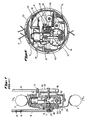
- This embodiment according to the present invention (as shown in Fig. 2) is a device comprising engine and drive units, which is adapted mainly to bicy- des or motor cycles.
- the engine in the said device is started through such a process to be described as follows:
- the propulsion power of the engine is transmitted through the drive units to the wheel by the process to be described as follows:
- the method to operate a bicycle equiped with a drive device according to the present invention may be as follows:
Landscapes
- Engineering & Computer Science (AREA)
- Chemical & Material Sciences (AREA)
- Combustion & Propulsion (AREA)
- Transportation (AREA)
- Mechanical Engineering (AREA)
- One-Way And Automatic Clutches, And Combinations Of Different Clutches (AREA)
- Arrangement Or Mounting Of Propulsion Units For Vehicles (AREA)
Claims (14)
Applications Claiming Priority (2)
| Application Number | Priority Date | Filing Date | Title |
|---|---|---|---|
| CN85101503A CN85101503B (zh) | 1985-04-01 | 1985-04-01 | 车轮的直接驱动装置 |
| CN85101503 | 1985-04-01 |
Publications (3)
| Publication Number | Publication Date |
|---|---|
| EP0198297A2 EP0198297A2 (fr) | 1986-10-22 |
| EP0198297A3 EP0198297A3 (en) | 1987-05-27 |
| EP0198297B1 true EP0198297B1 (fr) | 1990-08-16 |
Family
ID=4791878
Family Applications (1)
| Application Number | Title | Priority Date | Filing Date |
|---|---|---|---|
| EP86104277A Expired - Lifetime EP0198297B1 (fr) | 1985-04-01 | 1986-03-27 | Dispositif de propulsion directe des roues |
Country Status (6)
| Country | Link |
|---|---|
| US (1) | US4721177A (fr) |
| EP (1) | EP0198297B1 (fr) |
| JP (1) | JPS62295721A (fr) |
| CN (2) | CN85101503B (fr) |
| AU (1) | AU578525B2 (fr) |
| DE (1) | DE3673441D1 (fr) |
Families Citing this family (43)
| Publication number | Priority date | Publication date | Assignee | Title |
|---|---|---|---|---|
| GB8629897D0 (en) * | 1986-12-15 | 1987-01-28 | Hydro Spartan Ltd | Wheel drive arrangement |
| US5937962A (en) | 1995-08-08 | 1999-08-17 | Yamaha Hatsudoki Kabushiki Kaisha | Bicycle with assist engine |
| TW451881U (en) * | 1995-08-30 | 2001-08-21 | Sanyo Electric Co | Electric vehicle |
| USRE37583E1 (en) * | 1997-02-20 | 2002-03-19 | Currie Technologies, Incorporated | Precision direct drive mechanism for a power assist apparatus for a bicycle |
| US5934401A (en) * | 1997-02-20 | 1999-08-10 | Currie Technologies, Incorporated | Precision direct drive mechanism for a power assist apparatus for a bicycle |
| US6199651B1 (en) | 1997-12-11 | 2001-03-13 | Vectrix Corporation | Vehicle drive wheel assembly |
| US6199652B1 (en) | 1997-12-11 | 2001-03-13 | Vectrix Corporation | Vehicle drive wheel assembly |
| US6296072B1 (en) | 1999-01-20 | 2001-10-02 | Opti-Bike Llc | Electric bicycle and methods |
| WO2003098039A2 (fr) * | 2002-05-15 | 2003-11-27 | Katsaros Stephen B | Moteur a moyeu forme dans une roue et procede correspondant |
| FR2842147A1 (fr) * | 2002-07-15 | 2004-01-16 | Conception & Dev Michelin Sa | Chaine de traction comportant un mecanisme de changement de rapport integre dans une roue |
| US20050023052A1 (en) * | 2003-02-21 | 2005-02-03 | Beck Michael S. | Vehicle having an articulated suspension and method of using same |
| US20040163869A1 (en) * | 2003-02-21 | 2004-08-26 | Chun Wendell H. | Articulated vehicle suspension system shoulder joint |
| US7150340B2 (en) * | 2003-02-21 | 2006-12-19 | Lockheed Martin Corporation | Hub drive and method of using same |
| US7261176B2 (en) * | 2003-02-21 | 2007-08-28 | Lockheed Martin Corporation | Articulated vehicle suspension system shoulder joint |
| US20040232632A1 (en) * | 2003-02-21 | 2004-11-25 | Beck Michael S. | System and method for dynamically controlling the stability of an articulated vehicle |
| US8839891B2 (en) | 2003-02-21 | 2014-09-23 | Lockheed Martin Corporation | Multi-mode skid steering |
| US7464775B2 (en) * | 2003-02-21 | 2008-12-16 | Lockheed Martin Corporation | Payload module for mobility assist |
| JP4263587B2 (ja) * | 2003-12-08 | 2009-05-13 | 本田技研工業株式会社 | ワンウェイクラッチ装置及びこれを用いた自動二輪車 |
| BRPI0514598A (pt) * | 2004-08-25 | 2008-06-17 | Stephen B Katsaros | motor central formado em um roda e métodos associados |
| US7156196B2 (en) * | 2004-11-12 | 2007-01-02 | Stephen Basil Katsaros | Hub motor formed in a wheel |
| EP1733962A3 (fr) * | 2005-06-17 | 2007-09-05 | Shimano Inc. | Dispositif d'entraînement pour une roue de bicyclette |
| JP4073929B2 (ja) * | 2005-06-17 | 2008-04-09 | 株式会社シマノ | 自転車用車輪駆動装置 |
| CN1880160B (zh) * | 2005-06-17 | 2010-04-28 | 株式会社岛野 | 滚子式制动器的安装连接部件 |
| US8096103B1 (en) | 2006-08-03 | 2012-01-17 | Radius X, LLC | External combustion engine with a general wheel rotation power motor |
| US20080129107A1 (en) * | 2006-12-01 | 2008-06-05 | Keith Hodgson | Motor-Bearing Wheel Hub |
| FR2918034B3 (fr) * | 2007-06-26 | 2011-10-28 | Yvan Philippe Gilles Pesenti | Assistance thermique pour velo. |
| CN201367091Y (zh) * | 2009-01-16 | 2009-12-23 | 彭伟乐 | 前驱动无链齿轮传动自行车 |
| US9027681B2 (en) * | 2009-12-04 | 2015-05-12 | Massachusetts Institute Of Technology | Hybrid sensor-enabled electric wheel and associated systems, multi-hub wheel spoking systems, and methods of manufacturing and installing wheel spokes |
| CN101767529B (zh) * | 2010-03-25 | 2013-02-13 | 台州市黄岩华阳机电科技有限公司 | 电动车变档驱动轮毂的离合式输出机构 |
| JP5149938B2 (ja) * | 2010-06-11 | 2013-02-20 | 株式会社シマノ | モータ内蔵自転車用ハブ |
| US10308065B2 (en) | 2014-04-04 | 2019-06-04 | Superpedestrian, Inc. | Devices and methods for connecting a spoke to a hub |
| US10005317B2 (en) | 2014-04-04 | 2018-06-26 | Superpedestrian, Inc. | Devices and methods of thermal management for a motorized wheel |
| EP3126184B1 (fr) | 2014-04-04 | 2019-09-04 | Superpedestrian, Inc. | Systèmes, procédés et dispositifs pour le fonctionnement de véhicules à moteur électrique |
| JP2018502549A (ja) | 2014-11-24 | 2018-01-25 | スーパーペデストリアン インク | モータ付きホイールの装置および方法 |
| CN104494774B (zh) * | 2015-01-28 | 2016-10-05 | 朱幕松 | 遥控齿轮离合双驱动高速无刷大轮毂电机 |
| CN106050949B (zh) * | 2016-07-25 | 2018-11-23 | 西安科技大学 | 一种用于软启动的柔性扭矩增量联轴器 |
| CN106985963B (zh) * | 2017-05-11 | 2022-06-07 | 张家港川梭车业有限公司 | 单轮驱动三挡变速装置 |
| RU2666622C1 (ru) * | 2017-05-22 | 2018-09-11 | Владимир Григорьевич Гончаров | Трансмиссия моторизованного велосипеда (варианты) |
| KR102626712B1 (ko) * | 2018-12-27 | 2024-01-17 | 현대트랜시스 주식회사 | 인휠 모터 파워트레인 |
| JP2020192951A (ja) * | 2019-05-30 | 2020-12-03 | ヤマハ発動機株式会社 | インホイールモータユニット及び電動車両 |
| NO345745B1 (en) * | 2019-12-05 | 2021-07-12 | Ca Tech Systems As | Breathing mechanical power transmission and a pedally propelled vehicle with such power transmission |
| CN111016640B (zh) * | 2019-12-31 | 2022-03-01 | 西南大学 | 超大载荷的紧凑型中央驱动式自适应电驱动总成 |
| CN112248795B (zh) * | 2020-11-11 | 2025-05-13 | 西安文理学院 | 基于麦轮全方位转向功能的移动机器人上下楼机构及方法 |
Family Cites Families (12)
| Publication number | Priority date | Publication date | Assignee | Title |
|---|---|---|---|---|
| US904721A (en) * | 1907-04-01 | 1908-11-24 | Jules Emile Perillard | Motor-wheel for cycles. |
| US1247752A (en) * | 1916-10-24 | 1917-11-27 | Power Wheel Mfg Company | Motor-wheel for cycles. |
| US1394516A (en) * | 1920-02-24 | 1921-10-18 | Burlat Antoine | Motorcycle |
| DE706520C (de) * | 1938-03-10 | 1941-05-28 | Auto Union A G | Motorfahrrad mit im Hinterrad eingebautem Antriebsblock |
| US2253408A (en) * | 1939-06-28 | 1941-08-19 | Ernest M Watkins | Motor driven vehicle |
| FR981787A (fr) * | 1946-11-12 | 1951-05-30 | Roue motrice pour bicycles, tricycles et véhicules similaires | |
| US2588889A (en) * | 1948-07-22 | 1952-03-11 | Adrienne M Sherwood | Motor wheel and mounting strut |
| US3626815A (en) * | 1970-05-25 | 1971-12-14 | American Motors Corp | Piston |
| DE2253868B2 (de) * | 1972-11-03 | 1980-11-20 | M.A.N. Maschinenfabrik Augsburg-Nuernberg Ag, 8500 Nuernberg | Einteiliger, mit einer Pleuelstange verbundener Gußeisenkolben |
| US4091887A (en) * | 1976-12-15 | 1978-05-30 | Honda Giken Kogyo Kabushiki Kaisha | Power unit for a motor cycle |
| DE3024891A1 (de) * | 1980-07-01 | 1982-02-11 | Karl Schmidt Gmbh, 7107 Neckarsulm | Leichtmetall-regelkolben fuer brennkraftmaschinen |
| JPS6035681A (ja) * | 1983-08-08 | 1985-02-23 | 本田技研工業株式会社 | 車両における変速機装置 |
-
1985
- 1985-04-01 CN CN85101503A patent/CN85101503B/zh not_active Expired
-
1986
- 1986-03-26 US US06/844,176 patent/US4721177A/en not_active Expired - Fee Related
- 1986-03-27 EP EP86104277A patent/EP0198297B1/fr not_active Expired - Lifetime
- 1986-03-27 DE DE8686104277T patent/DE3673441D1/de not_active Expired - Lifetime
- 1986-03-27 AU AU55317/86A patent/AU578525B2/en not_active Ceased
- 1986-03-31 JP JP61071386A patent/JPS62295721A/ja active Pending
- 1986-04-25 CN CN86102809.0A patent/CN1003990B/zh not_active Expired
Also Published As
| Publication number | Publication date |
|---|---|
| CN1003990B (zh) | 1989-04-26 |
| US4721177A (en) | 1988-01-26 |
| CN85101503A (zh) | 1987-10-07 |
| CN85101503B (zh) | 1987-12-23 |
| JPS62295721A (ja) | 1987-12-23 |
| EP0198297A3 (en) | 1987-05-27 |
| CN86102809A (zh) | 1987-12-16 |
| AU578525B2 (en) | 1988-10-27 |
| AU5531786A (en) | 1986-10-09 |
| DE3673441D1 (de) | 1990-09-20 |
| EP0198297A2 (fr) | 1986-10-22 |
Similar Documents
| Publication | Publication Date | Title |
|---|---|---|
| EP0198297B1 (fr) | Dispositif de propulsion directe des roues | |
| CN1204351C (zh) | 车辆用动力传递装置 | |
| CN1280550C (zh) | 具有辅助手动操纵控制机构的自动离合器 | |
| US7770682B2 (en) | Power assist system and method for a vehicle | |
| CN1059163C (zh) | 带有助推马达的自行车上的踏力检测装置 | |
| EP0714801B1 (fr) | Engrenage à courroie ayant un réglage continu | |
| JP2006046618A (ja) | 無段変速機構の制御装置 | |
| EP1770307B1 (fr) | Transmission variable en continu à courroie trapézoïdale pour véhicule de petite taille et de type saddle-riding | |
| CN1123753A (zh) | 自行车用辅助电机的控制方法 | |
| JPH08175477A (ja) | 自動二輪車等のエンジンとモータの動力切換装置 | |
| JP2022539973A (ja) | 自転車用電動ギアモータアセンブリ | |
| CA2376787A1 (fr) | Motorisation d'une bicyclette par le simple remplacement du pignon inferieur | |
| RU2666622C1 (ru) | Трансмиссия моторизованного велосипеда (варианты) | |
| JP3140538B2 (ja) | 鞍乗型車両における動力伝達装置の構成部品配設構造 | |
| EP0145431A2 (fr) | Système d'entraînement pour véhicules | |
| JP7826408B1 (ja) | 多板式クラッチ装置 | |
| JP3582288B2 (ja) | 自動二・三輪車のクラッチ装置 | |
| EP4289714B1 (fr) | Scooter | |
| CN2199930Y (zh) | 一种后轮直接驱动式微型车辆助行器 | |
| JPS5923673Y2 (ja) | 補助エンジン付自転車の駆動装置 | |
| CN2170265Y (zh) | 车轮的直接驱动装置 | |
| CN118517520A (zh) | 变速器 | |
| CN110573418B (zh) | 用于两轮车辆的传动系统 | |
| JPH05213263A (ja) | 自動二輪車の動力伝達装置 | |
| CN2138618Y (zh) | 自行车后轮助力装置 |
Legal Events
| Date | Code | Title | Description |
|---|---|---|---|
| PUAI | Public reference made under article 153(3) epc to a published international application that has entered the european phase |
Free format text: ORIGINAL CODE: 0009012 |
|
| AK | Designated contracting states |
Kind code of ref document: A2 Designated state(s): CH DE FR GB IT LI |
|
| PUAL | Search report despatched |
Free format text: ORIGINAL CODE: 0009013 |
|
| AK | Designated contracting states |
Kind code of ref document: A3 Designated state(s): CH DE FR GB IT LI |
|
| 17P | Request for examination filed |
Effective date: 19871119 |
|
| 17Q | First examination report despatched |
Effective date: 19880316 |
|
| GRAA | (expected) grant |
Free format text: ORIGINAL CODE: 0009210 |
|
| AK | Designated contracting states |
Kind code of ref document: B1 Designated state(s): CH DE FR GB IT LI |
|
| REF | Corresponds to: |
Ref document number: 3673441 Country of ref document: DE Date of ref document: 19900920 |
|
| ET | Fr: translation filed | ||
| ITF | It: translation for a ep patent filed | ||
| ITTA | It: last paid annual fee | ||
| PLBE | No opposition filed within time limit |
Free format text: ORIGINAL CODE: 0009261 |
|
| STAA | Information on the status of an ep patent application or granted ep patent |
Free format text: STATUS: NO OPPOSITION FILED WITHIN TIME LIMIT |
|
| 26N | No opposition filed | ||
| PGFP | Annual fee paid to national office [announced via postgrant information from national office to epo] |
Ref country code: FR Payment date: 19940328 Year of fee payment: 9 Ref country code: DE Payment date: 19940328 Year of fee payment: 9 |
|
| PGFP | Annual fee paid to national office [announced via postgrant information from national office to epo] |
Ref country code: CH Payment date: 19940406 Year of fee payment: 9 |
|
| PG25 | Lapsed in a contracting state [announced via postgrant information from national office to epo] |
Ref country code: LI Effective date: 19950331 Ref country code: CH Effective date: 19950331 |
|
| PG25 | Lapsed in a contracting state [announced via postgrant information from national office to epo] |
Ref country code: FR Free format text: LAPSE BECAUSE OF NON-PAYMENT OF DUE FEES Effective date: 19951130 |
|
| REG | Reference to a national code |
Ref country code: CH Ref legal event code: PL |
|
| PG25 | Lapsed in a contracting state [announced via postgrant information from national office to epo] |
Ref country code: DE Effective date: 19951201 |
|
| PGFP | Annual fee paid to national office [announced via postgrant information from national office to epo] |
Ref country code: GB Payment date: 19960318 Year of fee payment: 11 |
|
| REG | Reference to a national code |
Ref country code: FR Ref legal event code: ST |
|
| PG25 | Lapsed in a contracting state [announced via postgrant information from national office to epo] |
Ref country code: GB Effective date: 19970327 |
|
| GBPC | Gb: european patent ceased through non-payment of renewal fee |
Effective date: 19970327 |
|
| PG25 | Lapsed in a contracting state [announced via postgrant information from national office to epo] |
Ref country code: IT Free format text: LAPSE BECAUSE OF NON-PAYMENT OF DUE FEES;WARNING: LAPSES OF ITALIAN PATENTS WITH EFFECTIVE DATE BEFORE 2007 MAY HAVE OCCURRED AT ANY TIME BEFORE 2007. THE CORRECT EFFECTIVE DATE MAY BE DIFFERENT FROM THE ONE RECORDED. Effective date: 20050327 |