EP0198363A2 - Photorécepteurs en silicium amorphe pour l'électrophotographie, procédé de préparation et/ou de régénération et méthode électrophotographique utilisant ces matériaux - Google Patents
Photorécepteurs en silicium amorphe pour l'électrophotographie, procédé de préparation et/ou de régénération et méthode électrophotographique utilisant ces matériaux Download PDFInfo
- Publication number
- EP0198363A2 EP0198363A2 EP86104635A EP86104635A EP0198363A2 EP 0198363 A2 EP0198363 A2 EP 0198363A2 EP 86104635 A EP86104635 A EP 86104635A EP 86104635 A EP86104635 A EP 86104635A EP 0198363 A2 EP0198363 A2 EP 0198363A2
- Authority
- EP
- European Patent Office
- Prior art keywords
- photoreceptor
- surface roughness
- measured
- mean
- less
- Prior art date
- Legal status (The legal status is an assumption and is not a legal conclusion. Google has not performed a legal analysis and makes no representation as to the accuracy of the status listed.)
- Withdrawn
Links
Images

Classifications
-
- G—PHYSICS
- G03—PHOTOGRAPHY; CINEMATOGRAPHY; ANALOGOUS TECHNIQUES USING WAVES OTHER THAN OPTICAL WAVES; ELECTROGRAPHY; HOLOGRAPHY
- G03G—ELECTROGRAPHY; ELECTROPHOTOGRAPHY; MAGNETOGRAPHY
- G03G5/00—Recording-members for original recording by exposure, e.g. to light, to heat or to electrons; Manufacture thereof; Selection of materials therefor
- G03G5/02—Charge-receiving layers
- G03G5/04—Photoconductive layers; Charge-generation layers or charge-transporting layers; Additives therefor; Binders therefor
- G03G5/08—Photoconductive layers; Charge-generation layers or charge-transporting layers; Additives therefor; Binders therefor characterised by the photoconductive material being inorganic
- G03G5/082—Photoconductive layers; Charge-generation layers or charge-transporting layers; Additives therefor; Binders therefor characterised by the photoconductive material being inorganic and not being incorporated in a bonding material, e.g. vacuum deposited
- G03G5/08214—Silicon-based
-
- G—PHYSICS
- G03—PHOTOGRAPHY; CINEMATOGRAPHY; ANALOGOUS TECHNIQUES USING WAVES OTHER THAN OPTICAL WAVES; ELECTROGRAPHY; HOLOGRAPHY
- G03G—ELECTROGRAPHY; ELECTROPHOTOGRAPHY; MAGNETOGRAPHY
- G03G21/00—Arrangements not provided for by groups G03G13/00 - G03G19/00, e.g. cleaning, elimination of residual charge
Definitions
- This invention relates to an amorphous silicon photoreceptor for electrophotography which causes no "image blurring" (as defined hereinafter) in use under a high-humidity environment, a process for the preparation and/or regeneration thereof, and a method of electrophotography using such a photoreceptor.
- Electrophotography is but one of several image forming methods, the principle of which was discovered by Carlson in 1983.
- Various improvements have been made on the technique and now electrophotography is widely applied in the image recording arts for example in plain paper copiers - (PPC's), a laser printers, a facsimiles and the like: see R.M. Schaffert, "Electrophotography", 1975, Focal Press Ltd.
- an electrophotographic method comprises several elementary processes.
- the method usually comprises the following processes:
- Photoreceptors which have hitherto been used for electrophotography include dispersions of fine CdS, ZnO or other powder coated with the binder of organic material, Se (selenium) photoreceptors containing As or Te coated by the vacuum evaporation method, organic photoconductor (OPC) materials such as polyvinylcarbazole. and trinitrofluorene, and others.
- OPC organic photoconductor
- a-Si amorphous silicon hydride
- P-CVD plasma chemical vapor deposition
- Photosensitive a-Si films are made from raw materials consisting essentially of silane gas by plasma CVD, as mentioned above.
- Various proposals and improvements have been made on the items required as a photoreceptor, such as acceptance voltage, spectral sensitivity and photoreceptor life.
- a-Si photoreceptors The photoreceptors based on such silicon hydride will hereinafter be referred to as "a-Si photoreceptors".
- the a-Si has the following excellent properties as compared with the aforementioned conventional photoreceptors:
- a-Si photoreceptors had such chemical and thermal stability and high surface hardness as mentioned above, they were at first expected to exhibit both stable performance in use as photoreceptors under various environmental conditions and to endure a very large number of copying procedures. It was actually found, however, that a phenomenon could occur in which the copy image is blurred when electrophotographic copying procedures using such a-Si photoreceptors were carried out under a high-humidity condition, more specifically, under a relative humidity above 70%, and furthermore, no image could be obtained at all under higher humidity conditions: this phenomenon is herein referred to as "image blurring".
- the image blurring is characterized by
- a commercially available copying machine was so modified so that only one of the elementary processes, that is, (a) the initial corona charging and the alternating corona discharging, (b) the light irradiation, (c) the magnetic brush development, or (d) the cleaning, might be conducted separately, and each operation was repeated as many times as the number of operating procedures corresponding to that required to take 10,000 copies. Thereafter, a copying test was carried out at 30°C, 80% RH - (relative humidity) to examine the occurrence of image blurring. The phenomena most often occurred with a-Si photoreceptors which had been subjected to the repeated corona charge (a) alone.
- a-Si photoreceptors have extremely high surface hardness. Accordingly, it may be supposed that when a deteriorated surface layer is produced by corona charge, the deteriorated layer is not thoroughly removed even through the magnetic brush development and/or cleaning process, but rather such a layer will be accumulated as copying procedures are repeated.
- the present inventors have discovered that the problem of image blurring in a-Si photoreceptors can be solved by either improving one or more steps in the electrophotographic and/or by adding -one or more additional steps to the conventional electrophotographic processes, each method being used to effect gradual removal (i.e. polishing) of the surface of the a-Si photoreceptors.
- the present inventors thus propose the following three methods as means for obtaining the desired improvements in a-Si electrophotography:
- a cleaning blade may be made of a material having a higher surface hardness than a-Si.
- an amorphous silicon photoreceptor for electrophotography which has at least one of the following properties:
- a process for preparing and/or regenerating an amorphous silicon photoreceptor for electrophotography which is characterized by mechanically removing at least a part of a solid phase reaction product produced by using an abrasive substance capable of inducing a solid phase reaction with the photoreceptor for electrophotography into contact with the surface of said photoreceptor.
- an improved method for electrophotography which is characterized by using a developer containing at least one soft abrasive additive selected from carbonates and sulfates of alkaline earth metals, rare earth metals and transition metals, triiron tetraoxide, and mineral clays having a layer structure.
- This invention also provides an improved method for electrophotography which is characterized by further comprising a step of polishing the surface of an a-Si photoreceptor on which an image is formed by using at least one soft abrasive substance selected from carbonates and sulfates of alkaline earth metals, rare earth metals and transition metals, triiron tetraoxide, and mineral clays having a layer structure.
- the invention further provides an improved method for electrophotography which is characterized by further comprising a step of contacting, preferably intermittently, an amorphous silicon photoreceptor with a cleaning member containing as a soft abrasive at least one substance selected from carbonates and sulfates of alkaline earth metals, rare earth metals and transition metals, triiron tetraoxide, and mineral clays having a layer structure.
- the surface of a conventional a-Si photoreceptor formed by plasma CVD usually has fine unevenness due to the preparation process and the base AI tube.
- the present inventors measured surface roughness of many a-Si materials prepared by various processes by means of a needle type surface roughness tester "Talystep" manufactured by Rank Taylor Hobson Co., and found that the materials generally had the mean roughness along the center line of about 300 A with the minimum being 210 ⁇ .
- Methods considered by the present inventors for lowering the surface roughness of a-Si photoreceptors include: (1) the surface of the photoreceptor is polished after the production thereof; (2) the processes and conditions for forming films are improved; and (3) the surface roughness of a base Al tube is reduced.
- the inventors attempted to improve the surface roughness by the polishing method (1) described just above, and found that the image blurring under a high humidity can be prevented from occurring by polishing the surface of the a-Si photoreceptor immediately after the production thereof by means of an abrasive capable of causing a solid phase reaction with the material, as will be described below.
- the surface of a-Si photoreceptors was polished longitudinally with a certain width like a belt for various periods of time according to the polishing method (1) and photoreceptor drums having a polished part were subjected to a copying test.
- Image blurring occurred at the non-polished part after approximately 10,000 copies were formed, whereas at the polished part good image qualities were obtained with no image blurring under a high humidity even after 500,000 runs.
- polishing conditions revealed that the effect of the polishing on the prevention of image blurring depended on the surface roughness of photoreceptors. Further, it was also found that the surface roughness of a polished photoreceptor could be controlled by the period of time for polishing if other polishing conditions such as pressure, etc., were not varied; that is, the longer the polishing period is, the more reduced (the lower) the surface roughness is.
- the present inventors have discovered as a result of further investigations that a marked advantage can be obtained when the surface of a phtoreceptor has at least one of the following properties (i) to (v).
- the surface having at least the property (ii) is particularly preferred.
- the mean roughness along the center line as derived from measurements by a needle type surface roughness tester is 190 A or less, preferably 150 A or less, more preferably 120 A or less.
- the mean roughness along the center line, R'-(a), is defined by the following equation: where L is the length of the measured surface and y'(x) is any value of the measurements.
- the mean roughness along the center line is represented by the mean of ten values of R'(a) calculated by the above equation from the values measured at any ten positions on a photoreceptor.
- the measurement is carried out by a needle type surface roughness tester "Talystep" manufactured by Rank Taylor Hobson Co. under the following conditions -----needle load: 4 mg, stylus: 0.1 x 2.5 um, lateral magnification: 1,250 times, longitudinal magnification: 100,000 times, filter cut-off frequency: 0.33 Hz, measuring speed: 0.0025 mm/sec, and length to be measured: 30-80 ⁇ m.
- the mean surface roughness along the center line as derived from measurements by a coordinates measuring scanning electron microscope and a section measuring apparatus is 60 A or less, preferably 40 A or less, more preferably 30 A or less.
- the mean roughness along the center line, R-(a), is defined by the following equation (1): where L is the length of the measured surface and y(x) is any value derived from a measured value by eliminating low frequency components therefrom.
- the "measured values” mean a set of data measured for 300 discrete data points within the measured length of 12 u.m by a coordinates measuring scanning electron microscope “EMM-3000” and a section measuring apparatus “PMS-1 ", both having the magnification of 10,000 times and manufactured by Elionix Co.
- 256 values are expressed as ⁇ Y j ⁇ , and the Fourier coefficients ⁇ a k ⁇ and ⁇ b k ⁇ defined by the following equations (2) are determined.
- the Fourier coefficients a o , a 1 , a 2 , a 3 , b o , b 1 , b 2 and b 3 which correspond to low frequency components, are forced to zero. These components correspond to wave lengths ⁇ , 10.24, 5.12 and 3.41 ⁇ m, respectively.
- the thus modified Fourier coefficients are subjected to the Fourier inverse transformation defined by the following equation(3): Thus, the data set from which the low frequency components has been excluded is obtained.
- R(a) is calculated according to the above definitions. Taking into consideration possible random sampling, 10 sets of measured data are taken and the mean value of the sets is designated as the "mean roughness along the center line" in the present invention. (iii) The variance of mean roughnesses along the center line as derived from measurements by a coordinates measuring scanning electron microscope and a section measuring apparatus is 70 A or less, preferably 50 A or less, more preferably 40 ⁇ or less.
- R ⁇ The variance, R ⁇ , of mean roughnesses along the center line is defined by the following equation: wherein Y i represents any data value derived from a measured value by eliminating low frequency components, N is the number of data and m is the mean value of the data values from which the low frequency components have been eliminated.
- R a is calculated from the measured data according to the definitions above. Taking into consideration possible random sampling, 10 sets of measured data are taken and the mean value of the sets is designated as the "variance of mean roughnesses along the center line" in the invention.
- the maximum amplitude as derived from measurements by a coordinates measuring scanning electron microscope and a section measuring apparatus is 450 A or less, preferably 350 A or less more preferably 250 A nr less
- the maximum amplitude R(t) is defined as the largest peak-valley of actual data values from which the low frequency components have been eliminated.
- R(t) is calculated from the measured data according to the above definitions. Taking into consideration possible random sampling, 10 sets of measured data are taken and the mean value of the sets is designated as the "maximum amplitude" in the invention.
- the difference between the mean of five largest values and the mean of five smallest values of the surface roughness as measured by a coordinates measuring scanning electron microscope and a section measuring apparatus is 420 A or iess, preferably 300 A or less, more preferably 250 A or less.
- the difference, R z , between the mean value of five data from the maximum and the mean value of five data from the minimum is defined as the difference between the mean value of five largest data and the mean value of five smallest data, these data being those values obtained by eliminating low frequency components from the measured data.
- R z is calculated from the measured data according to the above definitions. Taking into consideration possible random sampling, 10 sets of measured data are taken and the mean value of the sets is designated as the "difference between the mean value of five largest values and the mean value of five smallest values" in the invention.
- the amorphous silicon hydride (a-Si ⁇ photoreceptors of the present invention can be obtained by contacting, the surface of a conventional a-Si photoreceptor (i.e., one whose surface does not have any of the above described properties) with a soft abrasive selected from the group consisting of carbonates and sulfates of alkaline earth metals, rare earth metals and transition metals, iron oxide, especially triiron tetraoxide (Fe 3 O 4 ), and mineral clays having a layer structure, which can participate in a solid phase reaction with the surface material of the photoreceptor, and mechanically removing at least a part of the reaction product formed by the solid phase reaction of the surface material with the abrasive.
- a soft abrasive selected from the group consisting of carbonates and sulfates of alkaline earth metals, rare earth metals and transition metals, iron oxide, especially triiron tetraoxide (Fe 3 O 4 ), and mineral clay
- This process according to the invention can be applied not only to such a new photoreceptor immediately after being produced but also to the regeneration of a photoreceptor which has caused image blurring.
- the substance, i.e. abrasive, capable of participating a solid phase reaction with the photoreceptor surface, which may be used in the invention is selected from group consisting of carbonates and sulfates of alkaline earth metals. such as Ba, Mg, Ca, etc., rare earth metals such as Ce, Y, La, Eu, etc., and other transition metals such as Fe, Ti. Zr. etc., triiton tetraoxide, and mineral clays having a layer structure such as kaolinite, montmorillonite, etc.
- Carbonates of alkaline earth metals or rare earth metals are especially preferred.
- the abrasives used in the invention are referred to herein as "soft abrasives" because they have a relatively low hardness when compared to conventional hard abrasives (e.g., Ce0 2 . BaO,, SiC, Al 2 O 3 , and the like) and are unusual in that they have a hardness less than the substance being polished, a-Si.
- conventional hard abrasives e.g., Ce0 2 . BaO,, SiC, Al 2 O 3 , and the like
- the present process is quite distinct from conventional processes utilizing an abrasive with hardness higher than that of a material to be polished. It has not been elucidated why the above mentioned carbonates etc. are par- ticulary effective for the removal of the deteriorated layer on an a-Si photoreceptor.
- the abrasive according to this invention may be utilized as an external additive for a developer.
- the weight ratio of the abrasive to the toner in the developer is suitably limited within the range of 0.01 to 5% by weigtht, preferably 0.05 to 0.5% by weight.
- the abrasive is preferably used in the form of powder.
- the abrasive of the invention preferably has a particle size smaller than that of the toner used therewith, usually approximately 10 ⁇ , in order that no deterioration of image quality might be caused, although the particle size of the abrasive, which has a relatively low hardness, is gradually reduced by repeated operations such as mixing with a developer, contact with a photoreceptor, and the like.
- the abrasive used as an external additive in the present invention may be supplied into a developer together with a toner after being mixed therewith, or it can be supplied alone into a developer.
- the abrasive according to this invention may be utilized in an additional process other than the development process.
- an abrasive to a developer may be accompanied by the deterioration of image quality.
- such an additional process adventageously involves the use of a jig, or a like member useful for contacting the abrasive according to this invention with the surface of the a-Si photoreceptor drum uniformly along the axial - (longitudinal) direction, a means for supplying the abrasive to both the jig and the drum surface, and a means for preventing scattering of the abrasive in the copying machine.
- a magnetic brush developing unit containing the abrasive (but no toner) may be provided independently of the developing process.
- a blade-like jig is pressed on the surface of the a-Si photoreceptor by a spring or other means under an appropriate pressure of from about 10 to 1,000 g/cm 2 , so that the abrasive of the present invention may be . interposed between the jig and the photoreceptor.
- This additional process may preferably be carried out after the transfer process but before the corona re-charging process in the electrophotography. More preferably, this process may be incorporated with the cleaning process which will be hereinafter described in detail, since a simple construction of the whole apparatus can thus be attained.
- Any polishing machine which can polish the surface of a cylindrical drum may be used in the present invention.
- a machine in which the drum is continuously contacted with the abrasive while the surface thereof is polished by a pad as shown in Fig. 1 is preferably utilized.
- a polishing machine which comprises a photoreceptor drum 1, a bearing 2 for fixing the drum in position, a pulley 3 for transmitting the rotation from a motor to a shaft of the drum, a container 4 for retaining the abrasive at all times, a means 5 for holding a pad and moving it in the axial (longitudinal) direction of the photoreceptor drum at a constant speed, a jig 6 attached to the means 5 and fixing the pad for polishing the surface of the photoreceptor drum, and a speed-controllable motor 7.
- the pad may be of any type, but preferably it should be soft not to scratch the drum. Most preferably, it is a soft cloth or non-woven fabric.
- the shape of the pad to be contacted with the circular surface of the photoreceptor drum is preferably a circular arc concentric to the transversally sectional circle of the drum, said arc corresponding to a central angle of the circle of at least 10 degrees, in order to avoid any linear contact of the pad with th'e surface.
- the size of the container 4 is preferably slightly larger than that of the photoreceptor drum. But a too large size is not preferred since the amount of the abrasive to be fed will increase largely.
- the container 4 may not always be necessary in certain polishing conditions. For instance, if a pad fixed on the jig 6 is initially impregnated with an abrasive, the abrasive can be evenly and thinly distributed all over the photoreceptor surface by rotating the drum while moving the pad along the means 5.
- the drum may usually be rotated at a speed of . from 10 to 200 r.p.m., but a speed of from 20 to 50 r.p.m. is preferred.
- a speed of rotation is in the range of from 20 to 50 r.p.m.
- a period of time for polishing is usually from 5 to 30 minutes. If lower speeds of rotation are utilized, the polishing time will generally be prolonged.
- the tolerance for the construction of the polishing machine is desirably 10 ⁇ m or smaller.
- the particle size of the soft abrasive of the present invention may be as large as several tens u.m (from about 10 to 30 ⁇ m) or even greater, but preferably the particle size of the abrasive is 30 ⁇ m or less. Because the abrasive is softer than the a-Si photoreceptor, the abrasive itself will be broken and its size will be reduced in the course of the polishing. For example, if a commercially available special grade BaC03 reagent is treated in a mortar to adjust its average particle size to approximately 30 u.m and then polished at 25 r.p.m. for 10 minutes in the apparatus shown in Fig.
- the average particle size will be approximately 5 u.m.
- the fracture section of the broken abrasive is chemically active and a solid phase reaction may readily occur under the high pressure of several Kbar exerted at the contact point between the abrasive and the surface of the photoreceptor.
- the desired effect of the invention can also be achieved by using a cleaning member comprising the abrasive according to the invention as a con- situent.
- the abrasive may be solidified and shaped into any form of members fur use in the cleaning process, for example, a cleaning blade, a cleaning roll, a cleaning brush, etc., by employing a suitable means, e.g., by using an appropriate binder (e.g., organic or other).
- a suitable means e.g., by using an appropriate binder (e.g., organic or other).
- the abrasive of this invention may be incorporated into a presently used cleaning blade or brush made of a resin.
- the current compounding techniques in the plastics art may enable a person with ordinary skill to prepare a composite material having the content of the abrasive of about 30 % by volume or more. Such a technique enables the preparation of a resinous cleaning blade, brush, roll, sponge or other member which contains the abrasive of this invention.
- the ratio of the period of time for contacting the member with the drum to that for rotating the drum is selected from the range of 1:5 to 1:500, preferably 1:50 to 1:10.
- any image blurring can be prevented from occurring by intermittently polishing the photoreceptor with the abrasive approximately every 1,000 runs.
- cleaning members such as cleaning blade, cleaning brush, cleaning roll, cleaning sponge, etc.
- first cleaning process an additional cleaning process, hereinafter referred to as second cleaning process, is provided after the first cleaning process and the cleaning members are used in the second process.
- second cleaning process any conventional cleaning member may be utilized as the member for the first cleaning process.
- a sufficient polishing effect can be attained merely by intermittently contacting the photoreceptor drum with the cleaning member containing the abrasive of the invention (for example, at a rate of several tens times of contact per several thousands runs of copying) in the second cleaning process.
- such an interm i t-tently contacting method is more economically advantageous: that is, the present method enables an appreciable reduction of defects of the former method, such as deterioration due to toner contamination, wear, etc., of the cleaning member, thus realizing a drastic prolongation of the life of the member.
- the most simple method of effecting the intermittent contact of the cleaning member with the photoreceptor drum is one in which the member is manually contacted with and slided on the drum.
- Automatic intermittent contact methods using an electromagnetic or electric driving means include the cleaning blade method in which the blade and the pad are intermittently pressed on the drum, and the cleaning roller method.
- the roller used in the cleaning roller method may be a foamed or unfoamed resinous rod-like member impregnated with the abrasive. Further, it is also effective to form grooves or the like on the rod.
- Such a cleaning roller is contacted with the surface of the moving drum while being pressed thereon by an appropriate pressure of from about 1 gicm' to 10 kg / cm 2 .
- the contact of the drum and the cleaning member is preferably performed under friction, although the roller may be allowed to rotate freely.
- Two groups (A and B) of a-Si photoreceptor drums prepared under the same conditions were polished for various periods of polishing time. For each period of time used, the drum surface was polished by a width of about 5 cm.
- the drums used were prepared in the following manner:
- Photosensitive layer The layer structure of the film formed and the conditions for the preparation thereof are as follows: Photosensitive layer:
- the abrasive used was barium carbonate.
- Each photoreceptor drum was set in the polishing apparatus shown in Fig. 1 and polished at a drum rotation speed of 20 r.p.m. while applying a load of 6 kg at the jig 6 in the figure.
- the group A of drums was subjected to the polishing procedure for 50 or 120 minutes, whereas the group B of drums was polished for 60, 300 or 480 minutes.
- each drum was subjected to numbers of copying procedures using a commercially available copying machine, "U-Bix 3300 MR" manufactured by KONISHIROKU PHOTO IND. CO., LTD., Japan, under normal humidity. Image blurring was checked every 10,000 runs of copying by subjecting the drum to copying procedures under a high humidity of 85% RH at 30°C. (One run herein means a series of procedures for obtaining one copy under normal humidity.)
- a-Si photoreceptor drums prepared the following conditions were polished while varying the period of polishing time and the abrasive. For each period of time and abrasive used, the drum surface was polished by a width of about 5 cm.
- the drums were prepared in the following manner:
- the abrasive used were barium carbonate, calcium carbonate, triiron tetraoxide, a polyester abrasive paper "Surfin 000" manufactured by Fujimi Kenmazai K.K., Japan, silicon carbide, and zirconium oxide.
- Each photoreceptor drum was set in the polishing apparatus shown in Fig. 1 and polished with each abrasive at a drum rotation speed of 20 r.p.m. for 5 or 10 minutes.
- each drum was subjected to numbers of copying procedures using a commercially available copying machine U-Bix V2, KONISHIROKU PHOTO IND. CO., LTD., Japan, under normal humidity. Image blurring was checked every 5,000 runs of copying procedures by subjecting the drum to copying procedures under a high humidity condition of 85% at 30°C.
- the part treated with barium carbonate, calcium carbonate or triiron tetraoxide for 10 minutes gave an clear image without causing any image blurring even after 30,000 runs of copying.
- the part treated with each of said abrasives for 5 minutes caused a slight image blurring after 30,000 runs.
- image blurring began to occur after 5,000 runs and extensively occurred after 10,000 runs of copying.
- An a-Si photoreceptor drum similar to those used in Example 3 was set in a copying machine and subjected to 10,000 runs of copying procedures under normal humidity conditions. After having observed that image blurring certainly occurred under a high humidity condition of 85% at 30°C, the photoreceptor drum was placed in the polishing apparatus shown in Fig. 1 and a part of the drum surface of about 5 cm in width was polished with barium carbonate, silicon carbide, zirconium oxide or triiron tetraoxide at a drum rotation speed of 30 r.p.m. for 5 minutes.
- the drum having the part treated with barium carbonate or triiron tetraoxide was then subjected to further 10,000 runs of copying procedures. Good image qualities could be obtained without causing any image blurring under high humidity conditions.
- An a-Si photoreceptor drum was prepared in the following manner:
- the developer used was composed of 970 g of iron powder having a particle size in the range of 10 to 200 ⁇ as a carrier, 30 g of a conventionally used negatively charged toner, and 60 mg of barium carbonate, calcium carbonate, yttrium carbonate. magnesium carbonate, triiron tetraoxide, cerium carbonate, silicon carbide, silica, cerium oxide. or aluminum oxide as an external additive.
- the drum was subjected to numbers of copying procedures under normal humidity using each of the ten types of developers and UBIX V-11, KONISHIROKU PHOTO IND. CO., LTD., Japan. Image blurring was checked every 5,000 runs of copying procedures by subjecting the drum to copying procedures under a high humidity condition of 85% at 30°C.
- Each fabric was impregnated with barium carbonate, calcium carbonate, triiron tetraoxide, lanthanum carbonate, cerium carbonate, silicon carbide, cerium oxide, aluminum oxide or diamond powder, respectively.
- An a-Si photoreceptor drum was prepared under the following conditions:
- the developer used was composed of 970 g of amorphous iron powder having a particle size in the range of 10 to 200 ⁇ as a carrier and 30 g of a conventionally used negatively charged toner.
- the drum was subjected to numbers of normal humidity copying procedures using the developer and "UBIX 3300 MR", KONISHIROKU PHOTO IND. CO., LTD., JAPAN, and image blurring was then checked by subjecting the drum to copying procedures under 85% humidity at 30°C.
- a cleaning member was prepared by impregnating a foamed sponge of urethane elastomer with a mixture of SiC, AI 2 0,, SmC0 3 or BaC0 3 and a binder. The same sponge containing no polishing powder was used as a blank. The surface of the a-Si photoreceptor drum which had observed image blurring after 10,000 runs of normal humidity copying procedures was partially polished tens times lightly with hand by using each of the sponges. The thus polished drum was subjected to copying procedures under a high humidity condition to investigate image blurring.
- a cleaning roller was prepared by impregnating a foamed urethane elastomer rod in the form of a roller with SiC, Al 2 O 3 , SmCO, or BaCO 3 powder mixed with a binder. The same rod containing no abrasive was used as a blank cleaning roller. The surface of the a-Si photoreceptor drum which had caused image blurring after 10,000 runs of copying procedures was contacted with the cleaning roller and rotated about 50 times. The drum was then subjected to copying procedures under a high humidity condition to investigate image blurring.
- Image blurring was observed at the part of the drum polished with the blank, or the roller containing SiC or Al 2 O 3 .
- a good preventive effect on image blurring was obtained by SmCO 3 or BaCO, and BaCO 3 gave a complete recovery of the effect. Further copying life tests showed that the preventive effect on image blurring could last about 1,000 copying procedures by BaCO 3 and about hundreds copying procedures by SmCO j .
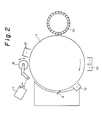
- the cleaning roller impregnated with BaCO 3 was set in a copying machine, "UBIX 3300 MR", KONISHIROKU PHOTO IND. CO., LTD., Japan.
- the cleaning roller 8 was placed between a cleaning blade 9 and a corona charger 10.
- a magnetic brush (magroll) 12 a transfer charger 13 and a discharge unit 14 are also shown.
- the roller 8 was pushed on the photoreceptor drum 1 intermittently (50 rotations of the roller per 1,000 copying procedures) by using a solenoid coil 11.
Landscapes
- Physics & Mathematics (AREA)
- General Physics & Mathematics (AREA)
- Chemical & Material Sciences (AREA)
- Inorganic Chemistry (AREA)
- Photoreceptors In Electrophotography (AREA)
- Cleaning In Electrography (AREA)
- Silicon Compounds (AREA)
Applications Claiming Priority (16)
| Application Number | Priority Date | Filing Date | Title |
|---|---|---|---|
| JP60072356A JPS61231564A (ja) | 1985-04-05 | 1985-04-05 | 電子写真複写方式 |
| JP7235585A JPS61231558A (ja) | 1985-04-05 | 1985-04-05 | 電子写真感光体の製造及び再生方法 |
| JP72356/85 | 1985-04-05 | ||
| JP72355/85 | 1985-04-05 | ||
| JP261879/85 | 1985-11-21 | ||
| JP26187985A JPS62121479A (ja) | 1985-11-21 | 1985-11-21 | 電子写真複写機 |
| JP263294/85 | 1985-11-22 | ||
| JP26329285A JPS62123471A (ja) | 1985-11-22 | 1985-11-22 | アモルフアスシリコン電子写真感光体 |
| JP263293/85 | 1985-11-22 | ||
| JP263292/85 | 1985-11-22 | ||
| JP26329385A JPS62123472A (ja) | 1985-11-22 | 1985-11-22 | アモルフアスシリコン電子写真感光体 |
| JP26329485A JPS62123473A (ja) | 1985-11-22 | 1985-11-22 | アモルフアスシリコン電子写真感光体 |
| JP60264546A JPH0789231B2 (ja) | 1985-11-25 | 1985-11-25 | アモルフアスシリコン電子写真感光体 |
| JP264547/85 | 1985-11-25 | ||
| JP26454785A JPS62124562A (ja) | 1985-11-25 | 1985-11-25 | アモルフアスシリコン電子写真感光体 |
| JP264546/85 | 1985-11-25 |
Publications (2)
| Publication Number | Publication Date |
|---|---|
| EP0198363A2 true EP0198363A2 (fr) | 1986-10-22 |
| EP0198363A3 EP0198363A3 (fr) | 1988-06-01 |
Family
ID=27572639
Family Applications (1)
| Application Number | Title | Priority Date | Filing Date |
|---|---|---|---|
| EP86104635A Withdrawn EP0198363A3 (fr) | 1985-04-05 | 1986-04-04 | Photorécepteurs en silicium amorphe pour l'électrophotographie, procédé de préparation et/ou de régénération et méthode électrophotographique utilisant ces matériaux |
Country Status (4)
| Country | Link |
|---|---|
| US (1) | US4764448A (fr) |
| EP (1) | EP0198363A3 (fr) |
| AU (1) | AU587812B2 (fr) |
| CA (1) | CA1267804A (fr) |
Cited By (2)
| Publication number | Priority date | Publication date | Assignee | Title |
|---|---|---|---|---|
| GB2200079A (en) * | 1986-12-27 | 1988-07-27 | Canon Kk | Electrophotographic apparatus |
| EP0671671A1 (fr) * | 1994-03-11 | 1995-09-13 | Océ-Nederland B.V. | Dispositif pour transférer une image de toner d'un milieu de formation d'images vers un matériau de réception |
Families Citing this family (13)
| Publication number | Priority date | Publication date | Assignee | Title |
|---|---|---|---|---|
| US5162183A (en) * | 1990-07-31 | 1992-11-10 | Xerox Corporation | Overcoat for imaging members |
| US5187039A (en) * | 1990-07-31 | 1993-02-16 | Xerox Corporation | Imaging member having roughened surface |
| US5381211A (en) * | 1993-05-24 | 1995-01-10 | Xerox Corporation | Texturing of overcoated imaging member for cleaning |
| US5547805A (en) * | 1994-04-28 | 1996-08-20 | Mita Industrial Co., Ltd. | Electrophotographic method using amorphous silicon photosensitive material |
| JP3548327B2 (ja) * | 1995-03-17 | 2004-07-28 | キヤノン株式会社 | 電子写真用光受容部材 |
| US5797071A (en) * | 1995-11-02 | 1998-08-18 | Kyocera Corporation | Electrophotographic apparatus |
| US5733698A (en) * | 1996-09-30 | 1998-03-31 | Minnesota Mining And Manufacturing Company | Release layer for photoreceptors |
| US5965243A (en) * | 1997-04-04 | 1999-10-12 | 3M Innovative Properties Company | Electrostatic receptors having release layers with texture and means for providing such receptors |
| JP3507406B2 (ja) * | 2000-05-12 | 2004-03-15 | キヤノン株式会社 | 画像形成方法および感光体 |
| US7374855B2 (en) * | 2005-05-10 | 2008-05-20 | Xerox Corporation | Photoreceptors |
| CN101185036B (zh) * | 2005-05-27 | 2011-12-07 | 京瓷株式会社 | 电子照相感光体以及备有此的图像形成装置 |
| JP5267164B2 (ja) * | 2009-01-30 | 2013-08-21 | コニカミノルタビジネステクノロジーズ株式会社 | 電子写真感光体の表面研磨方法 |
| JP5699643B2 (ja) * | 2011-01-31 | 2015-04-15 | 富士ゼロックス株式会社 | 電子写真感光体の製造方法、並びに、この電子写真感光体を用いたプロセスカートリッジ及び画像形成装置 |
Family Cites Families (18)
| Publication number | Priority date | Publication date | Assignee | Title |
|---|---|---|---|---|
| US2772991A (en) * | 1954-12-14 | 1956-12-04 | Haloid Co | Process of cleaning a residual powder image from an electrophotographic plate |
| CA565006A (fr) * | 1954-12-23 | 1958-10-21 | The Battelle Development Corporation | Developpeur divise en trois pour images electrostatiques |
| US2911330A (en) * | 1958-04-11 | 1959-11-03 | Haloid Xerox Inc | Magnetic brush cleaning |
| US3592675A (en) * | 1967-10-09 | 1971-07-13 | Azoplate Corp | Method for developing latent electrostatic images |
| US4019903A (en) * | 1971-01-06 | 1977-04-26 | Xerox Corporation | Electrostatic development |
| US3910697A (en) * | 1971-08-02 | 1975-10-07 | Turlabor Ag | Process and apparatus for regenerating a photoconductive layer |
| US3983045A (en) * | 1971-10-12 | 1976-09-28 | Xerox Corporation | Three component developer composition |
| JPS5133732B2 (fr) * | 1972-02-17 | 1976-09-21 | ||
| US3900588A (en) * | 1974-02-25 | 1975-08-19 | Xerox Corp | Non-filming dual additive developer |
| DE2708061C3 (de) * | 1976-02-28 | 1980-08-07 | Ricoh Co., Ltd., Tokio | Toner für einen elektrostatographischen Trockenentwickler |
| JPS5451843A (en) * | 1977-09-30 | 1979-04-24 | Canon Inc | Polishing member for electrophotographic image holding body |
| JPS5453538A (en) * | 1977-10-05 | 1979-04-26 | Matsushita Electric Ind Co Ltd | Image forming particles |
| DE2917015C2 (de) * | 1978-04-27 | 1984-07-26 | Canon K.K., Tokio/Tokyo | Elektrophotographische Vorrichtung und Abschleifeinrichtung dafür |
| JPS55166652A (en) * | 1979-06-15 | 1980-12-25 | Canon Inc | Electrostatic charge image toner |
| US4255044A (en) * | 1979-07-09 | 1981-03-10 | Nashua Corporation | Cleaning blade for electrophotography |
| JPS5891462A (ja) * | 1981-11-26 | 1983-05-31 | Canon Inc | 正荷電性圧力定着用磁性トナ− |
| JPS58115464A (ja) * | 1981-12-29 | 1983-07-09 | Canon Inc | 感光体研磨方法 |
| US4626487A (en) * | 1983-08-03 | 1986-12-02 | Canon Kabushiki Kaisha | Particulate developer containing inorganic scraper particles and image forming method using the same |
-
1986
- 1986-04-02 US US06/847,409 patent/US4764448A/en not_active Expired - Fee Related
- 1986-04-03 AU AU55629/86A patent/AU587812B2/en not_active Ceased
- 1986-04-04 EP EP86104635A patent/EP0198363A3/fr not_active Withdrawn
- 1986-04-04 CA CA000505920A patent/CA1267804A/fr not_active Expired - Lifetime
Cited By (4)
| Publication number | Priority date | Publication date | Assignee | Title |
|---|---|---|---|---|
| GB2200079A (en) * | 1986-12-27 | 1988-07-27 | Canon Kk | Electrophotographic apparatus |
| US4931841A (en) * | 1986-12-27 | 1990-06-05 | Canon Kabushiki Kaisha | Electrophotographic apparatus having abraded surface photosensitive member |
| GB2200079B (en) * | 1986-12-27 | 1991-05-22 | Canon Kk | Electrophotographic apparatus |
| EP0671671A1 (fr) * | 1994-03-11 | 1995-09-13 | Océ-Nederland B.V. | Dispositif pour transférer une image de toner d'un milieu de formation d'images vers un matériau de réception |
Also Published As
| Publication number | Publication date |
|---|---|
| AU5562986A (en) | 1986-10-09 |
| CA1267804A (fr) | 1990-04-17 |
| US4764448A (en) | 1988-08-16 |
| AU587812B2 (en) | 1989-08-31 |
| EP0198363A3 (fr) | 1988-06-01 |
Similar Documents
| Publication | Publication Date | Title |
|---|---|---|
| EP0198363A2 (fr) | Photorécepteurs en silicium amorphe pour l'électrophotographie, procédé de préparation et/ou de régénération et méthode électrophotographique utilisant ces matériaux | |
| EP1302819B1 (fr) | Appareil de formation d'images et lame de nettoyage | |
| JP3507322B2 (ja) | 電子写真装置 | |
| JPH02245767A (ja) | 電子写真感光体とその製法並びにそれを用いた電子写真法及び電子写真装置 | |
| JP3796352B2 (ja) | 画像形成方法 | |
| JP2019061091A (ja) | 画像形成装置、及び画像形成装置用ユニット | |
| JP3302326B2 (ja) | 画像形成装置 | |
| EP0689102B1 (fr) | Particules magnétiques pour éléments de charge, et appareil électrophotographique, unité de traitement et procédé de formation d'images, les utilisant | |
| US6029034A (en) | Image forming apparatus having an α-Si photosensitive drum and a non-magnetic uni-component toner | |
| EP0762229B1 (fr) | Appareil de formation d'images et procédé de formation d'images | |
| JP2007183339A (ja) | 画像形成装置 | |
| US4698288A (en) | Electrophotographic imaging members having a ground plane of hydrogenated amorphous silicon | |
| JP3548327B2 (ja) | 電子写真用光受容部材 | |
| EP0962838B1 (fr) | Appareil et méthode de formation d'images | |
| EP0258889A2 (fr) | Méthode d'électrophotographie en couleur | |
| JP2005010328A (ja) | 画像形成方法、画像形成装置、プロセスカートリッジ及び該画像形成装置に用いられる現像装置 | |
| JP2023144988A (ja) | 画像形成装置、及び画像形成装置用ユニット | |
| JP2001343773A (ja) | 電子写真用感光体及び電子写真装置 | |
| JPH0764312A (ja) | 電子写真感光体の表面処理方法 | |
| JP3373376B2 (ja) | 画像形成装置 | |
| JPS61231564A (ja) | 電子写真複写方式 | |
| JPH09297422A (ja) | 電子写真装置 | |
| JP3545925B2 (ja) | 画像形成装置 | |
| JP2000147819A (ja) | 電子写真感光体および該電子写真感光体を用いた画像形成装置と画像形成方法 | |
| JPH0629983B2 (ja) | 非晶質シリコン感光体用現像剤 |
Legal Events
| Date | Code | Title | Description |
|---|---|---|---|
| PUAI | Public reference made under article 153(3) epc to a published international application that has entered the european phase |
Free format text: ORIGINAL CODE: 0009012 |
|
| AK | Designated contracting states |
Kind code of ref document: A2 Designated state(s): AT BE CH DE FR GB IT LI NL SE |
|
| PUAL | Search report despatched |
Free format text: ORIGINAL CODE: 0009013 |
|
| AK | Designated contracting states |
Kind code of ref document: A3 Designated state(s): AT BE CH DE FR GB IT LI NL SE |
|
| 17P | Request for examination filed |
Effective date: 19880929 |
|
| RAP1 | Party data changed (applicant data changed or rights of an application transferred) |
Owner name: MITSUBISHI KASEI CORPORATION |
|
| 17Q | First examination report despatched |
Effective date: 19910220 |
|
| STAA | Information on the status of an ep patent application or granted ep patent |
Free format text: STATUS: THE APPLICATION IS DEEMED TO BE WITHDRAWN |
|
| 18D | Application deemed to be withdrawn |
Effective date: 19920310 |
|
| RIN1 | Information on inventor provided before grant (corrected) |
Inventor name: YAMAGUCHI, YUKIO Inventor name: YOSHITOMI, TOSHIHIKO Inventor name: SEKIHARA, KIYOSHI Inventor name: HORIUCHI, HIROMI Inventor name: KAMOSHITA, YASUO |