EP0198704A2 - Procédé pour la fabrication d'un produit en matière plastique à structure maillée - Google Patents
Procédé pour la fabrication d'un produit en matière plastique à structure maillée Download PDFInfo
- Publication number
- EP0198704A2 EP0198704A2 EP86302766A EP86302766A EP0198704A2 EP 0198704 A2 EP0198704 A2 EP 0198704A2 EP 86302766 A EP86302766 A EP 86302766A EP 86302766 A EP86302766 A EP 86302766A EP 0198704 A2 EP0198704 A2 EP 0198704A2
- Authority
- EP
- European Patent Office
- Prior art keywords
- strand
- stretching
- parts
- molecularly
- orientated
- Prior art date
- Legal status (The legal status is an assumption and is not a legal conclusion. Google has not performed a legal analysis and makes no representation as to the accuracy of the status listed.)
- Withdrawn
Links
- 239000000463 material Substances 0.000 title claims abstract description 14
- 239000004033 plastic Substances 0.000 title claims abstract description 7
- 229920003023 plastic Polymers 0.000 title claims abstract description 7
- 238000000034 method Methods 0.000 title claims description 14
- 239000007858 starting material Substances 0.000 claims abstract description 19
- 230000007704 transition Effects 0.000 claims description 5
- 238000004519 manufacturing process Methods 0.000 abstract description 6
- 239000004743 Polypropylene Substances 0.000 description 6
- 229920001155 polypropylene Polymers 0.000 description 6
- 229920001903 high density polyethylene Polymers 0.000 description 5
- 239000004700 high-density polyethylene Substances 0.000 description 5
- 230000035515 penetration Effects 0.000 description 5
- 230000000694 effects Effects 0.000 description 3
- 230000001788 irregular Effects 0.000 description 3
- 230000003111 delayed effect Effects 0.000 description 2
- 230000007774 longterm Effects 0.000 description 2
- 230000005540 biological transmission Effects 0.000 description 1
- 238000004049 embossing Methods 0.000 description 1
- 230000002349 favourable effect Effects 0.000 description 1
- 238000005259 measurement Methods 0.000 description 1
- 238000012986 modification Methods 0.000 description 1
- 230000004048 modification Effects 0.000 description 1
- 230000000149 penetrating effect Effects 0.000 description 1
- 229920000642 polymer Polymers 0.000 description 1
- -1 polypropylene Polymers 0.000 description 1
- 238000004080 punching Methods 0.000 description 1
- 230000002787 reinforcement Effects 0.000 description 1
- 239000002689 soil Substances 0.000 description 1
Images


Classifications
-
- D—TEXTILES; PAPER
- D04—BRAIDING; LACE-MAKING; KNITTING; TRIMMINGS; NON-WOVEN FABRICS
- D04C—BRAIDING OR MANUFACTURE OF LACE, INCLUDING BOBBIN-NET OR CARBONISED LACE; BRAIDING MACHINES; BRAID; LACE
- D04C1/00—Braid or lace, e.g. pillow-lace; Processes for the manufacture thereof
-
- B—PERFORMING OPERATIONS; TRANSPORTING
- B29—WORKING OF PLASTICS; WORKING OF SUBSTANCES IN A PLASTIC STATE IN GENERAL
- B29D—PRODUCING PARTICULAR ARTICLES FROM PLASTICS OR FROM SUBSTANCES IN A PLASTIC STATE
- B29D28/00—Producing nets or the like, e.g. meshes, lattices
-
- B—PERFORMING OPERATIONS; TRANSPORTING
- B29—WORKING OF PLASTICS; WORKING OF SUBSTANCES IN A PLASTIC STATE IN GENERAL
- B29C—SHAPING OR JOINING OF PLASTICS; SHAPING OF MATERIAL IN A PLASTIC STATE, NOT OTHERWISE PROVIDED FOR; AFTER-TREATMENT OF THE SHAPED PRODUCTS, e.g. REPAIRING
- B29C55/00—Shaping by stretching, e.g. drawing through a die; Apparatus therefor
-
- Y—GENERAL TAGGING OF NEW TECHNOLOGICAL DEVELOPMENTS; GENERAL TAGGING OF CROSS-SECTIONAL TECHNOLOGIES SPANNING OVER SEVERAL SECTIONS OF THE IPC; TECHNICAL SUBJECTS COVERED BY FORMER USPC CROSS-REFERENCE ART COLLECTIONS [XRACs] AND DIGESTS
- Y10—TECHNICAL SUBJECTS COVERED BY FORMER USPC
- Y10S—TECHNICAL SUBJECTS COVERED BY FORMER USPC CROSS-REFERENCE ART COLLECTIONS [XRACs] AND DIGESTS
- Y10S264/00—Plastic and nonmetallic article shaping or treating: processes
- Y10S264/81—Plastic net
-
- Y—GENERAL TAGGING OF NEW TECHNOLOGICAL DEVELOPMENTS; GENERAL TAGGING OF CROSS-SECTIONAL TECHNOLOGIES SPANNING OVER SEVERAL SECTIONS OF THE IPC; TECHNICAL SUBJECTS COVERED BY FORMER USPC CROSS-REFERENCE ART COLLECTIONS [XRACs] AND DIGESTS
- Y10—TECHNICAL SUBJECTS COVERED BY FORMER USPC
- Y10S—TECHNICAL SUBJECTS COVERED BY FORMER USPC CROSS-REFERENCE ART COLLECTIONS [XRACs] AND DIGESTS
- Y10S428/00—Stock material or miscellaneous articles
- Y10S428/91—Product with molecular orientation
-
- Y—GENERAL TAGGING OF NEW TECHNOLOGICAL DEVELOPMENTS; GENERAL TAGGING OF CROSS-SECTIONAL TECHNOLOGIES SPANNING OVER SEVERAL SECTIONS OF THE IPC; TECHNICAL SUBJECTS COVERED BY FORMER USPC CROSS-REFERENCE ART COLLECTIONS [XRACs] AND DIGESTS
- Y10—TECHNICAL SUBJECTS COVERED BY FORMER USPC
- Y10T—TECHNICAL SUBJECTS COVERED BY FORMER US CLASSIFICATION
- Y10T428/00—Stock material or miscellaneous articles
- Y10T428/24—Structurally defined web or sheet [e.g., overall dimension, etc.]
- Y10T428/24273—Structurally defined web or sheet [e.g., overall dimension, etc.] including aperture
-
- Y—GENERAL TAGGING OF NEW TECHNOLOGICAL DEVELOPMENTS; GENERAL TAGGING OF CROSS-SECTIONAL TECHNOLOGIES SPANNING OVER SEVERAL SECTIONS OF THE IPC; TECHNICAL SUBJECTS COVERED BY FORMER USPC CROSS-REFERENCE ART COLLECTIONS [XRACs] AND DIGESTS
- Y10—TECHNICAL SUBJECTS COVERED BY FORMER USPC
- Y10T—TECHNICAL SUBJECTS COVERED BY FORMER US CLASSIFICATION
- Y10T428/00—Stock material or miscellaneous articles
- Y10T428/24—Structurally defined web or sheet [e.g., overall dimension, etc.]
- Y10T428/24273—Structurally defined web or sheet [e.g., overall dimension, etc.] including aperture
- Y10T428/24298—Noncircular aperture [e.g., slit, diamond, rectangular, etc.]
-
- Y—GENERAL TAGGING OF NEW TECHNOLOGICAL DEVELOPMENTS; GENERAL TAGGING OF CROSS-SECTIONAL TECHNOLOGIES SPANNING OVER SEVERAL SECTIONS OF THE IPC; TECHNICAL SUBJECTS COVERED BY FORMER USPC CROSS-REFERENCE ART COLLECTIONS [XRACs] AND DIGESTS
- Y10—TECHNICAL SUBJECTS COVERED BY FORMER USPC
- Y10T—TECHNICAL SUBJECTS COVERED BY FORMER US CLASSIFICATION
- Y10T428/00—Stock material or miscellaneous articles
- Y10T428/24—Structurally defined web or sheet [e.g., overall dimension, etc.]
- Y10T428/24273—Structurally defined web or sheet [e.g., overall dimension, etc.] including aperture
- Y10T428/24298—Noncircular aperture [e.g., slit, diamond, rectangular, etc.]
- Y10T428/24314—Slit or elongated
Definitions
- the present invention relates to a method of producing a plastics material mesh structure, comprising providing a starting material which has a pattern of holes or depressions, and stretching the starting material in at least one stretching direction to stretch out and molecularly orientate strand-forming zones of the starting material to form molecularly-orientated strands.
- a method is described in for instance GB 2 035 191B, GB 2 073 090B, GB 2 096 531A, GB 2 108 896A and GB 2 124 965A.
- the invention is applicable to such patent specifications.
- the definitions given in the GB specifications recited above are applicable as appropriate to the present description.
- the strand-forming zones have, as considered in the stretching direction, a first part followed by a second part followed by a third part, the first and third parts being of less width than the second part, the respective widths being as measured in the direction at right angles to the stretching direction, and the strand-forming zones yielding initially at the first and third parts and the second parts subsequently being stretched out and molecularly orientated.
- a product of the invention has strands which have been molecularly orientated from end to end and comprising seven portions as considered going from one end of the strand to the other, namely first and seventh portions in which the middle of the strand has moved during stretching further away from the respective end of the strand than the edges of the strand, second, fourth and sixth portions in which the middle of the strand has moved during stretching the same distance from the ends of the strand as the edges of the strand, and third and fifth portions in which the middle of the strand has moved during stretching less from the respective end of the strand than the edges of the strand.
- the holes or depressions will have bulges or lobes defining the sides of the first and third parts.
- the bulges or lobes could be just on one side of the strand-forming zones, or one bulge could be on one side and the other bulge on the other side.
- the strand-forming zones should be substantially symmetrical about an axis parallel to said stretching direction.
- the preferred shape has just the two narrower parts, the second part being preferably in the middle of the strand-forming zones, as considered in the stretching direction.
- the widths of the first and third parts are preferably substantially equal.
- the strand-forming zones are substantially symmetrical about an axis at right angles to said stretching direction.
- the strand-forming zones are compelled to yield at the first and third parts, i.e. the invention determines which parts stretch first (and in which parts the stretching is delayed).
- orientation will progress from each yield part predominantly towards the centre of the strand-forming zone, i.e. towards the middle of the strand (which is the opposite to that occurring in GB 2 073 090B); in addition, progression in the opposite direction, towards the bar or junction, is delayed.
- This enables the level of orientation at the middle of the strand to be controlled. By exercising such control, the tensile failure position of the structure when in use can be predetermined and maintained well away from the transverse bars.
- the invention has an added advantage of enabling higher production speeds to be achieved (compared to a material of GB 2 073 090B with circular holes).
- the level of orientation penetrating the bar i.e. beyond the tangent line
- the level of orientation penetrating the bar is reduced for the same stretch ratio and the same strand-forming zone (minimum) width, compared with GB 2 073 090B, or conversely higher stretch ratios or wider strand-forming zones can be used with the same penetration, producing a lighter or stronger product.
- strand-forming zone may be shaped such that said one stretching direction is either the first or the second direction of stretch. Another possibility is to shape the strand-forming zones such that the sequence of widths occurs in each of the two stretching directions. If the biaxial stretching of GB 2 035 191B is being carried out using the same stretch ratios, considering the strand-forming zones in relation to the first stretch direction, the penetration of the bar is less and the uniaxially-stretched product is easier to stretch in the direction at 90° as a result of the lower molecular alignment through the bar; i.e., the zones between the future junctions orientate first and the junctions themselves are protected.
- This effect can be further enhanced by arranging the strand-forming zones in relation to both stretching directions, so that in the second stretch, there are again two parts at which the strand-forming zones will yield. It is expected that increased manufacturing speeds can be achieved due to the better control, and thus improve manufacturing economics.
- the invention is particularly useful when the starting material is high density polyethylene (HDPE) though it is also applicable to other plastics materials (such as polypropylene (PP)) which can be used to form molecularly-orientated strands.
- HDPE high density polyethylene
- PP polypropylene
- the peripheries of the respective holes or depressions have no sharp angles, i.e. be defined by curves or straight lines with smooth transitions from one curve or straight line to another. At least the sides of the first and third parts should not have any angles or sharp changes in direction, the transitions from one curve or straight line to another being curved or radiused. If the radiussing of the curves at the first and third parts (or even at the second part) is too small, high stresses can be generated in the first and third parts and cause rupture of the first and third parts during the stretching. The radiuses should be large enough to avoid any objectionable notching effect, to avoid highly stressed zones where the orientated strand enters the bar or junction and lessening the penetration of the orientation into the bar or junction.
- x 2 should be as close to x as possible, whilst ensuring that the first and third parts yield first; the most favourable conditions occur when the width reduction of the first and third parts is just sufficient to initiate yield at those parts, though X2 must be greater than x 1 .
- Width differentials and radiuses which work and which do not work, but these are not limiting as they may vary significantly from one polymer to another. It is preferred that, for HDPE and PP at least, the x 2 :x 1 ratio should not be less than 1.016:1 and it is preferred that the x 2 :x 1 ratio should not be greater than 1.2:1.
- the limits for HDPE and PP are very similar, though at the upper limit of the x 2 :x 1 ratio, PP does not necessarily break but leaves lumps in the centre of the strand.
- the radius of the second part can be determined by the hole length, width difference and radiussing of the first and second parts.
- the lines which indicate the profile of the structure extend up and down the slope, following the line of maximum gradient, i.e. at right angles to conventional contour lines.
- the starting material 1 is substantially uniplanar, having flat, parallel faces, and forms a uniplanar product.
- the starting material 1 has a regular, square pattern of holes 2 (i.e. with their centres on a notional square or rectangular grid), generally in accordance with GB 2 073 090B, which can be referred to for further explanation.
- the holes 2 were formed by punching. If alternatively the starting material had depressions formed in it by say embossing, the resulting mesh structures may have mesh openings containing film or such film may rupture during the stretching.
- the peripheries of the holes 2 are defined by circular arcs and straight lines with no abrupt transitions or sharp angles.
- Strand-forming zones 3 are defined between the holes. The centres of the curves are indicated in Figure 2.
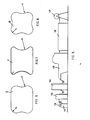
- Each strand-forming zone 3 has, considered in the stretching direction (N-S), a first part x1 followed by a second part x 2 followed in turn by a third part x l , the first and third parts x 1 being of equal width and of less width than the second part x 2 .
- Each hole 2 and each strand-forming zone 3 (except at the selvedges) is symmetrical about the stretching direction axis (N-S) and about the axis at right angles thereto.
- Example 5 below is a specific example relating to these Figures.
- the radiussing of the first and third (narrower) parts was 3 mm in Example 5.
- Figure 4 was the product of Example 7 below. The samples were stretched until each had the same level of penetration of orientation into the bar, the respective stretch ratios (on the strand) being 9.6 and 7.7. In stretching, the pitch of the transverse truth lines increases: also the transverse truth lines bow according to whether the middle strip of the strand is moving more than the sides; the bows are extended with dashed lines.
- Figure 4 corresponds to Figure 3; Figure 5 is a product of GB 2 073 090B though the hole length was less (N-S) in the starting material than for Figure 4.
- Figure 4 shows the transverse truth lines straight in three parts, corresponding to the three parts in the strand-forming zone 3.
- Figure 5 shows the transverse truth lines straight only in the centre, corresponding to the initial yield part.
- seven differing portions can be identified, namely: first and seventh portions 7 1 , 7 7 in which the middle of the strand has moved during stretching further away from the respective ends of the strand than the edges of the strand (truth lines bowed towards the mid-point), second, fourth and sixth portions 7 2 , 7 4# 7 6 in which the middle of the strand has moved during stretching the same distance from the ends of the strand as the edges of the strand (truth lines straight), and third and fifth portions in which the middle of the strand has moved during stretching less from the respective end of the strand than the edges of the strand (truth lines bowed away from the mid-point).
- the initial yield parts can be identified between truth lines which bow towards each other, which is also the case for the single yield part in Figure 5.
- the existence of the differential movement can be
- the product is useful for soil reinforcement.
- the very consistent width makes the product particularly useful for making gabions when connecting strands using the arrangement described in GB 2 078 833A & B.
- Figure 7 shows a punch that worked with data otherwise as given in Example 2 below, but produced a slightly inferior product. It is desirable to use the punch of Figure 6 with wider strand-forming zones than in Example 2.
- Figure 8 illustrates the shape of a hole 8 which is suitable for a square pattern for producing the biaxially-stretched products, as described in GB 2 035 191B.
- the peripheries of the holes 8 are completely defined by circular arcs with no abrupt transitions or sharp angles.
- a let-off unit 11 supports a roll 12 of unperforated starting material which passes through the plant along the path indicated by the dashed lines and arrows.
- the starting material passes through a sheet flattening unit 13, a perforator 14, a machine direction orientation machine 15 and a transverse direction orientation machine 16, and is wound up on a wind-up unit 17.
- the units of the plant are conventional units.
- the starting material is stretched uniaxially to form a mesh structure like that of Figure 3; in the machine 16, the second stretch is applied to form a biaxial mesh structure (not illustrated but generally as one of Figures 5 to 9, 21 and 22 of US 4 374 798).
- the transverse restraint is natural, due to the distance between the rolls, but not 100%. In the machine 16, there is natural, 100% machine direction restraint.
- Example 1 is theoretical.
- Example 8 is the same as Example 7, but expressed in metric units. The procedure was as in Figures 1 to 3. The sheet was 4.5 mm thick. Stretching was performed at 105°C for HDPE and 120°C for PP. There was no significant lateral restraint but very little transverse shrinkage occurred.
Landscapes
- Engineering & Computer Science (AREA)
- Mechanical Engineering (AREA)
- Manufacturing & Machinery (AREA)
- Textile Engineering (AREA)
- Shaping By String And By Release Of Stress In Plastics And The Like (AREA)
- Materials For Medical Uses (AREA)
- Nonwoven Fabrics (AREA)
- Spinning Methods And Devices For Manufacturing Artificial Fibers (AREA)
- Prostheses (AREA)
Applications Claiming Priority (2)
| Application Number | Priority Date | Filing Date | Title |
|---|---|---|---|
| GB858509498A GB8509498D0 (en) | 1985-04-12 | 1985-04-12 | Plastics material mesh structure |
| GB8509498 | 1985-04-12 |
Publications (2)
| Publication Number | Publication Date |
|---|---|
| EP0198704A2 true EP0198704A2 (fr) | 1986-10-22 |
| EP0198704A3 EP0198704A3 (fr) | 1989-01-25 |
Family
ID=10577587
Family Applications (1)
| Application Number | Title | Priority Date | Filing Date |
|---|---|---|---|
| EP86302766A Withdrawn EP0198704A3 (fr) | 1985-04-12 | 1986-04-14 | Procédé pour la fabrication d'un produit en matière plastique à structure maillée |
Country Status (9)
| Country | Link |
|---|---|
| US (1) | US4743486A (fr) |
| EP (1) | EP0198704A3 (fr) |
| JP (1) | JPH0661875B2 (fr) |
| KR (1) | KR860008321A (fr) |
| AU (1) | AU591112B2 (fr) |
| CA (1) | CA1281872C (fr) |
| DK (1) | DK164486A (fr) |
| GB (2) | GB8509498D0 (fr) |
| NO (1) | NO861420L (fr) |
Cited By (3)
| Publication number | Priority date | Publication date | Assignee | Title |
|---|---|---|---|---|
| WO1996015901A1 (fr) * | 1994-11-24 | 1996-05-30 | Netlon Limited | Structures maillees realisees en matieres plastiques |
| GB2496485A (en) * | 2011-10-28 | 2013-05-15 | Tensar Technologies Ltd | Molecularly oriented grid structure |
| GB2532027A (en) * | 2014-11-05 | 2016-05-11 | Concepts For Success (C4S) | Selective machine-directional stretching of a precombined elastic web of varying web width by speed differential stretching |
Families Citing this family (20)
| Publication number | Priority date | Publication date | Assignee | Title |
|---|---|---|---|---|
| IT1228101B (it) * | 1988-12-20 | 1991-05-28 | Rdb Plastotecnica S P A V | Elemento lastriforme del tipo rete monostirata, particolarmente per usi geotecnici |
| US5269631A (en) * | 1989-09-14 | 1993-12-14 | Netlon Limited | Plastics material mesh structures |
| US5267816A (en) * | 1989-09-14 | 1993-12-07 | Netlon Limited | Geogrids |
| CH683899A5 (de) * | 1990-09-21 | 1994-06-15 | Breveteam Sa | Verfahren zum Herstellen einer Oeffnungen aufweisenden Kunststoff-Folie, insbesondere eines eine Netzstruktur enthaltenden Gebildes und ein nach dem Verfahren hergestelltes Gebilde. |
| US5632571A (en) * | 1995-05-31 | 1997-05-27 | The Tensar Corporation | Concrete geomattress |
| US5851089A (en) * | 1996-10-07 | 1998-12-22 | Tenax Spa | Composite reinforced structure including an integrated multi-layer geogrid and method of constructing the same |
| US20070185222A1 (en) * | 2004-06-04 | 2007-08-09 | William Shelton | Lightweight polypropylene nets manufactured with a beta nucleation additive, the method of manufacture and uses thereof |
| US20050288404A1 (en) * | 2004-06-25 | 2005-12-29 | William Shelton | Polypropylene grids manufactured with a beta nucleation additive, the method of manufacture and uses thereof |
| WO2008097523A1 (fr) | 2007-02-06 | 2008-08-14 | The Tensar Corporation | Grilles en un seul bloc en polyéthylène téréphtalate, procédé de fabrication, et leurs utilisations |
| US20090214821A1 (en) | 2008-02-15 | 2009-08-27 | Walsh Anthony T | Multi-axial grid or mesh structures with high aspect ratio ribs |
| US20120257926A1 (en) | 2011-04-11 | 2012-10-11 | Tenax S.P.A. | Product having a net structure, a process for realizing the product and use of the product for geotechnical applications |
| ITMI20110606A1 (it) | 2011-04-11 | 2012-10-12 | Tenax Spa | Manufatto a struttura reticolare, procedimento per la realizzazione dello stesso ed uso di detto manufatto per applicazioni geotecniche |
| ES3074566T3 (en) | 2015-10-09 | 2026-07-21 | Tensar Corp Llc | Geogrid made from a coextruded multilayered polymer |
| AU2017307641B9 (en) * | 2016-08-02 | 2023-03-23 | Corex Plastics (Australia) Pty Ltd | Polymer sheet, method of installing and producing same |
| US11519150B2 (en) | 2020-06-24 | 2022-12-06 | Tensar International Corporation | Horizontal mechanically stabilizing geogrid with improved geotechnical interaction |
| US11390015B2 (en) | 2020-06-24 | 2022-07-19 | Tensar International Corporation | Multi-axial integral geogrid and methods of making and using same |
| US12414493B2 (en) * | 2020-07-06 | 2025-09-16 | New Aerofarms, Inc. | Resilient plant development media |
| ES3049592T3 (en) * | 2020-07-06 | 2025-12-17 | New Aerofarms Inc | Resilient plant development media |
| IL305468B2 (en) | 2021-02-26 | 2025-09-01 | Tensar Int Corporation | Horizontal mechanical stabilizer geogrid with enhanced geotechnical interaction |
| GB2635296B (en) | 2021-12-20 | 2026-04-08 | Tensar Int Corporation | Expanded multilayer integral geogrids and methods of making and using same |
Family Cites Families (14)
| Publication number | Priority date | Publication date | Assignee | Title |
|---|---|---|---|---|
| NL278551A (fr) * | 1961-06-02 | |||
| BE629367A (fr) * | 1962-03-09 | |||
| GB1055963A (en) * | 1963-08-27 | 1967-01-25 | Smith & Nephew | Improvements in and relating to open work materials in sheet form |
| GB1116181A (en) * | 1965-01-01 | 1968-06-06 | Bakelite Xylonite Ltd | Improvements in or relating to netting of thermoplastic material |
| NL6800231A (fr) * | 1967-01-06 | 1968-07-08 | ||
| GB1261515A (en) * | 1968-03-20 | 1972-01-26 | Smith & Nephew | Net-like openwork structure |
| BE754974A (fr) * | 1969-06-27 | 1971-02-18 | Cellu Prod Co | Procede de fabrication de materiaux thermoplastiques reticulaires ou analogues, produits pour son execution et articles ainsi obtenus, |
| NO152611C (no) * | 1978-10-16 | 1985-10-23 | Plg Res | Plastnettkonstruksjon, fremgangsmaate til dens fremstilling og anvendelse av konstruksjonen |
| GB2034240B (en) * | 1978-10-16 | 1983-01-19 | Plg Res | Plastics material mesh structure |
| NO152612C (no) * | 1978-10-16 | 1985-10-23 | Plg Res | Sammenhengende plastnettkonstruksjon med rombemasker og fremgangsmaate til dens fremstilling |
| EP0027031A1 (fr) * | 1979-10-09 | 1981-04-15 | P.L.G. Research Limited | Article tridimensionnel en matière plastique et procédé pour sa fabrication |
| ATE23056T1 (de) * | 1981-04-03 | 1986-11-15 | Plg Res | Netzstruktur aus kunststoff. |
| GB2124965B (en) * | 1982-07-06 | 1986-05-29 | Plg Res | Mesh structure and laminate made therewith |
| US4590029A (en) * | 1982-10-13 | 1986-05-20 | P. L. G. Research Limited | Molecularly orientating plastics material |
-
1985
- 1985-04-12 GB GB858509498A patent/GB8509498D0/en active Pending
-
1986
- 1986-04-09 GB GB8608594A patent/GB2174332B/en not_active Expired
- 1986-04-11 AU AU56009/86A patent/AU591112B2/en not_active Expired
- 1986-04-11 DK DK164486A patent/DK164486A/da not_active IP Right Cessation
- 1986-04-11 NO NO861420A patent/NO861420L/no unknown
- 1986-04-11 JP JP61084023A patent/JPH0661875B2/ja not_active Expired - Lifetime
- 1986-04-12 KR KR1019860002788A patent/KR860008321A/ko not_active Withdrawn
- 1986-04-14 US US06/851,737 patent/US4743486A/en not_active Expired - Lifetime
- 1986-04-14 CA CA000506619A patent/CA1281872C/fr not_active Expired - Lifetime
- 1986-04-14 EP EP86302766A patent/EP0198704A3/fr not_active Withdrawn
Cited By (7)
| Publication number | Priority date | Publication date | Assignee | Title |
|---|---|---|---|---|
| WO1996015901A1 (fr) * | 1994-11-24 | 1996-05-30 | Netlon Limited | Structures maillees realisees en matieres plastiques |
| US6423394B1 (en) | 1994-11-24 | 2002-07-23 | Netlon Limited | Plastics material mesh structures |
| GB2496485A (en) * | 2011-10-28 | 2013-05-15 | Tensar Technologies Ltd | Molecularly oriented grid structure |
| US9227377B2 (en) | 2011-10-28 | 2016-01-05 | Tensar Technologies Limited | Mesh structure, production and uses thereof |
| GB2496485B (en) * | 2011-10-28 | 2017-10-18 | Tensar Tech Ltd | Mesh structure, production and uses thereof |
| AU2012328139B2 (en) * | 2011-10-28 | 2017-11-09 | Tensar Technologies Limited | Mesh structure, production and uses thereof |
| GB2532027A (en) * | 2014-11-05 | 2016-05-11 | Concepts For Success (C4S) | Selective machine-directional stretching of a precombined elastic web of varying web width by speed differential stretching |
Also Published As
| Publication number | Publication date |
|---|---|
| JPH0661875B2 (ja) | 1994-08-17 |
| GB8608594D0 (en) | 1986-05-14 |
| AU5600986A (en) | 1986-10-16 |
| NO861420L (no) | 1986-10-13 |
| CA1281872C (fr) | 1991-03-26 |
| GB2174332B (en) | 1989-06-28 |
| JPS6218249A (ja) | 1987-01-27 |
| GB8509498D0 (en) | 1985-05-15 |
| DK164486D0 (da) | 1986-04-11 |
| KR860008321A (ko) | 1986-11-14 |
| US4743486A (en) | 1988-05-10 |
| AU591112B2 (en) | 1989-11-30 |
| EP0198704A3 (fr) | 1989-01-25 |
| DK164486A (da) | 1986-10-13 |
| GB2174332A (en) | 1986-11-05 |
Similar Documents
| Publication | Publication Date | Title |
|---|---|---|
| US4743486A (en) | Product and method of producing a plastics material mesh structure | |
| US4374798A (en) | Production of plastic mesh structure | |
| SU871726A3 (ru) | Способ изготовлени сетчатых пластиковых конструкций с ромбовидными чейками | |
| US5269631A (en) | Plastics material mesh structures | |
| US4144008A (en) | Apparatus for stretching a tubularly-formed sheet of thermoplastic material | |
| US5156495A (en) | Plastic material mesh structure | |
| EP0418104B1 (fr) | Grille pour application géotechnique | |
| EP0108513B1 (fr) | Orientation moléculaire de matière plastique | |
| GB2073090A (en) | Plastics Material Mesh Structure | |
| EP0076689A2 (fr) | Structure de filet en matière plastique | |
| EP0515233B1 (fr) | Treillis en matière plastique | |
| JP6054978B2 (ja) | メッシュ構造、その製造及び使用 | |
| US6423394B1 (en) | Plastics material mesh structures | |
| CA1080419A (fr) | Tissu reticule | |
| US3321355A (en) | Fabric reinforced plastic product and method of making same | |
| GB2034240A (en) | Plastics Material Mesh Structure | |
| EP1657178A1 (fr) | Bande de resine synthetique thermoplastique et son procede de production | |
| KR100996960B1 (ko) | 낮은 재단 손실율의 커팅 프레임 | |
| DE2902525A1 (de) | Verfahren zur herstellung von monofilaments | |
| JPH04216925A (ja) | 網目構造体 | |
| TH9382B (th) | ฟิล์มชนิดที่เป็นแผ่นซ้อนกัน | |
| TH15494A (th) | ฟิล์มชนิดที่เป็นแผ่นซ้อนกัน |
Legal Events
| Date | Code | Title | Description |
|---|---|---|---|
| PUAI | Public reference made under article 153(3) epc to a published international application that has entered the european phase |
Free format text: ORIGINAL CODE: 0009012 |
|
| AK | Designated contracting states |
Kind code of ref document: A2 Designated state(s): BE DE FR GB IT LU NL SE |
|
| PUAL | Search report despatched |
Free format text: ORIGINAL CODE: 0009013 |
|
| AK | Designated contracting states |
Kind code of ref document: A3 Designated state(s): BE DE FR GB IT LU NL SE |
|
| STAA | Information on the status of an ep patent application or granted ep patent |
Free format text: STATUS: THE APPLICATION IS DEEMED TO BE WITHDRAWN |
|
| 18D | Application deemed to be withdrawn |
Effective date: 19880503 |
|
| RIN1 | Information on inventor provided before grant (corrected) |
Inventor name: MERCER, FRANK BRIAN Inventor name: MARTIN, KEITH FRASER |