EP0199035A2 - Anpassungsfähiges Verfahren zum Komprimieren von Zeichendaten - Google Patents
Anpassungsfähiges Verfahren zum Komprimieren von Zeichendaten Download PDFInfo
- Publication number
- EP0199035A2 EP0199035A2 EP86103033A EP86103033A EP0199035A2 EP 0199035 A2 EP0199035 A2 EP 0199035A2 EP 86103033 A EP86103033 A EP 86103033A EP 86103033 A EP86103033 A EP 86103033A EP 0199035 A2 EP0199035 A2 EP 0199035A2
- Authority
- EP
- European Patent Office
- Prior art keywords
- word
- separator
- event
- new
- words
- Prior art date
- Legal status (The legal status is an assumption and is not a legal conclusion. Google has not performed a legal analysis and makes no representation as to the accuracy of the status listed.)
- Granted
Links
Images


Classifications
-
- H—ELECTRICITY
- H03—ELECTRONIC CIRCUITRY
- H03M—CODING; DECODING; CODE CONVERSION IN GENERAL
- H03M7/00—Conversion of a code where information is represented by a given sequence or number of digits to a code where the same, similar or subset of information is represented by a different sequence or number of digits
- H03M7/30—Compression; Expansion; Suppression of unnecessary data, e.g. redundancy reduction
- H03M7/40—Conversion to or from variable length codes, e.g. Shannon-Fano code, Huffman code, Morse code
- H03M7/42—Conversion to or from variable length codes, e.g. Shannon-Fano code, Huffman code, Morse code using table look-up for the coding or decoding process, e.g. using read-only memory
-
- H—ELECTRICITY
- H03—ELECTRONIC CIRCUITRY
- H03M—CODING; DECODING; CODE CONVERSION IN GENERAL
- H03M7/00—Conversion of a code where information is represented by a given sequence or number of digits to a code where the same, similar or subset of information is represented by a different sequence or number of digits
- H03M7/30—Compression; Expansion; Suppression of unnecessary data, e.g. redundancy reduction
- H03M7/40—Conversion to or from variable length codes, e.g. Shannon-Fano code, Huffman code, Morse code
- H03M7/4006—Conversion to or from arithmetic code
Definitions
- This invention generally relates to a method of compressing character data and, more particularly, to an adaptive method of compressing computer data files.
- the file compressor according to the invention is intended for use on files containing language, either computer programs or natural language.
- the problem of designing a compressor may be separated into two parts. The first is the construction of a model of the source document. For any such model, there is a theoretical minimum size for the compressed document, the so-called entropy limit. It is then necessary to formulate a practical coding scheme which will give actual compression close to the theoretical value.
- Huffman coding For non-adaptive models, i.e. models whose characteristics are independent of the document being transmitted, Huffman coding will often be quite efficient.
- the coding scheme must also change during the coding process. Adaptive Huffman coding is then required. While such schemes have been built and used, a faster method of coding is desirable.
- a count is maintained of all word events and a count is maintained of all separator events as those events are encoded.
- individual counts for each occurrence of a word and each occurrence of a separator are maintained.
- the ratio of the number of times a word has been encountered to the total number of words encountered is used to estimate the probability of the word.
- the ratio of the number of times a separator has been encountered to the total number of separators encountered is used to estimate the probability of the separator.
- the model used in the practice of the invention has the following characteristics. It is assumed that the data to be transmitted consists of a sequence of events, the events being coded one at a time, starting with the first event, then the second, and so forth. When it is time to code the n'th event, the model produces (1) the relevant event set and (2) the probability of each event. In doing so, the model may make use of its knowledge of all previous events, but may not take into account the specific n'th event or any as yet not encoded event. This restriction means that a copy of the model in the decoder can have the same information as that in the encoder.
- the model is adaptive; i.e., event frequencies are accumulated as the file is encoded.
- the probabilities are rational fractions, and the probability of a given event is the ratio of its count to the total count for the relevant event set.
- the probabilities used change during the coding process.
- a feature of the model is its selection of the appropriate event set to be used at any step in the coding process.
- the model may be thought of as a finite state machine.
- a file is treated as a sequence of records.
- Each record contains an alternating sequence of "words” and "separators", where a word is a string of alphanumeric characters and a separator is a string of non- alphanumeric characters.
- word is a string of alphanumeric characters
- separator is a string of non- alphanumeric characters.
- the single space will be the dominant separator.
- the coding process is diagramed in Figure 1.
- a record is read from the input file.
- the record will start with a separator or a word.
- the first event set consists of the two possibilities startword or startsep.
- the appropriate event of the pair is coded.
- the count of the encountered event is increased by one.
- the possible event is one of the following:
- the count for that event is increased by one.
- the old word event is one in which the word to be coded has previously been encountered and stored in the dictionary.
- N is the accession number.
- the new word event requires further action.
- the word must be entered in the dictionary, with a count of one, and must also be coded, the coding process for the word is shown in Figure 2.
- Figure 2 also applies to separators, sot the generic term "symbol" is used. The symbol is coded one character at a time.
- the event set is as follows:
- the appropriate count is increased by one.
- a new character When a new character is encountered, it must also be coded. This is done by assuming all new characters (0 to 255) are equally likely. the count for the specific character is set to one. It is important to note that separate tables are kept for the characters in words and in separators. After a word, unless the end of a record has been encountered, a separator is expected. Separators are treated similarly to words, but they have their own dictionary and statistics.
- the program switches between words and separators until the end of the input record is reached.
- the end of record event is coded and a new record is read.
- the coding process is repeated, beginning with the code to indicate whether the record starts with a word or a separator.
- the startword and end of record events are transmitted. This denotes an empty record, which is used as the end of a file.
- the practical implementation of the invention uses arithmetic coding.
- the arithmetic coding process is first described as if arithmetic may be carried out with unlimited precision. The details of a practical algorithm are given later.
- the input data required are the counts of each of the possible events, in some arbitrary order (known to both the compressor and the decompressor), and the particular event to be coded.
- the variable n denotes the event number. n starts at one and is increased by one as each event is coded.
- x(n) and r(n) be a pair of real numbers which describes the result of encoding the first n events.
- the coding formulae are, to code the n'th event (event i in the set described by C) are as follows:
- equations (2) become the following:
- Figure 3 shows the geometric representation of these formulae.
- the document is represented by the value of x(N).
- the coded file is represented by the value of x(N).
- the number of hits required to represent x(N) with sufficient accuracy is readily estimated. Any point in the interval X defined by will suffice to permit decoding the file. Thus, it is only necessary to transmit enough bits of some X in this interval to uniquely position it in the interval. Using bits will accomplish this.
- the algorithm has five event sets and five sets of counts to be maintained. These are given in the tables below:
- the event will be coded using the count for the event, the sum of the counts for all events in the set above the event being coded, and the total number of events in the set. After the event is coded, the count for the event is increased by one. If the event is a new word, separator, or character, the count for the new item is set to one, it being previously zero. Note that in this case the total number of events in the set has been increased by two, each new item being a double event in the set.
- the character counts in sets 3 and 5 are indexed by the corresponding E BCDIC code for the character. Since the word characters will not include those with codes of zero or one, these are used for end of word and new character, respectively.
- the separator characters any alphameric characters may be used to designate end of separator and new character. For example, the characters "x" and "y" may be choosen.
- Updating a count for an event is a simple computation.
- the cumulative counts are defined in equation (1).
- a full dictionary would require up to 4096 additions to obtain a cululative count. Maintaining the C(i,n) for each new event would also be time consuming.
- a technique which solves this problem is available.
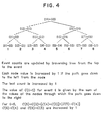
- the approach is indicated in Figure 4 which is constructed for an event set of eight events. The notation is that of equation (1). Note that the depth of the tree is much smaller than the number of leaves of the tree. Thus, the updating operation requires many less steps. In practice, the tree is traversed once from the top to the desired leaf or event. First, a variable cumulative count is set to zero.
- the count at that node is increased by one: On the other hand, if one goes to the right, the value of the node is added to the cumulative count. When the bottom of the tree is reached, the leaf has the desired value of c(i,n) and the cumulative count has the value for C(i-l,n).
- Such a c may readily be used to search the tree in Figure 4 to find the event.
- the determination of c is as follows. Try
- c > C(i-l,n).
- d and f are variables less than 1 and equal to or greater than zero.
- the variable e has the possible values of 0 and 0.5.
Landscapes
- Engineering & Computer Science (AREA)
- Theoretical Computer Science (AREA)
- Compression, Expansion, Code Conversion, And Decoders (AREA)
Applications Claiming Priority (2)
| Application Number | Priority Date | Filing Date | Title |
|---|---|---|---|
| US06/724,234 US4672539A (en) | 1985-04-17 | 1985-04-17 | File compressor |
| US724234 | 1985-04-17 |
Publications (3)
| Publication Number | Publication Date |
|---|---|
| EP0199035A2 true EP0199035A2 (de) | 1986-10-29 |
| EP0199035A3 EP0199035A3 (en) | 1989-11-29 |
| EP0199035B1 EP0199035B1 (de) | 1993-06-02 |
Family
ID=24909595
Family Applications (1)
| Application Number | Title | Priority Date | Filing Date |
|---|---|---|---|
| EP86103033A Expired - Lifetime EP0199035B1 (de) | 1985-04-17 | 1986-03-07 | Anpassungsfähiges Verfahren zum Komprimieren von Zeichendaten |
Country Status (5)
| Country | Link |
|---|---|
| US (1) | US4672539A (de) |
| EP (1) | EP0199035B1 (de) |
| JP (1) | JPS61242122A (de) |
| CA (1) | CA1241760A (de) |
| DE (1) | DE3688517T2 (de) |
Cited By (6)
| Publication number | Priority date | Publication date | Assignee | Title |
|---|---|---|---|---|
| GB2193866A (en) * | 1986-07-24 | 1988-02-17 | Serif Software Limited | Data compression method and apparatus |
| EP0280549A3 (en) * | 1987-02-25 | 1990-02-07 | Oki Electric Industry Company, Limited | Data compression method and apparatus |
| EP0412047A1 (de) * | 1989-07-28 | 1991-02-06 | International Business Machines Corporation | Verfahren und System der arithmetischen Kodierung und Dekodierung |
| EP0490606A3 (en) * | 1990-12-08 | 1992-08-05 | Dowty Communications Limited | An adaptive data compression system |
| WO1997012445A1 (en) * | 1995-09-27 | 1997-04-03 | Canon Research Centre Europe Ltd. | Data compression apparatus |
| RU2226044C2 (ru) * | 2002-01-09 | 2004-03-20 | Джи И ТЕКНОЛОДЖИ ДИВЕЛОПМЕНТ, ИНК. | Устройство для выдачи сжатого видеосигнала и способ его передачи |
Families Citing this family (14)
| Publication number | Priority date | Publication date | Assignee | Title |
|---|---|---|---|---|
| US4935882A (en) * | 1986-09-15 | 1990-06-19 | International Business Machines Corporation | Probability adaptation for arithmetic coders |
| WO1988009586A1 (en) * | 1987-05-25 | 1988-12-01 | Megaword International Pty. Ltd. | A method of processing a text in order to store the text in memory |
| DE69029217T2 (de) * | 1989-04-05 | 1997-04-03 | Xerox Corp | Verfahren zur Kodierung von Texten |
| US5625773A (en) * | 1989-04-05 | 1997-04-29 | Xerox Corporation | Method of encoding and line breaking text |
| GB9103080D0 (en) * | 1991-02-14 | 1991-04-03 | British And Foreign Bible The | Analysing textual documents |
| JPH06131152A (ja) * | 1992-04-13 | 1994-05-13 | Compaq Computer Corp | セパレータが無いか少ない言語を表わすコンピュータファイルのためのデータ圧縮方法 |
| AU659639B2 (en) * | 1992-05-11 | 1995-05-25 | British And Foreign Bible Society, The | Analysing textual documents |
| US5533051A (en) * | 1993-03-12 | 1996-07-02 | The James Group | Method for data compression |
| US5486864A (en) * | 1993-05-13 | 1996-01-23 | Rca Thomson Licensing Corporation | Differential time code method and apparatus as for a compressed video signal |
| US5546080A (en) * | 1994-01-03 | 1996-08-13 | International Business Machines Corporation | Order-preserving, fast-decoding arithmetic coding arithmetic coding and compression method and apparatus |
| US5778374A (en) * | 1995-08-03 | 1998-07-07 | International Business Machines Corporation | Compressed common file directory for mass storage systems |
| US5787446A (en) * | 1995-08-03 | 1998-07-28 | International Business Machines Corporation | Sub-volume with floating storage space |
| US5771011A (en) * | 1996-07-15 | 1998-06-23 | International Business Machines Corporation | Match detect logic for multi-byte per cycle hardware data compression |
| US6226628B1 (en) * | 1998-06-24 | 2001-05-01 | Microsoft Corporation | Cross-file pattern-matching compression |
Family Cites Families (9)
| Publication number | Priority date | Publication date | Assignee | Title |
|---|---|---|---|---|
| US3643226A (en) * | 1969-06-26 | 1972-02-15 | Ibm | Multilevel compressed index search method and means |
| US3694813A (en) * | 1970-10-30 | 1972-09-26 | Ibm | Method of achieving data compaction utilizing variable-length dependent coding techniques |
| US4103287A (en) * | 1973-12-17 | 1978-07-25 | Bell Telephone Laboratories, Incorporated | Variable length codes for high quality image encoding |
| US3984833A (en) * | 1973-12-26 | 1976-10-05 | International Business Machines Corporation | Apparatus for encoding extended run-length codes |
| US4410916A (en) * | 1979-08-24 | 1983-10-18 | Compression Labs, Inc. | Dual mode facsimile coding system and method |
| US4355306A (en) * | 1981-01-30 | 1982-10-19 | International Business Machines Corporation | Dynamic stack data compression and decompression system |
| US4420771A (en) * | 1981-02-09 | 1983-12-13 | Bell Telephone Laboratories, Incorporated | Technique for encoding multi-level signals |
| US4369463A (en) * | 1981-06-04 | 1983-01-18 | International Business Machines Corporation | Gray scale image data compression with code words a function of image history |
| US4545032A (en) * | 1982-03-08 | 1985-10-01 | Iodata, Inc. | Method and apparatus for character code compression and expansion |
-
1985
- 1985-04-17 US US06/724,234 patent/US4672539A/en not_active Expired - Fee Related
-
1986
- 1986-03-03 JP JP61044273A patent/JPS61242122A/ja active Granted
- 1986-03-07 EP EP86103033A patent/EP0199035B1/de not_active Expired - Lifetime
- 1986-03-07 DE DE86103033T patent/DE3688517T2/de not_active Expired - Fee Related
- 1986-03-20 CA CA000504662A patent/CA1241760A/en not_active Expired
Cited By (7)
| Publication number | Priority date | Publication date | Assignee | Title |
|---|---|---|---|---|
| GB2193866A (en) * | 1986-07-24 | 1988-02-17 | Serif Software Limited | Data compression method and apparatus |
| EP0280549A3 (en) * | 1987-02-25 | 1990-02-07 | Oki Electric Industry Company, Limited | Data compression method and apparatus |
| EP0412047A1 (de) * | 1989-07-28 | 1991-02-06 | International Business Machines Corporation | Verfahren und System der arithmetischen Kodierung und Dekodierung |
| EP0490606A3 (en) * | 1990-12-08 | 1992-08-05 | Dowty Communications Limited | An adaptive data compression system |
| WO1997012445A1 (en) * | 1995-09-27 | 1997-04-03 | Canon Research Centre Europe Ltd. | Data compression apparatus |
| US6304601B1 (en) * | 1995-09-27 | 2001-10-16 | Canon Research Centre Europe Ltd. | Data compression apparatus |
| RU2226044C2 (ru) * | 2002-01-09 | 2004-03-20 | Джи И ТЕКНОЛОДЖИ ДИВЕЛОПМЕНТ, ИНК. | Устройство для выдачи сжатого видеосигнала и способ его передачи |
Also Published As
| Publication number | Publication date |
|---|---|
| CA1241760A (en) | 1988-09-06 |
| US4672539A (en) | 1987-06-09 |
| JPH0358207B2 (de) | 1991-09-04 |
| EP0199035B1 (de) | 1993-06-02 |
| DE3688517T2 (de) | 1993-12-23 |
| DE3688517D1 (de) | 1993-07-08 |
| JPS61242122A (ja) | 1986-10-28 |
| EP0199035A3 (en) | 1989-11-29 |
Similar Documents
| Publication | Publication Date | Title |
|---|---|---|
| EP0199035A2 (de) | Anpassungsfähiges Verfahren zum Komprimieren von Zeichendaten | |
| US5325091A (en) | Text-compression technique using frequency-ordered array of word-number mappers | |
| EP0490964B1 (de) | Vorrichtung zur datenkompression | |
| JP2979106B2 (ja) | データ圧縮 | |
| JPH03204233A (ja) | データ圧縮方法 | |
| Abel et al. | Universal text preprocessing for data compression | |
| JPS6356726B2 (de) | ||
| JPH08167852A (ja) | データ圧縮方法及び装置 | |
| Bell et al. | The relationship between greedy parsing and symbolwise text compression | |
| JP3241787B2 (ja) | データ圧縮方式 | |
| Milidiú et al. | In-place length-restricted prefix coding | |
| Anisimov et al. | Practical Word-based Text Compression Using the Reverse Multi-Delimiter Codes. | |
| Plantinga | An asymmetric, semi-adaptive text compression algorithm | |
| JP2590287B2 (ja) | データ圧縮方法およびデータ圧縮装置 | |
| JP2954749B2 (ja) | データ圧縮方式 | |
| JP3018990B2 (ja) | 算術符号化装置 | |
| Wirth | Symbol-driven compression of Burrows Wheeler transformed text | |
| JP2785168B2 (ja) | 単語検索のための電子辞書圧縮方法及び装置 | |
| Begum et al. | A Novel Multidictionary Based Text Compression | |
| Sadakane | Text compression using recency rank with context and relation to context sorting, block sorting and PPM/sup* | |
| Bloom | New Techniques in Context Modeling and Arithmetic Encoding. | |
| Bookstein et al. | Models of bitmap generation: A systematic approach to bitmap compression | |
| Koivula | Huffman source coding | |
| YOKOO | A lossless coding algorithm for the compression of numerical data | |
| Choi | Comparison of Methods for Text Compression |
Legal Events
| Date | Code | Title | Description |
|---|---|---|---|
| PUAI | Public reference made under article 153(3) epc to a published international application that has entered the european phase |
Free format text: ORIGINAL CODE: 0009012 |
|
| AK | Designated contracting states |
Kind code of ref document: A2 Designated state(s): DE FR GB IT |
|
| 17P | Request for examination filed |
Effective date: 19870224 |
|
| PUAL | Search report despatched |
Free format text: ORIGINAL CODE: 0009013 |
|
| AK | Designated contracting states |
Kind code of ref document: A3 Designated state(s): DE FR GB IT |
|
| RHK1 | Main classification (correction) |
Ipc: H03M 7/42 |
|
| 17Q | First examination report despatched |
Effective date: 19910808 |
|
| GRAA | (expected) grant |
Free format text: ORIGINAL CODE: 0009210 |
|
| AK | Designated contracting states |
Kind code of ref document: B1 Designated state(s): DE FR GB IT |
|
| PG25 | Lapsed in a contracting state [announced via postgrant information from national office to epo] |
Ref country code: IT Free format text: LAPSE BECAUSE OF FAILURE TO SUBMIT A TRANSLATION OF THE DESCRIPTION OR TO PAY THE FEE WITHIN THE PRE;WARNING: LAPSES OF ITALIAN PATENTS WITH EFFECTIVE DATE BEFORE 2007 MAY HAVE OCCURRED AT ANY TIME BEFORE 2007. THE CORRECT EFFECTIVE DATE MAY BE DIFFERENT FROM THE ONE RECORDED.SCRIBED TIME-LIMIT Effective date: 19930602 |
|
| REF | Corresponds to: |
Ref document number: 3688517 Country of ref document: DE Date of ref document: 19930708 |
|
| ET | Fr: translation filed | ||
| PLBE | No opposition filed within time limit |
Free format text: ORIGINAL CODE: 0009261 |
|
| STAA | Information on the status of an ep patent application or granted ep patent |
Free format text: STATUS: NO OPPOSITION FILED WITHIN TIME LIMIT |
|
| 26N | No opposition filed | ||
| PGFP | Annual fee paid to national office [announced via postgrant information from national office to epo] |
Ref country code: GB Payment date: 19950227 Year of fee payment: 10 |
|
| PGFP | Annual fee paid to national office [announced via postgrant information from national office to epo] |
Ref country code: FR Payment date: 19950228 Year of fee payment: 10 |
|
| PGFP | Annual fee paid to national office [announced via postgrant information from national office to epo] |
Ref country code: DE Payment date: 19950330 Year of fee payment: 10 |
|
| PG25 | Lapsed in a contracting state [announced via postgrant information from national office to epo] |
Ref country code: GB Effective date: 19960307 |
|
| GBPC | Gb: european patent ceased through non-payment of renewal fee |
Effective date: 19960307 |
|
| PG25 | Lapsed in a contracting state [announced via postgrant information from national office to epo] |
Ref country code: FR Effective date: 19961129 |
|
| PG25 | Lapsed in a contracting state [announced via postgrant information from national office to epo] |
Ref country code: DE Effective date: 19961203 |
|
| REG | Reference to a national code |
Ref country code: FR Ref legal event code: ST |