EP0199330A2 - Trimethylcyclohexen-Derivate, ihre Herstellung und deren Verwendung als Duftstoffe - Google Patents
Trimethylcyclohexen-Derivate, ihre Herstellung und deren Verwendung als Duftstoffe Download PDFInfo
- Publication number
- EP0199330A2 EP0199330A2 EP86105499A EP86105499A EP0199330A2 EP 0199330 A2 EP0199330 A2 EP 0199330A2 EP 86105499 A EP86105499 A EP 86105499A EP 86105499 A EP86105499 A EP 86105499A EP 0199330 A2 EP0199330 A2 EP 0199330A2
- Authority
- EP
- European Patent Office
- Prior art keywords
- trimethyl
- cyclohex
- methyl
- mol
- preparation
- Prior art date
- Legal status (The legal status is an assumption and is not a legal conclusion. Google has not performed a legal analysis and makes no representation as to the accuracy of the status listed.)
- Granted
Links
Classifications
-
- C—CHEMISTRY; METALLURGY
- C07—ORGANIC CHEMISTRY
- C07C—ACYCLIC OR CARBOCYCLIC COMPOUNDS
- C07C33/00—Unsaturated compounds having hydroxy or O-metal groups bound to acyclic carbon atoms
- C07C33/05—Alcohols containing rings other than six-membered aromatic rings
- C07C33/14—Alcohols containing rings other than six-membered aromatic rings containing six-membered rings
-
- C—CHEMISTRY; METALLURGY
- C07—ORGANIC CHEMISTRY
- C07C—ACYCLIC OR CARBOCYCLIC COMPOUNDS
- C07C45/00—Preparation of compounds having >C = O groups bound only to carbon or hydrogen atoms; Preparation of chelates of such compounds
- C07C45/61—Preparation of compounds having >C = O groups bound only to carbon or hydrogen atoms; Preparation of chelates of such compounds by reactions not involving the formation of >C = O groups
- C07C45/67—Preparation of compounds having >C = O groups bound only to carbon or hydrogen atoms; Preparation of chelates of such compounds by reactions not involving the formation of >C = O groups by isomerisation; by change of size of the carbon skeleton
- C07C45/68—Preparation of compounds having >C = O groups bound only to carbon or hydrogen atoms; Preparation of chelates of such compounds by reactions not involving the formation of >C = O groups by isomerisation; by change of size of the carbon skeleton by increase in the number of carbon atoms
- C07C45/69—Preparation of compounds having >C = O groups bound only to carbon or hydrogen atoms; Preparation of chelates of such compounds by reactions not involving the formation of >C = O groups by isomerisation; by change of size of the carbon skeleton by increase in the number of carbon atoms by addition to carbon-to-carbon double or triple bonds
-
- C—CHEMISTRY; METALLURGY
- C07—ORGANIC CHEMISTRY
- C07C—ACYCLIC OR CARBOCYCLIC COMPOUNDS
- C07C47/00—Compounds having —CHO groups
- C07C47/38—Unsaturated compounds having —CHO groups bound to carbon atoms of rings other than six—membered aromatic rings
- C07C47/42—Unsaturated compounds having —CHO groups bound to carbon atoms of rings other than six—membered aromatic rings with a six-membered ring
-
- C—CHEMISTRY; METALLURGY
- C07—ORGANIC CHEMISTRY
- C07C—ACYCLIC OR CARBOCYCLIC COMPOUNDS
- C07C49/00—Ketones; Ketenes; Dimeric ketenes; Ketonic chelates
- C07C49/527—Unsaturated compounds containing keto groups bound to rings other than six-membered aromatic rings
- C07C49/543—Unsaturated compounds containing keto groups bound to rings other than six-membered aromatic rings to a six-membered ring
-
- C—CHEMISTRY; METALLURGY
- C11—ANIMAL OR VEGETABLE OILS, FATS, FATTY SUBSTANCES OR WAXES; FATTY ACIDS THEREFROM; DETERGENTS; CANDLES
- C11B—PRODUCING, e.g. BY PRESSING RAW MATERIALS OR BY EXTRACTION FROM WASTE MATERIALS, REFINING OR PRESERVING FATS, FATTY SUBSTANCES, e.g. LANOLIN, FATTY OILS OR WAXES; ESSENTIAL OILS; PERFUMES
- C11B9/00—Essential oils; Perfumes
- C11B9/0026—Essential oils; Perfumes compounds containing an alicyclic ring not condensed with another ring
- C11B9/0034—Essential oils; Perfumes compounds containing an alicyclic ring not condensed with another ring the ring containing six carbon atoms
Definitions
- the invention relates to new compounds from the group of 1,4,6-trimethyl-cyclohex-3-ene derivatives.
- S.Arcander, "Perfumes and Flavor Chemicals” (1969) 3,5,6-trimethyl-cyclohex-3-en-1-carbaldehyde and 2,4,6-trimethyl-cyclohex-3-ene are already -1-carbaldehyde known.
- the smell of the fragrances mentioned is determined by sweet, floral notes.
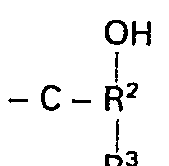
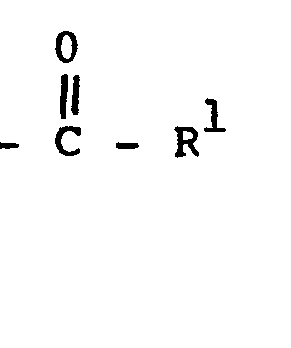
- the invention relates to compounds of the general formula where A is the or the group means and wherein R 1 is hydrogen, methyl, ethyl, n-propyl, iso-propyl, methoxy, ethoxy, n-propoxy and iso-propoxy and R 2 and R 3 are hydrogen, methyl and ethyl.
- Examples of compounds according to the invention are 1,4,6-trimethyl-cyclohex-3-en-1-carbaldehyde l, 4,6-trimethyl-cyclohex-3-en-1-carboxylic acid methyl ester 3,4,6-trimethyl-cyclohex-3 -en-1-carboxylic acid ethyl ester 1,4,6-trimethyl-cyclohex-3-en-1-carboxylic acid propyl ester 1,4,6-trimethyl-cyclohex-3-en-l-carboxylic acid iso-propyl ester (1,4,6 Trimethyl-cyclohex-3-en-1-yl) -methanol 1- (1,4,6-trimethyl-cyclohex-3-en-1-yl) -ethan-1-ol 1- (1,4,6 Trimethyl-cyclohex-3-en-1-yl) -propan-1-ol 2- (1,4,6-trimethyl-cyclohex-3-en-1-yl) -propan-2-ol 2 -
- the 1,4,6-trimethyl-cyclohex-3-en-3-carbaldehyde according to the invention and the analog ketones according to the invention are directly accessible by 1,4-cycloaddition of isoprene with tiglinaldehyde or with the corresponding 2-propenyl-alkyl-ketones.
- the carbaldehyde according to the invention and the analog ketones are directly accessible by 1,4-cycloaddition of tiglinaldehyde or the corresponding 2-propenyl-alkyl-ketones with isoprene.
- the primary and secondary alcohols according to the invention are obtained in a manner known per se by reducing the aldehyde or by reducing the corresponding ketones.
- suitable reducing agents are complex hydrides such as sodium borohydride, lithium aluminum hydride or aluminum isopropylate (according to Meerwein-Ponndorf).
- the tertiary alcohols according to the invention can be obtained, for example, from the corresponding ketones in a manner known per se by reaction with Grignard compounds such as methyl and ethyl magnesium halide.
- esters according to the invention are accessible by oxidation of the carbaldehyde to the acid (e.g. using chromosulfuric acid as the oxidizing agent) and subsequent esterification of the acid, if appropriate via the intermediate stage of the carboxylic acid chloride.
- dienophiles examples include tiglinaldehyde, 3-methyl-pent-3-en-2-one, 4-methyl- h ex-4-en-3-one, 2,4-dimethyl-hex-4-en-3- on and 5-methyl-hept-5-en-4-one.
- 1,4-cycloaddition is understood to mean the addition, also known as the Diels-Alder reaction, of a compound having 2 carbon double bonds in conjugation to an olefin, the carbon double bond of which is in conjugation with a carbonyl group, with the formation of a cyclohexene derivative.
- the remaining carbon double bond is formed at the point that originally formed the link between the conjugated double bonds of the diolefin.
- Isoprene (2-methyl-buta-1,3-diene) and dienophile are advantageously used in a molar ratio of 0.9 to 1.3 to 1, in particular 1.01 to 1.3 to 1.
- the reaction temperatures are usually 15 to 130 ° C. You can work with or without a catalyst. When working without a catalyst, the temperature range of 80 to 130 ° C is preferred.
- the reactions are expediently carried out in pressure apparatus at 5 to 20 bar absolute.
- the analogous 1,3,6-trimethylcyclohexene derivatives are also formed to a lesser extent, which, if desired, can be separated off by methods known per se, for example by chromatography.
- the Lewis acids are preferably used in amounts of 0.1 to 10 mol%, based on the amount of dienophile to be converted.
- Examples of Lewis acids to be used according to the invention as catalysts are aluminum chloride, zinc chloride, iron III chloride and others.
- the procedure is such that dienophile and Lewis acid are introduced and isoprene is metered in.
- the reaction temperatures are initially advantageously about 15 to 40 ° C and are gradually increased to 60 to 80 ° C by the end of the reaction.
- the reaction is exothermic.
- the reaction control can be controlled, for example, via the metering rate of the isoprene.
- the catalyst is in an inert solvent such as e.g. Submitted dibutyl ether and added dropwise a mixture of the reactants of isoprene and dienophile.
- the compounds according to the invention are used as fragrances or as constituents of fragrance mixtures. You can NEN individually or in a mixture and in particular also in a mixture with the analog 1,3,6-trimethyl-cyclohex-3-ene derivatives. The 1,3,6-trimethyl-cyclohexenes mentioned give off a very similar odor to the 1,4,6-cyclohex-3-ene derivatives.
- the fragrances according to the invention can be classified in the area of woody and spicy notes.
- woody and spicy notes In addition to fresh-herbaceous, spicy-flowery to earthy-woody scents, there are sometimes pronounced notes that are pronounced of ginger, calmus and sage. They all have a high odor intensity.
- odor-determining ingredients of natural patchouli oil are the tricyclic sesquiterpene alcohol patchoulol and the related norpatchoulenol, for which no economically viable syntheses are known to date.
- fully synthetically accessible fragrances are now available which can replace the natural patchouli oil in odor compositions.
- the organic phase was then separated off and fractionally distilled over a 60 cm high packed column without further purification.
- the yield of the target product was 265 g, corresponding to 80% of theory.
- Smell fresh herbaceous, slightly minty and sweet, balsamic-woody like rosemary
- Boiling point 65 ° C at 0.15 mbar
- Boiling point 80 ° C at 0.2 mbar
- Smell fresh-spicy, slightly minty, woody-balsamic, radiant, patchouli and sage character
- Boiling point 75 ° C at 16 mbar
- the target product was obtained analogously to the procedure according to Example 5 in virtually quantitative yield by reducing 1,4,6-trimethyl-cyclohex-3-en-1-carbaldehyde (according to Example 7) with lithium aluminum hydride.
- the yield of the target product was 13.5 g, corresponding to 75% of theory.
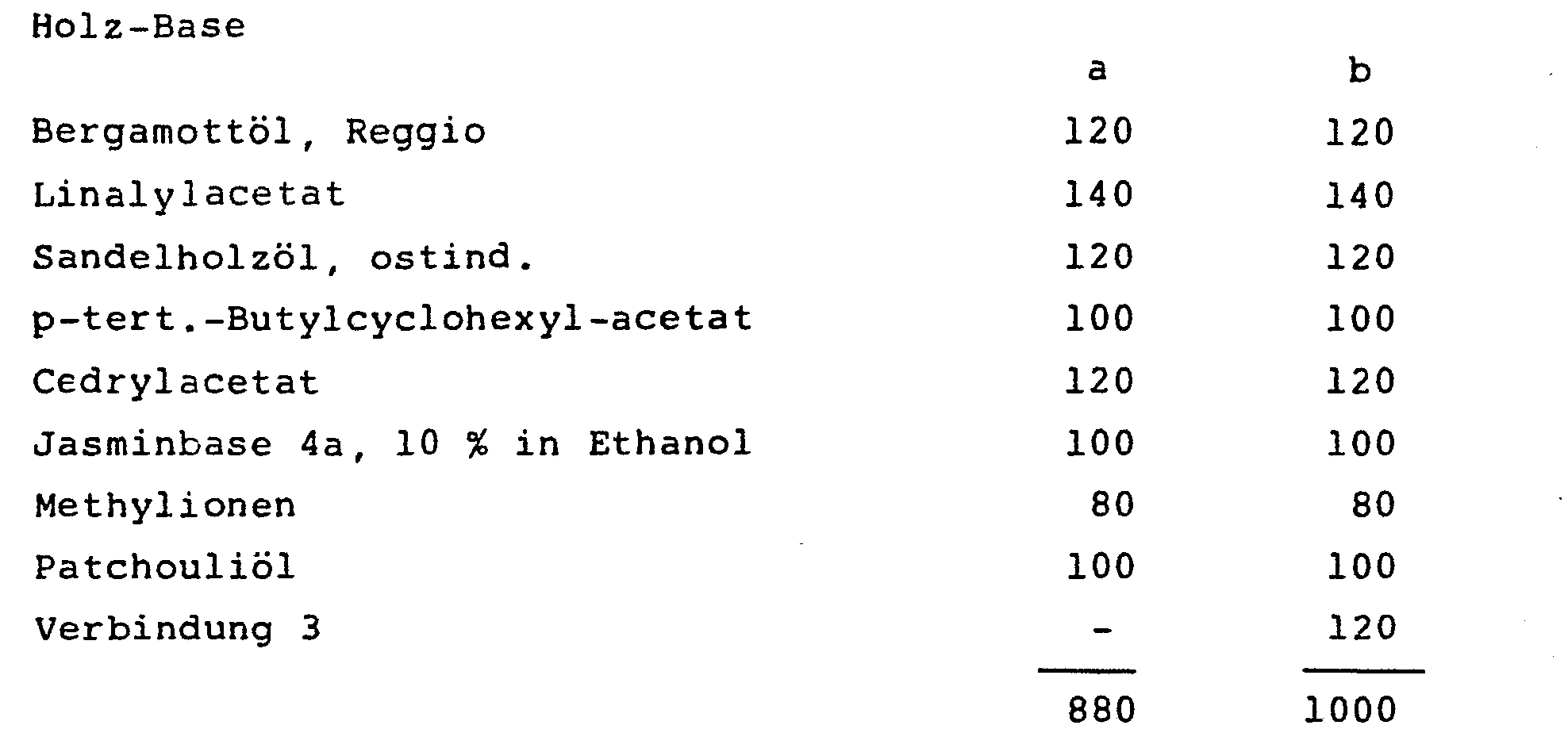
- Compostion a has a fresh, fruity fragrance with pronounced agrarian nuances. Herbaceous aspects can also be seen somewhat suddenly and without a proper connection. By adding 13% 1- (1,4,6-trimethyl-cyclohex-3-en-1-yl) -ethan-1-one (composition b) fruity and herbaceous-woody components combine to form a harmonious smell of a spicy masculine Colognes.
Landscapes
- Chemical & Material Sciences (AREA)
- Organic Chemistry (AREA)
- Chemical Kinetics & Catalysis (AREA)
- Life Sciences & Earth Sciences (AREA)
- Engineering & Computer Science (AREA)
- Oil, Petroleum & Natural Gas (AREA)
- Wood Science & Technology (AREA)
- Organic Low-Molecular-Weight Compounds And Preparation Thereof (AREA)
- Fats And Perfumes (AREA)
- Low-Molecular Organic Synthesis Reactions Using Catalysts (AREA)
- Chemical And Physical Treatments For Wood And The Like (AREA)
- Cosmetics (AREA)
Abstract


Description
- Die Erfindung betrifft neue Verbindungen aus der Gruppe der 1,4,6-Trimethyl-Cyclohex-3-en-derivate. Gemäß S.Arcander, "Perfumes and Flavour Chemicals" (1969), sind bereits der 3,5,6-Trimethyl-cyclohex-3-en-1-carbaldehyd und der 2,4,6-Trimethyl-cyclohex-3-en-1-carbaldehyd bekannt. Das Geruchsbild der genannten Duftstoffe wird durch süße, blumige Noten bestimmt.
- Es wurde nun gefunden, daß eine Auswahl von 1,4,6-Trimethyl- cyclohex-3-enen, die in 1-Stellung ein quartäres Kohlenstoffatom aufweisen, in einem völlig anderen Bereich des Duftspektrums einzuordnen sind, als die oben genannten, bekannten Trimethylcyclohexen-Derivate, nämlich in dem Bereich der würzigen und holzigen Noten. Insbesondere ist hervorzuheben, daß einige Vertreter der erfindungsgemäßen Verbindungen die wesentlichen Geruchsaspekte des natürlichen Patchouli-Öls abdecken.
- Gegenstand der Erfindung sind Verbindungender allgemeinen Formel


- Beispiele für erfindungsgemäße Verbindungen sind 1,4,6-Trimethyl-cyclohex-3-en-1-carbaldehyd l,4,6-Trimethyl-cyclohex-3-en-l-carbonsäuremethylester 3,4,6-Trimethyl-cyclohex-3-en-1-carbonsäureethylester 1,4,6-Trimethyl-cyclohex-3-en-1-carbonsäurepropylester 1,4,6-Trimethyl-cyclohex-3-en-l-carbonsäure-iso-propylester (1,4,6-Trimethyl-cyclohex-3-en-1-yl)-methanol 1-(1,4,6-Trimethyl-cyclohex-3-en-1-yl)-ethan-1-ol 1-(1,4,6-Trimethyl-cyclohex-3-en-1-yl)-propan-1-ol 2-(1,4,6-Trimethyl-cyclohex-3-en-1-yl)-propan-2-ol 2-(1,4,6-Trimethyl-cyclohex-3-en-1-yl)-butan-2-ol 3-(1,4,6-Trimethyl-cyclohex-3-en-1-yl)-pentan-3-ol 1-(1,4,6-Trimethyl-cyclohex-3-en-1-yl)-ethan-1-on 1-(1,4,6-Trimethyl-cyclohex-3-en-1-y13-propan-1-on 1-(1,4,6-Trimethyl-cyclohex-3-en-1-yl)-butan-1-on 1-(1,4,6-Trimethyl-cyclohex-3-en-1-yl)-3-methyl-propan-1-on.
- Der erfindungsgemäße 1,4,6-Trimethyl-cyclohex-3-en-3-carbaldehyd und die analogen erfindungsgemäßen Ketone sind direkt durch 1,4-Cycloaddition von Isopren mit Tiglinaldehyd bzw. mit den entsprechenden 2-Propenyl-alkyl-ketonen zugänglich.
- Der erfindungsgemäße Carbaldehyd und die analogen Ketone sind direkt durch 1,4-Cycloaddition von Tiglinaldehyd bzw. den entsprechenden 2-Propenyl-alkyl-Ketonen mit Isopren zugänglich.
- Die erfindungsgemäßen primären und sekundären Alkohole werden in an sich bekannter Weise durch Reduktion des Aldehyds bzw. durch Reduktion der entsprechenden Ketone gewonnen. Beispiele für geeignete Reduktionsmittel sind komplexe Hydride wie Natriumborhydrid, Lithiumaluminiumhydrid oder Aluminiumisopropylat (nach Meerwein-Ponndorf).
- Die erfindungsgemäßen tertiären Alkohole sind beispielsweise aus den entsprechenden Ketonen in an sich bekannter Weise durch Reaktion mit Grignard-Verbindungen wie Methyl- und Ethylmagnesiumhalogenid erhältlich.
- Die erfindungsgemäßen Ester sind durch Oxidation des Carbaldehyds zur Säure (z.B. mit Chromschwefelsäure als Oxidationsmittel) und anschließende Veresterung der Säure, gegebenenfalls über die Zwischenstufe des Carbonsäurechlorids, zugänglich.
- Das bevorzugte Verfahren zur Herstellung der erfindungsgemäßen Verbindungen ist dadurch gekennzeichnet, daß
- a) Isopren und ein Dienophil der Formel

- b) gegebenenfalls das Reaktionsprodukt gemäß a)
- bl) mittels Natriumborhydrid,Lithiumaluminiumhydrid oder Aluminiumisopropylat in den primären bzw. sekundären Alkohol,
- b2) mittels Alkylmagnesiumhalogenid in den tertiären Alkohol, oder
- b3) durch Oxidation zur Säure und anschließende Veresterung in den Ester,
übergeführt wird. - Beispiele für Dienophile sind-Tiglinaldehyd, 3-Methyl-pent-3-en-2-on, 4-Methyl-hex-4-en-3-on, 2,4-Dimethyl-hex-4-en-3-on und 5-Methyl-hept-5-en-4-on.
- Unter 1,4-Cycloaddition wird im Rahmen der Erfindung die auch als Diels-Alder-Reaktion bekannte Addition einer Verbindung mit 2 in Konjugation stehenden Kohlenstoffdoppelbindungen an ein Olefin, dessen Kohlenstoffdoppelbindung in Konjugation mit einer Carbonylgruppe steht, unter Ausbildung eines Cyclohexenderivats, verstanden. Die verbleibende Kohlenstoffdoppelbindung wird dabei an jener Stelle gebildet, die ursprünglich das Bindeglied zwischen den konjugierten Doppelbindungen des Diolefins bildete.
- Isopren (2-Methyl-buta-1,3-dien) und Dienophil werden zweckmäßigerweise im molaren Verhältnis von 0,9 bis 1,3 zu 1, insbesondere 1,01 bis 1,3 zu 1 eingesetzt.
- Die Reaktionstemperaturen betragen zumeist 15 bis 130°C. Es kann sowohl mit als auch ohne Katalysator gearbeitet werden. Beim Arbeiten ohne Katalysator wird der Temperaturbereich von 80 bis 130°C bevorzugt. Die Umsetzungen werden dabei zweckmäßigerweise in Druckapparaturen bei 5 bis 20 bar absolut durchgeführt.
- Dabei entstehen neben den 1,4,6-Trimethyl-cyclohexen-derivaten auch in geringerem Umfang die analogen 1,3,6-Trimethylcyclohexen-derivate, die falls erwünscht, durch an sich bekannte Methoden, beispielsweise durch Chromatographie, abgetrennt werden können.
- In Gegenwart von Lewissäuren wird die Bildung der 1,3,6-Trimethyl-cyclohexenspecies weitgehend zurückgedrängt. Zudem wird ein katalytischer Effekt erzielt, der es gestattet, die 1,4-Cycloaddition auch bereits beim Druck der umgebenden Atmosphäre und bei Temperaturen von 15 bis 80°C durchzuführen.
- Die Lewissäuren werden bevorzugt in Mengen von 0,1 bis 10 mol%, bezogen auf die Menge umzusetzenden Dienophils eingesetzt. Beispiele für erfindungsgemäß als Katalysatoren einzusetzende Lewissäuren sind Aluminiumchlorid, Zinkchlorid, Eisen-IIIchlorid und andere.
- Beispielsweise wird so vorgegangen, daß Dienophil und Lewissäure vorgelegt werden und Isopren zudosiert wird. Die Reaktionstemperaturen betragendabei.anfänglich zweckmäßigerweise etwa 15 bis 40°C und werden bis zum Ende der Reaktion allmählich auf 60 bis 80°C gesteigert. Die Reaktion verläuft exotherm. Die Reaktionskontrolle kann beispielsweise über die Dosiergeschwindigkeit des Isoprens gesteuert werden.
- In einer weiteren Verfahrensvariante wird der Katalysator in einem inerten Lösungsmittel wie z.B. Dibutylether vorgelegt und eine Mischung der Reaktanten aus Isopren und Dienophil zugetropft.
- Die erfindungsgemäßen Verbindu finden Verwendung als Riechstoffe bzw. als Bestandteile von Riechstoffmischungen. Sie können einzeln oder im Gemisch und insbesondere auch im Gemisch mit den analogen 1,3,6-Trimethyl-cyclohex-3-en-derivaten eingesetzt werden. Die genannten 1,3,6-Trimethyl-cyclohexene geben ein den 1,4,6-Cyclohex-3-en-derivaten sehr ähnliches Geruchsbild ab.
- Die erfindungsgemäßen Duftstoffe sind in dem Bereich holziger und würziger Noten einzuordnen. Neben frisch-krautigen, würzigblumigen bis erdig-holzigen Geruchsnoten treten, bisweilen auch ausgeprägt Noten hervor, die an Ingwer, Calmus und Salbei erinnern. Sie weisen durchwegs große Geruchsintensität auf.
- Insbesondere bei 1-(1,4,6-Trimethyl-cyclohex-3-en-1-yl)-ethan- l-ol, bei 1-(1,4,6-Trimethyl-cyclohex-3-en-1-yl)-propan-l-on, bei (1,4,6-Trimethyl-cyclohex-3-en-1-yl)-methanol und, besonders hervorzuheben bei 1-(1,4,6-Trimethyl-cyclohex-3-en-1-yl)-1-mathyl-ethan-l-ol sowie bei 1-(1,4,6-Trimethyl-cyclohex-3-en-1-yl)-1-methyl-propan-1-ol treten die wesentlichen Geruchsaspekte des natürlichen Patchouliöls hervor, das nur in begrenzter Menge und häufig sehr unterschiedlicher Qualität zur Verfügung steht. Die geruchsbestimmenden Inhaltsstoffe des natürlichen Patchouliöls sind der trizyklische Sesquiterpenalkohol Patchoulol und das verwandte Norpatchoulenol für die bisher keine wirtschaftlich verwertbare Synthesen bekannt sind. Mit den genannten erfindungsgemäßen Verbindungen stehen nunmehr vollsynthetisch zugängliche Duftstoffe zur Verfügung, die das natürliche Patchouliöl in Geruchskompositionen ersetzen können.
- Die Erfindung wir nun anhand von Beispielen näher erläutert:
- Herstellung von 1-(1,4,6-Trimethyl-cyclohex-3-en-1-yl)-ethan-1-on
- In einem 1-Liter-4-Halskolben mit Rührer, Rückflußkühler, Tropftrichter und Innenthermometer wurden 2 mol (196 g) 3-Methyl-pent-3-en-2-on und 0,1 mol (13,3 g) wasserfreies Aluminiumchlorid vorgelegt. In diese Mischung wurden 3 mol (300 ml) Isopren so zudosiert, daß die Temperatur des Reaktionsgemisches auf 80°C stieg. Schließlich wurde abgekühlt, mit 100 ml 5 Gew.%iger Salzsäure versetzt und extrahiert.
- Danach wurde die organische Phase abgetrennt und ohne weitere Reinigung über eine 60 cm hohe Füllkörperkolonne fraktioniert destilliert wird. Die Ausbeute an Zielprodukt betrug 265 g, entsprechend 80 % der Theorie.
- Siedepunkt bei 16 mbar 93°C
- Geruch: frisch-minzig, grün-krautig, süß-balsamisch, an Rosmarin und Salbei erinnernd
- Herstellung von 1-(1,4,6-Trimethyl-cyclohex-3-en-1-yl)-ethanol
- In einem 1-Liter-3-Halskolben mit Magnetrührer, Füllkörper- kolonne, Tropftrichter und Thermometer wurde eine Lösung von 0,33 mol (68 g) Aluminiumisopropylat in 600 ml Isopropanol zum Sieden erhitzt. In die siedende Lösung wurde innerhalb zwei Stunden 1 mol (166 g) 1-(1,4,6-Trimethyl-cyclo-hex-3-en-1-yl)-ethan-1-on (gemäß Beispiel 1) zugetropft und gleichzeitig das entstehende Isopropanol/Aceton-Gemisch abdestilliert. Nach 10 Stunden war die Reaktion beendet (nachdem im Destillat kein Aceton mehr nachzuweisen war). Danach wurde noch verbliebenes Isopropanol abgezogen und der Rückstand nach Abkühlen mit 175 ml 20 Gew.%iger Salzsäure versetzt. Es wurde extrahiert ! und die organische Phase säurefrei gewaschen. Nach fraktionierter Destillation wurden 151 g an Zielprodukt entsprechend 90 % der Theorie erthalten.
- Siedepunkt bei 0,2 mbar 65°C
- Geruch: trocken, erdig-holzig-würzig, an Stroh und Calmus erinnernd
- Herstellung von 2-(1,4,6-Trimethyl-cyclohex-3-en-1-yl)-propan-2-ol
- a) in einem 500 ml-4-Halskolben mit Magnetrührer, Rückflußkühler, Tropftrichter, Innenthermometer und Gaseinleitungsrohr wurden 0,5 mol (12 g) pulverförmiges Magnesium vorgelegt und mit 20 ml trockenem Tetrahydrofuran und 1 ml Ethylbromid überschichtet. Nach dem Anspringen der Reaktion (Graufärbung und Wärmetönung) wurden bei 50 bis 60°C weitere 110 ml Tetrahydrofuran innerhalb einer Stunde zugetropft. Gleichzeitg wurde Methylchlorid in das Gemisch eingeleitet bis alles Magnesium umgesetzt war.
- b) danach wurden 0,4 mol (66,4 g) 1-(1,4,6-Trimethyl-cyclohex-3-en-l-yl)- ethanol (gemäß Beispiel 2) bei 70°C der Reaktionsmischung gemäß a) zudosiert. Danach wurde noch eine Stunde bei 70°C gerührt. Die Reaktionsmischung wurde nun abgekühlt, auf 300 g Eis gegossen und das ausgefallene Magnesiumsalz mit 30 ml Eisessig gelöst. Schließlich wurden die Phasen getrennt, die organische Phase mit Natriumhydrogencarbonat-Lösung neutralisiert, das Lösungsmittel abgezogen und der Rückstand fraktioniert destilliert. Es wurden 30 g entsprechend 40 % der Theorie an Zielprodukt erhalten.
- Siedebereich 65 - 67°C bei 0,2 mbar
- Geruch: stark krautig, holzig, würzig, delikat-erdig-balsamisch, strahlend ausgeprägt Patchouli
- Herstellung von 1-(1,4,6-Trimethyl-cyclohex-3-en-1-yl)-propan-1-on
- In einem 250 ml-3-Halskolben mit Magnetrührer, Intensivkühler, Tropftrichter und Innenthermometer wurden unter kräftigem Rühren 0,025 mol (3,3 g) wasserfreies Aluminiumchlorid in 1 mol (112 g) 4-Methyl-hex-4-en-3-on gelöst. In diese Lösung wurden bei 40°C 1,5 mol (150 ml) Isopren zugetropft. Nach beendeter Zugabe wurde das Reaktionsgemisch noch 1 Stunde auf 80°C erwärmt. Nach dem Abkühlen wurde die Mischung mit 50 ml 5 Gew.- %iger Salzsäure versetzt, die Phasen getrennt und die organische Phase fraktioniert destilliert. Es wurden 144 g, entsprechend 80 % der Theorie an Zielprodukt erhalten.
- Siedepunkt bei 0,2 mbar 62°C
- Geruch: frisch krautig, leicht minzig und süß, balsamisch-holzig wie Rosmarin
- In einem 250 ml-3-Halskolben mit Magnetrührer, Intensivkühler, Tropftrichter und Innenthermometer wurde eine Lösung von 0,075 mol (2,85 g) Lithiumaluminiumhydrid in 150 ml absolutem Diethylether vorgelegt. In diese Lösung wurden unter Kühlung 0,2 mol (36 g) 1-(1,4,6-Trimethyl-cyclohex-3-en-1-yl)-propan-1-on (gemäß Beispiel 4) zugetropft. Danach wurde eine Stunde auf Rückfluß erhitzt, anschließend abgekühlt und das Reaktionsgemisch bis zur Beendigung der Wasserstoffentwicklung mit Wasser versetzt. Danach wurde mit soviel 2 normaler Salzsäure versetzt, daß der entstandene Niederschlag gelöst werden konnte. Schließlich wurden die Phasen getrennt, die organische Phase mit Natriumsulfat getrocknet und das Lösungsmittel abgezogen. Nach fraktionierter Destillation über eine 30 cm Vigreux-Kolonne wurde das Zielprodukt in praktisch quantitativer Ausbeute erhalten.
- Siedepunkt: 65°C bei 0,15 mbar
- Geruch: agrumig-frisch mit erdig-holzigen Aspekten
-
- a) es wurde nach der Arbeitsweise gemäß Beispiel 3a aus 12 g Magnesiumpulver die entsprechnde Grignard-Verbindung hergestellt.
- b) es wurden analog 3b 0,4 mol (72 g) 1-(1,4,6-Trimethyl-cyclo- hex-3-en-1-yl)-propan-1-on (gemäß Beispiel 4) mit der Grignard-Verbindung (gemäß a) umgesetzt. Das Zielprodukt wurde in einer Ausbeute von 48 g entsprechend 62 % der Theorie erhalten.
- Geruch: frisch-würzig, leicht minzig, holzig-balsamisch, strahlend, Patchouli- und Salbeicharakter
- Es wurde in einem 2-Liter-4-Halskolben mit Rührer, Intensivkühler, Tropftrichter und Innenthermometer eine Lösung von 0,2 mol (26,2 g) wasserfreien Aluminiumchlorids in 4 mol (336 g) 2-Methyl-but-2-en-l-al vorgelegt. In diese Lösung wurden 6 mol (600 ml) Isopren bei 40°C zugetropft. Danach wurde noch eine Stunde auf 60°C erwärmt. Nach dem Abkühlen wurde mit 200 ml 5 Gew.%iger Salzsäure versetzt, die Phasen getrennt und die organische Phase über eine 60 cm Füllkörper-Kolonne fraktioniert destilliert. Es wurden 350 g entsprechend 58 % der Theorie an Zielprodukt erhalten.
- Siedepunkt: 75°C bei 16 mbar
- Geruch: agrumig-frisch, grün, würzig-holzig, Ingwer-Aspekte
- Herstellung von 1,4,6-Trimethyl-cyclohex-3-en-l-carbynol
- Das Zielprodukt wurde analog der Arbeitsweise gemäß Beispiel 5 in praktisch quantitativer Ausbeute durch Reduktion von 1,4,6-Trimethyl-cyclohex-3-en-l-carbaldehyd (gemäß Beispiel 7) mit Litiumaluminiumhydrid erhalten.
- Siedepunkt: 84°C bei 16 mbar
- Geruch: stark minzig-süß, erdig
- Herstellung von 1,4,6-Trimethyl-cyclohex-3-en-l-carbonsäuremethylester
- In einem 500 ml-3-Halskolben mit Rückflußkühler und Rührer wurden 0,2 mol 1,4,6-Trimethyl-cyclohex-3-en-l-carbaldehyd (gemäß Beispiel 7) in 100 ml Diethylether vorgelegt. In diese Lösung wurde bei 25°C Chromschwefelsäure (0,07 mol Natriumdichromat 15 ml konzentrierte Schwefelsäure, 100 ml Wasser) unter Rühren getropft.
-
- b) in einem 100 ml-3-Halskolben mit Magnetrührer, Rückflußkühler, Tropftrichter und Innenthermometer wurden 0,1 mol (16,8 g) 1,4,6-Trimethyl-cyclohex-3-en-l-carbonsäure (gemäß a) mit 0,15 mol (11 ml) Thionylchlorid versetzt und eine Stunde unter Rückfluß erhitzt. Danach wurde überschüssiges Thionylchlorid abdestilliert.
- c) in einem 100 ml Becherglas mit Magnetrührer wurden 2 mol (8 ml) Methanol, 0,15 mol (12 ml) Pyridin und 50 ml Toluol vorgelegt und unter kräftigem Rührer das Rohprodukt gemäß b (1,4,6-Trimethyl-cyclohex-3-enl-carbonsäurechlorid ) zudosiert. Die Reaktionsmischung wurde noch eine Stunde bei Raumtemperatur gerührt und anschließend mit 25 ml und 5 ml konzentrierter Salzsäure versetzt. Danach wurden die Phasen getrennt, die organische Phase mit Natriumsulfat getrocknet und nach Abziehen des Lösungsmittels über Vigreux-Kolonne destilliert.
- Die Ausbeute an Zielprodukt betrug 13,5 g entsprechend 75 % der Theorie.
- Siedpunkt: 91°C bei 12 mbar
- Geruch: süß-krautig, minzig
-

-

-
Claims (3)


übergeführt wird.
Applications Claiming Priority (2)
| Application Number | Priority Date | Filing Date | Title |
|---|---|---|---|
| DE19853514665 DE3514665A1 (de) | 1985-04-23 | 1985-04-23 | Trimethylcyclohexen-derivate, ihre herstellung und deren verwendung als duftstoffe |
| DE3514665 | 1985-04-23 |
Publications (3)
| Publication Number | Publication Date |
|---|---|
| EP0199330A2 true EP0199330A2 (de) | 1986-10-29 |
| EP0199330A3 EP0199330A3 (en) | 1988-08-17 |
| EP0199330B1 EP0199330B1 (de) | 1990-12-19 |
Family
ID=6268910
Family Applications (1)
| Application Number | Title | Priority Date | Filing Date |
|---|---|---|---|
| EP86105499A Expired - Lifetime EP0199330B1 (de) | 1985-04-23 | 1986-04-21 | Trimethylcyclohexen-Derivate, ihre Herstellung und deren Verwendung als Duftstoffe |
Country Status (4)
| Country | Link |
|---|---|
| US (1) | US4704477A (de) |
| EP (1) | EP0199330B1 (de) |
| JP (1) | JPS61249942A (de) |
| DE (2) | DE3514665A1 (de) |
Cited By (3)
| Publication number | Priority date | Publication date | Assignee | Title |
|---|---|---|---|---|
| WO1994013766A3 (en) * | 1992-12-11 | 1996-02-01 | Quest Int | Dimethyl-cyclohexanecarboxylic acid esters in perfumery |
| WO2001000551A1 (en) * | 1999-06-28 | 2001-01-04 | Quest International B.V. | Novel fragrance compounds |
| WO2008071026A1 (en) * | 2006-12-13 | 2008-06-19 | Givaudan Sa | Cylohexenyl butenones and fragrance compositions comprising them |
Families Citing this family (7)
| Publication number | Priority date | Publication date | Assignee | Title |
|---|---|---|---|---|
| US4956342A (en) * | 1987-09-23 | 1990-09-11 | Basf K & F Corp. | Alkyltetramethylcyclohexane derivatives and their use as perfumes |
| EP0378825B1 (de) * | 1989-01-18 | 1994-07-06 | Firmenich Sa | Alicyclische Ester und ihre Anwendung als Riechstoffkomponenten |
| JPH0749593B2 (ja) * | 1989-07-28 | 1995-05-31 | 花王株式会社 | 2―シクロヘキシルプロピオン酸またはその誘導体を含有する調合香料組成物 |
| JPH0655765U (ja) * | 1992-06-12 | 1994-08-02 | 研一 三谷 | 結婚披露宴席次表及び招待状 |
| JPH0732770A (ja) * | 1993-07-23 | 1995-02-03 | Toshihiro Watanabe | 披露宴用新郎新婦紹介シート |
| DE60030674T2 (de) * | 1999-07-14 | 2007-09-20 | Showa Denko K.K. | Verfahren zur herstellung cyclohexandimethanole und zwischenprodukte davon |
| GB201516911D0 (en) * | 2015-09-24 | 2015-11-11 | Givaudan Sa | Perfume compositions |
Family Cites Families (11)
| Publication number | Priority date | Publication date | Assignee | Title |
|---|---|---|---|---|
| US2794812A (en) * | 1953-08-13 | 1957-06-04 | Union Carbide & Carbon Corp | 7-oxabicyclo-heptane 3-carboxylic acids and esters |
| US3067244A (en) * | 1958-03-06 | 1962-12-04 | Shell Oil Co | Process for the production of dielsalder adducts |
| US3220977A (en) * | 1961-09-14 | 1965-11-30 | Eastman Kodak Co | Linear polyesters from 4,4'-(cyclohexylmethylene)diphenols |
| NL7304990A (de) * | 1972-05-01 | 1973-11-05 | ||
| US4038326A (en) * | 1973-03-23 | 1977-07-26 | Phillips Petroleum Company | Unsaturated alicyclic carbinols and dicarbinols and method of preparation |
| NL174543C (nl) * | 1973-04-17 | 1984-07-02 | Firmenich & Cie | Werkwijze ter bereiding respectievelijk vervaardiging van een geparfumeerd of gearomatiseerd produkt met cumarine-achtige geur- en smaakeigenschappen, alsmede de aldus vervaardigde geparfumeerde of gearomatiseerde voorwerpen, en werkwijze ter bereiding van een cyclische ketoverbinding met cumarine-achtige organoleptische eigenschappen. |
| GB2005671A (en) * | 1977-09-26 | 1979-04-25 | Norda Inc | Methyl Pentadiene-methyl isopropenyl ketone adduct |
| US4250342A (en) * | 1978-10-20 | 1981-02-10 | International Flavors & Fragrances Inc. | 2-Oxabicyclooctane derivatives, processes for preparing same and organoleptic uses thereof |
| EP0021100B1 (de) * | 1979-06-13 | 1982-11-17 | L. GIVAUDAN & CIE Société Anonyme | Als Einzelverbindungen (I) oder in Form von Gemischen mit (IV) vorliegende Cyclohexenderivate, Verfahren zur Herstellung von (I), Verwendung von (I) bzw. (I+IV) als Riech- und/oder Geschmackstoffe und Riech- und/oder Geschmackstoffkompositionen mit einem Gehalt an (I) bzw. (I+IV) |
| EP0046606A1 (de) * | 1980-08-26 | 1982-03-03 | Firmenich Sa | Alicyclische sauerstoffhaltige Verbindungen, Verfahren zu ihrer Herstellung und ihre Verwendung als Ausgangsprodukte für die Herstellung von cyclohexadienischen Verbindungen |
| US4528020A (en) * | 1983-06-16 | 1985-07-09 | Allied Corporation | Urease inhibited urea based fertilizer compositions |
-
1985
- 1985-04-23 DE DE19853514665 patent/DE3514665A1/de not_active Withdrawn
-
1986
- 1986-03-07 US US06/837,218 patent/US4704477A/en not_active Expired - Lifetime
- 1986-04-08 JP JP61079329A patent/JPS61249942A/ja active Granted
- 1986-04-21 DE DE8686105499T patent/DE3676218D1/de not_active Expired - Lifetime
- 1986-04-21 EP EP86105499A patent/EP0199330B1/de not_active Expired - Lifetime
Cited By (5)
| Publication number | Priority date | Publication date | Assignee | Title |
|---|---|---|---|---|
| WO1994013766A3 (en) * | 1992-12-11 | 1996-02-01 | Quest Int | Dimethyl-cyclohexanecarboxylic acid esters in perfumery |
| WO2001000551A1 (en) * | 1999-06-28 | 2001-01-04 | Quest International B.V. | Novel fragrance compounds |
| US6559118B1 (en) | 1999-06-28 | 2003-05-06 | Quest International B.V. | Fragrance compounds |
| WO2008071026A1 (en) * | 2006-12-13 | 2008-06-19 | Givaudan Sa | Cylohexenyl butenones and fragrance compositions comprising them |
| US7812195B2 (en) | 2006-12-13 | 2010-10-12 | Givaudan Sa | Cyclohexenyl butenones and fragrance compositions comprising them |
Also Published As
| Publication number | Publication date |
|---|---|
| JPS6339576B2 (de) | 1988-08-05 |
| DE3676218D1 (de) | 1991-01-31 |
| US4704477A (en) | 1987-11-03 |
| EP0199330B1 (de) | 1990-12-19 |
| DE3514665A1 (de) | 1986-10-30 |
| EP0199330A3 (en) | 1988-08-17 |
| JPS61249942A (ja) | 1986-11-07 |
Similar Documents
| Publication | Publication Date | Title |
|---|---|---|
| DE2502767C3 (de) | Oxygenierte alicycUsche Verbindungen und diese enthaltende Parfümkompositionen | |
| EP0199330B1 (de) | Trimethylcyclohexen-Derivate, ihre Herstellung und deren Verwendung als Duftstoffe | |
| DE69527045T2 (de) | Tetrahydrofurane und tetrahydropyrane | |
| DE1768552A1 (de) | Verfahren zur Herstellung von ungesaettigten Carbonylverbindungen | |
| DE2814558C2 (de) | Spiro-(5-isopropylbicyclo[3,1,0]hexan-2,2'-oxirane), Verfahren zu ihrer Herstellung und ihre Verwendung | |
| EP0278384B1 (de) | Alkohole und Ether mit Cyclododecyl- und Cyclododecenylgruppen, deren Herstellung und Verwendung als Duftstoffe | |
| DE2516696C3 (de) | Riechstoffe der 3,6,6-Trimethyll-(but-3-enoyl)-cyclohexenreihe, Verfahren zu deren Herstellung und diese enthaltende Riechstoffkompositionen | |
| EP0037584A1 (de) | 2.4-Dialkyl-2.6-heptadienale und -heptadienole, Verfahren zu deren Herstellung und ihre Anwendung als Geruchs- und Geschmacksstoffe | |
| EP0045453B1 (de) | Neue Alkenole (I) und Verfahren zu deren Herstellung, Verwendung von (I) als Riech- und/oder Geschmackstoffe sowie Riech- und/oder Geschmackstoffkompositionen mit einem Gehalt an (I) | |
| CH623802A5 (de) | ||
| EP0064605B1 (de) | Verfahren zur Herstellung von Resorcinderivaten sowie Verwendung bestimmter Resorcinderivate als Riechstoffe | |
| EP0086945B1 (de) | Neue Alkenole(I), Verfahren zu deren Herstellung, Verwendung von (I) als Riechstoffe und Riechstoffkompositionen mit einem Gehalt an (I) | |
| EP0002510A1 (de) | Cyclohexane, Verfahren zu deren Herstellung, deren Verwendung und diese enthaltende Kompositionen | |
| EP0002743B1 (de) | Bicyclo (2.2.1)-hept-5-ene(ane)(I), Verfahren zu deren Herstellung, Verwendung von (I) als Riechstoffe und Riechstoffkompositionen mit einem Gehalt an den bicyclischen Verbindungen (I) | |
| DE2359659B2 (de) | 4-Tricyclo [5A1.02·6! decyl-8-butanal. Verfahren zu seiner Herstellung und Verwendung als Riechstoff | |
| EP0086944B1 (de) | Neue ungesättigte Aether (I), Verfahren zu deren Herstellung, Verwendung von (I) als Riech- und/oder Geschmackstoffe und Riech- und/oder Geschmackstoffkompositionen mit einem Gehalt an (I) | |
| EP0075237B1 (de) | Verfahren zur Herstellung von Derivaten des 1-Formyl-2,6,6-trimethyl-cyclohex-1-ens | |
| DE1801663A1 (de) | Neue Riechstoffe und Verfahren zu deren Herstellung | |
| EP1284951B1 (de) | 3,3-dimethylcyclohexan-derivate | |
| CH637612A5 (en) | Substituted cyclohexanes | |
| DE2111753A1 (de) | Makrocyclische Verbindungen und Verfahren zu ihrer Herstellung | |
| EP0096243B1 (de) | Cyclohex(en)ylmethanole und ihre Ester, mit Riechstoffeigenschaften | |
| DE2917450A1 (de) | Neue alicyclische ketone, ihre verwendung und verfahren zu ihrer herstellung | |
| EP0070566A1 (de) | C-8-substituierte 1,5-Dimethyl-bicyclo (3.2.1)octan-8-ole | |
| EP0330995B1 (de) | Bicyclische Aether |
Legal Events
| Date | Code | Title | Description |
|---|---|---|---|
| PUAI | Public reference made under article 153(3) epc to a published international application that has entered the european phase |
Free format text: ORIGINAL CODE: 0009012 |
|
| 17P | Request for examination filed |
Effective date: 19860421 |
|
| AK | Designated contracting states |
Kind code of ref document: A2 Designated state(s): CH DE FR GB LI NL |
|
| PUAL | Search report despatched |
Free format text: ORIGINAL CODE: 0009013 |
|
| AK | Designated contracting states |
Kind code of ref document: A3 Designated state(s): CH DE FR GB LI NL |
|
| 17Q | First examination report despatched |
Effective date: 19900117 |
|
| GRAA | (expected) grant |
Free format text: ORIGINAL CODE: 0009210 |
|
| AK | Designated contracting states |
Kind code of ref document: B1 Designated state(s): CH DE FR GB LI NL |
|
| REF | Corresponds to: |
Ref document number: 3676218 Country of ref document: DE Date of ref document: 19910131 |
|
| ET | Fr: translation filed | ||
| GBT | Gb: translation of ep patent filed (gb section 77(6)(a)/1977) | ||
| PLBE | No opposition filed within time limit |
Free format text: ORIGINAL CODE: 0009261 |
|
| STAA | Information on the status of an ep patent application or granted ep patent |
Free format text: STATUS: NO OPPOSITION FILED WITHIN TIME LIMIT |
|
| 26N | No opposition filed | ||
| REG | Reference to a national code |
Ref country code: CH Ref legal event code: PUE Owner name: CONSORTIUM FUER ELEKTROCHEMISCHE INDUSTRIE GMBH -D |
|
| NLS | Nl: assignments of ep-patents |
Owner name: FRAGRANCE RESOURCES AGENCY, S.A. |
|
| REG | Reference to a national code |
Ref country code: FR Ref legal event code: TP |
|
| REG | Reference to a national code |
Ref country code: GB Ref legal event code: 732E |
|
| REG | Reference to a national code |
Ref country code: CH Ref legal event code: PUE Owner name: FRA FRAGRANCE RESSOURCES AGENCY SA TRANSFER- HAARM |
|
| REG | Reference to a national code |
Ref country code: FR Ref legal event code: TP |
|
| NLS | Nl: assignments of ep-patents |
Owner name: HAARMAN & REIMER GMBH |
|
| REG | Reference to a national code |
Ref country code: GB Ref legal event code: 732E |
|
| PGFP | Annual fee paid to national office [announced via postgrant information from national office to epo] |
Ref country code: CH Payment date: 20010409 Year of fee payment: 16 |
|
| PGFP | Annual fee paid to national office [announced via postgrant information from national office to epo] |
Ref country code: NL Payment date: 20010430 Year of fee payment: 16 |
|
| REG | Reference to a national code |
Ref country code: GB Ref legal event code: IF02 |
|
| PGFP | Annual fee paid to national office [announced via postgrant information from national office to epo] |
Ref country code: DE Payment date: 20020315 Year of fee payment: 17 |
|
| PGFP | Annual fee paid to national office [announced via postgrant information from national office to epo] |
Ref country code: FR Payment date: 20020424 Year of fee payment: 17 |
|
| PG25 | Lapsed in a contracting state [announced via postgrant information from national office to epo] |
Ref country code: LI Free format text: LAPSE BECAUSE OF NON-PAYMENT OF DUE FEES Effective date: 20020430 Ref country code: CH Free format text: LAPSE BECAUSE OF NON-PAYMENT OF DUE FEES Effective date: 20020430 |
|
| PG25 | Lapsed in a contracting state [announced via postgrant information from national office to epo] |
Ref country code: NL Free format text: LAPSE BECAUSE OF NON-PAYMENT OF DUE FEES Effective date: 20021101 |
|
| REG | Reference to a national code |
Ref country code: CH Ref legal event code: PL |
|
| NLV4 | Nl: lapsed or anulled due to non-payment of the annual fee |
Effective date: 20021101 |
|
| PGFP | Annual fee paid to national office [announced via postgrant information from national office to epo] |
Ref country code: GB Payment date: 20030514 Year of fee payment: 18 |
|
| PG25 | Lapsed in a contracting state [announced via postgrant information from national office to epo] |
Ref country code: DE Free format text: LAPSE BECAUSE OF NON-PAYMENT OF DUE FEES Effective date: 20031101 |
|
| PG25 | Lapsed in a contracting state [announced via postgrant information from national office to epo] |
Ref country code: FR Free format text: LAPSE BECAUSE OF NON-PAYMENT OF DUE FEES Effective date: 20031231 |
|
| REG | Reference to a national code |
Ref country code: FR Ref legal event code: ST |
|
| PG25 | Lapsed in a contracting state [announced via postgrant information from national office to epo] |
Ref country code: GB Free format text: LAPSE BECAUSE OF NON-PAYMENT OF DUE FEES Effective date: 20040421 |
|
| GBPC | Gb: european patent ceased through non-payment of renewal fee |
Effective date: 20040421 |