EP0199357B1 - Dialyselösung für Peritonealdialyse - Google Patents
Dialyselösung für Peritonealdialyse Download PDFInfo
- Publication number
- EP0199357B1 EP0199357B1 EP86105679A EP86105679A EP0199357B1 EP 0199357 B1 EP0199357 B1 EP 0199357B1 EP 86105679 A EP86105679 A EP 86105679A EP 86105679 A EP86105679 A EP 86105679A EP 0199357 B1 EP0199357 B1 EP 0199357B1
- Authority
- EP
- European Patent Office
- Prior art keywords
- dialytic
- peritoneal dialysis
- glycerol
- solution
- glucose
- Prior art date
- Legal status (The legal status is an assumption and is not a legal conclusion. Google has not performed a legal analysis and makes no representation as to the accuracy of the status listed.)
- Expired
Links
- 238000000502 dialysis Methods 0.000 title claims description 74
- PEDCQBHIVMGVHV-UHFFFAOYSA-N Glycerine Chemical compound OCC(O)CO PEDCQBHIVMGVHV-UHFFFAOYSA-N 0.000 claims description 171
- WQZGKKKJIJFFOK-GASJEMHNSA-N Glucose Natural products OC[C@H]1OC(O)[C@H](O)[C@@H](O)[C@@H]1O WQZGKKKJIJFFOK-GASJEMHNSA-N 0.000 claims description 40
- 239000008103 glucose Substances 0.000 claims description 40
- 230000003204 osmotic effect Effects 0.000 claims description 38
- 229930091371 Fructose Natural products 0.000 claims description 26
- 239000005715 Fructose Substances 0.000 claims description 26
- RFSUNEUAIZKAJO-ARQDHWQXSA-N Fructose Chemical compound OC[C@H]1O[C@](O)(CO)[C@@H](O)[C@@H]1O RFSUNEUAIZKAJO-ARQDHWQXSA-N 0.000 claims description 26
- -1 Ca2+ ion Chemical class 0.000 claims description 10
- QTBSBXVTEAMEQO-UHFFFAOYSA-N Acetic acid Chemical compound CC(O)=O QTBSBXVTEAMEQO-UHFFFAOYSA-N 0.000 claims description 9
- JVTAAEKCZFNVCJ-UHFFFAOYSA-N lactic acid Chemical compound CC(O)C(O)=O JVTAAEKCZFNVCJ-UHFFFAOYSA-N 0.000 claims description 8
- BVKZGUZCCUSVTD-UHFFFAOYSA-M Bicarbonate Chemical compound OC([O-])=O BVKZGUZCCUSVTD-UHFFFAOYSA-M 0.000 claims description 7
- 150000002500 ions Chemical class 0.000 claims description 6
- 229910001415 sodium ion Inorganic materials 0.000 claims description 6
- KDYFGRWQOYBRFD-UHFFFAOYSA-N succinic acid Chemical compound OC(=O)CCC(O)=O KDYFGRWQOYBRFD-UHFFFAOYSA-N 0.000 claims description 6
- 239000004310 lactic acid Substances 0.000 claims description 4
- 235000014655 lactic acid Nutrition 0.000 claims description 4
- 239000002243 precursor Substances 0.000 claims description 4
- BJEPYKJPYRNKOW-REOHCLBHSA-N (S)-malic acid Chemical compound OC(=O)[C@@H](O)CC(O)=O BJEPYKJPYRNKOW-REOHCLBHSA-N 0.000 claims description 3
- 235000011054 acetic acid Nutrition 0.000 claims description 3
- BJEPYKJPYRNKOW-UHFFFAOYSA-N alpha-hydroxysuccinic acid Natural products OC(=O)C(O)CC(O)=O BJEPYKJPYRNKOW-UHFFFAOYSA-N 0.000 claims description 3
- 239000001630 malic acid Substances 0.000 claims description 3
- 235000011090 malic acid Nutrition 0.000 claims description 3
- 239000001384 succinic acid Substances 0.000 claims description 3
- 235000011044 succinic acid Nutrition 0.000 claims description 3
- 239000000243 solution Substances 0.000 description 85
- 150000002772 monosaccharides Chemical class 0.000 description 41
- 230000001105 regulatory effect Effects 0.000 description 22
- 239000003795 chemical substances by application Substances 0.000 description 21
- 210000004369 blood Anatomy 0.000 description 18
- 239000008280 blood Substances 0.000 description 17
- 230000002949 hemolytic effect Effects 0.000 description 14
- 241000700159 Rattus Species 0.000 description 11
- WQZGKKKJIJFFOK-VFUOTHLCSA-N beta-D-glucose Chemical compound OC[C@H]1O[C@@H](O)[C@H](O)[C@@H](O)[C@@H]1O WQZGKKKJIJFFOK-VFUOTHLCSA-N 0.000 description 11
- XLYOFNOQVPJJNP-UHFFFAOYSA-N water Substances O XLYOFNOQVPJJNP-UHFFFAOYSA-N 0.000 description 10
- 238000012360 testing method Methods 0.000 description 9
- 230000000694 effects Effects 0.000 description 8
- 238000001631 haemodialysis Methods 0.000 description 8
- 230000000322 hemodialysis Effects 0.000 description 8
- 239000000203 mixture Substances 0.000 description 8
- 238000011282 treatment Methods 0.000 description 8
- 230000001954 sterilising effect Effects 0.000 description 7
- 238000004659 sterilization and disinfection Methods 0.000 description 7
- 241001465754 Metazoa Species 0.000 description 6
- FAPWRFPIFSIZLT-UHFFFAOYSA-M Sodium chloride Chemical compound [Na+].[Cl-] FAPWRFPIFSIZLT-UHFFFAOYSA-M 0.000 description 6
- 238000000034 method Methods 0.000 description 6
- 210000002966 serum Anatomy 0.000 description 6
- 238000002560 therapeutic procedure Methods 0.000 description 6
- 210000001124 body fluid Anatomy 0.000 description 5
- 239000010839 body fluid Substances 0.000 description 5
- 239000003792 electrolyte Substances 0.000 description 5
- 210000004379 membrane Anatomy 0.000 description 5
- 239000012528 membrane Substances 0.000 description 5
- 230000002503 metabolic effect Effects 0.000 description 5
- 210000004303 peritoneum Anatomy 0.000 description 5
- 235000002639 sodium chloride Nutrition 0.000 description 5
- 230000002459 sustained effect Effects 0.000 description 5
- 206010018910 Haemolysis Diseases 0.000 description 4
- 102000001554 Hemoglobins Human genes 0.000 description 4
- 108010054147 Hemoglobins Proteins 0.000 description 4
- TWRXJAOTZQYOKJ-UHFFFAOYSA-L Magnesium chloride Chemical compound [Mg+2].[Cl-].[Cl-] TWRXJAOTZQYOKJ-UHFFFAOYSA-L 0.000 description 4
- 210000000683 abdominal cavity Anatomy 0.000 description 4
- 150000001720 carbohydrates Chemical class 0.000 description 4
- 201000010099 disease Diseases 0.000 description 4
- 208000037265 diseases, disorders, signs and symptoms Diseases 0.000 description 4
- 230000008588 hemolysis Effects 0.000 description 4
- NOESYZHRGYRDHS-UHFFFAOYSA-N insulin Chemical compound N1C(=O)C(NC(=O)C(CCC(N)=O)NC(=O)C(CCC(O)=O)NC(=O)C(C(C)C)NC(=O)C(NC(=O)CN)C(C)CC)CSSCC(C(NC(CO)C(=O)NC(CC(C)C)C(=O)NC(CC=2C=CC(O)=CC=2)C(=O)NC(CCC(N)=O)C(=O)NC(CC(C)C)C(=O)NC(CCC(O)=O)C(=O)NC(CC(N)=O)C(=O)NC(CC=2C=CC(O)=CC=2)C(=O)NC(CSSCC(NC(=O)C(C(C)C)NC(=O)C(CC(C)C)NC(=O)C(CC=2C=CC(O)=CC=2)NC(=O)C(CC(C)C)NC(=O)C(C)NC(=O)C(CCC(O)=O)NC(=O)C(C(C)C)NC(=O)C(CC(C)C)NC(=O)C(CC=2NC=NC=2)NC(=O)C(CO)NC(=O)CNC2=O)C(=O)NCC(=O)NC(CCC(O)=O)C(=O)NC(CCCNC(N)=N)C(=O)NCC(=O)NC(CC=3C=CC=CC=3)C(=O)NC(CC=3C=CC=CC=3)C(=O)NC(CC=3C=CC(O)=CC=3)C(=O)NC(C(C)O)C(=O)N3C(CCC3)C(=O)NC(CCCCN)C(=O)NC(C)C(O)=O)C(=O)NC(CC(N)=O)C(O)=O)=O)NC(=O)C(C(C)CC)NC(=O)C(CO)NC(=O)C(C(C)O)NC(=O)C1CSSCC2NC(=O)C(CC(C)C)NC(=O)C(NC(=O)C(CCC(N)=O)NC(=O)C(CC(N)=O)NC(=O)C(NC(=O)C(N)CC=1C=CC=CC=1)C(C)C)CC1=CN=CN1 NOESYZHRGYRDHS-UHFFFAOYSA-N 0.000 description 4
- CYDQOEWLBCCFJZ-UHFFFAOYSA-N 4-(4-fluorophenyl)oxane-4-carboxylic acid Chemical compound C=1C=C(F)C=CC=1C1(C(=O)O)CCOCC1 CYDQOEWLBCCFJZ-UHFFFAOYSA-N 0.000 description 3
- HEMHJVSKTPXQMS-UHFFFAOYSA-M Sodium hydroxide Chemical compound [OH-].[Na+] HEMHJVSKTPXQMS-UHFFFAOYSA-M 0.000 description 3
- 208000011775 arteriosclerosis disease Diseases 0.000 description 3
- 210000003743 erythrocyte Anatomy 0.000 description 3
- 230000001965 increasing effect Effects 0.000 description 3
- 230000002401 inhibitory effect Effects 0.000 description 3
- 230000004060 metabolic process Effects 0.000 description 3
- 239000011780 sodium chloride Substances 0.000 description 3
- 239000001540 sodium lactate Substances 0.000 description 3
- 235000011088 sodium lactate Nutrition 0.000 description 3
- 229940005581 sodium lactate Drugs 0.000 description 3
- 239000012085 test solution Substances 0.000 description 3
- 239000002699 waste material Substances 0.000 description 3
- 208000021959 Abnormal metabolism Diseases 0.000 description 2
- 206010003210 Arteriosclerosis Diseases 0.000 description 2
- UXVMQQNJUSDDNG-UHFFFAOYSA-L Calcium chloride Chemical compound [Cl-].[Cl-].[Ca+2] UXVMQQNJUSDDNG-UHFFFAOYSA-L 0.000 description 2
- 102000004877 Insulin Human genes 0.000 description 2
- 108090001061 Insulin Proteins 0.000 description 2
- 241000699670 Mus sp. Species 0.000 description 2
- WCUXLLCKKVVCTQ-UHFFFAOYSA-M Potassium chloride Chemical compound [Cl-].[K+] WCUXLLCKKVVCTQ-UHFFFAOYSA-M 0.000 description 2
- 208000001647 Renal Insufficiency Diseases 0.000 description 2
- XSQUKJJJFZCRTK-UHFFFAOYSA-N Urea Chemical compound NC(N)=O XSQUKJJJFZCRTK-UHFFFAOYSA-N 0.000 description 2
- 238000010521 absorption reaction Methods 0.000 description 2
- 230000002587 anti-hemolytic effect Effects 0.000 description 2
- 239000000823 artificial membrane Substances 0.000 description 2
- 238000009395 breeding Methods 0.000 description 2
- 230000001488 breeding effect Effects 0.000 description 2
- 239000001110 calcium chloride Substances 0.000 description 2
- 229910001628 calcium chloride Inorganic materials 0.000 description 2
- DDRJAANPRJIHGJ-UHFFFAOYSA-N creatinine Chemical compound CN1CC(=O)NC1=N DDRJAANPRJIHGJ-UHFFFAOYSA-N 0.000 description 2
- 230000007423 decrease Effects 0.000 description 2
- 230000003247 decreasing effect Effects 0.000 description 2
- 239000008151 electrolyte solution Substances 0.000 description 2
- 238000002347 injection Methods 0.000 description 2
- 239000007924 injection Substances 0.000 description 2
- 229940125396 insulin Drugs 0.000 description 2
- 230000035987 intoxication Effects 0.000 description 2
- 231100000566 intoxication Toxicity 0.000 description 2
- 201000006370 kidney failure Diseases 0.000 description 2
- 150000002632 lipids Chemical class 0.000 description 2
- 229910001629 magnesium chloride Inorganic materials 0.000 description 2
- 230000007246 mechanism Effects 0.000 description 2
- 230000006371 metabolic abnormality Effects 0.000 description 2
- 239000002504 physiological saline solution Substances 0.000 description 2
- 210000002381 plasma Anatomy 0.000 description 2
- 239000002574 poison Substances 0.000 description 2
- 231100000614 poison Toxicity 0.000 description 2
- 150000003839 salts Chemical class 0.000 description 2
- 241000894007 species Species 0.000 description 2
- 239000000126 substance Substances 0.000 description 2
- 210000003462 vein Anatomy 0.000 description 2
- GMVPRGQOIOIIMI-DODZYUBVSA-N 7-[(1R,2R,3R)-3-hydroxy-2-[(3S)-3-hydroxyoct-1-enyl]-5-oxocyclopentyl]heptanoic acid Chemical compound CCCCC[C@H](O)C=C[C@H]1[C@H](O)CC(=O)[C@@H]1CCCCCCC(O)=O GMVPRGQOIOIIMI-DODZYUBVSA-N 0.000 description 1
- QTBSBXVTEAMEQO-UHFFFAOYSA-M Acetate Chemical compound CC([O-])=O QTBSBXVTEAMEQO-UHFFFAOYSA-M 0.000 description 1
- WQZGKKKJIJFFOK-QTVWNMPRSA-N D-mannopyranose Chemical compound OC[C@H]1OC(O)[C@@H](O)[C@@H](O)[C@@H]1O WQZGKKKJIJFFOK-QTVWNMPRSA-N 0.000 description 1
- 206010019663 Hepatic failure Diseases 0.000 description 1
- JVTAAEKCZFNVCJ-UHFFFAOYSA-M Lactate Chemical compound CC(O)C([O-])=O JVTAAEKCZFNVCJ-UHFFFAOYSA-M 0.000 description 1
- 241000699666 Mus <mouse, genus> Species 0.000 description 1
- VMHLLURERBWHNL-UHFFFAOYSA-M Sodium acetate Chemical compound [Na+].CC([O-])=O VMHLLURERBWHNL-UHFFFAOYSA-M 0.000 description 1
- 230000005856 abnormality Effects 0.000 description 1
- 239000002253 acid Substances 0.000 description 1
- 150000007513 acids Chemical class 0.000 description 1
- WQZGKKKJIJFFOK-PHYPRBDBSA-N alpha-D-galactose Chemical compound OC[C@H]1O[C@H](O)[C@H](O)[C@@H](O)[C@H]1O WQZGKKKJIJFFOK-PHYPRBDBSA-N 0.000 description 1
- 150000001413 amino acids Chemical class 0.000 description 1
- 208000007502 anemia Diseases 0.000 description 1
- 210000000702 aorta abdominal Anatomy 0.000 description 1
- 230000033228 biological regulation Effects 0.000 description 1
- 210000000988 bone and bone Anatomy 0.000 description 1
- 235000011148 calcium chloride Nutrition 0.000 description 1
- LLSDKQJKOVVTOJ-UHFFFAOYSA-L calcium chloride dihydrate Chemical compound O.O.[Cl-].[Cl-].[Ca+2] LLSDKQJKOVVTOJ-UHFFFAOYSA-L 0.000 description 1
- 239000004202 carbamide Substances 0.000 description 1
- 210000004027 cell Anatomy 0.000 description 1
- 230000008859 change Effects 0.000 description 1
- 229940109239 creatinine Drugs 0.000 description 1
- 238000000354 decomposition reaction Methods 0.000 description 1
- 230000002950 deficient Effects 0.000 description 1
- 230000018044 dehydration Effects 0.000 description 1
- 238000006297 dehydration reaction Methods 0.000 description 1
- 206010012601 diabetes mellitus Diseases 0.000 description 1
- 239000000385 dialysis solution Substances 0.000 description 1
- 235000020805 dietary restrictions Nutrition 0.000 description 1
- 229940079593 drug Drugs 0.000 description 1
- 239000003814 drug Substances 0.000 description 1
- 230000008030 elimination Effects 0.000 description 1
- 238000003379 elimination reaction Methods 0.000 description 1
- 238000011156 evaluation Methods 0.000 description 1
- 229930182830 galactose Natural products 0.000 description 1
- 201000001505 hemoglobinuria Diseases 0.000 description 1
- 238000005286 illumination Methods 0.000 description 1
- 230000036039 immunity Effects 0.000 description 1
- 238000000338 in vitro Methods 0.000 description 1
- 230000001939 inductive effect Effects 0.000 description 1
- 238000010253 intravenous injection Methods 0.000 description 1
- 210000003734 kidney Anatomy 0.000 description 1
- 229940001447 lactate Drugs 0.000 description 1
- 230000037356 lipid metabolism Effects 0.000 description 1
- 210000004185 liver Anatomy 0.000 description 1
- 208000007903 liver failure Diseases 0.000 description 1
- 231100000835 liver failure Toxicity 0.000 description 1
- DHRRIBDTHFBPNG-UHFFFAOYSA-L magnesium dichloride hexahydrate Chemical compound O.O.O.O.O.O.[Mg+2].[Cl-].[Cl-] DHRRIBDTHFBPNG-UHFFFAOYSA-L 0.000 description 1
- 238000012423 maintenance Methods 0.000 description 1
- 230000014759 maintenance of location Effects 0.000 description 1
- 230000004048 modification Effects 0.000 description 1
- 238000012986 modification Methods 0.000 description 1
- 208000030212 nutrition disease Diseases 0.000 description 1
- 208000019180 nutritional disease Diseases 0.000 description 1
- 210000000056 organ Anatomy 0.000 description 1
- 239000002357 osmotic agent Substances 0.000 description 1
- 230000036961 partial effect Effects 0.000 description 1
- 230000000737 periodic effect Effects 0.000 description 1
- 206010034674 peritonitis Diseases 0.000 description 1
- 230000002085 persistent effect Effects 0.000 description 1
- 239000001103 potassium chloride Substances 0.000 description 1
- 235000011164 potassium chloride Nutrition 0.000 description 1
- 238000004321 preservation Methods 0.000 description 1
- 238000000746 purification Methods 0.000 description 1
- 230000009467 reduction Effects 0.000 description 1
- 230000000717 retained effect Effects 0.000 description 1
- 239000001632 sodium acetate Substances 0.000 description 1
- 235000017281 sodium acetate Nutrition 0.000 description 1
- ZNVGYHOBTCWGTO-UHFFFAOYSA-N solutin Natural products Cc1cc(O)cc2OC(C)(O)C(=O)c12 ZNVGYHOBTCWGTO-UHFFFAOYSA-N 0.000 description 1
- 230000004936 stimulating effect Effects 0.000 description 1
- 208000024891 symptom Diseases 0.000 description 1
- 238000000108 ultra-filtration Methods 0.000 description 1
- 238000005406 washing Methods 0.000 description 1
Images
Classifications
-
- A—HUMAN NECESSITIES
- A61—MEDICAL OR VETERINARY SCIENCE; HYGIENE
- A61M—DEVICES FOR INTRODUCING MEDIA INTO, OR ONTO, THE BODY; DEVICES FOR TRANSDUCING BODY MEDIA OR FOR TAKING MEDIA FROM THE BODY; DEVICES FOR PRODUCING OR ENDING SLEEP OR STUPOR
- A61M1/00—Suction or pumping devices for medical purposes; Devices for carrying-off, for treatment of, or for carrying-over, body-liquids; Drainage systems
- A61M1/14—Dialysis systems; Artificial kidneys; Blood oxygenators ; Reciprocating systems for treatment of body fluids, e.g. single needle systems for hemofiltration or pheresis
- A61M1/28—Peritoneal dialysis ; Other peritoneal treatment, e.g. oxygenation
- A61M1/287—Dialysates therefor
Definitions
- This invention relates to a dialytic solution for peritoneal dialysis. More particularly, this invention relates to a dialytic solution for peritoneal dialysis, which is free from the danger latent in the load exerted on the partient by an osmotic pressure regulating agent contained in the dialytic solution.
- the dialytic therapy As one method for the treatment of patients suffering from renal failure or from intoxication with poisons or violent substances, the dialytic therapy has been in application for a long time. Broadly, this dialytic therapy is divided into hemodialysis and peritoneal dialysis.
- the hemodialysis is effected by drawing the patient's blood out of his body, introducing the blood into an artificial kidney, i.e. a dialyzer provided with an artificial dialytic membrane, allowing metabolic wastes contained in the blood to diffuse through the artificial membrane and pass into a washing perfusing solution, and removing excess water through ultrafiltration utilizing the pressure adjusted with an external circulating device.
- an artificial kidney i.e. a dialyzer provided with an artificial dialytic membrane
- the peritoneal dialysis is effected by directly injecting a dialytic solution into the patient's abdominal cavity, allowing the metabolic wastes contained in the blood to diffuse through the peritoneum and pass into the dialytic solution, and removing excess water by virtue of difference of osmotic pressure produced between the injected hypertonic dialytic solution and the body fluid.
- the hemodialysis has chiefly found application to date because the peritoneal dialysis is liable to induce peritonitis.
- the peritoneal dialysis has been selectively adopted for cases of blood access trouble, complications, and senility for which the hemodialysis is not suitable.
- the hemodialysis has been demonstrated to permit elongation of the patient's life by not less than 20 years on the condition that it is applied smoothly. Further the fact that most patients under sustained treatment of hemodialyisis visit hospitals regularly for the treatment apparently indicates that this therapy contributes appreciably to the patient's return to normal social life.
- the hemodialysis in current use does not prove fully satisfactory.
- CAPD continuous ambulatory peritoneal dialysis
- This CAPD is rapidly disseminating as one method of dialytic therapy.
- the CAPD which comprises keeping a dialytic solution retained at all times within the abdominal cavity, repeating discharge and injection of the dialytic solution at intervals of 4 to 8 hours, and thus using 4 to 10 liters of the dialytic solution daily provides efficient dialysis, because the dialysis constitutes itself a sustained treatment, because the dialysis exerts no heavy physiological load upon the patient, because the peritoneum excels the artificial dialytic membrane in the removal of medium to high molecular weight solutes and, therefore, the problem of vital adaptability inherent in the artificial membrane is not encountered, because the dialytic soluiton to be used can be of a far more refined grade, because the dialysis has no use for any large apparatus and is relatively simple to operate and, therefore, suits home treatment, because the patient is allowed to decrease the frequnec
- the dialytic solutions used for the peritoneal dialysis are varied in minute details by the difference a manner of peritoneal dialysis as between the CAPD and the intermittent peritoneal dialysis (IPD). Basically, however, they are similar in respect that they invariably comprise electrolytes represented by Na+ ion, Ca2+ ion, Mg2+ ion, and Cl ⁇ ion, alkalinizing agents typified by lactate and acetate, and osmotic pressure regulating agents.
- Table 1 the basic compositions of the peritoneal dialytic solutions currently in general use or in clinical use are shown in comparison with the composition of blood plasma.
- the osmotic pressure of the dialytic solution for the peritoneal dialysis must be maintained at a higher level than that of the patient's blood plasma.
- the dialytic solution for the peritoneal dialysis requires to incorporate therein an osmotic pressure regulating agent, i.e. a solute for heightening the osmotic pressure thereof.
- an osmotic pressure regulating agent i.e. a solute for heightening the osmotic pressure thereof.
- glucose is used as mentioned above.
- the solute which is contained as the osmotic pressure regulating agent in the dialytic solution for the peritoneal dialysis is diffused through the peritoneum into the body fluid by entirely the same mechanism as the metabolic wastes contained in the body fluid, specifically such electrolytes as Na+ ion and Cl ⁇ ion and such solutes as urea and creatinine are diffused through the peritoneum into the dialytic soluiton for the peritoneal dialysis.
- the glucose content of the electrolytic solution decreases with elapse of time when the electrolytic solution is actually used for the peritoneal dialysis.
- the peritoneal dialysis causes sustained absorption of the glucose into the patient's body.
- This forced assimilation of the high-calory sugar by the peritoneal dialysis has the latent danger of exposing the patient to aggravation of diverence, arteriosclerosis, compelling the patient of diabetes to strive for maintenance of blood sugar content, and inducing accelerated complication of various diseases.
- Patent Serial 263,818 (corresponding to Japanese Patent Application SHO 56(1981)-187,674), B. Lindholm et al.: "Glycerol as osmotic agent in perinoteal dialysis (PD)"; Artificial Organs, 7A , 47, 1983 (Nov.)].
- An example of a dialytic solution whereby the glycerol is utilized as a partial or preferably complete substitute for a sugar is given in WO-A-82/03987 Since glycerol has a small molecular weight, specifically about one half of the molecular weight of glucose, it permits required adjustment of the osmotic pressure at a low application rate and lessens the caloric burden on the patient.
- Glycerol has no use for insulin in completing its main path of metabolism and undergoes metabolism quickly and completely. It has only a sparing possibility of increasing the blood sugar level. Thus, glycerol enjoys various advantageous not found in glucose.
- Lindholm et al. pointed out in their report that since glycerol has a small molecular weight as compared with glucose and diffuses quickly through the peritoneum into the patient's body, the osmotic pressure required for the removal of excess water during the sustained retention of the dialytic solution within the abdominal cavity cannot be maintained for a long time.
- the hemolytic action of glycerol is interpreted as a phenomenon that the glycerol causes part of the lipid of the erythrocytic membrane to be dissolved out into the solute and includes dehydration of the erythrocytic membrane [Masayuki Arakawa: "Hemolytic action of glycerol and antihemolytic action of fructose, " Journal of Japan Pharmacology Society, 73 , 541-547, 1977].
- This invention therefore, aims to solve the problem mentioned above.
- an object of this invention is to provide an improved dialytic solution for peritoneal dialysis.
- Another object of this invention is to provide a dialytic solution for peritoneal dialysis, which has no danger latent in the load exerted upon the patient by an osmotic pressure regulating agent contained in the dialytic solution for peritoneal dialysis.
- a further object of this invention is to provide a dialytic solution for peritoneal dialysis, which permits highly safe protracted use and proves particularly advantageous for the purpose of CAPD.
- This dialytic solution contains glycerol and a monosaccharide as osmotic pressure regulating agents for regulating the osmotic pressure necessary for removal of water.
- This invention also discloses a dialytic solution for peritoneal dialysis, which has a human metabolic monosaccharide as the monosaccharide.
- This inveniton further discloses a dialytic solution for peritoneal dialysis, which contains a plurality of monosaccharides as the monosaccharide.
- This invention further discloses a dialytic solution for peritoneal dialysis, which contains glucose and fructose as the monosaccharide.
- This invention further discloses a dialytic solution for peritoneal dialysis, which contains 130 to 140 mEq. of Na+ ion, 100 to 140 mEq. of Cl ⁇ ion, 0 to 8 mEq.
- This invention further discloses a dialytic solution for peritoneal dialysis, which contains 30 to 50 mEq. of at least one bicarbonate precursor ion selected from the group consisting of bicarbonates, lactic acid, acetic acid, malic acid, and succinic acid per liter.
- this invention discloses a dialytic solution for peritoneal dialysis, which has an osmotic pressure in the range of 280 to 700 m Osm/lit.
- This invention also discloses a dialytic solution for peritoneal dialysis, which has a pH in the range of 5.5 to 6.5.
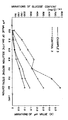
- the drawing illustrates the relation between the variations of glucose content and pH value of the dialytic solution caused by the sterilization in an autoclave and the pH value of the dialytic solution.
- the strongest characteristic of this invention resides in using glycerol and a monosaccharide in combination as osmotic pressure regulating agents in the dialytic solution for peritoneal dialysis.
- glycerol as an osmotic pressure regulating agent for the purpose of eliminating the problem that excess glucose is wholly absorbed as an energy source and, because of the reducing group possessed by glucose, the dialytic solution having the pH thereof closely approximated to the physiological level (pH 7.4) is deprived of stability by the high temperature used during the sterilization in the autoclave.
- glycerol completely replaces glucose, i.e.
- the amount of the saccharide to be so contained is small because of the combined use of glycerol and, therefore, is incapable of substantially affecting the elevation of blood sugar value and that although it is important for the pH value of the dialytic solution of the peritoneal dialysis to be closely approximated to the physiological level, the dialytic solution which has a pH exceeding a certain level such as, for example, 5.5 refrains from manifesting any intraabdominal stimulating property similarly to the dialytic solution of a physiological pH level.
- This invention is directed to a dialytic solution for peritoneal dialysis, which dialytic solution is characterized by containing glycerol and a monosaccharide as osmotic pressure regulating agents for regulating the osmotic pressure to a level necessary for the removal of water.
- the monosaccharide when the monosaccharide is added to a glycerol solution and the resulting mixture is injected directly into the veins or into the blood in vitro, the monosaccharide has an effect of precluding glycerol from manifesting a hemolytic activity (Masayuki Arakawa: "Hemolytic action of glycerol and antihemolytic action of fructose," ibidem). It has now been found that the monosaccharide functions to prevent glycerol from manifesting a hemolytic activity also when it is administered intra-abdominally in combination with glycerol. It does not need to be only one monosaccharide that it added to the dialytic solution for peritoneal dialysis.
- a plurality of monosaccharides may be added at the same time. Particularly when a plurality of monosaccharides are added, the produced dialytic solution can be expected to have an effect of lightening the burden imposed by each of the monosaccharides upon the patient because the amount in which each of the monosaccharides is required to be used for the purpose of attaining the prescribed osmotic pressure is smaller than when only one monosaccharide is added.
- These monosaccharides are desired to be such monosaccharides as glucose, fructose, mannose, and galactose which can be metabolized in human bodies.
- the dialytic soluiton is desired to contain fructose or glucose, preferably to contain both fructose and glucose.
- fructose manifests the effect of inhibiting the hemolytic activity of glycerol when it is added in combination with glycerol to the dialysis solution for peritoneal dialysis.
- fructose has already found utility. It warrants high safety unless the dose thereof is abnormally increased.
- the occurrence of fructose in an amount of about 0.5 to 5 mg/dl is recognized in the live blood. Insulin has no part to play in the incorporationg of fructose into the cells.
- fructose is utilized more than glucose.
- fructose In the case of fructose injected into the veins, although about 30% of the amount of fructose injected manifests itself in the form of blood sugar, the added fructose causes no appreciable change in the blood sugar value. Thus, fructose is highly effective on a patient suffering from abnormal metabolism. Glucose is not so effective in inhibiting the hemolytic activity of glycerol as fructose when it is added in combination with glycerol to the dialytic solution for peritoneal dialysis. It, however, has been long used as an osmotic pressure regulating agent in the dialytic soluiton for peritoneal dialysis.
- the dialytic solution for peritoneal dialysis may be in a varying percentage composition because the mobility varies from one patient to another, because the ability of treatment varies among the substances to be added, an further because most patients in need of peritoneal dialysis involve qualitative or quantitative abnormality in lipid metabolism.
- the glycerol and the monosaccharide as osmotic pressure regulating agents are added in such amounts that the osmotic pressure of the produced dialytic solution for peritoneal dialysis will reach a prescribed level within the range of 280 to 700 mOsm/lit.
- the amount of glycerol is in the range of 0.5 to 40 g/lit., preferably 1.0 to 21 g/lit., and that of saccharide in the range of 0.005 to 78 g/lit., preferably 0.01 to 40 g/lit. More desirably, the monosaccharide is contained in an amount of not less than 1 w/v % based on the amount of glycerol. If the amount of the monosaccharide is lower than this value, it cannot be expected to manifest an effect of prevending the hemolytic activity. If the monosaccharide is added in an extremely large amount as an osmotic pressure regulating agent, there ensues the undesirable possibility that the patient will be forced to take in an excessive energy source.
- the amount of glycerol will be in the range of 0.5 to 40 g/lit., preferably 1.0 to 21 g/lit., the amount of each of the monosaccharides in the range of 0.005 to 78 g/lit., preferably 0.01 to 40 g/lit., and the total amount of the monosaccharides in the range of 0.005 to 78 g/lit., preferably 0.01 to 40 g/lit.
- the content of each of the monosaccharides will be decreased so as to lessen the burden imposed on the patient.
- the dialytic solution of this invention for peritoneal dialysis can be expected to bring about the best effect when it contains glycerol in an amount 0.5 to 40 g/lit., preferably 1.0 to 21 g/lit., glucose in an amount of 0.005 to 78 g/lit., preferably 0.01 to 40 g/lit., and fructose in an amount of 0.005 to 78 g/lit., preferably 0.01 to 40 g/lit.
- the dialytic solution contains 130 to 140 mEq. of Na+ ion, 100 to 140 mEq. of Cl ⁇ ion, 0 to 8 mEq. of Ca2+ ion, and 0 to 4 mEq. of Mg2+ ion per liter. It further contains, when necessary, 30 to 50 meq. of at least one bicarbonate precursor ion selected from the group consisting of bicarbonate, lactic acid, acetic acid, malic acid, and succinic acid per liter.
- the bicarbonate precursor ion is added to the dialytic solution of this invention for peritoneal dialysis for the purpose of adjusting the pH of the dialytic solution to a level in the range of about 5.5 to 6.5. If the pH of the dialytic solution of this invention for peritoneal dialysis is not more than 5.5, there ensues the possibility that the dialytic solution introduced into the abdominal cavity will stimulate the living body. If the pH value is close to the vital level (pH 7.4), there is the possibility that the monosaccharides contained as osmotic pressure regulating agents will be seriously decomposed by the intense heat used during the sterilization in an autoclave.
- the dialytic solution causes absolutely no stimulator on the living body as when the pH is close to the level of the living body and the absolute amount of decomposition caused on the monosaccharides during the sterilization in an antoclave is too small to pose any serious problem.
- the ions contained in the prescribed concentrations in the dialytic solution of this invention for peritoneal dialysis can be easily attained by the addition of such popularly used physiological salts as sodium chloride, calcium chloride, sodium lactate, and sodium acetate, such pharmaceutically accepted salts as potassium chloride and magnesium chloride, and free acids.
- the dialytic solution of this invention for peritoneal dialysis in a typical composition, contains 5.53 g of sodium chloride (NaCl), 0.52 g of calcium chloride (CaCl2.2H2O), 0.07 g of magnesium chloride (MgCl2.6H2O), and 4.20 g of sodium lactate (8.40 g of 50% by weight sodium lactate) per liter.
- the amounts of glycerol, fructose, and glucose which the dialytic solution for peritoneal dialysis is presumably required to contain in acquiring electrolyte concentrations (theoretical values) shown in Table 2, pH of 0.5, and an osmotic pressure (theoretical value) of 510 mOsm/lit. are shown in Table 3.
- the amounts of glycerol, fructose, and glucose which the dialytic solution for peritoneal dialysis is required to contain in acquiring the same electrolyte concentrations and pH as mentioned above and an osmotic pressure (theoretical value) of 350 mOsm/lit. are shown in Table 4.
- Tables 3 and 4 indicate the amount of glycerol to be required when fructose and glucose are increased or decreased at a fixed proportion.
- Dialytic solutions, A (Example 1) and B (Example 2), for peritoneal dialysis having compositions shown in Table 5 were prepared. Separately, a physiological saline water, a glucose CAPD solution "CAPD-400" (product of Terumo Kabushiki Raisha) (Control 1), and a glycerol CAPD solution (Control 2), having compositions shown in Table 1 were prepared. In an environment of 23 ⁇ 1°C of temperature, 60 ⁇ 10% of humidity, and 12 hours of illumination time, 130 male rats of Wistar species 6 weeks of age (purchased from Shizuoka Laboratory Animal Center) were kept under preliminary breeding for one week. Water and feed were left to be taken freely by the animals.
- the rats were divided into 13 lots (each of 10 rats).
- the aforementioned test solutions were intra-abdominally given in a fixed dose of 40 ml/kg with a syringe using a 25G needle.
- the rats were anesthesized 60 minutes after the use of the test solutions.
- Bloods were extracted from their abdominal aortas and were centrifuged to obtain serums.
- the serums were tested for free hemoglobin concentration in accordance with the Nishikaze method (Akira Nishikaze: "New Method for Determination of Blood Oxidized Hemoglobin," March of Medicine, 56 , 644, 1966), with necessary modifications.
- the results of the test are shown in Table 6, as sorted by the presence or absence of residual error inthe amounts of serumal free hemoglobin found by comparison between the lot of rats given the physiological saline water and the various lots of rats given the test solutions.
- Dialytic solutions for peritoneal dialysis containing 17.89 g of glycerol and 5.00 g of glucose per lit. and having varying pH values (between 5.0 and 8.0, as graduated by intervals of 0.5) were prepared. These dialytic solutions were sterilized in an autoclave at a temperature of 121°C and pressure of 1 kg/cm2 for 40 minutes. After the sterilization, they were tested for glucose concentration and pH, with the results compared with those obtained before the sterilization. The results are shown in Table 7 and Fig. 1.
- Dialytic solutions (osmotic pressure 510 mOsm/lit.) containing 40.00 g of glucose per lit. and having varying pH values similarly to Example 3 were prepared. They were sterilized in an autoclave similarly to Example 3 and tested for glucose concentration and pH before and after the sterilization. The results are shown in Table 7 and Fig. 1.
- Dialytic solutions osmotic pressure about 500 mOsm/lit. containing 4 W/V% of glucose, 135 mEq/lit. of Na+ ion, 4 mEq/lit. of Mg2+ ion, and 105.5 mEq/lit. of Cl ⁇ ion and adjusted to varying pH values (between 3 and 7, as graduated by 10 intervals) with lactic acid or a 10% sodium hydroxide solution were prepared.
- mice To mice (ddY, male, 4 weeks of age), the dialytic solutions mentioned above were intra-abdominally given at a fixed dose of 1 ml/mouse following the elapse of 10 minutes after the use of the dialytic solutions, the mice were placed under observation as to the number of writhings and the symptoms. The results are shown in Table 8.
- the dialytic solution of the present invention for peritoneal dialysis is characterized by containing glycerol and glucose and fructose as osmotic pressure regulating agents for the regulation of the osmotic pressure to a level necessary for the removal of water.
- the dialytic solution of this invention for peritoneal dialysis is highly safe on the living body, it can be used advantageously for protracted administration or sustained administration as by CAPD.
- These desirable effects of the dialytic solution are particularly conspicuous when it contains, as the monosaccharide, a human metabolic monosaccharide, particularly fructose or glucose, and more particularly both fructose and glucose, when the glycerol and the monosaccharide are contained respectively in the range of 0.5 to 40 g/lit.
- the glycerol in the range of 1.0 to 21 g/lit.
- the glucose in the range of 0.01 to 40 g/lit.
- the fructose in the range of 0.01 to 40 g/lit.
- the pH of the dialytic solution falls in the range of 5.5 to 6.5.
Landscapes
- Health & Medical Sciences (AREA)
- Emergency Medicine (AREA)
- Urology & Nephrology (AREA)
- Heart & Thoracic Surgery (AREA)
- Hematology (AREA)
- Engineering & Computer Science (AREA)
- Anesthesiology (AREA)
- Biomedical Technology (AREA)
- Vascular Medicine (AREA)
- Life Sciences & Earth Sciences (AREA)
- Animal Behavior & Ethology (AREA)
- General Health & Medical Sciences (AREA)
- Public Health (AREA)
- Veterinary Medicine (AREA)
- External Artificial Organs (AREA)
- Pharmaceuticals Containing Other Organic And Inorganic Compounds (AREA)
Claims (4)
- Dialyselösung für eine peritoneale Dialyse, enthaltend Glycerin in einer Menge von 1,0 bis 21 g/l, Glucose in einer Menge von 0,01 bis 40 g/l und Fructose in einer Menge von 0,01 bis 40 g/l mit einem osmotischen Druck von 280 bis 700 mOsm/l.
- Dialyselösung nach Anspruch 1, enthaltend Na⁺-Ionen in einer Menge von 130 bis 140 mÄq/l, Cl⁻-Ionen in einer Menge von 100 bis 140 mÄq/l, Ca²⁺-Ionen in einer Menge von 0 bis 8 mÄq/l und Mg²⁺-Ionen in einer Menge von 0 bis 4 mÄq/l.
- Dialyselösung nach Anspruch 1, enthaltend zumindest eine Art Bicarbonatvorläuferionen aus der Gruppe Bicarbonate, Milchsäure, Essigsäure, Äpfelsäure und Bernsteinsäure in einer Menge von 30 bis 50 mÄq/l.
- Dialyselösung nach Anspruch 1 eines pH-Werts im Bereich von 5,5 bis 6,5.
Applications Claiming Priority (2)
| Application Number | Priority Date | Filing Date | Title |
|---|---|---|---|
| JP60087621A JPS61247466A (ja) | 1985-04-25 | 1985-04-25 | 腹膜透析用透析液 |
| JP87621/85 | 1985-04-25 |
Publications (3)
| Publication Number | Publication Date |
|---|---|
| EP0199357A2 EP0199357A2 (de) | 1986-10-29 |
| EP0199357A3 EP0199357A3 (en) | 1988-08-10 |
| EP0199357B1 true EP0199357B1 (de) | 1991-12-18 |
Family
ID=13920039
Family Applications (1)
| Application Number | Title | Priority Date | Filing Date |
|---|---|---|---|
| EP86105679A Expired EP0199357B1 (de) | 1985-04-25 | 1986-04-24 | Dialyselösung für Peritonealdialyse |
Country Status (6)
| Country | Link |
|---|---|
| US (1) | US4880629A (de) |
| EP (1) | EP0199357B1 (de) |
| JP (1) | JPS61247466A (de) |
| AU (1) | AU567832B2 (de) |
| CA (1) | CA1264036A (de) |
| DE (1) | DE3682932D1 (de) |
Cited By (1)
| Publication number | Priority date | Publication date | Assignee | Title |
|---|---|---|---|---|
| US7053059B2 (en) | 2003-07-25 | 2006-05-30 | Baxter International Inc. | Dialysis solutions with reduced levels of glucose degradation products |
Families Citing this family (15)
| Publication number | Priority date | Publication date | Assignee | Title |
|---|---|---|---|---|
| DE3812525C1 (de) * | 1988-04-15 | 1989-06-22 | Fresenius Ag, 6380 Bad Homburg, De | |
| AU627140B3 (en) * | 1991-09-13 | 1992-06-26 | Baxter International Inc. | Method of peritoneal dialysis |
| AU627141B3 (en) * | 1991-09-13 | 1992-06-26 | Baxter International Inc. | Peritoneal dialysis solution |
| ES2121941T3 (es) * | 1992-02-04 | 1998-12-16 | Baxter Int | Soluciones de dialisis peritoneal y metodos utiles para reducir las lesiones y los efectos psicologicos negativos producidos por la peritonitis. |
| CA2102234C (en) * | 1992-02-04 | 2008-11-18 | Andrzej Breborowicz | Peritoneal dialysis composition and method usable during and after peritonitis |
| US6380163B1 (en) * | 1992-12-22 | 2002-04-30 | Baxter International Inc. | Peritoneal dialysis solutions with polypeptides |
| US6770148B1 (en) * | 1998-12-04 | 2004-08-03 | Baxter International Inc. | Peritoneal dialysis solution containing modified icodextrins |
| US8105258B2 (en) * | 1999-04-26 | 2012-01-31 | Baxter International Inc. | Citrate anticoagulation system for extracorporeal blood treatments |
| US7186420B2 (en) * | 1999-04-26 | 2007-03-06 | Edwards Lifesciences Corporation | Multi-part substitution infusion fluids and matching anticoagulants |
| US6743191B1 (en) | 1999-04-26 | 2004-06-01 | Edwards Lifesciences Ag | Substitution infusion fluid and citrate anticoagulation |
| US20040121982A1 (en) * | 2002-12-20 | 2004-06-24 | Leo Martis | Biocompatible dialysis fluids containing icodextrins |
| US20050276868A1 (en) * | 2004-06-10 | 2005-12-15 | Bart Degreve | Bicarbonate-based peritoneal dialysis solutions |
| JP2009269887A (ja) * | 2008-05-09 | 2009-11-19 | Kagawa Univ | 希少糖を含有する腹膜劣化抑制剤、腹膜透析液および腹膜透析法 |
| PE20150288A1 (es) * | 2012-04-24 | 2015-02-22 | Univ British Columbia | Dialisato a base de polimero |
| EP3071030B1 (de) | 2013-11-21 | 2020-03-25 | Jayachandran Kizhakkedathu | Polymerbasierte transplantatkonservierungslösung |
Family Cites Families (4)
| Publication number | Priority date | Publication date | Assignee | Title |
|---|---|---|---|---|
| US3234089A (en) * | 1962-04-17 | 1966-02-08 | Cutter Lab | Non-toxic intravenous, high-calorie solution containing glycerol |
| DE2508474A1 (de) * | 1975-02-27 | 1976-09-02 | Boehringer Mannheim Gmbh | Infusions- und spuelfluessigkeiten zur behandlung von hirnoedemen |
| AU8521682A (en) * | 1981-05-15 | 1982-12-07 | Baxter Travenol Laboratories Inc. | Dialysis solution containing glycerol |
| US4574085A (en) * | 1981-05-15 | 1986-03-04 | Baxter Travenol Laboratories, Inc. | Method for using dialysis solution containing glycerol |
-
1985
- 1985-04-25 JP JP60087621A patent/JPS61247466A/ja active Pending
-
1986
- 1986-04-23 CA CA000507353A patent/CA1264036A/en not_active Expired
- 1986-04-24 EP EP86105679A patent/EP0199357B1/de not_active Expired
- 1986-04-24 DE DE8686105679T patent/DE3682932D1/de not_active Expired - Fee Related
- 1986-04-24 US US06/855,343 patent/US4880629A/en not_active Expired - Fee Related
- 1986-04-24 AU AU56600/86A patent/AU567832B2/en not_active Ceased
Cited By (1)
| Publication number | Priority date | Publication date | Assignee | Title |
|---|---|---|---|---|
| US7053059B2 (en) | 2003-07-25 | 2006-05-30 | Baxter International Inc. | Dialysis solutions with reduced levels of glucose degradation products |
Also Published As
| Publication number | Publication date |
|---|---|
| US4880629A (en) | 1989-11-14 |
| JPS61247466A (ja) | 1986-11-04 |
| EP0199357A3 (en) | 1988-08-10 |
| CA1264036A (en) | 1989-12-27 |
| AU567832B2 (en) | 1987-12-03 |
| EP0199357A2 (de) | 1986-10-29 |
| AU5660086A (en) | 1986-10-30 |
| DE3682932D1 (de) | 1992-01-30 |
Similar Documents
| Publication | Publication Date | Title |
|---|---|---|
| US4880629A (en) | Dialytic solution for peritoneal dialysis | |
| CA2045610C (en) | Histidine buffered peritoneal dialysis solution | |
| US5100677A (en) | Fluid therapy with various organic anions | |
| DE69531426T2 (de) | Lösungen für die peritonealdialyse, die maltodextrine und aminosäuren enthalten | |
| EP1753437B1 (de) | Peritonealdialyselösungen auf bicarbonatbasis | |
| EP0078832B1 (de) | Dialyselösung enthaltendes glycerol | |
| US5945449A (en) | Sterile bicarbonate concentrate | |
| AU2003299683A1 (en) | Biocompatible dialysis fluids containing icodextrins | |
| EP0827748B2 (de) | Lösung für die Peritonealdialyse | |
| Jungers et al. | The Essentials in Hemodialysis: An Illustrated Guide | |
| CN1739531A (zh) | 一种治疗缺铁性贫血的蔗糖铁注射液及其制备方法 | |
| JPH02196724A (ja) | 腹膜透析液 | |
| de Baulny et al. | Emergency treatments | |
| SU1715355A1 (ru) | Способ гемосорбции | |
| CA2219822C (en) | Sterile bicarbonate concentrate | |
| Coran et al. | The use of parenteral alimentation in renal failure: the effect of an intravenous fat emulsion and essential amino acids on dogs undergoing bilateral nephrectomy | |
| Forrest et al. | Parenteral nutrition in acute renal failure | |
| MXPA98005326A (en) | Compositions for the treatment of renal failure, comprising l-carnosine | |
| AU1496600A (en) | Fluid therapy with L-lactate and/or pyruvate anions |
Legal Events
| Date | Code | Title | Description |
|---|---|---|---|
| PUAI | Public reference made under article 153(3) epc to a published international application that has entered the european phase |
Free format text: ORIGINAL CODE: 0009012 |
|
| 17P | Request for examination filed |
Effective date: 19860521 |
|
| AK | Designated contracting states |
Kind code of ref document: A2 Designated state(s): BE DE FR GB SE |
|
| PUAL | Search report despatched |
Free format text: ORIGINAL CODE: 0009013 |
|
| AK | Designated contracting states |
Kind code of ref document: A3 Designated state(s): BE DE FR GB SE |
|
| 17Q | First examination report despatched |
Effective date: 19900307 |
|
| GRAA | (expected) grant |
Free format text: ORIGINAL CODE: 0009210 |
|
| AK | Designated contracting states |
Kind code of ref document: B1 Designated state(s): BE DE FR GB SE |
|
| REF | Corresponds to: |
Ref document number: 3682932 Country of ref document: DE Date of ref document: 19920130 |
|
| ET | Fr: translation filed | ||
| PLBE | No opposition filed within time limit |
Free format text: ORIGINAL CODE: 0009261 |
|
| STAA | Information on the status of an ep patent application or granted ep patent |
Free format text: STATUS: NO OPPOSITION FILED WITHIN TIME LIMIT |
|
| 26N | No opposition filed | ||
| EAL | Se: european patent in force in sweden |
Ref document number: 86105679.4 |
|
| PGFP | Annual fee paid to national office [announced via postgrant information from national office to epo] |
Ref country code: FR Payment date: 19950411 Year of fee payment: 10 |
|
| PGFP | Annual fee paid to national office [announced via postgrant information from national office to epo] |
Ref country code: GB Payment date: 19950413 Year of fee payment: 10 |
|
| PGFP | Annual fee paid to national office [announced via postgrant information from national office to epo] |
Ref country code: SE Payment date: 19950419 Year of fee payment: 10 |
|
| PGFP | Annual fee paid to national office [announced via postgrant information from national office to epo] |
Ref country code: DE Payment date: 19950421 Year of fee payment: 10 |
|
| PGFP | Annual fee paid to national office [announced via postgrant information from national office to epo] |
Ref country code: BE Payment date: 19950602 Year of fee payment: 10 |
|
| PG25 | Lapsed in a contracting state [announced via postgrant information from national office to epo] |
Ref country code: GB Effective date: 19960424 |
|
| PG25 | Lapsed in a contracting state [announced via postgrant information from national office to epo] |
Ref country code: SE Effective date: 19960425 |
|
| PG25 | Lapsed in a contracting state [announced via postgrant information from national office to epo] |
Ref country code: BE Effective date: 19960430 |
|
| BERE | Be: lapsed |
Owner name: TERUMO K.K. TRADING AS TERUMO CORP. Effective date: 19960430 |
|
| GBPC | Gb: european patent ceased through non-payment of renewal fee |
Effective date: 19960424 |
|
| PG25 | Lapsed in a contracting state [announced via postgrant information from national office to epo] |
Ref country code: FR Effective date: 19961227 |
|
| PG25 | Lapsed in a contracting state [announced via postgrant information from national office to epo] |
Ref country code: DE Effective date: 19970101 |
|
| EUG | Se: european patent has lapsed |
Ref document number: 86105679.4 |
|
| REG | Reference to a national code |
Ref country code: FR Ref legal event code: ST |