EP0199511A2 - Langspänige Spanplatten - Google Patents
Langspänige Spanplatten Download PDFInfo
- Publication number
- EP0199511A2 EP0199511A2 EP86302715A EP86302715A EP0199511A2 EP 0199511 A2 EP0199511 A2 EP 0199511A2 EP 86302715 A EP86302715 A EP 86302715A EP 86302715 A EP86302715 A EP 86302715A EP 0199511 A2 EP0199511 A2 EP 0199511A2
- Authority
- EP
- European Patent Office
- Prior art keywords
- wafers
- range
- layers
- panel
- waferboard
- Prior art date
- Legal status (The legal status is an assumption and is not a legal conclusion. Google has not performed a legal analysis and makes no representation as to the accuracy of the status listed.)
- Withdrawn
Links
- 235000012431 wafers Nutrition 0.000 claims abstract description 119
- 239000010410 layer Substances 0.000 claims abstract description 51
- 239000002023 wood Substances 0.000 claims abstract description 38
- 239000012792 core layer Substances 0.000 claims abstract description 30
- 230000005484 gravity Effects 0.000 claims abstract description 9
- KXGFMDJXCMQABM-UHFFFAOYSA-N 2-methoxy-6-methylphenol Chemical compound [CH]OC1=CC=CC([CH])=C1O KXGFMDJXCMQABM-UHFFFAOYSA-N 0.000 claims description 9
- 229920001568 phenolic resin Polymers 0.000 claims description 9
- 239000011120 plywood Substances 0.000 abstract description 15
- 229920005989 resin Polymers 0.000 description 16
- 239000011347 resin Substances 0.000 description 16
- 239000000047 product Substances 0.000 description 13
- 238000004519 manufacturing process Methods 0.000 description 9
- 230000000694 effects Effects 0.000 description 6
- 238000002156 mixing Methods 0.000 description 5
- 239000002245 particle Substances 0.000 description 5
- 230000008901 benefit Effects 0.000 description 4
- 238000005516 engineering process Methods 0.000 description 4
- 239000007788 liquid Substances 0.000 description 4
- 239000000123 paper Substances 0.000 description 4
- 241000196324 Embryophyta Species 0.000 description 3
- 241000183024 Populus tremula Species 0.000 description 3
- 239000011121 hardwood Substances 0.000 description 3
- 239000000203 mixture Substances 0.000 description 3
- 238000002360 preparation method Methods 0.000 description 3
- 239000011122 softwood Substances 0.000 description 3
- 239000011094 fiberboard Substances 0.000 description 2
- 244000283070 Abies balsamea Species 0.000 description 1
- 235000007173 Abies balsamea Nutrition 0.000 description 1
- 235000004710 Abies lasiocarpa Nutrition 0.000 description 1
- 235000014466 Douglas bleu Nutrition 0.000 description 1
- 241000218657 Picea Species 0.000 description 1
- 235000005018 Pinus echinata Nutrition 0.000 description 1
- 241001236219 Pinus echinata Species 0.000 description 1
- 235000017339 Pinus palustris Nutrition 0.000 description 1
- 240000001416 Pseudotsuga menziesii Species 0.000 description 1
- 235000005386 Pseudotsuga menziesii var menziesii Nutrition 0.000 description 1
- 239000007795 chemical reaction product Substances 0.000 description 1
- 239000011248 coating agent Substances 0.000 description 1
- 238000000576 coating method Methods 0.000 description 1
- 238000010276 construction Methods 0.000 description 1
- 238000001035 drying Methods 0.000 description 1
- 239000000463 material Substances 0.000 description 1
- 239000000843 powder Substances 0.000 description 1
- 239000002356 single layer Substances 0.000 description 1
- 239000007921 spray Substances 0.000 description 1
- XLYOFNOQVPJJNP-UHFFFAOYSA-N water Substances O XLYOFNOQVPJJNP-UHFFFAOYSA-N 0.000 description 1
Images


Classifications
-
- B—PERFORMING OPERATIONS; TRANSPORTING
- B27—WORKING OR PRESERVING WOOD OR SIMILAR MATERIAL; NAILING OR STAPLING MACHINES IN GENERAL
- B27N—MANUFACTURE BY DRY PROCESSES OF ARTICLES, WITH OR WITHOUT ORGANIC BINDING AGENTS, MADE FROM PARTICLES OR FIBRES CONSISTING OF WOOD OR OTHER LIGNOCELLULOSIC OR LIKE ORGANIC MATERIAL
- B27N3/00—Manufacture of substantially flat articles, e.g. boards, from particles or fibres
- B27N3/04—Manufacture of substantially flat articles, e.g. boards, from particles or fibres from fibres
Definitions
- the present invention relates to waferboard panels made with long wafers to produce a structural panel board having strength and stiffness properties equivalent to plywood.
- waferboard panels can be used in place of plywood, there are substantial advantages.
- Plywood is made from veneer sheets which are sliced or peeled from logs and this requires a reasonably high grade of logs. Wafers are cut on a waferizer from lower grade logs and have a higher wood yield than in the preparation of veneer. Capital costs are less for waferboard plants than for plywood plants, and waferboard manufacturing costs are less than the manufacturing costs of making plywood.
- waferboards have a major disadvantage relative to plywoods, namely they have a low strength to density ratio. Comparing strength to density ratios, both modulus of rupture to density ratio and modulus of elasticity to density ratio -ds far lower for waferboard than for plywood.
- Construction grade Southern pine plywood (CDX) has an average modulus of rupture (MOR) of about 41,370 KPa and a modulus of elasticity (MOE) of about 13,790 (M) KPa at a density of 592 Kgms per cu metre to give an MOR/Density ratio of 70 and an MOE(M)/Density of 23.
- Douglas fir 5-ply CDX sheathing has an MOR/Density ratio of 54 and an MOE(M)/Density ratio of 19.
- Non-oriented waferboard made from 38 mm long wafers and a resin content of 2.3% has an MOR of about 18,615 KPa and an MOE of about 3450 (M) KPa at a density of 664 Kgms per cu metre to give an MOR/Density ratio of 28 and an MOE(M)/Density ratio of 5.
- MOR/Density ratio of waferboard is under one half that of plywood.
- a machine oriented strandboard made with 75 mm long wafers and higher resin contents can increase the strength/density ratios, but they are still only about half that of plywood.
- the strength properties of waferboard can be increased by increasing density, or increasing resin content, however, increased density raises wood cost and transportation cost, makes the product heavier to handle, causes greater thickness swell when wet and reduces productivity when plant is wood processing limited. If the resin content is increased say from 3% to 6%, the manufacturing costs increase by about 15%.
- panel boards such as particle board, fiberboard, waferboard, flakeboard, oriented strand board (O.S.B.) have generally been made with wafers or flakes having lengths not more than 100 mm.
- H. Dale Turner in an article entitled "EFFECT OF PARTICLE SIZE AND SHAPE ON STRENGTH AND DIMENSIONAL STABILITY OF RESIN BONDED WOOD PARTICLE PANELS", published October 1954 in the Journal of F.R.P.S., describes tests carried out on wafers having lengths up to 7.5 cm and concluded that 4 cm was the most economic length of wood wafers for the production of waferboard or strand board.
- Long wafers can be properly coated with resin in either powder or liquid form.
- One example of an apparatus to blend long wood wafers with a liquid resin is disclosed in our co-pending application, U.S. Serial Number 441,925 filed November 15, 1982. It has also been found that long wafers can be laid in a mat of substantially uniform thickness.
- One such device for forming such a mat is shown in our co-pending application U.S. Serial Number 420,084 filed September 20, 1982.
- the apparatus spreads the wood wafers in a uniform manner to provide a mat having substantially even thickness.
- the wafers may be laid in an oriented pattern or in a random pattern.
- the present invention provides a waferboard panel with increased strength properties, comprising at least three layers of wood wafers having an initial aggregate specific gravity less than about 0.6 oven dry weight, with volume at 12% moisture content, the panel having face layers on outside surfaces and at least one core layer, the wafers in the face layers having a mean orientation in the range of about 2 to 10 degrees, the wafers in the face layers having lengths of at least about 15 cm, and preferably at least about 30 cm, average widths in the range of about 0.75 to 5.0 cm and average thickness in the range of about 0.025 to 0.125 cm with a .
- phenol-formaldehyde resin content is in the range of about 1 1/2 to 8%, preferably 2 to 3%, based on the oven dry weight of the wood wafers for the face layers and core layers.
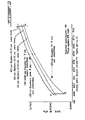
- the panel having an MOR parallel to the orientation of the wafers in the face layers for an oven dry wood density in the range of about 430 to 720 Kgms per cu m. within the boundary of A, B, C and D in FIG. 1, and an MOE parallel to the orientation of the wafers in the face layers within the boundary of E, F, G and H in FIG. 2.
- the panel has face layers representing a range of about 30-60% of total thickness of the panel. Dry MOR and dry MOE of the panel in the direction perpendicular to the orientation of the wafers, is not less than about 20% of the dry MOR and dry MOE of the panel parallel to the orientation of the wafers.
- the core layer has a random orientation of wafers or a cross orientation of wafers.
- each layer of wood wafers has a thickness greater than three wafers.
- wafers used throughout the specification includes flakes, strands, plates and other terms sometimes used in different countries. Wafers may be made on conventional waferizers which cuts wafers to the desired shape, or wafers may be cut or slit from veneer. In the present invention the wafers are made having a length greater than 15 cm, preferably greater than 30 cm, up to 60 cm or more. Greater lengths may be used but there appears to be little improvement in strength properties over this figure. Thicknesses of the wafers may vary from about 0.025 to 0.125 cm and width should be in the range from about 0.75 to 5.00 cm. It is preferred that the average wafer thickness in the face layers is in the range of about 0.05 to 0.075 cm and in the core layers in the range of about 0.075 to 0.125 cm.
- the type of wood used in North America, particularly in the West Coast is generally a mixture of different types of hardwoods and softwoods having an initial aggregate specific gravity, oven dry weight with volume at 12% moisture content, of less than about 0.6.
- Aspen for instance, is a hardwood having a specific gravity in the range of about .35 - .39.
- An example of a softwood is a Balsam fir.
- Slack wax is a prepared wax generally blended with the wafers to improve water proof properties of the end product, and preferably powdered phenol-formaldehyde resin is generally used for both face and core layers.
- powdered resin it is also feasible to spray liquid resin onto the wafers.
- An example of such a blending system is shown in co-pending application U.S. Serial Number 441,925 which describes a multiple stage blending of wood wafers with a liquid resin.
- the phenol-formaldehyde resin content is preferably in the range of about 1 1/2 to 8% based on the oven dry weight of the wood wafers for both face layers and core layers.
- wafers are generally laid in at least three separate mats one on top of another before proceeding to a press where the layers of wafers are compressed and simultaneously heated to cure the resin.
- the face layers of a waferboard panel generally represent about 30 - 60% of the total thickness of the panel.
- the core layer, or core layers, represent the remaining panel thickness.
- the long wafers are laid in a oriented fashion such that the mean orientation of the wafers laid in the mat are at an angle greater than zero degrees, but not more than about 10 degrees from the direction of orientation. If the orientation angle increases much beyond about 10 degrees, then the strength in the direction of orientation of the panel is reduced.
- the mean orientation of the wafers results in too small an angle, that is to say below about 2 degrees, then the strength of the panel in the direction perpendicular to the direction of orientation is reduced. It has been found that an angle of orientation around 10 degrees proves satisfactory, and it is preferred that the product have a strength and stiffness in the perpendicular direction to the direction of orientation of about 20% of the direction parallel to the orientation.
- the core layer or core layers may be random oriented or cross oriented.
- cross oriented means that the wafers in the core layers are laid in a direction which is approximately 90 degrees to the direction of orientation of the wafers in the face layers. In some embodiments a mixture of both random and cross oriented core layers are provided depending on the requirements of the waferboard panel. In the case or core layers, it is not imperative that the wafers be the same thickness or as long as those in the face layers.
- the multi-layered mat advances to a press where in a preferred embodiment, each panel is compressed at a temperature of slightly above 200 degrees Celsius for at least four minutes.
- the press is a standard unit well known in the manufacture of waferboard panels.
- the resin content is at least about 1.5% based on the oven dry weight of the wood wafers.
- the resin content for both face and core layers is in the range of about 2 to 3% based on the oven dry weight of the wood wafers.
- 4% phenol-formaldehyde resin was used in the face layers with 3% only in the core layer.
- the wax content was 2% based on the oven dry weight of the wood wafers.
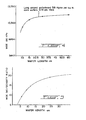
- FIGS. 1 and 2 illustrate the strength properties for long wafer waferboard for varying densities made according to the present invention for different lengths of wafers.
- Oven dry wood densities from 430 to 720 Kgms per cu m. cover the range of densities for the long wafer waferboard product made from wafers having an initial aggregate specific gravity oven dry weight with volume at 12% moisture content of below 0.6.
- the ratios of MOR to density within the boundary lines A, B, C and D of FIG. 1 are at least 75.
- the ratios of MOE (M) to density within the boundary lines E, F, G and H of FIG. 2 are at least 17.
- Waferboard samples were made by slitting wafers from veneer strips cut from Aspen with an initial aggregate specific gravity oven dry weight with volume at 12% moisture content of approximately 0.38.
- the wafers in the face layers were 0.05 cm thick and were cut to 7.5, 15, 30 and 60 cm lengths.
- the core wafers were 0.10 cm thick.
- the face layers were oriented with a mean orientation not greater than 10 degrees and the core layer was cross oriented.
- 5% phenol-formaldehyde resin was used in the panels whose overall thickness was 1.25 cm.
- the panels comprise three plies.
- FIGS. 3 and 4 illustrate the effect of strand length on MOR and on MOE. As can be seen in the FIGS. above a 30 cm wafer length, the curve commences to level out. There is believed to be no real improvement in strength properties beyond 60 cm long wafers.
- Waferboard samples were made from wafers cut on a commercial waferizer for nominal wafer lengths of 3, 7.5, 11.4, 15 and 30 cm. Actual wafer lengths varied substantially below the nominal length, but had a mean value of up to about 20% below the nominal.
- the wood was Aspen, similar to the type of wood used in EXAMPLE I.
- the thickness of the core wafers was 0.05 cm, the same thickness as the wafers in the face layers.
- the waferboard made from nominal 11.4 cm long wafers had an MOR/Density ratio above 50 and an MOE(M)/Density ratio of about 12.
- the waferboard made from nominal 30 cm long wafers had an MOR/Density ratio of 108, and an MOE/Density ratio of 19.
- FIG. 5 illustrates the comparison between the mean wafer lengths against MOR/Density ratio for a waferboard having a wafer thickness of about 0.05 cm in both core layer and face layers. As can be seen, a mean wafer length of 16.5 cm was required to attain a ratio of 17 in this test.
Landscapes
- Life Sciences & Earth Sciences (AREA)
- Engineering & Computer Science (AREA)
- Manufacturing & Machinery (AREA)
- Wood Science & Technology (AREA)
- Forests & Forestry (AREA)
- Dry Formation Of Fiberboard And The Like (AREA)
- Chemical And Physical Treatments For Wood And The Like (AREA)
- Finished Plywoods (AREA)
- Manufacturing Optical Record Carriers (AREA)
- Transition And Organic Metals Composition Catalysts For Addition Polymerization (AREA)
- Paper (AREA)
Applications Claiming Priority (2)
| Application Number | Priority Date | Filing Date | Title |
|---|---|---|---|
| US72364185A | 1985-04-16 | 1985-04-16 | |
| US723641 | 1985-04-16 |
Publications (2)
| Publication Number | Publication Date |
|---|---|
| EP0199511A2 true EP0199511A2 (de) | 1986-10-29 |
| EP0199511A3 EP0199511A3 (de) | 1989-02-08 |
Family
ID=24907087
Family Applications (1)
| Application Number | Title | Priority Date | Filing Date |
|---|---|---|---|
| EP86302715A Withdrawn EP0199511A3 (de) | 1985-04-16 | 1986-04-11 | Langspänige Spanplatten |
Country Status (7)
| Country | Link |
|---|---|
| EP (1) | EP0199511A3 (de) |
| JP (1) | JPS61280903A (de) |
| AU (1) | AU584183B2 (de) |
| ES (1) | ES296997Y (de) |
| FI (1) | FI861306A7 (de) |
| NO (1) | NO162802C (de) |
| NZ (1) | NZ215803A (de) |
Cited By (3)
| Publication number | Priority date | Publication date | Assignee | Title |
|---|---|---|---|---|
| EP0627977A4 (de) * | 1992-02-25 | 1994-10-27 | Borden Inc | Phenolformaldehyddampfpressen von Spanplatten. |
| CN102814843A (zh) * | 2004-01-27 | 2012-12-12 | 利格讷有限公司 | 硬木条产品及其制造方法 |
| US9440418B2 (en) | 2012-08-13 | 2016-09-13 | Weyerhaeuser Nr Company | Thermally insulating low density structural wooden composite |
Family Cites Families (10)
| Publication number | Priority date | Publication date | Assignee | Title |
|---|---|---|---|---|
| FR1011675A (fr) * | 1949-03-01 | 1952-06-25 | Perfectionnements apportés à la fabrication et à l'application de matériaux en bois agglomérés | |
| US2773790A (en) * | 1955-09-02 | 1956-12-11 | Changewood Corp | Hard molded board |
| US3164511A (en) * | 1963-10-31 | 1965-01-05 | Elmendorf Armin | Oriented strand board |
| US4061819A (en) * | 1974-08-30 | 1977-12-06 | Macmillan Bloedel Limited | Products of converted lignocellulosic materials |
| US4122236A (en) * | 1977-05-09 | 1978-10-24 | Holman John A | Artificial board of lumber and method for manufacturing same |
| US4246310A (en) * | 1979-04-06 | 1981-01-20 | The United States Of America As Represented By The Secretary Of Agriculture | High performance, lightweight structural particleboard |
| US4361612A (en) * | 1981-07-14 | 1982-11-30 | International Paper Co. | Medium density mixed hardwood flake lamina |
| US4492726A (en) * | 1982-06-16 | 1985-01-08 | Macmillan Bloedel Limited | High wet strength waferboard |
| US4494919A (en) * | 1982-09-20 | 1985-01-22 | Macmillan Bloedel Limited | Apparatus for laying a mat of wood strands |
| US4610913A (en) * | 1986-02-14 | 1986-09-09 | Macmillan Bloedel Limited | Long wafer waferboard panels |
-
1986
- 1986-03-26 FI FI861306A patent/FI861306A7/fi not_active Application Discontinuation
- 1986-03-26 NO NO861237A patent/NO162802C/no unknown
- 1986-04-11 EP EP86302715A patent/EP0199511A3/de not_active Withdrawn
- 1986-04-14 AU AU56053/86A patent/AU584183B2/en not_active Ceased
- 1986-04-14 NZ NZ215803A patent/NZ215803A/xx unknown
- 1986-04-15 ES ES1986296997U patent/ES296997Y/es not_active Expired
- 1986-04-16 JP JP61087882A patent/JPS61280903A/ja active Pending
Cited By (3)
| Publication number | Priority date | Publication date | Assignee | Title |
|---|---|---|---|---|
| EP0627977A4 (de) * | 1992-02-25 | 1994-10-27 | Borden Inc | Phenolformaldehyddampfpressen von Spanplatten. |
| CN102814843A (zh) * | 2004-01-27 | 2012-12-12 | 利格讷有限公司 | 硬木条产品及其制造方法 |
| US9440418B2 (en) | 2012-08-13 | 2016-09-13 | Weyerhaeuser Nr Company | Thermally insulating low density structural wooden composite |
Also Published As
| Publication number | Publication date |
|---|---|
| ES296997U (es) | 1988-10-01 |
| AU584183B2 (en) | 1989-05-18 |
| NO162802C (no) | 1990-02-21 |
| FI861306L (fi) | 1986-10-17 |
| ES296997Y (es) | 1989-05-01 |
| JPS61280903A (ja) | 1986-12-11 |
| NO861237L (no) | 1986-10-17 |
| EP0199511A3 (de) | 1989-02-08 |
| NZ215803A (en) | 1988-07-28 |
| FI861306A7 (fi) | 1986-10-17 |
| NO162802B (no) | 1989-11-13 |
| FI861306A0 (fi) | 1986-03-26 |
| AU5605386A (en) | 1986-10-23 |
Similar Documents
| Publication | Publication Date | Title |
|---|---|---|
| US4610913A (en) | Long wafer waferboard panels | |
| US4364984A (en) | Surfaced oriented strand board | |
| US4361612A (en) | Medium density mixed hardwood flake lamina | |
| US5234747A (en) | High strength laminated veneer lumber | |
| US4751131A (en) | Waferboard lumber | |
| US5352317A (en) | Method of preparing a multilayered solid wood panel | |
| US20110291441A1 (en) | Cross laminated strand product | |
| EP2574455B1 (de) | Leichte mehrschicht-holzwerkstoffplatte | |
| US4844763A (en) | Laminated veneer lumber (LVL) | |
| US20220411177A1 (en) | Container flooring | |
| US8454790B2 (en) | Method of manufacturing a hard wood strand product | |
| EP0199511A2 (de) | Langspänige Spanplatten | |
| US2773790A (en) | Hard molded board | |
| CA1250728A (en) | Long wafer waferboard panels | |
| US20060035056A1 (en) | Multi layered wood panel product and process | |
| US20070144663A1 (en) | Process for manufacture of oriented strand lumber products | |
| US4802946A (en) | Method of constructing laminated panels | |
| CN116277320B (zh) | 一种基于高周波的定尺压密板 | |
| Biblis | Composite plywood with southern pine veneer faces and oriented strand core from sweetgum and southern pine | |
| CA1309942C (en) | Method of construction laminated panels | |
| Barger et al. | New products from low-grade ponderosa pine timber | |
| WO2025245021A1 (en) | Method of manufacturing an improved oriented strand board panel | |
| WO2008036106A2 (en) | Integrated process for simultaneous manufacture of oriented strand lumber and board products | |
| JPH0635470U (ja) | 階段用踏板 |
Legal Events
| Date | Code | Title | Description |
|---|---|---|---|
| PUAI | Public reference made under article 153(3) epc to a published international application that has entered the european phase |
Free format text: ORIGINAL CODE: 0009012 |
|
| AK | Designated contracting states |
Kind code of ref document: A2 Designated state(s): AT BE CH DE FR GB IT LI LU NL SE |
|
| PUAL | Search report despatched |
Free format text: ORIGINAL CODE: 0009013 |
|
| AK | Designated contracting states |
Kind code of ref document: A3 Designated state(s): AT BE CH DE FR GB IT LI LU NL SE |
|
| 17P | Request for examination filed |
Effective date: 19890802 |
|
| STAA | Information on the status of an ep patent application or granted ep patent |
Free format text: STATUS: THE APPLICATION HAS BEEN WITHDRAWN |
|
| 18W | Application withdrawn |
Withdrawal date: 19900521 |
|
| R18W | Application withdrawn (corrected) |
Effective date: 19900521 |
|
| RIN1 | Information on inventor provided before grant (corrected) |
Inventor name: BARNES, DEREK |