EP0199706A2 - Procédé et dispositif pour éviter le bosselage de rails dans la zone de transition entre l'extrémité et le profil de l'aiguille - Google Patents
Procédé et dispositif pour éviter le bosselage de rails dans la zone de transition entre l'extrémité et le profil de l'aiguille Download PDFInfo
- Publication number
- EP0199706A2 EP0199706A2 EP86890076A EP86890076A EP0199706A2 EP 0199706 A2 EP0199706 A2 EP 0199706A2 EP 86890076 A EP86890076 A EP 86890076A EP 86890076 A EP86890076 A EP 86890076A EP 0199706 A2 EP0199706 A2 EP 0199706A2
- Authority
- EP
- European Patent Office
- Prior art keywords
- rail
- tongue
- heat treatment
- temperature
- burner
- Prior art date
- Legal status (The legal status is an assumption and is not a legal conclusion. Google has not performed a legal analysis and makes no representation as to the accuracy of the status listed.)
- Granted
Links
Images
Classifications
-
- C—CHEMISTRY; METALLURGY
- C21—METALLURGY OF IRON
- C21D—MODIFYING THE PHYSICAL STRUCTURE OF FERROUS METALS; GENERAL DEVICES FOR HEAT TREATMENT OF FERROUS OR NON-FERROUS METALS OR ALLOYS; MAKING METAL MALLEABLE, e.g. BY DECARBURISATION OR TEMPERING
- C21D9/00—Heat treatment, e.g. annealing, hardening, quenching or tempering, adapted for particular articles; Furnaces therefor
- C21D9/04—Heat treatment, e.g. annealing, hardening, quenching or tempering, adapted for particular articles; Furnaces therefor for rails
Definitions
- the invention relates to a method for preventing the indentation of rails in the transition area between the tongue end and tongue profile, and to an apparatus for performing this method.
- Bulging the tongue rail end onto the Vignol rail profile is usually done by hot forming in the die.
- the heating to the forming temperature required for this takes place in special annealing furnaces, the rails being inserted into the furnace to a corresponding length.
- the agglomeration process is usually divided into three work stages, between which reheating to the forming temperature is required.
- a temperature transition area is created in the profile towards the cold rail end, which results in a metallurgical change in the material structure.
- This structural change which occurs in particular in a temperature range of 750 to 760 ° C with pearlitic rail steel, has a kind of soft annealing effect. The longer the rail steel is in this temperature range, the greater this soft annealing effect and thus the decrease in strength.
- the length of the structural change zone is directly dependent on the forming temperature and the duration of the hot forming process.
- the drop in strength of the hardness trough reaches orders of magnitude of 150 to 200 N / mm 2, and the wheel overflow results in a dent length which is in a range of approximately 120 mm. Dents can only be prevented if the length range in which a drop in hardness or a hardness trough is observed is limited to approximately 30 mm, since plastic deformation due to Hertzian surface pressure depending on the wheel diameter and thus a dent formation is reliably prevented. If the structure change zone is limited to such lengths, the support of the edge zone structure is sufficient to avoid plastic deformation.
- DE-AS 25 41 978 already shows a process in which rails are heat-treated for the purpose of forming a fine pearlitic structure.
- the heating covers the entire length of the rail, using a continuous process.
- cooling is carried out in a controlled manner using compressed air or compressed air with a liquid medium.
- the method according to the invention essentially consists in that the heat treatment is carried out simultaneously with or immediately after the hot forming of the tongue rail end, that the transition region has a depth of at least 7 mm, preferably at least 10 mm, and preferably at most 25 mm , is heated above the austenitizing temperature, in particular above 860 ° C., and is cooled in still air after reaching the austenitizing temperature.
- This heat treatment restores the original state of the pearlitic structure, the selected depth of penetration being chosen with a view to the fact that the maximum stress is usually about 7 mm below the workpiece surface.
- An essential factor for heat treatment is the shortest possible heating time to the forming temperature in order to prevent the heat from spreading to the cold rail end.
- the workpieces are in a temperature range of approx. 400 to 450 ° C in the area of the microstructure change zone, whereby the heating-up time for the subsequent heat treatment can be shortened considerably by the fact that the heat treatment immediately after the hot shaping of the tongue rail end is made. In this way, the heat treatment can be limited to a short length.
- the heat treatment is advantageously limited to the rail head.
- the cooling then takes place in still air, whereby the original structural state is reached before the forming.
- the procedure according to the invention is such that a length range of at least 150 mm, preferably at least 300 mm, is subjected to the heat treatment at the transition zone between the standard rail profile and the tongue end.
- the maximum length range can vary depending on the duration of the hot forming process This is usually limited to less than 900 mm.
- the control of the heat treatment is preferably carried out in such a way that the length of the structural change zone formed by reshaping the tongue is kept less than 30 mm in the longitudinal direction of the rail.
- the device according to the invention for carrying out this method is essentially characterized in that a burner with a controllable flame temperature is mounted such that it can be moved over the surface of the rail, the travel of which is limited, preferably by adjustable limit switches, that the burner is mounted in a support with a reversible drive and that a temperature measuring device is provided for detecting the surface temperature of the rail.
- the design is such that the fuel gas and / or combustion air or.
- Oxygen supply and / or the linear travel speed of the burner along the rail is regulated as a function of temperature measurement values, the temperature measurement device preferably being connected via control lines to a process computer which is connected to a controllable valve arrangement of a gas-oxygen mixing device for the burner.
- a process computer-controlled system has proven to be particularly advantageous.
- the burner bundles are mounted on a support and the heat treatment length can be optimally adjusted using limit switches.
- the introduction of heat can be monitored via a temperature measuring device, for example as a miliscope or pyrometer, whereby the hardness of the flame can be regulated by a process computer and in particular is operated with a hard flame in the heating process and is only operated with a soft flame in the holding stage. In this way, overheating of the areas that are already at the transition temperature can be ruled out.
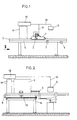
- FIG. 1 shows a schematic side view of the device according to the invention and FIG. 2 shows a view in the direction of arrow II in FIG. 1 shows a movable support 1 which carries burner 2.
- the burners 2 are water-cooled bundle burners, the flame direction of which is directed towards the head 3 of a rail 4.
- the burners are connected via gas lines 5 to a valve arrangement of a gas-oxygen mixing device which is shown schematically in FIG.
- limit switches 7 and 8 are arranged, which serve to limit the path of the support.
- Above the rail is a temperature measuring device 9, which is connected to a process computer 11 via signal lines 10.
- a display device for the measured temperature is designated by 12.
- the drive 13 for the support is arranged on the side next to the rail.
- the limit switches 7 and 8 for path limitation are also located in the area of the movable drive.
- the support can be moved on a table 14 and is supported on this table 14.
- the travel range of the support is usually limited to 600 to 900 mm, whereby the minimum travel path is usually chosen to be around 300 mm. Cooling in still air has proven to be sufficient to avoid undesired hardening and only to restore the state that prevailed before heating to the hot forming temperature.
Landscapes
- Chemical & Material Sciences (AREA)
- Engineering & Computer Science (AREA)
- Thermal Sciences (AREA)
- Crystallography & Structural Chemistry (AREA)
- Mechanical Engineering (AREA)
- Materials Engineering (AREA)
- Metallurgy (AREA)
- Organic Chemistry (AREA)
- Physics & Mathematics (AREA)
- Heat Treatment Of Articles (AREA)
- Screw Conveyors (AREA)
- Chutes (AREA)
- Feeding, Discharge, Calcimining, Fusing, And Gas-Generation Devices (AREA)
- Seats For Vehicles (AREA)
- Laying Of Electric Cables Or Lines Outside (AREA)
- Furnace Charging Or Discharging (AREA)
- Heat Treatments In General, Especially Conveying And Cooling (AREA)
- Manufacture And Refinement Of Metals (AREA)
- Paper (AREA)
- Excavating Of Shafts Or Tunnels (AREA)
- Underground Or Underwater Handling Of Building Materials (AREA)
- Electrical Discharge Machining, Electrochemical Machining, And Combined Machining (AREA)
- Machines For Laying And Maintaining Railways (AREA)
- Manufacturing Of Electrical Connectors (AREA)
- Railway Tracks (AREA)
Applications Claiming Priority (2)
| Application Number | Priority Date | Filing Date | Title |
|---|---|---|---|
| AT0088785A AT391707B (de) | 1985-03-25 | 1985-03-25 | Verfahren zum verhindern der eindellung von schienen im uebergangsbereich sowie vorrichtung zur durchfuehrung dieses verfahrens |
| AT887/85 | 1985-03-25 |
Publications (3)
| Publication Number | Publication Date |
|---|---|
| EP0199706A2 true EP0199706A2 (fr) | 1986-10-29 |
| EP0199706A3 EP0199706A3 (en) | 1987-05-13 |
| EP0199706B1 EP0199706B1 (fr) | 1990-03-14 |
Family
ID=3502117
Family Applications (1)
| Application Number | Title | Priority Date | Filing Date |
|---|---|---|---|
| EP86890076A Expired - Lifetime EP0199706B1 (fr) | 1985-03-25 | 1986-03-24 | Procédé et dispositif pour éviter le bosselage de rails dans la zone de transition entre l'extrémité et le profil de l'aiguille |
Country Status (9)
| Country | Link |
|---|---|
| EP (1) | EP0199706B1 (fr) |
| AT (2) | AT391707B (fr) |
| CS (1) | CS266577B2 (fr) |
| DD (1) | DD244990A5 (fr) |
| DE (1) | DE3669538D1 (fr) |
| HU (1) | HU195545B (fr) |
| NO (1) | NO161632C (fr) |
| PL (1) | PL145456B1 (fr) |
| YU (2) | YU44545B (fr) |
Family Cites Families (6)
| Publication number | Priority date | Publication date | Assignee | Title |
|---|---|---|---|---|
| GB448416A (en) * | 1933-09-06 | 1936-05-27 | Oxweld Railroad Service Compan | Improvements in or relating to the surface hardening of rails and to rails treated thereby |
| US2484897A (en) * | 1946-10-22 | 1949-10-18 | Linde Air Prod Co | Apparatus for heat-treating surfaces of rails |
| DE800867C (de) * | 1949-10-25 | 1950-12-11 | Deutsche Bundesbahn | Verfahren und Vorrichtung zum Beseitigen von Riffeln auf Schienen |
| BE626486A (fr) * | 1961-12-27 | |||
| DE2541978C3 (de) * | 1975-09-20 | 1978-08-24 | Butzbacher Weichenbau Gmbh, 6308 Butzbach | Verfahren zur Wärmebehandlung von Weichenteilen im Durchlaufverfahren |
| DE2821227C2 (de) * | 1978-05-16 | 1982-12-23 | Krupp Stahl Ag, 4630 Bochum | Verfahren zur Herstellung von Schienen mit verminderter Riffelbildung |
-
1985
- 1985-03-25 AT AT0088785A patent/AT391707B/de not_active IP Right Cessation
-
1986
- 1986-03-12 YU YU365/86A patent/YU44545B/xx unknown
- 1986-03-19 HU HU861158A patent/HU195545B/hu not_active IP Right Cessation
- 1986-03-19 CS CS861937A patent/CS266577B2/cs unknown
- 1986-03-21 NO NO861149A patent/NO161632C/no unknown
- 1986-03-24 DE DE8686890076T patent/DE3669538D1/de not_active Expired - Lifetime
- 1986-03-24 AT AT86890076T patent/ATE51036T1/de not_active IP Right Cessation
- 1986-03-24 EP EP86890076A patent/EP0199706B1/fr not_active Expired - Lifetime
- 1986-03-24 DD DD86288247A patent/DD244990A5/de not_active IP Right Cessation
- 1986-03-24 PL PL1986258590A patent/PL145456B1/pl unknown
-
1987
- 1987-09-04 YU YU1643/87A patent/YU44642B/xx unknown
Also Published As
| Publication number | Publication date |
|---|---|
| CS266577B2 (en) | 1990-01-12 |
| YU44545B (en) | 1990-08-31 |
| HUT43655A (en) | 1987-11-30 |
| HU195545B (en) | 1988-05-30 |
| PL145456B1 (en) | 1988-09-30 |
| CS193786A2 (en) | 1989-04-14 |
| YU36586A (en) | 1988-06-30 |
| EP0199706B1 (fr) | 1990-03-14 |
| NO161632B (no) | 1989-05-29 |
| NO161632C (no) | 1989-09-06 |
| EP0199706A3 (en) | 1987-05-13 |
| ATE51036T1 (de) | 1990-03-15 |
| NO861149L (no) | 1986-09-26 |
| YU44642B (en) | 1990-10-31 |
| DE3669538D1 (de) | 1990-04-19 |
| YU164387A (en) | 1988-12-31 |
| AT391707B (de) | 1990-11-26 |
| DD244990A5 (de) | 1987-04-22 |
| ATA88785A (de) | 1990-05-15 |
Similar Documents
| Publication | Publication Date | Title |
|---|---|---|
| EP2012948B1 (fr) | procédé de faconnage de platines en aciers à résistance élevée et très élevée | |
| EP0186373B1 (fr) | Procédé et dispositif pour le traitement thermique de rails | |
| EP3303642B1 (fr) | Procédé de refroidissement sans contact de tôles d'acier et dispositif à cet effet | |
| EP1412543B1 (fr) | Procede de refroidissement de pieces, en particulier de produits lamines profiles en acier qualite rail | |
| EP2106305B1 (fr) | Dispositif de dressage à la flamme | |
| EP2097544B1 (fr) | Procédé et dispositif de traitement thermique de cordons de soudure | |
| DE19619171C1 (de) | Verfahren zur Wärmebehandlung einer durch Zwischengußverschweißung hergestellten Schienenverbindung und Vorrichtung zur Durchführung des Verfahrens mit bestimmter Brenneranordnung | |
| DE2338514A1 (de) | Verfahren und vorrichtung zur laserstrahl-bearbeitung von werkstuecken | |
| CH668728A5 (de) | Verfahren und vorrichtung zum verbinden von werkstueckteilen. | |
| AT391707B (de) | Verfahren zum verhindern der eindellung von schienen im uebergangsbereich sowie vorrichtung zur durchfuehrung dieses verfahrens | |
| DE3501522C1 (de) | Verfahren zur Herstellung eigenspannungsarmer Stahlschienen mittels Rollenrichten | |
| DE3744044A1 (de) | Verfahren zur waermebehandlung der schweissnaht an laengsgeschweissten metallrohren und vorrichtung zur durchfuehrung des verfahrens | |
| EP0632137B1 (fr) | Procédé pour le prétraitement thermique de pièces métalliques | |
| WO2024141872A1 (fr) | Procédé et dispositif permettant de souder des composants praticables d'une voie, par soudage par étincelage | |
| CH621364A5 (en) | Process and equipment for the heat treatment of switch components | |
| EP0190448A1 (fr) | Procédé pour diminuer les tensions résiduelles de rails d'acier dressés par rouleaux | |
| EP0416356A2 (fr) | Installation pour la fabrication de bande en acier | |
| DE3016259C2 (de) | Verfahren zum Mehrlagen-Lichtbogenschweißen ferritischer, vergüteter Stähle und zum anschließenden Wärmebehandeln der Schweißstelle und Vorrichtung zur Durchführung des Verfahrens | |
| DE655383C (de) | Vorrichtung zur Waermebehandlung von durch Schweissen, Brennschneiden u. dgl. in ihrem Gefuege veraenderten oder zum Teil mit Spannung behafteten Zonen von Werkstuecken | |
| DE662453C (de) | Gluehverfahren zur Vorbereitung hartgebremster Schienenstahlraeder zum Abdrehen der abgeplatteten Radlaufflaeche | |
| AT248202B (de) | Verfahren und Vorrichtung zur Wärmebehandlung von Schienenverbindungs- und Auftragschweißungen | |
| DE1496004C (de) | Verfahren zum Tempern einer Glastafel | |
| DE2940826A1 (de) | Verfahren zur tiefenhaertung von werkstuecken sowie vorrichtung zur durchfuehrung dieses verfahrens | |
| DE2344234C3 (de) | Durchstoßofen zum Erwärmen von metallenen Werkstücken | |
| DE1004896B (de) | Verfahren und Vorrichtung zum Zusammenloeten von Koerpern mit unterschiedlichen Waermedehnungsbeiwerten |
Legal Events
| Date | Code | Title | Description |
|---|---|---|---|
| PUAI | Public reference made under article 153(3) epc to a published international application that has entered the european phase |
Free format text: ORIGINAL CODE: 0009012 |
|
| AK | Designated contracting states |
Kind code of ref document: A2 Designated state(s): AT BE CH DE FR GB IT LI LU NL SE |
|
| PUAL | Search report despatched |
Free format text: ORIGINAL CODE: 0009013 |
|
| AK | Designated contracting states |
Kind code of ref document: A3 Designated state(s): AT BE CH DE FR GB IT LI LU NL SE |
|
| 17P | Request for examination filed |
Effective date: 19870813 |
|
| 17Q | First examination report despatched |
Effective date: 19880915 |
|
| GRAA | (expected) grant |
Free format text: ORIGINAL CODE: 0009210 |
|
| AK | Designated contracting states |
Kind code of ref document: B1 Designated state(s): AT BE CH DE FR GB IT LI LU NL SE |
|
| REF | Corresponds to: |
Ref document number: 51036 Country of ref document: AT Date of ref document: 19900315 Kind code of ref document: T |
|
| ITF | It: translation for a ep patent filed | ||
| REF | Corresponds to: |
Ref document number: 3669538 Country of ref document: DE Date of ref document: 19900419 |
|
| GBT | Gb: translation of ep patent filed (gb section 77(6)(a)/1977) | ||
| ET | Fr: translation filed | ||
| PLBE | No opposition filed within time limit |
Free format text: ORIGINAL CODE: 0009261 |
|
| STAA | Information on the status of an ep patent application or granted ep patent |
Free format text: STATUS: NO OPPOSITION FILED WITHIN TIME LIMIT |
|
| 26N | No opposition filed | ||
| ITPR | It: changes in ownership of a european patent |
Owner name: CESSIONE;VOEST - ALPINE EISENBAHNSYSTEME GESELLSCH |
|
| REG | Reference to a national code |
Ref country code: GB Ref legal event code: 732 |
|
| REG | Reference to a national code |
Ref country code: CH Ref legal event code: PUE Owner name: VOEST-ALPINE EISENBAHNSYSTEME GESELLSCHAFT M.B.H. |
|
| REG | Reference to a national code |
Ref country code: FR Ref legal event code: TP |
|
| NLS | Nl: assignments of ep-patents |
Owner name: VOEST-ALPINE EISENBAHNSYSTEME GESELLSCHAFT M.B.H. |
|
| BECA | Be: change of holder's address |
Free format text: 920331 *VOEST-ALPINE EISENBAHNSYSTEME G.M.B.H.:FLORAGASSE 7, 1040 WIEN |
|
| ITTA | It: last paid annual fee | ||
| EPTA | Lu: last paid annual fee | ||
| EAL | Se: european patent in force in sweden |
Ref document number: 86890076.2 |
|
| PGFP | Annual fee paid to national office [announced via postgrant information from national office to epo] |
Ref country code: SE Payment date: 19960219 Year of fee payment: 11 |
|
| PGFP | Annual fee paid to national office [announced via postgrant information from national office to epo] |
Ref country code: NL Payment date: 19960222 Year of fee payment: 11 |
|
| PGFP | Annual fee paid to national office [announced via postgrant information from national office to epo] |
Ref country code: DE Payment date: 19960223 Year of fee payment: 11 |
|
| PG25 | Lapsed in a contracting state [announced via postgrant information from national office to epo] |
Ref country code: SE Effective date: 19970325 |
|
| PG25 | Lapsed in a contracting state [announced via postgrant information from national office to epo] |
Ref country code: NL Effective date: 19971001 |
|
| NLV4 | Nl: lapsed or anulled due to non-payment of the annual fee |
Effective date: 19971001 |
|
| PG25 | Lapsed in a contracting state [announced via postgrant information from national office to epo] |
Ref country code: DE Effective date: 19971202 |
|
| EUG | Se: european patent has lapsed |
Ref document number: 86890076.2 |
|
| PGFP | Annual fee paid to national office [announced via postgrant information from national office to epo] |
Ref country code: GB Payment date: 19980213 Year of fee payment: 13 Ref country code: FR Payment date: 19980213 Year of fee payment: 13 |
|
| PGFP | Annual fee paid to national office [announced via postgrant information from national office to epo] |
Ref country code: AT Payment date: 19980223 Year of fee payment: 13 |
|
| PGFP | Annual fee paid to national office [announced via postgrant information from national office to epo] |
Ref country code: CH Payment date: 19980224 Year of fee payment: 13 |
|
| PGFP | Annual fee paid to national office [announced via postgrant information from national office to epo] |
Ref country code: LU Payment date: 19980303 Year of fee payment: 13 |
|
| PGFP | Annual fee paid to national office [announced via postgrant information from national office to epo] |
Ref country code: BE Payment date: 19980320 Year of fee payment: 13 |
|
| PG25 | Lapsed in a contracting state [announced via postgrant information from national office to epo] |
Ref country code: LU Free format text: LAPSE BECAUSE OF NON-PAYMENT OF DUE FEES Effective date: 19990324 Ref country code: GB Free format text: LAPSE BECAUSE OF NON-PAYMENT OF DUE FEES Effective date: 19990324 Ref country code: AT Free format text: LAPSE BECAUSE OF NON-PAYMENT OF DUE FEES Effective date: 19990324 |
|
| PG25 | Lapsed in a contracting state [announced via postgrant information from national office to epo] |
Ref country code: LI Free format text: LAPSE BECAUSE OF NON-PAYMENT OF DUE FEES Effective date: 19990331 Ref country code: CH Free format text: LAPSE BECAUSE OF NON-PAYMENT OF DUE FEES Effective date: 19990331 Ref country code: BE Free format text: LAPSE BECAUSE OF NON-PAYMENT OF DUE FEES Effective date: 19990331 |
|
| BERE | Be: lapsed |
Owner name: VOEST-ALPINE EISENBAHNSYSTEME G.M.B.H. Effective date: 19990331 |
|
| REG | Reference to a national code |
Ref country code: CH Ref legal event code: PL |
|
| GBPC | Gb: european patent ceased through non-payment of renewal fee |
Effective date: 19990324 |
|
| PG25 | Lapsed in a contracting state [announced via postgrant information from national office to epo] |
Ref country code: FR Free format text: LAPSE BECAUSE OF NON-PAYMENT OF DUE FEES Effective date: 19991130 |
|
| REG | Reference to a national code |
Ref country code: FR Ref legal event code: ST |
|
| PG25 | Lapsed in a contracting state [announced via postgrant information from national office to epo] |
Ref country code: IT Free format text: LAPSE BECAUSE OF NON-PAYMENT OF DUE FEES;WARNING: LAPSES OF ITALIAN PATENTS WITH EFFECTIVE DATE BEFORE 2007 MAY HAVE OCCURRED AT ANY TIME BEFORE 2007. THE CORRECT EFFECTIVE DATE MAY BE DIFFERENT FROM THE ONE RECORDED. Effective date: 20050324 |