EP0200149A2 - 1,3-Dioxan-5-yl alkyl triazoles, their preparation, their use as plant growth regulators and compositions therefor - Google Patents
1,3-Dioxan-5-yl alkyl triazoles, their preparation, their use as plant growth regulators and compositions therefor Download PDFInfo
- Publication number
- EP0200149A2 EP0200149A2 EP86105586A EP86105586A EP0200149A2 EP 0200149 A2 EP0200149 A2 EP 0200149A2 EP 86105586 A EP86105586 A EP 86105586A EP 86105586 A EP86105586 A EP 86105586A EP 0200149 A2 EP0200149 A2 EP 0200149A2
- Authority
- EP
- European Patent Office
- Prior art keywords
- formula
- methyl
- compounds
- alkyl
- plant growth
- Prior art date
- Legal status (The legal status is an assumption and is not a legal conclusion. Google has not performed a legal analysis and makes no representation as to the accuracy of the status listed.)
- Granted
Links
- 0 C*C1(*)COC(*)OC1 Chemical compound C*C1(*)COC(*)OC1 0.000 description 1
- MWZDIEIXRBWPLG-UHFFFAOYSA-N C[n]1ncnc1 Chemical compound C[n]1ncnc1 MWZDIEIXRBWPLG-UHFFFAOYSA-N 0.000 description 1
Classifications
-
- C—CHEMISTRY; METALLURGY
- C07—ORGANIC CHEMISTRY
- C07D—HETEROCYCLIC COMPOUNDS
- C07D231/00—Heterocyclic compounds containing 1,2-diazole or hydrogenated 1,2-diazole rings
- C07D231/02—Heterocyclic compounds containing 1,2-diazole or hydrogenated 1,2-diazole rings not condensed with other rings
- C07D231/10—Heterocyclic compounds containing 1,2-diazole or hydrogenated 1,2-diazole rings not condensed with other rings having two or three double bonds between ring members or between ring members and non-ring members
- C07D231/12—Heterocyclic compounds containing 1,2-diazole or hydrogenated 1,2-diazole rings not condensed with other rings having two or three double bonds between ring members or between ring members and non-ring members with only hydrogen atoms, hydrocarbon or substituted hydrocarbon radicals, directly attached to ring carbon atoms
-
- A—HUMAN NECESSITIES
- A01—AGRICULTURE; FORESTRY; ANIMAL HUSBANDRY; HUNTING; TRAPPING; FISHING
- A01N—PRESERVATION OF BODIES OF HUMANS OR ANIMALS OR PLANTS OR PARTS THEREOF; BIOCIDES, e.g. AS DISINFECTANTS, AS PESTICIDES OR AS HERBICIDES; PEST REPELLANTS OR ATTRACTANTS; PLANT GROWTH REGULATORS
- A01N43/00—Biocides, pest repellants or attractants, or plant growth regulators containing heterocyclic compounds
- A01N43/64—Biocides, pest repellants or attractants, or plant growth regulators containing heterocyclic compounds having rings with three nitrogen atoms as the only ring hetero atoms
- A01N43/647—Triazoles; Hydrogenated triazoles
- A01N43/653—1,2,4-Triazoles; Hydrogenated 1,2,4-triazoles
-
- C—CHEMISTRY; METALLURGY
- C07—ORGANIC CHEMISTRY
- C07D—HETEROCYCLIC COMPOUNDS
- C07D233/00—Heterocyclic compounds containing 1,3-diazole or hydrogenated 1,3-diazole rings, not condensed with other rings
- C07D233/54—Heterocyclic compounds containing 1,3-diazole or hydrogenated 1,3-diazole rings, not condensed with other rings having two double bonds between ring members or between ring members and non-ring members
- C07D233/56—Heterocyclic compounds containing 1,3-diazole or hydrogenated 1,3-diazole rings, not condensed with other rings having two double bonds between ring members or between ring members and non-ring members with only hydrogen atoms or radicals containing only hydrogen and carbon atoms, attached to ring carbon atoms
-
- C—CHEMISTRY; METALLURGY
- C07—ORGANIC CHEMISTRY
- C07D—HETEROCYCLIC COMPOUNDS
- C07D249/00—Heterocyclic compounds containing five-membered rings having three nitrogen atoms as the only ring hetero atoms
- C07D249/02—Heterocyclic compounds containing five-membered rings having three nitrogen atoms as the only ring hetero atoms not condensed with other rings
- C07D249/08—1,2,4-Triazoles; Hydrogenated 1,2,4-triazoles
-
- C—CHEMISTRY; METALLURGY
- C07—ORGANIC CHEMISTRY
- C07D—HETEROCYCLIC COMPOUNDS
- C07D319/00—Heterocyclic compounds containing six-membered rings having two oxygen atoms as the only ring hetero atoms
- C07D319/04—1,3-Dioxanes; Hydrogenated 1,3-dioxanes
- C07D319/06—1,3-Dioxanes; Hydrogenated 1,3-dioxanes not condensed with other rings
Definitions
- the invention relates to new 1,3-dioxan-5-yl-alkyltriazoles, processes for their preparation, agents for regulating plant growth with these compounds.
- the effect of the compounds known as growth regulators is in need of improvement with regard to the application rate, lack of side effects and morphospecific effect.
- the present invention relates to both the diastereomer (mixtures) and the uniform enantiomers obtainable in a known manner.
- R 'and R 2 are preferably hydrogen, methyl, ethyl, n-propyl, isopropyl, n-butyl, sec-butyl, iso-butyl, tert-butyl, n-pentyl and neopentyl.
- X m - is preferably hydrogen, 2-fluorine, 4-fluorine, 2-chloro, 3-chloro, 4-chloro, 4-bromo, 2,4-dichloro, 2,6-dichloro , 3,4-dichloro, 2,4,6-trichloro, 2-chloro-4-methyl, 2-methyl-4-chloro, 2-methyl, 3-methyl, 4-methyl, 4-ethyl, 4-isopropyl, 4-tert-butyl, 2,4-dimethyl, 2,4,6-trimethyl, 2-methoxy. 4-methyl, 2-methoxy, 4-methoxy, 4-ethoxy, 2-trifluoromethyl, 4-trifluoromethyl, 4-cyano, 4-nitro, 4-phenyl.
- the reactions a) and b) can be carried out in a known manner by the analogy process, as can the reduction of the ketone to alcohol.
- the corresponding reactants are partly known (cf. EP 069 290 or DE-OS 30 25 879).
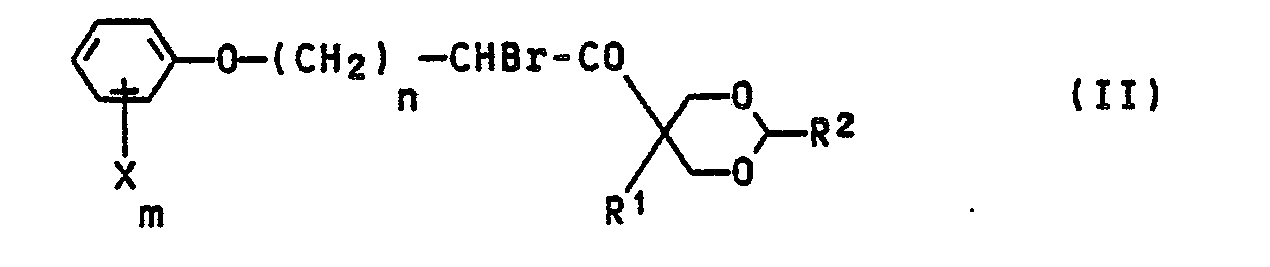
- the bromoketones of formula II are new compounds. You can, for example, by bromination of corresponding compounds of the formula V, with bromine in formamide (H. Bredereck et al., Chem. Ber. 93, 2083 (1960)) or with dioxane-dibromide - (SJ Pasariber and LR Williams, Aust. J. Chem. 26, 1327 (1973)) or with the complex - (pyrrolidone) 3 • HBR • Br2 (DC Awang et al., Can.J. Chem. 47, 706 (1969)).
- the 1- (1,3-dioxan-5-yl) -2- (1,2,4-triazolyl- (1)) - ethan-1-ones of the formula IV can be obtained, for example, by reacting corresponding 2-halo-1 (2,5-dialkyl-1,3-dioxan-5-yl) -ethan-1-ones of the formula VI can be obtained with 1,2,4-triazole or its alkali salt in a suitable solvent.
- halogen ketones of the formula VI are obtained, for example, by bromination of known (1,3-dioxan-5-yl) ethan-1-ones of the formula VII in which R 'and R 2 have the meanings given above, for example with the pyrrolidone-bromine complex according to DP Wyman and PR Kaufmann, J.Org.Chem. 29, 1956 (1964).
- the resulting alcohols of the formula I contain a considerably higher proportion of the diastereomers with R *, S * configuration than those with R *, R * configuration.
- the proportion of R *, R * diastereomers in the mixture is generally well below 30%.
- Pure R * , S * diastereomers can be obtained from this by simply washing the crude products with suitable solvents, such as, for example, diisopropyl ether, or by recrystallization or by other, conventional purification steps, for example chromatography.
- the resulting alcohols contain a considerably higher proportion of the diastereomers with R *, R * configuration.
- a solution of 8.0 g (0.021 mol) of 1- (5-methyl-1) is added dropwise under nitrogen to the solution of about 0.06 mol of n-propyl magnesium bromide prepared in the customary manner in 100 ml of dry tetrahydrofuran at reflux temperature with stirring , 3-dioxan-5-yl) -6- (2-fluorophenoxy) hexan-1-one in 100 ml of dry tetrahydrofuran.
- the mixture is heated under reflux for a further 5 hours. Then it is hydrolyzed dropwise at 0 ° C. with 50 ml of water and mixed with 50 ml of concentrated ammonium chloride solution.
- R * diastereomers e.g. serve that in the '-H-NMR spectrum, the signal for the 3 protons of the methyl group on the dioxanyl residue occurs at 0.1 to 0.2 ppm, while it occurs in the R *, S * diastereomers at 0.8 to 1.0 ppm is.
- Test plants were used to determine the growth-regulating property of the test substances.
- culture substrate adequately supplied with nutrients in plastic vessels of approx. 12.5 cm diameter.
- Chlorcholine chloride and the active substances referred to below as B, C and D served as reference substances.
- the color intensity of the leaves increased in line with the reduction in length growth.
- the increased chlorophyll content also suggests an increased photosynthesis rate and thus increased yield formation.
Landscapes
- Chemical & Material Sciences (AREA)
- Organic Chemistry (AREA)
- Life Sciences & Earth Sciences (AREA)
- Agronomy & Crop Science (AREA)
- Pest Control & Pesticides (AREA)
- Plant Pathology (AREA)
- Health & Medical Sciences (AREA)
- Engineering & Computer Science (AREA)
- Dentistry (AREA)
- General Health & Medical Sciences (AREA)
- Wood Science & Technology (AREA)
- Zoology (AREA)
- Environmental Sciences (AREA)
- Agricultural Chemicals And Associated Chemicals (AREA)
- Plural Heterocyclic Compounds (AREA)
- Heterocyclic Compounds That Contain Two Or More Ring Oxygen Atoms (AREA)
Abstract
Verbindungen der Formel I

- R' und R2 verschieden oder gleich sind und Wasserstoff oder Alkyl mit 1 bis 5 C-Atomen bedeuten,
- X (m = null bis 5) gleiche oder verschiedene Substituenten, ausgewählt aus Halogen, Cyano, Trifluormethyl, Nitro, C1-C4-Alkyl, C1-C4-Alkoxy, gegebenenfalls substituiertes Phenyl oder Wasserstoff bedeuten,
- n eine ganze Zahl von 2 bis 6 und
- Y die -CO-oder die -CH(OH)-Gruppe bedeutet,
deren Vorprodukte der Formel (II)

- R 'and R 2 are different or identical and denote hydrogen or alkyl having 1 to 5 carbon atoms,
- X (m = zero to 5) are identical or different substituents selected from halogen, cyano, trifluoromethyl, nitro, C 1 -C 4 alkyl, C 1 -C 4 alkoxy, optionally substituted phenyl or hydrogen,
- n is an integer from 2 to 6 and
- Y represents the -CO or the -CH (OH) group,
their precursors of formula (II)
Description
Die Erfindung betrifft neue 1,3-Dioxan-5-yl-al- kyltriazole, Verfahren zu ihrer Herstellung, Mittel zur Regulierung des Pflanzenwachstums mit diesen Verbindungen.The invention relates to new 1,3-dioxan-5-yl-alkyltriazoles, processes for their preparation, agents for regulating plant growth with these compounds.
Es ist bekannt, daß bestimmte 2-Halogenethyltrialkylammonium-halogenide pflanzenwachstumsregulierende Eigenschaften aufweisen (vgl. US-PS 3 156 554). So läßt sich mit Hilfe von (2-Chlorethyl)-trimethylammoniumchlorid das Pflanzenwachstum beeinflussen. Allerdings ist die Wirksamkeit dieses Stoffes, vor allem bei niedrigen Aufwandmengen nicht immer befriedigend.It is known that certain 2-haloethyltrialkylammonium halides have plant growth regulating properties (see US Pat. No. 3,156,554). Plant growth can be influenced with the help of (2-chloroethyl) trimethylammonium chloride. However, the effectiveness of this substance is not always satisfactory, especially at low application rates.
Es ist ferner bekannt, 3,3-Dimethyl-2-(1,2,4-triazol-1-yl)-1-(4-Chlorbenzoyl)-butan zur Regulierung des Pflanzenwachstums zu verwenden (DE-OS 2 739 352).It is also known to use 3,3-dimethyl-2- (1,2,4-triazol-1-yl) -1- (4-chlorobenzoyl) butane to regulate plant growth (DE-OS 2 739 352) .
Weiterhin ist die pflanzenwachstumsregulierende Wirkung von 3,3-Dimethyl-2-(1,2,4-triazol-1-yl)-1-methyl-1-(4-Chlorbenzoyl)-butan (DE-OS 29 21 168) und von 1-(5-Methyl-1,3-dioxan-5-yl)-2-(1,2,4-triazol-1-yl)-3-(4-trifluormethylphenyl-propen-1-ol (DE-OS 30 26 140) bekannt.Furthermore, the plant growth-regulating effect of 3,3-dimethyl-2- (1,2,4-triazol-1-yl) -1-methyl-1- (4-chlorobenzoyl) butane (DE-OS 29 21 168) and of 1- (5-methyl-1,3-dioxan-5-yl) -2- (1,2,4-triazol-1-yl) -3- (4-trifluoromethylphenyl-propen-1-ol (DE- OS 30 26 140) is known.
Die Wirkung der als wachstumsregulierend bekannten Verbindungen ist, mindestens bei bestimmten Zielorganismen, hinsichtlich Aufwandmenge, Nebenwirkungsarmut und morphospezifischer Wirkung verbesserungsbedürftig.The effect of the compounds known as growth regulators, at least in the case of certain target organisms, is in need of improvement with regard to the application rate, lack of side effects and morphospecific effect.
Es wurde nun gefunden, daß Verbindungen der Formel I
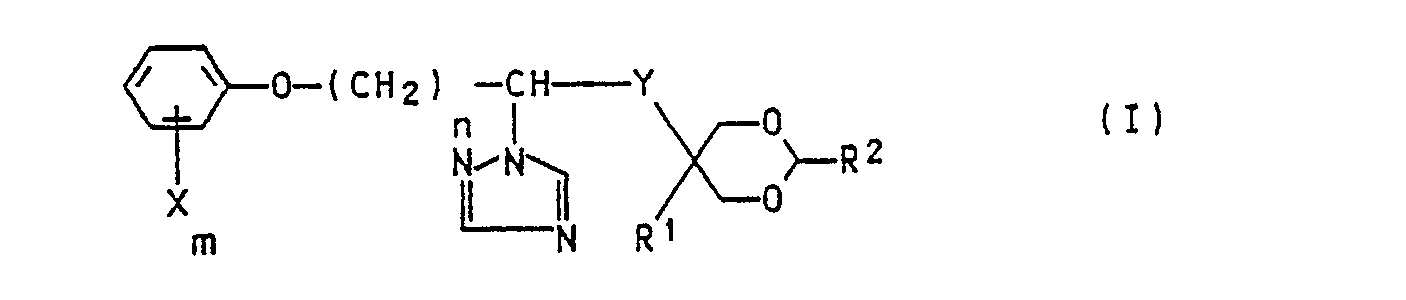
- R' und R2 verschieden oder gleich sind und Wasserstoff oder Alkyl mit 1 bis 5 C-Atomen bedeuten,
- X (m = null bis 5) gleiche oder verschiedene Substituenten, ausgewählt aus Halogen, Cyano, Trifluormethyl, Nitro, C,-C4-Alkyl, C,-C4-Alkoxy, gegebenenfalls substituiertes Phenyl oder Wasserstoff bedeuten,
- n eine ganze Zahl von 2 bis 6 und
- Y die -CO-oder die -CH(OH)-Gruppe bedeutet,
hervorragend zur Beeinflussung des Pflanzenwachstums geeignet sind und eine sehr gute Pflanzenverträglichkeit besitzen; im letzteren Fall handelt es sich um Diastereomere mit jeweils zwei Antipodenpaaren (Enantiomeren), die an den beiden Chiralitätszentren die Konfiguration R*, S* oder R*,R* haben können (vgl. D. Seebach und V. Prelog, Angew. Chem. 94, 696 (1982) und dort angegebene Literatur).It has now been found that compounds of the formula I
- R 'and R 2 are different or identical and denote hydrogen or alkyl having 1 to 5 carbon atoms,
- X (m = zero to 5) are identical or different substituents selected from halogen, cyano, trifluoromethyl, nitro, C, -C4-alkyl, C, -C 4 -alkoxy, optionally substituted phenyl or hydrogen,
- n is an integer from 2 to 6 and
- Y represents the -CO or the -CH (OH) group,
are excellent for influencing plant growth and are very well tolerated by plants; in the latter case they are diastereomers, each with two pairs of antipodes (enantiomers), which can have the configuration R * , S * or R *, R * at the two chiral centers (cf. D. Seebach and V. Prelog, Angew. Chem 94, 696 (1982) and literature cited there).
Gegenstand der vorliegenden Erfindung sind sowohl die Diastereomeren-(gemische) als auch die auf bekannte Weise erhältlichen, einheitlichen Enantiomeren.The present invention relates to both the diastereomer (mixtures) and the uniform enantiomers obtainable in a known manner.
R' und R2 bedeuten bevorzugt Wasserstoff, Methyl, Ethyl, n-Propyl, Isopropyl, n-Butyl, sek.-Butyl, iso-Butyl, tert.-Butyl, n-Pentyl und Neopentyl.R 'and R 2 are preferably hydrogen, methyl, ethyl, n-propyl, isopropyl, n-butyl, sec-butyl, iso-butyl, tert-butyl, n-pentyl and neopentyl.
Xm- ist bevorzugt Wasserstoff, 2-Fluor-, 4-Fluor-, 2-Chlor-, 3-Chlor-, 4-Chlor-, 4-Brom-, 2,4-Dichlor-, 2,6-Dichlor-, 3,4-Dichlor-, 2,4,6-Trichlor-, 2-Chlor-4-methyl-, 2-Methyl-4-chlor-, 2-Methyl-, 3-Methyl-, 4-Methyl-, 4-Ethyl-, 4-lsopropyl-, 4-tert.-Butyl-, 2,4-Dimethyl-, 2,4,6-Trimethyl-, 2-Methoxy- . 4-methyl-, 2-Methoxy-, 4-Methoxy-, 4-Ethoxy-, 2-Trifluormethyl-, 4-Trifluormethyl-, 4-Cyano-, 4-Nitro- , 4-Phenyl-.X m - is preferably hydrogen, 2-fluorine, 4-fluorine, 2-chloro, 3-chloro, 4-chloro, 4-bromo, 2,4-dichloro, 2,6-dichloro , 3,4-dichloro, 2,4,6-trichloro, 2-chloro-4-methyl, 2-methyl-4-chloro, 2-methyl, 3-methyl, 4-methyl, 4-ethyl, 4-isopropyl, 4-tert-butyl, 2,4-dimethyl, 2,4,6-trimethyl, 2-methoxy. 4-methyl, 2-methoxy, 4-methoxy, 4-ethoxy, 2-trifluoromethyl, 4-trifluoromethyl, 4-cyano, 4-nitro, 4-phenyl.
Die neuen Verbindungen lassen sich herstellen, indem man
- a) 1,2,4-Triazol mit einem entsprechenden a-Bromketon der Formel II

- b) ein entsprechendes Aryloxyalkylhalogenid der Formel 111


- a) 1,2,4-triazole with a corresponding a-bromoketone of the formula II
- b) a corresponding aryloxyalkyl halide of the formula 111
Die Umsetzungen a) und b) können im Wege des Analogieverfahrens auf bekannte Weise vorgenommen werden, ebenso die Reduktion des Ketons zum Alkohol. Die entsprechenden Reaktionsteilnehmer sind z.T. bekannt (vgl. EP 069 290 bzw. DE-OS 30 25 879).The reactions a) and b) can be carried out in a known manner by the analogy process, as can the reduction of the ketone to alcohol. The corresponding reactants are partly known (cf. EP 069 290 or DE-OS 30 25 879).
Die Bromketone der Formel II sind neue Verbindungen. Sie können z.B. durch Bromierung entsprechender Verbindungen der Formel V,

Die 1-(1,3-Dioxan-5-yl)-2-(1,2,4-triazolyl-(1))-ethan-1-one der Formel IV können beispielsweise durch Umsetzung von entsprechenden 2-Halogen-1(2,5-dialkyl-1.3-dioxan-5-yl)-ethan-1-onen der Formel VI
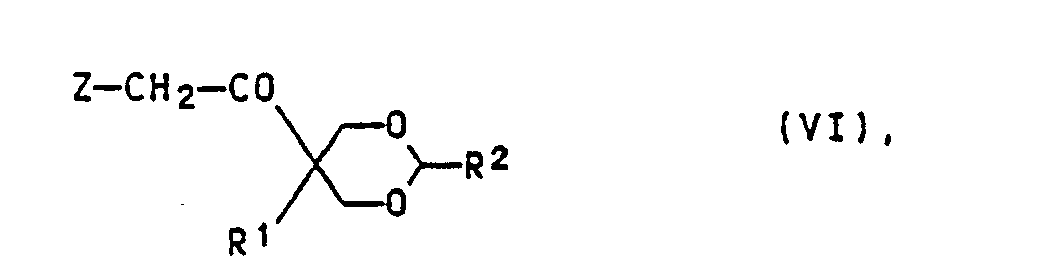
Die Halogenketone der Formel VI erhält man z.B. durch Bromierung von bekannten (1,3-Dioxan-5-yl)-ethan-1-onen der Formel VII

Die gemäß a) oder b) erhaltenen Ketone lassen sich, wenn gewünscht, stereoselektiv reduzieren und zwar in bekannter Weise
- a) mit sekundären Alkoholaten (EP-A-11 191) oder
- b) mit Alkylmagnesiumhalogeniden, die einen Alkylrest mit 2 bis 6 C-Atomen und einem betaständigen Wasserstoffatom im Alkylrest enthalten (vgl. O.Z. 0050/36557) oder
- c) mit Wasserstoff in Gegenwart von Ruthenium oder Rutheniumderivaten, insbesondere Rutheniumoxidhydrat (vgl. O.Z. 0050/36557).
- a) with secondary alcoholates (EP-A-11 191) or
- b) with alkylmagnesium halides containing an alkyl radical with 2 to 6 carbon atoms and a hydrogen atom in the alkyl radical (see OZ 0050/36557) or
- c) with hydrogen in the presence of ruthenium or ruthenium derivatives, in particular ruthenium oxide hydrate (cf. OZ 0050/36557).
Die resultierenden Alkohole der Formel I enthalten einen erheblich höheren Anteil der Diastereomeren mit R*,S*-Konfiguration als derjenigen mit R*,R*-Konfiguration. Der Anteil der R*,R*-Diastereomeren im Gemisch liegt in der Regel weit unter 30 %. Reine R*,S*-Diastereomeren können daraus durch einfaches Waschen der Rohprodukte mit geeigneten Lösungsmitteln, wie z.B. Diisopropylether, oder durch Umkristallisieren oder durch andere, übliche Reinigungsschritte, z.B. Chromatographie, erhalten werden.The resulting alcohols of the formula I contain a considerably higher proportion of the diastereomers with R *, S * configuration than those with R *, R * configuration. The proportion of R *, R * diastereomers in the mixture is generally well below 30%. Pure R * , S * diastereomers can be obtained from this by simply washing the crude products with suitable solvents, such as, for example, diisopropyl ether, or by recrystallization or by other, conventional purification steps, for example chromatography.
Bei der -an sich ebenfalls bekannten -Methode der diastereoselektiven Reduktion der Ketone mit komplexen Hydriden, bevorzugt Natriumborhydrid, enthalten die resultierenden Alkohole einen erheblich höheren Anteil der Diastereomeren mit R*,R*-Konfiguration.In the - also known per se - method of diastereoselective reduction of the ketones with complex hydrides, preferably sodium borohydride, the resulting alcohols contain a considerably higher proportion of the diastereomers with R *, R * configuration.
- aa) Zu einer Lösung von 144 g (1 mol) 5-Acetyl-5-methyl-1,3-dioxan und 85,5 g (1 mol) Pyrrolidon in 500 ml Tetrahydrofuran wird in 2 Stunden bei 50°C die Lösung von 498 g (1 mol) Pyrrolidon-Brom-Komplex in 1 I Tetrahydrofuran zugetropft. Nach achtstündigem Nachrühren bei 50°C wird der weiße Niederschlag von Pyrrolidon-Hydrobromid abgesaugt, mit 50 ml Tetrahydrofuran gewaschen und das Filtrat im Vakuum eingeengt. Man erhält 220 g (99 %) rohes, öliges 1-(5-Methyl-1,3-dioxan-5-yl)-2-brom-ethan-1-on.aa) To a solution of 144 g (1 mol) of 5-acetyl-5-methyl-1,3-dioxane and 85.5 g (1 mol) of pyrrolidone in 500 ml of tetrahydrofuran is the solution of in 2 hours at 50 ° C. 498 g (1 mol) of pyrrolidone-bromine complex were added dropwise in 1 liter of tetrahydrofuran. After stirring for eight hours at 50 ° C., the white precipitate of pyrrolidone hydrobromide is filtered off, washed with 50 ml of tetrahydrofuran and the filtrate is concentrated in vacuo. 220 g (99%) of crude, oily 1- (5-methyl-1,3-dioxan-5-yl) -2-bromo-ethan-1-one are obtained.
- ab) Zu einer unter Stickstoff gehaltenen Suspension von 110,1 g (1,1 mol) Natrium-1,2,4-triazolid in 300 ml trockenem Tetrahydrofuran wird unter Rühren die Lösung von 223 g (1 mol) 1-(5-Methyl-1,3-dioxan-5-yl)-2-brom-ethan-1-on in 200 ml Tetrahydrofuran bei 25°C in 2 Stunden zugetropft. Nach achtstündigem Erhitzen unter Rückfluß wird der anorganische Niederschlag abfiltriert und das Filtrat zur Hälfte eingeengt.ab) To a suspension of 110.1 g (1.1 mol) sodium 1,2,4-triazolide in 300 ml dry tetrahydrofuran kept under nitrogen, the solution of 223 g (1 mol) 1- (5- Methyl-1,3-dioxan-5-yl) -2-bromo-ethan-1-one in 200 ml of tetrahydrofuran was added dropwise at 25 ° C. in 2 hours. After heating under reflux for eight hours, the inorganic precipitate is filtered off and the filtrate is evaporated in half.
Das Gemisch wird angeimpft und über Nacht bei +3°C stehengelassen. Der Niederschlag wird abgesaugt, mit 30 ml kaltem (+5°C) Tetrahydrofuran, dann mit 80 ml Ether und anschließend mit 100 ml n-Pentan gewaschen und getrocknet. Man erhält 184 g (87,2 %) 1-(5-Methyl-1,3-dioxan-5-yl)-2-(1,2,4-triazolyl-(1))-ethan-1- on als weiße Kristalle vom Schmelzpunkt 95 bis 97°C.The mixture is inoculated and left overnight at +3 ° C. The precipitate is filtered off, washed with 30 ml of cold (+ 5 ° C) tetrahydrofuran, then with 80 ml of ether and then with 100 ml of n-pentane and dried. 184 g (87.2%) of 1- (5-methyl-1,3-dioxan-5-yl) -2- (1,2,4-triazolyl- (1)) - ethan-1-one are obtained as white crystals with a melting point of 95 to 97 ° C.
Zu einer unter Stickstoff gehaltenen Suspension von 5,3 g (0,22 mol) Natriumhydrid in 50 ml absolutem Dimethylformamid wird unter Rühren die Lösung von 42,2 g (0,2 mol) 1-(5-Methyl-1,3-dioxan-5-yl)-2-(1,2,4-triazolyl-(1))-ethan-1-on in 150 ml absolutem Dimethylformamid bei 20 bis 25°C zugetropft. Nach dreistOndigem Nachrühren wird bei 60°C die Lösung von 49,4 g (0,2 mol) 1-Brom-4-(2-fluorphe- noxy)-butan in 50 ml absolutem Dimethylformamid zugetropft. Anschließend wird das Reaktionsgemisch weitere 5 Stunden unter Rückfluß erhitzt. Bei Raumtemperatur werden dann etwa 100 ml Eiswasser vorsichtig zugetropft. Es wird dreimal mit je 300 ml Methylenchlorid extrahiert. Die organische Phase wird anschließend mehrmals mit Wasser gewaschen, über Na2S04 getrocknet und eingeengt. Nach der Destillation (Kp0.005 = 248°C) erhält man 56 g (74 %) 1-(5-Methyl-1,3-dioxan-5-yl)-2-(1,2,4-triazol-1-yl)-6-(2- fluorphenoxy)-hexan-1-on als gelbliches Harz.To a suspension of 5.3 g (0.22 mol) of sodium hydride in 50 ml of absolute dimethylformamide kept under nitrogen, the solution of 42.2 g (0.2 mol) of 1- (5-methyl-1,3- dioxan-5-yl) -2- (1,2,4-triazolyl- (1)) - ethan-1-one in 150 ml of absolute dimethylformamide was added dropwise at 20 to 25 ° C. After stirring for three hours at 60 ° C., the solution of 49.4 g (0.2 mol) of 1-bromo-4- (2-fluorophenoxy) butane in 50 ml of absolute dimethylformamide is added dropwise. The reaction mixture is then refluxed for a further 5 hours. About 100 ml of ice water are then carefully added dropwise at room temperature. It is extracted three times with 300 ml of methylene chloride. The organic phase is then washed several times with water, dried over Na2S04 and concentrated. After distillation (bp 0.005 = 248 ° C.), 56 g (74%) of 1- (5-methyl-1,3-dioxan-5-yl) -2- (1,2,4-triazol-1-) are obtained. yl) -6- (2-fluorophenoxy) hexan-1-one as a yellowish resin.
Zu einer Lösung von 24,5 g (0,065 mol) 1-(5-Methyt-1,3-dioxan-5-yl)-2-(1,2,4-triazo)-1-yl)-6-(2-fluorophenoxy)-hexan-1-on in 300 ml Methanol werden zwischen 0 und +5°C 3,0 g (0,078 mol) Natriumborhydrid portionsweise zugegeben. Nach fünfstündigem Rühren unter Rückfluß wird eingeengt, der Rückstand zwischen 400 ml Ether und 200 ml Wasser verteilt, die etherische Lösung dreimal mit 200 ml Wasser gewaschen, über Natriumsulfat getrocknet und wiederum eingeengt. Es wird über eine Kieselgelsäule mit Methylenchlorid/Aceton (9:1) chromatographiert und das Lösungsmittel entfernt. Man erhält 13,2 g - (54 %) des diastereomerenreinen Produktes als weiße Kristallmasse (Fp. = 87 bis 89°C).To a solution of 24.5 g (0.065 mol) of 1- (5-methyl-1,3-dioxan-5-yl) -2- (1,2,4-triazo) -1-yl) -6- ( 2-fluorophenoxy) -hexan-1-one in 300 ml of methanol are added in portions between 0 and +5 ° C 3.0 g (0.078 mol) of sodium borohydride. After stirring under reflux for five hours, the mixture is concentrated, the residue is partitioned between 400 ml of ether and 200 ml of water, the ethereal solution is washed three times with 200 ml of water, dried over sodium sulfate and again concentrated. It is chromatographed on a silica gel column with methylene chloride / acetone (9: 1) and the solvent is removed. 13.2 g - (54%) of the diastereomerically pure product are obtained as a white crystal mass (mp. = 87 to 89 ° C.).
Unter Stickstoff tropft man zur Lösung von ca. 0,06 mol auf die übliche Weise hergestelltem n-Propylmagnesiumbromid in 100 ml trockenem Tetrahydrofuran bei Rückflußtemperatur unter Rühren - eine Lösung von 8,0 g (0,021 mol) 1-(5-Methyl-1,3-dioxan-5-yl)-6-(2-fluorphenoxy)-hexan-1-on in 100 ml trockenem Tetrahydrofuran. Man erhitzt die Mischung nach vollständiger Zugabe noch weitere 5 Stunden unter Rückfluß. Anschließend wird bei 0°C tropfenweise mit 50 ml Wasser hydrolysiert und mit 50 ml konzentrierter Ammoniumchloridlösung versetzt. Es wird dreimal mit je 200 ml Diethylether extrahiert, mit Wasser neutral gewaschen und über Magnesiumsulfat getrocknet. Man chromatographiert über eine Kieselgelsäule mit Methylenchlorid/Aceton (9:1) und erhält 3,5 g (44 %) des diastereomerenreinen Produktes als hellgelbes ÖI.A solution of 8.0 g (0.021 mol) of 1- (5-methyl-1) is added dropwise under nitrogen to the solution of about 0.06 mol of n-propyl magnesium bromide prepared in the customary manner in 100 ml of dry tetrahydrofuran at reflux temperature with stirring , 3-dioxan-5-yl) -6- (2-fluorophenoxy) hexan-1-one in 100 ml of dry tetrahydrofuran. After the addition is complete, the mixture is heated under reflux for a further 5 hours. Then it is hydrolyzed dropwise at 0 ° C. with 50 ml of water and mixed with 50 ml of concentrated ammonium chloride solution. It is extracted three times with 200 ml of diethyl ether, washed neutral with water and dried over magnesium sulfate. It is chromatographed on a silica gel column with methylene chloride / acetone (9: 1) and 3.5 g (44%) of the diastereomerically pure product are obtained as a light yellow oil.
'H-NMR (80 MHz/CDCI): 5 = 0,9 (s, 3H), 1,0-1,4 (m, 2H), 2,8 (m, 2H), 2,0-2,1 (m, 2H), 3,4 (2d, 2H), 3,8-4,2 (m, 6H), 4,6-4,7 (m, 2H), 4,95 (d, 1H), 6,8-7,1 (m, 4H), 7,95 (s, 1H), 8,15 (s, 1 H).'H NMR (80 MHz / CDCI): 5 = 0.9 (s, 3H), 1.0-1.4 (m, 2H), 2.8 (m, 2H), 2.0-2, 1 (m, 2H), 3.4 (2d, 2H), 3.8-4.2 (m, 6H), 4.6-4.7 (m, 2H), 4.95 (d, 1H) , 6.8-7.1 (m, 4H), 7.95 (s, 1H), 8.15 (s, 1H).
Als Erkennungsmerkmal für die R*,R*-Diastereomeren kann z.B. dienen, daß im '-H-NMR-Spektrum das Signal für die 3 Protonen der Methylgruppe am Dioxanylrest bei 0,1 bis 0,2 ppm auftritt, während es beim R*,S*-Diastereomeren bei 0,8 bis 1,0 ppm liegt.As a distinguishing feature for the R *, R * diastereomers, e.g. serve that in the '-H-NMR spectrum, the signal for the 3 protons of the methyl group on the dioxanyl residue occurs at 0.1 to 0.2 ppm, while it occurs in the R *, S * diastereomers at 0.8 to 1.0 ppm is.
Unter entsprechender Abwandlung der vorstehenden Angaben wurden die in der folgenden Tabelle aufgeführten Verbindungen hergestellt (Dia A = R*,R*-Diastereomeres; Dia B = R*.S*-Diastereo- meres).


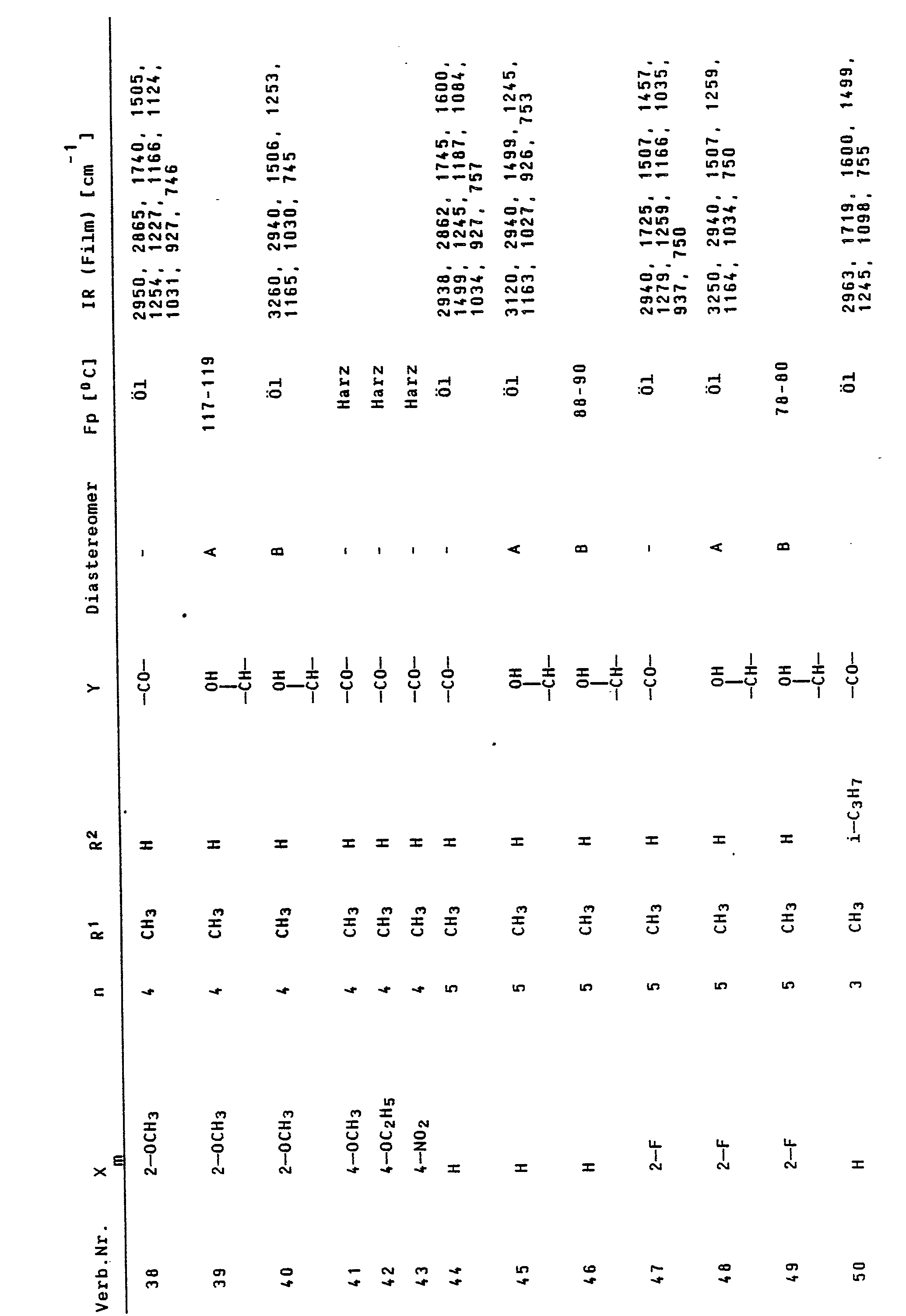


Zur Bestimmung der wachstumsregulierenden Eigenschaft der Prüfsubstanzen wurden Testpflanzen auf. ausreichend mit Nährstoffen versorgtem Kultursubstrat in Kunststoffgefäßen von ca. 12,5 cm Durchmesser angezogen.Test plants were used to determine the growth-regulating property of the test substances. culture substrate adequately supplied with nutrients in plastic vessels of approx. 12.5 cm diameter.
Im Nachauflaufverfahren wurden die zu prüfenden Substanzen in wäßriger Aufbereitung auf die Pflanzen gesprüht. Die beobachtete wachstumsregulierende Wirkung wurde bei Versuchsende durch Wuchshöhenmessung belegt. Die so gewonnenen Meßwerte wurden zur Wuchshöhe der unbehandelten Pflanzen in Relation gesetzt. Als Vergleichssubstanzen dienten Chlorcholinchlorid und die nachstehend mit B, C und D bezeichneten Wirkstoffe.In the post-emergence process, the substances to be tested were sprayed onto the plants in aqueous preparation. The observed growth-regulating effect was demonstrated at the end of the test by measuring the height of the plants. The measured values obtained in this way were related to the height of the untreated plants. Chlorcholine chloride and the active substances referred to below as B, C and D served as reference substances.
Gleichlaufend zur Reduzierung des Längenwachstums stieg die Farbintensität der Blätter an. Der erhöhte Chlorphyllgehalt läßt eine ebenfalls erhöhte Photosyntheserate und damit erhöhte Ertragsbildung erwarten.The color intensity of the leaves increased in line with the reduction in length growth. The increased chlorophyll content also suggests an increased photosynthesis rate and thus increased yield formation.
Vergleichssubstanzen:

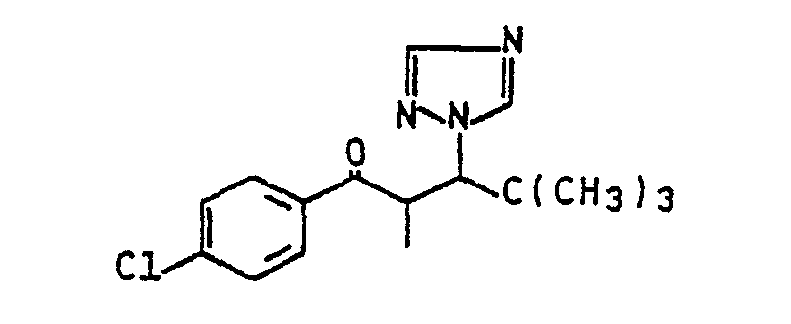


Dabei ergab sich, daß in Versuchen mit Sommergerste, Sonnenblumen und Sommerraps sowie im Reiskeimlingstest hinsichtlich Standfestigkeit und Wuchshöhenreduzierung bei Aufwandmengen von 1,5 und 6 mg Wirkstoff je Gefäß die Verbindungen 3, 5, 8, 9, 50, 51, 82, 84, 85, 92, 95, 96, 108, 109, 114 und 115 durchweg eine günstigere Wirkung als der Vergleich erzielten.It was found that in tests with spring barley, sunflowers and summer rape, as well as in the rice seedling test with regard to stability and growth height reduction at application rates of 1.5 and 6 mg of active ingredient per container, the compounds 3, 5, 8, 9, 50, 51, 82, 84, 85, 92, 95, 96, 108, 109, 114 and 115 consistently had a more favorable effect than the comparison.
Claims (9)


Priority Applications (1)
| Application Number | Priority Date | Filing Date | Title |
|---|---|---|---|
| AT86105586T ATE48423T1 (en) | 1985-04-27 | 1986-04-23 | 1,3-DIOXANE 5-YL-ALKYLTRIAZOLE, THEIR PREPARATION, THEIR USE FOR REGULATION OF PLANT GROWTH AND MEANS THEREOF. |
Applications Claiming Priority (2)
| Application Number | Priority Date | Filing Date | Title |
|---|---|---|---|
| DE3515309 | 1985-04-27 | ||
| DE19853515309 DE3515309A1 (en) | 1985-04-27 | 1985-04-27 | 1,3-DIOXAN-5-YL-ALKYLTRIAZOLE, THEIR PRODUCTION, THEIR USE FOR REGULATING THE PLANT GROWTH AND MEANS THEREFOR |
Publications (3)
| Publication Number | Publication Date |
|---|---|
| EP0200149A2 true EP0200149A2 (en) | 1986-11-05 |
| EP0200149A3 EP0200149A3 (en) | 1987-08-05 |
| EP0200149B1 EP0200149B1 (en) | 1989-12-06 |
Family
ID=6269321
Family Applications (1)
| Application Number | Title | Priority Date | Filing Date |
|---|---|---|---|
| EP86105586A Expired EP0200149B1 (en) | 1985-04-27 | 1986-04-23 | 1,3-dioxan-5-yl alkyl triazoles, their preparation, their use as plant growth regulators and compositions therefor |
Country Status (6)
| Country | Link |
|---|---|
| US (1) | US4822400A (en) |
| EP (1) | EP0200149B1 (en) |
| JP (1) | JPS61254583A (en) |
| AT (1) | ATE48423T1 (en) |
| CA (1) | CA1272730A (en) |
| DE (2) | DE3515309A1 (en) |
Cited By (3)
| Publication number | Priority date | Publication date | Assignee | Title |
|---|---|---|---|---|
| WO2010028974A1 (en) * | 2008-09-10 | 2010-03-18 | Basf Se | Imidazole and triazole compounds, use thereof and agents containing said compounds |
| WO2010029065A1 (en) * | 2008-09-10 | 2010-03-18 | Basf Se | Imidazole and triazole compounds, use thereof and agents containing said compounds |
| WO2010029066A1 (en) * | 2008-09-10 | 2010-03-18 | Basf Se | Imidazole and triazole compounds, use thereof and agents containing said compounds |
Family Cites Families (8)
| Publication number | Priority date | Publication date | Assignee | Title |
|---|---|---|---|---|
| US3156554A (en) | 1959-08-10 | 1964-11-10 | Research Corp | Method of controlling relative stem growth of plants |
| DE2738725A1 (en) * | 1977-08-27 | 1979-03-08 | Basf Ag | AZOLYL ALCOHOLS |
| DE2921168A1 (en) | 1979-05-25 | 1980-12-11 | Basf Ag | TRIAZOLYL DERIVATIVES AND METHOD FOR THE PRODUCTION THEREOF AND THEIR CONTAINERS FOR INFLUENCING PLANT GROWTH |
| DE3019049A1 (en) * | 1980-05-19 | 1981-12-03 | Basf Ag, 6700 Ludwigshafen | NEW AZOLES |
| DE3025879A1 (en) * | 1980-07-09 | 1982-02-11 | Basf Ag, 6700 Ludwigshafen | 1,3-DIOXAN-5-YL-ALKYLTRIAZOLE, THEIR PRODUCTION, THEIR USE FOR REGULATING THE PLANT GROWTH AND MEANS THEREFOR |
| DE3026140A1 (en) | 1980-07-10 | 1982-02-18 | Basf Ag, 6700 Ludwigshafen | 1,3-DIOXAN-5-YL-ALKENYLTRIAZOLE, THEIR PRODUCTION, THEIR USE FOR REGULATING THE PLANT GROWTH AND MEANS THEREFOR |
| DE3231334A1 (en) * | 1982-08-24 | 1984-03-01 | Basf Ag, 6700 Ludwigshafen | DIOXANYLAZOLE DERIVATIVES, FUNGICIDES CONTAINING THEM AND METHOD FOR CONTROLLING MUSHROOMS WITH THESE COMPOUNDS |
| DE3242252A1 (en) * | 1982-11-15 | 1984-05-17 | Bayer Ag, 5090 Leverkusen | HETEROCYCLICALLY SUBSTITUTED HYDROXYALKYL-AZOLYL DERIVATIVES |
-
1985
- 1985-04-27 DE DE19853515309 patent/DE3515309A1/en not_active Withdrawn
-
1986
- 1986-04-23 AT AT86105586T patent/ATE48423T1/en not_active IP Right Cessation
- 1986-04-23 CA CA000507374A patent/CA1272730A/en not_active Expired - Lifetime
- 1986-04-23 EP EP86105586A patent/EP0200149B1/en not_active Expired
- 1986-04-23 DE DE8686105586T patent/DE3667282D1/en not_active Expired - Lifetime
- 1986-04-25 US US06/855,598 patent/US4822400A/en not_active Expired - Fee Related
- 1986-04-25 JP JP61094953A patent/JPS61254583A/en active Pending
Cited By (3)
| Publication number | Priority date | Publication date | Assignee | Title |
|---|---|---|---|---|
| WO2010028974A1 (en) * | 2008-09-10 | 2010-03-18 | Basf Se | Imidazole and triazole compounds, use thereof and agents containing said compounds |
| WO2010029065A1 (en) * | 2008-09-10 | 2010-03-18 | Basf Se | Imidazole and triazole compounds, use thereof and agents containing said compounds |
| WO2010029066A1 (en) * | 2008-09-10 | 2010-03-18 | Basf Se | Imidazole and triazole compounds, use thereof and agents containing said compounds |
Also Published As
| Publication number | Publication date |
|---|---|
| JPS61254583A (en) | 1986-11-12 |
| CA1272730A (en) | 1990-08-14 |
| US4822400A (en) | 1989-04-18 |
| ATE48423T1 (en) | 1989-12-15 |
| DE3515309A1 (en) | 1986-10-30 |
| DE3667282D1 (en) | 1990-01-11 |
| EP0200149B1 (en) | 1989-12-06 |
| EP0200149A3 (en) | 1987-08-05 |
Similar Documents
| Publication | Publication Date | Title |
|---|---|---|
| EP0000017B1 (en) | 1-(2-phenylethyl)-triazolium salts, their preparation and their use as fungicides | |
| EP0057357A2 (en) | Plant growth stunting agent | |
| EP0192055B1 (en) | Hydroxyalkynyl-azolyl derivatives, process for their preparation and their use as fungicides | |
| EP0019189B1 (en) | Fungicidal agents, process for their preparation and their use as fungicides | |
| EP0019131B1 (en) | Fluorinated derivatives of 1-triazolyl butane, process for their preparation and their use as fungicides | |
| EP0054865A1 (en) | Substituted 1-azolyl-butan-2-ones, their preparation and their application as fungicides as well as intermediates | |
| EP0071009B1 (en) | Fungicidal alkinyl-azole derivatives and their use | |
| DE3325313A1 (en) | FUNGICIDES, THEIR PRODUCTION AND USE | |
| EP0032561B1 (en) | Triazolylphenacyl-pyridyl-ether derivatives, process for their preparation and their application as fungicides | |
| EP0200149B1 (en) | 1,3-dioxan-5-yl alkyl triazoles, their preparation, their use as plant growth regulators and compositions therefor | |
| EP0040740A2 (en) | Aminopropanol derivatives, process for their preparation and their use as fungicides | |
| EP0029542A2 (en) | Hydroxybutyl-imidazole derivatives, process for their preparation, intermediates necessary for the latter and their use as fungicides | |
| EP0023286B1 (en) | Azolyl-alkenols, process for their preparation and their use as fungicides | |
| EP0118069A1 (en) | Fungicides containing 1,3-diazolyl propanols | |
| EP0057864A2 (en) | 2-Azolylmethyl-1,3-dioxolane and dioxane derivatives, process for their preparation and their application as fungicides | |
| EP0073331B1 (en) | 5-aryloxy-5-azolyl-3,3-dimethyl-1-penten-4-ones and -ols, process for their preparation and their use as fungicides | |
| EP0047420A2 (en) | Fluorinated 1-azolyl-butane derivatives, process for their preparation and their use as fungicides | |
| EP0019190A2 (en) | Use of hydroxyalkyl-imidazoles as fungicides | |
| EP0065204B1 (en) | 3-substituted 1-azolyl-3-methyl-1-phenoxy-butan-2-on and ol, process for their preparation and their application as fungicides | |
| EP0024538B1 (en) | 1,2,4-triazolyl-enol ethers, process for preparing them and their use as fungicides | |
| EP0045016A1 (en) | Triazolylalkyl-pyridyl ethers, their preparation and use as fungicides | |
| EP0039405A2 (en) | Triazolyl-benzyloxy ketones and carbinols, process for their preparation and their use as fungicides | |
| EP0102591A2 (en) | Substituted azolylether ketones and carbinols | |
| DE3723246A1 (en) | NEW THIENYL AZOLYL METHYL SILANE |
Legal Events
| Date | Code | Title | Description |
|---|---|---|---|
| PUAI | Public reference made under article 153(3) epc to a published international application that has entered the european phase |
Free format text: ORIGINAL CODE: 0009012 |
|
| AK | Designated contracting states |
Kind code of ref document: A2 Designated state(s): AT BE CH DE FR GB IT LI NL |
|
| PUAB | Information related to the publication of an a document modified or deleted |
Free format text: ORIGINAL CODE: 0009199EPPU |
|
| RA1 | Application published (corrected) |
Date of ref document: 19861210 Kind code of ref document: A2 |
|
| PUAL | Search report despatched |
Free format text: ORIGINAL CODE: 0009013 |
|
| AK | Designated contracting states |
Kind code of ref document: A3 Designated state(s): AT BE CH DE FR GB IT LI NL |
|
| 17P | Request for examination filed |
Effective date: 19870704 |
|
| 17Q | First examination report despatched |
Effective date: 19880504 |
|
| GRAA | (expected) grant |
Free format text: ORIGINAL CODE: 0009210 |
|
| AK | Designated contracting states |
Kind code of ref document: B1 Designated state(s): AT BE CH DE FR GB IT LI NL |
|
| REF | Corresponds to: |
Ref document number: 48423 Country of ref document: AT Date of ref document: 19891215 Kind code of ref document: T |
|
| ITF | It: translation for a ep patent filed | ||
| GBT | Gb: translation of ep patent filed (gb section 77(6)(a)/1977) | ||
| REF | Corresponds to: |
Ref document number: 3667282 Country of ref document: DE Date of ref document: 19900111 |
|
| ET | Fr: translation filed | ||
| PLBE | No opposition filed within time limit |
Free format text: ORIGINAL CODE: 0009261 |
|
| STAA | Information on the status of an ep patent application or granted ep patent |
Free format text: STATUS: NO OPPOSITION FILED WITHIN TIME LIMIT |
|
| 26N | No opposition filed | ||
| PGFP | Annual fee paid to national office [announced via postgrant information from national office to epo] |
Ref country code: FR Payment date: 19910314 Year of fee payment: 6 |
|
| PGFP | Annual fee paid to national office [announced via postgrant information from national office to epo] |
Ref country code: CH Payment date: 19910315 Year of fee payment: 6 Ref country code: AT Payment date: 19910315 Year of fee payment: 6 |
|
| PGFP | Annual fee paid to national office [announced via postgrant information from national office to epo] |
Ref country code: BE Payment date: 19910409 Year of fee payment: 6 |
|
| PGFP | Annual fee paid to national office [announced via postgrant information from national office to epo] |
Ref country code: GB Payment date: 19910415 Year of fee payment: 6 |
|
| PGFP | Annual fee paid to national office [announced via postgrant information from national office to epo] |
Ref country code: DE Payment date: 19910420 Year of fee payment: 6 |
|
| ITTA | It: last paid annual fee | ||
| PGFP | Annual fee paid to national office [announced via postgrant information from national office to epo] |
Ref country code: NL Payment date: 19910430 Year of fee payment: 6 |
|
| PG25 | Lapsed in a contracting state [announced via postgrant information from national office to epo] |
Ref country code: DE Effective date: 19920413 |
|
| PG25 | Lapsed in a contracting state [announced via postgrant information from national office to epo] |
Ref country code: GB Effective date: 19920423 Ref country code: AT Effective date: 19920423 |
|
| PG25 | Lapsed in a contracting state [announced via postgrant information from national office to epo] |
Ref country code: LI Effective date: 19920430 Ref country code: CH Effective date: 19920430 Ref country code: BE Effective date: 19920430 |
|
| BERE | Be: lapsed |
Owner name: BASF A.G. Effective date: 19920430 |
|
| PG25 | Lapsed in a contracting state [announced via postgrant information from national office to epo] |
Ref country code: NL Effective date: 19921101 |
|
| NLV4 | Nl: lapsed or anulled due to non-payment of the annual fee | ||
| GBPC | Gb: european patent ceased through non-payment of renewal fee | ||
| PG25 | Lapsed in a contracting state [announced via postgrant information from national office to epo] |
Ref country code: FR Effective date: 19921230 |
|
| REG | Reference to a national code |
Ref country code: CH Ref legal event code: PL |
|
| REG | Reference to a national code |
Ref country code: FR Ref legal event code: ST |
|
| PG25 | Lapsed in a contracting state [announced via postgrant information from national office to epo] |
Ref country code: IT Free format text: LAPSE BECAUSE OF NON-PAYMENT OF DUE FEES;WARNING: LAPSES OF ITALIAN PATENTS WITH EFFECTIVE DATE BEFORE 2007 MAY HAVE OCCURRED AT ANY TIME BEFORE 2007. THE CORRECT EFFECTIVE DATE MAY BE DIFFERENT FROM THE ONE RECORDED. Effective date: 20050423 |