EP0200242A2 - Procédé et dispositif pour la fabrication de corps en verre - Google Patents
Procédé et dispositif pour la fabrication de corps en verre Download PDFInfo
- Publication number
- EP0200242A2 EP0200242A2 EP86200489A EP86200489A EP0200242A2 EP 0200242 A2 EP0200242 A2 EP 0200242A2 EP 86200489 A EP86200489 A EP 86200489A EP 86200489 A EP86200489 A EP 86200489A EP 0200242 A2 EP0200242 A2 EP 0200242A2
- Authority
- EP
- European Patent Office
- Prior art keywords
- membrane
- suspension
- anode
- porous
- added
- Prior art date
- Legal status (The legal status is an assumption and is not a legal conclusion. Google has not performed a legal analysis and makes no representation as to the accuracy of the status listed.)
- Granted
Links
Images
Classifications
-
- C—CHEMISTRY; METALLURGY
- C03—GLASS; MINERAL OR SLAG WOOL
- C03B—MANUFACTURE, SHAPING, OR SUPPLEMENTARY PROCESSES
- C03B37/00—Manufacture or treatment of flakes, fibres, or filaments from softened glass, minerals, or slags
- C03B37/01—Manufacture of glass fibres or filaments
- C03B37/012—Manufacture of preforms for drawing fibres or filaments
- C03B37/014—Manufacture of preforms for drawing fibres or filaments made entirely or partially by chemical means, e.g. vapour phase deposition of bulk porous glass either by outside vapour deposition [OVD], or by outside vapour phase oxidation [OVPO] or by vapour axial deposition [VAD]
- C03B37/016—Manufacture of preforms for drawing fibres or filaments made entirely or partially by chemical means, e.g. vapour phase deposition of bulk porous glass either by outside vapour deposition [OVD], or by outside vapour phase oxidation [OVPO] or by vapour axial deposition [VAD] by a liquid phase reaction process, e.g. through a gel phase
-
- C—CHEMISTRY; METALLURGY
- C03—GLASS; MINERAL OR SLAG WOOL
- C03B—MANUFACTURE, SHAPING, OR SUPPLEMENTARY PROCESSES
- C03B19/00—Other methods of shaping glass
- C03B19/12—Other methods of shaping glass by liquid-phase reaction processes
-
- Y—GENERAL TAGGING OF NEW TECHNOLOGICAL DEVELOPMENTS; GENERAL TAGGING OF CROSS-SECTIONAL TECHNOLOGIES SPANNING OVER SEVERAL SECTIONS OF THE IPC; TECHNICAL SUBJECTS COVERED BY FORMER USPC CROSS-REFERENCE ART COLLECTIONS [XRACs] AND DIGESTS
- Y10—TECHNICAL SUBJECTS COVERED BY FORMER USPC
- Y10S—TECHNICAL SUBJECTS COVERED BY FORMER USPC CROSS-REFERENCE ART COLLECTIONS [XRACs] AND DIGESTS
- Y10S65/00—Glass manufacturing
- Y10S65/90—Drying, dehydration, minimizing oh groups
-
- Y—GENERAL TAGGING OF NEW TECHNOLOGICAL DEVELOPMENTS; GENERAL TAGGING OF CROSS-SECTIONAL TECHNOLOGIES SPANNING OVER SEVERAL SECTIONS OF THE IPC; TECHNICAL SUBJECTS COVERED BY FORMER USPC CROSS-REFERENCE ART COLLECTIONS [XRACs] AND DIGESTS
- Y10—TECHNICAL SUBJECTS COVERED BY FORMER USPC
- Y10S—TECHNICAL SUBJECTS COVERED BY FORMER USPC CROSS-REFERENCE ART COLLECTIONS [XRACs] AND DIGESTS
- Y10S65/00—Glass manufacturing
- Y10S65/901—Liquid phase reaction process
Definitions
- the invention relates to a process for the production of vitreous bodies, in which a porous green body is formed from the starting material for the vitreous body in the form of an aqueous suspension with a highly disperse solid component and this is then cleaned and sintered.
- the invention further relates to devices for carrying out such a method and to the use of the glass bodies produced by the method according to the invention.
- the method mentioned at the outset is particularly suitable for producing preforms for optical waveguides made of quartz glass.
- Methods are known for producing high-purity quartz glass bodies, in particular preforms for optical waveguides, in which a porous green body is produced from highly disperse SiOrGa particles, after which this porous green body is first cleaned in, for example, a chlorine-containing atmosphere at temperatures in the range from 600 to 900 ° C.
- the sintering to compact, transparent glass then takes place at temperatures in the region of 1500 ° C; the level of the sintering temperature depends on the size of the SiO 2 particles and the homogeneity of the green body.
- preforms for the production of a manageable green body and presses for the compression of this green body in order to finally obtain a green body which is suitable for efficient sintering, ie sintering at temperatures ⁇ 1550 ° C to a bubble-free and streak-free glass body, has a sufficiently high density.
- Such a method for producing a preform for optical waveguides is known for example from DE-PS 32 40 355.
- the invention has for its object to provide a method and devices for the production of high-purity glass bodies, with which a green body is obtained which is porous enough that it can be cleaned in an intermediate heating step in a gas atmosphere reacting with impurities, but which has such a high compression that the subsequent sintering step can take place without additional compression measures of the cleaned green body.
- a device for carrying out this method is characterized by a vessel in which a porous membrane corresponding to the shape of the green body to be produced is arranged centrally, within which a cathode is arranged centrally, the interior of the membrane for receiving starting material to be separated into phases in the form a suspension is provided and the space between the membrane and an anode arranged at a distance from the membrane is filled with an electrically conductive liquid, the anode and the cathode being electrically connected via electrode connections.
- the procedure according to an advantageous development of the invention is now as follows: the solids content of the suspension on a porous membrane with pores of one diameter. which is smaller than the average particle diameter of the solid particles present in the suspension. being the membrane
- an aqueous suspension the Si0 2 particles with a diameter in the range from 10 to 500 nm, preferably 15 to 100 nm, with an average particle diameter of 40 nm for a solid: water is used as the starting material for the vitreous body -Weight ratio of 1: 1 to 1: 4 used.
- This is associated with the advantage that green bodies can be obtained with an advantageously high density, which is 35 to 60%, preferably 50%, of the density of compact quartz glass.
- a porous membrane which has pores with a pore diameter of ⁇ 10 nm and> 0.14 nm.
- the pore diameter of the membrane is chosen so that the highly disperse solid particles with an average particle diameter of 40 nm are held on the membrane, smaller ions, e.g. OH ions with a diameter of 0.14 nm, but can pass through the membrane.
- a porous plastic tube can be used as the membrane, such as e.g. is used for dialysis procedures.
- an ionogenic additive is added to the suspension, which shifts the pH of the suspension towards the basic range (pH 5 10).
- the ionogenic additive initially causes the solid particles to be dispersed (in particular in an ultrasound field) and promotes the uniform crosslinking of the solid particles in the suspension both in terms of the rate of crosslinking and in terms of increasing the binding power of the solid particles among themselves.
- an ammonium compound is used as the ionogenic additive, there is the advantage that the additive is volatile and can be removed without residue from the green body in a subsequent cleaning and heating step, so that quartz glass bodies of a very high purity are producible.
- an ammonium compound By adding an ammonium compound, green bodies with a relatively high strength are achieved, since gel formation occurs at the contact points of two SiO 2 primary particles. Si02 is excreted at the contact points and forms a bridge layer.
- the suspension is used as a 5% aqueous NH, F solution as an ionogenic additive, fluorine doping can be achieved which is suitable, for example, for the production of cladding glasses for optical waveguides.
- the ionogenic additive is added in an amount of 0.05 to 5% by weight, based on the solids content in the suspension.
- the additive acting as a crosslinking activator is present in such an amount that the surface of the solid particles in the suspension is covered with ions of the ionogenic additive.
- the amount of the ionogenic additive should not be greater than 5% by weight, based on the solids content of the suspension, since otherwise the viscosity of the suspension increases greatly, which adversely affects the electrophoretic deposition.
- a laminated body is produced by depositing several layers in succession from differently doped suspensions. For this purpose, after reaching a desired layer thickness of the green body, the first suspension is removed from the device and the deposition process with a second suspension, for example doped differently than the first suspension sion continued.
- the present method is therefore particularly suitable for producing preforms for optical waveguides which have a step profile of the refractive index.
- an optical waveguide with a W profile by incorporating an intermediate layer with a lower refractive index, which is obtained by using a suspension with appropriate doping.
- Dopants for changing the refractive index of a vitreous body are known to the person skilled in the art; For example, Ge02 or A1 2 O 3 > is used to increase the refractive index and B 2 O 3 or fluorine to lower the refractive index.
- a quartz glass body with an approximately continuous refractive index profile by depositing a multiplicity of graded doped layers.
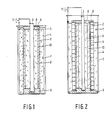
- FIGS. 1 and 2 Identical device parts of the electrophoresis devices according to FIGS. 1 and 2 have the same reference symbols.
- Figure 1 is a self-supporting membrane 1 clamped between two holders 9 in the form of a porous tube, e.g. a dialysis tube, shown;
- FIG. 2 shows a self-supporting membrane in the form of a porous support body 2 made of hydrophilic material with a pore size of 1 to 50 ⁇ m, on which the porous membrane 1 is fastened on the deposition side.
- An anode 4 and a cathode 3, to which a voltage source is connected via electrode connections 11, are mounted concentrically in a vessel 5, preferably made of laboratory or quartz glass.
- the electrodes 3.4 are preferably made of noble metal (eg platinum) or graphite in order to avoid contamination of an aqueous suspension 6 to be separated after phases with interfering ions of the transition metals (eg copper).
- a membrane 1 is also placed concentrically with the electrode system 3, 4 between the electrodes 3, 4. This membrane 1 has pores that are at least smaller than the average particle diameter of the solid particles in the aqueous suspension 6.
- a pore size is advantageously less than 10 nm, which corresponds to the diameter of the smallest particles present in the suspension 6, and larger than 0.14 nm, which corresponds to the ion diameter of OH ions.
- the use of the membrane 1 is based on the following knowledge: since only the highly disperse solid particles of the suspension 6 are retained by it, the separation of the two negative charge carriers present in the suspension becomes. namely OH ions and SiO 2 particles, spatially separated. Because of the separation by the membrane 1, oxygen formed at the anode 4 can no longer get into a solid layer 10 deposited on the membrane 1 and thus no longer the homogeneous structure of the solid layer 10. In this way, bubble-free solid deposits from aqueous SiO 2 -Suspensions possible.
- the aqueous suspension 6 having the composition specified below is filled into the inner space formed by the stretched membrane 1 between the cathode 3 and the membrane 1 via a filling opening 8.
- a tensioning device for tensioning the self-supporting membrane according to FIG. 1 is not shown separately in the drawing.
- an electrically conductive liquid 7 preferably high-purity water with an electrolyte additive in the form of an ionic substance, as is also used for the preparation of the suspension and in the composition and concentration range as in the Poured suspension, preferably with the same composition and concentration as in the suspension.
- a direct voltage source or a direct current source is connected to the electrodes 3, 4 via electrode connections 11. Since deposition takes place only when the voltage is applied, layers can easily be deposited one after the other by exchanging the suspension for other suspensions with different dopings, which layers lead to a glass with a refractive index gradient after sintem.
- the current density during the deposition is between 0.1 and 100 mAlcm 2 . This results in deposition rates of 3 to 300 mg / cm 2 / min; this corresponds to a deposition rate of 2 to 200 g / min for a 1 m long tube with a diameter of 30 mm.
- the deposited solid layer 10 is separated from the membrane 1 or from the supporting body 2 with the membrane 1, dried and sintered to a vitreous body as described below.
- the suspension thus produced is poured into a slightly stretched dialysis tube as membrane 1 made of regenerated cellulose with a pore size of 5 nm and a diameter of 21 mm, in which a platinum rod with a diameter of 2 mm is concentrically located as cathode 3.
- membrane 1 made of regenerated cellulose with a pore size of 5 nm and a diameter of 21 mm, in which a platinum rod with a diameter of 2 mm is concentrically located as cathode 3.
- the membrane 1 and the anode 4 which in this example is a platinum sheet bent to a tube with an inner diameter of 34 mm
- there is a solution of high-purity water with an addition of 0.3% by weight NH ⁇ F.
- the deposition rate is 0.09 g / cm 2 / min and the layer thickness of the deposited solid layer 10 is 3 mm.
- the depleted suspension is then poured out of the membrane 1 with the deposited solid layer 10 and the membrane 1 is separated from the deposited solid layer 10. If a membrane in the form of a dialysis tube is used, it can be pulled off in narrow strips in a spiral shape without damaging the glossy surface of the deposited solid layer 10.
- the dried green body with a density of 52%, based on the density of compact quartz glass is heated to 900 ° C in 3 h and over a period of 4 h in a flowing oxygen atmosphere with 6 vol % Chlorine gas additive cleaned.
- the final sintering to a bubble and streak-free transparent quartz glass body takes place at 1500 ° C in a helium atmosphere with 2 vol.% Chlorine gas addition at a lowering speed of the green body to be sintered of 3 mm / min through the furnace.
- a quartz glass tube with a glossy, structure-free surface was obtained.
- the outer diameter of the high-purity quartz glass tube produced in this way was 17 mm.
- a membrane 1 arranged on a porous support body 2 in the form of a filter tube can also be used according to a second example.
- a two-part hydrophilic polyethylene tube with a pore size of 10 ⁇ m, an outer diameter of 32 mm and an inner diameter of 24 mm is used, which has been coated on the inside with a continuous nitrocellulose layer as membrane 1 with a pore size of 10 nm.
- a green body is deposited in the same way as described in Example 1, dried, cleaned and sintered after opening the two-part mold.
- the porous support body can consist of several, separable parts.
- the membrane 1 on the inside of the support body 2 seamlessly spans the mold separation points and is only removed in the form of the solid layer 10 when the green body separated from the suspension 6 is removed from the mold.
- the quartz glass body produced in this way had the same properties as described in Example 1.
- Glasses which are suitable for optical waveguides can also be used advantageously for the production of lamp bulbs for halogen or gas discharge lamps, because these glasses, like the glasses for optical waveguides, must be virtually water-free and have a high silicon dioxide content.
Landscapes
- Chemical & Material Sciences (AREA)
- Engineering & Computer Science (AREA)
- Chemical Kinetics & Catalysis (AREA)
- Manufacturing & Machinery (AREA)
- Materials Engineering (AREA)
- Organic Chemistry (AREA)
- Dispersion Chemistry (AREA)
- General Chemical & Material Sciences (AREA)
- Life Sciences & Earth Sciences (AREA)
- General Life Sciences & Earth Sciences (AREA)
- Geochemistry & Mineralogy (AREA)
- Glass Melting And Manufacturing (AREA)
- Glass Compositions (AREA)
- Manufacture, Treatment Of Glass Fibers (AREA)
- Optical Integrated Circuits (AREA)
Applications Claiming Priority (2)
| Application Number | Priority Date | Filing Date | Title |
|---|---|---|---|
| DE3511451 | 1985-03-29 | ||
| DE19853511451 DE3511451A1 (de) | 1985-03-29 | 1985-03-29 | Verfahren und vorrichtung zur herstellung von glaskoerpern |
Publications (3)
| Publication Number | Publication Date |
|---|---|
| EP0200242A2 true EP0200242A2 (fr) | 1986-11-05 |
| EP0200242A3 EP0200242A3 (en) | 1987-09-16 |
| EP0200242B1 EP0200242B1 (fr) | 1990-08-08 |
Family
ID=6266694
Family Applications (1)
| Application Number | Title | Priority Date | Filing Date |
|---|---|---|---|
| EP86200489A Expired - Lifetime EP0200242B1 (fr) | 1985-03-29 | 1986-03-21 | Procédé et dispositif pour la fabrication de corps en verre |
Country Status (4)
| Country | Link |
|---|---|
| US (1) | US4684386A (fr) |
| EP (1) | EP0200242B1 (fr) |
| JP (1) | JPS61227927A (fr) |
| DE (2) | DE3511451A1 (fr) |
Cited By (9)
| Publication number | Priority date | Publication date | Assignee | Title |
|---|---|---|---|---|
| EP0446999A1 (fr) * | 1990-03-14 | 1991-09-18 | Philips Patentverwaltung GmbH | Procédé et dispositif pour la production de corps vitreux |
| FR2760448A1 (fr) * | 1997-03-10 | 1998-09-11 | Samsung Electronics Co Ltd | Dispositif et procede pour fabriquer un monolithe de verre en forme de tube en utilisant un traitement de gel de solution |
| DE10320934B3 (de) * | 2003-05-09 | 2004-09-09 | C. Hafner Gmbh + Co. | Verfahren zur Herstellung keramischer Formkörper hoher Dichte |
| WO2004067808A3 (fr) * | 2003-01-24 | 2004-09-23 | Univ Saarland | Procede de fabrication de corps moules metalliques pourvus d'une couche ceramique, corps moule metallique et utilisation de ce dernier |
| DE10319300A1 (de) * | 2003-04-29 | 2004-11-25 | Wacker-Chemie Gmbh | Verfahren zur Herstellung eines Formkörpers aus Kieselglas |
| DE10320936A1 (de) * | 2003-05-09 | 2004-12-02 | C. Hafner Gmbh + Co. | Verfahren zur Herstellung keramischer Formkörper |
| DE102004003450A1 (de) * | 2004-01-22 | 2005-08-18 | Universität des Saarlandes | Verfahren zur Herstellung dotierter oder undotierter Gläser aus Glaspulvern |
| WO2005103339A1 (fr) * | 2004-04-20 | 2005-11-03 | C. Hafner Gmbh + Co. | Procede de realisation d'un corps cru |
| DE102005031955A1 (de) * | 2005-07-08 | 2007-01-11 | Universität des Saarlandes | Verfahren zur Herstellung zwei- und dreidimensionaler Formkörper |
Families Citing this family (8)
| Publication number | Priority date | Publication date | Assignee | Title |
|---|---|---|---|---|
| DE3739907A1 (de) * | 1987-11-25 | 1989-06-08 | Philips Patentverwaltung | Verfahren zur herstellung von glaskoerpern |
| DE4008108A1 (de) * | 1990-03-14 | 1991-09-19 | Philips Patentverwaltung | Verfahren und vorrichtung zum herstellen von glaskoerpern |
| US7111476B2 (en) * | 1994-06-30 | 2006-09-26 | Ted A Loxley | Electrophoretic deposition process for making quartz glass products |
| US20020083740A1 (en) * | 2000-12-29 | 2002-07-04 | Pandelisev Kiril A. | Process and apparatus for production of silica grain having desired properties and their fiber optic and semiconductor application |
| US20020083739A1 (en) * | 2000-12-29 | 2002-07-04 | Pandelisev Kiril A. | Hot substrate deposition fiber optic preforms and preform components process and apparatus |
| US7797966B2 (en) * | 2000-12-29 | 2010-09-21 | Single Crystal Technologies, Inc. | Hot substrate deposition of fused silica |
| US20020117625A1 (en) * | 2001-02-26 | 2002-08-29 | Pandelisev Kiril A. | Fiber optic enhanced scintillator detector |
| DE102006010808B4 (de) * | 2006-03-07 | 2009-08-13 | BEGO Bremer Goldschlägerei Wilh. Herbst GmbH & Co. KG | Vorrichtung, System, Verfahren, Computerprogramm und Datenträger zur elektrophoretischen Abscheidung mit einer beweglichen Elektrode |
Family Cites Families (6)
| Publication number | Priority date | Publication date | Assignee | Title |
|---|---|---|---|---|
| FR2334639A1 (fr) * | 1975-10-16 | 1977-07-08 | Ceramiques Speciales Lab | Procede de fabrication d'ebauches en vue de la realisation de fibres optiques de silice a gradient d'indice |
| US4220461A (en) * | 1978-04-06 | 1980-09-02 | Mrinmay Samanta | Low temperature synthesis of vitreous bodies and their intermediates |
| EP0029590B1 (fr) * | 1979-11-21 | 1984-03-21 | Hitachi, Ltd. | Procédé de préparation de verre optique |
| FR2490211B1 (fr) * | 1980-09-17 | 1990-09-21 | Passaret Michel | |
| US4419115A (en) * | 1981-07-31 | 1983-12-06 | Bell Telephone Laboratories, Incorporated | Fabrication of sintered high-silica glasses |
| DE3314302A1 (de) * | 1983-04-20 | 1984-10-25 | Standard Elektrik Lorenz Ag, 7000 Stuttgart | Verfahren zum herstellen von poroesen glaskoerpern, insbesondere fuer die herstellung von lichtwellenleitern |
-
1985
- 1985-03-29 DE DE19853511451 patent/DE3511451A1/de not_active Withdrawn
-
1986
- 1986-03-06 US US06/836,919 patent/US4684386A/en not_active Expired - Fee Related
- 1986-03-21 DE DE8686200489T patent/DE3673223D1/de not_active Expired - Lifetime
- 1986-03-21 EP EP86200489A patent/EP0200242B1/fr not_active Expired - Lifetime
- 1986-03-26 JP JP61066077A patent/JPS61227927A/ja active Pending
Cited By (13)
| Publication number | Priority date | Publication date | Assignee | Title |
|---|---|---|---|---|
| EP0446999A1 (fr) * | 1990-03-14 | 1991-09-18 | Philips Patentverwaltung GmbH | Procédé et dispositif pour la production de corps vitreux |
| FR2760448A1 (fr) * | 1997-03-10 | 1998-09-11 | Samsung Electronics Co Ltd | Dispositif et procede pour fabriquer un monolithe de verre en forme de tube en utilisant un traitement de gel de solution |
| WO2004067808A3 (fr) * | 2003-01-24 | 2004-09-23 | Univ Saarland | Procede de fabrication de corps moules metalliques pourvus d'une couche ceramique, corps moule metallique et utilisation de ce dernier |
| US8361295B2 (en) | 2003-01-24 | 2013-01-29 | Ezelleron Gmbh | Method for producing metallic moulded bodies comprising a ceramic layer, metallic moulded body, and the use of the same |
| DE10319300A1 (de) * | 2003-04-29 | 2004-11-25 | Wacker-Chemie Gmbh | Verfahren zur Herstellung eines Formkörpers aus Kieselglas |
| DE10319300B4 (de) * | 2003-04-29 | 2006-03-30 | Wacker Chemie Ag | Verfahren zur Herstellung eines Formkörpers aus Kieselglas |
| DE10320936B4 (de) * | 2003-05-09 | 2007-01-18 | C. Hafner Gmbh + Co. | Verfahren zur Herstellung keramischer Formkörper |
| DE10320934B3 (de) * | 2003-05-09 | 2004-09-09 | C. Hafner Gmbh + Co. | Verfahren zur Herstellung keramischer Formkörper hoher Dichte |
| DE10320936A1 (de) * | 2003-05-09 | 2004-12-02 | C. Hafner Gmbh + Co. | Verfahren zur Herstellung keramischer Formkörper |
| DE102004003450A1 (de) * | 2004-01-22 | 2005-08-18 | Universität des Saarlandes | Verfahren zur Herstellung dotierter oder undotierter Gläser aus Glaspulvern |
| WO2005103339A1 (fr) * | 2004-04-20 | 2005-11-03 | C. Hafner Gmbh + Co. | Procede de realisation d'un corps cru |
| DE102005031955A1 (de) * | 2005-07-08 | 2007-01-11 | Universität des Saarlandes | Verfahren zur Herstellung zwei- und dreidimensionaler Formkörper |
| DE102005031955B4 (de) * | 2005-07-08 | 2009-04-09 | Universität des Saarlandes | Verfahren zur Herstellung zwei- und dreidimensionaler Formkörper und deren Verwendung |
Also Published As
| Publication number | Publication date |
|---|---|
| US4684386A (en) | 1987-08-04 |
| JPS61227927A (ja) | 1986-10-11 |
| DE3673223D1 (de) | 1990-09-13 |
| EP0200242B1 (fr) | 1990-08-08 |
| EP0200242A3 (en) | 1987-09-16 |
| DE3511451A1 (de) | 1986-10-09 |
Similar Documents
| Publication | Publication Date | Title |
|---|---|---|
| EP0200242B1 (fr) | Procédé et dispositif pour la fabrication de corps en verre | |
| DE2922794C3 (de) | Verfahren zur Herstellung von optischen Wellenleitern durch Dotieren einer rohrförmigen, offenporigen Vorform mit Gasen | |
| DE69805934T2 (de) | Verfahren zum Herstellen von Vorformen für optische Wellenleiter mit einem Segmentkern | |
| DE29823926U1 (de) | Lichtwellenleiterglashalbzeug und Vorrichtung zur Herstellung eines rohrförmigen Gliedes zur Lichtwellenleiterproduktion | |
| EP0392599A2 (fr) | Procédé pour la fabrication de corps en verre avec des domaines de réfraction optique différente | |
| DE2217725B2 (de) | Kontinuierliches Verfahren zur Herstellung eines länglichen Teils aus Quarzglas | |
| DE3406148C2 (fr) | ||
| DE10319300B4 (de) | Verfahren zur Herstellung eines Formkörpers aus Kieselglas | |
| EP0446999B1 (fr) | Procédé et dispositif pour la production de corps vitreux | |
| DE3739907A1 (de) | Verfahren zur herstellung von glaskoerpern | |
| EP1324959B1 (fr) | Corps faconne en sio2, postcompacte electrophoretiquement, procede de fabrication et utilisation dudit corps | |
| EP0249278B1 (fr) | Procédé de production de corps en verre ou céramique | |
| EP0196719B1 (fr) | Procédé et dispositif pour la fabrication de corps en verre | |
| DE3522194A1 (de) | Verfahren zur herstellung von glaskoerpern | |
| EP0200243B1 (fr) | Procédé et dispositif pour la fabrication de corps en verre | |
| DE3537972A1 (de) | Verfahren zur herstellung von rotationssymmetrischen glaskoerpern | |
| EP0196718B1 (fr) | Procédé et dispositif pour la fabrication de corps en verre | |
| EP0196717B1 (fr) | Procédé et appareils pour la fabrication de corps en verre | |
| DE2827303C2 (de) | Verfahren zur Herstellung eines Glasgegenstandes und dessen Anwendung | |
| EP0276886A1 (fr) | Procédé et dispositif de fabrication de corps solides poreux à symétrie de révolution | |
| DE3330910A1 (de) | Verfahren zum herstellen eines reaktionsgefaesses fuer kristallzuchtzwecke | |
| EP0196716A2 (fr) | Procédé et dispositif pour la fabrication de corps en verre | |
| DE3511439A1 (de) | Verfahren zur herstellung von glaskoerpern | |
| EP0448155B1 (fr) | Procédé de production de corps vitreux | |
| DE4008108A1 (de) | Verfahren und vorrichtung zum herstellen von glaskoerpern |
Legal Events
| Date | Code | Title | Description |
|---|---|---|---|
| PUAI | Public reference made under article 153(3) epc to a published international application that has entered the european phase |
Free format text: ORIGINAL CODE: 0009012 |
|
| AK | Designated contracting states |
Kind code of ref document: A2 Designated state(s): DE FR GB IT NL SE |
|
| PUAB | Information related to the publication of an a document modified or deleted |
Free format text: ORIGINAL CODE: 0009199EPPU |
|
| RA1 | Application published (corrected) |
Date of ref document: 19861210 Kind code of ref document: A2 |
|
| PUAL | Search report despatched |
Free format text: ORIGINAL CODE: 0009013 |
|
| AK | Designated contracting states |
Kind code of ref document: A3 Designated state(s): DE FR GB IT NL SE |
|
| RAP1 | Party data changed (applicant data changed or rights of an application transferred) |
Owner name: N.V. PHILIPS' GLOEILAMPENFABRIEKEN Owner name: PHILIPS PATENTVERWALTUNG GMBH |
|
| 17P | Request for examination filed |
Effective date: 19880315 |
|
| 17Q | First examination report despatched |
Effective date: 19890303 |
|
| GRAA | (expected) grant |
Free format text: ORIGINAL CODE: 0009210 |
|
| AK | Designated contracting states |
Kind code of ref document: B1 Designated state(s): DE FR GB IT NL SE |
|
| PG25 | Lapsed in a contracting state [announced via postgrant information from national office to epo] |
Ref country code: SE Free format text: THE PATENT HAS BEEN ANNULLED BY A DECISION OF A NATIONAL AUTHORITY Effective date: 19900808 Ref country code: NL Effective date: 19900808 |
|
| REF | Corresponds to: |
Ref document number: 3673223 Country of ref document: DE Date of ref document: 19900913 |
|
| ITF | It: translation for a ep patent filed | ||
| GBT | Gb: translation of ep patent filed (gb section 77(6)(a)/1977) | ||
| ET | Fr: translation filed | ||
| NLV1 | Nl: lapsed or annulled due to failure to fulfill the requirements of art. 29p and 29m of the patents act | ||
| PG25 | Lapsed in a contracting state [announced via postgrant information from national office to epo] |
Ref country code: GB Effective date: 19910321 |
|
| PLBE | No opposition filed within time limit |
Free format text: ORIGINAL CODE: 0009261 |
|
| STAA | Information on the status of an ep patent application or granted ep patent |
Free format text: STATUS: NO OPPOSITION FILED WITHIN TIME LIMIT |
|
| 26N | No opposition filed | ||
| GBPC | Gb: european patent ceased through non-payment of renewal fee | ||
| PG25 | Lapsed in a contracting state [announced via postgrant information from national office to epo] |
Ref country code: FR Effective date: 19911129 |
|
| PG25 | Lapsed in a contracting state [announced via postgrant information from national office to epo] |
Ref country code: DE Effective date: 19920101 |
|
| REG | Reference to a national code |
Ref country code: FR Ref legal event code: ST |
|
| PG25 | Lapsed in a contracting state [announced via postgrant information from national office to epo] |
Ref country code: IT Free format text: LAPSE BECAUSE OF NON-PAYMENT OF DUE FEES;WARNING: LAPSES OF ITALIAN PATENTS WITH EFFECTIVE DATE BEFORE 2007 MAY HAVE OCCURRED AT ANY TIME BEFORE 2007. THE CORRECT EFFECTIVE DATE MAY BE DIFFERENT FROM THE ONE RECORDED. Effective date: 20050321 |