EP0200378A1 - Procédé pour créer des motifs dans des matériaux - Google Patents
Procédé pour créer des motifs dans des matériaux Download PDFInfo
- Publication number
- EP0200378A1 EP0200378A1 EP86302474A EP86302474A EP0200378A1 EP 0200378 A1 EP0200378 A1 EP 0200378A1 EP 86302474 A EP86302474 A EP 86302474A EP 86302474 A EP86302474 A EP 86302474A EP 0200378 A1 EP0200378 A1 EP 0200378A1
- Authority
- EP
- European Patent Office
- Prior art keywords
- template
- accordance
- medium
- surface characteristics
- topographical
- Prior art date
- Legal status (The legal status is an assumption and is not a legal conclusion. Google has not performed a legal analysis and makes no representation as to the accuracy of the status listed.)
- Withdrawn
Links
Images
Classifications
-
- D—TEXTILES; PAPER
- D06—TREATMENT OF TEXTILES OR THE LIKE; LAUNDERING; FLEXIBLE MATERIALS NOT OTHERWISE PROVIDED FOR
- D06B—TREATING TEXTILE MATERIALS USING LIQUIDS, GASES OR VAPOURS
- D06B11/00—Treatment of selected parts of textile materials, e.g. partial dyeing
- D06B11/0093—Treatments carried out during or after a regular application of treating materials, in order to get differentiated effects on the textile material
Definitions
- This invention relates generally to processes for producing design patterns on materials and, more particularly, to a unique process for producing such design patterns using the surface characteristic of a template for interacting with such material and a medium applied thereto for a selected time period.
- one of the oldest methods of applying surface designs is the use of resist printing, early Japanese batiks and Japanese stencil prints being examples thereof as well as plangi tie- dye techniques developed in Asia. Such techniques normally use an appropriate device to protect certain areas of the material so as to prevent color penentration in such areas, as from a dye.
- Other similar printing techniques have been developed such as stencil printing, screen printing, transfer printing and the like.
- yams and threads as a method of decorating fabrics has long been used as in the field of embroidery and tapestry, for example.
- mechanical techniques such as embossing have also been used over the years.
- This invention can be used to provide noteworthy, imaginative and unique design patterns on various materials, such as metals, fabrics, paper, leather, wood, plastics, or other materials, in a manner which is novel to the art.
- the material on which a design pattern is to be produced is positioned adjacent a surface of a template, the template having selected surface characteristics.
- the material is held against the template surface for a selected time period using a selected pressure which may be externally applied thereto or which may merely be due to the weight of the material itself.
- a medium such as an ink, dye or a paint, for example, is applied to selective portions of the exposed surface of the material and at least a portion of the medium is permitted to penetrate through the material to the surface which is adjacent the template surface.
- the surface characteristics of the template interact with the material as the medium is being applied thereto and produces a design pattern in the material.
- the medium is a wet medium
- the material can then be dried, either by using natural air drying or by applying heat thereto, and the dried material can then be removed from the template.
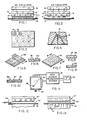
- FIG. 1 the process of the invention can be illustrated most clearly using a simplified diagrammatic representation of a device for performing the process.
- a device for performing the process.
- Such an apparatus utilizes a substrate or template 10 on which is positioned a material 11 such as a fabric or textile material on which a design pattern is to be created.
- a design pattern can be either random or non-random in nature and, if non-random, such pattern can be either abstract or representational.
- a resevoir 12 containing a suitable medium, such as a dye, an ink or a paint medium can be applied to the exposed surface of material 11 opposite the surface adjacent template 10 via a suitable application means 13 which may include a plurality of channels 14, depicted more clearly in FIG.
- a suitable air circulator 16 can be used to apply either heated or unheated air to the material 11 via a plurality of channels 17 appropriately placed in the resevoir means 12 between the various media application channels, as shown in FIGS. 2 and 3.
- the material 11 is positioned adjacent a surface of a template10 as depicted in FIG. 1.
- a selectable pressure which can be either the pressure provided by the weight of the material itself or a controllable pressure which can be supplied externally in an appropriate manner.
- air at a controllable pressure can be utilized from air circulator 16 so as to supply heated or unheated air under pressure through channels 17, the air then impinging upon the material at such.a controllable pressure as to hold the material against the template 10 with a desired force.
- a medium is applied to selected portions of the exposed surface of material 11 via selectively activated channels 14. Not all of the channels need be used and certain channel assemblies or certain channels within one or more of such assemblies can be selected for use in accordance with the process of the invention so as to create various design pattern effects.
- Template 10 is provided with selectable surface characteristics, as discussed in more detail below. In accordance with such process it is found that the interaction of the selected surface characteristics of template 10 with the material held against the template surface for a selected time period under pressure as the medium is being applied thereto produces a striking and impressive design pattern effect on the surface of the material which is adjacent the template. Different pattern effects can be achieved using different material substrates, different template surface characteristics, different pressures of the material against the template, different time periods, and different media e.g. different types of either wet or dry media.
- the material containing the medium which has been applied thereto is permitted to dry.
- drying process can be achieved by using a naturally circulating air current drying process, or an air circulator 16 can be utilized to apply heated or unheated air under pressure to the material 11 so as to dry it more quickly, as depicted in FIG. 2.
- an air circulator 16 can be utilized to apply heated or unheated air under pressure to the material 11 so as to dry it more quickly, as depicted in FIG. 2.
- the original pattern can be suitably enhanced or further changed as desired either after the process has been completed or at some point during the process.
- the original pattern can be built up (as in a low or shallow relief) to achieve a layered design pattern effect.
- a template 20 may have a surface thereof formed in a topographical pattern.
- Such pattern may be in the form of a regularized pattern as depicted, which pattern is formed utilizing a plurality of grooves 21 and protrusions 22 as shown more clearly in FIG. 6.
- Such a topographical pattern may also be formed in a random fashion utilizing an appropriate device for producing random indentations 23 in the surface of template 24 as shown in FIGS. 7 and 8.
- such topographical patterns may be in a purposely designed artistic form which can be either abstract or representational in nature or combinations of both random or non-random patterns can be created by_ using different templates in succession as described above.
- a non-topographical template surface characteristics such as shown by the template 25 of FIG. 9.
- an appropriate plastic material such as a clear polyethylene or a vinyl material, having a smooth surface can be used for the template.
- the interaction of the non-topographical surface characteristic of such a template with the material having the wet medium applied thereto tends to cause portions of the template surface to be removed when the material itself is removed therefrom, portions of such plastic template thereby being permanently bonded to the adjacent surface of the material on which the design pattern is to be formed.
- imaginative and effective design patterns result from the presence of such permanently bonded portions.
- the particular design pattern may not necessarily be predicatable by the user but it has been found that many impressive and vivid design effects can be achieved using a suitable plastic material having smooth, or non-topographical, characteristics and being capable of such bonding operation.
- further or additional printing processes i.e. using conventional techniques, can be applied to a design completed in accordance with the invention, thereby creating another different design made by using a combination of the techniques of the invention and conventional techniques.
- a further alternative embodiment for providing an effective design pattern is depicted in the template substrate 26 of FIG. 10.
- a plastic or non-magnetizable material is utilized for the substrate itself and the interior 27 thereof is hollow.
- Magnetizable elements in the form of a magnetized filler material are placed within the interior 27 of the substrate.
- a selected pattern of such magentizable elements may be formed in the interior of template 26 by moving a magnet 28 over the surface thereof along a line which forms a desired pattern configuration, such as depicted by dashed line 29. The movement of the magnet causes the filler material to be aligned with such design pattern within the interior of template 26.
- the designer can display in real time, as he or she is creating the design, the pattern which is being formed on a suitable monitor screen 30 (e.g. a cathode ray tube) using a suitable data display processor system 31.
- a suitable monitor screen 30 e.g. a cathode ray tube
- data display processor system 31 For example, it would be well known in the display art to utilize an appropriate grid wire matrix, position sensing structure in association with the template for supplying data to the data display processor system which represents the position of the magent as it is being moved on the surface of the tample. Such data can then be suitably processed so as to be displayed on screen 30 as shown.
- the magnetic elements may be formed in random or non-random patterns, and, if non-random, may be arranged to produce either an abstract or a representational design pattern.
- a magnetized medium which can be appropriately magnetized in accordance with well known techniques, is applied to the surface of the material 11. The medium is attracted to those regions of the substrate under which the desired pattern of magnetizable elements has been formed.
- the manetizable particles can be used with non-magnetized media, e.g. regular dyes, paints, etc., by forming a pattern of such particles in a template having a very thin, flexible surface layer so that, when the material on which a design is to be created is held against such layer, the magnetizable particles form a topographical pattern on the thin layer surface for such purpose.
- non-magnetized media e.g. regular dyes, paints, etc.
- FIGS. 5-10 Other techniques for forming surface characteristics of the template substrate may also be devised by those in the art for use in the process of the invention and the above discussion of FIGS. 5-10 is intended to be exemplary thereof.
- FIGS. 12 and 13 An alternative embodiment of the process of the invention is illustrated in FIGS. 12 and 13 wherein a medium is applied to the material substrate on which a pattern is to be formed prior to its being placed adjacent a template.
- a medium is applied to the material substrate on which a pattern is to be formed prior to its being placed adjacent a template.
- a material 35 is placed on a suitable mounting structure 36 during an initial stage of operation and a medium is appropriately applied to the material via a suitable media application means 37 as discussed above.
- No template substrate 38 is present between the media application means and the material 35 or between the material and mounting structure 36 at such stage.
- a template 38 can then be moved into position against the surface of material 35, an appropriate force (e.g. using a mechanical or fluid pressure techniques) being applied to the opposite side of material 35 as depicted by arrows 39 for holding the material against the substrate 38, as shown in FIG. 13.
- the surface characteristics of the template 38 interact with the material 35 containing the medium which has been applied thereto so as to form a desired design pattern on the surface of the material which is adjacent the substrate.
- Appropriate drying may be achieved, as before, either by applying heated or unheated air (depicted by arrows 40) or by permitting the material to dry naturally.
- the material can then be removed from the template by moving the template out of its position away from the material and then removing the material from mounting structure 36.
- the material utilized in the process of the invention can be selected from any materials on which a suitable design pattern effect can be obtained, such as textiles, fabrics (synthetic and natural), paper, leather and the like.
- the medium utilized may be either in a wet form, such as an ink, a paint, a dye, etc., or it may be in a dry form, i.e., in a powder or other particulate form.
- the consistency of the medium may be as thick or as thin as desired and may be applied in a pressurized manner as by using a high pressure atomizer or a jet stream applicator or by using low pressure spray at any desired pressure. Alternatively it can be applied in a non-pressurized manner such as by merely letting the medium drip on to the surface of the material under gravity.
- the template may be formed of a rigid material or it may be formed as a semi-rigid or flexible material and may be made of a suitable plastic, metal, wood, paper, or other suitable material.
- the surface characteristics of the template may be in the form of topographical characteristics or non-topographical characteristics.
- the template itself may have a thickness of any desired value, different effects being achieved depending on the selected thickness as well as on the selected topographical on non-topographical surface characteristics thereof.
- the material may be held against the template for a selected time period and at a selected pressure, which characteristics can be selected over relatively wide ranges depending upon the design effects which are desired to be achieved. In some cases, as mentioned above, the mere weight of the material itself may be sufficient to provide the desired pressure.
- drying may be achieved either naturally by merely utilizing naturally circulating air currents as at room temperature or by using an external air circulator source to apply heated or unheated air, or other gas, to the material so as to dry it more quickly.
Landscapes
- Engineering & Computer Science (AREA)
- Chemical & Material Sciences (AREA)
- Materials Engineering (AREA)
- Textile Engineering (AREA)
- Application Of Or Painting With Fluid Materials (AREA)
- Superconductors And Manufacturing Methods Therefor (AREA)
- Printing Methods (AREA)
Applications Claiming Priority (2)
| Application Number | Priority Date | Filing Date | Title |
|---|---|---|---|
| US719408 | 1985-04-03 | ||
| US06/719,408 US4767584A (en) | 1985-04-03 | 1985-04-03 | Process of and apparatus for producing design patterns in materials |
Publications (1)
| Publication Number | Publication Date |
|---|---|
| EP0200378A1 true EP0200378A1 (fr) | 1986-11-05 |
Family
ID=24889955
Family Applications (1)
| Application Number | Title | Priority Date | Filing Date |
|---|---|---|---|
| EP86302474A Withdrawn EP0200378A1 (fr) | 1985-04-03 | 1986-04-03 | Procédé pour créer des motifs dans des matériaux |
Country Status (4)
| Country | Link |
|---|---|
| US (1) | US4767584A (fr) |
| EP (1) | EP0200378A1 (fr) |
| JP (1) | JPS621600A (fr) |
| CA (1) | CA1252346A (fr) |
Cited By (2)
| Publication number | Priority date | Publication date | Assignee | Title |
|---|---|---|---|---|
| EP0337777A1 (fr) * | 1988-04-12 | 1989-10-18 | Milliken Research Corporation | Procédé et appareil pour décorer des matières utilisant des jets de gaz |
| US5400485A (en) * | 1992-03-30 | 1995-03-28 | Terpel, S.A. De C.V. | Apparatus for manufacturing imitation jacquard fabric |
Families Citing this family (16)
| Publication number | Priority date | Publication date | Assignee | Title |
|---|---|---|---|---|
| US4960630A (en) * | 1988-04-14 | 1990-10-02 | International Paper Company | Apparatus for producing symmetrical fluid entangled non-woven fabrics and related method |
| US5235733A (en) * | 1984-09-28 | 1993-08-17 | Milliken Research Corporation | Method and apparatus for patterning fabrics and products |
| USRE40362E1 (en) | 1987-04-23 | 2008-06-10 | Polymer Group, Inc. | Apparatus and method for hydroenhancing fabric |
| US5737813A (en) | 1988-04-14 | 1998-04-14 | International Paper Company | Method and apparatus for striped patterning of dyed fabric by hydrojet treatment |
| US5632072A (en) | 1988-04-14 | 1997-05-27 | International Paper Company | Method for hydropatterning napped fabric |
| US5397523A (en) * | 1993-07-20 | 1995-03-14 | Cincinnati Mliacron Inc. | Method and apparatus for sizing composite tows |
| US6595777B1 (en) | 2001-03-16 | 2003-07-22 | Michael A. Summar | Method for creating abstract artwork, apparatus therefor and methods of making the apparatus |
| US7019819B2 (en) | 2002-11-13 | 2006-03-28 | Molecular Imprints, Inc. | Chucking system for modulating shapes of substrates |
| US7641840B2 (en) * | 2002-11-13 | 2010-01-05 | Molecular Imprints, Inc. | Method for expelling gas positioned between a substrate and a mold |
| US7090716B2 (en) * | 2003-10-02 | 2006-08-15 | Molecular Imprints, Inc. | Single phase fluid imprint lithography method |
| US7611348B2 (en) * | 2005-04-19 | 2009-11-03 | Asml Netherlands B.V. | Imprint lithography |
| US7316554B2 (en) * | 2005-09-21 | 2008-01-08 | Molecular Imprints, Inc. | System to control an atmosphere between a body and a substrate |
| CN101405087A (zh) * | 2006-04-03 | 2009-04-08 | 分子制模股份有限公司 | 光刻印刷系统 |
| US8215946B2 (en) | 2006-05-18 | 2012-07-10 | Molecular Imprints, Inc. | Imprint lithography system and method |
| US20090304930A1 (en) * | 2008-06-05 | 2009-12-10 | Michael Chaimberg | System and method of applying a gel coat brush stroke pattern over an image surface |
| US20100096764A1 (en) * | 2008-10-20 | 2010-04-22 | Molecular Imprints, Inc. | Gas Environment for Imprint Lithography |
Citations (6)
| Publication number | Priority date | Publication date | Assignee | Title |
|---|---|---|---|---|
| FR2046749A2 (fr) * | 1969-06-13 | 1971-03-12 | Gaf Corp | |
| FR2093468A5 (fr) * | 1970-04-30 | 1972-01-28 | Schroers Co Textilausruest | |
| FR2227135A1 (fr) * | 1973-04-28 | 1974-11-22 | Girmes Werke Ag | |
| FR2254667A1 (en) * | 1973-12-17 | 1975-07-11 | Hoechst Ag | Fabric colour shading process - uses combination of reactive dyestuff and thermal surface treatment |
| FR2346162A1 (fr) * | 1976-03-29 | 1977-10-28 | Peintures Ind Ass | Procede de frappage et d'impression simultanes d'un support textile et installation pour sa mise en oeuvre |
| FR2370520A1 (fr) * | 1976-11-16 | 1978-06-09 | Bouvard Claude | Procede d'application d'une matiere sur une structure mince ou un tissu et dispositif pour la mise en oeuvre de ce procede |
Family Cites Families (31)
| Publication number | Priority date | Publication date | Assignee | Title |
|---|---|---|---|---|
| US2661543A (en) * | 1950-06-24 | 1953-12-08 | United Shoe Machinery Corp | Apparatus for and methods of drying leather |
| NL302147A (fr) * | 1962-12-28 | |||
| FR1387518A (fr) * | 1963-02-26 | 1965-05-19 | ||
| US3519466A (en) * | 1965-07-15 | 1970-07-07 | Toyo Kako Co Ltd | Method for color printing thermoplastic or rubber articles |
| FR1460696A (fr) * | 1965-09-23 | 1966-01-07 | Procédé et appareil pour le séchage sous vide des cuirs et peaux | |
| DE1301439B (de) * | 1966-11-11 | 1969-08-21 | Hofmann | Verfahren und Vorrichtung zum Herstellen einer Giessform mittels eines magnetisierbaren Werkstoffes |
| GB1222744A (en) * | 1968-09-24 | 1971-02-17 | Schaetti & Co | Coating of fabrics |
| US3523152A (en) * | 1969-03-24 | 1970-08-04 | Cincinnati Milling Machine Co | Process for making plastic articles |
| US3696780A (en) * | 1969-11-25 | 1972-10-10 | Gen Electric | Apparatus for applying powered coating material to an article |
| IT938725B (it) * | 1970-11-07 | 1973-02-10 | Magnetfab Bonn Gmbh | Procedimento e dispositivo per otte nere disegni in strati superficiali per mezzo di campi magnetici |
| US3867299A (en) * | 1971-08-11 | 1975-02-18 | Bethlehem Steel Corp | Method of making synthetic resin composites with magnetic fillers |
| CA1006671A (en) * | 1971-09-20 | 1977-03-15 | Ronald N. Dixon | Molded article having three-dimensional, decorated surface and method of producing same |
| US3925905A (en) * | 1973-08-06 | 1975-12-16 | Gaston County Dyeing Mach | Piece goods extraction apparatus and method |
| US3865540A (en) * | 1973-04-27 | 1975-02-11 | Johns Manville | Purging system and method for a process producing glass fiber blankets |
| US3941636A (en) * | 1973-04-30 | 1976-03-02 | Armstrong Cork Company | Process for forming decorative surface coverings |
| US4033153A (en) * | 1973-07-11 | 1977-07-05 | Eduard Kustes | Apparatus for producing patterns on advancing strips |
| US3953654A (en) * | 1973-08-13 | 1976-04-27 | Rca Corporation | Temperature-stable non-magnetic alloy |
| US3986274A (en) * | 1974-02-28 | 1976-10-19 | Riggs & Lombard, Inc. | Apparatus for web treatment |
| JPS5341590A (en) * | 1976-09-24 | 1978-04-15 | Sato Koshio | Appearance method of part ombre and ather part thermo shrink ombre design by ultra red lamp |
| US4157938A (en) * | 1977-04-21 | 1979-06-12 | The Procter & Gamble Company | Method and apparatus for continuously expelling an atomized stream of water from a moving fibrous web |
| JPS53149256A (en) * | 1977-05-31 | 1978-12-26 | Matsushita Electric Works Ltd | Embossing molding |
| DE2730891C3 (de) * | 1977-07-08 | 1980-06-04 | Kuesters, Eduard, 4150 Krefeld | Verfahren zum mustermäßigen Aufbringen einer Flüssigkeit auf eine laufende Bahn und entsprechende Vorrichtung |
| DE2750984C3 (de) * | 1977-11-15 | 1980-10-30 | Dynamit Nobel Ag, 5210 Troisdorf | Verfahren zur Herstellung eines ein- oder mehrfarbig gefärbten Flächengebildes aus Kunststoff |
| JPS5549230A (en) * | 1978-10-03 | 1980-04-09 | Dainippon Printing Co Ltd | Decorative sheet manufacturing method |
| US4388137A (en) * | 1978-12-07 | 1983-06-14 | Mobil Oil Corporation | Process for transfer coating with radiation-curable compositions |
| DE3006604C2 (de) * | 1980-02-22 | 1985-02-28 | Dynamit Nobel Ag, 5210 Troisdorf | Verfahren zur Herstellung von farblichen und figürlichen Dessinierungen von Formkörpern aus Kunststoff |
| DE3010003C2 (de) * | 1980-03-15 | 1986-02-13 | Jiří Dipl-Ing. 6251 Gückingen Dokoupil | Verfahren und Vorrichtung zur Flächenvergrößerung und -trocknung von Lederstücken, Fellen und ähnlichen Materialien |
| DE3123102C2 (de) * | 1981-06-11 | 1984-10-04 | Pegulan-Werke Ag, 6710 Frankenthal | Verfahren und Bemusterungsflotte zum unregelmäßigen, mehrfarbigen Bemustern von textilen Flächengebilden |
| US4454179A (en) * | 1982-05-10 | 1984-06-12 | Minnesota Mining And Manufacturing Company | Dry transfer article |
| US4547410A (en) * | 1983-12-21 | 1985-10-15 | Inmont Corporation | Process for applying a multi-layer paint containing mica pigment |
| US4576020A (en) * | 1985-01-22 | 1986-03-18 | Otting International, Inc. | Jet printer |
-
1985
- 1985-04-03 US US06/719,408 patent/US4767584A/en not_active Expired - Lifetime
-
1986
- 1986-04-02 JP JP61076427A patent/JPS621600A/ja active Pending
- 1986-04-02 CA CA000505627A patent/CA1252346A/fr not_active Expired
- 1986-04-03 EP EP86302474A patent/EP0200378A1/fr not_active Withdrawn
Patent Citations (6)
| Publication number | Priority date | Publication date | Assignee | Title |
|---|---|---|---|---|
| FR2046749A2 (fr) * | 1969-06-13 | 1971-03-12 | Gaf Corp | |
| FR2093468A5 (fr) * | 1970-04-30 | 1972-01-28 | Schroers Co Textilausruest | |
| FR2227135A1 (fr) * | 1973-04-28 | 1974-11-22 | Girmes Werke Ag | |
| FR2254667A1 (en) * | 1973-12-17 | 1975-07-11 | Hoechst Ag | Fabric colour shading process - uses combination of reactive dyestuff and thermal surface treatment |
| FR2346162A1 (fr) * | 1976-03-29 | 1977-10-28 | Peintures Ind Ass | Procede de frappage et d'impression simultanes d'un support textile et installation pour sa mise en oeuvre |
| FR2370520A1 (fr) * | 1976-11-16 | 1978-06-09 | Bouvard Claude | Procede d'application d'une matiere sur une structure mince ou un tissu et dispositif pour la mise en oeuvre de ce procede |
Cited By (2)
| Publication number | Priority date | Publication date | Assignee | Title |
|---|---|---|---|---|
| EP0337777A1 (fr) * | 1988-04-12 | 1989-10-18 | Milliken Research Corporation | Procédé et appareil pour décorer des matières utilisant des jets de gaz |
| US5400485A (en) * | 1992-03-30 | 1995-03-28 | Terpel, S.A. De C.V. | Apparatus for manufacturing imitation jacquard fabric |
Also Published As
| Publication number | Publication date |
|---|---|
| CA1252346A (fr) | 1989-04-11 |
| JPS621600A (ja) | 1987-01-07 |
| US4767584A (en) | 1988-08-30 |
Similar Documents
| Publication | Publication Date | Title |
|---|---|---|
| US4767584A (en) | Process of and apparatus for producing design patterns in materials | |
| US3567548A (en) | Production of permanently sculptured pile fabrics | |
| US4490413A (en) | Method for producing a painting | |
| GB1064131A (en) | Improvements relating to decorative processes | |
| US5165337A (en) | Screen printing kit for children | |
| ES2076957T3 (es) | Metodo para producir materia impresa brillante. | |
| US3672929A (en) | Flocked open looped pile fabric and method of making same | |
| US1983180A (en) | Manufacture of surface coverings | |
| KR101526842B1 (ko) | 원단 표면에 대한 디자인 패턴 발포 성형 및 러버 프린팅 성형 방법 | |
| US2547554A (en) | Apparatus for applying linear designs to work surfaces | |
| US3582440A (en) | Simulated hand-embroidered material and method of making same | |
| US4935083A (en) | Process for producing design patterns on materials | |
| US2071163A (en) | Method of multicoloring a fabric | |
| US2810673A (en) | Process for applying colored designs on fabrics | |
| ATE10461T1 (de) | Methode zum verleihen von licht- oder schattenfarbeffekten an dekorative, texturierte schichtstoffe. | |
| WO1995021064A1 (fr) | Procede de production d'articles decoratifs a l'aide de pellicules de transfert | |
| EP4166244A1 (fr) | Procédé de peinture | |
| JPS6159232B2 (fr) | ||
| JPS6261440B2 (fr) | ||
| JPH0782676A (ja) | 立体感ある着色模様を有する製品及びその製造方法 | |
| JPH06238824A (ja) | 化粧板 | |
| US5254376A (en) | Graphic communication medium | |
| JPS6285086A (ja) | 毛製品の部分的防縮加工による異色凹凸柄模様の柄出法 | |
| US1422599A (en) | Ornamenting device and method | |
| DE3129758C2 (de) | Verfahren zur Herstellung eines Dekormaterials |
Legal Events
| Date | Code | Title | Description |
|---|---|---|---|
| PUAI | Public reference made under article 153(3) epc to a published international application that has entered the european phase |
Free format text: ORIGINAL CODE: 0009012 |
|
| AK | Designated contracting states |
Kind code of ref document: A1 Designated state(s): CH DE FR GB IT LI NL |
|
| PUAB | Information related to the publication of an a document modified or deleted |
Free format text: ORIGINAL CODE: 0009199EPPU |
|
| PUAF | Information related to the publication of a search report (a3 document) modified or deleted |
Free format text: ORIGINAL CODE: 0009199SEPU |
|
| R17D | Deferred search report published (corrected) |
Effective date: 19861210 |
|
| RA1 | Application published (corrected) |
Date of ref document: 19861210 Kind code of ref document: A1 |
|
| STAA | Information on the status of an ep patent application or granted ep patent |
Free format text: STATUS: THE APPLICATION IS DEEMED TO BE WITHDRAWN |
|
| 18D | Application deemed to be withdrawn |
Effective date: 19870805 |
|
| RIN1 | Information on inventor provided before grant (corrected) |
Inventor name: SILER, TODD LAEL |