EP0200390B1 - Ablation atherosklerotischer Plaque bei einem Patienten - Google Patents
Ablation atherosklerotischer Plaque bei einem Patienten Download PDFInfo
- Publication number
- EP0200390B1 EP0200390B1 EP86302603A EP86302603A EP0200390B1 EP 0200390 B1 EP0200390 B1 EP 0200390B1 EP 86302603 A EP86302603 A EP 86302603A EP 86302603 A EP86302603 A EP 86302603A EP 0200390 B1 EP0200390 B1 EP 0200390B1
- Authority
- EP
- European Patent Office
- Prior art keywords
- plaque
- patient
- carotenoid
- tissue
- wavelength
- Prior art date
- Legal status (The legal status is an assumption and is not a legal conclusion. Google has not performed a legal analysis and makes no representation as to the accuracy of the status listed.)
- Expired - Lifetime
Links
Images

Classifications
-
- A—HUMAN NECESSITIES
- A61—MEDICAL OR VETERINARY SCIENCE; HYGIENE
- A61B—DIAGNOSIS; SURGERY; IDENTIFICATION
- A61B18/00—Surgical instruments, devices or methods for transferring non-mechanical forms of energy to or from the body
- A61B18/18—Surgical instruments, devices or methods for transferring non-mechanical forms of energy to or from the body by applying electromagnetic radiation, e.g. microwaves
- A61B18/20—Surgical instruments, devices or methods for transferring non-mechanical forms of energy to or from the body by applying electromagnetic radiation, e.g. microwaves using laser
-
- A—HUMAN NECESSITIES
- A61—MEDICAL OR VETERINARY SCIENCE; HYGIENE
- A61B—DIAGNOSIS; SURGERY; IDENTIFICATION
- A61B18/00—Surgical instruments, devices or methods for transferring non-mechanical forms of energy to or from the body
- A61B18/18—Surgical instruments, devices or methods for transferring non-mechanical forms of energy to or from the body by applying electromagnetic radiation, e.g. microwaves
- A61B18/20—Surgical instruments, devices or methods for transferring non-mechanical forms of energy to or from the body by applying electromagnetic radiation, e.g. microwaves using laser
- A61B18/22—Surgical instruments, devices or methods for transferring non-mechanical forms of energy to or from the body by applying electromagnetic radiation, e.g. microwaves using laser the beam being directed along or through a flexible conduit, e.g. an optical fibre; Couplings or hand-pieces therefor
- A61B18/24—Surgical instruments, devices or methods for transferring non-mechanical forms of energy to or from the body by applying electromagnetic radiation, e.g. microwaves using laser the beam being directed along or through a flexible conduit, e.g. an optical fibre; Couplings or hand-pieces therefor with a catheter
- A61B18/245—Surgical instruments, devices or methods for transferring non-mechanical forms of energy to or from the body by applying electromagnetic radiation, e.g. microwaves using laser the beam being directed along or through a flexible conduit, e.g. an optical fibre; Couplings or hand-pieces therefor with a catheter for removing obstructions in blood vessels or calculi
-
- G—PHYSICS
- G02—OPTICS
- G02B—OPTICAL ELEMENTS, SYSTEMS OR APPARATUS
- G02B6/00—Light guides; Structural details of arrangements comprising light guides and other optical elements, e.g. couplings
- G02B6/24—Coupling light guides
- G02B6/42—Coupling light guides with opto-electronic elements
- G02B6/4201—Packages, e.g. shape, construction, internal or external details
- G02B6/4204—Packages, e.g. shape, construction, internal or external details the coupling comprising intermediate optical elements, e.g. lenses, holograms
- G02B6/4214—Packages, e.g. shape, construction, internal or external details the coupling comprising intermediate optical elements, e.g. lenses, holograms the intermediate optical element having redirecting reflective means, e.g. mirrors, prisms for deflecting the radiation from horizontal to down- or upward direction toward a device
-
- G—PHYSICS
- G02—OPTICS
- G02B—OPTICAL ELEMENTS, SYSTEMS OR APPARATUS
- G02B6/00—Light guides; Structural details of arrangements comprising light guides and other optical elements, e.g. couplings
- G02B6/24—Coupling light guides
- G02B6/42—Coupling light guides with opto-electronic elements
- G02B6/4296—Coupling light guides with opto-electronic elements coupling with sources of high radiant energy, e.g. high power lasers, high temperature light sources
-
- A—HUMAN NECESSITIES
- A61—MEDICAL OR VETERINARY SCIENCE; HYGIENE
- A61B—DIAGNOSIS; SURGERY; IDENTIFICATION
- A61B17/00—Surgical instruments, devices or methods
- A61B2017/00017—Electrical control of surgical instruments
- A61B2017/00137—Details of operation mode
- A61B2017/00154—Details of operation mode pulsed
-
- A—HUMAN NECESSITIES
- A61—MEDICAL OR VETERINARY SCIENCE; HYGIENE
- A61B—DIAGNOSIS; SURGERY; IDENTIFICATION
- A61B17/00—Surgical instruments, devices or methods
- A61B17/22—Implements for squeezing-off ulcers or the like on inner organs of the body; Implements for scraping-out cavities of body organs, e.g. bones; for invasive removal or destruction of calculus using mechanical vibrations; for removing obstructions in blood vessels, not otherwise provided for
- A61B2017/22082—Implements for squeezing-off ulcers or the like on inner organs of the body; Implements for scraping-out cavities of body organs, e.g. bones; for invasive removal or destruction of calculus using mechanical vibrations; for removing obstructions in blood vessels, not otherwise provided for after introduction of a substance
- A61B2017/22085—Implements for squeezing-off ulcers or the like on inner organs of the body; Implements for scraping-out cavities of body organs, e.g. bones; for invasive removal or destruction of calculus using mechanical vibrations; for removing obstructions in blood vessels, not otherwise provided for after introduction of a substance light-absorbing
-
- A—HUMAN NECESSITIES
- A61—MEDICAL OR VETERINARY SCIENCE; HYGIENE
- A61B—DIAGNOSIS; SURGERY; IDENTIFICATION
- A61B17/00—Surgical instruments, devices or methods
- A61B17/22—Implements for squeezing-off ulcers or the like on inner organs of the body; Implements for scraping-out cavities of body organs, e.g. bones; for invasive removal or destruction of calculus using mechanical vibrations; for removing obstructions in blood vessels, not otherwise provided for
- A61B2017/22082—Implements for squeezing-off ulcers or the like on inner organs of the body; Implements for scraping-out cavities of body organs, e.g. bones; for invasive removal or destruction of calculus using mechanical vibrations; for removing obstructions in blood vessels, not otherwise provided for after introduction of a substance
- A61B2017/22087—Implements for squeezing-off ulcers or the like on inner organs of the body; Implements for scraping-out cavities of body organs, e.g. bones; for invasive removal or destruction of calculus using mechanical vibrations; for removing obstructions in blood vessels, not otherwise provided for after introduction of a substance photodynamic
-
- A—HUMAN NECESSITIES
- A61—MEDICAL OR VETERINARY SCIENCE; HYGIENE
- A61B—DIAGNOSIS; SURGERY; IDENTIFICATION
- A61B18/00—Surgical instruments, devices or methods for transferring non-mechanical forms of energy to or from the body
- A61B2018/00636—Sensing and controlling the application of energy
Definitions
- This invention relates to the ablation of atherosclerotic plaque in a patient.
- Atherosclerotic plaque has previously been attempted in patients using a variety of lasers, e.g. argon lasers, at various wavelengths, e.g. 514 nm (for argon lasers).
- the technique typically involves the use of a flexible optical fibre associated with the laser, as described, e.g. in Choy U.S. Pat. No. 4,207,874.
- the plaque is first visualized, either by angiography or using a coherent fibre optic bundle built into the laser catheter, and the ablating laser is then aimed and "fired" at the plaque.
- Hematoporphyrin is a photosensitizing agent which, when exposed to laser light, may bring about the photochemical destruction of the plaque.
- GB-A-2125986 discloses a device for the treatment of cancers comprising a pulsed laser beam source, an image detecting means and an endoscope which is arranged to transmit the pulsed laser beam from the pulsed laser beam source and to direct the beam onto a cancer focus to sterilize the cancerous cells.
- the endoscope also serves to transmit light from the cancer focus and the surface of the affected organism to the image detecting means to enable diagnosis and observation of the cancer focus to be made.
- EP-A-0194856 discloses an apparatus and method for irradiating a treatment area within a body.
- the method includes introducing elongated flexible radiation transfer conduit (fiberoptic arrays) into the body cavity with the distal end thereof operatively opposite the treatment area.
- elongated flexible radiation transfer conduit fiberoptic arrays
- At the other end of the conduit a particular optical characteristic of the treatment area (such as fluorescence) is photoelectrically sensed and as long as the particular optical characteristic is sensed there is periodically transmitted laser pulses via the conduit to the treatment site.
- a carotenoid to be selectively taken up by atherosclerotic plaque in a patient
- a laser apparatus which provides pulsed laser light with a wavelength at which the ratio of Kubelka-Munk absorption coefficients of said plaque substance to normal aortic endothelium is at least 1.5:1, and preferably at least 2:1, with a pulse duration less than the thermal relaxation time of the volume of the tissue defined by the diameter of the laser beam within the tissue and the depth at which 67% of the incident light of said laser has been absorbed, and at a beam intensity sufficiently high to cause heating of the target plaque, at the said wavelength and with the said pulse duration, to a temperature effective to burn away a substantial portion of said plaque but not to cause unacceptable damage to surrounding healthy tissue.
- the carotenoid is administered orally or intravenously; the administered carotenoid is ⁇ -carotene; the wavelength of the laser light as 440-480 nm, more preferably about 460 nm; and administration of ⁇ -carotene is oral and is carried out at least once daily for at least two days, and more preferably at least one week, prior the exposure to the laser light, at a dosage of between 100 mg and 5,000 mg per day, and preferably at least 300 mg per day.
- a carotenoid for the manufacture of a medicament for administration to a patient in treatment to ablate atherosclerotic plaque in which treatment, following such administration, the plaque is exposed to pulsed laser light having a wavelength at which the ratio of Kubelka-Munk absorption coefficients of said plaque to normal aortic endothelium is at least 1.5:1, and preferably at least 2:1, a pulse duration less than the thermal relaxation time of the volume of the tissue defined by the diameter of the laser beam within the tissue and the depth at which 67% of the incident light of said laser has been absorbed, and at a beam intensity sufficiently high to cause heating of the target plaque at the said wavelength and with the said pulse duration, to a temperature effective to burn away a substantial portion of said plaque but not to cause unacceptable damage to surrounding healthy tissue.
- the carotenoid is ⁇ -carotene.
- a foodstuff containing the carotenoid may be used.
- Fig. 1 is a diagrammatic representation of apparatus used to determine the wavelength of tissue absorption.
- Fig. 2 is a diagrammatic representation of a laser and associated apparatus used to demonstrate selective plaque ablation according to the invention.
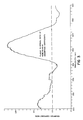
- Fig. 3 is a graph showing ratios of absorption coefficients for normal human aortic endothelium and aortic plaque over a range of wavelengths.
- the first step in the plaque ablation method described is to select a wavelength at which the plaque:normal aorta Kubelka-Munk absorption coefficent is at least 1.5:1. This difference in absorption coefficients (seen at about 460 nm in patients not administered supplemental chromophore) results from the preferential accumulation in plaque of dietary carotenoids.
- the wavelength employed will reflect the concommitant change in the composition of the plaque.
- administration of a chromophore e.g., capsanthin
- which absorbs at a wavelength above 460 nm will bring about some increase in the optimal wavelength.
- the administration of a chromophore absorbing above or below the pre-administration optimum will generally result in an optimal wavelength somewhere between the absorption maximum of the administered chromophore, and the pre-administration optimum.
- the absorption maxima of ten suitable carotenoids known to exist in humans and, in some instances, in foods, are given in the table below.
- the Kubelka-Munk absorbance coefficients of plaque and normal aortic tissue are measured by conventional techniques, as is explained in more detail below.
- the amount, duration, and mode of administration of the chromophore will depend on its properties, e.g., toxicity and affinity for plaque. Some carotenoids are naturally present in high concentrations in foods such as carrots and tomatoes, and administration of these could be achieved at least in part by daily ingestion of such foods.
- the chromophore can also be administered, orally, admixed with a pharmaceutically acceptable carrier substance, in a pill or liquid, or can be administered intravenously or intraperitoneally.
- chromophore which, in addition to being preferentially accumulated in plaque, fluoresces, facilitating detection and laser aiming.
- Carotenoids for example, advantageously fluoresces when excited at 460 nm.
- the pulse duration used is related to the thermal relaxation time t of the volume of tissue defined by the diameter of the laser beam within the tissue and the depth at which 67% of the incident light of the laser has been absorbed;
- the relaxation time is the time it takes for the temperature increase ( ⁇ T) caused by a pulse of light of a duration approaching zero to decrease by one-half at the surface of that tissue volume after the pulse has ceased.
- Thermal relaxation time t is roughly approximated by: where d, expressed in cm, is the smaller of the diameter of the irradiated volume (conventionally referred to as "D") and the depth at which 67% of the incident light has been absorbed (conventionally referred to as "d"). K is the thermal difussivity, in cm2/sec.; K is approximately 0.0013, for water. It should be emphasized that this method of calculating t is given for convenience only; where reference is made herein to the relationship between pulse duration and t, actual t, as defined earlier in terms of a one-half decrease in ⁇ T, is intended.
- the fluence (Joules/cm2) of the laser light should be sufficiently high to cause heating of the target plaque, at the wavelength and pulse duration employed, to a temperature at which a substantial portion of the plaque is burned away, and not so high as to cause unacceptable damage to surrounding healthy tissue.
- the requisite fluence range varies with the diameter of the optical fiber used in conjunction with the laser. Generally, a fluence of 2-10J/cm2 is preferred for a 1 mm diameter optical fibre, while smaller diameter fibres will require higher fluences to compensate for scattering losses at the periphery of the illustrated volume.
- a lower, non-burning intensity e.g., about 1 milliwatt, is used in a pulsing or continuous mode to excite fluorescence.
- a laser which can deliver pulses of the desired intensity, duration, and wavelength can be used.
- a preferred laser is a flashlamp pumped pulse dye laser.
- the fibre optic bundles and auxiliary apparatus by which laser light is delivered to the plaques can be of any conventional configuration, e.g., as described in Choy, id .
- a second fibre optic bundle can be used for plaque detection, and if fluorescence of a plaque-associated carotenoid is to be employed in detection, excitation can be achieved by means of a third optic bundle, or by use of the ablation bundle in an excitation mode.
- a particular plaque ablation procedure was carried out as follows.
- Absorbance coefficients were determined by measuring remittance and transmittance of normal aortic endothelium and aortic plaque, essentially by the integrating sphere technique described in Anderson et al. (1979) Proc. Symp. Bioengineer and the Skin, Edinburgh, Wales (MTP Press, London).
- the procedure was carried out using the apparatus shown in Fig. 1, including 7.5 cm diameter barium sulphate coated integrating sphere 10, connected by 2 mm diameter quartz fibre optic bundles 12 to Beckman 5270 double beam spectrophotometer 14, which is interfaced with Hewlett Packard 9825A computer 16 for digital data acquisition and analysis. Freshly coated barium sulphate plates (not shown) were used as 100% remittance standards.
- the apparatus further included collimating lens 18, for providing a collimating light beam to illuminate a 5 mm diameter region of the tissue; quartz sample-holding plates 20 and 21; photomultiplier tube 22; beam source 24; fibre optic bundle 26, connecting beam source 24 with spectrophotometer 14; and lead sulphide cell 26.
- cadaveric specimens of human aorta were obtained less than 48 hours post mortem .
- Optical measurements were made on soft, yellow, raised plaques in which the outer portion of the media and adventicia had been stripped by blunt dissection.
- Specimens were .2 to 2 mm thick.
- the specimens were mounted sandwiched between polished quartz plates 20 (for remittance measurement) or 21 (for transmittance measurement), and the tissue surface irregularities filled in with saline to replace the irregular air-tissue interface with a smooth air-quartz interface.
- the air-quartz interface had a consistent and predictable remittance that was measured and subtracted from the tissue remittance measurement.
- tissue-quartz plate sandwiches were placed on the integrating sphere apparatus of Fig. 1; remittance and transmittance measured as in Anderson et al., id , and Kubelka-Murk absorption coefficients calculated as described therein.
- Fig. 3 The results are given in Fig. 3, expressed as the plaque to normal ratio. As shown in Fig. 3, the ratio is highest between 440 and 480 nm, with a peak at 460 nm.
- Ablation of aortic plaques of cadavers was carried out using the apparatus of claim 2, including Candella SLL 500 Coaxial Flashlamp pumped dye laser 10, translating tissue mount 12, and a 40% output coupler (not shown).
- Laser wavelength output was measured with a high intensity monochrometer (Bausch Lomb # 33-86-76) and the pulse width characterized with an ultrafast silicon photodiode (EG&G FND 100Q) reverse biased by 90 volts.
- the laser mirrors were adjusted until output burn patterns on polaroid film were circular.
- the 1 cm diameter light beam coming out of the laser was focused with a 20 cm focal length quartz lens to form a 2-3 mm diameter spot on the specimen.
- the specimen could then be translated across the laser beam to give an identical radiation dose to several normal and atheromatous regions of cadaver aorta, obtained as before. Specimens were irradiated, photographed fresh, fixed in formalin, bisected through the rows of irradiation sites, and photographed in cross section.
Landscapes
- Physics & Mathematics (AREA)
- Health & Medical Sciences (AREA)
- Surgery (AREA)
- Optics & Photonics (AREA)
- Life Sciences & Earth Sciences (AREA)
- Molecular Biology (AREA)
- General Health & Medical Sciences (AREA)
- Nuclear Medicine, Radiotherapy & Molecular Imaging (AREA)
- Engineering & Computer Science (AREA)
- Biomedical Technology (AREA)
- Heart & Thoracic Surgery (AREA)
- Medical Informatics (AREA)
- Electromagnetism (AREA)
- Animal Behavior & Ethology (AREA)
- Otolaryngology (AREA)
- Public Health (AREA)
- Veterinary Medicine (AREA)
- General Physics & Mathematics (AREA)
- Vascular Medicine (AREA)
- Laser Surgery Devices (AREA)
- Medicines Containing Antibodies Or Antigens For Use As Internal Diagnostic Agents (AREA)
- Radiation-Therapy Devices (AREA)
- Lasers (AREA)
- Surgical Instruments (AREA)
Claims (11)
- In Kombination:- ein Carotenoid, das selektiv von atherosclerotischer Plaque in einem Patienten aufgenommen wird,- und eine Laser-Vorrichtung, die gepulstes Laserlicht mit einer Wellenlänge abgibt, bei der das Verhältnis der Kubelka-Munk-Absorptionskoeffizienten der genannten Plaque zu normalem Aorta-Endothel wenigstens 1,5 : 1, vorzugsweise wenigstens 2 : 1, beträgt,- mit einer Pulsdauer, die kleiner ist als die thermische Relaxationszeit des Gewebe-Volumens, das durch den Durchmesser des Laserstrahls innerhalb des Gewebes und der Tiefe, in der 67% des einfallenden Laserlichtes absorbiert worden ist, begrenzt (definiert) ist,- und mit einer Strahlintensität, die bei der genannten Wellenlänge und Pulsdauer genügend hoch ist, um die Target-Plaque auf eine Temperatur zu erwärmen, bei der ein wesentlicher Teil der Plaque weggebrannt wird, ohne daß ein unannehmbarer Schaden im umgegebenden gesunden Gewebe verursacht wird.
- In Kombination:- eine Vorratsmenge an Nahrungsmittel, die (das) Carotenoid enthält, welches nach Einnahme durch einen Patienten selektiv von atherosclerotischer Plaque in dem Patienten aufgenommen wird,- und eine Laser-Vorrichtung, die gepulstes Laserlicht mit einer Wellenlänge abgibt, bei der das Verhältnis der Kubelka-Munk-Absorptionskoeffizienten der genannten Plaque zu normalem Aorta-Endothel wenigstens 1,5 : 1, vorzugsweise wenigstens 2 : 1, beträgt,- mit einer Pulsdauer, die kleiner ist als die thermische Relaxationszeit des Gewebe-Volumens, das durch den Durchmesser des Laserstrahls innerhalb des Gewebes und der Tiefe, in der 67% des einfallenden Laserlichtes absorbiert worden ist, begrenzt (definiert) ist,- und mit einer Strahlintensität, die bei der genannten Wellenlänge und Pulsdauer genügend hoch ist, um die Target-Plaque auf eine Temperatur zu erwärmen, bei der ein wesentlicher Teil der Plaque weggebrannt wird, ohne daß ein unannehmbarer Schaden im umgegebenden gesunden Gewebe verursacht wird.
- Kombination gemäß Anspruch 1 oder 2, dadurch gekennzeichnet, daß das genannte Carotenoid β-Carotin ist.
- Kombination nach Anspruch 1 oder 2, dadurch gekennzeichnet, daß die genannte Wellenlänge im Bereich von 440 bis 480 nm liegt, vorzugsweise etwa 460 nm ist.
- Kombination nach Anspruch 1 oder einem untergeordneten Anspruch, dadurch gekennzeichnet, daß das genannte Carotenoid in einer Dosierungsform vorgegeben wird, die eine intravenöse Verabreichung bei einem Patienten ermöglicht.
- Kombination nach Anspruch 1 oder Anspruch 3 oder 4 als untergerordnet zu Anspruch 1, dadurch gekennzeichnet, daß das genannte Carotenoid in einer Dosierungsform vorgegeben wird, die eine orale Verabreichung bei einem Patienten ermöglicht, und zwar wenigstens einmal täglich für wenigstens zwei Tage, bevor der Patient dem genannten Laserlicht ausgesetzt wird.
- Kombination nach Anspruch 1 oder einem diesen nachgeordneten Anspruch, dadurch gekennzeichnet, daß das genannte Carotenoid in einer Dosierungsfrom vorgegeben wird, die die Verabreichung bei einem Patienten mit einer Dosierungsrate zwischen 100 mg und 5.000 mg pro Tag ermöglicht.
- Verwendung eines Carotenoids zur Herstellung eines Medikamentes, das einem Patienten zur Ablation (Ablösung) von atherosclerotischer Plaque verabreichhar ist, wobei nach der Verabreichung im Laufe dieser Ablations-Behandlung die Plaque gepulstem Laserlicht mit einer Wellenlänge ausgesetzt wird, bei der das Verhältnis der Kubelka-Munk-Absorptionskoeffizienten der genannten Plaque zu normalem Aorta-Endothel wenigstens 1,5 : 1, vorzugsweise wenigstens 2 : 1, beträgt, mit einer Pulsdauer, die kleiner ist als die thermische Relaxationszeit des Gewebe-Volumens, das durch den Durchmesser des Laserstrahls innerhalb des Gewebes und der Tiefe, in der 67% des einfallenden Laserlichtes absorbiert worden ist, begrenzt (definiert) ist, und mit einer Strahlintensität, die bei der genannten Wellenlänge und Pulsdauer genügend hoch ist, um die Target-Plaque auf eine Temperatur zu erwärmen, bei der ein wesentlicher Teil der Plaque weggebrannt wird, ohne daß ein unannehmbarer Schaden im umgegebenden gesunden Gewebe verursacht wird.
- Verwendung von β-Carotin zur Herstellung eines Medikamentes, das einem Patienten bei einer Behandlung gemäß Anspruch 8 verabreichbar ist.
- Verwendung eines Nahrungsmittels, das ein Carotenoid zur Herstellung eines Medikamentes enthält, das einem Patienten bei einer Behandlung gemäß Anspruch 8 verabreichbar ist.
- Verwendung eines rohen Nahrungsmittels, das ein Carotenoid für die Präparation eines Agens zur Einnahme durch einen Patienten bei einer Behandlung zur Ablation (Ablösung) atherosklerotischer Plaque enthält, wobei bei dieser Behandlung, der Einnahme folgend, die Plaque einem gepulsten Laserlicht gemäß Anspruch 8 ausgesetzt wird.
Priority Applications (1)
| Application Number | Priority Date | Filing Date | Title |
|---|---|---|---|
| AT86302603T ATE86463T1 (de) | 1985-04-08 | 1986-04-08 | Ablation atherosklerotischer plaque bei einem patienten. |
Applications Claiming Priority (2)
| Application Number | Priority Date | Filing Date | Title |
|---|---|---|---|
| US72059585A | 1985-04-08 | 1985-04-08 | |
| US720595 | 1985-04-08 |
Publications (3)
| Publication Number | Publication Date |
|---|---|
| EP0200390A2 EP0200390A2 (de) | 1986-11-05 |
| EP0200390A3 EP0200390A3 (en) | 1988-07-06 |
| EP0200390B1 true EP0200390B1 (de) | 1993-03-10 |
Family
ID=24894593
Family Applications (1)
| Application Number | Title | Priority Date | Filing Date |
|---|---|---|---|
| EP86302603A Expired - Lifetime EP0200390B1 (de) | 1985-04-08 | 1986-04-08 | Ablation atherosklerotischer Plaque bei einem Patienten |
Country Status (5)
| Country | Link |
|---|---|
| EP (1) | EP0200390B1 (de) |
| JP (1) | JPS61288851A (de) |
| AT (1) | ATE86463T1 (de) |
| CA (1) | CA1266888A (de) |
| DE (1) | DE3687916T2 (de) |
Families Citing this family (6)
| Publication number | Priority date | Publication date | Assignee | Title |
|---|---|---|---|---|
| IL78567A (en) * | 1985-04-24 | 1991-12-15 | Candela Corp | Laser apparatus for medical use |
| US5071422A (en) * | 1985-04-24 | 1991-12-10 | Candela Laser Corporation | Use of lasers to break down objects |
| US5354324A (en) * | 1990-10-18 | 1994-10-11 | The General Hospital Corporation | Laser induced platelet inhibition |
| US5275594A (en) * | 1990-11-09 | 1994-01-04 | C. R. Bard, Inc. | Angioplasty system having means for identification of atherosclerotic plaque |
| ATE169483T1 (de) | 1993-04-28 | 1998-08-15 | Focal Inc | Vorrichtung, produkt und verwendung betreffend die intraluminale photothermoformgebung |
| FR2710990B1 (fr) * | 1993-10-04 | 1995-12-22 | Alis | Dispositif de transmission de l'énergie produite par un générateur laser. |
Citations (1)
| Publication number | Priority date | Publication date | Assignee | Title |
|---|---|---|---|---|
| WO1986002783A1 (en) * | 1984-10-25 | 1986-05-09 | Candela Corporation | Long pulse tunable dye laser |
Family Cites Families (4)
| Publication number | Priority date | Publication date | Assignee | Title |
|---|---|---|---|---|
| US4207874A (en) | 1978-03-27 | 1980-06-17 | Choy Daniel S J | Laser tunnelling device |
| JPS5940869A (ja) | 1982-08-31 | 1984-03-06 | 工業技術院長 | レ−ザ光パルスを用いた癌の治療装置 |
| IL75998A0 (en) * | 1984-08-07 | 1985-12-31 | Medical Laser Research & Dev C | Laser system for providing target tissue specific energy deposition |
| US4682594A (en) * | 1985-03-11 | 1987-07-28 | Mcm Laboratories, Inc. | Probe-and-fire lasers |
-
1986
- 1986-04-07 CA CA000505953A patent/CA1266888A/en not_active Expired
- 1986-04-08 AT AT86302603T patent/ATE86463T1/de not_active IP Right Cessation
- 1986-04-08 JP JP61080961A patent/JPS61288851A/ja active Pending
- 1986-04-08 DE DE86302603T patent/DE3687916T2/de not_active Expired - Fee Related
- 1986-04-08 EP EP86302603A patent/EP0200390B1/de not_active Expired - Lifetime
Patent Citations (1)
| Publication number | Priority date | Publication date | Assignee | Title |
|---|---|---|---|---|
| WO1986002783A1 (en) * | 1984-10-25 | 1986-05-09 | Candela Corporation | Long pulse tunable dye laser |
Non-Patent Citations (3)
| Title |
|---|
| Anderson,Parrish "Selective Photothermolysis: Precise microsurgery by selective absorption of pulsed radiation", Science, Vol.220, April 1983, pages 524-527; * |
| J.H. Walter "Wirkungsmechanismen von Laserstrahlung im biologischen Gewebe" in Berlin.Müller "Angewandte Lasermedizin", 3. Ergänzungslieferung,11/90, II-31, pages 1-5; * |
| J.R. Spears et al. "Fluorescence of experimental atheromatous plaques with hematoporphyrin derivative", J. Clin.Invest, Vol.71, Feb. 1983, pages 395-399; * |
Also Published As
| Publication number | Publication date |
|---|---|
| JPS61288851A (ja) | 1986-12-19 |
| ATE86463T1 (de) | 1993-03-15 |
| EP0200390A3 (en) | 1988-07-06 |
| CA1266888A (en) | 1990-03-20 |
| DE3687916T2 (de) | 1993-10-07 |
| DE3687916D1 (de) | 1993-04-15 |
| EP0200390A2 (de) | 1986-11-05 |
Similar Documents
| Publication | Publication Date | Title |
|---|---|---|
| US5346488A (en) | Laser-induced ablation of atherosclerotic plaque | |
| Singleton et al. | Excimer laser angioplasty: Tissue ablation, arterial response, and fiber optic delivery | |
| US7998181B2 (en) | System and method utilizing guided fluorescence for high intensity applications | |
| Waynant | Lasers in medicine | |
| US4862886A (en) | Laser angioplasty | |
| Benson Jr et al. | Treatment of transitional cell carcinoma of the bladder with hematoporphyrin derivative phototherapy | |
| Van Leeuwen et al. | Noncontact tissue ablation by holmium: YSGG laser pulses in blood | |
| US5304170A (en) | Method of laser-induced tissue necrosis in carotenoid-containing skin structures | |
| Nishioka et al. | Ablation of rabbit liver, stomach, and colon with a pulsed holmium laser | |
| JP2723119B2 (ja) | 歯科処置装置 | |
| CA1275450C (en) | Infrared laser catheter system | |
| US4973848A (en) | Laser apparatus for concurrent analysis and treatment | |
| AU598135B2 (en) | Ultraviolet surgical and dental procedures | |
| EP0726083A2 (de) | Verfahren und Vorrichtung zur Diagnose und Behandlung mit zusammengesetzter gepulster Erwärmung und photodynamischer Therapie | |
| Oraevsky et al. | XeCl laser ablation of atherosclerotic aorta: optical properties and energy pathways | |
| US20080221560A1 (en) | Intravascular Diagnostic or Therapeutic Apparatus Using High-Intensity Pulsed Light | |
| WO1989006519A3 (en) | Method and apparatus for laser surgery | |
| CA2153337C (en) | Light emitting diode light source for photodynamic therapy | |
| EP0200390B1 (de) | Ablation atherosklerotischer Plaque bei einem Patienten | |
| Cothren et al. | Controlled light delivery for laser angiosurgery | |
| SELZER et al. | Optimizing strategies for laser angioplasty | |
| LU602551B1 (en) | A photodynamic therapy system and treatment method for tumors | |
| Pankratov et al. | Comparative laser-tissue interaction effects at 1.96 and 2.01 um of Cr; Tm: YAG laser | |
| Nishioka et al. | Selective vascular coagulation of rabbit colon using a flashlamp-excited dye laser operating at 577 nanometers | |
| Duda et al. | Holmium: YAG laser angioplasty: experimental ablation of vascular tissue via flexible ring catheters |
Legal Events
| Date | Code | Title | Description |
|---|---|---|---|
| PUAI | Public reference made under article 153(3) epc to a published international application that has entered the european phase |
Free format text: ORIGINAL CODE: 0009012 |
|
| AK | Designated contracting states |
Kind code of ref document: A2 Designated state(s): AT BE CH DE FR GB IT LI LU NL SE |
|
| PUAL | Search report despatched |
Free format text: ORIGINAL CODE: 0009013 |
|
| AK | Designated contracting states |
Kind code of ref document: A3 Designated state(s): AT BE CH DE FR GB IT LI LU NL SE |
|
| 17P | Request for examination filed |
Effective date: 19890106 |
|
| 17Q | First examination report despatched |
Effective date: 19910524 |
|
| RTI1 | Title (correction) | ||
| GRAA | (expected) grant |
Free format text: ORIGINAL CODE: 0009210 |
|
| AK | Designated contracting states |
Kind code of ref document: B1 Designated state(s): AT BE CH DE FR GB IT LI LU NL SE |
|
| REF | Corresponds to: |
Ref document number: 86463 Country of ref document: AT Date of ref document: 19930315 Kind code of ref document: T |
|
| REF | Corresponds to: |
Ref document number: 3687916 Country of ref document: DE Date of ref document: 19930415 |
|
| ITF | It: translation for a ep patent filed | ||
| ET | Fr: translation filed | ||
| PLBE | No opposition filed within time limit |
Free format text: ORIGINAL CODE: 0009261 |
|
| STAA | Information on the status of an ep patent application or granted ep patent |
Free format text: STATUS: NO OPPOSITION FILED WITHIN TIME LIMIT |
|
| 26N | No opposition filed | ||
| EPTA | Lu: last paid annual fee | ||
| EAL | Se: european patent in force in sweden |
Ref document number: 86302603.5 |
|
| PGFP | Annual fee paid to national office [announced via postgrant information from national office to epo] |
Ref country code: GB Payment date: 19960318 Year of fee payment: 11 |
|
| PGFP | Annual fee paid to national office [announced via postgrant information from national office to epo] |
Ref country code: SE Payment date: 19960321 Year of fee payment: 11 |
|
| PGFP | Annual fee paid to national office [announced via postgrant information from national office to epo] |
Ref country code: AT Payment date: 19960327 Year of fee payment: 11 |
|
| PGFP | Annual fee paid to national office [announced via postgrant information from national office to epo] |
Ref country code: NL Payment date: 19960328 Year of fee payment: 11 |
|
| PGFP | Annual fee paid to national office [announced via postgrant information from national office to epo] |
Ref country code: LU Payment date: 19960401 Year of fee payment: 11 |
|
| PGFP | Annual fee paid to national office [announced via postgrant information from national office to epo] |
Ref country code: FR Payment date: 19960412 Year of fee payment: 11 |
|
| PGFP | Annual fee paid to national office [announced via postgrant information from national office to epo] |
Ref country code: DE Payment date: 19960430 Year of fee payment: 11 |
|
| PGFP | Annual fee paid to national office [announced via postgrant information from national office to epo] |
Ref country code: BE Payment date: 19960510 Year of fee payment: 11 |
|
| PGFP | Annual fee paid to national office [announced via postgrant information from national office to epo] |
Ref country code: CH Payment date: 19960703 Year of fee payment: 11 |
|
| PG25 | Lapsed in a contracting state [announced via postgrant information from national office to epo] |
Ref country code: LU Free format text: LAPSE BECAUSE OF NON-PAYMENT OF DUE FEES Effective date: 19970408 Ref country code: GB Effective date: 19970408 Ref country code: AT Effective date: 19970408 |
|
| PG25 | Lapsed in a contracting state [announced via postgrant information from national office to epo] |
Ref country code: SE Effective date: 19970409 |
|
| PG25 | Lapsed in a contracting state [announced via postgrant information from national office to epo] |
Ref country code: LI Free format text: LAPSE BECAUSE OF NON-PAYMENT OF DUE FEES Effective date: 19970430 Ref country code: CH Free format text: LAPSE BECAUSE OF NON-PAYMENT OF DUE FEES Effective date: 19970430 Ref country code: BE Effective date: 19970430 |
|
| BERE | Be: lapsed |
Owner name: THE GENERAL HOSPITAL CORP. Effective date: 19970430 |
|
| PG25 | Lapsed in a contracting state [announced via postgrant information from national office to epo] |
Ref country code: NL Effective date: 19971101 |
|
| GBPC | Gb: european patent ceased through non-payment of renewal fee |
Effective date: 19970408 |
|
| REG | Reference to a national code |
Ref country code: CH Ref legal event code: PL |
|
| PG25 | Lapsed in a contracting state [announced via postgrant information from national office to epo] |
Ref country code: FR Free format text: LAPSE BECAUSE OF NON-PAYMENT OF DUE FEES Effective date: 19971231 |
|
| PG25 | Lapsed in a contracting state [announced via postgrant information from national office to epo] |
Ref country code: DE Free format text: LAPSE BECAUSE OF NON-PAYMENT OF DUE FEES Effective date: 19980101 |
|
| NLV4 | Nl: lapsed or anulled due to non-payment of the annual fee |
Effective date: 19971101 |
|
| EUG | Se: european patent has lapsed |
Ref document number: 86302603.5 |
|
| REG | Reference to a national code |
Ref country code: FR Ref legal event code: ST |
|
| PG25 | Lapsed in a contracting state [announced via postgrant information from national office to epo] |
Ref country code: IT Free format text: LAPSE BECAUSE OF NON-PAYMENT OF DUE FEES;WARNING: LAPSES OF ITALIAN PATENTS WITH EFFECTIVE DATE BEFORE 2007 MAY HAVE OCCURRED AT ANY TIME BEFORE 2007. THE CORRECT EFFECTIVE DATE MAY BE DIFFERENT FROM THE ONE RECORDED. Effective date: 20050408 |